


Community hub
Recent from talks
Contribute something
Nothing was collected or created yet.
Oystercatcher
View on Wikipedia
| Oystercatchers Temporal range:
| |
|---|---|

| |
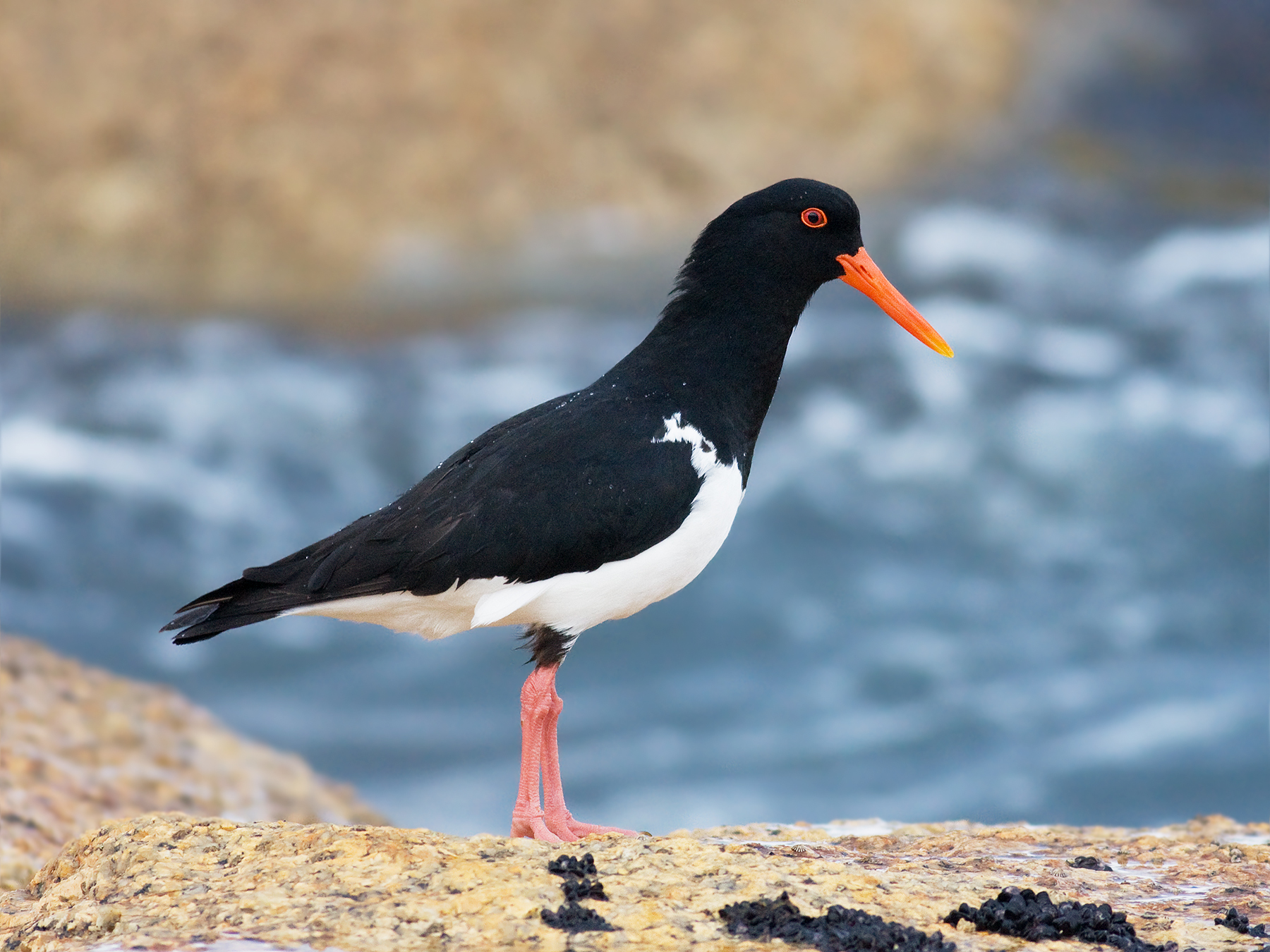
| Pied oystercatcher (Haematopus longirostris) | |
Scientific classification 
| |
| Kingdom: | Animalia |
| Phylum: | Chordata |
| Class: | Aves |
| Order: | Charadriiformes |
| Suborder: | Charadrii |
| Family: | Haematopodidae Bonaparte, 1838 |
| Genus: | Haematopus Linnaeus, 1758 |
| Type species | |
| Haematopus ostralegus Linnaeus, 1758
| |
| Species | |
|
Twelve, see table | |
.jpg)
.jpg)
The oystercatchers are a group of waders forming the family Haematopodidae, which has a single genus, Haematopus. They are found on coasts worldwide apart from the polar regions and some tropical regions of Africa and South East Asia. The exceptions to this are the Eurasian oystercatcher, the South Island oystercatcher, and the Magellanic oystercatcher, which also breed inland, far inland in some cases. In the past there has been a great deal of confusion as to the species limits, with discrete populations of all black oystercatchers being afforded specific status but pied oystercatchers being considered one single species.[1]
Taxonomy
[edit]The genus Haematopus was introduced in 1758 by the Swedish naturalist Carl Linnaeus in 1758 in the tenth edition of his Systema Naturae to accommodate a single species, the Eurasian oystercatcher Haematopus ostralegus.[2] The genus name Haematopus comes from the Ancient Greek words haima αἳμα meaning blood, and pous πούς meaning foot, referring to the red legs of the Eurasian oystercatcher;[3] it had been in use since Pierre Belon in 1555.[4] The family Haematopodidae was introduced (as the subfamily Haematopodinae) by the French naturalist Charles Bonaparte in 1838.[5][6]
The common name oystercatcher was coined by Mark Catesby in 1731 for the North American species H. palliatus, which he described as eating oysters.[7][8] The English zoologist William Yarrell in 1843 established this as the preferred term, replacing the older name sea pie,[7][9] although the term had earlier been used by the Welsh Naturalist Thomas Pennant in 1776 in his British Zoology.[10]
Description
[edit]The different species of oystercatcher show little variation in shape or appearance. They range from 39–50 centimetres (15+1⁄2–19+1⁄2 inches) in length and 72–91 cm (28+1⁄2–36 in) in wingspan. The Eurasian oystercatcher is the lightest on average, at 526 grams (1 pound 2+1⁄2 ounces), while the sooty oystercatcher is the heaviest, at 819 g (1 lb 13 oz).[11] The plumage of all species is either all-black, or black (or dark brown) on top and white underneath.
The variable oystercatcher is slightly exceptional in being either all-black or pied. They are large, obvious, and noisy plover-like birds, with massive long orange or red bills used for smashing or prying open molluscs. The bill shape varies between species, according to the diet. Those birds with blade-like bill tips pry open or smash mollusc shells, and those with pointed bill tips tend to probe for annelid worms. They show sexual dimorphism, with females being longer-billed and heavier than males.[1]
Feeding
[edit]The diet of oystercatchers varies with location. Species occurring inland feed upon earthworms and insect larvae.[1] The diet of coastal oystercatchers is more varied, although dependent upon coast type; on estuaries, bivalves, the ivy gastropods and polychaete worms are the most important part of the diet, whereas rocky shore oystercatchers prey upon limpets, mussels, gastropods, and chitons. Other prey items include echinoderms, fish, and crabs.
Breeding
[edit].jpg)
Nearly all species of oystercatcher are monogamous, although there are reports of polygamy in the Eurasian oystercatcher. They are territorial during the breeding season (with a few species defending territories year round). There is strong mate and site fidelity in the species that have been studied, with one record of a pair defending the same site for 20 years. A single nesting attempt is made per breeding season, which is timed over the summer months. The nests of oystercatchers are simple affairs, scrapes in the ground which may be lined, and placed in a spot with good visibility.
The eggs of oystercatchers are spotted and cryptic. Between one and four eggs are laid, with three being typical in the Northern Hemisphere and two in the south. Incubation is shared but not proportionally, females tend to take more incubation and males engage in more territory defence. Incubation varies by species, lasting between 24–39 days. Oystercatchers are also known to practice "egg dumping". Like the cuckoo, they sometimes lay their eggs in the nests of other species such as gulls, abandoning them to be raised by those birds.[12]
Conservation
[edit]The Canary Islands oystercatcher became extinct during the 20th century. The Chatham oystercatcher is endemic to the Chatham Islands of New Zealand and is listed as endangered by the IUCN, while both the African and Eurasian oystercatchers are considered near threatened. There has been conflict with commercial shellfish farmers, but studies have found that the impact of oystercatchers is much smaller than that of shore crabs.
Species
[edit]The genus contains twelve Recent species.[13] Species in taxonomic order:
| Common name | Scientific name and subspecies | Range | Size and ecology | IUCN status and estimated population |
|---|---|---|---|---|
| Magellanic oystercatcher
|
Haematopus leucopodus Garnot, 1826 |
Southern South America
|
Size: Habitat: Diet: |
LC
|
| Blackish oystercatcher
|
Haematopus ater Vieillot & Oudart, 1825 |
South America
|
Size: Habitat: Diet: |
LC
|
| Black oystercatcher
|
Haematopus bachmani Audubon, 1838 |
West coast of North America
|
Size: Habitat: Diet: |
LC
|
| American oystercatcher
|
Haematopus palliatus Temminck, 1820 |
North and South America
|
Size: Habitat: Diet: |
LC
|
| † Canary Islands oystercatcher
|
Haematopus meadewaldoi Bannerman, 1913 |
Canary Islands | Size: Habitat: Diet: |
EX
|
| African oystercatcher
|
Haematopus moquini (Bonaparte, 1856) |
Southern Africa
|
Size: Habitat: Diet: |
LC
|
| Eurasian oystercatcher or Palaearctic oystercatcher
|
Haematopus ostralegus Linnaeus, 1758 |
Europe, Asia and northern Africa
|
Size: Habitat: Diet: |
NT
|
| Pied oystercatcher
|
Haematopus longirostris Vieillot, 1817 |
Australia
|
Size: Habitat: Diet: |
LC
|
| South Island oystercatcher
|
Haematopus finschi Martens, 1897 |
New Zealand
|
Size: Habitat: Diet: |
LC
|
| Chatham oystercatcher
|
Haematopus chathamensis Hartert, 1927 |
Chatham Islands | Size: Habitat: Diet: |
EN
|
| Variable oystercatcher
|
Haematopus unicolor (Forster, 1844) |
New Zealand
|
Size: Habitat: Diet: |
LC
|
| Sooty oystercatcher
|
Haematopus fuliginosus Gould, 1845 |
Australia
|
Size: Habitat: Diet: |
LC
|


.JPG)


.jpg)


The earliest fossil of a Haematopus-like bird is a skull from the Miocene of Saint-Gérand-le-Puy, France.[14] The only other pre-Pleistocene fossils are from the Pliocene of the east coast of North America. Palostralegus sulcatuswas described from the Barstovian of Florida,[15] but is now considered to belong to the modern genus. Two species are also known from Pliocene Yorktown Formation of North Carolina, and have been referred to H. aff. palliatus and H. aff. ostralegus.[16]
References
[edit]- ^ a b c Hockey, P (1996). "Family Haematopodidae (Oystercatchers)". In del Hoyo, J.; Elliot, A. & Sargatal, J. (editors). Handbook of the Birds of the World. Volume 3: Hoatzin to Auks. Lynx Edicions. ISBN 84-87334-20-2.
- ^ Linnaeus, Carl (1758). Systema Naturae per regna tria naturae, secundum classes, ordines, genera, species, cum characteribus, differentiis, synonymis, locis (in Latin). Vol. 1 (10th ed.). Holmiae (Stockholm): Laurentii Salvii. p. 152.
- ^ Jobling, James A (2010). The Helm Dictionary of Scientific Bird Names. London: Christopher Helm. p. 184. ISBN 978-1-4081-2501-4.
- ^ Belon, Pierre (1555). L'histoire de la natvre des oyseavx : avec levrs descriptions, & naïfs portraicts retirez du natvrel, escrite en sept livres (in French). Paris: Gilles Corrozet. p. 203.
- ^ Bonaparte, Charles Lucien (1838). "Synopsis vertebratorum systematis". Nuovi Annali delle Scienze Naturali, Bologna (in Latin). 2: 105–133 [118].
- ^ Bock, Walter J. (1994). History and Nomenclature of Avian Family-Group Names. Bulletin of the American Museum of Natural History. Vol. 222. New York: American Museum of Natural History. pp. 139, 229. hdl:2246/830.
- ^ a b Lockwood, W.B. (1984). The Oxford Book of British Bird Names. Oxford: Oxford University Press. p. 113. ISBN 978-0-19-214155-2.
- ^ Catesby, Mark (1729–1732). The Natural History of Carolina, Florida and the Bahama Islands (in English and French). Vol. 1. London: W. Innys and R. Manby. p. 85.
- ^ Yarrell, William (1845). A History of British Birds. Vol. 2. London: J. Van Voorst. p. 496.
- ^ Pennant, Thomas (1776). British Zoology v.2. London: Benjamin White. pp. 482–483.
- ^ John B. Dunning Jr. (1992). CRC Handbook of Avian Body Masses. CRC Press. p. 98. ISBN 978-0-8493-4258-5.
- ^ "Birds Dumping Eggs on the Neighbors". Sciencedaily.com. 2011-06-03. Retrieved 2012-12-20.
- ^ Gill, Frank; Donsker, David; Rasmussen, Pamela, eds. (July 2021). "Buttonquail, thick-knees, sheathbills, plovers, oystercatchers, stilts, painted-snipes, jacanas, Plains-wanderer, seedsnipes". IOC World Bird List Version 11.2. International Ornithologists' Union. Retrieved 18 August 2021.
- ^ De Pietri, V.L.; Mayr, G.; Guentert, M. (2013). "A Haematopus-like skull and other remains of Charadrii (Aves, Charadriiformes) from the Early Miocene of Saint-Gérand-le-Puy (Allier, France)". In Göhlich, U. B.; Kroh, A. (eds.). Paleornithological research: proceedings of the 8th International Meeting of the Society of Avian Paleontology and Evolution, Vienna, 2012. pp. 93–101 fulltext.
- ^ Brodkorb, P. (1955). "The avifauna of the Bone Valley Formation". Florida Geological Survey, Report of Investigations (14): 1–57.
- ^ Olson, Storrs L.; Rasmussen, Pamela C. (2001). "Miocene and Pliocene Birds from the Lee Creek Mine, North Carolina.". In Ray, C.E.; Bohaska, D.J. (eds.). Geology and Paleontology of the Lee Creek Mine, North Carolina III. Smithsonian Contributions to Paleobiology. Vol. 90. pp. 233–307. PDF fulltext.
External links
[edit]
- ARKive – images and movies of the oystercatcher (Haematopus ostralegus)
- Oystercatcher videos on the Internet Bird Collection
- LIVE webcam at the seashore in Namsos, Norway 2013 Archived 2014-05-17 at the Wayback Machine
Genera of shorebirds and their extinct allies | |||||||||||||||||||||||||||||
|---|---|---|---|---|---|---|---|---|---|---|---|---|---|---|---|---|---|---|---|---|---|---|---|---|---|---|---|---|---|
| |||||||||||||||||||||||||||||
| |||||||||||||||||||||||||||||
| |||||||||||||||||||||||||||||
| |||||||||||||||||||||||||||||
_svg-element.svg)


Oystercatcher
View on GrokipediaTaxonomy and Systematics
Classification
Oystercatchers belong to the family Haematopodidae within the order Charadriiformes, encompassing a single genus, Haematopus, which includes 12 recognized species as per recent assessments.[7] This monotypic genus reflects the morphological uniformity among oystercatchers, characterized by their distinctive wedge-shaped bills and coastal adaptations, distinguishing them from related shorebird families. The family's placement in Charadriiformes aligns with their shared wading and foraging behaviors, though oystercatchers form a distinct clade supported by both anatomical and molecular evidence.[1] Historically, oystercatchers were classified under the broader family Charadriidae (plovers and allies) due to superficial similarities in body form and habitat use.[15] This changed in the 20th century as morphological analyses highlighted unique features, such as their specialized bills and leg structures, leading to the recognition of Haematopodidae as a separate family. Genetic studies further solidified this reclassification; for instance, Chu's 1995 DNA-DNA hybridization analysis of charadriiform birds demonstrated that oystercatchers form a monophyletic group distinct from plovers, supporting their familial independence based on genetic divergence.[16] Subspecies variations within oystercatchers often reflect geographic isolation and environmental adaptations. For example, the American oystercatcher (Haematopus palliatus) exhibits up to five subspecies across the Americas, including the nominate H. p. palliatus along the Atlantic coast and H. p. frazari on the Pacific side, with differences in plumage darkness, bill length, and overall size corresponding to latitudinal gradients from North to South America.[17] Phylogenetically, oystercatchers show close affinities to the family Recurvirostridae (avocets and stilts), forming a sister group within the suborder Charadrii. This relationship is corroborated by molecular data from nuclear genes, such as the RAG-1 sequences analyzed by Paton et al. (2003), which resolved oystercatchers as basal to recurvirostrids with strong bootstrap support, underscoring shared evolutionary origins in coastal niches.[18]Species
The genus Haematopus comprises 12 recognized species of oystercatchers, distributed across coastal regions worldwide except the polar extremes and some tropical areas of Africa and South America. These species exhibit a mix of pied and all-dark plumages, with recent genetic analyses, including mitochondrial DNA studies from the early 2000s and morphological assessments in the 2010s, supporting taxonomic distinctions such as the separation of the South Island oystercatcher (H. finschi) from the variable oystercatcher (H. unicolor) based on limited gene flow and plumage differences.[19][20]- Eurasian oystercatcher (Haematopus ostralegus): This widespread species breeds across Europe and temperate Asia, with long-distance migratory populations wintering along African and Indian Ocean coasts; it features four subspecies (H. o. ostralegus, H. o. longipes, H. o. osculans, and H. o. butleri), showing variations in size and bill length adapted to local foraging.[21][22]
- African black oystercatcher (Haematopus moquini): Endemic to the rocky coasts of Namibia and South Africa, this all-black species is non-migratory and relies on shellfish in intertidal zones, classified as Near Threatened due to habitat disturbance.
- American oystercatcher (Haematopus palliatus): Found along the Atlantic and Gulf coasts of North and South America, it is resident in warmer areas but partially migratory northward, known for its bold black-and-white plumage and wedge-shaped bill for prying open bivalves; populations are stable but locally threatened by development.[23]
- Black oystercatcher (Haematopus bachmani): Restricted to rocky Pacific shores from Alaska to Baja California, this entirely black species forages on limpets and mussels in the intertidal zone and is non-migratory, with stable populations but sensitivity to oil spills.[24]
- Blackish oystercatcher (Haematopus ater): Inhabiting Pacific coasts from Peru to southern Chile, it is all-dark with a bright red bill and legs, non-migratory, and feeds primarily on marine invertebrates; it is listed as Least Concern.
- Magellanic oystercatcher (Haematopus leucopodus): Breeding in southern South America, particularly Patagonia and the Falkland Islands, this pied species is partially migratory, moving northward along the coast in winter, and is distinguished by its white wing patches in flight; it is Least Concern globally but faces local threats from habitat loss.[25]
- Variable oystercatcher (Haematopus unicolor): Endemic to New Zealand's North and South Islands, it shows plumage variation from all-black to pied, is largely resident, and is classified as Least Concern globally, but threatened locally due to predation and habitat changes.[26]
- South Island oystercatcher (Haematopus finschi): Confined to New Zealand's South Island and Stewart Island, this pied species is migratory within the region and distinguished from H. unicolor by consistent white plumage and bill shape; it is Least Concern globally, but at risk locally from introduced predators.
- Chatham oystercatcher (Haematopus chathamensis): Restricted to the Chatham Islands of New Zealand, this all-black species is Endangered, with declines driven by predation by introduced mammals and a population of fewer than 400 birds.[27]
- Canary Islands oystercatcher (Haematopus meadewaldoi): Formerly endemic to the Canary Islands, this all-black species went extinct in the early 20th century (last confirmed records around 1913–1940, declared extinct by IUCN in 1994), likely due to hunting and habitat alteration; recent DNA studies (as of 2019) suggest it may not have been a distinct species.[28][29]
- Pied oystercatcher (Haematopus longirostris): Native to Australia's coasts, this striking black-and-white species is resident and feeds on worms and shellfish in estuarine mudflats, listed as Least Concern globally, but threatened locally from coastal development.[30]
- Sooty oystercatcher (Haematopus fuliginosus): Occurring on Australia's eastern and southern coasts, this predominantly black species with white wing flashes is non-migratory and forages on rocky shores, with stable populations classified as Least Concern.