Hubbry Logo
SheathbillSheathbillMain
Open search
Sheathbill
Community hub
Sheathbill
logo
8 pages, 0 posts
0 subscribers
Be the first to start a discussion here.
Sheathbill
Sheathbill
from Wikipedia

Sheathbills
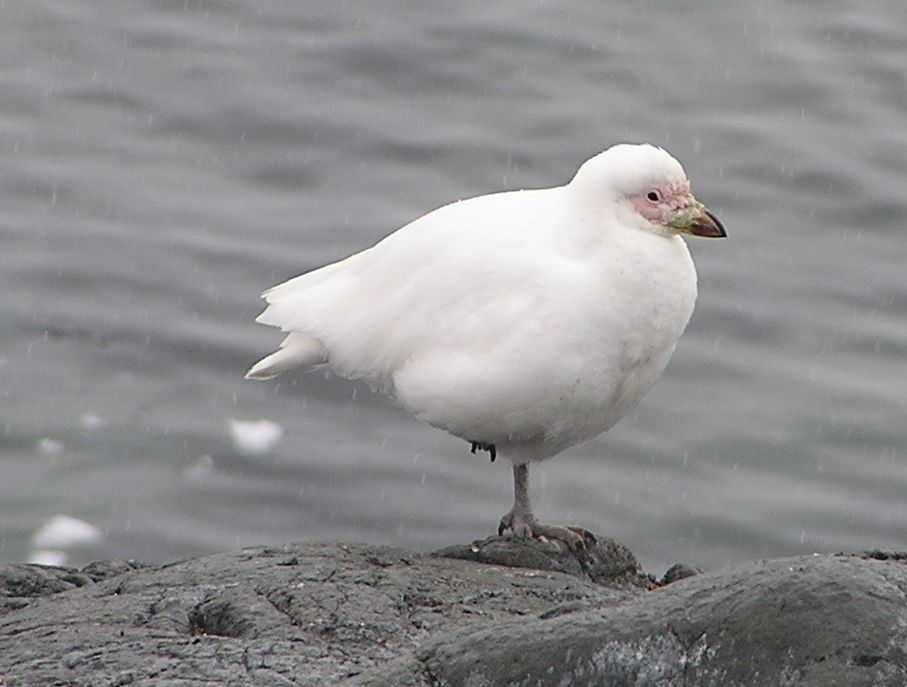
Snowy sheathbill (C. albus)
Scientific classification Edit this classification
Kingdom: Animalia
Phylum: Chordata
Class: Aves
Order: Charadriiformes
Suborder: Charadrii
Family: Chionidae
Bonaparte, 1832
Genus: Chionis
J.R. Forster, 1788[1]
Type species
Vaginalis alba
Species

Chionis albus
Chionis minor

The sheathbills (Chionis) is a genus of birds in the monotypic family Chionidae of the wader order Charadriiformes; the family consists of one genus with two species. They breed on subantarctic islands and the Antarctic Peninsula, and the snowy sheathbill migrates to the Falkland Islands and coastal southern South America in the southern winter; they are the only bird family endemic as breeders to the Antarctic region.[2] They are also the only Antarctic birds without webbed feet.

Taxonomy

[edit]

The genus Chionis was introduced in 1788 by the German naturalist Johann Reinhold Forster.[3] The type species is the snowy sheathbill, Chionis albus.[4] The genus name is from the Ancient Greek khiōn meaning snow.[5]

Genetic studies of the order Charadriiformes show the sheathbills to be a sister group of the thick-knees of the family Burhinidae. These two groups together are in turn a sister group to the Recurvirostridae-Haematopodidae and Charadriidae.[6] Recent research on the Magellanic plover (Pluvianellus socialis) of southern South America has indicated it too may be classified within the sheathbill family.[7][8][9]

Description

[edit]

Sheathbills have white plumage including a thick layer of down, with only the face and leg colours distinguishing the two species. They appear plump and dove-like, but are believed to be similar to the ancestors of the modern gulls and terns.[citation needed] There is a rudimentary spur on the "wrist" or carpal joint, as in plovers. The skin around the eye is bare, as is the skin above the bill, which has carbuncular swellings. They derive their English common name from the horny sheath (rhamphotheca) which partially covers the upper mandible of their stout bills.[2] They are commonly known in the Antarctic as "Mutts" because of their call which is a soft "Mutt, mutt, mutt".[citation needed]

The two species are:

Genus Chionis J.R. Forster, 1788 – two species
Common name Scientific name and subspecies Range Size and ecology IUCN status and estimated population
snowy sheathbill

Chionis albus
(Gmelin, JF, 1789)
Antarctica, the Scotia Arc, the South Orkneys, and South Georgia
Map of range
Size:

Habitat:

Diet:
 LC 


black-faced sheathbill

Chionis minor
Hartlaub, 1841
South African territory of the Prince Edward Islands, the French territories of the Crozet Islands and Kerguelen Islands, and the Australian territory of Heard Island. Size:

Habitat:

Diet:
 LC 


Behaviour

[edit]

Sheathbills habitually walk on the ground, somewhat like rails. They fly only when alarmed or in migration, looking like pigeons.[2]

Food and feeding

[edit]

The sheathbills are scavengers and opportunistic feeders, consuming invertebrates, faeces, and carrion—including the afterbirth of seals and their stillborn pups—between the tidelines. They also take chicks and eggs from penguins and cormorants.[citation needed]

The bird has also been observed to directly pilfer milk from the teats of elephant seals.[10][11][12]

Breeding

[edit]

During the penguin breeding season, which is also the sheathbill breeding season, pairs of sheathbills in penguin colonies maintain territories covering a number of penguin nests. Two mated sheathbills often work together to harass adult penguins, nimbly avoiding their attempts to peck; they gain access to the eggs or chicks or steal the krill that the adult penguins regurgitate to feed their chicks. Near the few human settlements of the region, they boldly forage for offal. Because of this diet, they spend a good deal of time cleaning themselves.[2]

They lay two or three blotchy white eggs in crevices or rock cavities.[13] The nests are lined messily with seaweed, stones, feathers, guano, bones, and occasionally plastic trash; even dead chicks may not be removed. Incubation lasts 28 to 32 days, and the young fledge 50 to 60 days later.[2]

References

[edit]
[edit]
Revisions and contributorsEdit on WikipediaRead on Wikipedia
from Grokipedia
Sheathbills are two species of predominantly terrestrial, pigeon-sized birds comprising the monotypic family Chionidae in the order , renowned for their all-white and a unique horny sheath encasing the base of their stout bills. These opportunistic scavengers and kleptoparasites inhabit coastal and sub- regions, where they associate closely with penguin and seal colonies, feeding on carrion, , eggs, chicks, and regurgitated food while exhibiting bold, pugnacious behavior toward conspecifics and familiarity with humans. The family includes the larger (Chionis albus), measuring 34–41 cm in length and weighing 460–780 g, and the slightly smaller Black-faced sheathbill (Chionis minor), at 38–41 cm and 460–730 g, both of which breed in crevices or under boulders, laying clutches of 2–3 eggs during the austral summer.

Taxonomy and Classification

Sheathbills belong to the family Chionidae, classified within the suborder Charadrii of the wader order , with morphological affinities to () based on skeletal features. The genus Chionis contains only two extant species: the (C. albus) and the Black-faced sheathbill (C. minor), both of which diverged evolutionarily in the Antarctic region. Fossil evidence suggests ancient relatives in the , indicating a long history in southern high latitudes.

Physical Description

Both species exhibit pure white feathering that provides against , short necks, and a dumpy, pigeon-like , though they lack webbed feet despite their classification. The features pinkish facial skin, a pale grayish bill sheath, and lead-gray legs, while the Black-faced sheathbill has contrasting black facial skin, bill, and sheath, with pinkish legs in some . Males are slightly larger than females in both species, and adults measure approximately 34–41 cm in length with wingspans of 74–80 cm; their flight is direct and pigeon-like, used primarily for short distances or migration.

Distribution and Habitat

The breeds on the , , , , and , migrating northward in winter to the , coastal ( and ), and occasionally as a vagrant to , , and St. Helena, with an extent of occurrence of about 594,000 km². In contrast, the Black-faced sheathbill is non-migratory and restricted to sub-Antarctic islands in the southern , including the Prince Edward Islands (), Marion Island, (French Southern Territories), , Heard Island, and McDonald Islands (), spanning an extent of occurrence of 809,000 km². Both species favor coastal habitats such as rocky shorelines, intertidal zones, colonies, and seal rookeries, often near human settlements where food is abundant, but they avoid dense and open ocean.

Diet and Foraging Behavior

Sheathbills are omnivorous opportunists, scavenging a wide array of items including , strandline debris, , , eggs and chicks, seal placentas, blood, , carrion, feces (especially penguin rich in ), and human refuse. They employ by harassing penguins to steal regurgitated and actively prey on unattended eggs or nestlings, spending up to 38% of their day in colonies during the breeding season. occurs terrestrially on coastal plains and intertidal areas, with individuals devoting about 20% of time to eating, 23% to resting, and 3% to agonistic interactions; in winter, they may rely more on human-associated sources.

Breeding and Life History

Breeding occurs during the austral summer, with sheathbills arriving at colonies from to ; nests are constructed in rock crevices, caves, or under boulders, lined with pebbles, bones, and . Clutches consist of 2–3 creamy-white eggs speckled with brown, incubated for about 30 days by both parents, with fledging at around 50 days and juveniles reaching breeding age at 3–5 years. Both sexes share brooding and feeding duties equally, delivering whole prey items rather than regurgitating , and colonies can form near or rookeries for foraging opportunities. Pairs are monogamous for the season, and the Snowy sheathbill's global population is estimated at around 200,000 individuals.

Conservation Status

Both species are classified as Least Concern on the , with the Snowy sheathbill's population considered stable despite localized declines near some Antarctic sites since 1988. The Black-faced sheathbill has an estimated 8,700–13,000 mature individuals and a decreasing trend attributed to predation by on its island habitats, though it does not yet qualify for higher threat categories. Climate-driven range shifts may influence future distributions, but their adaptability as generalist feeders supports resilience.

Taxonomy

Classification

Sheathbills belong to the order , suborder Charadrii, and the monotypic family Chionidae, which comprises a single , Chionis. The Chionis was introduced by the German naturalist in 1788, with the Chionis albus (). Molecular phylogenetic analyses using nuclear DNA sequences, such as the RAG-1 gene and II, strongly support sheathbills as the to thick-knees (family Burhinidae), forming a well-resolved within (bootstrap support >99%). This positioning contrasts with morphological studies, which place Chionidae closer to and allies (family ) based on of skeletal and soft-tissue features. Some molecular evidence also suggests a close relationship to the Magellanic (Pluvianellus socialis, family Pluvianellidae), collectively forming the Chionoidea, though the exact phylogenetic resolution remains debated due to incongruences between nuclear and mitochondrial . The evolutionary history of sheathbills traces to ancient Gondwanan origins, with records of Chionoidea-like birds from the late (ca. 26–24 Ma) and early (ca. 19–16 Ma) in , including Chionoides australiensis from and Neilus sansomae from . These s, resembling modern sheathbills in size and inferred ecology but sharing plover-like traits, indicate diversification predating the late split from and support a southern hemispheric . Key morphological adaptations, such as robust legs for wading and a sturdy bill structure, link sheathbills to shorebirds ( core) while exhibiting some gull-like features in cranial and pedal anatomy that underpin alternative classifications.

Species

The sheathbills are represented by two extant species in the genus Chionis, both belonging to the family Chionidae: the (Chionis albus) and the black-faced sheathbill (Chionis minor). These species are morphologically similar in their overall white and pigeon-like build but differ in , features, and breeding distributions. The is the slightly larger species, with a length of 34–41 cm and weight ranging from 460–780 g. It features entirely white , pinkish skin, a bill with a greenish-yellow sheath at the base, and gray legs. This species breeds primarily on the and associated sub-Antarctic islands, including the , , , and . In contrast, the black-faced sheathbill is marginally smaller, measuring 38–41 cm in length and weighing 450–760 g. It also has predominantly white but is distinguished by black facial skin and caruncles, a black bill sheath, a pink eye-ring, and variable leg coloration that is often pinkish to dark among populations. It breeds on sub-Antarctic islands in the southern , including the (Marion and Prince Edward), , , . The Black-faced sheathbill comprises four , each endemic to distinct island groups: C. m. marionensis (), C. m. crozetensis (), C. m. minor (), and C. m. nasicornis (). Historically, the has been referred to as the greater sheathbill or paddy, while the black-faced sheathbill is known as the lesser sheathbill. The two have largely allopatric distributions, with no significant range overlap.

Physical Characteristics

Morphology

Sheathbills are pigeon-sized birds measuring 38–41 cm in length, with a of 74–80 cm and a body mass ranging from 450–810 g, varying slightly between the two . The (Chionis albus) tends to be the larger of the two, while the black-faced sheathbill (Chionis minor) is marginally smaller in mass and dimensions. The most distinctive anatomical feature is the robust, short bill, which is partially encased in a prominent horny sheath (rhamphotheca) that covers the nostrils and the base of the upper , providing protection during scavenging and probing activities. This sheath is flexible and extends forward along the culmen, aiding in the bird's terrestrial without on the toes, unlike many other shorebirds. Sheathbills exhibit a robust skeletal structure adapted to their , and environments, including short, rounded wings suited for brief flights rather than long-distance migration, and powerful, unwebbed legs with strong claws that facilitate walking and running on rocky terrain and . Beneath the plumage lies a thick layer of dark grey down, which provides essential insulation against low temperatures by trapping air when the feathers are fluffed. Sexual dimorphism is minimal, primarily manifesting as males being slightly larger than females in body mass and linear measurements, such as bill length and tarsus width. Juveniles resemble adults but possess a smaller, less developed bill sheath and reduced facial wattles, which become more prominent with age.

Plumage Variations

Sheathbills possess predominantly white that provides effective against snowy and sub-Antarctic environments. This coloration is uniform across the body, wings, and tail, contributing to their dove-like appearance despite their as shorebirds. Beneath the contour feathers lies a thick layer of down, which serves as insulation for in harsh, cold conditions. The structure is adapted for waterproofing, preventing water absorption during scavenging near coastal areas and penguin colonies. The two species exhibit distinct facial features contrasting their shared white body plumage. In the snowy sheathbill (Chionis albus), the facial skin is pinkish with caruncles, and the bill is pale green to yellow-orange, enhancing visibility during foraging. The black-faced sheathbill (Chionis minor) maintains black facial skin, caruncles, and bill year-round, with leg coloration varying from pinkish to dark among subspecies, but the body remains pure white. These differences in soft parts aid in species identification, while the white feathers remain consistent. Seasonal changes primarily affect the facial soft parts rather than the feathers themselves. During the breeding season, adult snowy sheathbills develop more prominent caruncles and wattles on the face, often taking on a yellow-orange hue, which may signal reproductive status; in non-breeding periods, these features appear duller and less developed. The black-faced sheathbill shows minimal such variation, retaining its black facial coloration throughout the year. itself lacks seasonal dimorphism in both species. Juveniles differ from adults in both plumage tone and facial features. Newly hatched chicks are covered in brown natal down, which is replaced by thick grey mesoptile down around 14 days post-hatching, giving a greyer overall appearance before white contour feathers emerge. By 7–8 weeks, juveniles acquire a full white plumage similar to adults but with shorter, less robust bill sheaths and reduced facial wattles and caruncles. They complete their first moult to adult-like form within the initial year, with rectrices transitioning from pointed to rounded tips. These immature traits persist until full maturity at 3–5 years. This feature, combined with the dense down layer, supports efficient movement and insulation without compromising mobility in wet, icy habitats.

Distribution and Habitat

Geographic Range

Sheathbills exhibit a circumpolar distribution confined to the , with the two species occupying distinct but complementary ranges in Antarctic and sub-Antarctic regions. The (Chionis albus) breeds along coastal areas of the (south to approximately 65°S), including the , , , and , spanning an extent of occurrence of 594,000 km². During the non-breeding season, some individuals undertake northward migrations to southern , reaching the , in , and in and . Vagrant records extend as far north as , , and , though these are rare. In contrast, the black-faced sheathbill (Chionis minor) is non-migratory and restricted to isolated sub-Antarctic island groups in the southern . Its range encompasses the Prince Edward and Marion Islands (subspecies C. m. marionensis), (C. m. crozetensis), (C. m. minor), and Heard and (C. m. nasicornis), all under French, Australian, or South African territories. This distribution spans an estimated extent of occurrence of 809,000 km², characterized by high fragmentation due to oceanic isolation. Fossil evidence reveals a broader historical range for sheathbill-like birds (: Chionoidea) during the and epochs in , including sites in and , suggesting ancestral diversification before the current Antarctic-centric distribution. The contemporary range remains stable overall, though populations are vulnerable to localized declines from environmental pressures on these remote islands.

Habitat Preferences

Sheathbills, comprising the snowy sheathbill (Chionis albus) and the black-faced sheathbill (Chionis minor), primarily inhabit coastal and sub-Antarctic zones characterized by rocky shores, gravel beaches, and tussock grasslands adjacent to colonies. These environments provide access to nutrient-rich substrates, including from penguin rookeries and strandline debris along shorelines, which support their opportunistic lifestyle in harsh polar conditions. Both species show a strong association with penguin and seal colonies, favoring ice-free areas during the breeding season to exploit concentrated food resources without excessive snow cover impeding access. They demonstrate tolerance to extreme cold in sub-Antarctic and Antarctic climates, with mean annual temperatures around 5°C, high winds, and frequent precipitation, adapting through behaviors like preening for insulation. Nesting occurs in protective sites such as rock crevices, cavities beneath boulders, abandoned burrows, or under vegetation cover, which shield against wind and predators in these open terrains. Sheathbills avoid dense forests, preferring open coastal landscapes with low canopy heights under 15 cm to facilitate and movement. Their altitudinal range is limited to up to approximately 100 m, encompassing intertidal zones where they shift seasonally for amid tidepools, shingle, , and sandy shorelines. These preferences align with tundra-like habitats rich in and marine-derived nutrients, ensuring survival in otherwise resource-scarce polar ecosystems.

Behavior and Ecology

Locomotion and Social Behavior

Sheathbills are primarily terrestrial birds that walk with a pigeon-like , often bobbing their heads while moving swiftly and restlessly across open ground. This locomotion resembles that of pigeons or small hens and is the dominant mode of movement outside of alarm situations. Their flight capabilities are limited, featuring weak, direct flapping similar to pigeons, used mainly for short bursts over or when alarmed or during brief migrations. Sheathbills rarely soar and do not lose flight ability during molt. Outside the breeding season, sheathbills typically solitarily or in small flocks of 2 to 33 individuals on coastal plains, with average flock sizes around 8 for and 17 for roosting. Flocking behavior aids in exploiting patchy resources and reducing predation risk from like skuas. During the breeding season, they shift to territorial pairs that defend compact areas of 100 to square , often centered on penguin colonies to secure access to resources. These territories are maintained at a low energetic cost, occupying about 2% of daylight hours. Vocalizations consist of harsh, crow-like calls such as "kik-kik" or notes, which are audible over noise and used primarily for defense. Displays include rapid bowing during bob calls for pair maintenance and intruder deterrence, as well as wing-spreading to expose carpal spurs in aggressive upright postures. Sheathbills are pugnacious, engaging in brief chases (lasting about 4 seconds on average) and occasional toward intruders. They frequently practice , opportunistically stealing food from other birds like penguins.

Feeding Habits

Sheathbills exhibit an omnivorous and opportunistic diet, with approximately 70% derived from scavenging activities such as consuming , remains, , , and carrion, and 30% from predation on penguin eggs, chicks, and including amphipods. In penguin colonies, the black-faced sheathbill (Chionis minor) frequently scavenges flesh, , and (59% occurrence), penguin eggs (12% occurrence), and excreta (88% occurrence), while also kleptoparasitizing from other birds. The snowy sheathbill (Chionis albus), in contrast, heavily exploits seal colonies for placentas (19% occurrence, contributing 54% of energy intake) and pup carcasses (26% occurrence, 26% energy), alongside minor consumption of and excreta. Foraging techniques are adapted to their coastal and colony environments, including probing the distinctive sheathed bill into , soil, or intertidal zones to extract , , or waste; chasing small prey on foot across beaches or turf; and engaging in by harassing , , or skuas to steal regurgitated food or catches. These birds spend up to 88% of daytime hours , with activities divided among searching (38%), feeding (20%), and walking, emphasizing their reliance on and seal colonies for abundant, patchily distributed resources. Daily food intake typically ranges from 50 to 100 g per , peaking during the breeding season to support increased energy demands, though their approach remains broadly opportunistic without evidence of specialized hunting tactics. Differences between reflect preferences: the black-faced sheathbill is more predatory, targeting petrel chicks such as those of Wilson's storm-petrel (Oceanites oceanicus) and terrestrial like earthworms and weevils, in addition to in intertidal areas. The , however, focuses more on seal afterbirths and marine carrion in colonies, with less emphasis on inland predation. As , sheathbills contribute to ecological balance by controlling waste and reducing carrion accumulation in dense colonies, but their predation on eggs and chicks, combined with that steals 0.6–0.9% of penguin-provisioned food, can diminish the of seabirds like .

Breeding Biology

Sheathbills breed during the austral spring and summer, with breeding activities commencing in and peaking in , aligning closely with the reproductive cycles of sympatric seabirds such as that provide key opportunities. For the black-faced sheathbill (Chionis minor), nest building begins as early as 4 , with egg-laying peaking between 11 and 17 and 95% of eggs laid by 31 ; similarly, snowy sheathbills (Chionis albus) return to breeding grounds in early , pair in early , and initiate laying in early . Pairs are strictly monogamous, often forming lifelong bonds that persist across seasons unless disrupted by mate mortality, with high site fidelity and an adult return rate of approximately 88% to established territories. Nesting occurs in sheltered sites such as rock crevices, under boulders, or in burrows within or near colonies, where pairs construct simple scrapes or platforms lined with available materials including , penguin feathers, shells, , leaves, and debris; construction is a joint effort, with males typically gathering materials and females arranging them, beginning 6 weeks prior to laying. sizes range from 1 to 4 s, though 2 or 3 s predominate (each comprising about 47% of es in C. minor), with mean dimensions of 54.7 × 37.2 mm and mass of 41.7 g for C. minor. Incubation, which commences only after completion, lasts 28–32 days (averaging 29.9 days in C. albus and 29–31 days in C. minor) and is shared biparentally, though males often take longer shifts (e.g., 172 minutes vs. 90 minutes for females in diurnal bouts of C. minor); females may contribute more overall in some contexts, while males focus additionally on territorial guarding. Chicks are semi-precocial and nidicolous upon , covered in brown down, and remain in the nest for the initial period while both parents brood (with roughly equal effort, averaging 54–56 minutes per bout) and carry food in their beaks directly to them without regurgitation, primarily kleptoparasitized items such as and crustaceans obtained from , delivering an estimated 26,195 kJ per chick over the rearing period in C. minor. Fledging occurs at 50–60 days post- for both , after which young begin independent around 45–60 days but achieve full independence at 3–4 months (approximately 70–80 days in some populations), with post-fledging minimal and often limited to tolerance within the . Breeding success yields an average of 1.07 fledglings per pair annually for C. minor (with 29% of pairs producing none, 40% one, and 26% two), though success reaches 68% and overall productivity can be lower (1–3 fledglings) due to high risks of predation by sub-Antarctic skuas (Catharacta ) and cats, as well as ; chick is enhanced by flocking behaviors and proximity to dense penguin colonies that deter predators.

Conservation

Status and Population

Both species of sheathbills, the snowy sheathbill (Chionis albus) and the black-faced sheathbill (Chionis minor), are classified as Least Concern on the , with assessments indicating populations as of the most recent evaluations in 2024. The global population of the has not been quantified, but it is not believed to approach the thresholds for Vulnerable under the population size criterion; trends are generally stable across its breeding range. For the black-faced sheathbill, the population is estimated at 13,000–20,000 individuals (equating to 8,700–13,000 mature individuals), with a suspected decreasing trend owing to predation by . Population monitoring relies on Antarctic and sub-Antarctic surveys, such as those conducted in the Argentine Islands region, where numbers have shown a localized decline since 1988, yet no broader global decreases are evident. These efforts, including long-term observations by organizations like the , confirm overall stability without indications of large-scale declines. No subspecies are recognized for the snowy sheathbill, while the black-faced sheathbill has four allopatric subspecies (C. m. minor, C. m. ellisi, C. m. nasicornis, and C. m. georgianus), each confined to specific island archipelagos; genetic diversity is maintained at moderate levels despite isolation, with limited mixing among populations. Sheathbills demonstrate resilience to climate variability through stable population trends in harsh polar environments, though their island endemism and limited dispersal capabilities constrain long-term adaptability to shifting conditions.

Threats and Protection

Sheathbills face several anthropogenic threats, primarily from introduced predators on sub-Antarctic islands. Feral cats (Felis catus), introduced to Marion Island in 1949 and eradicated in the early 1990s, occasionally preyed on lesser sheathbills (Chionis minor), contributing to localized population pressures. Brown rats (Rattus norvegicus) on , present since the late , pose risks through predation on eggs and chicks of ground-nesting seabirds, including sheathbills, though direct impacts on sheathbill populations remain limited due to their scavenging habits. mice (Mus musculus) on islands like Marion compete with sheathbills for macro-invertebrate prey, potentially exacerbating food shortages, with warming possibly increasing mouse densities and intensifying this competition. Indirect effects of climate change further threaten sheathbills by altering the distribution and size of penguin colonies, on which both species heavily rely for breeding and foraging opportunities. A 2025 study indicates that climate change may drive range shifts in sheathbills, potentially altering their Antarctic and sub-Antarctic distributions. Warming trends in the sub-Antarctic may shift king penguin (Aptenodytes patagonicus) rookeries at Marion Island, reducing available scavenging resources for lesser sheathbills during winter when they disperse from coastal areas. Local issues include vulnerability to secondary poisoning during invasive species control efforts; lesser sheathbills, as scavengers, risk ingesting rodenticides used in mouse eradications, as observed in monitoring during South Georgia operations where sheathbill carcasses were attributed to bait uptake. Human disturbance at research stations, such as those on the Crozet Islands, attracts sheathbills to waste sites, potentially increasing exposure to contaminants and altering natural behaviors through frequent human interactions. Protection measures for sheathbills are integrated into broader Antarctic and sub-Antarctic frameworks. The Protocol on Environmental Protection to the Antarctic Treaty (1991) safeguards native birds like the (Chionis albus) by prohibiting harmful interference and requiring permits for activities in protected areas, ensuring ecosystem-wide conservation in . Island biosecurity initiatives, such as the multi-phase rodent eradication on from 2011 to 2020, successfully removed rats and mice, benefiting seabird communities including black-faced sheathbills by reducing predation risks, despite minor non-target effects from baiting. Given their Least Concern status on the , neither species requires targeted recovery programs, though ongoing monitoring supports stable populations for the and addresses declines in the black-faced sheathbill. Research efforts focus on to mitigate emerging threats. Virome studies on at sites have identified potential pathogens, including viruses from interactions with penguins and other birds, highlighting their role as sentinels for viral spillover in polar ecosystems. The future outlook remains positive for the , with stable populations across its range, but the black-faced sheathbill could face elevation to Near Threatened if spread to additional islands without sustained .

References

Add your contribution
Related Hubs
User Avatar
No comments yet.