Hubbry Logo
Teda languageTeda languageMain
Open search
Teda language
Community hub
Teda language
logo
8 pages, 0 posts
0 subscribers
Be the first to start a discussion here.
Teda language
Teda language
from Wikipedia
Teda
Tedaga
Native toChad, Libya, Niger[1]
RegionBET, Kanem, Tibesti, Murzuq, Agadez
EthnicityTeda
Native speakers
130,000 (2020–2024)[1]
Latin
Language codes
ISO 639-3tuq
Glottologteda1241
ELPTedaga
Linguasphere02-BAA-aa

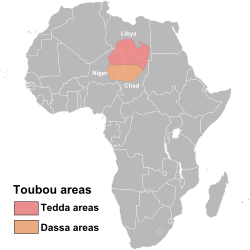
The Teda language, also known as Tedaga, Todaga, Todga, or Tudaga is a Nilo-Saharan language spoken by the Teda, a northern subgroup of the Toubou people who inhabit southern Libya, northern Chad and eastern Niger. A small number also inhabit northeastern Nigeria.[1]

Along with the more populous southern dialect of Daza, the northern Teda dialect constitutes one of the two varieties of Tebu. However, Teda is also sometimes used for Tebu in general.

Phonology

[edit]

Alphabet

[edit]
The Teda (Tedaga) Latin alphabet
Teda alphabet
A a à ã B b Č č D d E e Ê ê G g H h I i Î î Ĩ ĩ K k L l M m N n Ñ ñ
NJ nj Ŋ ŋ O o Ô ô P p R r S s Š š T t U u Û û Ũ ũ W w Y y Z z Y y Z z

References

[edit]
Revisions and contributorsEdit on WikipediaRead on Wikipedia
from Grokipedia
The Teda language (also known as Tedaga or Tudaga; : tuq), is a of the proposed Nilo-Saharan family, spoken primarily by the Teda subgroup of the Toubou (Tebu) people in the central region. It serves as the northern member of the Tebu language group, alongside the more widely spoken Dazaga to the south, and is characterized by its use among nomadic pastoralist communities in remote desert areas. With an estimated 42,500 native speakers worldwide according to late 20th-century assessments—primarily 28,500 in (1993 census), 10,000 in (1998 SIL estimate), and around 4,000 in (early 1980s estimate)—the language is classified as vulnerable due to limited institutional support and intergenerational transmission challenges. Teda is primarily used in the of northern , the Murzuq District of southwestern , and the of northern , where it functions as a vehicle for oral traditions, , and daily communication among its speakers. Linguistically, Teda shares typical Saharan features such as complex verbal morphology, tone systems, and a reliance on Arabic and Berber loanwords due to historical trade and contact in the Sahara. Despite its relative isolation, the language has been documented in key studies highlighting its phonological and syntactic structures, contributing to broader understanding of Nilo-Saharan diversity. As a stable yet endangered indigenous tongue, Teda plays a vital role in preserving the cultural identity of the Teda people amid ongoing desertification and political instability in the region.

Overview

Classification

The Teda language, also known as Tedaga, belongs to the Nilo-Saharan phylum, specifically the Saharan branch and the Tebu subgroup. This classification positions Teda within a small but well-established family of Saharan languages characterized by shared areal features in the central Sahara. Teda forms part of the Tebu language group alongside Daza, its closest relative, where Teda represents the northern dialect continuum spoken primarily by the Teda subgroup of the Toubou people. The two languages exhibit high mutual intelligibility, with phonological similarities such as vowel harmony patterns. The ISO 639-3 code for Teda is tuq, and its Glottolog identifier is teda1241. The broader Nilo-Saharan phylum's genetic unity, first proposed by Greenberg in 1963, remains debated among linguists, though supporting evidence includes shared basic lexicon (e.g., pronouns and body part terms) and morphological elements like verbal extensions and case marking. Within Saharan, Teda (Central subgroup via Tebu) is distinct from Western Saharan languages like Kanuri and Eastern Saharan ones like Zaghawa, differing in subgroup-specific innovations in syntax and nominal morphology.

Geographic distribution

The Teda language is primarily spoken across the Desert in northern , particularly in the Borkou-Ennedi-Tibesti region, including the and areas around Bardai. Speakers are also present in southern Libya's Murzuq District within the region, northern Niger's encompassing locales such as , Seguedine, and the Termit Massif, and to a lesser extent in northeastern near the border. As of 2024, the language has approximately 130,000 native speakers worldwide, primarily in and (over 100,000 combined), with smaller populations (under 10,000 each) in and . Teda is the primary language of the Teda subgroup within the broader Toubou (or Tubu) ethnic group, comprising both nomadic pastoralists who herd camels and goats across desert routes and sedentary communities involved in oasis agriculture, date palm cultivation, and caravan trade. The nomadic traditions and transborder migrations of Teda speakers, facilitated by the fluid Saharan landscape, contribute to dialectal variations, with influences from adjacent interactions shaping local forms of the language. Overall, Teda maintains stable vitality in its indigenous heartlands, though smaller diaspora populations in peripheral areas like Nigeria and Libya face risks of endangerment due to assimilation pressures. Teda speakers coexist with Daza communities in overlapping Saharan zones, where the related Daza language is also prevalent.

Phonology

Consonants

The Teda language, part of the Teda-Daza within the Saharan branch of Nilo-Saharan, features a inventory of 20 phonemes. These include stops, fricatives, nasals, affricates, liquids, and glides, articulated across bilabial, labiodental, alveolar, alveopalatal, palatal, velar, and glottal places. There is no phonemic /p/; instead, appears as an of /b/. The following table presents the consonant phonemes organized by place and , using IPA symbols:
BilabialLabiodentalAlveolarAlveopalatalPalatalVelarGlottal
Stopsbt dk ɡ
Affricatestʃ dʒ
Fricativesfs zʃh
Nasalsmnɲŋ
Liquidsl ɾ
Glideswj
This chart reflects the primary distinctions, with /ʃ/ considered marginal and occurring mainly in loanwords. Allophonic variations include post-nasal devoicing of /b/ to , as in environments following nasals or in voicing assimilation. The velar stops /k/ and /ɡ/ have labialized variants [kʷ] and [ɡʷ] as free allophones. The alveolar flap /ɾ/ geminates to in /ɾɾ/ and assimilates to adjacent sonorants, such as /dɛɾ-n/ realizing as [dɛnn]. Affrication occurs in sequences like /d-j/ to [dʒ]. Root-final assimilate in before the -t, exemplified by /ks-t-m/ to [kssm]. Phonotactics permit limited consonant clusters, primarily heterosyllabic nasal-obstruent or liquid-obstruent combinations, such as -nt in verbal forms. structure constraints favor CV or CVC patterns, with a maximal [CVVC] allowing coda consonants but restricting complex onsets beyond affricates like /tʃ/. Consonant-final roots often insert epenthetic vowels to resolve illicit codas.

Vowels

The Teda-Daza language, also known as Teda or Tedaga in its eastern varieties, possesses a vowel inventory of nine phonemes organized into harmonic sets based on the advanced root ([+ATR]) feature. These include four [+ATR] vowels (/i/, /u/, /e/, /o/) and five [-ATR] vowels (/ɪ/, /ʊ/, /ɛ/, /ɔ/, /a/), with the low vowel /a/ being inherently [-ATR] and transparent to processes. Vowel qualities are symmetrically distributed across height and backness, as shown in the following chart:
FrontCentralBack
Highi, ɪu, ʊ
Mide, ɛo, ɔ
Lowa
[+ATR] vowels exhibit a more advanced tongue root position, resulting in higher second frequencies compared to their [-ATR] counterparts, a distinction crucial for lexical contrasts such as [èɾí] ‘pearl’ versus [ɛɾɛ] ‘’. Vowel plays a phonemic , with short and long distinctions occurring in open (CV or CVV structures), where long vowels are realized as bimoraic and often transcribed with doubled graphemes in practical orthographies, for example, [kɛɛ] ‘to refuse’. Length contrasts can alter meaning, as in minimal pairs like short /kɛ/ versus long /kɛː/, though such oppositions are less frequent than quality contrasts. In formation, vowels interact with consonants to permit only CV or CVV onsets, avoiding complex codas beyond length. Advanced tongue root (ATR) harmony governs the vowel system, requiring vowels within a phonological word—encompassing roots, suffixes, and clitics—to agree in [ATR] value, with the root typically controlling the feature. For instance, the [+ATR] in [bìkí] ‘invitation’ triggers in the plural form [bìká] ‘invitations’, where the transparent /a/ suffix does not block propagation to subsequent elements. This root-controlled, regressive aligns with typological patterns observed in , as described by Casali (2008), and applies bidirectionally across boundaries but spares the low /a/. Diphthongs arise phonetically from high gliding in hiatus resolution, particularly when a high precedes a non-high one, yielding sequences like [tòwá] from underlying /toʊ/ + /-a/ in verbal derivations. Vowel sequences are otherwise dispreferred, often resolving through or gliding rather than co-occurrence of mismatched [ATR] values. Representative examples include [bùɾtíɾígì] ‘we jump’ (all [+ATR]) and [fɪljɪntgɪ] ‘they ’ (all [-ATR]), illustrating permitted harmonic combinations.

Tone

Teda employs a tone system similar to that of closely related Dazaga in the Tebu continuum, featuring a pitch-accent pattern with phonemic high tone and default low tone, resulting in four phonetic tones: high, low, falling, and rising. Every word has at least one high-toned syllable, with high tones being contiguous. Falling or rising tones may arise from the deletion of final syllables, with tones spreading to suffixes or clitics. Tone distinguishes lexical items, such as [fád] ‘knowledge’ versus [fàd] ‘tail’, and grammatical categories, like plural imperatives from third-person plural perfectives. Tone is not marked in the standard Roman orthography.

Morphology

Nouns

Nouns in the Teda language, part of the Teda-Daza continuum, exhibit minimal inflectional morphology, primarily marking number and optionally case through enclitics, with no system. Biological is expressed lexically using separate terms such as those for "" or "" rather than through noun suffixes or inherent classes. There are no classes, and derivation is limited to processes like the addition of a suffix, which applies to certain nouns. is also used to form new nouns, though affixation for derivation remains rare beyond diminutives and occasional adjectival formations from nominal bases. Number is distinguished between singular and , with singular forms unmarked and plurals typically formed by a that may involve assimilation or in certain stems. Some sources note variant plural markers in specific contexts, but the primary pattern predominates for s. Possession is marked using pronominal possessives that agree in number with the possessed or genitive enclitics attached to the head . For instance, possessive pronouns precede the noun to indicate possession, while enclitics integrate with the noun. No explicit distinction between alienable and inalienable possession is morphologically encoded; instead, context and pronominal choice convey nuances. Verbs may agree in number with possessed subjects, but this is handled through verbal morphology rather than nominal changes. Case roles, including nominative and accusative, are primarily indicated by rather than obligatory affixes, with nominative subjects unmarked and accusative objects optionally taking an enclitic. The enclitic is required for pronominal objects but optional for full nouns. This relies on SVO to establish core arguments, minimizing morphological complexity.

Verbs

Verbs in the Teda language exhibit a highly agglutinative morphology, with inflections primarily realized through suffixes and prefixes to encode , and subject agreement. The verbal typically serves as the base, to which affixes are added in a templatic order: subject prefix - - derivational affixes - suffix. This allows for complex expressions of temporality and valency within a single word, characteristic of . The tense-aspect-mood system relies on suffixes attached to the verbal stem. is marked by the suffix -ki, as in the example käl-ki "he ate" from the root käl "eat." The uses -a, yielding käl-a "he eats." is indicated by -wa, for instance käl-wa "he will eat." Additionally, the , which denotes ongoing or habitual actions, is expressed through a dedicated suffix, often combining with other TAM markers to convey nuances like progressive present (e.g., käl-a-imperfective). These markers interact with aspectual distinctions, where perfective forms emphasize completed events and imperfective forms ongoing ones. Person agreement for the subject is realized via prefixes on the verb stem. The first person singular uses n-, as in n-käl-a "I eat." The second person singular employs k-, yielding k-käl-a "you (sg.) eat." The third person singular has a zero prefix, resulting in Ø-käl-a "he/she eats." subjects are handled through additional suffixes like -an, but the core singular agreement follows this prefix pattern, which aligns with broader Saharan pronominal strategies. Object agreement, when present in transitive verbs, may use suffixes or pronouns, but subject prefixes are obligatory in finite forms. Valency changes are achieved through derivational or inserted between the and TAM markers. The derivation employs the -is-, increasing the verb's valency by adding a causer argument, as in käl-is- "to cause to eat" (e.g., n-käl-is-a "I cause him to eat"). The passive is formed with the -am-, reducing valency by demoting the agent, exemplified by käl-am- "to be eaten" (e.g., käl-am-a "it is eaten"). These derivations follow a consistent template, allowing transitive verbs to shift to causative or passive without altering the core meaning. Serial verb constructions function as morphological s, where multiple verbs chain together to express complex events, sharing a single set of agreement markers. For example, a motion + action sequence like "go and eat" appears as n-tèr-käl-a, where tèr "go" and käl "eat" compound under unified , behaving as a single predicate unit. This strategy extends verbal semantics without additional morphology, common in for aspectual or directional modifications. Irregular verbs deviate from standard patterns through suppletion, where different replace the expected forms across tenses or persons, reflecting inherited irregularities from proto-Saharan . For instance, the "to be" may supplete as zero in present ( "is") but use a distinct like wən in past (wən-ki "was"), while motion verbs like "go" show stem alternation (tèr present vs. tì past). These patterns, numbering around a dozen high-frequency verbs, preserve archaic proto-Saharan morphology, including alternations and suppletion tied to aspectual shifts.

Syntax

Word order

The Teda language, a member of the Saharan branch of the Nilo-Saharan family, exhibits a basic constituent order of subject-object-verb (SOV) in declarative clauses, which is rigidly maintained in most syntactic contexts. This head-final structure at the clause level is typical of many and contrasts with the head-initial organization of noun phrases, where the noun precedes possessors, adjectives, numerals, demonstratives, genitives, quantifiers, and determiners. For example, a simple transitive sentence such as "They are playing cards" is rendered as [ká ɾtà wá pp ɡ], with the subject "they" followed by the object "cards" and then the "playing." Word order in Teda shows minimal flexibility, with deviations primarily driven by discourse functions such as focus or topicalization, often resulting in object-subject-verb (OSV) constructions accompanied by ergative marking on the subject. A topic-comment structure is frequently employed through left-dislocation of the topic, followed by a resumptive pronoun in the main clause to maintain coreference and emphasize new information. For instance, expressions like "Me, I have grown" use a dislocated pronoun for the topic, highlighting contrast or focus without altering the underlying SOV order of the comment. Such structures aid in information packaging, where morphological markers on verbs and nouns provide additional cues for interpreting roles when order varies slightly. Adpositional phrases in Teda consistently use postpositions, which follow the nouns they govern, aligning with the language's SOV typology. Common postpositions include =ɾù for the dative ("to/for"), dɾɔ for locative ("in"), and báɾà for temporal ("after"), as in constructions denoting spatial or relational semantics. This postpositional pattern reinforces the head-final nature of clauses and distinguishes Teda from preposition-using languages. Question formation in Teda does not typically involve inversion but instead relies on dedicated markers or positioning of elements. Yes/no questions are formed by adding a clause-final enclitic such as =à or =ɾà, preserving the SOV order. Content questions employ wh-words like ɲàá ("who") or ínní ("what"), which may appear within the or preverbally for emphasis, as in "What did he say?" translated as [ínní dɛɛŋ n mmà ɾ tʃɛ n]. This approach maintains syntactic stability while signaling intent. Typologically, Teda's SOV order aligns closely with other such as Kanuri and Beria (Zaghawa), which also feature agglutinative morphology and postpositions, reflecting a shared areal preference for head-final structures in the region. Unlike some SOV languages with stricter prenominal modifiers, Teda's noun phrases follow a pattern akin to Heine's "Galla" , allowing reversible ordering of adjectives and numerals for stylistic variation. These similarities underscore the conservative syntactic profile of the , with Teda exhibiting optional ergative alignment that may trace to proto-Saharan ergative/absolutive origins.

Clause structure

Simple clauses in Teda consist of a subject, optional object, and , typically following a subject-object-verb (SOV) order. Intransitive clauses feature a subject and , while transitive ones include an object; case marking is optional, with ergative on subjects and accusative on objects in certain contexts. carry agreement affixes and tense-aspect markers, forming the core of the predicate. Relative clauses in Teda are post-nominal and restrictive, modifying a head with an external head. They employ a relativizer particle such as or a like -ɾɛ, allowing relativization of subjects, objects, and other roles via gapping or resumptive pronouns. For example, a relative clause might describe a as in "the whose tail is bent," structured as head noun followed by the relativized . Headless relatives require a generic head like "thing." Coordination in Teda links clauses or phrases using conjunctions; clausal coordination employs n for 'and' and wàllá for 'or', often bisyndetically. Phrasal coordination uses enclitics like =j or =jɛ ('and'). These structures connect independent clauses without shared arguments, distinguishing them from serial verb constructions. An example is "My friend sold a , and I bought a ." Complement clauses in Teda embed under matrix verbs of or speech, preceding the main and marked by subordinators like = or infinitives with =ɾu. Speech act complements may use direct quotes with ergative marking on the matrix subject. For instance, verbs like 'say' or 'want' introduce complements such as "I want to learn French." Adverbial complements employ temporal or causal subordinators like =ŋà. Negation in Teda clauses primarily involves verbal suffixes such as -n, -m, or -d, applied to finite verbs in simple and complex structures. Non-verbal clauses use a dedicated particle 'not,' while negative existentials rely on forms like bèí ('to not be'). These strategies scope over the , including embedded complements, as in "He didn’t like what she said." occurs with auxiliaries like ɡúò ('unable to').

Writing system

Orthography

The Teda language, also known as Tedaga, employs a Latin-based that was developed in the late by pour le Développement et la Paix (ADP) in . This script adaptation began as an effort to transition the traditionally oral language into a written form, with initial work led by the ADP, culminating in the publication of the first Teda alphabet and vocabulary books in 1998. The draws on standard Latin letters to represent the language's phonemic inventory, facilitating programs and basic publications, though it remains provisional and subject to ongoing revisions. Consonant phonemes are typically rendered with single letters for basic stops and fricatives (e.g., for /b/, for /ɡ/), while digraphs account for prenasalized stops (e.g., /mb/, /nd/) and geminates are doubled (e.g., in ekke for [ɛkkɛ] 'tree'). These choices ensure a phonemic basis, aligning written forms closely with spoken sounds without excessive diacritics for consonants. Vowel representation addresses the language's nine-vowel system and [ATR] harmony, where vowels harmonize as [+ATR] or [-ATR] across words (with /a/ transparent). Basic vowels use standard letters (e.g., for /ɛ/, for /ɔ/), but [+ATR] variants employ a circumflex diacritic on the first vowel to signal the harmony set (e.g., <ê> in dêgil for [déɡil] 'monkey', indicating all [+ATR] vowels). Long vowels are doubled (e.g., in kee for [kɛɛ] 'hand'), and tone is not marked, prioritizing simplicity in practical use. Standardization efforts have involved collaboration between local linguists, such as those from ADP in and , and international organizations like SIL International, which has supported development through affiliated institutions and publications since the early 2000s. By 2013, extensions to related Daza dialects incorporated the Teda framework for literacy curricula, including school materials and advanced texts on and . As of 2024, the Teda written language is part of Chad's national curriculum, with literacy supported by centers like the ‘Mosko Hanadii-ĩ’ Centre (opened 2011) and annual writing competitions since 2012. Despite these advances, challenges persist, including dialectal variations between Teda and Daza that lead to spelling inconsistencies. An alternative Arabic-script version is also in development to accommodate cultural and regional preferences.
Add your contribution
Related Hubs
User Avatar
No comments yet.