


Community hub
Recent from talks
Contribute something
Nothing was collected or created yet.
The Freewheelin' Bob Dylan
View on Wikipedia
| The Freewheelin' Bob Dylan | ||||
|---|---|---|---|---|
 | ||||
| Studio album by | ||||
| Released | May 27, 1963 | |||
| Recorded | July 9, 1962 – April 24, 1963 | |||
| Studio | Columbia A (New York City) | |||
| Genre | ||||
| Length | 50:04 | |||
| Label | Columbia | |||
| Producer | ||||
| Bob Dylan chronology | ||||
| ||||
| Singles from The Freewheelin' Bob Dylan | ||||
| ||||
The Freewheelin' Bob Dylan is the second studio album by the American singer-songwriter Bob Dylan. It was released on May 27, 1963, through Columbia Records. The record marks the beginning of Dylan's writing contemporary lyrics to traditional melodies. His debut album Bob Dylan contains only two original songs, whereas eleven of the thirteen songs on Freewheelin' are Dylan's compositions. It opens with "Blowin' in the Wind", which became an anthem of the 1960s, and an international hit for folk trio Peter, Paul and Mary soon after the release of the album. The album featured several other songs which came to be regarded as among Dylan's best compositions and classics of the 1960s folk scene: "Girl from the North Country", "Masters of War", "A Hard Rain's a-Gonna Fall" and "Don't Think Twice, It's All Right".
Dylan's lyrics embraced news stories drawn from headlines about the ongoing civil rights movement and he articulated anxieties about the fear of nuclear warfare. Balancing this political material were love songs, sometimes bitter and accusatory, and material that features surreal humor. Freewheelin' showcased Dylan's songwriting talent for the first time, propelling him to national and international fame. The success of the album and Dylan's subsequent recognition led to his being named as "Spokesman of a Generation", a label Dylan repudiated.
The Freewheelin' Bob Dylan reached number 22 in the US (eventually going platinum), and became a number-one album in the UK in 1965. In 2003, the album was ranked number 97 on Rolling Stone's list of the "500 Greatest Albums of All Time". In 2002, Freewheelin' was one of the first 50 recordings chosen by the Library of Congress to be added to the National Recording Registry as "culturally, historically, or aesthetically significant".
Recording sessions
[edit]Neither critics nor the public took much notice of Dylan's self-titled debut album, Bob Dylan, which sold only 5,000 copies in its first year, just enough to break even. In a pointed rebuke to John Hammond, who had signed Dylan to Columbia Records, some within the company referred to the singer as "Hammond's Folly"[1] and suggested dropping his contract. Hammond defended Dylan vigorously and was determined that Dylan's second album should be a success.[2] The recording of Freewheelin' took place from April 1962 to April 1963, and the album was assembled from eight recording sessions at Columbia Records Studio A, located at 799 Seventh Avenue in New York City.[3]
Political and personal background
[edit]
Many critics have noted the extraordinary development of Dylan's songwriting immediately after completing his first album. One of Dylan's biographers, Clinton Heylin, connects the sudden increase in lyrics written along topical and political lines to the fact that Dylan had moved into an apartment on West 4th Street with his girlfriend Suze Rotolo (1943–2011) in January 1962.[4] Rotolo's family had strong left-wing political commitments; both of her parents were members of the American Communist Party.[5] Dylan acknowledged her influence when he told an interviewer: "Suze was into this equality-freedom thing long before I was. I checked out the songs with her".[6]
Dylan's relationship with Rotolo also provided an important emotional dynamic in the composition of the Freewheelin' album. After six months of living with Dylan, Rotolo agreed to her mother's proposal that she travel to Italy to study art.[7][a 1] Dylan missed her and wrote long letters to her conveying his hope that she would return soon to New York.[8] She postponed her return several times, finally coming back in January 1963. Critics have connected the intense love songs expressing longing and loss on Freewheelin' to Dylan's fraught relationship with Rotolo.[9] In her autobiography, Rotolo explains that musicians' girlfriends were routinely described as "chicks", and she resented being regarded as "a possession of Bob, who was the center of attention".[10]
The speed and facility with which Dylan wrote topical songs attracted the attention of other musicians in the New York folk scene. In a radio interview on WBAI in June 1962, Pete Seeger described Dylan as "the most prolific songwriter on the scene" and then asked Dylan how many songs he had written recently. Dylan replied, "I might go for two weeks without writing these songs. I write a lot of stuff. In fact, I wrote five songs last night but I gave all the papers away in some place called the Bitter End."[11] Dylan also expressed the impersonal idea that the songs were not his own creation. In an interview with Sing Out! magazine, Dylan said, "The songs are there. They exist all by themselves just waiting for someone to write them down. I just put them down on paper. If I didn't do it, somebody else would".[12]
Recording in New York
[edit]Dylan began work on his second album at Columbia's Studio A in New York on April 24, 1962. The album was provisionally entitled Bob Dylan's Blues, and as late as July 1962, this would remain the working title.[13] At this session, Dylan recorded four of his own compositions: "Sally Gal", "The Death of Emmett Till", "Rambling, Gambling Willie", and "Talkin' John Birch Paranoid Blues". He also recorded two traditional folk songs, "Going To New Orleans" and "Corrina, Corrina", and Hank Williams' "(I Heard That) Lonesome Whistle".[14]
Returning to Studio A the following day, Dylan recorded his new song about fallout shelters, "Let Me Die in My Footsteps". Other original compositions followed: "Rocks and Gravel", "Talking Hava Negiliah Blues", "Talkin' Bear Mountain Picnic Massacre Blues", and two more takes of "Sally Gal". Dylan recorded cover versions of "Wichita", Big Joe Williams' "Baby, Please Don't Go", and Robert Johnson's "Milk Cow's Calf's Blues".[14] Because Dylan's songwriting talent was developing so rapidly, nothing from the April sessions appeared on Freewheelin'.[3]
The recording sessions at Studio A resumed on July 9, when Dylan recorded "Blowin' in the Wind", a song that he had first performed live at Gerde's Folk City on April 16.[15] Dylan also recorded "Bob Dylan's Blues", "Down the Highway", and "Honey, Just Allow Me One More Chance", all of which ended up on Freewheelin', plus one other original composition, "Baby, I'm in the Mood for You", which did not.[16]
At this point, music manager Albert Grossman began to take an interest in Dylan's business affairs. Grossman persuaded Dylan to transfer the publishing rights of his songs from Duchess Music, whom he had signed a contract with in January 1962, to Witmark Music, a division of Warner's music publishing operation. Dylan signed a contract with Witmark on July 13, 1962.[17] Unknown to Dylan, Grossman had also negotiated a deal with Witmark. This gave Grossman fifty percent of Witmark's share of the publishing income generated by any songwriter Grossman had brought to the company. This "secret deal" resulted in a bitter legal battle between Dylan and Grossman in the 1980s.[18]
Albert Grossman became Dylan's manager on August 20, 1962.[19] Since Dylan was under twenty-one when he had signed his contract with CBS, Grossman argued that the contract was invalid and had to be re-negotiated. Instead, Hammond responded by inviting Dylan to his office and persuading him to sign a "reaffirment"—agreeing to abide by the original contract. This effectively neutralized Grossman's strategy, and led to some animosity between Grossman and Hammond.[20] Grossman enjoyed a reputation in the folk scene of being commercially aggressive, generating more income and defending his clients' interests more fiercely than "the nicer, more amateurish managers in the Village".[21] Dylan critic Andy Gill has suggested that Grossman encouraged Dylan to become more reclusive and aloof, even paranoid.[22]

On September 22, Dylan appeared for the first time at Carnegie Hall, part of an all-star hootenanny. On this occasion, he premiered his new composition "A Hard Rain's a-Gonna Fall",[23] a complex and powerful song built upon the question and answer refrain pattern of the traditional British ballad "Lord Randall". "Hard Rain" would gain added resonance one month later, when President Kennedy appeared on national television on October 22, and announced the discovery of Soviet missiles on the island of Cuba, initiating the Cuban Missile Crisis. In the sleeve notes on the Freewheelin' album, Nat Hentoff quotes Dylan as saying that he wrote "Hard Rain" in response to the Cuban Missile Crisis: "Every line in it is actually the start of a whole new song. But when I wrote it, I thought I wouldn't have enough time alive to write all those songs so I put all I could into this one".[24] In fact, Dylan had written the song more than a month before the crisis broke.
Dylan resumed work on Freewheelin' at Columbia's Studio A on October 26, when a major innovation took place—Dylan made his first studio recordings with a backing band. Accompanied by Dick Wellstood on piano, Howie Collins and Bruce Langhorne on guitar, Leonard Gaskin on bass, and Herb Lovelle on drums, Dylan recorded three songs. Several takes of Dylan's "Mixed-Up Confusion" and Arthur Crudup's "That's All Right Mama" were deemed unusable,[25] but a master take of "Corrina, Corrina" was selected for the final album. An "alternate take" of "Corrina, Corrina" from the same session would also be selected for the B-side of "Mixed Up Confusion", Dylan's first electric single issued later in the year. At the next recording session on November 1, the band included Art Davis on bass, while jazz guitarist George Barnes replaced Howie Collins. "Mixed-Up Confusion" and "That's All Right Mama" were re-recorded, and again the results were deemed unsatisfactory. A take of the third song, "Rocks and Gravel", was selected for the album, but the track was subsequently dropped.[26]
On November 14, Dylan resumed work with his backup band, this time with Gene Ramey on bass, devoting most of the session to recording "Mixed-Up Confusion". Although this track did not appear on Freewheelin', it was released as a single on December 14, 1962, and then swiftly withdrawn.[27] Unlike the other material which Dylan recorded between 1961 and 1964, "Mixed-Up Confusion" attempted a rockabilly sound. Cameron Crowe described it as "a fascinating look at a folk artist with his mind wandering towards Elvis Presley and Sun Records".[28]
Also recorded on November 14 was the new composition "Don't Think Twice, It's All Right" (Clinton Heylin writes that, although the sleeve notes of Freewheelin' describe this song as being accompanied by a backing band, no band is audible on the released version).[24][29] Langhorne then accompanied Dylan on three more original compositions: "Ballad of Hollis Brown", "Kingsport Town", and "Whatcha Gonna Do", but these performances were not included on Freewheelin'.[26]
Dylan held another session at Studio A on December 6. Five songs, all original compositions, were recorded, three of which were eventually included on The Freewheelin' Bob Dylan: "A Hard Rain's a-Gonna Fall", "Oxford Town", and "I Shall Be Free". Dylan also made another attempt at "Whatcha Gonna Do" and recorded a new song, "Hero Blues", but both songs were ultimately rejected and left unreleased.[26]
Traveling to England
[edit]Twelve days later, Dylan made his first trip abroad. British TV director Philip Saville had heard Dylan perform in Greenwich Village, and invited him to take part in a BBC television drama: Madhouse on Castle Street. Dylan arrived in London on December 17. In the play, Dylan performed "Blowin' in the Wind" and two other songs.[30] Dylan also immersed himself in the London folk scene, making contact with the Troubadour folk club organizer Anthea Joseph and folk singers Martin Carthy and Bob Davenport. "I ran into some people in England who really knew those [traditional English] songs", Dylan recalled in 1984. "Martin Carthy, another guy named [Bob] Davenport. Martin Carthy's incredible. I learned a lot of stuff from Martin."[31]
Carthy taught Dylan two English songs that would prove important for the Freewheelin' album. Carthy's arrangement of "Scarborough Fair" would be used by Dylan as the basis of his own composition, "Girl from the North Country". A 19th-century ballad commemorating the death of Sir John Franklin in 1847, "Lady Franklin's Lament", gave Dylan the melody for his composition "Bob Dylan's Dream". Both songs displayed Dylan's fast-growing ability to take traditional melodies and use them as a basis for highly personal songwriting.[32]
From England, Dylan traveled to Italy, and joined Albert Grossman, who was touring with his client Odetta.[33] Dylan was also hoping to make contact with his girlfriend, Suze Rotolo, unaware that she had already left Italy and was on her way back to New York. Dylan worked on his new material, and when he returned to London, Martin Carthy received a surprise: "When he came back from Italy, he'd written 'Girl From the North Country'; he came down to the Troubadour and said, 'Hey, here's "Scarborough Fair"' and he started playing this thing".[34]
Returning to New York
[edit]Dylan flew back to New York on January 16, 1963.[35] In January and February, he recorded some of his new compositions in sessions for the folk magazine Broadside, including a new anti-war song, "Masters of War", which he had composed in London.[36][37] Dylan was happy to be reunited with Suze Rotolo, and he persuaded her to move back into the apartment they had shared on West 4th Street.[38]
Dylan's keenness to record his new material for Freewheelin' paralleled a dramatic power struggle in the studio: Albert Grossman's determination to have John Hammond replaced as Dylan's producer at CBS. According to Dylan biographer Howard Sounes, "The two men could not have been more different. Hammond was a WASP, so relaxed during recording sessions that he sat with feet up, reading The New Yorker. Grossman was a Jewish businessman with a shady past, hustling to become a millionaire".[20]
Because of Grossman's hostility to Hammond, Columbia paired Dylan with a young, African-American jazz producer, Tom Wilson. Wilson recalled: "I didn't even particularly like folk music. I'd been recording Sun Ra and Coltrane ... I thought folk music was for the dumb guys. [Dylan] played like the dumb guys, but then these words came out. I was flabbergasted."[39] At a recording session on April 24, produced by Wilson, Dylan recorded five new compositions: "Girl from the North Country", "Masters of War", "Talkin' World War III Blues", "Bob Dylan's Dream", and "Walls of Red Wing". "Walls of Red Wing" was ultimately rejected, but the other four were included in a revised album sequence.[40]
The final drama of recording Freewheelin' occurred when Dylan was scheduled to appear on The Ed Sullivan Show on May 12, 1963. Dylan had told Sullivan he would perform "Talkin' John Birch Paranoid Blues", but the "head of program practices" at CBS Television informed Dylan that this song was potentially libelous to the John Birch Society, and asked him to perform another number. Rather than comply with TV censorship, Dylan refused to appear on the show.[41] There is disagreement between Dylan's biographers about the consequences of this censorship row. Anthony Scaduto writes that after The Ed Sullivan Show debacle, CBS lawyers were alarmed to discover that the controversial song was to be included on Dylan's new album, only a few weeks from its release date. They insisted that the song be dropped, and four songs ("John Birch", "Let Me Die in My Footsteps", "Rambling Gambling Willie", "Rocks and Gravel") on the album were replaced with Dylan's newer compositions recorded in April ("Girl from the North Country", "Masters of War", "Talkin' World War III Blues", "Bob Dylan's Dream"). Scaduto writes that Dylan felt "crushed" by being compelled to submit to censorship, but he was in no position to argue.[42]
According to Heylin, "There remains a common belief that [Dylan] was forced by Columbia to pull 'Talkin' John Birch Paranoid Blues' from the album after he walked out on The Ed Sullivan Show." However, the "revised" version of The Freewheelin' Bob Dylan was released on May 27, 1963; this would have given Columbia Records only two weeks to recut the album, reprint the record sleeves, and press and package enough copies of the new version to fill orders. Heylin suggests that CBS had probably forced Dylan to withdraw "John Birch" from the album some weeks earlier and that Dylan had responded by recording his new material on April 24.[43] Whether the songs were substituted before or after The Ed Sullivan Show, critics agree that the new material gave the album a more personal feel, distanced from the traditional folk-blues material which had dominated his first album, Bob Dylan.[44]
A few copies of the original pressing of the LP with the four deleted tracks have turned up over the years, despite Columbia's supposed destruction of all copies during the pre-release phase (all copies found were in the standard album sleeve with the revised track selection). Other permutations of the Freewheelin' album include versions with a different running order of the tracks on the album, and a Canadian version of the album that listed the tracks in the wrong order.[45][46] The original pressing of The Freewheelin' Bob Dylan is considered the most valuable and rarest record in America,[46] with one copy having sold for $35,000.[47]
Songs and themes
[edit]Side one
[edit]"Blowin' in the Wind"
[edit]"Blowin' in the Wind" is among Dylan's most celebrated compositions. In his sleeve notes for The Bootleg Series Volumes 1–3 (Rare & Unreleased) 1961–1991, John Bauldie writes that it was Pete Seeger who first identified the melody of "Blowin' in the Wind" as Dylan's adaptation of the old Negro spiritual "No More Auction Block". According to Alan Lomax's The Folk Songs of North America, the song originated in Canada and was sung by former slaves who fled there after Britain abolished slavery in 1833. In 1978, Dylan acknowledged the source when he told journalist Marc Rowland: "'Blowin' in the Wind' has always been a spiritual. I took it off a song called 'No More Auction Block'—that's a spiritual and 'Blowin' in the Wind' follows the same feeling."[48] Dylan's performance of "No More Auction Block" was recorded at the Gaslight Cafe in October 1962, and appeared on The Bootleg Series Volumes 1–3 (Rare & Unreleased) 1961–1991.
Critic Andy Gill wrote: "'Blowin' in the Wind' marked a huge jump in Dylan's songwriting: for the first time, Dylan discovered the effectiveness of moving from the particular to the general. Whereas 'The Ballad of Donald White' would become completely redundant as soon as the eponymous criminal was executed, a song as vague as 'Blowin' in the Wind' could be applied to just about any freedom issue. It remains the song with which Dylan's name is most inextricably linked, and safeguarded his reputation as a civil libertarian through any number of changes in style and attitude."[49]
"Blowin' in the Wind" became world-famous when Peter, Paul and Mary issued the song as a single three weeks after the release of Freewheelin'. They and Dylan both shared the same manager: Albert Grossman. The single sold a phenomenal three hundred thousand copies in the first week of release. On July 13, 1963, it reached number two on the Billboard chart with sales exceeding one million copies.[50] Dylan later recalled that he was astonished when Peter Yarrow told him he was going to make $5,000 from the publishing rights.[28]
"Girl from the North Country"
[edit]There has been much speculation in print about the identity of the girl in "Girl from the North Country". Clinton Heylin states that the most frequently mooted candidates are Echo Helstrom, an early girlfriend of Dylan from his hometown of Hibbing,[51] and Suze Rotolo, for whom Dylan was pining as he finished the song in Italy.[52] Howard Sounes suggests the girl Dylan probably had in mind was Bonnie Beecher, a girlfriend of Dylan's when he was at the University of Minnesota.[53][a 2] There's no proof of any of this, and musicologist Todd Harvey notes that "the lyrics do not, however, contain enough specific information to suggest that Dylan was leaving clues about his personal life".[54]
Harvey notes that Dylan not only took the tune of "Scarborough Fair", which he learned from Martin Carthy in London but also adapted the theme of that song. "Scarborough Fair" derives from "The Elfin Knight" (Child Ballad Number 2), which was first transcribed in 1670. In the song, a supernatural character poses a series of questions to an innocent, requesting her to perform impossible tasks. Harvey points out that Dylan "retains the idea of the listener being sent upon a task, a northern place setting, and an antique lyric quality".[55] Dylan returned to this song on Nashville Skyline (1969), recording it as a duet with Johnny Cash, and he returned to it again in the studio with an unreleased organ and sax version in 1978.
Later in his book about Dylan, Howard Sounes offers the opinion that Dylan may have been utilizing the largely autobiographical song as a way to gain favor with different girlfriends whom he dated over the years. Sounes states: "... one wondered which girlfriend Bob was singing about... Bob later gave Echo (Helstrom) the impression (that it) was her song. But, no doubt thinking that women were flattered by having songs written about them, Bob led another north country girlfriend, Bonnie Beecher, to think the same... Later in 1963, when he performed the song on a radio show... Bob indicated that the song was about an idealized woman, saying, 'This is dedicated to all the north country girls.'"[56]
"Masters of War"
[edit]A scathing song directed against the war industry, "Masters of War" is based on Jean Ritchie's arrangement of "Nottamun Town", an English riddle song. It was written in late 1962 while Dylan was in London; eyewitnesses (including Martin Carthy and Anthea Joseph) recall Dylan performing the song in folk clubs at the time. Ritchie would later assert her claim on the song's arrangement; according to one Dylan biography, the suit was settled when Ritchie received $5,000 from Dylan's lawyers.[57]
"Down the Highway"
[edit]Dylan composed "Down the Highway" in the form of a 12-bar blues. In the sleeve notes of Freewheelin', Dylan explained to Nat Hentoff: "What made the real blues singers so great is that they were able to state all the problems they had; but at the same time, they were standing outside of them and could look at them. And in that way, they had them beat."[24] Into this song, Dylan injected one explicit mention of an absence that was troubling him: the sojourn of Suze Rotolo in Perugia: "My baby took my heart from me/ She packed it all up in a suitcase/ Lord, she took it away to Italy, Italy."
"Bob Dylan's Blues"
[edit]"Bob Dylan's Blues" begins with a spoken intro where Dylan describes the origins of folk songs in a satirical vein: "most of the songs that are written uptown in Tin Pan Alley, that's where most of the folk songs come from nowadays".[58] What follows has been characterized as an absurd, improvised blues[58] which Dylan, in the sleeve notes, describes as "a really off-the-cuff-song. I start with an idea and then I feel what follows. Best way I can describe this one is that it's sort of like walking by a side street. You gaze in and walk on."[24] Harvey points out that Dylan subsequently elaborated this style of self-deprecatory, absurdist humor into more complex songs, such as "I Shall Be Free No.10" (1964).[59]
"A Hard Rain's a-Gonna Fall"
[edit]Dylan was 21 years old when he wrote one of his most complex songs, "A Hard Rain's a-Gonna Fall", often referred to as "Hard Rain". Dylan is said to have premiered "Hard Rain" at the Gaslight Cafe, where Village performer Peter Blankfield recalled: "He put out these pieces of loose-leaf paper ripped out of a spiral notebook. And he starts singing ['Hard Rain'] ... He finished singing it, and no one could say anything. The length of it, the episodic sense of it. Every line kept building and bursting."[60] Dylan performed "Hard Rain" days later at Carnegie Hall on September 22, 1962, as part of a concert organized by Pete Seeger. The song gained added resonance during the Cuban Missile Crisis, one month after Dylan's first performance of "Hard Rain", when U.S. President John F. Kennedy gave his warning to the Soviet Union over their deployment of nuclear missiles in Cuba. Critics have interpreted the lyric 'hard rain' as a reference to nuclear fallout, but Dylan resisted the specificity of this interpretation. In a radio interview with Studs Terkel in 1963, Dylan said,
No, it's not atomic rain, it's just a hard rain. It isn't the fallout rain. I mean some sort of end that's just gotta happen ... In the last verse, when I say, "the pellets of poison are flooding the waters", that means all the lies that people get told on their radios and in their newspapers.[61]
Many people were astonished by the power and complexity of this work. For Robert Shelton, who had given Dylan an important boost in his 1961 review in The New York Times, this song was "a landmark in topical, folk-based songwriting. Here blooms the promised fruit of the 1950s poetry-jazz fusion of Ginsberg, Ferlinghetti, and Rexroth."[62] Folk singer Dave Van Ronk later commented: "I was acutely aware that it represented the beginning of an artistic revolution."[63] Seeger expressed the opinion that this song would last longer than any other written by Dylan.[64]
Side two
[edit]"Don't Think Twice, It's All Right"
[edit]Dylan wrote "Don't Think Twice, It's All Right" on hearing from Suze Rotolo that she was considering staying in Italy indefinitely,[65] and he used a melody he adapted from Paul Clayton's song "Who's Gonna Buy You Ribbons (When I'm Gone)".[66] In the Freewheelin' sleeve notes, Dylan comments: "It isn't a love song. It's a statement that maybe you can say to make yourself feel better. It's as if you were talking to yourself."[67]
Dylan's contemporaries hailed the song as a masterpiece: Bob Spitz quotes Paul Stookey saying "I thought it was a masterful statement", while Dave Van Ronk called it "self-pitying but brilliant".[68][69] Dylan biographer Howard Sounes commented: "The greatness of the song was in the cleverness of the language. The phrase "don't think twice, it's all right" could be snarled, sung with resignation, or delivered with an ambiguous mixture of bitterness and regret. Seldom have the contradictory emotions of a thwarted lover been so well expressed, and the song transcended the autobiographical origins of Dylan's pain".[70]
"Bob Dylan's Dream"
[edit]"Bob Dylan's Dream" was based on the melody of the traditional "Lady Franklin's Lament", in which the title character dreams of finding her husband, Arctic explorer Sir John Franklin, alive and well. (Sir John Franklin had vanished on an expedition searching for the North West Passage in 1845; a stone cairn on King William Island detailing his demise was found by a later expedition in 1859.) Todd Harvey points out that Dylan transforms the song into a personal journey, yet he retains both the theme and the mood of the original ballad. The world outside is depicted as stormy and harsh, and Dylan's most fervent wish, like Lady Franklin's, is to be reunited with departed companions and to relive the fond memories they represent.[71]
"Oxford Town"
[edit]"Oxford Town" is Dylan's sardonic account of events at the University of Mississippi in September 1962. U.S. Air Force veteran James Meredith was the first black student to enroll at the University of Mississippi, in Oxford, Mississippi. When Meredith first tried to attend classes at the school, some Mississippians pledged to keep the university segregated, including the state governor Ross Barnett. Ultimately, the University of Mississippi had to be integrated with the help of U.S. federal troops. Dylan responded rapidly: his song was published in the November 1962 issue of Broadside.[72]
"Talkin' World War III Blues"
[edit]The "talkin' blues" was a style of improvised songwriting that Woody Guthrie had developed to a high plane. (A Minneapolis domestic recording that Dylan made in September 1960 includes his performances of Guthrie's "Talking Columbia" and "Talking Merchant Marine".)[73] "Talkin' World War III Blues" was a spontaneous composition Dylan created in the studio during the final session for The Freewheelin' Bob Dylan. He recorded five takes of the song and the fifth was selected for the album. The format of the "talkin' blues" permitted Dylan to address the serious subject of nuclear annihilation with humor, and "without resorting to his finger-pointing or apocalyptical-prophetic persona".[73]
"Corrina, Corrina"
[edit]"Corrina, Corrina" was recorded by the Mississippi Sheiks, and by their leader Bo Carter in 1928. The song was covered by artists as diverse as Bob Wills, Big Joe Turner, and Doc Watson. Dylan's version borrows phrases from a few Robert Johnson songs: "Stones In My Passway", "32-20 Blues", and "Hellhound On My Trail".[74] An alternate take of the song was used as a B-side for his "Mixed-Up Confusion" single.[75]
"Honey, Just Allow Me One More Chance"
[edit]"Honey, Just Allow Me One More Chance" is based on "Honey, Won't You Allow Me One More Chance?", a song dating back to the 1890s that was popularized by Henry Thomas in his 1928 recording. "However, Thomas's original provided no more than a song title and a notion", writes Heylin, "which Dylan turned into a personal plea to an absent lover to allow him 'one more chance to get along with you.' It is a vocal tour de force and ... showed a Dylan prepared to make light of his own blues by using the form itself."[76]
"I Shall Be Free"
[edit]"I Shall Be Free" is a rewrite of Lead Belly's "We Shall Be Free", which was performed by Lead Belly, Sonny Terry, Cisco Houston, and Woody Guthrie. According to Todd Harvey, Dylan's version draws its melody from the Guthrie recording but omits its signature chorus ("We'll soon be free/When the Lord will call us home").[77] Critics have been divided about the worth of this final song. Robert Shelton dismissed the song as "a decided anticlimax. Although the album has at least a half dozen blockbusters, two of the weakest songs are tucked in at the end, like shirttails."[78] Todd Harvey has argued that by placing the song at the close of the Freewheelin' LP, Dylan ends on a note of levity which is a relief after the weighty sentiments expressed in several songs on the album.[79]
Outtakes
[edit]The known outtakes from the Freewheelin' album are as follows. All songs released in 1991 on The Bootleg Series 1–3 are discussed in that album's liner notes,[48] while songs that have never been released have been documented by biographer Clinton Heylin,[80] except where noted. All songs written by Bob Dylan, except where noted.
| Title | Status |
|---|---|
| "Baby, I'm in the Mood for You" | Released on Biograph[28] and on The Freewheelin' Outtakes, issued by Resurfaced Records in 2018 |
| "Baby, Please Don't Go" (Big Joe Williams) |
Released on iTunes' Exclusive Outtakes From No Direction Home EP[81] and on The Freewheelin' Outtakes in 2018. |
| "Corrine, Corrina" | Two alternative takes released on The Freewheelin' Outtakes in 2018. |
| "Ballad of Hollis Brown" | Freewheelin' sessions recordings released on The Freewheelin' Outtakes in 2018. Re-recorded for Dylan's next album, The Times They Are a-Changin'. Demo version released on The Bootleg Series Vol. 9: The Witmark Demos: 1962–1964[82]
Dylan and Mike Seeger recorded a duet version for Seeger's album Third Annual Farewell Reunion (Rounder Records, 1994). |
| "The Death of Emmett Till" | Freewheelin' sessions recordings released on The Freewheelin' Outtakes, issued by Resurfaced Records in 2018. Recording for "Broadside Show" on WBAI-FM, May 1962, released on Folkways Records' Broadside Ballads, Vol. 6: Broadside Reunion under pseudonym Blind Boy Grunt.[83][84] Demo version released on The Bootleg Series Vol. 9: The Witmark Demos: 1962–1964[82] |
| "Hero Blues" | Freewheelin' sessions recordings unreleased. Demo version released on The Bootleg Series Vol. 9: The Witmark Demos: 1962–1964[82] |
| "Going to New Orleans" | Released on The Freewheelin' Outtakes, issued by Resurfaced Records in 2018. Takes 1 and 2 released on The 50th Anniversary Collection Vol. 1) |
| "(I Heard That) Lonesome Whistle" (Hank Williams, Jimmie Davis) |
Released on The Freewheelin' Outtakes in 2018. (Take 2 released on The 50th Anniversary Collection Vol. 1) |
| "Kingsport Town" (traditional) |
Released on The Bootleg Series 1–3 |
| "Let Me Die in My Footsteps" | Released on The Bootleg Series 1–3 |
| "Milk Cow's Calf's Blues" (Robert Johnson) |
Released on The Freewheelin' Outtakes in 2018. (Takes 1, 3, and 4 released on The 50th Anniversary Collection Vol. 1) |
| "Mixed-Up Confusion" | Released as a single, but quickly withdrawn. Later released in 1985 on Biograph[28] and on The Freewheelin' Outtakes in 2018. |
| "Quit Your Lowdown Ways" | Released on The Bootleg Series 1–3 |
| "Rambling, Gambling Willie" | Released on The Bootleg Series 1–3 |
| "Rocks and Gravel" | Studio version released on soundtrack CD of US TV series True Detective episode one, ("The Long Bright Dark" 2014). Acoustic version released as a live recording from The Gaslight Cafe, October 1962, on Live at the Gaslight 1962[85][86] (Takes 2 and 3 released on The 50th Anniversary Collection Vol. 1 and on The Freewheelin' Outtakes in 2018.) |
| "Sally Gal" | Released on No Direction Home: The Bootleg Series Vol. 7.[87] Two takes released on The Freewheelin' Outtakes in 2018. |
| "Talkin' Bear Mountain Picnic Massacre Blues" | Released on The Bootleg Series 1–3 |
| "Talkin' Hava Negiliah Blues" | Released on The Bootleg Series 1–3 |
| "Talkin' John Birch Paranoid Blues" | Freewheelin' sessions recordings released on The Freewheelin' Outtakes, issued by Resurfaced Records in 2018. Released as a live recording from Carnegie Hall, October 26, 1963, on The Bootleg Series 1–3. Demo version released on The Bootleg Series Vol. 9: The Witmark Demos: 1962–1964[82] |
| "That's All Right (Mama)" (Arthur Crudup) |
Two takes released on The Freewheelin' Outtakes in 2018. (Takes 1, 3, 5 and "Remake Overdub CO76893-3" released on The 50th Anniversary Collection Vol. 1) |
| "Walls of Red Wing" | Released on The Bootleg Series 1–3 |
| "Whatcha Gonna Do" | Freewheelin' sessions recordings unreleased. Demo version released on The Bootleg Series Vol. 9: The Witmark Demos: 1962–1964[82] and on The Freewheelin' Outtakes in 2018. |
| "Wichita (Goin' to Louisiana)" (traditional) |
Unreleased (Takes 1 and 2 released on The 50th Anniversary Collection Vol. 1 and on The Freewheelin' Outtakes in 2018.) |
| "Worried Blues" (traditional) |
Released on The Bootleg Series 1–3 |
Release
[edit]| Review scores | |
|---|---|
| Source | Rating |
| AllMusic |  [88] [88] |
| The Encyclopedia of Popular Music | [89] |
| Entertainment Weekly | A−[90] |
| MusicHound Rock | 4.5/5[92] |
| The Rolling Stone Album Guide | [91] |
| Tom Hull | A−[93] |
Dylan promoted his upcoming album with radio appearances and concert performances. In May 1963, Dylan performed with Joan Baez at the Monterey Folk Festival, where she joined him on stage for a duet of a new Dylan song, "With God on Our Side". Baez was at the pinnacle of her fame, having appeared on the cover of Time magazine the previous November. The performance not only gave Dylan and his songs a new prominence, it also marked the beginning of a romantic relationship between Baez and Dylan, the start of what Dylan biographer Sounes termed "one of the most celebrated love affairs of the decade".[57]
The Freewheelin' Bob Dylan was released at the end of May. According to Scaduto, it was an immediate success, selling 10,000 copies a month and bringing Dylan an income of about $2,500 a month[94] (equivalent to $25,700 in 2024). An article by Nat Hentoff on folk music appeared in the June issue of Playboy magazine and devoted considerable space to Dylan's achievements, calling him "the most vital of the younger citybillies".[94]
In July, Dylan appeared at the second Newport Folk Festival. That weekend, Peter, Paul and Mary's rendition of "Blowin' in the Wind" reached number two on Billboard's pop chart. Baez was also at Newport, appearing twice on stage with Dylan. The combination of the chart success of "Blowin' in the Wind", and the glamor of Baez and Dylan singing together generated excitement about Dylan and his new album. Tom Paxton recalled: "That was a big breakout festival for Bob. The buzz kept growing exponentially and it was like a coronation of Bob and Joan. They were King and Queen of the festival".[95] His friend Bob Fass recalled that after Newport, Dylan told him that "suddenly I just can't walk around without a disguise. I used to walk around and go wherever I wanted. But now it's gotten very weird. People follow me into the men's room just so they can say that they saw me pee".[96]
In September, the album entered Billboard's album charts; the highest position Freewheelin' reached was number 22, but it eventually came to sell one million copies in the U.S.[97] Dylan himself came to acknowledge Freewheelin' as the album that marked the start of his success. During his dispute with Albert Grossman, Dylan stated in a deposition: "Although I didn't know it at the time, the second album was destined to become a great success because it was to include 'Blowin' in the Wind'."[98] Besides "Blowin' in the Wind", "Masters of War", "Girl from the North Country", "A Hard Rain's a-Gonna Fall" and "Don't Think Twice, It's All Right" have all been acclaimed as masterpieces, and they have been mainstays of Dylan's performing repertory to the present day.[99] The album's balance between serious subject matter and levity, earnest finger-pointing songs and surreal jokes captured a wide audience, including The Beatles, who were on the cusp of global success. John Lennon recalled: "In Paris in 1964 was the first time I ever heard Dylan at all. Paul got the record (The Freewheelin' Bob Dylan) from a French DJ. For three weeks in Paris we didn't stop playing it. We all went potty about Dylan".[100]
The album was re-issued in 2010 as part of The Original Mono Recordings, a Columbia Legacy box set that included the monaural versions of Dylan's first eight albums.[101]
Artwork
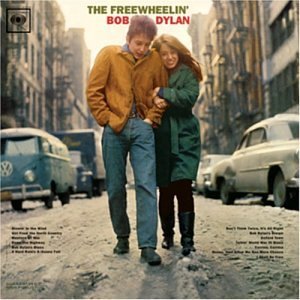
[edit]The album cover features a photograph of Dylan with Suze Rotolo. It was taken in February 1963—a few weeks after Rotolo had returned from Italy—by CBS staff photographer Don Hunstein as Dylan and Rotolo walked in the middle of Jones Street, approximately 50 feet from West 4th Street in the West Village, New York City, close to the apartment where the couple lived at the time.[102] In 2008, Rotolo described the circumstances surrounding the famous photo to The New York Times: "He wore a very thin jacket, because image was all. Our apartment was always cold, so I had a sweater on, plus I borrowed one of his big, bulky sweaters. On top of that I put on a coat. So I felt like an Italian sausage. Every time I look at that picture, I think I look fat."[103] In her memoir, A Freewheelin' Time, Rotolo analyzed the significance of the cover art:
It is one of those cultural markers that influenced the look of album covers precisely because of its casual down-home spontaneity and sensibility. Most album covers were carefully staged and controlled, to terrific effect on the Blue Note jazz album covers ... and to not-so great-effect on the perfectly posed and clean-cut pop and folk albums. Whoever was responsible for choosing that particular photograph for The Freewheelin' Bob Dylan really had an eye for a new look.[104]
Critic Janet Maslin summed up the iconic impact of the cover as "a photograph that inspired countless young men to hunch their shoulders, look distant, and let the girl do the clinging".[105]
In popular culture
[edit]The album's cover photo was carefully recreated by Cameron Crowe for his 2001 Tom Cruise-starring film Vanilla Sky[106] and by Todd Haynes for his 2007 Dylan biopic I'm Not There.[107] It also served as a visual reference for the Coen brothers' 2013 film Inside Llewyn Davis[108] and James Mangold's 2024 film A Complete Unknown.[109]
A copy of the vinyl album itself is an important prop in Jacques Rivette's 1969 film L'Amour fou. In one key scene, the male lead, Sebastien (Jean-Pierre Kalfon), is in the apartment of his girlfriend, Marta (Josée Destoop), helping her sort through LPs she could potentially re-sell in order to raise some quick cash. He holds up her copy of The Freewheelin' Bob Dylan, which she declines to sell on the grounds that she still listens to it.[110]
In November 2023, Rolling Stone cited "Bob Dylan Core", a TikTok trend inspired by the album cover, as turning Generation Z on to Dylan. The trend sees users of the app recreating the album cover, usually walking down a cold street in a small jacket. According to the article, videos tagged with the #BobDylanCore hashtag had been viewed 11.5 million times.[111]
Legacy
[edit]The success of Freewheelin' transformed the public perception of Dylan. Before the album's release, he was one among many folk-singers. Afterwards, at the age of 22, Dylan was regarded as a major artist, perhaps even a spokesman for disaffected youth. As one critic described the transformation, "In barely over a year, a young plagiarist had been reborn as a songwriter of substance, and his first album of fully realized original material got the 1960s off their musical starting block."[112] Janet Maslin wrote of the album: "These were the songs that established him as the voice of his generation—someone who implicitly understood how concerned young Americans felt about nuclear disarmament and the growing Civil Rights Movement: his mixture of moral authority and nonconformity was perhaps the most timely of his attributes".[113]
This title of "Spokesman of a Generation" was viewed by Dylan with disgust in later years. He came to feel it was a label that the media had pinned on him, and in his autobiography, Chronicles, Dylan wrote: "The press never let up. Once in a while I would have to rise up and offer myself for an interview so they wouldn't beat the door down. Later an article would hit the streets with the headline 'Spokesman Denies That He's A Spokesman'. I felt like a piece of meat that someone had thrown to the dogs".[114]
The album secured for Dylan an "unstoppable cult following" of fans who preferred the harshness of his performances to the softer cover versions released by other singers.[3] Richard Williams has suggested that the richness of the imagery in Freewheelin' transformed Dylan into a key performer for a burgeoning college audience hungry for a new cultural complexity: "For students whose exam courses included Eliot and Yeats, here was something that flattered their expanding intellect while appealing to the teenage rebel in their early-sixties souls. James Dean had walked around reading James Joyce; here were both in a single package, the words and the attitude set to music."[115] Andy Gill adds that in the few months between the release of Freewheelin' in May 1963, and Dylan's next album The Times They Are A-Changin' in January 1964, Dylan became the hottest property in American music, stretching the boundaries of what had been previously viewed as a collegiate folk music audience.[116]
Critical opinion about Freewheelin' has been consistently favorable in the years since its release. Dylan biographer Howard Sounes called it "Bob Dylan's first great album".[57] In a survey of Dylan's work published by Q magazine in 2000, the Freewheelin' album was described as "easily the best of [Dylan's] acoustic albums and a quantum leap from his debut—which shows the frantic pace at which Dylan's mind was moving." The magazine went on to comment, "You can see why this album got The Beatles listening. The songs at its core must have sounded like communiques from another plane".[117]
For Patrick Humphries, "rarely has one album so effectively reflected the times which produced it. Freewheelin' spoke directly to the concerns of its audience and addressed them in a mature and reflective manner: it mirrored the state of the nation."[112] Stephen Thomas Erlewine's verdict on the album in the AllMusic guide was: "It's hard to overestimate the importance of The Freewheelin' Bob Dylan, the record that firmly established Dylan as an unparalleled songwriter ... This is rich, imaginative music, capturing the sound and spirit of America as much as that of Louis Armstrong, Hank Williams, or Elvis Presley. Dylan, in many ways, recorded music that equaled this, but he never topped it".[88]
In March 2000, Van Morrison told the Irish rock magazine Hot Press about the impact that Freewheelin' made on him: "I think I heard it in a record shop in Smith Street. And I just thought it was incredible that this guy's not singing about 'moon in June' and he's getting away with it. That's what I thought at the time. The subject matter wasn't pop songs, ya know, and I thought this kind of opens the whole thing up ... Dylan put it into the mainstream that this could be done".[118]
Freewheelin' was one of 50 recordings chosen by the Library of Congress to be added to the National Recording Registry in 2002. The citation read: "This album is considered by some to be the most important collection of original songs issued in the 1960s. It includes 'Blowin' in the Wind,' the era's popular and powerful protest anthem."[119] The following year (2003), Rolling Stone Magazine ranked it number 97 on their list of the 500 greatest albums of all time,[97] maintaining the rating in a 2012 revised list,[120] before dropping to number 255 in a 2020 revised list.[121]
The album was included in Robert Christgau's "Basic Record Library" of 1950s and 1960s recordings, published in Christgau's Record Guide: Rock Albums of the Seventies (1981).[122] It was also included in Robert Dimery's 1001 Albums You Must Hear Before You Die.[123] It was voted number 127 in the third edition of Colin Larkin's All Time Top 1000 Albums (2000).[124]
Taylor Swift cited the album as the inspiration for her song "Betty" on Folklore. As "Betty"'s co-writer, The National's Aaron Dessner explained to Vulture, "She wanted it to have an early Bob Dylan, sort of a Freewheelin' Bob Dylan feel".[125]
Track listing
[edit]All tracks are written by Bob Dylan, except where noted.
| No. | Title | Recorded | Length |
|---|---|---|---|
| 1. | "Blowin' in the Wind" | July 9, 1962 | 2:48 |
| 2. | "Girl from the North Country" | April 24, 1963 | 3:22 |
| 3. | "Masters of War" | April 24, 1963 | 4:34 |
| 4. | "Down the Highway" | July 9, 1962 | 3:27 |
| 5. | "Bob Dylan's Blues" | July 9, 1962 | 2:23 |
| 6. | "A Hard Rain's a-Gonna Fall" | December 6, 1962 | 6:55 |
| Total length: | 23:29 | ||
| No. | Title | Writer(s) | Recorded | Length |
|---|---|---|---|---|
| 1. | "Don't Think Twice, It's All Right" | November 14, 1962 | 3:40 | |
| 2. | "Bob Dylan's Dream" | April 24, 1963 | 5:03 | |
| 3. | "Oxford Town" | December 6, 1962 | 1:50 | |
| 4. | "Talkin' World War III Blues" | April 24, 1963 | 6:28 | |
| 5. | "Corrina, Corrina" | traditional | October 26, 1962 | 2:44 |
| 6. | "Honey, Just Allow Me One More Chance" | Bob Dylan, Henry Thomas | July 9, 1962 | 2:01 |
| 7. | "I Shall Be Free" | December 6, 1962 | 4:49 | |
| Total length: | 26:35 | |||
Note: Some very early first pressing copies contained four songs that were ultimately replaced by Columbia on all subsequent pressings. These songs were "Rocks and Gravel", "Let Me Die in My Footsteps", "Rambling Gambling Willie" and "Talkin' John Birch Blues". Copies of the "original" version of The Freewheelin' Bob Dylan (in either mono or stereo) are extremely rare.
The original track listing was as follows:
| No. | Title | Recorded | Length |
|---|---|---|---|
| 1. | "Blowin' in the Wind" | July 9, 1962 | 2:46 |
| 2. | "Rocks and Gravel" | November 1, 1962 | 2:21 |
| 3. | "A Hard Rain's a-Gonna Fall" | December 6, 1962 | 6:48 |
| 4. | "Down the Highway" | July 9, 1962 | 3:10 |
| 5. | "Bob Dylan's Blues" | July 9, 1962 | 2:19 |
| 6. | "Let Me Die in My Footsteps" | April 25, 1962 | 4:05 |
| Total length: | 21:29 | ||
| No. | Title | Recorded | Length |
|---|---|---|---|
| 1. | "Don't Think Twice, It's All Right" | November 14, 1962 | 3:37 |
| 2. | "Gamblin' Willie's Dead Man's Hand" | April 24, 1962 | 4:11 |
| 3. | "Oxford Town" | December 6, 1962 | 1:47 |
| 4. | "Corrina, Corrina" (Traditional) | October 26, 1962 | 2:42 |
| 5. | "Talkin' John Birch Blues" | April 24, 1962 | 3:45 |
| 6. | "Honey, Just Allow Me One More Chance" (Dylan, Thomas) | July 9, 1962 | 1:57 |
| 7. | "I Shall Be Free" | December 6, 1962 | 4:46 |
| Total length: | 22:45 | ||
Personnel
[edit]- Bob Dylan – acoustic guitar, harmonica, vocals
Additional musicians
- Howie Collins – guitar on "Corrina, Corrina"
- Leonard Gaskin – double bass on "Corrina, Corrina"
- Bruce Langhorne – guitar on "Corrina, Corrina"
- Herbie Lovelle – drums on "Corrina, Corrina"
- Dick Wellstood – piano on "Corrina, Corrina"
Technical
- John H. Hammond – production
- Nat Hentoff – liner notes
- Don Hunstein – album cover photographer
- Tom Wilson – production
Charts
[edit]| Chart (1963) | Peak position |
|---|---|
| US Billboard 200[126] | 22 |
| Chart (1965) | Peak position |
| UK Albums Chart[127] | 1 |
| Chart (2020) | Peak position |
| Portuguese Albums (AFP)[128] | 33 |
Certifications
[edit]| Region | Certification | Certified units/sales |
|---|---|---|
| United Kingdom (BPI)[129] 2004 release |
Platinum | 300,000‡ |
| United States (RIAA)[130] | Platinum | 1,000,000^ |
|
^ Shipments figures based on certification alone. | ||
Notes
[edit]- ^ Rotolo writes that "my mother did not approve of Bob at all. He paid her no homage and she paid him none". Rotolo suspected that her mother presented her with the trip to Italy "as a fait accompli" to lure her away from her relationship with Dylan. See Rotolo 2009, p. 169.
- ^ An important recording of Dylan playing traditional material was taped in Beecher's apartment in December 1961. Misnamed the "Minneapolis Hotel Tape", the songs were released on the Great White Wonder bootleg. See Gray 2006, pp. 590–591. Beecher subsequently married counter-cultural figure Wavy Gravy.
Footnotes
[edit]- ^ Gilliland 1969, show 31, track 3.
- ^ Scaduto 2001, p. 110
- ^ a b c Gray 2006, pp. 243–244
- ^ Heylin 2000, pp. 88–89
- ^ Rotolo 2009, pp. 26–40
- ^ Heylin 2000, p. 90
- ^ Rotolo 2009, pp. 168–169
- ^ Rotolo 2009, pp. 171–181
- ^ Heylin 2000, pp. 99–101
- ^ Rotolo 2009, p. 254
- ^ Heylin 2000, p. 92
- ^ Sing Out!, October–November 1962, quoted in Sounes 2001, p. 122
- ^ Heylin 2000, pp. 98–99
- ^ a b Heylin 1996, p. 30
- ^ Heylin 1996, p. 29
- ^ Heylin 1996, p. 32
- ^ Heylin 2000, pp. 94–95
- ^ Sounes 2001, pp. 118–119
- ^ Gray 2006, p. 284
- ^ a b Sounes 2001, p. 124
- ^ Gray 2006, p. 283
- ^ Gill 1999, p. 20
- ^ Heylin 1996, p. 33
- ^ a b c d e Hentoff 1963
- ^ Heylin 1996, pp. 33–34
- ^ a b c Heylin 1996, p. 34
- ^ Heylin 1996, p. 35
- ^ a b c d Crowe 1985
- ^ Heylin 2000, p. 104
- ^ BBC TV 2007
- ^ Loder, Kurt (1984), "Interview with Kurt Loder, Rolling Stone", reprinted in Cott 2006, pp. 295–296
- ^ Heylin 2000, pp. 106–107
- ^ Sounes 2001, p. 127
- ^ Heylin 2000, p. 110
- ^ Heylin 1996, p. 40
- ^ Harvey 2001, p. 142
- ^ Heylin 2009, p. 117
- ^ Heylin 2000, p. 114
- ^ Heylin 2000, p. 115
- ^ Heylin 1996, p. 43
- ^ Heylin 1996, p. 44
- ^ Scaduto 2001, p. 141
- ^ Heylin 2000, pp. 114–117
- ^ Scaduto 2001, p. 142
- ^ Gray 2006, p. 244
- ^ a b Thompson 2002, pp. 12–13
- ^ Sharp 2007
- ^ a b Bauldie 1991
- ^ Gill 1999, p. 23
- ^ Sounes 2001, p. 135
- ^ Bob Dylan's Hibbing. Hibbing, Minnesota: EDLIS Café Press. 2019. ISBN 978-1-09-178289-1.
- ^ Heylin 2009, pp. 120–121
- ^ Sounes 2001, p. 47
- ^ Jürgen Kloss (June 16, 2012). ""...She Once Was A True Love Of Mine" - Some Notes About Bob Dylan's "Girl From The North Country"". ....Just Another Tune: Songs & Their History. Retrieved February 1, 2025.
- ^ Harvey 2001, pp. 33–34
- ^ Sounes 2001, p. 128
- ^ a b c Sounes 2001, p. 132
- ^ a b Shelton 2003, p. 155
- ^ Harvey 2001, p. 17
- ^ Heylin 2000, p. 102
- ^ Terkel, Studs (1963). "Radio Interview with Studs Terkel, WFMT (Chicago)", reprinted in Cott 2006, pp. 6–7
- ^ Shelton 2003, pp. 155–156
- ^ Gill 1999, p. 31
- ^ Sounes 2001, p. 122
- ^ Heylin 2000, p. 101
- ^ Harvey 2001, p. 24
- ^ MacDowell, Jay (May 2, 2024). "The Story Behind "Don't Think Twice, It's All Right" by Bob Dylan and Why It's Not a Love Song". American Songwriter. Savage Ventures. Retrieved August 1, 2025.
- ^ Spitz 1989, pp. 199–200
- ^ Harvey 2001, pp. 25–26
- ^ Sounes 2001, p. 120
- ^ Harvey 2001, p. 19
- ^ Gill 1999, pp. 32–33
- ^ a b Harvey 2001, p. 103
- ^ Harvey 2001, pp. 20–22
- ^ Shelton 2003, pp. 173, 178
- ^ Heylin 2000, p. 99
- ^ Harvey 2001, p. 50
- ^ Shelton 2003, p. 157
- ^ Harvey 2001, p. 52
- ^ Heylin 1996, pp. 30–43
- ^ Three Song Sampler 2005
- ^ a b c d e Escott 2010
- ^ Heylin 1995, p. 11
- ^ Broadside Ballads, Vol. 6: Broadside Reunion
- ^ Browne 2005
- ^ Collette 2005
- ^ Gorodetsky 2005
- ^ a b Erlewine
- ^ Larkin, Colin (2007). The Encyclopedia of Popular Music (4th ed.). Oxford University Press. ISBN 978-0-19-531373-4.
- ^ Flanagan 1991
- ^ Brackett & Hoard 2004, p. 262
- ^ Graff, Gary; Durchholz, Daniel, eds. (1999). MusicHound Rock: The Essential Album Guide (2nd ed.). Farmington Hills, MI: Visible Ink Press. p. 369. ISBN 1-57859-061-2.
- ^ Hull, Tom (June 21, 2014). "Rhapsody Streamnotes: June 21, 2014". tomhull.com. Archived from the original on March 1, 2020. Retrieved March 1, 2020.
- ^ a b Scaduto 2001, p. 144
- ^ Sounes 2001, p. 136
- ^ Heylin 2000, p. 120
- ^ a b Levy 2005
- ^ Dylan's deposition of October 15, 1984, in the case Albert B. Grossman et al. vs. Bob Dylan; quoted in Sounes 2001, p. 132
- ^ Sounes 2001, p. 133
- ^ The Beatles 2000, p. 114
- ^ Kirby, David (October 21, 2010). "Bob Dylan unfiltered: Fall tour brings new releases, old recordings". The Christian Science Monitor. Archived from the original on May 10, 2013. Retrieved March 30, 2012.
- ^ Carlson 2006
- ^ DeCurtis, Anthony (May 11, 2008). "Memoirs of a Girl From the East Country (O.K., Queens)". The New York Times. Archived from the original on December 7, 2011. Retrieved March 4, 2011.
- ^ Rotolo 2009, p. 217
- ^ Miller 1981, p. 221
- ^ Nobody. "The Freewheelin Bob Dylan". Archived from the original on September 12, 2016. Retrieved November 18, 2016.
- ^ "Suze Rotolo: A Freewheelin' Time". AUX. May 22, 2008. Retrieved February 26, 2021.
- ^ "It's Cold Outside: The Style of Llewyn Davis". Classiq – An online journal that celebrates cinema, culture, style and storytelling. November 26, 2018. Retrieved February 26, 2021.
- ^ Korpan, Andrew (December 17, 2024). "Exclusivie: A Complete Unknown DP Drops Revelation On Cut Timothée Chalamet Scene". ClutchPoints | Entertainment News. Retrieved December 19, 2024.
- ^ michaelgloversmith (May 21, 2012). "A Decalogue of the Dopest Dylan References in Movies". White City Cinema. Retrieved February 26, 2021.
- ^ Martoccio, Angie (November 18, 2023). "What Is Bob Dylan Core? Inside the Hot New TikTok Trend of … Braving the Cold in a Thin Jacket". Rolling Stone. Retrieved November 19, 2023.
- ^ a b Humphries 1991, p. 43
- ^ Miller 1981, p. 220
- ^ Dylan 2004, p. 119
- ^ Williams 1992, p. 53
- ^ Gill 1999, p. 37
- ^ Harris 2000, p. 138
- ^ Heylin 2003, p. 134
- ^ The Library of Congress 2002
- ^ "500 Greatest Albums of All Time Rolling Stone's definitive list of the 500 greatest albums of all time". Rolling Stone. 2012. Archived from the original on June 28, 2019. Retrieved September 19, 2019.
- ^ "The 500 Greatest Albums of All Time". Rolling Stone. September 22, 2020. Retrieved August 20, 2021.
- ^ Christgau, Robert (1981). "A Basic Record Library: The Fifties and Sixties". Christgau's Record Guide: Rock Albums of the Seventies. Ticknor & Fields. ISBN 0-89919-025-1. Retrieved March 16, 2019 – via robertchristgau.com.
- ^ Robert Dimery; Michael Lydon (March 23, 2010). 1001 Albums You Must Hear Before You Die: Revised and Updated Edition. Universe. ISBN 978-0-7893-2074-2.
- ^ Colin Larkin, ed. (2006). All Time Top 1000 Albums (3rd ed.). Virgin Books. p. 82. ISBN 0-7535-0493-6.
- ^ Gerber, Brady (July 27, 2020). "The Story Behind Every Song on Taylor Swift's folklore". Vulture. Retrieved March 22, 2021.
- ^ The Freewheelin' Bob Dylan – Bob Dylan: Awards at AllMusic. Retrieved July 28, 2012.
- ^ "THE FREE WHEELIN' BOB DYLAN". Official Charts. May 23, 1964. Retrieved July 10, 2024.
- ^ "Portuguesecharts.com – Bob Dylan – The Freewheelin' Bob Dylan". Hung Medien. Retrieved June 7, 2020.
- ^ "British album certifications – Bob Dylan – The Freewheelin'". British Phonographic Industry. Retrieved February 7, 2025.
- ^ "American album certifications – Bob Dylan – The Freewheelin_ Bob Dylan". Recording Industry Association of America.
References
[edit]- Bauldie, John (1991). The Bootleg Series Volumes 1–3 (Rare & Unreleased) 1961–1991 (booklet). Bob Dylan. New York: Columbia Records.
- The Beatles (2000). The Beatles Anthology. Cassell & Co. ISBN 0-304-35605-0.
- Björner, Olof (October 21, 2010). "Still on the Road: 1962 Concerts and Recording Sessions". Bjorner.com. Archived from the original on November 20, 2010. Retrieved November 12, 2010.
- Brackett, Nathan; Hoard, Christian (2004). The New Rolling Stone Album Guide (Media notes) (4th ed.). Fireside. ISBN 0-7432-0169-8. Archived from the original on October 12, 2019. Retrieved August 6, 2019.
- "Broadside Ballads, Vol. 6: Broadside Reunion". Folkways Records. Archived from the original on May 14, 2013. Retrieved May 19, 2013.
- Browne, David (October 30, 2005). "EW reviews: Kanye West and Bob Dylan". CNN. Archived from the original on August 25, 2010. Retrieved April 3, 2010.
- Carlson, Jen (April 18, 2006). "NYC Album Art: The Freewheelin' Bob Dylan". Gothamist. Archived from the original on March 28, 2010. Retrieved March 4, 2010.
- Collette, Doug (November 12, 2005). "Bob Dylan: No Direction Home & Live at the Gaslight 1962". Allaboutjazz.com. Archived from the original on June 5, 2011. Retrieved April 3, 2010.
- Cott, Jonathan, ed. (2006). Dylan on Dylan: The Essential Interviews. Hodder & Stoughton. ISBN 0-340-92312-1.
- Crowe, Cameron (1985). Biograph (booklet). Bob Dylan. New York: Columbia Records.
- Dylan, Bob (2004). Chronicles: Volume One. Simon and Schuster. ISBN 0-7432-2815-4.
- "Dylan in the Madhouse". BBC TV. October 14, 2007. Archived from the original on May 14, 2011. Retrieved August 31, 2009.
- Erlewine, Stephen Thomas. "The Freewheelin' Bob Dylan". AllMusic. Retrieved March 11, 2010.
- Escott, Colin (2010). The Bootleg Series Vol. 9: The Witmark Demos: 1962–1964 (booklet). Bob Dylan. New York: Columbia Records.
- Flanagan, Bill (May 29, 1991). "Dylan Catalog Revisited". Entertainment Weekly. Archived from the original on September 28, 2011. Retrieved September 10, 2011.
- "The Freewheelin' Bob Dylan". Rolling Stone. Archived from the original on February 8, 2013. Retrieved January 27, 2013.
- Gill, Andy (1999). Classic Bob Dylan: My Back Pages. Carlton. ISBN 1-85868-599-0.
- Gilliland, John (1969). "Ballad in Plain D: An introduction to the Bob Dylan era" (audio). Pop Chronicles. University of North Texas Libraries.
- Gorodetsky, Eddie (2005). No Direction Home: The Soundtrack—The Bootleg Series Volume 7 (booklet). Bob Dylan. New York: Columbia Records.
- Gray, Michael (2006). The Bob Dylan Encyclopedia. Continuum International. ISBN 0-8264-6933-7. Archived from the original on September 9, 2019. Retrieved August 6, 2019.
- Harris, John, ed. (2000). "Q Dylan: Maximum Bob! The Definitive Celebration of Rock's Ultimate Genius". Q magazine.
- Harvey, Todd (2001). The Formative Dylan: Transmission & Stylistic Influences, 1961–1963. The Scarecrow Press. ISBN 0-8108-4115-0.
- Hentoff, Nat (1963). The Freewheelin' Bob Dylan (Media notes). Bob Dylan. New York: Columbia Records.
- Heylin, Clinton (1995). Bob Dylan: The Recording Sessions: 1960–1994. St. Martin's Griffin. ISBN 0-312-15067-9. Archived from the original on July 22, 2011. Retrieved January 8, 2011.
- Heylin, Clinton (1996). Bob Dylan: A Life In Stolen Moments: Day by Day 1941–1995. Schirmer Books. ISBN 0-7119-5669-3.
- Heylin, Clinton (2000). Bob Dylan: Behind the Shades Revisited. Perennial Currents. ISBN 0-06-052569-X. Archived from the original on February 22, 2014. Retrieved January 8, 2011.
- Heylin, Clinton (2003). Can You Feel the Silence? Van Morrison: A New Biography. Chicago Review Press. ISBN 1-55652-542-7.
- Heylin, Clinton (2009). Revolution in the Air: The Songs of Bob Dylan, Volume One: 1957–73. Constable. ISBN 978-1-55652-843-9. Archived from the original on June 6, 2014. Retrieved January 8, 2011.
- Humphries, Patrick (1991). Oh No! Not Another Bob Dylan Book. Square One Books. ISBN 1-872747-04-3.
- Levy, Joe, ed. (2005). The Greatest 500 Albums of All Time. Wenner Books. ISBN 1-932958-61-4.
- Miller, Jim, ed. (1981). The Rolling Stone History of Rock & Roll. Picador. ISBN 0-330-26568-7.
- "The National Recording Registry". The Library of Congress. June 9, 2002. Archived from the original on March 15, 2015. Retrieved February 28, 2010.
- Rotolo, Suze (2009). A Freewheelin' Time. Aurum Press. ISBN 978-0-7679-2688-1.
- Scaduto, Anthony (2001). Bob Dylan. Helter Skelter. ISBN 1-900924-23-4.
- Sharp, Johnny (March 1, 2007). "Scrap that recording—it'll become an instant classic". The Guardian. Archived from the original on August 8, 2014. Retrieved March 20, 2010.
- Shelton, Robert (2003). No Direction Home. Da Capo Press. ISBN 0-306-81287-8.
- Sounes, Howard (2001). Down The Highway: The Life Of Bob Dylan. Grove Press. ISBN 0-8021-1686-8.
- Spitz, Bob (1989). Dylan: A Biography. W. W. Norton & Co. ISBN 0-393-30769-7.
- Thompson, Dave (2002). The Music Lover's Guide to Record Collecting. Backbeat Books. ISBN 0-87930-713-7.
- "Three Song Sampler". iTunes. November 14, 2005. Retrieved May 19, 2013.[dead link]
- Williams, Richard (1992). Dylan: a man called alias. Bloomsbury. ISBN 0-7475-1084-9.

| International | |
|---|---|
| Other | |

The Freewheelin' Bob Dylan
View on GrokipediaBackground and Development
Dylan's Early Career Shift
Bob Dylan's self-titled debut album, released on March 19, 1962, by Columbia Records, primarily featured covers of traditional folk and blues songs, with only two original compositions.[9] The record achieved modest commercial results, selling approximately 2,500 to 5,000 copies initially and failing to chart significantly, which underscored its underperformance amid the era's folk revival market.[10] [11] Critical reception was lukewarm, with reviewers noting Dylan's raw potential but critiquing the album's derivative approach and lack of distinctive voice, positioning it as a tentative entry rather than a breakthrough.[9] [10] Following the debut, Dylan deepened his involvement in New York City's Greenwich Village folk scene, a hub for acoustic performers drawing on Appalachian, blues, and protest traditions. There, he frequently interacted with established figures like Dave Van Ronk, a prominent folk singer whose expansive repertoire and interpretive style influenced Dylan's early performances, including uncredited adaptations of Van Ronk's arrangements.[12] [13] Amid a competitive environment where imitation of folk standards was commonplace, Dylan recognized the limitations of relying on covers for artistic and professional sustainability, prompting a deliberate pivot toward original songwriting to forge a unique identity and secure greater autonomy from scene expectations.[14] [15] This evolution manifested empirically in Dylan's live repertoire by late 1962, as bootlegged and archival recordings from venues like the Gaslight Cafe captured an increasing proportion of self-composed material in his sets, signaling accelerated creative output over rote reproduction.[16] [17] Such performances, documented from October 1962 onward, reflected a pragmatic response to market realities—originals offered differentiation in a saturated folk circuit—laying the groundwork for The Freewheelin' Bob Dylan as a showcase of innovation rather than emulation.[18] [19]Personal Influences and Songwriting Genesis
Bob Dylan's relationship with Suze Rotolo, which began in 1961 and ended amid strains by early 1962, directly catalyzed several introspective love songs on The Freewheelin' Bob Dylan, including "Don't Think Twice, It's All Right" and "One Too Many Mornings," where themes of separation and emotional detachment reflect the personal turmoil of their breakup. Rotolo, an artist active in New York's folk and civil rights circles, introduced Dylan to European literature such as Arthur Rimbaud's poetry and Bertolt Brecht's works, broadening his lyrical palette beyond American folk traditions and infusing his writing with surreal, impressionistic elements. Their joint travels in Europe during 1962 further shaped these compositions, providing experiential fodder for songs evoking transience and romantic disillusionment, as Dylan drafted material in notebooks during this period of flux.[20][21] Dylan's early songwriting on the album emulated Woody Guthrie's hobo-style narratives and melodic simplicity, as seen in his 1961 composition "Song to Woody," written after visiting the ailing Guthrie in Greystone Park Psychiatric Hospital on January 29, 1961, but Dylan infused these with personal surrealism, diverging from Guthrie's didactic realism toward ambiguous, visionary imagery. This synthesis stemmed from Dylan's immersion in Guthrie's Bound for Glory autobiography and recordings, which he absorbed upon arriving in New York in January 1961, prompting him to adopt a Dust Bowl persona while adapting folk melodies to original, introspective lyrics rather than strict emulation. Evidence of this evolution appears in Dylan's rapid output of originals between late 1961 and early 1963, prioritizing craft over imitation.[22][23] While contemporary events like the 1962 University of Mississippi integration crisis informed "Oxford Town" and Cold War nuclear anxieties surfaced in "A Hard Rain's a-Gonna Fall," Dylan treated these as raw poetic material for universal questions, not prescriptive advocacy, as he explicitly rejected the "protest singer" label in a 1963 interview, stating, "I don't write no protest songs," emphasizing lyrical ambiguity to evoke broader human conditions over ideological blueprints. This stance aligned with his aversion to formulaic topicality, favoring first-hand observation and folk synthesis, a position he maintained despite songs like "Blowin' in the Wind" later being co-opted by civil rights activists without his endorsement as anthems. Dylan's pre-studio drafts thus crystallized personal genesis over politicized intent, setting the album's material apart from mere reportage.[24][14][25]Production Process
New York Recording Sessions
The New York recording sessions for The Freewheelin' Bob Dylan took place at Columbia Records' Studio A in New York City, spanning multiple dates from April to December 1962 under producer John Hammond.[26] Hammond, who had signed Dylan after a 1961 audition and produced his debut album, maintained a non-interventionist style that prioritized capturing the artist's unpolished acoustic guitar and harmonica-driven performances with sparse instrumentation and few overdubs.[27] This method contrasted with the more orchestrated approaches of contemporaneous folk recordings, enabling Dylan's direct vocal delivery and phrasing to dominate the sound.[1] Initial sessions occurred on April 24 and 25, 1962, where Dylan recorded early versions of originals like "Girl from the North Country" and covers, though many tracks required later revisits for refinement.[28] A pivotal July 9, 1962, session produced the master take of "Blowin' in the Wind," recorded solo with acoustic guitar after Dylan arrived at the studio with the freshly composed song.[24] By late 1962, sessions on November 14 and December 6 yielded key tracks, including "A Hard Rain's a-Gonna Fall" in a single take on December 6, reflecting the efficiency driven by Dylan's preparedness and Hammond's focus on live-feel authenticity over extensive editing.[29] These New York efforts formed the album's core, with approximately 30 songs attempted across eight sessions, emphasizing Dylan's evolving songcraft through iterative solo and light ensemble takes.[30]Overseas Travel and Supplemental Takes
In December 1962, Bob Dylan undertook his first trip outside the United States, arriving in London on December 17 to participate in a BBC television play titled The Madhouse on Castle Street, where he performed "Blowin' in the Wind" and other songs informally.[31] During this visit, which extended into early 1963 and included stops in Italy before his return to New York by mid-January, Dylan engaged with the British folk scene, meeting musicians such as Martin Carthy and absorbing traditional ballads like "Scarborough Fair."[32] These encounters exposed him to melodic structures and lyrical phrasings rooted in English and Irish folk traditions, prompting adaptations that informed revisions to existing material rather than serving as a premeditated production phase.[31] The journey functioned less as a structured recording endeavor and more as an opportunistic source of maturation, broadening Dylan's stylistic palette through direct immersion in global folk variants without imposing ideological overlays; contemporaries noted his selective absorption of performative techniques, such as fingerpicking patterns, which enhanced rhythmic subtlety in subsequent takes.[32] Upon returning to New York in mid-January 1963, Dylan reconvened at Columbia's Studio A for supplemental sessions, focusing on refinements driven by these fresh insights, including the remake of "Girl from the North Country" on January 13, which incorporated harmonic echoes of the traditional tunes encountered abroad.[1] These efforts prioritized evolving arrangements over wholesale reinvention, with logs from the period indicating targeted overdubs and retakes to capture matured interpretations, bridging earlier drafts toward the album's cohesive sound.[31] This post-travel phase underscored Dylan's pragmatic approach to production, where external stimuli catalyzed iterative improvements—evident in the streamlined acoustics and narrative depth added to tracks like "Bob Dylan's Dream," originally sketched pre-trip but polished for greater evocative precision—without derailing the album's folk authenticity or veering into prescriptive activism.[33] The sessions, spanning several days in January, logged approximately 10-15 hours of focused work across multiple takes, emphasizing efficiency in resolving unresolved elements from prior New York dates and setting the stage for editorial selections of outtakes.[1]Outtakes and Editorial Decisions
During the recording sessions for The Freewheelin' Bob Dylan between April and November 1962, Dylan and producer John Hammond generated over a dozen outtakes, reflecting an iterative process of experimentation with covers, originals, and alternate takes that did not align with the album's final structure. Notable exclusions included "Let Me Die in My Footsteps," an anti-nuclear protest song recorded on October 23, 1962; "Gamblin' Willie's Dead Man's Hand," a narrative ballad from the same session; and "Rocks and Gravel," a traditional cover attempted early on. These were part of early test pressings but ultimately discarded to prioritize Dylan's recent original compositions, such as "A Hard Rain's a-Gonna Fall" and "Masters of War," which offered greater lyrical density and personal urgency over borrowed or extended topical material.[34][35] The most prominent outtake, "Talkin' John Birch Society Blues," a satirical monologue recorded on April 24, 1962, critiquing the anti-communist John Birch Society's conspiratorial worldview, appeared on initial mono pressings prepared for release in early 1963. Its removal stemmed from commercial pragmatism: on May 12, 1963, CBS censors barred Dylan from performing it on The Ed Sullivan Show, citing potential libel against the organization, prompting Columbia Records to recall approximately 250,000 copies on the eve of wider distribution to avert litigation and safeguard promotional opportunities like television appearances. The track was replaced by "Masters of War," shifting the album toward broader anti-militarism without the risk of targeted backlash.[36][37] Dylan's editorial control emphasized curation for tonal balance and artistic versatility, with minimal intervention from Columbia beyond the forced recall; he selected tracks to intermix grave political anthems like "Blowin' in the Wind" with humorous, introspective pieces such as "I Shall Be Free" and "Don't Think Twice, It's All Right," deliberately countering expectations of a uniform "protest singer" identity. This self-directed pruning favored coherence—eschewing overly lengthy or mismatched narratives in favor of a runtime under 50 minutes and a sequence that alternated intensity—over exhaustive inclusion, as evidenced by the exclusion of redundant session takes like alternate versions of "House of the Risin' Sun" or covers such as "Corrina, Corrina," which duplicated stylistic ground already covered.[34][38]Content and Themes
Lyrical Structure and Folk Roots
The album's eleven tracks predominantly employ strophic forms derived from folk ballad traditions, featuring sequences of verses that unfold narratives or rhetorical questions with minimal refrains, allowing for fluid progression and interpretive openness. This structure echoes the storytelling conventions of Anglo-American folk music, where lyrics prioritize linear development over pop-derived verse-chorus rigidity, as Dylan adapted from sources like British broadsides and Appalachian tunes during his early immersion in the folk revival scene.[39][40] Instrumentation reinforces these roots, centering on Dylan's acoustic guitar strumming and harmonica riffs—hallmarks of rural folk and blues traditions that emphasize raw vocal delivery and sparse accompaniment to highlight lyrical content. While traditional ballads often relied on end-rhyme couplets for mnemonic simplicity, Dylan's innovations incorporate slant rhymes, internal assonances, and irregular meter shifts, enhancing rhythmic propulsion and poetic ambiguity without abandoning the form's narrative drive.[41][42] The sequencing across vinyl sides contributes to an overarching arc: the first side accumulates intensity through escalating thematic density in its six tracks, transitioning to a more relaxed cadence on the second side's five, blending original works with reinterpretations of folk standards like "Corrina, Corrina"—a pre-World War II blues-folk hybrid—to anchor modernist experimentation in verifiable tradition. This hybridity underscores Dylan's method of extending folk processes, where borrowed melodies and motifs serve as scaffolds for personal invention, verifiable through his documented adaptations from archival collections.[1][43]Political Elements: Craft Over Ideology
The album's politically oriented tracks, including "Blowin' in the Wind," "Masters of War," and "A Hard Rain's A-Gonna Fall," employ rhetorical devices and vivid imagery drawn from folk traditions and literary influences rather than explicit ideological manifestos. "Blowin' in the Wind," for instance, structures its critique through a series of nine rhetorical questions probing human blindness to injustice, war, and freedom, echoing the interrogative form of spirituals and ballads without prescribing solutions.[44] Biblical allusions, such as the dove and wind evoking the Holy Spirit, further frame these inquiries as poetic meditations on eternal verities, not transient activism.[45] Dylan debuted "Blowin' in the Wind" live at Gerde's Folk City in April 1962, prefacing it with the remark, "This here ain't no protest song or anything like that, 'cause I don't write no protest songs," signaling his resistance to categorization as a topical agitator.[46] Similarly, "Masters of War" adapts the melody of the traditional "Nottamun Town" to deliver a venomous litany against arms manufacturers, invoking hellfire and biblical curses like "Even Jesus would never forgive what you do," yet its power lies in hyperbolic rhetoric over policy analysis, composed amid the October 1962 Cuban Missile Crisis headlines that heightened nuclear dread.[47] "A Hard Rain's A-Gonna Fall," also linked to the crisis's existential shadow, unfolds in surreal, symbolist vignettes inspired by Arthur Rimbaud—visions of poisoned rivers, crooked highways, and ten thousand swords—structured as an expanded question-and-answer ballad akin to "Lord Randal," where each image expands into potential songs but coalesces into apocalyptic prophecy rather than actionable dissent. This defies literal interpretation, as Dylan later clarified the "hard rain" was not confined to nuclear fallout but a broader cascade of societal ills.[48] While these songs channeled contemporary tensions—the Missile Crisis's brinkmanship and civil rights clashes into folk idiom, amplifying critique's reach—their vagueness limited causal specificity, inspiring rallies yet offering no mechanisms for change beyond moral indictment. Dylan's craft prioritized lyrical compression and archaic echoes over ideological blueprinting, yielding evocative ambiguity that resonated widely but invited projection. By 1964, he distanced himself from such output, decrying the proliferation of "finger-pointing songs" that merely highlighted flaws without deeper insight, marking his shift from accusatory verse toward personal exploration.[49] This phase's moral urgency sometimes overshadowed melodic innovation, as raw topicality strained against weaker harmonic frameworks in tracks like "Masters of War," though their poetic bite endures as literary artifacts of era's unease.[47]Personal Narratives and Humor
The album features several songs rooted in personal experience, particularly romantic relationships. "Girl from the North Country" conveys wistful longing for a distant lover through stark imagery of winter isolation and echoing memories, structured around a traditional folk melody adapted with Dylan's original lyrics to emphasize emotional separation.[50] Similarly, "Don't Think Twice, It's All Right" adopts a blues-inflected fingerpicking style to articulate a narrator's resolute departure from a faltering romance, blending resignation with self-assured detachment in lines that prioritize individual freedom over reconciliation. This track reflects Dylan's mid-1962 breakup with Suze Rotolo, whose influence permeates the album's intimate reflections on autonomy amid relational strain.[21][51] "Bob Dylan's Dream" further humanizes these narratives through a dreamlike recounting of youthful camaraderie lost to time's passage, employing a waltz-like rhythm to mourn the erosion of once-vibrant bonds and the inevitability of change. These pieces underscore emotional authenticity by drawing on autobiographical elements without overt sentimentality, allowing vulnerability to emerge via understated verse rather than didactic moralizing. Countering the album's denser themes, Dylan infuses humor through surreal and satirical tracks. "Talkin' World War III Blues" unfolds as a talking blues recounting an apocalyptic dream, where post-nuclear absurdities—like scavenging Cadillacs and debating philosophers amid ruins—satirize Cold War anxieties with deadpan wit, transforming existential dread into comedic reverie.[52] "I Shall Be Free," meanwhile, rambles through absurd non-sequiturs blending domestic trivia with fantastical escapism, such as romancing Jackie Kennedy or evading political figures, evidencing Dylan's anti-sentimental bent via stream-of-consciousness levity that mocks conformity and elevates the ridiculous.[53] Together, these songs reveal protest as merely one dimension of Dylan's oeuvre, prioritizing relatable human quirks and irreverence to broaden the album's scope beyond ideological gravity.Release and Alterations
Initial Pressing and Censorship Incident
The album The Freewheelin' Bob Dylan was released on May 27, 1963, by Columbia Records in both mono (catalog CL 1986) and stereo (CS 8786) editions.[3] Initial pressings included the track "Talkin' John Birch Paranoid Blues," a satirical talking blues that parodied the anti-communist paranoia of the John Birch Society, an ultra-conservative organization founded in 1958.[54] The song's inclusion stemmed from Dylan's recording of it on October 26, 1962, during early sessions, positioning it as the seventh track in place of "Masters of War."[55] On May 12, 1963—two weeks before the album's launch—Dylan rehearsed "Talkin' John Birch Paranoid Blues" for The Ed Sullivan Show, but CBS network censors banned it, citing potential libel against the John Birch Society due to its depiction of members searching for communists in absurd locations like their ice cream.[54] [55] Dylan refused to select an alternative song, walking off the show in protest. In response, Columbia Records hastily withdrew all initial pressings containing the track to avert commercial backlash or legal threats from the society, which had publicly criticized the song's content.[56] The track was replaced by "Masters of War," an anti-militarism piece Dylan had recorded on January 9, 1963, during the album's New York sessions; updated pressings hit the market shortly thereafter. Only a small number of the original LPs—estimated by collectors at fewer than 300 copies—escaped destruction or recall, rendering them among the rarest Dylan artifacts and commanding high values at auction.[57] This episode reflected Columbia's market-driven caution amid Cold War-era sensitivities, prioritizing broad accessibility over retaining provocative satire that risked alienating conservative audiences and hindering Dylan's breakthrough. Dylan, focused on career momentum, acquiesced to the label's decision, foreshadowing his later rejection of rigid protest-song expectations in favor of personal and surrealist expressions. Left-leaning observers have framed the removal as industry self-censorship capitulating to right-wing pressure, potentially muting anti-conservative critique, while the song's bite—rooted in exaggerated societal fears rather than partisan allegiance—underscored Dylan's apolitical contrarianism, as he avoided endorsing any ideology.[56]Artwork and Visual Presentation
The album's cover features a black-and-white photograph taken by Columbia Records staff photographer Don Hunstein in February 1963, showing Bob Dylan walking arm-in-arm with his girlfriend Suze Rotolo down Jones Street in Greenwich Village, New York City, amid light snowfall.[58][59] The impromptu session captured Dylan in a brown leather jacket and blue jeans, with Rotolo clinging to his arm in a bulky green coat and black pants, evoking a sense of casual urban intimacy against the cold winter backdrop.[58] This visual emphasized Dylan's folk authenticity through everyday simplicity, contrasting the raw, unpolished ethos of his music with the gritty Village streets.[60] The title "The Freewheelin' Bob Dylan" reflects Dylan's self-fashioned hobo wanderer persona, drawing from the free-spirited, nomadic traditions he invoked in his early career narratives.[61] Liner notes on the back cover, authored by Dylan, consist of cryptic, humorous pseudobiographies for the tracks, such as fabricating absurd origins for songs to enhance his mysterious, anti-establishment image.[62] Critics have noted that the cover's romanticized depiction of harmony masked personal strains, as Dylan and Rotolo's relationship was deteriorating by the shoot's time, tensions that later surfaced in Dylan's lyrics expressing resentment toward her family.[21][63] Nonetheless, the artwork's stark, unadorned design achieved iconic identifiability, with the couple's huddled pose and snowy setting boosting the album's visual appeal and reinforcing Dylan's image as a youthful folk troubadour.[6]Reception
Contemporary Critiques and Praise
Upon its release on May 27, 1963, The Freewheelin' Bob Dylan garnered praise from folk and mainstream critics for elevating personal and topical songwriting within the genre. New York Times critic Robert Shelton, whose 1961 profile had propelled Dylan's early visibility by describing him as a "distinctive stylist" blending Woody Guthrie influences with poetic originality, viewed the album's tracks—particularly "Blowin' in the Wind"—as advancing topical folk expression beyond mere reportage. The Village Voice spotlighted the record in its July 25, 1963, issue, aligning it with the burgeoning Greenwich Village scene's emphasis on authentic, narrative-driven folk innovation.[64] Critiques emerged primarily from folk purists wary of Dylan's evolving style, which deviated from traditional balladry toward more individualistic, cryptic narratives. A Minneapolis folk newsletter deemed the album a "great disappointment," faulting Dylan's vocal delivery as "affected" and "pretentious" amid its blend of humor, romance, and protest themes like those in "Masters of War."[34] While leftist outlets embraced its civil rights and anti-militarism elements, Dylan distanced himself from spokesperson expectations in contemporaneous interviews, emphasizing craft over ideological alignment.[34] This spectrum reflected broader tensions in the folk revival between preservationist orthodoxy and Dylan's push toward lyrical autonomy, though universal acclaim eluded the release.Sales Data and Market Response
Upon its release in May 1963, The Freewheelin' Bob Dylan debuted at number 125 on the Billboard 200 chart on September 7, reflecting limited initial commercial traction amid Dylan's status as an emerging folk artist without prior mainstream hits.[65] The album climbed to a peak of number 22 on October 5, 1963, buoyed by the folk revival's growing popularity but constrained by Dylan's relative obscurity compared to established acts like Peter, Paul and Mary, whose cover of "Blowin' in the Wind" reached number 2 on the Billboard Hot 100 in August 1963, introducing Dylan's songwriting to broader audiences and indirectly supporting album sales.[65][66] The album's U.S. performance underscored a niche market response, with sales accumulating steadily rather than exploding, as folk music's appeal remained segmented from pop dominance; it has since been certified platinum by the RIAA for shipments exceeding one million units, indicating long-term viability tied to Dylan's rising profile rather than immediate blockbuster status. Internationally, uptake lagged initially but surged in the UK, where it first charted in 1965 amid the British folk and beat boom, reaching number 1 on April 17 and holding for one week, driven by cross-Atlantic interest in Dylan's catalog post his electric pivot.[67] This delayed peak highlighted causal factors like regional revival waves and cover-driven exposure over organic debut momentum.Legacy and Reassessment
Broader Cultural Footprint
The album's songs exerted a demonstrable influence on subsequent rock songwriting by elevating literary depth and personal narrative over simplistic structures, as evidenced by its role in prompting The Beatles to incorporate more introspective, folk-derived compositions following their exposure to it in 1963.[68] John Lennon, in particular, underwent a stylistic shift toward Dylanesque phrasing and thematic ambiguity in tracks like "You've Got to Hide Your Love Away" from 1965's Help!, attributing this evolution directly to Freewheelin' after receiving an advance copy from Dylan associate Al Aronowitz.[69] This causal link is supported by contemporaneous accounts of Lennon circulating the album among bandmates, fostering a reciprocal dynamic that bridged folk traditions with emerging rock electrification, though Dylan's acoustic purity on the record itself underscored a transitional rather than revolutionary sonic break.[70] "Blowin' in the Wind," the album's opener, achieved outsized reach through covers that amplified its rhetorical questions on freedom and war without altering policy trajectories, instead embedding them in broader 1960s cultural discourse. Peter, Paul and Mary's version, released June 1963, peaked at number two on the Billboard Hot 100 and sold over a million copies, introducing Dylan's work to mass audiences via folk-pop accessibility and civil rights performances, yet the song's impact remained symbolic rather than legislative, with no direct causal evidence tying it to specific reforms.[71] Over 375 artists have since recorded it, including renditions by Stevie Wonder and Bob Marley, democratizing access to protest lyricism but often diluting its surreal undertones in favor of straightforward activism anthems.[34][72] While frequently linked to Vietnam-era media and rallies—such as its use in 1960s newsreels—the album's footprint prioritized songcraft innovation over ideological mobilization, countering narratives of Dylan as a movement figurehead given his documented reluctance to perform at organized events.[73] Tracks like "A Hard Rain's A-Gonna Fall" inspired apocalyptic imagery in later works by artists including Bruce Springsteen, yet empirical analysis reveals no verifiable shifts in public policy or activism metrics attributable to the record, emphasizing instead its elevation of individual poetic voice amid folk revival conventions dominated by traditional covers.[74] This overassociation with 1960s progressivism has obscured the album's surreal and humorous elements, such as in "Bob Dylan's Blues," which prioritized artistic experimentation over partisan utility.[75]Dylan's Disavowal and Artistic Evolution
Following the release of The Freewheelin' Bob Dylan in May 1963, Dylan publicly rejected the mantle of protest singer, emphasizing that his compositions stemmed from personal introspection rather than ideological activism. At the March on Washington for Jobs and Freedom on August 28, 1963, he introduced "When the Ship Comes In" by stating, "This here ain't a protest song or anything like that," signaling his discomfort with being cast as a movement spokesman.[76] In a contemporaneous interview, Dylan clarified, "I don't write protest songs... I'm just writing it as something to be said, really," underscoring his intent to pose questions about human experience rather than prescribe solutions or align with causes.[77] This stance critiqued the folk scene's tendency to politicize ambiguous lyrics, such as those in "Blowin' in the Wind," which vagueness had enabled audiences and activists to co-opt as rallying cries despite Dylan's focus on artistic expression over utility. Dylan's artistic shift manifested in his next album, Bringing It All Back Home, released on March 22, 1965, which divided into acoustic folk on side one and electric rock on side two, diverging from the unadorned acoustic style of Freewheelin'. This evolution rejected the purist folk framework that had boxed him in, incorporating rock instrumentation and surreal, introspective lyrics that prioritized poetic ambiguity over didactic moralism.[78] The change alienated folk traditionalists but allowed Dylan to explore broader influences, marking a causal break from the protest era's constraints toward more personal and experimental forms. In later reflections, Dylan maintained this prioritization of art, viewing the 1960s folk-protest milieu as limiting and somewhat illusory in its self-seriousness. In his 2004 memoir Chronicles: Volume One, he described early songs not as protest anthems but as "rebel ballads" infused with underlying defiance, critiquing the scene's elevation of topicality over depth.[79] While acknowledging Freewheelin' achievements in raw emotional conveyance, Dylan implicitly contrasted its overt moralism—evident in tracks like "Masters of War"—with the richer ambiguity of later works, where interpretive openness fostered enduring artistic resonance over transient activism. This evolution highlighted a first-principles commitment to songcraft unbound by ideological expectations, debunking narratives that retroactively enshrine him as an enduring protest figure.Modern Reissues and Scholarly Views
In 2005, Columbia Records released outtakes from The Freewheelin' Bob Dylan sessions as part of The Bootleg Series Vol. 7: No Direction Home: The Soundtrack, including the early recording of "Baby, Please Don't Go" from April 25, 1962, which highlighted Dylan's raw interpretive style on traditional material before his original compositions dominated the album. This volume provided empirical evidence of Dylan's studio experimentation, featuring alternate takes that demonstrated his shift from covers to self-authored songs rooted in blues and folk traditions. Subsequent unofficial compilations, such as The Freewheelin' Outtakes 1962 Sessions, circulated among collectors but lacked official verification until broader archival releases.[80] The 2025 Bootleg Series Vol. 18: Through the Open Window, 1956-1963, an eight-disc set released on October 31, offered 139 tracks spanning Dylan's formative years, including previously unreleased Freewheelin'-era performances like additional outtakes of "Baby, Please Don't Go," contextualizing his artistic maturation through verifiable session data from New York studios.[81] Complementing this, Legacy Recordings issued The Original Freewheelin' Bob Dylan as a Record Store Day Black Friday exclusive on November 28, 2025, restoring the album's initial track sequence with the four withdrawn songs—"Talkin' John Birch Paranoid Blues," "Let Me Die in My Footsteps," "Rocks and Gravel," and "Ramblin' Gamblin' Willie"—which had been removed amid concerns over the satirical Birch track following Dylan's 1963 Ed Sullivan Show walkout.[82][83] This reissue, limited to 13,000 copies in mono format, reignited debate on the original alterations, with archival evidence confirming the changes prioritized commercial viability over Dylan's intent to include politically pointed satire, though no causal link to external censorship beyond network pressure has been substantiated.[84] Scholarly reassessments since the album's 2002 induction into the National Recording Registry emphasize its innovation in personal lyricism over mere topical protest, as Elizabeth Thomson argues in her analysis, crediting Dylan with transcending folk conventions through vivid, first-person narratives drawn from empirical observation rather than ideological posturing.[85] Thomson's essay underscores the album's causal role in elevating songwriting from communal traditions to individualistic expression, evidenced by tracks like "A Hard Rain's A-Gonna Fall," which layered apocalyptic imagery without relying on overt activism. Critiques, however, caution against romanticizing Dylan's early persona, noting that interpretations often overlook the ironic humor in songs like "Bob Dylan's Blues," where self-deprecation undercuts the mythic troubadour narrative, a perspective informed by Dylan's own later reflections on avoiding folk purism.[86] The 2025 releases further verify this evolution, providing unvarnished session material that reveals Dylan's pragmatic adaptations sans retrospective bias toward politicized readings.Credits and Details
Track Listing
All songs on The Freewheelin' Bob Dylan were written by Bob Dylan, except "Corrina, Corrina", an adaptation of a traditional blues song with roots dating to at least the 1920s.[87] The standard LP edition, following the 1963 recall of early pressings that included "Talkin' John Birch Paranoid Blues" in place of "Talkin' World War III Blues", contains 13 tracks across two sides, with a total runtime of approximately 48 minutes 58 seconds in the original mono configuration; stereo versions exhibit minor variances in some tracks due to remixing but maintain the same sequence.[3]| Side one | |||
|---|---|---|---|
| No. | Title | Writer(s) | Length |
| 1 | "Blowin' in the Wind" | Dylan | 2:48 |
| 2 | "Girl from the North Country" | Dylan | 3:20 |
| 3 | "Masters of War" | Dylan | 4:18 |
| 4 | "Down the Highway" | Dylan | 3:25 |
| 5 | "Bob Dylan's Blues" | Dylan | 2:22 |
| 6 | "A Hard Rain's A-Gonna Fall" | Dylan | 6:48 |
| Side two | |||
|---|---|---|---|
| No. | Title | Writer(s) | Length |
| 1 | "Don't Think Twice, It's All Right" | Dylan | 3:59 |
| 2 | "Bob Dylan's Dream" | Dylan | 5:02 |
| 3 | "Oxford Town" | Dylan | 1:49 |
| 4 | "Talkin' World War III Blues" | Dylan | 6:27 |
| 5 | "Corrina, Corrina" | Traditional, arr. Dylan | 2:56 |
| 6 | "Honey, Just Allow Me One More Chance" | Dylan | 2:23 |
| 7 | "I Shall Be Free" | Dylan | 4:01 |