Hubbry Logo
logo
Three-world model
Community hub

Three-world model

logo
0 subscribers
Read side by side
from Wikipedia

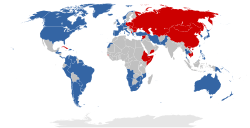
Political alignments in Europe during the Cold War after 1961


The terms First World, Second World, and Third World were originally used to divide the world's nations into three categories. The complete overthrow of the pre–World War II status quo left two superpowers (the United States and the Soviet Union) vying for ultimate global supremacy, a struggle known as the Cold War. They created two camps, known as blocs. These blocs formed the basis of the concepts of the First and Second Worlds.[1] The Third World consisted of those countries that were not closely aligned with either bloc.

History

[edit]

Cold War

[edit]

Early in the Cold War era, NATO and the Warsaw Pact were created by the United States and the Soviet Union, respectively. They were also referred to as the Western Bloc and the Eastern Bloc. The circumstances of these two blocs were so different that they were essentially two worlds, however, they were not numbered first and second.[2][3][4] The onset of the Cold War is marked by Winston Churchill's famous "Iron Curtain" speech.[5] In this speech, Churchill describes the division of the West and East to be so solid that it could be called an iron curtain.[5]

In 1952, the French demographer Alfred Sauvy coined the term Third World in reference to the three estates in pre-revolutionary France.[6] The first two estates being the nobility and clergy and everybody else comprising the third estate.[6] He compared the capitalist world (i.e., First World) to the nobility and the communist world (i.e., Second World) to the clergy. The First World countries were characterized by economic prosperity, technological advancement, and political stability, whereas the Second World countries were characterized by state-controlled economies and centralized political structures. Just as the third estate comprised everybody else, Sauvy called the Third World all the countries that were not in this Cold War division, i.e., the unaligned and uninvolved states in the "East–West Conflict."[6][4] The Third World countries are often described as developing nations with diverse economic, social, and political conditions. With the coining of the term Third World directly, the first two groups came to be known as the "First World" and "Second World," respectively. Here the three-world system emerged.[4]

However, Shuswap Chief George Manuel presented a critique of the three-worlds model, considering it to be outdated. In his 1974 book The Fourth World: An Indian Reality, he describes the emergence of the Fourth World while coining the term. The fourth world refers to "nations," e.g., cultural entities and ethnic groups, of indigenous people who do not compose states in the traditional sense.[7] Rather, they live within or across state boundaries (see First Nations). One example is the Native Americans of North America, Central America, and the Caribbean.[7]

Post Cold War

[edit]

With the fall of the Soviet Union in 1991, the Eastern Bloc ceased to exist; with it, so did all applicability of the Three-world model.[8]

However, Third World is still used as a term for the traditionally less-developed world (e.g. Africa).[citation needed]

See also

[edit]

References

[edit]
Revisions and contributorsEdit on WikipediaRead on Wikipedia
from Grokipedia
The three-world model is a Cold War-era geopolitical classification system that divides nations into three categories based on their ideological alignments and economic development levels: the First World, comprising affluent capitalist democracies allied with the United States and Western Europe; the Second World, consisting of centrally planned communist economies aligned with the Soviet Union and its Eastern Bloc partners; and the Third World, encompassing non-aligned, often newly independent developing countries in Asia, Africa, and Latin America that sought autonomy from superpower blocs.[1][2] Originating from French demographer Alfred Sauvy's 1952 analogy to the Third Estate of the French Revolution, the model highlighted the bipolar tensions of the era while framing the Third World as a potential revolutionary force analogous to historical underclasses.[2] This framework shaped international relations by guiding alliance formations, such as NATO for the First World and the Warsaw Pact for the Second, and influenced development assistance strategies aimed at swaying Third World nations amid proxy conflicts and decolonization movements.[1] Although effective in capturing mid-20th-century divisions, the model proved increasingly inadequate after the Soviet Union's 1991 collapse, leading to its obsolescence in favor of terms emphasizing economic disparities over ideological camps, and drawing critiques for imposing a Western-centric hierarchy that overlooked intra-bloc diversities and shifting global dynamics.[2][1]

Core Concepts

Classification of the Three Worlds

The Three Worlds Theory delineates global geopolitical alignments into three hierarchical categories based on economic development, power status, and imperialist tendencies, as conceptualized by Mao Zedong in the early 1970s.[3] The First World comprises the two dominant superpowers, the United States and the Soviet Union, identified as the primary imperialist forces capable of global hegemony and the chief threats to international peace due to their aggressive expansionism and control over advanced military-industrial complexes.[4] These nations, with their vast resources and alliances, exploit weaker states while competing for supremacy, embodying the highest concentration of contradictions in the international system.[3] The Second World encompasses intermediate developed countries positioned between the superpowers and the underdeveloped majority, including Western European nations such as Britain and France, along with Japan and Canada.[4] These states possess significant industrial bases and influence but lack the global reach of the First World, often aligning opportunistically with one superpower or another while pursuing their own regional interests; Mao described them as "second-rate imperialist powers" susceptible to both rivalry and potential cooperation against First World dominance.[3] This category highlights nations capable of technological and economic leverage, yet vulnerable to superpower pressures, forming a buffer in global power dynamics. The Third World constitutes the vast majority of the global population, comprising developing nations across Asia (excluding Japan), Africa, and Latin America, which suffer exploitation by the First and Second Worlds through neocolonial mechanisms, resource extraction, and unequal trade.[4] Mao explicitly included China in this group, viewing it as part of the oppressed developing bloc with revolutionary potential to resist imperialism and foster national liberation movements.[3] Characterized by agrarian economies, post-colonial struggles, and aspirations for independence, Third World countries represent the primary arena for anti-hegemonic alliances, interconnected with the other worlds through economic dependencies and ideological conflicts that propel historical change.[4]

Theoretical Foundations in Maoist Thought

The three-world model emerged from Mao Zedong's strategic assessment of global power dynamics, articulated in a February 22, 1974, conversation with Zambian President Kenneth Kaunda, where Mao classified the United States and Soviet Union as the "first world" superpowers, intermediate developed nations like Japan, Europe, and Canada as the "second world," and the developing countries including China as the "third world."[3][5] This formulation built on Mao's dialectical materialist method, particularly his 1937 essay "On Contradiction," which stressed analyzing the principal contradiction amid multiple secondary ones to determine revolutionary priorities. In the international context, Mao identified the core antagonism as existing between the hegemonic superpowers—characterized as imperialist (U.S.) and social-imperialist (U.S.S.R.)—and the exploited nations of the world, shifting focus from earlier Marxist-Leninist emphases on capitalism versus socialism.[6] Maoist thought positioned the third world as the dynamic force driving historical change, drawing parallels to Mao's domestic theory of protracted people's war, where peripheral, underdeveloped regions (the global "countryside") encircle and ultimately overthrow centralized imperialist cores (the global "cities"). This perspective echoed Mao's support for national liberation struggles since the 1955 Bandung Conference, viewing anti-colonial movements in Asia, Africa, and Latin America as integral to worldwide proletarian revolution rather than peripheral distractions.[6][7] The model thus reframed Lenin's theory of imperialism as the highest stage of capitalism, updating it to account for post-World War II bipolarity and the Soviet Union's perceived betrayal of anti-imperialist principles through expansionism, which Mao critiqued as early as the 1960s Sino-Soviet polemics.[6] Central to these foundations was Mao's emphasis on differentiating allies and enemies through concrete analysis of class interests on a world scale, as outlined in his 1940 work "On New Democracy," which advocated united fronts against primary oppressors while preparing for broader socialist transformation. The three-world schema operationalized this by designating second-world nations as potential buffers or swing forces against superpower dominance, rather than automatic class enemies, enabling tactical alliances like China's outreach to Europe amid the 1970s détente era.[7] This pragmatic differentiation, however, diverged from orthodox Maoist insistence on irreconcilable class struggle, prompting later intra-Maoist critiques that the model subordinated proletarian internationalism to nationalist geopolitics.[8]

Historical Development

Antecedents in Sino-Soviet Relations

The Sino-Soviet alliance, established through the 1950 Treaty of Friendship, Alliance, and Mutual Assistance signed on February 14, 1950, initially provided China with substantial Soviet economic and military aid, including loans totaling 300 million rubles and technical assistance for industrialization projects like the First Five-Year Plan.[9] This partnership framed the Soviet Union as the elder brother in the communist bloc, with China deferring to Moscow's leadership in international communist affairs.[10] Tensions surfaced after Nikita Khrushchev's February 1956 "Secret Speech" denouncing Stalin's cult of personality at the 20th Congress of the Communist Party of the Soviet Union, which Mao perceived as an abandonment of revolutionary orthodoxy and a shift toward revisionism, undermining China's domestic campaigns like the ongoing suppression of counter-revolutionaries.[11] Mao's resistance intensified with his rejection of Khrushchev's doctrine of "peaceful coexistence" with capitalist states, viewing it as capitulation to imperialism rather than advancing class struggle globally; by 1958, China openly criticized this at the Moscow Conference of Communist Parties.[10] Ideological divergences compounded territorial disputes, as Soviet demands for influence over Chinese border regions echoed pre-revolutionary tsarist expansionism.[12] The rift escalated in 1960 when the Soviet Union abruptly withdrew over 1,390 technical advisors and canceled joint projects, including nuclear and missile programs, in response to China's independent pursuit of policies like the Great Leap Forward and its support for Albania's Enver Hoxha against Khrushchev's de-Stalinization.[9] Public polemics followed at the Bucharest Conference in June 1960 and the 81-party Moscow Congress in November, where Chinese delegates accused the USSR of "modern revisionism" and monopolizing the communist movement.[10] By 1963, a series of nine Chinese articles in People's Daily labeled the Soviet leadership as betrayers of Leninism, prompting reciprocal Soviet denunciations of Maoism as dogmatic adventurism.[11] Military confrontation peaked with border clashes on March 2, 1969, along the Ussuri River at Zhenbao Island, involving artillery exchanges that killed dozens and raised fears of nuclear escalation, as Mao mobilized forces along the 4,300-kilometer frontier.[12] These events crystallized Mao's assessment of the USSR as a "social-imperialist" power posing a greater immediate threat than the United States, due to its proximity, expansionist claims, and perceived betrayal of proletarian internationalism.[11] This adversarial reframing, rooted in both ideological schisms and national security imperatives, dismantled the unified socialist camp and compelled China to forge an autonomous foreign policy, setting the conceptual groundwork for distinguishing hegemonic superpowers from potential allies in the global hierarchy.[10]

Formal Articulation and Key Events (1974 Onward)

Vice Premier Deng Xiaoping formally articulated the Three Worlds Theory in his address to the United Nations General Assembly's Sixth Special Session on April 10, 1974.[4] In the speech, Deng outlined the global division into three worlds: the First World comprising the two superpowers, the United States and the Soviet Union; the Second World consisting of other advanced capitalist and developed countries; and the Third World encompassing developing nations in Asia, Africa, Latin America, and elsewhere, including China itself.[4] He emphasized contradictions between these worlds, positioning the Third World as the primary force against superpower hegemony and advocating unity among developing countries to oppose both U.S. imperialism and Soviet social-imperialism.[4] [3] The theory's formalization aligned with China's support for the New International Economic Order proposed at the same UN session, urging reforms to address economic inequalities favoring superpowers.[4] Following the speech, China pursued diplomatic normalization with several Southeast Asian nations to expand Third World alliances and counter Soviet influence: relations with Malaysia were established on May 31, 1974; with the Philippines on June 9, 1975; and with Thailand on July 1, 1975.[13] These moves reflected the theory's emphasis on rallying intermediate and developing states against the primary contradiction of superpower rivalry.[7] In the late 1970s, the framework guided China's strategic opening to the United States, culminating in the normalization of diplomatic relations on January 1, 1979, framed as a tactical measure to oppose Soviet expansionism rather than ideological alignment.[7] The 1979 Sino-Vietnamese War, launched on February 17, 1979, was justified as a limited action to deter Soviet-backed Vietnamese hegemony in the region, consistent with anti-hegemonism central to the Three Worlds Theory.[13] By the 11th Congress of the Communist Party of China in 1977, the theory was reaffirmed as a basis for ongoing foreign policy, though its revolutionary rhetoric began softening under Deng's leadership post-1978.[7]

Implementation During the Cold War

Strategic Alignment Against the Soviet Union

The Three Worlds model provided the ideological rationale for China's strategic realignment against the Soviet Union, portraying the USSR as a primary hegemonist power alongside the United States but emphasizing Soviet expansionism as the more immediate threat to China and the developing world. Following the Sino-Soviet border clashes on Zhenbao Island in March 1969, which killed approximately 58 Soviet personnel and an unknown number of Chinese troops, Beijing faced a massive Soviet military buildup along its northern border, estimated at up to 1 million troops by the early 1970s.[14][15] This escalation, coupled with ideological divergences from the Sino-Soviet split since the early 1960s, led Chinese leaders to view the USSR as "social-imperialist" and the chief adversary.[16] Mao Zedong first outlined the Three Worlds division on February 22, 1974, during talks with Zambian President Kenneth Kaunda, classifying the US and USSR as the First World of superpowers, developed nations like Europe and Japan as the Second World, and China alongside other developing countries as the Third World—the revolutionary force against superpower domination.[3] This framework, elaborated by Deng Xiaoping in his April 10, 1974, speech to the United Nations General Assembly, justified uniting non-superpower states against hegemonic aggression, with implicit prioritization of countering Soviet influence in Asia and beyond.[4] The theory supported a "united front" strategy that facilitated rapprochement with the US, as evidenced by the February 1972 visit of President Richard Nixon to China and the resulting Shanghai Communiqué, which acknowledged shared opposition to potential threats without naming the USSR directly but aligning against its global ambitions.[13] In diplomatic practice, China leveraged the model to oppose Soviet-backed initiatives, such as condemning the USSR's 1979 invasion of Afghanistan and providing material support to anti-Soviet mujahideen forces in coordination with US interests, while normalizing relations with Washington in January 1979.[17] Beijing also courted Second World nations like Japan and Western Europe to isolate the Soviets, establishing full diplomatic ties with the US in 1979 and engaging in intelligence cooperation on Soviet military movements.[18] This alignment deterred Soviet aggression along China's borders and positioned the People's Republic as a counterweight to Moscow's influence in the Third World, though it drew criticism from orthodox Marxists for deviating from proletarian internationalism toward pragmatic power balancing.[16]

Engagement with Second and Third Worlds

China positioned itself as a leader within the Third World, emphasizing solidarity with developing nations in Asia (excluding Japan), Africa, and Latin America against superpower hegemony, particularly Soviet expansionism. Beijing provided economic, technical, and military assistance to support national liberation movements and anti-imperialist struggles, viewing these countries as the main revolutionary force in global politics.[3][19] Following its 1971 admission to the United Nations, China rapidly expanded diplomatic recognition, establishing formal ties with over 100 developing countries by the late 1970s and advocating for a new international economic order to address inequalities imposed by First World dominance.[19] This included promoting South-South cooperation and the Five Principles of Peaceful Coexistence, which prioritized mutual non-interference and ideological flexibility to broaden alliances beyond communist states.[19] In practice, Chinese aid to Third World recipients peaked in the 1970s, funding infrastructure projects, agricultural initiatives, and guerrilla operations in regions like southern Africa and Southeast Asia, though totals remained modest compared to superpower programs—estimated at around $1-2 billion annually in grants and loans by the mid-1970s.[20] Examples included technical support for Tanzania's Tazara Railway, completed in 1975 with over 50,000 Chinese workers, and diplomatic backing for the Non-Aligned Movement, despite occasional tensions over China's perceived alignment with the United States.[19] By the early 1980s, as domestic reforms under Deng Xiaoping took precedence, aid shifted toward trade-oriented joint ventures, reducing ideological exportation and emphasizing pragmatic economic exchanges.[19] Engagement with the Second World—comprising developed nations like Japan, Western Europe, and Canada—focused on drawing these "intermediate" powers into a united front against the Soviet Union, rather than ideological conversion. Mao Zedong advocated cooperation with these states to form strategic alliances, as articulated in 1973 discussions where he urged the United States to align with Japan and Europe to counter Moscow's threats.[3] Diplomatic breakthroughs included the 1972 normalization of Sino-Japanese relations, which facilitated technology transfers and trade exceeding $1 billion by 1975, positioning Japan as a counterweight to Soviet influence in Asia.[13] Similarly, China established or upgraded ties with European countries, such as the United Kingdom (full ambassadorial relations in 1972) and France (earlier in 1964, deepened in the 1970s), through high-level visits and agreements on science, technology, and anti-Soviet coordination, though economic interdependence grew cautiously amid mutual suspicions.[16] This outreach aimed to exploit Second World desires for autonomy from superpower blocs, yielding limited but symbolic successes like joint statements condemning Soviet actions in Afghanistan by the late 1970s.[3]

Diplomatic and Military Applications

The Three Worlds Theory informed China's diplomatic strategy by emphasizing solidarity with developing nations against superpower hegemony, particularly Soviet expansionism. In his address to the United Nations General Assembly's Special Session on Raw Materials and Development on April 10, 1974, Deng Xiaoping outlined the theory, declaring that the United States and Soviet Union constituted the First World as exploitative superpowers, while China aligned with the Third World of developing countries to oppose their domination.[4] This framework guided China's outreach, resulting in the establishment of diplomatic relations with numerous Third World states following its 1971 admission to the UN, expanding from around 50 countries in 1970 to over 100 by the late 1970s.[7] Diplomatically, China provided economic and technical assistance to Third World countries to foster anti-hegemonist alliances, surpassing Soviet aid levels by 1970 in support for developing nations.[21] Examples include infrastructure projects like the Tanzania-Zambia Railway, completed in 1975 with Chinese funding and labor, symbolizing commitment to Third World self-reliance.[22] China also backed national liberation movements, such as providing rhetorical and material support to African independence struggles, while advocating for reforms in international economic institutions to benefit the Global South.[13] Militarily, the theory justified prioritizing the Soviet threat as the principal adversary, prompting defensive buildups along the 4,300-kilometer Sino-Soviet border after the 1969 clashes.[23] China deployed approximately 1 million troops and enhanced fortifications in the region by the mid-1970s, countering Soviet force increases from 12 divisions in 1965 to 37-41 by 1969.[24][25] In line with anti-Soviet orientation, China extended military aid to Third World proxies opposing Soviet-backed regimes, including arms to non-communist factions in Angola's civil war (1975-1976) against the Soviet-supported MPLA, and support for Pakistan during its conflicts with Soviet-aligned India.[22] This aid, often in the form of grants totaling tens of millions annually, aimed to encircle Soviet influence without direct confrontation.[26]

Post-Cold War Trajectory

Adaptations Under Deng Xiaoping and Successors

Following Mao Zedong's death in 1976, Deng Xiaoping, who consolidated power by 1978, initially reaffirmed the Three Worlds Theory as a cornerstone of China's independent foreign policy, positioning the People's Republic as a developing socialist nation firmly within the Third World alongside Asia, Africa, and Latin America.[3] This stance emphasized opposition to superpower hegemonism—particularly Soviet expansionism—and solidarity with oppressed nations, aligning with Deng's 1974 United Nations address that had first publicly articulated the model.[3] However, Deng subordinated ideological rigidity to pragmatic reforms, adopting the guideline of taoguang yanghui ("hide one's capacities and bide one's time") to prioritize domestic economic modernization over revolutionary confrontation.[27] Deng's adaptations manifested in a strategic pivot toward engagement with Second World states for technology transfer and investment, exemplified by the normalization of Sino-U.S. relations on January 1, 1979, and the influx of Western capital under the "reform and opening-up" policy launched at the Third Plenum of the 11th Central Committee in December 1978.[28] While retaining anti-hegemonist rhetoric to justify non-alignment, China de-emphasized accusatory labels like "social-imperialism" against the Soviet Union by the early 1980s, facilitating Sino-Soviet reconciliation by 1989 and reducing the theory's confrontational edge.[16] Third World orientation persisted through aid to African and Asian nations—such as the $1.5 billion in low-interest loans pledged at the 1983 China-Africa Economic and Trade Seminar—but served instrumental ends, bolstering diplomatic support in international forums like the United Nations rather than fueling global revolution.[16] Under Deng's successors—Jiang Zemin (1989–2002) and Hu Jintao (2002–2012)—the model's influence waned further amid China's integration into the global economy, with GDP growth averaging 10% annually from 1978 to 2010 enabling a shift from Third World solidarity to multifaceted partnerships.[29] Jiang's "go global" strategy expanded trade with developed economies, joining the World Trade Organization on December 11, 2001, while Hu promoted "harmonious world" diplomacy that diluted superpower antagonism in favor of multilateral institutions.[30] Elements like South-South cooperation endured, as seen in the 2000 Forum on China-Africa Cooperation establishing a triennial summit mechanism, but these were decoupled from Maoist framing, reflecting China's hybrid status as both a developing advocate and an economic power engaging G7 nations.[16] By the 1990s, the theory's empirical basis eroded with the Soviet Union's 1991 dissolution, rendering its bipolar assumptions obsolete and exposing tensions between China's rising industrial might—export volumes surpassing $1 trillion by 2006—and claims of perpetual Third World alignment.[29] Adaptations thus prioritized realpolitik over doctrine, with official rhetoric retaining Third World identity for legitimacy in the Global South while policy pursued balanced great-power relations, marking a transition from tactical geopolitics to economic pragmatism.[16][29]

Declining Relevance and Modern Critiques

The collapse of the Soviet Union on December 25, 1991, fundamentally undermined the Three Worlds model's foundational premise by eliminating one of the two superpowers comprising the First World, leaving the United States as the unchallenged hegemon in a unipolar order.[18] This shift rendered the theory's emphasis on inter-superpower rivalry obsolete, as global dynamics moved toward U.S.-led globalization rather than the predicted Third World-led encirclement of both hegemonies.[31] Under Deng Xiaoping's leadership following Mao's death in 1976, China's foreign policy pragmatically de-emphasized rigid adherence to the model in favor of economic modernization and broader diplomatic engagement, exemplified by the 1979 normalization of relations with the United States and integration into international institutions like the World Bank in 1980.[32] Deng's 1978 reforms prioritized "socialism with Chinese characteristics," subordinating ideological alignments to domestic development goals, which diluted the model's revolutionary anti-hegemonism as China pursued trade with Second World economies.[30] By the 1990s, successors like Jiang Zemin further adapted policy toward "major power diplomacy," engaging global institutions without invoking Three Worlds divisions, marking a tacit decline in its doctrinal centrality.[33] Modern critiques highlight the model's empirical shortcomings in anticipating post-Cold War multipolarity and economic interdependence, which blurred distinctions between worlds as developing nations like China achieved rapid growth—China's GDP surpassing Japan's in 2010 to become the second-largest economy.[29] Analysts argue it failed to foresee intra-Third World divergences, such as resource competition and authoritarian consolidations, rendering its unified anti-imperialist front unrealistic amid globalization's supply chain integrations.[34] Ideologically, orthodox Marxist-Leninists, including Enver Hoxha's 1977 analysis, condemned the theory as revisionist for equating Soviet socialism with U.S. imperialism, thereby negating proletarian internationalism and class struggle in favor of bloc geopolitics that accommodated bourgeois states.[35][36] This perspective persists among critics who view it as enabling opportunistic alliances, such as China's 1970s détente with the West, over principled anti-capitalist solidarity.[37]

Criticisms and Debates

Ideological Deviations from Marxism-Leninism

The Three Worlds Theory diverged from Marxism-Leninism by supplanting the binary division of the world into socialist and imperialist camps—central to Lenin's analysis of imperialism as the highest stage of capitalism—with a tripartite schema that equated the Soviet Union with the United States as equivalent "superpowers" driving global exploitation.[35] This equivalence, rooted in Mao's designation of the USSR as "social-imperialist," rejected the orthodox view of the Soviet state as a bastion of proletarian internationalism, even amid post-Stalinist critiques, and instead framed both as primary threats to national liberation, thereby diluting the primacy of class antagonism between socialism and capitalism.[36] Orthodox Marxist-Leninists, including Enver Hoxha of Albania's Party of Labour, condemned the theory as a direct negation of Marxist fundamentals, accusing it of fostering counterrevolutionary chauvinism by prioritizing interimperialist rivalries over the global class struggle for proletarian dictatorship.[35] Hoxha argued that it abandoned Lenin's call for unity among socialist forces against imperialism, instead promoting alliances with bourgeois-nationalist regimes in the "Second" and "Third Worlds" to isolate the USSR, which he saw as a betrayal of revolutionary principles in favor of pragmatic geopolitics.[35] The framework's emphasis on "Third World" solidarity transcended class lines, endorsing unity with comprador and feudal elites in developing nations as long as they opposed superpowers, which critics like the German MLPD labeled a right-opportunist deviation that negated internal class struggle and the need for socialist revolutions within those states.[37] This approach justified China's diplomatic overtures to capitalist powers, such as the 1972 Nixon visit and support for reactionary governments in Asia and Africa, positions that Marxist-Leninist factions viewed as subordinating proletarian internationalism to Chinese national interests and anti-Soviet vendettas.[36][37] Even among Maoist variants, such as Marxism-Leninism-Maoism, the theory faced rejection as a late-Maoist rightward turn that compromised ideological purity by prettifying non-proletarian regimes and sidelining the vanguard role of communist parties in favor of broad anti-hegemonism.[36] These deviations, articulated in Chinese foreign policy documents from 1974 onward, underscored a shift toward realpolitik over doctrinal adherence, prompting intra-communist polemics that highlighted the theory's incompatibility with Leninist commitments to worldwide socialist transformation.[38]

Pragmatic vs. Principled Foreign Policy

The three-world model's influence on Chinese foreign policy engendered debates over whether it promoted pragmatic realpolitik at the expense of principled Marxist-Leninist internationalism. Orthodox Marxism-Leninism demanded consistent opposition to all imperialist entities and unconditional support for global proletarian revolutions, irrespective of national interests. In contrast, the model framed the Soviet Union as the principal aggressor, enabling tactical alliances with the United States—despite both superpowers' classification in the First World—to mitigate immediate threats. This approach culminated in the February 1972 visit by U.S. President Richard Nixon to Beijing, which facilitated Sino-American rapprochement and intelligence-sharing against Soviet expansion, prioritizing geopolitical survival over ideological purity.[7][36] Critics from Marxist-Leninist perspectives, such as Enver Hoxha's Albania, condemned this as a revisionist deviation, arguing that the theory amalgamated borrowed Marxist elements with pragmatic opportunism, thereby diluting class struggle and justifying collaboration with exploiters. Hoxha's analysis portrayed "Mao Tsetung thought" as inherently anti-Marxist for subordinating revolutionary principles to national power calculations, evidenced by China's selective endorsement of Third World insurgencies only when they countered Soviet influence, as in support for Afghan mujahideen post-1979 Soviet invasion. Such positions, they contended, negated the model's own anti-hegemonist rhetoric by fostering dependencies on Western capital and military aid.[39][38] Under Deng Xiaoping, who formalized the theory in his 1977 United Nations address, this pragmatism intensified, integrating economic reforms with alliances like the 1979 normalization of U.S. ties and joint opposition to Vietnam's invasion of Cambodia—actions that bolstered China's regional leverage but alienated ideological purists. Detractors highlighted how the framework's flexibility masked a shift toward state capitalism, where foreign policy served domestic stabilization rather than global emancipation, as seen in reduced aid to non-aligned movements post-1980s. This tension underscored broader critiques that the model served as a rhetorical veneer for power maximization, diverging from Leninist imperatives against compromising with imperialism.[40][41]

Empirical Failures and Unintended Consequences

China's alignment with Third World movements under the Three Worlds model often resulted in support for unstable or repressive regimes, leading to humanitarian disasters and strategic setbacks. A prominent example is China's extensive backing of the Khmer Rouge in Cambodia, initiated in the early 1970s as part of countering Soviet influence in Southeast Asia. Beijing supplied military aid, training, and diplomatic cover, enabling the Khmer Rouge's 1975 seizure of power. The regime's subsequent policies caused the Cambodian genocide, with 1.7 to 2 million deaths—approximately one-quarter of the population—through execution, forced labor, and starvation between 1975 and 1979.[42][43] Despite reports of atrocities reaching Chinese officials, support persisted, including opposition to Vietnam's 1979 invasion that ousted the Khmer Rouge; this prolonged regional instability and tied China to a pariah regime at the United Nations until the early 1990s.[44][45] The outcome undermined China's revolutionary credentials without yielding a reliable ally, as Cambodia fragmented into factional conflicts backed by external powers. Infrastructure projects emblematic of Third World solidarity, such as the Tanzania-Zambia Railway (TAZARA), highlighted operational and economic shortfalls. Constructed between 1970 and 1975 with a Chinese interest-free loan equivalent to $400 million (about $3.3 billion in 2025 dollars), the 1,860-kilometer line aimed to bypass colonial-era routes controlled by Portuguese Mozambique and Rhodesia, fostering independence. However, post-completion issues including poor maintenance, technical failures, and underutilization plagued the project; freight volumes fell short of projections, generating persistent losses for Tanzania and Zambia, which defaulted on repayments by the 1980s.[46] Repeated Chinese interventions were required, culminating in a $1.4 billion refurbishment deal in 2025, underscoring the initial model's failure to ensure self-sustaining development amid local capacity constraints.[47] Broader applications of the model diverted resources from domestic recovery, exacerbating China's economic vulnerabilities during the 1960s and 1970s. Aid to Third World nations totaled billions amid post-Great Leap Forward reconstruction, prioritizing ideological exports over pragmatic growth; this contributed to fiscal strain without commensurate geopolitical gains, as many recipients pursued non-aligned or Western partnerships post-independence. The anticipated Third World uprising against superpowers did not materialize, with decolonization yielding hybrid economies integrated into global markets rather than unified anti-hegemonic blocs under Chinese leadership.[40] Unintended diplomatic isolation followed in some cases, as alliances frayed—evident in Africa's shift toward multipolar engagements by the 1980s—prompting post-Mao adaptations that de-emphasized revolutionary aid for economic pragmatism. These outcomes revealed the model's disconnect from real-world complexities, where ideological commitments clashed with sustainable statecraft.

Legacy and Influence

Impact on Chinese Foreign Policy

The Three Worlds Theory, formulated by Mao Zedong in February 1974, repositioned Chinese foreign policy to emphasize unity with developing nations in Asia, Africa, and Latin America against the dominance of the two superpowers, the United States and the Soviet Union. China explicitly identified itself as a socialist developing country within the Third World, rejecting aspirations to superpower status and committing to support anti-hegemonist struggles, particularly against Soviet expansionism. This strategic framework, articulated by Deng Xiaoping at the United Nations Special Session on April 10, 1974, justified pragmatic alliances, including tacit cooperation with the United States—such as facilitating Henry Kissinger's secret visit in July 1971 and Richard Nixon's public trip in February 1972—to counter the perceived greater threat from the USSR.[3][3][3] The theory directly spurred intensified engagement with Third World countries through economic aid, military support, and diplomatic advocacy, aiming to cultivate leadership in the Global South. Between 1974 and the late 1970s, China extended over $3 billion in low-interest loans and grants to more than 100 developing nations, funding infrastructure like the Tanzania-Zambia Railway (TAZARA), a 1,860-kilometer line completed in 1975 that connected landlocked Zambia to the Indian Ocean port of Dar es Salaam, bypassing routes controlled by apartheid-era South Africa and Rhodesia. This project, initiated in 1967 but aligned with the theory's principles, involved 50,000 Chinese workers and symbolized anti-imperialist solidarity, enhancing China's influence in Africa amid decolonization. Such efforts also bolstered China's bid for international legitimacy, building on its restoration to the UN Security Council in October 1971 by rallying votes from newly independent states.[48][49] Post-Mao adaptations under Deng Xiaoping retained the theory's core anti-hegemonist orientation while integrating it into an "independent foreign policy" focused on economic modernization, evident in sustained South-South cooperation through forums like the Non-Aligned Movement. The emphasis on multipolarity and Third World agency influenced subsequent leaders, including Xi Jinping, who invokes China's developing-nation identity in initiatives such as the 2021 Global Development Initiative, which partners with over 100 countries to address infrastructure gaps, echoing Mao-era commitments but prioritizing mutual economic benefit over ideological export. This legacy manifests in China's advocacy for a "community with a shared future for mankind," framing opposition to unilateralism in UN speeches and bilateral ties with Africa, where trade volumes exceeded $250 billion annually by 2023. However, the theory's rigid divisions have been critiqued internally for limiting flexibility, contributing to a shift toward bilateral pragmatism in Beijing's diplomacy.[3][50][50]

Broader Geopolitical Ramifications

The Three Worlds Theory enabled China to pursue an independent foreign policy amid the Sino-Soviet split, framing both superpowers as threats while elevating the Third World as the locus of revolutionary potential and anti-hegemonist resistance. Articulated by Mao Zedong in private discussions from 1973 and publicly by Deng Xiaoping at the United Nations on April 10, 1974, the model justified tactical alignment with the United States against the perceived greater Soviet menace, contributing to the 1972 Nixon-Mao summit and the subsequent Shanghai Communiqué of February 28, 1972, which acknowledged mutual interests in curbing Soviet influence.[3] [51] This triangular geometry disrupted bipolar Cold War dynamics, pressuring the USSR into concessions like the 1975 Helsinki Accords and fostering a brief era of U.S.-China coordination in regions such as South Asia, where Beijing supported Pakistan against Soviet-backed India during the 1971 war.[16] By designating Asia (excluding Japan), Africa, and Latin America as the Third World—the exploited yet dynamic force against First World domination—the theory drove China's expansive outreach, including over $1 billion in interest-free loans and grants to African states between 1956 and 1976, often tied to infrastructure like the 1,860-kilometer Tazara Railway linking Zambia and Tanzania, completed on September 24, 1975.[51] This diplomacy secured China's expulsion of Taiwan from the UN on October 25, 1971, with 76 votes from Third World nations, and bolstered Beijing's sway in forums like the Non-Aligned Movement, where it advocated solidarity against neocolonialism. However, the framework intensified Sino-Soviet rivalry in proxy arenas, such as Angola's civil war (1975–2002), where China backed UNITA against Soviet-supported MPLA forces, fragmenting leftist alliances and prolonging conflicts that claimed over 500,000 lives.[52] [53] The theory's ramifications extended to reshaping global perceptions of power distribution, promoting a proto-multipolar worldview that diminished the salience of ideological blocs in favor of developmental hierarchies and national sovereignty. It influenced Third World leaders to diversify alignments beyond U.S.-Soviet binaries, as seen in increased diplomatic recognitions of China—rising from 50 countries in 1970 to 100 by 1978—and laid groundwork for post-Cold War South-South frameworks, though empirical outcomes revealed limitations, including overlooked class struggles within developing states and China's selective support for regimes aligning with its interests over universal proletarian revolution.[53] [16] Chinese state sources, such as Ministry of Foreign Affairs records, emphasize the model's enduring anti-hegemonist validity, yet Western analyses highlight how it pragmatically accommodated capitalist Second World economies, foreshadowing Deng-era reforms.[3]

References

User Avatar
No comments yet.