Hubbry Logo
Tollens' reagentTollens' reagentMain
Open search
Tollens' reagent
Community hub
Tollens' reagent
logo
8 pages, 0 posts
0 subscribers
Be the first to start a discussion here.
Tollens' reagent
Tollens' reagent
from Wikipedia

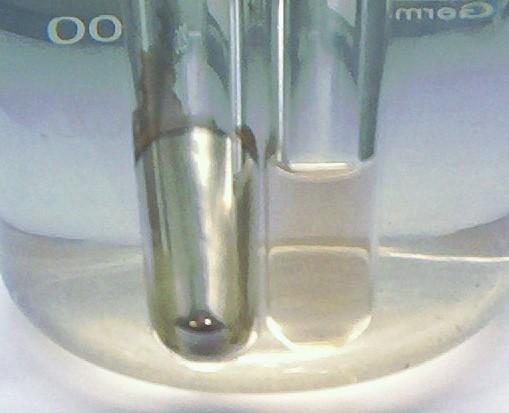
Tollens' test for aldehyde: left side positive (silver mirror), right side negative
Ball-and-stick model of the diamminesilver(I) complex

Tollens' reagent (chemical formula ) is a chemical reagent used to distinguish between aldehydes and ketones along with some alpha-hydroxy ketones which can tautomerize into aldehydes. The reagent consists of a solution of silver nitrate, ammonium hydroxide and some sodium hydroxide (to maintain a basic pH of the reagent solution). It was named after its discoverer, the German chemist Bernhard Tollens.[1] A positive test with Tollens' reagent is indicated by the precipitation of elemental silver, often producing a characteristic "silver mirror" on the inner surface of the reaction vessel.

Laboratory preparation

[edit]

This reagent is not commercially available due to its short shelf life, so it must be freshly prepared in the laboratory. One common preparation involves two steps. First a few drops of dilute sodium hydroxide are added to some aqueous 0.1 M silver nitrate. The ions convert the silver aquo complex form into silver(I) oxide, , which precipitates from the solution as a brown solid:

In the next step, sufficient aqueous ammonia is added to dissolve the brown silver(I) oxide. The resulting solution contains the [Ag(NH3)2]+ complexes in the mixture, which is the main component of Tollens' reagent. Sodium hydroxide is reformed:

Alternatively, aqueous ammonia can be added directly to silver nitrate solution.[2] At first, ammonia will induce formation of solid silver oxide, but with additional ammonia, this solid precipitate dissolves to give a clear solution of diamminesilver(I) coordination complex, . Filtering the reagent before use helps to prevent false-positive results.

Uses

[edit]

Qualitative organic analysis

[edit]

Once the presence of a carbonyl group has been identified using 2,4-dinitrophenylhydrazine (also known as Brady's reagent or 2,4-DNPH or 2,4-DNP), Tollens' reagent can be used to distinguish ketone vs aldehyde. Tollens' reagent gives a negative test for most ketones, with alpha-hydroxy ketones being one exception.

The test rests on the premise that aldehydes are more readily oxidized compared with ketones; this is due to the carbonyl-containing carbon in aldehydes having attached hydrogen. The diamine silver(I) complex in the mixture is an oxidizing agent and is the essential reactant in Tollens' reagent. The test is generally carried out in a test tube in a warm water bath.

In a positive test, the diamine silver(I) complex oxidizes the aldehyde to a carboxylate ion and in the process is reduced to elemental silver and aqueous ammonia. The elemental silver precipitates out of solution, occasionally onto the inner surface of the reaction vessel, giving a characteristic "silver mirror". The carboxylate ion on acidification will give its corresponding carboxylic acid. The carboxylic acid is not directly formed in the first place as the reaction takes place under alkaline conditions. The ionic equations for the overall reaction are shown below; R refers to an alkyl group.[3]

Tollens' reagent can also be used to test for terminal alkynes (). A white precipitate of the acetylide () is formed in this case. Another test relies on reaction of the furfural with phloroglucinol to produce a colored compound with high molar absorptivity.[4] It also gives a positive test with hydrazines, hydrazones, α-hydroxy ketones and 1,2-dicarbonyls.

Both Tollens' reagent and Fehling's reagent give positive results with formic acid.[citation needed]

Staining

[edit]

In anatomic pathology, ammonical silver nitrate is used in the Fontana–Masson stain, which is a silver stain technique used to detect melanin, argentaffin, and lipofuscin in tissue sections. Melanin and the other chromaffins reduce the silver nitrate to metallic silver.[2]

In silver mirroring

[edit]

Tollens' reagent is also used to apply a silver mirror to glassware; for example the inside of an insulated vacuum flask. The underlying chemical process is called silver mirror reaction. The reducing agent is glucose (an aldehyde) for such applications. Clean glassware is required for a high quality mirror. To increase the speed of deposition, the glass surface may be pre-treated with tin(II) chloride stabilised in hydrochloric acid solution.[5]

For applications requiring the highest optical quality, such as in telescope mirrors, the use of tin(II) chloride is problematic, since it creates nanoscale roughness and reduces the reflectivity.[6][7] Methods to produce telescope mirrors include additional additives to increase adhesion and film resilience, such as in Martin's method, which includes tartaric acid and ethanol.[7]

Safety

[edit]

Aged reagent can be destroyed with dilute acid to prevent the formation of the highly explosive silver nitride.[8]

See also

[edit]

References

[edit]
[edit]
Revisions and contributorsEdit on WikipediaRead on Wikipedia
from Grokipedia
Tollens' reagent is a chemical used primarily to distinguish aldehydes from ketones in through the silver mirror test, where aldehydes reduce the reagent to metallic silver, forming a reflective coating on the reaction vessel. It consists of the diamminesilver(I) complex ion, [Ag(NH₃)₂]⁺, dissolved in aqueous and rendered alkaline with or to maintain and reactivity. Developed by German chemist Bernhard Tollens in the late 19th century during his research on carbohydrates, the reagent was first described in 1882 as an ammoniacal silver solution for detecting aldehydes. To prepare it, silver nitrate is first treated with sodium hydroxide to precipitate silver(I) oxide, which is then dissolved by adding concentrated ammonia to form the soluble complex; the solution must be freshly prepared due to its instability. In the test, the reagent oxidizes aldehydes to carboxylic acids while reducing Ag⁺ to Ag, producing the characteristic silver mirror; alpha-hydroxy ketones may also give a positive result due to tautomerization to aldehydes. Beyond qualitative analysis, Tollens' reagent has applications in nanoparticle synthesis and historical carbohydrate studies, though its use requires caution as the dry residue can form explosive silver azide.

Overview

Definition and Composition

Tollens' reagent is a colorless primarily used for the qualitative detection of aldehydes through the . It consists of the diamminesilver(I) complex, denoted as [Ag(NH3)2]+[Ag(NH_3)_2]^+, in a basic medium, which acts as a mild . The reagent is formed by combining (AgNO3AgNO_3), (NH3NH_3 or NH4OHNH_4OH), and (NaOHNaOH), resulting in the overall representation [Ag(NH3)2]+[Ag(NH_3)_2]^+ with OHOH^- ions in solution. In this composition, the silver ion (Ag+Ag^+) from silver nitrate serves as the key oxidant responsible for the selective reaction with aldehydes. Ammonia ligands coordinate with the silver ion to form the stable diamminesilver(I) complex, preventing the precipitation of silver oxide or other insoluble salts and maintaining the reagent's solubility. Sodium hydroxide provides the necessary alkalinity, establishing a pH of approximately 11, which supports the complex formation and enhances the oxidizing capability without causing excessive precipitation. Physically, Tollens' reagent appears as a clear, alkaline solution that is inherently unstable and prone to , forming potentially silver compounds if stored. For this reason, it must be prepared fresh immediately before use to ensure reliability and safety. The reagent was named after the German chemist Bernhard Tollens, who developed it in the late .

Historical Background

Tollens' reagent was invented by Bernhard Tollens, a German chemist (1841–1918), in 1882 during his research on carbohydrates. He introduced it as a silver-based test specifically for detecting aldehydes by their ability to reduce ammoniacal to metallic silver, producing a characteristic mirror-like deposit. This formulation represented an improvement over earlier 19th-century silver-ammonia solutions used to test reducing sugars, such as the process developed by in 1835, which employed sugar as a reductant to deposit silver on surfaces. The reagent's original purpose was to differentiate aldehydes from ketones in organic qualitative analysis, as aldehydes possess reducing properties due to their while most ketones do not. Tollens first detailed the in his 1882 publication in Berichte der deutschen chemischen Gesellschaft, with a 1887 article in Landwirthschaftliche Versuchs-Stationen emphasizing its application in identifying aldehydic compounds in complex mixtures like those derived from sugars. Building on foundational work in during the mid-19th century, including explorations of carbonyl reactivity, the test provided a visually distinctive method for functional group identification. By the early , Tollens' reagent had gained widespread adoption as a staple in qualitative organic laboratories and textbooks, valued for its simplicity and dramatic silver mirror result. Over subsequent decades, minor modifications—such as the addition of to enhance sensitivity and stability by promoting faster reduction—refined its reliability without altering the core formulation. Its enduring significance lies in establishing a benchmark for educational demonstrations and analytical protocols in , owing to the reagent's clear, observable outcome that confirms the presence of aldehydes.

Preparation

Laboratory Procedure

The preparation of Tollens' reagent requires careful sequential addition of reagents to form the diammine silver(I) complex while minimizing decomposition risks. Begin by dissolving 0.5 g of silver nitrate (AgNO₃) in 10 mL of distilled water to create a clear aqueous solution of AgNO₃. Next, add a few drops of 5% sodium hydroxide (NaOH) solution to form the brown precipitate of silver(I) oxide (Ag₂O). Then, add dilute ammonium hydroxide (NH₄OH, typically 2-5% aqueous ammonia) dropwise with gentle swirling until the precipitate dissolves completely, yielding a clear solution containing the [Ag(NH₃)₂]⁺ complex. This step uses NaOH to precipitate Ag₂O, followed by complexation with ammonia ligands for solubilization. The resulting reagent should be colorless and transparent, ready for testing, with a pH of approximately 11-12. Tollens' reagent must be prepared fresh immediately before use, as it decomposes within hours to form a black precipitate of Ag₂O due to the instability of the silver-ammonia complex in solution. Storage is not recommended, and any unused portions should be discarded immediately after use to prevent hazardous decomposition products, including explosive . Common variations in the procedure include the use of concentrated (e.g., 15 M NH₃) instead of dilute NH₄OH to form a stronger [Ag(NH₃)₂]⁺ complex more rapidly, particularly for larger-scale preparations. Additionally, minimizing excess beyond the specified 0.5 g prevents unnecessary waste and reduces the risk of incomplete complexation. These adjustments maintain the reagent's efficacy while adhering to efficiency principles.

Required Materials and Conditions

The preparation of Tollens' reagent requires high-purity reagents to ensure the formation of a stable diamminesilver(I) complex without interference from contaminants. Analytical-grade (AgNO₃, typically 0.5 g) is dissolved in 10 mL of to create the initial solution. A few drops of 5% (NaOH) are then added to generate the precipitate, followed by 5-10 mL of 5-10% hydroxide (NH₄OH) to redissolve it through complexation. The use of analytical-grade chemicals is essential to avoid impurities that could lead to unwanted precipitates or reduce the reagent's sensitivity. Essential equipment includes clean glass test tubes or beakers to minimize contamination, droppers for precise addition of solutions, and a stirring rod for thorough mixing. All operations should be performed in a to provide adequate ventilation, particularly when handling . Optimal conditions involve (20-25°C) to maintain reagent stability without promoting unwanted reactions. The solution must be kept at a basic pH of 10-12 to support the silver-ammonia complex. Preparation under dim light is recommended to prevent photoreduction of silver ions, a known issue with solutions. The role of in complexing silver ions to form the active [Ag(NH₃)₂]⁺ species is crucial for the reagent's function, as outlined in the definition section. Tollens' reagent is inherently unstable and should be prepared immediately before use; any unused portion must be discarded immediately to prevent the formation of hazardous silver compounds.

Reaction Mechanism

Oxidation of Aldehydes

Tollens' reagent selectively oxidizes aldehydes (RCHO) to their corresponding carboxylate ions (RCOO⁻) in a basic medium, accompanied by the reduction of Ag⁺ ions from the [Ag(NH₃)₂]⁺ complex. This process forms the basis of the reagent's utility in distinguishing aldehydes from other carbonyl compounds. The overall balanced equation for the reaction is: RCHO+2[Ag(NH3)2]++3OHRCOO+2Ag+4NH3+2H2O\text{RCHO} + 2[\text{Ag(NH}_3)_2]^+ + 3\text{OH}^- \rightarrow \text{RCOO}^- + 2\text{Ag} + 4\text{NH}_3 + 2\text{H}_2\text{O} The mechanism proceeds through several key steps initiated by the basic conditions of the reagent. First, the aldehyde undergoes reversible hydration to form a gem-diol intermediate (RCH(OH)₂). In the presence of excess OH⁻, this gem-diol deprotonates to yield the gem-diolate anion (RCH(OH)O⁻). Next, the silver ion coordinates to the oxygen of the diolate, facilitating a hydride (H⁻) transfer from the carbon atom to Ag⁺, which cleaves the aldehydic C-H bond and generates metallic silver while forming a radical intermediate. This radical is then further oxidized by another Ag⁺ ion to produce the carboxylic acid, which deprotonates in the basic medium to the carboxylate. The process relies on the mild oxidizing nature of the ammoniacal silver complex, which targets the readily accessible aldehydic hydrogen. This oxidation is selective for both aliphatic and aromatic aldehydes, as the aldehydic C-H bond is uniquely susceptible to the reagent's action. Ketones generally do not react under standard conditions because they lack the aldehydic C-H bond, which is essential for the hydride transfer in the mechanism. The reaction rate is enhanced for aldehydes bearing electron-withdrawing groups (e.g., in chloral, where the trichloromethyl substituent stabilizes anionic intermediates), and it exhibits temperature dependence, proceeding optimally at 20-50°C to balance reactivity and control over side reactions. Freshly prepared reagent is essential to maintain the active [Ag(NH₃)₂]⁺ species for efficient oxidation.

Silver Deposition Process

The silver deposition process begins with the reduction of silver(I) ions derived from the diammine silver(I) complex, [\Ag(\NH3)2]+[ \Ag(\NH_3)_2 ]^+, to metallic silver. The relevant reduction half-reaction is 2\Ag++2\e2\Ag2 \Ag^+ + 2 \e^- \to 2 \Ag where the \Ag+\Ag^+ ions are supplied by dissociation of the complex under the reaction conditions. The reduced silver atoms nucleate on the clean surface, which consists primarily of silica (\SiO2\SiO_2), through weak der Waals interactions, particularly with oxygen atoms on hydroxylated sites of the surface. These initial nuclei then facilitate autocatalytic growth, wherein the deposited silver acts as a to accelerate further reduction of \Ag+\Ag^+ ions directly at the surface, leading to the formation of a continuous, reflective metallic . Optimal conditions for mirror formation require a scrupulously grease-free surface, achieved by cleaning with or concentrated followed by thorough water rinsing to remove organic residues and ensure wettability. The reaction vessel, typically a or flask, is tilted or swirled gently during the process to promote uniform liquid distribution and even deposition across the interior walls. Under ideal conditions, the process yields a bright, highly reflective silver mirror coating the . In contrast, an unclean or improperly prepared surface results in poor , producing a dull gray or black precipitate rather than the desired adherent film. Key factors influencing deposition quality include the concentration, which maintains the of \Ag+\Ag^+ as the stable [\Ag(\NH3)2]+[ \Ag(\NH_3)_2 ]^+ complex and suppresses bulk precipitation of ; insufficient leads to uncontrolled precipitation, while excess can form unreactive - adducts. Additionally, employing an excess of provides ample reducing equivalents to drive complete reduction and film formation without interruption.

Applications

Qualitative Organic Analysis

Tollens' reagent serves as a key tool in qualitative organic analysis for detecting aldehydes in unknown samples by exploiting their reducing properties. The standard procedure involves adding a few drops of the sample to 2 mL of freshly prepared Tollens' reagent in a clean, grease-free test tube, then gently warming the mixture in a water bath at 40-60°C while observing for changes over 5-10 minutes. A positive result manifests as the formation of a shiny silver mirror on the test tube's inner surface, confirming the presence of an aldehyde, whereas ketones remain unreactive and produce no such deposit. This distinction arises because aldehydes are oxidized to carboxylic acids, reducing Ag⁺ to metallic Ag, while ketones lack the necessary hydrogen on the carbonyl carbon for such oxidation. For example, acetaldehyde (CH₃CHO) yields a rapid silver mirror, benzaldehyde (C₆H₅CHO) forms one more gradually due to steric hindrance, and acetone (CH₃COCH₃) shows no reaction, highlighting the test's utility in classifying carbonyl compounds. Despite its specificity, the test has limitations that can lead to false positives in complex samples. Alpha-hydroxy ketones, like glucose, undergo enediol tautomerism to generate an aldehydic form, resulting in a positive mirror; similarly, terminal alkynes slowly reduce the reagent to form a silver acetylide precipitate. In carbohydrate analysis, Tollens' test is frequently complemented by Fehling's or Benedict's solutions for cross-verification, as these also detect reducing sugars but differ in color change (brick-red precipitate) and sensitivity to aliphatic aldehydes.

Silver Mirroring Techniques

Tollens'-like solutions, involving ammoniacal silver nitrate reduced by glucose, were employed in the 19th century for silvering the backs of glass mirrors and decorative ornaments, enabling the production of reflective surfaces through chemical deposition rather than mercury amalgamation. This method, pioneered by Justus von Liebig in 1835, allowed for the creation of thin, uniform silver layers on glass by applying a mixture of silver nitrate, ammonia, and a reducing sugar like glucose, which precipitated metallic silver onto the substrate. In modern applications, a variant known as Brashear's process, developed by John A. Brashear in the late , has been used for silvering astronomical mirrors to achieve high-reflectivity coatings. This technique involves first sensitizing the glass surface with stannous chloride (SnCl₂) to promote adhesion, followed by immersion in a Tollens'-like solution where a reducing sugar such as glucose serves as the reductant, resulting in a durable silver suitable for optical precision. For practical implementation on larger objects, the procedure is adapted by immersing the cleaned substrate in a freshly prepared Tollens' reagent bath at , allowing the silver deposition to occur over several minutes while gently agitating to ensure even coating. After deposition, the silvered surface is rinsed and typically treated with a protective , such as cellulose , to inhibit tarnishing from atmospheric compounds and extend the coating's lifespan. Industrially, Tollens' reagent provides an electroless plating alternative for depositing thin silver films on non-conductive substrates like polyamides and polyetheretherketone plastics, offering conductive or reflective layers without requiring electrical current. This heterogeneous reaction enables uniform coatings on complex shapes, as demonstrated in applications for and surfaces. Key advantages of this silvering method include its operation at ambient , which simplifies equipment needs compared to , and the absence of toxic salts used in traditional silver processes, making it more environmentally benign and safer for handling.

Staining in Microscopy

Ammoniacal silver solutions similar to Tollens' reagent serve as a key component in silver impregnation techniques for histological and biological , where they facilitate the deposition of metallic silver onto specific tissue structures through reduction by cellular aldehydes or other endogenous reducing agents such as those in glycoproteins. This application targets fibers, , and fungi in fixed tissue samples, enabling their visualization as dark, mirror-like deposits under light . The selectivity arises from the solutions' sensitivity to reducing sites, which are abundant in neuronal components and microbial cell walls. The staining procedure begins with fixation of tissue sections, often using formalin to preserve , followed by sensitization with to promote adherence. Sections are then immersed in diluted ammoniacal silver solution (typically 0.1–0.5% at 7.5–9) for impregnation, allowing silver ions to bind to reducing sites; development is achieved by brief exposure to a mild like or , resulting in selective silver deposition on targeted structures while minimizing background . This process yields high-resolution images of fine details, such as axonal neurofibrils or microbial morphology, with incubation times ranging from minutes to hours depending on tissue thickness and reagent concentration. Prominent examples include the Bielschowsky method, which adapts ammoniacal silver to stain neurofibrils, axons, and senile plaques in brain tissue for diagnosing neuropathologies like . For bacterial detection, the Levaditi method employs ammoniacal to impregnate spirochetes such as in syphilitic lesions, highlighting their spiral forms against tissue. Golgi's method, while related in its impregnation principle, differs by incorporating dichromate fixation and is distinct in application. For fungi, Gomori's ammoniacal variant stains cell walls of pathogens like , producing black outlines. These techniques offer advantages including exceptional contrast under light due to the opaque, electron-dense silver precipitates, which delineate structures like fibers or microbial elements sharply against lighter backgrounds. Selectivity for reducing sites ensures minimal non-specific , enhancing specificity for aldehyde-rich components in glycoproteins or . In modern adaptations, ammoniacal silver-based impregnation has been combined with electron for ultrastructural silver labeling, allowing nanoscale visualization of labeled cellular components such as histones in erythroid cells or sheaths, often after fixation to stabilize deposits. This integration supports correlative light-electron workflows, providing both overview and detailed subcellular insights.

Nanoparticle Synthesis

Tollens' reagent is utilized in the synthesis of silver nanoparticles (AgNPs) through controlled reduction of the silver complex, often employing aldehydes, sugars, or plant extracts as reductants to produce stable, monodisperse nanoparticles for applications in , agents, and biomedical imaging. This method allows for room-temperature synthesis and size control by adjusting reaction parameters such as concentration and reductant type. For instance, a modified Tollens' process using leaf extracts from plants like has been reported to yield spherical AgNPs with diameters of 10-50 nm, demonstrating and enhanced stability. As of 2023, time-domain variants enable precise shape control, producing rods or plates for plasmonic applications.

Safety and Limitations

Chemical Hazards

Tollens' reagent, a solution of in aqueous , presents significant primarily due to its components: and . is highly corrosive to and eyes, causing severe burns upon contact, and chronic exposure can lead to , a permanent bluish-gray discoloration of the skin, mucous membranes, and organs resulting from silver deposition. The oral LD50 for in rats is 1173 mg/kg, indicating moderate , with symptoms including , , and . Ammonia in the reagent, typically as concentrated ammonium hydroxide, acts as an irritant, causing to the , eyes, and mucous membranes even at low concentrations. Concentrated solutions can produce severe burns on contact and, if inhaled in high amounts, may lead to laryngeal , pulmonary , or . Additionally, improper handling allowing the reagent to dry can result in the formation of explosive silver compounds, such as (fulminating silver), which pose a risk of spontaneous ; fresh solutions are , but residues must be disposed of immediately to prevent this. The environmental hazards stem from silver ions released during preparation or use, which are highly toxic to aquatic life, disrupting function in and inhibiting , with long-lasting effects in ecosystems. As a result, Tollens' reagent is classified as very toxic to aquatic environments, necessitating treatment as to avoid release into waterways. Acute exposure effects include respiratory irritation from fumes, primarily due to vapors, which can cause coughing, throat pain, and . of the reagent leads to severe gastrointestinal damage, including burns to the , , and , along with , , , and potential hemorrhage.

Practical Limitations and Precautions

Tollens' reagent exhibits significant instability, decomposing upon exposure to light, heat, or prolonged standing to form potentially silver (fulminating silver), necessitating preparation immediately before use and limiting its effective validity to approximately 30 minutes. This short requires in-situ preparation for each experiment, as storage is not feasible without risk of hazardous decomposition. Additionally, the reagent shows reduced sensitivity toward sterically hindered aldehydes due to accessibility issues at the reactive carbonyl site, potentially leading to incomplete or absent mirror formation in such cases. The test can produce false positive results in the presence of other reducing agents, such as reducing sugars (e.g., glucose) or ascorbic acid, which oxidize similarly to aldehydes and deposit silver mirrors. In contrast, non-reducing compounds, including most ketones, yield negative results as they do not reduce the silver ions, which is expected but can complicate interpretation if an aldehyde is anticipated. Interferences from halides in the sample may also occur, precipitating insoluble (AgCl) that obscures the diagnostic silver mirror. Precautions for safe handling include wearing appropriate , such as safety goggles and disposable nitrile gloves, to protect against corrosive splashes and staining from . Preparation and reactions should be conducted in a well-ventilated to minimize exposure to irritating vapors. All glassware must be thoroughly cleaned with , concentrated , and water prior to use to ensure clear mirror formation and avoid contamination. Waste solutions must be disposed of immediately after the test by dilution with copious amounts of cold water and flushing down the drain, or treated with dilute acid like to precipitate for proper collection; residues should never be allowed to dry, as this increases the risk of explosive compound formation. For greater stability in aldehyde detection, alternatives such as Schiff's reagent, which forms a colored with s, or 2,4-dinitrophenylhydrazine (2,4-DNP, or Brady's ) for carbonyl identification via stable derivatives, are preferable in routine analyses. Laboratory protocols involving Tollens' and other silver compounds must adhere to OSHA guidelines, including maintaining airborne silver concentrations below the of 0.01 mg/m³ to prevent and other health effects from chronic exposure.

References

Add your contribution
Related Hubs
User Avatar
No comments yet.