Trapezoid
Trapezoid
Main page
2249343

Trapezoid

logo
Community Hub0 subscribers
Read side by side
from Wikipedia

Trapezoid (American English)
Trapezium (British English)
Trapezoid or trapezium
Typequadrilateral
Edges and vertices4
Area
Propertiesconvex

In geometry, a trapezoid (/ˈtræpəzɔɪd/) in North American English, or trapezium (/trəˈpziəm/) in British English,[1][2] is a quadrilateral that has at least one pair of parallel sides.

The parallel sides are called the bases of the trapezoid.[3] The other two sides are called the legs[3] or lateral sides. If the trapezoid is a parallelogram, then the choice of bases and legs is arbitrary.

A trapezoid is usually considered to be a convex quadrilateral in Euclidean geometry, but there are also crossed cases. If shape ABCD is a convex trapezoid, then ABDC is a crossed trapezoid. The metric formulas in this article apply in convex trapezoids.

Definitions

[edit]

Trapezoid can be defined exclusively or inclusively. Under an exclusive definition a trapezoid is a quadrilateral having exactly one pair of parallel sides, with the other pair of opposite sides non-parallel. Parallelograms including rhombi, rectangles, and squares are then not considered to be trapezoids.[4][5] Under an inclusive definition, a trapezoid is any quadrilateral with at least one pair of parallel sides.[6] In an inclusive classification scheme, definitions are hierarchical: a square is a type of rectangle and a type of rhombus, a rectangle or rhombus is a type of parallelogram, and every parallelogram is a type of trapezoid.[7]

Professional mathematicians and post-secondary geometry textbooks nearly always prefer inclusive definitions and classifications, because they simplify statements and proofs of geometric theorems.[8] In primary and secondary education, definitions of rectangle and parallelogram are also nearly always inclusive, but an exclusive definition of trapezoid is commonly found.[9][10] This article uses the inclusive definition and considers parallelograms to be special kinds of trapezoids. (cf. Quadrilateral § Taxonomy)

To avoid confusion, some sources use the term proper trapezoid to describe trapezoids with exactly one pair of parallel sides, analogous to uses of the word proper in some other mathematical objects.[11][12]

Etymology

[edit]

In the ancient Greek geometry of Euclid's Elements (c. 300 BC), quadrilaterals were classified into exclusive categories: square; oblong (non-square rectangle); (non-square) rhombus; rhomboid, meaning a non-rhombus non-rectangle parallelogram; or trapezium (τραπέζιον, literally "table"), meaning any quadrilateral not already included in the previous categories.[13]

The Neoplatonist philosopher Proclus (mid 5th century AD) wrote an influential commentary on Euclid with a richer set of categories, which he attributed to Posidonius (c. 100 BC). In this scheme, a quadrilateral can be a parallelogram or a non-parallelogram. A parallelogram can itself be a square, an oblong (non-square rectangle), a rhombus, or a rhomboid (non-rhombus non-rectangle). A non-parallelogram can be a trapezium with exactly one pair of parallel sides, which can be isosceles (with equal legs) or scalene (with unequal legs); or a trapezoid (τραπεζοειδή, literally "table-like") with no parallel sides.[13][14]

Hutton's definitions in 1795

All European languages except American English follow Proclus's meanings of trapezium and trapezoid,[15]. However, the meaning in British English was reversed for much of the 19th century. In 1795, an influential mathematical dictionary published by Charles Hutton transposed the two terms without explanation, leading to widespread inconsistency. Hutton's change was reverted in British English in about 1875, but it has been retained in American English to the present.[13] Late 19th century American geometry textbooks define a trapezium as having no parallel sides, a trapezoid as having exactly one pair of parallel sides, and a parallelogram as having two sets of opposing parallel sides.[3][16] To avoid confusion between contradictory British and American meanings of trapezium and trapezoid, quadrilaterals with no parallel sides have sometimes been called irregular quadrilaterals.[17]

Special cases

[edit]
Trapezoid special cases. The orange figures also qualify as parallelograms.

An isosceles trapezoid is a trapezoid where the base angles have the same measure.[18][19] As a consequence the two legs are also of equal length and it has reflection symmetry.[20] This is possible for acute trapezoids or right trapezoids as rectangles. An acute trapezoid is a trapezoid with two adjacent acute angles on its longer base, and the isosceles trapezoid is an example of an acute trapezoid. The isosceles trapezoid has a special case known as a three-sided trapezoid, meaning it is a trapezoid wherein two trapezoid's legs have equal lengths as the trapezoid's base at the top.[21] The isosceles trapezoid is the convex hull of an antiparallelogram, a type of crossed quadrilateral. Every antiparallelogram is formed with such a trapezoid by replacing two parallel sides by the two diagonals.[22]

An obtuse trapezoid, on the other hand, has one acute and one obtuse angle on each base. An example is parallelogram with equal acute angles.[21]

A right trapezoid is a trapezoid with two adjacent right angle. One special type of right trapezoid is by forming three right triangles,[23] which was used by James Garfield to prove the Pythagorean theorem.[24]

A tangential trapezoid is a trapezoid that has an incircle.

Condition of existence

[edit]

Four lengths a, c, b, d can constitute the consecutive sides of a non-parallelogram trapezoid with a and b parallel only when[25]

The quadrilateral is a parallelogram when , but it is an ex-tangential quadrilateral (which is not a trapezoid) when .[26]


Characterizations

[edit]
general trapezoid/trapezium:
parallel sides: with
legs:
diagonals:
midsegment:
height/altitude:
trapezoid/trapezium with opposing triangles formed by the diagonals

Given a convex quadrilateral, the following properties are equivalent, and each implies that the quadrilateral is a trapezoid:

  • It has two adjacent angles that are supplementary, that is, they add up to 180 degrees.
  • The angle between a side and a diagonal is equal to the angle between the opposite side and the same diagonal.
  • The diagonals cut each other in mutually the same ratio (this ratio is the same as that between the lengths of the parallel sides).
  • The diagonals cut the quadrilateral into four triangles of which one opposite pair have equal areas.[27]
  • The product of the areas of the two triangles formed by one diagonal equals the product of the areas of the two triangles formed by the other diagonal.[28]
  • The areas S and T of some two opposite triangles of the four triangles formed by the diagonals satisfy the equation

where K is the area of the quadrilateral.[29]
  • The midpoints of two opposite sides of the trapezoid and the intersection of the diagonals are collinear.[30]
  • The angles in the quadrilateral ABCD satisfy [31]
  • The cosines of two adjacent angles sum to 0, as do the cosines of the other two angles.[31]
  • The cotangents of two adjacent angles sum to 0, as do the cotangents of the other two adjacent angles.[32]
  • One bimedian divides the quadrilateral into two quadrilaterals of equal areas.[32]
  • Twice the length of the bimedian connecting the midpoints of two opposite sides equals the sum of the lengths of the other sides.[33]

Additionally, the following properties are equivalent, and each implies that opposite sides a and b are parallel:

  • The consecutive sides a, c, b, d and the diagonals p, q satisfy the equation[34]

  • The distance v between the midpoints of the diagonals satisfies the equation[35]

Properties

[edit]

Midsegment and height

[edit]

The midsegment or median of a trapezoid is the segment that joins the midpoints of the legs. It is parallel to the bases. Its length m is equal to the average of the lengths of the bases a and b of the trapezoid,[36][19][37][6]

The midsegment of a trapezoid is one of the two bimedians (the other bimedian divides the trapezoid into equal areas).

The height (or altitude) is the perpendicular distance between the bases.[3] In the case that the two bases have different lengths (ab), the height of a trapezoid h can be determined by the length of its four sides using the formula[38]

where c and d are the lengths of the legs and .

Area

[edit]

The area of a trapezoid is given by the product of the midsegment (the average of the two bases) and the height: where and are the lengths of the bases, and is the height (the perpendicular distance between these sides).[39] This method was used in the classical age of India in Aryabhata's Aryabhatiya (section 2.8), yielding as a special case the well-known formula for the area of a triangle, by considering a triangle as a degenerate trapezoid in which one of the parallel sides has shrunk to a point.

The 7th-century Indian mathematician Bhāskara I derived the following formula for the area of a trapezoid with consecutive sides , , , :: where and are parallel and .[40] This formula can be factored into a more symmetric version[38]

When one of the parallel sides has shrunk to a point (say a = 0), this formula reduces to Heron's formula for the area of a triangle.

Another equivalent formula for the area, which more closely resembles Heron's formula, is[38]

where is the semiperimeter of the trapezoid. (This formula is similar to Brahmagupta's formula, but it differs from it, in that a trapezoid might not be cyclic (inscribed in a circle). The formula is also a special case of Bretschneider's formula for a general quadrilateral).

From Bretschneider's formula, it follows that

The bimedian connecting the parallel sides bisects the area. More generally, any line drawn through the midpoint of the median parallel to the bases, that intersects the bases, bisects the area. Any triangle connecting the two ends of one leg to the midpoint of the other leg is also half of the area.[41]

Diagonals

[edit]

The lengths of the diagonals are where is the short base, is the long base, and and are the trapezoid legs.[42]

If the trapezoid is divided into four triangles by its diagonals AC and BD (as shown on the right), intersecting at O, then the area of AOD is equal to that of BOC, and the product of the areas of AOD and BOC is equal to that of AOB and COD. The ratio of the areas of each pair of adjacent triangles is the same as that between the lengths of the parallel sides.[38]

If is the length of the line segment parallel to the bases, passing through the intersection of the diagonals, with one endpoint on each leg, then is the harmonic mean of the lengths of the bases:[43]

The line that goes through both the intersection point of the extended nonparallel sides and the intersection point of the diagonals, bisects each base.[44]

Other properties

[edit]

The center of area (center of mass for a uniform lamina) lies along the line segment joining the midpoints of the parallel sides, at a perpendicular distance x from the longer side b given by[45]
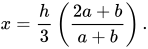
The center of area divides this segment in the ratio (when taken from the short to the long side)[46]: p. 862 

If the angle bisectors to angles A and B intersect at P, and the angle bisectors to angles C and D intersect at Q, then[44]

Applications

[edit]
The trapezoidal rule for numerical integration
Example of a trapeziform pronotum outlined on a spurge bug

In calculus, the definite integral of a function can be numerically approximated as a discrete sum by partitioning the interval of integration into small uniform intervals and approximating the function's value on each interval as the average of the values at its endpoints: where is the number of intervals, , , and . Graphically, this amounts to approximating the region under the graph of the function by a collection of trapezoids, so this method is called the trapezoidal rule.[47]

When any rectangle is viewed in perspective from a position which is centered on one axis but not the other, it appears to be an isosceles trapezoid, called the keystone effect because arch keystones are commonly trapezoidal. For example, when a rectangular building façade is photographed from the ground at a position directly in front using a rectilinear lens, the image of the building is an isosceles trapezoid. Such photographs sometimes have a "keystone transformation" applied to them to recover rectangular shapes. Video projectors sometimes apply such a keystone transformation to the recorded image before projection, so that the image projected on a flat screen appears undistorted.

Piazza del Campidoglio viewed from directly above.

Trapezoidal doors and windows were the standard style for the Inca, although it can be found used by earlier cultures of the same region and did not necessarily originate with them.[48][49] An almena, a battlement feature characteristic of Moorish architecture, is trapezoidal.[50] Michaelangelo's redesign of the Piazza del Campidoglio (see photograph at right) incorporated a trapezoid surrounding an ellipse, giving the effect of a square surrounding a circle when seen foreshortened at ground level.[51] Cinematography takes advantage of trapezoids in the opposite way, to produce an excessive foreshortening effect from the camera viewpoint, giving the illusion of greater depth to a room in a movie studio than the set physically has.[52] Trapezoids were also used to produce the visual distortions of Caligarism.[52] Canals and drainage ditches commonly have a trapezoidal cross-section.

In biology, especially morphology and taxonomy, terms such as trapezoidal or trapeziform commonly are useful in descriptions of particular organs or forms.[53]

Trapezoids are sometimes used as a graphical symbol. In circuit diagrams, a trapezoid is the symbol for a multiplexer.[54] An isosceles trapezoid is used for the shape of road signs, for example, on secondary highways in Ontario, Canada.[55]

Non-Euclidean geometry

[edit]

In spherical or hyperbolic geometry, the internal angles of a quadrilateral do not sum to 360°, but quadrilaterals analogous to trapezoids, parallelograms, and rectangles can still be defined, and additionally there are a few new types of quadrilaterals not distinguished in the Euclidean case.

A spherical or hyperbolic trapezoid is a quadrilateral with two opposite sides, the legs, each of whose two adjacent angles sum to the same quantity; the other two sides are the bases.[56] As in Euclidean geometry, special cases include isosceles trapezoids whose legs are equal (as are the angles adjacent to each base), parallelograms with two pairs of opposite equal angles and two pairs of opposite equal sides, rhombuses with two pairs of opposite equal angles and four equal sides, rectangles with four equal (non-right) angles and two pairs of opposite equal sides, and squares with four equal (non-right) angles and four equal sides.

When a rectangle is cut in half along the line through the midpoints of two opposite sides, each of the resulting two pieces is an isosceles trapezoid with two right angles, called a Saccheri quadrilateral. When a rectangle is cut into quarters by the two lines through pairs of opposite midpoints, each of the resulting four pieces is a quadrilateral with three right angles called a Lambert quadrilateral. In Euclidean geometry Saccheri and Lambert quadrilaterals are merely rectangles.

[edit]
An example of trapezoidal number: 15 = 4 + 5 + 6

A trapezoidal number is a set of positive integers obtained by summing consecutively two or more positive integers greater than one, forming a trapezoidal pattern.[57]

A crossed ladders problem is the problem of finding the distance between the parallel sides of a right trapezoid, given the diagonal lengths and the distance from the perpendicular leg to the diagonal intersection.[58]

See also

[edit]
  • Frustum, a solid having trapezoidal faces
  • Wedge, a polyhedron defined by two triangles and three trapezoid faces.

Notes

[edit]

Bibliography

[edit]

Further reading

[edit]
[edit]
Revisions and contributorsEdit on WikipediaRead on Wikipedia
from Grokipedia
A trapezoid is a quadrilateral in Euclidean geometry with exactly one pair of parallel sides, known as the bases, and the non-parallel sides called the legs.[1] The term originates from the Greek word trapeza, meaning "table," reflecting its table-like shape with parallel sides.[2] Definitions vary regionally: in North American English, it typically specifies exactly one pair of parallel sides, excluding parallelograms, while some international contexts use an inclusive definition with at least one pair.[3] Key properties include the midsegment (or median), which connects the midpoints of the legs and is parallel to the bases with a length equal to the average of the base lengths: $ m = \frac{a + b}{2} $, where $ a $ and $ b $ are the base lengths.[4] The area of a trapezoid is given by $ A = \frac{1}{2} (a + b) h $, where $ h $ is the height, the perpendicular distance between the bases.[2] The diagonals intersect at a point that divides each diagonal in the ratio of the lengths of the parallel sides.[3] Trapezoids are classified into types such as the isosceles trapezoid, where the legs are congruent and the base angles are equal, resulting in congruent diagonals and symmetry.[5] A right trapezoid features two adjacent right angles.[2] These shapes appear in architecture, engineering, and natural formations, with historical uses tracing back to ancient Egyptian measurements for land and structures.[6]

Definitions and Terminology

Standard Definition

A trapezoid is a convex quadrilateral in the Euclidean plane, defined as a four-sided polygon with exactly one pair of parallel sides.[2][7] The parallel sides are referred to as the bases, while the non-parallel sides are called the legs.[7] This configuration ensures that the trapezoid remains convex, meaning all interior angles are less than 180 degrees and the line segments connecting any two points within the shape lie entirely inside it.[8] In standard illustrations, the two bases are positioned such that one is horizontal, with the longer base typically drawn at the bottom to emphasize the shape's stability and common visual representation in geometry.[9] The legs connect the endpoints of the bases, forming the non-parallel sides that may vary in length and angle. For example, consider a quadrilateral ABCD where side AB is parallel to side CD; here, AB and CD serve as the bases, and sides AD and BC are the legs.[10] This setup distinguishes the trapezoid from other quadrilaterals like parallelograms, which have two pairs of parallel sides. Special cases of the trapezoid, such as the isosceles trapezoid where the legs are congruent, build upon this standard definition but introduce additional symmetry.[2]

Regional Variations

In the United States, a trapezoid is defined as a quadrilateral with exactly one pair of parallel sides, an exclusive definition that distinguishes it from parallelograms.[11] This approach is prevalent in American elementary and secondary textbooks, emphasizing precise classification of quadrilaterals.[12] In contrast, British, Commonwealth, and much of the international mathematical community adopt an inclusive definition for trapezoids (often termed "trapezium" in British English), describing them as quadrilaterals with at least one pair of parallel sides, thereby encompassing parallelograms as a special case.[13] Under this view, the shape includes all quadrilaterals with parallel sides, aligning with broader geometric hierarchies in higher mathematics.[3] This terminological and definitional divergence emerged in the 20th century, as U.S. textbooks increasingly favored the exclusive definition for pedagogical clarity in early education, while international standards shifted toward the inclusive one to facilitate theorem generalization.[3] The variation traces back to 19th-century adaptations of European terminology, with American texts reversing traditional labels around 1795 but solidifying the exclusive stance later.[13] The implications of these differences affect shape classifications: the U.S. exclusive definition excludes parallelograms from trapezoids, requiring separate treatment in curricula and potentially complicating hierarchical diagrams, whereas the inclusive international approach streamlines proofs by treating parallelograms as subsets.[11] This can lead to inconsistencies in cross-regional mathematical communication and education.[12]

Etymology and History

Etymology

The term "trapezoid" originates from the Late Greek trapezoeidēs, meaning "table-shaped," derived from trapeza (table) combined with the suffix -oeidēs (shaped like).[14] The root trapeza itself stems from tetra- (four) and peza (foot), evoking a four-legged table.[14] The earliest geometric usage appears in the 5th-century AD commentary on Euclid's Elements by the Neoplatonist philosopher Proclus, who applied trapezoeidēs (trapezoid) to a quadrilateral with no parallel sides, distinguishing it from the trapezion (trapezium), which he defined as having exactly two parallel sides.[13] The word entered English in 1706 via Modern Latin trapezoides, initially retaining the ancient sense of a quadrilateral lacking parallel sides, but by the late 18th century, its meaning transposed with "trapezium" in common usage, coming to denote an irregular quadrilateral with exactly one pair of parallel sides.[14] This transposition persists in regional variations: in British English, "trapezium" refers to a quadrilateral with one pair of parallel sides (the American "trapezoid"), while "trapezoid" denotes a quadrilateral with no parallel sides.[14]

Historical Development

Preceding Greek developments, ancient Babylonian mathematics (c. 2000–1600 BCE) employed trapezoid-like figures for approximating areas in land measurement, influencing later traditions. The concept of the trapezoid emerged in ancient Greek mathematics as part of broader classifications of quadrilaterals. In Euclid's Elements (c. 300 BC), Book I, Definition 22 describes "trapezia" as quadrilaterals that are neither equilateral and right-angled (squares), right-angled but not equilateral (oblongs), equilateral but not right-angled (rhombi), nor having opposite sides and angles equal (rhomboids), providing a vague catch-all term without specifying parallel sides. This ambiguity was addressed centuries later by the Neoplatonist philosopher Proclus (c. 412–485 AD) in his extensive commentary on Euclid's Elements. Proclus introduced a more structured categorization, attributing to earlier geometers the distinction where a trapezium has exactly two parallel sides and a trapezoid has none, influencing subsequent interpretations of quadrilateral types.[13] During the medieval Islamic Golden Age, Arabic scholars applied geometric figures akin to trapezoids in practical contexts such as surveying and inheritance division, using algebraic methods to resolve real-world land measurement problems encountered in agriculture and taxation. The 19th and 20th centuries saw the trapezoid's definition standardize across educational materials, particularly in the West. Late 19th-century American geometry textbooks adopted an exclusive definition of the trapezoid as a quadrilateral with exactly one pair of parallel sides, contrasting with European conventions where the term often denoted no parallel sides; this U.S.-specific usage solidified around the 1950s in response to growing emphasis on precise terminology in secondary education.[13] Significant milestones in the trapezoid's development include its routine inclusion in school geometry curricula by the mid-19th century, reflecting broader Euclidean influences in public education, and debates over definitional inclusivity during the 1960s "New Math" reforms, where curriculum developers grappled with whether parallelograms should be subsumed under trapezoids to align with axiomatic rigor.

Types and Special Cases

Isosceles Trapezoid

An isosceles trapezoid is a trapezoid in which the two non-parallel sides, known as the legs, are congruent in length. This configuration distinguishes it from a general trapezoid, which requires only one pair of parallel sides called the bases. The base angles adjacent to each leg are also equal, with the angles adjacent to the longer base being congruent to each other and those adjacent to the shorter base being congruent to each other.[1][4][15] Due to the equal leg lengths, an isosceles trapezoid possesses a line of symmetry that is perpendicular to both bases and passes through their midpoints, bisecting each base, the two legs, and the four base angles. This symmetry implies that the figure is symmetric across this axis, meaning one half is a mirror image of the other. The diagonals of an isosceles trapezoid are congruent, providing an additional characteristic not necessarily present in non-isosceles trapezoids. Furthermore, each pair of adjacent angles formed by a leg and one of the bases is supplementary, summing to 180 degrees, which follows from the parallel bases and the equal leg lengths.[16][17][18][1][19] To construct an isosceles trapezoid using compass and straightedge, begin by drawing the longer base as a line segment AB. Construct the midpoint M of AB and draw a perpendicular line through M. Select a point P on AB between A and M, then reflect P over the perpendicular to obtain point Q on the other side. Draw perpendiculars to AB at P and Q, and choose a point C on the perpendicular at P such that the distance from the base is the desired height. Draw a line through C parallel to AB, and let it intersect the perpendicular at Q to form point D. Connect A to D and B to C to complete the figure, ensuring the legs AD and BC are equal due to the symmetric construction.[20]

Right Trapezoid

A right trapezoid is a trapezoid featuring two adjacent right angles, typically formed when one of the non-parallel sides, or legs, is perpendicular to the pair of parallel sides known as the bases. This perpendicular leg creates 90-degree angles at both ends where it meets the bases.[21][22] Key characteristics of a right trapezoid include the perpendicular leg directly measuring the height of the shape, which simplifies geometric computations compared to general trapezoids where height must be derived separately. The other leg remains oblique, forming acute and obtuse angles with the bases, resulting in an asymmetric form that distinguishes it from more symmetric variants like the isosceles trapezoid.[23][24] If the oblique leg also becomes perpendicular to the bases—such as when the lengths of the two bases are equal—the right trapezoid degenerates into a rectangle, possessing four right angles and opposite sides of equal length.[25] An example of a right trapezoid appears in architectural lintels with one vertical support, where the perpendicular leg aligns with structural columns to span openings efficiently while maintaining stability.[26]

Construction and Existence

Conditions for Existence

A trapezoid is fundamentally a convex quadrilateral with exactly one pair of opposite sides parallel, known as the bases, while the other two sides are the legs.[2] This parallelism condition is necessary and sufficient under the exclusive definition, though some conventions use an inclusive definition with at least one such pair.[3] The convexity requirement ensures that the interior angles are less than 180 degrees and the sides do not intersect, preventing crossed or self-intersecting configurations that would violate the simple polygonal structure. No additional constraints on side lengths exist beyond the quadrilateral inequality, which states that the sum of the lengths of any three sides must exceed the length of the remaining side; this guarantees that the figure can form a closed shape without collapsing.[27] For the trapezoid specifically, this applies to the bases and legs collectively, akin to ensuring the triangle inequality holds when dividing the shape along a diagonal into two triangles. Degenerate cases arise when the configuration fails to produce a proper quadrilateral, such as when the two parallel bases coincide in position and length, reducing the shape to a line segment, or when one leg has zero length, degenerating into a triangle.[28] In these instances, the parallelism condition persists but the four-sided nature is lost, excluding them from standard trapezoid classifications.

Characterizations

A trapezoid can be characterized in coordinate geometry by positioning its parallel bases along lines of constant y-coordinate, with one base extending from (x1,0)(x_1, 0) to (x2,0)(x_2, 0) and the other from (x3,h)(x_3, h) to (x4,h)(x_4, h), where h>0h > 0 is the height. The non-parallel sides, or legs, then connect (x1,0)(x_1, 0) to (x3,h)(x_3, h) and (x2,0)(x_2, 0) to (x4,h)(x_4, h). This placement ensures the bases are horizontal and parallel, facilitating calculations of properties such as area or diagonals through standard vector or distance formulas.[29] Another characterization uses vectors and midpoints: the line segment connecting the midpoints of the non-parallel sides (legs) is parallel to the bases and has a length equal to the average of the bases' lengths. This serves as an equivalent defining feature, as its parallelism to a pair of opposite sides confirms the trapezoidal structure in a convex quadrilateral.[30] The angle condition provides a further equivalent definition: a convex quadrilateral is a trapezoid if and only if the pairs of adjacent angles formed by each leg and the bases are supplementary, summing to 180180^\circ. This arises because the legs act as transversals to the parallel bases, making the adjacent angles same-side interior angles; conversely, such supplementary pairs imply the bases are parallel.[31] In a trapezoid, the sum of the lengths of the projections of the legs onto the line containing one of the bases equals the absolute difference between the lengths of the two bases. This property accounts for the "overhang" created by the legs when the bases are aligned, as seen when dropping perpendiculars from the shorter base to the longer one, where the projections form the overhanging segments.

Properties

Midsegment and Height

In a trapezoid, the midsegment is the line segment connecting the midpoints of the two non-parallel sides, known as the legs. The midsegment theorem states that this segment is parallel to the two bases and has a length equal to the average of the lengths of the bases, given by the formula $ m = \frac{a + b}{2} $, where $ a $ and $ b $ are the lengths of the parallel bases.[2][32] A proof of the midsegment theorem can be outlined using similar triangles formed through height projection. Consider trapezoid ABCD with bases AB and CD (AB shorter than CD) and legs AD and BC. Drop perpendiculars from A and B to CD, meeting at points P and Q, respectively, forming right triangles ADP and BCQ with height $ h $, and a central rectangle APQB. Let M and N be the midpoints of legs AD and BC. The line MN intersects the heights at their midpoints, creating smaller similar triangles at the top half-height similar to the original right triangles ADP and BCQ by AA similarity (sharing angles and proportional heights of $ h/2 $). The bases of these smaller triangles are half the overhangs, leading to the midsegment length $ m = AB + \frac{1}{2}(CD - AB) = \frac{a + b}{2} $. Parallelism follows from the corresponding angles being equal due to the similarity.[33][34] The height $ h $ of a trapezoid is defined as the perpendicular distance between its two parallel bases. To derive $ h $, drop perpendiculars from the endpoints of the shorter base to the longer base, forming two right triangles adjacent to a central rectangle. The length of each perpendicular segment is $ h $, which can be found using the Pythagorean theorem in these right triangles: for each triangle, $ h = \sqrt{l^2 - x^2} $, where $ l $ is the leg length and $ x $ is the horizontal overhang (with the total overhang $ b - a $ split between the two sides). In the general case, the overhangs may differ, requiring separate calculations for each side and ensuring consistency.[35][36] The midsegment acts as the midline in trapezoid diagrams, providing a reference for dividing the figure into equal-area regions or visualizing properties like symmetry in isosceles cases. It is particularly useful in applications where the average base length simplifies computations, such as deriving the area as midsegment times height.[2]

Area Formulas

The area $ A $ of a trapezoid with parallel bases of lengths $ a $ and $ b $ (where $ a > b $) and height $ h $ (the perpendicular distance between the bases) is given by the formula
A=a+b2h. A = \frac{a + b}{2} h.
[2] This formula arises from the fact that the area represents the average of the base lengths multiplied by the height. One derivation of this formula uses decomposition into a central rectangle and two right triangles. By dropping perpendiculars from the endpoints of the shorter base $ b $ to the longer base $ a $, the trapezoid divides into a rectangle of width $ b $ and height $ h $, plus two right triangles each with height $ h $ and bases totaling $ a - b $ (split according to the leg projections). The rectangle area is $ b h $, and the triangles' combined area is $ \frac{(a - b) h}{2} $, yielding
A=bh+(ab)h2=(a+b)h2. A = b h + \frac{(a - b) h}{2} = \frac{(a + b) h}{2}.
[37] An equivalent derivation relies on the midsegment theorem, which states that the length $ m $ of the midsegment (connecting the midpoints of the non-parallel legs) is the average of the bases, $ m = \frac{a + b}{2} $. The trapezoid's area equals that of a rectangle with base $ m $ and height $ h $, so
A=mh=a+b2h. A = m h = \frac{a + b}{2} h.
[2] An alternative form expresses the area directly in terms of the midsegment: $ A = m h $.[2] When the leg lengths $ c $ and $ d $ are known instead of the height, the area can be computed using
A=a+b4(ba)(a+b+c+d)(ab+c+d)(a+bc+d)(ab+cd), A = \frac{a + b}{4(b - a)} \sqrt{(-a + b + c + d)(a - b + c + d)(a + b - c + d)(a - b + c - d)},
assuming $ b > a $; this derives from combining the height expression with the trapezoid's side lengths via a quadrilateral area formula adapted for parallel sides.[2] If base angles are known, the height can first be found as $ h = c \sin \alpha $ (where $ \alpha $ is the angle between leg $ c $ and the adjacent base), then substituted into the standard formula; this approach is particularly straightforward for isosceles trapezoids where the base angles are equal.[38] For a trapezoid with vertices at coordinates $ (x_1, y_1) $, $ (x_2, y_2) $, $ (x_3, y_3) $, $ (x_4, y_4) $ (listed in clockwise or counterclockwise order), the area can be calculated using the shoelace formula for polygons:
A=12x1y2+x2y3+x3y4+x4y1(y1x2+y2x3+y3x4+y4x1). A = \frac{1}{2} \left| x_1 y_2 + x_2 y_3 + x_3 y_4 + x_4 y_1 - (y_1 x_2 + y_2 x_3 + y_3 x_4 + y_4 x_1) \right|.
This method applies directly since a trapezoid is a simple quadrilateral.[39] The area is measured in square units consistent with the input lengths (e.g., square meters if bases and height are in meters). For example, consider a trapezoid with bases $ a = 6 $ units and $ b = 4 $ units, and height $ h = 5 $ units; the area is
A=6+42×5=25 A = \frac{6 + 4}{2} \times 5 = 25
square units.[2]

Diagonal Properties

In a trapezoid ABCD with parallel bases AB and CD, the diagonals AC and BD intersect at a point E that divides each diagonal in the ratio of the lengths of the bases, such that AE/CE = BE/DE = AB/CD.[3] This property arises from the similarity of triangles ABE and CDE, which share corresponding angles due to the parallel lines and transversals formed by the diagonals.[3] The lengths of the diagonals in a trapezoid depend on the base lengths, leg lengths, and height. In an isosceles trapezoid, where the non-parallel legs are equal, the diagonals are congruent, each with length given by
d=h2+(ab2)2, d = \sqrt{h^2 + \left( \frac{|a - b|}{2} \right)^2},
where aa and bb are the lengths of the parallel bases (a>ba > b) and hh is the height; this follows from dropping perpendiculars from the ends of the shorter base, creating right triangles with base ab2\frac{a - b}{2}.[40][41] For a general trapezoid, the diagonals differ in length, and their squares can be expressed as
e2=ab+c2ad2bab,f2=ab+d2ac2bab, e^2 = ab + \frac{c^2 a - d^2 b}{a - b}, \quad f^2 = ab + \frac{d^2 a - c^2 b}{a - b},
where aa and bb are the bases (a>ba > b) and cc and dd are the legs.[42] A key relation among the sides and diagonals is that the sum of the squares of the legs equals the sum of the squares of the diagonals minus twice the product of the bases:
c2+d2=e2+f22ab. c^2 + d^2 = e^2 + f^2 - 2ab.
This trapezoid law provides a direct connection between the non-parallel sides and the diagonals, analogous to vector-based identities in Euclidean geometry.[42] In the special case of an isosceles trapezoid, the equality of the diagonals follows from the bilateral symmetry across the line perpendicular to the bases through their midpoints.[41]

Angle and Symmetry Properties

In a trapezoid, the two angles adjacent to each non-parallel side (leg) are supplementary, meaning their measures sum to 180180^\circ. This property arises because the bases are parallel, and each leg serves as a transversal, making the adjacent angles consecutive interior angles.[1] Depending on the slant of the legs relative to the bases, one pair of base angles may be acute while the other is obtuse; for instance, if the legs slope inward toward the shorter base, the angles at the longer base are acute, and those at the shorter base are obtuse.[43] An isosceles trapezoid exhibits additional angle equality: the two base angles adjacent to the longer base are congruent to each other, and the two adjacent to the shorter base are also congruent to each other. Moreover, each angle at the longer base is supplementary to the adjacent angle at the shorter base.[1] In a right trapezoid, one such base angle measures exactly 9090^\circ.[43] Regarding symmetry, a general trapezoid possesses no line or rotational symmetry due to the unequal lengths of its legs and the lack of balanced proportions. In contrast, an isosceles trapezoid has reflection symmetry across the line perpendicular to the bases passing through their midpoints, which acts as an axis of symmetry, mirroring the equal legs and base angles. It lacks rotational symmetry, as rotating the figure by any non-trivial angle (other than 360360^\circ) disrupts the alignment of the unequal bases.[44]

Applications

In Architecture and Engineering

In architecture, trapezoidal shapes are employed in roofs to enhance structural stability and load-bearing capacity, as the parallel bases allow for efficient distribution of weight across the surface, mimicking the stability seen in ancient monumental structures.[45] Trapezoidal roof panels, common in modern industrial and agricultural buildings, provide high strength-to-weight ratios, enabling them to withstand wind, snow, and seismic loads while minimizing material use.[46] Inca architecture prominently features trapezoidal doorways and windows, which replace traditional arches and offer superior seismic resistance by allowing walls to flex without collapsing during earthquakes.[47] These sloped, trapezoidal openings, as seen in sites like Machu Picchu, distribute stress evenly across stone joints, contributing to the enduring stability of structures in tectonically active regions.[48] Trapezoidal shapes also appear in road signs, particularly those designating recreational and cultural areas, where the form aids in quick visual recognition and provides mounting stability against wind forces due to its aerodynamic profile.[49] In engineering, trapezoidal channels are widely used in hydraulic systems for efficient water flow, as their geometry optimizes the hydraulic radius in Manning's equation, reducing friction and erosion while maximizing conveyance capacity.[50] For instance, irrigation and drainage systems often incorporate trapezoidal cross-sections to balance flow velocity and sediment transport.[51] Trapezoidal wedges serve as critical components in machinery, such as in electrical motor stators, where their parallel-sided profile ensures secure slot retention and uniform force application during operation.[52] The primary advantage of trapezoids in these applications lies in their parallel bases, which facilitate even load distribution, reducing stress concentrations and enhancing overall structural integrity compared to rectangular or irregular forms.[53]

In Mathematics and Computing

In numerical analysis, the trapezoidal rule serves as a fundamental method for approximating the definite integral of a function by dividing the integration interval into trapezoids and summing their areas. This approach approximates the area under the curve f(x)f(x) over [a,b][a, b] using linear interpolation between function values at the endpoints. For a single interval, the formula is given by
abf(x)dxh2(f(a)+f(b)), \int_a^b f(x) \, dx \approx \frac{h}{2} \left( f(a) + f(b) \right),
where h=bah = b - a.[54] The rule originates from the Newton-Cotes family of quadrature formulas and provides a second-order accurate approximation, with the error term proportional to h3f(ξ)h^3 f''(\xi) for some ξ[a,b]\xi \in [a, b].[55] For broader applicability, the composite trapezoidal rule extends this to multiple subintervals by partitioning [a,b][a, b] into nn equal parts of width h=(ba)/nh = (b - a)/n, yielding
abf(x)dxh2(f(x0)+2i=1n1f(xi)+f(xn)), \int_a^b f(x) \, dx \approx \frac{h}{2} \left( f(x_0) + 2 \sum_{i=1}^{n-1} f(x_i) + f(x_n) \right),
where xi=a+ihx_i = a + i h. This method achieves an error of order O(h2)O(h^2), making it efficient for computational integration when combined with adaptive step-sizing.[54] It underpins many numerical libraries and is particularly valued for its simplicity in estimating integrals where exact antiderivatives are unavailable.[55] In computer graphics and computational geometry, trapezoids play a key role in polygon processing algorithms, notably through clipping and decomposition techniques that facilitate efficient rendering. The Sutherland-Hodgman algorithm, a classic reentrant clipping method, processes polygons against convex boundaries by iteratively clipping edges, producing intermediate polygons suitable for further decomposition. Following clipping, trapezoid decomposition breaks down the resulting polygons into non-overlapping trapezoids aligned with scanlines, enabling rapid rasterization and filling in rendering pipelines. This approach, as detailed in early high-performance graphics work, computes edge slopes and interpolates attributes across trapezoid spans to generate pixel coverage, significantly reducing computational overhead in scanline-based systems.[56] Trapezoidal fuzzy numbers extend trapezoid concepts to fuzzy set theory, representing imprecise quantities with membership functions defined by four parameters (core interval and support bounds) in optimization models. In linear programming, these numbers model uncertain coefficients or constraints in decision-making under vagueness, transforming crisp problems into fuzzy equivalents solvable via ranking functions or defuzzification. Seminal developments in this area, such as symmetric trapezoidal formulations, allow for duality and sensitivity analysis while preserving computational tractability.[57] This application is prevalent in operations research for handling real-world ambiguities in resource allocation and multi-criteria decisions.[58]

Extensions

In Non-Euclidean Geometry

In hyperbolic geometry, trapezoids are quadrilaterals with at least one pair of parallel sides, but the parallel postulate allows such lines to diverge asymptotically, causing the non-parallel legs to slant in the same direction and the distance between the bases to vary along their length. This divergence contrasts with Euclidean trapezoids, where the height is constant. A prominent example is the Saccheri quadrilateral, formed by a base with two equal perpendicular legs of length dd, resulting in a summit longer than the base of length cc and acute summit angles α<π/2\alpha < \pi/2. The altitude hh between the base and summit satisfies coshh=coshdcoshc21+cosh2dsinh2c2\cosh h = \frac{\cosh d \cdot \cosh \frac{c}{2}}{\sqrt{1 + \cosh^2 d \cdot \sinh^2 \frac{c}{2}}}, reflecting the negative Gaussian curvature.[59] The area formula for a Saccheri trapezoid adjusts for curvature K=1K = -1, given by tan(S/2)=sinhdtanh(c/2)\tan(S/2) = \sinh d \cdot \tanh(c/2), where SS is the area, differing from the Euclidean (a+b)h/2(a + b)h/2 due to hyperbolic expansion.[60] Properties like the midsegment theorem fail: the segment joining midpoints of the legs remains parallel to the bases but its length exceeds the arithmetic mean of the bases, as hyperbolic parallels spread apart. Diagonals intersect but do not bisect each other proportionally, violating Euclidean symmetry.[60] In spherical (elliptic) geometry, no true parallel lines exist, as all great circles intersect. Analogous figures to Euclidean trapezoids include Saccheri quadrilaterals, which have obtuse summit angles α>π/2\alpha > \pi/2 and a summit shorter than the base.[61] The area is given by the spherical excess: the sum of the interior angles minus 2π2\pi, adjusted by the positive curvature.[61] Symmetric spherical quadrilaterals, such as those bounded by latitude circles and meridians, exhibit similar properties. In taxicab (Manhattan) geometry, defined by L1L_1-metric distances along grid lines, trapezoids appear as quadrilaterals with two parallel sides, such as in Apollonian sets where the locus forms a trapezoid when foci share no guiding line, with legs slanting at 45 degrees to the axes.[62] The midsegment connects leg midpoints parallel to bases but its length equals the average only if legs are axis-aligned; otherwise, it varies due to the metric's anisotropy. Diagonals follow grid paths and intersect non-proportionally.

In Three-Dimensional Geometry

In three-dimensional Euclidean geometry, the trapezoid serves as a foundational shape for several polyhedral extensions, notably the trapezoidal prism and the frustum of a pyramid or cone. A trapezoidal prism is a prism with two congruent trapezoidal bases that are parallel and separated by a height, connected by four rectangular lateral faces. This structure maintains the parallelism of the bases' non-parallel sides across the third dimension, resulting in a total of six faces, twelve edges, and eight vertices.[63] The frustum represents another key extension, formed by truncating a pyramid or cone with a plane parallel to its base, yielding two parallel polygonal or circular bases of unequal size at different heights and trapezoidal lateral faces. In a pyramidal frustum, each lateral face is an isosceles trapezoid connecting corresponding sides of the bases, with the slant height determined by the difference in base perimeters and the frustum's height. For a regular pyramidal frustum, the volume is calculated as $ V = \frac{1}{3} h (A_1 + A_2 + \sqrt{A_1 A_2}) $, where $ A_1 $ and $ A_2 $ are the areas of the lower and upper bases, respectively, and $ h $ is the perpendicular height between them; this formula derives from integrating the varying cross-sectional areas, analogous to the average area times height but adjusted for the geometric mean to account for linear tapering.[64] Frustums also arise as solids of revolution when a right trapezoid is rotated about one of its legs, generating a conical frustum with circular bases and a curved lateral surface unrolled into a sector of an annulus.[65] These 3D figures exhibit properties such as uniform cross-sections parallel to the bases, which scale linearly from one base to the other in frustums, enabling efficient computation of centroids and moments of inertia for stability analysis. In engineering applications, frustums with trapezoidal lateral faces are commonly employed in the design of storage tanks and hoppers, where the tapering shape facilitates controlled material discharge and minimizes dead zones in bulk handling systems, as seen in square pyramidal hoppers for granular flow.[66] Trapezoidal prisms, meanwhile, appear in structural components like beams or channels with uniform cross-sections for load-bearing efficiency.[63]

References

User Avatar
No comments yet.

