Hubbry Logo
TrellechTrellechMain
Open search
Trellech
Community hub
Trellech
logo
8 pages, 0 posts
0 subscribers
Be the first to start a discussion here.
Trellech
Trellech
from Wikipedia

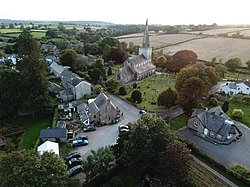
Trellech viewed from Beacon Hill

Key Information

Trellech (occasionally spelt Trelech, Treleck or Trelleck; Welsh: Tryleg) is a village and parish in Monmouthshire, south-east Wales. Located 5 miles (8 km) south of Monmouth and 4 miles (6.4 km) north-north-west of Tintern, Trellech lies on a plateau above the Wye Valley on the southern fringes of 320 acres (130 ha) of woodland in an Area of Outstanding Natural Beauty. Three Bronze Age standing stones are situated in the village, known as Harold's Stones, which overlook the historic church of St Nicholas, a Grade I listed building.

Although a relatively small village in modern times, it was one of the largest towns in Wales in the 13th century, and is now a site of archaeological interest to determine its extent and role at that time. The village is designated as a conservation area.[1]

There are four nature reserves nearby; New Grove Flower Meadow, noted for its orchids, and Trellech Beacon are both owned by Gwent Wildlife Trust while Cleddon Bog[2] and Croes Robert Wood are both SSSIs.[3]

Etymology

[edit]

It is thought that the Welsh name Tryleg probably means 'conspicuous stone' and derives from the intensifying prefix try- and *lleg, an unrecorded variant of the common noun llech 'stone, slab'. If so, the name probably refers to a large stone that once stood on a mound about a mile-and-a-half north of the village. Historical forms of the name vary between Try-, Tri- and Tre-. It is likely that the three standing stones known as Harold's Stones influenced those forms that begin with Tri- (Welsh tri 'three'). Another Welsh noun tre(f) 'settlement, town' has probably influenced forms that begin with Tre-. The noun llech, mentioned above, has also influenced various forms of the name.[4] The <ll> in the English form Trellech is given its English pronunciation (not as Welsh [ɬ]). Likewise, the final <ch> is pronounced as [k] not as Welsh [χ].[citation needed]

The village is noteworthy because of the variety of different modern spellings of the name. Historically, up to 30 different variations of the name have been recorded, of which four are still commonly used.[5] On each of the three roads entering the village, signs give a different spelling: Trellech, Trelleck and Trelech.

History

[edit]

Trellech was one of the major towns of medieval Wales, the remains of which have been subject to archaeological excavations which have been sustained over many years and which continue today. It is most likely that the town was established by the De Clare family specifically for the exploitation of local supplies of iron ore from the Forest of Dean, and charcoal produced in the surrounding woodlands, to provide weapons, armour and iron work for their military advances in Wales, including the building of Caerphilly Castle.[6] By 1288 there were 378 burgage plots recorded in Trellech, which would have made it bigger than Cardiff or Chepstow at the time. Trellech was largely destroyed in 1291 as a result of a raid following a dispute over alleged deer poaching. The Black Death struck in 1340 and again in 1350. Subsequently, the ravages of Owain Glyndŵr and his men in the early 15th century further reduced the prosperity and in consequence the importance of Trellech.

Archaeological investigations

[edit]

Archaeological investigations at Trellech have been led since the early 1990s by the South Wales Centre for Historical and Interdisciplinary Research at the University of Wales, Newport.[7] There is currently some dispute over the layout and development of the medieval town and its environs.[8] In 2005, Stuart Wilson bought a field in which, he was convinced, were remains of the lost medieval town. Wilson had previously broken into sites and undermined the work of other archaeologists in the area, claiming he "once sneaked onto Howell's dig site to prove an ancient wall the professor had uncovered was really a modern field drain." [1].This site had first been identified as of potential interest by (the unrelated) Julia Wilson, in 1998.[9][10]

Stuart Wilson's interest in this field and the possibility that his hunch might be correct was the subject of a 30-minute BBC Radio 4 documentary, presented by the archaeologist Francis Pryor, and entitled The Boy Who Bought a Field, broadcast on 6 March 2006. The programme revealed that Wilson had apparently discovered medieval walls and yard-paving. In 2008 the Monmouth Archaeological Society said, "there is now no room for debate"[11] that the excavations by Wilson and others have identified the main part of the medieval town to be around the minor road towards Catbrook, to the south of the current village, on what is now farmland. In 2016, Wilson proposed turning the site into a camp site, research centre and tourist attraction.[12][13] Some of Wilson's claims have been criticised by academic archaeologists.[14]

Places of historical interest

[edit]

Church of St Nicholas

[edit]
St Nicholas' Church

The Anglican parish church has been designated a Grade I listed building since 19 November 1953,[15] and is described by Joseph Bradney as "one of the largest and most handsome of the country churches in the county" of Monmouthshire.[16] With an elegant pointed and prominent steeple, a font and 17th-century sundial, it is a focal point of the village. The main part of the church building is of local Old Red Sandstone, with a three-stage tower. The stone spire can be seen for several miles around and is described by architectural writer John Newman as "the town's pride and joy".[17]

A church on this site, probably a wooden structure, was endowed by Ffernfael ap Ithel and Meurig ap Tewdrig who were rulers of Gwent in the 7th and 8th centuries. The Preaching Cross in the churchyard is early Medieval in date, as is the font.[18] The present building dates from the 13th or early 14th century. The early English Gothic stonework has been dated to between 1225 and 1272, and that of the Decorated Gothic up to 1350. The church has a large clerestoried nave, with a much smaller chancel. The "impressive" interior has a "spendidly high" tower arch, and the five-bay nave has arcades on octagonal piers.[19] The altar rails and pulpit, dated 1640, are survivals of 17th century church interior design. At the west end of the church, directly below the window, is a Royal Coat of Arms for King Charles II dated 1683.[19] Records are held by the church dating from 1692. Complete lists of vicars, from 1359, and churchwardens, from 1763, can be found in the entrance to the south aisle. The rear of the main church door is inscribed "IHS 1595".

When the weathercock was removed from the spire in 1972 it was found to have been made in Ross-on-Wye in 1792. The original spire fell, damaging the roof of the nave, and a contemporary reference attributes this to "lightning and storms". In the belfry the cage housing the three bells is of a type similar to that found in others constructed about the year 1700. At the end of the last century the church was in a neglected state and was extensively renovated and re-roofed. The Belgian slates then in place were replaced with Welsh slates in 1961. The chancel was replastered in 1972 and painted white. During 1974 considerable repairs were undertaken to the north and south aisles, and in 2001 the majority of the churchyard dry-stone wall was removed and rebuilt.

Sundial

[edit]

The church contains a stone sundial, dated 1689, which was originally set up by Lady Probert of the Argoed, Penallt. Three of the four faces of the sundial show the village's historic features: Tump Terret, with the inscriptions MAGNA MOLE ("Great in its Mound") and O QUOT HIC SEPULTI ("Oh! How many are buried here"); Harold's Stones with the inscriptions MAIOR SAXIS ("Greater in its Stones") and HIC FUIT VICTOR HARALDUS ("Here Harold was victorious"); and the Virtuous Well, with the inscriptions MAXIMA FONTE ("Greatest in its Well") and DOM. MAGD. PROBERT OSTENDIT ("Lady Magdalen Probert gives proof of it"). The sundial stood in a garden, on top of the inverted ancient font, until both were moved inside the church in the early 20th century.[16] A carved wooden replica of the sundial was placed in a field south of the village in recent years.[19]

Harold's Stones

[edit]
Harold's Stones, looking north east

Three large monoliths of conglomerate stone, commonly referred to as puddingstone, are located in a field on the eastern side of the B4293 to the south of the village. (SO 498051)[20] The stones, situated on publicly accessible land belonging to the Davies family of Crosshands Farm, are a scheduled ancient monument.[21] The stones have been described as "one of the more substantial megalithic monuments in Monmouthshire".[22]

The stones are on slightly elevated ground close to running water and springs, which might be relevant to the choice of site.[23] They are believed to date back to the Bronze Age. Such remains are rare in this part of Wales. Various local traditions are ascribed to them: that they were erected by Harold Godwinson to celebrate a victory over the Welsh in 1063; that they commemorate three chieftains who fell fighting against the Romans; or that they were flung from the Skirrid by the mythical Jack o' Kent in a trial of strength with the Devil.[24][25][26]

The stones form an approximate line running between north-east and south-west at an azimuth of about 229°, which probably indicates the midwinter sunset,[27] though the midsummer sunrise cannot be excluded on account of the lack of precise alignment of the stones.[28] They have been described as "the most visually impressive of the alignments in South Wales."[28] Their location, without good views beyond the immediate surroundings, suggests that its alignment may be significant.[29] The stones are respectively 2.7 metres (8 ft 10 in), 3.7 metres (12 ft), and 4.6 metres (15 ft) high, the tallest being at the south-west; the overall length of the row is 11 metres (36 ft).[24][30] The central stone has what are thought to be cup marks.[19] It is supposed that the stones were dragged to the site on logs and levered into position, probably either for seasonal information or for use at religious ceremonies. Houlder (1978) speculates that they were once part of a much larger and impressive alignment,[31] but Castleden (1992) suggests that they did not form part of a stone circle[22][32]

Aubrey Burl asserts that short stone-rows of this kind were used as the ritual centres of families of "perhaps ten or twenty adults and children", though the erection of large stones required the co-operation of several such families. He compared the Trellech stones to the row at Le Vieux-Moulin, Plouharnel, near Carnac, and says that "Similar short rows were erected by communities in Ireland, Britain and Brittany in the centuries of the Bronze age between 1800 and 1000 BC".[30] The source of the Trellech stones may have been the nearby Beacon Hill where there are outcrops of a similar conglomerate. A fourth stone, on nearby common land, is believed to have been destroyed in the 18th century.[22]

Tump Terret and Court Farm

[edit]
Tump Terret

Tump Terret is situated within the grounds of Court Farm to the southwest of the church. It dates back to Norman times, as the site of a small motte and bailey castle; traces of its surrounding ditch remain.[19] It was known to be in existence before 1231[33] and the castle was still extant in 1263, when it was mentioned in manorial documents. A local myth, commemorated on the sundial, was that it was a burial mound for those killed in actions between the forces of Harold Godwinson and the opposing Welsh. A now-vanished summer house was built by the Rumsey family on top of the mound.[16]

Trellech Court – now the site of the farmhouse – was the seat of a branch of the Seymour family until it passed to John Rumsey in the early 18th century. The existing building is, according to Bradney, "a building of no architectural features", and dates from around the time of Rumsey's ownership. It was converted into a farmhouse in the later 19th century.[16]

The Virtuous Well

[edit]
The Virtuous Well

Sometimes known as St Anne's Well, this circular wellspring, surrounded by a stone wall and seating, is located in a field on the left of the road to Tintern, about 400 yards (370 m) east of the village. Local tradition is that it is the only one remaining of originally nine holy wells in Trellech. In the 17th century, it was reportedly much frequented, and reputed to cure "the scurvy, colic and other distempers".[19] Water from the well is rich in chalybeate.[16]

It is a clootie well, where token offerings are placed around and within the well, and strips of cloth and ribbons are hung from neighbouring trees. It is also used as a wishing well. Traditionally, "to make a wish one threw into the water a small metal object. Many bubbles arising from it meant a rapid granting of one's wish, few bubbles meant that a long period of time would elapse before the wish came true and no bubbles at all meant that one's wish had not been granted. The young maidens of Trellech anxious to know how long they had to wait until their wedding day, would drop a pebble into the water and every bubble that arose counted for one month."[34]

The Village Hall / The Babington Centre

[edit]

The building now known as the Trellech Village Hall, previously The Babington Centre was constructed in 1820 as a primary school. A school was first established in the village in 1591 by the epigrammatist John Owen, and a century later, in 1691, a new school was set up by the local vicar, Zachary Babington, a relative of the bishop of Llandaff, Gervase Babington.[16] Babington established a charity to enable poor children in the village to be educated.[35]

When Trellech Primary School moved to a new site on the north side of the village, the 1820 school building was claimed by the Diocese of Monmouth, but eventually passed to the Trellech Babington Educational Trust, a registered charity established in 1992.[35] The Babington Centre is now the main asset owned by the Babington Educational Foundation. The Centre is a focus for many aspects of village life including film nights, concerts, educational classes and other social events.

The Lion Inn

[edit]

Built in the late 16th century and completed in 1580, the grade II listed Lion Inn was originally a coaching inn, brew house and pig farm. Many of the original features of the brewing cellar still remain, as do a number of outhouses that were used as pigsties. The Lion Inn has won CAMRA awards for its real ales. The inn has activities including an annual beer festival, a cider and perry festival, the entering of a team in the Monmouth raft race and a Burns Night celebration. Alternate Mondays feature 'Open Mic' nights.[36]

Notable people

[edit]

Philosopher, logician and mathematician Bertrand Russell (1872–1970) was born at Cleddon Hall, then known as "Ravenscroft", the country home of his parents Lord and Lady Amberley, situated between Trellech and Llandogo.[37]

Kate Humble, the television presenter, farms in Trellech.[38] In 2013 Spice Girls singer Melanie Chisholm had a house in Catbrook, 2 miles (3.2 km) to the south of the village.[39]

References

[edit]
[edit]
Revisions and contributorsEdit on WikipediaRead on Wikipedia
from Grokipedia
Trellech is a small rural village in , south-east , situated on a plateau 5 miles (8 km) south of Monmouth above the within an . With a of approximately 426 electors as of 2023, it features historic landmarks such as the prehistoric Harold's Stones—three standing stones—and the remains of a Norman castle overlooking the Grade I listed St Nicholas Church. Once a modest settlement, Trellech flourished in the 13th century as one of 's largest medieval towns, serving as a key industrial center under the family, who exploited local resources for iron production to support military campaigns, including those of Edward I. By 1288, records indicate 378 burgage plots, suggesting a potentially reaching 10,000 or more, with evidence of slums pushing estimates toward 20,000, making it larger than contemporaries like and . The town's rapid growth stemmed from its strategic location near the Forest of Dean's deposits and its designation as a , which granted rights to markets, fairs, and courts, fostering a grid-like layout with parallel roads uncovered in excavations. However, Trellech's prominence was short-lived; a devastating fire in 1296 during a Welsh destroyed one-third of its plots, followed by the in 1369 and further ruin from Owain Glyndŵr's uprising in 1400, leading to its abandonment by the mid-17th century and eventual obscurity under farmland. This decline transformed the site into a "lost" medieval city, preserved remarkably intact due to lack of later development, offering rare insights into everyday medieval life in a border region marked by Anglo-Welsh conflicts. In modern times, Trellech's archaeological significance was revived through amateur efforts, notably by Stuart Wilson, who in 2004 purchased 4.6 acres of the suspected site for £32,000 using his life savings, defying skepticism from others who deemed him "mad." Excavations beginning in 2005, supported by volunteers from the Monmouth Archaeological Society, have unearthed eight buildings—including a fortified moated , a round stone tower, and outbuildings—along with artifacts such as 13th-century , metalwork, a 15th-century , silver coins, and sharpening stones, confirming its role as an iron-boom town akin to the "wild west" of medieval industry. The site, now part of the Lost City of Trellech Project, includes six ancient monuments and remains a designated conservation area, highlighting the village's blend of prehistoric, medieval, and contemporary heritage amid its amenities like the 16th-century Lion Inn, a , and community facilities. Excavations continue as part of the ongoing project, with opportunities available as of 2025.

Geography and Demographics

Location and Topography

Trellech is located in , southeast , at approximately 51.74506°N, 2.72560°W, corresponding to the grid reference SO500054. The village occupies a position about 5 miles (8 km) south of Monmouth and 4 miles (6.4 km) north-north-west of , situated on a plateau elevated above the . This elevated setting provides a natural vantage over the surrounding landscape, integrating the village into the broader National Landscape, an area recognized for its scenic and ecological value. The of Trellech is characterized by gently rolling hills interspersed with lush green fields, contributing to a environment typical of the region's undulating terrain. The village is bordered to the east by the River Wye, which marks the England-Wales boundary, and to the west by the extending from the River Trothy, influencing local drainage and soil patterns. Encompassing woodlands, such as Ninewells Wood and Catbrook Wood, frame the area, offering dense forest cover that enhances and provides recreational trails. Geologically, the region around Trellech features deposits of ore, evident in iron-rich springs and ore fragments, which provided a resource base for historical industrial activities without extensive modern extraction. This underlying contributes to the area's ferruginous soils and influences the through subtle variations in and .

Population and Community Structure

The Trellech United community, which encompasses the village of Trellech and surrounding areas, recorded a of 2,125 residents in the 2011 . This figure reflects the area's rural character within , where small-scale settlements predominate. By the 2021 , the had increased to 2,439, indicating stable growth trends typical of Welsh rural communities with minimal net migration or development pressures and an average annual growth rate of approximately 1.4% over the decade. Administratively, Trellech forms part of the , which governs a broader area including nearby hamlets such as Penallt, Trellech Grange, Catbrook, Llanishen, The Narth, and Trellech Town. This structure supports local decision-making for a dispersed rural , with 13 elected councillors representing these wards to address community needs like planning and maintenance. The council's jurisdiction covers roughly 51.5 square kilometers, fostering cohesion among isolated settlements connected by rural roads. Demographically, the community exhibits traits of an aging rural populace, with 28.8% of residents aged 65 or older in , compared to 16.6% under 18 and 54% in working ages. The median age stands at approximately 54, higher than the average, reflecting a composition of families, active farmers, and retirees drawn to the area's tranquility. This profile underscores limited youth influx and reliance on agriculture and for economic stability. In contrast to its medieval peak, when estimates suggest up to 10,000 inhabitants resided in the thriving settlement, today's numbers highlight a dramatic long-term decline.

Name

Etymology

The name Trellech derives from the Welsh Tryleg, believed to originate from the Old Welsh try- meaning "conspicuous" or "prominent," combined with llech for "stone" or "slab." This etymology suggests a reference to a notable stone or rock formation in the area, possibly evoking a prehistoric connotation linked to ancient standing stones such as Harold's Stones near the village. Over time, the name evolved under linguistic influences, incorporating elements from tre(f), denoting a "settlement" or "homestead," and llech, a term for "stone," "slab," or "flat rock," resulting in interpretations like "settlement of stones" or "place of slabs," or possibly "three stones" from tri llech. The earliest recorded form, Trylec from 1132, reflects this root, while later variants in English and Welsh usage adapted the name to emphasize its lithic associations, transitioning to the modern standardized form Trellech by the medieval period. This development highlights the name's enduring connection to the landscape's rocky features, underscoring Trellech's identity as a "place of stones."

Historical Spellings

The name Trellech has exhibited remarkable variation throughout history, with at least 26 recorded spellings documented across various sources up to the 19th century. These inconsistencies reflect the village's evolution in documentation from onward. Common modern variants include Trellech, Trelech, Trelleg, and Tryleg, with the latter serving as the standard Welsh form and the others appearing on contemporary road signs, maps, and local establishments. Historical records reveal a progression of forms tied to specific eras. The earliest known spelling, Trylec, appears in a 1132 , as collated by the Place-Name Research Centre at . By the 13th and 14th centuries, and Anglo-Norman influences produced variants such as Trillek and Trellek, often found in charters and administrative records. In the 1400s, forms like Tryllek and Trilleg emerged in English and Welsh contexts, while later 17th- and 18th-century maps and texts show anglicizations including Trelleck, Trelegh, and Trellage. Additional examples from broader compilations encompass Trylleck, Treleeck, Trellegg, Trilec, Trillec, and Trilegh, among others, illustrating the fluidity in up to the modern period. These spelling variations arose primarily from phonetic adaptations in multilingual records, as Trellech's location on the Anglo-Welsh border exposed it to influences from Welsh, English, Latin, and occasionally French scribes during the medieval and early modern periods. Without standardized spelling conventions until the 18th century, names were transcribed based on local pronunciation and the recorder's linguistic background, leading to diverse renditions in parish registers, maps, and legal documents. This border dynamic preserved a rich tapestry of forms, contributing to the village's unique identity.

History

Origins and Medieval Prosperity

Trellech was established in the 13th century by the De Clare family, powerful Anglo-Norman lords of Glamorgan, as a key industrial and military hub within the Marcher Lordships along the Welsh border. The settlement, likely initiated around the 1230s under the influence of Gilbert de Clare, the 7th Earl of Gloucester, capitalized on abundant local iron ore deposits to develop as a manufacturing center for weapons, armor, and other iron goods essential to the family's military campaigns. This strategic positioning facilitated the production of munitions and supported the construction of fortifications like Caerphilly Castle, underscoring Trellech's role in bolstering Norman control over contested territories. By 1288, Trellech had flourished into one of ' premier medieval towns, evidenced by a record of 378 burgage plots—land parcels leased for housing and small-scale enterprise—that surpassed the sizes of nearby urban centers like and . This expansion suggests a peak population of up to 10,000 inhabitants, reflecting the town's rapid growth driven by industrial demand and its integration into broader trade networks. The economic foundation of medieval Trellech rested on its ironworking industry, which supplied the lordship's military needs, complemented by the establishment of markets and fairs through charters granted by Gilbert de Clare. These privileges enabled weekly markets for local goods and annual fairs, such as one recorded in 1296, fostering commerce in iron products, , and agricultural wares while enhancing the town's strategic value for and defense in the Marcher region.

Decline and Destruction

Trellech, which had flourished as a major medieval town under the patronage of the family, experienced its first major catastrophe in 1296 when a Welsh attack destroyed much of the settlement, leading to the permanent abandonment of many burgage plots. This event, occurring amid tensions in the marcher lordships, marked the beginning of the town's rapid depopulation and physical ruin. The decline was accelerated following the death of at the in 1314, which led to the fragmentation of the estates. The devastation was compounded by a plague outbreak in 1369, which struck the residents with devastating force and further eroded the population base essential to sustaining urban life. This plague, part of broader 14th-century pandemics that ravaged and , left Trellech particularly vulnerable due to its prior losses, reducing its burgage plots and economic vitality. In the early , the rebellion led by brought additional ravages to the region, with his forces targeting marcher settlements like Trellech and accelerating the abandonment of the town. The intermittent warfare and destruction during this uprising disrupted remaining trade and ironworking activities, pushing survivors toward rural subsistence. The cumulative impact of these events transformed Trellech from a bustling into a rural village by the , with the shifting predominantly to as urban institutions and markets faded. This long-term decline reflected broader patterns in the , where repeated conflicts and demographic crises undermined medieval prosperity.

Post-Medieval Period

Following the extensive decline of its medieval prominence, Trellech transitioned into a modest agricultural settlement during the 16th to 19th centuries, with scattered farms and outbuildings repurposed within surviving stone enclosures to support rural livelihoods. This evolution was aided by the establishment of coaching inns along the B4293 route, including the 18th-century Lion Inn and the late 18th- or early 19th-century Crown Inn, which facilitated travel between Monmouth and and provided essential stops for stagecoaches and locals. In the , community infrastructure saw gradual improvements, marked by the construction of a village around 1820 in Tudor Revival style using rubble and freestone, which later became the Babington Centre. The Church of St Nicholas underwent significant restoration in 1893, incorporating local to preserve and enhance its medieval fabric while adapting it for continued use. The 20th century brought further rural depopulation, with the number of houses dropping from 29 in 1861 to 19 by 1901, reflecting broader agricultural shifts and outmigration. However, growing interest in the village's historical ruins and serene landscape began to attract tourists, offsetting some economic pressures through heritage-related visits without spurring industrial development. Into the 21st century, preservation has been prioritized by , with Trellech designated as a conservation area in 1975 and subject to detailed appraisals in 2008 and 2012 that recommended boundary extensions to protect its historic character. These efforts emphasize maintaining the rural village's architectural and environmental integrity amid modern challenges, ensuring no major industrial revival occurs.

Archaeology

Key Discoveries

One of the most significant modern archaeological revelations in Trellech occurred in 2005 when Stuart Wilson identified and began excavating medieval field remains along Catbrook Road, uncovering evidence of the town's extensive urban layout. These included well-preserved burgage plots—linear property divisions typical of planned medieval settlements—spanning several acres, which suggest a densely populated with organized commercial and residential zones. Excavations have also revealed eight buildings, including a fortified moated , a round stone tower, and outbuildings, along with artifacts such as 13th-century , metalwork, a 15th-century , silver coins, and sharpening stones. Complementing these urban features, excavations yielded substantial evidence of ironworking, including deposits, furnace remnants, and iron artifacts, indicating that Trellech served as a key industrial hub likely sourcing from nearby regions like the . This industrial activity underscores the town's economic vitality during its medieval peak, supporting a population estimated in the thousands through metal production tied to regional and demands.

Excavations and Controversies

Archaeological investigations at Trellech commenced in the early 1990s under the leadership of the Centre for Historical and Interdisciplinary Research at the , in collaboration with the Monmouth Archaeological Society, focusing on uncovering medieval structures and establishing a stratigraphic sequence along roads such as Catbrook and Llandogo. These efforts, which included surveys documented in December 2008, confirmed the presence of buildings dating from the first half of the 13th century to the early , supporting the identification of a medieval plan with burgage plots. In 2004, amateur archaeologist Stuart Wilson purchased a 4.6-acre field near Trellech based on landscape analysis and reports of medieval , initiating manual excavations with volunteers from 2005 onward using methods like test pitting and geophysical surveys. Wilson's work gained early public attention through a 2006 BBC Radio 4 documentary titled "The Boy Who Bought a Field," which highlighted his personal investment and initial findings. Wilson's claims of unearthing a "" at Trellech have sparked significant controversies, particularly regarding credit attribution and the extent of discoveries. Professional have accused him of appropriating findings from prior academic excavations, such as those by the , while exaggerating the site's scale without sufficient peer-reviewed verification. A 2017 Washington Post article detailed these disputes, portraying Wilson as a "militant " whose amateur-led project overshadowed established and raised questions about the unverified boundaries of the purported medieval settlement. As of November 2025, excavations at Trellech continue on a community-supported basis through Wilson's Lost City of Trellech Project, offering individual experience days but forgoing a full annual summer dig, with no major new discoveries reported since 2020.

Historical Sites

Church of St Nicholas

The Church of St Nicholas serves as the central of Trellech, , and holds Grade I listed status due to its exceptional architectural and historical significance as a well-preserved medieval structure. Primarily constructed in the early in a simplified Decorated Gothic style, it features local red and conglomerate construction, with a , two aisles, , separate , west tower topped by a prominent , and south ; the tall nave walls and towering spire make it a dominant landmark visible across the village. Established as the during Trellech's medieval prosperity, it has functioned continuously in this role, hosting religious services and serving as a hub for community gatherings such as weddings, baptisms, and local events that reinforce village identity. The church's historical continuity is evidenced by references to an earlier site possibly dating to a 10th-century , underscoring its enduring spiritual and social importance to the locality. Key architectural elements include the medieval and , which retain much of their original form, alongside a notable dated 1689 donated by Lady Probert of nearby The Argoed; originally positioned for public timekeeping in the village, it was relocated inside the church in 1895 for preservation and remains a significant artifact. The structure also incorporates 15th-, 16th-, and 17th-century additions that enhanced its functionality without overshadowing the core Gothic design. Restorations in the , particularly a major overhaul in , focused on maintaining structural integrity while preserving medieval elements such as the stonework and woodwork; these interventions ensured the church's survival as a living heritage site amid Trellech's post-medieval decline. Situated in the village center, it stands in proximity to prehistoric monuments like Harold's Stones, integrating layers of historical narrative.

Harold's Stones

Harold's Stones are a group of three prehistoric standing stones located near the center of Trellech, , , recognized as a scheduled ( reference MM017). Dating to the , approximately 2000–1500 BCE, the stones are constructed from local conglomerate rock known as puddingstone, which was likely transported and erected using rudimentary techniques such as log rollers. They form a linear alignment oriented northeast to southwest, spanning about 14 meters, and may have served ritual or astronomical purposes, though their exact function remains uncertain. The stones vary in height from approximately 2.7 meters to 4.6 meters, with the tallest at the southwestern end leaning noticeably at an angle; the central stone features two prominent cup marks on its southwestern face, potentially aligned toward the sunset. All three stones lean at different angles, contributing to their distinctive and enigmatic appearance in the landscape. The village name Trellech derives from the Welsh words for "place of stones," reflecting the longstanding significance of this in the local area. Local folklore associates the stones with King Harold II of , claiming he erected them to commemorate a battle against Welsh forces, a that is anachronistic given the origins of the site. As a protected , Harold's Stones are preserved without recent excavations, though a 2002 geophysical indicated possible nearby features like a ; public access is permitted via a nearby lay-by, allowing visitors to view the site freely.

Tump Terret

Tump Terret is a motte-and-bailey earthwork situated within the grounds of Court Farm, to the southwest of Trellech village in , . Constructed before 1231 by the family, Norman lords associated with the region, it functioned primarily as a residence for overlords during the initial establishment and medieval prosperity of the town. The site's key feature is a steep-sided earthen , or tump, rising approximately 5 meters high above the surrounding , with a flat measuring about 14 meters in diameter. Originally a timber-built structure typical of early Norman fortifications, it included wooden palisades for defense atop the mound, though no stone elements survive. A partial encircles the motte, preserved on the northern side at 4 meters wide and 2.2 meters deep, with a shallower trace (0.7 meters deep) on the eastern side; the southern and western sides lack visible ditches, likely due to later . The bailey, positioned to the north or northeast and separated by the ditch, has not survived as a distinct earthwork, but its former presence indicates the site's role in manorial administration and oversight of the burgeoning settlement. As a defensive structure, Tump Terret contributed to the protection of the early medieval town during its formative phase. Today, the monument remains as grass-covered earthworks on private farmland, with limited public access restricted to protect its integrity. Designated as a scheduled (reference MM016) since the medieval period (c. 1066–1540), it holds significant archaeological potential for understanding Norman military architecture in the .

Virtuous Well

The Virtuous Well, also known as St Anne's Well, is a historic spring and Grade II situated in a field near the village of Trellech in , . The iron-rich waters of this spring have long been attributed with medicinal virtues, drawing pilgrims seeking cures for various ailments from at least the onward. During the 18th and 19th centuries, the well's waters were particularly valued for treating eye ailments and conditions peculiar to women, reflecting broader traditions of mineral springs in Britain used for therapeutic purposes. As a pilgrimage site with roots in both pagan and Christian practices, it remained popular into the 17th century, when devotees visited to invoke its healing properties. The site's medieval associations extended to , where it doubled as a ; rituals involved dropping small objects, such as pebbles or metal items, into the water to predict fortunes or grant wishes, with the resulting bubbles interpreted as omens of success. The well is enclosed by a stone surround, likely dating to the , featuring built-in seating around a central basin that captures the spring's flow; this structure preserves the site's accessibility while evoking its historical role as a communal spot. It lies along a path proximate to the village church, enhancing its integration into local sacred landscapes. In contemporary times, the Virtuous Well serves as a , appealing to those exploring Trellech's heritage of holy sites and , and it is maintained through efforts that include clearing offerings like ribbons from surrounding trees.

Community and Amenities

Babington Centre

The Babington Centre in Trellech originated from an educational charity founded in 1691 by the local , Reverend Zacharias Babington, who provided a schoolhouse for the of poor children in the . The current structure, built around 1820, initially served as the village's National School on lands associated with the Clock House estate, replacing an earlier premises. Constructed in a low, one-storey Tudor-style design with rubble facings, freestone dressings, a slate roof, and a symmetrical three-window front featuring a central cross gable, the building reflects post-medieval educational architecture in rural . It functioned as a for over a century before transitioning to community use, a change supported by the Trellech Babington Educational Trust, a registered charity with roots dating to that promotes for local youth under 18 while maintaining the hall for broader needs. Managed by the Trellech Babington Educational Trust, the centre was fully adapted as a multifunctional village hall by the late , with references to its community role appearing in records from at least 2010 amid efforts to preserve it from potential sale due to underuse. Facilities include accessible meeting rooms, a main space equipped for gatherings, on-site parking, disabled toilets, and provisions for activities like fitness classes and parties. The hall supports a variety of social and educational programs, such as playgroups, sessions, and workshops, accommodating groups without specified maximum capacities but designed for typical village-scale . As of 2025, the Babington Centre remains a central hub for the Trellech United , hosting ordinary meetings, agenda discussions on local issues like , and trustee appointments related to educational foundations. Its significance lies in fostering cohesion through formal proceedings and informal socials, continuing the legacy of Babington's benefaction by blending historical educational ties with modern village life.

Lion Inn

The Inn is a Grade II listed situated on the north end of Trellech in , , approximately 60 meters northeast of the Church of St Nicholas. Likely dating from circa 1700 with a rear outshut from circa 1800 and another from the late , it was originally a house that later functioned as a , brew house, and pig farm, retaining features such as a brewing cellar and pig sty outhouses. Following Trellech's post-medieval decline from its earlier prominence as a major settlement, the inn played a vital role in serving travelers along regional routes and evolved into a central gathering place. Architecturally, the inn features red rubble walls under Welsh roofs, forming a two-storey building with a , steeply pitched , and end chimney stacks. The exterior includes three 2-over-2 pane windows flanking a late 20th-century gabled porch, with modern casements in added outshuts dating to circa and the late 20th century. Internally, it preserves a traditional layout with exposed wooden beams, open fires, and a ground-floor bar space that incorporates remnants of a central passage and fireplaces, though altered for modern use into a village bar and . These elements contribute to its designation as a well-preserved early of group value within Trellech's historic core, listed on 28 2001. In operation, the Lion Inn emphasizes local produce with a focus on real ales—typically including among up to four cask options—and real ciders, alongside a selection of whiskies, gins, and rums. It hosts annual events such as the Beer and Music Festival in early July and the Cider, Perry, and Music Festival in early August, featuring live music and sample tastings to draw visitors. These gatherings, along with quizzes, nights, and seasonal parties, underscore its cultural role in village life. As of 2025, the inn remains a family-run establishment under The Lion Inn Trellech Limited, open daily for food and drinks, with accommodation in a and B&B rooms to bolster local in the . It continues to promote the area's heritage by highlighting its proximity to historical sites and supporting community activities like local leagues.

Education and Local Governance

Trellech , established in 1987, serves children aged 4 to 11 from the local community of approximately 2,400 residents (2021 ) in the Trellech United parish. The school maintains strong ties with families through fortnightly newsletters that detail upcoming events and achievements, such as digital technology presentations and charity fundraisers. Community engagement is emphasized via events like the annual at St Nicholas Church and the whole-school , which celebrate local traditions and expressive arts. Local governance in Trellech is primarily managed by the Trellech United Community Council, an elected body of 14 councillors representing wards including Trellech Town, Penallt, and The Narth. This council sets the annual precept as part of the 2024-2025 budget to fund and community projects. It administers grants to local non-profit organizations and charities, with over £15,000 allocated yearly through an updated policy and application process approved in June 2025. Key issues addressed include management, where the council has informed residents of changes requiring private tankering from May 2024 due to capacity limitations. The broader administrative framework falls under , which oversees , policing, and in the region. The reviews and comments on local applications, such as those for residential extensions and agricultural structures in Trellech United parish during 2025. It also receives monthly police reports from to track incidents and enhance community safety, with updates shared publicly for transparency. Recent initiatives include partnerships with Gwent Association of Voluntary Organisations (GAVO) to bolster rural services, such as funding and support for community groups in isolated areas, as discussed in council meetings.

Society

Notable People

Trellech, a village in , , has connections to several prominent figures in philosophy, media, and entertainment. Among the most notable is the philosopher and , who was born on 18 May 1872 at Cleddon Hall (also known as Ravenscroft) in the village. , a key figure in and , received the in 1950 for his work promoting humanitarian ideals and . Although his family left the area shortly after his birth due to the deaths of his parents, his early connection to Trellech underscores the village's historical appeal to intellectual families. In more recent times, broadcaster has made Trellech her home, residing there with her husband, television producer , since around 2009. Humble, known for presenting programs such as Springwatch and , has embraced rural life by establishing Humble by Nature, a working farm in the that focuses on and education. Her presence highlights Trellech's ongoing attraction for those seeking a tranquil base amid professional commitments in media. Singer Melanie Chisholm, professionally known as Mel C and a member of the , acquired a nearby property in 2004, purchasing The Grove, an Edwardian country house in the adjacent village of Catbrook for nearly £1 million. The six-bedroom estate, set in two acres of gardens in the , served as a retreat from urban life for Chisholm and her then-partner, property developer Thomas Starr. This acquisition reflects the area's draw for celebrities valuing privacy and natural beauty. Historically, Trellech owes its origins to the powerful family of Norman lords, who founded the medieval settlement in the 13th century as an industrial center for ironworking and munitions production to support their marcher lordships. Figures like , 7th , oversaw its development but maintained residences elsewhere, such as at , rather than residing in the town itself. The village's serene location has long attracted intellectuals and high-profile individuals seeking respite.

Cultural and Social Life

Trellech's cultural and social life reflects its rural character, emphasizing community-driven events and amid a backdrop of historical intrigue. Residents engage in seasonal gatherings that foster social bonds, such as the Lion Inn's longstanding , which draw locals and visitors to celebrate regional produce and music. These events, including the 23rd Annual held from July 4 to 6, 2025, and the 15th Annual & from August 8 to 10, 2025, feature live performances, sessions, and , highlighting the inn's role in promoting real ales and ciders sourced locally. Environmental initiatives form a core part of community activities, with groups organizing walks and campaigns to protect local ecosystems. The Meadows Group hosts annual open days, such as the 2025 event on June 22, inviting visitors to explore sites like Trellech Wet Meadow, a designated Local Site managed for conservation. These meadow walks educate participants on wildflower habitats and support, aligning with broader efforts like the group's 2025 meeting on corridors to enhance connectivity for species across rural landscapes. In 2024, community activism extended to river protection, exemplified by a march organized by Save the River Usk, where children from Trellech Primary School joined residents in Monmouth to advocate for restoration of the River Usk, delivering poems and messages to the local MP's office. Social trends in Trellech underscore a tranquil rural lifestyle centered on farming, tourism, and preservation. Agriculture remains a pillar, with local farms contributing to the area's economy alongside tourism drawn to its natural beauty and historical sites, while groups like the Monmouthshire Meadows promote sustainable land management to preserve habitats. Preservation efforts are bolstered by low crime rates, as evidenced by Gwent Police reports for Trellech United in 2025, which document minimal incidents such as isolated vehicle collisions and off-road vehicle complaints, contributing to a overall low crime level in the vicinity. Cultural heritage in Trellech is enriched by oral traditions and storytelling surrounding the "," inspiring local narratives that blend history with identity. While lacking large-scale festivals, artistic expression manifests in smaller-scale pursuits, such as at the Lion Inn and educational talks on the site's and finds, fostering appreciation for the area's layered past without overshadowing everyday rural pursuits.

References

Add your contribution
Related Hubs
User Avatar
No comments yet.