Hubbry Logo
TylosTylosMain
Open search
Tylos
Community hub
Tylos
logo
8 pages, 0 posts
0 subscribers
Be the first to start a discussion here.
Tylos
Tylos
from Wikipedia

Tylos (Ancient Greek: Τύλος) was the Greek exonym of ancient Bahrain in the classical era, during which the island was a center of maritime trade and pearling in the Erythraean Sea.[1] The name Tylos is thought to be a Hellenisation of the Semitic Tilmun (from Dilmun).[2] From the 6th to 3rd century BC Bahrain was part of the Persian Empire.[3] After the conquest of Persia by Alexander the Great, his admiral Nearchus led an expedition which discovered the island, and serving under Nearchus was Androsthenes of Thasos, who left an extensive account of the island in Periplus of India, the source of many subsequent writers, including the contemporary botanist Theophrastus, who states that the island was a rich source of cotton and timber.[4]

History

[edit]

The Greek geographer Strabo mentions islands in Persian Gulf named Tyre and Arad (Muharraq) and the local legend that they are the metropoleis of Phoenicians.[5][6] Herodotus also reports the Tyrian tradition that Phoenicians originated in the Persian Gulf, and theory that the same pair of cities Tyros/Tylos and Arad in both Phoenicia and Persian Gulf may suggest colonization from one way or another has been much discussed.[7][8][9] However, there is little evidence of occupation at all in Bahrain during the time when such migration had supposedly taken place.[10]

It is not known whether Bahrain was part of the Seleucid Empire, although the archaeological site at Qalat Al Bahrain has been proposed as a Seleucid base in the Persian Gulf.[11] During this period, Tylos was very much part of the Hellenised world: while Aramaic was in everyday use, the language of the upper classes was Greek. Local coinage shows a seated Zeus, who may have been worshiped there as a syncretised form of the Arabian sun-god Shams.[12] Tylos also held Greek athletic contests.[13]

With the waning of Seleucid power, Tylos passed under the control of Mesene, the kingdom founded in what today is Kuwait by Hyspaosines in 129 BC, which ruled the island until second century AD. A building inscription found in Bahrain indicates that Hyspoasines appointed a strategos to rule the islands.[14] Another king of Mesene Meredates (r. 130–151 AD) from the Parthian dynasty is also mentioned by an inscription to have Tylos governed by a satrap.[15]

Asia in 600 CE, showing the Sassanid Empire before the Arab conquest.

In the third century AD, the Sassanids succeeded the Parthians as the suzerain of Mesene. Ardashir, the first ruler of the Sassanian dynasty conquered the area and give the kingdom to his son. Likewise, the son of Shapur I was crowned the king of Mesene.[16] At some point Mesene ceased to be a sub-kingdom, and Bahrain was incorporated into the Sassanid province of Mazon covering the Persian Gulf's southern shore.[17]

By the fifth century Bahrain was a centre for Nestorian Christianity, with Samahij having an episcopal see. In 410, according to the Oriental Syriac Church synodal records, a bishop named Batai was excommunicated from the church in Bahrain.[2] It was also the site of worship of a shark deity called Awal. Worshipers reputedly built a large statue to Awal in Muharraq, although it has now been lost, and for many centuries after Tylos, the islands of Bahrain were known as Awal.

References

[edit]
Revisions and contributorsEdit on WikipediaRead on Wikipedia
from Grokipedia
Tylos (: Τύλος) was the Hellenistic-era Greek exonym for the archipelago, centered on its largest island in the , deriving from earlier Semitic terms like Tilmun or .
The name appears in classical sources following explorations by the Great's admiral around 324 BCE and Androsthenes, marking Tylos as a longstanding settlement of fishers, herders, and traders dating back to the fourth millennium BCE.
Under Seleucid and later Parthian influences from circa 325 BCE to 250 CE, it functioned as a pivotal maritime nexus, exchanging ceramics, metals, semi-precious stones, and glassware with regions including , , , , and the Syro-Levantine coast.
Tylos gained prominence for its prolific pearl fisheries, documented by as yielding vast quantities of high-quality pearls that fueled luxury demand across ancient empires.
Archaeological evidence from Tylos-period necropolises reveals hybrid cultural practices, including individual chamber graves with stelae, , and coinage like silver obols, reflecting Greco-eastern exchanges amid enduring local customs.

Geography

Location and Extent

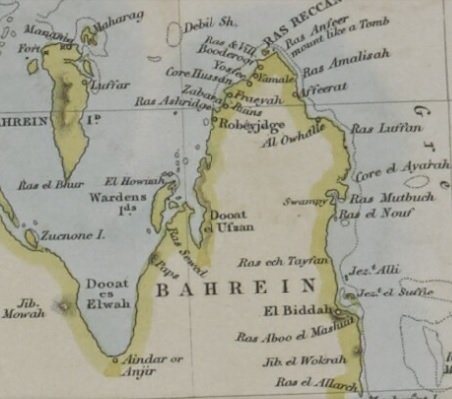
Tylos was the exonym for the in the western , corresponding to modern , situated at coordinates approximately 26°14′ N, 50°31′ E. This location positioned it strategically along maritime trade routes connecting , the , and , roughly 30 km northwest of the Qatari coast and 200 km from the Mesopotamian shore. The consists of as the largest landmass, measuring about 48 km in length and 16 km in width, alongside Muharraq Island and nearly 30 smaller islets, forming a group historically described as comprising multiple s off the Arabian coast. Ancient sources, such as , noted Tylos as an famed for pearls, with a nearby smaller , emphasizing its insular and separation from the mainland. The total land area of the region remains approximately 787 square kilometers today, reflecting the compact extent that supported pearling and trade in antiquity.

Environmental Features

The comprising Tylos featured low-lying, flat terrain dominated by sandy plains and coral limestone formations, with the principal island exhibiting the only notable in Jabal ad-Dukhan at 122 meters. Smaller islets were uniformly level and arid, shaped by sedimentary deposits from the . The region experienced a hot , with average annual temperatures of approximately 26°C, extreme summer highs exceeding 40°C, and minimal rainfall under 100 mm concentrated in sporadic winter showers, fostering reliance on rather than . Hydrologically, Tylos was distinguished by abundant artesian springs—both terrestrial and submarine—emerging from fractured limestone aquifers recharged from the Arabian peninsula, providing perennial freshwater that enabled oasis agriculture and distinguished the islands from surrounding arid coasts. Vegetation clustered in spring-fed oases, primarily date palms (Phoenix dactylifera) and salt-tolerant shrubs, with archaeobotanical evidence from Hellenistic sites indicating supplementary crops like cotton (Gossypium spp.), while coastal fringes supported limited mangroves adapted to brackish conditions.

Etymology

Origins of the Name

The name Tylos (: Τύλος) was applied by ancient Greek writers to the principal of the archipelago, corresponding to the core of the earlier cultural region. It first appears in historical records from the voyage of , admiral of the Great's fleet, who reached the in 324 BCE during the return expedition from the after 's conquests in Persia. ' account, preserved in fragments via later authors like , highlighted Tylos as a trading hub noted for its pearls, marking the initial Greek encounter and naming of the locale. Etymologically, Tylos is regarded as a Greek adaptation of the Akkadian Tilmun, the ancient Mesopotamian term for the polity centered in from circa 2300 BCE onward, transmitted likely via forms such as Tylwos (evidenced in Syriac tlwn from a 6th-century CE letter). This linguistic evolution reflects the continuity of Semitic regional nomenclature into Hellenistic usage, rather than a Greek invention, as the phonetic shift from Tilmun to Tylos aligns with patterns of -to-Greek borrowing in the context. The name supplanted direct references to in Greek sources after the Achaemenid period, persisting through the Hellenistic and early Roman eras. Subsequent classical authors, including Strabo (circa 64 BCE–24 CE) and Pliny the Elder (23–79 CE), perpetuated Tylos in their geographies, associating it with abundant pearl fisheries and trade links to India and Arabia; Strabo equates it variably with nearby Tyros, while Pliny (Natural History 12.21.38) praises its shell-based exports. The term remained in use until Ptolemy's Geography in the 2nd century CE, after which Persian designations like Mishmahig gradually overshadowed it under Parthian and Sasanian influence. This endurance underscores Tylos as a bridge between Bronze Age Semitic toponymy and Greco-Roman cartography, grounded in empirical maritime exploration rather than mythological invention.

Linguistic Connections

The name Tylos (Τύλος in Greek) used by Hellenistic authors such as and derives from the Akkadian Tilmun, a Semitic adaptation of the earlier Sumerian Dilmun, which designated the islands in Mesopotamian texts from the third millennium BCE onward. This phonetic progression—featuring initial d-/t- variation and simplification of intervocalic consonants—exemplifies standard processes of Semitic-to-Indo-European name transmission in ancient Near Eastern geography, preserving the core referent across non-contiguous linguistic traditions without implying direct borrowing but rather via and conquest records. Archaeolinguistic evidence from reveals bilingual toponyms blending Greek and local or South Arabian substrates, as seen in the evolution of Arados (a Hellenistic port name) into the modern suburb of Arad, reflecting administrative imposition of Greek forms on pre-existing Semitic hydronyms tied to regional . Greek inscriptions on , dated to the second century BCE through first century CE, often pair Hellenic dedicatory phrases with Semitic personal names borne by non-Greek residents, indicating a substrate of -speaking communities under Seleucid and subsequent rule, where Greek served as a prestige for elite and mercantile contexts. Post-Hellenistic transitions further underscore these links, with Mishmahig ("ewe-fish," alluding to marine fauna) supplanting Tylos by the Sassanid era (circa 224–651 CE), yet retaining phonetic echoes of Semitic maritime terminology prevalent in the Gulf. Such layered highlights causal persistence of trade-oriented ethnonyms amid successive imperial overlays, rather than wholesale replacement.

Historical Context

Pre-Tylos Dilmun Civilization

The civilization, an ancient East Semitic-speaking society, occupied the islands of present-day and adjacent coastal regions of , functioning primarily as a maritime hub from the late fourth millennium BCE until its decline around the sixth century BCE. Archaeological evidence indicates initial settlement phases dating to approximately 3200–3000 BCE, with the earliest textual references to Dilmun appearing in around 3300 BCE, coinciding with the advent of writing in . The civilization's formative period (c. 3200–2200 BCE) featured modest trading outposts, evolving into a "Golden Age" of prosperity between c. 2200 and 1600 BCE, marked by urban development and extensive commercial networks. Major archaeological sites underscore Dilmun's and continuity. Qal'at al-Bahrain, a fortified tell spanning 300 by 600 meters, reveals seven phases of occupation starting c. 2300 BCE, including city walls, administrative structures, and harbor facilities during the peak phase of 2300–1800 BCE; excavations have uncovered about 25% of the site, attesting to sustained human activity through the era. The Barbar Temple complex, with its layered sanctuaries and water features, reflects ritual practices tied to freshwater springs, while over 170,000 tumuli burial mounds across indicate a and standardized funerary customs involving like beads and Mesopotamian-style seals. These finds, including seals depicting date palms and ships, confirm a distinct identity blending local and imported elements, without evidence of monumental palaces or large-scale irrigation typical of Mesopotamian states. Dilmun's economy centered on trade, positioning it as an intermediary between , the Indus Valley Civilization (), and Magan (/UAE), facilitating the exchange of raw materials such as , , timber, and for Sumerian , wool, and textiles. tablets from document shipments via Dilmun merchants, with the civilization's role expanding after the Ur III dynasty's collapse c. 2000 BCE, as Gulf routes bypassed direct Mesopotamian-Indus contacts. Artifacts like Indus seals and Mesopotamian pottery at sites verify these links, though Dilmun lacked indigenous or on a scale rivaling its partners, relying instead on its strategic Gulf location for prosperity. In Sumerian mythology, Dilmun appears as a pristine "land of immortality" free of disease, symbolizing an idealized origin point for civilization, as in the and where it hosts divine creation. The civilization's decline commenced c. 1600 BCE amid disruptions from Kassite incursions in and shifts in Indus trade, leading to reduced urban activity by the first millennium BCE; by the second century BCE, waning Mesopotamian demand and emerging powers like Gerrha in eroded Dilmun's dominance, paving the way for Hellenistic influences that renamed the region Tylos. Despite this, archaeological continuity at sites like persisted into later periods, suggesting cultural adaptation rather than abrupt abandonment.

Transition to Hellenistic Influence

The decline of the civilization around 500 BCE left the incorporated into the Achaemenid Persian as part of its eastern satrapies, where it served primarily as a maritime outpost for trade and naval operations in the . This period maintained local Semitic cultural elements but subordinated the region to Persian imperial administration, with limited evidence of direct Achaemenid architectural or artistic imposition beyond administrative oversight and tribute extraction. Alexander the Great's conquest of the Achaemenid core territories culminated in 330 BCE, dismantling Persian control over the Gulf periphery and initiating the diffusion of Macedonian military and exploratory enterprises into the region. Although Alexander's campaigns did not extend directly to the islands, his admiral conducted a reconnaissance voyage through the circa 325–324 BCE, identifying (the Hellenized designation for the Bahrain islands, derived from the Semitic Tilmun) as a fertile trading hub rich in pearls and dates, thereby integrating it into Greek geographic knowledge via Nearchus' Indica. This exploration marked the initial Hellenistic contact, emphasizing Tylos' strategic value for maritime routes linking to . Under the , consolidated the by 305 BCE, extending authority over the Gulf coasts and islands, including Tylos, through naval patrols and garrison establishments that facilitated the export of Greek settlers, merchants, and administrators. Archaeological evidence from sites like reveals this shift: imports of Eastern Sigillata A ware , Attic-type amphorae, and Seleucid coins dated to the late 3rd–2nd centuries BCE indicate intensified trade networks and cultural exchange, while Greek inscriptions—such as dedications to deities like the Dioscuri—attest to localized without wholesale displacement of indigenous Aramean and Arabian populations. Seleucid manifested in aesthetic influences, such as molded ceramics mimicking Greek forms, fostering economic prosperity through pearl diving monopolies and transit commerce, though political control waned by the mid-2nd century BCE amid Parthian encroachments, transitioning Tylos toward semi-autonomous status under Hellenistic successor states like .

Tylos Period

Establishment under Alexander's Successors

Following Alexander the Great's death in 323 BC, the island of (modern ) transitioned from Achaemenid Persian control to incorporation within the , one of the successor states emerging from the Wars of the Diadochi. , who consolidated power over the eastern territories by 301 BC after the , extended administrative oversight to the region, including Tylos, which had been noted by ' fleet during Alexander's 324 BC return voyage as a prosperous trading center with abundant pearls and date palms. Archaeological evidence from sites like Qala'at al-Bahrain indicates the establishment of Hellenistic garrisons and settlements in the late , marking the onset of the Tylos period characterized by Greek administrative and presence alongside local Dilmunite continuity. Seleucid control integrated Tylos into a broader Gulf district termed "Tylos and the Islands," potentially encompassing nearby Failaka (ancient ) and Tarut, functioning as a strategic maritime node for trade and defense against nomadic threats from Arabia. from this era, including Hellenistic pottery, coinage, and architectural elements like Greek-style sanctuaries, reflects directed cultural influence to promote imperial cohesion, with local artisans adapting imported forms using indigenous limestone by the 3rd–2nd centuries BC. A Greek inscription dated to the 120s BC, dedicating a to the Dioscuri, underscores ongoing Seleucid-era administration before the shift to Characenian independence under Hyspaosines around 129 BC. This establishment phase emphasized through Hellenized public spaces, such as temples and funerary stelae blending Greek iconography with local motifs, facilitating economic ties in pearls and maritime routes while maintaining a footprint to secure loyalties in the periphery.

Governance and Administration

Following the in 323 BC, Tylos fell under the influence of his successors, initially integrated into the as part of the eastern satrapies controlling the region. Administration during this phase emphasized garrisons and oversight by Greek-speaking officials, with Tylos designated as an administrative encompassing "Tylos and the Islands," functioning as a strategic node for maritime trade and defense. A key figure in this structure was the , a combined and civil governor responsible for local , as evidenced by a Greek inscription from the 120s BC dedicating a to the Dioskouroi under Seleucid authority. Seleucid rulers relied on alliances with local elites to maintain control, blending Hellenistic bureaucratic practices—such as standardized coinage and tax collection on pearl diving—with indigenous tribal systems, though direct epigraphic of satrapal titles specific to Tylos remains limited. By the mid-2nd century BC, weakening Seleucid power enabled the rise of regional autonomy, culminating in Tylos's incorporation into the Kingdom of Characene (Mesenē), founded circa 141 BC by Hyspaosines, a former Seleucid who declared independence. The 120s BC inscription honors Hyspaosines, marking his transition from satrapal governor to sovereign, with continued use of existing administrative frameworks, including Gulf naval assets for enforcement. Characenian rule preserved Hellenistic elements like Greek dedications and at sites such as Qala'at al-Bahrain, presumed to serve as a fortified administrative center, while delegating day-to-day affairs to local Arab sheikhs under royal oversight from . This hybrid system facilitated trade regulation and tribute extraction, with no records of fully independent Tylos rulers, indicating subordinate status within broader Mesopotamian polities. Administrative continuity extended into the early AD under Characenian kings, who appointed for Tylos, as noted in a Palmyrene inscription from 131 AD referencing a satrap under the king of Charax, reflecting persistent semi-autonomous local governance amid shifting Parthian influences. Evidence from and seals at excavation sites suggests formalized taxation on exports like pearls and dates, managed through harbor dues and merchant guilds, underscoring Tylos's role as a peripheral but economically vital rather than a centralized .

Interactions with Neighboring Powers

Following Alexander the Great's campaigns, Tylos was incorporated into the by circa 312 BCE, serving as a peripheral outpost in the under Hellenistic overlordship. Local persisted with nominal , evidenced by the adoption of Greek administrative practices and artifacts reflecting cultural exchanges, though direct interventions appear limited. The Seleucids leveraged Tylos for maritime trade control, positioning it as a with eastern Arabian tribes and Mesopotamian centers, while countering residual Achaemenid Persian influences in the Gulf. Archaeological finds, including Hellenistic and coinage, underscore economic ties rather than frequent conflict. Amid Seleucid decline from Parthian incursions in the mid-2nd century BCE, Tylos transitioned to control by the kingdom, founded by the Hyspaosines in 127 BCE at the head of the Gulf. A Greek inscription from , dated to 124 BCE, documents Kephisodoros as epistates (military governor) of Tylos under Hyspaosines, affirming Characene administrative extension and naval projection into the archipelago. Characene rule integrated Tylos into a network buffering Parthian dominance, with Hyspaosines' forces securing Gulf routes against nomadic Arab disruptions while maintaining Hellenistic nomenclature alongside emerging Iranian terms like Mishmahig. By the 1st century BCE, Parthian subsumed Characene vassals, imposing garrisons and tribute systems on Tylos to consolidate trade monopolies extending to .

Economy and Trade

Pearl Diving and Exports

Pearl diving constituted a cornerstone of the economy in ancient Tylos, the Hellenistic-era name for Bahrain, where the island's coastal waters yielded high-quality pearls from Pinctada radiata oysters abundant in the Persian Gulf. Greek admiral Nearchus, following Alexander the Great's campaigns around 325 BCE, identified Tylos as a primary hub for pearl procurement and trade, noting the local divers' expertise in harvesting oysters from seabeds teeming with shellfish. Archaeological excavations in Bahrain have uncovered pearls and pearl-inlaid jewelry from Tylos-period sites (circa 3rd century BCE to 3rd century CE), including specimens from burial mounds and settlements, confirming the scale of local production and craftsmanship. Divers in Tylos employed free-diving techniques, plunging from small boats or rafts to depths of up to 20 fathoms (approximately 36.6 meters), as described by the 1st-century BCE geographer Isidorus of Charax in reference to like Tylos; this labor-intensive method relied on breath-holding and weighted stones for descent, with divers surfacing oysters for onboard sorting. The seasonal industry, peaking in summer months when oysters were fattest, involved thousands of participants, including local and possibly enslaved laborers, fostering a specialized maritime workforce that integrated with broader Gulf pearling traditions predating Hellenism but intensified under Seleucid and later Parthian oversight. Risks were high, with accounts from classical sources like (1st century BCE) highlighting dangers from , jellyfish stings, and decompression issues, yet the pursuit persisted due to the pearls' exceptional luster and size, prized for their iridescence. Exports of Tylos pearls fueled long-distance trade networks, with shipments routing via Mesopotamian ports to markets in the , , and Persia, where they adorned elite jewelry and were valued as luxury commodities equivalent to in weight. Roman historian (1st century CE) documented Gulf pearls' superiority, attributing their demand to Roman consumption that escalated from the 1st century BCE, supported by numismatic and artifact evidence of intensified under Ptolemaic and Roman influences. Tylos served as an emporium, exporting raw pearls and finished goods; archaeological finds of pearl-set artifacts in distant sites, such as Roman contexts, underscore this export orientation, with trade volumes likely doubling periodically amid Hellenistic maritime expansions. This pearl-centric economy underpinned Tylos's prosperity, integrating it into Indo-Roman exchange circuits until the rise of alternatives diminished natural Gulf sourcing in later eras.

Maritime Networks and Routes

Tylos occupied a pivotal position in the Hellenistic-era maritime networks of the , serving as a hub for the export of pearls harvested from its surrounding shoals, alongside dates, textiles, and aromatic woods obtained through regional exchanges. These networks linked the island to Mesopotamian river ports via short coastal voyages northward, connecting to the Seleucid Empire's infrastructure, while southward routes extended to the Arabian of Gerrha and onward to the via monsoon-driven sea lanes or hugging the Omani coast. Archaeological evidence from Tylos-period settlements, including imported ceramics and seals, corroborates integration into broader Gulf circuits that facilitated bidirectional flows of , such as Indian spices and Iranian metals, sustaining local prosperity from the BCE. The primary routes radiated from Tylos' harbors, such as those near , where Greek-influenced amphorae and weights indicate standardized trade practices under Seleucid oversight around 300–200 BCE. Voyages to typically involved small coastal vessels navigating the shallow Gulf waters to or directly to Tigris-Euphrates deltas, enabling rapid pearl shipments to urban centers like Antioch; distances averaged 500–800 kilometers, traversable in weeks under favorable winds. To the east, connections to mirrored earlier patterns but intensified with Hellenistic demand, with routes spanning 2,000–3,000 kilometers to ports like Barygaza, carrying Tylos pearls prized in Roman markets as documented in classical geographic texts. Pearl-centric trade dominated these networks, with Tylos divers supplying gems that reached as far as the Mediterranean via overland extensions from Gulf ports, though direct routes to the were less emphasized due to Parthian intermediaries post-140 BCE. A Greek inscription from dated to the 120s BCE highlights sustained Hellenistic commercial presence, underscoring Tylos' role in projection through material exchanges rather than military dominance. Environmental factors, including seasonal pearling from to , dictated route timing, with fleets of dhow-like boats—evidenced by harbor remains—ensuring efficient distribution amid competition from rivals.

Society and Culture

Population and Demographics

The of Tylos during the Hellenistic and Parthian periods (circa 300 BCE to 600 CE) lacked contemporary numerical estimates in surviving classical texts, though archaeological evidence of dense settlement patterns, including numerous villages and extensive tomb clusters, indicates a sizable community sustained by maritime trade and pearl diving. Excavations reveal at least 13 tomb clusters on Bahrain's main island, each containing tens to hundreds of burials, reflecting a likely numbering in the thousands, with urban centers like the fortified settlement at serving as administrative and commercial hubs. Genetic analysis of four Tylos-period individuals sequenced in 2024 demonstrates a demographic composition marked by admixture from western Eurasian sources, best modeled as a mixture of ancestries related to prehistoric populations from , the , and or the , positioning them genetically intermediate between ancient Levantine/Anatolian groups and Iranian/Caucasian ones. This profile aligns them more closely with modern populations from and the than with contemporary groups, which exhibit additional East African ancestry components absent in the Tylos samples, suggesting significant from Mesopotamian or Levantine traders and amid Hellenistic and Parthian influences rather than isolation or purely local continuity. Skeletal from Tylos burials shows minor metric variations from earlier Dilmun-period remains, consistent with gradual admixture rather than wholesale replacement. Demographically, the society appears to have been stratified, with evidence of elites in imported goods-rich tombs contrasting with laborers involved in pearling and fishing, though no direct records quantify slaves or social classes; Aramaic inscriptions and Parthian administrative practices imply a Semitic-speaking majority with administrative elites potentially including Persian or Greek elements. By the late Tylos period, under Sasanian influence, Christian communities emerged among inhabitants, coexisting with adherents to local deities, as inferred from burial practices and epigraphy, indicating religious diversity without dominance of any single group. Oxygen isotope analysis of tooth enamel from burials further supports mobility, with some individuals showing non-local signatures consistent with immigration from mainland Gulf or western Asia, reinforcing the admixed genetic profile.

Religion and Funerary Practices

The of the Tylos period (c. 323 BCE–3rd century CE) exhibited between indigenous Dilmun-era deities and imported Hellenistic cults, reflecting Bahrain's position as a maritime crossroads. The primary local god was Inzak, equated with the Mesopotamian in Neo-Assyrian records, while the goddess Ninsikila—potentially akin to —persisted in worship, underscoring continuity from earlier traditions. Archaeological evidence, including Greek inscriptions from the 120s BCE, indicates veneration of Greek deities associated with , such as the Dioscuri, adapted to local seafaring needs. Hellenistic influences introduced cults like that of Asklepios, the healing god, likely established under Seleucid patronage around the 3rd–2nd centuries BCE, with syncretic elements merging Greek practices and Phoenician healing traditions via identification with the Dioscuri. Religious practices blended Mesopotamian, Persian, and Greek elements, as seen in artifactual and epigraphic records, though direct temple structures from this era remain scarce beyond potential northern island sites linked to Tylos architecture. Funerary practices centered on tumulus burials, with over 170,000 low mounds—many from the Tylos era—dotting Bahrain's landscape, particularly in northern necropolises like Sar and Hamad Town, attesting to a belief in structured afterlife rituals tied to communal and familial continuity. These consisted of rectangular stone chambers oriented north-south, accessed via entrances or shafts, with internal alcoves for secondary burials and capped by large slabs under earthen mounds often encircled by ring walls up to 1–2 meters high. Excavations of Tylos-period graves (c. 2nd century BCE–3rd century CE) across sites like Shakhoura and Jannusan reveal multi-generational use, with skeletons in flexed or extended positions accompanied by grave goods such as imported Hellenistic pottery, glass vessels, carnelian beads, bronze tools, and shell jewelry, signaling social stratification linked to pearl trade wealth. Variations in mound size and offerings—larger for elites with metal artifacts—highlight status differences, while the prevalence of chamber tombs over cremation underscores Semitic-influenced earth-bound interment customs persisting amid Hellenistic overlays.

Material Culture and Artifacts

Archaeological excavations in Tylos-period sites, primarily burial mounds and settlements like those at Al-Hajjar and Qal'at al-Bahrain, have uncovered a diverse array of artifacts reflecting a blend of local traditions and Hellenistic influences from the 3rd century BCE to the 3rd century CE. Common finds include pottery, glass vessels, jewelry, and metal objects, which indicate extensive trade networks connecting Tylos to the Seleucid Empire, Parthian territories, and Mediterranean regions. These items, often deposited in graves, suggest stratified social practices with elite burials featuring luxury imports. Pottery constitutes a major component of the material record, with local wheel-turned wares alongside imported Hellenistic and Eastern Sigillata types, including red-gloss vessels and glazed ceramics that point to technological exchanges. Figurines, such as a notable and rider from Hellenistic graves, evoke Greek stylistic elements while adapting to regional motifs, evidencing cultural hybridization rather than wholesale adoption. Glazed and containers further highlight artisanal sophistication tied to maritime commerce. Glassware, predominantly Roman and Parthian imports like bowls and vessels found in ensembles, underscores Tylos' role as a redistribution hub for , with over 300 such items documented in some mound fields. Jewelry, crafted from gold, silver, , and pearls—evident in necklaces and rings—reflects wealth from pearl diving and illustrates personal adornment practices influenced by Indo-Mediterranean styles. Iron weapons and tools, alongside limestone , appear in funerary contexts, indicating elements and possible uses in a society maintaining defensive postures amid regional powers. These artifacts, analyzed through typological and isotopic studies, reveal no uniform but rather selective integration of foreign motifs into indigenous forms, as seen in burial architectures combining tumuli with Greek-inspired . Coins, including imitation silver tetradrachms from the 2nd century BCE, further attest to economic ties, with hoards containing up to 310 pieces mimicking Seleucid currency. Overall, the emphasizes Tylos' prosperity through , with artifacts serving both utilitarian and symbolic roles in a cosmopolitan society.

Archaeology

Major Excavation Sites

, the ancient harbor and capital associated with both and subsequent Tylos-period occupation, represents the most extensively excavated site revealing Hellenistic influences in . Danish expeditions from 1954 to 1972 uncovered stratified layers spanning from approximately 2300 BCE through the CE, with Tylos-period (circa BCE to CE) remains including urban structures, fortifications, and artifacts indicative of with the Hellenistic world. About 25% of the 300 by 600 meter tell has been excavated, yielding evidence of a fortified settlement that transitioned from traditions to Parthian-influenced architecture, such as columned buildings and imported pottery. Al-Hajar, encompassing and Tylos cemeteries, features rock-cut tombs and burial mounds from the Tylos period (Hellenistic to Parthian eras, circa 300 BCE to 300 CE), with unexcavated southern mounds and northern complexes highlighting funerary practices influenced by contacts. Excavations have documented chamber tombs with like glass vessels and coins, reflecting Tylos' role as a maritime hub under Seleucid and later Parthian oversight. The site's northern rock-cut features, dated to the Tylos era, include hypogea with multiple burial chambers, distinguishing them from earlier tumuli. Tylos-period burials have been systematically excavated across multiple mound fields, such as those in Maqabah and other western Bahrain sites, revealing chamber tombs from the 1st to 2nd centuries BCE with artifacts including Hellenistic-style jewelry and ceramics. These excavations, part of broader surveys of over 11,700 mounds across 21 fields, underscore shifts in burial customs, including secondary inhumations and eastern orientations, linked to cultural exchanges during Bahrain's integration into Hellenistic trade networks. At least 24 features from five tumuli fields have been explored, providing data on social organization through sexed burials and associated offerings. While earlier sites like Barbar Temple and settlement exhibit foundational layers predating Tylos, their upper strata occasionally yield transitional artifacts, but major Tylos-specific excavations prioritize urban and funerary contexts at Qal'at and cemeteries for insights into Hellenistic and economic vitality.

Key Findings and Interpretations

Archaeological investigations have documented thousands of Tylos-period tombs (c. 300 BCE–600 CE) across , forming extensive necropolises that reflect a substantial settled and persistent funerary traditions. These include graves constructed with hand-sized stones and mortar, often oriented east-west or east-northeast to west-southwest, containing skeletal remains in individual or collective arrangements. commonly feature vessels, bowls, jewelry, and beads of or , demonstrating local artisanal skills alongside imports indicative of broad exchange networks. At sites like Hamad Town and Abu Saiba, specific artifacts such as earrings composed of small pearl clusters mimicking grape bunches have been recovered, affirming pearl diving as a of economic activity during this era. Excavations at yielded a significant of Tylos-phase silver coins, alongside evidence of a 3rd-century CE coastal fortress, highlighting monetary circulation and fortified maritime infrastructure. Interpretations position Tylos as a pivotal in trade, integrating indigenous practices with Hellenistic influences following Seleucid expansion, as evidenced by styles, coinage, and architectural forms linking to Greek settlements. The abundance of burial clusters and diverse grave inclusions suggests stratified social organization, with collective tombs possibly denoting familial or communal rituals influenced by regional powers like and Sasanian Persia. Chronological refinements from wooden analyses date initial Tylos burials to the 1st century BCE, implying a transitional phase from precedents amid cultural rather than abrupt replacement. These discoveries underscore Tylos's role in sustaining Dilmun's legacy as a commercial hub, with pearl exports and harbor facilities facilitating exchanges evidenced by artifacts from the Mediterranean, , and , though local agency in adapting foreign elements remains a focus of ongoing among excavators. Defensive structures and hoards further imply geopolitical tensions, interpreting the period as one of tempered by imperial oversight.

Recent Discoveries

In , the Authority for Culture and Antiquities announced discoveries from excavations at the Abu Saiba site, a hill dating to the Middle Tylos period (circa 50 BCE–150 CE), revealing nearly 70 built graves including three jars, with approximately 40 fully excavated and analyzed. These findings, led by a French archaeological expedition, uncovered skeletal remains and artifacts providing insights into practices during the Tylos era, characterized by structured constructions up to 70 meters in and 4–5 meters in . Further excavations at Abu Saiba, continuing through agreements with French and Danish teams, have exposed layers from the Tylos, , and early Islamic periods, yielding artifacts such as and structural remains that illuminate trade and funerary customs in ancient . In the Maqabah area, surveys identified Tylos-period burial mounds from the 1st–2nd centuries BCE alongside earlier Early features, contributing to mapping of necropolises and enhancing understanding of settlement continuity. These efforts, often in collaboration with international missions, have emphasized non-invasive techniques alongside targeted digs to preserve site integrity, with results presented in symposia and publications focusing on the Tylos necropolis's role in regional Hellenistic influences. Ongoing work as of 2025 continues to refine chronologies, though challenges persist in distinguishing Tylos-specific artifacts from overlapping strata due to stratigraphic complexity.

Legacy and Modern Interpretations

Accounts in Classical Sources

The earliest surviving classical references to Tylos derive from Greek explorers associated with Alexander the Great's campaigns. Nearchus, Alexander's admiral, documented the island during his 325 BCE voyage from the mouth of the Indus to the Persian Gulf, identifying it as a key pearling station where divers harvested shellfish for export, marking the initial Hellenistic encounter with the region. Strabo, in his (composed circa 7 BCE–23 CE), situates Tylos approximately 1,000 stadia from the Arabian mainland opposite Gerrha, portraying it as economically subordinate to that coastal emporium; the island's products, including pearls and purple dye from murex shellfish, were transported overland by to for redistribution across . Pliny the Elder provides one of the most detailed descriptions in (completed 77 CE), stating that Tylos lies opposite Gerra (Gerrha) at a distance of 112 Roman miles in circumference, with towns named Tylos and Aradus; he notes its exceptional palm groves—superior in delicacy to those of Judaea—and underscores its renown for abundant pearls, while reporting unvisited islands visible beyond it. Pliny also relays that Alexander's companions observed on Tylos trees producing a resinous gum used in , and he contrasts the island's maritime wealth with the mainland's nomadic sparsity./Book_16) Claudius Ptolemy, in his (circa 150 CE), incorporates Tylos into a systematic , assigning it 24° and approximately 68° east of the Fortunate Islands (Canaries), positioning it amid Gulf islands like (Failaka) and confirming its alignment with Arabian coastal features derived from earlier periploi. These accounts collectively emphasize Tylos' strategic position, though they rely on secondhand reports from sailors and merchants, with potential distortions from hearsay or ideological framing of peripheral "" economies.

Archaeological Significance

The archaeology of Tylos, the designation for from roughly the 3rd century BCE to the CE, underscores its role as a pivotal maritime entrepôt in the , bridging the civilization with later Parthian and Sasanian influences. Excavations reveal a society marked by cultural synthesis, with evidence of sustained trade linking the Mediterranean, , , and , as attested by imported artifacts such as Eastern Sigillata A from the and glassware suggestive of Greco-Roman techniques found in contexts. This period's material record, dominated by over 350,000 tumuli across —many dating to Tylos—highlights advanced funerary architecture, including multi-chambered with capstones and dromos entrances, reflecting both local traditions and external stimuli without evidence of large-scale or colonization. Necropolises like those at Sar, Shakhura, and Abu Saiba form the core of , yielding that illuminate socioeconomic diversity and population mobility. At Abu Saiba, for instance, over 70 tombs excavated since the early have uncovered and inhumation burials accompanied by iron weapons, bronze vessels, and beads, indicating warrior elites and artisanal imports from as far as the . Isotopic analysis of human remains from northern clusters demonstrates patterns, with oxygen and strontium ratios pointing to origins in the , , and , suggesting Tylos attracted merchants and settlers amid shifting Hellenistic trade dynamics post-Alexander the Great. studies further model Tylos populations as admixtures of these regions, with minimal local genetic continuity, implying demographic renewal through commerce rather than indigenous evolution. The scarcity of preserved settlements—likely overlaid by modern urbanization—contrasts with the necropoleis, yet fortification remnants and harbor traces at sites like Qala'at al-Bahrain indicate fortified ports facilitating pearl diving, , and spice routes, positioning Tylos as a neutral hub under nominal Seleucid, then Parthian, oversight. Hellenistic influences, evident in coinage and terracotta figurines depicting deities like , affirm cultural exchanges without dominance, as local inscriptions and Zoroastrian motifs persist. Overall, Tylos challenges narratives of peripheral isolation, instead evidencing a resilient, multi-ethnic whose prosperity derived from geographic centrality, informing broader understandings of Gulf connectivity in antiquity.

Contemporary Relevance to Bahrain

Bahrain's prominently incorporates the ancient Tylos period (circa 300 BCE to 300 CE), viewing it as a continuation of the earlier civilization and a key element of the island's historical continuity from the third millennium BCE. Official narratives emphasize Tylos-era settlements, trade networks, and cultural practices—such as pearl diving and Hellenistic influences following the Great's campaigns—as foundational to the modern state's heritage, distinguishing from neighboring Gulf regions with less attested ancient urbanism. Archaeological preservation efforts underscore this relevance, with the Bahrain Authority for Culture and Antiquities maintaining sites like the Shakhura Tylos Necropolis and Al-Hajar cemeteries, which span from the phase into the Tylos era and feature over 170,000 burial mounds, the world's largest concentration. , a since 2005, exemplifies layered occupation from capitals through Tylos urban expansions, including Hellenistic urban renewal documented in excavations revealing administrative structures and imported ceramics. These sites are actively protected amid urban development pressures, as evidenced by legal disputes over Tylos-period graves threatening modern infrastructure projects since Bahrain's independence. In and , Tylos heritage drives initiatives like the Bahrain National Museum's exhibits on Greco-Roman influences, including Nearchus's accounts of Tylos as a pearl-trading hub, and international collaborations such as the 2022 Louvre exhibition "From Dilmun to Tylos," which highlighted Bahrain's role in ancient Near Eastern exchanges through artifacts like Tylos-period seals and pottery. These efforts bolster and economic diversification, with contributing to Bahrain's post-oil identity narrative, as promoted in government campaigns linking ancient Tylos prosperity to contemporary Gulf stability. Genetic studies of Tylos burials further affirm partial ancestry continuity with modern , supporting claims of demographic persistence despite migrations.

References

Add your contribution
Related Hubs
User Avatar
No comments yet.