Hubbry Logo
logo
Ulster
Community hub

Ulster

logo
0 subscribers
Read side by side
from Wikipedia

Ulster (/ˈʌlstər/; Irish: Ulaidh [ˈʊlˠiː, ˈʊlˠə] or Cúige Uladh [ˌkuːɟə ˈʊlˠə, - ˈʊlˠuː]; Ulster Scots: Ulstèr[6][7][8] or Ulster)[9][10][11] is one of the four historical provinces of Ireland, located in the northern part of the island. It is made up of nine counties, with six of these comprising Northern Ireland (a part of the United Kingdom), while the remaining three are in the Republic of Ireland.

Key Information

It is the second-largest (after Munster) and second-most populous (after Leinster) of Ireland's four traditional provinces, with Belfast being its biggest city. Unlike the other provinces, Ulster has a high percentage of Protestants, making up almost half of its population. English is the main language and Ulster English the main dialect. A minority also speak Irish, and there are Gaeltachtaí (Irish-speaking regions) in County Donegal which is home to a quarter of the total Gaeltacht population of the Republic of Ireland.[12] There are also large Irish-speaking networks in southern County Londonderry and in the Gaeltacht Quarter, Belfast. Ulster-Scots is also spoken extensively in the counties Antrim, Down, Londonderry, Tyrone and Donegal. Lough Neagh, in the east, is the largest lake in the British Isles, while Lough Erne in the west is one of its largest lake networks. The main mountain ranges are the Mournes, Sperrins, Blue Stack (Croaghgorms) and Derryveagh Mountains.

Historically, Ulster lay at the heart of the Gaelic world made up of Gaelic Ireland, Scotland and the Isle of Man. According to tradition, in ancient Ireland it was one of the fifths (Irish: cúige) ruled by a rí ruirech, or 'king of over-kings'. It is named after the overkingdom of Ulaid, in the east of the province, which was in turn named after the Ulaid folk. The other overkingdoms in Ulster were Airgíalla and Ailech. After the Norman invasion of Ireland in the twelfth century, eastern Ulster was conquered by the Anglo-Normans and became the Earldom of Ulster. By the late fourteenth century the Earldom had collapsed and the O'Neill dynasty had come to dominate most of Ulster, claiming the title King of Ulster. Ulster became the most thoroughly Gaelic and independent of Ireland's provinces. Its rulers resisted English encroachment but were defeated in the Nine Years' War (1594–1603). King James I then colonised Ulster with English-speaking Protestant settlers from Great Britain, in the Plantation of Ulster. This led to the founding of many of Ulster's towns. The inflow of Protestant settlers and migrants also led to bouts of sectarian violence with Catholics, notably during the 1641 rebellion and the Armagh disturbances.

Along with the rest of Ireland, Ulster became part of the United Kingdom in 1801. In the early twentieth century, moves towards Irish self-rule were opposed by many Ulster Protestants, sparking the Home Rule Crisis. In the last all Ireland election (1918 Irish general election) counties Donegal and Monaghan returned large Sinn Féin (nationalist) majorities. Sinn Féin candidates ran unopposed in Cavan. Fermanagh and Tyrone had Sinn Féin/Nationalist Party (Irish Parliamentary Party) majorities. The other four Counties of Ulster had Unionist Party majorities.[13] The home rule crisis and the subsequent Irish War of Independence led to the partition of Ireland under the Government of Ireland Act 1920. Six Ulster counties became Northern Ireland, a self-governing territory within the United Kingdom, while the rest of Ireland became the Irish Free State, now the Republic of Ireland.

The term Ulster has no official function for local government purposes in either state. However, for the purposes of ISO 3166-2:IE, Ulster is used to refer to the three counties of Cavan, Donegal and Monaghan only, which are given country sub-division code "IE-U".[14] The name is also used by various organisations such as cultural and sporting bodies.

Terminology

[edit]

Ulster's name ultimately derives from the Ulaidh, a group of tribes that once dwelt in this part of Ireland. The Norsemen knew the province as Ulaztir, the tír or 'land' (a word borrowed from Irish) of the Ulaidh;[15] this was then taken into English as Ullister or Ulvester, and later contracted to Ulster.[16] Another, less probable explanation is that the suffix -ster represents the Old Norse element staðr ('place'), found in names like Lybster and Scrabster in Scotland.[15]

Ulster is still known as Cúige Uladh in Irish, meaning the province (literally 'fifth') of the Ulaidh. Ulaidh has historically been anglicised as Ulagh or Ullagh[17] and Latinised as Ulidia or Ultonia.[18] The latter two have yielded the terms Ulidian and Ultonian. The Irish word for someone or something from Ulster is Ultach, and this can be found in the surnames MacNulty, MacAnulty, and Nulty, which all derive from Mac an Ultaigh, meaning 'son of the Ulsterman'.[19]

Northern Ireland is often referred to as Ulster,[20] despite including only six of Ulster's nine counties. This usage is most common among people in Northern Ireland who are unionist,[21] although it is also used by the media throughout the United Kingdom.[22][23] Some Irish nationalists object to the use of Ulster in this context.[21]

Geography and political sub-divisions

[edit]
Ulster (coloured), showing Northern Ireland in pink and the Republic of Ireland part in green

Ulster has a population of just over two million people and an area of 22,067 square kilometres (8,520 sq mi). About 62% of the area of Ulster is in the UK while the remaining 38% is in the Republic of Ireland. Ulster's biggest city, Belfast, has an urban population of over half a million inhabitants, making it the second-largest city on the island of Ireland and the 10th largest urban area in the UK. Six of Ulster's nine counties, Antrim, Armagh, Down, Fermanagh, Londonderry and Tyrone, including the former parliamentary boroughs of Belfast and Londonderry, form Northern Ireland which remained part of the United Kingdom after the partition of Ireland in 1921. Three Ulster counties – Cavan, Donegal and Monaghan – form part of the Republic of Ireland. About half of Ulster's population lives in counties Antrim and Down. Across the nine counties, according to the aggregate UK 2011 Census for Northern Ireland, and the ROI 2011 Census for counties Cavan, Donegal and Monaghan, there is a Roman Catholic majority over Protestant of 50.8% to 42.7%.[24]

While the traditional counties continue to demarcate areas of local government in the Republic of Ireland, this is no longer the case in Northern Ireland. Since 1974, the traditional counties have a ceremonial role only. Local government in Northern Ireland is now demarcated by 11 districts.

County-based sub-divisions

[edit]
County Population Area
County Antrim (Contae Aontroma; Coontie Anthrim/Antrìm/Entrim) 618,108 3,088 km2 (1,192 sq mi)
County Armagh (Contae Ard Mhacha; Coontie Airmagh/Armagh) 174,792 1,327 km2 (512 sq mi)
County Cavan (Contae an Chabháin) 81,704 1,932 km2 (746 sq mi)
County Donegal (Contae Dhún na nGall or Thír Chonaill; Coontie Dunnygal/Dinnygal) 167,084 4,861 km2 (1,877 sq mi)
County Down (Contae an Dúin; Coontie Doon/Doun) 531,665 2,489 km2 (961 sq mi)
County Fermanagh (Contae Fhear Manach; Coontie Fermanagh/Fermanay) 61,170 1,691 km2 (653 sq mi)
County Londonderry (Contae Dhoire; Coontie Loonenderrie) 247,132 2,118 km2 (818 sq mi)
County Monaghan (Contae Mhuineacháin) 65,288 1,295 km2 (500 sq mi)
County Tyrone (Contae Thír Eoghain; Coontie Tyrone/Owenslann) 177,986 3,266 km2 (1,261 sq mi)
Total 2,217,176 22,067 km2 (8,520 sq mi)

Counties shaded in grey are in the Republic of Ireland. Counties shaded in pink are in Northern Ireland.

Council-based sub-divisions

[edit]
District Council
County Cavan Cavan County Council
County Donegal Donegal County Council
County Monaghan Monaghan County Council
Fermanagh and Omagh Fermanagh and Omagh District Council
Derry and Strabane Derry and Strabane District Council
Mid-Ulster Mid-Ulster District Council
Causeway Coast and Glens Causeway Coast and Glens District Council
Mid and East Antrim Mid and East Antrim District Council
Antrim and Newtownabbey Antrim and Newtownabbey Borough Council
Ards and North Down Ards and North Down Borough Council
Armagh, Banbridge and Craigavon Armagh, Banbridge and Craigavon District Council
Lisburn and Castlereagh Lisburn and Castlereagh City Council
Newry, Mourne and Down Newry, Mourne and Down District Council
Belfast Belfast City Council

Largest settlements

[edit]

Settlements in Ulster with at least 14,000 inhabitants, listed in order of population:

  1. Belfast (480,000)
  2. Derry (105,000)
  3. Lisburn (75,000)
  4. Craigavon (65,000)
  5. Bangor (58,400)
  6. Ballymena (28,700)
  7. Newtownards (27,800)
  8. Newry (27,400)
  9. Carrickfergus (27,200)
  10. Coleraine (25,000)
  11. Antrim (20,000)
  12. Omagh (19,800)
  13. Letterkenny (19,600)
  14. Larne (18,200)
  15. Banbridge (14,700)
  16. Armagh (14,500)

Economy

[edit]

The GDP of the province of Ulster is around €50 billion. Salary levels are the lowest on the island of Ireland.

Area Population Country Largest settlement GDP € GDP per person €
Greater Belfast 720,000 NI Belfast €20.9 bn €33,550
Border Region (includes two non-Ulster counties) 430,000 (roughly half in Ulster) ROI Letterkenny €10.7 bn €21,100
East of Northern Ireland 430,000 NI Ballymena €9.5 bn €20,300
North of Northern Ireland 280,000 NI Derry €5.5 bn €18,400
West and South of Northern Ireland 400,000 NI Newry €8.4 bn €19,300

[25]

Physical geography

[edit]

The biggest lake in the British Isles, Lough Neagh, lies in eastern Ulster. The province's highest point, Slieve Donard (848 metres (2,782 ft)), stands in County Down. The most northerly point in Ireland, Malin Head, is in County Donegal, as are the sixth-highest (601 metres (1,972 ft)) sea cliffs in Europe, at Slieve League, and the province's largest island, Arranmore. The most easterly point in Ireland is also in Ulster, in County Down, and the most westerly point in the UK is in County Fermanagh. The longest river in the British Isles, the Shannon, rises at the Shannon Pot in County Cavan with underground tributaries from County Fermanagh. Volcanic activity in eastern Ulster led to the formation of the Antrim Plateau and the Giant's Causeway, one of Ireland's three UNESCO World Heritage Sites. Ulster also has a significant drumlin belt. The geographical centre of Ulster lies between the villages of Pomeroy and Carrickmore in County Tyrone. In terms of area, County Donegal is the largest county in all of Ulster.

Transport

[edit]

Air

[edit]

The province's main airport is Belfast International Airport (popularly called Aldergrove Airport), which is located at Aldergrove, 11.5 miles northwest of Belfast near Antrim. George Best Belfast City Airport (sometimes referred to as "the City Airport" or "the Harbour Airport") is another, smaller airport which is located at Sydenham in Belfast. The City of Derry Airport is located at Eglinton, 13 kilometres (8 mi) east of the city of Derry. There is also Donegal Airport (Irish: Aerfort Dhún na nGall), popularly known as Carrickfinn Airport, which is located in The Rosses.

Rail

[edit]

Railway lines are run by NI Railways (NIR). Belfast to Bangor and Belfast to Lisburn are strategically the most important routes on the network with the greatest number of passengers and largest profit margins. The Belfast-Derry railway line connecting Derry~Londonderry railway station, via Coleraine, Ballymoney, Ballymena and Antrim, with Lanyon Place and Belfast Grand Central is a noted scenic route. Belfast is also connected with Carrickfergus and Larne Harbour, Portadown, Newry and onwards, via the Enterprise service jointly operated by NIR and Iarnród Éireann, to Dublin Connolly.

The main railway lines linking to and from Belfast Grand Central and Belfast Lanyon Place are:

  • The Derry Line and the Portrush Branch
  • The Larne Line
  • The Bangor Line
  • The Portadown Line

Only five Irish counties, all in Southern and Western Ulster, currently have no mainline railway. The historic Great Northern Railway of Ireland connected them. They are Cavan, Monaghan, Fermanagh, Tyrone and Donegal. A plan to re-link Sligo and Derry through Donegal has been postponed until at least 2030.[26]

Languages and dialects

[edit]

Most people in Ulster speak English. English is taught in all schools in the province; Irish (Gaeilge) is taught in all schools in the counties that are part of the Republic, and in schools in Northern Ireland, almost exclusively in the Roman Catholic and Irish-medium sectors. In responses to the 2001 census in Northern Ireland 10% of the population had "some knowledge of Irish"[27] and 4.7% could "speak, read, write and understand" Irish.[27] Large parts of County Donegal are Gaeltacht areas where Irish is the first language and some people in west Belfast also speak Irish, especially in the "Gaeltacht Quarter".[28] The dialect of Irish most commonly spoken in Ulster (especially throughout Northern Ireland and County Donegal) is Gaeilge Thír Chonaill or Donegal Irish, also known as Gaeilge Uladh or Ulster Irish. Donegal Irish has many similarities to Scottish Gaelic. Polish is the third most common language. Ulster Scots dialects, sometimes known by the neologism Ullans, are also spoken in Counties Down, Antrim, Londonderry and Donegal.[29]

History

[edit]

Early history

[edit]

Ulster is one of the four Irish provinces. Its name derives from the Irish language Cúige Uladh (pronounced [ˌkuːɟə ˈʊlˠə]), meaning 'fifth of the Ulaidh', named for the ancient inhabitants of the region.

The province's early story extends further back than written records and survives mainly in legends such as the Ulster Cycle. The archaeology of Ulster, formerly called Ulandia, gives examples of "ritual enclosures", such as the Giant's Ring near Belfast, which is an earth bank about 590 feet (180 m) in diameter and 15 feet (4.5 m) high, in the centre of which there is a dolmen.[30]

The Boyne and its tributary the Blackwater were the traditional southern boundary of the province of Ulster and appear as such in the Táin Bó Cúailnge. According to historian Francis John Byrne the Ulaid 'possibly still ruled directly in Louth as far as the Boyne in the early seventh century'[31] when Congal Cáech made a bid for the kingship of Tara. In 637, the Battle of Moira, known archaically as the Battle of Magh Rath, was fought by the Gaelic High King of Ireland Domhnall II against his foster son King Congal Cáech of Ulster, supported by his ally Domhnall the Freckled (Irish: Domhnall Brecc) of Dalriada. The battle was fought near the Woods of Killultagh, just outside the village of Moira in what would become County Down. It was allegedly the largest battle ever fought on the island of Ireland, and resulted in the death of Congal and the retreat of Domhnall Brecc.

In early medieval Ireland, a branch of the Northern Uí Néill, the Cenél nEógain of the province of Ailech, gradually eroded the territory of the province of Ulaidh until it lay east of the River Bann. The Cenél nEógain would make Tír Eóghain (most of which forms modern County Tyrone) their base. Among the High Kings of Ireland were Áed Findliath (died 879), Niall Glúndub (died 919), and Domnall ua Néill (died 980), all of the Cenél nEógain. The province of Ulaidh would survive restricted to the east of modern Ulster until the Norman invasion in the late 12th century. It would only once more become a province of Ireland in the mid-14th century after the collapse of the Norman Earldom of Ulster, when the O'Neills who had come to dominate the Northern Uí Néill stepped into the power vacuum and staked a claim for the first time the title of "king of Ulster" along with the Red Hand of Ulster symbol. This symbol is rooted in ancient Gaelic Culture to symbolise a great warrior.[32] It was then that the provinces of Ailech, Airgialla, and Ulaidh would all merge largely into what would become the modern province of Ulster.

A bronze statue commemorating The Flight of the Earls at Rathmullan in north County Donegal.

Domnall Ua Lochlainn (died 1121) and Muirchertach Mac Lochlainn (died 1166) were of this dynasty. The Meic Lochlainn were in 1241 overthrown by their kin, the clan Ó Néill (see O'Neill dynasty). The Ó Néill's were from then on established as Ulster's most powerful Gaelic family.

The Ó Domhnaill (O'Donnell) dynasty were Ulster's second most powerful clan from the early thirteenth-century through to the beginning of the seventeenth-century. The O'Donnells ruled over Tír Chonaill (most of modern County Donegal) in West Ulster.

After the Norman invasion of Ireland in the twelfth century, the east of the province fell by conquest to Norman barons, first De Courcy (died 1219), then Hugh de Lacy (1176–1243), who founded the Earldom of Ulster based on the modern counties of Antrim and Down.

In the 1600s Ulster was the last redoubt of the traditional Gaelic way of life, and following the defeat of the Irish forces in the Nine Years War (1594–1603) at the battle of Kinsale (1601), Elizabeth I's English forces succeeded in subjugating Ulster and all of Ireland.

The Gaelic leaders of Ulster, the O'Neills and O'Donnells, finding their power under English suzerainty limited, decamped en masse in 1607 (the Flight of the Earls) to Roman Catholic Europe. This allowed the English Crown to plant Ulster with more loyal English and Scottish planters, a process which began in earnest in 1610.

Plantations and civil wars

[edit]

The Plantation of Ulster (Irish: Plandáil Uladh) was the organised colonisation (or plantation) of Ulster by people from Great Britain (especially Presbyterians from Scotland). Private plantation by wealthy landowners began in 1606,[33][34][35] while the official plantation controlled by King James I of England (who was also King James VI of Scots) began in 1609. All land owned by Irish chieftains, the Ó Neills and Ó Donnells (along with those of their supporters), who fought against the English Crown in the Nine Years War, were confiscated and used to settle the colonists. The Counties Tyrconnell, Tyrone, Fermanagh, Cavan, Coleraine and Armagh comprised the official Colony.[36] However, most of the counties, including the most heavily colonised Counties Antrim and Down, were privately colonised.[33][34][35] These counties, though not officially designated as subject to Plantation, had suffered violent depopulation during the previous wars and proved attractive to Private Colonialists from nearby Britain. The efforts to attract colonists from England and Scotland to the Ulster Plantation were considerably affected by the existence of British colonies in the Americas, which served as a more attractive destination for many potential emigrants.[37]

The official reason for the Plantation is said to have been to pay for the costly Nine Years' War,[38] but this view was not shared by all in the English government of the time, most notably the English Crown-appointed Attorney-General for Ireland in 1609, Sir John Davies:

A barbarous country must be first broken by a war before it will be capable of good government; and when it is fully subdued and conquered, if it be not well planted and governed after the conquest, it will eftsoons return to the former barbarism.[39]

The Plantation of Ulster continued well into the 18th century, interrupted only by the Irish Rebellion of 1641. This Rebellion was initially led by Sir Phelim O'Neill (Irish: Sir Féilim Ó Néill), and was intended to overthrow British rule rapidly, but quickly degenerated into attacks on colonists, in which dispossessed Irish slaughtered thousands of the colonists. In the ensuing wars (1641–1653, fought against the background of civil war in England, Scotland and Ireland), Ulster became a battleground between the Colonialists and the native Irish. In 1646, an Irish army under command by Owen Roe O'Neill (Irish: Eoghan Ruadh Ó Néill) inflicted a defeat on a Scottish Covenanter army at Benburb in County Tyrone, but the native Irish forces failed to follow up their victory and the war lapsed into stalemate. The war in Ulster ended with the defeat of the native army at the Battle of Scarrifholis, near Newmills on the western outskirts of Letterkenny, County Donegal, in 1650, as part of the Cromwellian conquest of Ireland conducted by Oliver Cromwell and the New Model Army, the aim of which was to expel all native Irish to the province of Connaught.[40]

Forty years later, in 1688–1691, the Williamite War was fought, the belligerents of which were the Williamites and Jacobites. The war was partly due to a dispute over who was the rightful claimant to the British Throne, and thus the supreme monarch of the nascent British Empire. However, the war was also a part of the greater War of the Grand Alliance, fought between King Louis XIV of France and his allies, and a European-wide coalition, the Grand Alliance, led by Prince William of Orange and Emperor Leopold I of the Holy Roman Empire, supported by the Vatican and many other states. The Grand Alliance was a cross-denominational alliance designed to stop French eastward colonialist expansion under Louis XIV, with whom King James II was allied.

The majority of Irish people were "Jacobites" and supported James II due to his 1687 Declaration of Indulgence or, as it is also known, The Declaration for the Liberty of Conscience, that granted religious freedom to all denominations in England and Scotland and also due to James II's promise to the Irish Parliament of an eventual right to self-determination.[41][42] However, James II was deposed in the Glorious Revolution, and the majority of Ulster Colonialists (Williamites) backed William of Orange. Both the Williamite and Jacobite armies were religiously mixed; William of Orange's own elite forces, the Dutch Blue Guards had a papal banner with them during the invasion, many of them being Dutch Roman Catholics.[43]

At the start of the war, Irish Jacobites controlled most of Ireland for James II, with the exception of the Williamite strongholds at Derry and at Enniskillen in Ulster. The Jacobites besieged Derry from December 1688 to July 1689, ending when a Williamite army from Britain relieved the city. The Williamites based in Enniskillen defeated another Jacobite army at the battle of Newtownbutler on 28 July 1689. Thereafter, Ulster remained firmly under Williamite control and William's forces completed their conquest of the rest of Ireland in the next two years. The war provided Protestant loyalists with the iconic victories of the Siege of Derry, the Battle of the Boyne (1 July 1690) and the Battle of Aughrim (12 July 1691), all of which the Orange Order commemorate each year.

The Williamites' victory in this war ensured British rule in Ireland for over 200 years. The Protestant Ascendancy in Ireland excluded most of Ulster's population from having any Civil power on religious grounds. Roman Catholics (descended from the indigenous Irish) and Presbyterians (mainly descended from Scottish colonists) both suffered discrimination under the Penal Laws, which gave full political rights only to Anglican Protestants (mostly descended from English settlers). In the 1690s, Scottish Presbyterians became a majority in Ulster, due to a large influx of them into the Province.

Emigration

[edit]

Considerable numbers of Ulster-Scots (who became commonly known as "Scots-Irish" in America) emigrated to the North American colonies throughout the 18th century (160,000 settled in what would become the United States between 1717 and 1770 alone).

Disdaining (or forced out of) the heavily English regions on the Atlantic coast, most groups of Ulster-Scots settlers crossed into the "western mountains", where their descendants populated the Appalachian regions and the Ohio Valley. Here they lived on the frontiers of America, carving their own world out of the wilderness. The Scots-Irish soon became the dominant culture of the Appalachians from Pennsylvania to Georgia. Author (and US Senator) Jim Webb puts forth a thesis in his book Born Fighting to suggest that the character traits he ascribes to the Scots-Irish such as loyalty to kin, mistrust of governmental authority, and a propensity to bear arms, helped shape the American identity.

In the United States Census, 2000, 4.3 million Americans claimed Scots-Irish ancestry. The areas where the most Americans reported themselves in the 2000 Census only as "American" with no further qualification (e.g. Kentucky, north-central Texas, and many other areas in the Southern US) are largely the areas where many Scots-Irish settled, and are in complementary distribution with the areas which most heavily report Scots-Irish ancestry.

According to the Harvard Encyclopedia of American Ethnic Groups, 400,000 people in the US were of Irish birth or ancestry in 1790 when the first US Census counted 3,100,000 white Americans. According to the encyclopaedia, half of these Irish Americans were descended from Ulster, and half from the other three provinces of Ireland.[44]

Republicanism, rebellion and communal strife

[edit]

Most of the 18th century saw a calming of sectarian tensions in Ulster. The economy of the province improved, as small producers exported linen and other goods. Belfast developed from a village into a bustling provincial town. However, this did not stop many thousands of Ulster people from emigrating to British North America in this period, where they became known as "Scots Irish" or "Scotch-Irish".[citation needed]

Political tensions resurfaced, albeit in a new form, towards the end of the 18th century. In the 1790s many Roman Catholics and Presbyterians, in opposition to Anglican domination and inspired by the American and French revolutions joined in the United Irishmen movement. This group (founded in Belfast) dedicated itself to founding a non-sectarian and independent Irish republic. The United Irishmen had particular strength in Belfast, Antrim and Down. Paradoxically however, this period also saw much sectarian violence between Roman Catholics and Protestants, principally members of the Church of Ireland (Anglicans, who practised the British state religion and had rights denied to both Presbyterians and Roman Catholics), notably the "Battle of the Diamond" in 1795, a faction fight between the rival "Defenders" (Roman Catholic) and "Peep O'Day Boys" (Anglican), which led to over 100 deaths and to the founding of the Orange Order. This event, and many others like it, came about with the relaxation of the Penal Laws and Roman Catholics began to be allowed to purchase land and involve themselves in the linen trade (activities which previously had involved many onerous restrictions). Protestants, including some Presbyterians, who in some parts of the province had come to identify with the Roman Catholic community, used violence to intimidate Roman Catholics who tried to enter the linen trade. Estimates suggest that up to 7000 Roman Catholics suffered expulsion from Ulster during this violence. Many of them settled in northern Connacht. These refugees' linguistic influence still survives in the dialects of Irish spoken in County Mayo, which have many similarities to Ulster Irish not found elsewhere in Connacht. Loyalist militias, primarily Anglicans, also used violence against the United Irishmen and against Roman Catholic and Protestant republicans throughout the province.

In 1798 the United Irishmen, led by Henry Joy McCracken, launched a rebellion in Ulster, mostly supported by Presbyterians. But the British authorities swiftly put down the rebellion and employed severe repression after the fighting had ended. In the wake of the failure of this rebellion, and following the gradual abolition of official religious discrimination after the Act of Union in 1800, Presbyterians came to identify more with the State and with their Anglican neighbours, due to their civil rights now being respected by both the state and their Anglican neighbours.

The 1859 Ulster Revival was a major Christian revival that spread throughout Ulster.

Industrialisation, Home Rule and partition

[edit]
Royal Avenue, Belfast. Photochrom print c. 1890–1900.

In the 19th century, Ulster had the only large-scale industrialisation and became the most prosperous province on the island. In the latter part of the century, Belfast briefly overtook Dublin as the island's largest city. Belfast became famous in this period for its huge dockyards and shipbuilding – and notably for the construction of the RMS Titanic. Sectarian divisions in Ulster became hardened into the political categories of unionist (supporters of the Union with Britain; mostly, but not exclusively, Protestant) and nationalist (advocates of repeal of the 1800 Act of Union, usually, though not exclusively, Roman Catholic). Northern Ireland's current politics originate from these late 19th century disputes over Home Rule that would have devolved some powers of government to Ireland. At least a dozen large scale sectarian disturbances/riots occurred in Belfast during the 19th century.[45] Ulster Protestants usually opposed Home Rule — fearing for their religious rights calling it "Rome Rule" in an autonomous Roman Catholic-dominated Ireland and also not trusting politicians from the agrarian south and west to support the more industrial economy of Ulster. This lack of trust, however, was largely unfounded as during the 19th and early 20th century important industries in the southernmost region of Cork included brewing, distilling, wool and like Belfast, shipbuilding.[46]

The results of the 1918 Irish general election, in which Sinn Féin and the Irish Parliamentary Party won the majority of votes on the island of Ireland, shown in the color green and light green respectively, with the exception being primarily in the East of the province of Ulster.

Thousands of unionists, led by the Dublin-born barrister Sir Edward Carson and James Craig, signed the "Ulster Covenant" of 1912 pledging to resist Home Rule. This movement also set up the Ulster Volunteer Force (UVF). In April 1914, the UVF assisted with the landing of 30,000 German rifles with 3,000,000 rounds at Larne by blockading authorities. (See Larne gunrunning). The Curragh Incident showed it would be difficult to use the British army to enforce home rule from Dublin on Ulster's unionist minority.

In response, Irish republicans created the Irish Volunteers, part of which became the forerunner of the Irish Republican Army (IRA) – to seek to ensure the passing of the Home Rule Bill. Upon the outbreak of World War I in 1914, 200,000 Irishmen, both Southern and Northern, of all religious sects volunteered to serve in the British Army. This had the effect of interrupting the armed stand-off in Ireland. As the war progressed, in Ireland, opposition to the War grew stronger, reaching its peak in 1918 when the British government proposed laws to extend conscription to all able bodied Irishmen during the Conscription Crisis.

In the aftermath of World War I, the political party Sinn Féin ("Ourselves") won the majority of votes in the 1918 Irish general election, this political party pursued a policy of complete independent self-determination for the island of Ireland as outlined in the Sinn Féin campaign Manifesto of 1918, a great deal more than the devolved government/Home Rule advocated by the (I.P.P) Irish Parliamentary Party. Following the Sinn Féin victory in these elections the Irish Declaration of Independence was penned and Irish republicans launched a guerrilla campaign against British rule in what became the Irish War of Independence (January 1919 – July 1921). The fighting in Ulster during the Irish War of Independence generally took the form of street battles between Protestants and Roman Catholics in the city of Belfast. Estimates suggest that about 600 civilians died in this communal violence, the majority of them (58%) Roman Catholics (see The Troubles (1920–1922)). The IRA remained relatively quiescent in Ulster, with the exception of the south Armagh area, where Frank Aiken led it. A lot of IRA activity also took place at this time in County Donegal and the City of Derry, where one of the main Republican leaders was Peadar O'Donnell. Hugh O'Doherty, a Sinn Féin politician, was elected mayor of Derry at this time. In the First Dáil, which was elected in late 1918, Eoin Mac Néill served as the Sinn Féin T.D. for Londonderry City.

1920 to present

[edit]

Partition of Ireland, first mooted in 1912, was introduced with the enactment of the Government of Ireland Act 1920, which gave a form of "Home rule" self-government to two areas, Southern Ireland, with its capital at Dublin, and "Northern Ireland", consisting of six of Ulster's central and eastern counties, both within a continuing United Kingdom of Great Britain and Ireland. Dissatisfaction with this led to the Irish War of Independence, which formally ceased on 11 July 1921. Low-level violence, however, continued in Ulster, causing Michael Collins in the south to order a boycott of Northern products in protest at attacks on the Nationalist community there. The Partition was effectively confirmed by the Anglo-Irish Treaty of 6 December 1921. One of the primary stipulations of the treaty was the transformation of Ireland into a self-governing British dominion called the Irish Free State (which later became the sovereign Republic of Ireland), but with the option of a continuation of the home rule institution of Northern Ireland, still within the United Kingdom, if the Northern Ireland Parliament (already in existence) chose to opt out of the Irish Free State. All parties knew that this was certain to be the choice of the Ulster Unionists who had a majority in the parliament, and immediately on the creation of the Free State they resolved to leave it.

Following the Anglo Irish treaty, the exact border between the new dominion of the Irish Free State and the future Northern Ireland, if it chose to opt out, was to be decided by the Irish Boundary Commission. This did not announce its findings until 1925, when the line was again drawn around six of Ulster's nine counties, with no change from the partition of 1920.

Electorally, voting in the six Northern Ireland counties of Ulster tends to follow religious or sectarian lines; noticeable religious demarcation does not exist in the South Ulster counties of Cavan and Monaghan in the Republic of Ireland. County Donegal is largely a Roman Catholic county, but with a large Protestant minority. Generally, Protestants in Donegal vote for the political party Fine Gael ("Family of the Irish").[47] However, religious sectarianism in politics has largely disappeared from the rest of the Republic of Ireland. This was illustrated when Erskine H. Childers, a Church of Ireland member and Teachta Dála (TD, a member of the lower house of the National Parliament) who had represented Monaghan, won election as President after having served as a long-term minister under Fianna Fáil Taoisigh Éamon de Valera, Seán Lemass and Jack Lynch.

The Orange Order freely organises in counties Donegal, Cavan and Monaghan, with several Orange parades taking place throughout County Donegal each year. The only major Orange Order march in the Republic of Ireland takes place every July in the village of Rossnowlagh, near Ballyshannon, in the south of County Donegal.

As of 2017, Northern Ireland has seven Roman Catholic members of parliament, all members of Sinn Féin (of a total of 18 from the whole of Northern Ireland) in the British House of Commons at Westminster; and the other three counties have one Protestant T.D. of the ten it has elected to Dáil Éireann, the Lower House of the Oireachtas, the parliament of the Republic of Ireland. At present (August 2007) County Donegal sends six T.D.'s to Dáil Éireann. The county is divided into two constituencies: Donegal North-East and Donegal South-West, each with three T.D.'s. County Cavan and County Monaghan form the one constituency called Cavan-Monaghan, which sends five T.D.'s to the Dáil (one of whom is a Protestant).

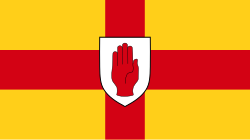
The historic Flag of Ulster served as the basis for the Ulster Banner (often referred to as the Flag of Northern Ireland), which was the flag of the Government of Northern Ireland until the proroguing of the Stormont parliament in 1973.

People

[edit]

Sport

[edit]

The border has divided association football teams since 1921.[50] The Irish Football Association (the I.F.A.) oversees the sport in N.I., while the Football Association of Ireland (the F.A.I.) oversees the sport in the Republic. As a result, separate international teams are fielded and separate championships take place (Irish Football League in Northern Ireland, League of Ireland in the rest of Ulster and Ireland). Anomalously, Derry City F.C. has played in the League of Ireland since 1985 due to crowd trouble at some of their Irish League matches prior to this. The other major Ulster team in the League of Ireland is Finn Harps of Ballybofey, County Donegal. When Derry City F.C. and Finn Harps play against each other, the game is usually referred to as a 'North-West Derby'. There have been cup competitions between I.F.A. and F.A.I. clubs, most recently the Setanta Sports Cup.

In Rugby union, the professional rugby team representing the province and the IRFU Ulster Branch, Ulster Rugby, compete in the United Rugby Championship along with teams from Wales, Scotland, Italy, South Africa and the other Irish Provinces (Leinster, Munster and Connacht). They also compete in Europe's main club rugby tournament, the European Rugby Champions Cup, which they won (as the Heineken Cup) back in 1999. Notable Ulster rugby players include Willy John McBride, Jack Kyle and Mike Gibson. The former is the most capped British and Irish Lion of all time, having completed four tours with the Lions in the sixties and seventies. At international level players from Ulster join with those from the other 3 provinces to form the island-wide Ireland team.

In Gaelic games (which include Gaelic football and hurling), Ulster counties play the Ulster Senior Football Championship and Ulster Senior Hurling Championship. In football, the main competitions in which they compete with the other Irish counties are the All-Ireland Senior Football Championship and National Football League, while the Ulster club champions represent the province in the All-Ireland Senior Club Football Championship. Hurling teams play in the All-Ireland Senior Hurling Championship, National Hurling League and All-Ireland Senior Club Hurling Championship. The whole province fields a team to play the other provinces in the Railway Cup in both football and hurling. Gaelic Football is by far the most popular of the GAA sports in Ulster but hurling is also played, especially in Antrim, Armagh, Derry, and Down.

The Ulster Hockey Union organises field hockey in the province and contributes substantially to the all-island hockey team.[51]

Cricket is also played in Ulster, especially in Northern Ireland and East Donegal.[52] Ulster enters two teams into the Interprovincial Series; the North Knights and the North West Warriors, who are the respective representative teams of the Northern Cricket Union (NCU) and the North West Cricket Union (NWCU).

Golf is, however, by far the most high-profile sport and the sport that Ulster has succeeded at more than any other. Ulster has produced many great players over the years, from Fred Daly winning The Open Championship in 1947 at the Royal Liverpool Golf Club, Hoylake to most recently Rory McIlroy winning the US Open and Darren Clarke winning The Open Championship in 2011. Ulster also has another Major winner in Graeme McDowell, who also won the US Open in 2010. The Open Championship returned to Ulster, after 68 years, in 2019 at Royal Portrush Golf Club.

In horse racing, specifically National Hunt, Ulster has produced the most dominant jockey of all time, Tony McCoy.

The Circuit of Ireland Rally is an annual automobile rally held in Ulster since 1931.

See also

[edit]

Notes

[edit]

References

[edit]

Further reading

[edit]
[edit]
Revisions and contributorsEdit on WikipediaRead on Wikipedia
from Grokipedia
Ulster is the northernmost of Ireland's four traditional provinces, consisting of nine counties—Antrim, Armagh, Cavan, Donegal, Down, Fermanagh, Londonderry, Monaghan, and Tyrone—that span the political border between Northern Ireland (part of the United Kingdom) and the Republic of Ireland.[1][2] The name derives from the Ulaid, an ancient Gaelic confederation that dominated the region in the early medieval period.[3] In the early 17th century, following the defeat of Gaelic lords in the Nine Years' War and their subsequent flight, King James I initiated the Plantation of Ulster, confiscating lands in six counties (Armagh, Cavan, Donegal, Fermanagh, Londonderry, and Tyrone) and reallocating them to English and Scottish Protestant settlers to secure British control and promote loyalty.[4][5] This policy resulted in significant demographic changes, establishing a Protestant majority in much of the province and fostering Ulster Scots culture alongside native Irish traditions.[4] The enduring ethnic and religious divisions contributed to the 1920 partition under the Government of Ireland Act, which created Northern Ireland from the six predominantly unionist counties, while the three southern counties joined the Irish Free State.[6][2] Ulster's landscape features dramatic coastlines like the Giant's Causeway, mountainous regions such as the Mournes, and fertile glens, supporting agriculture, tourism, and industries including linen and shipbuilding historically centered in Belfast.[4] The province remains defined by its dual heritage, with ongoing debates over identity, sovereignty, and cross-border cooperation, exemplified by the 1998 Good Friday Agreement that addressed long-standing conflicts known as the Troubles.[6]

Terminology

Etymology and historical names

The name Ulster originates from the Old Irish Ulaid (genitive Ulad), denoting an ancient Gaelic overkingdom and tribal confederation centered in northeastern Ireland from the Iron Age onward, as attested in early medieval Irish texts and linguistic reconstructions.[7] This ethnonym is linked to Ptolemy's Geography (c. 150 AD), where northern Irish tribes are described under variants such as Voluntii or Ouolountioi, positioned along the eastern and northern coasts based on second-century trade and geographic data.[8] Empirical linguistic analysis traces Ulaid to Proto-Celtic roots possibly connoting "beard" (ulcha in Irish), reflecting descriptive tribal nomenclature rather than unsubstantiated mythic origins.[9] In medieval Latin records, the region was termed Ultonia, a Latinized form of Ulaid, appearing in annals such as the Annals of Ulster (Annála Uladh), which chronicle events from 431 AD but were primarily compiled by Ruaidhrí Ó Luinín around 1498 at a Franciscan house in Donegal.[10] The modern English Ulster emerged in the 14th century through Anglo-Norman Ulvestre and Old Norse Ulfastaðir or Ulfastir, combining Ulaidh with Norse elements for "land" (staðr or tír), evidencing Viking linguistic influence on Gaelic place names during the 9th–12th centuries.[7] This evolution reflects phonetic shifts from Irish Cúige Uladh ("fifth of the Ulaid") to anglicized forms without altering the core reference to the historic Ulaid territory.[11]

Modern political and cultural connotations

In contemporary unionist discourse, "Ulster" predominantly signifies the six counties of Northern Ireland, embodying a distinct Protestant regional identity oriented toward preserving constitutional ties with the United Kingdom.[12] This connotation emerged from the partition under the Government of Ireland Act 1920, which delimited Northern Ireland to ensure a unionist majority by excluding the three Ulster counties with nationalist majorities.[2] Irish nationalists, conversely, associate "Ulster" with the full historical province of nine counties, framing the six-county division as a gerrymandered severance that undermines Ireland's territorial integrity.[13] Such definitional ambiguities perpetuate political friction, as each side leverages the term to advance competing visions of sovereignty and belonging. Cultural symbols amplify these connotations. The Ulster Banner, adopted in 1953 and discontinued officially after the Northern Ireland Parliament's suspension in 1972, endures unofficially in unionist parades, loyalist murals, and select international sports representations for Northern Ireland, including Commonwealth Games events.[14] Its persistence draws criticism for evoking the one-party unionist era, yet replacement efforts risk exacerbating sectarian divides.[14] In neutral or cross-community contexts, the Red Hand of Ulster functions as a shared heraldic motif, appearing on flags for provincial Gaelic games teams that span the nine counties and in rugby union fixtures drawing players from both jurisdictions.[13] Empirical evidence from the 2021 Northern Ireland census highlights the fractured identities informing these usages, with 31.9% of respondents selecting British-only national identity, 29.1% Irish-only, and 19.8% Northern Irish-only.[15] These near-parity figures, alongside smaller multiple-identity selections, illustrate entrenched communal cleavages without resolution, rendering "Ulster" a vessel for ongoing debates over legitimacy and self-perception rather than a unified geographic or cultural referent.[16]

Geography

Physical landscape and natural features

Ulster's terrain encompasses low-lying eastern plains and central basins, giving way to uplands and mountains in the north and west, with the landscape shaped by a topographic saucer centered on Lough Neagh.[17] The eastern regions feature gentler rolling hills and drumlins from glacial activity, while the north exhibits plateaus of basalt-capped Antrim hills.[17] Prominent uplands include the Mourne Mountains in County Down, where Slieve Donard rises to 850 meters as the province's highest point, and the Sperrin Mountains straddling Counties Tyrone and Derry, with Sawel Mountain at 678 meters.[18] These ranges consist primarily of granite and schist in the Mournes, contrasting with the quartzite and schist of the Sperrins.[18] Geologically, Ulster overlays Carboniferous limestone in its central lowlands with Tertiary basalt flows in the northeast, the latter forming the Antrim Plateau and columnar jointing from Paleogene volcanic activity around 60 million years ago.[19] The Giant's Causeway exemplifies this, comprising approximately 40,000 interlocking hexagonal basalt columns exposed along the coast, recognized as a UNESCO World Heritage Site since 1986 for its unique volcanic landforms.[20][21] River systems drain the province northward and eastward, including the River Bann, which spans about 80 kilometers through peatlands and lowlands, and the River Foyle forming the western border with expansive tidal estuaries.[22] Inland, Lough Neagh covers 383 square kilometers as the largest freshwater lake in the British Isles, while the interconnected Lough Erne system in the southwest features over 150 islands amid calcareous bedrock.[17] Ecologically, blanket peat bogs dominate uplands, supporting species like the hen harrier (Circus cyaneus), golden plover (Pluvialis apricaria), and red grouse (Lagopus lagopus), alongside peat-forming Sphagnum mosses and invertebrates such as the marsh fritillary butterfly (Euphydryas aurinia).[23] Temperate Atlantic oakwoods, featuring pedunculate oak (Quercus robur) and holly (Ilex aquifolium), persist in sheltered valleys, harboring bryophytes and ferns adapted to oceanic climates, though fragmented by historical clearance.[24] Coastal cliffs and dunes host salt-tolerant flora, with low rates of endemism reflecting Ireland's post-glacial colonization.[25]

Climate and environment

Ulster possesses a temperate oceanic climate moderated by the North Atlantic Drift, which transports warm waters from the Gulf Stream northward, preventing extreme seasonal variations despite its high latitude. Annual mean temperatures in low-lying areas range from 8.5°C to 10°C, with coastal and eastern regions like Belfast recording higher averages around 9.5-10°C, while upland interiors are cooler. January means typically fall between 4°C and 6°C, and July highs average 14-16°C, with rare prolonged freezes due to maritime influences.[26][27] Precipitation is abundant and evenly distributed, averaging 800-1,500 mm annually across much of the region, though western and upland areas such as the Sperrin Mountains or Donegal receive 1,500-2,000 mm due to orographic effects from prevailing westerly winds. The North Atlantic Drift contributes to high humidity and frequent cloud cover, limiting sunshine hours to about 1,200-1,400 per year. Historical Met Office records for Northern Ireland confirm mild winters with snowfall confined mostly to higher elevations, averaging fewer than 10 days of lying snow annually in lowlands.[26][28] Post-2000 weather trends show an uptick in storm frequency and intensity during autumn and winter, correlating with positive phases of the Atlantic Multidecadal Oscillation, which amplifies North Atlantic variability and enhances cyclone tracks toward the region. Met Office data indicate more named storms impacting Ulster since the early 2010s, though long-term temperature records reveal no statistically significant warming beyond multidecadal cycles observed since the 19th century.[29][27][30] Environmentally, Ulster's extensive peatlands, covering about 10-15% of the land area, have undergone degradation primarily through drainage for agriculture and afforestation since the 19th century, altering hydrology and shifting them from carbon sinks to sources via oxidation and emissions estimated at 10-20 t CO2-equivalent per hectare annually in managed sites. Agricultural runoff exacerbates water quality issues, with farming activities contributing 62% of phosphorus loads to rivers and lakes in Northern Ireland, leading to elevated nutrient levels documented in monitoring data. Historical deforestation during industrialization reduced woodland cover in Ulster to roughly 15,000 hectares by 1905 from pre-1800 levels exceeding 20% of land, though afforestation since the mid-20th century has reversed losses, adding 22.7 thousand hectares of tree cover in Northern Ireland from 2000 to 2020.[31][32][33][34]

Political and administrative divisions

Ulster's political division stems from the partition of Ireland under the Government of Ireland Act 1920, effective in 1921, which separated the six predominantly unionist counties of Antrim, Armagh, Down, Fermanagh, Londonderry, and Tyrone to form Northern Ireland within the United Kingdom, while Cavan, Donegal, and Monaghan remained part of the Irish Free State, later the Republic of Ireland. This fragmentation persists, with the historic counties serving ceremonial or cultural roles but overlaid by modern administrative structures. Northern Ireland's six counties are subdivided into 11 local government districts established by the Local Government Act (Northern Ireland) 2014, operational from April 2015, which merged the prior 26 districts introduced in 1973 to enhance efficiency in delivering services like planning, waste collection, and community development.[35][36] In the Republic of Ireland, the three Ulster counties operate as primary administrative units with elected county councils managing local affairs under the framework of 31 such councils nationwide, including responsibilities for housing, roads, and environmental protection. Donegal County notably encompasses designated Gaeltacht areas—Irish-speaking districts covering regions like Gweedore (Gaoth Dobhair), the Rosses (Na Rosa), and Glencolmcille—where Irish holds official primacy in education and signage, comprising roughly one-fifth of the county's territory and preserving linguistic heritage amid broader anglicization.[37][38] The 2021 census enumerated Northern Ireland's population at 1,903,175, exhibiting an east-west gradient with denser urban clusters in Antrim and Down (encompassing Belfast's metropolitan area, housing over 600,000) versus sparser rural settlements in Fermanagh and Tyrone, where populations hover below 100,000 per county. Complementarily, Ireland's 2022 census (aligned closely with 2021 data) reported 167,084 residents in Donegal, 81,704 in Cavan, and 65,288 in Monaghan, underscoring predominantly rural character with low densities (e.g., Donegal at 34 persons per km²), particularly in Gaeltacht zones reliant on agriculture and tourism. This distribution highlights Ulster's post-partition disparities, with Northern Ireland's total dwarfing the Republic's share by over fivefold, reflecting historical economic and demographic divergences.[39][40]

Major settlements and urban centers

Belfast serves as the largest urban center in Ulster, with a local government district population of 350,500 as of mid-2024 estimates.[41] The city's expansion accelerated after 1800 amid the linen industry's mechanization, earning it the moniker "Linenopolis" by the mid-19th century, when it produced over 40% of the world's linen and supported a workforce exceeding 70,000 by the early 20th century.[42] Functionally, Belfast functions as a key port through Belfast Harbour and hosts Queen's University Belfast, established by royal charter in 1845 as a non-denominational institution.[43] Urban growth has extended into commuter belts, with the metropolitan area reaching approximately 647,000 residents in 2024.[44] Derry, also known as Londonderry, ranks as the second-largest settlement, with a city population of 85,279 recorded in the 2021 census.[45] Its strategic border position facilitates cross-border trade and connectivity, while the urban area encompasses around 105,000 people.[46] The city hosts a campus of Ulster University and maintains historical significance tied to its 17th-century walls. Other notable centers include Armagh, with 16,310 residents in 2021, recognized for its ecclesiastical heritage as the ancient seat of Ulster's kings and site of St. Patrick's primatial cathedral.[47] In the Republic of Ireland portion, Letterkenny stands out as a growth hub in County Donegal, boasting 22,549 inhabitants in 2022 and serving as a regional commercial and educational node.[48] Ports like Larne further support maritime functions, handling significant ferry and cargo traffic.[49] Urbanization patterns reflect 19th-century industrialization concentrated in the north-east, with ongoing population increases in Northern Ireland's districts averaging 0.4% annually as of 2024.[41]

Demographics

The population of Ulster totaled approximately 2.22 million as of the 2021-2022 censuses, with Northern Ireland accounting for 1,903,175 residents across its six counties and the Republic of Ireland's three Ulster counties (Donegal, Cavan, and Monaghan) totaling 314,076 residents (Donegal: 167,084; Cavan: 81,704; Monaghan: 65,288).[39][50] Northern Ireland's population has shown steady growth, reaching an estimated 1,920,400 by mid-2023, primarily driven by net international and internal migration rather than natural increase, which contributed only +1,900 persons in the year to mid-2023.[51][52] Historically, Ulster's population peaked at around 2.4 million in the 1841 census across its nine counties, prior to sharp declines between 1841 and 1851, during which approximately 291,000 residents emigrated and 184,000 deaths were recorded, reflecting broader island-wide reductions from 8.2 million to 6.5 million.[53] Subsequent trends indicate partial recovery, with Northern Ireland's share growing from 1.24 million in 1926 to the current figure through net inflows, including over 62,000 net international migrants from 2001 to 2023.[54] In contrast, the Republic's Ulster counties have experienced slower growth amid rural outflows, though precise net migration data for these areas highlights differentials from urban centers elsewhere in Ireland. Age structures reveal a median age of 40 years in Northern Ireland per the 2021 census, with a sex ratio near parity and a dependency ratio influenced by an aging population (over 16% aged 65+ by mid-2024).[55][51] The Republic's Ulster counties exhibit slightly younger profiles, such as Cavan's average age of 38.5 years in 2022, reflecting higher proportions of working-age residents despite emigration pressures.[50] Population density varies markedly, averaging 133 persons per km² in Northern Ireland, with concentrations exceeding 200 per km² in eastern counties like Antrim and Down due to urban centers such as Belfast, compared to under 60 per km² in western areas like Fermanagh. In the Republic's portion, densities are sparser overall, at approximately 32 per km² in Donegal and 60 per km² in Monaghan, underscoring east-west gradients tied to settlement patterns.
County/RegionPopulation (Census Year)Density (per km²)Median/Average Age
Northern Ireland (6 counties)1,903,175 (2021)13340 (median, 2021)[55]
Donegal (ROI)167,084 (2022)~32~38 (est. avg.)
Cavan (ROI)81,704 (2022)~5038.5 (avg., 2022)[50]
Monaghan (ROI)65,288 (2022)~60~39 (est. avg.)

Ethnic and cultural composition

The ethnic composition of Ulster reflects a historical layering of native Gaelic Irish populations with significant inflows of Scottish and English settlers during the 17th-century Ulster Plantation, which systematically redistributed lands and introduced Protestant settlers primarily from lowland Scotland and northern England.[56] Genetic analyses confirm this admixture, with fine-scale studies identifying distinct clusters in Ulster populations attributable to these plantations, showing elevated Scottish genetic signatures compared to other Irish regions, often estimated at 20-40% input from post-medieval migrations based on surname and Y-chromosome data correlated with settlement patterns.[57][58] In contemporary terms, the 2021 Northern Ireland census (covering six Ulster counties) reports 96.6% of the population as White, predominantly of British or Irish descent, with self-reported ethnic groups including White British (40.2%), White Irish (12.4%), and White Other (40.9%), the latter incorporating descendants of planters and recent European migrants.[59][60] The three Ulster counties in the Republic of Ireland (Donegal, Cavan, Monaghan) exhibit even higher homogeneity, with over 90% identifying as White Irish in national patterns, retaining stronger continuity with pre-plantation Gaelic ancestry due to less intensive settlement.[61] Minority ethnic groups remain small but notable. Irish Travellers, a distinct nomadic ethnic community with origins tracing to medieval Ireland, comprise approximately 0.14% of Northern Ireland's population (2,609 individuals in 2021) and contribute to the national 0.7% figure in the Republic, with concentrations in border Ulster areas reflecting historical itinerancy.[62] Post-2004 EU enlargement spurred inflows of Eastern European migrants, particularly Polish (now the largest non-British/Irish group in Northern Ireland at around 1% of the population) and Lithuanians, drawn by economic opportunities in construction and services, altering urban demographics in Belfast and Derry.[59] Cultural markers underscore these ethnic layers, such as annual parades organized by the Orange Order—founded in 1795 amid agrarian tensions—to commemorate the Battle of the Boyne and preserve settler traditions like flute bands and loyalist symbolism, which persist as expressions of Ulster Scots heritage in the northern counties.[63] These practices, while rooted in historical defense of plantation gains, continue to shape communal identity without implying uniform endorsement across the province.[64]

Religious demographics and sectarian dynamics

In Northern Ireland, the 2021 census recorded 45.7% of the population as Catholic or raised Catholic, 43.5% as Protestant or raised Protestant, 1.5% adhering to other religions, and 17.4% stating no religion.[15][65] In the three Ulster counties of the Republic of Ireland (Cavan, Donegal, and Monaghan), the 2022 census indicated approximately 80% Catholic affiliation overall, with Monaghan at 78%, reflecting a longstanding Catholic majority in these areas.[66] These figures correlate with residential segregation patterns, where Catholic-background populations predominate in western and southern districts of Northern Ireland, while Protestant-background groups cluster in eastern and northern areas.[15] Historically, Northern Ireland maintained a Protestant majority of 66.3% against 33.5% Catholic in the 1926 census, with the gap narrowing progressively; by 1961, Catholics comprised about 35%, and the Protestant share eroded further to 48.4% by 2011 amid higher Catholic birth rates and emigration differentials.[67] This shift challenged the demographic assumptions underpinning partition, as Catholic numbers grew from differential fertility—averaging 2.5 children per Catholic woman versus 1.9 for Protestant in the late 20th century—and net Protestant out-migration.[68] The no-religion category expanded sharply, from under 1% in 1961 to 17.4% in 2021, particularly among younger cohorts, indicating secularization that dilutes sectarian identifiers across both communities.[65] Sectarian dynamics manifest in spatial divisions, such as Belfast's interface areas—over 80 documented sites where Protestant/unionist and Catholic/nationalist neighborhoods adjoin, often demarcated by peacelines erected since 1969 to curb clashes.[69] Flashpoints like the Drumcree disputes in Portadown during the 1990s involved standoffs over Orange Order parades routing through Catholic-majority Garvaghy Road, escalating to riots in 1995–1998 that drew thousands of protesters and prompted police rerouting decisions, exacerbating localized tensions.[70] Pre-1998 violence during the Troubles totaled around 3,500 deaths, peaking at 480 in 1972, with data showing concentrated fatalities in interface zones and paramilitary-linked incidents correlating to religious segregation rather than uniform distribution.[71][72] These patterns underscore data-driven risks of friction in mixed or proximate areas, though declining affiliations suggest evolving social correlations beyond binary religious divides.[73]

Languages

English dialects and accents

Ulster English encompasses a range of dialects spoken primarily in Northern Ireland, characterized by distinct phonological traits that set it apart from Received Pronunciation (RP) and other British varieties. Mid-Ulster English, prevalent in urban areas like Belfast, features widespread glottal stops replacing /t/ in intervocalic and final positions, as in "bu'er" for "butter," a phenomenon noted in local speech patterns since at least the late 20th century.[74] This dialect also exhibits vowel shifts, such as the centralization of /ʌ/ to [ə] in words like "strut" and monophthongization in diphthongs like /aɪ/ to [aː] in some contexts, distinguishing it from southern Irish English forms.[75] In contrast, East Ulster varieties, influenced by historical Scots settlement, retain rhoticity—pronouncing non-prevocalic /r/ as a tapped or uvular approximant—more consistently than in Mid-Ulster urban speech, where rhoticity may weaken among younger speakers.[76] These dialects show Scots-derived phonological mergers, such as the goat-foot split avoidance, with /oː/ and /uː/ remaining distinct, reflecting Plantation-era migrations from Scotland in the 17th century.[77] Lexically, Ulster English incorporates numerous Scots borrowings, including "wee" for small, used ubiquitously as in "wee house," and "dander" for a short walk, documented in dialect surveys tracing these to Lowland Scots substrates.[78] Other terms like "thole" (endure) and "boke" (vomit) persist regionally, as mapped in archival collections of Ulster speech from the mid-20th century onward.[79] Post-1950s exposure to broadcast media, including BBC Northern Ireland programming, has promoted Mid-Ulster forms as a de facto standard, reducing rural dialectal divergence while preserving core features like glottalization in informal contexts.[80]

Irish language usage and revival efforts

In Northern Ireland, the 2021 census reported 228,600 people aged 3 and over with some ability to speak Irish, equating to 12.4% of the population, up from 10.65% in 2011, though daily speakers totaled approximately 18,000, primarily in urban areas like Belfast and Derry.[81][82] In the Republic of Ireland's Ulster counties (Donegal, Cavan, and Monaghan), the 2022 census recorded about 70,000 individuals claiming ability to speak Irish, with daily usage clustered in Donegal's Gaeltacht districts, where Irish remains a community language for roughly 25-37% of residents despite territorial contraction since 1926.[83][84] Ulster Irish, the regional dialect, preserves archaic elements including aspirated consonants (e.g., "t'" pronounced with a fricative), the negative particle cha(n) shared with Scottish Gaelic, and in eastern variants, a 'v' sound for bh and mh rather than 'w', rendering it more conservative and intelligible compared to southern forms.[85][86] Early revival efforts emerged in the 1730s through hedge schools—clandestine, outdoor classes operated by itinerant masters that taught Irish literacy to Catholic children amid Penal Laws restricting formal education, sustaining the language until national schools shifted focus to English by the 1830s.[87] Modern initiatives include Irish-medium immersion schools (gaelscoileanna) in Northern Ireland, legalized under the Education Reform (Northern Ireland) Order 1989 and statutorily encouraged by the 1998 Education Order, now serving over 6,000 pupils.[88][89] Cross-border body Foras na Gaeilge, funded at €20-25 million annually post-Good Friday Agreement, supports classes, media, and signage, correlating with rises in self-reported ability.[90][91] Empirical metrics reveal limited efficacy: despite policy and funding, fluency is low, with only 40-45% of ability-claimants in censuses rating themselves as proficient, many gains attributable to mandatory schooling rather than organic transmission, and Gaeltacht shrinkage in Donegal reflecting persistent English dominance.[92][93]

Ulster Scots language and heritage

Ulster Scots originated from the migration of Lowland Scots speakers to Ulster during the Plantation of Ulster in the early 17th century, with settlements peaking between 1610 and the 1690s involving approximately 200,000 colonists who brought varieties of the Scots language.[76] This linguistic importation established a distinct variety outside Scotland, influenced by ongoing contact with English but retaining core Scots features in phonology and lexicon.[94] In the 2021 Northern Ireland census, around 10.4% of respondents (approximately 198,000 people) reported some knowledge of Ulster Scots, though active fluency remains low, with only a small fraction indicating regular use such as daily or weekly speaking.[81][15] The Northern Ireland Act 1998, as amended by subsequent legislation including the St Andrews Agreement provisions, facilitates recognition of Ulster Scots alongside Irish, treating it as an expression of cultural heritage entitled to public authority support, though formal "indigenous" status derives more from post-Agreement commitments than explicit statutory language.[95][96] Distinctive lexical items persist, such as thole meaning "to endure" or "bear," which traces directly to Scots usage and appears in Ulster Scots corpora without equivalent standard English connotations.[97][98] Heritage validations, including survival in Donegal communities despite Anglicization pressures, underscore its historical continuity as a cultural marker.[99] Academic debate centers on whether Ulster Scots constitutes a separate language or a dialect of Scots/English, with corpus-based phonetic analyses—drawing on mid-20th-century surveys by Robert J. Gregg—revealing shared innovations like the Northern Subject Rule in verbal concord, which aligns more closely with Scots patterns than Southern English ones, supporting continuity as a Scots variety rather than a mere English dialect.[100][76] Critics arguing for dialect status often emphasize convergence with Hiberno-English due to substrate influences and later Anglicization, yet phonological evidence from rural idiolects, such as vowel shifts in words like house or goose, favors Scots derivation over independent evolution.[77] These disputes highlight methodological variances: pro-language advocates prioritize historical corpora and mutual intelligibility with Scots, while skeptics stress sociolinguistic vitality metrics, though the latter may undervalue conservative speech pockets preserved in isolated communities.[101]

Economy

Economic overview and regional disparities

Northern Ireland's gross value added (GVA) per capita reached £28,194 in 2022, equivalent to 81% of the UK average of approximately £34,800, reflecting persistent productivity gaps linked to historical underinvestment and structural challenges post-partition.[102][103] In the Republic of Ireland's Ulster counties (Donegal, Cavan, and Monaghan), forming part of the Border region, GVA per person remains substantially below the national average, with the region consistently ranking among the lowest in Ireland due to rural economies and limited industrial diversification; for instance, Donegal's disposable income per capita was €19,253 in 2021, 21% under the state average, indicative of broader output constraints despite Ireland's overall GDP per capita exceeding €90,000 in 2022.[104][105] These divergences stem from partition's market fragmentation, with Northern Ireland's economy oriented predominantly toward the UK (over 50% of external goods sales to Great Britain in 2022) and the ROI counties integrated into EU supply chains but hampered by peripheral location and cross-border barriers.[106] Unemployment rates in 2023 averaged around 3% in Northern Ireland, aligning closely with UK levels but masking elevated youth unemployment at approximately 12%, driven by skills mismatches and slower private sector growth in peripheral areas.[107][108] In ROI's Ulster counties, rates hover higher, often 5-7% in the Border region, reflecting heavy reliance on seasonal agriculture and tourism, which amplifies vulnerabilities to external shocks compared to Ireland's urban-driven national unemployment of under 5%.[109] Partition exacerbated these imbalances by severing integrated Ulster trade networks, leading to depopulation and infrastructure neglect in border zones on both sides, though EU structural funds have mitigated some ROI disparities since the 1980s.[110] Overall, Ulster's economic output lags both UK and Irish averages, with Northern Ireland's GVA growth trailing the UK by 1-2 percentage points annually in recent years, while ROI Ulster counties benefit from Ireland's fiscal transfers but suffer from emigration and low-value sectors; cross-border initiatives post-Good Friday Agreement have fostered limited integration, yet persistent disparities underscore the causal role of divided governance and markets.[111][112]

Key industries and historical development

Agriculture has long been a cornerstone of Ulster's economy, particularly in Northern Ireland, where it employs around 4% of the workforce and contributes approximately 1.5% to gross value added, with dairy and beef production dominant. Northern Ireland accounts for about 18% of total UK milk deliveries, producing over 2.5 billion liters annually, supported by grassland suitable for livestock farming. In the Republic of Ireland's Ulster counties (Cavan, Donegal, Monaghan), agriculture focuses on beef, dairy, and poultry, with these areas contributing significantly to Ireland's overall farm output, though on smaller scales compared to the east.[113][114] Historically, Ulster's industrialization in the 19th century centered on textiles and heavy manufacturing, transforming the province into Ireland's economic hub through linen production and shipbuilding. The linen industry, concentrated in areas like Lisburn and Belfast, peaked around 1900 with over 35,000 power looms operational, exporting high-quality fabrics globally and employing tens of thousands in spinning, weaving, and bleaching. Shipbuilding at Harland & Wolff in Belfast reached employment highs of about 16,000 workers by 1908-1914, constructing iconic vessels like the RMS Titanic and driving urban growth amid the liner boom. These sectors declined post-World War I due to global competition, technological shifts, and reduced demand, with linen output falling sharply by the mid-20th century and shipbuilding output contracting after the 1960s.[115][116][117] Services now dominate Ulster's economy, comprising about 75% of Northern Ireland's gross value added, with financial and professional services in Belfast employing 43,000 people and adding £4.1 billion annually. Tourism has grown, boosted by filming locations for Game of Thrones, which drew 120,000 visitors in 2016 and generated £30 million yearly for Northern Ireland through themed tours and attractions. In the Republic's Ulster counties, medtech and diagnostics firms like Randox in Donegal contribute to manufacturing, focusing on drug delivery devices and healthcare testing rather than traditional pharma heavyweights. Research and development spending in Northern Ireland totaled £1.1 billion in 2023, but remains below the UK average of around 1.7% of GDP, limiting innovation-driven growth in emerging sectors.[118][119][120][121][122]

Post-partition economic trajectories

Following partition in 1921, Northern Ireland benefited from substantial fiscal transfers from the UK government, which supported public spending and infrastructure amid structural industrial decline. These subventions, equivalent to about 8.4% of Northern Ireland's GDP by 1970-71, helped sustain welfare provisions and offset weaker private sector performance compared to the UK average.[123][124] Economic expansion accelerated in the 1960s, driven by inward investment in manufacturing and shipbuilding, with industrial growth rates briefly surpassing UK norms. However, the outbreak of the Troubles from the late 1960s led to a sharp downturn, as violence deterred foreign investment and exacerbated unemployment, with public sector expansion becoming the primary stabilizer through the 1970s and beyond. Recovery gained momentum post-1998 Good Friday Agreement, fueled by renewed foreign direct investment, particularly from the US, which created jobs in high-tech and services sectors and contributed to GDP growth averaging around 2-3% annually in the 2000s.[125][126][127] In the Republic of Ireland, economic policy pivoted from protectionism to export-oriented openness in the late 1950s, formalized in the 1958 First Programme for Economic Expansion, which prioritized foreign investment incentives and tariff reductions to integrate with global markets. This shift laid groundwork for the Celtic Tiger boom of the 1990s-2000s, but benefits were uneven across Ulster counties (Donegal, Cavan, Monaghan), which remained peripheral to the east-coast hubs like Dublin, experiencing limited spillover from FDI in tech and finance. Border counties continued to lag, with GDP per capita in the Border, Midlands, and West (BMW) region—encompassing these areas—trailing the national average by 20-30% during the boom, reliant more on EU structural funds for agriculture and tourism than high-value industries.[128][129][130] Comparatively, per capita income in Northern Ireland hovered at around 80-90% of the UK average post-1960s, sustained by subsidies but showing productivity gaps; in contrast, Republic-wide GDP per capita surged past Northern Ireland's in the 1990s, narrowing the north-south gap from Ireland at 90% of Northern Ireland's level in the early 1990s to reversal by 2000. Post-2008 financial crisis, Ireland's sharper initial contraction (GDP drop of 10% in 2009) gave way to faster recovery via exports and EU support, widening the gap anew—Ireland's GNI* per capita reaching 57% above Northern Ireland's GDP per capita by 2022—while Ulster border counties in the Republic grew more modestly, their EU market access offset by remoteness from growth poles.[131][132]

Infrastructure and Transport

Road and motorway networks

The road network in Northern Ireland, comprising the bulk of Ulster's infrastructure, totals 25,922 kilometres as of April 2024, with unclassified roads forming the largest share at over 60%. Motorways and dual carriageways constitute a smaller but critical portion, including the M1, which extends 61 kilometres from Belfast to Dungannon, linking to the A1 dual carriageway that continues southward toward the Irish border and Dublin, facilitating the primary east-west corridor across the province. The M2, Northern Ireland's longest motorway at 43 kilometres, serves Belfast's northern approaches and was partially extended in phases through the 1970s and 1980s, with further dualling of connecting A-roads like the A26 completed in the 2010s to mitigate gaps in the original network.[133] Cross-border connectivity relies on routes such as the A5, a 94-kilometre primary road from Derry southward through Strabane and Omagh to the border near Aughnacloy, where it joins the Republic's N2 toward Dublin, handling significant regional traffic despite ongoing safety concerns and stalled dualling plans initiated post-2007. The A4 provides an east-west alternative, spanning 111 kilometres from Portadown via Dungannon and Enniskillen to Belcoo, intersecting the A5 and linking to Republic roads like the N16 in Fermanagh-Leitrim border areas. In the Republic's Ulster counties—Donegal, Cavan, and Monaghan—national primary roads predominate without extensive motorways, including the N2 paralleling the A5 for northwest-southeast access and the N3 through Cavan connecting to the midlands, with total national routes across Ireland measuring 5,306 kilometres as of recent inventories.[134][135] Post-1990s investments have focused on upgrading single-carriageway primaries to dual standards, such as sections of the A1 between Newry and the border completed between 2006 and 2018, reducing journey times on the Belfast-Dublin route from over two hours to approximately 90 minutes under free-flow conditions. Belfast experiences notable congestion, ranking as the 50th most congested city globally in 2022, with drivers losing 58 hours annually to traffic delays, particularly on radial routes like the M1 and M2 during peak hours. Brexit's implementation via the Northern Ireland Protocol and subsequent Windsor Framework has avoided physical customs infrastructure on land borders, resulting in negligible routine delays for road vehicles crossing Ulster's internal frontiers, though isolated checks on goods documentation persist for certain freight without broad disruption to passenger or light vehicle flows.[136][137][138][139]

Rail and public transport systems

The rail network in Northern Ireland comprises approximately 300 route-kilometres of track, operated by NI Railways under the Translink umbrella, serving key urban and regional routes such as the Belfast–Londonderry line, Belfast–Bangor suburban service, and Belfast–Larne Harbour branch.[140] The cross-border Enterprise service, jointly run with Iarnród Éireann since its inception in 1947, links Belfast to Dublin Connolly station, with hourly departures introduced in October 2024 to enhance all-island connectivity despite partition-era gauge compatibility on the Irish broad gauge (1,600 mm).[141][142] In 2023–24, NI Railways handled 13.8 million passenger journeys, reflecting recovery from pandemic lows but still below pre-2019 peaks, with integration into the UK funding model via the Department for Infrastructure while maintaining operational ties to Republic of Ireland networks.[143] In contrast, the three Ulster counties within the Republic of Ireland—Donegal, Monaghan, and Cavan—lack any active passenger rail services, with all lines closed between the 1950s and 1970s due to low usage and economic shifts; residents access the Iarnród Éireann network via distant connections like the Sligo or Dundalk lines, resulting in regional underutilization evidenced by negligible freight or commuter traffic in these areas.[144] Iarnród Éireann's broader Republic network totals around 2,300 km but remains isolated from Northern Ireland's system except for the Enterprise, with Ulster-bordering routes showing sparse demand outside Dublin commuter zones.[145] Public transport in Northern Ireland benefits from Translink's integrated system, encompassing NI Railways with Ulsterbus regional services and Metro/Glider urban buses under a unified Smartlink contactless ticketing scheme, facilitating seamless multimodal journeys across the province.[146] In Republic Ulster counties, services depend on non-integrated bus operators like Bus Éireann, with no rail linkage exacerbating peripheral access challenges. The 2024 All-Island Strategic Rail Review outlines ambitions for network expansion, including potential line restorations to Donegal and electrification of core Irish routes by 2050, though Northern Ireland's diesel-only infrastructure awaits firm commitments amid funding disparities between UK and Republic investments.[145]

Air and sea connectivity

Belfast International Airport, located near Aldergrove, serves as the primary international gateway for Ulster, handling a record 6.757 million passengers in 2024, with major routes to Great Britain, Europe, and North America facilitating tourism, business, and cargo logistics.[147][148] George Best Belfast City Airport, situated closer to Belfast city center, complements this by focusing on short-haul regional flights, primarily to Great Britain and Ireland, and recorded approximately 2.4 million passengers in 2024, emphasizing efficient connectivity for business travelers and low-cost carriers.[149][150] In the Republic of Ireland portion of Ulster, Donegal Airport operates as a small regional facility with public service obligation flights mainly to Dublin, serving around 41,867 passengers in 2023, supporting remote connectivity for local communities and limited cargo.[151] Sea connectivity relies heavily on ports for passenger ferries, freight, and specialized cargo. Larne Harbour functions as the key roll-on/roll-off ferry terminal linking Ulster to Scotland via Cairnryan, handling over 521,000 passengers annually alongside substantial freight units, which bolsters trade with Great Britain despite post-Brexit customs adjustments that have prompted route optimizations to minimize delays.[152] Belfast Harbour supports diverse operations, including container handling (with quarterly volumes in the thousands of TEU) and cruise traffic, processing around 24 million tonnes of total trade yearly and serving 1.7 million ferry passengers, though goods movements have adapted to the Northern Ireland Protocol by favoring direct UK routes over EU transshipments.[153][154] In the Republic, Killybegs Harbour dominates as Europe's largest fishing port, landing over 181,000 tonnes of seafood in recent years, primarily pelagic species, and generating €271 million in direct economic turnover through processing and exports.[155][156] Post-Brexit, sea freight patterns have shifted toward enhanced direct links from Great Britain to Northern Irish ports like Larne and Belfast to circumvent Irish Sea border checks on EU-bound goods, reducing transit times compared to pre-2021 routing via Irish ports, while air routes remain largely unaffected for passengers but see targeted cargo adjustments for perishable exports.[157]

Culture and Society

Traditional customs and festivals

The Twelfth of July, a key Protestant observance in Ulster, commemorates the 1690 Battle of the Boyne, where Protestant King William III defeated Catholic King James II, symbolizing the Glorious Revolution's preservation of Protestant ascendancy. Organized by the Orange Order, it features parades with marching bands, banners, and lodges across Northern Ireland, drawing tens of thousands of participants annually; in 2025, crowds lined streets in 18 locations despite high temperatures.[158][159] These events, rooted in 18th-century loyalist traditions, emphasize historical reenactments and communal gatherings but have seen scrutiny over routes in mixed areas, though participation remains robust at around 50,000 marchers and spectators combined in major hubs like Belfast.[160] St. Patrick's Day on March 17 honors Ireland's patron saint, traditionally linked to Catholic heritage for his 5th-century missionary work converting Gaelic tribes to Christianity. In Ulster, celebrations blend religious processions with secular parades, music sessions, and family events, particularly in Northern Ireland cities like Derry and Belfast, where events include traditional Irish dancing and folklore storytelling at venues such as the Ulster Folk Museum.[161] While more prominently state-supported in the Republic of Ireland with nationwide holidays, Northern Ireland's observances attract local crowds for ceili dances and shamrock-wearing, reflecting shared Irish identity despite sectarian divides; Derry's two-day festival in 2023 featured music in Guildhall Square.[162] Participation varies, with Belfast hosting multi-day activities including trad trails, though empirical data shows attendance fluctuating with weather and post-pandemic recovery.[163] Halloween on October 31 traces to the ancient Celtic festival of Samhain, observed in pre-Christian Ireland as the harvest's end and winter's start, when boundaries between living and spirit worlds thinned, prompting bonfires, disguises, and offerings to appease supernatural entities. In Ulster, this pagan-rooted custom evolved into communal traditions of carving turnip lanterns (later jack-o'-lanterns from pumpkins) and games like bobbing for apples, with Derry hosting one of Europe's largest Halloween carnivals since 1983, featuring fireworks and parades drawing over 30,000 visitors annually.[164] Historically non-sectarian, Samhain bonfires were lit by both Protestants and Catholics at midsummer, May Day, and Halloween until the 20th century, underscoring Ulster's shared Gaelic folklore before Christian overlays like All Saints' Eve.[165] Modern attendance at rural customs has declined due to urbanization, but urban festivals persist, blending Celtic origins with global influences.[166] Traditional agricultural fairs, such as those showcasing livestock and wool, persist in rural Ulster but reflect empirical declines in attendance amid mechanization and market shifts. The Ulster Wool Group's activities highlight falling sheep flocks—down 10% in wool deliveries from 2022 to 2023—mirroring broader rural depopulation, though events like open evenings still draw hundreds for heritage demonstrations.[167] These gatherings preserve customs like sheep shearing contests and market bargaining, rooted in pre-industrial economies, but participation has waned as younger generations migrate to urban centers.[168]

Literature, music, and arts

Seamus Heaney, born in 1939 near Bellaghy in County Londonderry, Northern Ireland, frequently incorporated motifs from Ulster's rural landscapes, including peat bogs symbolizing historical memory and cultural layers, in collections such as Death of a Naturalist (1966) and North (1975), works that contributed to his receipt of the Nobel Prize in Literature in 1995.[169][170] C. S. Lewis, born in Belfast in 1898, drew on the province's natural settings and childhood experiences in east Ulster for imaginative elements in The Chronicles of Narnia series (1950–1956), which has sold over 100 million copies worldwide since publication.[171][172] Van Morrison, born in Belfast in 1945, fused rhythm and blues, jazz, and Celtic folk elements derived from Ulster's postwar musical environment in albums like Astral Weeks (1968), which has influenced subsequent generations through its introspective style and regional sonic references, as evidenced by its induction into the Grammy Hall of Fame in 1999.[173] Traditional Ulster music emphasizes fiddle playing with regional variations, particularly in County Donegal where ornamented bowing and modal tunings distinguish it from other Irish styles, preserving repertoires of reels and airs passed through oral transmission in rural communities. The Ulster Museum in Belfast maintains collections exceeding 15,000 historical and contemporary artworks, including paintings, sculptures, and decorative arts that document regional artistic production from the 18th century onward.[174] Arts in Ulster reflect a divide between folk expressions, such as vernacular crafts tied to agrarian life, and classical forms, where the latter depend heavily on external touring ensembles despite the presence of the Ulster Orchestra, founded in 1966, for symphonic performances.[160] Blackstaff Press, established in Belfast in 1971, has published over 1,000 titles focused on Irish and Ulster-themed literature, supporting local authors through non-fiction and fiction that amplify provincial voices in print.[175]

Sports and recreational activities

Gaelic games, including Gaelic football and hurling, hold strong cultural significance in Ulster, particularly within nationalist communities, with the Ulster GAA overseeing competitions across the nine counties. Participation is promoted through provincial programs, such as Games for All initiatives that have engaged over 1,000 additional individuals in recent years, though overall adult playing rates remain modest at around 2-3% island-wide, concentrated in areas like Donegal, Derry, and Armagh. Ulster counties have produced All-Ireland champions, including Armagh's football victory in 2024, but southern provinces like Leinster and Munster dominate national titles, reflecting broader demographic strengths in the Republic of Ireland. Fanbases for GAA clubs and county teams often align with Catholic-majority areas, paralleling sectarian divides observed in support patterns.[176] Rugby union, governed by the all-island Irish Rugby Football Union, transcends divisions more effectively, with Ulster Rugby representing the province in the United Rugby Championship and European competitions. The team achieved its pinnacle in 1999 by winning the Heineken Cup, defeating Colomiers 21-6 in the final, a feat that highlighted cross-community talent from Belfast to Letterkenny. Participation draws from schools and clubs across denominations, with surveys indicating rugby's role in fostering integration, unlike more polarized sports. Ulster's consistent qualification for the European Rugby Champions Cup underscores sustained competitiveness, though recent seasons have focused on domestic rebuilding.[177][178] Association football (soccer) features separate national teams for Northern Ireland, affiliated with the Irish Football Association, and the Republic of Ireland, reflecting partition's legacy since 1921. Club football in Northern Ireland operates via the NIFL Premiership, while Donegal and other southern Ulster counties compete in the League of Ireland, with fan allegiances often mirroring identity lines—unionist support for NI internationals and nationalist preference for ROI fixtures. Head-to-head matches, such as Northern Ireland's 1-0 victory over the Republic in 1999, highlight rivalry, but league data shows divided attendances: NI clubs average 1,000-2,000 per game, versus higher in ROI counterparts. Sectarian echoes persist in fan chants and boycotts, though cross-border play has increased post-1998.[179][180] Cricket enjoys niche popularity in unionist-dominated regions of Northern Ireland, with Ireland's international team—including Ulster players—competing as a unified entity, yet domestic leagues like the North West Premier draw primarily Protestant participants. Olympic representation from Ulster varies by eligibility: athletes from Northern Ireland typically compete for Great Britain, yielding successes like the six medalists (including four golds) at Paris 2024, while dual citizens like swimmer Daniel Wiffen opted for Ireland. This choice underscores identity fractures, with most Northern Irish Olympians aligning with GB's 387-medal historical tally versus Ireland's smaller contingent.[181][180]

History

Prehistoric settlements and early Celtic period

The earliest evidence of permanent human habitation in Ulster comes from the Mesolithic site at Mountsandel Fort, near Coleraine in County Londonderry, dated to between 7900 and 7600 BC through radiocarbon analysis of hearths and organic remains.[182] Excavations in the 1970s by Peter Woodman uncovered semi-permanent huts constructed from timber and hides, along with microlithic flint tools and evidence of hazelnut processing, indicating small-scale hunter-gatherer groups exploiting riverine resources along the Bann Valley.[183] This site represents one of Europe's northernmost early post-glacial settlements, with Bayesian modeling refining the occupation sequence to multiple short-term visits rather than continuous residency.[184] The Neolithic period, beginning around 4000 BC, introduced agriculture, domesticated animals, and megalithic monument construction to Ulster, as evidenced by pollen records showing cereal cultivation and clearance of woodland.[185] Sites such as the passage tomb and henge at Ballynahatty in County Down demonstrate ritual architecture with corbelled chambers and kerbstones, aligned to solar events and containing cremated bone deposits, linking to broader Irish traditions like those at Brú na Bóinne.[186] These structures, built using local quartz and granite, reflect organized labor and ideological continuity across the region, with artifacts including polished axes for forest clearance underscoring the shift to sedentary farming communities. Bronze Age developments from circa 2500 BC brought metallurgy, with Ulster yielding significant goldwork such as the twisted torc from Corrard, County Fermanagh, crafted from alloyed gold wire hammered and annealed into a rigid neck-ring weighing approximately 200 grams.[187] This artifact exemplifies early experimentation in sheet-gold manipulation and beading techniques, paralleled by lunulae and discs found in hoards, indicating elite status symbols exchanged via Atlantic networks.[188] Copper mining at sites like Navan in County Armagh supported bronze tool production, while burial practices evolved to include cists with urns and food vessels, signaling increased social complexity and trade in amber and jet. The Iron Age, from around 800 BC, saw the emergence of Gaelic-speaking groups akin to Celtic cultural traits, with Ulster associated archaeologically with the Ulaid through promontory forts and raths fortified by timber palisades and ditches.[189] Hillforts like Emain Macha (Navan Fort) in County Armagh, occupied from the 3rd century BC, featured massive timber structures and feasting halls, evidenced by animal bone assemblages and imported pottery, suggesting centralized authority. Bog bodies from Ireland, including those with ritual triple-killings via stabbing and garroting, preserve Iron Age practices of possible sacrificial execution, with pollen and isotope analysis indicating high-status individuals from wetland fringes.[190] By the 1st century AD, settlement patterns of ring dykes and souterrains point to dispersed farmsteads amid a landscape of managed pastures and bogs.

Medieval lordships and Anglo-Norman influence

In the early medieval period, Ulster was dominated by Gaelic kingdoms, particularly the Northern Uí Néill, whose Cenél nEógain branch exerted significant influence over Tír Eoghain (modern County Tyrone) from the eleventh century onward, often contesting power with Cenél Conaill and pressuring the ancient Ulaid territories in the east.[191] These dynasties operated through a system of túatha (petty kingdoms) under overkings, evidenced by charters and annals recording succession disputes and alliances, such as those centered at Tullach Óg, the traditional inauguration site for Cenél nEógain kings.[192] Anglo-Norman incursions began in earnest in 1177 when John de Courcy, a knight from Somerset, launched an unauthorized expedition from Dublin into eastern Ulster, defeating the forces of Ruaidrí Mac Duinn Sléibe, king of Ulaid, at Downpatrick and establishing control over much of present-day Counties Antrim and Down.[193] De Courcy fortified key sites like Carrickfergus Castle by 1178 and styled himself lord of Ulster, introducing feudal land grants and constructing mottes, though his authority relied on military dominance rather than broad integration with Gaelic structures.[193] The formal Earldom of Ulster emerged after de Courcy's forfeiture in 1205, with Hugh de Lacy granted the title by King John, but stable de Burgh control from around 1217 persisted until 1461, when the earldom escheated to the Crown following the murder of Thomas Fitzsimon.[194] This lordship incorporated feudal elements like knight-service tenures and royal charters confirming holdings, yet remained confined largely to the Lagan corridor and Ards Peninsula, with limited penetration into the Gaelic northwest dominated by Ó Néill and Ó Domhnaill clans.[195] The Bruce invasions of 1315–1318, led by Edward Bruce with support from Domhnall Ó Néill of Tír Eoghain, devastated Anglo-Norman holdings in Ulster, culminating in the destruction of Carrickfergus and a famine that killed up to 20% of Ireland's population, severely weakening feudal remnants.[196] Edward's defeat and death at the Battle of Faughart on 14 October 1318 marked the invasion's end, but it facilitated a Gaelic resurgence, as native lords exploited the power vacuum to reclaim territories through Brehon law-based tanistry and military coalitions.[197] By the fifteenth century, feudal influences had eroded, with Gaelic dynasties like the Cenél nEógain Ó Néills expanding into former earldom lands via charters and alliances, reversing much of the twelfth-century conquest and restoring indigenous power structures across Ulster.[198] This revival underscored the resilience of Gaelic kingship, characterized by fluid overlordships rather than rigid feudal hierarchies, as evidenced by annals recording Ó Néill dominance over subordinate túatha.[199]

Plantation of Ulster and its socio-economic impacts

The Plantation of Ulster was formally launched in 1609 by King James VI and I, in response to the power vacuum created by the Flight of the Earls in September 1607, when key Gaelic lords including Hugh Ó Neill and Rory Ó Donnell fled to continental Europe, resulting in the attainder and confiscation of their estates.[200] The scheme targeted escheated lands across six counties—Armagh, Cavan, Donegal, Fermanagh, Tyrone, and Coleraine (renamed Londonderry in 1613)—excluding Antrim and Down, which had seen prior informal settlements, and initially emphasizing controlled colonization in these designated precincts.[4] Land redistribution favored British Protestant grantees: undertakers (private investors) received estates of 1,000–3,000 acres each, servitors (military officials) smaller holdings, and the City of London a proprietary share in Londonderry, with mandates to build defenses, churches, and settle British tenants at ratios like 24 adult males per 1,000 acres.[201] Implementation involved surveys identifying forfeitures totaling hundreds of thousands of acres suitable for arable use, with undertakers' grants alone exceeding 197,000 acres and servitors' around 51,000 acres by early allocations.[202] By the 1620s, British immigration had introduced over 30,000 settlers, mostly Scots comprising more than 60% of arrivals, including families and laborers, though native Irish remained the rural majority, often as tenants on regranted lands.[56] This influx reversed depopulation from prior conflicts, contributing to Ulster's overall population rebound, as evidenced by hearth tax records and settlement surveys showing sustained habitation rather than mass exodus. Socio-economically, the plantation shifted land tenure from Gaelic communal systems to English freehold and leasehold models, incentivizing proprietors to invest in improvements like woodland clearance for expanded cultivation—transforming forested precincts into fields on a previously unseen scale—and hedgerow enclosures that facilitated crop rotation and livestock management.[203] Agricultural practices evolved toward market production, incorporating iron tools, plows, and mixed farming that boosted yields over subsistence pastoralism dominant under Gaelic lords, though such changes were incremental and built on existing techniques rather than wholesale reinvention.[204] Native Irish participation persisted, with many bidding higher rents to retain ancestral plots, integrating into the tenant economy and mitigating elite displacement's impacts, as plantation rents rose amid demand but supported broader prosperity.[203] Long-term, Protestant settler dominance entrenched a landowning class that drove productivity gains, including early drainage efforts in boggy areas and urban nucleations around fortified bawns, fostering trade hubs; by mid-century, these dynamics yielded population growth exceeding pre-plantation levels and economic diversification, countering biased accounts overemphasizing uprooting without acknowledging empirical integration and expansion.[205] [206] Evidence from contemporary surveys indicates no net depopulation but rather a causal link between secure tenure, capital inflows, and heightened output, establishing foundations for Ulster's relative advancement despite initial frictions.[207]

17th-century conflicts and Cromwellian conquest

The Irish Rebellion of 1641 commenced on 22 October in Ulster, when Catholic lords including Phelim O'Neill of Kinard seized control of northern strongholds such as Dungannon and Charlemont Castle, ostensibly under a forged commission from King Charles I to counter perceived Protestant encroachments.[208] This uprising targeted Protestant settlers and officials, leading to widespread displacement and violence; contemporary Protestant depositions collected by the Irish government estimated over 10,000 civilian deaths in the initial months, primarily through drowning, exposure during flight, and targeted killings like the Portadown bridge incident where around 100 were drowned.[209] Modern analyses, drawing on cross-verified records, revise this to 4,000–12,000 direct fatalities in Ulster and adjacent regions during 1641–42, attributing excess claims to wartime inflation and inclusion of war-related privations rather than pure massacres.[209] The rebellion's Ulster origins stemmed from grievances over land losses from earlier plantations, economic distress, and fears of further marginalization amid England's Civil War, though its rapid spread reflected broader Catholic solidarity against Protestant dominance. The ensuing Confederate Wars (1642–1649) saw Ulster's rebels coalesce into the Catholic Confederation based in Kilkenny, fielding armies that contested control against Scottish Covenanters in the north (who repelled invasions at Benburb in 1646) and English Parliamentarian forces.[208] Factional divisions plagued the Confederates, with "Old English" moderates negotiating a 1643 cessation treaty with Royalist Marquis of Ormonde, allowing Charles I to recruit Irish troops for his English campaigns, while Ulster hardliners pursued independent papal alliances.[210] By 1647, Ormonde's surrender of Dublin to Parliament and the Confederate defeat at Dungan Hill (killing 2,000–3,000) eroded northern resistance, setting the stage for full-scale reconquest. These wars, intertwined with Britain's conflicts, caused tens of thousands of military casualties and initiated demographic collapse through disrupted agriculture, though precise Ulster-specific tallies remain elusive amid fluid alliances. Oliver Cromwell's Parliamentary expedition landed at Dublin on 15 August 1649, launching the conquest phase with the siege of Drogheda (September 1649), where 12,000 troops stormed defenses held by 2,500–3,000 Royalist-Confederate forces under Arthur Aston; after breaching, Parliamentarians executed most of the garrison and civilian refuges, with Cromwell reporting 3,000–4,000 slain to prevent prolonged sieges elsewhere.[211] This deliberate severity, echoed at Wexford (2,000 killed), aimed to break Irish morale by matching perceived 1641 atrocities, though it escalated cycles of retribution without immediate strategic overmatch in Ulster, where guerrilla resistance persisted under figures like Owen Roe O'Neill's successors. The 1649–1653 campaign, combining field battles, scorched-earth tactics, and blockades, triggered famine and plague; Ireland-wide, these factors yielded 400,000–600,000 excess deaths—about 20–40% of a 1.5 million pre-war population—with Ulster suffering proportionally from disrupted harvests and refugee influxes, though disease amplified tolls beyond direct combat.[212][213] The Act for the Settlement of Ireland (passed 12 August 1652) codified victors' gains by classifying participants—exempting "innocent" Protestants while forfeiting estates of Confederate leaders, rank-and-file soldiers, and 1641 rebels, transplanting up to 50,000 to Connacht's infertile lands.[213] In Ulster, where pre-war Protestant holdings comprised roughly 40% via plantations, the redistribution allocated forfeited Catholic estates (over 11 million acres island-wide) to 30,000 soldiery adventurers and creditors, elevating Protestant freehold ownership to approximately 60% by 1660 surveys, entrenching economic and confessional divides that prioritized security through demographic engineering over reconciliation.[213] This causal shift—from native Gaelic tenure to settler ascendancy—restored order but sowed long-term resentments, as empirical land audits confirm the scale of transfers without evidence of systematic overestimation in forfeiture rolls.[213]

18th-19th century industrialization and union with Britain

The linen industry drove Ulster's economic transformation in the 18th century, benefiting from duty-free access to English and colonial markets that spurred rapid expansion.[214] By the late 1790s, linen and related goods accounted for 56.5 percent of Irish exports, shifting dominance from woolens and establishing Ulster—particularly counties Antrim, Down, and Armagh—as the production hub.[215] This proto-industrial activity, centered on household spinning and handloom weaving, integrated rural economies with urban markets, fostering ancillary trades like bleaching and marketing.[216] Into the 19th century, mechanization accelerated growth, with Belfast emerging as the epicenter; its population expanded from approximately 21,000 in 1800 to 87,000 by the 1851 census, reflecting influxes of workers and capital.[217] Diversification followed, including shipbuilding—pioneered by yards like those of Robert Napier and later Harland & Wolff—and distilleries producing whiskey, which complemented linen's export orientation and leveraged Ulster's ports for transatlantic trade.[218] These sectors capitalized on steam power and imperial demand, positioning Belfast as Ireland's industrial vanguard by mid-century. The 1798 Rebellion, orchestrated by the Society of United Irishmen seeking republican reform amid French revolutionary influence, destabilized the region with an estimated 10,000 to 30,000 deaths from combat, reprisals, and famine.[219] [220] Primarily concentrated in Leinster and Antrim, the uprising exposed vulnerabilities in Ireland's separate parliamentary system, prompting British Prime Minister William Pitt the Younger to advocate legislative union as a stabilizing measure against further insurrection and French invasion risks.[221] The Act of Union, passed in 1800 and effective from January 1, 1801, abolished the Dublin Parliament, integrating Ireland into the United Kingdom of Great Britain and Ireland with 100 seats in the Westminster House of Commons and 32 in the Lords (four bishops, 28 temporal peers elected for life).[222] Economic integration under the Union facilitated deeper trade ties, with British-Irish commerce growing at 2.1 percent annually from 1804–1826, outpacing Britain's overall trade expansion of 0.4 percent amid post-Napoleonic adjustments.[223] This access to imperial markets bolstered Ulster's exports, including linen which comprised about one-third of Ireland's total by the early 19th century, underpinning industrialization despite uneven benefits across agrarian hinterlands.[224] [125] Social reforms accompanied industrialization, including the Roman Catholic Relief Act of 1829, which repealed remaining Penal Laws barring Catholics from Parliament and key offices, easing religious tensions post-Union.[225] Concurrently, tenant-right agitation intensified in Ulster, where the informal "Ulster Custom"—affording outgoing tenants compensation for improvements and goodwill—clashed with landlord prerogatives amid rising evictions and population pressures.[226] Figures like William Sharman Crawford mobilized protests in the 1840s–1850s, culminating in the Tenant Right League (1850), which sought statutory recognition of the custom to protect smallholders tied to the linen economy, though legislative success eluded until later land acts.[227]

Home Rule debates, Easter Rising, and partition

The Third Home Rule Bill, introduced by Prime Minister H. H. Asquith on 11 April 1912, proposed establishing a devolved parliament for Ireland while maintaining its place within the United Kingdom.[228] The legislation passed its third reading in the House of Commons in May 1914 but faced staunch opposition from Ulster unionists, who feared it would subordinate their Protestant-majority region to a Catholic-dominated Irish assembly.[228] Enacted as the Government of Ireland Act 1914 on 18 September 1914, implementation was suspended indefinitely due to the outbreak of World War I.[228] Unionist resistance crystallized with the Ulster Covenant, drafted in response to the bill and publicly signed on 28 September 1912 at Belfast City Hall, where Sir Edward Carson affixed his signature first using a silver pen.[229] Approximately 200,000 Ulster Protestant men pledged "to use all means which may be found necessary to defeat the present Home Rule Bill" and any similar measure, with a parallel declaration signed by around 234,000 women.[230] This mass mobilization underscored the depth of opposition in Ulster's nine counties, where Protestants comprised a plurality overall but a clear majority in the northeast, reflecting demographic realities that prioritized local self-determination over island-wide governance.[2] The Easter Rising erupted on 24 April 1916, when Irish republicans, led by figures including Patrick Pearse and James Connolly, seized key sites in Dublin and proclaimed an Irish Republic independent of Britain.[231] British forces suppressed the rebellion by 29 April after street fighting that killed approximately 450 people, including 116 soldiers and police.[231] The subsequent court-martial and execution of 15 leaders between 3 and 12 May 1916 transformed them into martyrs in nationalist eyes, eroding support for constitutional Home Rule and galvanizing separatist sentiment amid Britain's wartime conscription threats.[232] The December 1918 UK general election delivered a seismic shift, with Sinn Féin securing 73 of Ireland's 105 seats on a platform repudiating Westminster and establishing Dáil Éireann, while unionists retained dominance in Ulster's northeastern counties.[233] This outcome fueled the Irish War of Independence from January 1919 to July 1921, pitting the Irish Republican Army against British Crown forces in guerrilla actions that claimed over 2,000 lives.[234] Amid escalating violence, the Government of Ireland Act 1920 partitioned the island into two entities: Northern Ireland, comprising six Ulster counties (Antrim, Armagh, Down, Fermanagh, Londonderry, and Tyrone) with a Protestant majority of about 66%, and Southern Ireland with the remaining 26 counties.[2] The selection of six counties, rather than all nine of Ulster, stemmed from demographic logic: including Tyrone and Fermanagh—where Catholics held slim majorities—would have eroded Northern Ireland's unionist viability, whereas the six-county unit ensured economic cohesion around Belfast's industrial base and a secure Protestant ascendancy.[2] Nationalist critiques of "gerrymandering" overlooked these causal factors, as unionist majorities in Antrim, Down, and Belfast alone exceeded potential Catholic pluralities in the border counties.[235] The Anglo-Irish Treaty, signed on 6 December 1921, formalized partition by establishing the Irish Free State from the 26 southern counties while affirming Northern Ireland's right to opt out via address to the UK Parliament, an option exercised immediately.[236] Article 12 anticipated a boundary commission to adjust the frontier based on local majorities and practical considerations, but the 1924-1925 commission collapsed after leaked reports revealed minimal territorial shifts—favoring minor Irish gains but no substantial redraw—and Northern Ireland's refusal to cede land amid irreconcilable expectations.[237] The failure preserved the 1920 border, entrenching partition as a pragmatic response to irreconcilable communal identities rather than reversible administrative lines.[238]

Interwar period and devolved governance in Northern Ireland

The Parliament of Northern Ireland, established under the Government of Ireland Act 1920 and opened by King George V on 22 June 1921, provided devolved governance to the six northeastern counties while maintaining subordination to the UK Parliament at Westminster.[239] The Ulster Unionist Party (UUP) dominated this institution from its inception, securing majorities in every general election to the House of Commons at Stormont through 1972, reflecting the province's Protestant-unionist demographic majority of approximately 66% in the 1926 census.[240] For instance, in the 1945 Northern Ireland general election, the UUP obtained 48.3% of the first-preference vote and 33 of 52 seats, despite wartime disruptions and opposition gains, underscoring electoral support rather than mere manipulation.[241] Early governance emphasized stability and economic development, including infrastructure investments funded by UK grants and local revenues. In the 1920s, local authorities utilized Roads Board allocations to construct new routes and maintain existing ones, contributing to improved connectivity amid post-partition recovery. This era saw minimal internal unrest, with unionist administrations prioritizing unionist interests but also fostering industrial growth, such as in Belfast's shipyards, which later proved vital during World War II when Northern Ireland served as a strategic UK base for Allied forces, hosting over 300,000 American troops by 1944 and producing armaments without conscription.[242][243] Claims of systemic discrimination, particularly gerrymandering in local government boundaries to favor unionists, emerged from nationalist critiques, yet empirical analysis tempers their extent. The Stormont regime initially employed proportional representation via single transferable vote (STV) for its 1921 and 1925 assembly elections, under which unionists still won clear majorities aligned with vote shares; STV was replaced by first-past-the-post in 1929, ostensibly for administrative efficiency but enabling safer unionist seats.[244] Local elections saw PR abolished in 1923 and boundaries redrawn, yielding unionist overrepresentation in some councils (e.g., nationalists winning 31% of votes but only 16% of seats province-wide by the 1960s), though scholars like John Whyte attribute this partly to natural unionist concentrations in suburbs rather than uniform rigging, with discrimination more evident in housing allocations than voting.[245] Security challenges included the Irish Republican Army's (IRA) border campaign (Operation Harvest) from December 1956 to February 1962, involving sabotage and guerrilla actions to undermine partition; the effort faltered due to public apathy and robust policing, resulting in over 250 IRA arrests, internment of key figures, and negligible casualties (six deaths total), leading to the IRA's effective dismantling by 1962.[246] This period affirmed Stormont's capacity for internal stability, with unionist governance enduring until Westminster's direct rule in 1972 amid escalating unrest.[239]

The Troubles: Causes, violence, and security responses

The conflict known as the Troubles, spanning approximately 1969 to 1998, arose from escalating tensions over civil rights grievances among Northern Ireland's Catholic minority, including housing discrimination, electoral gerrymandering, and unequal local government representation, which fueled protests organized by the Northern Ireland Civil Rights Association starting in 1967. These initially non-violent marches, demanding reforms like one-person-one-vote in local elections, faced opposition from unionist authorities and loyalist counter-protesters, culminating in riots in Derry's Bogside in August 1969 after clashes between civil rights demonstrators and the Royal Ulster Constabulary (RUC), with petrol bombs and stones thrown at police.[247] The violence spread to Belfast and other areas, prompting the British Army's deployment on August 14, 1969, to restore order amid widespread arson and gun battles that killed at least five people in Belfast alone.[248] This escalation was exacerbated by the formation of the Provisional Irish Republican Army (PIRA) in December 1969 as a splinter from the Official IRA, explicitly to defend Catholic areas through armed means, while loyalist groups like the Ulster Volunteer Force (UVF) reactivated for retaliatory attacks. The ensuing paramilitary campaign resulted in approximately 3,523 deaths between 1969 and 1998, with nearly 50% of victims being civilians uninvolved in the conflict, according to compilations from official inquests and police records.[249] Republican paramilitaries, primarily the PIRA, were responsible for 1,778 fatalities, including over 1,000 civilians and security personnel, through bombings, shootings, and assassinations targeting British forces, RUC officers, and perceived collaborators.[249] Loyalist groups such as the UVF and Ulster Defence Association accounted for around 1,017 deaths, mostly Catholic civilians in sectarian killings.[249] British security forces caused 357 deaths, predominantly in engagements with armed paramilitaries, while internal paramilitary feuds and unattributed incidents added to the toll.[249] PIRA tactics emphasized urban guerrilla warfare, with over 10,000 bomb incidents recorded, many aimed at economic disruption, while loyalist violence often involved random shootings in bars and workplaces.[250] British security responses evolved from peacekeeping to counter-terrorism, beginning with Operation Banner in 1969, which involved up to 30,000 troops at peak deployment to contain riots and protect infrastructure.[251] Internment without trial was introduced on August 9, 1971 (Operation Demetrius), detaining over 1,900 suspected republicans initially, based on intelligence of imminent PIRA attacks, though it yielded mixed results with only 107 convictions by 1975 and fueled recruitment due to allegations of abuse.[252] Special Air Service (SAS) units, deployed covertly from the mid-1970s, conducted targeted ambushes and arrests, neutralizing key PIRA figures in operations like the 1987 Loughgall raid where eight attackers were killed during an RPG assault on an RUC station.[253] Supergrass trials in 1983-1985 relied on turned informants to secure over 400 convictions against republican and loyalist suspects, correlating with a 50% drop in bombings from 1982 peaks by disrupting command structures.[254] Controversial incidents included Bloody Sunday on January 30, 1972, when the Parachute Regiment killed 14 unarmed civilians during a banned civil rights march in Derry, following days of rioting and nail bombings that had injured soldiers; this occurred amid 1971's 500 deaths, mostly from PIRA bombings, but official inquiries later found unjustified shootings without immediate threat.[255][256] The 1981 hunger strikes by PIRA and Irish National Liberation Army prisoners protesting prison conditions led to 10 deaths, including Bobby Sands after 66 days, sparking riots that killed 61 more, primarily civilians targeted by paramilitaries.[257] These events, while critiqued for state overreach, unfolded against a backdrop where paramilitary terrorism—responsible for 88% of killings per security analyses—necessitated robust defenses, though early missteps like internment without due process eroded community trust.[258]

Peace process, Good Friday Agreement, and aftermath

The Good Friday Agreement, formally the Belfast Agreement, was reached on April 10, 1998, between the British and Irish governments and most Northern Ireland political parties, establishing a framework for power-sharing governance in Northern Ireland. Key provisions included the creation of a devolved Northern Ireland Assembly and Executive requiring cross-community consent for major decisions, such as the parallel consent rule for electing the First Minister and Deputy First Minister; the establishment of North-South and British-Irish intergovernmental bodies to foster cooperation; a commitment to decommissioning paramilitary weapons overseen by the Independent International Commission on Decommissioning (IICD); the release of paramilitary prisoners; and reform of the Royal Ulster Constabulary into the Police Service of Northern Ireland. The agreement affirmed Northern Ireland's status within the United Kingdom unless a majority voted otherwise, while allowing the Irish government to drop its constitutional claim to the territory. Referendums held on May 22, 1998, approved the agreement, with 71.1% voting yes in Northern Ireland on a turnout of 81.1%, and 94.4% in the Republic of Ireland following amendments to its constitution.[259][260] Implementation faced significant hurdles, particularly around decommissioning and trust between unionist and nationalist parties. The Provisional IRA's full decommissioning was not verified by the IICD until September 26, 2005, when it confirmed that the group had put all its weaponry beyond use, following partial acts in 2001 and 2002. This delay contributed to repeated suspensions of devolution: briefly in February-May 2000 over IRA arms dumps, a 24-hour halt in August 2001, and most extensively from October 2002 to May 2007 amid allegations of IRA criminality and intelligence-gathering. These collapses highlighted flaws in the mandatory coalition model, where either community could effectively veto the Executive through resignation or boycott, prioritizing communal veto power over stable governance and incentivizing intransigence rather than compromise. Unionist critics, including the Democratic Unionist Party, argued that the agreement demanded disproportionate concessions from unionists—such as power-sharing without initial reciprocity on decommissioning—while embedding republican influence via structures like the North-South Council, which they viewed as steps toward erosion of Northern Ireland's union with Britain.[261][262][263] In the aftermath, the agreement reduced large-scale paramilitary violence, with conflict-related deaths dropping from thousands during the Troubles to 158 security-related incidents between 1998 and 2018, though dissident republican groups like the Real IRA and Continuity IRA persisted with attacks, including over 30 security force casualties and sporadic bombings. Stability improved post-2007 restoration, enabling periods of devolved rule, but the system's fragility was evident in further suspensions, such as 2017-2020 over renewable energy scandals and Irish language disputes. Economically, a modest peace dividend emerged, with foreign direct investment rising—evidenced by new sectors like film production contributing £300 million from 2018-2022—and unemployment falling from 6.1% in 1998 to around 2.8% by 2019, alongside wage gains for low earners; however, productivity lagged UK averages, and structural inequalities persisted without transformative growth. Critiques from empirical analyses note that while the accord ended mainstream conflict, its consociational design entrenched sectarian divisions by mandating ethnic designation for voting and offices, fostering zero-sum politics over merit-based governance, and failing to fully neutralize paramilitary legacies or integrate economies across the border without addressing causal drivers like demographic shifts and irredentist aspirations.[264][265][266]

21st-century challenges: Brexit, protocols, and identity politics

In the 2016 United Kingdom European Union membership referendum held on 23 June, Northern Ireland voted 55.8% in favor of remaining in the EU compared to 44.2% for leaving, a margin that contrasted sharply with the overall UK result of 51.9% Leave.[267] This outcome underscored the region's economic reliance on EU single market access and cross-border ties with the Republic of Ireland, yet the UK's departure necessitated arrangements to prevent a hard border on the island, as mandated by the 1998 Good Friday Agreement's commitment to open borders.[268] The Northern Ireland Protocol, annexed to the UK-EU Withdrawal Agreement and effective from 1 January 2021 following the end of the transition period on 31 December 2020, addressed this by aligning Northern Ireland with certain EU customs and regulatory rules, effectively positioning the Irish Sea as the UK's external frontier for goods moving from Great Britain.[269] This created checks on trade flows between Great Britain and Northern Ireland to protect the EU single market, including customs declarations, sanitary and phytosanitary controls, and rules of origin verification, which unionist parties argued undermined Northern Ireland's constitutional status within the UK by treating it as a distinct territory.[270] Empirical trade data post-2021 revealed disruptions, with Great Britain-to-Northern Ireland exports declining by approximately 20% in volume terms initially, and additional compliance costs estimated at £900 million annually for businesses, equivalent to heightened barriers eroding the seamless internal UK market.[271] These effects validated unionist claims of practical economic divergence, as supermarkets reported empty shelves for certain goods and firms faced redirected supply chains, though government subsidies totaling £250 million per year partially offset burdens.[272] Opposition from the Democratic Unionist Party (DUP), the largest unionist bloc, intensified, culminating in the resignation of First Minister Paul Givan on 3 February 2022, which triggered the automatic collapse of the Northern Ireland Executive and Assembly under power-sharing rules requiring cross-community consent.[273] The DUP cited the Protocol's sea border as a breach of UK sovereignty and the 2016 referendum's implications, refusing to nominate ministers or restore devolved government until substantive changes addressed trade frictions and checks.[274] This impasse persisted for nearly two years, halting legislative functions and exacerbating governance vacuums on issues like public sector pay. The Windsor Framework, agreed on 27 February 2023 between the UK and EU, introduced mitigations to the Protocol, including a "green lane" for trusted traders moving goods destined for Northern Ireland (excluding those at risk of onward EU export), reduced paperwork via digital systems, and exemptions for parcels under 30kg from routine checks.[270] It also enabled UK-wide legislation like the Internal Market Bill to apply more uniformly, aiming to restore frictionless intra-UK trade while preserving EU market integrity; initial implementation data showed partial recovery in goods movement, though full efficacy depended on trader adoption and ongoing Joint Committee oversight.[269] Brexit-related strains intersected with evolving identity dynamics, as the 2021 census revealed a Catholic-background plurality of 45.7% against 43.5% Protestant-background in Northern Ireland's population of 1.9 million, reflecting demographic shifts from higher Catholic birth rates and migration patterns.[275] Yet unionist parties maintained electoral resilience, securing a combined first-preference vote share of approximately 40% in the May 2022 Assembly election—DUP at 21.3%, Traditional Unionist Voice at 7.6%, and Ulster Unionist Party at 1.3%—despite Sinn Féin's lead, indicating that identity affiliation did not uniformly translate to separatist momentum amid economic uncertainties.[276] These tensions fueled identity politics, with Protocol grievances amplifying unionist alienation and providing fodder for dissident republicans; the New IRA, a splinter group rejecting the peace process, explicitly threatened border infrastructure as "legitimate targets" in 2019 and escalated attacks post-Brexit, including ambushes on police in 2019-2023, exploiting perceived divisions to recruit and justify violence against perceived British rule.[277] UK security assessments raised the Northern Ireland-related terrorism threat level to "severe" in 2023, citing heightened dissident activity amid political stasis, though overall violence remained far below Troubles-era peaks.[278]

Politics and Governance

Structures in Northern Ireland

The Northern Ireland Assembly, established through the 1998 Belfast Agreement (also known as the Good Friday Agreement), serves as the devolved legislature for Northern Ireland, with powers over transferred matters such as health, education, and agriculture.[279] Initially comprising 108 Members of the Legislative Assembly (MLAs) elected via the single transferable vote in 18 six-member constituencies, the Assembly's size was reduced to 90 MLAs starting with the 2017 election under the Northern Ireland Act 1998 (as amended).[280] This structure embodies consociational power-sharing principles, requiring MLAs to designate as unionist, nationalist, or other upon election, which influences key decisions like electing the Speaker and passing legislation via parallel or weighted majority consent to ensure cross-community support.[281] The Northern Ireland Executive, headed jointly by the First Minister and deputy First Minister (FM/DFM), operates as a mandatory coalition cabinet to foster inclusive governance across communal lines.[282] The FM is nominated by the largest party in the Assembly, while the DFM is nominated by the largest party in the opposing designation (unionist or nationalist), with both positions holding equal authority and requiring mutual nomination for election; ministerial portfolios are then allocated proportionally using the D'Hondt method among parties based on their seat shares.[283] This mechanism, alongside safeguards like the petition of concern—allowing 30 MLAs from the same designation to veto bills perceived as undermining communal interests—provides unionist protections by necessitating broad consensus and preventing unilateral nationalist dominance in a region where unionists have historically prioritized retention of UK ties.[284] Devolution operates under retained UK parliamentary sovereignty, with reserved matters—including foreign policy, defense, immigration, and international trade—remaining under Westminster control, and excepted matters like the Crown or constitutional status non-devoluble.[285] The Northern Ireland Civil Service maintains strict neutrality, advising ministers impartially regardless of communal affiliation, as mandated by the Ministerial Code to uphold administrative continuity.[282] The institutions faced suspension from May 2022 to February 2024, triggered by the Democratic Unionist Party's withdrawal over unresolved post-Brexit Northern Ireland Protocol arrangements, which they argued created economic divergence from Great Britain without adequate safeguards; direct rule from London was averted through interim budgeting, but full legislative functions resumed only after negotiations yielding the Windsor Framework.[286]

Structures in the Republic of Ireland counties

The Ulster counties within the Republic of Ireland—Donegal, Cavan, and Monaghan—are administered by county councils that deliver services in areas such as spatial planning, housing provision, local road networks, waste management, and fire safety, all under statutory frameworks set by the national government.[287] These bodies operate without devolved legislative authority akin to Northern Ireland's assembly, instead executing centrally directed policies through elected councillors and appointed chief executives, with limited discretion on fiscal or regulatory matters.[288] County council elections occur every five years using proportional representation by single transferable vote across local electoral areas grouped into municipal districts; Donegal County Council comprises 37 councillors across five districts, Cavan County Council 18 across three, and Monaghan County Council 18 across three.[289][290][291] National parliamentary representation occurs via Dáil Éireann constituencies employing the same PR-STV system, with Donegal electing 5 Teachtaí Dála and Cavan–Monaghan electing 5.[292] As components of an EU member state, these counties implement directives transposed via Irish legislation, notably in agriculture where the Common Agricultural Policy provides direct payments; €1.2 billion was disbursed to Irish farmers under CAP in 2023, supporting rural economies in these predominantly agrarian areas.[293] Cross-border ties, mandated by the 1998 Good Friday Agreement, involve participation in the North-South Ministerial Council and its six implementation bodies—such as Waterways Ireland (overseeing the Erne waterway system abutting Donegal and Fermanagh) and the Foyle, Carlingford and Irish Lights Commission (managing Lough Foyle shared with Derry)—to coordinate on shared concerns like inland navigation, aquaculture, and tourism promotion.[294] County finances rely on central allocations (approximately 70-80% of revenue), supplemented by commercial rates on non-domestic properties and EU scheme contributions like CAP, precluding independent borrowing or taxation powers beyond minor fees.[287] This structure underscores centralized control, with councils vetoable on developments conflicting with national priorities, such as infrastructure or environmental standards.

Unionism, nationalism, and cross-border relations

Unionism in Ulster prioritizes Northern Ireland's integration within the United Kingdom, emphasizing tangible economic benefits such as unfettered access to the National Health Service, which delivers universal healthcare irrespective of ability to pay, funded through UK-wide taxation and resources.[295] Unionist parties like the Ulster Unionist Party argue this arrangement provides superior stability and prosperity compared to alternatives, with manifestos underscoring the Union's role in securing global market access and fiscal transfers averaging £10 billion annually to Northern Ireland's economy.[296] The 2021 census recorded 31.9% of residents identifying exclusively as British, concentrated in areas like Antrim and Down, underpinning electoral strongholds for unionist representatives.[15] Irish nationalism, as articulated by Sinn Féin, centers on cultural affinity across the island, promoting shared heritage through initiatives like Irish language revitalization and historical commemoration, while accepting partition's de facto legitimacy via participation in devolved institutions and consent-based mechanisms under the 1998 Good Friday Agreement.[297] Sinn Féin's 2024 manifesto pledges a structured pathway to reunification referendum but prioritizes cross-community governance in the interim, reflecting pragmatic adaptation to demographic realities rather than immediate dissolution of borders.[298] Empirical support manifests in 29.1% identifying solely as Irish in the 2021 census, primarily in western counties like Derry and Fermanagh, though this figure trails British identification overall.[15] Cross-border relations operate through the North South Ministerial Council, instituted in 1998 to foster practical cooperation without undermining constitutional statuses, with its 30th plenary meeting held on October 17, 2025, addressing sectors like health and agriculture.[299] Notable outcomes include joint animal health protocols and rural development funding, alongside the Single Electricity Market—launched November 1, 2007—which unifies wholesale trading for 2.8 million customers across jurisdictions, optimizing supply via interconnected grids and reducing costs through shared renewables integration.[300] Polling data from LucidTalk indicates generational fluidity, with 18-24 year olds showing diminished rigid allegiance—up to 62% in some surveys favoring unity polls—driven by post-Brexit economic concerns and hybrid "Northern Irish" identities (19.8% census share), signaling potential erosion of binary divides amid sustained cross-community intermarriage rates exceeding 10% in recent decades.[301][15]

Major controversies: Partition legitimacy, terrorism legacies, and economic integration

![The results of the 1918 Irish general election, in which Sinn Féin and the Irish Parliamentary Party won the majority of votes on the island of Ireland, shown in the color green and light green respectively, with the exception being primarily in the East of the province of Ulster.](./assets/1918_United_Kingdom_general_election_%28Ireland%29[float-right] The legitimacy of Ireland's partition under the Government of Ireland Act 1920 hinges on competing interpretations of self-determination versus coercion. Proponents argue it reflected the democratic will of Ulster unionists, who formed a majority in the six northeastern counties selected for Northern Ireland, as evidenced by their dominance in the 1918 general election in those areas where they secured most seats against nationalist opposition.[302] The Act allowed Northern Ireland's parliament, elected in May 1921, to vote itself out of the Irish Free State, which it did unanimously on December 7, 1922, affirming the opt-out provision as a mechanism for local consent.[302] Critics, however, contend that subsequent unionist governance undermined this foundation through gerrymandering, such as the 1923 redrawing of Stormont constituencies to favor Protestant-majority districts and the abolition of proportional representation for local elections in 1922, which entrenched unionist control despite a significant Catholic minority.[245] These measures, while not altering the initial partition vote, fueled claims of systemic bias that persisted into the civil rights era. The legacies of terrorism during the Troubles (1969–1998) center on attributions of aggression and victimhood, with data indicating republican paramilitaries as the primary initiators of violence. Of approximately 3,500 deaths, republican groups like the Provisional IRA accounted for around 1,900, including over 90% of bombings and a majority of civilian killings, often targeting security forces and Protestant communities in a campaign aimed at forcing unification.[249] Loyalist paramilitaries caused about 1,000 deaths, mainly retaliatory against Catholics, while security forces were responsible for roughly 350, or 10–11%, including controversial incidents like Bloody Sunday in 1972.[303] [249] Debates over state overreach persist, but empirical records show IRA bombings and assassinations as the conflict's main escalatory drivers, with per-capita violence data revealing higher incidences in border areas under republican influence rather than uniform "state oppression" narratives. Victimhood claims from all sides are complicated by perpetrator-victim overlaps, as cross-tabulations indicate many deaths stemmed from intra-community feuds or paramilitary enforcement, undermining absolutist portrayals.[72] Economic integration debates highlight Northern Ireland's stronger ties to the UK, exacerbated by Brexit, against unification arguments. Trade statistics show sales to Great Britain at £17.1 billion in recent figures, dwarfing exports to the Republic of Ireland, underscoring supply chain dependencies on the UK market.[304] The Northern Ireland Protocol, implemented post-2020, created internal UK trade barriers, yet polls reflect limited support for unification, with 2024 surveys indicating 34–36% favoring it versus 42–48% preferring UK status quo, even among some nationalists wary of economic disruption.[305] Economic models estimate unification's first-year cost at €3 billion for harmonizing pensions, debt, and services, with break-even projected after nine years via convergence, though critics note NI's lower GNI per capita would impose divergence costs absent UK subventions, potentially straining Ireland's economy given differing fiscal structures.[306] These realities favor sustained UK integration, as Brexit exposures reinforce causal links to British economic orbits over cross-border alternatives.[307]

References

User Avatar
No comments yet.