Hubbry Logo
Ticker tapeTicker tapeMain
Open search
Ticker tape
Community hub
Ticker tape
logo
8 pages, 0 posts
0 subscribers
Be the first to start a discussion here.
Ticker tape
Ticker tape
from Wikipedia
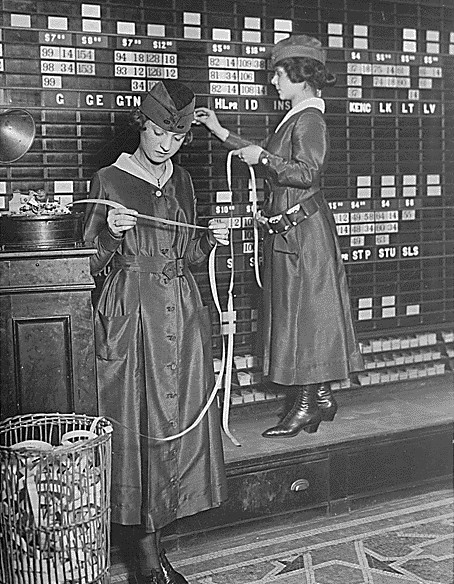
Watching the ticker tape, 1918
Women at the Waldorf-Astoria Hotel watching ticker tape, 1918

Ticker tape was the earliest electrical dedicated financial communications medium, transmitting stock price information over telegraph lines, in use from around 1870 to 1970. It consisted of a paper strip that ran through a machine called a stock ticker, which printed abbreviated company names as alphabetic symbols followed by numeric stock transaction price and volume information. The term "ticker" came from the sound made by the machine as it printed.

The ticker tape revolutionized financial markets, as it relayed information from trading floors continuously and simultaneously across geographical distances.[1] Paper ticker tape became obsolete in the 1960s, as television and computers were increasingly used to transmit financial information. The concept of the stock ticker lives on, however, in the scrolling electronic tickers seen on brokerage walls and on news and financial television channels.

Ticker tape stock price telegraphs were invented in 1867 by Edward A. Calahan, an employee of the American Telegraph Company who later founded The ADT Corporation.[2][3]

History

[edit]
Edison gold & stock ticker

Although telegraphic printing systems were invented by Royal Earl House in 1846, early models were fragile, required hand-cranked power, frequently went out of synchronization between sender and receiver, and did not become popular in widespread commercial use. David E. Hughes improved the printing telegraph design with clockwork weight power in 1856,[4] and his design was further improved and became viable for commercial use when George M. Phelps devised a resynchronization system in 1858.[5] The first stock price ticker system using a telegraphic printer was invented by Edward A. Calahan in 1863; he unveiled his device in New York City on November 15, 1867.[6][7][8] Early versions of stock tickers provided the first mechanical means of conveying stock prices ("quotes"), over a long distance via telegraph wiring. In its infancy, the ticker used the same symbols as Morse code as a medium for conveying messages. One of the earliest practical stock ticker machines, the Universal Stock Ticker developed by Thomas Edison in 1869, used alphanumeric characters with a printing speed of approximately one character per second.

Previously, stock prices had been hand-delivered via written or verbal messages. Since the useful time-span of individual quotes is very brief, they generally had not been sent long distances; aggregated summaries, typically for one day, were sent instead. The increase in speed provided by the ticker allowed for faster and more exact sales. Since the ticker ran continuously, updates to a stock's price whenever the price changed became effective much faster and trading became a more time-sensitive matter. For the first time, trades were being done in what is now thought of as near real-time.

By the 1880s, there were about a thousand stock tickers installed in the offices of New York bankers and brokers. In 1890, members of the exchange agreed to create the New York Quotation Co., buying up all other ticker companies to ensure accuracy of reporting of price and volume activity.[9]

Technology

[edit]
Hughes telegraph (1866–1914) transmitter keyboard to send text over telegraph wires to be printed as text on a paper tape. Manufactured by Siemens & Halske, Germany; range: 300–400 km
A ticker monitor, as shown in this picture on the Australian Securities Exchange trading floor, simulates ticker tape but uses a different method.

Stock ticker machines are an ancestor of the modern computer printer, being one of the first applications of transmitting text over a wire to a printing device, based on the printing telegraph. This used the technology of the then-recently invented telegraph machines, with the advantage that the output was readable text, instead of the dots and dashes of Morse code. A special typewriter designed for operation over telegraph wires was used at the opposite end of the telegraph wire connection to the ticker machine. Text typed on the typewriter was displayed on the ticker machine at the opposite end of the connection.

The machines printed a series of ticker symbols (usually shortened forms of a company's name), followed by brief information about the price of that company's stock; the thin strip of paper on which they were printed was called ticker tape. The word ticker comes from the distinct tapping (or ticking) noise the machines made while printing. Pulses on the telegraph line made a letter wheel turn step by step until the correct symbol was reached and then printed. A typical 32-symbol letter wheel had to turn on average 15 steps until the next letter could be printed resulting in a very slow printing speed of one character per second.[10] In 1883, ticker transmitter keyboards resembled the keyboard of a piano with black keys indicating letters and the white keys indicating numbers and fractions, corresponding to two rotating type wheels in the connected ticker tape printers.[11]

Newer and more efficient tickers became available in the 1930s, but these newer and better tickers still had an approximate 15- to 20-minute delay. Ticker machines became obsolete in the 1960s, replaced by computer networks; none have been manufactured for use for decades. However, working reproductions of at least one model are now being manufactured for museums and collectors.[12]

Simulated ticker displays, named after the original machines, still exist as part of the display of television news channels and on some websites—see news ticker. One of the most famous outdoor displays was the simulated ticker scrolling marquee called the "Zipper", located at One Times Square in New York City.

Ticker tapes then and now contain generally the same information. The ticker symbol is a unique set of characters used to identify the company. The shares traded is the volume for the trade being quoted. Price traded refers to the price per share of a particular trade. Change direction is a visual cue showing whether the stock is trading higher or lower than the previous trade, hence the terms downtick and uptick. Change amount refers to the difference in price from the previous day's closing. Many today include color to indicate whether a stock is trading higher than the previous day's (green), lower than previous (red), or has remained unchanged (blue or white).

Other uses

[edit]

Baseball

[edit]

In the early days of baseball, before electronic scoreboards, manual score turners used a ticker to get the latest scores from around the league. Today, computers and electronic scoreboards have replaced the manual scoreboard and the ticker.

Parades

[edit]
Ticker tape parade in New York City for presidential candidate Richard Nixon in 1960. The long streamers are entire spools of ticker tape.

Used ticker tape was often repurposed as confetti, to be thrown from the windows above parades either cut up into scraps or thrown as whole spools, primarily in lower Manhattan; this became known as a ticker tape parade.[13] Ticker tape parades generally celebrated some significant event, such as the end of World War I and World War II, or the safe return of one of the early astronauts.

Ticker tape parades are still held in New York City, specifically in the "Canyon of Heroes" in Manhattan, most often when local sports teams win a championship. However, actual ticker tape is not used any longer during these parades; often, pieces of paper from paper shredders are used as a convenient source of confetti.

Art

[edit]

Ticker tape was also incorporated into some of the weaver Dorothy Liebes' unusual art textiles.[14]

See also

[edit]

References

[edit]
[edit]
Revisions and contributorsEdit on WikipediaRead on Wikipedia
from Grokipedia
Ticker tape is a narrow strip of paper on which stock ticker machines printed abbreviated symbols for securities, along with their latest transaction prices and volumes, providing investors with timely market updates via a continuous ribbon emerging from the device. These machines, essentially specialized telegraph receivers, operated by receiving Morse code transmissions of stock quotes and using mechanical keys to imprint the data at speeds of up to 900 characters per minute in advanced models. The stock ticker was invented in 1867 by Edward A. Calahan, a telegraph operator, who developed the first prototype for the to transmit gold prices more efficiently than manual messengers. In 1871, patented an improved version that quadrupled the printing speed and used uniform-sized type, making it more reliable for widespread use in brokerage offices across the . By the late , ticker tape machines had become essential infrastructure for the growing , disseminating information from exchanges like the NYSE to remote locations via telegraph lines. Financially, ticker tape transformed trading by reducing delays in quote dissemination from hours to minutes, enabling faster and contributing to the market's expansion during the industrial era; however, mechanical limitations caused lags of 15 to 20 minutes during high-volume periods, as seen in the 1929 stock market crash when tapes ran hours behind. The technology evolved in the with electronic versions that eliminated paper, and by 1996, real-time digital tickers were introduced, rendering physical tape obsolete but preserving the term for modern scrolling displays on financial news networks. Beyond finance, ticker tape gained cultural prominence through ticker-tape parades in , a tradition that began on October 29, 1886, when excess tape from Wall Street offices was thrown from windows during the dedication ceremony for the , creating a celebratory "snowstorm" effect along Broadway. The first parade honoring an individual occurred in 1899 for Admiral after his victory in the Spanish-American War, and the practice continued for over 200 events, including returns of astronauts, war heroes like General Douglas MacArthur in 1951, and sports champions, typically routed through the "Canyon of Heroes" in and marked by embedded bronze plaques. Though genuine ticker tape is no longer used, modern parades employ and shredded paper to evoke the historic spectacle.

History

Invention and Early Adoption

The stock ticker, a pioneering telegraph-based printing device, was invented in 1867 by Edward A. Calahan, an employee of the American Telegraph Company, specifically to transmit stock transaction data for the . Calahan's device marked the first commercial application of real-time stock quoting via telegraph lines, replacing the inefficient system of messenger boys who manually delivered price updates from the exchange floor to brokerage offices. The machine operated by printing abbreviated stock symbols, prices, and transaction volumes onto a narrow, continuous strip of paper tape, which advanced through the printer as arrived over dedicated telegraph wires. This paper tape, typically 3/4 inch wide, allowed for compact, sequential recording of market activity, enabling brokers to monitor trades instantaneously without relying on verbal announcements or handwritten notes. Early ticker machines faced significant limitations, including a transmission speed of approximately one character per second, which constrained the volume of data that could be disseminated during peak trading hours. Additionally, operation required skilled telegraphers to manually key in information from the exchange, introducing potential delays and in the process. The first commercial deployment occurred on November 15, 1867, in , with rapid expansion to other major U.S. exchanges by 1870, fundamentally automating data dissemination and accelerating the pace of financial trading nationwide. By 1880, over 1,000 such machines were installed in firms, underscoring their swift integration into the burgeoning financial infrastructure. Later refinements, including contributions from in 1869, built upon this foundation to enhance reliability.

Expansion and Technological Improvements

Following Thomas Edison's development of the Universal Stock Ticker in 1869, which printed alphanumeric characters at approximately one character per second—a substantial increase over prior manual methods—the system saw rapid enhancements in transmission efficiency. Edison's subsequent invention of the quadruplex telegraph in 1874 quadrupled the capacity of single telegraph wires to carry four simultaneous messages, facilitating bidirectional communication and enabling faster, more reliable delivery of stock quotations to multiple recipients across distances. These innovations laid the groundwork for broader , allowing ticker systems to handle growing financial data volumes without proportional increases in infrastructure. By the 1890s, ticker tape technology had expanded internationally, with adoption in London's through the Exchange Telegraph Company, which centralized control over price dissemination and integrated it into European markets. In the United States, usage surged alongside rising trading activity; during the 1920s, daily share volumes on the routinely exceeded 3 million, pushing the system to produce thousands of miles of paper tape annually to relay quotations nationwide. , as the primary operator, managed this expansion by upgrading lines and equipment to accommodate peak loads, culminating in a high-speed ticker system introduced in that printed at rates sufficient to report up to 8 million shares per day without significant delays under normal conditions. The system's peak efficiency was tested during the 1929 Wall Street Crash, particularly on Black Tuesday, October 29, when over 16 million shares traded and the ticker lagged by 152 minutes, yet still generated approximately 15,000 miles of tape for that day's transactions alone—demonstrating its capacity even amid overload. This event underscored both the ticker's role in global finance, where it synchronized markets from New York to , and the need for further , such as electric motor-driven printers introduced in the early to enable continuous operation without manual restarts.

Decline and Transition to Digital

The emergence of teletypewriters and early computers during the 1950s and 1960s markedly diminished the reliance on mechanical paper ticker tape for data transmission. Teletypewriter systems, such as the 5-A model produced by , integrated perforated paper tape for input but increasingly favored direct printing or electronic output, bypassing the continuous stream of waste paper from traditional tickers. These advancements allowed for faster, more efficient handling of growing trading volumes without the mechanical limitations of earlier devices. By 1960, the final model of a purely mechanical stock ticker was introduced, capable of 900 characters per minute, yet it represented the twilight of the technology as electronic alternatives proliferated. Mechanical tickers were fully phased out by the early , supplanted by digital systems that rendered physical tape obsolete. A pivotal shift occurred in 1971 with the launch of the National Association of Securities Dealers Automated Quotations () system, the world's first electronic stock market, which delivered real-time quotes via cathode ray tube (CRT) terminals to brokers, eliminating paper tape entirely. This screen-based platform provided instantaneous bid and ask prices over computer networks, transforming over-the-counter trading from manual to automated processes. The transition accelerated in the mid-1990s, when widespread real-time computer feeds enabled online access to for investors, completing the move away from through integrated electronic networks. Economic pressures hastened the decline, as the ongoing costs of paper supplies—estimated at 30 miles per machine annually during peak usage—and mechanical maintenance became unsustainable amid rising trading activity. With thousands of machines in operation by , this generated hundreds of thousands of miles of discarded tape each year, exacerbating environmental waste and operational inefficiencies. In the , brokerage firms transitioned to CRT displays for direct data visualization, slashing expenses and enabling quicker decision-making without handling physical output. ceased its mechanical ticker services in the early , aligning with industry-wide adoption of electronic alternatives; by the 1970s, television broadcasts and digital networks had assumed all responsibilities for market data distribution. The legacy of this waste, peaking alongside unprecedented trading volumes in the late , underscored broader concerns over efficiency and sustainability that propelled the digital era.

Technology

Mechanical Components and Operation

The core mechanical components of traditional ticker tape machines included an electromechanical printer equipped with a rotating typewheel—a disk with raised alphabetic and numeric characters around its circumference— actuators for character selection and positioning, and a feed mechanism that employed an to imprint characters onto the tape. In operation, the machine received telegraph signals from a central transmitter, which were decoded to rotate the typewheel to the desired character while simultaneously advancing the paper tape at a constant speed. A then activated to press the inked ribbon and tape against the raised character on the typewheel, producing a printed impression; this sequence repeated rapidly to form messages such as abbreviated stock symbols followed by prices, for example "NYC 100" denoting stock trading at $100 per share. Edison's "" mechanism synchronized distant printers by resetting typewheels remotely via electrical signals, preventing misalignment. The tape was a narrow strip, typically 1/2 inch wide and made of thin, oiled to facilitate smooth feeding and adhesion, unspooled from reels that held up to 1,000 feet for prolonged use without interruption. Early models operated at around 40-60 characters per minute, while advanced versions from the late achieved speeds of up to 200 characters per minute, balancing reliability with the need for real-time market updates. challenges were common, with frequent jams arising from buildup on the typewheel or tears in the fragile tape, necessitating daily oiling of gears and bearings as well as periodic of the mechanism with incoming telegraph signals to avoid errors. Machines typically employed synchronous to drive the typewheel and paper feed, ensuring precise timing and preventing cumulative drift that could occur with asynchronous and lead to misaligned . Edison's improvements in the , including refined typewheel shifting and paper feed designs, significantly boosted operational speeds beyond prior limitations.

Data Encoding and Transmission Methods

Data on ticker tape machines was encoded using standardized abbreviations for stock symbols, typically consisting of one to three letters representing company names, followed by numeric representations of prices and abbreviated volumes to minimize transmission length. These encodings derived from principles but were adapted for printing telegraphs, where specialized keyboards at stock exchanges converted the data into electrical impulses representing dots and dashes, enabling readable alphanumeric output rather than raw code at the receiver. Transmission occurred over dedicated telegraph networks, primarily single-wire lines connecting major exchanges like the to printers in brokerage offices across the country. Operators at the exchange entered data via these keyboards, which generated signals sent as electrical pulses along the wires; receiving printers interpreted the signals synchronously to imprint the information on paper tape. To address bandwidth constraints inherent in early telegraph systems, innovations like Thomas Edison's quadruplex telegraph, introduced in 1874, enabled four simultaneous message channels—two in each direction—on a single wire, significantly increasing overall telegraph capacity. Early 20th-century ticker systems were limited to approximately 285 characters per minute, allowing for roughly 20-30 stock updates depending on the length of each entry (typically 10-15 characters including symbol, price, and volume); later models in reached 500 characters per minute, though high trading volumes could still cause delays of 15-20 minutes during peak periods. Error detection in these systems relied on manual verification and retransmission requests rather than automated digital methods, as operators at receiving ends could signal for repeats if garbled prints were observed, a process facilitated by the synchronous nature of later printing telegraphs. While ticker transmissions carried public quotes, related private and trading telegrams in the widely employed codebooks that substituted words and phrases with numeric or abbreviated codes to ensure and obscure sensitive financial details from . Conceptually, the overall data rate for ticker transmission could be approximated as the product of the line's pulse frequency (in signals per second) and an efficiency factor accounting for code density, divided by the average length of encoded messages in pulses; this highlighted the system's reliance on concise encoding to maximize throughput within telegraph limitations, though exact derivations varied by equipment.

Financial Uses

Traditional Stock Reporting

Ticker tape served as the primary medium for disseminating data in the pre-digital era, delivering near-real-time transaction updates to brokers and traders via telegraph-connected printers. This system enabled quicker decision-making on the trading floor and in remote offices, as prices and volumes were relayed almost instantaneously from exchanges like the (NYSE). By 1900, ticker tape had become indispensable for floor traders monitoring live auctions and for off-site brokerage firms coordinating buys and sells, fundamentally accelerating the pace of financial transactions across the . The content on the ticker tape appeared in a compact, sequential format optimized for speed, featuring abbreviated stock symbols followed by last sale prices, bid/ask spreads, and occasional dividend announcements. For instance, an entry like "GM 50s" indicated shares closing at $50 per share, while spreads might show bids and offers in such as "AT 48-48½" for between $48 and $48.50. This concise printing allowed continuous flow without interruption, printing up to 200 characters per minute on standard machines, ensuring brokers could scan updates rapidly amid high-volume trading days. By broadening access to timely market information beyond exchange insiders, ticker tape significantly democratized financial markets, leveling the playing field for retail investors and smaller firms during periods of economic expansion. In the bull market, "tape reading" developed as a specialized skill among speculators, who analyzed the rhythm of prices and volumes on the tape to gauge supply-demand imbalances and momentum shifts, as exemplified by traders like . This practice turned the humble paper strip into a tool for predictive analysis, fostering a culture of active, informed that drove market participation to new heights. A stark illustration of the ticker's centrality occurred during the 1929 Crash, when overwhelming trade volumes caused severe backlogs; on Black Tuesday, , the tape lagged 152 minutes behind actual transactions, obscuring closing prices and amplifying uncertainty that fueled widespread panic selling. In trading environments, ticker tapes were routinely integrated with blackboards in pits and brokerage rooms, where clerks known as "board boys" transcribed key updates from the tape onto large chalkboards for at-a-glance visualization by crowds of traders, enhancing situational awareness in the chaotic open-outcry system.

Modern Electronic Displays and Systems

The transition from mechanical ticker tapes to electronic displays accelerated in the 1970s with the adoption of cathode ray tube (CRT) terminals on trading floors, enabling brokers to view real-time stock quotes and trade executions on screens rather than unspooling paper. These systems marked the initial shift toward digital dissemination, reducing reliance on while improving speed and accessibility for market participants. By the , (LED) scrolling displays had become standard on trading floors and in prominent public venues, offering continuous, high-visibility streams of . A notable example is the in , launched in the late 1990s, which featured a massive LED ticker displaying symbols, prices, and logos to attract both professionals and the public. These innovations addressed the limitations of earlier CRTs by providing brighter, more dynamic visualizations in high-traffic environments like brokerage offices and urban centers. Contemporary electronic systems have evolved into sophisticated software platforms and protocols that deliver comprehensive, low-latency data feeds. Bloomberg terminals, for instance, integrate real-time market data streams via the B-PIPE service, consolidating information from global exchanges for analysis and decision-making. Similarly, LSEG Workspace, the successor to (withdrawn on June 30, 2025), provides real-time pricing, news, and analytics through a unified interface accessible on desktops and mobile devices. NASDAQ's protocol exemplifies high-frequency capabilities, disseminating full-depth data at rates of millions of messages per second to support ultra-low-latency trading. Key features of these modern displays and systems include color-coded interfaces for rapid interpretation, such as green for rising prices and red for declines, alongside customizable alerts for volatility or volume thresholds. Integration with platforms allows automated execution based on real-time feeds, enabling high-frequency strategies that process data streams instantaneously. For public-facing applications, LED tickers in locations like continue to broadcast major indices, such as the and , in scrolling format to reflect live market movements. Electronic systems surpass traditional paper tickers in scalability, generating unlimited data outputs without material waste or logistical constraints, while internet connectivity ensures global access for remote users. By 2025, over 90% of stock trades are executed through these digital feeds, eliminating physical outputs entirely and streamlining market operations. Regulatory frameworks enforced by the U.S. Securities and Exchange Commission (SEC) further underpin these systems, requiring trade reports within seconds via consolidated tapes like the Securities Information Processor (SIP), a stark evolution from the minutes-long delays of historical ticker tapes. This mandates real-time dissemination to promote transparency and prevent informational asymmetries, with ongoing updates shortening reporting windows for even greater efficiency.

Cultural and Symbolic Uses

Ticker Tape Parades

The tradition of ticker tape parades originated on October 28, 1886, during the dedication ceremonies for the in , when Wall Street office workers spontaneously hurled excess ticker tape—narrow strips of paper from stock quotation machines—out of windows along the parade route, producing a makeshift "confetti rain" effect. This impromptu act transformed the waste product of financial reporting into a symbol of collective exuberance, marking the first instance of what would become a signature New York celebratory ritual. Over the decades, the practice evolved into a formalized honor for national and local heroes, becoming a staple of public acclaim by the early 20th century. Notable examples include the 1919 parade for General following , which drew massive crowds to Broadway, and multiple events in the celebrating space achievements, such as John Glenn's 1962 orbital flight and the Apollo 11 astronauts' 1969 moon landing, where an estimated four million spectators lined the streets. The mid-20th century represented the peak of the tradition, with 129 parades held between 1945 and 1965 alone, often involving millions of pounds of shredded office paper tossed from skyscrapers; for instance, the 1945 V-J Day celebration generated over 5,000 tons (10 million pounds) of debris. These events typically proceed along a fixed route down Broadway from the Battery to City Hall in Lower Manhattan, an area dubbed the "Canyon of Heroes" and lined with over 200 granite plaques commemorating each parade since 1886. In contemporary iterations, actual ticker tape has been replaced by biodegradable confetti to mitigate environmental impact and ease cleanup, though the logistics remain labor-intensive; the 2015 ticker tape parade for the U.S. Women's World Cup champions, for example, incurred approximately $2 million in city costs, including extensive sanitation efforts involving hundreds of workers. To date, 209 official parades have occurred, with the most recent on October 24, 2024, honoring the New York Liberty for their WNBA championship victory. Culturally, ticker tape parades embody the fusion of New York's financial heritage with broader American ideals of triumph and unity, serving as a visceral public affirmation of achievement in the shadow of Wall Street's towering institutions.

Representations in Sports, Media, and Art

In the realm of sports, ticker tape initially served a practical role in disseminating real-time game information during the early 20th century. By 1900, leased ticker machines to hotels and saloons, enabling patrons to receive scores and results transmitted via telegraph from distant locations. This system extended into the , when telegraph broadcasts used tickers to relay play-by-play updates, fostering widespread fan engagement beyond stadiums. In contemporary sports culture, the ticker tape motif endures symbolically through victory parades for (MLB) and (NFL) teams. For instance, the New York Yankees celebrated their win with a confetti-filled procession along Broadway's Canyon of Heroes, evoking the chaotic exuberance of historical ticker tape showers. Similarly, the New York Giants marked their 2012 Super Bowl victory with a parade featuring shredded paper cascades, reinterpreting the tradition as a marker of triumph and communal celebration. More recent examples include the 2019 parade for the U.S. Women's National Soccer Team after their win and the 2024 parade for the New York Liberty's WNBA championship, highlighting the tradition's role in celebrating achievements. Ticker tape has been a recurring visual and thematic element in media, often embodying the frenzy of financial markets and urgent information flow. In the 1983 film Trading Places, chaotic trading floor scenes with brokers shouting amid swirling papers and price updates symbolize the manipulative volatility of commodities markets, highlighting themes of greed and economic disruption. These depictions draw on the historical image of ticker machines spewing endless streams of data, amplifying the narrative's critique of Wall Street excess. In television, the ticker tape evolved into the digital news ticker, or chyron, introduced in the 1970s as an electronic graphics platform for overlaying headlines and updates on broadcasts. Pioneered by Systems Resource Corporation, this innovation allowed networks like CNN—launched in 1980—to display scrolling text for breaking news, transforming the ephemeral paper tape into a persistent on-screen feature that conveys immediacy and overload in 24-hour news cycles. In art, the ticker tape motif has inspired works exploring commerce, repetition, and transience. , in the 1960s, incorporated themes into his practice, viewing art itself as a akin to trading; he even proposed selling shares of his company on the exchange, blurring lines between cultural production and financial speculation. His silkscreen prints, with their mechanical repetition, echoed the relentless output of ticker machines, critiquing through commodified imagery. Conceptual artists in subsequent decades used shredded paper—evoking discarded ticker tape—to address ephemerality and waste. For example, installations like those by in the featured thousands of fluorescent shredded paper pieces forming waves and rains, symbolizing the fleeting nature of information and material excess in modern society. The 1927 ticker tape parade honoring Charles Lindbergh's transatlantic flight became a cultural touchstone, influencing literary depictions of progress and heroism in the Jazz Age. F. Scott Fitzgerald referenced the era's aviator icons, including Lindbergh, in essays like "Echoes of the Jazz Age," portraying such feats as emblematic of American ambition and fleeting glory amid economic exuberance. In the 2020s, digital artists have revived the motif through non-fungible tokens (NFTs), such as the "Ticker Art" collection on , which generates algorithmic visuals mimicking scrolling stock symbols to satirize blockchain-based and virtual ephemera. Broadly, ticker tape symbolizes chaos, progress, and obsolescence in postmodern culture, representing the dizzying pace of and capitalist flux. In artistic interpretations, it evokes the disorder of shredded data streams, as seen in animations and installations where ticker machines underscore themes of historical rupture and cultural . This duality—celebratory yet disposable—mirrors postmodern critiques of progress as illusory, with the once-vital tape now a relic of analog urgency in a digital age.

References

Add your contribution
Related Hubs
User Avatar
No comments yet.