


Community hub
Recent from talks
Contribute something
Nothing was collected or created yet.
Virginia State Police
View on Wikipedia | This article has multiple issues. Please help improve it or discuss these issues on the talk page. (Learn how and when to remove these messages)
|


| Virginia Department of State Police | |
|---|---|
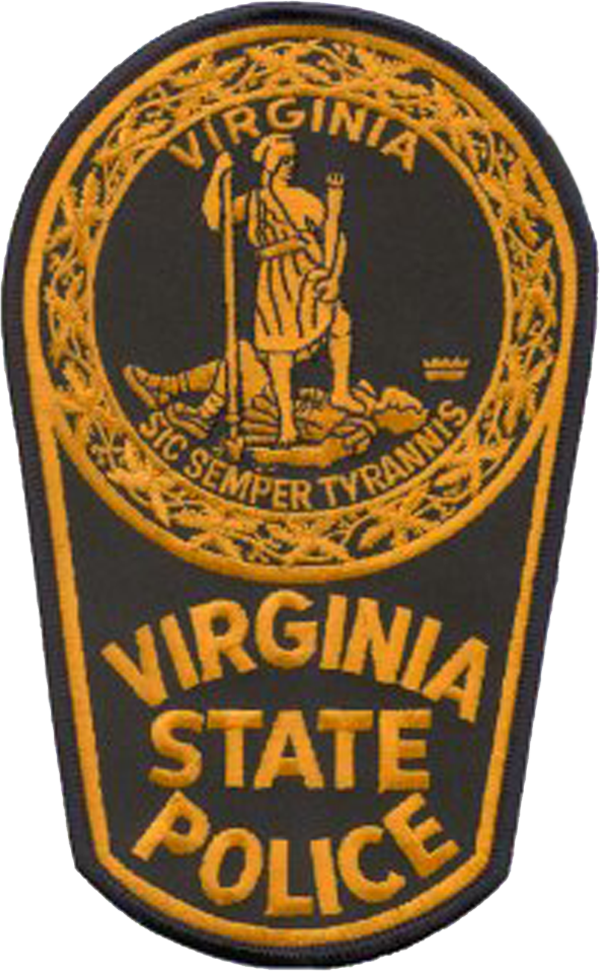
 Patch of Virginia State Police | |
 Badge of a Trooper | |
 Flag of the Commonwealth of Virginia | |
| Common name | Virginia State Police |
| Abbreviation | VSP |
| Agency overview | |
| Formed | 1932 |
| Preceding agency |
|
| Employees | 2,966 (as of September 24, 2018)[1] |
| Jurisdictional structure | |
| Operations jurisdiction | U.S. |
 | |
| Virginia State Police Divisions Map | |
| Size | 42,774 square miles (110,780 km2) |
| Population | 8,470,020 (July 1, 2017 estimate[2]) |
| Legal jurisdiction | State of Virginia |
| General nature | |
| Operational structure | |
| Headquarters | North Chesterfield, Virginia |
| Troopers & Special Agents | 2,118 (as of 2018)[3] |
| Civilian employees | 848 civilian employees (as of 2018)[3] |
| Agency executives |
|
| Parent agency | Virginia Secretary of Public Safety |
| Divisions | 7 |
| Facilities | |
| Airplanes | 4 |
| Helicopters | 7 |
| Website | |
| www.vsp.virginia.gov | |
The Virginia State Police, officially the Virginia Department of State Police, conceived in 1919 and established in 1932, is the state police force for the U.S. state of Virginia. The agency originated out of the Virginia Department of Motor Vehicles as an inspector and enforcer of highway laws. It is currently one of fourteen agencies within the Cabinet Secretariat of Public Safety. On January 18, 2018, Gary T. Settle was sworn in as Superintendent of the Virginia State Police. Colonel Settle replaced retiring Colonel W. Steven Flaherty, who had served since 2003. On November 5, 2024 Lieutenant Colonel Matt Hanley was appointed Interim Superintendent by Governor Glenn Youngkin, after Colonel Settle announced his retirement, effective February 1, 2025.[4][5]
History
[edit]In 1919, the Virginia State Police was conceived with the passing of the Automobile acts which stated that the Commissioner of Motor Vehicles and his assistants were vested with the powers of a Sheriff for the purpose of enforcing the provisions of the law. The Secretary of the Commonwealth continued to be responsible for this regulation. The burden of enforcement remained with Sheriffs and Constables in counties and police officers in the cities and towns.
In 1919, the Motor Vehicle Act was passed, creating the first title laws for Virginia motor vehicle owners.
In 1932, inspectors became empowered to enforce criminal codes, as well as motor vehicle codes. In doing so legislators created a state enforcement group with the power to arrest anywhere in Virginia. A mobile enforcement agency was now ready for duty wherever civil strife or emergency conditions might exist that would warrant police personnel to ensure peace and security. It was at this time that inspectors began to be known as "Troopers."
On November 3, 1938, an executive order from Majors Bishop and Nicholas officially adopted the title of "State Trooper." The purpose of this was to identify specific members of the Division of Motor Vehicles performing the role of inspector and motorcycle deputy.
On March 14, 1942, the General Assembly abolished the existing Division of Motor Vehicles and created two separate agencies: The Division of Motor Vehicles and the Department of State Police. The act called for a position of superintendent for the State Police and a commissioner for the Division of Motor Vehicles. Major C. W. Woodson Jr. was officially appointed as superintendent for the State Police.
Trooper Training
[edit]Training for Troopers is divided into two phases. Academy Training consists of approximately 29 weeks with 1,536 hours of instruction covering more than 100 courses.
The second phase is six to eight weeks of field training.
Organizational structure
[edit]The Department of State Police consists of the Superintendent's Office and four bureaus; Administrative and Support Services, Criminal Investigations, Field Operations and Strategic Governance.[6]
The Superintendent's Office oversees;
- Public Relations Office
- Executive Protection Division
The four bureaus are:
- Department of State Police (commanded by the Colonel)
- Bureaus (commanded by a Lieutenant Colonel)
- Divisions (commanded by a Captain)
- Areas (commanded by a First Sergeant)
Bureau of Field Operations (BFO)
[edit]- Aviation Division - Composed of three aviation bases:
- Abingdon
- Lynchburg
- Richmond
- Safety Division
- Virginia Motor Vehicle Safety Inspection Program (MVIP)
- Motor Carrier Safety Unit (MCSU)
- Special Operations Division - Established on August 1, 2022, oversees and coordinates specialized resources.
- Tactical Teams
- Search and Recovery Teams (SRT)
- Operational Medical Support (OMS).
- Field Offices (Divisions numbered 1 through 7)
- Richmond
- Culpeper
- Appomattox
- Wytheville
- Chesapeake
- Salem
- Fairfax
BFO Divisions are further organized into "Area offices", numbered 1 through 49.
Bureau of Criminal Investigation (BCI)
[edit]- Homeland Security Division (formerly Criminal Intelligence Division), Composed of three sections:
- Virginia Fusion Center (VFC)
- Field Intelligence Unit
- Joint Terrorism Task Force
- High Tech Crimes Division, Composed of four sections:
- High Tech Crimes Section (HTCS)
- Northern Virginia / District of Columbia Internet Crimes Against Children (NOVA/DC ICAC) Task Force
- Technical Support Section (TSS)
- Computer Evidence Recovery Section (CERS)
- Special Investigations & Programs Division, Composed of:
- Counter-Terrorism / Criminal Interdiction (CCI)
- Asset Forfeiture
- Illegal Marijuana Eradication
- Multi-Jurisdictional Task Forces
- Polygraph Quality Control
- Help Eliminate Auto Theft (HEAT) Program
- Insurance Fraud Program
- Drug Diversion
- Field Offices (Divisions numbered 1 through 7)
- Richmond
- Culpeper
- Appomattox
- Wytheville
- Chesapeake
- Salem
- Fairfax
Bureau of Administrative and Support Services (BASS)
[edit]- Communications Division
- Criminal Justice Information Services
- Human Resources Division
- Information Technology Division
- Property and Finance Division
- Training Division
Bureau of Strategic Governance (BSG)
[edit]- Chief Diversity Officer
- Professional Standards Division
- Records Request (FOIA)
Uniform and equipment
[edit]Uniform
[edit].jpg)
The standard Trooper uniform consists of a light gray colored button-up shirt, with long sleeves in winter and short sleeves in summer. A black tie is worn with the long-sleeve shirt. Patches are sewn to each sleeve. Gray pants with a Dark Blue stripe down the sides are worn year round. Black Clarino shoes and Sam Browne belt, without cross strap, gun belt are worn with the uniform.
A black semi-gloss straw Campaign hat is worn year round. A modified winter fur cap can be worn in the colder months.
A dark blue dress blouse and standard black Clarino Sam Browne gun belt, without the cross strap, are worn for special occasions. Dark blue work jackets are utilized for colder months. Black Commando Sweaters, or "wooly pullys" with proper patches and rank can also be worn by Troopers in cold weather.
Sergeants and First Sergeants wear silver, out lined in blue, chevrons showing their rank on both sleeves. Lieutenants and above wear their rank insignia on the shirt collar.
First Sergeants and below wear silver, out lined in blue, hash marks on the left sleeve denoting years of service. Each hash mark represents five years of service.
Issued Weapons
[edit]Beginning in late 2018, Troopers of all ranks and Special Agents are issued the SIG Sauer P320 .357 SIG pistol, while Troopers ranked First Sergeant and below are also issued the Benelli Supernova 12-gauge, pump-action shotgun and the Colt M4 Carbine patrol rifle. Less-than-lethal weapons carried by troopers include OC spray and the ASP baton.
Previous Issued Weapons
[edit].jpg)
- Remington Model 870 12-gauge Police Magnum shotgun, issued till 2019
- SIG Sauer P229 R .357 SIG DAK pistol, issued from 2004 to 2018
- SIG Sauer P229 DA/SA .357 SIG, issued from 1997 to 2004
- SIG Sauer P228 DA/SA 9mm, issued from 1993 to 1997
- Smith & Wesson Model 1026 10mm DA/SA 5-inch barrel stainless semi-auto pistol, issued from 1990 to 1993
- Smith & Wesson Model 64 .38 caliber 4-inch barrel stainless steel revolver, issued in the mid 1970s to 1990
- Colt Officer's Model .38 caliber 4-inch barrel revolver was used from 1967 until the mid-1970s.
- Colt Official Police .38 caliber 6-inch barrel revolver was used up until 1967
- Thompson submachine gun .45 caliber used from the 1930s until 1974
Issued Vehicles
[edit]The department has used many different makes and models since its inception.
Patrol Cars
[edit]Prior to 1928, inspectors only used automobiles once they had seized a vehicle used to transport illegal whiskey and it had been released to the Division for enforcement purposes by the courts. Fords became the first issued patrol vehicles in 1928. In 1932, white Chevrolet roadsters and white motorcycles were purchased and became known as the "Great White Fleet". Fords and Chevys were the main staple of the patrol force in the 1930s and early 1940s. In 1945 post-war acquisitions of police vehicles were rare and troopers made arrangements to purchase vehicles wherever they could. Buicks and Pontiacs supplemented the fleet until auto manufacturers resumed normal production.
In 1948, the Department adopted the distinctive blue and gray paint scheme for all vehicles. Later in 1952, reflective markings were adopted and used for all marked vehicles. Those same markings are still in use today.
During the 1940s, 50's, 60's, 70's, and 80's the Department purchased Fords, Chevy's, Chryslers, and Plymouths for use as patrol cars. Ford's and Chevy's were used mainly used in the 90's and 2000's. Dodge Chargers were introduced into the fleet in 2006.
Red emergency lights were in use until 1985 and then were replaced with blue emergency lights. Bar lights were phased onto vehicles in 1988 replacing the single "bubble gum" light. "TROOPER" decals were added to the front fenders of patrol cars in 1995. In 1999, the Department adopted Ford's silver, replacing the traditional paint scheme's gray. Only the hood, roof and trunk were painted blue. This was due to budget constraints and that Ford stopped using that particular gray paint. "Slicktop" Chevrolet Impalas were put into use beginning in 2001. Seven "slicktop" 2002 Chevrolet 9C1 Camaros were put into service in high traffic areas in 2002.
In 2006, the Department purchased 30+ Hemi V8 Dodge Chargers and for the first time since 1948 adopted new graphics for the marked and slicktop Chargers.
In 2008, the Virginia State Police's Dodge Charger was Law and Order Magazine's Police Vehicle Design Winner for State and Federal Agencies.
In 2013, the Ford Police Interceptor Sedan was added to the fleet of Virginia State Police vehicles since the Ford Crown Victoria model ceased production. In 2019, the Virginia State Police bought every available new Police Interceptor sedan, giving the state a steady supply of new Interceptor sedans for up to 5 years beyond the model's discontinuation depending on vehicle attrition due to accidents or other damage.
In 2019, the department added Ford Police Interceptor Utility SUV for specialty units (K-9, TacTeam and Motor Carrier units).
Starting in 2020, the department took delivery of their new patrol vehicles, the 2020 Ford Police Interceptor Utility. Dressed in all silver and adopting newer styled graphics, first used on the 2006 Dodge Chargers. Ending a long tradition of their blue and gray paint scheme, in use since 1948 and traditional graphics, in use since 1952. These new patrol vehicles ended another long tradition; the adoption of red emergency lights in combination with blue and the use of internal light bars instead of roof mounted lights.[7]
As of 2021, the Virginia State Police fleet consists primarily of 2013–2019 Ford Police Interceptor Sedans and 2020 and 2021 Ford Police Interceptor Utilities. These vehicles are supplemented by 2013–2022 Chevrolet Tahoe PPVs primarily used for specialty units and 2020 Ford F-350 Super Duty XLs as utility vehicles; as well as the remaining Ford Crown Victoria Police Interceptors and unmarked Chevrolet Impala PPVs.

Aviation Division
[edit]- 5 Bell 407 Helicopters
- 1 Bell 412EPI Helicopter
- 2 Airbus EC-145 Helicopters
- 3 Cessna 206 Turbo Stationair Airplanes
Rank structure
[edit]Bureau of Field Operations (BFO)[8]
| Rank | Insignia | Description |
|---|---|---|
| Superintendent/Colonel[8] |  |
Superintendent of State Police |
| Deputy Superintendent/Lieutenant Colonel[8] |  |
Deputy Superintendent (1) / Bureau Director (1 per bureau) / Office of Performance Management and Internal Controls (1) |
| Major[8] |  |
Bureau Deputy Director (2 per bureau) |
| Captain[8] |  |
Division Commander |
| Lieutenant[8] |  |
Field / Headquarters Lieutenant / Staff Assistant |
| First Sergeant[8] |  |
Area Commander |
| Sergeant[8] |  |
First-line supervisor |
| Master Trooper[8] |  |
Career Progression, based on length of service, 25+ years[8] |
| Senior Trooper[8] | |
Career Progression, based on length of service, 9+ years[8] |
| Trooper-Pilot[8] | |
Trooper's assigned to the Aviation Unit[8] |
| Trooper II[8] | |
Career Progression, automatic after 1 year probationary period[8] |
| Trooper I[8] | |
Probationary Trooper, first year in the field[8] |
| Trainee[8] | |
Status while attending the state police academy[8] |
Bureau of Criminal Investigation (BCI)[8]
- Lieutenant Colonel (Bureau Director)[8]
- Major (Bureau Deputy Director)[8]
- Captain (Division Commander)[8]
- Lieutenant (Special Agent in Charge / Section Commander / Staff Assistant)[8]
- First Sergeant (Assistant Special Agent in Charge / Unit Commander / First-line supervisor)[8]
- Senior Special Agent, career progression[8]
- Special Agent[8]
See also
[edit]
References
[edit]- ^ NR-1, Department of State Police (January 18, 2018). NEW YEAR WELCOMES NEW LEADERSHIP WITHIN VIRGINIA STATE POLICE (Report). Richmond, VA: Commonwealth of Virginia. p. 1. Retrieved January 18, 2018.
{{cite report}}: CS1 maint: numeric names: authors list (link) - ^ "U.S. Census Bureau QuickFacts: Virginia". U.S. Census Bureau. Retrieved January 2, 2020.
- ^ a b "NR-1 NEW YEAR WELCOMES NEW LEADERSHIP WITHIN VIRGINIA STATE POLICE .pdf". Google Docs. Retrieved January 2, 2020.
- ^ "Superintendent's Office - Virginia State Police". Archived from the original on December 17, 2021. Retrieved August 2, 2025.
- ^ "October- Colonel Gary T. Settle to Retire After Nearly Four Decades of Service to the Commonwealth | Governor.Virginia.gov". www.governor.virginia.gov. Retrieved August 2, 2025.
- ^ "Virginia State Police - Section, Units, Bureaus". www.vsp.virginia.gov. Retrieved January 2, 2020.
- ^ "Virginia State Police - Newly issued vehicles". twitter.com. Retrieved June 26, 2022.
- ^ a b c d e f g h i j k l m n o p q r s t u v w x y z aa ab Virginia Department of State Police (2009). "Trooper Recruitment : Rank Structure". Richmond, VA: Commonwealth of Virginia. Retrieved August 16, 2017.
External links
[edit]
| International | |
|---|---|
| National | |

Virginia State Police
View on GrokipediaOrigins and Historical Development
Establishment and Early Formation
The Virginia State Police traces its origins to efforts to regulate the burgeoning automobile industry in the early 20th century. In 1919, the Virginia General Assembly passed the Automobile Acts, mandating vehicle registration and licensing amid rising motor vehicle usage, which necessitated enforcement mechanisms. By 1922, recognizing enforcement needs, the Assembly authorized the hiring of eight inspectors tasked specifically with upholding these laws, each compensated between $1,500 and $1,800 annually.[3] These initial personnel operated under the Division of Motor Vehicles, focusing on compliance with licensing and safety standards rather than general law enforcement.[7] In 1923, these inspectors were formally integrated into the newly established Virginia Department of Motor Vehicles (DMV), expanding their administrative oversight of highway-related regulations. By 1928, the Division was authorized to hire 20 additional inspectors to meet growing demands, drawing from hundreds of applications and marking an early expansion in personnel. T.K. Sexton was appointed as the first Superintendent of the DMV Enforcement Division in 1930, providing centralized leadership to the group. That same year, the inspectors adopted a distinctive blue and gray uniform, which remains in use today, symbolizing continuity in the agency's identity.[3][8] A pivotal shift occurred on July 1, 1932, when the General Assembly amended legislation to empower these DMV inspectors with authority to enforce broader criminal codes beyond motor vehicle laws, renaming them "state troopers" and laying the foundation for a statewide police force. This expansion was accompanied by the agency's first formalized training: a five-week academy held at a National Guard camp in Princess Anne County, emphasizing skills in arrest procedures and general policing. Early operations tested these new powers, as in 1933 when troopers were deployed to maintain order during violent coal strikes in Wise, Lee, and Russell counties involving approximately 10,000 miners, demonstrating the agency's emerging role in public safety beyond highways.[3] Formal institutionalization followed in 1939, with the creation of the Virginia State Police Superintendent position, filled by Major H.B. Nicholas, and relocation of headquarters to a Route 60 farmhouse, solidifying the transition from inspectors to a dedicated state police entity.[3]Expansion Through the 20th Century
The origins of the Virginia State Police trace to 1922, when the Virginia Department of Motor Vehicles established a force of eight inspectors tasked with enforcing automobile registration and licensing laws enacted in 1919.[3] These early officers operated primarily as a highway patrol, focusing on vehicle safety and compliance amid the rapid growth of automobile use in the state.[3] In 1932, the Virginia General Assembly expanded the inspectors' authority to include enforcement of the state's criminal code, redesignating them as "Troopers" and inaugurating the first five-week training academy to professionalize operations.[3] This legislative change marked a pivotal shift from limited traffic duties to broader law enforcement responsibilities. By 1939, the agency formalized as the Virginia State Police, with Major H.B. Nicholas appointed as the first Superintendent and headquarters relocated to a 65-acre facility along Route 60 in North Chesterfield.[3] World War II catalyzed significant expansion, as House Bill 292 in 1942 established the Virginia State Police as an independent agency with an initial complement of 220 troopers, 16 dispatchers, and 29 license examiners.[3] To address wartime demands, the Women's Auxiliary State Police was formed that year, comprising 26 women who supported administrative and auxiliary roles.[3] A dedicated bureau for investigating major crimes and stolen vehicles was created in 1938, laying groundwork for specialized criminal probes.[3] Postwar developments in the 1950s emphasized operational modernization, including the issuance of the first radar units for speed enforcement in 1952, reduction of shifts to eight hours that same year, and a five-day workweek by 1959; motorcycles were temporarily phased out in 1954 before reinstatement in 1966.[3] The 1960s saw territorial growth with the addition of a sixth division in Salem in 1961 and the launch of a canine program, enhancing capabilities in search and apprehension; the first African American trooper, Reginald L. Boyd, joined in 1969.[3] The 1970s introduced the Investigation Division and Criminal Intelligence Unit in 1973, expanding investigative reach, while the first female trooper, Cheryl L. Nottingham, graduated in 1976, promoting diversification.[3] Further growth in the 1980s included a seventh division in Northern Virginia in 1980 to cover burgeoning suburban areas, formation of the Aviation Unit and Safety Division in 1982 for aerial support and accident analysis, and accreditation by the Commission on Accreditation for Law Enforcement Agencies in 1985.[3] By the 1990s, infrastructure investments like a 37,330-square-foot addition to the training academy in 1990 supported increased recruitment, alongside technological upgrades such as in-car video systems in 1991, which improved evidence collection and accountability.[3] That year also saw the agency's largest cocaine seizure, 660 pounds valued at $7.5 million, underscoring enhanced drug interdiction efforts amid rising interstate trafficking.[3] These cumulative changes reflected the agency's adaptation to population growth, highway expansion, and evolving criminal threats across Virginia.[3]Modern Era and Key Milestones Post-2000
In June 2000, Lieutenant Colonel W. Gerald Massengill was appointed Superintendent following a nationwide search, marking a leadership transition amid expanding departmental responsibilities.[3] That year, the Virginia General Assembly authorized the Virginia State Police (VSP) to deploy aerial speed enforcement on state highways to enhance traffic safety, and the department dedicated its new Administrative Headquarters in North Chesterfield while implementing department-wide email addresses for all personnel.[3] Following the September 11, 2001, terrorist attacks, VSP troopers from Area 45 assisted in rescue efforts at the Pentagon, reflecting an early shift toward heightened homeland security roles.[3] In 2002, the department contributed to the investigation of the Beltway sniper attacks, aiding in the resolution of high-profile cases alongside federal agencies. By 2003, Captain Eugene A. Stockton became the first African American to achieve the rank of Lieutenant Colonel, and the Virginia AMBER Alert system was established to facilitate rapid responses to child abductions, coinciding with the passage of the "Move Over" law requiring drivers to yield to emergency vehicles.[3] The mid-2000s saw further operational expansions, including the 2005 deployment of troopers to Mississippi for Hurricane Katrina recovery and the dedication of a $15 million addition to the State Police Headquarters housing the Virginia Fusion Center, a joint initiative with the Virginia Department of Emergency Management focused on threat intelligence sharing.[3] On April 16, 2007, VSP led the investigation into the Virginia Tech mass shooting, deploying over 400 personnel to process evidence and support local authorities in the aftermath of the attack that claimed 32 lives.[3] Later that year, troopers provided security for Queen Elizabeth II's visit commemorating Jamestown's 400th anniversary. Technological advancements continued with the 2008 acquisition of the department's first license plate readers to bolster vehicle identification in investigations.[3] In 2010, VSP launched its official Facebook page to improve public communication and introduced a two-member motors unit in the Appomattox Division for specialized patrol. Leadership shifted again in 2017 when Colonel W. Steven Flaherty retired, paving the way for Colonel Gary T. Settle to assume the superintendency in January 2018 after serving as Lieutenant Colonel.[9] That August, VSP responded to the Unite the Right rally in Charlottesville, during which a department helicopter crashed, killing Lieutenant H. Jay Cullen and Trooper-Pilot Berke M. M. Bates while monitoring the event. The 2018 inaugural Accelerated Lateral Entry Program graduated 39 experienced officers, streamlining recruitment of qualified laterals.[3] Subsequent years featured responses to mass casualty incidents, including the 2019 Virginia Beach municipal building shooting, and the adoption of electronic summons issuance in select Fairfax Division vehicles for efficiency. In 2020, VSP managed security for a large gun rights rally in Richmond amid civil unrest and coordinated COVID-19 enforcement, while establishing positions for a diversity, equity, and inclusion officer and wellness coordinator. The department assisted federal efforts at the U.S. Capitol on January 6, 2021, deploying its Fairfax Division Tactical Field Force. By 2023, Operation Bold Blue Line yielded over 1,000 arrests and significant narcotics seizures, alongside the creation of dedicated Human Trafficking and Gaming Enforcement Units to target emerging criminal threats. Colonel Settle retired effective February 1, 2025, succeeded by Colonel Hanley, who had joined VSP in 1993.[10][11]Mission, Legal Authority, and Jurisdictional Scope
Core Responsibilities and Duties
The Virginia State Police (VSP) possesses statewide jurisdiction under § 52-1 of the Code of Virginia to enforce state laws, preserve public order, and safeguard citizens and property across the Commonwealth, operating under the direction of the Governor and Superintendent.[12] This authority extends to patrol, criminal investigation, and traffic enforcement on highways, interstates, and public areas as outlined in § 52-6, enabling intervention where local resources are insufficient or statewide coordination is required.[13] A primary duty involves highway patrol through the Bureau of Field Operations, which maintains visibility and enforcement on over 74,000 miles of state-maintained roadways and interstate highways to reduce accidents, enforce traffic regulations, and interdict criminal activity such as drug trafficking.[14] Troopers conduct routine patrols, respond to crashes, issue citations for violations like speeding and impaired driving, and provide motorist assistance, contributing to goals of orderly traffic flow and public safety.[15] The Bureau of Criminal Investigation handles major felony probes, including homicides, sexual assaults, and arson, as mandated by statute, often assisting local agencies with forensic analysis, evidence collection, and multi-jurisdictional cases.[16] Duties here emphasize thorough examinations of violent crimes, explosives incidents, and specialized units for gaming enforcement and vice operations, prioritizing evidence-based resolutions over volume. Beyond core policing, VSP fulfills statutory roles in executive protection for the Governor and dignitaries via the Executive Protective Unit, counter-terrorism through threat assessments and tactical responses, and administrative services like statewide vehicle safety inspections at over 1,000 stations and criminal background checks processed annually for employers and licensing boards.[2][17] These functions support broader crime prevention by integrating technology, such as radio communications and data analysis, to enhance response efficacy across divisions.[18]Legal Framework and Interstate Cooperation
The Virginia State Police operates under the authority of Title 52 of the Code of Virginia, specifically Chapter 1, which establishes the Department of State Police and delineates its structure, powers, and duties.[19] The Superintendent, appointed by the Governor with the advice and consent of the General Assembly, holds primary responsibility for directing the department's enforcement of state criminal laws, traffic regulations, and public safety measures across the Commonwealth. State troopers possess full powers of arrest and investigation throughout Virginia, with concurrent jurisdiction alongside local law enforcement agencies, though their mandate emphasizes statewide mobility, particularly on highways and interstates under § 46.2-102, which empowers uniformed officers to enforce motor vehicle laws without territorial limits.[20] This framework prioritizes uniform application of state law, including aircraft accident investigations and general criminal enforcement as outlined in § 52-1. Interstate cooperation is facilitated through statutory provisions enabling liaison with agencies beyond Virginia's borders. Under § 52-26, the Superintendent is explicitly authorized to collaborate with law-enforcement entities in other states, as well as federal counterparts, to address cross-jurisdictional matters such as fugitive apprehension and traffic safety.[21] Practical examples include VSP's participation in the annual "I-95 Drive to Save Lives" initiative, a multi-state traffic enforcement effort spanning 15 East Coast states from Maine to Florida, aimed at reducing fatalities through coordinated patrols and awareness campaigns along Interstate 95.[22] Such arrangements extend to reciprocal agreements on fresh pursuit, rooted in Virginia's 1936 legislation allowing cross-border chases with consenting states, ensuring seamless response to crimes spanning state lines without formal extradition delays in exigent circumstances.[23] These mechanisms underscore VSP's role in regional security without supplanting local or federal primacy, grounded in mutual aid principles rather than unilateral expansion.Organizational Structure
Bureau of Field Operations
The Bureau of Field Operations constitutes the primary uniformed patrol arm of the Virginia State Police, tasked with enforcing motor vehicle and criminal laws across the commonwealth. Its core responsibilities include patrolling more than 74,000 miles of state-maintained roadways and interstate highways, investigating traffic crashes, and responding to incidents requiring immediate law enforcement intervention.[14] These operations emphasize traffic safety, criminal apprehension, and public assistance, with troopers deployed to address workload demands in urban and rural areas alike.[14] Organizationally, the bureau operates through seven geographic field divisions, each commanded by a captain and encompassing multiple area offices—totaling 49 such offices—led by first sergeants.[14] This decentralized structure facilitates localized enforcement while maintaining statewide coordination, supported by seven emergency dispatch centers that handle communications for field units.[6] The bureau directs approximately 1,700 sworn troopers and civilian support staff, enabling comprehensive coverage of Virginia's transportation infrastructure.[10] Specialized divisions augment the bureau's capabilities. The Aviation Division provides aerial surveillance, search and rescue, and rapid transport using helicopters and fixed-wing aircraft.[2] The Safety Division oversees the Motor Carrier Safety Unit, which conducts compliance inspections of commercial vehicles, and the statewide Vehicle Inspection Program to ensure roadworthiness.[2] Complementing these, the Special Operations Division manages tactical teams for high-risk incidents, executive protection details, counter-terrorism efforts, and operational medical support.[2] Together, these elements enable the bureau to integrate routine patrol with advanced operational responses.Bureau of Criminal Investigation
The Bureau of Criminal Investigation (BCI) within the Virginia State Police conducts thorough and comprehensive investigations of criminal matters as mandated by state statutes and departmental policies.[16] It prioritizes cases referred by the Governor, Class 1, 2, or 3 felony investigations requested by the Attorney General, commonwealth's attorneys, chiefs of police, sheriffs, or grand juries, and probes into elected officials when directed by the Governor, Attorney General, or grand juries.[16] Led by Lieutenant Colonel Caren M. Sterling as bureau director, the BCI operates through specialized divisions and maintains seven field offices across Virginia's divisions to deliver technical, forensic, and investigative support to local, state, and federal partners.[16] The General Investigation Section handles complex cases including homicides, officer-involved shootings, arson, bomb threats and post-blast scenes, financial crimes such as embezzlement, fraud, and public corruption, as well as violent offenses like rape and child exploitation.[24] Special agents in this section assist local agencies with major crime scenes, hostage situations, fire investigations, and forensic analysis, supported by dedicated units such as the FBI-certified Bomb Squad and the Financial Crimes Unit staffed by agents certified as CPAs or Certified Fraud Examiners (CFEs).[24] The Drug Enforcement Section assigns sworn personnel in each of Virginia's seven divisions exclusively to enforce drug laws, targeting trafficking, distribution, and related organized crime.[25] Complementing this, the Special Investigations & Programs Division, established in 2018, addresses multifaceted threats through units like the Interstate Criminal Enforcement team, which interdicts drugs, gangs, and terrorism via surveillance at ports, airports, and highways; the Mass Transit Unit for narcotics interdiction at transit hubs; Drug Diversion for managing the Prescription Monitoring Program and providing analytics training; Asset Forfeiture for seizing proceeds under Virginia Code § 19.2 Chapter 22.1; Counter-Terrorism and HAZMAT Response for hazardous incidents; and Illegal Marijuana Eradication operations in coordination with the DEA.[26] The Homeland Security Division promotes intelligence-led policing to counter crime, gangs, and terrorism while protecting civil rights, comprising the Virginia Fusion Center as a hub for all-crimes intelligence sharing with multi-sector partners; the Field Intelligence Unit for tactical support and strategic planning; and the FBI-led Joint Terrorism Task Force for crisis response and national coordination.[27] Additional specialized units include the High Tech Crimes Division, formed in 2009 to probe computer-facilitated offenses and aid agencies with digital forensics, and the Gaming Enforcement Unit, which coordinates statewide enforcement of gaming laws, operates a public tip line for illegal operations, and liaises with regulators and locals on violations including online and social media-based activities.[28][29]Bureau of Administrative and Support Services
The Bureau of Administrative and Support Services (BASS) of the Virginia State Police oversees a wide array of non-operational functions essential to the agency's operations, employing the majority of the department's civilian personnel alongside select sworn officers.[30] It delivers critical support through specialized expertise in areas such as human resources, finance, information technology, and facilities management, enabling the broader mission of law enforcement across the commonwealth.[30] BASS also serves as the agency's primary liaison to the Virginia General Assembly, advocating for legislative priorities and ensuring alignment with state policy needs.[30] Key divisions within BASS handle recruitment and training, with the Training Division administering the Virginia State Police Basic School—a rigorous 28-week program designed to equip new troopers with the physical, tactical, and procedural skills required for highway patrol and public safety duties.[31] The Human Resources Division focuses on recruiting a diverse pool of candidates, processing applications, and managing volunteer programs to support departmental initiatives.[30] Meanwhile, the Property and Finance Division prepares the annual budget, oversees procurement of supplies and equipment, and maintains warehousing operations to sustain logistical efficiency.[32] Information technology and communications fall under dedicated units, where the Information Technology Division procures hardware and software, develops secure network solutions, and sustains systems like the Computer-Aided Dispatch platform critical for real-time coordination during emergencies.[30] The Communications Division installs, maintains, and services land mobile radios, microwave systems, wireline, and wireless telephone infrastructure to ensure reliable connectivity for field operations.[18] Facilities management addresses upkeep of departmental buildings and grounds, while the Biometric and Criminal Justice Information Services unit safeguards sensitive data, including compliance enforcement for sex offender registries and firearms statutes.[30] Leadership of BASS is provided by Lieutenant Colonel Eric W. Gowin, who directs these integrated services from the administrative headquarters at 7700 Midlothian Turnpike in North Chesterfield, Virginia.[30] The bureau's technical services unit further supports operational readiness by equipping patrol vehicles with radios, radar units, and related electronics, minimizing downtime and enhancing enforcement capabilities on Virginia's roadways.[30]Bureau of Strategic Governance and Technology
The Bureau of Strategic Governance (BSG) oversees the tracking, monitoring, securing, and guiding of the Virginia State Police's progress toward achieving and sustaining its strategic objectives, utilizing data-driven tools and processes to align departmental efforts with broader goals.[33] This includes maintaining the agency's Continuity of Operations plan and managing state and federal grants to support operational resilience and resource allocation.[33] The bureau, directed by Lieutenant Colonel Norman E. Gray, Sr., following his promotion in an executive staff restructure, integrates governance functions with elements of technology oversight, particularly through information security measures that protect IT infrastructure.[34][33] Central to BSG's operations is the Strategic Planning and Research Division (SPRD), which develops and maintains the agency's comprehensive strategic plan while objectively assessing performance against departmental goals.[35] The division promotes strategic thinking, facilitates continuous improvement initiatives, and conducts research into innovative solutions for operational challenges, commanded by Captain Keeli L. Hill.[35] It also administers the Staff & Leadership Employee Development (SLED) Program, a formal mentoring effort for sworn personnel initiated in September 2021, featuring a one-week orientation, six months of fieldwork across 10 divisions with assigned mentors, and a capstone session to enhance leadership skills, decision-making, and critical thinking.[35] The Information Security Office within BSG focuses on technology governance by ensuring the confidentiality, integrity, and availability of IT systems and data across the department.[36] It applies established information security frameworks and best practices to manage risks, safeguard electronic and paper-based infrastructure with replicable measures, and protect data privacy as a shared responsibility aligned with VSP's strategic priorities.[36] Cybersecurity incidents are reported in compliance with Virginia Code § 2.2-5514, effective July 1, 2022, emphasizing proactive defense of mission-critical applications.[36][37] Additional units under BSG bolster governance and accountability, including the Professional Standards Division, which promotes excellence and ethical standards; the Internal Audit Section, tasked with mitigating operational risks; the Office of Legal Affairs, providing guidance and training on legal matters; the FOIA Officer for handling public records requests; the Chief Diversity Officer for fostering inclusivity; and the Legislative Liaison for coordination with the state administration and General Assembly.[33] These components collectively ensure strategic alignment, risk management, and adaptive governance in support of law enforcement objectives.[33]Recruitment, Training, and Professional Development
Recruitment Standards and Process
Applicants to become Virginia State Troopers must meet stringent eligibility requirements set by the Virginia State Police, including United States citizenship, a high school diploma or equivalent GED, attainment of 21 years of age by academy graduation, possession of a valid driver's license from their state of residence, and vision correctable to 20/20.[38] Additional standards mandate passing a physical examination, satisfying employment eligibility under the Immigration Reform and Control Act of 1986, and demonstrating good character via a comprehensive background check that incorporates a polygraph examination.[38] Convictions for driving under the influence within the past five years or multiple lifetime DUI offenses disqualify candidates, as do patterns of illegal drug use or other criminal history revealed in investigations.[39] The selection process commences with submission of an online application via the official Virginia State Police recruitment portal at vatrooper.com, where candidates provide personal, educational, and employment history.[40] Upon review, qualified applicants advance to Phase I: the Work Performance Test, evaluating cognitive skills through a written examination and initial physical readiness.[41] Phase II encompasses a polygraph examination to verify truthfulness regarding background disclosures, followed by an in-depth investigation covering criminal records, financial history, references, and prior employment.[41][38] Subsequent evaluations include oral interviews assessing suitability for law enforcement duties, medical examinations to confirm physical fitness for high-risk operations, and psychological assessments to evaluate mental resilience and decision-making under stress.[42] Successful candidates receive a conditional offer contingent on academy performance, with the entire process typically spanning several months to ensure only highly qualified individuals proceed to the 28-week Basic Trooper Training Program.[31] To address recruitment challenges and attract younger talent, the Virginia State Police introduced the "Pathway to Trooper" program in 2024, targeting 18- to 20-year-olds ineligible for direct trooper applications due to age.[43] Participants undergo the full pre-employment screening as trooper applicants but begin as emergency dispatchers at one of seven communications centers, earning a $5,000 hiring bonus, full benefits, and a reserved academy slot upon turning 21, after which they receive a 10% salary increase and $5,000 retention bonus post-training.[43] This initiative integrates early organizational exposure while upholding core standards, reflecting efforts to bolster applicant pools amid national law enforcement shortages.[44]Basic Trooper Training Program
The Virginia State Police Basic Trooper Training Program, also known as the Basic School, is a rigorous 28-week regimen designed to transform recruits into fully prepared troopers capable of handling the physical, mental, and operational demands of state law enforcement.[31] Conducted at the Virginia State Police Academy in North Chesterfield, Virginia, the program emphasizes a blend of classroom-based academic instruction and hands-on practical training to instill knowledge of criminal justice procedures, state laws, and professional policing standards.[31] Recruits, selected through a competitive process including physical fitness assessments such as a 150-yard competence course, undergo this training to ensure they can perform duties safely and effectively upon graduation.[45] Core curriculum components include advanced driving skills for high-speed and emergency vehicle operations, comprehensive physical fitness training to build endurance and strength, and in-depth study of Virginia state laws governing traffic enforcement, criminal offenses, and public safety.[31] Firearms proficiency training covers marksmanship, tactical reloading, and scenario-based shooting under stress, while defensive tactics modules teach hand-to-hand combat, use-of-force decision-making, and suspect apprehension techniques.[31] Criminal investigation training introduces evidence collection, interview methods, report writing, and basic forensic principles, fostering analytical skills essential for field operations.[31] The program also integrates soft skills development, such as teamwork, stress management, critical thinking, interpersonal communication, and leadership, through structured exercises and simulations that replicate real-world policing scenarios.[46] Trainees must maintain high standards of discipline, with failure in any phase potentially leading to dismissal; successful completion results in certification by the Virginia Department of Criminal Justice Services and assignment to field duties.[47] For pre-certified officers from other agencies, an abbreviated 8-week accelerated session is available, but the standard Basic School remains the primary pathway for entry-level troopers.[48]Advanced and Specialized Training
The Virginia State Police Training Division administers advanced and specialized training programs to maintain and elevate trooper proficiency following initial basic schooling. In-service training mandates at least 40 hours per year for all personnel, encompassing legal updates, cultural diversity awareness, de-escalation techniques, use-of-force policies, first aid/CPR, defensive tactics, officer safety protocols, defensive driving, and firearms requalification.[31] Career development initiatives focus on skill enhancement in areas such as Advanced Crash Investigation, which equips troopers with in-depth accident reconstruction methods; the Forensic Trooper Program, providing hands-on forensic evidence collection and analysis; Special Agent Basic training for investigative roles; and the Staff and Leadership Employee Development (SLED) program, which fosters supervisory and managerial competencies through structured leadership modules.[31] Specialized driver training occurs at dedicated facilities, including precision driving, urban maneuvers, high-speed pursuit tactics, Pursuit Intervention Technique, motorcycle operations, and speed measurement radar calibration, all aimed at improving vehicular control and enforcement safety.[31] Tactical operations training, delivered via the Tactical Operations Unit, includes Officer Survival courses, Advanced Law Enforcement Rapid Response Training (ALERRT) for active threat response, and field force tactics for crowd control and high-risk warrant service.[31] The canine program features a 13-week (520-hour) initial handler school for explosives, narcotic, patrol, or bloodhound certification, followed by monthly in-service maintenance to sustain detection and apprehension efficacy.[31] The Impaired Driver Training Unit advances DUI enforcement expertise through the 16-hour Advanced Roadside Impaired Driving Enforcement (ARIDE) course, which builds on standardized field sobriety testing (SFST) to detect drug and alcohol impairment via enhanced observation and biological sampling; the multi-week Drug Recognition Expert (DRE) certification, involving a 12-step protocol for toxicological evaluation with biennial recertification; and the SFST Instructor Development Course for propagating standardized instruction statewide.[49] Within the Special Operations Division, tactical team members undergo rigorous preparation for crisis intervention, including over 1,060 responses in 2024 such as search warrants and barricade resolutions, while search and recovery teams receive instruction in underwater criminal investigations, swiftwater rescue, land search operations, rope rescue, and advanced medical support.[50] Operational Medical Support personnel train to paramedic levels as an Advanced Life Support Agency certified by the Virginia Department of Health.[50] In the Bureau of Criminal Investigation's General Investigation Section, special agents pursue role-specific advancements, including practical hostage negotiation exercises emphasizing non-violent resolution of barricades and crises; FBI Hazardous Devices School certification for bomb squad technicians; comprehensive fire and explosion investigation protocols; financial forensics requiring accounting degrees, audit experience, and credentials like Certified Public Accountant (CPA) or Certified Fraud Examiner (CFE); advanced interview techniques for violent crime probes; and Virginia Forensic Science Academy graduation plus supplemental modules in bloodstain pattern analysis, laser scanning, and panoramic photography for forensic technicians.[24] These programs ensure operational readiness across diverse threats, with ongoing adaptations to emerging challenges like counter-terrorism and hazardous materials response.[24][50]Uniforms, Equipment, and Operational Assets
Standard Uniform and Insignia
The standard uniform of Virginia State Police troopers incorporates a blue and gray color scheme, established in 1931 and retained as the primary design to the present day.[3] This includes gray shirts or blouses paired with blue trousers, reflecting a traditional state police aesthetic emphasizing visibility and authority on highways and in field operations.[51] [52] A distinctive element is the uniform shoulder patch, worn on the sleeves of all shirts, blouses, and winter jackets. The patch features the obverse of the Great Seal of Virginia, encircled by a blue border and the department's name, designed by a department member in 1949 and officially adopted in 1950.[53] [54] Troopers don a year-round campaign hat, introduced in 2001 to replace the seasonal Stetson, providing practical headgear for diverse weather conditions encountered in patrol duties.[3] The badge, typically a shield-shaped emblem topped with an eagle, is affixed to the chest for identification, symbolizing the trooper's authority under Virginia law.[1] Uniform regulations mandate neat grooming, with male troopers required to keep hair trimmed and not extending below the collar, while female troopers must secure hair above the collar line, ensuring a professional appearance consistent with departmental standards.[38] Variations exist for seasonal use, such as long-sleeve winter shirts and short-sleeve summer options, alongside jackets for colder months, all maintaining the core blue-gray motif.[53]Firearms, Non-Lethal Weapons, and Personal Gear
Virginia State Police troopers are issued the SIG Sauer P320 as their standard-issue sidearm, adopted in 2018 for its modular design, which allows customization to individual needs, along with enhanced accuracy, reliability, and safety features compared to prior models such as the SIG P229.[55][56] The P320 is chambered in 9mm and typically carried with multiple magazines for operational readiness.[57] For shoulder-fired long guns, the department utilizes the Benelli SuperNova pump-action shotgun as its primary patrol shotgun, selected around 2018 to replace the Remington Model 870 Police Magnum, with troopers undergoing proficiency training on the 12-gauge platform.[58][59] Specific details on patrol rifles, such as AR-15 variants, are not publicly detailed in available departmental announcements, though many state police agencies equip specialized units with selective-fire or semi-automatic rifles for high-risk scenarios. Non-lethal weapons employed by troopers include conducted energy devices, chemical munitions like oleoresin capsicum (OC) spray, and impact tools such as expandable batons, aligned with Virginia's broader law enforcement use-of-force guidelines that prioritize de-escalation before escalating to kinetic options.[60] These tools support continuum-of-force doctrines, where less-lethal options are deployed when deadly force is not justified, as outlined in state code prohibiting unnecessary kinetic impacts during civil unrest.[61] Personal gear for troopers encompasses a duty belt with holster, spare magazine carriers, handcuffs, radio, and flashlight, supplemented by body armor approved for operational use, such as soft armor panels rated for handgun threats.[62] All equipment must be maintained in serviceable condition per departmental standards, ensuring readiness during patrols and responses.[38] Troopers receive training on gear integration during basic sessions to optimize mobility and effectiveness.[63]Vehicles, Aircraft, and Fleet Management
The Virginia State Police (VSP) maintains a diverse fleet of marked and unmarked patrol vehicles primarily consisting of pursuit-rated sedans and specialty models designed for high-speed interdiction and traffic enforcement. In 2025, the agency introduced nine Ford Mustang GT pursuit vehicles (S650 generation) to enhance enforcement capabilities, improve fuel efficiency, and support recruitment efforts by appealing to performance-oriented applicants; these vehicles debuted publicly at Martinsville Speedway in March 2025 and are deployed statewide.[64][65] VSP's Fleet Services division annually custom-builds and equips hundreds of vehicles, including 342 for internal use in 2021 and 323 in 2022, while processing additional units for maintenance and outfitting to meet operational demands across Virginia's divisions.[66][67] Motorcycles were reinstated to the fleet by 1966 for targeted patrol duties.[3] The VSP Aviation Division operates a fleet of helicopters and fixed-wing aircraft for aerial surveillance, search and rescue, medical evacuations, and support to ground operations, enabling rapid response across the state's 42,000 square miles. As of recent records, the inventory includes five Bell 407 helicopters, one Bell 412EPI helicopter, one Airbus EC-145 helicopter, and three Cessna 206 Turbo Stationair airplanes, all maintained by full-time mechanics exceeding Federal Aviation Administration standards.[68][6] In July 2025, training commenced on a new Daher Kodiak 100 Special Mission Aircraft equipped with a 750-horsepower Pratt & Whitney PT6 turbine engine, capable of reaching any point in Virginia within 45 minutes to bolster medevac and law enforcement missions.[69][70] Fleet management falls under VSP's Vehicle Fleet Management operations, encompassing the Installation Facility and Fleet Services Garage, which handle procurement, customization, maintenance, and equipping of all agency vehicles and aircraft, extending support to other state entities for specialized needs.[10][71] This centralized approach ensures operational readiness, with annual processing of over 600 vehicles documented in recent years, prioritizing durability for highway patrol and investigative pursuits while adhering to state procurement guidelines under the Department of General Services for non-specialized assets.[67][72]Command Structure and Leadership
Rank Hierarchy and Insignia
The Virginia State Police operates under a paramilitary rank structure comprising commissioned officers and non-commissioned troopers, with the Superintendent holding the highest rank of Colonel, appointed by the Governor of Virginia.[73] As of 2023, Colonel Matthew D. Hanley serves in this role, overseeing the agency's executive leadership.[34] Lieutenant Colonels direct the agency's four bureaus—Field Operations, Criminal Investigation, Administrative and Support Services, and Strategic Governance—and include roles such as Deputy Superintendent.[74] Majors function as deputy bureau directors or deputy directors within bureaus.[74] Captains manage divisions and specialized units, such as field offices or special investigations, while Lieutenants supervise operational teams or serve in staff roles like legal affairs.[74] Non-commissioned ranks begin with First Sergeants and Sergeants, who provide area command and first-line supervision of troopers, respectively.[10] Trooper ranks progress by experience: Master Trooper (typically after 25+ years), Senior Trooper, and entry-level Trooper, reflecting career milestones without supervisory authority.[67] Insignia for commissioned officers are worn on epaulets or collars in a style akin to U.S. military equivalents, with the Colonel's featuring a silver eagle and lower ranks using bars, oak leaves, or combinations thereof. Non-commissioned troopers display rank via sleeve chevrons: Sergeants with three inverted chevrons under the agency patch, and First Sergeants distinguished by additional elements such as a rocker or diamond overlay.[74] These are integrated into the standard uniform for identification during operations.[53]| Rank Category | Ranks (Highest to Lowest) | Primary Role |
|---|---|---|
| Commissioned Officers | Colonel, Lieutenant Colonel, Major, Captain, Lieutenant | Executive leadership, bureau direction, division management, unit supervision[74] |
| Non-Commissioned | First Sergeant, Sergeant, Master Trooper, Senior Trooper, Trooper | Supervision, experienced patrol, entry-level enforcement[10][67] |
Superintendent and Executive Leadership
The Superintendent of the Virginia State Police (VSP), holding the rank of colonel, serves as the chief executive officer responsible for directing all departmental operations, policy implementation, and resource allocation across the agency's bureaus and divisions.[4] The position is appointed by the Governor of Virginia for a term aligned with the gubernatorial administration, subject to confirmation, and oversees approximately 2,100 sworn officers and civilians engaged in statewide law enforcement, investigations, and public safety services.[75] [67] Colonel Matthew D. Hanley has served as Superintendent since his formal appointment on February 26, 2025, by Governor Glenn Youngkin, following an interim role beginning November 5, 2024, after the retirement of predecessor Colonel Gary T. Settle.[73] [76] Hanley joined the VSP in 1993 and holds a bachelor's degree from Norwich University and a master's degree from the Naval Postgraduate School; his leadership emphasizes operational efficiency and strategic enhancements to agency capabilities.[4] The executive leadership team supports the Superintendent through key deputy and director roles, with a notable restructure announced on April 15, 2025, to bolster governance, investigations, and field operations amid evolving public safety demands.[34] Lieutenant Colonel Keenon C. Hook was promoted to Deputy Superintendent effective April 25, 2025, managing day-to-day operations; Hook, a former patrol trooper, special agent, and prosecuting attorney, holds a B.A. from The Citadel and a J.D. from the College of William & Mary.[34] Lieutenant Colonel Kirk S. Marlowe serves as Chief Transformation Officer, focusing on strategic initiatives after prior roles including Deputy Superintendent since 2022; a 1988 VSP joiner, he possesses degrees from the University of Richmond and the Naval Postgraduate School.[34] Additional executive positions filled via the 2025 promotions include Lieutenant Colonel Norman E. Gray, Sr., as Director of the Bureau of Strategic Governance (joined VSP in 1989; degrees from the University of Virginia and Bluefield University), and Lieutenant Colonel Caren M. Sterling as Director of the Bureau of Criminal Investigation—the first woman in that role—effective April 25, 2025, initially co-directing with Lieutenant Colonel Timothy D. Lyon until July 1 (Sterling joined in 2001; degrees from Virginia Commonwealth University and Regent University).[34] Major Gregory T. Mathias was elevated to Deputy Director of the Bureau of Field Operations, commanding the Aviation Division since November 2024 (joined in 1998; degree from California Coast University).[34] These changes prioritize enhanced coordination in criminal interdiction, administrative support, and technological integration to address empirical trends in crime and traffic safety data.[34]Operational Activities and Achievements
Traffic Enforcement and Highway Safety
The Virginia State Police (VSP) holds primary jurisdiction for traffic enforcement on over 74,000 miles of state roadways and interstate highways across the Commonwealth, focusing on detecting and deterring violations such as speeding, reckless driving, and impaired operation to mitigate crash risks and fatalities.[77] This patrol function, executed primarily through the Bureau of Field Operations, emphasizes visible presence and proactive interventions to maintain orderly traffic flow and protect public safety.[6] In fiscal year 2023, VSP troopers issued 76,049 summonses for speeding and 46,822 for reckless driving, reflecting targeted efforts against high-risk behaviors empirically linked to severe collisions.[6] Troopers investigated 69,234 crashes during the same period, providing on-scene analysis and evidence collection to support accident reconstruction and legal proceedings.[6] Additionally, they assisted 61,152 disabled or stranded motorists, underscoring a dual role in enforcement and roadside aid that enhances overall highway resilience.[6]| Enforcement Metric (2023) | Number |
|---|---|
| Speeding Summonses | 76,049 |
| Reckless Driving Summonses | 46,822 |
| Crashes Investigated | 69,234 |
| Motorists Assisted | 61,152 |
Criminal Investigations and Interdiction Efforts
The Virginia State Police Bureau of Criminal Investigation (BCI) conducts comprehensive investigations into criminal matters mandated by state statute, including Class 1, 2, or 3 felonies referred by the Governor, Attorney General, commonwealth's attorneys, police chiefs, sheriffs, or grand juries.[16] The bureau also probes alleged misconduct by elected officials when directed by appropriate authorities and provides specialized technical and forensic support to investigations.[16] Organized into divisions such as the Criminal Intelligence Division, Special Investigations and Programs Division, General Investigation Section, and Drug Enforcement Section, the BCI operates from seven field offices statewide to facilitate thorough case handling.[16] In fiscal year 2024, the General Investigation Section initiated 1,979 criminal cases, resulting in 497 arrests, 428 search warrants executed, and 202 fugitive extraditions.[10] These efforts address a range of felonies, including homicides, sexual assaults, and corruption, often in collaboration with local agencies lacking resources for complex probes.[16] The Drug Enforcement Section, focused on narcotics trafficking and related crimes, initiated 3,384 cases that year, yielding 1,826 arrests, 910 search warrants, seizure of 763 illegal firearms, drugs valued at $135 million on the street, and 34 vehicles forfeited.[10] Interdiction efforts emphasize highway enforcement to disrupt drug and contraband flows, exemplified by the Interstate Criminal Enforcement (ICE) program, which in 2024 conducted 2,113 traffic stops leading to 52 drug arrests, seizure of drugs worth $93.3 million, and 35 firearms recovered.[10] Operations like Bold Blue Line further amplified these outcomes, initiating 588 investigations, seizing 359 firearms, drugs valued at $37.7 million, and $3.3 million in currency.[10] Such targeted interdictions leverage troopers' patrol authority on interstates to identify suspicious transport, yielding empirical disruptions in criminal networks without reliance on subjective profiling claims often amplified in biased media narratives.[81] The BCI's Human Trafficking Unit investigates both sex and labor trafficking, initiating 274 cases in 2024 with 34 arrests, 135 charges filed, and 59 search warrants served.[10] Weekly crime suppression reports document ongoing tips—over 1,200 received by mid-2025—translating to hundreds of active investigations, victim identifications (e.g., 66 in one recent period), and services offered, prioritizing causal links between interstate mobility and trafficking routes.[82] These units integrate intelligence from the Criminal Intelligence Division to prioritize high-impact cases, demonstrating measurable outputs in arrests and asset forfeitures over vague awareness campaigns.[16]Emergency Response and Support to Other Agencies
The Virginia State Police (VSP) serves as the lead agency for Emergency Support Function #13 (Public Safety and Security) under the Commonwealth of Virginia Emergency Operations Plan, coordinating law enforcement responses to maintain order, protect life and property, and facilitate mutual aid during disasters and critical incidents.[83][84] This role encompasses deploying personnel and resources to support local, state, and federal partners overwhelmed by events such as hurricanes, floods, or widespread civil unrest, ensuring seamless interoperability through established protocols.[85] VSP's involvement extends to enforcing state emergency declarations, where troopers provide traffic control, security perimeters, and supplemental enforcement to prevent looting or secondary hazards.[86] Central to VSP's emergency capabilities is the Special Operations Division, which focuses on tactical response to high-risk scenarios, including barricaded suspects, hostage situations, and active threats, often augmenting under-resourced local agencies.[50] The division's Tactical Team, functioning as the state's SWAT unit with 70 full-time members equipped for life-threatening events, delivers specialized intervention upon request, emphasizing precision to minimize casualties and preserve evidence.[87] This team has supported operations requiring advanced tools like breaching equipment and unmanned aerial systems, integrating with regional mutual aid networks to address gaps in local tactical expertise.[88] Additionally, the Search and Recovery Team conducts underwater rescues and evidence recovery in flood-prone or submerged environments, contributing to both immediate life-saving efforts and post-incident investigations.[89] VSP extends support to other agencies through dispatch operations that relay critical intelligence to first responders, enabling coordinated multi-jurisdictional actions during surges in calls for service.[90] The Homeland Security Division further bolsters this by sharing threat assessments and intelligence with partners, enhancing preparedness for terrorism-related or mass-casualty emergencies.[27] In practice, such as during flood responses, VSP personnel have executed helicopter rescues from inundated structures, demonstrating operational agility in real-time crises.[91] These efforts align with state mutual aid compacts, allowing VSP to deploy assets like aviation units or forensics teams without jurisdictional barriers, though reimbursement delays for out-of-state aid have occasionally strained resources, as noted in federal audits of interstate compacts.[92] Overall, VSP's framework prioritizes scalable, evidence-based interventions grounded in training protocols like ALERRT for active shooter scenarios.[31]Controversies, Reforms, and Accountability
Historical and Recent Criticisms
The Virginia State Police (VSP) has faced limited documented historical criticisms of systemic misconduct, with internal investigations historically handled opaquely due to state laws shielding police personnel records from public disclosure. Prior to reforms enacted in the 2020s, Virginia ranked among 23 states where misconduct and use-of-force records remained effectively confidential, complicating external scrutiny of VSP actions.[93] [94] One early concern involved allegations of racial profiling in traffic enforcement dating to the late 1990s and early 2000s, where anecdotal reports and interstate stop data prompted the American Civil Liberties Union to advocate for legislative bans; a VSP-commissioned study deemed evidence inconclusive but acknowledged the need for data collection to address perceptions of bias.[95] Recent criticisms have centered on disparities in traffic stops and isolated officer misconduct. Analysis of 2020–2023 data under Virginia's Community Policing Act revealed Black drivers were stopped at rates 1.5–2 times higher than White drivers relative to population shares in many jurisdictions, including those patrolled by VSP, with search rates for Black motorists exceeding those for others despite lower contraband hit rates (around 20–25% versus 30–35% for White drivers); critics, including defense attorneys and Democratic lawmakers, attributed this to pretextual policing enabling racial profiling, leading to 2021 legislation prohibiting stops for minor equipment violations like faulty taillights.[96] [97] [98] VSP data collection efforts have highlighted methodological challenges in benchmarking for profiling, such as accounting for driving patterns and crime rates, though disparities persisted post-reform.[99] Individual cases have drawn scrutiny to hiring and ethical lapses. In 2019, former VSP Special Agent Luis Alberto Lopez-Perez was convicted on federal charges of bribery, obstruction of justice, and lying to the FBI after accepting $10,000 to influence a criminal case outcome.[100] A 2023 state investigation into VSP's background checks ended without a public report after revelations that ex-trooper Austin Lee Edwards, who resigned from VSP in 2017 amid unspecified issues, later committed a 2022 triple homicide in California following a catfishing scheme; relatives alleged VSP inadequately flagged his failed 2016 mental health evaluation during prior employment verification.[101] [102] Ongoing probes include a 2024 bribery investigation by local media into VSP personnel.[103] In 2024, VSP's Professional Standards Division processed 214 misconduct complaints, sustaining 38 for discipline, reflecting broader post-2020 reforms that quadrupled statewide officer decertifications for violations like dishonesty; however, critics note persistent secrecy in non-decertified cases limits accountability.[104] [105] A 2021 class-action lawsuit by two troopers alleged systematic denial of overtime pay for off-duty work, claiming violations of state contracts and the Fair Labor Standards Act, though outcomes emphasized contractual disputes over widespread abuse.[106] In 2025, Trooper Logan Pingley faced felony charges for threatening a civilian, underscoring isolated but recurrent ethical concerns amid VSP's 2,000+ personnel.[104] These incidents, while not indicative of institutional corruption per empirical reviews, have fueled calls for enhanced transparency in an agency otherwise noted for low per-capita complaint volumes relative to size.[6]Police Reforms in Virginia and Their Impact on VSP
In August 2020, following the death of George Floyd, the Virginia General Assembly enacted sweeping police reforms through legislation such as SB 5030 and related bills, which applied to all state law enforcement agencies including the Virginia State Police (VSP).[107][108] Key provisions banned chokeholds except in life-threatening situations, prohibited discharging firearms at moving vehicles unless necessary to prevent imminent death or serious injury, eliminated no-knock warrants, and expanded mandatory decertification for misconduct including lying during investigations, falsifying documents, or certain felony convictions.[109][110] These measures, effective primarily from July 1, 2021, aimed to enhance accountability and were overseen by the Department of Criminal Justice Services (DCJS), which audits training and standards for agencies like VSP.[111] The VSP integrated these reforms into its operations, updating policies on use of force, search procedures, and disciplinary processes as outlined in its 2022-2024 Strategic Plan, which emphasized alignment with principles of 21st-century policing.[112] Decertifications statewide surged fourfold post-reform, averaging about 80 annually by 2025, with VSP among the top agencies decertifying over 10 officers for violations such as excessive force or dishonesty.[113][114] This heightened scrutiny facilitated removal of problematic personnel but also introduced procedural complexities, including expanded investigative powers for DCJS and civilian oversight elements.[115] Empirical impacts on VSP include persistent staffing challenges, with over 300 sworn vacancies reported in 2024 amid national trends of declining recruitment following 2020 reforms, potentially exacerbated by increased liability concerns and morale effects from heightened accountability measures.[44][116] These shortages have strained operational capacity in areas like traffic enforcement and investigations, coinciding with broader Virginia law enforcement issues such as falling clearance rates for crimes.[117] Crime data shows mixed results: violent offenses rose 4.9% from 2021 to 2022 (17,655 incidents), reflecting a post-2020 national uptick, though rates later declined in 2024-2025, with no direct causal link established to reforms versus factors like pandemic disruptions.[118][119] Overall, while reforms bolstered decertification efficacy, they correlated with recruitment hurdles without clear evidence of reduced misconduct incidence or improved public safety outcomes specific to VSP.[105]Oversight Mechanisms and Empirical Outcomes
The Virginia State Police maintains primary oversight through its Professional Standards Division, which includes the Office of Internal Affairs responsible for investigating allegations of employee misconduct, including citizen complaints, internal referrals, and use-of-force incidents.[120] Complaints are filed via supervisors, direct contact with the division, or online forms, with investigations typically completed within 45 workdays and reviewed by division commanders or bureau directors for disposition categories such as sustained, not sustained, exonerated, or unfounded.[120] Criminal allegations are prioritized through the Bureau of Criminal Investigation. External oversight is provided by the Virginia Department of Criminal Justice Services (DCJS), which enforces certification standards, conducts audits, and handles decertifications for serious misconduct under post-2020 reforms that expanded mandatory reporting of offenses like felony convictions or sustained dishonesty findings.[121][111] The Superintendent, appointed by the Governor, reports to executive authority, with legislative input via the General Assembly's budget and policy reviews, though statewide civilian oversight bodies remain limited and non-mandatory for state-level agencies.[111] Empirical outcomes indicate consistent internal handling of complaints, with data published annually by the Virginia State Police. In 2023, the agency investigated 220 total complaints, comprising 80 external/citizen complaints and 140 internal complaints, resulting in 105 sustained findings (16 from external sources) and 34 instances of formal discipline.[6] Sustained rates for external complaints hovered around 20-27% in recent years (e.g., 21 of 78 in 2023 per calendar-year data), reflecting a pattern where most allegations are not upheld, potentially due to evidentiary thresholds or internal review dynamics.[120] Use-of-force investigations numbered 104 in 2023, integrated into broader complaint processes without separate public outcome breakdowns beyond sustainments.[6] Statewide reforms have elevated decertification rates to approximately 80 annually since 2021, up from 81 total cases between 1999 and 2020, driven by DCJS-mandated reporting of disqualifying conduct, though agency-specific figures for the Virginia State Police are not disaggregated publicly.[113] Transparency constraints persist, as Virginia law exempts many internal affairs records from routine disclosure, limiting independent verification of outcomes and contributing to criticisms of inconsistent accountability across jurisdictions.[93][111]| Year | Total Complaints | Sustained | Formal Discipline |
|---|---|---|---|
| 2023 | 220 | 105 | 34 |
| 2022 | 168 | 89 | Not specified |
| 2021 | 151 | 83 | Not specified |