Hubbry Logo
search
logo

Weyl tensor

logo
Community Hub0 Subscribers
Read side by side
from Wikipedia

In differential geometry, the Weyl curvature tensor, named after Hermann Weyl,[1] is a measure of the curvature of spacetime or, more generally, a pseudo-Riemannian manifold. Like the Riemann curvature tensor, the Weyl tensor expresses the tidal force that a body feels when moving along a geodesic. The Weyl tensor differs from the Riemann curvature tensor in that it does not convey information on how the volume of the body changes, but rather only how the shape of the body is distorted by the tidal force. The Ricci curvature, or trace component of the Riemann tensor contains precisely the information about how volumes change in the presence of tidal forces, so the Weyl tensor is the traceless component of the Riemann tensor. This tensor has the same symmetries as the Riemann tensor, but satisfies the extra condition that it is trace-free: metric contraction on any pair of indices yields zero. It is obtained from the Riemann tensor by subtracting a tensor that is a linear expression in the Ricci tensor.

In general relativity, the Weyl curvature is the only part of the curvature that exists in free space—a solution of the vacuum Einstein equation—and it governs the propagation of gravitational waves through regions of space devoid of matter.[2] More generally, the Weyl curvature is the only component of curvature for Ricci-flat manifolds and always governs the characteristics of the field equations of an Einstein manifold.[2]

In dimensions 2 and 3 the Weyl curvature tensor vanishes identically. In dimensions ≥ 4, the Weyl curvature is generally nonzero. If the Weyl tensor vanishes in dimension ≥ 4, then the metric is locally conformally flat: there exists a local coordinate system in which the metric tensor is proportional to a constant tensor. This fact was a key component of Nordström's theory of gravitation, which was a precursor of general relativity.

Definition

[edit]

The Weyl tensor can be obtained from the full curvature tensor by subtracting out various traces. This is most easily done by writing the Riemann tensor as a (0,4) valence tensor (by contracting with the metric). The (0,4) valence Weyl tensor is then (Petersen 2006, p. 92)

where n is the dimension of the manifold, g is the metric, R is the Riemann tensor, Ric is the Ricci tensor, s is the scalar curvature, and denotes the Kulkarni–Nomizu product of two symmetric (0,2) tensors:


In tensor component notation, this can be written as

The ordinary (1,3) valent Weyl tensor is then given by contracting the above with the inverse of the metric.

The decomposition (1) expresses the Riemann tensor as an orthogonal direct sum, in the sense that

This decomposition, known as the Ricci decomposition, expresses the Riemann curvature tensor into its irreducible components under the action of the orthogonal group.[3] In dimension 4, the Weyl tensor further decomposes into invariant factors for the action of the special orthogonal group, the self-dual and antiself-dual parts C+ and C.

The Weyl tensor can also be expressed using the Schouten tensor, which is a trace-adjusted multiple of the Ricci tensor,

Then

In indices,[4]

where is the Riemann tensor, is the Ricci tensor, is the Ricci scalar (the scalar curvature) and brackets around indices refers to the antisymmetric part. Equivalently,

where S denotes the Schouten tensor.

Properties

[edit]

Conformal rescaling

[edit]

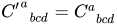
The Weyl tensor has the special property that it is invariant under conformal changes to the metric. That is, if for some positive scalar function then the (1,3) valent Weyl tensor satisfies . For this reason the Weyl tensor is also called the conformal tensor. It follows that a necessary condition for a Riemannian manifold to be conformally flat is that the Weyl tensor vanish. In dimensions ≥ 4 this condition is sufficient as well. In dimension 3 the vanishing of the Cotton tensor is a necessary and sufficient condition for the Riemannian manifold being conformally flat. Any 2-dimensional (smooth) Riemannian manifold is conformally flat, a consequence of the existence of isothermal coordinates.

Indeed, the existence of a conformally flat scale amounts to solving the overdetermined partial differential equation

In dimension ≥ 4, the vanishing of the Weyl tensor is the only integrability condition for this equation; in dimension 3, it is the Cotton tensor instead.

Symmetries

[edit]

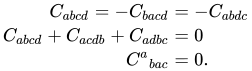
The Weyl tensor has the same symmetries as the Riemann tensor. This includes:

In addition, of course, the Weyl tensor is trace free:
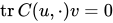
for all u, v. In indices these four conditions are
Bianchi identity

[edit]

Taking traces of the usual second Bianchi identity of the Riemann tensor eventually shows that

where S is the Schouten tensor. The valence (0,3) tensor on the right-hand side is the Cotton tensor, apart from the initial factor.

See also

[edit]

Notes

[edit]

References

[edit]
Revisions and contributorsEdit on WikipediaRead on Wikipedia
from Grokipedia
The Weyl tensor, denoted $ C_{\mu\nu\rho\sigma} $, is a rank-4 tensor in differential geometry that represents the trace-free, conformally invariant portion of the Riemann curvature tensor, distinguishing the intrinsic conformal structure of a manifold from contributions due to local scalar and Ricci curvatures.[1] Introduced by Hermann Weyl in his 1918 work on pure infinitesimal geometry, the tensor is mathematically defined in an $ n dimensional[spacetime](/page/Spacetime)(-dimensional [spacetime](/page/Spacetime) ( n \geq 3 $) by decomposing the Riemann tensor $ R_{\mu\nu\rho\sigma} $ as
Cμνρσ=Rμνρσ2n2(gμ[ρRσ]νgν[ρRσ]μ)+2(n1)(n2)Rgμ[ρgσ]ν, C_{\mu\nu\rho\sigma} = R_{\mu\nu\rho\sigma} - \frac{2}{n-2} \left( g_{\mu[\rho} R_{\sigma]\nu} - g_{\nu[\rho} R_{\sigma]\mu} \right) + \frac{2}{(n-1)(n-2)} R g_{\mu[\rho} g_{\sigma]\nu},
where $ g_{\mu\nu} $ is the metric tensor, $ R_{\mu\nu} $ is the Ricci tensor, and $ R $ is the scalar curvature; this subtraction isolates the parts traceable to matter-energy content via Einstein's field equations.[1][2] The Weyl tensor inherits all symmetries of the Riemann tensor—such as antisymmetry in the first and second index pairs, symmetry under pair exchange, and the first Bianchi identity—but additionally satisfies tracelessness ($ C^\lambda_{\ \mu\lambda\nu} = 0 $) and possesses $ \frac{1}{12} n (n+1) (n+2) (n-3) $ independent components, reducing to 10 in four-dimensional spacetime.[1][3] A defining feature is its invariance under conformal transformations of the metric $ \tilde{g}{\mu\nu} = \Omega^2(x) g{\mu\nu} $, where $ \Omega $ is a positive scalar function; unlike the full Riemann tensor, the Weyl tensor is unaltered, making it a measure of the angle-preserving (conformal) class of geometries rather than the absolute scale.[1][2] It vanishes precisely in conformally flat spacetimes, such as those with constant curvature (e.g., Minkowski or de Sitter space).[2] In general relativity, the Weyl tensor quantifies the "free gravitational field," encoding curvature effects not sourced by local matter or energy-momentum as captured by the Ricci tensor; in vacuum regions, where the Ricci tensor vanishes, the Riemann tensor coincides with the Weyl tensor, directly governing gravitational wave propagation.[2][3] Physically, its electric part $ E_{ab} $ describes tidal deformations of extended bodies along geodesics (geodesic deviation), while the magnetic part $ B_{ab} $ relates to vortical, frame-dragging effects akin to gravitomagnetism.[3] This decomposition underscores its role in distinguishing local gravitational influences from propagating radiation in solutions like black hole spacetimes or cosmological perturbations.[3]

Mathematical Definition

Expression in Terms of Riemann Tensor

The Ricci decomposition expresses the Riemann curvature tensor on an n-dimensional pseudo-Riemannian manifold (n ≥ 3) as the orthogonal sum of three components: the conformally invariant Weyl tensor, a term involving the Ricci tensor, and a term involving the scalar curvature. This decomposition isolates the part of the curvature that is independent of the local volume scale, with the Weyl tensor capturing the "pure" tidal or distortion effects beyond those encoded in the Ricci and scalar curvatures.[4] The explicit tensorial form of this decomposition is
Riem=C+1n2(Ricg)R2(n1)(n2)(gg), \mathrm{Riem} = C + \frac{1}{n-2} (\mathrm{Ric} \wedge \bigcirc g) - \frac{R}{2(n-1)(n-2)} (g \wedge \bigcirc g),
where CC denotes the Weyl tensor, Riem\mathrm{Riem} the Riemann tensor, Ric\mathrm{Ric} the Ricci tensor, RR the scalar curvature, gg the metric tensor, and \wedge \bigcirc the Kulkarni–Nomizu product of two symmetric (0,2)-tensors hh and kk, defined by
(hk)(X,Y,Z,W)=h(X,Z)k(Y,W)h(X,W)k(Y,Z)+h(Y,W)k(X,Z)h(Y,Z)k(X,W). (h \wedge \bigcirc k)(X,Y,Z,W) = h(X,Z)k(Y,W) - h(X,W)k(Y,Z) + h(Y,W)k(X,Z) - h(Y,Z)k(X,W).
Rearranging yields the expression for the Weyl tensor itself:
C=Riem1n2(Ricg)+R2(n1)(n2)(gg). C = \mathrm{Riem} - \frac{1}{n-2} (\mathrm{Ric} \wedge \bigcirc g) + \frac{R}{2(n-1)(n-2)} (g \wedge \bigcirc g).
This form was developed using the algebraic structure of curvature tensors under the action of the orthogonal group, with the Kulkarni–Nomizu product ensuring the resulting terms possess the full symmetries of the Riemann tensor (antisymmetry in the first two and last two arguments, symmetry under pair exchange, and the first Bianchi identity).[4][5] To derive this expression, begin with the known symmetries and contraction properties of the Riemann tensor: its contraction yields the Ricci tensor, Ric(Y,Z)=Riem(ei,Y,Z,ei)\mathrm{Ric}(Y,Z) = \mathrm{Riem}(e_i, Y, Z, e_i) (summation over orthonormal basis eie_i), and a further contraction yields the scalar curvature R=gYZRic(Y,Z)R = g^{YZ} \mathrm{Ric}(Y,Z). Assume a decomposition Riem=C+a(Ricg)+b(gg)\mathrm{Riem} = C + a (\mathrm{Ric} \wedge \bigcirc g) + b (g \wedge \bigcirc g), where CC is required to be trace-free (C(ei,Y,Z,ei)=0C(e_i, Y, Z, e_i) = 0) and conformally invariant. Contracting the assumed form with respect to the first and third indices gives Ric=a[(n2)Ric+Rg]+b2(n1)g\mathrm{Ric} = a \cdot [(n-2) \mathrm{Ric} + R g] + b \cdot 2(n-1) g. Solving for aa requires a=1/(n2)a = 1/(n-2) to match the leading Ricci tensor term. This introduces an extra scalar contribution Rg/(n2)R g /(n-2). To cancel this excess, b2(n1)g=Rg/(n2)b \cdot 2(n-1) g = - R g /(n-2), so b=R/[2(n1)(n2)]b = -R / [2(n-1)(n-2)]. A second contraction confirms consistency with the scalar curvature RR. The Weyl tensor CC thus emerges as the remainder after subtracting these Ricci and scalar contributions.[4] The Weyl tensor CC is a (0,4)-tensor sharing all algebraic symmetries of the Riemann tensor and serves as the irreducible component in the orthogonal decomposition of the space of curvature tensors under the representation of the orthogonal group O(n)O(n).[4]

Component Form and Dimension Dependence

The component form of the Weyl tensor in an nn-dimensional pseudo-Riemannian manifold is given by
C σμνρ=R σμνρ1n2(δμρRσνδνρRσμgσμR νρ+gσνR μρ)+R(n1)(n2)(δμρgσνδνρgσμ), \begin{aligned} C^\rho_{\ \sigma\mu\nu} &= R^\rho_{\ \sigma\mu\nu} - \frac{1}{n-2} \left( \delta^\rho_\mu R_{\sigma\nu} - \delta^\rho_\nu R_{\sigma\mu} - g_{\sigma\mu} R^\rho_{\ \nu} + g_{\sigma\nu} R^\rho_{\ \mu} \right) \\ &\quad + \frac{R}{(n-1)(n-2)} \left( \delta^\rho_\mu g_{\sigma\nu} - \delta^\rho_\nu g_{\sigma\mu} \right), \end{aligned}
where R σμνρR^\rho_{\ \sigma\mu\nu} is the Riemann curvature tensor, RσνR_{\sigma\nu} is the Ricci tensor, R=gσνRσνR = g^{\sigma\nu} R_{\sigma\nu} is the Ricci scalar, gσνg_{\sigma\nu} is the metric tensor, and δμρ\delta^\rho_\mu is the Kronecker delta.[6] This expression arises from the tensorial decomposition of the Riemann tensor into its trace-free (Weyl), Ricci, and scalar parts, isolating the conformal curvature information.[6] In spacetimes of dimension n3n \leq 3, the Weyl tensor vanishes identically due to the structure of the Riemann tensor, which can be fully expressed in terms of the Ricci tensor and scalar curvature without a independent traceless component.[7] For n=2n=2, the Riemann tensor has only one independent component proportional to the Gaussian curvature, leaving no room for a nonzero Weyl tensor.[6] In n=3n=3, the six independent components of the Riemann tensor match those of the symmetric Ricci tensor, implying the Weyl part is zero by the decomposition.[7] The Weyl tensor exists and is generally nonzero only for n4n \geq 4, where the Riemann tensor has more independent components than can be accounted for by the Ricci and scalar parts.[6] A key example occurs in four-dimensional Lorentzian spacetimes of general relativity, such as the Schwarzschild vacuum solution, where the Weyl tensor captures the tidal distortions absent in conformally flat regions.[6] In four dimensions specifically, the Weyl tensor possesses 10 independent components, corresponding to the degrees of freedom in the gravitational field beyond local matter contributions.[6]

Algebraic Properties

Symmetries

The Weyl tensor inherits all the algebraic symmetries of the Riemann curvature tensor, reflecting its role as the trace-free part that encodes the conformal structure of spacetime. These pointwise symmetries constrain the tensor's components and ensure consistency with the underlying geometry.[8] The primary symmetries include antisymmetry within each pair of indices, expressed as
Cρσμν=Cσρμν=Cρσνμ, C_{\rho\sigma\mu\nu} = -C_{\sigma\rho\mu\nu} = -C_{\rho\sigma\nu\mu},
which follows directly from the corresponding properties of the Riemann tensor. Additionally, the Weyl tensor satisfies an interchange symmetry between the pairs of indices,
Cρσμν=Cμνρσ, C_{\rho\sigma\mu\nu} = C_{\mu\nu\rho\sigma},
allowing the tensor to be viewed as a symmetric bilinear form on the space of bivectors. A further constraint is the cyclic identity on the last three indices,
Cρσμν+Cρμνσ+Cρνσμ=0, C_{\rho\sigma\mu\nu} + C_{\rho\mu\nu\sigma} + C_{\rho\nu\sigma\mu} = 0,
derived from the first Bianchi identity and preserved in the projection to the Weyl part. These relations collectively form the full symmetry group shared with the Riemann tensor.[8][9] In four dimensions, these algebraic symmetries, reinforced by the trace-free condition, reduce the number of independent components of the Weyl tensor to 10, in contrast to the 20 independent components of the Riemann tensor under the same symmetries. This dimensionality highlights the Weyl tensor's specialization to the "free" gravitational degrees of freedom beyond local matter contributions.[8][10]

Trace-Free Condition

The Weyl tensor C σμνρC^\rho_{\ \sigma\mu\nu} is characterized by its trace-free condition, which states that the contraction of the first and third indices vanishes: C σμρρ=0C^\rho_{\ \sigma\mu\rho} = 0. Similarly, contracting the second and fourth indices yields Cρσμρ=0C_{\rho\sigma\mu}{}^\rho = 0. This property holds for all pairs of indices due to the tensor's symmetries, making it totally trace-free. These conditions ensure that the Weyl tensor contains no scalar or Ricci-type trace contributions, distinguishing it from the full Riemann curvature tensor.[11][10] To derive this trace-freeness, the Weyl tensor is constructed as the trace-free component of the Riemann tensor R σμνρR^\rho_{\ \sigma\mu\nu} through a specific subtraction of its trace parts. In an nn-dimensional spacetime with n3n \geq 3, the decomposition is given by
R σμνρ=C σμνρ+2n2(δ[μρRν]σgσ[μRν]ρ)2(n2)(n1)δ[μρgν]σR, R^\rho_{\ \sigma\mu\nu} = C^\rho_{\ \sigma\mu\nu} + \frac{2}{n-2} \left( \delta^\rho_{[\mu} R_{\nu]\sigma} - g_{\sigma[\mu} R_{\nu]}^\rho \right) - \frac{2}{(n-2)(n-1)} \delta^\rho_{[\mu} g_{\nu]\sigma} R,
where RσνR_{\sigma\nu} is the Ricci tensor and R=gσνRσνR = g^{\sigma\nu} R_{\sigma\nu} is the Ricci scalar. The additional terms involving the metric gσνg_{\sigma\nu}, Ricci tensor, and scalar curvature account for all possible traces in the Riemann tensor. By construction, these terms are chosen such that when contracted appropriately, they cancel the traces of the Riemann tensor, leaving the Weyl tensor with zero trace in every contraction. This isolates the "pure" tidal or conformal curvature, free from volumetric distortions captured by the Ricci parts.[11][10] The trace-free condition arises within an orthogonal decomposition of the space of algebraic curvature tensors under the natural inner product A,B=A  μνρσBρσ  μν\langle A, B \rangle = A^{\rho\sigma}_{\ \ \mu\nu} B_{\rho\sigma}^{\ \ \mu\nu}. Here, the Weyl tensor represents the component orthogonal to both the Ricci trace (spanned by terms like gRg \wedge R) and the scalar trace (spanned by ggg \wedge g). This orthogonality ensures that the Weyl part does not overlap with the trace subspaces, preserving its independence and the total trace-freeness. In four dimensions, this decomposition reduces the 20 independent components of the Riemann tensor to 10 for the Weyl tensor, after accounting for 9 from the Ricci tensor and 1 from the scalar.[12][11] In Ricci-flat spacetimes, where the Ricci tensor vanishes (Rσν=0R_{\sigma\nu} = 0), the decomposition simplifies such that the Riemann tensor equals the Weyl tensor: R σμνρ=C σμνρR^\rho_{\ \sigma\mu\nu} = C^\rho_{\ \sigma\mu\nu}. This equivalence underscores the Weyl tensor's role in describing gravitational phenomena without local matter sources, such as propagating gravitational waves in vacuum general relativity.[10][13]

Differential Properties

Bianchi Identity

The Weyl tensor CρσμνC^\rho{}_{\sigma\mu\nu} satisfies the second Bianchi identity in the form of a cyclic sum over its covariant derivatives,
λCρσμν+μCρσνλ+νCρσλμ=0. \nabla_\lambda C^\rho{}_{\sigma\mu\nu} + \nabla_\mu C^\rho{}_{\sigma\nu\lambda} + \nabla_\nu C^\rho{}_{\sigma\lambda\mu} = 0.
This identity arises directly from the corresponding identity for the Riemann curvature tensor, as the Weyl tensor represents the conformally invariant, trace-free part of the Riemann tensor, and the additional terms involving the Ricci tensor satisfy their own Bianchi relations that do not contribute to this cyclic sum.[14] Contracting the identity by setting ρ=λ\rho = \lambda yields the divergence-free condition for the Weyl tensor in dimensions n>3n > 3,
ρCρσμν=0, \nabla^\rho C_{\rho\sigma\mu\nu} = 0,
where the lowered index follows from the metric. The vanishing of the other cyclic terms upon contraction stems from the antisymmetry of the Weyl tensor in its final two indices. This divergence-free property holds independently of the dimension for n4n \geq 4, reflecting the tensor's role in encoding gravitational degrees of freedom orthogonal to local matter contributions.[14][15] A further specialization of the identity provides a differential relation between the Weyl tensor and the Schouten tensor PabP_{ab},
aCabcd=2(n3)[cPd]b, \nabla_a C^a{}_{bcd} = 2(n-3) \nabla_{[c} P_{d]b},
where the antisymmetrization is over cc and dd. This equation links the evolution of the Weyl tensor to gradients in the Schouten tensor, which encapsulates trace-adjusted Ricci curvature. In dimensions n>3n > 3, the factor 2(n3)2(n-3) ensures that the right-hand side vanishes when the Cotton tensor (defined via the antisymmetric derivative of PP) is zero, consistent with the divergence-free condition.[16] This Bianchi identity constrains the evolution of spacetime curvature in higher-dimensional general relativity by governing how the Weyl tensor propagates along geodesics, particularly in vacuum solutions where it describes the radiative, non-local aspects of gravity. In such settings, the identity implies that perturbations in the Weyl tensor satisfy wave-like equations, limiting the possible configurations of curvature and ensuring consistency with energy conservation. In three dimensions, the Weyl tensor identically vanishes, and the identity reduces to a relation solely involving the Schouten tensor and the Cotton tensor.[15]

Relation to Cotton Tensor

The Cotton tensor, denoted $ C_{ijk} $, serves as the three-dimensional analog of the Weyl tensor in conformal geometry. It is defined as $ C_{ijk} = \nabla_k P_{ij} - \nabla_j P_{ik} $, where $ P_{ij} $ is the Schouten tensor, given by $ P_{ij} = \frac{1}{n-2} \left( \mathrm{Ric}{ij} - \frac{R}{2(n-1)} g{ij} \right) $ for an $ n $-dimensional Riemannian manifold. This tensor is traceless, antisymmetric in the last two indices, and conformally invariant, measuring deviations from conformal flatness in three dimensions.[17] The connection between the Weyl tensor and the Cotton tensor arises from the second Bianchi identity applied to the curvature tensors. In general dimensions, this identity implies that the covariant divergence of the Weyl tensor is proportional to the Cotton tensor: $ \nabla^l W_{ijkl} = (n-3) C_{kij} $. In three dimensions, where the Weyl tensor vanishes identically, the Bianchi identity implies that the Cotton tensor is covariantly conserved, $ \nabla^k C_{kij} = 0 $, establishing a direct link that underscores the Cotton tensor's role as the primary conformal invariant.[17][15] In three-dimensional conformal geometry, the vanishing of the Cotton tensor is both necessary and sufficient for the manifold to be conformally flat, paralleling the role of the Weyl tensor in higher dimensions as the obstruction to local conformal flatness.[17] Furthermore, this conservation property reinforces the Cotton tensor's status as a conserved current-like quantity in conformal theories. This positions the Cotton tensor as a key object for studying conformal anomalies and boundary terms in three-dimensional gravity and field theories.[17]

Conformal Properties

Invariance Under Rescaling

The Weyl tensor exhibits invariance under conformal rescalings of the metric tensor, a property central to its role in describing the conformal geometry of spacetime. Specifically, if the metric is rescaled as $ g'{\mu\nu} = \Omega^2 g{\mu\nu} $, where $ \Omega $ is a positive smooth function on the manifold, the components of the Weyl tensor remain unchanged: $ C'^\rho{}{\sigma\mu\nu} = C^\rho{}{\sigma\mu\nu} $.[18] This transformation law holds in dimensions $ n \geq 3 $, reflecting the tensor's insensitivity to local scale changes.[19] To derive this invariance, consider the transformation of the full Riemann curvature tensor under the conformal rescaling. The Riemann tensor acquires additional terms involving the Hessian of $ \ln \Omega $ and contractions thereof, which can be expressed as:
Rρσμν=Rρσμν+δνρμσlnΩδμρνσlnΩ+gσμρνlnΩgσνρμlnΩ+terms quadratic in lnΩ, R'^\rho{}_{\sigma\mu\nu} = R^\rho{}_{\sigma\mu\nu} + \delta^\rho_\nu \nabla_\mu \nabla_\sigma \ln \Omega - \delta^\rho_\mu \nabla_\nu \nabla_\sigma \ln \Omega + g_{\sigma\mu} \nabla^\rho \nabla_\nu \ln \Omega - g_{\sigma\nu} \nabla^\rho \nabla_\mu \ln \Omega + \text{terms quadratic in } \nabla \ln \Omega,
where the exact form depends on the dimension, but crucially includes contributions that affect the Ricci tensor $ R_{\mu\nu} $ and scalar curvature $ R $. When forming the Weyl tensor by subtracting the Ricci and scalar parts—via $ C^\rho{}{\sigma\mu\nu} = R^\rho{}{\sigma\mu\nu} - \frac{2}{n-2} \left( \delta^\rho_{[\mu} R_{\nu]\sigma} - g_{\sigma[\mu} R^\rho_{\nu]} \right) + \frac{2}{(n-2)(n-1)} R , g_{\sigma[\mu} \delta^\rho_{\nu]} $—these extra terms transform in precisely the manner needed to cancel between the Riemann, Ricci, and scalar contributions under the rescaling. The resulting structure ensures $ \delta C^\rho{}_{\sigma\mu\nu} = 0 $ for infinitesimal rescalings $ \Omega = 1 + \epsilon \pi $, confirming the invariance.[18] This invariance arises in part from the trace-free condition of the Weyl tensor, which eliminates scalar dependencies that would otherwise vary under rescaling. Consequently, the Weyl tensor captures the intrinsic conformal structure of the spacetime, measuring deviations from conformality in a scale-independent way. A spacetime is conformally flat—meaning its metric is locally conformal to the flat Minkowski (or Euclidean) metric—if and only if the Weyl tensor vanishes pointwise: $ C^\rho{}_{\sigma\mu\nu} = 0 $.

Connection to Schouten Tensor

The Schouten tensor PμνP_{\mu\nu}, introduced by Jan Arnoldus Schouten in the context of Riemannian geometry, is defined for an nn-dimensional manifold with n3n \geq 3 as
Pμν=1n2(RicμνR2(n1)gμν), P_{\mu\nu} = \frac{1}{n-2} \left( \mathrm{Ric}_{\mu\nu} - \frac{R}{2(n-1)} g_{\mu\nu} \right),
where Ricμν\mathrm{Ric}_{\mu\nu} denotes the Ricci tensor and RR is the scalar curvature.[20] This tensor captures the trace-adjusted portion of the Ricci curvature, playing a central role in decomposing the full curvature structure. The Weyl tensor CC connects directly to the Schouten tensor through the algebraic decomposition of the Riemann curvature tensor Riem\mathrm{Riem}:
C=RiemPg, C = \mathrm{Riem} - P \wedge g,
where \wedge represents the Kulkarni–Nomizu product, an algebraic operation that symmetrizes two symmetric bilinear forms into a curvature-like (0,4)-tensor preserving the required algebraic symmetries.[21] This relation isolates the conformally invariant part of the curvature (the Weyl tensor) from the parts influenced by local volume scaling, with the Schouten tensor encoding the latter contribution. Under a conformal rescaling g=e2ωgg' = e^{2\omega} g, the Schouten tensor transforms according to
Pij=Pijijω+(iω)(jω)12gij(kω)(kω), P'_{ij} = P_{ij} - \nabla_i \nabla_j \omega + (\nabla_i \omega)(\nabla_j \omega) - \frac{1}{2} g_{ij} (\nabla_k \omega)(\nabla^k \omega),
where indices follow the original metric gg and \nabla is the Levi-Civita connection of gg.[22] This relatively simple second-order transformation law underscores the Schouten tensor's utility in conformal geometry, facilitating the study of metric deformations while highlighting how the Weyl tensor remains invariant under such rescalings. In conformal gravity, the Schouten tensor links to the Weyl tensor via the Bach tensor BμνB_{\mu\nu}, defined as
Bμν=λλPμν+PλσCλμσν, B_{\mu\nu} = \nabla^\lambda \nabla_\lambda P_{\mu\nu} + P^{\lambda\sigma} C_{\lambda\mu\sigma\nu},
which serves as the field equation for theories based on the C2C^2 action and enforces Bach-flat conditions in vacuum solutions.[23]

Physical Applications

Role in General Relativity

In general relativity, the Weyl tensor provides a measure of the tidal forces acting on a test body freely falling along a geodesic, capturing the shear and distortion of spacetime without altering the volume element. This geometric interpretation arises from the geodesic deviation equation, where the electric part of the Weyl tensor governs the relative acceleration between neighboring geodesics, leading to traceless deformations that distinguish it from the Ricci tensor's role in isotropic expansion or contraction. The Weyl tensor thus quantifies the "free gravitational field" propagating through vacuum, embodying the non-local aspects of curvature sourced by distant masses. In vacuum solutions to the Einstein field equations, where the stress-energy tensor vanishes, the Ricci tensor is zero, reducing the Riemann curvature tensor to the Weyl tensor alone. Consequently, the Weyl tensor encodes the complete dynamical information of gravitational waves, including their two independent transverse polarizations that propagate at the speed of light. This equivalence highlights the Weyl tensor's centrality in describing radiative degrees of freedom, as its components satisfy wave equations in linearized gravity and fully characterize nonlinear vacuum spacetimes like those encountered in binary black hole mergers.[24] The algebraic structure of the Weyl tensor in four-dimensional spacetimes is classified via the Petrov scheme, which identifies algebraically special solutions based on the alignment of principal null directions. The types—I (general), II, D (double-aligned, e.g., Schwarzschild), III, N (null, e.g., plane waves), and O (vanishing)—provide a tool for analyzing exact solutions, revealing symmetries relevant to phenomena like gravitational wave bursts or black hole horizons. A vanishing Weyl tensor in four dimensions implies the spacetime is conformally flat, with the metric locally equivalent to flat spacetime up to a conformal factor. This condition holds for Friedmann–Lemaître–Robertson–Walker models describing homogeneous and isotropic cosmologies, as well as the interior Schwarzschild solution for a static, spherically symmetric star with constant density, where tidal distortions are absent despite nonzero Ricci curvature from matter.[25] In Ricci-flat cases, the trace-free nature of the Weyl tensor ensures it alone represents the full curvature, aligning with its role in vacuum gravitational dynamics.

Weyl Gravity Theories

In 1918, Hermann Weyl proposed a unified field theory that integrated general relativity with electromagnetism by introducing a conformal gauge invariance, where the metric tensor is rescaled by a local factor, and the electromagnetic potential is identified with the gauge field of this transformation.[26] However, the theory encountered inconsistencies due to the non-integrable nature of the Weyl connection, which led to path-dependent lengths and unphysical effects on atomic spectra, ultimately rendering it incompatible with observations.[26] Modern conformal gravity, also known as Weyl gravity, extends these ideas by constructing a theory based on the square of the Weyl tensor as the action, given by
S=CμνρσCμνρσgd4x, S = \int C_{\mu\nu\rho\sigma} C^{\mu\nu\rho\sigma} \sqrt{-g} \, d^4x,
where CμνρσC_{\mu\nu\rho\sigma} is the Weyl tensor and gg is the metric determinant.[27] The variation of this action yields the Bach equation as the equation of motion:
μνCμανβ+CμαρσRμρσν=0, \nabla^\mu \nabla^\nu C_{\mu\alpha\nu\beta} + C_{\mu\alpha\rho\sigma} R^{\mu\rho\sigma\nu} = 0,
with RμρσνR^{\mu\rho\sigma\nu} denoting the Riemann tensor, making the theory fourth-order in derivatives and conformally invariant.[27] This framework avoids the issues of Weyl's original proposal by not directly coupling to electromagnetism in the same gauge manner. However, conformal gravity faces theoretical challenges, including the introduction of ghostly modes due to higher-order derivatives, which lead to instabilities, and it has been criticized for not fully matching observations beyond galactic rotation curves, such as light deflection or cosmological data. One key application of conformal gravity lies in explaining galactic rotation curves without invoking dark matter; for instance, fits to samples of over 100 spiral galaxies demonstrate that the theory's linear and quadratic potentials reproduce observed velocities across the galactic disk and halo.[28] Additionally, post-2010 numerical investigations have yielded black hole solutions in Weyl conformal geometry, including static spherically symmetric configurations that deviate from general relativity predictions while maintaining asymptotic flatness.[29] A specific development concerns asymptotic safety in quantum Weyl gravity, where functional renormalization group analyses indicate a non-Gaussian ultraviolet fixed point, suggesting UV completeness; studies through 2025, incorporating Einstein-Weyl terms, confirm the viability of this scenario for renormalizability without ghosts.[30]

Historical Development

Hermann Weyl's Original Work

In 1918, Hermann Weyl proposed a unified field theory aimed at integrating gravity and electromagnetism within the framework of general relativity, extending the geometric description of spacetime to include scale variations.[19] Central to this approach was the introduction of length non-integrability, where the metric is conformal and allows lengths to change under parallel transport, reflecting a gauge-like freedom in scaling that Weyl associated with electromagnetic potentials.[31] This non-integrability arose from a linear differential form governing scale changes between points, departing from the rigid metric of Riemannian geometry to achieve a scale-invariant structure. Weyl defined the Weyl tensor as the conformally invariant portion of the curvature tensor, isolating the part unaffected by metric rescalings and thus essential for maintaining the theory's scale invariance. This tensor captured the "direction curvature" inherent to the geometry, distinguishing it from components tied to length variations that Weyl linked to the electromagnetic field. The theory's conformal properties were pivotal, ensuring that angles and causal structures remained preserved under gauge transformations.[32] Weyl's framework appeared in his seminal paper "Reine Infinitesimalgeometrie," published in Mathematische Zeitschrift. However, Albert Einstein critiqued the theory shortly after, arguing that the non-integrable paths implied by length variations would lead to physical inconsistencies, such as the spectral lines of atoms depending on their transport history rather than having fixed frequencies, contradicting empirical observations. In Weyl's geometry, parallel transport incorporated a gauge field—manifest as a metric rotation tensor—serving as a geometric precursor to the modern concept of gauge invariance in field theories.[32]

Later Contributions and Extensions

In the decades following Hermann Weyl's 1918 introduction of his conformal geometry, researchers in the 1920s and 1930s, including Leopold Infeld, extended these ideas within unified field theories. Infeld's 1928 publications explored asymmetric metrics to combine gravitational and electromagnetic fields, deriving approximations to the Einstein-Maxwell equations under conditions like vanishing non-metricity, thereby refining the geometric framework for gauge-invariant interactions inspired by Weyl's approach.[33] By the 1930s, Infeld, collaborating with Bartel L. van der Waerden, advanced spinor formulations in general relativity, incorporating the Ricci scalar into wave equations for electrons and emphasizing spin densities, which indirectly bolstered the role of conformal structures in relativistic field theory.[33] During the 1950s and 1960s, Jürgen Ehlers contributed to the physical interpretation of the Weyl tensor through its algebraic classification, building on A. Z. Petrov's 1954 scheme. Ehlers' 1957 dissertation and subsequent work with Felix Pirani evaluated the tensor's types in the context of gravitational wave propagation and the mechanics of continuous media, highlighting its role in describing tidal distortions and null congruences in curved spacetimes.[34] This classification gained further traction in Ehlers' collaborations, such as the 1972 paper with Pirani and Alfred Schild, which embedded Weyl geometry within the foundational structures of general relativity, linking it to observable gravitational effects like frame-dragging. Roger Penrose later connected these developments to twistor theory in the late 1960s, using the Weyl tensor's conformal invariance to formulate spinor-based descriptions of massless fields and spacetime geometry.[35] From the 1970s onward, applications of the Weyl tensor expanded into quantum field theory and anomalies. In 1993, Stanley Deser and Adi Schwimmer provided a geometric classification of conformal anomalies in even dimensions, identifying two classes: type A (Euler density) and type B (Weyl tensor squared invariants), which quantify trace anomalies in curved backgrounds and influence renormalization in conformal field theories.[36] This framework has since informed holographic computations and effective actions. In the 1990s, Philip D. Mannheim developed conformal gravity models for cosmology, using the square of the Weyl tensor as the action to address the flatness problem and galactic rotation curves without dark matter, yielding de Sitter-like solutions that dynamically generate a cosmological constant.[37] Mannheim's approach, detailed in works like his 1992 Astrophysical Journal paper, posits conformal invariance as a fundamental symmetry resolving fine-tuning issues in standard cosmology.[38] In 2009, Ashkbiz Danehkar published a study emphasizing the physical significance of the Weyl curvature in relativistic cosmological models, interpreting its electric and magnetic parts as encoding tidal forces and a novel anti-Newtonian field, sourced by the stress-energy tensor via Bianchi identities.[39] This work underscored the tensor's role in long-range gravitational interactions and wave propagation. Recent developments from 2000 to 2025 have increasingly explored quantum aspects. For instance, a 2023 analysis of thermal one-point functions for massive scalars in AdS black holes sourced the correlators by the Weyl tensor squared, revealing insights into black hole interiors and holographic entropy computations within AdS/CFT correspondence.[40] 2024 investigations have incorporated Weyl curvature measures, such as Penrose's hypothesis on initial low Weyl entropy, into higher-order gravity models to assess finite-action singularities and the universe's early quantum state.[41] These extensions highlight the tensor's enduring relevance in bridging classical geometry with quantum gravity phenomenology.

References

User Avatar
No comments yet.