


Community hub
Recent from talks
Contribute something
Nothing was collected or created yet.
Flap (aeronautics)
View on Wikipedia | This article needs additional citations for verification. (February 2013) |

A flap is a high-lift device used to reduce the stalling speed of an aircraft wing at a given weight. Flaps are usually mounted on the wing trailing edges of a fixed-wing aircraft. Flaps are used to reduce the take-off distance and the landing distance. Flaps also cause an increase in drag so they are retracted when not needed.
The flaps installed on most aircraft are partial-span flaps; spanwise from near the wing root to the inboard end of the ailerons. When partial-span flaps are extended they alter the spanwise lift distribution on the wing by causing the inboard half of the wing to supply an increased proportion of the lift, and the outboard half to supply a reduced proportion of the lift. Reducing the proportion of the lift supplied by the outboard half of the wing is accompanied by a reduction in the angle of attack on the outboard half. This is beneficial because it increases the margin above the stall of the outboard half, maintaining aileron effectiveness and reducing the likelihood of asymmetric stall, and spinning. The ideal lift distribution across a wing is elliptical, and extending partial-span flaps causes a significant departure from the elliptical. This increases lift-induced drag which can be beneficial during approach and landing because it allows the aircraft to descend at a steeper angle.
Extending the wing flaps increases the camber or curvature of the wing, raising the maximum lift coefficient or the upper limit to the lift a wing can generate. This allows the aircraft to generate the required lift at a lower speed, reducing the minimum speed (known as stall speed) at which the aircraft will safely maintain flight. For most aircraft configurations, a useful side effect of flap deployment is a decrease in aircraft pitch angle which lowers the nose thereby improving the pilot's view of the runway over the nose of the aircraft during landing.
There are many different designs of flaps, with the specific choice depending on the size, speed and complexity of the aircraft on which they are to be used, as well as the era in which the aircraft was designed. Plain flaps, slotted flaps, and Fowler flaps are the most common. Krueger flaps are positioned on the leading edge of the wings and are used on many jet airliners. The Fowler, Fairey-Youngman and Gouge types of flap increase the wing area in addition to changing the camber. The larger lifting surface reduces wing loading, hence further reducing the stalling speed.
Some flaps are fitted elsewhere. Leading-edge flaps form the wing leading edge and when deployed they rotate down to increase the wing camber. The de Havilland DH.88 Comet racer had flaps running beneath the fuselage and forward of the wing trailing edge. Many of the Waco Custom Cabin series biplanes have the flaps at mid-chord on the underside of the top wing.
Principles of operation
[edit]The general airplane lift equation demonstrates these relationships:[1]
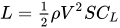
where:
- L is the amount of Lift produced,
- is the air density,
- V is the true airspeed of the airplane or the Velocity of the airplane, relative to the air
- S is the area of the wing
- is the lift coefficient, which is determined by the shape of the airfoil used and the angle at which the wing meets the air (or angle of attack).


Here, it can be seen that increasing the area (S) and lift coefficient () allow a similar amount of lift to be generated at a lower airspeed (V). Thus, flaps are extensively in use for short takeoffs and landings (STOL).

Extending the flaps also increases the drag coefficient of the aircraft. Therefore, for any given weight and airspeed, flaps increase the drag force. Flaps increase the drag coefficient of an aircraft due to higher induced drag caused by the distorted spanwise lift distribution on the wing with flaps extended. Some flaps increase the wing area and, for any given speed, this also increases the parasitic drag component of total drag.[1]
Flaps during takeoff
[edit]Depending on the aircraft type, flaps may be partially extended for takeoff.[1] When used during takeoff, flaps trade runway distance for climb rate: using flaps reduces ground roll but also reduces the climb rate. The amount of flap used on takeoff is specific to each type of aircraft, and the manufacturer will suggest limits and may indicate the reduction in climb rate to be expected. The Cessna 172S Pilot Operating Handbook recommends 10° of flaps on takeoff, when the ground is soft or it is a short runway, otherwise 0 degrees is used.[2]
Flaps during landing
[edit]

Flaps may be fully extended for landing to give the aircraft a lower stall speed so the approach to landing can be flown more slowly, which also allows the aircraft to land in a shorter distance. The higher drag and lower stalling speed associated with fully extended flaps allow a steeper and slower approach to the landing site, but imposes handling difficulties in aircraft with very low wing loading (i.e. having little weight and a large wing area). Winds across the line of flight, known as crosswinds, cause the windward side of the aircraft to generate more lift and drag, causing the aircraft to roll, yaw and pitch off its intended flight path, and as a result many light aircraft land with reduced flap settings in crosswinds. Furthermore, once the aircraft is on the ground, the flaps may decrease the effectiveness of the brakes since the wing is still generating lift and preventing the entire weight of the aircraft from resting on the tires, thus increasing stopping distance, particularly in wet or icy conditions. Usually, the pilot will raise the flaps as soon as possible to prevent this from occurring.[2]
Maneuvering flaps
[edit]Some gliders not only use flaps when landing, but also in flight to optimize the camber of the wing for the chosen speed. While thermalling, flaps may be partially extended to reduce the stall speed so that the glider can be flown more slowly and thereby reduce the rate of sink, which lets the glider use the rising air of the thermal more efficiently, and to turn in a smaller circle to make best use of the core of the thermal.[citation needed] At higher speeds a negative flap setting is used to reduce the nose-down pitching moment. This reduces the balancing load required on the horizontal stabilizer, which in turn reduces the trim drag associated with keeping the glider in longitudinal trim.[citation needed] Negative flap may also be used during the initial stage of an aerotow launch and at the end of the landing run in order to maintain better control by the ailerons.[citation needed]
Like gliders, some fighters such as the Nakajima Ki-43 also use special flaps to improve maneuverability during air combat (manually operated, just a fowler flap), reducing the stalling speed and allowing for much tighter turns.[3] The flaps used for this must be designed specifically to handle the greater stresses and most flaps have a maximum speed at which they can be deployed. Control line model aircraft built for precision aerobatics competition usually have a type of maneuvering flap system that moves them in an opposing direction to the elevators, to assist in tightening the radius of a maneuver.
"Goerge 21" and others had analog computing automatic dog-fighting flap system. (ja: 自動空戦フラップ )
Flap tracks
[edit]Manufactured most often from PH steels and titanium, flap tracks control the flaps located on the trailing edge of an aircraft's wings. Extending flaps often run on guide tracks. Where these run outside the wing structure they may be faired in to streamline them and protect them from damage.[4] Some flap track fairings are designed to act as anti-shock bodies, which reduce drag caused by local sonic shock waves where the airflow becomes transonic at high speeds.
Thrust gates
[edit]Thrust gates, or gaps, in the trailing edge flaps may be required to minimise interference between the engine flow and deployed flaps. In the absence of an inboard aileron, which provides a gap in many flap installations, a modified flap section may be needed. The thrust gate on the Boeing 757 was provided by a single-slotted flap in between the inboard and outboard double-slotted flaps.[5] The A320, A330, A340 and A380 have no inboard aileron. No thrust gate is required in the continuous, single-slotted flap. Interference in the go-around case while the flaps are still fully deployed can cause increased drag which must not compromise the climb gradient.[6]
Types of flap
[edit].png)
Plain flap
[edit]The rear portion of airfoil rotates downwards on a simple hinge mounted at the front of the flap.[7] The Royal Aircraft Factory and National Physical Laboratory in the United Kingdom tested flaps in 1913 and 1914, but these were never installed in an actual aircraft.[8] In 1916, the Fairey Aviation Company made a number of improvements to a Sopwith Baby they were rebuilding, including their Patent Camber Changing Gear, making the Fairey Hamble Baby as they renamed it, the first aircraft to fly with flaps.[8] These were full-span plain flaps which incorporated ailerons, making it also the first instance of flaperons.[8] Fairey were not alone however, as Breguet soon incorporated automatic flaps into the lower wing of their Breguet 14 reconnaissance/bomber in 1917.[9] Owing to the greater efficiency of other flap types, the plain flap is normally only used where simplicity is required.
Split flap
[edit]The rear portion of the lower surface of the airfoil hinges downwards from the leading edge of the flap, while the upper surface stays immobile.[10] This can cause large changes in longitudinal trim, pitching the nose either down or up. At full deflection, a split flaps acts much like a spoiler, adding significantly to drag coefficient.[citation needed] It also adds a little to lift coefficient. It was invented by Orville Wright and James M. H. Jacobs in 1920, but only became common in the 1930s and was then quickly superseded.[11][failed verification] The Supermarine Spitfire and Douglas DC-1 (progenitor to the DC-3 and C-47) are two of the many 1930s aircraft types to use split flaps.
Slotted flap
[edit]A gap between the flap and the wing forces high pressure air from below the wing over the flap helping the airflow remain attached to the flap, increasing the maximum lift coefficient compared to a split flap.[12] Additionally, pressure across the entire chord of the primary airfoil is greatly reduced as the velocity of air leaving its trailing edge is raised, from the typical non-flap 80% of freestream, to that of the higher-speed, lower-pressure air flowing around the leading edge of the slotted flap.[13] Any flap that allows air to pass between the wing and the flap is considered a slotted flap. The slotted flap was a result of research at Handley-Page, a variant of the slot that dates from the 1920s, but was not widely used until much later. Some flaps use multiple slots to further boost the effect.
Fowler flap
[edit]A split flap that slides backwards, before hinging downward, thereby increasing first chord, then camber.[14] The flap may form part of the upper surface of the wing, like a plain flap, or it may not, like a split flap, but it must slide rearward before lowering. As a defining feature – distinguishing it from the Gouge Flap – it always provides a slot effect.
The flap was invented by Harlan D. Fowler in 1924, and tested by Fred Weick at NACA in 1932. First used on the Martin 146 prototype in 1935, it entered production on the 1937 Lockheed Super Electra,[15] and remains in widespread use on modern aircraft, often with multiple slots.[16]
Junkers flap
[edit]A slotted plain flap fixed below the trailing edge of the wing, and rotating about its forward edge.[17] When not in use, it has more drag than other types, but is more effective at reducing stalling speed than a plain or split flap, while retaining their mechanical simplicity. Invented by Otto Mader at Junkers in the late 1920s, they were most often seen on the Junkers Ju 52 and the Junkers Ju 87 Stuka, though the same basic design can also be found on many modern ultralights, like the Denney Kitfox. This type of flap is sometimes referred to as an external-airfoil flap.[18]
Gouge flap
[edit]A type of split flap that slides backward along curved tracks that force the trailing edge downward, increasing chord and camber without affecting trim or requiring any additional mechanisms.[19] It was invented by Arthur Gouge for Short Brothers in 1936 and used on the Short Empire and Sunderland flying boats, which used the very thick Shorts A.D.5 airfoil. Short Brothers may have been the only company to use this type.
Fairey-Youngman flap
[edit]Drops down (becoming a Junkers Flap) before sliding aft and then rotating up or down. Fairey was one of the few exponents of this design, which was used on the Fairey Firefly and Fairey Barracuda. When in the extended position, it could be angled up (to a negative angle of incidence) so that the aircraft could be dived vertically without needing excessive trim changes.[citation needed]
Zap flap
[edit]The Zap flap was invented by Edward F. Zaparka while he was with Berliner/Joyce and tested on a General Airplanes Corporation Aristocrat in 1932 and on other types periodically thereafter, but it saw little use on production aircraft other than on the Northrop P-61 Black Widow. The leading edge of the flap is mounted on a track, while a point at mid chord on the flap is connected via an arm to a pivot just above the track. When the flap's leading edge moves aft along the track, the triangle formed by the track, the shaft and the surface of the flap (fixed at the pivot) gets narrower and deeper, forcing the flap down.[20]
Krueger flap
[edit]A hinged flap which folds out from under the wing's leading edge while not forming a part of the leading edge of the wing when retracted. This increases the camber and thickness of the wing, which in turn reduces stalling speed and increases drag.[21][22] This is not the same as a leading edge droop flap, as that is formed from the entire leading edge.[23] Invented by Werner Krüger in 1943 and evaluated in Goettingen, Krueger flaps are found on many modern swept wing airliners.
Gurney flap
[edit]A small fixed perpendicular tab of between 1 and 2% of the wing chord, mounted on the high pressure side of the trailing edge of an airfoil. It was named for racing car driver Dan Gurney who rediscovered it in 1971, and has since been used on some helicopters such as the Sikorsky S-76B to correct control problems without having to resort to a major redesign. It boosts the efficiency of even basic theoretical airfoils (made up of a triangle and a circle overlapped) to the equivalent of a conventional airfoil. The principle was discovered in the 1930s, but was rarely used and was then forgotten. Late marks of the Supermarine Spitfire used a bead on the trailing edge of the elevators, which functioned in a similar manner.
Leading edge flap
[edit]The entire leading edge of the wing rotates downward, effectively increasing camber and also slightly reducing chord.[24][25] Most commonly found on fighters with very thin wings unsuited to other leading edge high lift devices. Slats are one of such devices, Slats are extendable high lift devices on the leading edge of the wings of some fixed wing aircraft. Their purpose is to increase lift during low speed operations such as take-off, initial climb, approach and landing.
Blown flap
[edit]A type of Boundary Layer Control System, blown flaps pass engine-generated air or exhaust over the flaps to reduce stalling speed below that attainable with mechanical flaps. Types include the original (internally blown flap) which blows compressed air from the engine over the top of the flap, the externally blown flap, which blows engine exhaust over the upper and lower surfaces of the flap, and upper surface blowing which blows engine exhaust over the top of the wing and flap. While testing was done in Britain and Germany before the Second World War,[26] and flight trials started, the first production aircraft with blown flaps was not until the 1957 Lockheed T2V SeaStar.[27] Upper Surface Blowing was used on the Boeing YC-14 in 1976.
Flexible flap
[edit]Also known as the FlexFoil. A modern interpretation of wing warping, internal mechanical actuators bend a lattice that changes the airfoil shape. It may have a flexible gap seal at the transition between fixed and flexible airfoils.[28]
Flaperon
[edit]A type of aircraft control surface that combines the functions of both flaps and ailerons.
Continuous trailing-edge flap
[edit]As of 2014, U.S. Army Research Laboratory (ARL) researchers at NASA's Langley Research Center developed an active-flap design for helicopter rotor blades. The Continuous Trailing-Edge Flap (CTEF) uses components to change blade camber during flight, eliminating mechanical hinges in order to improve system reliability. Prototypes were constructed for wind-tunnel testing.[29]
A team from ARL completed a live-fire test of a rotor blade with individual blade control technology in January 2016. The live fire experiments explored the ballistic vulnerability of blade control technologies. Researchers fired three shots representative of typical ground fire on a 7-foot-span, 10-inch-chord rotor blade section with a 4-foot-long CTEF at ARL's Airbase Experimental Facility.[30]
Related devices
[edit]- Leading edge slats and slots are mounted on the top of the wings' leading edge and while they may be either fixed or retractable, when deployed they provide a slot or gap under the slat to force air against the top of the wing, which is absent on a Krueger flap. They enhance controllability at low speeds. Leading edge slats allow the wing to fly at a higher angle of attack which decrease takeoff and landing distances.[31] Other types of flaps may be equipped with one or more slots to increase their effectiveness, a typical setup on many modern airliners. These are known as slotted flaps as described above. Frederick Handley Page experimented with fore and aft slot designs in the 20s and 30s.
- Spoilers are intended to increase drag by "spoiling" the airflow over the wing. A spoiler is much larger than a Gurney flap, and can be retracted. Spoilers are usually installed mid chord on the upper surface of the wing, but may also be installed on the lower surface of the wing as well.
- Air brakes are used to increase drag, allowing the aircraft to descend at a steep angle or decelerate rapidly.
- Ailerons are similar to flaps (and work the same way), but are intended to provide lateral control, rather than to change the lifting characteristics of both wings together, and so operate differentially – when an aileron on one half-wing increases the lift on that half-wing, the opposite aileron does not, and will often work to decrease lift on its half-wing. When ailerons are designed to lower in conjunction with flaps, they are usually called flaperons, while those that spoil the airflow (typically placed on the upper surface before the trailing edge) they are called spoilerons.
-
 Plain flap at full deflection.
 -
 Split flap on a World War II bomber
 -
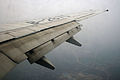 Double slotted Fowler flaps extended for landing
 -
 Krueger flaps and triple-slotted trailing-edge flaps of a Boeing 747 extended for landing
 -
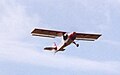 Junkers flaps, doubling as ailerons.
 -
 C-17A showing the multiple slotted flaps and slats while flaps are extended at the three quarters position


See also
[edit]
- Air brake (aeronautics)
- Aircraft flight control system
- Aileron
- Body flaps, a type of high-drag set of aerosurfaces designed for very high angle-of-attack descent of rocket-powered vehicles, particularly used during atmospheric entry of space vehicles. Body flaps are being designed to bleed off as much kinetic and potential energy as possible during a near-vertical descent through the atmosphere.[32][33][34]
- Circulation control wing
- High-lift device
- Leading-edge slat
References
[edit]- ^ a b c Perkins, Courtland; Hage, Robert (1949). Airplane performance, stability and control, Chapter 2, John Wiley and Sons. ISBN 0-471-68046-X.
- ^ a b Cessna Aircraft Company. Cessna Model 172S Nav III. Revision 3-12, 2006, pp. 4–19 to 4–47.
- ^ Windrow 1965, p. 4.
- ^ Rudolph, Peter K. C. (September 1996). "High-Lift Systems on Commercial Subsonic Airliners" (PDF). NASA. p. 39. Archived (PDF) from the original on 21 December 2019. Retrieved 7 July 2017.
- ^ Rudolph, Peter K. C. (September 1996). "High-Lift Systems on Commercial Subsonic Airliners" (PDF). NASA. pp. 40, 54. Archived (PDF) from the original on 21 December 2019. Retrieved 7 July 2017.
- ^ Reckzeh, Daniel (2004). "Aerodynamic Design of Airbus High-lift Wings in a Multidisciplinary Environment". p. 7. CiteSeerX 10.1.1.602.7484.
- ^ Gunston 2004, p. 452.
- ^ a b c Taylor 1974, pp. 8–9.
- ^ Toelle, Alan (2003). Windsock Datafile Special, Breguet 14. Hertfordshire, Great Britain: Albatros Productions. ISBN 978-1-902207-61-2.
- ^ Gunston 2004, p. 584.
- ^ Jacobs, James Wilbur (4 March 1967). "Interview with James Wilbur Jacobs". eCommons (Interview). Interviewed by Susan Bennet. University of Dayton. Archived from the original on 18 March 2020. Retrieved 20 July 2020.
- ^ Gunston 2004, p. 569.
- ^ Smith, Apollo M. O. (1975). "High-Lift Aerodynamics" (PDF). Journal of Aircraft. 12 (6): 518–523. doi:10.2514/3.59830. ISSN 0021-8669. Archived from the original (PDF) on 7 July 2011. Retrieved 12 July 2011.
- ^ Gunston 2004, p. 249–250.
- ^ National Aeronautics and Space Administration. Wind and Beyond: A Documentary Journey Into the History of Aerodynamics.
- ^ Hansen, James R.; Taylor, D. Bryan; Kinney, Jeremy; Lee, J. Lawrence (January 2003). "The Wind and Beyond: A Documentary Journey into the History of Aerodynamics in America. Volume 1; The Ascent of the Airplane" (PDF). ntrs.nasa.gov. NASA. Archived (PDF) from the original on 17 July 2020. Retrieved 17 July 2020.
- ^ Gunston 2004, p. 331.
- ^ Reed, Warren D.; Clay, William C. (30 June 1937). "Full-scale wind-tunnel and flight tests of a Fairchild 22 airplane equipped with external-airfoil flaps". NACA. Archived from the original on 21 October 2020. Retrieved 10 August 2020.
- ^ Gunston 2004, p. 270.
- ^ C.M. Poulsen, ed. (27 July 1933). ""The Aircraft Engineer - flight engineering section" Supplement to Flight". Flight Magazine. pp. 754a–d. Archived from the original on 27 June 2013.
- ^ "Chapter 10: Technology of the Jet Airplane". www.hq.nasa.gov. Archived from the original on 15 January 2017. Retrieved 11 December 2006.
- ^ "Virginia Tech – Aerospace & Ocean Engineering". Archived from the original on 7 March 2007.
- ^ Gunston 2004, p. 335.
- ^ Clancy 1975, pp. 110–112.
- ^ Gunston 2004, p. 191.
- ^ Williams, J. (September 1954). "An Analysis of Aerodynamic Data on Blowing Over Trailing Edge Flaps for Increasing Lift" (PDF). NACA. p. 1. Archived (PDF) from the original on 1 October 2015. Retrieved 11 January 2016.
- ^ American Military Training Aircraft' E.R. Johnson and Lloyd S. Jones, McFarland & Co. Inc. Publishers, Jefferson, North Carolina
- ^ "Shape-shifting flap takes flight". 17 November 2014. Archived from the original on 29 November 2014. Retrieved 19 November 2014.
- ^ Technical Committees Present the Year in Review. Aerospace America. 2014. p. 15.
- ^ "Army researchers explore future rotorcraft technologies". www.arl.army.mil. Archived from the original on 10 July 2018. Retrieved 10 July 2018.
- ^ "fig | slot opffh | pbar slot | 1921 | 0845 | Flight Archive". www.flightglobal.com. Archived from the original on 15 May 2019. Retrieved 18 April 2019.
- ^ Paul Wooster (20 October 2019). SpaceX - Mars Society Convention 2019 (video). Event occurs at 47:30-49:00. Retrieved 25 October 2019 – via YouTube.
Vehicle is designed to be able to land at the Earth, Moon or Mars. Depending on which ... the ratio of the energy dissipated aerodynamically vs. propulsively is quite different. In the case of the Moon, it's entirely propulsive. ... Earth: over 99.9% of the energy is removed aerodynamically ... Mars: over 99% of the energy is being removed aerodynamically at Mars.
- ^ @ElonMusk (5 August 2020). "We will do several short hops to smooth out launch process, then go high altitude with body flaps" (Tweet). Archived from the original on 6 August 2020 – via Twitter.
- ^ "UPCOMING TEST: Starship high-altitude flight test". spacex.com. 7 December 2020. Archived from the original on 27 November 2020. Retrieved 8 December 2020.
Bibliography
[edit]- Clancy, L.J. (1975). "6". Aerodynamics. London: Pitman Publishing Limited. ISBN 978-0-273-01120-0.
- Gunston, Bill, The Cambridge Aerospace Dictionary Cambridge, Cambridge University Press 2004, ISBN 978-0-521-84140-5/ISBN 0-521-84140-2
- Windrow, Martin C. and René J. Francillon. The Nakajima Ki-43 Hayabusa. Leatherhead, Surrey, UK: Profile Publications, 1965.

Flap (aeronautics)
View on GrokipediaAerodynamic Principles
Lift and Drag Enhancement
Flaps serve as high-lift devices in aeronautics, functioning by deflecting the trailing or leading edge of an aircraft wing to alter the airflow over the airfoil surface.[4] This deflection modifies the pressure distribution around the wing, enabling enhanced aerodynamic performance during critical flight phases.[5] The primary mechanism for lift enhancement involves increasing the wing's effective camber and expanding its effective area. Deflecting the trailing edge downward raises the camber, which steepens the lift curve and elevates the lift coefficient at a given angle of attack; simultaneously, certain flap designs extend the chord length, augmenting the reference area exposed to the airflow.[4] Mathematically, the flapped lift coefficient is expressed as , where is the incremental lift from the flap, dependent on the deflection angle and the flap chord ratio .[4] For trailing edge flaps, this increment typically yields a maximum lift coefficient increase of 50-100% compared to the clean wing configuration.[6] Regarding drag, flap deployment generally reduces induced drag at high lift conditions by lowering the effective induced angle of attack through improved spanwise lift distribution, but it substantially elevates parasitic drag due to the altered wetted surface and flow separation on the flap itself.[5] The overall drag is governed by the equation , where post-deployment (the zero-lift drag coefficient) rises owing to increased form and skin friction components, shifting the drag polar upward.[4] Early theoretical foundations for these effects trace to the 1920s, when Ludwig Prandtl's lifting-line theory—initially formulated in 1918—was extended to analyze flapped wings, modeling the spanwise circulation and induced effects to predict lift and drag alterations from edge deflections.[7] This framework provided the seminal basis for quantifying flap-induced changes in wing aerodynamics, emphasizing vortex interactions and optimal load distributions.[7]Stall Characteristics and Boundary Layer Control
Flaps significantly alter the stall characteristics of an airfoil by modifying the effective camber and flow separation behavior. For plain flaps, the increased camber typically lowers the stall angle of attack by 5-10° compared to the clean configuration, as the adverse pressure gradient on the flap surface promotes earlier flow separation.[8] This reduction in stall angle arises from the flap's contribution to lift at lower angles, but it can lead to premature stall if the deflection exceeds design limits, limiting maximum lift coefficients to around 1.5-2.0 for typical airfoils.[9] In contrast, slotted flaps mitigate this by incorporating gaps that delay separation, allowing stall angles closer to or exceeding those of the clean wing in some cases. Boundary layer control is a key mechanism by which flaps, particularly slotted designs, influence stall onset. The slot between the wing and flap allows high-energy freestream air to flow into the boundary layer over the flap, re-energizing it and preventing premature separation.[10] This process adds momentum thickness to the low-energy boundary layer, effectively increasing its resistance to adverse pressure gradients and extending the attached flow region. For single-slotted flaps, this enables deflections up to 35° without separation, compared to only 10° for plain flaps, resulting in higher maximum lift coefficients (e.g., up to 2.42 in wind tunnel tests at Re = 2.83 × 10^6).[10][9] The reduction in stall speed due to flaps follows directly from the increase in maximum lift coefficient (C_{L_{max}}). The flapped stall speed is given by where the higher C_{L_{max, flapped}} (often 1.5-2.0 times the clean value) yields a 20-30% lower stall speed in typical configurations.[11] This formula derives from the steady lift equation, L = \frac{1}{2} \rho V^2 S C_L, equating lift to weight at minimum speed. For example, in transport aircraft with advanced high-lift systems, this enables safe operations at approach speeds well below clean stall limits. Despite these benefits, flaps introduce adverse effects at high angles of attack. Hinge moments increase significantly with flap deflection and angle of attack, as the pressure differential across the flap surface generates substantial aerodynamic loads, often requiring powered actuation to maintain position.[12] Additionally, at high angles of attack near stall, flaps can induce buffet through unsteady flow separation and vortex shedding over the flap, exacerbating structural vibrations and pilot workload.[13] Wind tunnel experiments highlight differences in separation behavior between flap types. On plain flaps, a leading-edge separation bubble forms at moderate deflections (e.g., 20°), leading to long-bubble stall and abrupt lift loss, with maximum lift increments limited to about 0.5 times theoretical values.[9] Slotted flaps, however, promote short-bubble or trailing-edge stall via slot-induced suction, delaying separation and achieving higher lift (e.g., C_{l_{max}} ≥ 2.77 for landing configurations at Re_c = 1.37 × 10^6).[9] These results, from tests on supercritical airfoils, underscore the role of slot geometry in boundary layer management for stall resistance.Operational Applications
Takeoff and Climb Configurations
In takeoff and climb configurations, flaps are typically deflected between 10 and 20 degrees to optimize the balance between increased lift and the accompanying drag penalty, enabling shorter runway distances while maintaining adequate initial climb performance.[14] This partial extension enhances the wing's camber and effective area, allowing the aircraft to achieve the required lift coefficient at lower airspeeds without excessive induced drag that could hinder acceleration.[15] The primary performance impacts of these flap settings include a reduction in takeoff speed (V_TO) by approximately 10-15 percent compared to clean configurations, as the lower stall speed permits rotation and liftoff at reduced velocities, while also increasing the initial climb gradient through higher excess thrust available at low speeds.[16] This configuration shortens the ground roll and total takeoff distance, with an approximation given by the formulawhere is the liftoff speed and is the climb acceleration incorporating flap-induced changes to lift and drag coefficients.[17] For example, in light general aviation aircraft like the Cessna 172, a 10-degree flap setting can reduce ground roll by about 10 percent under standard conditions.[16] Configuration specifics emphasize partial flap extension during the initial climb-out phase to minimize drag buildup, with retraction typically initiated once a safe altitude and speed (often above 400 feet and at or beyond best rate-of-climb speed, V_Y) are achieved.[18] Regulatory standards in FAR Part 25 require, for example, an all-engines steady climb gradient of at least 4% with gear retracted and flaps in takeoff position (FAR 25.119), and for one-engine-inoperative conditions, a 2.4% gross gradient to 400 feet with flaps in takeoff position (FAR 25.121(b)), transitioning to flaps retracted for continued climb while ensuring obstacle clearance capability even after flap retraction.[18][19][20] Historically, the use of around 15-degree flap settings for takeoff evolved in 1930s aircraft designs, including bombers and early airliners, to improve short-field performance on unprepared runways common during that era; for instance, the Douglas DC-3 typically employed zero-degree flap deflection for standard takeoffs, with flaps used optionally for short-field performance to enhance low-speed lift without compromising climb.[21][22] Such configurations marked a shift from earlier clean-wing takeoffs, prioritizing balanced high-lift benefits in operational environments with limited infrastructure. Key risks associated with these configurations include over-reliance on flaps, which can lead to higher fuel burn due to increased drag requiring greater engine power during the early climb phase, and potential issues from asymmetric deployment, such as unintended roll moments that demand immediate corrective aileron input to maintain control.[23] Proper pre-takeoff checks and adherence to aircraft-specific procedures mitigate these hazards, ensuring safe transition to climb.[18]
Landing and Approach Configurations
In landing and approach phases, flaps are typically extended to full deflection, often between 30° and 40°, to maximize both lift and drag coefficients, allowing for reduced approach speeds and steeper descent paths. This configuration lowers the stall speed by increasing the maximum lift coefficient (C_{L_{max}}), enabling approach speeds as low as 1.3 times the stall speed in landing configuration (V_{S1G}), which can reduce the reference approach speed (V_{APP}) by approximately 20-30% compared to clean configuration, depending on the aircraft type and wing design.[24] For instance, on straight-wing aircraft, full flap extension can boost C_{L_{max}} by up to 50%, directly contributing to this speed reduction while permitting glideslopes steeper than the standard 3° to enhance obstacle clearance and noise abatement.[24] This practice relies on the stall delay provided by flaps, which maintains attached flow at higher angles of attack during low-speed descent.[24] The drag-focused benefits of full flap extension are particularly valuable for speed control and deceleration during approach. Parasitic drag rises substantially beyond 15°-20° deflection, with the drag coefficient (C_D) increasing by approximately 0.05 to 0.10 or more in typical landing setups, aiding in maintaining a stable descent rate without excessive power adjustments.[25] This elevated drag reduces the glide ratio (GR), which is fundamentally the lift-to-drag ratio (L/D = C_L / C_D), such that the flapped configuration yields GR_{flapped} \approx GR_{clean} \times \left( \frac{(C_{L}/C_{D}){flapped}}{(C{L}/C_{D})_{clean}} \right), often halving the clean-wing GR to promote a steeper path and quicker energy dissipation.[24] Approach procedures emphasize a stabilized configuration, with flaps fully extended, landing gear down, and a descent rate of 500-1,000 feet per minute at the target speed, ensuring the aircraft crosses the threshold at the correct attitude for flare and touchdown; deviations prompt a go-around.[25] During flare, the increased lift from flaps supports a smooth transition to ground effect, minimizing bounce risks, while actuation systems must reliably achieve full deployment for these dynamics.[25] Go-around maneuvers from a landing approach require prompt flap retraction to the takeoff setting (typically 10°-20°) to restore climb performance and minimize drag, allowing the aircraft to accelerate to a safe climb speed while maintaining positive rate of climb.[25] Energy management is critical in balked landings, where full power is applied, pitch is adjusted for best angle of climb, and flaps are retracted incrementally to avoid excessive sink or stall; improper sequencing can lead to insufficient thrust-to-drag ratio for recovery.[25] Case studies highlight risks of misconfiguration, such as a 2011 domestic non-scheduled flight where unstable approach and delayed go-around with flaps at 40° resulted in controlled flight into terrain (CFIT), killing 12 of 15 aboard due to inadequate altitude gain from persistent high-drag settings.[26] Post-2000 aviation safety analyses underscore that such incidents often stem from unstabilized approaches below 500 feet AGL, emphasizing checklist adherence for flap settings to prevent CFIT.[26]In-Flight Maneuvering and Control
In fighter aircraft, flaps are deployed at partial deflections, typically between 10° and 20°, to augment roll control and reduce turn radii during dynamic maneuvers such as sustained turns or combat engagements.[27] This partial extension increases the wing's lift coefficient (C_L) without excessively increasing drag, enabling tighter turns at subsonic speeds where stall limits would otherwise constrain performance.[28] For instance, in the F-4 aircraft, a 13° trailing-edge flap deflection delayed buffet onset and boosted the normal-force coefficient by up to 0.25 at Mach 0.89, enhancing turn capability across a range of angles of attack.[28] The primary benefit of flaps in maneuvering stems from their ability to elevate the maximum load factor (n) at lower airspeeds by amplifying C_L, which directly influences turn performance. The instantaneous turn rate (ω) can be expressed as: where g is gravitational acceleration and V is true airspeed; flaps boost n, thereby increasing ω for a given V, particularly in sustained turns where energy management is critical.[29] In military applications, such as the F-16, automatic "combat flap" scheduling deploys trailing-edge devices to optimize lift during high-g pulls, improving sustained turn rates by minimizing speed bleed-off compared to clean configurations.[30] Conversely, civil aircraft restrict flap use in maneuvers to partial extensions below 15° to prevent structural overload, as full deflections could exceed design load limits and induce excessive hinge moments.[31] Despite these advantages, partial flap deployment in maneuvers introduces challenges, including elevated hinge moment loads that necessitate powered hydraulic or electro-hydrostatic actuation to maintain control authority.[32] Cyclic flap operations during repeated combat turns—averaging 23 cycles per 100 maneuvers—also accelerate structural fatigue in flap tracks and hinges, requiring rigorous damage tolerance assessments and inspections to ensure longevity.[33] Modern developments in fly-by-wire (FBW) systems have integrated automatic flap scheduling for enhanced maneuver control, particularly in post-2010 designs like the F-35, where electro-hydrostatic actuators dynamically position leading- and trailing-edge flaps based on flight regime and pilot inputs to optimize lift during agile operations from hover to supersonic flight.[34] This FBW-driven approach reduces pilot workload while mitigating fatigue risks through precise, condition-specific deflections.[30]Mechanical Design and Actuation
Track Systems and Deployment Mechanisms
Track systems guide the precise movement of flaps during extension and retraction, ensuring structural integrity and aerodynamic efficiency. Common configurations include straight tracks, which provide linear aft motion suitable for initial Fowler deployment, as seen on the Airbus A320 and A330 aircraft.[35] Hooked tracks, featuring a straight forward section transitioning to a curved aft end, enable combined aft and downward motion for landing configurations, employed on Boeing 727, 737, and 747 models.[35] Articulated tracks, often integrated with multi-linkage mechanisms like four-bar systems, allow complex drooped or pivoting paths to optimize flap positioning, as in the Boeing 767's hinged-beam design.[35] For Fowler flaps, roller-bearing tracks facilitate smooth aft extension, increasing wing area while minimizing friction and wear during deployment.[36] Actuation methods power the flap's motion, with hydraulic systems dominating large commercial and military aircraft due to their high force output and rapid response from incompressible fluid.[37] Electric actuators, often using high-torque motors like Samarium-Cobalt types, are prevalent for secondary controls such as flaps, offering precise control and reduced maintenance in modern designs; electro-mechanical systems are increasingly used in contemporary aircraft like regional jets for efficiency.[37] Pneumatic systems, though less common, provide reliable operation in simpler applications with lower pressure requirements.[37] Torque demands arise from aerodynamic hinge moments, calculated as where is air density, is velocity, is flap area, is flap chord, is the hinge moment derivative with respect to deflection, and is flap deflection angle; this formulation ensures actuators can overcome moments scaling with dynamic pressure and flap geometry.[12] Synchronization mechanisms prevent asymmetric deployment, which could induce severe rolling moments, through mechanical linkages and centralized power drive units (PDUs) that distribute torque evenly across flap panels.[35] In commercial jets, redundancy features dual hydraulic circuits and independent motors within PDUs, allowing continued operation if one system fails, as required by certification standards.[38] These setups, often including self-locking gearboxes and jam-resistant shafts, maintain flap symmetry during takeoff extensions.[35] Flap deployment mechanisms have evolved from manual cable systems in 1920s aircraft, reliant on pilot effort for basic hinging, to powered hydraulic setups by the 1930s, as in the Douglas DC-3's flaps.[39] By the 1950s, Boeing integrated hydraulic actuators in models like the 707 for reliable extension in jetliners. Maintenance focuses on inspecting tracks, fairings, and seals for wear, as degradation can increase parasitic drag from exposed mechanisms.[40] Routine checks involve visual and non-destructive testing of roller bearings and linkages to detect corrosion or binding, ensuring seals remain intact to preserve streamline flow over fairings.[41]Load Limitations and Thrust Gates
Load limitations for aircraft flaps are primarily dictated by structural integrity considerations, ensuring that the wing and flap assemblies can withstand anticipated aerodynamic and inertial loads without failure. Maximum deflection angles are constrained based on wing loads to prevent exceeding design limits; for instance, under Federal Aviation Regulations (FAR) Part 25, transport category airplanes must be designed to accommodate a maneuvering load factor of 1.5 g at maximum takeoff weight with flaps in the approach position, which directly influences permissible deflection during critical phases like takeoff and landing. Similarly, European Union Aviation Safety Agency (EASA) Certification Specifications (CS-25) align with these requirements, mandating equivalent load considerations for flap-extended configurations to maintain structural safety margins. Extended flap positions can compromise aeroelastic stability by reducing the flutter onset speed compared to the clean wing configuration, necessitating strict adherence to flap-extended speed limits (V_FE) to avoid dynamic instabilities. Gust load factors specified in certification standards further shape flap speed schedules; FAR 25.341 requires design for vertical gusts up to 1.5 g upward and 1.0 g downward at relevant speeds, ensuring flaps do not encounter excessive bending moments or torsional loads during turbulent conditions. These limits are verified through ground vibration testing and flight flutter tests, as outlined in FAA Advisory Circular AC 25-7D, to confirm safe margins above operational envelopes.[43] Thrust gates serve as protective mechanisms to mitigate risks associated with high engine power settings and extended flaps, such as aerodynamic separation, hot gas reingestion into engines, or structural overload from uneven thrust distribution. These systems typically implement engine power cutoffs, reduced thrust limits, or cockpit warnings, varying by aircraft type; they are integrated into the aircraft's engine control and flap actuation logic to ensure coordinated response without hardware overload.[44] Failure modes for flaps often stem from overload events like bird strikes or icing accumulation, which can deform or jam mechanisms, leading to asymmetric deployment or total loss of control surface authority. Bird strikes damage wings (including potential flap areas) in approximately 25% of damaging wildlife strikes reported from 1990-2024, compromising structural integrity and requiring immediate pilot intervention.[45] Icing exacerbates this by adding uneven weight and altering airflow, potentially causing overload fractures in flap tracks or hinges. Historical accidents in the 1980s involved post-crash overload damage to flap mechanisms like control cables and push-pull rods, highlighting these vulnerabilities and prompting enhanced design standards.[46][47] To counter these risks, modern aircraft incorporate mitigation features like precise flap position indicators, which provide real-time feedback in the cockpit to detect discrepancies early, and auto-retract systems that automatically retract flaps during overspeed or high-gust conditions to alleviate loads.[48] These systems, common in fly-by-wire designs, use sensors and flight control computers to execute gust load alleviation, reducing peak loads by up to 20% without pilot input and referencing maneuvering risks only in terms of overall stability.[49] Certification under FAR 25.1309 ensures these mitigations achieve a probability of catastrophic failure below 10^{-9} per flight hour, enhancing overall safety.Trailing Edge Flap Types
Plain and Split Flaps
Plain flaps consist of a hinged section at the trailing edge of the wing that pivots downward, effectively increasing the camber of the airfoil to generate additional lift at low speeds.[50] This simple design relies on deflecting the entire trailing-edge surface, typically limited to angles of about 20° to 30° to avoid excessive flow separation on the flap's upper surface, which can lead to early stall.[51] The maximum lift coefficient increment (ΔC_L max) for plain flaps is generally in the range of 0.9 to 1.0, depending on the airfoil section and deflection angle, such as 0.9 for an NACA 65,3-618 airfoil at 60° deflection.[50] However, the abrupt change in surface curvature often promotes boundary layer separation, reducing the overall effectiveness compared to more advanced flap types.[51] Design specifics for plain flaps include a chord ratio of approximately 20% of the wing chord, allowing for straightforward integration into the wing structure.[50] Actuation is achieved through simple mechanical linkages or hinges, often powered by hydraulic or electric systems, which contribute to their low manufacturing and maintenance costs.[50] Advantages of plain flaps encompass their mechanical simplicity, reliability, and ease of actuation, making them suitable for early aircraft designs where high-lift requirements were modest.[50] Disadvantages include limited lift augmentation relative to modern slotted or extending flaps and a notable increase in drag, with the drag polar showing a C_D increment of around 0.02 to 0.04 at typical deflections, which aids in landing but penalizes takeoff performance.[51] Split flaps operate by deflecting only the lower surface of the trailing edge downward, while the upper surface remains fixed, creating a slot-like gap that energizes the boundary layer and enhances lift through increased circulation.[50] This configuration was notably employed on the Douglas DC-3 airliner in the 1930s, where hydraulically actuated split flaps spanning the inboard wing sections provided essential low-speed lift for short-field operations.[52] The ΔC_L max for split flaps averages about 1.0, slightly higher than plain flaps of equal chord due to the effective camber increase and reduced chord loss from the fixed upper surface, though values can reach 1.5 under optimal conditions.[50] Like plain flaps, split flaps promote flow separation in the wake, resulting in high drag that is particularly beneficial for steep descent profiles during landing.[51] Split flaps typically feature a chord ratio of 20% to 30%, with actuation via basic hinges and linkages that maintain the upper surface's integrity for cruise efficiency.[50] Their primary advantages include greater lift generation than plain flaps at a comparable simplicity and cost, along with substantial drag for speed control without additional devices.[50] However, the pronounced drag polar shift—often exceeding that of plain flaps—and tendency for large separated flow regions limit their use in high-performance applications, favoring instead their role in early commercial and military aircraft for landing drag management.[51] Early wind-tunnel investigations, such as those by the National Advisory Committee for Aeronautics in the 1920s, confirmed split flaps' superior lift increments over ordinary flaps but highlighted their drag penalties.[53]Slotted and Fowler Flaps
Slotted flaps feature a fixed or variable gap between the wing and the flap, which allows high-energy airflow from the underside of the wing to energize the boundary layer over the upper surface of the deflected flap, thereby delaying stall and improving lift generation.[24] This design typically achieves a maximum lift coefficient increment (ΔC_L max) of approximately 1.2 to 1.5 compared to the clean wing configuration, enabling better stall delay and higher maximum lift at lower speeds.[5] The Fowler flap, a specialized type of slotted flap, incorporates vanes and curved tracks that enable the flap to extend aft and downward, increasing the wing area by 20-30% while also forming a slot for energized airflow.[51] Patented in 1921 by American engineer Harlan D. Fowler, this mechanism was notably employed on the Boeing B-17 Flying Fortress bomber during the 1930s and 1940s, marking its early adoption in military transports.[54] The deployment path follows a curved trajectory, facilitating both area expansion and camber increase. Common configurations include single-slotted Fowler flaps for simplicity in smaller aircraft and double-slotted variants for enhanced performance in airliners, such as the Boeing 737 Next Generation series, which uses double-slotted trailing-edge flaps powered by hydraulic systems.[55] Performance-wise, the lift-to-drag ratio (L/D) for Fowler flaps peaks at deflections of 15-20°, optimizing takeoff and climb efficiency before drag dominates at higher angles.[51] Their widespread historical adoption began in 1940s transport aircraft, evolving from early military applications to standard use in commercial jets for superior high-lift capabilities.[56] Despite these advantages, Fowler flaps introduce drawbacks due to their mechanical complexity, including multiple tracks and linkages that can increase aircraft weight by 5-10% relative to simpler flap systems.[51] This added mass and maintenance demands have prompted ongoing efforts to simplify designs in modern airliners while retaining effective lift augmentation.[57]High-Lift Specialized Flaps
High-lift specialized flaps represent a category of trailing edge devices developed for exceptional aerodynamic performance in niche applications, often prioritizing maximum lift generation over simplicity or widespread adoption. These designs emerged primarily in the interwar and World War II eras, addressing specific needs like short takeoff and landing (STOL) capabilities or enhanced low-speed handling in prototypes and military aircraft. Unlike more conventional flaps, they incorporate unique geometries or deployment paths to achieve substantial increases in lift coefficient while introducing trade-offs in drag and mechanical complexity.[58] The Junkers flap, a full-span split-type configuration with the upper surface remaining fixed, was pioneered by the German Junkers company in the late 1920s and early 1930s. It features an external pivoting section mounted below the trailing edge that rotates about its forward hinge, creating a slotted gap to energize airflow over the flap and augment lift. This design provided substantial lift augmentation for aircraft like the Junkers Ju 52 transport and Ju 87 Stuka dive bomber, though it incurred high drag penalties due to the exposed supporting structure.[58][59][60] In contrast, the Gouge flap employs a bulbous lower surface extension that translates rearward and downward along a curved track, effectively increasing wing area and camber for improved low-speed performance. Invented by Arthur Gouge for Short Brothers in 1936, it was implemented as a low-drag variant on flying boats such as the Short Empire and the WWII Sunderland patrol bomber, where the sharp-nosed aerofoil section integrates seamlessly when retracted. This mechanism enhances handling at low speeds by promoting attached flow, making it suitable for operations on water or unprepared surfaces.[61][62] The Fairey-Youngman flap combines pivoting and translational motion to achieve extreme camber changes, often dropping downward initially before sliding aft and rotating, which can yield up to a significant portion of additional wing area—approaching 50% in some configurations—for superior high-lift output. Developed in the British 1940s prototypes by Fairey Aviation in collaboration with Robert Youngman, this external aerofoil type was tested on aircraft like the Fairey P.4/34 and later fitted to the Fairey Firefly naval fighter, providing nearly double the lift increment of contemporary split flaps at the cost of increased drag during approach. Its dual-position deployment allowed for medium-lift/low-drag settings for takeoff and full extension for landing.[63][64][65] The Zap flap, a variant of the split design capable of high deflections up to 90 degrees, was explored for STOL applications in post-1970s experimental contexts, where it hinges sharply to maximize lift by altering effective camber dramatically. Its use remains rare due to challenges in maintaining flow attachment at extreme angles, often requiring augmentation like suction to suppress wake turbulence and sustain lift gains.[66][62] Collectively, these specialized flaps can deliver lift coefficient increments exceeding 1.5, surpassing many standard trailing edge devices, but their benefits come at the expense of retraction complexity and elevated drag, limiting adoption to specific historical or experimental roles without standardized performance equations owing to their infrequent implementation. They build on precursors like the Fowler flap for STOL utility, emphasizing area and camber enhancements in operational scenarios demanding ultra-low speeds.[58][59][66]Leading Edge Flap Types
Krueger and Slotted Leading Edge Devices
Krueger flaps and slotted leading edge devices are high-lift mechanisms deployed on the forward portion of the wing to enhance aerodynamic performance at low speeds by maintaining attached airflow and delaying stall. These devices primarily increase the maximum lift coefficient (C_L,max) by modifying the leading edge geometry, allowing higher angles of attack before flow separation occurs. Unlike trailing edge flaps, which primarily alter camber, leading edge devices focus on energizing the boundary layer over the upper surface to prevent premature stall, often providing a lift increment of approximately 0.5 to 0.8 in C_L.[67][5] The Krueger flap, named after its inventor Werner Krueger, is a hinged leading edge device that deploys from a stowed position beneath the wing's leading edge. It rotates forward and downward via a four-bar linkage mechanism, forming an extension that increases effective camber and promotes attached flow at high angles of attack. On the Boeing 747, variable camber Krueger flaps are employed along the inboard leading edge, contributing to stall delay by shifting the stall angle higher. This configuration exemplifies their role in large transport aircraft, where they provide significant low-speed lift augmentation without excessive complexity.[67][68] Slotted leading edge devices, often implemented as retractable slats, consist of auxiliary airfoils positioned ahead of the main wing leading edge to create a narrow slot. When extended, this slot channels high-energy airflow from below the wing over the upper surface, re-energizing the boundary layer and delaying separation. Fixed slots are simpler but incur cruise drag penalties, while retractable slats can deploy automatically through aerodynamic forces or droop mechanisms, particularly on swept wings where low-speed handling is critical. These devices typically achieve deflections of 20 to 30 degrees via hinge or track systems, optimizing lift at angles of attack up to 25 degrees or more.[5][69] The airflow through the slot in these devices is characterized by an accelerated velocity, approximately V_{slot} \approx 1.2 V_{\infty}, where V_{\infty} is the freestream velocity; this enhancement helps maintain laminar flow attachment and boosts local lift coefficients near the leading edge. In deployment, the slat or flap pivots on tracks or hinges, with the slot gap designed to minimize drag while maximizing energy transfer—typically 0.5 to 2% of chord length for optimal performance.[68][5] Historically, these devices gained prominence in 1950s swept-wing jet aircraft, such as early fighters and transports, to address low-speed stall issues inherent to high-sweep designs. In supersonic applications, they delay shock-induced boundary layer separation on swept leading edges, improving transonic and low-supersonic handling by promoting vortex formation or attached flow over the wing. For instance, Krueger flaps have been integrated into tactical aircraft configurations to enhance short takeoff and landing (STOL) capabilities while mitigating separation at high angles.[69][70] Despite their benefits, Krueger flaps and slats introduce limitations, including vulnerability to ice accumulation on the exposed leading edge, which can disrupt slot airflow and reduce lift even with thin accretions. This risk necessitates dedicated anti-icing systems, such as pneumatic boots or heated elements, particularly on the slat tracks and hinges. Additionally, the added structural weight along with actuation mechanisms imposes a cruise performance penalty through increased drag when retracted. These devices often synergize with trailing edge flaps to achieve full high-lift configurations, further extending stall margins during approach and landing.[71][72][73]Variable Camber Leading Edge Flaps
Variable camber leading edge flaps enable dynamic adjustment of the wing's leading edge shape to optimize aerodynamic performance across flight regimes, contrasting with rigid devices like the Krueger flap by allowing continuous camber variation without discrete gaps.[67] These flaps primarily increase camber at high angles of attack to enhance lift while minimizing drag penalties in cruise. A basic implementation is the drooped leading edge flap, which uses a simple hinged mechanism to deflect the leading edge downward by 10-15 degrees, increasing local camber and thereby boosting the maximum lift coefficient by approximately ΔC_L = 0.3.[74] This design is commonly applied in general aviation aircraft to improve low-speed handling and stall characteristics without significantly compromising cruise efficiency.[75] Advanced seamless variants, such as flex-core flaps, employ piezoelectric composites or shape-memory alloys to achieve smooth camber changes post-2000, driven by research into morphing structures for reduced aerodynamic discontinuities.[76] These actuators induce strain in the leading edge skin, enabling gapless deflection that lowers airframe noise during deployment compared to hinged systems.[77] In terms of performance, variable camber leading edge flaps extend the region of laminar flow attachment by adapting the airfoil curvature, where the camber is modulated through controlled actuator strain to delay transition to turbulent flow.[78] This adaptation supports higher lift at low speeds while preserving low drag in cruise. NASA conducted wind tunnel tests in the 2010s on variable camber leading edge concepts, demonstrating seamless transitions from cruise to landing configurations that improve overall mission efficiency by optimizing lift distribution without abrupt shape changes.[79] Key challenges include actuator durability under repeated cyclic loads, as piezoelectric and shape-memory alloy systems experience fatigue from thousands of deformation cycles, necessitating robust materials to ensure long-term reliability in operational environments.[80]Advanced and Hybrid Flap Systems
Blown and Flexible Flaps
Blown flaps augment aerodynamic lift by directing engine exhaust or bleed air over the flap surface, leveraging the Coanda effect to adhere the jet to the curved surface and delay flow separation. This technique, developed in the mid-20th century, can increase the maximum lift coefficient by 50-100% compared to conventional flaps alone, enabling short takeoff and landing (STOL) capabilities.[81] Early applications included STOL prototypes like the LTV XC-142 tiltwing aircraft in the 1960s, where blowing enhanced low-speed performance.[82] In upper surface blowing configurations, high-bypass turbofan exhaust is directed over the wing and flap via contoured nacelles, achieving turning efficiencies up to 94% and lift coefficients exceeding 9.0 at high thrust levels.[81] The effectiveness is quantified by the blowing momentum coefficient , where is the mass flow rate, the jet velocity, the freestream density, the freestream velocity, and the wing area; typical values of 0.05-0.10 suffice for boundary layer control and separation prevention.[83] Flexible flaps employ composite materials or inflatable sections to enable smooth, seamless deflection without gaps, contrasting rigid mechanisms by minimizing aerodynamic discontinuities. These designs, such as those using FlexSys Inc.'s patented composites, reduce airframe noise during landing by eliminating "step" gaps that generate tonal noise.[84] Such systems find applications in military V/STOL aircraft, where vectored thrust supports vertical operations, and in post-2015 experimental UAVs incorporating bio-inspired flexible flaps for enhanced low-Reynolds-number robustness. Recent research as of 2025 has explored compliant morphing flaps for next-generation green aircraft to further improve efficiency and reduce noise.[82][85][86] Despite a fuel efficiency penalty from bleed air extraction—reducing engine thrust by up to 10%—blown and flexible flaps enable ultra-short takeoffs, offsetting costs in specialized missions.[87]Gurney and Continuous Trailing-Edge Flaps
The Gurney flap is a simple passive device consisting of a short, perpendicular tab attached to the trailing edge of an airfoil, typically with a height of 1-2% of the chord length.[88] Invented by American race car driver and engineer Dan Gurney in 1971 to generate additional downforce on vehicle wings during testing for the Indianapolis 500, it was later adapted for aeronautical use to enhance lift generation.[89] The flap operates by altering the Kutta condition at the trailing edge, producing a pair of counter-rotating vortices in the near wake that effectively increase the airfoil's camber and the pressure differential between the upper and lower surfaces.[90] This mechanism yields a lift coefficient increment (ΔC_L) of approximately 0.2 to 0.4, with wind tunnel experiments demonstrating a nearly linear relationship between ΔC_L and the normalized flap height (h/c) for values up to 2%. However, the induced wake turbulence and form drag result in a performance penalty, typically increasing drag and reducing the lift-to-drag (L/D) ratio by 10-20% compared to the unflapped airfoil.[90] In aeronautical applications, Gurney flaps provide fine-tuned lift augmentation suitable for scenarios requiring modest high-lift enhancements without complex actuation. They have been employed on sailplanes to improve glide ratios and low-speed performance, on light aircraft for trim adjustments to maintain stability, and on helicopter horizontal stabilizers to counteract pitch moments during forward flight.[88] Originally derived from motorsport aerodynamics, the device's simplicity allows easy retrofitting to existing wings, though its drag penalty limits use to low-speed or specialized regimes rather than primary high-lift systems. The continuous trailing-edge flap (CTEF) represents an advanced seamless variant of trailing-edge devices, featuring a full-span hinged structure that deflects without gaps or breaks to maintain aerodynamic continuity. Developed under NASA's Morphing Aircraft Structures program in the early 2000s, with key advancements through the Variable Camber Continuous Trailing-Edge Flap (VCCTEF) concept in collaboration with Boeing starting around 2010, it enables variable camber shaping via multiple spanwise segments actuated by piezocomposite materials or other mechanisms.[91] The design achieves smooth deflections up to 30° in high-lift configurations by proportionally adjusting chordwise segments into a continuous arc, minimizing hinge-induced drag and noise while allowing precise load alleviation and camber optimization.[92] Wind tunnel tests of VCCTEF systems have shown linear lift increases with deflection angle, supporting applications in performance-adaptive wings for transport aircraft.[91] CTEF technology focuses on efficient lift tuning across flight phases, particularly for flexible aeroelastic structures where traditional gapped flaps would exacerbate drag. In fixed-wing aircraft, it facilitates seamless transitions for cruise efficiency and takeoff/landing augmentation, as demonstrated in NASA-Boeing wind tunnel models achieving up to 6% drag reduction at moderate lift coefficients.[91] For rotorcraft, CTEF enables primary flight control by providing uniform trailing-edge deformation for pitch, roll, and yaw without discrete actuators, enhancing responsiveness in helicopters.[92] Overall, its gapless operation suits high-efficiency designs like sailplanes and light aircraft, where subtle camber adjustments improve trim and endurance without the vortex-induced penalties of discrete tabs like the Gurney flap.[93]Flaperons and Related Control Surfaces
Flaperons are hybrid control surfaces that integrate the functions of trailing-edge flaps and ailerons on an aircraft's wings.[94] They are typically located on the outboard trailing edge and can deflect downward symmetrically to augment lift and drag during low-speed operations such as takeoff and landing, or differentially to produce rolling moments for bank control.[94] This dual-role design allows a single surface to handle both high-lift generation and lateral maneuvering, distinguishing flaperons from dedicated flaps or ailerons.[95] Each flaperon requires independent actuation systems for the left and right wings to enable precise symmetric or differential deflection.[94] Pilot inputs for flaps and ailerons are mixed through a control system that commands the surfaces accordingly; for instance, symmetric deflection increases camber for lift, while differential movement creates a net rolling moment.[94] In simplified terms, the steady-state roll rate induced by differential flaperon deflection can be approximated as , where is airspeed, is the roll moment coefficient derivative with respect to deflection, and is the moment of inertia about the roll axis; this equation highlights the dependence on deflection, speed, and aircraft inertia for roll performance.[95] The primary advantages of flaperons include reduced overall aircraft weight and structural complexity in designs with blended or tailless wings, as fewer dedicated surfaces are needed.[96] Their implementation became more feasible with the advent of digital fly-by-wire systems in the post-1980s era, which allow programmed mixing of control laws to optimize lift and roll without mechanical linkages.[97] However, a key drawback arises during high-lift phases, where a demand for roll control can require asymmetric deflection, potentially reducing maximum lift on one wing and compromising overall performance or stall margins.[95] A representative example is the F/A-18 Hornet, where the trailing-edge surfaces function as programmed flaperons to provide maneuver enhancement; they deflect symmetrically for lift during carrier operations and differentially for agile roll response, integrated via fly-by-wire controls.[95] Related control surfaces extend the hybrid concept to other configurations. Elevons combine elevator and aileron functions for pitch and roll control in tailless delta-wing aircraft, such as the Concorde supersonic transport, where six elevons on each wing trailing edge are managed by an early fly-by-wire system to maintain stability without a horizontal stabilizer.[97] Spoilerons, meanwhile, employ differential spoiler deployment on the wings to assist roll control alongside flap operations, reducing lift asymmetrically to enhance bank rates while minimizing adverse yaw; this is common in larger transport aircraft for supplementary lateral authority during descent.[94]References
- https://ntrs.[nasa](/page/NASA).gov/api/citations/19870004356/downloads/19870004356.pdf