Hubbry Logo
Xu ChuXu ChuMain
Open search
Xu Chu
Community hub
Xu Chu
logo
8 pages, 0 posts
0 subscribers
Be the first to start a discussion here.
Xu Chu
Xu Chu
from Wikipedia

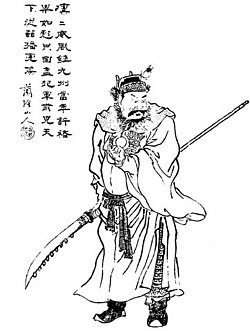
Xu Chu (pronunciation) (died c. 230),[a] courtesy name Zhongkang, was a Chinese military general who lived during the late Eastern Han dynasty and the Three Kingdoms period of China. He started his career as a bodyguard to the warlord Cao Cao and later became a general in the state of Wei during the Three Kingdoms period. He was described to be a big and strong man, yet simple minded and honest, so he was nicknamed "Tiger Fool" by his men. After his death, he was posthumously honoured with the title "Marquis Zhuang", which literally means "robust marquis".

Key Information

Early life

[edit]

Xu Chu was from Qiao County (譙縣), Pei State (沛國), which is present-day Bozhou, Anhui.[3] He was over eight chi tall (≈1.86 metres) with a broad waist. He had an imposing and sturdy look and was known for his great strength and courage.[4]

Towards the end of the Eastern Han dynasty, Xu Chu rallied thousands of his clan members and they constructed a fortress to fend off the Yellow Turban rebels. An army of rebels from Runan (汝南; present-day Runan County, Henan), numbering more than 10,000, once attacked Xu Chu's fortress. The defenders were outnumbered and worn out as the battle dragged on. When the arrows were used up, Xu Chu told all the men and women within the fortress to gather stones the size of chess pieces and place them in the four corners of the fortress. He then hurled the stones at the enemies, crushing the bones of all those who were hit. The rebels then kept a distance away and did not dare to come close. When the food supply was exhausted, Xu Chu pretended to negotiate a truce with the rebels and discuss a deal to exchange an ox for food. When the rebels came to collect the ox, the animal would always run back. Xu Chu, holding on to the ox's tail, pulled it along for more than a hundred steps. Seeing this, the startled rebels took off without the ox. The rebels in the surrounding areas heard of this incident and became fearful of Xu Chu.[5]

Service under Cao Cao

[edit]

In 197, when Cao Cao came to the Runan and Huainan area, Xu Chu led his militia to join the warlord. Upon seeing Xu Chu's strength, Cao Cao exclaimed: "This man is my Fan Kuai!" Xu Chu was appointed as a Commandant (都尉) among Cao Cao's close guards, who were known as the "Tiger Warriors" (虎士). During Cao Cao's campaign against a rival warlord Zhang Xiu, Xu Chu fought on the frontline and slew many enemies. He was promoted to Colonel (校尉) for his achievement.[6]

In 200, Xu Chu followed Cao Cao to the Battle of Guandu against the northern warlord Yuan Shao. During the battle, Xu Ta (徐他) and some conspirators plotted to assassinate Cao Cao. They feared Xu Chu so they waited until he went to rest before they entered Cao Cao's tent with swords hidden under their clothes. Xu Chu felt uneasy earlier on, so he had returned to Cao Cao's tent to protect his lord. When Xu Ta and the others showed up in Cao Cao's tent, they were very surprised to see Xu Chu there and could not contain their astonishment. Xu Chu sensed their intentions and killed them. After this incident, Cao Cao trusted Xu Chu even more and would go nowhere without Xu Chu by his side. Xu Chu participated in the Battle of Ye in 204 and received the title of a Secondary Marquis (關內侯) as a reward for his efforts.[7]

Battle of Tong Pass

[edit]

In 211, during the Battle of Tong Pass against a coalition of northwestern warlords led by Ma Chao and Han Sui, Cao Cao led his troops north across the Wei River in an attempt to circle to the rear of the enemy. The bulk of Cao Cao's troops had already crossed the river, leaving Cao Cao and his "Tiger Warriors" to bring up the rear. Just then, Ma Chao and his 10,000 horsemen caught up with them. As the enemies were approaching fast, Cao Cao's soldiers rushed to get on board the ferry, which was on the verge of sinking under the weight. Xu Chu held up a saddle with his left hand to shield Cao Cao from arrows and carried a sword in his right hand, using it to slash enemy soldiers trying to clamber onto the vessel. By then, the boatman had been killed by arrows, so Xu Chu, still holding up the saddle with his left hand, used his other hand to grab a bargepole and push the ferry away from the ford to safety.[8]

Cao Cao later agreed to meet Ma Chao and Han Sui for talks, and he brought along only Xu Chu. Ma Chao had confidence in himself and he secretly planned to use the opportunity to charge forward and capture Cao Cao, but he had heard of Xu Chu's might before and he suspected that the man beside Cao Cao was Xu Chu. Ma Chao asked Cao Cao: "Where's your Tiger Marquis?" Cao Cao pointed at Xu Chu, who glared at Ma Chao. Ma Chao was afraid and did not dare to make his move. Both sides then returned to their respective camps. Several days later, a battle was fought, and Cao Cao scored a major victory. Xu Chu killed several enemies and was promoted to Military Guard General of the Household (武衞中郎將) for his achievement. This was the first time the term "Military Guard" (武衞) was used. Cao Cao's soldiers knew that Xu Chu possessed the might of a tiger, but he was also simple minded, so they nicknamed him "Tiger Fool" (虎癡).[9]

Incident with Cao Ren

[edit]

Xu Chu was known to be a cautious and serious person who did not talk much and was very mindful of rules and regulations. Once, Cao Cao's cousin Cao Ren came from Jing Province to meet Cao Cao, who had recently been enfeoffed as a vassal king. Cao Cao was still in his personal chambers, with Xu Chu standing guard outside, when Cao Ren arrived. Cao Ren asked Xu Chu to join him in the side room for a chat. However, Xu Chu told Cao Ren that Cao Cao was coming out soon, and then turned his back on Cao Ren and entered Cao Cao's chambers. Cao Ren was very unhappy with Xu Chu for treating him coldly. Later, someone told Xu Chu: "The General (Cao Ren) is a close relative and important subject of the King. He lowered himself when he asked to chat with you. How could you reject him?" Xu Chu replied: "He may be a close relative and important subject of the King, but he's in charge of external defences at the borders. I, Xu Chu, am in charge of internal security. If he wanted to chat with me, we could do so in public. Why did he ask to chat with me in private?" Cao Cao was impressed and he favoured Xu Chu even more after he heard about the incident, so he promoted him to Central Resolute General (中堅將軍).[10]

Service under Cao Pi

[edit]

When Cao Cao died in March 220, Xu Chu was so overwhelmed with sorrow that he vomited blood. Later that year, Cao Cao's son Cao Pi ended the Eastern Han dynasty and established the state of Wei, marking the start of the Three Kingdoms period. Cao Pi became emperor and he also favoured Xu Chu greatly. He promoted Xu Chu to General of the Military Guards (武衞將軍), put him in charge of the palace guards and enfeoffed him as the Marquis of Wansui Village (萬歲亭侯). The original "Tiger Warriors" under Xu Chu's command were all commissioned as officers, but only slightly more than 10 of them rose through the ranks to become generals and marquises, while only about a hundred were promoted to commandants and colonels.[11]

Cao Pi died in June 226 and was succeeded by his son Cao Rui. Cao Rui enfeoffed Xu Chu as the Marquis of Mou District (牟鄉侯) and granted him a marquisate comprising 700 taxable households. He also awarded the peerage of a Secondary Marquis (關內侯) to one of Xu Chu's sons. After his death, Xu Chu was given the posthumous name "Marquis Zhuang" (壯侯), which literally means "robust marquis".[12]

Family and descendants

[edit]

Sometime during the Taihe era (227-233) of Cao Rui's reign, the emperor issued an imperial edict praising Xu Chu and conferring the peerage of a Secondary Marquis (關內侯) on one of Xu Chu's sons and one of his grandsons.[13]

Xu Chu's son, Xu Yi (許儀), inherited his father's peerage. In 263, when the Wei state launched a major campaign to conquer its rival state Shu, Xu Yi served as an officer under the Wei general Zhong Hui, who tasked him with overseeing the construction of a road leading into Shu. However, when the road turned out to be poorly built, Zhong Hui disregarded Xu Yi's background and had him executed for failing his mission. The Wei army was shocked at Zhong Hui's audacity.[14] Xu Yi's son, Xu Zong (許綜), inherited his father's peerage at the beginning of the Taishi era (February 266 to 274) of the reign of Jin-dynasty emperor Emperor Wu.[15]

Xu Chu's elder brother, Xu Ding (許定), also served in the Wei military and was promoted to General Who Inspires Might (振威將軍) and commanded the huben division of the imperial guards.[16]

Appraisal

[edit]

Chen Shou, who wrote Xu Chu's biography in the Sanguozhi, commented that Xu Chu and Dian Wei were powerful bodyguards and were comparable to Fan Kuai, a general who served under Liu Bang, the founding emperor of the Han dynasty.[17]

In Romance of the Three Kingdoms

[edit]
Wooden sculpture of duel between Xu Chu (right) against Ma Chao (left) in fictionalized Three Kingdoms novel

Xu Chu appears as a character in the 14th-century historical novel Romance of the Three Kingdoms, which romanticises the historical events before and during the Three Kingdoms period. His bravery and strength are emphasised by a fictitious story in Chapter 59, when he duels with Ma Chao during the Battle of Tong Pass.[b]

[edit]

Xu Chu is featured as a playable character in Koei's Dynasty Warriors and Warriors Orochi video game series. His name is erroneously romanised as "Xu Zhu" in the games.

Xu Chu is featured as a guardian spirit alongside Dian Wei of General Cao Yanbing in the anime "Rakshasa Street".

See also

[edit]

Notes

[edit]

References

[edit]
Revisions and contributorsEdit on WikipediaRead on Wikipedia
from Grokipedia
Xu Chu (許褚; died c. 230), Zhongkang, was a military general of the late Eastern and early state during China's period, best known for his service as a personal and elite commander to the . Hailing from Qiao Commandery in modern-day , he initially organized a local militia to repel bandits and Yellow Turban rebels, demonstrating exceptional courage and physical strength documented in primary historical records as towering over eight chi (approximately 1.85 meters) with a robust build. Joining 's forces around 196 CE after the death of fellow guard , Xu Chu protected his lord during key campaigns, including foiling a mutiny at the and shielding him from Ma Chao's assault at Tong Pass, earning promotions to roles such as Colonel Who Attacks the Bandits and General of the Guards. reportedly likened him to the hero for his resolute valor, and under and , he commanded the imperial Tiger Guards while accumulating noble titles, including Marquis of Mou Township, before receiving the posthumous honor of Marquis Zhuang.

Origins and Early Career

Family Background and Physical Attributes

Xu Chu originated from Qiao County in Pei Commandery (modern-day , Province), a locale in Yu Province during the late Eastern Han . His family background reflects that of local or influential landowners, as he was able to rally thousands of households from his clan and young retainers to construct fortified walls against bandit incursions, demonstrating substantial regional authority and communal ties without recorded noble lineage or central court connections. Historical accounts emphasize Xu Chu's extraordinary physical stature and prowess. The Records of the Three Kingdoms describes him as exceeding eight chi (approximately 1.85 meters or 6 feet) in height, with a waist of ten wei (an immense girth, indicative of a massively built frame), a stern and resolute countenance, and strength far surpassing that of ordinary men. This build enabled feats such as single-handedly repelling bandits while clad only in shorts, underscoring his raw power and fearlessness rather than mere bulk. Such attributes positioned him as an ideal enforcer in an era valuing martial dominance, though exact measurements reflect ancient units and anecdotal exaggeration common in dynastic biographies.

Local Exploits and Initial Recognition

Prior to his service under Cao Cao, Xu Chu gained renown in his native Qiao commandery for organizing resistance against rampant banditry during the widespread disorder of the late Eastern Han dynasty. Over 8 chi (approximately 1.85 meters) in height and possessing exceptional strength, he rallied hundreds of his clansmen to construct defensive walls and repel incursions by more than 10,000 thieves from neighboring Runan commandery. In one engagement, after exhausting their arrows, Xu Chu and his followers hurled rocks at the attackers, ultimately forcing their retreat. A notable demonstration of his prowess occurred when bandits demanded in the form of oxen; as the animals fled, Xu Chu seized one by the tail with a single hand and dragged it over 100 steps back to safety, alarming the thieves into fleeing without reclaiming the beast. This feat, alongside his successful defenses, instilled widespread fear among bandit groups across the Huai, Ru, Chen, and Liang regions, earning him the nickname "Tiger Maniac" (hu chi) for his fierce, unyielding demeanor. These local exploits established Xu Chu's as a formidable warrior capable of safeguarding communities amid chaos, drawing initial attention from regional authorities and setting the stage for his formal entry into military service following 's campaigns in the area around 196–197 AD.

Recruitment by

Xu Chu submitted to following the latter's military campaigns that subdued the Huai and Ru regions in the early 190s CE, during efforts to consolidate control amid widespread disorder from Yellow Turban remnants and local warlords. His prior for exceptional strength and leadership in repelling bandit incursions had preceded him, drawing 's attention as a potential asset for personal protection and enforcement. Upon meeting Xu Chu, praised his formidable physique and resolve, declaring him "my "—a reference to the warrior , renowned for boldly defending Liu Bang at the Hongmen Banquet against assassination threats. This comparison underscored 's intent to employ Xu Chu as a loyal enforcer akin to historical precedents of unyielding guardianship. immediately elevated him to the rank of Chief Commandant (duwei) and integrated him into the palace guard (suwei), entrusting him with close-quarters security duties from the outset of his service. Pei Songzhi's annotations to the Sanguozhi affirm this rapid promotion, attributing it to verified accounts of Xu Chu's martial capabilities rather than mere rumor.

Military Service under Cao Cao

Role as Personal Bodyguard

Xu Chu was appointed as 's personal guard (suwei) shortly after joining his service, owing to his exceptional , demonstrated in local exploits, and unwavering . He was promoted to Chief Commandant (duwei) and tasked with constant accompaniment of , forming the core of an elite bodyguard unit that ensured the warlord's protection amid frequent threats from rivals and internal dissent. This role highlighted Xu Chu's reputation for ferocity, earning him the nicknames "tiger idiot" (huchi) for his straightforward, unrefined demeanor and "tiger marquess" (huhou) among troops, reflecting his intimidating presence and reliability in safeguarding 's life. A pivotal demonstration of his bodyguard duties occurred during the Guandu Campaign against around 200 CE, when Xu Chu uncovered an assassination plot by mutinous soldiers concealing daggers; he promptly executed the conspirators, thereby preventing harm to and solidifying his trust. Such vigilance was essential in an era of shifting alliances and betrayals, where faced repeated attempts on his life, and Xu Chu's proactive intervention underscored the causal importance of personal loyalty in maintaining command stability. His position extended to leading select guards, later formalized under titles like Commandant of the Martial Guard, emphasizing a role beyond mere protection to embodying 's martial authority.

Participation in Key Battles

Xu Chu joined Cao Cao's forces around 197 CE following the submission of his local followers in Pei Commandery, and soon participated in the campaign against the warlord Zhang Xiu in Nanyang Commandery. Leading assaults, he reportedly beheaded approximately 10,000 enemy soldiers, earning promotion to the rank of (校尉). In 200 CE, during the Battle of Guandu against the rival warlord Yuan Shao, Xu Chu served primarily as Cao Cao's personal bodyguard. He played a critical role in thwarting a mutiny plotted by the officer Xu Ta (徐他) and other conspirators within the ranks, thereby securing Cao Cao's safety amid the prolonged stalemate. This incident solidified his trusted position close to Cao Cao's side in subsequent engagements. Following Cao Cao's victory at Guandu, Xu Chu continued in campaigns to consolidate northern territories against Yuan Shao's remnants. In the 204 CE attack on Ye (邺), a key city in Jizhou held by Yuan forces, Xu Chu fought with notable merits, contributing to the city's capture after a prolonged siege involving damming the Zhang River for flooding tactics. For his efforts, he received enfeoffment as Marquis within the Passes (關內侯), a secondary marquis title recognizing battlefield contributions without territorial grants. Throughout these operations, Xu Chu's role emphasized close protection of , often commanding select tiger guards (虎士) in vanguard or rearguard actions, though primary historical accounts from the Records of the highlight his loyalty and physical prowess over independent command in large-scale maneuvers.

Battle of Tong Pass against

In 211 AD, launched a campaign against the coalition led by and Han Sui, who sought revenge for the execution of Ma Chao's father, . The decisive engagement occurred at (Tongguan), where 's forces faced Ma Chao's cavalry in a series of skirmishes along the . Xu Chu, serving as 's trusted and leader of the elite Tiger Guard, accompanied his lord throughout the operation. During a critical retreat across the , launched a surprise attack with over 10,000 , unleashing a volley of arrows on 's position. Xu Chu promptly assessed the enemy strength and reported it to , then assisted him in boarding a vessel under heavy fire. Holding a horse saddle in his left hand to from arrows, Xu Chu wielded his sword in his right to slay assailants who boarded the ship, ensuring the boat's safe passage to the northern bank despite the chaos. Later, in a bold , met alone with and Han Sui to sow discord through psychological tactics, positioning Xu Chu nearby as a deterrent. When Ma Chao inquired about the identity of the "Tiger Marquis"—Xu Chu's epithet for his ferocity— indicated him, prompting Xu Chu to fix a menacing glare on the enemy general, which quelled any immediate threat of violence. Xu Chu's vigilance and combat prowess during these episodes contributed to 's eventual victory, earning him promotion to General of the Household Gentlemen with a martial commandant's rank for numerous enemy beheadings. While primary historical records emphasize Xu Chu's protective role and deterrence without recording a personal duel, later fictional accounts in the embellish the narrative with a prolonged topless combat between Xu Chu and , highlighting his legendary strength but diverging from verifiable events.

Confrontation with Cao Ren's Subordinate

During Cao Ren's visit to the court from Jing Province, while had not yet appeared, Ren encountered Xu Chu stationed as guard outside and invited him to a private conversation in an adjacent chamber. Xu Chu refused, informing Ren that the King of Wei would soon emerge, before turning away and re-entering to resume his duties. Cao Ren took offense at the dismissal, noting his position as a close imperial relative and senior minister who had condescended to engage Xu Chu directly. In response, Xu Chu maintained that, despite Ren's kinship ties, he commanded external forces as a frontier general, whereas Xu Chu's role pertained strictly to internal defense; private discourse between such distinct offices risked impropriety, and formal exchanges sufficed amid public company. , informed of the matter, praised Xu Chu's principled conduct and fidelity to protocol, appointing him General of the Central Army in recognition. This episode underscored Xu Chu's unwavering commitment to hierarchical separation and security protocols, even toward high-ranking kin of his lord.

Later Career in Cao Wei

Transition to Service under Cao Pi

Following Cao Cao's death on 15 March 220, Xu Chu expressed intense mourning, reportedly weeping profusely until he coughed up blood, a display of loyalty noted in historical records. , who succeeded his father as director of the central government apparatus and was proclaimed later that year on 25 November, promptly honored Xu Chu's service by promoting him to General of the Martial Guard (武衛將軍), a role overseeing the imperial , and enfeoffing him as Marquis of Wansui Pavilion (萬歲亭侯) with an unspecified number of households. This elevation built directly on Xu Chu's prior appointments under , such as Colonel Who Maintains the Martial Commandant (執金吾中郎將), ensuring continuity in his protective duties amid the dynastic transition from the late Eastern Han to the nascent regime. No disruptions or reassignments occurred; Xu Chu's position facilitated the seamless shift, reflecting 's reliance on established loyalists from his father's inner circle to stabilize authority during the abdication of the last Han emperor. Further consolidation came with Xu Chu's appointment as Chief Controller of the Central Army (督中軍), reinforcing his command over elite units in the capital at . These honors, granted in the early phase of Cao Pi's rule (220–226), underscored Xu Chu's enduring value as a enforcer, with primary accounts emphasizing his physical prowess and unwavering over strategic .

Leadership of the Tiger Guard

Upon the death of in March 220, Xu Chu mourned intensely, reportedly weeping until he coughed up blood, demonstrating his deep loyalty. , ascending as Emperor Wen of Wei, favored Xu Chu and elevated him to the position of General of the Guards of the Palace Gates (Zhongmen Wuwei Jiangjun), entrusting him with command of the elite and Leopard Cavalry (Hubao Qi), a prestigious unit originally formed by comprising select warriors known for their ferocity and discipline. This cavalry served as the imperial vanguard, responsible for protecting the emperor and executing rapid strikes in critical operations, reflecting Xu Chu's proven reliability as a and from earlier campaigns. Under Xu Chu's leadership, the Tiger and Leopard Cavalry maintained its role as a core element of Wei's imperial defenses, with its members receiving promotions alongside their commander, underscoring the unit's continued elite status during the early Wei dynasty. Xu Chu also held concurrent titles such as General of the Military Guards (Wuwei Jiangjun) and of the Palace Citadel (Zhonglei Xiaowei), overseeing broader security and reinforcing the emperor's personal guard apparatus. These appointments, granted between 220 and 226, positioned Xu Chu among Wei's highest military honors without noble rank elevation beyond Marquis of Guannei (Guannei Hou), a village-level marquisate, indicating a focus on his martial utility rather than administrative expansion. No major battlefield engagements are recorded for Xu Chu or the unit in this period, suggesting a shift to internal security duties amid Wei's consolidation post-Han collapse. Xu Chu retained command until his death around 230, after which he received posthumous enfeoffment as Marquis of Wan Su亭 (Wansuting Hou), affirming his enduring service. The Tiger and Leopard Cavalry, under his oversight, symbolized the martial traditions inherited from Cao Cao, though primary records like the Records of the Three Kingdoms emphasize Xu Chu's personal valor over tactical innovations in this phase, prioritizing stability over expansion. His leadership ensured the unit's loyalty during the transition to Cao Pi's reign, averting potential disruptions in the nascent dynasty's power structure.

Death and Posthumous Honors

Xu Chu died circa 230 AD, during the reign of Cao Rui (Emperor Ming of Wei), though the Records of the Three Kingdoms does not specify an exact date or cause of death, indicating it occurred after Cao Pi's ascension in 220 AD. Following his death, Xu Chu received the posthumous title of Marquis Zhuang (壯侯), a designation emphasizing robustness and strength, consistent with historical accounts of his physical prowess and unyielding loyalty. His son, Xu Yi, inherited the marquisate and associated privileges. Cao Rui further honored Xu Chu's service during the Tahe era (227–232 AD) by praising his fidelity in edicts and augmenting the family by 700 households; Xu Yi and Xu Chu's grandson, Xu Zong, were granted the secondary noble rank of Marquis within the Passes (關內侯). These measures underscored the Wei court's recognition of Xu Chu's contributions as a steadfast guardian and commander, despite his limited strategic role in later years.

Family and Legacy

Immediate Family

Xu Chu's biography in the Records of the Three Kingdoms (Sanguozhi) provides limited details on his , omitting any reference to his parents or spouse. He had a younger brother, Xu Ding (徐丁), who served in the military and earned merits sufficient for appointment as General Who Raises Might (振威將軍) and Chief Controller (督督) of the Jiao Dao Hu Bi commandery. Xu Chu's son, Xu Yi (許儀), succeeded to his father's as Marquis Who Establishes Firmness (成堅侯) following Xu Chu's death around 230 AD; Xu Yi held the rank of Marquis Within the Passes (關內侯) but was executed during Zhong Hui's rebellion in 264 AD. No other children are recorded in primary sources.

Descendants and Hereditary Positions

Xu Chu's son, Xu Yi (許儀), succeeded to his father's noble titles following Xu Chu's death around 230 AD. Upon Xu Chu's passing, the Wei court conferred the posthumous honorific title of Marquis Zhuang (莊侯) on him, which Xu Yi inherited as the hereditary holder of the marquisate. Primary historical records, including the Records of the Three Kingdoms, provide no further details on Xu Yi's career, progeny, or the continuation of the line beyond this succession. Xu Chu's brother, Xu Ding (許定), also received recognition for military service under , attaining the rank of colonel, though he is not noted as part of the direct hereditary lineage.

Historical Evaluation

Assessments in Primary Sources

In the Records of the Three Kingdoms (Sanguozhi), compiled by in the late third century CE, Xu Chu is depicted as a figure of extraordinary physical prowess and unyielding loyalty, serving primarily as an elite and enforcer under . describes Xu Chu as exceeding eight chi (approximately 1.85–2 meters) in height, with a stern and imposing demeanor that commanded natural respect; his exceptional strength was evidenced early when, as a youth, he single-handedly dragged an ox by its tail for over a hundred paces to deter bandits, and he later organized his clan's roughly one thousand members to repel an assault by more than ten thousand raiders using rocks from higher ground and by toppling structures upon the enemy. These feats earned him renown across the commanderies of Huai, Ru, Chen, and Liang, establishing his reputation as a paragon before entering 's service. Chen Shou's explicit evaluation positions Xu Chu, alongside Dian Wei, as comparable to Fan Kuai—the famed Han dynasty general known for his ferocity and devotion to Liu Bang—praising them as "brave and powerful" guardians whose personal valor directly safeguarded Cao Cao during perilous campaigns, such as the confrontation at Tong Pass against Ma Chao in 211 CE. This assessment underscores Xu Chu's role not merely as a brute force but as a disciplined retainer: Chen highlights his prudence and adherence to protocol, as when Xu Chu rebuffed an invitation to dine informally with subordinates of Cao Ren, insisting on maintaining military decorum even among peers, which reinforced his image of steadfast integrity over familiarity. Posthumously, after Xu Chu's death around 226–230 CE, Chen notes his enfeoffment as Marquis of Zhuangmou, with his son Xu Yi inheriting the title, reflecting official recognition of his contributions to the nascent Cao Wei regime. While Pei Songzhi's fifth-century annotations to the Sanguozhi supplement Xu Chu's biography with anecdotal details—such as his bare-chested charge against Ma Chao's forces, earning the epithet "Tiger Idiot" (Hu Ben) from Cao Cao for reckless bravery—they do not alter Chen Shou's core appraisal, instead corroborating the emphasis on raw power tempered by loyalty. No substantial assessments appear in contemporaneous works like the Book of the Later Han (Hou Hanshu), as Xu Chu's prominence emerged amid the dynasty's collapse; the Sanguozhi thus stands as the principal primary authority, compiled from official records and eyewitness accounts, though filtered through Chen Shou's Wei-favoring lens in a Jin-era context that prioritized martial exemplars for state legitimacy.

Analysis of Martial Prowess and Loyalty

Xu Chu's martial prowess is attested in primary historical records through accounts of his exceptional physical strength and battlefield effectiveness. Standing over eight chi (approximately 2.1 meters in ancient measurement) tall with a robust build, he demonstrated superhuman feats early in life, such as single-handedly repelling over 10,000 bandits by hurling large rocks at them while defending his clan, and dragging a live ox more than 100 steps by its tail to intimidate local thieves. These anecdotes, recorded in the Records of the Three Kingdoms (Sanguozhi), underscore a reputation for raw power that exceeded ordinary men, earning him nicknames like "Tiger Idiot" (huchi) and "Tiger Marquis" (huhou) among contemporaries. In military campaigns, Xu Chu's abilities translated to direct contributions under . During the 197 pursuit of Zhang Xiu, his forces reportedly beheaded around 10,000 enemies, highlighting his role in aggressive offensives. At the 200 against Yuan Shao's mutineers, he personally executed disloyal soldiers threatening , preventing potential collapse. His most celebrated exploit occurred in 211 at Tong Pass against Ma Chao's cavalry: Xu Chu shielded with a saddle in one hand while wielding a in the other to fend off attackers, then rowed a across a river under heavy arrow fire to evacuate him, saving his life amid 10,000 pursuing horsemen. These actions reflect not mere brawn but tactical acumen in high-stakes personal combat, though the scale of some figures (e.g., beheadings) likely includes unit attributions as per historiographic conventions of the era. Xu Chu's loyalty to Cao Cao was characterized by unwavering personal devotion and self-sacrifice, prioritizing duty over personal indulgence. He constantly attended without leave, declining invitations to dine or hunt to remain vigilant, a discipline explicitly praised as exemplary. This extended to foiling plots, such as killing suspicious intruders bare-handed during campaigns, which cemented 's trust and led to his appointment as leader of the elite Tiger Guard (hulin jun). Upon 's death in 220, Xu Chu reportedly wept profusely and coughed up blood in grief, a visceral reaction noted in the Sanguozhi as evidence of profound emotional attachment. His continued service under , including retention of guard command despite advanced age, further illustrates sustained allegiance to the Cao regime. Evaluations in primary sources portray Xu Chu as a paragon of martial reliability tempered by prudence, with noting his reticence, adherence to law, and absence of strategic counsel—traits that amplified his value as an enforcer rather than advisor. While romanticized later depictions exaggerate feats like tiger-wrestling (absent from Sanguozhi), the historical record substantiates a causal link between his physical dominance and Cao Cao's survival in crises, fostering regime stability through personal fealty over broader command. This loyalty, rooted in direct reciprocity rather than , exemplifies the warlord-era dynamic where individual prowess secured elite bonds amid endemic betrayal.

Criticisms and Limitations

Xu Chu's historical portrayal in primary sources such as the Records of the Three Kingdoms emphasizes his physical strength and loyalty, yet his nickname "Tiger Fool" (虎痴), bestowed by subordinates, suggests a contemporary of or intellectual limitations alongside his bravery. This moniker, reflecting views of him as honest but lacking cunning or strategic acumen, contrasts with more multifaceted generals like or , who balanced martial skill with administrative roles. His military career was predominantly confined to personal bodyguard duties and leadership of the Tiger Guard, with few instances of independent field command or large-scale tactical innovations, indicating constraints in versatility beyond direct combat and defense. For example, while he repelled bandits in his youth by organizing local militia and even fighting stripped bare— an act that dispersed foes but underscored a raw, unrefined ferocity—such exploits highlight prowess in melee over disciplined strategy. Pei Songzhi's annotations to Chen Shou's text preserve these details without overt praise for broader generalship, implying Xu Chu's value lay in deterrence through intimidation rather than maneuver warfare. Interpersonal frictions, such as Cao Ren's resentment over Xu Chu's strict adherence to protocol—refusing casual socialization to prioritize palace vigilance—reveal a rigidity that may have limited his integration into Wei's . Chen Shou's appraisal, while laudatory on , omits commendations for or policy contributions, reinforcing that Xu Chu's strengths were narrow: exceptional in crisis response, as during the Tong Pass engagement where he beheaded numerous enemies, but not in sustaining prolonged campaigns or . Posthumous honors, including enfeoffment as Marquis of Moyang, affirm his service yet align with a role more symbolic than pivotal in Wei's expansion.

Representations in Fiction and Media

Depiction in Romance of the Three Kingdoms

In Luo Guanzhong's 14th-century novel Romance of the Three Kingdoms, Xu Chu is depicted as a towering, ferociously loyal bodyguard to the warlord Cao Cao, renowned for his unparalleled physical prowess and unyielding devotion. Introduced early in the narrative during Cao Cao's campaigns against rebellious forces, Xu Chu leads local militias with brute force, subduing bandits and earning Cao Cao's trust through displays of raw strength, such as charging into enemy lines with minimal regard for personal safety. His nickname, "Tiger Marquis" (Hú Hóu), underscores his beast-like ferocity and imposing stature, often described as broad and muscular, evoking terror in foes. Xu Chu's loyalty manifests impulsively yet effectively; in Chapter 33, after the defection of the advisor Xu You following the , Xu Chu slays him upon hearing Xu You's drunken insults toward , presenting the head as justification despite initial outrage from his lord, who ultimately pardons the act recognizing its protective intent. This episode highlights the novel's portrayal of Xu Chu as a straightforward guardian prioritizing his master's honor over or , a trait recurring in his role as commander of Cao Cao's elite Tiger Guard after the death of . Throughout the story, he remains at Cao Cao's side in critical moments, such as skirmishes against Zhang Fei's forces where he engages in fierce combats alongside generals like and . The pinnacle of Xu Chu's martial depiction occurs in Chapter 59 during the against . Challenging the enemy champion to , Xu Chu fights over 200 bouts, stripping off his armor and clothing in the freezing winter—his body steaming with exertion—to grapple bare-handed after breaking Ma Chao's spear, showcasing superhuman endurance and strength that forces a temporary retreat of Cao's foes despite sustaining arrow wounds. This fictional embellishment elevates Xu Chu beyond historical accounts, emphasizing raw power over tactical finesse, though the tempers his character with crude habits, such as implied tolerance for uncooked provisions in camp, aligning with anecdotes of his barbaric vigor. His unwavering protection of cements his as the ideal, if unrefined, retainer in the Wei faction's narrative.

Portrayals in Modern Adaptations

In the video game series by , Xu Chu is depicted as a playable character emphasizing his historical role as Cao Cao's fiercely loyal , characterized by immense physical strength, a burly physique, and aggressive combat style using heavy axes or hammers to cleave through enemies en masse. His portrayal highlights raw power and unyielding protection of , often in scenarios like the Battle of Wancheng or defenses against rival warlords, with gameplay mechanics granting high health and defense stats to reflect his tank-like durability in battles. This representation extends to spin-offs such as , where he maintains a boisterous, battle-hungry personality while allying with figures from other mythologies. The 2010 Chinese television series Three Kingdoms, a 95-episode adaptation of the novel, casts actor Guo Tao as Xu Chu, portraying him as a formidable Wei general in pivotal confrontations, including a intense duel with Ma Chao during the Battle of Tong Pass in 211 AD, underscoring his bravery and martial skill despite numerical disadvantages. In this production, Xu Chu appears across multiple episodes as a supporting figure loyal to Cao Cao, blending historical elements like his bare-chested charge against bandits with dramatized loyalty tests, though critics note the series' overall emphasis on Wei perspectives may amplify his heroic traits beyond primary records. Other modern media, such as the strategy game Total War: Three Kingdoms (2019), features Xu Chu as a unique bodyguard unit with enhanced melee prowess and traits like "Tiger General," prioritizing his protective ferocity in real-time battles.
Add your contribution
Related Hubs
User Avatar
No comments yet.