Hubbry Logo
Yucca schidigeraYucca schidigeraMain
Open search
Yucca schidigera
Community hub
Yucca schidigera
logo
8 pages, 0 posts
0 subscribers
Be the first to start a discussion here.
Contribute something
Yucca schidigera
Yucca schidigera
from Wikipedia

Yucca schidigera
Mojave yucca
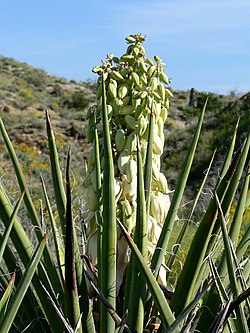
Flowering plant, Palm Canyon, California
Scientific classification Edit this classification
Kingdom: Plantae
Clade: Tracheophytes
Clade: Angiosperms
Clade: Monocots
Order: Asparagales
Family: Asparagaceae
Subfamily: Agavoideae
Genus: Yucca
Species:
Y. schidigera
Binomial name
Yucca schidigera
Synonyms[2]
  • Yucca californica Nutt. ex Baker
  • Yucca mohavensis Sarg.
  • Sarcoyucca mohavensis (Sarg.) Linding.

Yucca schidigera, also known as the Mojave yucca or Spanish dagger, is a perennial plant in the asparagus family Asparagaceae, native to the southwestern United States and northwestern Mexico. It is most common in the Mojave Desert, but also occurs extensively in the Sonoran Desert and west to the Pacific coast of southern California and Baja California.

Description

[edit]

Yucca schidigera is a small evergreen tree growing to 5 metres (16 feet) tall, with a dense crown of spirally arranged bayonet-like leaves on top of a conspicuous basal trunk. The bark is gray-brown, being covered with brown dead leaves near the top, becoming irregularly rough and scaly-to-ridged closer to the ground. The leaves are 30–150 centimetres (12–59 inches) long and 4–11 cm (1+124+14 in) broad at the base, concavo-convex, thick, very rigid, and yellow-green to blue-green in color.

The flowers are white, sometimes with a purple tinge, 3–5 cm (1+14–2 in) long (rarely to 7.5 cm), bell-shaped and segmented into six parts;[3] they are produced in a compact, bulbous cluster 60–120 cm (24–47 in) tall at the top of the stem. The fruit is an elongate berry, up to 11.5 cm (4.5 in) long.[4][5]

Distribution and habitat

[edit]

Yucca schidigera is native to Arizona, Baja California, California, Nevada,[3] and Utah.[6] It is found in the southernmost part of Nevada, in Washington County in Utah, and the northwestern part of Arizona.[6]

It is most common in the Mojave Desert, but is also widespread in the Sonoran Desert and west to the Pacific coast of southern California and into Baja California.[6] Y. schidigera reaches its southernmost extent in the Baja California desert.[7]

In the coastal part of its range, Y. schidigera usually associates with Adenostoma fasciculatum (chamise).[6]

This yucca typically grows on rocky desert slopes and creosote desert flats between 300–1,200 m (980–3,940 ft) altitude, rarely up to 2,500 m (8,200 ft). They thrive in full sun and in soil with excellent drainage. It also needs no summer water. It is related to the banana yucca (Y. baccata), which occurs in the same general area; hybrids between the two are sometimes found.

Fire ecology

[edit]

Post fire, the Mojave yucca produces sprouts eagerly and the regeneration of the seedlings are witnessed.[8] The fire regime is defined predominantly by heavy crop vegetation that take part in carrying the fire in the ecosystem. Over time, the invasive species that have been introduced to the ecosystem, such as grasses, have turned more fire tolerant, increasing the fire frequency and altering the fire regime that existed in the past.

Early accounts describe the flora of the Mojave Desert as arid grassland and shrubland communities. This ecosystem depended on winter precipitation. Y. schidigera was tolerant of this fire regime and rarely harmed. However, the introduction of nonnative grasses led to a higher frequency of fire, which decreased the survival rate of Y. schidigera.

Uses

[edit]

Moths gather pollen from the flowers and deposit it on the stigma of a flower, the ovary of which they lay their eggs in; the larvae eat of the fruit capsule as it grows, but leave behind some seeds to develop into fruit.[9]

The fibers of the Yucca schidigera leaves are used by Native Americans to make rope, cloth,[9] thread,[10] and sandals. The flowers and fruit are eaten either raw or roasted,[9] and the black seeds were ground into a flour. The roots are used to make soap.[9] Some reports claim that Native Americans wash their hair with yucca to fight dandruff and hair loss. Among the other maladies this yucca has been used to treat are headaches, bleeding, gonorrhea, arthritis and rheumatism.[11]

Currently, extracts from this plant are in animal feed and various herbal medications. The rigid flower stalk of the yucca, after maturation, is used as a substitute for eucalyptus stems or logs to make didgeridoos. It is also used as a natural deodorizer, and is used in pet deodorizers. Steroid saponins are produced commercially from Y. schidigera that can be used as naturally derived food-grade surfactant.[12] Y. schidigera is an ingredient that is found in a quarter of dog food sold. It is mainly included in their food to reduce the waste odor of most pets.[13]

Researchers have also found that the ingestion of Y. schidigera have decreased the blood cholesterol of human and chickens, increased vitamin and mineral absorption in animals, and increased cattle reproduction.[14]

In fish, Yucca schidigera extract is beneficial. It can improve the growth rate in fish as a result of increased protein metabolism, requiring less food to sustain populations of fish. Outside of boosted growth rates, Yucca schidigera can also be used to improve the health of fish as it reduces ammonia that may be present in the water, generally improving the water quality. Evidence also suggests that Yucca schidigera is a suitable substitute in enabling fish to fight off the many diseases that characterize aquaculture.[15]

References

[edit]
[edit]
Revisions and contributorsEdit on WikipediaRead on Wikipedia
from Grokipedia
Yucca schidigera, commonly known as Mojave yucca or Spanish dagger, is a perennial evergreen shrub or small tree in the asparagus family (Asparagaceae), native to the arid and semiarid regions of the southwestern United States and northwestern Mexico. It grows 2–20 feet (0.5–6 meters) tall, often forming dense clumps with multiple unbranched or sparsely branched stems arising from a swollen caudex, each topped by a dense rosette of rigid, linear leaves 12–30 inches (30–75 cm) long and 0.5–2 inches (1–5 cm) wide, with marginal white filaments and sharp terminal spines. In spring (April–June), it produces a 2–4-foot (0.6–1.2 m) inflorescence of pendulous, creamy white, bell-shaped flowers 1–2 inches (2.5–5 cm) long, pollinated exclusively by the mutualistic yucca moth (Tegeticula mojavella), followed by elongated, fleshy fruits that mature from green to brownish-black and contain numerous black seeds. The plant is long-lived, potentially exceeding 500 years, with slow growth rates of 0.4–1 inch (1–2.5 cm) per year, and reproduces both sexually via seeds dispersed by mammals and asexually through basal sprouting from rhizomes. Primarily distributed across the and extending into the , Yucca schidigera thrives in hot, dry climates at elevations from to 6,000 feet (1,800 m), though occasionally up to 8,500 feet (2,600 m) in transitional zones. Its range encompasses (from to San Bernardino counties), southern (Clark County), western , southwestern , and northern , , where it inhabits rocky slopes, gravelly flats, washes, and open desert scrub communities dominated by creosote bush (Larrea tridentata) and mixed . Ecologically, it plays a key role in desert ecosystems by providing and food for , including seeds for like kangaroo rats and nesting sites for birds, while its fire-resilient sprouting aids post-disturbance recovery; however, seedling establishment is rare in the wild due to intense and . Historically, Native American groups such as the , Paiute, and others utilized Yucca schidigera extensively: the sweet, edible fruits were consumed raw or roasted, fibrous leaves served for ropes, baskets, and , and roots or trunk were processed into soap-like suds for and laundering. In modern applications, extracts rich in are widely employed as feed additives in and production to reduce emissions, improve digestibility, and enhance animal performance by modulating and odor control. Additionally, it is used in for its foaming and emulsifying properties, as a natural flavoring in foods and beverages, and as an ornamental plant in arid gardens due to its and striking form. Research also highlights potential health benefits, including and effects from its and steroidal .

Taxonomy

Classification

Yucca schidigera is classified within the kingdom Plantae, phylum , class Equisetopsida, subclass Magnoliidae, order , family , subfamily , genus , and species schidigera. This placement reflects modern phylogenetic based on molecular evidence integrating and nuclear DNA sequences. A 2025 phylogenetic study confirmed the of with two main s differentiated by fruit type (dry vs. fleshy), placing Y. schidigera in the fleshy-fruit clade. Historically, Yucca schidigera was assigned to the family Agavaceae, a grouping emphasized in traditional classifications due to shared morphological traits like rosette-forming habits and fibrous leaves among genera such as Agave and Yucca. However, molecular phylogenetic studies in the early 2000s, including analyses of ndhF, rbcL, and ITS sequences, demonstrated that Agavaceae is monophyletic and nested within the broader Asparagaceae, leading to its recognition as the subfamily Agavoideae under the Angiosperm Phylogeny Group III system in 2009. This reclassification resolved paraphyly in earlier family delimitations and aligned the taxonomy with evolutionary relationships inferred from DNA data. No subspecies or varieties of Yucca schidigera are widely recognized in contemporary , though historical accounts noted minor morphological variations that have not been substantiated as distinct taxa. Within the genus , which comprises approximately 40 species primarily in the , Y. schidigera belongs to subgenus Yucca (section Sarcocarpa), characterized by fleshy, indehiscent fruits and often caulescent growth forms. This subgenus also includes close relatives such as (Joshua tree), sharing adaptations to arid environments and obligate by yucca moths in the genus Tegeticula.

Etymology and synonyms

The genus name Yucca was established by Carl Linnaeus in his 1753 work Species Plantarum, derived from the Spanish term "yucca" or "yuca," which originates from the Taíno (Arawak) word for cassava (Manihot esculenta), a root crop; Linnaeus misapplied it to this genus likely due to the superficial resemblance in the use of young inflorescences as an edible food source. The specific epithet schidigera comes from the Latin schīdō (to split or cleave) and gerō (to bear or carry), alluding to the plant's rigid leaves that split lengthwise into long, coarse, thread-like fibers along the margins. This nomenclature highlights the distinctive foliar structure that distinguishes Y. schidigera from other yuccas. The species was first formally described as Yucca schidigera by Benedikt Roezl, with the description published by Hermann August Ortgies in 1871 in the German horticultural journal Gartenflora. Prior to this, specimens from the region had been collected and sometimes misidentified under other names, contributing to nomenclatural confusion. Several historical synonyms exist for Y. schidigera, arising from overlapping morphological descriptions of regional variants: Yucca mohavensis Sarg. (1896), based on plants from the Mohave Desert with similar trunked habit and leaf form; Yucca californica Nutt. ex Baker (1892), reflecting early collections from ; and Sarcoyucca mohavensis (Sarg.) Linding. (1931), a generic reclassification that was later rejected. These synonyms were consolidated under Y. schidigera as the accepted in subsequent taxonomic revisions due to type specimen comparisons showing conspecificity. Common names for Y. schidigera include Mojave yucca, reflecting its primary range in the , and Spanish dagger, alluding to the sharp, pointed leaves resembling daggers. Regional variations, such as Mohave yucca or datilillo in Spanish-speaking areas, emphasize its geographic and cultural associations, though terms like Adam's needle are occasionally applied in broader horticultural contexts but more precisely refer to eastern North American yuccas like Y. filamentosa.

Description

Morphology

Yucca schidigera is an or small that typically reaches heights of 0.5 to 5 meters (2 to 20 feet), with exceptional individuals up to 9 meters (30 feet), forming a single trunk or occasionally sparsely branched stems up to 50 cm in diameter, crowned by dense terminal rosettes of leaves. The trunk is unbranched or sparingly so, with soft, spongy wood, and plants often occur in colonies derived from rhizomes. The leaves are rigid and sword-shaped, measuring 30 to 150 cm in length and 2 to 11 cm in width, arranged in a spiral rosette at the stem apex. They are linear to lanceolate, broadest at the middle, concave, and thick, with a yellowish-green to gray-green coloration; the margins are entire but bear coarse, curly white fibers or threads, and the tips end in sharp spines 7 to 12 mm long. The is an erect, densely paniculate structure arising from the rosette, reaching 0.5 to 1.3 meters tall on a scapelike peduncle, bearing numerous pendulous, bell-shaped flowers. The flowers are creamy white, 3 to 7.5 cm long and 1 to 1.8 cm wide, with spreading lanceolate tepals and a globose ; they occur in a compact, obovoid to cluster that is flat at the distal end. Fruits develop as pendent, indehiscent, fleshy capsules that are cylindrical, 5 to 11.5 cm long and 3 to 4 cm wide, initially green and turning brown at maturity. Each capsule contains numerous black seeds, 8 to 11 mm in diameter and 6 to 9 mm thick, which are rugose and dispersed primarily by mammals. The root system is extensive and fibrous, featuring fleshy rhizomes 1.5 to 2 cm in diameter and up to 20 cm long, along with sparse deeper roots extending to at least 75 cm, enabling efficient water storage and uptake in arid environments.

Growth and lifespan

Yucca schidigera exhibits a slow growth habit typical of desert-adapted perennials, beginning life as a basal rosette of rigid, sword-shaped leaves before developing an erect, unbranched or sparsely branched trunk with age. Young plants form compact rosettes close to the ground, gradually elongating into stems that elevate the crown, often reaching 0.5 to 5 meters in height, though exceptional individuals can reach 9 meters. Over several years, the plant transitions from a form to a more arborescent structure, with litter accumulating around the base of the trunk as older leaves senesce. The species demonstrates modest annual height increments, averaging 1 to 2.6 centimeters per year under natural conditions, though rates can vary slightly by location and availability. This incremental growth contributes to its overall stature over decades, with clonal colonies expanding outward through basal sprouting, sometimes producing multiple stems per clump. Individual plants of Yucca schidigera are long-lived, with lifespans commonly exceeding 100 years and potentially reaching 200 to 500 years or more, as estimated from growth ring analysis and count methods in mature trunks. Clonal groups, formed by , can achieve even greater ages, averaging 300 to 600 years based on shoot production rates and radial expansion. This longevity underscores its resilience in harsh environments, where mature specimens maintain structural integrity through periodic replacement. Growth in Yucca schidigera is strongly influenced by patterns, with enhanced vertical and radial development following periods of adequate rainfall or supplemental , while severe droughts induce physiological to conserve resources. Episodic flowering, which requires substantial energy accumulation, is more probable after wetter seasons, particularly when spring and summer accumulates over 120 days, interacting with and photoperiod cues. During prolonged dry spells, the plant sustains itself with deep taproots, minimizing above-ground activity and preserving . Morphological variability exists among populations of Yucca schidigera, with plants in open desert flats often adopting a more tree-like form with taller, single trunks, whereas those in rocky or constrained sites tend toward a shrubby, multi-stemmed habit. This variation is partly attributable to local edaphic conditions and potential hybridization influences, leading to differences in stem number (typically 4 to 23 per clump) and overall symmetry. Such adaptations allow the species to occupy diverse microhabitats within its range.

Distribution and habitat

Geographic range

Yucca schidigera is native to the , including , southern Nevada (particularly Clark County), western Arizona, and southwestern Utah (Washington County), as well as northwestern Mexico, encompassing and parts of . The species is most abundant in the , where it forms characteristic elements of the vegetation, and extends into the fringes of the in its southern and eastern portions of the range. It typically occupies elevations from (0 m) to 2,200 meters, though records indicate occurrences up to 2,500 meters in some areas. The overall geographic extent of Yucca schidigera has remained stable historically, with no evidence of large-scale contraction across its native range, though localized population declines have been observed in urbanizing areas such as near , , due to and development pressures. Outside its native distribution, the plant is widely cultivated as an ornamental and for extract production.

Environmental preferences

Yucca schidigera is adapted to arid and semi-arid climates, where annual precipitation typically ranges from 100 to 300 mm, with most rainfall occurring in winter and spring, supplemented by occasional summer monsoons in parts of its range. These regions experience hot summers with daytime temperatures often exceeding 38°C and cool winters with nighttime lows dropping below 10°C, though the demonstrates tolerance to extremes from -10°C to 45°C. The species prefers well-drained sandy or rocky soils, frequently derived from granitic, , or substrates, with a range of 6 to 8. It thrives on gravelly bajadas, hardpan, and alkaline or saline grounds but avoids heavy clay soils that retain excess moisture. In terms of , Yucca schidigera commonly occupies dry rocky slopes, mesas, and sandy washes at elevations from to 1,800 m, often on bajadas that offer protection from flash flooding. It frequently associates with creosote bush scrub communities in these microhabitats, enhancing its establishment in open shrublands. Key adaptations to these conditions include an extensive , including older roots capable of efficient water uptake from deeper soil layers, allowing access to during prolonged droughts. Additionally, its rigid, sword-shaped leaves with thick, fibrous margins function as succulents, storing and minimizing losses in xeric environments.

Ecology

Pollination and reproduction

Yucca schidigera typically flowers from late winter to early spring, between March and May, with blooming often triggered by sufficient winter rainfall that supports inflorescence development. The flowers are protandrous, with the male phase preceding the female phase to facilitate cross-pollination by specialized moths. Pollination in Yucca schidigera is exclusively handled by the yucca moth Tegeticula mojavella in an obligate mutualistic relationship. Female moths collect pollen from the anthers of one flower using specialized maxillary tentacles, form it into a pollen ball, and carry it to another flower in its female phase, where they actively place it on the stigma before laying eggs in the ovary. The moth larvae subsequently hatch and feed on a portion of the developing seeds, while leaving enough viable seeds for the plant's reproduction; without these moths, seed set is effectively zero, as the flowers receive no pollen from other pollinators. The moth's lifecycle is tightly synchronized with the plant's phenology, with adults emerging to coincide with flowering periods. Following successful , each mature —a fleshy capsule—produces dozens of flattened , typically 20 to 50 viable ones per after accounting for larval consumption, with overall seed viability around 80%. Seeds are primarily dispersed by mammals, such as , that consume the edible pulp and cache the intact seeds, aiding in short-distance spread across arid habitats. In addition to , Yucca schidigera exhibits through vegetative sprouting from basal rhizomes and buds, particularly after disturbance, leading to clonal colonies of 4 to 5 stems that expand slowly outward; this mode is predominant in established populations.

Fire adaptation

_Yucca schidigera is adapted to the infrequent, low-intensity regime characteristic of lands, where historical fire return intervals typically range from several decades to over 400 years, depending on fuel availability and weather conditions. These fires are often limited by sparse but can spread under high winds, low humidity, and elevated temperatures. The species exhibits robust survival mechanisms against . Although aboveground tissues are typically top-killed, Y. schidigera resprouts vigorously from protected basal meristems, crowns, and rhizomes, with new growth observed as early as two months post- and continuing into the second growing season. Regeneration is predominantly vegetative rather than via seeds, as Y. schidigera seeds are highly sensitive to fire heat and rarely establish seedlings in burned areas. This resprouting strategy allows rapid recovery of cover and density in post- environments, though long-term reductions can occur if sprout predation by herbivores like woodrats and rabbits is intense. Historically, fires in the were rare before widespread European settlement, with frequency limited by low fine fuels; however, modern fire suppression combined with the invasion of nonnative annual grasses has shortened return intervals in some areas to less than 10 years, altering natural patterns. These intensified fires, fueled by exotics like cheatgrass and red brome, pose vulnerabilities by killing mature plants outright and hindering resprouting, potentially leading to population declines.

Interactions with wildlife

Yucca schidigera experiences herbivory primarily from small mammals in its desert habitat, with rabbits serving as the main browsers of leaves and young shoots, particularly following events that promote new growth. Merriam's rats and white-tailed squirrels also consume portions of the plant, comprising 1.2% and 13.6% of their respective diets, while woodrats occasionally feed on it; however, the plant's sharp, spine-tipped leaves deter larger mammals such as , which avoid it across all seasons. Seeds of Yucca schidigera face predation from various wildlife beyond its mutualistic yucca moth pollinators, including ants that directly consume seeds and larvae of non-pollinating "cheater" moths (Tegeticula corruptrix), though ant presence indirectly benefits seed viability by reducing cheater oviposition by up to 46 seeds per fruit. Birds and larger mammals, such as coyotes, consume fruits and contribute to seed dispersal by ingesting and stashing them, aiding propagation while destroying some seeds in the process; in coastal populations, moth larvae alone destroy only about 3% of seeds. As a nurse plant, Yucca schidigera facilitates establishment of other by creating shaded microhabitats under its canopy that increase native cover (F = 10.47, p = 0.0028) and invasive cover (F = 25.21, p < 0.0001) through improved properties and reduced stress, though it competes with annuals for limited . The 's rosettes and fallen leaves provide essential microhabitats for insects like ants and , as well as small reptiles; desert night lizards (Xantusia vigilis) preferentially shelter under partially decomposed logs for thermal stability (χ² = 16.1, p < 0.001), supporting local biodiversity. Additionally, its structure offers nesting sites for birds such as and shrikes. Yucca schidigera shows susceptibility to fungal pathogens, particularly in unusually wet conditions that promote infection, though such issues are infrequent in its arid native range and viral diseases remain rare.

Conservation

Status and threats

Yucca schidigera is classified as Least Concern on the , with the assessment last updated in 2020, indicating a wide distribution and no major global threats leading to . The species holds no special federal in the United States. In California, it is not ranked as rare or threatened by the California Native Plant Society (CNPS), though populations are considered stable overall. Populations of Yucca schidigera remain stable in the core of its range, supported by its long lifespan exceeding 500 years and reliance on . However, declines have occurred in peripheral areas, with modeled suitable decreasing by about 17% between 1979 and 2016 due to habitat loss and environmental changes. The primary threats to Yucca schidigera include urban expansion, exemplified by sprawl around , which fragments habitats and eliminates suitable sites through development like sand and gravel operations. activity damages , compacts soil, and hinders recolonization, with disturbed areas showing no recovery even after 40 years. exacerbates risks by altering rainfall patterns, reducing critical for seedling establishment, and intensifying drought stress in the . Additionally, invasive non-native grasses, such as cheatgrass, promote higher fire intensity and frequency, endangering adult plants that are not fire-adapted for frequent burns. Monitoring efforts by the (BLM) and CNPS, including vegetation inventories and assessment protocols, track population health and distribution, revealing no imminent risk despite localized pressures.

Protection efforts

Yucca schidigera occurs within several protected areas across its range, including and in the United States, as well as desert reserves in , , which collectively safeguard a substantial portion of its . Harvesting of Yucca schidigera is regulated in parts of its range; in , permits are required for commercial collection, with guidelines limiting stem size and ensuring integrity to support regeneration. Similar restrictions apply in to prevent overexploitation. Restoration initiatives by the USDA Service include salvaging and transplanting Yucca schidigera from disturbed sites, such as areas, to revegetate degraded habitats, with post-transplant rates of 82% and 66% in excellent health after two years. These efforts also involve monitoring pollinator moth populations, such as Tegeticula species, to bolster in restored areas. Research in the 2020s focuses on Yucca schidigera's resilience to stressors like elevated CO2 and , with studies demonstrating its tolerance to conditions exceeding one month without wilting. Ex-situ conservation efforts maintain living collections in botanical gardens, including those in for Agavaceae species, to preserve amid environmental changes. In , indigenous communities promote sustainable harvesting practices for Yucca schidigera, collaborating with local companies to counter illegal extraction and ensure long-term resource availability.

Uses

Traditional applications

Yucca schidigera has been utilized by various Native American tribes in the and for millennia, with documented applications spanning , , materials, and ceremonies. These uses reflect the plant's versatility in arid environments, drawing on its leaves, , fruits, flowers, and seeds. Indigenous knowledge of the plant, transmitted orally across generations, underscores its cultural and practical significance in pre-Columbian societies. In food preparation, tribes such as the , Luiseno, , and Mohave harvested young flower stalks, blossoms, and fruits, often roasting or boiling them for consumption. The and Luiseno peoples cooked the blossoms and roasted the pods, while the baked and dried fruits for winter storage or ground them into meal as a staple. were similarly processed by grinding into , providing a nutrient-dense resource during scarce periods. Fruits were also eaten raw or cooked into beverages by Southwest Indian groups, including the Serrano. Medicinally, the plant served as a remedy for various ailments, particularly among Paiute and tribes. Leaf sap was applied as a to treat wounds and sores, leveraging the plant's natural properties. Roots, rich in , were mashed into a soap-like used for and addressing conditions such as irritations and infections, with leaves sometimes boiled into teas for general therapeutic purposes. These applications extended to treating sprains and other injuries through or baths. For material purposes, the tough fibers extracted from the leaves were indispensable for crafting. The wove them into cordage for bowstrings, netting, and strings, as well as baskets and body-painting brushes. Diegueno and groups fashioned sandals and shoes from the fibers, while Luiseno used them for fishing lines. The sharp leaf tips often doubled as natural needles in these traditions. provided additional utility as a saponin-based substitute. These traditional applications date back to pre-Columbian times, with archaeological and ethnographic evidence indicating sustained use through the 19th and into the , as documented in studies from the late 1800s to the . Tribal knowledge persisted despite disruptions from , with some practices continuing today among descendant communities.

Modern commercial uses

Yucca schidigera extracts, rich in , are widely utilized as natural in such as soaps, shampoos, and foaming agents due to their ability to reduce and create stable foams without synthetic chemicals. These applications leverage the plant's amphiphilic compounds, which provide cleansing and emulsifying properties, contributing to the global yucca schidigera extract market valued at approximately USD 90 million in 2025. In animal agriculture, yucca schidigera serves as a feed additive to mitigate emissions in and systems, including and fish production, by binding and inhibiting activity, thereby improving animal , reducing odor, and enhancing environmental . Recent studies, including those from 2025, have demonstrated emission reductions of approximately 20% in storage when added at 0.5% w/w, and significant reductions in at doses of 6-10 mg/L. Similarly, in formulations for dogs and cats, the extract aids digestion and controls fecal odor, having received (GRAS) status from the FDA under 21 CFR 172.510 since the late . Additional commercial applications include its use as a natural in , where facilitate foam stabilization and in beverages like . In , the extract's and properties support products, promoting and reducing irritation. Commercial production involves cultivated farms primarily in , , and , where sustainable harvesting practices limit extraction to no more than 50% of available plant material per site to prevent depletion and comply with forestry regulations. These guidelines ensure long-term viability while supporting an expanding market driven by demand for natural additives.

References

Add your contribution
Related Hubs
Contribute something
User Avatar
No comments yet.