


Community hub
Recent from talks
Contribute something
Nothing was collected or created yet.

18XX is the generic term for a series of board games that, with a few exceptions, recreate the building of railroad corporations during the 19th century; individual games within the series use particular years in the 19th century as their title (usually the date of the start of railway development in the area of the world they cover), or "18" plus a two or more letter geographical designator (such as 18EU for a game set in the European Union). The games 2038, set in the future, and Poseidon and Ur, 1830 BC, both set in ancient history, are also regarded as 18XX titles as their game mechanics and titling nomenclature are similar despite variance from the common railroad/stock-market theme.
The 18XX series has its origins in the game 1829, first produced by Francis Tresham in the mid-1970s. 1829 was chosen as it was the year of the Rainhill Trials. 1830 was produced by Avalon Hill in 1986, and was the first game of the series widely available in the United States; it is seen as the basic 18XX game by the U.S. audience.[1][2]
In addition to traditionally published games, the 18XX series has spawned self-published variants and games published by low-volume game companies.[3][4]
With few exceptions (such as 2038), 18XX titles are multiplayer board games without random variables in their game mechanics.
Gameplay
[edit]Common features
[edit]18XX games vary, but most follow this general pattern:[5]
- The objective is to enhance personal wealth, not the assets of any companies a player may be operating. Personal wealth consists of cash, company stock (which increases wealth both by receiving dividends and by capital appreciation), and other investments (such as private companies).
- Players don't directly interact with the game board, but do so indirectly through companies they control. Generally, the player who owns the most stock of a company is the president of that company and makes all decisions on behalf of that company. The president is also often required to help fund the company when it lacks sufficient funds to satisfy a mandated expense (such as owning a train by the end of its turn).
- Game play alternates between "stock rounds" and one or more "operating rounds". In a stock round, players buy and sell stock (some games have company actions during a stock round as well), while in an operating round players take actions on behalf of companies they control, including laying track, placing station tokens, operating trains, withholding income or paying dividends, and buying trains.
- "Certificate limit": there is usually a limit to how many corporate shares and private companies a player may own, to keep the game competitive by preventing snowball effects resulting from early leads by some players.
- The "President's certificate" (or "Director's certificate") represents control of a railroad corporation, usually represents a greater percentage of corporate stock than other certificates (e.g., 20% as opposed to 10%), and is usually the first one purchased for a company (with its purchaser setting the price, or "par value", for regular shares of stock in many titles in the series). If another player accumulates more shares in a company than the current president, they acquire the President's certificate (with attendant side-effects for both players regarding certificate limits) in exchange for their own lesser shares, and becomes the new controller of the corporation.
- Certain games may impose restrictions on the order in which companies may be started (generally to impose a historical context upon the game), and they vary in how many shares must be purchased before the company may operate ("floats").
- The map is usually a hex grid that depicts cities and terrain features. Hexagonal "track" tiles (representing available land-rights) are laid on top of this map to represent the growth of railroad networks, and tokens are placed on the board to represent stations (as well as special abilities from private companies). Cities have values which can vary based on which tiles have been laid on the city, the phase of the game, their historical importance to a corporation, or type of train used to reach them. Different color tiles are available in succession, and in phases that are typically determined by the first purchase of a more advanced type of train.
- A company's stock price is adjusted based on the revenues earned and whether the president chose to pay dividends or to withhold the earnings in the company treasury. Stock prices are usually also affected by actions in the stock round, and some games have other mechanisms that affect the stock price.
- Scarcity (forcing future-turn planning by players) of available corporations, shares thereof, train types, and track tiles.
- Trains eventually become obsolete and must be replaced by more-expensive trains that also have greater capacity for earning revenue. Purchase of a new type of train usually triggers other phase-changes in the game, such as the obsolescence of older trains, the availability of different sets of tiles, increased valuation of certain non-tiled cities, closure of private companies, and the ability to merge corporations or form them at higher valuations.
- Game end is usually determined when the bank runs out of money, and also by player bankruptcy (when a player cannot pay the debt of a company they control). Some games do not end when a player goes bankrupt, while others add other conditions for ending the game such as when a stock reaches a certain value on the stock market, or the most advanced type of train has been purchased. Other games do not feature bankruptcy at all, and enable a player to place a moribund company in "receivership", or be incorporated into a government railway, and walk away from debts.
Differences
[edit]While adhering to common similarities (see preceding section), each 18XX game differs from the others in subtle or significant ways in rule set as well as game map. As with games in general, each individual mechanic has probably been used before, but a new game can put together a set of mechanics which provide a new and interesting challenge. Some typical areas of difference are:[5]
- Initial Auction – there are many different ways to distribute initial private companies and starting major corporations.
- Private Companies – most 18XX games have private companies which are entirely owned by one player, and represent the earliest companies in the game and/or provide special abilities. "Privates", as they are called, generally do little other than provide revenue, but in some games they control access to or enhance the revenue of certain hexes on the map. Some games have very similar private companies, some have very different private companies, and some dispense with having private companies at all. Some titles (e.g., 1835 and 1861) also have Minor Companies, which are again owned entirely by one player but play a more dynamic role than Privates.
- Corporation Funding – some games have full funding for a corporation as soon as it floats, while others have the company receiving money only as each share is sold. Some games require the corporation to reach a historically relevant destination in order to receive some of its capital or earn the best level of income.
- Company Types – some games have multiple company types. These types may vary based on how many shares are available for purchase, the funding model for the company, the number of station tokens available, or which types of trains may be purchased by the company.
- Corporate mergers and demergers – some games feature optional, or forced, mergers or splits of one or more companies.
- Corporate stock-ownership – some games enable companies to hold their own stock, purchase private corporations, and/or own the stock of other companies (even to the point of owning or as prelude to merger).
- Train Types – some may offer multiple types of trains with distinct capabilities or lifetimes.
- Some trains may "degrade" into other train types upon certain events (for example, delayed obsolescence of 4-trains in 18MEX, or normal trains becoming H-trains in 1844).
- Trains may become available in unusual sequences. For example, in 1830, diesel engines are available as soon as the first 6-train is purchased — all the 6-trains are not required to be purchased first. In 1824, G-train availability is controlled by when normal trains are purchased.
- Certain trains may be restricted in terms of which locations they may run to or may count revenue from, or they may provide bonuses for running to certain locations. For example, in 1844, H-trains are prohibited from running to off-board locations. In 1854, only Orient Express trains may run to certain off-board areas. In 1889, diesels get special bonuses for off-board locations. In 1826, E-trains and TGVs ignore dot-towns. TGVs in 1826 and 4D-trains in 18MEX double the value of cities they count. In 1824, only G-trains may run to mines and the corporation always gets the value of the mine rather than it being potentially paid to stockholders.
- Theme – a few titles eschew the common railroad/stock-market theme. For example, 2038 involves space exploration of the asteroid belt, while Ur, 1830 BC involves building dams and canals in ancient Mesopotamia (in the latter game, "corporations", "presidents" and stock "shares" are represented by kingdoms, rulers and parcels of land).
Conventions and tournaments
[edit]A number of conventions have at least some emphasis on 18XX games, including the Chattanooga Rail Gaming Challenge, held in January or February in Chattanooga, Tennessee and run by Mark Derrick.[6][7] 18XX games also figure prominently in various "RailCon" and "Puffing Billy" tournaments at many conventions.[8][9]
Play by email and Online
[edit]18xx games are often played remotely using various tools that support play by email games.
Many games in the genre are implemented on 18xx.games , which is open-source and supports both multiplayer and local play.
Another open source project which supports a large number of 18xx titles is BOARD18. BOARD18 was designed for use in play by email games and is not recommended for live play. [10]
Publishers
[edit]Following Tresham's initial design, many different designers and publishers have made games using the same basic mechanics and theming. Today, many different publishers offer 18XX games. Some of the most notable include:
- All-Aboard Games, a publisher dedicated solely to 18XX games
- GMT Games, notable for its collaborations with designer Tom Lehmann (also known for the Race for the Galaxy series)
- Golden Spike Games, which manufactures games by hand for Deep Thought Games (a now-inactive publisher of 18XX games)
- Grand Trunk Games, publishing previously self-published titles
- Lonny Games, a German publisher reprinting games and the original designs of Leonhard Orgler
- Marflow Games, a German publisher mainly publishing the designs of Wolfram Janich
- TraXX Games, offering print-and-play titles
- 18Wood, offering mainly handmade 18XX accessories
List of 18XX titles
[edit]The 18XX series is prolific, with many different publishers offering games and many fans designing and self-publishing titles in the series as well. The website BoardGameGeek lists 293 titles (including games and expansions) in the series as of January 2025.[11] Not all of these titles are necessarily in production: many titles are only available as print-and-play games, offering rules and digital assets but requiring fans to print and assemble the games independently.
Due to the large number of games, the disparate designers and publishers, and the question of what constitutes a complete 18XX game, it is difficult to create an exhaustive list of all 18XX titles. This list contains the most notable titles from major publishers as well as some notable self-published 18XX titles.
- 1761: From Canal to Rail
- Self-published in 2011, and then in 2017 by All-Aboard Games and designed by Ian D. Wilson. 1761 is set in England, with its early game focused on building canals and portrays the eventual fading away of canal companies as rail companies start to dominate.[12]
- 1800: Colorado
- Set in Colorado, the game was published in 2002 by David Methany in Rail Gamer magazine #17 and was later available in free print-and-play format. The game was designed by Antonio Leal. A mini-18XX game for 2–3 players, and consists of only nine playable hexes.
- 1817
- Designed by Craig Bartell and Tim Flowers and published by Deep Thought Games in 2009 and subsequently by All-Aboard Games in 2012 and 2020. 1817, set in the United States, is well-known as one of the heaviest 18XX titles in term of complexity and game length. It offers a complex financial system with features such as short selling, market-driven interest rates, and company liquidations. An expansion, 18USA, published in 2017 (self-published), 2018, and 2021 (by All-Aboard Games) offers new contents and a randomizing of elements of the game.
- 1822: The Railways of Great Britain
- Designed by Simon Cutforth and published 2016 by All-Aboard Games. Set in Great Britain, the game offers several unique features such as historical destinations for companies and new local trains. The game was the winner of "Golden Elephant Award" for "Best Heavy Game of 2016" by Heavy Cardboard.[13]
- 1822CA
- Designed by Robert Lecuyer and Simon Cutforth, and published 2018 by All-Aboard Games. This game, also strongly based on 1822: The Railways of Great Britain, takes place in Canada, features a larger number of private companies, and includes an innovative scale change halfway across the map to account for the larger expanse between cities in Western Canada.
- 1822MX
- Inspired by 1822: The Railways of Great Britain, the game (set in Mexico) was designed by Scott Petersen and published by All-Aboard Games in 2019.
- 1822PNW
- Designed by Ken Kuhn and published 2023 by All-Aboard Games and inspired by 1822: The Railways of Great Britain; takes place in the mountainous Pacific Northwest.
- 1824: Austria-Hungary
- 1824 was published by Double-O Games in 2005. The game was designed by Leonard "Lonny" Orgler and Helmut Ohley, and is set in Austria-Hungary. It is a smaller and simpler version of Lonny's 1837, and adds some ideas from his later 1854 and Helmut's 1844. Publisher Fox in the Box and Lonny Games re-implemented the game in 2019 under the title 1824: Austrian-Hungarian Railway.
- 1825
- Great Britain, released 1995 (Unit 1) by Hartland Trefoil, 2000 (Unit 2) and 2004 (Unit 3) by Tresham Games, designed by Francis Tresham. The game has subsequently had many revisions, reprints, add-on kits and variants.
- 1826: Railroading in France and Belgium from 1826
- 1826 was published by Chris Lawson in 2000 and Deep Thought Games in 2004[14] and set in France and Belgium. As David Hecht's first design, it is the most conventional, and only one to use "traditional" green and brown plain track upgrade tiles. 1826 started out as "1830 on a different map", but rapidly evolved into a game of capital and technology management: the game's key decisions revolve around when to "grow" a company, and which trains to buy to optimize a company's final position.
- 1829 Mainline
- England, released 2005 by Tresham Games, designed by Francis Tresham.
- 1829 (South) and 1829 (North)
- 1829 (South) was the first game in the 18XX series, published by Hartland Trefoil Ltd (UK) in 1974 from an original design by Francis Tresham. A second version, 1829 (North) was published in 1981. The game has subsequently had many revisions, reprints, add-on kits and variants.
- 1830: The Game of Railroads and Robber Barons
- 1830 was published by Avalon Hill in 1986, and its popularity led to the creation of many other 18XX games. The game has subsequently had many revisions, reprints, add-on kits and variants. The latest English editions were published in 2011 and 2021 by Mayfair Games and Lookout Games, respectively, under the title 1830: Railways & Robber Barons.[15] Set in eastern United States.
- 1832: The South
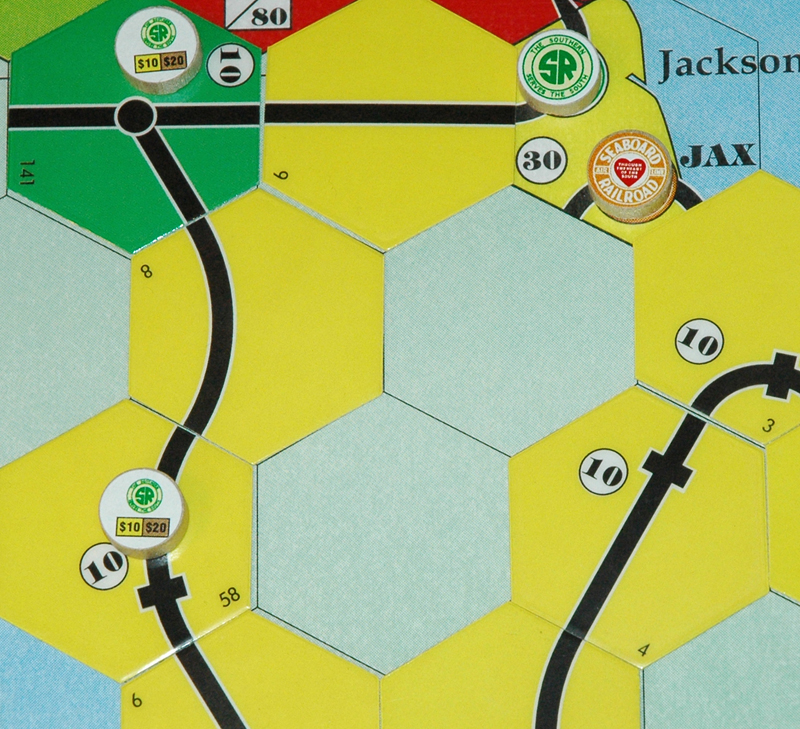
- 1832 was published by Deep Thought Games in 2006.[14] The game was designed by Bill Dixon and is set in the Southeastern United States. It retains the new rules Bill introduced in 1850 and 1870 for share price protection, stock redeeming, and reissuing, while adding new rules to model the mergers that shaped the South's railroads.
- 1835
- 1835 was designed and published by Hans im Glück in 1990 and distributed in the United States by Mayfair Games.[16] The game board covers most of Germany. It was the first 18XX game use the concept of 'minor' companies, which operated like the normal stock companies (with some limitations) but are owned by a single person like a private company.
- 1837: Rail Building in the Austro-Hungarian Empire
- Set in Austria-Hungary, self-published and designed 1994 by Leonard "Lonny" Orgler. It was subsequently republished in 2021 by All-Aboard Games.
- 1837 Saxony
- The game, an updated version of 1837SX and 18SX by the same designer Wolfram Janich, was due to be published in 2022 by Spielworxx, but is now expected in 2026 under the name 18Saxonia. As the title suggests, it is set in the Saxony region.[17]
- 1838: Rheinland
- Designed and self-published by Wolfram Janich in 2003, and set in the Rhineland region. 18Rhl-Rhineland, a newer version, was published in 2007 by Marflow Games.[18]
- 1839
- Published in 1993 by Diabolo and designed by Paul Stouthard and Rob van Wijngaarden. Set in the Netherlands. The designers hand-made only 32 copies of the game.[19]
- 1840: Vienna Tramways
- Designed by Leonard Orgler and published through Lonny Games in 2020, the game is unique in that it focuses on the building of tram transport systems rather than heavy rails. It is set in Vienna, Austria. Also innovative is the availability of the best trains from the very start, albeit with reduced income as they grow older.
- 1841: Railways in Northern Italy
- 1841 was published by Chris Lawson in 1996. The game was designed by Federico Vellani with assistance from Manlio Manzini and is set in Italy. With its complicated financial rules and very steep train gradient (i.e., the trains get very expensive very quickly), it emphasizes stock manipulation and funding train purchases over route building.
- 1842: Schleswig Holstein
- Self-published in 1992 by Wolfram Janich through Marflow Games and set in the Schleswig-Holstein province of Germany.[20]
- 1844: Schweiz
- 1844 was designed and published by Helmut Ohley in 2003 and set in Switzerland. Peter Minder collected extensive background materials and drew the map. The game was republished (with revisions) as 1844/1854 in 2016.
- 1844/1854
- A 2016 Mayfair Games and Lookout Games republishing and re-packaging of 1844 and 1854 in one box with various changes.
- 1846: The Race for the Midwest
- 1846 was published by Deep Thought Games in 2005,[14] with a second edition by GMT Games in 2016. The game was designed by Tom Lehmann and is set in the Midwestern United States. It features a linear stock market (like 1829), N/M trains (which count N cities but may run through M total cities) and a simplified private company distribution. Another unusual feature is that the number of corporations, private companies, and the bank size all scale with the number of players, and the resulting game is shorter than most 18XX games.
- 1847: Pfalz
- Set in the German Pfalz area, the game was self-published in 1996 by its designer Wolfram Janich. An Anniversary Edition was published in 2015.
- 1848: Australia
- The game was published in 2007 by Double-O Games, designed by Helmut Ohley and Leonhard "Lonny" Orgler. It is set in Australia. 1848 was unique in that it includes the Bank of England as a public company that extends loans and administers railroads that are in receivership. A newer 2022 version was published by GMT Games.[21]
- 1849: The Game of Sicilian Railways
- Set in Sicily. The game was designed by Federico Vellani and released in 1998 by Chris Lawson. A newer 2021 version was published by All-Aboard games.
- 1850
- 1850 was published by Deep Thought Games in 2006.[14] The game was designed by Bill Dixon and is set in the upper Midwestern United States. It retains the rules Bill introduced in 1870 for share price protection and stock redeeming/reissuing.
- 1851: Kentucky and Tennessee
- Set in the Tennessee, the game was released 1998 by Chris Lawson, designed by Mark Derrick and Chris Lawson. It's a streamlined 18XX game designed for smaller groups with a shorter playing time.
- 1853
- Set in India, designed by Francis Tresham, and published in 1989 by Hartland Trefoil. Mayfair Games and Lookout Games released a revised, newer version in 2009.
- 1854
- 1854 was published by both Leonard "Lonny" Orgler in 2002 and Deep Thought Games in 2005.[14] The game was designed by Lonny Orgler and is set in Austria. It features a hexagonal stock market, local railways which operate on a smaller map (which takes place on two hexes of the large map), mail contracts, 150% capitalization, and player share options. There are also tunnels which allow you to build under other track and terrain features, such as avoiding small cities. The local railways eventually grow up to be regional railroads operating on the main map, and the tradeoff between getting good revenues on the local map versus getting locked out of important locations on the main map is an important decision to make. The game was republished (with revisions) as 1844/1854 in 2016.
- 1856: Railroading in Upper Canada from 1856
- 1856 was published by Mayfair Games in 1995 and was designed by Bill Dixon.[22] The game is set in Upper Canada, including the upper reaches of the St. Lawrence River, and the Toronto to Detroit area for southern Ontario.
- 1858: The Railways of Iberia
- 1858 was designed by Ian D. Wilson, and published in 2012 by All-Aboard Games. 1858 is set in Spain and Portugal in the late 19th to early 20th centuries
- 1860: Railways on the Isle of Wight
- Set in the Isle of Wight, the game was released 2004 by JKLM Games, designed by Mike Hutton. Z-Man Games published a second edition in 2010, and All-Aboard Games published the newest edition in 2022.
- 1861: The Railways of the Russian Empire
- Set in Russia, the game was released by JKLM Games in 2006 and by All-Aboard Games in 2012. It was designed by Ian D. Wilson and features a non-player controlled government railway.
- 1861/1867: Railways of Russia/Canada
- Published in 2020 as a package containing the two games 1861 and 1867 by Grand Trunk Games.
- 1862
- 1862 was designed and published by Helmut Ohley in 2000. The game covers the entire width of the United States and parts of Canada.
- 1862: Railway Mania in the Eastern Counties
- East Anglia, England; designed by Mike Hutton and published in 2013. The game was famous for a few unique features; among them was petitioning the parliament as a mean to float new companies and three different train types available. It was re-released by GMT Games in 2019.
- 1865: Sardinia
- Designed by Alessandro Lala and published by Gotha Games in 2011, 1865 is set in Sardinia and features the Dragon, a non-player foreign investor who trade in certificates between players. It also contains the Traffic system, which makes calculating company revenues easier.
- 1867: Railways of Canada
- Set in Canada and designed by Ian D. Wilson, the game was originally set as an expansion to 1861 in 2015 (published by All-Aboard Games), but was released as a standalone game in 2017 by Grand Trunk Games.
- 1868
- Set in Uruguay and designed by John Bohrer. As usual with Winsome 18XX games, a copy of 1830 is required to play, largely due to the need for the tiles. 1868 has a shorter playing time than 1830 and includes a number of little companies, a delayed fifth railroad and a bit of South American history. For 3-5 players for about 3 hours.
- 1870: Railroading across the Trans Mississippi from 1870
- The game is set in the Mississippi Valley and central United States, released in 1992 by Mayfair Games, and designed by Bill Dixon.[23]
- Harzbahn 1873
- Harzbahn 1873, set in the Harz mountains in Germany, was designed by Klaus Kiermeier and initially self-published in 2011 in German. It was later republished by All-Aboard Games in 2014 and 2021 in English, and by Marflow Games in 2017 in German. Harzbahn 1873 includes independent and public mining companies which can purchase trains as "machines" to improve their revenue and the revenue earned by train companies running past mines, a unique method of revenue calculation (a 4-train runs 4 connected routes of arbitrary length), and a maintenance mechanic that replaces train rusting.
- 1880: China
- Set in China and designed by Helmut Ohley and Leonhard "Lonny" Orgler, this game was self-published through Double-O Games in 2010 and 2016. Lookout Games worked with the designers to republish a new third edition in 2022. The game is unique in that the turn order for companies are set along with the starting par price, and players could manipulate the Stock Round-Operation Round ratio.
- 1882: Assiniboia
- Designed by Marc Voyer and published by All-Aboard Games in 2020, 1882 is set in the historical Assiniboia region of Canada and depicts the Canadian Prairies railway boom.
- Shikoku 1889
- 1889 was published by both Wild Heaven Productions in 2004 and Deep Thought Games in 2006.[14] The game was designed by Yasutaka Ikeda and is set in Shikoku, Japan. The rules for 1889 are essentially the same as 1830, except on a much smaller and terrain-heavy map and different privates. The goal is to make a quick and relatively simple game which explores the history of railroads on Shikoku. A new 2022 version was published by Grand Trunk Games.
- 1890
- Set in Osaka metropolitan area, Japan, the game was designed by Shin-ichi Takasaki and released in 1999 by Nobuhiro Izumi.
- 1895 Namibia
- Designed by Helmut Ohley and Adam Romoth and self-published through Double-O Games in 2004, the game is set in Namibia, one of the few 18XX titles to be set in the Africa continent.
- 1899
- A variant of the 1830 played on a new map set in China and Korea. It was designed by Dirk Clemens and Ingo Meyer and released by Chris Lawson in 1994.
- 18??
- A variant in a form of add-on kit for 1870 played on a somewhat larger fictionalized map, with additional privates and other rules variations. Designed by Allen Sliwinski and self-published by Scott Petersen through All-Aboard Games.
- 18AL
- 18AL was self-published by Mark Derrick in 1999 and later by John David Galt. It is set in Alabama, United States and aims to provide a quicker and simpler introduction to the 18XX series. It is very similar to 18GA.
- 18C2C
- 18C2C (aka Coast to Coast) was published by Designs in Creative Entertainment in 2003. The game was designed by Mark Frazier and covers the entire United States and Southern Canada. This is an extremely large game that attempts to model the entire history of railroading in the United States, and accordingly takes a long time to play. It consists of a 38"x68" map, 34 public companies, 18 private companies, and 108 trains.
- 18Chesapeake
- The game, designed to provide a full 18XX experience for newcomers to the series, was published in 2020 by All-Aboard Games, and designed by Scott Petersen. It's similar to 1830, with a smaller map focused on the Chesapeake Bay area and a train export mechanic which improves gameplay pace.
- 18CZ
- Designed by Leonard Orgler and published by Fox in the Box and Lonny Games in 2017, the game is set in the Czech Republic. It features three different corporation sizes with their own share size distributions. Each company sizes own different sets of trains, and larger companies can absorb smaller ones.
- 18Dixie with 18MS and 18GA
- Published in 2015 by Deep Thought Games and designed by John Merrick, it is set in the Deep South US during the post-Civil War Reconstruction era. Also includes two upgraded smaller games: 18GA and 18MS.
- 18DO: Dortmund
- Designed by Wolfram Janich and Michael Scharf and published by Fox in the Box and Marflow Games in 2020, 18DO focuses on both the development of railway around Dortmund and its burgeoning breweries.
- 18EU
- 18EU was published by Deep Thought Games in 2004.[14] The game was designed by David G.D. Hecht, and is set in the heart of Europe, reaching from Paris and London to Rome, Budapest and Warsaw. 18EU is a compact game, played on four map panels. Unlike most 18XX games, there are no private companies, and before the sale of the first 5 train, share companies may only be started indirectly. When the game starts, fifteen minor companies (similar to the "forerunner" companies in 1835, 1837 and 1824) are auctioned off. These companies represent regional or private-sector rail companies. There are eight possible share companies, and before the first 5 train at least one minor company must be merged into a share company to form it.[24]
- 18FL
- 18FL was published by Deep Thought Games in 2006.[14] The game was designed by David G.D. Hecht and is set in Florida, United States. It is very similar to Mark Derrick's 18AL and 18GA in that it is a simple game intended as an introduction to the 18XX game system for new players. Unlike the two mentioned games, the "ultimate" train is a 6 (or a 3E) train. This means that 4 trains never become obsolete, and the greatest difficulty in a small game (and the greatest deterrent for new players), a massive "train rush" when permanent trains are first available, is substantially mitigated.
- 18GA
- 18GA was self-published by Mark Derrick in 1998 and later by John David Galt. It is set in Georgia, United States and aims to provide a quicker and simpler introduction to the 18XX series. It is very similar to 18AL. The game was republished in a package with 18Dixie in 2015.
- 18GB: The Railways of Great Britain
- 18GB was published by Deep Thought Games in 2018. It was designed by Dave Berry and is set in Great Britain. It combines elements of 1860 and 1830, and features a twist to the usual 18XX rules for laying tiles.
- 18GL
- 18GL was published by Deep Thought Games in 2006.[14] The game was designed by Gary Mroczka and is set in the Great Lakes area of United States. It uses basically the same rules as David G.D. Hecht's 1826 (specifically, H-trains, loans, trainless companies get merged into a government railroad) except that there are no destinations, there is only one merger, and instead of TGV trains there are Diesel trains. The map is quite different, and the private companies have the effect of altering how the map develops depending on the combinations of private companies and corporations particular players get.
- 18GM: The 18XX GameMaster
- Self-published in 1996 by designers Colin Barnhorst and Kristopher Marquardt. 18GM is an 18XX game development kit with modular boards which permits many different scenarios to be designed and played out.
- 18HeXX
- A variable-geometry 18XX map system, designed and self-published in 2000 by Mike Schneider
- 18Ireland
- Set in Ireland, the game was web-published in 2016 and designed by Ian Scrivins. It was republished in 2017 by All-Aboard Games.
- 18Kaas
- Set in Utrecht, Netherlands, and self-published in 1992 by Erno Eekelschot through ERJO Games.[25]
- 18Lilliput
- Designed by Leonard Orgler and published by Fox in the Box and Lonny Games in 2018, this game was noted for its innovative elements which stayed true to the 18XX spirit but provides a fresh and light experience for players. Actions are picked based on a set of action cards in a common pool. As the title suggest, the game was set in the fictional land of Lilliput.
- 18Mag: Hungarian Railway History
- Designed by Leonard Orgler and published by Lonny Games in 2021, 18Mag recreates the history of Hungarian railroads and companies. The game features, in addition to the usual operating railroad companies, seven service companies which provides special supporting effects to its owners. All trains are also available from the start of the game.
- 18MEX
- 18MEX was published by Deep Thought Games in 2005[14] and by All-Aboard Games as a second edition in 2020. The game was designed by Mark Derrick and is set in Mexico. The moderate length game features minor and major railroads, as well as government ones.
- 18MS: The Railroads Come to Mississippi
- The standalone version of 18MS was published by All-Aboard Games in 2020 and designed by Mark Derrick. A lighter 18XX game set in Mississippi and Alabama. The older 2015 version was only available in the same package with 19Dixie.
- 18Namibia
- Designed by Helmut Ohley and Adam Romoth. Reimplements 1895 Namibia.
- 18NEB
- 18NEB was published by Deep Thought Games in 2010.[14] Designed by Matthew Campbell, it supports 2–4 players and plays in 2–4 hours. It is set in Nebraska, United States.
- 18NL
- Set in Netherlands, the game was self-published in 1999 and 2005 by Wolfram Janich through Marflow Games. It uses the same system as 1830 over a new map.
- 18NW: Railroading in the "Great Northwest"
- Designed and self-published by Gary Mroczka in 2017. Set in the US Pacific Northwest and surrounding areas.
- 18NY
- Designed by Pierre LeBoeuf, published by Deep Thought Games in 2011. Set in the New York state and surrounding areas. All-Aboard Games will publish a new version in 2023 through its fifth Kickstarter wave of projects.
- 18OE: On the Rails of the Orient Express
- Designed by Edward Sindelar and published by Designs In Creative Entertainment in 2014. The large game (rivaling those of the likes of 18C2C) covers the entire Europe and features a staggering five types of companies.
- 18SA
- 18SA, set in South America, designed by Peter Mette and published by Marflow Games in 2015, is a feature-rich and moderately complex entry in the 18XX series, such as different tokens for different kinds of trains, and extra costs for laying tracks across countries.
- 18Scan
- 18Scan was published by Deep Thought Games in 2005.[14] The game, set in the Scandinavia, is one of the smaller 18XX titles, and was designed by David G.D. Hecht in order to introduce gamers to some of the more "exotic" systems used in other designs. 18Scan includes 1835-style minor companies, an 1835-style merger corporation, 1870-style destination rules (for the minor companies), 1856-style company flotation rules, and market-priced incremental capitalization rules as in 1851 and 1826.
- 18SJ: Railway in the Frozen North
- Designed by Örjan Wennman and self-published in 2021 (with a newer edition publishing in 2023 by All-Aboard Games), 18SJ is set in the United Kingdoms of Sweden and Norway during the formative years of Nordic railways. The game features nationalization of public railway corporations.
- 18Svea
- Designed by Jonas Jones and self-published in 2022. 18Svea is one of the smallest and fastest 18XX games around with less than two hours playtime taking place on a map with only ten hexes in total. Designed for two or three players.
- 18TN
- 18TN was published by Deep Thought Games in 2006.[14] The game was designed by Mark Derrick originally in 1996, and upon discussions with Chris Lawson it was modified and published by Chris as 1851 in 1998. The two games were sufficiently different that the publication of the original was warranted. It is set in Tennessee.
- 18US
- 18US was published in 2006 by Deep Thought Games.[14] The game, designed by David G.D. Hecht as an "advanced" 18XX game, is set in the continental United States. Unlike 18C2C or other, similar products, it is a very compact game: the entire "Lower 48" only takes up two map panels.
- 18VA
- 18VA was published by Deep Thought Games in 2005.[14] The game, designed by David G.D. Hecht, is a smaller 18xx game, originally intended to be similar in scope to Mark Derrick's "one-state" games 18AL and 18GA. Set in Virginia and Maryland, it is slightly more complex than the two mentioned.
- 18West
- 18West was published in 2007 by Deep Thought Games.[14] The game, designed by David G.D. Hecht, is set in the western United States. Many of the mechanics are quite different from other 18XX games, such as three different kinds of companies (including the Grange Road) and subsidized track laying. All-Aboard Games published a new version of the game in 2020.
- 2038: Tycoons of the Asteroid Belt
- 2038, by Tom Lehmann, has the game mechanics of an 18XX railroad game but with an asteroid mining theme. Its financial aspects are fairly similar to those of 1835, including a set of minor companies and a larger merger company. Its board features include asteroid mines that can be improved (the equivalent of cities), a small exploration reward for companies which explore asteroids (the equivalent of laying a tile, but requiring a spaceship/train), and two different types of corporations (those that start with full monetary assets and "growth companies", which start with fewer assets and a lower stock price but retain earnings from their unsold stock). The game was published in 1995 by Prism Games and TimJim Games.
- 21Moon
- Published in 2020 by All-Aboard Games and designed by Jonas Jones, the futuristic game is set in 2117 on the Moon. Players must build a network of transportation to support the resource mining efforts on the Earth's natural satellite.
- Poseidon
- Set in the Aegean Sea during the Ancient Greece period, designed by Helmut Ohley and Lonny Orgler, with artworks drawn by Klemens Franz, and published through Lookout Games and Z-Man Games in 2010, is a shorter two-hours 18XX game with shipping lines instead of railroads.[26]
- Powerrails
- Designed and self-published by Tom Schoeps in 1999. The game, based on 1830 and 1835, uses eleven small A4-sized map boards with only a handful of hexes and a small set of special rules for each of them.[27]
- Steam Over Holland
- Set in the 1839 Netherlands, the game was designed by Bart van Dijk and published by Vendetta in 2007.
- Railways of the Lost Atlas
- Designed by Kevin Delger and Jacob Schacht, and published by Asterisk Games in 2024, RotLA features a variable-geometry modular board with divergent corporate abilities and mergers, with many variant options.
- Ur: 1830 BC
- The game is loosely adapted from the 18XX series, and features irrigation and kingdom management in ancient Mesopotamia. It was designed by Jeroen Doumen and Joris Wiersinga and published by Splotter Spellen in 2001. Its play centers around ownership of valuable networks, replacing the rail networks found in most 18XX games with irrigation canals, shares with parcels of land, companies with kingdoms, trains with irrigation technologies (such as reservoirs and pumps), and presidents with kings. Networks of canals and waterworks generate income by irrigating lands within kingdoms.[28]
References
[edit]- ^ Siggins, Mike (1991), "The 18xx Series – A Case for Re-Design?", Sumo, no. 6, archived from the original on 14 November 2007, retrieved 12 October 2007
- ^ Bankler, Brian (1995), "A Survey of 18xx Rail Games", The Game Report, vol. 3, no. 4, archived from the original on 2008-05-09, retrieved 12 October 2007
- ^ How, Alan (September 2006), "The Independent Publisher – interviews with Gary Dicken and John Tamplin", Counter Magazine (34): 8–13.
- ^ "Of Dice and Men: 18xx", Counter Magazine (33): 5, June 2006.
- ^ a b Thomasson, Keith. "18xx Rules Difference List". Archived from the original on 29 September 2007. Retrieved 2007-10-12.
- ^ Galletta, Jan (2006-01-13), "Tracks lead to rail-gamers tournament", Chattanooga Times Free Press, p. 12
- ^ "Rail Gamers Compete", Chattanooga Times Free Press, 2005-01-17
- ^ "TactiCon 2006-7 schedule". Archived from the original on 2008-05-11. Retrieved 2008-04-05.
- ^ "U*Con 2008 schedule". Archived from the original on 2008-09-08. Retrieved 2008-04-05.
- ^ Price, Richard (2020), Optimistic database locking, archived from the original on 6 August 2020
- ^ https://boardgamegeek.com/boardgamefamily/19/series-18xx
- ^ "1761: From Canal to Rail | Board Game | BoardGameGeek".
- ^ "Podblast – 2016 Golden Elephant Award winner".
- ^ a b c d e f g h i j k l m n o p "Deep Thought Games, LLC – Games". Archived from the original on 12 September 2007. Retrieved 2007-10-11.
- ^ "1830: Railways & Robber Barons | Board Game | BoardGameGeek".
- ^ "Mayfair – 1835 Product Page". Archived from the original on 2007-08-27. Retrieved 2007-10-12.
- ^ "1837-Saxonia | Board Game | BoardGameGeek".
- ^ "18Rhl: Rhineland | Board Game | BoardGameGeek".
- ^ "1839 | Board Game | BoardGameGeek".
- ^ "1842: Schleswig Holstein | Board Game | BoardGameGeek".
- ^ "1848: Australia | Board Game | BoardGameGeek".
- ^ "Mayfair – 1856 Product Page". Archived from the original on 2007-09-28. Retrieved 2007-10-12.
- ^ "Mayfair – 1870 Product Page". Archived from the original on 2007-09-18. Retrieved 2007-10-12.
- ^ Walters, Neil (December 2004). "Reviews: 18EU". Counter Magazine (27).
- ^ "18Kaas | Board Game | BoardGameGeek".
- ^ "Poseidon | Board Game". BoardGameGeek.com. Retrieved 2016-01-24.
- ^ "Powerrails; Board Game". BoardGameGeek.com. Retrieved 2021-02-25.
- ^ "Ur: 1830 BC". Board Game Geek.
External links
[edit]- Article on the 18xx family on BoardGameGeek
- BoardGameGeek rules synopsis for 1870 (extrapolatable to other 'xx titles)
- Boardgames With Scott 046, a video introduction to the 18xx family of games
- Review of 1853 in Games International
Introduction
Definition and Scope
The 18XX series refers to a genre of board games that simulate the economic aspects of building and operating 19th-century railroad corporations, with a primary focus on stock market trading, track laying using hexagonal tiles, and managing train routes to generate revenue.[1] These games emphasize strategic decision-making in a competitive environment where players buy and sell shares, develop networks, and optimize operations to maximize personal wealth.[1] At their core, 18XX games revolve around economic rivalry, positioning players simultaneously as investors speculating on company performance and as presidents directing corporate actions such as route expansion and train purchases.[1] This dual role creates tension between short-term stock manipulation and long-term network building, often leading to player-driven market fluctuations without reliance on random elements like dice.[11] While the vast majority of titles center on historical railroad development, a few exceptions adopt alternative themes while preserving the foundational mechanics of share acquisition and route optimization; notable examples include 2038, which explores asteroid belt mining in a futuristic setting, and Ur: 1830 BC, depicting ancient Mesopotamian trade networks.[1] As of 2025, the series encompasses more than 200 distinct titles, originating with 1829 in 1974 and continuing through ongoing releases that innovate within the established framework.[1][12]Origins and Naming
The "18XX" designation for this series of board games derives from the convention of titling individual entries after significant years in 19th-century railroad history, with "XX" acting as a placeholder for the varying two-digit suffixes representing specific years or regional focuses, such as 1829 for early British rail developments or 1830 for American expansion. This etymology reflects the games' thematic emphasis on historical railroad building and economic competition during the Industrial Revolution era.[2] The origins of the series trace back to British designer Francis Tresham, whose fascination with historical railroads and economic simulations began in his youth through modifications to games like Monopoly and its horse-racing variant Totopoly, which he adapted to address perceived imbalances in scoring and strategy depth. Tresham's early experiments evolved into a prototype focused on railway stock trading and route optimization, culminating in the inaugural published title, 1829, released in 1974 by his own company, Hartland Trefoil. Set in southern England, 1829 was named for the 1829 Rainhill Trials, a landmark competition that validated steam locomotives as the future of rail transport by showcasing George Stephenson's Rocket design.[13][14][15] The naming convention solidified with subsequent releases, as Tresham and other designers extended the "18XX" format to evoke period authenticity while allowing flexibility for different locales and mechanics. The series gained broader recognition in English-speaking markets through 1830: Railways & Robber Barons, published in 1986 by Avalon Hill, which adapted Tresham's core system for the U.S. Northeast and introduced refinements that emphasized cutthroat stock market play, helping establish "18XX" as a shorthand for the genre.[16]History
Francis Tresham's Contributions
Francis Tresham (1936–2019) was a British board game designer renowned for laying the foundations of the 18XX series of railroad-themed economic games. Developing his initial prototype in 1974, Tresham created a system that simulated historical railway expansion through stock trading and operational management, marking a significant advancement in economic board game design. This prototype, later refined and published as 1829 in 1974 by his company Hartland Trefoil, established the core framework for the genre.[17][18] Tresham's innovations were pivotal in defining the 18XX mechanics, particularly the integration of a dynamic stock market where players set a company's par value during its formation to influence initial share prices and market positioning. He introduced permanent interest dividends, allowing shareholders to receive ongoing payouts based on company performance, which added layers of long-term investment strategy. Additionally, the train rusting mechanic—where older trains become obsolete upon the introduction of more advanced ones—mirrored real-world technological progression and forced players to adapt their portfolios, simulating economic phases of growth and disruption. These elements created a balanced interplay between financial speculation and logistical planning.[19][20] Among Tresham's early 18XX titles, 1829 focused on British railways and set the standard for the series, while 1830, co-designed with Bruce Shelley and published by Avalon Hill in 1986, adapted the system to an American setting with refined rules for broader accessibility. Later, Tresham developed 1825 in 1995 as a modular expansion of his original concepts, emphasizing regional networks in the UK. His work established the "Tresham formula," characterized by interleaved phases of share buying, track laying, and train operations, which became the blueprint for subsequent 18XX designs.[17][21][22] Tresham's contributions extended the genre's appeal by blending historical accuracy with strategic depth, influencing not only board games but also digital titles like Sid Meier's Railroad Tycoon. His designs prioritized player agency in economic simulation, ensuring the 18XX series endured as a cornerstone of hobby gaming.[22][20]Expansion and Modern Developments
Following Francis Tresham's foundational work on games like 1829 and 1830, the 18XX series expanded through contributions from other designers who adapted the core mechanics to diverse historical and regional contexts. Wolfram Janich, a prominent German designer, introduced games like 1842 (Hamburg/Schleswig-Holstein, 1995) focusing on regional German railways while incorporating innovative mechanics that influenced later titles.[23] Helmut Ohley developed 1844 (Switzerland, 2004), while Leonhard Orgler developed 1837 (Austro-Hungarian Empire, 1995), shifting emphasis to intricate national rail networks and share structures tailored to continental economics.[23] These efforts broadened the series beyond British and American settings, fostering global themes that encouraged experimentation with local historical events and geography. The 1990s and 2000s marked a publishing boom, with increased output from specialized publishers that made 18XX games more accessible to enthusiasts. Hartland Trefoil, Tresham's own imprint, continued releasing variants like 1853 (India, 1989, revised 1997), while GMT Games entered the fray with titles such as 1846 (USA, 2011), emphasizing modular maps and balanced stock markets.[9] This period saw dozens of new entries, including the introduction of 18EU in 2001 by Fred L. Worth and Mark D. Smith, published by GMT, which simulated European rail integration across multiple nations with shared privates and majors.[24] The surge reflected growing community interest, with annual releases climbing from a handful in the 1980s to over 20 in peak years, supported by conventions and playtesting networks. In the 2010s and up to 2025, modern developments emphasized digital integration, thematic innovation, and streamlined designs to attract broader audiences. Platforms like 18xx.games, launched in the early 2020s, provide online implementations for over 60 titles, enabling asynchronous play and tutorials that reduce setup barriers for newcomers.[8] Thematic diversions emerged, such as 18Mars (2018) by Scott Petersen and published by All-Aboard Games, which transposed rail-building to a Martian colony with sci-fi privates and terraforming tiles.[25] Recent releases highlight this evolution: 1822PNW (2023) by Mark Henderson and JR Conrad explores Pacific Northwest railroads with dynamic minor companies; 18SJ (2023) by Örjan Wennman depicts Swedish-Norwegian unification through nationalization mechanics; Railways of the Lost Atlas (2024) by Matt Tonks introduces modular, player-built maps for replayability; 1824 (revised edition, 2024) refines Austrian-Hungarian empire-building with updated operations; and 18Milwaukee (October 2025), a new midwestern U.S. title currently in testing and release.[26][27][28][29][30] Community-driven initiatives have propelled growth, with fan expansions and Kickstarter campaigns funding innovative titles that push series boundaries. All-Aboard Games' Wave 5 Kickstarter in 2023, for instance, successfully backed multiple games including 1822PNW and 18SJ, raising $112,360 and exemplifying crowdfunding's role in sustaining niche development.[31] These efforts have expanded the series to over 300 titles by late 2025, including recent additions like 18DDR and 18Milwaukee, encompassing full games, expansions, and prototypes tracked in dedicated databases.[30][1] Despite this proliferation, challenges persist in production and player onboarding. Print-on-demand models, adopted by publishers like All-Aboard Games and Deep Thought Games, ensure availability without large inventories but often result in limited components and higher per-unit costs, sometimes exceeding $150 for premium editions.[25] Accessibility remains a hurdle due to the genre's steep learning curve and playtimes of 3–6 hours, though initiatives like beginner-oriented titles (e.g., 18Chesapeake, 2019) and digital aids mitigate this by simplifying rules and providing guided play.[32]Gameplay Mechanics
Core Elements
18XX games revolve around the simulation of 19th-century railroad expansion, blending stock market speculation with operational management of transportation networks. At their foundation, these games share a set of standardized components that enable strategic track building and economic maneuvering. Central to gameplay is a modular board constructed from hexagonal tiles depicting various track configurations, stations, and terrain features, which players use to lay and upgrade rail lines across a historical map.[2] Additional components include stock certificates representing ownership in railroad companies, train cards that specify escalating purchase costs and route lengths (such as speeds measured in hexes), and a phase chart that outlines the progression of game phases tied to train technology advancements.[33] These elements, first formalized by designer Francis Tresham in his 1829 game, provide a consistent framework for all titles in the series.[2] The economic principles underpinning 18XX games emphasize investor-driven capitalism, where players act as tycoons funding and controlling companies through share transactions rather than direct operation. Initial capital for company formation and actions derives from the sale of shares during stock rounds, with proceeds entering the corporate treasury to finance track laying, train purchases, and route development.[33] The primary objective is to maximize personal net worth, achieved by collecting dividends from profitable company operations and profiting from fluctuations in stock values influenced by company performance and market dynamics.[2] This creates a tension between short-term income generation and long-term portfolio appreciation, as over-investment in one company can limit diversification and expose players to risks like train obsolescence.[33] Key mechanics reinforce this investor role while enforcing strategic constraints on control and expansion. Upon floating a company—issuing its initial shares—players set a par value on the stock market chart, establishing the starting price per share and influencing early valuation.[2] Presidency is held by the player owning the most shares in the company, with the president's certificate counting as two shares; if another player acquires more shares than the current president, presidency transfers via an exchange where the new president receives the certificate and the former president receives two single-share certificates.[34] Trains represent escalating technological phases, with early types like 2-trains limited to short, local routes of two hexes to bootstrap connectivity, progressing to advanced 6-trains capable of spanning national networks for higher revenues but at greater cost and with risks of rapid obsolescence.[2] Gameplay alternates between two core phase types to interweave financial and operational decisions. In stock rounds, players buy, sell, or trade shares to adjust portfolios, float new companies, or capitalize on market movements, limited by hand size and priority order.[33] Operating rounds follow, where company presidents sequentially manage their holdings: laying or upgrading track tiles within terrain limits, purchasing or upgrading trains from the bank, and running routes to calculate income based on station values and train capabilities, with revenues paid as dividends or retained for future growth.[2] The phase chart dictates transitions, such as when new train types become available or old ones are phased out, tightening resource availability. Victory is determined by the player with the highest net worth at game end, calculated as cash on hand plus the current market value of owned stock certificates.[33] The game concludes when triggered by phase events, such as the introduction of final train types that obsolete existing ones or when the bank exhausts its train supply, forcing a final stock round to settle portfolios.[2] This endgame focus underscores the series' emphasis on sustained economic strategy over mere operational efficiency.Turn Structure and Phases
The gameplay of 18XX games proceeds through an alternating sequence of Stock Rounds (SR) and Operating Rounds (OR), with the number of ORs following each SR increasing as the game advances through phases, typically starting with one OR and progressing to two or three.[34] This structure repeats until the game's end condition is met, such as the bankruptcy of all but one player or the exhaustion of available trains.[35] The Priority Deal determines the starting player for each SR, initially assigned to the winner of private company auctions and thereafter passing to the player immediately to the left of the last one to act before all players pass consecutively.[34] In a Stock Round, players take turns clockwise from the Priority Deal holder, engaging in transactions to build their portfolios until all consecutively pass, at which point the round ends and the Priority Deal shifts. Actions include purchasing shares in public companies from the initial offering (at par value, which sets the company's starting share price between predefined limits like $67 to $100) or the open market (at current market value), selling shares to the bank pool (the pool holds a maximum of five shares per company, and the share price drops one space per share sold in standard rules like 1830), and capitalizing companies by buying the president's certificate, which floats the company and injects initial capital equal to ten times the par value directly from the bank.[34] Private companies may also be auctioned or traded, providing income or special abilities, though sales are restricted in the opening SR to prevent immediate flipping. Players are limited to owning no more than 60% of any single company's shares and a total certificate count based on player count (e.g., 15 for three players).[36] Operating Rounds shift control to company presidents (the players holding the most shares in each floated corporation), who act in order of their companies' current share prices, from highest to lowest, with ties broken by the order in which the companies were floated (earlier companies first). Each company's president performs a series of mandatory and optional steps: laying or upgrading one track tile adjacent to existing track (costs vary by tile type and phase, using yellow tiles initially and progressing to green, brown, and gray as phases advance), placing or upgrading station tokens (free for the home station, $40 for each additional station, blocking rivals from those cities), purchasing trains from the bank (in ascending order of type, such as 2-trains first, with costs rising per phase and a per-company limit decreasing from four to two), running all owned trains along legal routes to generate revenue (calculated by summing station values along the route, with train length determining the maximum number of cities traversed, such as six for a 6-train), and deciding to pay dividends to shareholders (boosting share prices) or withhold revenue in the company treasury (potentially lowering prices but funding further expansion). Private companies operate simultaneously before public ones, paying fixed incomes to owners.[34][36][37] Phases advance automatically when the most expensive train type available is purchased from the bank, shifting the game economy by introducing new tile colors for track upgrades, enforcing train obsolescence (where older trains "rust" and are discarded or sold back, such as 2-trains upon a 4-train buy), reducing per-company train limits, closing low-revenue private companies, and increasing the number of ORs per SR to accelerate operations. For instance, in the classic 1830, phases progress as follows: Phase I begins with the first 2-train purchase (yellow tiles available, one OR); Phase II with the first 3-train (yellow tiles, one OR); Phase III with the first 4-train (green tiles, two ORs, 2-trains retire); Phase IV with the first 5-train (green tiles, two ORs, 3-trains retire); Phase V with the first 6-train (brown tiles, three ORs, 4-trains retire); Phase VI with the first diesel (brown tiles, three ORs, 5-trains retire).[34][35] This phased progression creates economic cycles where early phases emphasize network expansion through track laying and train acquisition to connect high-value stations, fostering rapid growth and share price appreciation, while later phases shift toward route optimization, dividend management, and speculative stock trading as train costs rise, routes consolidate, and withholding becomes riskier due to market penalties.[35][36]Variations and Differences
Map and Company Specifics
Maps in 18XX games utilize hexagonal grids to simulate historical railroad networks, allowing players to lay track tiles that represent infrastructure development in specific regions. These maps often include cities of varying values, terrain features that impose building costs, and off-board areas for route extension, fostering strategic decisions around connectivity and expansion. For instance, the map in 1830 depicts the northeastern United States and southeastern Canada, with a balanced layout of major cities like New York and Boston connected by rivers, mountains, and off-board routes to external hubs, emphasizing competitive access to high-revenue lines.[38] Private companies serve as initial investments that generate steady income or provide special bonuses, such as permanent track upgrades or share exchanges, and can typically be sold to public companies for capital infusion during early phases. In 1830, there are ten private companies in the base game, ranging from the Schuylkill Valley ($20 cost, $5 revenue) to the Baltimore & Ohio ($220 cost, $30 revenue plus presidency in the B&O public company), allowing players to bid for advantages like free tile lays in specific hexes. Similarly, in 18India, six private companies offer one-time abilities, such as commodity concessions for extra revenue, before closing and returning face value to the owner.[38][39] Public companies, numbering 4 to 8 per game, feature distinct starting locations marked on the map, unique colors for tokens and shares, and specialized abilities that influence route building and operations. The 1830 map assigns specific home cities to its eight public companies, such as the Pennsylvania Railroad starting in Altoona (hex H-12) with brown tokens, enabling players to block rivals through strategic station placement costing $40 for the first token and $100 thereafter. In 1853, set in imperial India, eight public companies like the East Indian Railway (starting in Calcutta) incorporate gauge-specific rules, where major companies initially build broad-gauge track but can switch to meter gauge for lower terrain costs in hills ($50 vs. $80) and mountains ($70 vs. $140), reflecting historical engineering challenges.[38][40] Strategic variances arise from map-specific elements like terrain costs, city connections, and token placement, which can block or enable routes. The 18Mex map of Mexico introduces elevated terrain costs for deserts, rivers, and mountains, requiring upgrade fees that double initial yellow tile lays in challenging hexes, prioritizing efficient paths through central valleys over rugged peripheries. In contrast, 18India's map exhibits colonial asymmetry through "Guaranty Companies" like the Tirhoot Railway, which receive a fixed 5% dividend from the government until Phase IV, alongside variable-value cities and commodity routes that favor British-backed lines from ports to inland production centers. The 1829 map, representing 19th-century England, uses a compact hex grid with private companies like the Arbroath & Forfar (£30, basic income) feeding into public firms such as the Great Western Railway, where city connections in London and off-board growth areas drive balanced but route-blocking strategies.[41][39][42]Unique Rules in Select Titles
Individual 18XX titles introduce rule variations that adapt the core mechanics to specific historical, geographical, or thematic contexts, enhancing strategic depth while maintaining the foundational stock market and operational framework. These deviations often revolve around train management, economic events, company interactions, and game pacing, allowing designers to explore alternative emphases such as financial risk, historical simulation, or thematic innovation.[43] Train and phase variants represent one key area of divergence, altering how technological progression affects gameplay. In 1817, permanent trains do not rust or become obsolete with phase advancements, enabling companies to retain early-generation locomotives throughout the game and emphasizing long-term asset preservation over the standard rusting cycle seen in titles like 1830.[44] In contrast, 18AL modifies train obsolescence by allowing 4-trains to remain operational for one additional turn after a 7-train purchase, rather than immediate removal, which delays phase-induced disruptions and supports more gradual network expansion.[36] Meanwhile, 2038 replaces traditional rail phases with spaceship upgrades and asteroid mining operations, where players deliver commodities across the belt instead of laying track, simulating space industrialization without physical rail building.[45] These changes shift focus from linear phase escalation to adaptive resource exploitation, as referenced briefly in standard phase structures.[35] Economic twists further distinguish titles by incorporating external factors that influence market dynamics and revenue. 1849 integrates historical event cards, drawn and resolved during operating rounds, which trigger effects such as mass train rusting, station closures, or bonus revenues tied to Sicilian unification events from 1849 to 1922, adding unpredictability to the partial capitalization system.[46] This mechanic simulates historical disruptions, forcing players to adapt investments amid volatile conditions rather than relying solely on predictable phase transitions. Company abilities often manifest through specialized mergers, financing, or bidding, promoting consolidation or competitive maneuvering. In 18EU, mergers allow minor companies to combine into majors at set values, with loans available to majors for track laying or train purchases, introducing receivership risks if unpaid and emphasizing financial management in a European setting.[43] Similarly, 1862 features a Parliament round where players bid to charter companies, determining initial share prices and influencing route priorities through multiple train types (passenger, freight, and permanent way), where routes must intersect home stations without double-counting cities, rewarding strategic mergers for hybrid operations.[47] Play length adjustments tailor games to different session durations, with some titles compressing or extending the core loop for thematic fidelity. 18Chesapeake, set in the 19th-century Chesapeake Bay region simulating early American canal and railroad development, streamlines operations through historical privates like the Baltimore and Ohio Railroad (providing a free share) and Cornelius Vanderbilt (delivering a president's certificate), resulting in shorter games around 2-3 hours that prioritize rapid network growth amid technological phases.[48] Conversely, 1856 extends play over six distinct phases tied to train purchases, simulating Canadian rail development with rules for private acquisitions by companies and off-board revenue scaling, often leading to 4-6 hour sessions that build epic portfolios through incremental expansions.[35] Recent titles continue this tradition of innovation, blending core rules with fresh elements. Railways of the Lost Atlas (2024) employs modular maps assembled by players during setup, creating variable landscapes that alter route possibilities each game while adhering to standard stock and operations, fostering replayability in a concise 18XX framework.[49] Likewise, 1824: New York State Railroading (2024) emphasizes coal-hauling routes within New York confines, with rules that highlight regional privates and track upgrades tied to anthracite transport, delivering a focused 18XX experience in under 3 hours.[50]Community Engagement
Conventions and Tournaments
The 18xx community has fostered a vibrant scene of in-person conventions and tournaments dedicated to competitive play of these railroad-themed board games. One of the premier events is the Chattanooga Rail Gaming Challenge (CRGC), held annually in Chattanooga, Tennessee, since 1997. This multi-day gathering features structured 18xx tournaments alongside open gaming sessions, attracting dozens of participants focused on various titles within the series. In 2024, the 28th edition saw 40 players engage in at least one 18xx game, with top finishers recognized through prizes and awards.[51] In the United Kingdom, ManorCon serves as a key hub for 18xx enthusiasts, hosting a longstanding tournament that has run for many years at this general board gaming convention in Northampton. From 2025 onward, the event awards The Lyndon Gurr Trophy in honor of a prominent community member, emphasizing competitive play across multiple 18xx variants. In 2025, the tournament was won by Steve Thomas with about 30 players participating. Teaching sessions for newcomers are offered, starting at 9 a.m. on weekends to accommodate beginners exploring the genre's mechanics.[52][53] Tournament formats typically employ heat systems where players compete in preliminary rounds, advancing through elimination based on performance, culminating in finals for top scorers. Scoring is determined by net worth at the game's conclusion—a standard metric in 18xx play that tallies cash holdings and share values—often aggregated across multiple titles for overall rankings. For instance, variants like the 1830 nationals at events such as the World Boardgaming Championships involve multi-round play in specific games, with semifinal and final matches selecting champions from initial heats.[54] Larger conventions like Origins Game Fair in Columbus, Ohio, and Essen Spiel in Germany incorporate dedicated 18xx tracks or sessions amid broader programming, providing spaces for both competitive tournaments and casual games. Registration for these events is commonly handled through platforms like BoardGameGeek, facilitating player sign-ups and scheduling.[55] The evolution of these gatherings traces back to informal local meets in the 1980s among early adopters of titles like 1829 and 1830, growing into organized events by the 1990s as the community expanded via mailing lists and clubs. By the mid-2020s, major conventions routinely draw over 100 total attendees, with 18xx-specific participation typically 30–50 players in key tournaments, reflecting sustained interest and the inclusion of awards for outstanding players. To enhance accessibility, many events offer beginner rules primers, introductory sessions, and side events for shorter variants, ensuring newcomers can participate alongside veterans.[56]Online Play and Play-by-Email
Online play for 18XX games has expanded significantly through dedicated digital tools that facilitate both real-time and asynchronous sessions, allowing players worldwide to engage without physical components.[8] One prominent method is play-by-email (PBEM), where turns are exchanged via email attachments or web interfaces to simulate board states. BOARD18, a free web-based tool launched in the mid-2000s, enables PBEM for most 18XX titles by displaying interactive maps, stock markets, and automated calculations for track laying, train routes, and revenue.[57][58] It supports asynchronous play by allowing players to update the game state independently, with features like token placement and phase tracking to minimize errors in manual accounting.[59] For synchronous online play, 18xx.games provides a browser-based platform introduced in April 2020, supporting real-time multiplayer lobbies for titles such as 1889, 1846, and 18C2C.[60] The site automates complex mechanics like stock transactions, route optimization, and token reserves, reducing the cognitive load compared to physical play while preserving strategic depth.[8] VASSAL, an open-source engine available since 2003, offers customizable modules for various 18XX games, enabling both live sessions and PBEM through shared log files; its 18XX module handles hex grids, upgrades, and company operations via drag-and-drop interfaces.[61][62] The COVID-19 pandemic drove a surge in remote 18XX play starting in 2020, with platforms like 18xx.games seeing rapid adoption for its accessibility and lack of setup requirements.[63] By 2025, enhancements include full mobile support for desktop-equivalent functionality and integration of newer titles like 1822PNW, which features a Pacific Northwest map with unique permanent interest mechanics.[64][65] These updates have broadened participation, though challenges persist, such as steep learning curves for navigating digital tools like VASSAL's extensions and resolving asynchronous disputes through clear etiquette guidelines in PBEM groups.[66][67]Publishing and Titles
Major Publishers
Hartland Trefoil Ltd., founded by designer Francis Tresham, was the pioneering publisher of the 18XX series, releasing seminal titles such as 1829 in 1974; 1830 was published by Avalon Hill in 1986 and established the core mechanics of railroad stock trading and operations.[23] Active from the 1970s through the 1990s, the company produced several early games set in historical European and American rail contexts, influencing the genre's development before ceasing operations, with its legacy preserved through secondhand markets and later reprints.[68] GMT Games emerged as a dominant modern publisher in the 2000s, specializing in high-production-quality editions of 18XX titles through its 18xx.net imprint, including 1846: The Race to the Midwest (2016) and 1848: Australia (2021).[69] Known for accessible entry points and innovative variations like drafting mechanics, GMT has facilitated reprints of out-of-print classics, such as the second printing of 1846 in 2023, ensuring broader availability and introducing the series to new audiences.[9] All-Aboard Games, operated by designer Scott Petersen since 2010, has become a prolific independent publisher, producing over 20 titles including 18Chesapeake (2020) and 1817 (2023), often via limited-run handmade components.[25] This small-scale approach emphasizes niche accessibility, with games like 18Mexico (2012) highlighting regional themes and balanced gameplay for 3-5 players.[70] Other notable publishers include Marflow Games, a German outfit focused on handcrafted editions such as 18Rhl: The Railways of the Rhineland (2010), prioritizing detailed maps and historical accuracy for European settings.[71] TraXX, based in Denver, Colorado, publishes custom 18XX variants like 18TraXX 2020 (2020), often tied to community events, and supports print-on-demand options through partners like Ludo Fact for components.[72] A key trend in 18XX publishing since the 2010s is the rise of crowdfunding platforms like Kickstarter, enabling small publishers to fund productions such as All-Aboard's Wave 5 campaign for 1822PNW and others in 2023, which raised $112,360.[31] International licensing has expanded reach, with firms like Hans im Glück producing German editions of titles including 1835 (1990) and later collaborations. These efforts, alongside reprints by GMT and All-Aboard, have sustained the series' availability despite its niche status, preventing many foundational games from fading into obscurity.[69]Comprehensive List of 18XX Games
The 18xx series encompasses a vast array of railroad-themed board games, with titles spanning diverse historical settings, mechanical variations, and levels of complexity. As of October 2025, established ludographies list around 183 published titles, with the BoardGameGeek family page cataloging hundreds including variants, expansions, prototypes, and fan-designed variants.[1][23] This comprehensive enumeration groups the games chronologically into early, mid, and modern eras for reference, highlighting key examples with their publication year, designer(s), publisher, and brief thematic focus. Variants and expansions are noted as sub-entries where applicable. The full catalog draws from established ludographies and community databases to ensure completeness, including recent 2024–2025 releases such as expansions for existing titles and new prototypes like 1849: Alpenbahn (2025, TraXX Games). Recent highlights include 1830's induction into the BoardGameGeek Hall of Fame in 2025.Early Era (1974–1990)
This foundational period established the core mechanics of stock acquisition, track laying, and operational phases, primarily inspired by 19th-century European and American rail development. Only a handful of titles were released, setting the template for future designs.| Title | Year | Designer(s) | Publisher | Theme |
|---|---|---|---|---|
| 1829 | 1974 | Francis Tresham | Hartland Trefoil | Southern England railroads, focusing on the Rainhill Trials era and early British rail expansion.[23] |
| 1829 North (variant) | 1981 | Francis Tresham | Hartland Trefoil | Northern England railroads, as an expansion kit to the original 1829.[23] |
| 1830: Railways & Robber Barons | 1986 | Francis Tresham | Avalon Hill | U.S. Northeast railroads, emphasizing stock market manipulation and robber baron tactics in the mid-19th century.[23] |
| 1853 | 1989 | Francis Tresham | Hartland Trefoil | Indian subcontinent railroads, with technical engineering challenges in mountainous terrain.[23] |
| 1835 | 1990 | Michael Meier-Bachl | Hans im Glück | German railroads during the early industrial boom, featuring complex permanent track placements.[23] |
Mid Era (1990s–2010)
The series expanded significantly, incorporating international themes and refinements to stock and operational balance, with publishers like Hartland Trefoil and emerging independents driving growth. Dozens of titles emerged, often with modular maps or regional variants.| Title | Year | Designer(s) | Publisher | Theme |
|---|---|---|---|---|
| 1825 Unit 1 | 1994 | Francis Tresham | Theoria | South East England railroads, designed for 2–5 players with emphasis on route optimization.[23] |
| 1825 Unit 2 (expansion) | 1995 | Francis Tresham | Theoria | Expansion for 1825, adding western England routes and additional companies.[23] |
| 1856: Railroading in Upper Canada from 1856 | 1996 | Bill Dixon | Theoria | Canadian railroads in Upper Canada, introducing nationalization mechanics.[23] |
| 18EU | 2001 | Ian D. Wilson, Rick Emery | Self-published (later reprints by others) | Pan-European railroads, allowing cross-border route building across the continent.[23] |
| 1870: Railwar in the American South-East | 2001 | Bill Dixon | Theoria | American Southeast railroads post-Civil War, with variable company starts.[23] |
| 1824: Austria-Hungary (second edition) | 2019 | Leonhard Orgler, Helmut Ohley | Lonny Games | Austro-Hungarian Empire railroads, with imperial mergers and border routes.[23] |
Modern Era (2011–2025)
Recent years have seen explosive growth, fueled by crowdfunding, print-and-play formats, and digital implementations, with themes venturing into speculative or alternate histories. Independent publishers dominate, resulting in over 100 new entries, including prototypes shared via community platforms.| Title | Year | Designer(s) | Publisher | Theme |
|---|---|---|---|---|
| 1846 | 2016 | Geoff Spearing, Thomas Lehmann, Mark Frazier | GMT Games | U.S. Midwest railroads (1846–1935), blending stock play with private company powers (GMT edition; original 2005).[23] |
| 1817 | 2011 | Ian D. Wilson | Self-published (reprints by All-Aboard Games) | Netherlands and Belgium railroads in the early 19th century, with dual-map options. |
| 1822: The Railways of Great Britain | 2016 | Ian D. Wilson, Tony Fryer | All-Aboard Games | British railroads from 1822, featuring permanent ways and major/minor companies.[23] |
| 1822PNW (variant/expansion) | 2019 | Ian D. Wilson | All-Aboard Games | Pacific Northwest U.S. adaptation of 1822 mechanics. |
| 18SJ | 2020 | Sean McNamara | Self-published (print-and-play) | San Joaquin Valley railroads, focusing on California freight lines. |
| Railways of the Lost Atlas (prototype) | 2022 | Multiple (community design) | Fan design (unreleased) | Fictional lost continent railroads, emphasizing exploratory track laying.[1] |
| 1849: Alpenbahn | 2025 | Tony Fryer | TraXX | Swiss Alps railroads.[23] |