


Community hub
Recent from talks
Contribute something
Nothing was collected or created yet.
Forfar
View on Wikipedia
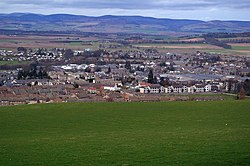
Forfar (/ˈfɔːrfər/ ⓘ; Scots: Farfar,[2] Scottish Gaelic: Baile Fharfair) is the county town of Angus, Scotland, and the administrative centre for Angus Council, with a new multi-million-pound office complex located on the outskirts of the town. As of 2021, the town had a population of 16,280.
Key Information


The town lies in Strathmore and is situated just off the main A90 road between Perth and Aberdeen, with Dundee (the nearest city) being 13 miles (21 km) away. It is approximately 5 miles (8 km) from Glamis Castle, seat of the Bowes-Lyon family and ancestral home of Queen Elizabeth the Queen Mother, and where the late Princess Margaret, younger sister of Queen Elizabeth II, was born in 1930.
Forfar dates back to the temporary Roman occupation of the area, and was subsequently held by the Picts and the Kingdom of Scotland. During the Scottish Wars of Independence, Forfar was occupied by English forces before being recaptured by the Scots and presented to Robert the Bruce. Forfar has been both a traditional market town and a major manufacturing centre for linen and jute. Today the main activities are agriculture and tourism around scenic Strathmore. The local glens are visited by hill-walkers, and there are ski-slopes in the mountains. The town is home to a number of local sporting teams, including the League Two football club, Forfar Athletic.
The Forfar bridie, a Scottish meat pastry snack, is traditionally identified with the town.
Etymology
[edit]The exact origin of the name Forfar is uncertain.[3] One suggestion is that the name is Gaelic and means "a cold point", involving, fuar meaning "cold, chilly", and bhar meaning "a point".[3]
History
[edit]Early history
[edit]During one of the Roman invasions of modern-day Scotland, the Romans established a major camp at Battledykes, approximately 3 miles (5 km) north of Forfar; this camp was analysed to have held 50,000 to 60,000 men.[dubious – discuss][4] From Battledykes northward the Romans established a succession of camps including Stracathro, Raedykes and Normandykes.[5]
Middle Ages
[edit]During the Middle Ages, a "claimant" to the throne, the daughter of the leader of the Meic Uilleim, who were descendants of King Duncan II, had her brains dashed out on Forfar market cross in 1230 while still an infant.[6]
During the First War of Scottish Independence, the castle of Forfar was held by the English. After Robert the Bruce's victory over the Earl of Buchan, Philip, the Forester of Platane, together with some of his friends, raised ladders against the wall and, climbing over, surprised the garrison and killed them. He then yielded the castle to Bruce, who rewarded him and gave instructions for its slighting.[7]
Early modern history
[edit]During the 16th and 17th century, several witch trials took place in Forfar, the last of which took place in 1662 and in which 52 people were accused. At the time, Forfar was a town of around 1000 inhabitants, with an additional 2000 people residing in the county.[8][9]
Like other parts of Angus, Forfar was home to a very successful textile industry during and after the Industrial Revolution. In the late 18th century the firm of William Don & Co. (later William and John Don & Co) was founded in the town. The firm originally bought and sold webs of linen which were woven in local cottages, although it also operated a small weaving shed. In 1865 the firm merged with A J Buist, a Dundee based firm, and began construction of St James Works in Forfar. The partnership also operated mills in Dundee and later built Station Works in Forfar, which contained some 300 looms. Workers' housing was built by the firm in Forfar. Don Brothers, Buist & Company Ltd, as the firm was known from 1904, built another works in Forfar, at Strang Street, in 1929. In 1960 it merged with another Dundee firm, Low Brothers & Co (Dundee) Ltd, eventually becoming Don & Low (Holdings) Ltd. By the 1980s the Don & Low group was the United Kingdom's biggest polypropylene textile extrusion and weaving unit. The firm retains premises in Forfar, mainly producing woven and non-woven polypropylene industrial textile products and plastic food packaging.[10][11][12][13] In 1958 Don Brothers, Buist & Co Ltd acquired a controlling interest in another Forfar based-textile firm, Moffat & Son Ltd, who operated Haugh Works in South Street.[14] Another important Forfar textile firm was J & A Craik & Company, Linen and Jute Manufacturers, which was based at the Manor Works. Craiks was started in 1863 when James Craik obtained land in Forfar to build the Manor Works and the company survived until 1981, the year in which it became part of the Low and Bonar group.[15] Craiks owned Forfar Fabrics Ltd, incorporated in 1965, which amalgamated with Low & Bonar Textiles Limited in 1981.[16] The jute manufacturers, John Lowson, Jnr & Co Ltd, also operated in Forfar, operating out of Victoria Works.[17][18]

The Meffan Museum is in the heart of the town. It was built by a daughter of the Provost Meffan as a bequest in 1898. It is home of the Forfar story. It is also an art gallery and a meeting place for local speakers, summer clubs for children and groups. The story of Forfar takes visitors from the history of the little cobbler shops to the burning of the witch Helen Guthrie. There is also a good selection of Pictish stones found in and around Forfar and Kirriemuir. The Large Class I Pictish stone, with a rare carving of a flower, is called the Dunnichen Stone. It was found in the early 19th century when a farmer from the East Mains of Dunnichen was ploughing. It was initially displayed at a church in the vicinity, then at Dunnichen House. In 1966 it was relocated at St Vigeans and finally moved to Dundee museum in 1972. After the Meffan Institute had been renovated it was brought to Forfar on a long-term loan where it is displayed alongside the Kirriemuir Sculptured Stones. There is a canoe, excavated from Forfar Loch, that dates back to the 11th century (one of two that were found).
Modern history
[edit]In 1911 more than 20% of workers in Forfar were employed in the jute industry. Employment levels in this industry generally dramatically declined in other parts of Angus, including Dundee, during the next four decades. Notably in Dundee, the centre of the British jute industry, more than 40.4% of the working population had worked in the jute industry in 1911, but by 1951 this had fallen to just 18.5%. In Forfar, however this trend was not followed as percentage of the workforce employed in the jute industry had actually risen to 24.4% by 1951.[19]
In the town there is a metal plaque to General Sikorski and the Polish troops commemorating the visit of King George VI and Queen Elizabeth to the town on 7 March 1941. The plaque is located on a wall on Market Street below Forfar Sheriff Court. It was here on 7 March 1941 that the royal couple, along with General Sikorski, took the salute in the march past of the Polish troops.[20]
Queen Elizabeth II and the Duke of Edinburgh visited the town and surrounding area in 2004 (the first time in around 30 years) and again in 2011. HRH Prince Charles, the Duke of Rothesay, visited the town in April 2012 to take the salute of the Black Watch during the regiment's homecoming parade, marking its return from a six-month tour of duty in Afghanistan.
Governance
[edit]
Forfar is a parish, town and former royal burgh. The meeting place of the burgh was the Forfar Town and County Hall.[21] It is the county town of Angus, which was officially known as Forfarshire from the 18th century until 1928.[22] The town is represented within Angus Council by the Forfar & District ward, from which four councillors are elected. The members elected from this ward are, as of 2021; Lynne Devine (Scottish National Party), Braden Davy (Scottish Conservative and Unionist), Colin Brown (Independent) and Ian McLaren (Independent).[23]
Transport
[edit]Road
[edit]The town is located just off the main A90 Dundee to Aberdeen road; having once passed through the town centre, the bypass was completed in 1987.
Railway
[edit]The nearest stations to Forfar are Dundee, Carnoustie and Arbroath, which are all around 14 miles (23 km) away. Connections to the rest of Scotland are available on the Edinburgh–Dundee line; the Glasgow–Dundee line, via Perth; and the Dundee to Aberdeen line.[24]
The town was once served by Forfar railway station, which ran goods and passenger lines until 3 September 1967 when it closed for passenger transport as part of the Beeching cuts; a goods line from Perth continued until 1982. The station was located on the main line of the Caledonian Railway from Glasgow Buchanan Street to Aberdeen, which was the furthest north link in the chain of the West Coast Main Line from London Euston. Lines also went to Dundee, Arbroath, Brechin and Kirriemuir. The station has since been demolished and replaced by a small housing estate. However, a major locomotive shed remains and is in use for vehicle body manufacture. Some bridges and cuttings still survive but the site of the goods station, which was the town's original railway station before the one near the County Buildings was built, is now mainly residential properties.
Buses
[edit]Local bus services are operated predominantly by Stagecoach Strathtay, Moffat & Williamson and JP Coaches. Key routes connect the town with Dundee, Kirriemuir, Edzell and Arbroath.[25]
Climate
[edit]As with most of the British Isles, Forfar has an oceanic climate (Köppen: Cfb). The nearest weather station to Forfar is located around 3 miles (5 km) north of Forfar, and is 91 m (299 ft) above sea level.
| Climate data for Forfar (91 m asl, averages 1991–2020) | |||||||||||||
|---|---|---|---|---|---|---|---|---|---|---|---|---|---|
| Month | Jan | Feb | Mar | Apr | May | Jun | Jul | Aug | Sep | Oct | Nov | Dec | Year |
| Record high °C (°F) | 14.4 (57.9) |
14.8 (58.6) |
21.5 (70.7) |
22.7 (72.9) |
24.0 (75.2) |
28.1 (82.6) |
28.5 (83.3) |
28.2 (82.8) |
25.3 (77.5) |
21.2 (70.2) |
16.7 (62.1) |
14.8 (58.6) |
28.5 (83.3) |
| Mean daily maximum °C (°F) | 5.8 (42.4) |
6.6 (43.9) |
8.7 (47.7) |
11.2 (52.2) |
14.3 (57.7) |
17.0 (62.6) |
18.8 (65.8) |
18.6 (65.5) |
16.1 (61.0) |
12.3 (54.1) |
8.5 (47.3) |
5.9 (42.6) |
12.0 (53.6) |
| Daily mean °C (°F) | 2.8 (37.0) |
3.5 (38.3) |
5.0 (41.0) |
7.2 (45.0) |
10.0 (50.0) |
12.6 (54.7) |
14.4 (57.9) |
14.2 (57.6) |
12.0 (53.6) |
8.8 (47.8) |
5.3 (41.5) |
2.8 (37.0) |
8.2 (46.8) |
| Mean daily minimum °C (°F) | −0.2 (31.6) |
0.3 (32.5) |
1.8 (35.2) |
3.2 (37.8) |
5.6 (42.1) |
8.3 (46.9) |
9.9 (49.8) |
9.7 (49.5) |
7.9 (46.2) |
5.2 (41.4) |
2.0 (35.6) |
−0.2 (31.6) |
4.4 (39.9) |
| Record low °C (°F) | −18.9 (−2.0) |
−18.4 (−1.1) |
−14.1 (6.6) |
−6.9 (19.6) |
−3.7 (25.3) |
−1.3 (29.7) |
1.8 (35.2) |
1.1 (34.0) |
−2.2 (28.0) |
−7.6 (18.3) |
−13.8 (7.2) |
−19.1 (−2.4) |
−19.1 (−2.4) |
| Average rainfall mm (inches) | 79.1 (3.11) |
54.8 (2.16) |
57.2 (2.25) |
49.7 (1.96) |
52.9 (2.08) |
66.1 (2.60) |
67.5 (2.66) |
75.5 (2.97) |
61.9 (2.44) |
98.9 (3.89) |
81.0 (3.19) |
74.6 (2.94) |
818.9 (32.24) |
| Average rainy days (≥ 1 mm) | 12.7 | 10.5 | 9.5 | 9.2 | 11.0 | 12.0 | 9.4 | 9.8 | 11.1 | 12.1 | 12.3 | 11.3 | 130.9 |
| Mean monthly sunshine hours | 51.1 | 77.5 | 113.5 | 161.1 | 195.7 | 159.0 | 166.7 | 156.2 | 122.5 | 98.0 | 63.3 | 46.5 | 1,411 |
| Source 1: Met Office (rainy days 1981–2010)[26] | |||||||||||||
| Source 2: Starlings Roost Weather[27] | |||||||||||||
Local sport
[edit]Football
[edit]The town is home to semi-professional football club Forfar Athletic, who are members of the Scottish Professional Football League and currently play in League Two and two SJFA clubs, Forfar West End, and Forfar United, who both currently play in the Midlands Football League. Forfar Athletic's ground, Station Park, plays host to matches featuring Dundee United Reserves.
Youth and women's football is available in the town, with Forfar Boys F.C (boys only), Lochside Boys F.C[28] (boys only) and Forfar Farmington F.C[29] (boys, girls and women). All the clubs have SFA Quality Mark Award at some level.[citation needed]
Rugby league
[edit]Forfar has a National League rugby league team, the Strathmore Silverbacks, who share Inchmacoble Park as their home ground with the local rugby union team.
Rugby union
[edit]Rugby Union is represented in the town by Strathmore Rugby Football Club, who play their home games at Inchmacoble Park, beside Forfar Loch. The club has men's and ladies' teams.
Golf
[edit]The Forfar Golf Club,[30] founded in 1871, has the fourth oldest 18 hole course in the world, and is the first club to have an 18-hole course from inception and inauguration. The course was designed by Tom Morris Snr, and in 1926 alterations recommended by five time Open Championship winner James Braid were implemented. The letter with Braid's recommendations is on display in the clubhouse.
The Forfar Golf Club has hosted the Scottish PGA Championship twice, once in 1932 and again in 1966.[31]
Cricket
[edit]Strathmore Cricket Club,[32] founded in 1862, has played at Lochside Park since 1873.
Other sports and facilities
[edit]The town has a dedicated community campus.
There is a skatepark near the Forfar loch. Forfar has an ice rink which was built in the early 1990s and this is home to the local curling club.
There are three bowling clubs in Forfar: Forfar Bowling Club, Canmore Bowling Club and Forfar Indoor Bowling Club. Both Forfar Bowling Club and Canmore Bowling Club have outdoor bowling greens.
Forfar Loch is home to Forfar Sailing Club.[33]
Angus Gliding Club operates at Roundyhill, between Glamis and Kirriemuir.
Education
[edit]Forfar has three primary schools:
- Whitehills Primary School on Service Road contains a Gaelic Medium Unit where pupils are educated exclusively through the medium of Scottish Gaelic. The head teachers are Coureen Peters & Elaine Gallon (acting).
- Strathmore Primary School is on St James' Road. The head teacher is Jennifer Garnes.
- Langlands Primary School is on Glamis Road. The school reopened in May 2009 after the demolishing of the original buildings and an extensive period of rebuilding and landscaping. The head teacher is Jayne McLean.
There is one secondary school in the town:
- Forfar Academy on Taylor Street is one of the largest schools in Angus, with a roll of around 1,200 pupils.
In 2007, the Forfar-Carnoustie Schools Project made major changes to schools in Forfar, with closure of the following primary schools:
Chapelpark Primary School on Academy Street (the former Forfar Academy) opened in 1967 and was active for 40 years before closing in 2007. The pupils were re-located to Strathmore Primary and Whitehills Primary. The building continued in use as a school, initially by Whitehills Primary until their new school was completed in early 2008. It was then home to Langlands Primary, until the new school on that site was completed in May 2009. In 2016 it was decided that it would be turned into an apartment block, ad work was completed in the summer of 2018.
Kirkriggs Primary School in St. James' Road was closed in 2007. Pupils were re-located to Langlands until the new school on this site (Strathmore Primary) was completed in early 2008.
Wellbrae Primary School closed in 2007. Pupils were sent to Chapelpark Primary School and later to Whitehills Primary School. The play areas of Wellbrae were all concrete. In 2016, it burned to the ground in an arson attack.[34]
Healthcare
[edit]The local community hospital, the Whitehills Health and Community Care Centre, was built on the site of the old Whitehills Hospital building (the former hospital for infectious diseases) and opened in Spring 2005. The new hospital replaced Forfar Infirmary, formerly the town's main hospital, as well as Whitehills Hospital. The Infirmary has since been completely demolished.[35]
The Fyfe-Jamieson maternity hospital closed some time ago; it was across the road from the Forfar Academy, but the site has since been built over with houses.
Places of worship
[edit]
Forfar has three Church of Scotland congregations:
- East and Old Church was originally the parish kirk, with a tall slender spire and steeple clock overlooking the town centre. It is a category B listed building and was refurbished in early 2017. The church is situated in the town centre and offers a mixture of traditional and contemporary worship.
- Lowson Memorial Church, off Montrose Road, is a category A listed church in late Scots Gothic style built in 1914 by A Marshall Mackenzie, who also designed Crathie Kirk. The church contains notable stained glass windows by Douglas Strachan. The church serves the east side of Forfar, and provides a mix of traditional and contemporary styles of worship.
- St Margaret's Church, in the West High Street, was originally a free kirk.
It had been decided (by a Church of Scotland arbiter) that the East and Old Parish Church would close, and the congregation would move to St. Margaret's Church. This was brought back for discussion at Angus Presbytery due to a large vote against this decision. Now the East and Old and St Margaret's are to remain individual churches as they have always have been.
The East & Old Church is built on the site of the original place of worship that some of the monks of Restenneth Priory built hundreds of years before the one today. The adjoining graveyard has famous 'residents' such as botanist George Don, quite a few scholars and a man who blamed the witches of Forfar for poisoning him after ill words were exchanged between them.

The steeple is a focal point of Forfar, visible when entering the town from any direction. Although abutting the East & Old building, it is owned by the 'Town' and is not formally part of the church property; it is all but certain to be retained following any disposal of the church building.[citation needed]
The town has churches of other denominations, including:
- St John the Evangelist Scottish Episcopal Church, East High Street, was designed by Sir R Rowand Anderson and consecrated in 1881. Elizabeth Bowes-Lyon, later to become Queen Elizabeth the Queen Mother, was confirmed in this church.
- St Fergus Roman Catholic Church
- Forfar Community Church at Wellbraehead on part of the old school site
There is a Kingdom Hall of Jehovah's witnesses.
Other items of interest
[edit]
The town is traditionally identified with the Forfar bridie, a meat pastry snack. A recipe for the Forfar bridie was featured in Maw Broon's Cookbook.
The Forfar Loch Country Park is visited by locals as a walking venue. It is said that the Forfar Loch extended over much more of Forfar in the 1800s, going as far up as Orchardbank and Wellbrae. A drainage project brought the water level down. In about the same time period the loch was used to dump raw sewage; this practice is no longer continued: it is now treated sewage.
The town holds many events throughout the year such as the bi-annual Forfar Mara-Fun, which raises money for charity, and the annual Forfar Food Festival, highlighting some of the local food. There is also a monthly farmers' market.
Forfar is home to the Strathmore Mineral Water Co., Ltd., a bottled mineral water producer now run by AG Barr. The company's products are shipped worldwide.
Forfar is known for the "coo o Forfar". A householder left a tub of beer in the doorway to cool, and a passing cow drank it. When the owner of the cow was charged for the beer, a baillie ruled that if the beer was drunk at the doorway it was "deoch an doras" or "stirrup cup", to charge for which would be an insult to Scots hospitality. This became a byword: "Be like the coo o Forfar, an tak a stannin drink".[36]
Public services
[edit]
Forfar and the surrounding area are supplied with water by Scottish Water from Lintrathen and Backwater reservoirs in Glen Isla. Electricity distribution is by Scottish Hydro Electric plc, part of the Scottish and Southern Energy group.
Waste management is handled by Angus Council. From June 2014, there has been a comprehensive recycling service in place, succeeding the more limited kerbside recycling scheme introduced in 2005. Recyclable waste (encompassing paper, card, cans, plastics and glass) is now collected fortnightly, on alternate weeks with non-recyclable waste, with households having separate bins for each purpose. Garden and food waste are also collected for separate processing. Roughly two-thirds of non-recyclable material is sent to landfill at Angus Council's site at Lochhead, Forfar, and the remainder sent for incineration (with energy recovery) outside the council area.[37]
A recycling centre is located at Queenswell Road. Items accepted include, steel and aluminium cans, cardboard, paper, electrical equipment, engine oil, fridges and freezers, garden waste, gas bottles, glass, liquid food and drinks cartons, plastic bottles, plastic carrier bags, rubble, scrap metal, shoes and handbags, spectacles, textiles, tin foil, wood and yellow pages. Angus council publishes details of where and how each product is processed.[38] There are also glass banks at the Abbeygate and Tesco car parks.[39] The Angus Council area had a recycling rate of 34.7% in 2007/08.[40]
Healthcare is supplied in the area by NHS Tayside. The nearest hospitals with accident and emergency departments are Arbroath Infirmary[41] and Ninewells Hospital, Dundee.[42] Primary Health Care in Forfar is supplied by several practices, based at Ravenswood Surgery on New Road, Academy Medical Centre in Academy Street and Lour Road Group Practice.[43][44][45] Forfar, along with the rest of Scotland, is served by the Scottish Ambulance Service.[46]
Since April 2013, law enforcement is provided by Police Scotland and Forfar is served by Scottish Fire and Rescue Service.
Notable people
[edit]
- Patrick Abercromby (1656–1716), antiquarian and physician
- Eilley Bowers, in her time, one of the richest women in the United States, and owner of the Bowers Mansion, one of the then-largest houses in the western United States; a Scottish farmer's daughter who emigrated, after converting to the LDS Church as a teenager
- Willie Brown (1928–2017), footballer
- Peter Ritchie Calder (1906–1982), socialist writer, journalist, and academic
- James Cook, BBC journalist
- Caroline Doig (1938–2019), paediatric surgeon and the first woman elected to the council of the Royal College of Surgeons of Edinburgh
- David Don (1799–1841), botanist
- George Don (1798–1856), botanist
- George Duncan (1884–1965), Church of Scotland minister
- Prince Edward, Earl of Forfar. HRH visited the town in June 2019 after being granted the title in March of the same year. He was presented with an Earl of Forfar tartan[47][48][49]
- Kathryn Findlay, architect
- James Simpson Fleming (1828–1899), banking lawyer
- David Ireland, colonel in the United States Army during American Civil War; commanded the 137th New York Infantry Regiment during crucial battles such as the Battle of Gettysburg; born in Forfar
- Reverend Dr John Ker, minister of Forfar 1745–1781, moderator in 1776
- George Langlands, footballer (primarily Dundee F.C.)[50]
- Jack Lorimer, comedian and father of Max Wall
- David McLean (1890–1967), footballer, played for both Celtic and Rangers, ended his career at Forfar Athletic[51][50]
- George McLean (1898–1970), footballer, younger brother of David, ended his career with Forfar Athletic[50]
- A. S. Neill (1883–1973), educator
- David W. Potter, sports author
- Ian Read, CEO of Pfizer
- Enn Reitel, actor
- Bon Scott, rock n' roll singer from the band AC/DC
- David Taylor (1954–2014), former Joint General Secretary of UEFA and Chief Executive of the Scottish Football Association (SFA)[52]
- Joseph Wedderburn (1882–1948), mathematician, modern algebra, born in Forfar[53]
Freedom of the Town
[edit]The following people and military units have received the Freedom of the Town of Forfar.
 |
Individuals
[edit]Military units
[edit]- The Black Watch: 1956
References
[edit]- ^ "Population estimates for settlements and localities in Scotland: mid-2020". National Records of Scotland. 31 March 2022. Retrieved 31 March 2022.
- ^ "Dictionaries of the Scots Language:: SND :: farfar".
- ^ a b Cumming, Gershom (1843). Forfarshire Illustrated: Being Views of Gentlemen's Seats, Antiquities, and Scenery in Forfarshire with Descriptive and Historical Notices. Angus.
- ^ Alan Reid, The Royal Burgh of Forfar: A Local History, 1902, Houlston & sons; 445 pages
- ^ C. Michael Hogan, Elsick Mounth, Megalithic Portal, ed Andy Burnham (2007)
- ^ "Maitland Club, Edinburgh 1839" (in Latin). Lanercost Chronicle. 1839. pp. 40–41.
- ^ Barbour, John (1856). The Brus. The Spalding club.
- ^ Mitchell, Claire; Venditozzi, Zoe (2025). How to Kill a Witch. Hatchett. ISBN 9781800961883.
- ^ Strachan, Graeme (26 October 2022). "Forfar Witch Trials: Suffering of executed women to be recognised in 'historic' service". The Courier. DC Thomson Co Ltd. Retrieved 16 May 2025.
- ^ "Archive Services Online Catalogue Don & Low (Holdings) Ltd". University of Dundee. Retrieved 21 August 2017.
- ^ "Archive Services Online Catalogue Don Brothers, Buist & Co. Ltd, Spinners and manufacturers, Dundee and Forfar, and Don & Low (Holdings) Ltd". University of Dundee. Retrieved 8 December 2014.
- ^ Whatley, Christopher A. (1992). Onwards from Osnaburgs: the rise & progress of a Scottish textile company, Don & Low of Forfar 1792–1992. Edinburgh: Mainstream. ISBN 1-85158-509-5.
- ^ "Don & Low". Don & Low. Retrieved 14 October 2011.
- ^ "MS 100/3 Moffat & Son Ltd, Manufacturers, Forfar". Archive Services Online Catalogue. University of Dundee. Retrieved 22 December 2017.
- ^ "MS 74 Craiks Limited, Linen and Jute Merchants and Manufacturers, Forfar". Archive Services Online Catalogue. University of Dundee. Retrieved 8 December 2014.
- ^ "MS 24/13 Forfar Fabrics Ltd". Archive Services Online Catalogue. University of Dundee. Retrieved 22 December 2017.
- ^ "MS 66/8 John Lowson, Jnr & Co Ltd, Jute Manufacturers, Forfar". Archives Services Online Catalogue. University of Dundee. Retrieved 22 December 2017.
- ^ The Jute & Canvas Trades Year-book & Directory 1946. London: British Continental Trade Press. 1946. p. 89.
- ^ Carstairs, A. M. (1974). The Tayside Industrial Population 1911–1951. Dundee: Abertay Historical Society. pp. 33–34.
- ^ "Polonica in Scotland, Forfar, Angus". ostrycharz.free-online.co.uk. Retrieved 11 June 2012.
- ^ Historic Environment Scotland. "Forfar Town and County Hall, Cross (LB31496)". Retrieved 4 September 2021.
- ^ "Forfarshire's New Name". The Times. No. 45032. London. 24 October 1928. p. 8.
It was last May that the Forfarshire County Council passed a resolution...
- ^ "Councillors". Angus Council.
- ^ "Timetables". ScotRail. May 2023. Retrieved 20 October 2023.
- ^ "Forfar Bus Services". Bus Times. 2023. Retrieved 20 October 2023.
- ^ "Forfar No 3 (Angus) UK climate averages". Met Office. Archived from the original on 18 March 2020. Retrieved 18 March 2020.
- ^ "Monthly Temperature Extremes". Roost Weather. Retrieved 11 August 2025.
- ^ http://www.lochsideboysfc.co.uk Archived 12 July 2013 at the Wayback Machine
- ^ "Forfar Farmington Football Club – North East's Girl's & Women's Football since 1984".
- ^ "Home". forfargolfclub.co.uk.
- ^ "History".
- ^ "Strathmore Cricket Club". Archived from the original on 13 July 2011. Retrieved 13 October 2007.
- ^ "FORFAR SAILING CLUB - Home". Archived from the original on 12 September 2007. Retrieved 13 October 2007.
- ^ "Two boys charged over fire that gutted former primary school". STV News. 24 October 2016. Retrieved 24 October 2018.
- ^ "Forfar Infirmary". Historic Hospitals. 26 April 2015. Retrieved 8 March 2020.
- ^ Brewer's Dictionary of Phrase and Fable
- ^ "Angus Council local plan section 37" (PDF). angus.gov.uk. Archived from the original (PDF) on 7 June 2011. Retrieved 2008-09-07.
- ^ "Angus Council recycling centres". angus.gov.uk. Archived from the original on 7 June 2011. Retrieved 2009-08-26.
- ^ "Angus Council neighbourhood recycling points". angus.gov.uk. Archived from the original on 5 June 2009. Retrieved 26 August 2009.
- ^ "Angus Council kerbside Recycling Scheme". angus.gov.uk. Archived from the original on 7 June 2011. Retrieved 26 August 2009.
- ^ "Arbroath Infirmary". nhstayside.scot.nhs.uk. Retrieved 7 September 2008.
- ^ "Ninewells Hospital". nhstayside.scot.nhs.uk. Retrieved 7 September 2008.
- ^ "Ravenswood Surgery". gpsites.scot.nhs.uk. Retrieved 26 August 2009.
- ^ "Academy Medical Centre". gpsites.scot.nhs.uk. Retrieved 26 August 2009.
- ^ "Lour Road Group Practice". gpsites.scot.nhs.uk. Retrieved 26 August 2009.
- ^ "Scottish Ambulance Service". scottishambulance.com. Archived from the original on 19 July 2008. Retrieved 2008-09-07.
- ^ Brown, Graham (2 July 2019). "VIDEO: 'Honour' to be named Earl of Forfar says Prince Edward as town welcomes him with bridies, tartan and fiddles". The Courier. Retrieved 10 April 2021.
- ^ "Royal Family". Twitter. Retrieved 10 April 2021.
- ^ "Tartan Details - The Scottish Register of Tartans". www.tartanregister.gov.uk. Retrieved 10 April 2021.
- ^ a b c John Litster (October 2012). "A Record of pre-war Scottish League Players". Scottish Football Historian magazine.
- ^ SFAQs: Davie McLean, ScottishLeague.net
- ^ "Scottish Football Association".
- ^ Entry for Joseph Wedderburn at the Mactutor History of Mathematics Archive
- ^ "QUEEN MOTHER IN FORFAR". British Movietone. 21 July 2015. Archived from the original on 12 December 2021 – via YouTube.
- ^ "Queen Mother's Visit To Forfar To Receive Freedom (1956)". British Pathé. 13 April 2014. Archived from the original on 12 December 2021 – via YouTube.
External links
[edit]
- Local Community Website for Forfar, Angus
- Photographs of Forfar on the Geograph web site
- History of the town and photographs
- . Encyclopædia Britannica (11th ed.). 1911.
| International | |
|---|---|
| National | |
| Geographic | |
| Other | |

Forfar
View on GrokipediaGeography
Etymology and name origins
The etymology of Forfar is uncertain, with several proposed derivations from Scottish Gaelic elements reflecting the region's linguistic history under Pictish and Gaelic influences. One theory posits the name originates from "for fuar", translating to "cold place" or "cold watch", possibly alluding to the site's exposed or chilly elevated position.[7] Another interpretation suggests "foither", combining elements for "slope" with a term implying "watching" or oversight, evoking a vantage point for surveillance.[7] Alternative analyses link the name to a Gaelic prefix "for-" denoting "above", "big", or "projecting", potentially combined with "farr" or similar roots evoking a post, man, or prominence, though the precise composition remains debated among place-name scholars.[8] A related suggestion interprets it as "a cold point", merging "fuar" (cold or chilly) with "bhar" or "barr" (point or top), consistent with topographic features in early Gaelic naming conventions.[9] These Gaelic hypotheses align with the area's integration into Gaelic-speaking Scots domains by the 9th century, superseding earlier Pictish elements, but no single origin has been definitively established through primary historical records.Location and topography
Forfar is situated in the Angus council area of eastern Scotland, within the historic county of Angus, approximately 12 miles (19 km) north of Dundee and 40 miles (64 km) north-northeast of Edinburgh. The town center lies at coordinates 56°38′39″N 02°53′18″W, positioning it in the central lowlands of Angus. As the administrative center of Angus, Forfar serves as a key hub for the surrounding rural region.[10] The topography of Forfar features a broad, flat-bottomed glacial valley with fertile alluvial soils conducive to agriculture, flanked by undulating hills rising to elevations of around 200-300 meters. The town's average elevation is approximately 63 meters (207 feet) above sea level, with modest variations within a 2-mile radius, including a maximum change of 397 feet. Forfar Loch, a shallow freshwater body covering about 0.5 square kilometers, occupies the western part of the town, influencing local drainage and providing a central natural landmark.[11][12][13] The surrounding landscape transitions from the valley floor to the foothills of the Grampian Mountains to the north and west, characterized by rolling farmland interspersed with hedgerows and woodland strips that enhance visual diversity. This setting supports intensive arable farming, with the valley's glacial origins contributing to productive soils derived from fluvio-glacial deposits.[13]Climate and environmental data
Forfar experiences a cool temperate oceanic climate, with average annual maximum temperatures of 12.0 °C and minimums of 4.4 °C, based on data from the Forfar No 3 station for the period 1991–2020.[14] Winters are mild but prone to frost, with January maximums averaging 5.8 °C and minimums -0.2 °C, while summers are cool, peaking in July at 18.8 °C maximum and 9.9 °C minimum.[14] Annual rainfall totals 819 mm, distributed relatively evenly but with October the wettest month at 99 mm; the region receives more sunshine than western Scotland due to its eastern inland position in the Strathmore valley, averaging 1,411 hours yearly.[14]| Month | Max Temp (°C) | Min Temp (°C) | Sunshine (hours) | Rainfall (mm) |
|---|---|---|---|---|
| January | 5.8 | -0.2 | 51 | 79 |
| February | 6.6 | 0.3 | 77 | 55 |
| March | 8.7 | 1.2 | 113 | 57 |
| April | 11.2 | 3.2 | 161 | 50 |
| May | 14.3 | 5.6 | 196 | 53 |
| June | 17.0 | 8.3 | 159 | 66 |
| July | 18.8 | 9.9 | 167 | 68 |
| August | 18.6 | 9.7 | 156 | 75 |
| September | 16.1 | 7.9 | 122 | 62 |
| October | 12.3 | 5.2 | 98 | 99 |
| November | 8.5 | 2.0 | 63 | 81 |
| December | 5.9 | -0.2 | 47 | 75 |
| Annual | 12.0 | 4.4 | 1,411 | 819 |
History
Prehistoric and early settlement
The earliest archaeological evidence of human presence near Forfar consists of Late Upper Palaeolithic stone artefacts, including 29 tools such as scrapers and strike-a-lights, discovered in 1993 at Lunanhead, approximately 5 km northeast of the town centre.[18] More consistent prehistoric activity is attested from the Bronze Age (c. 2500–700 BC), marked by cist burials, urnfields, and metalwork hoards across the locality. At Castle Hill, a central topographic feature, a 1760 excavation revealed a cist containing a conical vessel, arrows, and human remains, while 1840 drainage works uncovered a hoard of four socketed axes, a spearhead, a flat axe, and a brass female figurine.[19] Additional Bronze Age cists with food vessels and skeletal remains were found at Newmont Hill, alongside cinerary urns holding calcined bone at South Street (late 19th century) and Nursery Feus (1867).[19] These discoveries indicate funerary practices and resource exploitation in a fertile lowland setting, though no large-scale settlements have been identified. Iron Age (c. 700 BC–AD 100) evidence includes souterrains—underground storage or refuge structures—detected via aerial photography in the vicinity, suggesting defensive or agricultural adaptations amid regional hillfort proliferation, such as those at Caterthun to the southwest.[19] Temporary Roman military presence in the 3rd century AD is implied by a 63-acre camp at Lunanhead, aligning with broader campaigns into Caledonian territory, but no permanent infrastructure remains.[19] Post-Roman settlement coalesced around Forfar Loch and Castle Hill during the early medieval period, with the area forming part of the Pictish Kingdom of Circinn by the 7th–9th centuries AD.[1] Logboats recovered from the loch (one radiocarbon-dated to c. AD 1090 ± 50) point to prehistoric and early medieval navigation for fishing and transport, while a crannog on St Margaret's Inch—possibly prehistoric in origin—later hosted a medieval chapel, evidencing lake-based habitation.[19][20] A small long-cist cemetery excavated in 2004 near Auchterforfar Farm, comprising 20 stone-lined graves with flexed burials, reflects early Christian practices (c. 5th–7th centuries AD), potentially tied to Pictish or incoming Dal Riata populations amid cultural transitions.[21] By the 11th century, a royal residence on Castle Hill, linked to Malcolm III Canmore (r. 1058–1093), fostered proto-urban growth, predating formal burgh creation under David I (r. 1124–1153).[19] This site, with stone foundations and walls noted in later surveys, drew settlers to the lochside and hill, leveraging natural defenses and arable land in the Howe of Angus.[19]Medieval period
Forfar emerged as a key royal center in medieval Scotland, with evidence of its castle serving as a residence for early kings including Malcolm III (r. 1058–1093), who tradition holds resided there alongside Queen Margaret.[22] The fortress, likely surrounded by water from Forfar Loch, functioned as a strategic base, notably under Malcolm II (r. 1005–1034) for military campaigns against Danish invaders, culminating in victories at Aberlemno and Barry Hill around 1012.[22] By the 12th century, the site had established itself as the administrative seat of the sheriffdom of Angus, underscoring its governance role under the emerging Scottish kingdom.[19] King David I (r. 1124–1153) granted Forfar royal burgh status, conferring trading privileges and fostering urban development as a market hub for the region.[23] The castle underwent rebuilding during the reign of William I (r. 1165–1214), likely in the 1170s, coinciding with the town's designation as the administrative center of Angus and enhancing its status among Scottish burghs.[1] This period saw gradual expansion, supported by royal patronage and agricultural hinterlands, positioning Forfar as a notable settlement by the 13th century. The castle's prominence persisted into the 13th century under Alexander II (r. 1214–1249), but it became a flashpoint during the Wars of Scottish Independence. English forces under Edward I occupied it repeatedly in the 1290s, using it as a base for regional control.[24] Robert the Bruce ordered its slighting in 1307 to prevent reoccupation, though repairs followed; it faced final destruction around 1312 amid ongoing conflicts.[24] Despite these upheavals, Forfar's burgh charter endured, enabling recovery through trade and local administration, with the town ranking among Scotland's more prosperous by the late medieval era.[1]Early modern era
In the 16th and 17th centuries, Forfar functioned as a royal burgh and the administrative center of Forfarshire (now Angus), maintaining its medieval privileges for trade and governance amid Scotland's religious upheavals during the Reformation.[22] The town hosted regular markets for agricultural produce and livestock, supporting its role as a regional hub, with gradual population growth reflecting economic stability; by the early 1600s, it ranked among Scotland's top 25 towns by tax assessments.[1] A notorious episode occurred during the witch hunts of 1661–1663, when 42 residents were accused of witchcraft, imprisoned in the town tollbooth, and subjected to torture, resulting in at least nine executions by strangling and burning.[25] Confessions extracted under duress implicated locals in pacts with the devil and maleficium, such as causing illness or crop failure, amid broader European panic; the trials, presided over by the justiciary court, marked one of Scotland's last major outbreaks of such persecutions in the area.[26] Economically, Forfar's artisans specialized in producing wooden-soled brogues, earning the town the nickname "Sutortoun" from its shoemakers, who supplied durable footwear for rural laborers and travelers.[2] Linen weaving and wool processing persisted from earlier traditions, bolstered by local flax cultivation, though the town avoided large-scale industrialization until later centuries. Involvement in national events was peripheral; while Angus nobility supported Jacobite risings in 1715, Forfar itself saw limited direct action, with loyalties divided between Hanoverian authorities and local sympathizers.[27] By the late 18th century, enclosure movements and agricultural improvements began transforming surrounding farmlands, setting the stage for modernization.[28]Industrial and modern developments
In the 18th century, Forfar emerged as a center for the manufacture of coarse osnaburg linen, with production beginning around 1746 following the expansion of the flax trade in the region.[29] By the late 1700s, the town supported approximately 450 weavers, reflecting a shift from predominantly agricultural activities to textile production.[1] This industry benefited from local flax cultivation and proximity to ports like Dundee, though it remained smaller in scale compared to neighboring Arbroath or Dundee.[3] The 19th century saw further industrialization, with Forfar's textile sector incorporating jute alongside linen weaving, driven by demand surges during conflicts such as the Crimean War and American Civil War, which disrupted cotton supplies.[7] The town also maintained a tradition of shoemaking, known as the "sutors of Forfar," producing wooden-soled brogues that contributed to local craftsmanship.[30] Agriculture remained integral, supporting flax and food processing, but textiles formed the core of employment growth during the Industrial Revolution.[31] In the 20th century, Forfar's textile industry persisted but gradually declined amid competition from cheaper imports and mechanization elsewhere, with employment peaking in the early 1900s before contracting post-World War II.[32] By the late 20th century, the economy pivoted toward food processing— including potatoes, bottled water, and local specialties like Forfar bridies—and diversified agriculture, while retaining some jute and linen remnants.[1][33] Modern developments have emphasized residential expansion and community investments, such as housing masterplans and infrastructure funding exceeding £600,000 for local projects in 2024, amid ongoing challenges in sustaining traditional sectors.[34][35]Demographics
Population trends and statistics
The population of Forfar, defined as a settlement in official classifications, was 13,801 according to Scotland's Census 2022. This figure reflects a population density of approximately 2,331 inhabitants per square kilometre across an area of 5.92 km².[36] Census data indicate modest growth in the early 21st century, with the population rising from 13,410 in 2001 to 14,048 in 2011, before declining to 13,801 by 2022—a net decrease of 247 residents over the decade, or an average annual change of -0.16%.[36] This recent trend aligns with broader patterns in rural Scottish towns, where out-migration and ageing demographics have offset limited inflows.[37]| Census Year | Population |
|---|---|
| 2001 | 13,410 |
| 2011 | 14,048 |
| 2022 | 13,801 |