


Community hub
Recent from talks
Contribute something
Nothing was collected or created yet.
Chibok schoolgirls kidnapping
View on Wikipedia | This article needs to be updated. (April 2025) |
| Part of the Boko Haram insurgency | |
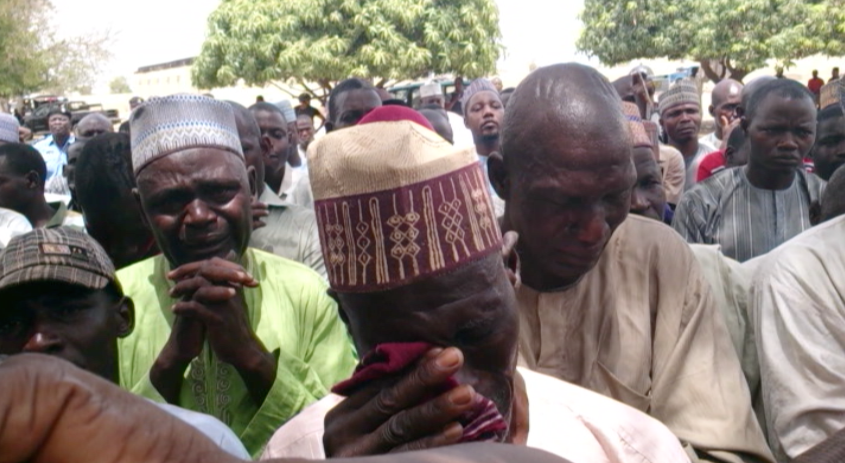
 Parents of the kidnapped girls | |
 | |
| Date | 14 April 2014 |
|---|---|
| Location | Chibok in Borno State, Nigeria |
| Coordinates | 10°52′55″N 12°50′17″E / 10.88194°N 12.83806°E |
| Perpetrator |  Boko Haram Boko Haram |
| Outcome | 276 female students abducted |
| Missing | 82 (as of 14 April 2024)[1] |
On the night of 14–15 April 2014, 276 mostly Christian, with some Muslim, schoolgirls aged from 16 to 18 were kidnapped by the Nigerian militant group Boko Haram from the Government Girls Secondary School in the town of Chibok in Borno State, Nigeria.[2][3][4] Prior to the raid, the school had been closed for four weeks due to deteriorating security conditions, but the girls were in attendance to take final exams in physics.
After the incident, 57 schoolgirls immediately escaped by jumping from the trucks on which they were being transported, and others have been rescued by the Nigerian Armed Forces on various occasions.[5][6] Amina Ali, one of the missing girls, was found in May 2016. She claimed that the remaining girls were still there, but that six had died.[7] On 14 April 2021, seven years after the initial kidnapping, over 100 of the girls remained missing.[8][9][10] As of 14 April 2024, ten years after the kidnapping, 82 of the girls remained missing and presumed captive.[1]
Some have described their capture in appearances at international human rights conferences.[11] Boko Haram has used the girls as negotiating pawns in prisoner exchanges, offering to release some girls in exchange for some of their captured commanders in jail.
The girls kidnapped in Chibok in 2014 are only a small percentage of the total number of people abducted by Boko Haram.[12] Amnesty International estimated in 2015 that at least 2,000 women and girls had been abducted by the group since 2014, many of whom had been forced into sexual slavery.[12]
Background
[edit]The militant group Boko Haram wants to institute an Islamic caliphate in Nigeria and is in particular opposed to western-style modern education, which they say lures people away from following Islamic teaching as a way of life.[13] By 2014, tens of thousands of people had been killed in attacks perpetrated by the group, and the Nigerian federal government declared a state of emergency in May 2013 in the states of Borno, Yobe and Adamawa during its fight against the insurgency.[14] The resulting crackdown led to the capture or killing of hundreds of Boko Haram members, with the remainder retreating to mountainous areas from which they began increasingly to target civilians.[15] However, the campaign failed to stabilise the country. A French military operation in Mali also pushed Boko Haram and AQIM militants into Nigeria.[16][17]

Boko Haram began to target schools in 2010, killing hundreds of students by 2014. A spokesperson for the group said such attacks would continue as long as the Nigerian government continued to interfere with traditional Islamic education. 10,000 children have been unable to attend school as a result of activities by Boko Haram.[13] Boko Haram has also been known to kidnap girls, whom it believes should not be educated, and use them as cooks or sex slaves.[16]
On 6 July 2013, armed men from Boko Haram attacked Government Secondary School in Mamudo, Yobe State, killing at least 42 people. Most of those killed were students, with some staff members among the dead.[14] On 29 September 2013, armed men from Boko Haram gained access to the male hostel in the College of Agriculture in Gujba, Yobe State, killing forty-four students and teachers.[18]
Boko Haram's attacks intensified in 2014. In February, the group killed more than 100 Christian men in the villages of Doron Baga and Izghe.[16] That same month, 59 boys were killed in the Federal Government College attack in northeastern Nigeria.[19] In March, the group attacked the Giwa military barracks, freeing captured militants.[16] The Chibok abduction occurred on the same day as a bombing attack in Abuja in which at least 88 people died.[20] The road leading to Chibok is frequently targeted due to the fact that there is little to no government protection for commuters for the village.[21] Boko Haram was blamed for nearly 4,000 deaths in 2014.[16] Training received from al-Qaeda in the Islamic Maghreb and al Qaeda in the Arabian Peninsula has helped Boko Haram intensify its attacks.[22]
Jonathan N.C. Hill of King's College London has suggested that Boko Haram kidnapped these girls after coming increasingly under the influence of al-Qaeda in the Islamic Maghreb, and asserts that the group's goal is to use girls and young women as sexual objects and as a means of intimidating the civilian population into compliance. Hill describes the attacks as similar to the kidnapping of girls in Algeria in the 1990s and early 2000s.[23][24]
Kidnapping
[edit]

On the night of 14 April 2014, members of the Islamic jihadist terrorist group Boko Haram[25][26] attacked the Government Girls Secondary School in Chibok, Nigeria, a majority Christian village. A few hours prior to the raid, residents in Chibok had received phone calls from neighbouring villages warning them of the incoming attack, who had witnessed convoys containing armed insurgents driving in the direction of the town.[27] The kidnappers broke into the school, pretending to be soldiers of the Nigerian Armed Forces and dressed in matching military uniforms.[28][29] The militants also engaged approximately 15 soldiers based in Chibok, who were unable to stop the attack as the militants had superior numbers and firepower, and no reinforcements were sent by the Nigerian Military during the course of the attack.[20][27] A soldier and a police officer were killed during the course of the raid.[30] The attack lasted for about 5 hours,[27] during which houses in Chibok were also burned down.[20]
According to accounts given by some of the girls, including a diary written by two of the girls (Naomi Adamu and Sarah Samuel) whilst in captivity, the militants had intended to steal a piece of machinery and were initially unsure what to do with the girls.[29][31] They told the girls to get out and come with them.[32] Some girls were loaded into vehicles and the rest had to walk several miles until other trucks came to take them away,[31] possibly into the Konduga area of the Sambisa Forest, a former nature reserve covering 60,000 km2 where Boko Haram were known to have fortified camps.[32] An unidentified senior military source believed that the girls may have been split up and placed in different Boko Haram camps, around Lake Chad, the Gorsi mountains and the Sambisa forest.[33] 57 girls were able to escape by jumping from the trucks in which they were being transported.[21][31][34]
In the immediate aftermath of the attack, local vigilantes and parents searched the Sambisa forest in an attempt to locate and rescue some of the kidnapped girls, however were unsuccessful in finding any of the captives.[27]
The school had been closed for four weeks before the attack due to deteriorating security conditions, however students from multiple schools and villages were in attendance at the time of the raid to take final exams in physics.[20][35] There were 530 students registered to participate in Senior Secondary Certificate Examination at the Government Girls Secondary School, although it is unclear how many were in attendance at the time of the attack.[36] The children were aged from 16 to 18 years of age and were in their final year of school.[37] There was initial confusion over the number of girls kidnapped, with the Nigerian military initially incorrectly claiming in a statement that the majority of the girls had escaped or been released and only eight were still unaccounted for.[38] Parents said that 234 girls were missing,[16] however according to the local police approximately 276 children were taken in the attack, of whom 53 had escaped by 2 May.[36] It is widely accepted that initially 276 girls were kidnapped.[38] Other reports gave various other figures for the number of kidnapped and missing students.[35][39][40]
Amnesty International condemned the Nigerian government, stating that it believed that the Nigerian military had a four hour advance warning of the kidnapping but failed to send reinforcements to protect the school.[41] The Nigerian military later confirmed that they had a four-hour advance notice of the attack but stated that their over-extended forces were unable to mobilize reinforcements.[42]
Aftermath
[edit]Events in 2014
[edit]
The overwhelming majority of the kidnapped girls who were Christian were forced to convert to Islam.[43][44][45] The girls were forced into marriage with members of Boko Haram, with a reputed bride price of ₦2,000 each ($6/£4).[46] Sightings of the students were reported by villagers living in the Sambisa Forest, considered a refuge for Boko Haram. Others reported seeing the students crossing into the neighbouring countries of Chad and Cameroon with the militants,[46][47] though Kashim Shettima, the governor of Borno State in Nigeria, said on 11 May that he had sighted the abducted girls and claimed that they had not been taken across the borders into either country.[48] The Nigerian Military enlisted help from local volunteers and vigilantes in order to search forests close to Nigeria's borders by 21 April.[16] Local residents were able to track the movements of the students with the help of contacts across north eastern Nigeria.[46] A diary written by some of the kidnapped students described how some were able to escape, but were returned to Boko Haram by local villagers and whipped as punishment.[31]
On 2 May, the Nigerian police said that the exact number of students kidnapped was unclear and asked parents to forward the names and photos of kidnapped girls so an official count could be made. The police blamed damage to school records during the attack as a reason for the confusion.[36] Nigerian president Goodluck Jonathan spoke publicly about the kidnapping for the first time on 4 May, saying the government was doing everything it could to find the missing girls.[37] At the same time, he criticized parents for not supplying enough information about their missing children, claiming that they were not fully cooperating with the police.[22]
The Guardian reported that the British Royal Air Force conducted Operation Turus in response to the kidnapping. A source involved with the operation told the Observer that "the girls were located in the first few weeks of the RAF mission", and that "we [the RAF] offered to rescue them, but the Nigerian government declined", because they viewed the matter as a "national issue" to be resolved by Nigerian intelligence and security services.[49] Sir Andrew Pocock, British High Commissioner to Nigeria at the time of the kidnapping, said that a couple of months after the kidnapping, a group of up to 80 of the Chibok girls were seen by American "eye in the sky" technology but nothing was done. About 80 girls, a camp and evidence of vehicle movement were spotted next to a local landmark called the "Tree of Life" in the Sambisa forest.[50]
Boko Haram leader Abubakar Shekau claimed responsibility for the kidnappings in a video released shortly after 1pm on 5 May.[51] Shekau claimed that "Allah instructed me to sell them... I will carry out his instructions",[37] and that "Slavery is allowed in my religion, and I shall capture people and make them slaves."[52] He said the girls should not have been in school and instead should have been married since girls as young as nine are suitable for marriage.[37][52] Another video was released a week later, which showed about 130 girls dressed in hijabs and long Islamic chadors. This was the first public sighting of the girls since they were abducted from Chibok.[53] In this video, Shekau acknowledged that many of the girls were not Muslims, but that some had converted to Islam[54][55] and that they would "treat them well the way the Prophet Muhammad treated the infidels he seized".[53] Shekau also mentioned that he would not release the girls until captured Boko Haram militants in prison were released, raising the possibility of a prisoner exchange with the Nigerian government.[53]
Following the Chibok kidnapping, several attacks linked to Boko Haram occurred in Nigeria. On 5 May, at least 300 residents of the nearby town of Gamboru Ngala were killed in an attack by Boko Haram militants after Nigerian security forces left the town to search for the kidnapped students.[56] The next day, Boko Haram militants abducted 8 girls aged between 12 and 15 from northeastern Nigeria.[57] In the night of 13 to 14 May, Boko Haram ambushed a military convoy that was searching for the abductees near Chibok, killing twelve soldiers and wounding several others. The incident led to mutiny of government forces at Maiduguri, reducing the ability of the Nigerian Army to rescue the schoolgirls.[58] Between 20 and 23 June 91 women and children were abducted in other areas of Borno State by Boko Haram militants,[59] with an estimated 600 girls held by Boko Haram in three camps outside Nigeria by this stage.[60] Boko Haram once again attacked Chibok and other nearby villages on 22 July, killing at least 51 people, including 11 parents of the abducted girls.[61]
A journalist-brokered deal to secure the release of the girls in exchange for 100 Boko Haram prisoners held in Nigerian jails was scrapped at a late stage on 24 May after President Goodluck Jonathan consulted with U.S., Israeli, French and British foreign ministers in Paris, where the consensus was that no deals should be struck with terrorists, and that a solution involving force was required.[62][63] On 26 May, the Nigerian Chief of Defence Staff announced that the Nigerian security forces had located the kidnapped girls, but ruled out a forceful rescue attempt for fears of collateral damage.[64] Two of the kidnapped girls were found raped, "half-dead", and tied to a tree on 30 May by a civilian militia in the Baale region of Northeastern Nigeria.[65][66] Villagers said that Boko Haram had left the two girls and had killed four other disobedient girls and buried them.[66] Another 4 girls escaped later in the year, walking for three weeks and reaching safety by 12 October. They said they had been held in a camp in Cameroon and raped every day.[67]
It was reported on 26 June that the Nigerian government had signed a contract worth more than $1.2 million with Levick, a Washington, D.C. public relations firm to work on "the international and local media narrative" surrounding the Chibok schoolgirl kidnapping.[68][69] The contract was labeled a waste of money by President Jonathan's critics.[70] Jonathan was criticized for a lack of communication regarding the kidnapping. Via an opinion column in The Washington Post, Jonathan attributed his silence to a desire not to compromise the details of security efforts being carried out to rescue the girls.[69][71]
On 1 July, a businessman suspected of carrying out the kidnappings of the school girls, as well as the bombing of a busy market in northeastern Nigeria, was arrested. Military sources said that he was also accused of helping the Islamist militant group kill the traditional leader Idrissa Timta, the Emir of Gwoza.[72] Two weeks later, Zakaria Mohammed, a high-ranking member of Boko Haram, was arrested at Darazo-Basrika Road while fleeing from counterinsurgency operations around the Balmo Forest.[73][74]
Events in 2015
[edit]Stephen Davis, a former Anglican clergyman, contacted three Boko Haram commanders who said they might be prepared to release Chibok schoolgirls and went to Nigeria in April 2015. He was given proof of life (a video of them being raped) and was told 18 were seriously ill, some with HIV. Davis got initial agreement that Boko Haram would release these ill girls. However, after three attempts the deal fell through when another group abducted the girls believing they could make money out of them and Davis left Nigeria.[50] Davis commented that it was not difficult to locate the five or six main Boko Haram camps, and that he was able to find them on Google Earth.[50]
Renovation of the school commenced in March, with Nigerian finance minister Ngozi Okonjo-Iweala visiting Chibok to deliver a short speech and help with laying bricks at the school.[75]
By May, the Nigerian military had reclaimed most of the areas previously controlled by Boko Haram in Nigeria[76] including many of the camps in the Sambisa forest where it was suspected the Chibok girls had been kept. Although many women previously held captive by Boko Haram had been freed as the Nigerian military reclaimed these areas,[77] none of the Chibok girls were found.[78] President Muhammadu Buhari, who gained power through the 2015 Nigerian general election, stated in December that he was willing to negotiate with Boko Haram for the release of the Chibok girls without any preconditions.[79]
Acting director of defence information, Col. Rabe Abubakar, stated that the Nigerian armed forces would "not rush" to rescue the remaining girls. He justified this by claiming that rescue operations required "diligent intervention and a high-level operation".[80]
Events in 2016
[edit]The Nigerian military freed 1,000 women and girls held captive in the village of Boboshe by Boko Haram in January,[81] but none of them were Chibok girls.[50]
Boko Haram released another video in April showing 15 girls who appeared to be Chibok girls, at which point at least 219 of those originally kidnapped were still missing.[82] The video was reportedly taken in December 2015, and the girls seemed to show no signs of distress, though it is possible that the militants selected the girls on the video specifically to give the impression all the Chibok girls were in good health.[83]
Chibok schoolgirl Amina Ali Nkeki was found on 17 May by the vigilante Civilian Joint Task Force group in the Sambisa Forest, along with her baby and Mohammad Hayyatu, a suspected Boko Haram militant who claimed to be her husband.[84] All three were suffering from severe malnutrition when they were found.[85][86] She was then taken to house of the group's leader Aboku Gaji who recognised her. The group then reunited the girl with her parents.[86] She met Nigerian President Muhammadu Buhari on 19 May.[87] Government officials announced the same day that the Nigerian army and vigilante groups had killed 35 Boko Haram militants, freed 97 women and children and claimed one of the women was a Chibok schoolgirl.[88] However, there were doubts that this girl, Serah Luka, was really one of the kidnapped Chibok schoolgirls.[89] On 21 May 2016, Amir Muhammad Abdullahi, who claimed to be the Boko Haram second in command and speaker for several senior militants, offered to surrender so long as they would not be harmed, and in return they would release hostages, including the Chibok girls. However, when talking about the Chibok girls, he said that "...frankly, just about a third of them remain, as the rest have been martyred".[90]
In August the Nigerian military announced they had launched an air attack on Boko Haram's headquarters in the Sambisa Forest, claiming to have killed several commanders and seriously wounded the leader Abubakar Shekau.[91] Later reports suggested the attack also killed 10 of the Chibok girls and wounded 30 others.[92] Later in the month Boko Haram released a video of what appeared to be about 50 Chibok girls, some holding babies, with an armed masked spokesman who demanded the release of jailed fighters in exchange for the girls' freedom.[93] The masked gunman said some of the Chibok girls had been killed by Nigerian air strikes and 40 had been married. The film was apparently released on the orders of Abubakar Shekau, the leader of one of the factions of Boko Haram.[94]
21 of the Chibok schoolgirls were released in October by Boko Haram after negotiations between the group and the Nigerian government, brokered by International Committee of the Red Cross and the Swiss government.[95][96][97] A child born to one of the girls and believed by medical personnel to be about 20 months old also was released.[98] On 16 October, President Buhari's spokesperson stated that the ISIL-allied faction of Boko Haram was willing to negotiate the release of 83 more of the girls. According to him, the splinter group had stated that the rest of the girls were under the control of Shekau-led faction.[99] Two days later, Pogu Bitrus, the chairman of the Chibok Development Association, claimed that more than 100 of the missing girls apparently did not want to return home because they had either been brainwashed or were fearful of the stigma they would receive.[100] Another girl named Maryam Ali Maiyanga was found along with a baby and rescued by the Nigerian Army on 5 November. The spokesman for the army, Sani Usman, said that she was found in Pulka, Borno State whilst screening escapees from Boko Haram's Sambisa forest base.[101] She was confirmed to be one of those kidnapped at Chibok by Bring Back Our Girls.[102][103]
Events in 2017
[edit].jpg)
One of the kidnapped girls, Rakiya Abubakar, was reported on 5 January to have been found by the Nigerian Army along with a 6-month-old baby while they were interrogating suspects detained in army raids on the Sambisa forest.[104] Her identity was later confirmed by Bring Back Our Girls group.[105]
82 further schoolgirls were released on 6 May following successful negotiations between the Nigerian government and Boko Haram, involving the exchange of five Boko Haram leaders.[106][107][108] The negotiations were carried out by Mustapha Zanna, barrister and owner of an orphanage in Maiduguri. The deal also involved the intervention of the human security division of Swiss government's foreign ministry[92] and the Red Cross.[108] 3 million euros (about 3.7 million USD) were paid as ransom money in two duffel bags for the total of 103 girls released in October 2016 and May 2017.[109] A Nigerian government spokesman stated that though 83 girls were originally to be released in May 2017, one of them chose to stay with her husband instead of being freed.[110]
U.S. President Donald Trump met Chibok schoolgirls Joy Bishara and Lydia Pogu at the White House on 27 June, who were due to start education at Southeastern University in Florida.[111] Bishara and Pogu delivered a letter to Trump, urging him to "keep America safe and strong".[111]
Events in 2018
[edit]The Nigerian military stated on 4 January that it had rescued Salomi Pogu, another of the kidnapped girls. Col. Onyema Nwachukwu stated that she was rescued near Pulka, Borno. She was found in the company of another young woman and her child.[112] In February 2018 most of the released girls were studying at the American University of Nigeria not far from the original scene of the kidnapping at Chibok.[109] It was estimated that 13 girls were presumed dead and 112 were still missing.[109] In September 2018, Ali Garga, a Boko Haram militant, offered to free 40 of the remaining Chibok schoolgirls. However, he was tortured and killed by other Boko Haram members when they found out what he was doing.[113] In July Nigerian police arrested and charged eight Boko Haram fighters allegedly involved in the kidnapping,[114] with one defendant convicted and sentenced to 20 years in prison.[115]
Events in 2021
[edit]An unknown number of girls escaped in January 2021.[116] In 2021 Parkinson and Hinshaw published a book (Bring Back Our Girls: The Astonishing Survival and Rescue of Nigeria's Missing Schoolgirls) which drew on interviews with the girls, former militants, spies and government officials. Much of the book was based on a diary kept by 24-year-old Naomi Adamu, one of the girls who had been kidnapped and freed in 2017.[117] Adamu described her experiences, including how they had compulsory lessons on the Quran every day and were regularly beaten with rifle butts, rope and wire. The girls who refused to be married were not abused sexually; however, they were treated as slaves and forced to provide hard manual labor. She led a group of resistant girls who refused to convert to Islam, who were threatened with being killed and starvation by the militants.[92]
Events in 2022
[edit]In June 2022, Nigerian troops found a Chibok girl called Mary Ngoshe and her baby near a village called Ngoshe in Borno State.[118] Three more were later rescued in July 2022.[119] A woman named Aisha Grema was rescued with her child in August 2022.[120] Three were rescued in September 2022 from different locations,[121] while Yana Pogu was rescued along with four children later in the same month from Bama and Rejoice Sanki was rescued from Kawuri in October 2022.[122]
Events in 2023
[edit]Two Chibok schoolgirls were rescued in April 2023 along with a baby; both had been married three times since being kidnapped.[123] Another named Saratu Dauda was rescued the next month.[124] A woman named Rebecca Kabu was rescued from Cameroon in July 2023,[125] whilst a girl named Mary Nkeki was rescued from Dikwa in Borno in August 2023.[126]
Events in 2024
[edit]On 4 April, members of the Chibok community gathered to attend the screening of the film Statues Also Breathe and to remember the women still missing.[127] In April 2024, one of the abducted girls named Lydia Simon was rescued by the Nigerian military.[128] In June 2024, another girl named Ehi Abdul was rescued by the Nigerian military.[129]
Events in 2025
[edit]The federal government of Nigeria announced a grant of ₦1.85 billion to educate and rehabilitate the rescued girls in September 2025.[130] Former Minister of Foreign Affairs Bolaji Akinyemi stated in November 2025 that the US had planned to assist the Nigerian military in rescuing the Chibok schoolgirls, but pulled out after discovering that Boko Haram had been alerted by someone in the Nigerian military.[131]
Reactions
[edit]
After the kidnapping, Borno State Governor Kashim Shettima demanded to visit Chibok, despite being advised that it was too dangerous. United Nations Secretary-General Ban Ki-moon and UNICEF condemned the abduction,[134] as did former Nigerian military ruler Muhammadu Buhari.[135] The UN Security Council also condemned the attack and warned of action against Boko Haram militants for abducting the girls.[136]
The president of the Muslim Students Society of Nigeria called on Muslims to fast and pray "in order to seek Allah's intervention in this precarious time".[137] Sa'ad Abubakar III, the Sultan of Sokoto, also called for prayers and intensified efforts to rescue the students.[138] On 9 May, Shettima called on all Muslims and Christians to join in "three days of prayers and fasting".[139] On the same day, Muslims in Cameroon called on fellow believers not to marry any of the girls should they be offered to them.[140] On the same day, the Grand Mufti of Saudi Arabia, Sheikh Abdulaziz Al al-Sheikh, joined other religious leaders in the Muslim world in condemning the kidnappings, describing Boko Haram as misguided and intent on smearing the name of Islam. He stated that Islam is against kidnapping, and that marrying kidnapped girls is not permitted.[141]
On the 600th day of the Chibok girls' abduction, a group of Nigeria experts in the United Kingdom known as the Nigeria Diaspora Security Forum called on the government of President Muhammadu Buhari to set up a special taskforce tasked solely with the responsibility of looking for the girls.[142]
International reactions
[edit]Governments
[edit] Canada: Canadian prime minister Stephen Harper acknowledged that Canadians had joined the international effort to free the schoolgirls. Details about the extent and duration of the involvement have been kept secret.[143]
 China announced its intention to make available "any useful information acquired by its satellites and intelligence services".[144]
 France offered a specialist team.[144] French President François Hollande also offered to hold a summit in Paris with Nigeria and its neighbours to tackle the issue.[48]
 Israel: Israeli prime minister Benjamin Netanyahu offered assistance to the Nigerian President in locating the missing pupils on 11 May 2014. "Israel expresses its deep shock at the crime committed against the girls. We are willing to help assist in locating the girls and fighting the terror that is afflicting you", he said.[145] According to an unnamed Israeli official, the Prime Minister later sent a team of intelligence experts to Nigeria. It contained people experienced in dealing with hostage situations, but he said they "are not operational troops, they're there to advise".[146] A joint U.S.-Israel project, which modified the Beechcraft C-12 Huron aircraft for electronic warfare and reconnaissance, was being used and "may prove decisive in finding the girls", according to one source.[147]
 United Kingdom agreed to send experts to Nigeria to assist in the search for the students. The British experts were to be drawn from various governmental departments including the Foreign Office, the Department for International Development and the Ministry of Defence, and would concentrate on planning, co-ordination and advice to local authorities.[148] A Sentinel R1 reconnaissance aircraft of the Royal Air Force was deployed to Ghana to assist in the search.[149]
 United States agreed to send experts to Nigeria to assist in the search for the students. The American team consists of military and law enforcement officers, specializing in "intelligence, investigations, hostage negotiation, information-sharing and victim assistance". The US is not considering sending armed forces.[148] Former Nigerian Vice President, Atiku Abubakar, and Dr. Babangida Aliyu, chairman of the Northern Governor's Forum, "welcomed the US government's offer of military assistance".[150][151] On 12 May 16 military personnel from US African Command joined the Search and Rescue Operations.[152] On 22 May, the Department of Defense announced that it was deploying an Unmanned Aerial Vehicle and 80 United States Air Force personnel to nearby Chad. Chad was chosen as a base for intelligence, surveillance, and reconnaissance flights because of its access to northern Nigeria.[153]


Organisations
[edit] European Union passed a resolution on 17 July, "calling for immediate and unconditional release of the abducted schoolgirls".[154]

Criticism of media coverage
[edit]Adaobi Tricia Nwaubani writing for BBC News said that the kidnappings had "nothing to do with" the way media described the event as "an attack on girls' education", but was instead "banditry gone wrong". She described the media response as "Determined to make the Boko Haram attacks about the irresistible theme of terrorists targeting female education, some media outlets ignored any thread that did not fit this narrative".[155] Victims of the kidnappings described the intention of the perpetrators as "simply on a mission to loot and steal". The perpetrators did not know what do to with the students after they had emptied a food store room, and began arguing. According to Nwaubani, little attention was paid by media to this detail.[155]
There were previous school attacks by Boko Haram which had little media attention. One such example is an attack a few weeks prior to Chibok where female students were let to flee but 40 male students were killed in the dormitory.[155]
Boko Haram eventually became the first terror group in history to use more female suicide bombers than male suicide bombers. Hilary Matfess, a co-author of the 2017 report by the Combating Terrorism Center which reported this number, said that "Through the global response to the Chibok abductions, the insurgents learned the potent symbolic value of young female bodies... that using them as bombers would attract attention".[155]
#BringBackOurGirls movement and protests
[edit]

Parents and others took to social media to complain about the government's perceived slow and inadequate response. The news caused international outrage against Boko Haram and the Nigerian government. On 30 April and 1 May, protests demanding greater government action were held in several Nigerian cities.[35] However, most parents were afraid of speaking publicly for fear their daughters would be targeted for reprisal. On 3 and 4 May, protests were held in major Western cities including Los Angeles and London.
Initially, usage of the hashtag came from individuals attempting to raise awareness of the kidnapping.[158] Ibrahim M Abdullahi, a lawyer in Abuja, the capital of Nigeria, started the hashtag #BringBackOurGirls in a tweet posted in April 2014[51][159] after listening to the former Federal Minister of Education Oby Ezekwesili speak on the kidnappings at an event at Port Harcourt.[159] It was then used by a group of Nigerian activists protesting about the government's slow response to the kidnapping to tag tweets as they marched down a highway in protest.[51][158] The hashtag began to trend globally on Twitter by May 2014[158] as a form of hashtag activism and the story spread rapidly internationally, becoming for a time Twitter's most tweeted hashtag.[22][50] By 11 May it had attracted 2.3 million tweets[160][161] and by 2016 it had been retweeted 6.1 million times.[50] An official Twitter account for the movement was then set up, with a group of 20–30 people involved in its organization.[158] Oby Ezekwesili and Aisha Yesufu have both been described as co-founders or co-conveners of the movement.[162][163] A $300,000 cash reward was initially offered by the movement to anyone who could help locate or rescue the girls from their kidnappers.[161]
The movement has been involved in the organization of several protests against the Nigerian government's slow response to the kidnapping. Naomi Mutah and Saratu Angus Ndirpaya, two women who were involved in the leadership and organization of the protests, were detained by the Nigerian police reportedly because the First Lady of Nigeria, Patience Jonathan, "felt slighted" when they were sent to attend a meeting instead of some of the mothers of the kidnapped girls.[37][164] Ndirpaya was released soon after, and stated that the First Lady had accused them of fabricating the abductions, whilst others at the meeting had accused the two of being members of Boko Haram.[37][164] Several online petitions were created to pressure the Nigerian government to act against the kidnapping.[165] On 30 April, hundreds of protestors marched on the National Assembly to demand government and military action against the kidnappers.[166] Vigils and protests were held around the world to mark 100 days since the kidnapping. Participating countries included Nigeria, Pakistan, India, Bangladesh, Togo, the United Kingdom, the United States, Canada and Portugal.[167] Daily rallies by Bring Back Our Girls demonstrators at the Unity Fountain in Abuja were continuing to at least 5 January 2015, despite efforts by the police to shut down such protests.[168][169] To mark a year since Boko Haram kidnapped the girls, on 13 April 2015 hundreds of protesters wearing red tape across their lips walked silently through the capital Abuja.[170] Security forces are known to have detained protestors and dispersed crowds with armed police and water cannon.[51]

The movement attracted support from several celebrities.[171] Notable participants included Malala Yousafzai,[158] Hillary Clinton,[171] Chris Brown[171] Forest Whitaker,[158] and First Lady Michelle Obama, who was photographed holding up a sheet of paper with the hashtag to support the movement[172] and gave a public address on the kidnappings a few days later.[172] Beyoncé had a separate section on her website that was dedicated to the movement.[173]
The movement was criticized by some American conservatives, including Fox News contributor George Will, who stated that it was "not intended to have any effect on the real world" and House Intelligence Committee Chairman Mike Rogers who stated that the White House could not base its policy "on what's trending on Twitter".[174] However, the hashtag has reportedly had an impact on Nigerian politics, with Oby Ezekwesili, a notable #BringBackOurGirls activist, running for presidency in the 2015 Nigerian general election.[175] President Goodluck was criticized for using the hashtag "#bringbackgoodluck2015", a play on #BringBackOurGirls, during his reelection campaign in 2015.[176][177] The newly-elected Nigerian President Muhammadu Buhari, who gained power over Goodluck following the 2015 elections after promising to tackle Boko Haram,[178] said during his inaugural address to the nation on 29 May 2015 that they could not claim to "have defeated Boko Haram without rescuing the Chibok girls".[179] Two weeks after President Buhari was sworn in, he, his wife Aisha Muhammadu Buhari, and the Vice President's wife Mrs. Dolapo Osinbajo met with some mothers of the abducted girls.[180]
Abubakar Shekau mocked the efforts of the movement in a video released by Boko Haram.[181][182][183] The movement has also been attributed to a change in Boko Haram tactics, and was linked to an increase in gender violence in the group in order to increase their recognition.[184] A report released by Human Rights Watch in October 2014 on Boko Haram's violence against women and girls in Nigeria claims that, "The relative ease with which Boko Haram carried out the Chibok abductions seems to have emboldened it to step up abductions elsewhere."[185] It has been reported that the international publicity for the Chibok schoolgirls has ironically made it more difficult to free the girls,[50][186] with a military commander based in Maiduguri stating that Boko Haram viewed the Chibok girls as their "trump card".[50]
Later abductions
[edit]Between 2014 and 2024, more than 1400 schoolchildren were taken from Nigerian schools.[187]
2015
[edit]In January 2015, less than a year after the 2014 Chibok abduction, in the village of Malari, Borno State about 40 boys and young men were abducted by Boko Haram.[188]
2018
[edit]In February 2018, approximately four years after the 2014 Chibok abduction, in the nearby town of Dapchi again another 110 schoolgirls were abducted by Boko Haram, with no government intervention intercepting the abductors yet as of 4 March 2018[update].[189]
A UNICEF report released in April 2018, claimed that more than 1,000 children have been kidnapped by Boko Haram since 2013.[190]
2020
[edit]In December 2020, more than 500 boys were abducted by a group of masked gunmen from a secondary school in Kankara, a town in Nigeria's northwestern state of Katsina. Later, Boko Haram took responsibility for the abductions.[191] Seven days after the incident, 344 boys out of the group were released due to successful negotiations by the Nigerian government.[192]
2021
[edit]In February 2021, three mass kidnappings occurred at schools in Nigeria. In the first incident, gunmen kidnapped over 40 people, including at least 27 students, from a school in north-central Nigeria.[193][194] In the second incident, on 25 February, gunmen abducted 317 girls from the Girls Science Secondary School in Jangebe, Zamfara State.[194] In March 2021, another mass kidnapping in Afaka resulted in 39 students (made up of 23 females and 16 males) being abducted from Federal College of Forestry Mechanisation, Afaka, in the Igabi local government area of Kaduna State.[195][196]
2024
[edit]On March 7, one staff member and 287 students were kidnapped from a school in Kuriga in northwestern Kaduna; 137 children were released two weeks later, but the staff member had died during that time.[197]
2025
[edit]On 21 November 2025, 303 students and 12 teachers were taken from St Mary's School in Papiri, Niger State.[198]
In media
[edit]- Irish writer Edna O'Brien's award-winning novel, Girl, published in 2019, offers an imaginative idea of what the experience of being kidnapped, even ultimately leading to escape, might have been like through the eyes of a single schoolgirl.[199]
- Prune Nourry, in collaboration with 108 students of Obafemi Awolowo University and the family of the abducted girls, produced 108 clay-head sculptures of the missing girls.[200]
- Atwal, Gemma (2018). Stolen Daughters: Kidnapped by Boko Haram (Motion picture).
- Nourry, Prune (2022). Statues Also Breathe (Video). Nigeria: Department of Fine and Applied Arts at Obafemi-Awolowo University.
- Nagarajan, Chitra. The World Was in Our Hands: Voices from the Boko Haram Conflict. Cassava Republic Press, 2025. ISBN 978-1913175566
See also
[edit]

- Daughters of Chibok
- Raptio - large scale abduction of women
- Aboke abductions
- 2025 Niger State school kidnapping
References
[edit]- ^ a b "Nigeria: Decade after Boko Haram attack on Chibok, 82 girls still in captivity". Amnesty International. 14 April 2024.
- ^ "US names Nigeria's Boko Haram and Ansaru 'terrorists'". BBC News. 13 November 2013. Archived from the original on 28 February 2021. Retrieved 1 March 2021.
- ^ "88 Nigerian schoolgirls abducted by Islamic extremists still missing". The Guardian. Associated Press. 19 April 2014. Archived from the original on 20 May 2019. Retrieved 23 April 2014.
- ^ Omeni, Akali (11 April 2017). "The Chibok Kidnappings in North-East Nigeria: A Military Analysis of Before and After". Small Wars Journal. 14 (4). Archived from the original on 3 November 2019. Retrieved 18 November 2017.
- ^ Romo, Vanessa (21 February 2018). "Nigerian Military Rescues 76 Schoolgirls After Alleged Boko Haram Attack". NPR. Archived from the original on 26 October 2020. Retrieved 23 October 2020.
- ^ Smith, Alexander; Bratu, Becky (20 May 2016). "Another Schoolgirl Taken by Boko Haram Is Rescued, Nigerian Army Says". NBC News. Archived from the original on 27 October 2020. Retrieved 20 June 2021.
- ^ "Boko Haram abductees freed in Nigeria". BBC News. 20 May 2016. Archived from the original on 9 May 2019. Retrieved 14 October 2016.
- ^ "Nigeria: 7 years after Chibok mass abduction, still no solution". Al Jazeera. 21 April 2021. Archived from the original on 18 April 2021. Retrieved 20 June 2021.
- ^ Obiezu, Timothy (15 April 2021). "More Than 100 Chibok Girls Still Missing Seven Years Later". Voice of America. Archived from the original on 18 April 2021. Retrieved 20 June 2021.
- ^ "Nigeria: Seven years since Chibok, the government fails to protect children". Amnesty International. 14 April 2021. Archived from the original on 17 April 2021. Retrieved 18 April 2021.
- ^ ""I escaped Boko Haram" – A Nigerian girl who was kidnapped with 270 others ("Bring Back Our Girls")". YouTube. 25 February 2015. Archived from the original on 14 April 2018. Retrieved 4 March 2016.
- ^ a b "Nigeria Chibok abductions: What we know". BBC News. 8 May 2017. Archived from the original on 1 March 2021. Retrieved 1 March 2021.
- ^ a b McElroy, Damien (6 July 2013). "Extremist attack in Nigeria kills 42 at boarding school". The Daily Telegraph. Archived from the original on 9 July 2013. Retrieved 3 October 2013.
- ^ a b "Nigeria school attack claims 42 lives". The Australian. Agence France-Presse. 6 July 2013. Archived from the original on 28 August 2017. Retrieved 20 June 2021.
- ^ Adamu, Adamu; Faul, Michelle (6 June 2013). "School attack kills 30 in northeast Nigeria". Newsday. Associated Press. Archived from the original on 5 October 2013. Retrieved 3 October 2013.
- ^ a b c d e f g Dorell, Oren (21 April 2014). "Terrorists kidnap more than 200 Nigerian girls". USA Today. Archived from the original on 22 April 2014. Retrieved 23 April 2014.
- ^ Aronson, Samuel (28 April 2014). "AQIM and Boko Haram Threats to Western Interests in the Africa's Sahel". Combating Terrorism Center Sentinel (CTC), West Point. Archived from the original on 13 May 2014. Retrieved 13 May 2014.
- ^ Adamu, Adamu; Faul, Michelle (29 September 2013). "Boko Haram blamed after attack on Nigerian college leaves as many as 50 dead". The Globe and Mail. Associated Press. Archived from the original on 2 October 2013. Retrieved 1 October 2013.
- ^ "Boko Haram kills 59 children at Nigerian boarding school". The Guardian. Reuters. 25 February 2014. Archived from the original on 26 February 2014. Retrieved 6 March 2014.
- ^ a b c d Perkins, Anne (23 April 2014). "200 girls are missing in Nigeria – so why doesn't anybody care?". The Guardian. Archived from the original on 22 May 2019. Retrieved 23 April 2014.
- ^ a b Mbah, Fidelis (14 April 2019). "Nigeria's Chibok schoolgirls: Five years on, 112 still missing". Al Jazeera. Archived from the original on 16 March 2021. Retrieved 20 June 2021.
- ^ a b c Abubakar, Aminu; Levs, Josh (5 May 2014). "'I will sell them,' Boko Haram leader says of kidnapped Nigerian girls". CNN. Archived from the original on 5 May 2014. Retrieved 5 May 2014.
- ^ Hill, Jonathan N.C. (30 July 2014). "Boko Haram, the Chibok Abductions and Nigeria's Counterterrorism Strategy". Combating Terrorism Center at West Point. Archived from the original on 4 September 2014. Retrieved 4 September 2014.
- ^ Marina Lazreg, "Consequences of Political Liberalisation and Sociocultural Mobilisation for Women in Algeria, Egypt and Jordan," in Anne-Marie Goetz, Governing Women: Women's Political Effectiveness in Contexts of Democratisation and Governance Reform (New York: Routledge/UNRISD, 2009), p. 47.
- ^ Hegarty, Stephanie (14 April 2016). "Chibok abduction: The Nigerian town that lost its girls". BBC News. Archived from the original on 26 May 2021. Retrieved 20 June 2021.
- ^ "Who are Nigeria's Boko Haram Islamist group?". BBC News. 24 November 2016. Archived from the original on 1 March 2021. Retrieved 1 March 2021.
- ^ a b c d Adewunmi, Bim; Mark, Monica; Burke, Jason (7 May 2014). "Nigeria's mass kidnapping: the vital questions answered". The Guardian. ISSN 0261-3077. Archived from the original on 1 March 2021. Retrieved 14 March 2021.
- ^ Burns, Rick (October 2015). "Threat Tactics Report: Boko Haram" (PDF). United States Army Training and Doctrine Command. p. 15. Archived (PDF) from the original on 12 March 2017. Retrieved 27 March 2018.
- ^ a b Nossiter, Adam (15 May 2014). "Tales of Escapees in Nigeria Add to Worries About Other Kidnapped Girls". The New York Times. Archived from the original on 24 August 2018. Retrieved 22 June 2021.
- ^ "Schoolgirls kidnapped by suspected Islamists in Nigeria". The Guardian. Associated Press. 15 April 2014. Archived from the original on 1 June 2021. Retrieved 22 June 2021.
- ^ a b c d Adamu, Naomi (23 October 2017). "The secret diaries of the Chibok girls". BBC News. Archived from the original on 23 October 2017. Retrieved 23 October 2017.
- ^ a b Maclean, Ruth (17 April 2014). "Nigerian schoolgirls still missing after military 'fabricated' rescue". The Times. Archived from the original on 3 February 2017. Retrieved 10 May 2014.
- ^ Burns, Rick (October 2015). "Threat Tactics Report: Boko Haram" (PDF). United States Army Training and Doctrine Command. p. 6. Archived (PDF) from the original on 12 March 2017. Retrieved 27 March 2018.
- ^ "Chibok abductions in Nigeria: 'More than 230 seized'". BBC News. 21 April 2014. Archived from the original on 24 April 2014. Retrieved 26 April 2014.
- ^ a b c "Authorities – 276 Kidnapped Girls Still Missing in Nigeria". Voice of America. 2 May 2014. Archived from the original on 21 June 2021. Retrieved 21 June 2021.
- ^ a b c "Nigerian Police Begin Documentation of Kidnapped Girls". Premium Times. 2 May 2014. Archived from the original on 29 May 2014. Retrieved 21 June 2021.
- ^ a b c d e f "Boko Haram admits abducting Nigeria girls from Chibok". BBC News. 5 May 2014. Archived from the original on 30 November 2018. Retrieved 5 May 2014.
- ^ a b Omolade, Temitope (5 August 2016). "Timeline on Nigeria's missing Chibok schoolgirls". Deutsche Welle. Archived from the original on 25 May 2021. Retrieved 15 June 2021.
- ^ Maclean, Ruth (3 May 2014). "Nigerian school says 329 girl pupils missing". The Times. Archived from the original on 8 February 2017. Retrieved 10 May 2014.
- ^ Chomiak, Catherine; Gittens, Hasani (13 May 2014). "United States Sending Manned Flights Over Nigeria to Look for Girls". NBC News. Archived from the original on 14 February 2019. Retrieved 21 October 2014.
- ^ "Nigeria abductions: Warnings of school raid 'ignored'". BBC News. 9 May 2014. Archived from the original on 9 May 2014. Retrieved 9 May 2014.
- ^ Macdonald, Hamish; Omisore, Bola (9 May 2014). "Nigeria Had 4-Hour Warning on School Raid, Amnesty International Says". ABC News. Archived from the original on 24 July 2020. Retrieved 27 June 2020.
- ^ LaFranchi, Howard (5 May 2014). "What role for US in efforts to rescue Nigeria's kidnapped girls?". The Christian Science Monitor. Archived from the original on 26 March 2017. Retrieved 9 May 2014.
- ^ Moodley, Kiran (27 October 2014). "Inside Boko Haram: Women and girls forced to marry, convert and endure forced labour and rape in captivity". The Independent. Archived from the original on 10 June 2021. Retrieved 21 June 2021.
- ^ Smith, David; Sherwood, Harriet (15 May 2014). "Military operation launched to locate kidnapped Nigerian girls". The Guardian. Archived from the original on 13 August 2018. Retrieved 22 June 2021.
- ^ a b c Heaton, Laura (30 April 2014). "Nigeria: kidnapped schoolgirls 'sold as wives to Islamist fighters'". The Daily Telegraph. Archived from the original on 28 May 2019. Retrieved 2 May 2014.
- ^ Hassan, Turaki A; Sule, Ibrahim Kabiru; Mutum, Ronald (29 April 2014). "Abducted girls moved abroad". Daily Trust. Archived from the original on 6 May 2014. Retrieved 6 May 2014.
- ^ a b "Nigerian governor says he sighted 200 abducted girls". IANS. news.biharprabha.com. Archived from the original on 12 May 2014. Retrieved 12 May 2014.
- ^ McQue, Katie (4 March 2017). "Nigeria rejected British offer to rescue seized Chibok schoolgirls". The Observer. The Guardian. Archived from the original on 30 March 2017. Retrieved 21 June 2021.
- ^ a b c d e f g h Lamb, Christina (20 March 2016). "A fight for the soul of the world". The Sunday Times. Archived from the original on 11 July 2021. Retrieved 10 July 2021.
- ^ a b c d "How a Hashtag Went Viral - and Incited a Military Intervention". Wired. ISSN 1059-1028. Archived from the original on 13 March 2021. Retrieved 28 March 2021.
- ^ a b Lister, Tim (6 May 2014). "Boko Haram: The essence of terror". CNN. Archived from the original on 13 May 2014. Retrieved 13 May 2014.
- ^ a b c Nossiter, Adam (13 May 2014). "Nigerian Girls Seen in Video From Militants". The New York Times. Archived from the original on 9 February 2021. Retrieved 21 June 2021.
- ^ "Nigeria abductions: Timeline of events". BBC News. 12 May 2014. Archived from the original on 9 March 2021. Retrieved 27 March 2021.
- ^ "Nigeria abduction video: Schoolgirls 'recognised'". BBC News. 14 May 2014. Archived from the original on 8 March 2021. Retrieved 22 June 2021.
- ^ Faul, Michelle (7 May 2014). "Islamic militant attack in Nigeria kills hundreds". Associated Press. Archived from the original on 22 June 2021. Retrieved 22 June 2021.
- ^ "Boko Haram kidnaps more girls in Nigeria". Australian Broadcasting Corporation. Reuters. 6 May 2014. Archived from the original on 11 May 2014. Retrieved 6 May 2014.
- ^ Burns, Rick (2015), Threat Tactics Report: Boko Haram, TRADOC G-2 ACE Threats Integration (PDF), United States Army Training and Doctrine Command, p. 9,10, archived (PDF) from the original on 12 March 2017, retrieved 26 March 2021
- ^ Pflanz, Mike; Strange, Hannah (23 June 2014). "Islamist fighters 'kidnap 90 women and children' from Nigeria villages". The Telegraph. Archived from the original on 25 June 2014. Retrieved 25 June 2014.
- ^ Haynes, Deborah (9 June 2014). "More than 600 girls kidnapped by Boko Haram militants". The Times. Archived from the original on 17 August 2016. Retrieved 13 October 2014.
- ^ "Boko Haram attacks hometown of missing girls". Al Jazeera. 22 July 2014. Archived from the original on 20 April 2021. Retrieved 27 March 2021.
- ^ "Nigerian government 'called off deal' to free kidnapped girls". Nigeria Sun. Archived from the original on 28 May 2014. Retrieved 27 May 2014.
- ^ "Nigeria kidnapped girls: Government 'called off deal'". BBC News. 26 May 2014. Archived from the original on 12 November 2020. Retrieved 22 June 2021.
- ^ "Nigeria army 'knows where Boko Haram are holding girls'". BBC News. 27 May 2014. Archived from the original on 27 May 2014. Retrieved 27 May 2014.
- ^ "#BringBackOurGirls: Two Chibok Girls Raped And Left To Die In Sambisa Forest By Boko Haram". The Paradigm. 19 May 2014. Archived from the original on 29 January 2015. Retrieved 8 June 2014.
- ^ a b Grill, Bartholomaus; Selander, Toby (30 May 2014). "The Devil in Nigeria: Boko Haram's Reign of Terror". Der Spiegel. Archived from the original on 15 September 2016. Retrieved 1 June 2014.
- ^ Maclean, Ruth (12 October 2014). "Kidnapped Boko Haram girls make long walk to freedom". The Times. Archived from the original on 25 May 2021. Retrieved 22 June 2021.
- ^ Wilson, Megan (26 June 2014). "Nigeria hires PR for Boko Haram fallout". The Hill. Archived from the original on 2 October 2020. Retrieved 22 June 2021.
- ^ a b Mnthali, Luso (1 July 2014). "Nigeria signs $1.2m PR deal to improve image after Boko Haram kidnaps". The Guardian. Archived from the original on 12 November 2020. Retrieved 22 June 2021.
- ^ Cocks, Tim (8 July 2014). "Jonathan's PR offensive backfires in Nigeria and abroad". Reuters. Archived from the original on 20 April 2021. Retrieved 27 March 2021.
- ^ Jonathan, Goodluck (26 June 2014). "Goodluck Jonathan: Nothing is more important than bringing home Nigeria's missing girls". The Washington Post. ISSN 0190-8286. Archived from the original on 2 October 2020. Retrieved 21 April 2021.
- ^ Ola, Lanre (1 July 2014). "Bomb kills 20 in Nigeria market, girls' abduction suspect held". Reuters. Archived from the original on 7 September 2020. Retrieved 22 June 2021.
- ^ Pearson, Michael (15 July 2014). "Nigerian police say they've arrested senior Boko Haram member". CNN. Archived from the original on 14 February 2021. Retrieved 22 June 2021.
- ^ "Police Arrests Another High Ranking Member of Boko Haram". Channels Television. Archived from the original on 3 May 2016. Retrieved 21 July 2014.
- ^ Orjinmo, Nduka (14 April 2021). "Why $30m didn't protect Nigerian pupils after Chibok". BBC News. Archived from the original on 18 April 2021. Retrieved 18 April 2021.
- ^ Corones, Mike (5 May 2015). "Mapping Boko Haram's decline in Nigeria". Reuters. Archived from the original on 8 May 2015. Retrieved 6 May 2015.
- ^ Leithead, Alastair (14 April 2016). "Boko Haram abductions: Freed 'bride' tells of stigma ordeal". BBC News. Archived from the original on 15 April 2016. Retrieved 14 April 2016.
- ^ "Boko Haram freed Nigerian women tell of captivity horror". BBC News. 4 May 2015. Archived from the original on 7 May 2015. Retrieved 7 May 2015.
- ^ "Nigerian president offers talks with Boko Haram over Chibok girls". BBC News. 31 December 2015. Archived from the original on 31 December 2015. Retrieved 31 December 2015.
- ^ Ugwuanyi, Sylvester (2 October 2015). "We will not rush to rescue Chibok girls ─ Army". Daily Post. Lagos, Nigeria. Archived from the original on 21 April 2021. Retrieved 21 April 2021.
- ^ Searcey, Dionne (11 February 2016). "Nigeria Vexed by Boko Haram's Use of Women as Suicide Bombers". The New York Times. Archived from the original on 16 February 2016. Retrieved 23 March 2016.
- ^ "Nigeria Chibok girls 'shown alive' in Boko Haram video". BBC News. 14 April 2016. Archived from the original on 14 April 2016. Retrieved 14 April 2016.
- ^ Knoops, Stephanie Busari, Nima Elbagir, Sebastiaan (13 April 2016). "Nigeria's missing girls: 'Proof of life?'". CNN. Retrieved 11 December 2025.
{{cite web}}: CS1 maint: multiple names: authors list (link) - ^ Busari, Stephanie (29 January 2021). "Several remaining missing Chibok schoolgirls escape from Boko Haram". CNN. Archived from the original on 6 July 2021. Retrieved 7 July 2021.
- ^ Lamb, Christina (22 May 2016). "Parents raise hopes as Chibok escapee says other girls alive". The Sunday Times. Archived from the original on 27 July 2020. Retrieved 12 July 2021.
- ^ a b "Chibok girls: Kidnapped schoolgirl found in Nigeria". BBC News. 18 May 2016. Archived from the original on 18 May 2016. Retrieved 7 July 2021.
- ^ "Chibok girls: Amina Ali Nkeki meets President Buhari". BBC News. 19 May 2016. Archived from the original on 4 December 2020. Retrieved 12 July 2021.
- ^ Stein, Chris; Searcey, Dionne (19 May 2016). "Another Chibok Schoolgirl Kidnapped by Boko Haram Is Found, Nigeria Says". The New York Times. Archived from the original on 26 September 2016. Retrieved 7 July 2021.
- ^ "Boko Haram abductees freed in Nigeria". BBC News. 20 May 2016. Archived from the original on 22 May 2016. Retrieved 7 July 2021.
- ^ Kelly, Jeremy (21 May 2016). "Boko Haram willing to release more Chibok girls". The Times. Archived from the original on 9 March 2021. Retrieved 7 July 2021.
- ^ "Boko Haram crisis: Nigeria air strike 'kills commanders'". BBC News. 23 August 2016. Archived from the original on 8 November 2020. Retrieved 24 February 2021.
- ^ a b c Burke, Jason (20 February 2021). "Smuggled diary tells how abducted women survived Boko Haram camp". The Observer. ISSN 0029-7712. Archived from the original on 23 February 2021. Retrieved 24 February 2021.
- ^ "Nigeria Chibok girls: Boko Haram video shows captives". BBC News. 14 August 2016. Archived from the original on 15 August 2016. Retrieved 7 July 2021.
- ^ Kelly, Jeremy (15 August 2016). "Kidnapped Nigerian girls in video plea for freedom". The Times. Archived from the original on 3 August 2020. Retrieved 7 July 2021.
- ^ "Chibok girls: Freed students reunite with families in Nigeria". BBC News. 16 October 2016. Archived from the original on 17 October 2016. Retrieved 16 October 2016.
- ^ "Nigeria's Chibok schoolgirls freed in Boko Haram deal". BBC News. 13 October 2016. Archived from the original on 13 October 2016. Retrieved 13 October 2016.
- ^ Zahn, Harry (13 October 2016). "Boko Haram releases 21 kidnapped Nigerian schoolgirls. Some 197 are still missing". PBS NewsHour. Archived from the original on 13 August 2020. Retrieved 7 July 2021.
- ^ Busari, Stephanie; Hanna, Jason; Karimi, Faith (14 October 2016). "Boko Haram releases 21 Chibok girls to Nigerian government". CNN. Archived from the original on 29 April 2019. Retrieved 7 July 2021.
- ^ "Negotiations to release of 83 Chibok girls". Yahoo7. 16 October 2016. Archived from the original on 19 October 2016. Retrieved 17 October 2016.
- ^ Withnall, Adam (18 October 2016). "Nigeria: More than 100 Chibok schoolgirls 'don't want to be freed from Boko Haram'". The Independent. Archived from the original on 20 October 2016. Retrieved 21 October 2016.
- ^ "Kidnapped Chibok schoolgirl found by Nigerian army". Al Jazeera. 5 November 2016. Archived from the original on 9 July 2021. Retrieved 6 November 2016.
- ^ Opeyemi Kehinde (5 November 2016). "Nigeria: #BringBackOurGirls Lauds Buhari, Army for Rescue of Another Chibok Girl". allAfrica. Archived from the original on 6 November 2016. Retrieved 6 November 2016.
- ^ "#BringBackOurGirls group confirms rescue of Chibok girl, Maryam Ali". News24 Nigeria. 5 November 2016. Archived from the original on 6 November 2016. Retrieved 6 November 2016.
- ^ "Nigerian girl kidnapped by Boko Haram, now a mother, found with baby". CBS News. Associated Press. 5 January 2017. Archived from the original on 12 November 2020. Retrieved 8 July 2021.
- ^ Okakwu, Evelyn (5 January 2017). "Bring Back Our Girls group confirms identity of rescued Chibok girl". Premium Times. Archived from the original on 7 April 2017. Retrieved 6 April 2017.
- ^ Busari, Stephanie; McCleary, Kelly (7 May 2017). "82 Chibok schoolgirls released in Nigeria". CNN. Archived from the original on 18 April 2019. Retrieved 7 May 2017.
- ^ Onuah, Felix; Kingimi, Ahmed (6 May 2017). "Nigeria exchanges 82 Chibok girls kidnapped by Boko Haram for prisoners". Reuters. Archived from the original on 7 May 2017. Retrieved 8 July 2021.
- ^ a b Maclean, Ruth; Ross, Alice (7 May 2017). "82 Chibok schoolgirls freed in exchange for five Boko Haram leaders". The Guardian. ISSN 0261-3077. Archived from the original on 7 May 2017. Retrieved 8 May 2017.
- ^ a b c Parkinson, Joe; Hinshaw, Drew (2 February 2018). "Nigeria Brought Back Its Girls—Now Comes the Hard Part". The Wall Street Journal. ISSN 0099-9660. Archived from the original on 2 February 2018. Retrieved 3 February 2018.
- ^ "Nigeria Chibok girls: 'One refused to be released'". BBC. 9 May 2017. Archived from the original on 9 May 2017. Retrieved 10 May 2017.
- ^ a b Gaffey, Conor (10 July 2017). "Donald Trump received support from two Nigerian girls kidnapped by Boko Haram". Newsweek. Archived from the original on 28 October 2020. Retrieved 28 March 2021.
- ^ "Nigeria confirms missing Chibok girl No. 86 found nearly four years after abduction". The Japan Times. Associated Press. 5 January 2018. Archived from the original on 5 January 2018. Retrieved 6 January 2018.
- ^ Oduah, Chika (9 July 2020). "'Mama Boko Haram': one woman's extraordinary mission to rescue 'her boys' from terrorism". The Guardian. ISSN 0261-3077. Archived from the original on 9 July 2020. Retrieved 9 July 2020.
- ^ "Boko Haram fighters who abducted Chibok girls captured". Al Jazeera. Archived from the original on 18 March 2021. Retrieved 19 April 2021.
- ^ "Nigeria: 5 Years After Chibok, Children Still at Risk". Human Rights Watch. 15 April 2019. Archived from the original on 16 April 2019. Retrieved 15 April 2019.
- ^ Busari, Stephanie (29 January 2021). "Several remaining missing Chibok schoolgirls escape from Boko Haram". CNN. Archived from the original on 6 July 2021. Retrieved 8 July 2021.
- ^ "Chibok diaries: Chronicling a Boko Haram kidnapping". BBC News. 23 October 2017. Archived from the original on 21 February 2021. Retrieved 24 February 2021.
- ^ "Nigerian troops find another kidnapped Chibok schoolgirl". Aljazeera. 15 June 2022. Retrieved 21 June 2022.
- ^ "Nigeria's Chibok girls: three women found years after their abduction". Africanews. 15 June 2022. Retrieved 30 July 2022.
- ^ Daramola, Kunle (13 August 2022). "Army rescues another Chibok schoolgirl — with child". The Cable. Retrieved 28 October 2023.
- ^ Odeniyi, Solomon (9 September 2022). "Troops rescue three Chibok girls, arrest terrorists' informant". The Punch. Retrieved 29 October 2023.
- ^ Daramola, Kunle (22 October 2022). "Army rescues two more Chibok girls in Borno". The Punch. Retrieved 28 October 2023.
- ^ Umar, Haruna (5 May 2023). "Kidnapped Nigerian girls freed, return to Chibok with babies". Associated Press. Retrieved 28 October 2023.
- ^ Uthman, Samad (15 May 2023). "Army rescues another Chibok girl 'married to Boko Haram bomb expert'". The Cable. Retrieved 28 October 2023.
- ^ Daramola, Kunle (12 August 2023). "Another Chibok girl rescued in Cameroon — nine years after abduction". The Cable. Retrieved 28 October 2023.
- ^ Uthman, Samad (21 August 2023). "Kidnapped Nigerian girls freed, return to Chibok with babies". The Cable. Retrieved 28 October 2023.
- ^ "A film in Nigeria remembers the Chibok girls abducted 10 years ago, and unites heartbroken families". AP News. 5 April 2024. Retrieved 7 March 2025.
- ^ Busari, Stephanie; Rios, Michael (19 April 2024). "Chibok girl rescued after 10 years in Boko Haram captivity". CNN. Retrieved 27 November 2025.
- ^ Gibson, Emeka (24 July 2024). "Nigerian military rescues Chibok girl". Voice of America. Retrieved 27 November 2025.
- ^ Oyelakin, Saheed (4 September 2025). "FG allocates ₦1.85bn to educate, rehabilitate Chibok schoolgirls". The Punch. Retrieved 4 December 2025.
- ^ Okerinde, Ayobami (11 November 2025). "How military leak scuttled US assistance to rescue Chibok girls – Bolaji Akinyemi". Vanguard News. Retrieved 4 December 2025.
- ^ "Nigerian artist marks 100 days of schoolgirl's abduction". Epping Forest Guardian. Archived from the original on 11 August 2014. Retrieved 24 July 2014.
- ^ "Nigerian artist marks 100 days of schoolgirl's abduction". This Is Local London Newspaper. Archived from the original on 3 August 2014. Retrieved 24 July 2014.
- ^ "UN calls for immediate release of abducted school girls in north-eastern Nigeria" (Press release). UN News Centre. Archived from the original on 24 April 2014. Retrieved 26 April 2014.
- ^ Aziken, Emmanuel (8 May 2014). "Buhari to Boko Haram: You're bigots masquerading as Muslims". Vanguard News. Archived from the original on 9 May 2014. Retrieved 9 May 2014.
- ^ "UNSC warns action against Boko Haram Militants in Nigeria". IANS. news.biharprabha.com. Archived from the original on 12 May 2014. Retrieved 10 May 2014.
- ^ "Nigeria Muslims Fast for Abducted Girls". On Islam. 6 May 2014. Archived from the original on 7 May 2014. Retrieved 7 May 2014.
- ^ "US Muslims Slam 'Un-Islamic' Boko Haram". On Islam. 6 May 2014. Archived from the original on 7 May 2014. Retrieved 7 May 2014.
- ^ "Gov. Shettima declares 3-day fasting for abducted girls". The Nation. Lagos. 9 May 2014. Archived from the original on 10 May 2014. Retrieved 9 May 2014.
- ^ "Cameroon denies harbouring Chibok schoolgirls". Vanguard News. 9 May 2014. Archived from the original on 9 May 2014. Retrieved 9 May 2014.
- ^ "Saudi Arabia's top cleric says Nigeria's Boko Haram smears Islam". GlobalPost. Reuters. 10 May 2014. Archived from the original on 11 May 2014. Retrieved 11 May 2014.
- ^ "Nigeria: Group Wants Special Taskforce On Boko Haram". allAfrica.com. Archived from the original on 2 February 2016. Retrieved 31 January 2016.
- ^ "Canada Joins Effort to Free 300 Nigerian Schoolgirls". Global News. 14 May 2014. Archived from the original on 16 May 2014. Retrieved 14 May 2014.
- ^ a b Mark, Monica; Jones, Sam (8 May 2014). "Nigerian president: kidnapping will mark beginning of the end of terror". The Guardian. Archived from the original on 8 May 2014. Retrieved 8 May 2014.
- ^ Keinon, Herb (11 May 2014). "Israel offers to help Nigeria find abducted girls". The Jerusalem Post. Archived from the original on 21 May 2014. Retrieved 21 May 2014.
- ^ "Israel sends experts to help hunt for Nigerian schoolgirls kidnapped by Islamists". JPost. Reuters. 20 May 2014. Archived from the original on 10 September 2018. Retrieved 21 May 2014.
- ^ "Electronic Weapons: A King Air Listens For The Lost Girls" Archived 28 August 2016 at the Wayback Machine, Strategypage, 18 May 2014
- ^ a b "Kidnapped schoolgirls: British experts to fly to Nigeria 'as soon as possible'". The Guardian. PA Media. 7 May 2014. Archived from the original on 22 October 2017. Retrieved 7 May 2014.
- ^ "UK deploys RAF Sentinel to help search for missing schoolgirls". UK Government. 18 May 2014. Archived from the original on 11 August 2014. Retrieved 23 June 2014.
- ^ Fabiyi, Olusola (9 May 2014). "Atiku backs US, UK intervention on abducted girls". The Punch. Archived from the original on 10 May 2014. Retrieved 9 May 2014.
- ^ Aborisade, Sunday (9 May 2014). "Northern govs, SERAP hail foreign intervention". The Punch. Archived from the original on 9 May 2014. Retrieved 9 May 2014.
- ^ "US Military Personnel join search for Abducted Nigerian girls". IANS. news.biharprabha.com. Archived from the original on 13 May 2014. Retrieved 13 May 2014.
- ^ Pellerin, Cheryl (22 May 2014). "DOD sends UAV, 80 Airmen to help Nigerian search". U.S. Air Force. Archived from the original on 24 May 2014. Retrieved 23 May 2014.
- ^ "European Parliament calls for immediate and unconditional release of Chibok girls". News Africa. 17 July 2014. Archived from the original on 26 July 2014. Retrieved 18 July 2014.
- ^ a b c d "Viewpoint: Global media's Nigeria abductions coverage 'wrong'". BBC News. 13 January 2021. Retrieved 11 November 2023.
- ^ Ries, Brian (6 May 2014). "Bring Back Our Girls: Why the World Is Finally Talking About Nigeria's Kidnapped Students". Mashable. Archived from the original on 6 May 2014. Retrieved 7 May 2014.
- ^ Litoff, Alyssa (6 May 2014). "Home International 'Bring Back Our Girls' Becomes Rallying Cry for Kidnapped Nigerian Schoolgirls". ABC News. Archived from the original on 6 May 2014. Retrieved 7 May 2014.
- ^ a b c d e f "#BBCtrending: How a million people called to #BringBackOurGirls". BBC News. 6 May 2014. Archived from the original on 19 April 2021. Retrieved 19 April 2021.
- ^ a b "#BBCtrending: The creator of #BringBackOurGirls". BBC News. 7 May 2014. Archived from the original on 9 March 2021. Retrieved 19 April 2021.
- ^ Lamb, Cristina (11 May 2014). "Find our girls and save their dreams". The Times. Archived from the original on 4 April 2016. Retrieved 12 May 2014.
- ^ a b Collins, Matt (9 May 2014). "#BringBackOurGirls: the power of a social media campaign". The Guardian. Archived from the original on 15 November 2016. Retrieved 11 May 2014.
- ^ "Aisha Yesufu: 'End Sars is a fight for the next generation of Nigerians'". BBC News. 27 October 2020. Archived from the original on 7 January 2021. Retrieved 3 June 2021.
- ^ Faul, Michelle (23 June 2016). "Family demands news of Chibok girl who escaped Boko Haram". Associated Press. Archived from the original on 3 June 2021. Retrieved 12 July 2021.
- ^ a b "Nigeria 'arrests protest leaders'". Al Jazeera. Archived from the original on 23 January 2021. Retrieved 29 March 2021.
- ^ "Nigerian schoolgirls", Walk Free, archived from the original on 6 May 2014
- ^ "Hundreds march: Nigeria Chibok schoolgirl kidnappings by Boko haram". The Guardian. Agence France-Presse. 30 April 2014. Archived from the original on 23 July 2016. Retrieved 11 December 2016.
- ^ "100 days blog: #BringBackOurGirls vigils held around the world". A World At School. Archived from the original on 24 July 2014. Retrieved 23 July 2014.
- ^ Okello Kelo Sam (5 January 2015). "Abducted Nigerian girls still missing, a distracted world must remember". Los Angeles Times. Archived from the original on 8 January 2015. Retrieved 8 January 2015.
- ^ Hassan, Tina A; Ogbu Amarachi Hannah (17 May 2014). "Nigeria: Unity Fountain – Abuja Landmark Turns Protest Venue". Daily Trust – AllAfrica. Archived from the original on 8 January 2015. Retrieved 8 January 2015.
- ^ "200 School Girls still untraceable after 1 Year of Kidnapping by Boko Haram". news.biharprabha.com. 14 April 2015. Archived from the original on 12 July 2015. Retrieved 14 April 2015.
- ^ a b c Curry, Colleen (5 May 2014). "Twitter Campaign #BringBackOurGirls Takes Off". ABC News. Archived from the original on 11 April 2021. Retrieved 11 April 2021.
- ^ a b "Michelle Obama's hashtag quest to rescue Nigerian girls". BBC News. 13 April 2016. Archived from the original on 11 April 2021. Retrieved 11 April 2021.
- ^ "#BringBackOurGirls". Beyonce. Archived from the original on 24 March 2017. Retrieved 23 March 2017.
- ^ Richinick, Michele (12 May 2014). "Conservatives mock 'Bring Back Our Girls' hashtag". MSNBC. Archived from the original on 4 December 2020. Retrieved 12 July 2021.
- ^ Olukoya, Sam (10 October 2018). "#BringBackOurGirls activist runs for Nigeria's presidency". Associated Press. Archived from the original on 20 April 2021. Retrieved 12 July 2021.
- ^ Shearlaw, Maeve (14 April 2015). "Did the #bringbackourgirls campaign make a difference in Nigeria?". The Guardian. Archived from the original on 8 November 2020. Retrieved 12 July 2021.
- ^ Tharoor, Ishaan (8 September 2014). "This may be the most inappropriate political hashtag of the year". The Washington Post. ISSN 0190-8286. Archived from the original on 5 January 2018. Retrieved 19 April 2021.
- ^ Taylor, Adam (18 May 2016). "What happened after interest faded in the #BringBackOurGirls campaign". The Washington Post. ISSN 0190-8286. Archived from the original on 15 September 2018. Retrieved 19 April 2021.
- ^ "Full text of the inaugural speech of President Muhammadu Buhari". mbuhari.ng. 29 May 2015. Archived from the original on 19 June 2015. Retrieved 19 June 2015.
- ^ Adoyi, Ali. "Tears as Aisha Buhari, Mrs Osinbajo meet mothers of Chibok=June 13, 2015". Daily Post. Lagos, Nigeria. Archived from the original on 19 June 2015. Retrieved 14 June 2015.
- ^ Patta, Deborah (14 July 2014). "Boko Haram mocks international "Bring Back our Girls" campaign". CBS News. Archived from the original on 13 June 2021. Retrieved 13 June 2021.
- ^ Smith, Alexander (14 July 2014). "Nigeria's Boko Haram Islamists Mock #BringBackOurGirls Effort". NBC News. Archived from the original on 13 June 2021. Retrieved 13 June 2021.
- ^ Molloy, Antonia (14 July 2014). "Boko Haram mocks #BringBackOurGirls hashtag campaign in latest video". The Independent. Archived from the original on 13 June 2021. Retrieved 13 June 2021.
- ^ Hinshaw, Joe; Parkinson, Drew (20 February 2021). "How the 'Bring Back Our Girls' Tweets Changed a War in Nigeria". The Wall Street Journal. ISSN 0099-9660. Archived from the original on 11 April 2021. Retrieved 11 April 2021.
- ^ ""Those Terrible Weeks in their Camp":Boko Haram Violence against Women and Girls in Northeast Nigeria". Human Rights Watch. 27 October 2014. Archived from the original on 6 May 2021. Retrieved 14 June 2021.
- ^ Parkinson, Joe; Hinshaw, Drew (16 April 2021). "How Twitter activism turned the fight against Boko Haram upside down". The Washington Post. ISSN 0190-8286. Archived from the original on 16 April 2021. Retrieved 21 April 2021.
- ^ "After weeks in captivity some of nearly 300 abducted Nigerian schoolchildren are freed". PBS. 21 March 2024. Retrieved 28 April 2025.
- ^ Abubakar, Aminu; Botelho, Greg (4 January 2015). "Villagers: Boko Haram abducts 40 boys, young men in northeastern Nigeria". CNN. No. 4 January 2015. Archived from the original on 4 January 2015. Retrieved 4 January 2015.
- ^ Boko Haram Has Kidnapped Dozens of Schoolgirls, Again. Here's What to Know Archived 21 June 2025 at the Wayback Machine Time. By Tara John. 26 February 2018. Downloaded 4 March 2018.
- ^ "More than 1,000 children in northeastern Nigeria abducted by Boko Haram since 2013". UNICEF. Archived from the original on 21 April 2018. Retrieved 13 April 2018.
- ^ "Over 300 schoolboys still missing after Nigeria school attack". Al Jazeera. Archived from the original on 19 December 2020. Retrieved 19 December 2020.
- ^ Akinwotu, Emmanuel (17 December 2020). "Group of 344 kidnapped Nigerian schoolboys handed to government". The Guardian. Archived from the original on 12 July 2021. Retrieved 12 July 2021.
- ^ Maclean, Ruth; Alfa, Ismail (17 February 2021). "Gunmen in Nigeria Attack School, Abducting Dozens and Killing a Student". The New York Times. Archived from the original on 26 February 2021. Retrieved 28 February 2021.
- ^ a b Paquette, Danielle; Garba, Ibrahim (26 February 2021). "Nigeria confronts second mass kidnapping of schoolchildren in nine days after 317 girls vanish". The Washington Post. Archived from the original on 1 March 2021. Retrieved 28 February 2021.
- ^ Olukoya, Sam (12 March 2021). "Gunmen abduct 39 students from school in northwest Nigeria". Associated Press. Archived from the original on 12 March 2021. Retrieved 12 July 2021.
- ^ Busari, Stephanie; Princewill, Nimi; Abrak, Isaac (14 March 2021). "New video emerges of abducted college students in Nigeria". CNN. Archived from the original on 11 July 2021. Retrieved 12 July 2021.
- ^ "In Nigeria parents finally able to see children who were abducted from school in early March". PBS. 24 March 2024. Retrieved 28 April 2025.
- ^ "Nigeria sees one of worst mass abductions as 315 taken from school". BBC News. 22 November 2025. Retrieved 23 November 2025.
- ^ O'Brien, Edna (2019). Girl (1st ed.). London: Faber & Faber. ISBN 978-0-571-34118-4.
- ^ "Nigerian girls abducted by Boko Haram honored in exhibition". AfricaNews. 29 December 2022. Retrieved 30 December 2022.
Bibliography
[edit]- Parkinson, Joe; Hinshaw, Drew (2021). Bring Back Our Girls: The Astonishing Survival and Rescue of Nigeria's Missing Schoolgirls. Swift Press. ISBN 978-1-80075-027-2.
- TRADOC G-2 (2015). Threat Tactics Report: Boko Haram (PDF). Fort Eustis: United States Army Training and Doctrine Command.
{{cite book}}: CS1 maint: numeric names: authors list (link) - Aisha Ahmad. 2019. ""We Have Captured Your Women": Explaining Jihadist Norm Change." International Security 44(1):80–116.
- Hilary Matfess. 2017. Women and the War on Boko Haram. Zed Books.
Further reading
[edit]- Helon Habila (2016). The Chibok Girls: The Boko Haram Kidnappings and Islamist Militancy in Nigeria. Columbia Global Reports. ISBN 978-0-9971264-6-4.
External links
[edit]
- Full video on YouTube claiming responsibility for kidnappings
- The Forgotten Ones Project at the Wayback Machine (archived 2 May 2014) features an activist-led campaign for the rescue of the students
- @BringGirlsBack - A Twitter channel devoted to the kidnapped students
- Why is the media ignoring 200 missing girls? (Salon.com)
- We want them all released
- They were kidnapped from a boarding school 10 years ago. Hear their stories