


Community hub
0 subscribers8 pages, 0 posts
Recent from talks
All channels
Be the first to start a discussion here.
Be the first to start a discussion here.
Be the first to start a discussion here.
Be the first to start a discussion here.
Contribute something
Welcome to the community hub built to collect knowledge and have discussions related to 2016.
Nothing was collected or created yet.
from Wikipedia

| Years |
|---|
| Millennium |
| 3rd millennium |
| Centuries |
| Decades |
| Years |
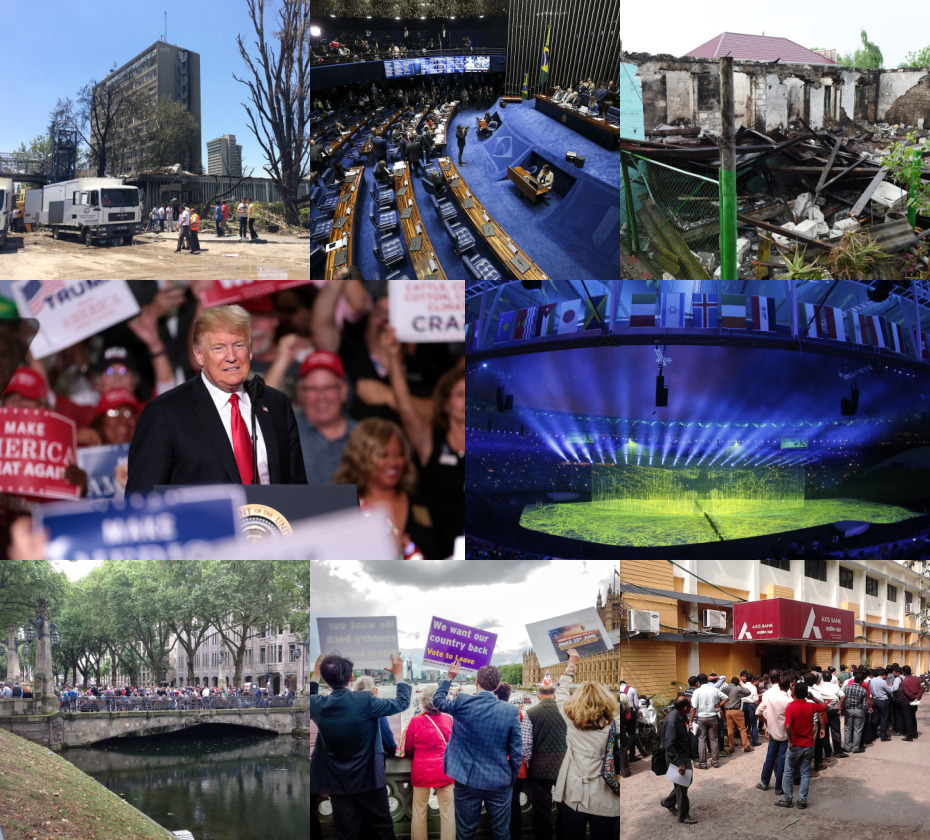
2016 (MMXVI) was a leap year starting on Friday of the Gregorian calendar, the 2016th year of the Common Era (CE) and Anno Domini (AD) designations, the 16th year of the 3rd millennium and the 21st century, and the 7th year of the 2010s decade.
| 2016 by topic |
|---|
2016 was designated as:
- International Year of Pulses by the sixty-eighth session of the United Nations General Assembly.[1]
- International Year of Global Understanding (IYGU) by the International Council for Science (ICSU), the International Social Science Council (ISSC), and the International Council for Philosophy and Human Sciences (CIPSH).[2]
Events
[edit]January
[edit]- January 3 – Following the fallout caused by the execution of Nimr al-Nimr, Saudi Arabia and several other countries end their diplomatic relations with Iran.[3]
- January 8 – Joaquín Guzmán, widely regarded as the world's most powerful drug trafficker, is recaptured following his escape from a maximum-security prison in Mexico.[4]
- January 10 – English singer, songwriter, musician, and actor David Bowie dies in his New York City apartment from liver cancer.[5]
- January 12 – Ten people are killed and 15 wounded in a bombing near the Blue Mosque in Istanbul.[6]
- January 16
- The International Atomic Energy Agency announces that Iran has adequately dismantled its nuclear weapons program, allowing the United Nations to lift sanctions immediately.[7]
- 30 people are killed and 56 injured in terrorist attacks in Ouagadougou, Burkina Faso, targeting a hotel and a nearby restaurant. A siege occurs and 176 hostages are released afterwards, by government forces.[8]
- In the general election of the Republic of China (Taiwan), the Democratic Progressive Party, led by Tsai Ing-wen, secured a majority in the Legislative Yuan, resulting in the first majority by a non-KMT party and the first majority won by the DPP. Tsai became the 14th President for Taiwan, and also became the first female leader in China.[9]
- January 28 – The World Health Organization announces an outbreak of the Zika virus.[10]
February
[edit]- February 6 – An earthquake of magnitude 6.6 strikes southern Taiwan, killing 117 people.[11]
- February 7 – North Korea launches a reconnaissance satellite named Kwangmyŏngsŏng-4 into space, it is condemned internationally as a long-range ballistic missile test.[12]
- February 12 – Pope Francis and Patriarch Kirill sign an Ecumenical Declaration in the first such meeting between leaders of the Catholic and Russian Orthodox Churches since their schism in 1054.[13]
March
[edit]- March 14 – The ESA and Roscosmos launch the joint ExoMars Trace Gas Orbiter on a mission to Mars.[14]
- March 21
- The International Criminal Court finds former Congolese Vice President Jean-Pierre Bemba guilty of war crimes and crimes against humanity, the first time the ICC convicted someone of sexual violence.[15]
- Barack Obama visits Cuba, marking the first time a sitting US president has visited the island nation since President Calvin Coolidge visited in 1928.[16]
- March 22 – 2016 Brussels bombings: Suicide bombing attacks at Brussels' Zaventem airport and Maalbeek metro station kill 35 people and injure 300 more.[17]
- March 24 – Ex-Bosnian Serb leader Radovan Karadžić is sentenced to 40 years in prison after being found guilty of genocide and crimes against humanity committed during the Bosnian War.[18]
April
[edit]- April 1–5 – 2016 Nagorno-Karabakh clashes: Clashes occur along the Nagorno-Karabakh line of contact with the Artsakh Defense Army, backed by the Armenian Armed Forces, on one side and the Azerbaijani Armed Forces on the other. The US State Department estimates that a total of 350 people have been killed in the clashes, which have been defined as "the worst" since the 1994 ceasefire.[19]
- April 3 – The International Consortium of Investigative Journalists (ICIJ) and the German newspaper Süddeutsche Zeitung publish the "Panama Papers", a set of 11.5 million confidential documents from the Panamanian corporate Mossack Fonseca that provides detailed information on more than 214,000 offshore companies, including the identities of shareholders and directors including noted personalities and heads of state.[20]
- April 8 – Pope Francis' apostolic exhortation Amoris laetitia (dated March 19) is published in the Vatican; it appears to amend the Roman Catholic Church's position on the availability of sacraments to Catholics who have divorced and contracted a civil remarriage.[21]
- April 16 – An earthquake of magnitude 7.8 strikes northwestern Ecuador killing 676 people and injuring over 6,000. Widespread damage was caused across Manabí Province, with structures hundreds of kilometres away from the epicenter collapsing.
- April 23 – American singer-songwriter Beyoncé releases her sixth studio album Lemonade.
May
[edit]- May 2 – Leicester City are officially confirmed Premier League Champions against 5000:1 odds at the start of the season.
- May 9 – Rodrigo Duterte is elected the President of the Philippines.
- May 10–14 – The Eurovision Song Contest 2016 is held in Stockholm, Sweden, and is won by Ukrainian entrant Jamala with the song "1944".
- May 19 – EgyptAir Flight 804 crashes into the Mediterranean Sea en route from Paris to Cairo, killing all 66 people on board.[22]
- May 20 – Tsai Ing-wen is sworn in as the President of the Republic of China (Taiwan).[23]
- May 28 – Real Madrid wins The UEFA Champions League against Atlético de Madrid by penalties 5–3 in San Siro in Milan, Italy
- May 29 – The 100th Indianapolis 500 is held and is won by rookie Alexander Rossi.
- May 30 – Former Chadian President Hissène Habré is sentenced to life in prison for crimes against humanity committed during his tenure from 1982 to 1990, the first time an African Union-backed court has convicted a former ruler of a country within its jurisdiction.[24]
June
[edit]- June 1 – The Gotthard Base Tunnel, the world's longest and deepest railway tunnel, is opened following two decades of construction work.[25]
- June 10–July 10 – France hosts the UEFA Euro 2016 football tournament, which is won by Portugal.[26]
- June 12 – A gunman claiming allegiance to the Islamic State opens fire at a gay nightclub in Orlando, Florida, killing 49 people and injuring 53 others.[27]
- June 23 – The United Kingdom votes in a referendum to leave the European Union, triggering the so-called Brexit.[28]
- June 28 – 2016 Atatürk Airport attack: ISIL is suspected to be responsible for attacking Atatürk Airport in Istanbul, Turkey, killing 44 people and injuring over 230 others.[29][30]
July
[edit]- July 1 – Latvia becomes the 35th member of the OECD.[31]
- July 2 – 2016 Australian federal election: Malcolm Turnbull's Liberal/National Coalition Government is narrowly re-elected,[32] defeating the Labor Party led by Bill Shorten.[33]
- July 5 – NASA's Juno spacecraft enters orbit around Jupiter and begins a 20-month survey of the planet.[34]
- July 6 – The augmented reality mobile game Pokémon Go is released, breaking numerous records in terms of sales and revenue.[35]
- July 12 – The Philippines wins the arbitration case they filed at the Permanent Court of Arbitration regarding the legality of China's "nine-dash line" claim over the South China Sea under the United Nations Convention on the Law of the Sea.[36][37]
- July 14 – 2016 Nice truck attack: 86 people are killed and more than 400 others injured in a truck attack in Nice, France, during Bastille Day celebrations.[38]
- July 15–16 – In Turkey, a faction within the Turkish Armed Forces that organized themselves as the Peace at Home Council, unsuccessfully stages a coup against the state institutions, resulting in the deaths of at least 240 people and triggering a series of unprecedented purges throughout the country.[39]
- July 22 – The final videocassette recorder is manufactured by the Japanese company Funai.[40]
- July 26 – Swiss Solar Impulse 2 becomes the first solar-powered aircraft to circumnavigate the Earth.[41]
August
[edit]
- August 3 – Emirates Flight 521 crashed at Dubai International Airport in Dubai, United Arab Emirates. 1 person was killed and 39 people were injured.[42]
- August 5–21 – The 2016 Summer Olympics are held in Rio de Janeiro, Brazil, the first time in South America.[43]
- August 24 – An earthquake of magnitude 6.2 hits central Italy, killing 299 people.
- August 31 – The Brazilian Senate votes (61–20) to impeach the President of Brazil Dilma Rousseff. The Vice President of Brazil, Michel Temer, who had assumed the presidential powers and duties as Acting President of Brazil during Rousseff's suspension, takes office for the remainder of her term.[44]
September
[edit]- September 1 – An annular solar eclipse was visible from Gabon, Congo, Democratic Republic of Congo, Tanzania, Mozambique and Madagascar.
- September 3 – The US and China, together responsible for 40% of the world's carbon emissions, both formally join the Paris global climate agreement.[45]
- September 8 – NASA launches OSIRIS-REx, its first asteroid sample return mission. The probe visited Bennu from 2018 to 2021 and would return samples to Earth on September 24, 2023.[46][47][48]
- September 9 – The government of North Korea conducts its fifth and reportedly biggest nuclear test. World leaders condemn the act, with South Korea calling it "maniacal recklessness".[49]
- September 28
- International investigators conclude that Malaysia Airlines Flight 17 was shot down by a Buk missile that came from an area controlled by pro-Russian rebels in eastern Ukraine.[50]
- Global CO2 levels exceed 400 ppm at the time of year normally associated with minimum levels.[51] A 400 ppm level is believed to be higher than anything experienced in human history.[52]
- September 30 – Two paintings by Vincent van Gogh with a combined value of $100 million, Seascape at Scheveningen and Congregation Leaving the Reformed Church in Nuenen, are recovered after having been stolen on December 7, 2002, from the Van Gogh Museum in Amsterdam.[53]
October
[edit]- October 3 – Hurricane Matthew makes landfall in Haiti as a category 4 hurricane, killing 842 and causing $2.8 billion in damages.[54]
- October 7 – Three events that will play a significant role in the 2016 United States presidential election all take place on the same afternoon: (1) U.S. intelligence agencies publicly accuse the Russian government of using computer hacking to interfere with the U.S. election process; (2) The Washington Post releases a videotape showing candidate Donald Trump privately bragging about sexual improprieties; (3) WikiLeaks releases thousands of private emails from inside the political campaign of candidate Hillary Clinton.
- October 13 – The Maldives announces its decision to withdraw from the Commonwealth of Nations.[55]
- October 14 – American missionary and aid worker Jeff Woodke is kidnapped in Abalak, Niger by militants. He would not be freed for six years.[56][57]
- October 15 – 150 nations meet at the United Nations Environment Programme (UNEP) summit in Rwanda and agree to phase out hydrofluorocarbons (HFCs) as an amendment to the Montreal Protocol.[58]
November
[edit]- November 1 – The number of people globally using mobile devices to access the internet overtakes those using desktop computers for the first time, having been preceded by the U.S. two years prior.[59][60][61][62][63]
- November 2 – The Chicago Cubs win the World Series for the first time since 1908, ending the longest championship drought in North American sports history.[64]
- November 6 – The government of India announces the demonetisation of certain banknotes, causing prolonged cash shortages in the weeks that follow and significant disruption throughout the economy.[65][66]
- November 8 – 2016 United States presidential election: Businessman and television personality Donald Trump is elected the 45th President of the United States in a surprise victory against his opponent, former Secretary of State and First Lady Hillary Clinton.[67]
- November 18 – The remains of Philippine dictator Ferdinand Marcos are buried in a private ceremony at the Libingan ng mga Bayani prompting protests throughout the Philippines.[68][69]
- November 24 – The Colombian government and the Revolutionary Armed Forces of Colombia—People's Army sign a revised peace deal, slowing the Colombian conflict.[70]
- November 28 – LaMia Flight 2933 crashes into a mountain near Medellín, Colombia, killing 71 of the 77 people on board, including members of the Brazilian Chapecoense football squad.
December
[edit]- December 1 – Following a mourning period of seven weeks after the death and funeral of Bhumibol Adulyadej, Vajiralongkorn formally succeeds his late father as the new King of Thailand.[71]
- December 4 – A constitutional referendum is held in Italy, resulting in the resignation of Prime Minister Matteo Renzi.
- December 9 – South Korean President Park Geun-hye is suspended after MPs vote to impeach her, following a political scandal.
- December 19
- Andrei Karlov, the Russian ambassador to Turkey, is assassinated by an off-duty Turkish police officer at an art exhibition in Ankara.[72]
- Berlin truck attack: A truck is deliberately driven into the Christmas market next to the Kaiser Wilhelm Memorial Church at Breitscheidplatz in Berlin, leaving 12 people dead and 56 others injured.
- December 22 – A study finds the VSV-EBOV vaccine against the Ebola virus between 70 and 100% effective, thus making it the first proven vaccine against the disease.[73]
- December 23 – The United Nations Security Council adopts Resolution 2334 condemning "Israeli settlements in Palestinian territories occupied since 1967".[74]
- December 25 – 2016 Russian Defence Ministry Tupolev Tu-154 crash: A Tupolev Tu-154 jetliner of the Russian Defence Ministry crashes into the Black Sea shortly after taking off from Sochi International Airport, Russia, while en route to Khmeimim Air Base, Syria. All 92 people on board, including 64 members of the Alexandrov Ensemble choir of the Russian Armed Forces, are killed.[75]
- December 28 – The chemical elements 113, 115, 117 and 118 are officially named Nihonium, Moscovium, Tennessine and Oganesson.[76][77]
- December 29 – The Helsinki District Court gives Jari Aarnio, the former head of anti-drugs police, to ten-year prison sentence for drug crimes as part of a rare police corruption scandal in Finland.[78]
- December 31 – Withdrawal of the majority of U.S. troops from Afghanistan after 15 years of war.[79]
General
[edit]- Pemon conflict in Venezuela.[80][81][82]
- Beginning of the famine in Yemen.[83]
Births and deaths
[edit]Nobel Prizes
[edit]
New English words
[edit]See also
[edit]
References
[edit]- ^ "United Nations Observances: International Years". United Nations. January 6, 2015. Archived from the original on May 8, 2015. Retrieved April 29, 2015.
- ^ "2016 to be the International Year of Global Understanding (IYGU)". Archived from the original on January 5, 2016. Retrieved January 7, 2016.
- ^ AFP news agency [@AFP] (January 3, 2016). "#BREAKING Saudi Arabia severs ties with Iran, foreign minister says" (Tweet) – via Twitter.
- ^ "'El Chapo': Sean Penn interviewed Guzman before recapture". BBC News. January 10, 2016. Archived from the original on January 10, 2016. Retrieved January 10, 2016.
- ^ Gallagher, Paul (January 14, 2016). "A friend of David Bowie says the singer died from liver cancer". The Independent. Archived from the original on January 12, 2016. Retrieved June 13, 2024.
- ^ "Turkey: 'IS suicide bomber' kills 10 in Istanbul Sultanahmet district". BBC News. January 12, 2016. Retrieved April 27, 2025.
- ^ "Iran nuclear deal: 'New chapter' for Tehran as sanctions end". BBC. January 17, 2016. Archived from the original on January 17, 2016. Retrieved January 17, 2016.
- ^ Hinshaw, Drew; Wonogo, Zoumana (January 16, 2016). "Al Qaeda Attacks in Burkina Faso Kill at Least 30". Wall Street Journal. ISSN 0099-9660. Retrieved April 27, 2025.
- ^ "Shih Ming-te fails to meet threshold, ends candidacy". taipeitimes.com. September 16, 2015. Archived from the original on January 15, 2019. Retrieved February 4, 2019.
- ^ Botelho, Greg (January 28, 2016). "Zika virus spreading explosively". CNN. Archived from the original on January 28, 2016. Retrieved January 28, 2016.
- ^ Lin, Chih-Hao; Chang, Wei-Hung; Wu, Chen-Long; Pan, Shih-Tien; Chi, Chih-Hsien (July 9, 2016). "Medical response to 2016 earthquake in Taiwan". The Lancet. 388 (10040): 129–130. doi:10.1016/S0140-6736(16)30978-3. ISSN 0140-6736. PMID 27411878.
- ^ "North Korea fires long-range rocket despite warnings". BBC News. February 7, 2016. Archived from the original on February 10, 2016. Retrieved February 12, 2016.
- ^ "Unity call as Pope Francis holds historic talks with Russian Orthodox Patriarch". BBC. February 13, 2016. Archived from the original on February 12, 2016. Retrieved February 14, 2016.
- ^ "ESA - Robotic Exploration of Mars: ExoMars Trace Gas Orbiter (TGO)". Archived from the original on March 29, 2015. Retrieved February 15, 2015.
- ^ Bowcott, Owen (March 21, 2016). "Congo politician guilty in first ICC trial to focus on rape as a war crime". The Guardian. ISSN 0261-3077. Archived from the original on March 25, 2016. Retrieved March 26, 2016.
- ^ "The Last Time an American President Visited Cuba". ABC News. March 22, 2016. Archived from the original on July 3, 2017. Retrieved June 24, 2017.
- ^ "Brussels terrorist attack trial: Belgian court hands out sentences to eight men". September 15, 2023. Retrieved April 27, 2025.
- ^ "Radovan Karadzic jailed for Bosnia war Srebrenica genocide". BBC News. March 24, 2016. Archived from the original on March 24, 2016. Retrieved March 24, 2016.
- ^ "Nagorno-Karabakh Conflict Situation Report No. 1 (as of 03 Apr 2016)". ReliefWeb. April 3, 2016. Archived from the original on April 4, 2016. Retrieved April 4, 2016.
- ^ Vasilyeva, Natalya; Anderson, Mae (April 3, 2016). "News Group Claims Huge Trove of Data on Offshore Accounts". The New York Times. Associated Press. ISSN 0362-4331. Archived from the original on December 26, 2018. Retrieved April 4, 2016.
- ^ Ouellet, Marc (November 21, 2017), "Accompanying, Discerning, Integrating Weakness", L'Osservatore Romano, archived from the original on January 5, 2019, retrieved November 29, 2017
- ^ "EgyptAir flight MS804 from Paris to Cairo crashed - Hollande". BBC News. May 19, 2016. Archived from the original on May 19, 2016. Retrieved May 19, 2016.
- ^ "Taiwan gets first female President as DPP sweeps election". Channel NewsAsia. Archived from the original on January 16, 2016. Retrieved January 16, 2016.
- ^ Maclean, Ruth (May 30, 2016). "Chad's Hissène Habré found guilty of crimes against humanity". The Guardian. ISSN 0261-3077. Archived from the original on May 31, 2016. Retrieved May 31, 2016.
- ^ "Gotthard tunnel: World's longest and deepest rail tunnel opens in Switzerland". BBC News. June 1, 2016. Archived from the original on June 1, 2016. Retrieved June 1, 2016.
- ^ "Euro 2016 Begins". The Independent. June 10, 2016. Archived from the original on May 1, 2022. Retrieved June 4, 2018.
- ^ "USA TODAY". USA TODAY. Retrieved June 15, 2018.
- ^ Erlanger, Steven (June 23, 2016). "Britain Votes to Leave the European Union". The New York Times. ISSN 0362-4331. Archived from the original on June 24, 2016. Retrieved June 24, 2016.
- ^ "Istanbul Ataturk airport attack: 41 dead and more than 230 hurt". BBC News. June 29, 2016. Archived from the original on May 18, 2017. Retrieved May 1, 2017.
- ^ Tuysuz, Ray Sanchez,Tim Lister,Matt Rivers,Gul (June 30, 2016). "Istanbul terror attack: These are the victims". CNN. Retrieved February 16, 2025.
{{cite web}}: CS1 maint: multiple names: authors list (link) - ^ "Latvia's accession to the OECD". OECD. July 1, 2016. Archived from the original on July 21, 2016. Retrieved July 22, 2016.
- ^ "Election 2016: LNP retains Capricornia, gives Coalition 76-seat majority government". ABC News. Australia. July 11, 2016.
- ^ "2016 Federal Election". Archived from the original on February 26, 2018.
- ^ Amos, Jonathan (July 5, 2016). "Juno probe enters into orbit around Jupiter". BBC News. Archived from the original on July 5, 2016. Retrieved July 5, 2016.
- ^ Swatman, Rachel (August 10, 2016). "Pokémon Go catches five new world records". Archived from the original on August 18, 2016. Retrieved January 19, 2018.
- ^ Phillips, Tom; Holmes, Oliver; Bowcott, Owen (July 12, 2016). "Beijing rejects tribunal's ruling in South China Sea case". The Guardian. ISSN 0261-3077. Archived from the original on July 12, 2016. Retrieved July 13, 2016.
- ^ Perlez, Jane (July 12, 2016). "Tribunal Rejects Beijing's Claims in South China Sea". The New York Times. ISSN 0362-4331. Archived from the original on July 12, 2016. Retrieved July 13, 2016.
- ^ Wesel, Barbara (July 3, 2017). "France remembers Nice terror attack victims but questions remain". DW. Archived from the original on January 20, 2018. Retrieved January 19, 2018.
- ^ "Turkey's failed coup attempt: All you need to know". Al Jazeera. July 15, 2017. Archived from the original on August 16, 2017.
- ^ Overly, Steven (July 22, 2016). "The VCR is officially dead. Yes, it was still alive". The Washington Post. Archived from the original on October 17, 2016. Retrieved September 25, 2016.
- ^ "Solar Impulse completes historic round-the-world trip". BBC News. July 26, 2016. Archived from the original on July 26, 2016. Retrieved July 26, 2016.
- ^ "Plane catches fire at Dubai airport; Emirates confirms 'incident'".
- ^ "Rio 2016 Olympic Games". Archived from the original on February 24, 2015. Retrieved February 25, 2015.
- ^ "Brazil impeachment: Key questions". BBC News. August 31, 2016. Archived from the original on August 31, 2016. Retrieved September 5, 2016.
- ^ "Paris climate deal: US and China announce ratification". BBC News. September 3, 2016. Archived from the original on September 3, 2016. Retrieved September 3, 2016.
- ^ "NASA's OSIRIS-REx Speeds Toward Asteroid Rendezvous". NASA. September 8, 2016. Archived from the original on September 9, 2016. Retrieved September 9, 2016.
- ^ Amos, Jonathan (September 9, 2016). "Asteroid probe begins seven-year quest". BBC News. Archived from the original on September 9, 2016.
- ^ "OSIRIS-REx". NASA. January 8, 2024. Retrieved January 17, 2024.
- ^ Hunt, Katie; Kwon, K.J.; Hanna, Jason (September 9, 2016). "North Korea claims successful test of nuclear warhead". CNN. Archived from the original on September 9, 2016. Retrieved September 9, 2016.
- ^ "JIT: Flight MH17 was shot down by a BUK missile from a farmland near Pervomaiskyi". Openbaar Ministerie. September 28, 2016. Archived from the original on October 14, 2016. Retrieved October 13, 2016.
- ^ Kahn, Brian (September 28, 2016). "The world passes 400ppm carbon dioxide threshold. Permanently". The Guardian. ISSN 0261-3077. Archived from the original on October 23, 2016. Retrieved October 31, 2016.
- ^ "Greenhouse gas level highest in two million years, NOAA reports". Phys.org. May 10, 2013. Archived from the original on November 4, 2016. Retrieved November 1, 2016.
- ^ "Van Gogh paintings stolen from Amsterdam found in Italy". BBC News. September 30, 2016. Archived from the original on July 7, 2017. Retrieved May 1, 2017.
- ^ Jones, Sam; Holpuch, Amanda (October 7, 2016). "Haiti death toll rises to 842 after Hurricane Matthew, reports say". The Guardian. ISSN 0261-3077. Retrieved February 16, 2025.
- ^ "The Maldives decides to leave the Commonwealth; commits to continue with its international engagement". Maldivian Ministry of Foreign Affairs. October 13, 2016. Archived from the original on October 14, 2016.
- ^ "U.S. Aid worker kidnapped in Niger released after more than 6 years". March 20, 2023. Archived from the original on March 20, 2023. Retrieved March 20, 2023.
- ^ "Bring Jeffery Woodke Home". bringjeffhome.com/. March 27, 2023. Archived from the original on March 20, 2023. Retrieved April 2, 2023.
- ^ McGrath, Matt (October 15, 2016). "Climate change: 'Monumental' deal to cut HFCs, fastest growing greenhouse gases". BBC News. Archived from the original on October 15, 2016. Retrieved October 15, 2016.
- ^ "Mobile apps overtake monthly Internet usage on PCS for the first time". February 28, 2014. Archived from the original on January 11, 2023. Retrieved January 11, 2023.
- ^ "Mobile internet use passes desktop for the first time, study finds". November 2016. Archived from the original on January 11, 2023. Retrieved January 11, 2023.
- ^ "Pivotal moments in 2014: When mobile overtook desktop". Archived from the original on January 11, 2023. Retrieved January 11, 2023.
- ^ "Mobile Now Exceeds PC: The Biggest Shift Since the Internet Began". July 8, 2014. Archived from the original on January 11, 2023. Retrieved January 11, 2023.
- ^ "Mobile and tablet internet usage exceeds desktop for first time worldwide". Archived from the original on July 29, 2019. Retrieved January 11, 2023.
- ^ Witz, Billy (November 3, 2016). "Cubs End 108-Year Wait for World Series Title, After a Little More Torment". The New York Times. Archived from the original on October 7, 2017. Retrieved October 24, 2017.
- ^ "Demonetisation debate in Parliament: Disaster, says Chidambaram; high cash economy corrupt, counters Jaitley : India, News – India Today". Indiatoday.intoday.in. February 9, 2017. Archived from the original on January 3, 2023. Retrieved June 26, 2017.
- ^ "Demonetisation: Opposition calls for countrywide protest on November 28". The Indian Express. November 23, 2016. Archived from the original on January 3, 2023. Retrieved November 23, 2016.
- ^ Flegenheimer, Matt; Barbaro, Michael (November 9, 2016). "Donald Trump Is Elected President in Stunning Repudiation of the Establishment". N.Y. Times. Archived from the original on January 21, 2017. Retrieved October 13, 2017.
- ^ "Protesters take to streets to denounce Marcos 'Libingan' burial". CNN - Philippines. November 19, 2016. Archived from the original on February 25, 2021. Retrieved February 24, 2021.
- ^ Tan, Kimberly Jane (November 18, 2016). "AFP: We only followed Marcoses' wish to keep burial secret". ABS-CBN News. Archived from the original on January 17, 2021. Retrieved February 24, 2021.
- ^ "Colombia signs new peace deal with Farc". BBC News. November 24, 2016. Archived from the original on December 28, 2016. Retrieved January 15, 2017.
- ^ "Crown Prince becomes King". Bangkok Post. December 2016. Retrieved December 1, 2016.
- ^ "Russian ambassador to Turkey Andrei Karlov shot dead in Ankara". BBC News. December 19, 2016. Archived from the original on December 21, 2016.
- ^ Berlinger, Joshua (December 23, 2016). "Ebola vaccine gives 100% protection, study finds". CNN. Archived from the original on December 27, 2016. Retrieved January 2, 2017.
- ^ "Israeli settlements: UN Security Council calls for an end". BBC News. December 23, 2016. Archived from the original on December 26, 2016. Retrieved December 27, 2016.
- ^ "Russian military plane crashes in Black Sea near Sochi". BBC News. December 25, 2016. Archived from the original on June 11, 2019. Retrieved June 9, 2019.
- ^ "The Periodic Table's 4 New Elements". www.westlab.com. Archived from the original on October 12, 2023. Retrieved September 21, 2023.
- ^ Öhrström, Lars; Reedijk, Jan (December 28, 2016). "Names and symbols of the elements with atomic numbers 113, 115, 117 and 118 (IUPAC Recommendations 2016)". Pure and Applied Chemistry. 88 (12): 1225–1229. doi:10.1515/pac-2016-0501. eISSN 1365-3075. hdl:1887/47427. ISSN 0033-4545. S2CID 99429711.
- ^ "Finland jails police chief Aarnio for drug-smuggling". BBC News. December 29, 2016. Retrieved July 3, 2025.
- ^ Sennott, Charles M. (May 5, 2015). "The First Battle of the 21st Century". The Atlantic. Archived from the original on July 30, 2019. Retrieved May 15, 2015.
Even after 14 years of war in Afghanistan, the U.S. military has not fully succeeded in restoring security to the country or defeating the Taliban. Now, at the request of the new Afghan government, the United States has delayed the completion of its troop withdrawal from the country until 2016 at the earliest.
- ^ Ebus, Bram (June 8, 2019). "Venezuela's mining arc: a legal veneer for armed groups to plunder". The Guardian. Archived from the original on October 19, 2021. Retrieved October 14, 2020.
- ^ "Pemones responden a Maduro: Fuera de aquí porque eres colombiano". NTN24 (in Spanish). December 13, 2018. Archived from the original on June 29, 2021. Retrieved November 27, 2019.
- ^ "As tensions over aid rise, Venezuelan troops fire on villagers, kill two". Thomson Reuters Foundation. February 22, 2019. Archived from the original on November 10, 2021. Retrieved February 23, 2019.
- ^ Graham-Harrison, Emma; agencies (October 4, 2016). "Yemen famine feared as starving children fight for lives in hospital". The Guardian. Archived from the original on October 4, 2016. Retrieved December 13, 2017.

from Grokipedia