Hubbry Logo
AcrobaticsAcrobaticsMain
Open search
Acrobatics
Community hub
Acrobatics
logo
8 pages, 0 posts
0 subscribers
Be the first to start a discussion here.
Acrobatics
Acrobatics
from Wikipedia
A showgirl performing aerial silk

Acrobatics (from Ancient Greek ἀκροβατέω (akrobatéō) 'walk on tiptoe, strut')[1] is the performance of human feats of balance, agility, and motor coordination. Acrobatic skills are used in performing arts, sporting events, and martial arts. Extensive use of acrobatic skills are most often performed in acro dance, circus, gymnastics, and freerunning and to a lesser extent in other athletic activities including ballet, slacklining and diving. Although acrobatics is most commonly associated with human body performance, the term is used to describe other types of performance, such as aerobatics.

History

[edit]
A female acrobat (Greek Campanian red-figure hydria, c. 340–330 BC)
Female acrobat shooting an arrow with a bow in her feet (Greek Gnathian style pelike, 4th century BC
Acrobatic performance in India c. 1863

Acrobatic traditions are found in many cultures, and there is evidence that the earliest such traditions occurred thousands of years ago. For example, Minoan art from c. 2000 BC contains depictions of acrobatic feats on the backs of bulls. Ancient Greeks practiced acrobatics,[2] and the noble court displays of the European Middle Ages would often include acrobatic performances that included juggling[citation needed].

In China, acrobatics have been a part of the culture since the Tang dynasty (618–907). Acrobatics were part of village harvest festivals.[3] During the Tang dynasty, acrobatics saw much the same sort of development as European acrobatics saw during the Middle Ages, with court displays during the 7th through 10th century dominating the practice.[4] Acrobatics continues to be an important part of modern Chinese variety art.

Though the term initially applied to tightrope walking,[citation needed] in the 19th century, a form of performance art including circus acts began to use the term as well. In the late 19th century, tumbling and other acrobatic and gymnastic activities became competitive sport in Europe.

Acrobatics has often served as a subject for fine art. Examples of this are paintings such as Acrobats at the Cirque Fernando (Francisca and Angelina Wartenberg) by Impressionist Pierre-Auguste Renoir, which depicts two German acrobatic sisters, and Acrobats in a Paris suburb by Viktor Vasnetsov.[citation needed]

Types

[edit]
Chinese acrobat in midair after being propelled off a teeterboard, China, 1987

Acrobalance

[edit]

Acrobalance is a floor based acrobatic art that involves balances, lifts and creating shapes performed in pairs or groups.

Acro dance

[edit]

Acro dance is a style of dance that combines classical dance technique with precision acrobatic elements.

Aerial

[edit]

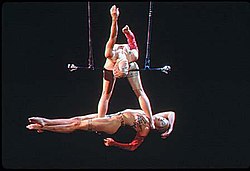
Aerial is acrobatics performed in the air on a suspended apparatus.[5]

Trapeze

[edit]

A trapeze is a short horizontal bar hung by ropes or metal straps from a support. Trapeze acts may be static, spinning (rigged from a single point), swinging or flying, and may be performed solo, double, triple or as a group act.[5]

Corde lisse

[edit]

Corde lisse is a skill or act that involves acrobatics on a vertically hanging rope. The name is French for "smooth rope".

Cloud swing

[edit]

Cloud swing is a skill that usually combines static and swinging trapeze skills, drops, holds and rebound lifts.

Cradle

[edit]

Cradle (also known as aerial cradle or casting cradle) is a type of aerial circus skill in which a performer hangs by their knees from a large rectangular frame and swings, tosses, and catches another performer

Silks

[edit]

Aerial silks is a type of aerial skill in which one or more artists perform aerial acrobatics while hanging from a long length of fabric suspended from a frame or ceiling.

Hoop

[edit]

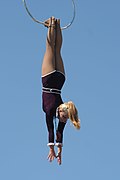
Aerial hoop (also known as the lyra, aerial ring or cerceau/cerceaux') is a circular steel apparatus (resembling a hula hoop) suspended from the ceiling or a frame, on which artists may perform aerial acrobatics. It can be used static, spinning, or swinging.

[edit]

Contortion

[edit]

Contortion (sometimes contortionism) is a performance art in which performers called contortionists showcase their skills of extreme physical flexibility

Rope and wire walking

[edit]

Tightrope walking, also called funambulism, is the skill of walking along a thin wire or rope. Its earliest performance has been traced to Ancient Greece.[6] It is commonly associated with the circus. Other skills similar to tightrope walking include slack rope walking and slacklining.

Tumbling

[edit]

Tumbling is an acrobatic skill involving rolls, twists, somersaults and other rotational activities using the whole body. Its origin can be traced to ancient China, Ancient Greece and ancient Egypt.[7] Tumbling continued in medieval times and then in circuses and theatre before becoming a competitive sport.

See also

[edit]

References

[edit]
[edit]
Revisions and contributorsEdit on WikipediaRead on Wikipedia
from Grokipedia
Acrobatics is a performing and athletic discipline that combines feats of strength, , balance, and coordination to execute dynamic movements such as tumbling, hand balancing, aerial maneuvers, and partner-supported pyramids, often incorporating apparatus like trampolines, poles, or teeterboards. These skills emphasize both individual prowess and synchronized group efforts, showcasing the human body's capabilities in entertainment, sport, and cultural displays. The term "acrobatics" originates from the ancient Greek words akros (meaning "extreme" or "high") and bainein (meaning "to walk" or "to go"), connoting a progression beyond ordinary movement or "walking on tiptoe." Historical evidence of acrobatic practices dates back over 4,000 years, with depictions in Egyptian tombs from around 2000 BCE illustrating flexible performers and in Minoan frescoes from (c. 1500 BCE) showing rituals that highlight early acrobatic agility. Such activities likely evolved from prehistoric hunter-gatherer imitations of animal movements during rituals, symbolizing vitality and rebirth in funerary contexts across , , and the Indus Valley. Throughout history, acrobatics has played a central role in diverse cultures, serving military training in , theatrical performances in , and festival entertainments in medieval and , where it incorporated , , and . By the 18th and 19th centuries, it became a cornerstone of circus arts in and America, with innovations like the introduced by in 1859. In the 20th century, acrobatics formalized as a competitive sport under the , particularly in , which originated in the during the 1930s and emphasizes partner routines blending , flexibility, and power. Today, it thrives in global competitions, , and , promoting teamwork, physical fitness, and artistic expression across recreational and elite levels.

History

Ancient Origins

The earliest known depictions of acrobatic-like feats appear in Minoan frescoes from the palace at on , dating to approximately 1450–1400 BC. These artworks illustrate , a ritualistic athletic display where participants vaulted over charging bulls by grasping their horns and somersaulting across their backs, representing a proto-form of acrobatics that emphasized agility, strength, and balance. Such performances likely served ceremonial purposes, showcasing physical prowess in Minoan society during the Late . In , acrobatic practices emerged around 2500 BC, integrated into religious rituals and illustrated in tomb to ensure entertainment and vitality in the . paintings from the tomb of Mehu at depict female acrobats performing dynamic balancing acts and contortions, often accompanying music and during banquets or sacred ceremonies honoring deities like . These representations, found in tombs, highlight acrobatics as a skilled form tied to and divine , with performers executing handstands, flips, and poses on elevated surfaces. Greek influences on acrobatics developed through military training and gymnasion exercises from the Archaic period onward, incorporating tumbling, vaulting, and leaping to build endurance and . Young men trained in palaestrae and gymnasia, practicing feats such as jumping over stuffed bags or poles to simulate battlefield maneuvers, fostering the physical discipline central to Hellenistic education. Roman adaptations extended these practices into structured military regimens, where legionaries honed vaulting over obstacles and tumbling for agility in formation tactics, viewing such exercises as essential for imperial conquests. events, introduced at the in 648 BC, further exemplified these roots by blending wrestling, striking, and grappling into grueling tests of acrobatic resilience and versatility. Chinese origins of acrobatics trace to the (475–221 BC), where rudimentary feats of strength and balance arose from labor and warfare, later evolving into wushu-related displays by the (206 BC–220 AD). Early forms included tumbling and pole-climbing integrated into military drills and court performances, reflecting a cultural emphasis on harmonious body control akin to traditions.

Cultural Evolution

In medieval , jongleurs and minstrels served as itinerant performers who entertained audiences at fairs and markets with a variety of acts, including tumbling, juggling, and acrobatic feats that showcased physical and dexterity. These performers drew upon a rich of influences, including Byzantine and Islamic traditions transmitted through trade routes, the , and cultural exchanges in regions like and , where Eastern performance arts such as contortions and aerial maneuvers were adapted into local spectacles. Such acts not only provided amusement but also integrated into festive gatherings, blending with elements of and music to captivate diverse crowds from the 12th to 15th centuries. During the (618–907 AD), Chinese acrobatics flourished as a sophisticated courtly form, featuring elaborate routines with apparatus like poles for climbing and balancing, as well as with balls and other objects, often performed to accompany and in imperial banquets. Scholars of the era composed poems extolling these displays, which highlighted the performers' precision and harmony between body and prop, elevating acrobatics from folk origins to a symbol of cultural refinement. By the (960–1279 AD), these traditions expanded beyond the palace to public venues, incorporating innovative apparatus such as stacked chairs and rolling barrels, while maintaining their role in festive and theatrical presentations that influenced later variety arts. In and , acrobatic forms evolved within temple rituals, martial training, and ceremonial dances from the medieval period onward, intertwining physical prowess with spiritual and warrior practices. A prominent example is Mallakhamb, a rope-climbing discipline originating in 12th-century , , where practitioners executed aerial poses and balances on poles or ropes to build strength for wrestling and combat, often performed in temple contexts to honor deities. In , particularly among Khmer traditions in (9th–15th centuries), similar acrobatic elements appeared in temple dances and martial displays, such as Bokator in , which combined striking, grappling, and weapon handling in ritual performances to invoke protection and celebrate royal prowess. These regional variations emphasized endurance and fluidity, adapting acrobatics into holistic systems that supported both artistic expression and military preparation across Hindu-Buddhist cultural spheres. The 18th and 19th centuries marked a pivotal shift in European acrobatics with the rise of organized circuses, beginning in 1768 when Philip Astley established the first modern circus in by combining equestrian feats—such as in a circular arena—with ground-based acrobatics, tumbling, and clowning to create a cohesive spectacle. Astley's innovation, drawing on his military background, standardized the ring format to enhance visibility and safety for horse-mounted performers, quickly attracting audiences and inspiring imitators across Europe who integrated diverse acrobatic disciplines into traveling shows. This era transformed acrobatics from sporadic fairground entertainment into a professional, narrative-driven industry, blending athleticism with theatricality to appeal to urban and rural crowds alike.

Modern Developments

The professionalization of acrobatics in the 20th and 21st centuries has been marked by the establishment of international governing bodies and competitive frameworks. In 1973, the International Federation of Sports Acrobatics (IFSA) was formed to standardize and promote the discipline globally, representing 12 national federations initially. This led to the inaugural World Championships in 1974, held in , which established acrobatics as a competitive with categories for pairs, groups, and individual routines emphasizing balance, power, and tempo elements. By the , IFSA had grown to oversee events across multiple continents, fostering technical advancements and athlete development programs. Efforts toward Olympic recognition have involved ongoing debates about integration into the broader program, highlighting challenges such as event complexity and judging consistency. While full Olympic inclusion remains elusive, acrobatic gymnastics achieved a with its debut at the in , featuring mixed pairs competitions that showcased 12 international teams performing synchronized routines. This event, sanctioned by the , served as a stepping stone, with advocates arguing it demonstrates the 's alignment with Olympic values of athleticism and artistry. Ongoing discussions within the (), which absorbed IFSA in 1999, continue to push for future inclusion, citing growing participation and global appeal. In 2025, acrobatic gymnastics featured prominently at The in , , with competitions from August 8–10, underscoring its international appeal amid continued efforts for Olympic recognition. Cirque du Soleil, founded in 1984 by Guy Laliberté and Gilles Ste-Croix, revolutionized acrobatics by blending traditional techniques with contemporary theater, elevating aerial and ground-based forms to high-art spectacles viewed by millions worldwide. The company's productions, such as O and Luzia, integrated innovative elements like synchronized diving and silks routines, influencing global training standards and inspiring hybrid performances that combine narrative storytelling with extreme physicality. By the 2020s, advancements included LED-integrated costumes and lighting in shows like Michael Jackson ONE, where illuminated apparel enhanced visual dynamics during dynamic acrobatic sequences, allowing for immersive, technology-enhanced experiences that pushed artistic boundaries. The COVID-19 pandemic from 2020 prompted significant digital adaptations in acrobatics training and competition. Virtual reality apps, such as those simulating trampoline and balance beam environments, emerged to enable safe, immersive practice for gymnasts and acrobats, allowing analysis of form and trajectory without physical contact. Platforms like AI Motion Labs facilitated VR-based stunt training for cheer and acrobatic routines, maintaining skill progression during lockdowns. Concurrently, online competitions proliferated, with events like USA Gymnastics-sanctioned virtual meets enabling athletes to submit video routines for judging, reducing travel and infection risks while sustaining competitive momentum—exemplified by regional acrobatic gymnastics qualifiers streamed via Zoom and similar tools. These shifts not only preserved the sport's continuity but also expanded accessibility through digital media up to 2025.

Ground-Based Acrobatics

Acrobalance

is a form of partner-based ground acrobatics characterized by static and dynamic balances between two or more performers, who utilize hands, feet, and bodies to provide mutual support and create intricate formations on a surface. This discipline emphasizes precision, strength, and synchronization, distinguishing it from solo feats by relying on interpersonal trust and weight distribution. Central to acrobalance are defined roles: the base, typically the stronger performer who supports the structure from below using their limbs or torso; the flyer, often lighter and more flexible, who assumes elevated or inverted positions atop the base; and spotters, who provide external assistance during to prevent falls and ensure safety. Common poses include shoulder stands, where the flyer balances upright on the base's shoulders, and various inversions such as handstands or planches, which demand and alignment to maintain equilibrium. These elements allow for progressive complexity, from basic lifts to multi-person pyramids. Historically, acrobalance traces roots to ancient Chinese acrobatic traditions, dating back over 2,000 years to the . In , partner balances emerged prominently in 19th-century circuses, where pairs performed hand-to-hand and equilibrium acts in variety shows, evolving from equestrian and tumbling displays into structured duo routines. In contemporary settings, acrobalance forms a core component of competitions under the (FIG), featuring routines in balance, dynamic, and combined formats performed to music on a spring floor. Scoring evaluates difficulty (based on element selection and connections), execution (technical precision and form), and artistry (, musicality, and expression), with total scores aggregating these components minus any deductions. Pairs or groups must incorporate required numbers of balances, flights, and individual skills, such as at least five balance elements in a balance routine. Acrobalance often integrates elements to elevate the performative quality, blending athleticism with rhythmic movement.

Tumbling

Tumbling is a dynamic discipline within ground-based acrobatics, consisting of a linear series of explosive movements performed on a or , emphasizing through hands and feet to execute flips, twists, and rolls. Core skills form the foundation of tumbling routines, starting with forward and backward rolls, which involve tucking the body to roll smoothly over the head and shoulders for momentum control. Handsprings, including front and back variations, propel into a hand-supported , bridging basic rolls to more advanced aerial maneuvers. Somersaults, or saltos, require full-body in tucked or piked positions, such as the front tuck or back tuck, while aerials represent handless flips like the , demanding precise timing and power for without hand contact. The evolution of tumbling began in ancient Greek gymnasia around 500 BCE, where it served as essential physical training for warriors, incorporating rolls and flips to build and strength alongside other exercises like wrestling and running. Archaeological evidence from , , and Persia also depicts similar acrobatic tumbling practices dating back over 2,000 years, often integrated into rituals or entertainment. By the in , tumbling was performed by traveling troupes of entertainers, evolving into structured forms through 19th-century German Turnverein systems that emphasized . In the , tumbling integrated into floor exercises and by the early , with power tumbling emerging as a standalone competitive discipline in the , now featured in international championships and collegiate sports. Competitions employ a 25-meter-long by 2-meter-wide sprung tumbling track, constructed with elastic springs beneath a foam-covered surface to maximize rebound while minimizing impact on joints. Routines, typically consisting of eight elements in passes, are evaluated by international panels using criteria from the and , awarding scores for difficulty based on element complexity, execution for body alignment and form, amplitude measuring flip height and extension, and landings requiring controlled feet-first contact without steps or falls. Deductions range from 0.1 to 1.0 points for form breaks, low amplitude, or unstable landings, ensuring emphasis on technical precision over mere speed. Training in tumbling follows structured progressions to prioritize and mastery, commencing with basic dives and rolls on padded surfaces to instill proper body shaping and spotting techniques. Intermediate stages introduce handsprings using spotting belts or incline mats for in , followed by single s to refine aerial awareness and twisting mechanics. Advanced training culminates in full passes linking multiple elements, such as a round-off into a back handspring series connected to a double , often practiced on progressively firmer surfaces to simulate competition conditions. Tumbling elements are occasionally integrated into routines for enhanced rhythmic dynamics.

Contortion

Contortion is a form of ground-based acrobatics that emphasizes extreme flexibility and deliberate manipulation of the body's joints and spine to achieve poses that exceed typical human range of motion, performed without apparatus or partners. This discipline requires years of dedicated training starting from childhood, often involving breath control and muscle engagement to maintain stability in highly contorted positions. Unlike dynamic movements in other acrobatic forms, contortion focuses on sustained, static displays that highlight the performer's control and endurance. The origins of trace back to ancient Asian traditions, particularly in and , where it evolved from spiritual and meditative practices. In , is a culturally significant form rooted in traditional and systems, with young practitioners training rigorously under experienced teachers to compete in festivals that blend heritage with modern spectacle. Indian influences stem from yogic s, incorporating poses inspired by animal imitations and breath work for spiritual , which laid foundational techniques for body folding and extension. These practices gained global prominence in the through Western circuses, where acts became staple attractions, drawing from imported Asian performers and adapting the skill for theatrical entertainment. Contortion techniques primarily involve backbends, which feature extreme spinal arches such as chest stands and forearm balances to showcase hyperextension, often combined with one-legged balances for added complexity. Frontbends, in contrast, emphasize forward spinal curls, including poses like leg-behind-head placements, where the foot rests on the or , and fold-throughs, with the upper body passing between straight legs to touch the head behind. Splits form a foundational element, progressing from basic front and side divisions to oversplits, while advanced maneuvers incorporate apparent dislocations—extreme rotations like or subluxations that appear dislocated but are controlled to avoid . These elements are frequently integrated with balances, such as handstands or arm-supported holds, to create fluid transitions between poses. Medically, contortion relies on joint hypermobility, a condition where exceed normal physiological ranges, often inherited through collagen-related genetic traits or enhanced by intensive training. This hypermobility, assessed via tools like the Beighton score, provides an advantage for performers by allowing greater mobility, though it carries risks of joint instability or pain if not managed with strengthening exercises. In contortionists, asymptomatic hypermobility predominates, enabling feats like full spinal inversion without disorders, but underlying syndromes such as Ehlers-Danlos can amplify flexibility while increasing vulnerability. In performances, contortion integrates into solo showcases that highlight isolated body manipulation for aesthetic impact, as well as illusions like acts, where performers coil live reptiles around contorted limbs to evoke mystical or exotic narratives. These routines emphasize visual through seamless pose shifts, occasionally paired with tumbling for brief dynamic contrasts in ground routines.

Aerial Acrobatics

Trapeze and Swings

Trapeze and swings form a core component of aerial acrobatics, utilizing suspended bars or ropes to harness swinging for dynamic performances. These apparatus enable performers to execute gravity-defying movements, emphasizing timing, strength, and precision in mid-air transitions. Unlike stationary ground-based disciplines, trapeze work relies on pendulum-like swings to generate height and speed, often performed at elevations that demand rigorous safety protocols. The primary types include , which involves a stationary bar suspended by ropes for balanced poses and climbs without significant swinging; swinging trapeze, where performers initiate and control motions to build for fluid sequences; and , characterized by exchanges between a flyer who releases from one bar and a on another, incorporating projectile-like trajectories. focuses on strength and control for intricate holds, while swinging and flying variants exploit for broader arcs and interactions. Key maneuvers in trapeze and swings encompass releases, where the performer lets go of the bar to twist or mid-air before re-grasping or being caught; , executed during the swing's peak to add rotational flair; and dismounts, such as backflips or straight jumps into a net for a dramatic finish. These elements demand precise with the apparatus's , typically rigged at heights of 8-10 meters to allow sufficient arc for safe execution. The apparatus, in particular, optimizes physics for these actions, with the bar spanning about 1.2 meters and suspended by ropes up to 10 meters long. Historical development of trapeze traces to 19th-century European circuses, where French acrobat invented the in 1859, debuting it at the Cirque Napoléon in with somersaults between bars. This innovation quickly spread through circus troupes, evolving from solo swings to team exchanges by the late 1800s. Modern safety nets were introduced post-1870s following fatal accidents, notably by the Hanlon Brothers after tragedies in the 1860s, including the 1868 death of Thomas Hanlon, transforming the act from high-risk spectacles to more structured performances. In team-based flying trapeze, roles are distinctly divided: flyers initiate swings and perform aerial tricks like releases and somersaults; catchers, positioned on a static or swinging bar, time their arcs to grasp the flyer's wrists or ankles in mid-air exchanges; and , including spotters and riggers, monitor equipment, signal timings, and ensure net readiness for dismounts. This collaboration requires split-second coordination to prevent falls, with catchers often using for grip and verbal cues like "hep" to synchronize jumps. Competitions, such as those under the U.S. Aerial Arts Organization or Aerialympics and aerial arts festivals, evaluate trapeze acts on technical difficulty, execution quality, and between team members, with deductions for timing errors in catches or swings. Synchronization aspects reward seamless exchanges and uniform momentum, highlighting the discipline's emphasis on collective precision over individual feats. Cloud swings share similarities with swinging trapeze in their use of momentum for drops and holds, though they employ softer ropes for added rebound.

Silks and Ropes

Aerial silks, also known as aerial fabric, consist of two long panels of resistant, elastic jersey fabric suspended vertically from a single point, allowing performers to climb, wrap, and manipulate the material for dynamic poses and transitions. The fabric is typically knotless to ensure safety and smooth movement, with lengths often ranging from 25 to 35 meters to accommodate high-ceiling venues like circus big tops, though shorter variants of 15 to 20 meters are used in training and smaller spaces. Corde lisse, or "smooth rope," is a single vertical rope apparatus, usually made of cotton or synthetic fibers for grip and durability, emphasizing elegant lines, static poses, and controlled descents without knots or spins from the rigging itself. A variant, the mullet or knotted rope, features a rope with integrated knots or braids, such as in the Spanish web style, providing additional footholds and enabling rotational spins through the apparatus's design. The origins of rope-based aerial acrobatics trace back to ancient , where rope dancing emerged during the (206 BCE–220 CE) as part of harvest celebrations and court performances, evolving into sophisticated acts by the in imperial circuses. In , the related discipline of mallakhamb, incorporating rope variants, dates to the 12th century as described in the text, serving as martial training for wrestlers through mid-air flips, balances, and gymnastic postures on a suspended 5.5-meter . Modern aerial silks emerged in the 1990s, invented by French artist Gérard Fasoli and first showcased by Isabelle Vaudelle at the 1995 Festival Mondial du Cirque de Demain, gaining global popularity through Cirque du Soleil's incorporation in their 1996 production . Key skills on silks and ropes include foot locks, where performers wrap the apparatus around their feet to create secure anchors for inversions and transitions, enabling sustained hangs and shifts in position. involve rotational wraps or twists in the fabric or to generate and visual flair, often combined with climbs using arm and leg grips for ascent. Drops are high-risk maneuvers categorized by freefall distance, such as short drops of 2-5 meters for controlled releases or longer ones spanning 5-15 meters for dramatic effect, where the performer unwinds and catches themselves mid-fall to build tension and showcase precision. These elements can occasionally integrate with trapeze for hybrid routines, enhancing narrative flow in performances.

Hoops and Other Apparatus

The , also known as or aerial ring, is a rigid circular apparatus typically constructed from tubing, suspended from the ceiling by ropes or chains, allowing performers to execute dynamic spins, inversions, and controlled drops. These maneuvers emphasize rotational dynamics and body control within the hoop's frame, distinguishing it from more flexible aerial disciplines. Standard hoop diameters range from 80 to 100 cm externally, with 95 cm being a common size for accommodating a variety of body types and facilitating both seated and inverted positions. Key techniques on the include inside and outside hangs, where performers grip the hoop from within its circumference for seated or straddled balances, or from the exterior for extended lines and arm-supported holds. Roll-throughs involve fluid transitions, such as rolling the body over or under the hoop's bar while maintaining , often progressing from basic knee hangs to advanced sequences like the mermaid roll, which combines inversion with a graceful arch. These movements require precise core engagement and to execute safely at heights of 4 to 6 meters above the ground. Beyond the , other apparatus in this category include the cloud swing, a set of multiple knotted ropes suspended to form a swinging web that supports holds, drops, and rebound lifts, originating in 17th-century European circus traditions. The aerial cradle features a rectangular metal frame resembling a hammock-like net, where one performer kneels inside to catch and toss a flyer, enabling synchronized aerial tosses and catches. Hair hangs involve suspension entirely by the performer's hair, secured via a harness or ring, allowing for poses and manipulations that highlight flexibility and endurance; this practice traces its roots to early 20th-century Chinese circus acts introduced to Western audiences around 1916. The aerial hoop's development emerged in late 19th-century American circuses, with performer Edward Van Wyck credited for adapting a head-balancing ring into the modern suspended around 1908, building on earlier static ring acts. In contemporary performances during the , fusions with LED-illuminated hoops have become popular, enabling visually striking routines with programmable lights synchronized to music, as seen in variety shows and events. These innovations often integrate briefly with silks for hybrid sequences that blend wrapping and spinning elements.

Training and Techniques

Physical Conditioning

Physical conditioning forms the cornerstone of acrobatic training, emphasizing the development of strength, flexibility, and to support the demands of dynamic movements and sustained performances. Acrobats engage in targeted strength exercises to build the muscular power necessary for lifts, balances, and impacts, with being paramount through routines involving planks and leg raises that enhance abdominal and lower back resilience. Upper body pulling movements, such as pull-ups, are integral for developing the grip and latissimus dorsi strength required in partner work and apparatus handling, while lower body power is cultivated via squats to facilitate jumps and landings. Flexibility training is equally essential, incorporating dynamic stretching protocols for tumbling sequences to promote during high-speed actions, contrasted with static holds for elements that allow deeper mobilization over time. Progressions often draw from yoga-inspired poses, such as forward folds and pigeon stretches, to systematically increase and spinal flexibility while minimizing injury risk through gradual overload. These routines, performed daily, contribute to the superior hamstring and flexibility observed in professional acrobats compared to novices. Endurance conditioning supports prolonged routines by building aerobic capacity, typically through cardiovascular activities like running or interval sprints that improve recovery heart rates and sustain during extended acts. In aerial disciplines, such as silks, this aerobic foundation enables prolonged holds and transitions without fatigue. Programs are adapted by age, with youth training prioritizing coordination and foundational motor skills through playful strength and flexibility drills to foster overall physical literacy, whereas regimens emphasize building injury-resistant musculature via progressive resistance and stability exercises to counteract the cumulative stresses of advanced techniques.

Skill Development

Skill development in acrobatics follows a structured progression that builds foundational techniques before advancing to complex maneuvers, ensuring safety and mastery across ground-based and aerial disciplines. This approach emphasizes incremental challenges, from basic coordination to intricate partnerships and inversions, tailored to individual readiness. For , begins with essential drills to develop body awareness and control. Spotting techniques are introduced early for flips, where a coach provides physical guidance to support the body during , such as in front flips, using hands on the hips or shoulders to assist and landing. Basic balances, like arabesques or one-legged stands, are practiced on padded mats to cushion falls and build stability without fear of injury. In aerial forms, harnesses offer a secure introduction, allowing novices to explore swings and basic climbs while suspended, reducing the risk of falls during initial exposure to height. Intermediate learners advance through supported progressions that incorporate interaction and elevation. In acrobalance, partner spotting becomes key, with one individual providing counterbalance or lift—such as hand-to-shoulder support—for moves like shoulder stands or bird poses, fostering trust and . For aerial silks, wall-assisted climbs help build endurance, where practitioners use a nearby wall for foot placement to practice foot locks and ascents, transitioning from ground to full aerial execution. At advanced levels, refines precision through analytical tools and sensory enhancement. Video allows performers to review footage for form corrections, identifying subtle misalignments in twists or drops to optimize technique and prevent compensatory habits. training, such as blindfolded balances or unstable surface drills, sharpens spatial awareness, enabling complex sequences like multi-partner tosses or sustained inversions. Pedagogical methods range from traditional institutional to contemporary digital resources. The School, established in 1927, employs a rigorous, sequential starting from age 11, integrating daily technique drills with performance rehearsals to cultivate professional acrobats. Modern tools like the My Acro App support self-paced learning by providing video demonstrations and progress tracking for levels, allowing home practice aligned with structured curricula. These approaches build on underlying to ensure techniques are executed with control and endurance.

Performance Aspects

In acrobatic performances, plays a central role in integrating athletic feats with artistic expression, requiring performers to synchronize movements precisely with to create a cohesive . Routines typically emphasize fluid transitions between skills, such as balancing holds and dynamic flights, ensuring continuous flow without pauses that disrupt the . This synchronization demands that harmonizes with the 's and mood, incorporating elements like spatial variation, level changes, and synchronized partnering to enhance visual unity. Standard routine durations in competitive range from 2:00 to 2:30 minutes, depending on the exercise type—such as dynamic routines limited to 2:00 and balance or combined routines up to 2:30—with penalties applied for exceeding these limits to maintain pacing. Costuming and are essential for both functionality and in acrobatic displays, particularly in aerial disciplines where mobility and intersect with visual appeal. Performers often select lightweight, breathable fabrics like blends for aerial silks or ropes, providing necessary grip while minimizing drag and allowing seamless skin contact for maneuvers. involves secure harness attachment points, such as full-body fly harnesses designed to be low-profile and concealable under costumes, ensuring stability without restricting movement. In contemporary shows, effects amplify these elements through dynamic color washes, spotlights, and moving heads that follow aerial paths, creating depth and emotional intensity to highlight transitions and peaks in the routine. Competitions evaluate acrobatic routines based on a composite score combining technical difficulty, execution, and artistry, with no fixed percentages but equal maximums for execution and artistry at 10.0 points each, alongside variable difficulty values. Technical difficulty assesses the complexity and quantity of elements, such as required pairs or flights, with deductions for unmet special requirements like . Execution judges focus on precision, form, and control, deducting for faults ranging from minor deviations (0.1 points) to falls (1.0 point). Artistry evaluates overall impression through criteria like , , and partnership harmony, rewarding routines that demonstrate originality and emotional engagement. Rehearsal protocols in acrobatics prioritize iterative refinement to ensure reliable under pressure, incorporating full run-throughs of entire routines to simulate live conditions. These sessions include backups for potential errors, such as spotting techniques or padded landing areas, to safely handle drops or misses while building for transitions. Performers conduct multiple run-throughs weekly, progressing from isolated drills to complete sequences with and , allowing coaches to identify and correct timing or issues before shows.

Safety and Risks

Common Injuries

Acrobats face a range of acute injuries, primarily resulting from falls, landings, and apparatus interactions. Ankle sprains are among the most prevalent, often occurring during dismounts or tumbling sequences where improper foot placement absorbs excessive impact. fractures, particularly of the distal , commonly arise from falls onto outstretched hands, especially in work or partner balances gone awry. In aerial disciplines, friction burns from ropes or silks represent a specific acute risk, caused by rapid slides or grips that abrade the skin during drops or climbs. Chronic injuries in acrobatics stem from repetitive and sustained positions inherent to the discipline. Shoulder impingements frequently develop from prolonged overhead holds in aerial apparatus or handstands, compressing the tendons against the . Lower back strains are common in elements, where extreme hyperextension overloads the spine and surrounding musculature. Injury prevalence in competitive is significant; a study of acrobatic gymnasts reported that 50.7% had sustained an in the past 12 months. Overuse contributes substantially, particularly repetitive tumbling that leads to stress fractures in young athletes, such as in the from high-impact landings. These factors underscore the need for targeted training to mitigate risks, though comprehensive prevention remains essential.

Prevention Strategies

Prevention strategies in acrobatics emphasize proactive measures to mitigate risks associated with high-impact movements and aerial maneuvers. Essential warm-up routines typically involve 10-15 minutes of dynamic stretches combined with light cardiovascular activities, such as or arm circles, to enhance blood flow, improve joint mobility, and prepare muscles for exertion, thereby reducing the incidence of strains and sprains. These routines should progress from low-intensity movements to skill-specific drills, ensuring a gradual increase in without fatigue. Appropriate equipment plays a critical role in safeguarding performers during training and performances. Crash mats, ideally 10-20 cm thick, provide cushioning for landings from heights, absorbing impact to prevent fractures and contusions common in tumbling or dismounts. For aerial disciplines, spotter belts—padded harnesses attached to secure overhead lines—offer controlled support during skill acquisition, allowing spotters to guide falls safely without direct physical contact. Anti-slip grips, such as resin-based aids or specialized tapes applied to ropes and silks, enhance hand and foot traction, minimizing slippage that could lead to uncontrolled drops. Rest and recovery protocols are vital to counteract overuse. training structures workouts into cycles, such as four weeks of progressive loading followed by one week of reduced intensity or deload, to allow tissue repair and prevent chronic conditions like stress fractures. Adhering to these cycles promotes long-term sustainability by balancing intensity with recovery periods. Professional guidelines from organizations like reinforce these strategies through standardized protocols. Annual medical checks, including physical examinations and injury documentation in systems like Healthy Roster, ensure early detection of vulnerabilities. Post-injury psychological support is integrated via Mental Health Emergency Action Plans (MHEAP) and required training in for staff, addressing emotional responses to setbacks and facilitating safe reintegration. These measures collectively foster a culture of , distinct from reactive injury management.

Cultural and Social Impact

In Entertainment and Sports

Acrobatics plays a central role in and theater productions, most notably through , which operates over 20 distinct shows worldwide, blending high-level acrobatic feats with theatrical storytelling. These performances, including resident spectacles in and touring productions across and beyond, have collectively entertained more than 400 million spectators in over 400 cities since the company's founding. 's annual revenue exceeded $1 billion prior to the , reflecting its significant economic footprint in the live entertainment sector, with recovery efforts post-2020 sustaining multiple high-grossing shows. Acrobatic acts frequently appear on television talent competitions, amplifying their visibility to global audiences. On , numerous acrobatic performers, such as aerialist Aidan Bryant—who won in 2021—and duo TT Boys, have delivered high-risk routines that garnered millions of views and advanced to live shows, showcasing elements like hand balancing and partner lifts. These appearances highlight acrobatics' appeal in , drawing from circus traditions while adapting to televised formats for broader accessibility. In competitive sports, acrobatic elements form the core of disciplines like artistic gymnastics, featured prominently at the 2024 Paris Olympics, where athletes executed complex routines on apparatus such as the floor exercise and uneven bars. Acrobatic gymnastics, a separate FIG-recognized sport emphasizing balance, tempo, and power elements, includes mixed pairs categories, as demonstrated in the 2024 World Championships in Guimarães, Portugal, where teams performed synchronized lifts and catches. This integration underscores acrobatics' evolution from entertainment to structured athletic competition, with ongoing efforts to include it in future Olympic programs. Media representations have further propelled acrobatics' popularity, as seen in the 2011 film , which depicted Depression-era circus life with authentic acrobatic sequences, including trapeze and aerial work that required intensive training for cast members like . The film's portrayal contributed to renewed interest in circus arts, influencing subsequent adaptations like the 2024 Broadway musical that incorporated live acrobats as performers and puppeteers. Additionally, viral TikTok challenges featuring duo acrobatics and flexibility routines, such as partner stunts and dance-integrated tricks, have boosted participation among younger demographics by leveraging social media's imitative nature to make acrobatics accessible and shareable. Economically, the circus performance market—which encompasses acrobatics as a primary component—reached a valuation of $9.18 billion in , driven by live events, training programs, and related . Projections indicate steady growth, supported by the integration of acrobatics into diverse platforms from theaters to , underscoring its sustained impact on global industries.

Global Variations

In Chinese variety arts, bianqian, or soft wire walking, involves performers navigating a flexible, slack tightrope with intricate balances and spins, often showcased by national troupes such as the National Acrobatic Troupe in their signature acts like "Soar ~ Soft Wire." Similarly, gangzi, a pole balancing technique, features acrobats scaling and tumbling on vertical poles, integrated into performances by the same troupe to highlight precision and strength, as seen in their "Swing Pole Act." These elements trace back to ancient Chinese circus traditions but have been refined in state-sponsored ensembles since the mid-20th century, emphasizing in contemporary shows. African acrobatic traditions in feature dynamic routines developed in modern like the Sheger Circus, rooted in communal displays of dexterity through acts such as , contortions, and hoop jumping. Human pyramids and appear in Ethiopian circus performances, often blending with rhythmic dances like . These practices, performed in settings from circuses to rural gatherings, preserve ancestral techniques amid evolving performance arts. Latin American influences manifest in Cuban rueda de casino, a circular salsa dance where partners execute synchronized turns and occasional lifts, such as overhead spins, enhancing the social and rhythmic flow of the style originating in 1950s Havana. In Brazil, capoeira fuses martial arts with acrobatic elements like au (cartwheels), macaco (back somersaults), and negativa (low sweeps), developed by enslaved Africans in the 16th century as a disguised form of resistance, evolving into a cultural expression of agility and rhythm. These hybrid forms highlight how acrobatics intertwine with dance in regional identities, from Cuban social gatherings to Brazilian roda circles. Asian fusions include Japanese tramp wall acrobatics, where performers rebound off vertical trampolines for mid-air twists and formations, demonstrated by ensembles in international festivals. In Korea, the teeterboard, known as neolttwigi or jultagi, propels acrobats into flips and towers using a flexible plank, a traditional game from the dynasty (1392–1910) performed by women during holidays like and Dano, now adapted for festival stages.

References

Add your contribution
Related Hubs
User Avatar
No comments yet.