


Community hub
Recent from talks
Contribute something
Nothing was collected or created yet.
Alâeddin Mosque
View on Wikipedia37°52′22″N 32°29′31″E / 37.872655°N 32.492046°E The Alâeddin Mosque (Turkish: Alâeddin Camii) is the principal monument on Alaaddin Hill (Alaadin Tepesi) in the centre of Konya, Turkey. Part of the hilltop citadel complex that contained the Seljuk Palace, it served as the main prayer hall for the Seljuk Sultans of Rum and its courtyard contains the burial places of several of the sultans. It was constructed in stages between the mid-12th and mid-13th centuries. It is the largest of several Seljuk mosques to survive in Konya.
Key Information


Both the mosque and the hill it stands on are named after the Seljuk Sultan Alaaddin Keykubad I (Alaaddin Tepesi and Alaaddin Camii).
History
[edit]Alaeddin Hill
[edit]The Alâeddin Hill was known as Kawania and Kaoania Hill in antiquity. The Eflatun Mescidi, the converted Byzantine church of Ayios Amphilochios, used to share the hill with the mosque before the 1920's.[1] The Alaaddin Mosque itself was likely built on the site of a former Christian basilica, a hypothesis supported by 20th-century excavations and by the ancient spolia re-used inside the mosque.[2][3][4][5] The complex lies near the artificial city mound where the ancient acropolis of the city once stood.[1]
The Mosque
[edit]The Seljuk Sultan Mesud I began work on the mosque in 1155.[6] Though there is evidence of it dating earlier to the years of 1120.[2] An inscription dates the fine ebony minbar to 1155, making it the first dated example of Seljuk art in Anatolia.[7] The polychrome ceramic frame of the mihrab and the dome above it may also date from this period. The eastern wing of the mosque, its pillars constructed with re-used Byzantine columns and capitals, is unusually open and spacious.[8]
Mesud I's son Kılıçarslan II continued his father's work on the mosque.[9] In 1219 Kaykaus I began a major rebuilding programme, moving the main entrance from the west to the north, opposite the mihrab, and adding a monumental façade on the north side, overlooking the city and facing the Seljuk palace. A marble tomb was begun in the courtyard. Kaykaus' building work was cut short by his death in the same year, only to be resumed by his brother and successor Alaaddin Keykubad I, Keykubad had several of his brother's inscriptions altered and claimed all the improvements to the mosque for himself. In 1235 he added a large room, supported by forty-two columns, to the east of the mihrab. The mosque now takes its name from Keykubad. Keykubad further built a protective structure around the Mosque et the Palace, the Konya citadel.
The minaret, the marble mihrab (1891) and the eastern door, through which most visitors enter the mosque, date from the Ottoman period.
The courtyard of the mosque contains two typically Seljuk tombs (kümbets), one built by Kilicarslan II and still retaining some blue tiles on its roof.[10] The base of the roof of one of the tombs carries the throne verse from the Qur'an.

Inscriptions
[edit]Over the main entrance to the mosque an inscription attributes its completion to Sultan Alaaddin Keykubad I in the year 617 H (1220–221).[11] To the right another inscription credits the same sultan as responsible for both the mosque and the tombs. Another inscription mentions the Syrian craftsman Muhammad ben Khaulan of Damascus. Inscriptions on the façade also show the names of Alaaddin, Izzeddin Keykavus, and the Atabeg who was responsible for work on the mosque during both Alaaddin's and Izzeddin's reigns. Izzeddin was responsible for constructing the main prayer hall of the mosque.[10]

Tombs of the Seljuk Sultans
[edit]
The courtyard of the Alaeddin Mosque contains two monumental mausolea, known as türbe or kümbets. According to an inscription on its façade, Kilijçarslan II commissioned a ten-sided tomb with a conical roof[12] which became the burial place of the Seljuk dynasty, housing the sarcophagi of eight of the Seljuk Sultans of Rum:
- Rukneddin Mesud I (d. 1156)
- Izzeddin Kiliçarslan II (d. 1196)
- Suleiman Shah (d. 1204)
- Gıyaseddin Kayhusrew I (d. 1210)
- Alaaddin Keykubad I (d. 1237)
- Gıyaseddin Kayhusrew II (d. 1246)
- Rukneddin Kiliçarslan IV (d. 1266)
- Gıyaseddin Kayhusrew III (d. 1283).
A second octagonal mausoleum was begun by Kaykaus I but was still unfinished at the time of his death in 1219. This unfinished marble mausoleum is known as the Adsız Türbe, or the "Nameless Mausoleum," since the names of those buried inside it are unknown.
Recent history
[edit]In 1945, the mosque was administered by the Ministry of Education which converted it into a museum along with the Karatay Madresesi. Until 1951, the mosque was administered by the General Directorate of Pious Endowments (Vakıflar Genel Müdürlüğü).[13] In 1952 the museum became a mosque again but disputes over its status continued because the courtyard was now owned by General Directorate of Antiquities and Museums (Eski Eserler ve Müzeler Genel Müdürlüğü).[14]
Restoration
[edit]During the Second World War the mosque was used for storing army equipment. No attempt was made to restore it until after the end of the War.[14] During a four-year restoration process lead sheets and heavy concrete slabs with waterproof layering were laid over the dome of the western section.[15]
In 2014 work began on a complete restoration of the mosque as part of a wider project to restore the remaining traces of the old Seljuk palace. By 2020 the work was almost complete.[16]
See also
[edit]Gallery
[edit]-
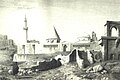 Alaaddin Mosque in an engraving of 1849
 -
 Alaeddin Mosque from the side
 -
 Prayer hall of the mosque
 -
 Mihrab
 -
 Dome
Dome -
 Minbar
 -
 Alaaddin Mosque Minber
 -
 Inscription
 -
 Inscription on Alaaddin Mosque
 -
 Inscription on Alaaddin Mosque
 -
 Main entrance to Alaaddin Mosque
 -
 Hadim Yusuf Paşa visiting the tombs of Rum Seljuq rulers in Konya, circa 1602

_4170.jpg)


_2340.jpg)
_2272.jpg)
_2274.jpg)
.jpg)

References
[edit]- ^ a b Scott Redford, The Alâeddin Mosque in Konya Reconsidered, Artibus Asiae, Vol. 51, No. 1/2, 1991:54
- ^ a b Scott Redford, The Alâeddin Mosque in Konya Reconsidered, Artibus Asiae, Vol. 51, No. 1/2, 1991:57
- ^ Ousterhout, Robert G. (2019). Eastern Medieval Architecture: The Building Traditions of Byzantium and Neighboring Lands. Oxford University Press. p. 579. ISBN 978-0-19-005840-1.
- ^ Beihammer, Alexander Daniel (2017). Byzantium and the Emergence of Muslim-Turkish Anatolia, Ca. 1040-1130. Taylor & Francis. p. 280. ISBN 978-1-351-98386-0.
- ^ Greenhalgh, Michael (2009). Marble Past, Monumental Present: Building With Antiquities in the Mediaeval Mediterranean. Brill. p. 473. ISBN 978-90-04-17083-4.
- ^ Konya, The Grove Encyclopedia of Islamic Art and Architecture, Vol.2, (Oxford University Press, 2009), 391.
- ^ Scott Redford, The Alâeddin Mosque in Konya Reconsidered, Artibus Asiae, Vol. 51, No. 1/2, 1991:55
- ^ Architecture, The Grove Encyclopedia of Islamic Art and Architecture, Vol.2, (Oxford University Press, 2009), 117.
- ^ Freely, John (1998). The Western Interior of Turkey (1st ed.). Istanbul: SEV. p. 237. ISBN 9758176226.
- ^ a b Redford, Scott (1991). "The Alaeddin Mosque in Konya Reconsidered". Artibus Asiae. 51 (1/2): 56. doi:10.2307/3249676. JSTOR 3249676.
- ^ Lamb, Dorothy (2013). "Notes on Seljouk Buildings at Konia". Cambridge University Press. 21: 32–33.
- ^ Scott Redford, The Alâeddin Mosque in Konya Reconsidered, 55.
- ^ Önge, Mustafa. "Conservation of Cultural Heritage on Alaeddin Hill in Konya from the 19th Century to Present Day." 183. Unpublished Ph.D Thesis from Metu, 2011.
- ^ a b Önge, Mustafa. "Conservation of Cultural Heritage on Alaeddin Hill in Konya from the 19th Century to Present Day." 184. Unpublished Ph.D Thesis from Metu, 2011.
- ^ Önge, Mustafa. "Conservation of Cultural Heritage on Alaeddin Hill in Konya from the 19th Century to Present Day." 214. Unpublished Ph.D Thesis from Metu, 2011.
- ^ "Konya'nın 800 yıllık en eski camisi Alâaddin Cami'nin restorasyonunun bitmesiyle vatandaşlar cuma namazında buluştular". www.iletisim.gov.tr (in Turkish). Retrieved 2022-07-23.
Sources
[edit]External links
[edit]
- "Alâeddin Mosque in Konya". ArchNet. Archived from the original on 2006-02-18.
- "Discovering Seljuk art in Konya". Bilkent University. Retrieved 5 September 2007.


Alâeddin Mosque
View on GrokipediaLocation and Site
Alaeddin Hill
Alaeddin Hill is a prominent elevation in the center of Konya, Turkey, forming the core of the ancient citadel and rising as an archaeological mound amidst the urban landscape. This elevated site, surrounded historically by a roughly circular perimeter of city walls measuring about 4.6 km, has long served as the heart of settlement in the region, with its slopes and summit hosting layered remains from multiple eras.[4] Evidence of human activity on the hill dates to the Early Bronze Age, with archaeological strata indicating settlements around 3000 BC, alongside earlier traces possibly extending to 7000 BC in the broader vicinity. Through the Phrygian period and into Hellenistic times, the hill was integral to the ancient city of Iconium, conquered by Alexander the Great between 333 and 323 BC and later integrated into the Pergamon kingdom and Roman Empire, where Hellenistic influences are evident in pottery and architectural fragments uncovered during excavations.[4] During the Byzantine era, the hill hosted several Christian structures, including the Eflatun Mescidi, a church dedicated to Hagios Amphilochios that was converted into a mosque and stood at the crest until its demolition in the 1920s. Archaeological digs, such as those conducted by the Turkish Historical Society in 1941, have revealed extensive spolia—reused marble columns, capitals, and inscriptions from Byzantine and Roman buildings—incorporated into later structures on the site, highlighting the hill's role as a repository of pre-Islamic heritage.[5][4] The hill's significance shifted with the Seljuk conquest of Konya around 1071, following the Battle of Manzikert, when Danishmendid and Seljuk forces captured the city and established it as a key power base in Anatolia, transforming the citadel into the royal and administrative seat of the Rum Seljuk Sultanate by the late 11th century.[4]Konya Citadel Context
Konya served as the capital of the Sultanate of Rum from the late 11th to the 13th centuries, establishing it as the political and cultural heart of the Seljuk Turks in Anatolia.[6] The citadel on Alaeddin Hill formed a fortified palace complex that enclosed the Alâeddin Mosque, integrating it into the defensive and administrative core of the sultanate's power structure.[7] The citadel's strategic positioning on the elevated hill enhanced its defensibility, offering a commanding overlook of the city below while connecting directly to the surrounding city walls and gates.[8] This layout not only facilitated surveillance and protection for the Seljuk rulers but also positioned the complex along key caravan routes linking the Black Sea to the Mediterranean and Iran to western Anatolia.[7] Adjacent to the mosque lie ruins of Seljuk palaces, including the Alaeddin Kiosk dating to the reign of Kilij Arslan II (1156–1192), underscoring the site's role as a royal enclave.[7] Within this complex, the Alâeddin Mosque functioned as the principal prayer hall for the sultans, symbolizing the fusion of religious and sovereign authority.[1] Today, the site is situated at coordinates 37°52′24″N 32°29′34″E in central Konya, transformed into a public park that provides panoramic views of the modern city and remains accessible via trams and walkways.[1][2]History
Pre-Seljuk Foundations
The site of the Alâeddin Mosque, situated on Alaeddin Hill in Konya (ancient Iconium), traces its origins to the Roman period, when the city was established as a colony under Emperor Augustus around 25 BCE and later renamed Claudiconium under Claudius in the 1st century CE.[4] Iconium served as an administrative and commercial hub in the province of Lycaonia, with the hill functioning as a strategic elevation for early fortifications and settlement, including remnants of a forum (Forum Isauricum) for regional assemblies and nearby structures such as a theater to the west and a Roman bath to the northwest.[4] Archaeological layers on the hill reveal continuous habitation from the Phrygian era around 2000 BCE, transitioning into Roman occupation evidenced by sarcophagi discovered west and north of the site, underscoring the hill's role in both defensive and civic functions during this era.[4] During the Byzantine period (395–1071 CE), Konya emerged as a key center of the Thema Anatolica, enduring invasions such as that by Attila in 446 CE and later Arab raids, which prompted reinforcements to its fortifications.[4] The hill, as part of the citadel, hosted repaired walls possibly under Emperor Heraclius in the 7th century, alongside religious sites that reflected a robust early Christian presence, including basilicas, the Amphilokhios Church (later known as Eflatun Camii), and the Metamorphosis Church within the citadel enclosure.[4][9] Two adjacent churches catered to Greek (Rum) and Armenian Christian communities, with a cemetery on the southern slopes, highlighting the hill's evolution into a focal point for Christian worship and defense amid a landscape dotted with monumental buildings vulnerable to events like the 12th-century earthquake.[4] The Seljuk conquest profoundly altered the site's trajectory, with Konya falling to the Seljuks in the late 11th century following their victory at the Battle of Manzikert in 1071, under the leadership of Suleiman ibn Qutalmish, who established the Sultanate of Rum.[9] This capture led to the displacement of Christian populations to nearby areas like Sille, while existing Byzantine structures on the hill, including churches, were initially repurposed for Islamic use or dismantled, marking the transition from Christian to Muslim dominance without immediate large-scale reconstruction.[4] Byzantine chronicles from the era record such conversions of churches to mosques in conquered Anatolian towns, facilitating the integration of the site into Seljuk administration as the emerging capital. Archaeological investigations illuminate this layered history, with excavations in 1941 and 1987–1988 uncovering pre-Seljuk remains such as a 10th-century church mosaic southwest of the hill, citadel wall fragments, and defensive ditches on the north and west flanks, though many artifacts were lost to early 20th-century demolitions.[4] Notably, spolia from Roman and middle Byzantine periods— including columns, capitals, bases, and bas-reliefs—were incorporated into later structures on the hill, evidencing the site's palimpsest-like evolution and the practical reuse of antique materials in the post-conquest landscape.[4] These findings, including Latin-inscribed tombstones, affirm the hill's continuous significance from pagan Roman fortifications through Christian Byzantine adaptations.[4]Seljuk Construction Phases
The construction of the Alâeddin Mosque began in 1155 under Sultan Mesud I (r. 1116–1155) as part of the broader expansion of the Konya citadel, marking the initial phase focused on establishing a foundational prayer hall.[10] This early effort incorporated pre-existing Byzantine spolia, reflecting the site's layered historical use.[11] The project advanced during the reign of Kılıç Arslan II (r. 1156–1192), who oversaw further development of the core structure amid the Seljuk consolidation of power in Anatolia.[12] In 1219, Sultan Kaykaus I (r. 1210–1220) initiated a significant rebuilding phase, which included the addition of the north entrance and façade, enhancing the mosque's prominence within the citadel complex.[13] This period saw increased involvement from key figures, including the Syrian craftsman Muhammad ben Khaulan (Muhammed bin Havlan al-Dımışki), who contributed to structural and decorative advancements.[12] Funding and oversight were provided by atabegs and viziers, ensuring continuity in the mid-construction expansions that addressed earlier limitations in the prayer hall layout.[14] The mosque reached completion in 1220 under Sultan Alaeddin Keykubad I (r. 1220–1237), finalizing the late decorative phases and solidifying its role as a central Seljuk religious site.[1] Subsequent Ottoman interventions included the addition of a minaret circa 1891 and updates to the mihrab, preserving and adapting the structure for continued use.Foundational Inscriptions
The foundational inscriptions of the Alâeddin Mosque in Konya primarily date to the early 13th century and serve as key epigraphic records of its Seljuk patronage and construction. The most prominent is the main entrance inscription on the north portal, dated to 617 AH (1220–1221 CE), which attributes the mosque's completion to Sultan Alaeddin Keykubad I as the primary patron during his reign.[1] This text underscores Keykubad's role in finalizing the structure, emphasizing his authority as a just ruler through phrases invoking divine favor and piety, drawn from Quranic verses such as those in Surah Al-Baqarah highlighting righteous leadership.[15] Additional inscriptions reference earlier contributions, including Sultan Izzeddin Keykavus I (r. 1211–1220 CE) and an atabeg, likely indicating oversight or initial phases under their influence.[16] These texts also praise the architects and craftsmen, notably the Syrian artisan Muhammad bin Khawlan al-Dimashqi, whose expertise in Syrian-style masonry is highlighted for elements like the portal's ablaq technique, symbolizing cultural exchange and technical prowess in Seljuk building. Such commendations reflect the collaborative nature of the project, blending local Anatolian and imported Syrian skills to elevate the monument's prestige.[17] The inscriptions employ a mix of Kufic and naskh scripts, carved into marble panels and inlaid tiles, which were characteristic of Seljuk epigraphy for their aesthetic and readability.[18] Kufic variants appear in bolder, angular forms on foundation stones for monumental emphasis, while naskh provides a more fluid style in narrative sections, often incorporating symbolic invocations of Quranic themes on divine protection and sovereign legitimacy to reinforce the Seljuk dynasty's Islamic rulership.[19] These epigraphic elements are concentrated on the north portal's lintel and arch, as well as scattered foundation stones around the base, strategically placed to greet visitors and mark the site's sanctity.[20] By invoking piety, craftsmanship, and dynastic continuity, the inscriptions played a crucial role in legitimizing Seljuk authority, portraying the mosque as a pinnacle of religious and political achievement in Anatolia.Architecture
Overall Structure
The Alâeddin Mosque in Konya exemplifies Seljuk architectural design through its hypostyle hall layout, which forms the core of its structural framework. The building adopts an irregular rectangular plan, oriented along a north-south axis to align with the qibla direction, with the north façade serving as the primary entrance. This hypostyle configuration consists of a spacious prayer hall supported by 42 columns, many of which are reused spolia from earlier Byzantine structures, creating an open interior space divided into aisles running perpendicular to the qibla wall.[1][15] Construction employs a combination of cut stone and brick, reflecting practical adaptations to local materials and building traditions in 12th- and 13th-century Anatolia. The façade incorporates the ablaq technique, featuring alternating bands of light and dark stone to create visual rhythm and contrast, particularly around portals and wall surfaces. Over the mihrab area at the southern end, a central dome rises, supported by squinches that transition from the square base to the circular dome profile, a method that demonstrates early Seljuk engineering solutions for vaulted roofs in hypostyle mosques.[2][21] Externally, the mosque integrates seamlessly with the surrounding Konya citadel walls, as it is embedded into the Alaeddin Hill, enhancing its defensive and monumental presence within the urban landscape. A northern courtyard, or sahn, precedes the prayer hall, enclosed by porticos that provide shaded access and frame the entrances. The structure includes a single minaret, added during the Ottoman period with a hexagonal base at its northeast corner, which contrasts with the original Seljuk proportions but serves as a later vertical accent.[1][2] Seljuk innovations in the mosque's design draw from Iranian and Central Asian influences, adapting them to Anatolian contexts through elements like muqarnas-carved portals that project intricate stalactite-like hoods over entrances, and geometric patterning in stone voussoirs that interlace stars and polygons for decorative depth. These features highlight the Rum Seljuks' synthesis of eastern Islamic motifs with local stoneworking expertise, establishing a prototype for subsequent Anatolian mosque architecture.[15][21]Interior and Decorative Features
The prayer hall of the Alâeddin Mosque features a hypostyle layout divided into bays and aisles by 42 reused antique columns, many of which are spolia from Byzantine, Roman, and Hellenistic structures.[1] These columns support a vaulted wooden ceiling, creating a spacious interior suited for large congregations.[1] The hall's irregular form reflects multiple construction phases, with the eastern section expanded under Sultan Alaeddin Keykubad I in the early 13th century.[21] A prominent artifact is the wooden minbar, crafted from ebony and dated to 1155 during the reign of Sultan Mesud I, making it the earliest dated example of Rum Seljuk woodwork in Anatolia.[1] Executed in the kündekâri technique of joinery without nails, it features deep-carved geometric patterns, including star-shaped compositions and octagons, alongside arabesque motifs with plant-inspired elements like trilobes and half-palmettes.[22] Epigraphic bands in Kufic and cursive scripts adorn its panels, containing Quranic verses and dedications to Sultans Mesud I and Kılıç Arslan II.[22] The mihrab, a later Ottoman addition dated to 1891, is constructed of marble with a polychrome ceramic frame featuring tiles in shades of blue.[21] These tiles, extending the mosque's exterior ablaq and blue tilework into the interior, incorporate Quranic inscriptions and geometric designs typical of 19th-century Ottoman aesthetics.[23] The surrounding dome, built by Kerimeddin Erdim Shah around 1220, is decorated with early Seljuk mosaic tiles in the transition zone.[23] Decorative elements include muqarnas vaulting in the dome's squinch transitions, a hallmark of Seljuk architectural sophistication that adds depth and light play to the interior.[21] Arched windows with geometric grilles provide natural illumination, enhancing the hall's acoustics for communal prayer through reflective stone surfaces and open bays.[1] Overall, these features blend Seljuk innovation with later Ottoman enhancements, preserving the mosque's role as a key exemplar of Anatolian Islamic art.[23]Tombs and Monuments
Kılıçarslan II Mausoleum
The Kılıç Arslan II Mausoleum is a ten-sided polygonal structure erected in the courtyard of the Alâeddin Mosque during the late 12th century by Sultan Kılıç Arslan II, who reigned from 1156 to 1192.[15][24] This decagonal tomb, constructed with cut stones by the architect Yusuf bin Abdulgaffar, features a conical dome aligned with its ten-cornered form and originally included greyish-blue tile decorations on the roof, blending Seljuk steppe traditions with regional influences.[25][10] The two-storied design incorporates vertical niches on the exterior for aesthetic and structural enhancement, positioning it as a prominent standalone monument within the mosque complex.[10] The mausoleum serves as a dynastic pantheon, housing the sarcophagi (sandukas) of nine Seljuk sultans, symbolizing the continuity and legacy of the Rum Sultanate's rulers.[26][10] These include Mesud I (d. 1155), Kılıç Arslan II (d. 1192), Süleyman II (d. 1204), Kayhüsrev I (d. 1211), Alaeddin Keykubad I (d. 1237), Kayhüsrev II (d. 1246), Kılıç Arslan IV (d. 1266), Kayhüsrev III (d. 1284), and Kayhüsrev IV (d. 1299), with all Seljuk sultans after Mesud I interred here except Izzeddin Kaykaus I.[25][1] Each ruler's sarcophagus is distinctly marked, underscoring the tomb's role in preserving Seljuk imperial memory. Architecturally, the mausoleum's entrance portal showcases intricate stone carvings typical of Seljuk craftsmanship, while the interior features marble tomb markers bearing epitaphs that detail the sultans' reigns and legacies.[1] These elements, combined with the structure's tilework and polygonal form, highlight its function as a focal point for Seljuk commemorative rituals during the sultanate's zenith in the 12th and 13th centuries.[10][25]Adsız Türbe
The Adsız Türbe, or "Nameless Tomb," is a secondary octagonal mausoleum situated adjacent to the primary Kılıçarslan II Mausoleum in the courtyard of the Alâeddin Mosque. Begun by Sultan Izzeddin Kaykaus I in 1219 as part of his contributions to the mosque complex, the structure remains unfinished, featuring plain marble walls and a flat roof devoid of the intricate carvings and decorations characteristic of contemporary Seljuk tombs.[27][12] The tomb's interior houses mummified remains, but the identities of its occupants are unknown, hence the designation "adsız" (nameless). Archaeological assessments suggest it may contain burials of Seljuk royal family members or court officials, though no inscriptions or records confirm this.[28] Construction halted mid-project following Kaykaus I's death in 1220, resulting in its stark, unadorned appearance in contrast to the elaborately tiled and inscribed main mausoleum.[27] This incomplete edifice exemplifies the ambitious scale of Seljuk funerary architecture while underscoring the disruptions within the Rum Sultanate during a period of dynastic transitions and external pressures.[1] Its preservation highlights the enduring legacy of early 13th-century Seljuk patronage in Konya, despite the unfulfilled vision.[12]Modern Developments
20th-Century Usage
During World War II, the Alâeddin Mosque in Konya was repurposed as a storage facility for army equipment, reflecting wartime exigencies that led to its temporary closure for worship.[4][29] This military allocation, spanning 1940–1945, aligned with broader patterns of requisitioning religious sites during conflicts, including earlier wars from 1914–1918 and 1920–1923.[29] Postwar, in 1945, the mosque underwent repairs and was designated for museum use by the Ministry of Education, integrating it into Konya's emerging cultural preservation framework alongside nearby sites like the Karatay Madrasah.[4] This shift facilitated early public access for educational and touristic purposes, positioning the structure as part of the Konya Antiquities Museum before its full religious reconversion.[4] By 1951, administrative control transitioned to the General Directorate of Pious Endowments (Vakıflar Genel Müdürlüğü), which restored the mosque's primary religious function, while the courtyard remained under the Directorate of Ancient Monuments and Museums (Eski Eserler ve Müzeler Genel Müdürlüğü).[4] The site reopened for worship in 1952 under the Presidency of Religious Affairs (Diyanet İşleri Başkanlığı), as announced in local publications like Yeni Konya.[4] These changes underscored the mosque's enduring role in Konya's cultural heritage amid Turkey's secular reforms initiated by Mustafa Kemal Atatürk, who had prioritized its conservation in a 1931 directive.[4] The mosque was closed again in 1958 due to dangerous cracks, with major repairs conducted in 1959, including courtyard wall reconstruction. Further structural consolidation occurred between 1968 and 1972, involving concrete and steel reinforcements and minaret rebuilding.[4][29]Restorations and Preservation
Following World War II, the Alâeddin Mosque received essential repairs in the 1940s and 1950s to address weathering and structural weaknesses. Efforts began in 1945 with renewals to the southeastern walls and the application of lead sheeting to the domes for protection against moisture. Between 1949 and 1952, more extensive interventions reinforced the foundations, added lead sheets across the domes, and placed a concrete slab on the western dome incorporating a waterproof layer to mitigate leaks.[4] A major restoration project from 2014 to 2020 formed part of the wider Seljuk Palace reconstruction initiative on Alaeddin Hill. This comprehensive work included careful cleaning of the mosque's ornate tiles to reveal original colors and patterns, reinforcement of columns to improve stability, and stabilization of foundations through targeted underpinning to counteract soil settlement.[30] Restorers prioritized traditional techniques and materials, such as lime mortar for repointing joints, to preserve the monument's historical integrity while adhering to modern conservation standards. Archaeological oversight guided the process, ensuring that incorporated spolia—reused ancient stones—remained undisturbed. The project concluded in 2020, celebrated with public prayers that highlighted the mosque's renewed role in community worship.[30] Ongoing preservation efforts contend with seismic risks in the Konya region, where the mosque's masonry construction on unstable clay-rich ground heightens vulnerability to earthquakes, as evidenced by historical cracks and requiring vigilant monitoring. Integration with the Alaeddin Hill Urban Park development further complicates conservation, demanding coordinated planning to harmonize green space enhancements with the site's archaeological and architectural protections.[4][31][32]References
- https://commons.wikimedia.org/wiki/File:Konya_Alaeddin_Mosque_tombs_008.jpg