Hubbry Logo
Alturas, CaliforniaAlturas, CaliforniaMain
Open search
Alturas, California
Community hub
Alturas, California
logo
8 pages, 0 posts
0 subscribers
Be the first to start a discussion here.
Alturas, California
Alturas, California
from Wikipedia

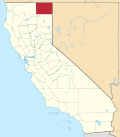
Alturas (Spanish for "Heights"; Achumawi: Kasalektawi)[7] is the only incorporated city in Modoc County, California of which it is also the county seat. Located in the Shasta Cascade region of Northern California, the city had a population of 2,715 at the 2020 census. Alturas is located at the confluence of the south and north forks of the Pit River, east of the center of Modoc County,[7] at an elevation of 4,370 feet (1,330 m).[5] Alturas is one of the largest cities in the region and a local economic hub.

Key Information

History

[edit]
The Nevada-California-Oregon Railway Building, built 1917–18
Alturas in 1920
Downtown Alturas in 1975

Alturas occupies what was initially an Achumawi (Pit River) village known as Kosealekte[8] or Kasalektawi.[9] The city was initially known as Dorris Bridge or Dorris' Bridge, named after Pressley and James Dorris, who built a bridge across the Pit River at this location.[7]

The Dorris Bridge post office opened in 1871.[7] The town was renamed Dorrisville in 1874[10] and Alturas in 1876, the latter meaning "heights" in Spanish.[11] The census of 1880 showed a population of 148. However, settlement continued over the next two decades, until the city was incorporated on September 16, 1901. Because of its central location, Dorrisville became the county seat when Modoc County formed in 1874, even though both Adin and Cedarville were then larger towns.[10]

Geography

[edit]

Alturas straddles the North Fork of the Pit River, near its confluence with the South Fork in the north end of South Fork Valley, in the extreme northeastern corner of California at 41°29′14″N 120°32′33″W / 41.48722°N 120.54250°W / 41.48722; -120.54250.[5] The tall Warner Mountains lie to the east, the wetlands and wild rice fields of South Fork Valley to the south, and the extensive Modoc Plateau to the north.

According to the United States Census Bureau, the city has a total area of 2.9 square miles (7.4 km2) and 0.63% of it is covered by water.

Climate

[edit]

The climate in Alturas is cold semi-arid (Köppen: BSk), bordering humid continental (Dsb). The average January temperatures are a high of 43.0 °F (6.1 °C) and a low of 20.6 °F (−6.3 °C). The average July temperatures are a high of 89.1 °F (31.7 °C) and a low of 47.2 °F (8.4 °C). There are an average of 39.8 days with highs of 90 °F (32.2 °C) or higher and an average of 195.5 days with lows of 32 °F (0 °C) or lower. The record high was 107 °F (41.7 °C) on July 19, 1960, and July 10–11, 2002, and the record low was −34 °F (−36.7 °C) on December 9, 1972. Freezing temperatures have occurred in every month of the year; cool nights are common even on the hottest summer days.

Precipitation averages 11.68 inches (297 mm) annually. There are an average of 90.8 days with measurable precipitation. The wettest year was 1952 with 20.80 in (528 mm) and the driest year was 2013 with 6.29 in (160 mm). The most precipitation in one month was 6.17 in (156.7 mm) in October 1962, and the most in 24 hours was 3.51 in (89.2 mm) on December 11, 1937. Snowfall averages 30.9 in (78 cm) per season. The most snowfall in a season was 85.5 in (217 cm) in 1952.

Climate data for Alturas, California (Alturas Municipal Airport), 1991–2020 normals, extremes 1935–present
Month Jan Feb Mar Apr May Jun Jul Aug Sep Oct Nov Dec Year
Record high °F (°C) 69
(21)
72
(22)
82
(28)
85
(29)
95
(35)
105
(41)
107
(42)
106
(41)
106
(41)
93
(34)
82
(28)
71
(22)
107
(42)
Mean maximum °F (°C) 56.6
(13.7)
60.4
(15.8)
69.4
(20.8)
76.5
(24.7)
85.3
(29.6)
93.2
(34.0)
99.1
(37.3)
98.0
(36.7)
92.8
(33.8)
82.1
(27.8)
69.5
(20.8)
55.2
(12.9)
100.3
(37.9)
Mean daily maximum °F (°C) 43.0
(6.1)
46.6
(8.1)
52.7
(11.5)
58.4
(14.7)
67.9
(19.9)
78.2
(25.7)
89.1
(31.7)
87.3
(30.7)
79.7
(26.5)
65.7
(18.7)
50.8
(10.4)
41.0
(5.0)
63.4
(17.4)
Daily mean °F (°C) 31.8
(−0.1)
34.8
(1.6)
39.6
(4.2)
44.3
(6.8)
52.5
(11.4)
60.2
(15.7)
68.2
(20.1)
65.8
(18.8)
58.5
(14.7)
47.5
(8.6)
37.7
(3.2)
30.5
(−0.8)
47.6
(8.7)
Mean daily minimum °F (°C) 20.6
(−6.3)
23.0
(−5.0)
26.5
(−3.1)
30.1
(−1.1)
37.2
(2.9)
42.2
(5.7)
47.2
(8.4)
44.2
(6.8)
37.2
(2.9)
29.3
(−1.5)
24.5
(−4.2)
20.0
(−6.7)
31.8
(−0.1)
Mean minimum °F (°C) −0.5
(−18.1)
6.2
(−14.3)
11.1
(−11.6)
17.5
(−8.1)
23.9
(−4.5)
30.3
(−0.9)
36.4
(2.4)
34.4
(1.3)
26.0
(−3.3)
15.5
(−9.2)
5.9
(−14.5)
−0.6
(−18.1)
−7.1
(−21.7)
Record low °F (°C) −32
(−36)
−33
(−36)
−7
(−22)
7
(−14)
14
(−10)
21
(−6)
28
(−2)
26
(−3)
15
(−9)
0
(−18)
−17
(−27)
−34
(−37)
−34
(−37)
Average precipitation inches (mm) 1.31
(33)
1.09
(28)
1.38
(35)
1.47
(37)
1.26
(32)
0.70
(18)
0.29
(7.4)
0.27
(6.9)
0.35
(8.9)
0.89
(23)
1.20
(30)
1.47
(37)
11.68
(296.2)
Average snowfall inches (cm) 8.4
(21)
6.2
(16)
5.4
(14)
2.9
(7.4)
0.9
(2.3)
0.0
(0.0)
0.0
(0.0)
0.0
(0.0)
0.0
(0.0)
0.3
(0.76)
3.5
(8.9)
6.6
(17)
34.2
(87.36)
Average extreme snow depth inches (cm) 4.4
(11)
3.0
(7.6)
2.6
(6.6)
1.1
(2.8)
0.4
(1.0)
0.0
(0.0)
0.0
(0.0)
0.0
(0.0)
0.0
(0.0)
0.2
(0.51)
1.6
(4.1)
2.6
(6.6)
5.6
(14)
Average precipitation days (≥ 0.01 in) 11.0 10.7 11.3 10.7 8.6 4.6 2.0 2.1 2.9 5.2 9.6 12.1 90.8
Average snowy days (≥ 0.1 in) 4.0 3.3 2.6 1.4 0.4 0.0 0.0 0.0 0.0 0.3 1.8 3.3 17.1
Source 1: NOAA[12]
Source 2: National Weather Service (snow/snow days 1935–2018)[13]

Demographics

[edit]
Historical population
CensusPop.Note
1880148
1910916
19209796.9%
19302,338138.8%
19402,090−10.6%
19502,81934.9%
19602,8190.0%
19702,799−0.7%
19803,0258.1%
19903,2316.8%
20002,892−10.5%
20102,827−2.2%
20202,715−4.0%
U.S. Decennial Census[14]
Sacred Heart Church of the Catholic Diocese of Sacramento
Alturas city, California – Racial composition
Note: the US Census treats Hispanic/Latino as an ethnic category. This table excludes Latinos from the racial categories and assigns them to a separate category. Hispanics/Latinos may be of any race.
Race (NH = Non-Hispanic) 2020[15] 2010[16] 2000[17] 1990[18] 1980[19]
White alone (NH) 73%
(1,982)
80.9%
(2,286)
80.2%
(2,319)
89.1%
(2,879)
94.1%
(2,847)
Black alone (NH) 1.1%
(31)
0.5%
(14)
0.2%
(7)
0.4%
(13)
0%
(0)
American Indian alone (NH) 3.2%
(88)
2.1%
(59)
3.6%
(105)
3.4%
(109)
0.6%
(19)
Asian alone (NH) 1.3%
(36)
1.4%
(40)
0.7%
(21)
0.5%
(16)
0.4%
(12)
Pacific Islander alone (NH) 0.3%
(7)
0.2%
(7)
0.1%
(3)
Other race alone (NH) 0.7%
(18)
0.1%
(3)
0.5%
(15)
0.1%
(2)
0%
(0)
Multiracial (NH) 5.1%
(138)
2.5%
(71)
2.7%
(78)
Hispanic/Latino (any race) 15.3%
(415)
12.3%
(347)
11.9%
(344)
6.6%
(212)
4.9%
(147)

The 2020 United States census reported that Alturas had a population of 2,715. The population density was 957.3 inhabitants per square mile (369.6/km2). The racial makeup of Alturas was 78.0% White, 1.1% African American, 4.1% Native American, 1.3% Asian, 0.3% Pacific Islander, 6.0% from other races, and 9.3% from two or more races. Hispanic or Latino of any race were 15.3% of the population.

The census reported that 99.2% of the population lived in households, 0.3% lived in non-institutionalized group quarters, and 0.6% were institutionalized.

There were 1,199 households, out of which 31.6% included children under the age of 18, 35.2% were married-couple households, 7.9% were cohabiting couple households, 35.0% had a female householder with no partner present, and 21.9% had a male householder with no partner present. 35.6% of households were one person, and 17.1% were one person aged 65 or older. The average household size was 2.25. There were 702 families (58.5% of all households).

The age distribution was 24.8% under the age of 18, 6.4% aged 18 to 24, 24.5% aged 25 to 44, 24.6% aged 45 to 64, and 19.8% who were 65 years of age or older. The median age was 38.9 years. For every 100 females, there were 90.5 males.

There were 1,393 housing units at an average density of 491.2 units per square mile (189.7 units/km2), of which 1,199 (86.1%) were occupied. Of these, 55.6% were owner-occupied, and 44.4% were occupied by renters.[20][21]

In 2023, the US Census Bureau estimated that the median household income was $54,634, and the per capita income was $31,725.[22]

Economy

[edit]
The historic Modoc County Courthouse, completed in 1914 to replace the prior courthouse built 1883–84

Alturas is the headquarters to the Modoc National Forest, the Applegate Field Office of the Bureau of Land Management, the Modoc National Wildlife Refuge and other recreation areas, and is the trade center for the agricultural region, which produces beef, sheep, potatoes, alfalfa and lumber. Despite its abundance of wilderness, recreational opportunities, hunting and fishing resources, and natural environment, tourism is not a major sector of the local economy – largely due to the city's remote location.[citation needed]

Local, State, Federal, and Tribal governments are the largest employers in Alturas.[23] A vibrant timber industry collapsed in the early 1980s due to increased production costs and low market prices for softwood lumber.

The Modoc Joint Unified School District is headquartered in Alturas.[24]

The Alturas Rancheria, a band of Pit River Indians, operates a small casino just outside the city limits.[25]

Government

[edit]

Transportation

[edit]
NCO Railway Depot, built 1908

Alturas is served by U.S. Route 395 and California State Route 299. U.S. 395 comes in from the south from Susanville and Reno. State Route 299 comes in from the west from Redding. Both highways merge in Alturas and head out of the city as a concurrency northeast toward Lakeview, Oregon; and Cedarville, respectively.

The Modoc Subdivision track of the Union Pacific Railroad and the Lake County Railroad (of Lake County, Oregon) serve the area. Alturas Municipal Airport is a public-use, general aviation facility located one nautical mile (1.2 mi; 1.9 km) west of the city's central business district.

Notable people

[edit]

See also

[edit]

References

[edit]
[edit]
Revisions and contributorsEdit on WikipediaRead on Wikipedia
from Grokipedia
Alturas is a small city in northeastern , serving as the and only incorporated in Modoc . With a population of 2,715 according to the and an estimated 2,652 as of 2024, it functions as a regional hub for agriculture, ranching, and forestry in the remote high-desert landscape of the Modoc Plateau. Situated at coordinates 41°14′57″N 120°34′16″W and an elevation of 4,370 feet (1,332 m), Alturas lies at the confluence of the north and south forks of the within the Shasta Cascade region, bordered by the Warner Mountains to the east and vast federal lands managed by the U.S. and Modoc National Forest. The area features a cold with warm, dry summers reaching highs near 90°F (32°C) and cold, snowy winters with average lows around 20°F (-7°C), receiving about 12 inches (305 mm) of precipitation annually, mostly as winter snow. The city's history is rooted in 19th-century settlement and the (1872–1873), a conflict between the U.S. Army and the that highlighted tensions over indigenous lands in the region. Originally known as Dorris Bridge after settlers Pressley and James Dorris who constructed a bridge across the in 1871, the settlement was renamed Dorrisville in 1874 and then Alturas—Spanish for "heights"—in 1876, coinciding with the formation of Modoc County from parts of Siskiyou County. By 1880, the population had reached 148, growing with the arrival of ranchers, farmers, and loggers drawn to the area's fertile valleys and timber resources. Today, Alturas remains a gateway to , including in the , in the surrounding national forest, and wildlife viewing in the Modoc Plateau's diverse ecosystems of and coniferous woodlands. The local economy centers on cattle and sheep ranching, potato and alfalfa farming, and lumber production, supporting a of $54,634 as of 2023 and employing residents in , retail, and services due to its role as the county administrative center. Known locally as "Where the West Still Lives," the city preserves its frontier heritage through historic sites like the Modoc County Courthouse (built ) and annual events celebrating pioneer culture.

History

Indigenous Peoples and Early Settlement

The area now known as Alturas was originally the site of an Achumawi (Pit River) village called Kosealekte or Kasalektawi, inhabited by who were part of the broader of the Modoc Plateau. This was home to several interrelated groups, including the Achumawi bands of the , the Modoc, and the Northern Paiute, who utilized the plateau's diverse ecosystems for hunting, gathering, and seasonal migrations. The Achumawi maintained a rich tradition of basketry, fishing along the , and trade networks that connected them to neighboring tribes across northeastern . The Modoc War (1872–1873) was a significant conflict in the region between the U.S. Army and the , who resisted relocation to the Klamath Reservation, leading to battles in the Lava Beds and heightened tensions over indigenous lands that shaped subsequent settlement. European American settlement began in the early 1870s, with the Dorris family—Presley A. Dorris, Carlos Dorris, and nephew Jim Dorris—arriving in 1870 to establish a ranch and construct a bridge over the to facilitate livestock crossing. The settlement was initially named Dorris Bridge in honor of the family's contribution, and a post office opened there in 1871 to serve the growing pioneer community. By 1874, the name changed to Dorrisville, coinciding with the formation of Modoc County from portions of Siskiyou County on February 17, 1874, after which Dorrisville was designated the county seat. The final renaming to Alturas occurred in 1876, derived from the Spanish word for "heights," reflecting the town's elevated position on the Modoc Plateau at approximately 4,350 feet above sea level. The early economy of the Alturas area revolved around ranching, which dominated due to the expansive grasslands suitable for and later sheep grazing, supporting large herds that drove local prosperity. production emerged in the 1860s and 1870s with the establishment of sawmills to harvest pine from the Warner Mountains and surrounding forests for construction and fuel. Trade flourished along the historic route, which crossed Modoc County through areas like Surprise Valley and Fandango Pass, enabling commerce in goods, , and supplies between , , and .

Incorporation and Modern Development

Alturas was formally incorporated as a on September 16, 1901, marking it as the only incorporated in Modoc County. At the time of incorporation, the community had grown from its early settlement roots to an estimated population of around 500 residents, reflecting steady development in the late . This status solidified Alturas's role as the and administrative hub for the sparsely populated region. A key milestone in the city's early 20th-century growth came with the construction of the Nevada-California-Oregon Railway depot in Alturas during 1908. This development enhanced regional transportation links, facilitating the movement of goods, passengers, and timber resources, which spurred and to 916 by the 1910 census. The depot, now repurposed as the Alturas Garden Club headquarters, symbolized the railway's importance in connecting Alturas to broader markets in and . The mid- to late brought challenges to Alturas's , particularly with the decline of the timber industry in the 1980s. Federal land policies, including restrictions under the National Forest Management Act and emerging environmental regulations to protect habitats, sharply reduced timber harvests on public lands in , including Modoc National Forest. This led to mill closures and job losses in the region, prompting economic diversification toward , ranching, and employment in Alturas. In the , Alturas has navigated population fluctuations amid broader rural trends, with the 2020 U.S. reporting 2,715 residents and a 2025 estimate of 2,657 as of January 1. The community faced environmental pressures in 2025, responding to multiple wildfires sparked by August thunderstorms in Modoc National Forest; local fire agencies, alongside U.S. Forest Service crews, contained incidents like the 980-acre Mountain Fire through rapid aerial and ground suppression efforts, minimizing threats to the city.

Geography

Location and Physical Features

Alturas is situated at 41°29′14″N 120°32′33″W, with an elevation of 4,370 feet (1,332 m), on the Modoc Plateau in northeastern . The Modoc Plateau forms a broad volcanic region characterized by flat-lying pyroclastic rocks and flows, extending across parts of Modoc and surrounding counties. This high-elevation tableland contributes to the area's rugged, open terrain, shaped by ancient lava flows and tectonic activity. The city lies at the confluence of the North and South Forks of the , in the Shasta Cascade region of , approximately 20 miles south of the border. This strategic location places Alturas within a transition zone between the southern Cascade Mountains to the west and the to the east, surrounded by the Warner Mountains rising to the east. The Modoc National Forest encompasses much of the surrounding landscape, providing a backdrop of coniferous forests, meadows, and volcanic features. According to the U.S. Census Bureau, Alturas encompasses a total area of 2.85 square miles (7.4 km²), of which approximately 0.63% consists of water, primarily from the nearby . As the of Modoc County, it functions as a gateway to expansive high desert landscapes and volcanic tablelands, facilitating access to remote natural areas. Alturas is adjacent to the Modoc National Wildlife Refuge, located along the South Fork of the southeast of the city, which protects wetlands and riparian habitats. The city also serves as the headquarters for the Modoc National Forest, with its supervisor's office at 225 West 8th Street, and hosts the Bureau of Land Management's Applegate Field Office at 708 West 12th Street, overseeing public lands in the region.

Climate

Alturas experiences a classified as Köppen BSk, bordering on humid continental (Dsb), primarily due to its of 4,370 feet (1,332 m) and the effect created by the Sierra Nevada mountains, which blocks much of the moisture from Pacific weather systems. The region receives an average annual of 11.68 inches (297 mm), with the majority occurring in winter months from to , and average snowfall totals 30.9 inches (79 cm), concentrated during the colder season. Temperatures exhibit significant seasonal variation, with an average July high of 87°F (31°C) and an average January low of 19°F (-7°C). Extreme records include a high of 107°F (42°C) on , 1960, and –11, 2002, and a low of -34°F (-37°C) on December 9, 1972. Summers are typically dry and warm, while winters are cold and snowy, reinforcing the semi-arid conditions. The also heightens risk, as demonstrated by the 38 lightning-caused fires in the Modoc National Forest during summer thunderstorms in 2025, many of which were contained at small sizes but underscored the area's vulnerability to dry .

Demographics and Society

Demographics

As of the , Alturas had a of 2,715 residents. The was 957 people per (369 per square kilometer). By 2024, the estimated had declined to 2,652, reflecting a steady decrease from 2,827 in the 2010 Census, primarily driven by rural outmigration in the region. Despite this trend, Alturas maintains an urban character as the of sparsely populated Modoc County, which had fewer than 10,000 residents as of 2020. The median age in Alturas was 45.2 years as of the 2019-2023 American Community Survey. The racial and ethnic composition was predominantly White (non-Hispanic) at 73.0%, followed by Hispanic or Latino at 15.3%, American Indian and Alaska Native at 4.2%, and two or more races at 5.1%; approximately 5.4% of residents were foreign-born. Household data from the 2020 Census indicated an average household size of 2.4 persons, with 32.1% of families having children under 18 years old and a homeownership rate of 52.3%.

Education

The Modoc Joint Unified School District (MJUSD) serves the educational needs of students in Alturas and surrounding areas in , operating six s with a total enrollment of approximately 832 students as of the 2023-2024 school year. The district emphasizes core academic programs while addressing the unique challenges of a rural community, including limited funding and geographic isolation that impact . Public education in Alturas is anchored by three main schools under MJUSD. Alturas Elementary School, serving grades K-5, enrolls about 357 students and focuses on foundational literacy and numeracy skills through interactive curricula. Modoc Middle School, for grades 6-8, has an enrollment of 202 students and integrates technology-enhanced learning to prepare students for high school transitions. Modoc High School, covering grades 9-12 with 237 students, offers Advanced Placement courses alongside vocational training in agriculture and trades relevant to the local economy. The district's overall student-teacher ratio stands at 16:1, supporting personalized instruction despite economic disadvantages affecting nearly 46% of students. Alternative educational options provide specialized support for diverse student needs. Shasta View Academy, a K-12 located at 214 West 1st Street in Alturas, emphasizes personalized, models with an online component to foster self-directed learning and served over 480 students county-wide in recent years. Modoc Special Education, administered through the county office, offers individualized programs for students with disabilities across MJUSD schools. High Desert Community Day School, targeting at-risk youth in grades 6-10, operates at 802 North East Street and focuses on credit recovery and behavioral support in a smaller, structured environment. The Modoc County Office of Education, located at 139 Henderson Street in Alturas, oversees MJUSD operations, provides administrative support, and coordinates for educators. There are no higher education institutions within Alturas; the nearest colleges, such as Shasta College in Redding, are in adjacent counties and accessible via regional transportation. Modoc High School reports a four-year rate of 87%, reflecting rural funding constraints that limit extracurricular and advanced program expansions, though engagement remains strong. In a recent highlight, four Modoc High soccer seniors participated in the inaugural Northern Section Fall Soccer All-Star Game on November 1, 2025, at University Preparatory High School in Redding, showcasing student athletic achievements.

Economy

Key Industries

The economy of Alturas is anchored by agriculture, which leverages the fertile lands of the Modoc Plateau for ranching and crop production. Beef cattle ranching dominates, with Modoc County ranking as California's leading producer of certified organic beef on 119,782 organic acres in 2022. Potato farming and hay production, including alfalfa, are also significant, supported by innovative practices like the "Walking Wetlands" rotation system at Tule Lake that enhances pest control through seasonal flooding. In 2022, Modoc County's total agricultural gross receipts reached $296.6 million, with field crops contributing $147.1 million and vegetable/specialty crops $31.9 million. In 2023, field crops value declined to $81.3 million amid drought conditions. Alturas serves as a key trade center for these surrounding farms and ranches, facilitating auctions, supply distribution, and market access through local facilities. Natural resources, particularly , have historically shaped the local but shifted toward following broader industry declines in during the 1980s, driven by reduced housing demand and increased environmental regulations. The Modoc National Forest, encompassing much of the surrounding area, once supported robust lumber production but now emphasizes to balance timber harvesting with protection, including wildlife habitat and preservation. This approach ensures ongoing economic contributions from wood products while mitigating risks from overharvesting. Tourism has emerged as a growing sector, drawn by outdoor recreation in the Modoc National Forest and the Modoc National Wildlife Refuge, which attract visitors for hiking, fishing, and birdwatching along the . In 2019, travel-related spending in Modoc County totaled $29.5 million, supporting local services through seasonal influxes. Small-scale and retail complement these industries, focusing on rural essentials like steel fabrication, machinery repair, and farm supplies to meet agricultural and forestry needs. Agriculture in the semi-arid region faces climate challenges, including recurrent that reduce water availability for and , prompting adaptations such as organic practices and resilient crop rotations for . Modoc County has been repeatedly designated area due to , affecting hay and production, yet high-altitude conditions and federal aid programs aid recovery and sustainability.

Major Employers

The major employers in Alturas are concentrated in , healthcare, and , reflecting the town's role as the Modoc County and its proximity to federal land management operations. Public administration supports 127 jobs, primarily through government agencies such as the Modoc National Forest headquarters, which oversees forest management across 1.6 million acres; the Bureau of Land Management's Applegate Field Office handling public land administration; and the Modoc National Wildlife Refuge, managed by a small team focused on and wildlife habitat. County and city offices, including Modoc County's administration (many based in Alturas), further bolster this sector by providing essential services like public safety and administration. Healthcare and social assistance employ 174 people, with Modoc Medical Center serving as the primary provider—a critical access offering care, family practice, and a 50-bed skilled nursing facility, alongside county health services that address needs in the rural area. Education contributes through the Modoc Joint Unified School District, which employs about 106 staff, including 46 teachers, to serve students across elementary, middle, and high school levels in Alturas and surrounding communities. Private sector employment includes the Desert Rose Casino, a tribal facility owned by the Alturas Indian Rancheria featuring 100 slot machines and two table games, which employs 11 to 50 people in gaming, , and food services. Smaller-scale opportunities arise in retail trade and agricultural processing, such as feed stores and ranch support operations, which employ around 8.6% of the county's workforce in related roles. These employers underscore Alturas's economic reliance on stable federal and positions, particularly following the decline of the timber industry in the early that once dominated the region's . In 2023, total in Alturas reached 960 people, with Modoc County's rate at 6.7%, a household income of $54,634 in Alturas, and a rate of 23.3%, highlighting ongoing challenges in a post-timber landscape.

Government

Local Administration

Alturas operates under a council-manager form of , where the elected sets policy and appoints a professional to oversee daily operations. The consists of five members, including the , who serves as the presiding officer. As of 2025, the is Paul Minchella, with vice mayor Jennifer Engel and members Duanna Knighton, Jodie Larranaga, and Brian Cox. The city's fiscal year 2024-2025 budget allocates major portions to (including utilities) and public safety, reflecting priorities for maintenance and emergency services in this rural community. As the seat of Modoc County, Alturas serves as the administrative hub for the county's rural population of approximately 9,000, hosting the Modoc County Courthouse, the Sheriff's Office at 102 South Court Street for and jail operations, and the County Administrative Office at 204 South Court Street for broader governmental services. The official city motto, "Where the West Still Lives," underscores its commitment to preserving rural Western heritage while delivering essential services. These include water and sewer utilities governed by the Alturas Municipal Code (codified through Ordinance No. 529), park maintenance, and recreational facilities such as the Alturas Municipal Pool, which provides swim lessons and public access during the 2025 season. Recent municipal actions have included issuing notices for 2025 elections managed through the Modoc County Elections Office and supporting (TNR) policies for management via local events organized by the Modoc Feline and High Plateau . These efforts occur under oversight from state agencies to ensure compliance with general requirements.

Political Representation

Alturas, located in Modoc County, falls within California's 1st State Senate District, represented by Republican since her election in 2024. Dahle, a resident of Bieber in neighboring Lassen County, focuses on rural issues such as , water rights, and wildfire management, which align with the district's predominantly agricultural and forested northern regions. At the state level, the city is also part of the 1st Assembly District, represented by Republican Heather Hadwick, who assumed office in 2024 and serves counties including Modoc, emphasizing in rural areas and opposition to certain environmental regulations impacting and ranching. Federally, Alturas is included in , represented by Republican since 2013. LaMalfa, whose district encompasses much of Northern California's rural interior, advocates for federal support in water infrastructure, farm subsidies, and land management policies that benefit Modoc County's timber and cattle industries. The district's boundaries, drawn by the independent California Citizens Redistricting Commission, group Alturas with other sparsely populated counties, ensuring representation for remote communities. However, the passage of Proposition 50 in the November 4, 2025, special election will allow the state legislature to draw new congressional districts for the 2026 elections, which may change the district boundaries including Alturas. Modoc County, and by extension Alturas, exhibits strong Republican voting trends, with the county consistently supporting Republican presidential candidates by wide margins; for instance, received over 75% of the vote in the county during the 2020 election. This conservative lean reflects the area's rural values, including emphasis on Second Amendment rights, intervention, and traditional land-use practices. In the November 4, 2025, special election, Modoc County participated in the statewide vote on Proposition 50, a allowing legislative-drawn congressional maps for 2026–2030 elections, which passed amid opposition from 30 California district attorneys—including those from rural counties—who argued it undermined independent redistricting and could dilute rural voices by pairing inland areas like Modoc with urban districts. Locally, Alturas operates under a non-partisan city council system, where elections for the five-member council and occur without party affiliations on the , though candidates and voters are influenced by the community's rural conservative , often prioritizing issues like infrastructure maintenance and agricultural preservation over partisan divides. This structure fosters consensus on local matters while aligning with broader district-level representation dominated by Republican officeholders.

Transportation

Highways and Roads

Alturas serves as a key transportation hub in Modoc County, with forming the primary north-south corridor through the town. This highway connects Alturas northward to , approximately 100 miles away, and southward to , about 170 miles distant, facilitating regional travel and commerce in the remote northeastern area. Intersecting in central Alturas is , which provides an essential east-west link extending westward to Redding, roughly 150 miles away, and eastward toward the border. This route supports connectivity across the rugged terrain of , with recent Caltrans projects focusing on pavement rehabilitation in the Alturas vicinity to enhance safety and durability. Within Alturas, local streets follow a grid-based layout centered around the intersection of and State Route 299, serving residential, commercial, and administrative needs. The town acts as a gateway for Modoc County's extensive network of over 1,000 miles of county and U.S. Forest Service roads, many unpaved, which connect to remote ranches and recreational sites. Road maintenance in Alturas and surrounding areas is primarily managed by the Modoc Roads Department, which oversees city streets and routes, including routine repairs and seasonal operations. Winter snow accumulation frequently leads to drifts and closures on higher-elevation roads, prompting dedicated efforts guided by county policy, often extending into spring. Summer wildfires pose additional challenges, resulting in temporary road closures and evacuations to ensure public safety during high-risk periods. Historically, State Route 299 near Alturas provides access to the , a 19th-century emigrant route established in 1846 as a safer alternative to the , which passed through the region en route to . These highways and roads are vital for supporting Modoc County's agricultural economy by enabling the transport of and goods to larger markets.

Airport and Rail

Alturas Municipal (KAAT), located approximately one mile west of the , serves as a public-use facility supporting private and emergency flights in Modoc County. The features two asphalt : the primary 13/31 measures 4,228 feet by 50 feet, while the secondary 03/21 is 2,506 feet by 60 feet, accommodating small operations without scheduled commercial service. Fuel services for 100LL and Jet A are available, along with tiedowns, but no or powerplant is provided on site. During the season from May to October, the facility hosts seasonal firefighting , playing a key role in aerial support for incidents in the adjacent Modoc National Forest, including operations for suppression and reconnaissance. Rail transportation in Alturas centers on freight operations, with no passenger services available. The operates the Modoc Line, a freight route traversing remote high-desert through the , connecting to broader networks for transcontinental shipments. Complementing this, the Goose Lake Railway—a short-line carrier—provides local freight service over a 55-mile segment from , to Alturas, utilizing track remnants of the historic Nevada-California-Oregon Railway, which was originally constructed in the early for regional connectivity. This line handles limited cargo volumes, primarily agricultural products, food items, and from the surrounding rural economy, with weekly trains facilitating switching and delivery to sidings south of town. The remote location of both and rail infrastructure poses challenges to expansion, as sparse population and rugged terrain constrain infrastructure upgrades and commercial viability. Nonetheless, these modes underscore Alturas's role in emergency logistics, with supporting Cal Fire's regional efforts for evacuations and fire response in northeastern .

Culture and Attractions

Landmarks and Recreation

Alturas offers a variety of natural landmarks that attract outdoor enthusiasts to the surrounding high desert landscape. The Modoc National Wildlife Refuge, located just south of the city, spans over 7,100 acres and provides prime opportunities for birdwatching, where visitors can observe migratory species such as sandhill cranes and snow geese during seasonal flyovers, as well as hiking along accessible trails and an auto-tour route. Nearby, the Modoc National Forest encompasses more than one million acres of diverse terrain, including the Warner Mountains, where camping is available at developed sites like those near the , renowned for its trout fishing, and free dispersed camping options throughout the area. Additional natural attractions include Mill Creek Falls, a scenic in the South Warner Wilderness about 20 miles south of Alturas, accessible via a moderate 3.4-mile round-trip trail that leads to the 30-foot cascade fed by snowmelt. Further east, approximately 40 miles away in Surprise Valley, the Surprise Valley Hot Springs resort features natural geothermal pools for soaking, drawing visitors to its private outdoor tubs amid the remote high-desert setting. Built attractions in Alturas highlight the region's cultural and recreational heritage. The Modoc County Museum, housed in a historic building at 600 South Main Street, showcases historical artifacts including Native American baskets and tools from the , as well as cowboy exhibits featuring ranching memorabilia and pioneer firearms dating back to the . The Desert Rose Casino, operated by the Alturas Indian Rancheria on County Road 56, provides gaming with over 100 slot machines and a few table games, alongside entertainment options like live sports viewing and a full-service restaurant. For golf enthusiasts, the Arrowhead Golf Course, a 9-hole public facility at 1901 North Warner Street established in 1969, offers 3,123 yards of play across well-maintained fairways with views of the surrounding mountains, open seasonally from to . Recreational facilities in Alturas cater to both locals and visitors seeking active pursuits. The Alturas Municipal Pool, located at 1112 West 4th Street and managed by the City of Alturas, features an outdoor swimming area with lap lanes, open swim sessions, and programs like aquacise classes during the summer months from June to August. opportunities abound in the Warner Mountains, part of the Modoc National Forest, with trails like the Summit Trail offering multi-day backpacking routes through alpine meadows and volcanic landscapes, suitable for various skill levels. Most landmarks and recreational sites are conveniently accessible, with key natural areas like the Modoc National Wildlife Refuge and Modoc National Forest lying within 10 miles of downtown Alturas via State Route 395, and entry to these public lands is free, though some facilities such as the museum charge a nominal $2 admission fee. Seasonal recreation benefits from the area's dry, sunny climate, which supports extended outdoor activities from spring through fall, though high summer temperatures may influence peak visiting times.

Annual Events and Notable Figures

Alturas hosts several annual events that celebrate its rural heritage and community spirit. The Alturas Balloonfest, organized by the Alturas Chamber of Commerce, is a prominent three-day hot air balloon show held in September, featuring launches and family-friendly activities that drew hundreds of attendees in 2025. The Modoc District Fair, a summer event in late August, showcases agricultural exhibits, livestock shows, and local crafts, highlighting the region's farming traditions at the fairgrounds in nearby Cedarville. In November 2025, community gatherings included the Haunted Farm Stand at the Harris Family Homestead, which attracted nearly 500 visitors with Halloween-themed activities, and the inaugural Fall Soccer All-Star Game featuring Modoc County players. The Alturas promotes additional recurring events such as Days in June, with and contests, and Winterfest in December, including a , fostering local and . The Modoc Historical Society, based at the Modoc County Museum in Alturas, organizes events celebrating the area's . Notable figures from Alturas include Ernest S. Brown (1903–1965), born in the town and a U.S. colonel during who later served as a . , a Modoc High School graduate from Alturas, played professionally in the WNBA for six seasons and now works as a broadcaster for the . Clinton Romesha, a Modoc County native raised near Alturas, received the in 2014 for his heroism during the 2009 in while serving in the U.S. . Robert Laxalt (1923–2001), born in Alturas to Basque immigrant parents, became a renowned author whose works, such as Sweet Promised Land, explored Basque-American life and Nevada's rural culture. These events and individuals underscore Alturas's emphasis on Western heritage, from agricultural fairs to valor, reflecting the town's small-town, rural character without producing major celebrities.

References

Add your contribution
Related Hubs
User Avatar
No comments yet.