Hubbry Logo
AnnasAnnasMain
Open search
Annas
Community hub
Annas
logo
8 pages, 0 posts
0 subscribers
Be the first to start a discussion here.
Annas
Annas
from Wikipedia
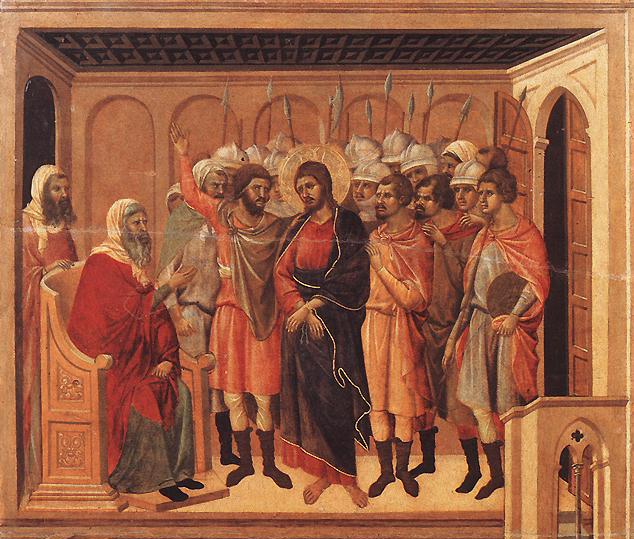
"Christ before Annas" (Duccio di Buoninsegna), c. 1308–11)
"Annas and Caiaphas" (Dutch, c. 1500)

Annas (also Ananus[1] or Ananias;[2] Hebrew: חָנָן, Ḥānān; Koine Greek: Ἅννας, Hánnas; 23/22 BC – death date unknown,[3] probably around AD 40) was appointed by the Roman legate Quirinius as the first High Priest of the newly formed Roman province of Judaea in AD 6 – just after the Romans had deposed Archelaus, Ethnarch of Judaea, thereby putting Judaea directly under Roman rule.

Annas appears in the Gospels and Passion plays as a high priest before whom Jesus is brought for judgment, prior to being brought before Pontius Pilate.

The sacerdotal family

[edit]

The terms of Annas, Caiaphas, and the five brothers are:

Ananus (or Annas), son of Seth (6–15)

[edit]

Annas served officially as High Priest for ten years (AD 6–15), when at the age of 36 he was deposed by the procurator Valerius Gratus. Yet while having been officially removed from office, he remained as one of the nation's most influential political and social individuals, aided greatly by the fact that his five sons and his son-in-law Caiaphas all served at sometime as High Priests.[4] His death is unrecorded. His son Annas the Younger, also known as Ananus the son of Ananus, was assassinated in AD 66 for advocating peace with Rome.[2]

After Valerius Gratus deposed Ishmael ben Fabus from the high priesthood, he installed Eleazar ben Ananus, (15—16),[5][6] a descendant of John Hyrcanus. It was a time of turbulence in Jewish politics, with the role of the high priesthood being contended for by several priestly families. Eleazar was likewise deposed by Gratus, who gave the office to Simon ben Camithus (17-18).

Caiaphas (18–36)

[edit]

Caiaphas was married to the daughter of Annas (John 18:13). Gratus made him high priest after depriving Simon ben Camithus of the office.[5] The comparatively long eighteen-year tenure of Caiaphas suggests he had established a good working relationship with the Roman authorities. Gratus' successor Pontius Pilate retained him as high priest.[7]

References in the Mosaic Law to "the death of the high priest" (Numbers 35:25, 28) suggest that the high-priesthood was ordinarily held for life.[citation needed] Annas was still called "high priest" even after his dismissal, along with Caiaphas (Luke 3:2),[non-primary source needed] perhaps for that reason.[verification needed][citation needed] It is also thought[according to whom?] that Annas also may have been acting as president of the Sanhedrin, or a coadjutor of the high priest.[verification needed][citation needed]


In the New Testament

[edit]

The trial of Jesus

[edit]

Although Caiaphas was the properly appointed high priest, Annas, being his father-in-law and a former incumbent of the office, possibly retained some of the power attached to the position.[8] According to the Gospel of John (the event is not mentioned in other accounts), Jesus was first brought before Annas, whose palace was closer.[9] Annas questioned him regarding his disciples and teaching, and then sent him on to Caiaphas, where some members of the Sanhedrin had met, and where in Matthew's account the first trial of Jesus took place (Matthew 26:57–68).

In the Book of Acts

[edit]

After Pentecost, Annas presided over the Sanhedrin before which the Apostles Peter and John were brought (Acts 4:6).

Cultural references

[edit]

See also

[edit]

References

[edit]
[edit]
Revisions and contributorsEdit on WikipediaRead on Wikipedia
from Grokipedia
Annas ben , also known as Ananus, was a first-century Jewish who officially held the office from 6 to 15 CE, appointed by the Roman legate and deposed by procurator . Born around 23–22 BCE as the son of , Annas wielded enduring influence after his tenure through his familial dynasty, as five of his sons and his son-in-law Joseph successively served as high priests, effectively controlling the position for much of the subsequent decades. In the accounts, Annas is portrayed as the initial interrogator of following his arrest, conducting a preliminary examination before transferring him to for the formal trial. His family's Sadducean leadership and reputed involvement in Temple administration, including allegations of corrupt practices such as servants seizing tithes, underscored their political and economic dominance amid Roman oversight.

Early Life and Appointment

Origins and Family Background

Annas, whose was Ananus ben Seth, was born into the Jewish priestly aristocracy of during the late era, with his father belonging to the Sadducean elite that controlled Temple administration. Limited historical records exist on his early life or precise birth date, estimated around 20–30 BC based on his appointment to the high priesthood at a typical adult age for such offices, but primary sources like provide no further ancestral details beyond this patrilineal identification, suggesting a background rooted in established Zadokite or comparable priestly lineages favored by Roman procurators for their pliability in governance. The defining feature of Annas' family background was its dynastic dominance over the high priesthood, which Josephus attributes to strategic marriages and Roman patronage rather than hereditary legitimacy under Hasmonean precedents. He fathered at least five sons—Eleazar, Jonathan, Theophilus, Matthias, and a second Ananus (the younger)—each of whom successively held the high priesthood after his own tenure, spanning from approximately AD 16 to 62 and enabling the family to retain de facto authority over Temple revenues and rituals for over half a century. Josephus notes this as evidence of Annas' "fortune," with his daughters marrying into other influential families, including one to Joseph Caiaphas, who served as high priest from AD 18 to 36 and acted as Annas' close political ally. This network exemplified the shift from hereditary to appointive high priesthood under Roman rule, where familial alliances secured repeated Roman endorsements despite frequent depositions.

Appointment as High Priest (6 AD)

Annas ben Seth was appointed High Priest of Judea in 6 CE by Publius Sulpicius Quirinius, the Roman legate of Syria, amid the transition to direct Roman provincial administration following the deposition of ethnarch Herod Archelaus by Emperor Augustus. Quirinius, dispatched to conduct a census and suppress unrest, exercised authority to install Annas, replacing Joazar ben Boethus, as part of efforts to stabilize governance and integrate Judea into the imperial tax system. This appointment, detailed in Flavius Josephus's Antiquities of the Jews (18.2.1–2), reflected Roman preference for Sadducean elites amenable to collaboration, with Annas hailing from a priestly lineage that positioned him to navigate both Temple rituals and prefectural demands. The selection occurred against a backdrop of Jewish resistance to the , viewed as a harbinger of heavier taxation and loss of autonomy, which sparked revolts led by . Annas's tenure thus began under strained conditions, requiring him to mediate between Roman imperatives—such as ensuring orderly revenue collection—and Jewish expectations of priestly legitimacy derived from Zadokite descent, though Roman veto power increasingly superseded hereditary claims. His role emphasized the high priesthood's evolution into a politically appointed office, prioritizing administrative utility over purely religious criteria.

Initial Tenure and Roman Relations (6-15 AD)

Annas ben Seth was appointed in 6 AD by Publius Sulpicius Quirinius, the Roman legate of , shortly after the annexation of Judaea as a following the deposition of . This selection replaced Joazar ben Boethus and aligned with Quirinius's administrative reforms, including the controversial census that assessed property for taxation and triggered the Galilean revolt led by and Zadok the Pharisee. As the first under direct Roman provincial governance, Annas's installation underscored the empire's strategy of appointing cooperative Sadducean elites to manage temple affairs and mitigate unrest, thereby ensuring fiscal contributions to flowed through Jerusalem's religious institutions. Throughout his tenure, Annas maintained functional relations with Roman authorities by upholding the of priestly Sadducean dominance, which prioritized temple revenues—estimated from sacrifices, tithes, and trade—over zealous resistance to imperial demands. No major revolts directly implicated him, suggesting effective between Roman prefects and Jewish factions during a period of adjustment to provincial rule, though underlying tensions from the 6 AD census persisted. His approximately nine-year hold on the office, longer than many contemporaries, reflected pragmatic alignment with Roman interests, as high priests derived legitimacy and security from imperial favor rather than solely from Hasmonean or popular mandate. In 15 AD, , the newly appointed Roman prefect of Judaea, deposed Annas and replaced him with ben Phiabi, initiating a pattern of rapid high priestly turnovers to consolidate procuratorial control. The deposition, executed without recorded cause in primary accounts, likely stemmed from Gratus's efforts to install more pliable figures amid ongoing fiscal pressures, though Annas's family retained informal influence over subsequent appointees. This event highlighted the precariousness of Jewish leadership under Roman oversight, where tenure depended on perceived loyalty and utility to imperial administration.

Dynastic Influence and Family Priesthood

Key Family Members and Their Tenures

Annas exerted dynastic control over the high priesthood through his , with five sons and one son-in-law appointed to the office by Roman authorities in the decades following his own tenure. These included , Jonathan, , Matthias, Ananus the younger, and , married to Annas' daughter. This succession, spanning from 16 CE to 62 CE, reflected the family's entrenched influence amid frequent Roman interventions in priestly appointments, as detailed by . The specific tenures of these key family members were:
NameRelation to AnnasTenure as High Priest
Eleazar ben AnanusSon16–17 CE
Joseph CaiaphasSon-in-law18–36 CE
Jonathan ben AnanusSon36–37 CE
Theophilus ben AnanusSon37–41 CE
Matthias ben AnanusSon43 CE
Son62 CE
These appointments, primarily recorded in Josephus' , underscore the family's ability to navigate Roman prefects and procurators, such as and , who favored Sadducean elites like Annas' kin for maintaining order. Ananus the younger's brief term ended amid controversy, including the unauthorized trial of , leading to his own deposition by King Agrippa II.

Mechanisms of Familial Power Maintenance

The Annas family sustained its dominance over the high priesthood through strategic alignments with Roman authorities, who controlled appointments and frequently rotated to ensure loyalty and extract revenues. Annas himself, appointed in 6 AD by the Roman legate and deposed in 15 AD by prefect , saw his immediate successor as his son (circa 16-17 AD), followed by his son-in-law (circa 18-36 AD), whose marriage to Annas' daughter consolidated familial ties to the position. This pattern continued with other sons—Jonathan (36-37 AD), (37-41 AD), and Matthias—each securing brief tenures amid Roman vicissitudes, spanning roughly six decades of near-uninterrupted family control. Josephus highlights the exceptional fortune of this dynasty, reporting that Annas fathered five sons who all ascended to the high priesthood, in addition to his son-in-law Caiaphas, attributing this to the elder's savvy navigation of Roman politics rather than hereditary entitlement under Jewish tradition. The mechanism hinged on the Roman system's commodification of the office: procurators like Gratus and appointed compliant Sadducean elites, often favoring those who offered substantial bribes or demonstrated fiscal reliability in managing Temple dues, which the Annas clan amassed through prior incumbencies. As Sadducean aristocrats, the family leveraged their sect's emphasis on Temple ritual and collaboration with imperial overseers, positioning relatives as dependable intermediaries who minimized unrest while channeling funds to . Beyond formal appointments, Annas preserved patriarchal sway post-deposition via customary deference within priestly circles, where deposed incumbents retained consultative prestige; this is evident in the account of ' arrest, where he was initially brought to Annas for preliminary questioning before transfer to , underscoring the elder's enduring veto power over proceedings. The Talmudic tradition echoes this longevity, critiquing the "house of Ananias" (a variant for Annas) for perpetuating influence through and economic leverage, though such sources blend approbation with later rabbinic disdain for Sadducean temporalism. This blend of Roman favoritism, endogamous alliances, and intra-elite norms effectively transformed the high priesthood from a lifetime spiritual role into a hereditary administrative fiefdom under Annas' oversight.

Post-Deposition Authority

Retained Influence as Patriarch

Despite his deposition as high priest by the Roman prefect in 15 AD, Annas maintained substantial as the of a dominant Sadducean priestly dynasty. Immediately following his removal, Gratus appointed Annas's son as high priest, who served briefly before being succeeded by Annas's son-in-law () in 18 AD; held the office until 36 AD. This pattern of familial succession underscored Annas's behind-the-scenes control over Temple leadership, as subsequent high priests included four more of his sons: (37–41 AD), Matthias (43 AD), Annas the Younger (c. 61–62 AD), and possibly others aligned with the family. Josephus explicitly described Annas (rendered as Ananus ben Seth) as exceptionally fortunate, noting that "he had five sons, who had all performed the office of a to God, and he had himself enjoyed that dignity a long time formerly." This dynastic entrenchment allowed Annas to shape religious and political decisions in , leveraging kinship ties to navigate Roman oversight while preserving Sadducean influence over the and Temple administration. His family's repeated appointments reflect not mere coincidence but strategic maneuvering, as Roman prefects often favored incumbents' relatives to ensure stability amid Jewish-Roman tensions. New Testament accounts further illustrate Annas's enduring power, portraying him as a de facto authority figure two decades after his formal ouster. In the Gospel of John, Jesus was brought first to Annas for preliminary during his (c. 30–33 AD), despite Caiaphas's official role, before transfer to the and Pilate. Similarly, Luke 3:2 refers to "Annas and Caiaphas" jointly as high priests during John the Baptist's ministry, signaling Annas's retained prestige in Jewish eyes, where the high priesthood carried lifelong honor beyond Roman revocability. In Acts 4:6, Annas appears as "the high priest" alongside and other kin when confronting Peter and John, demonstrating his oversight of early Christian efforts. These episodes highlight Annas's role as family elder, consulted for counsel and adjudication in high-stakes matters. This patriarchal influence extended economically and administratively, as the Annas dynasty controlled key Temple revenue streams, including bazaars for sacrificial animals and currency exchange, which later critiqued in related family members for exploitative practices. Annas's ability to install relatives ensured the family's and veto power over religious policy, positioning him as a stabilizing yet nepotistic force until his death around 40 AD.

Economic and Temple Control

The family of Annas exerted substantial control over the economic operations of the Second , leveraging their dominance of the high priesthood to manage key commercial concessions tied to religious observance. These included the provision of sacrificial animals, such as doves required for purification rites under Levitical , and the exchange of currencies for the half-shekel , which demanded pure Tyrian silver shekels acceptable for offerings. Pilgrims, often arriving with foreign coinage bearing imperial images deemed idolatrous, were compelled to convert funds at rates set by Temple-authorized exchangers, generating profits through fees and markups. The Annas clan's oversight of these activities stemmed from familial appointments to priestly roles that inspected animals for purity, effectively granting them a monopoly on approved sales and excluding independent vendors. Rabbinic sources refer to these enterprises as the "bazaars of the sons of Annas" (chanuyoth beney Annas), with stalls positioned on the to supply animals transported into the Temple courts, bypassing direct competition within the sacred precincts. This arrangement allowed the family to capitalize on the influx of worshippers during festivals like , when demand for unblemished livestock surged; doves, affordable for the poor, were sold at premiums that critics later decried as exploitative. The Babylonian , in tractates such as 31a-b, alludes to such operations in contexts of Temple administration critique, reflecting contemporary perceptions of priestly profiteering. While direct financial records are absent, the scale of Temple revenue—encompassing annual half-shekel payments from an estimated 2-3 million adult Jewish males worldwide, yielding roughly 2-4 tons of silver—underscores the potential for families like Annas's to amass through ancillary rather than tithes alone. Post-deposition, Annas retained de facto authority as the family patriarch, advising successors like his son Eleazar (high priest 16-17 AD) and son-in-law Caiaphas (18-36 AD), ensuring continuity in these economic levers amid Roman oversight. Josephus notes the broader pattern of Sadducean high priests, including Annas's kin, accumulating fortunes through Temple-linked ventures, exemplified by his description of Ananus ben Ananus—a grandson—as a "hoarder up of money" who bribed officials to maintain influence (Antiquities 20.205-206). This familial stranglehold, shared among four elite houses (Annas, Boethus, Phabi, and Kamith), prioritized revenue extraction over equitable access, fostering resentment that manifested in prophetic condemnations of Temple commerce as a "den of robbers" (Jeremiah 7:11 echoed in New Testament accounts). Empirical evidence from archaeological finds of Tyrian shekels and ritual animal bones corroborates the volume of transactions, though attributions of outright corruption remain interpretive, rooted in adversarial sources like rabbinic polemic rather than neutral ledgers.

Role in New Testament Accounts

Interrogation of Jesus

The interrogation of Jesus by Annas is recounted exclusively in the Gospel of John among the canonical Gospels. After Jesus' arrest in the Garden of Gethsemane by a cohort of Roman soldiers and Jewish temple guards, led by Judas Iscariot, he was initially brought to Annas for questioning, reflecting Annas' enduring influence despite his deposition as high priest in 15 AD. Annas, father-in-law to the incumbent high priest Caiaphas, interrogated Jesus regarding his disciples and the substance of his teaching. Jesus responded that his ministry had been public, conducted openly in synagogues, the temple, and among the public, challenging Annas to summon witnesses rather than conduct a private inquiry. During the exchange, one of Annas' attendants struck across the face for his perceived insolence toward the . calmly rebutted the act, stating, "If I have spoken wrongly, bear witness to the wrong; but if I have spoken rightly, why do you strike me?" This underscores the informal and potentially coercive nature of the nighttime proceedings, occurring before formal transfer to for the trial. Annas subsequently dispatched , still bound, to for further examination. The (Matthew, Mark, and Luke) omit Annas entirely, depicting ' post-arrest custody as proceeding directly to and the s' council, possibly indicating editorial emphasis on the official high priest or variance in trial traditions. Historians note that Annas' prominent role in John's account aligns with his documented patriarchal authority over the priestly family, as evidenced by the repeated high priestly appointments of his sons and son-in-law under Roman prefects, suggesting leadership persisted beyond his formal tenure. No extrabiblical sources, including Flavius , corroborate the specific interrogation details, rendering the narrative reliant on Johannine testimony, whose historical reliability scholars debate due to its theological framing and later composition circa 90-110 AD.

Confrontations with Apostles

In the Book of Acts, Annas is depicted as presiding over the interrogation of the apostles Peter and John following their public healing of a lame man at the temple gate and subsequent preaching of ' resurrection. This occurred shortly after , around 30-33 AD, when the apostles' activities drew crowds and provoked opposition from religious authorities. The text specifies that Peter and John were seized by the temple guard and , held overnight, and brought before Annas—referred to as the high priest despite his deposition in 15 AD—along with his son-in-law , John, , and other members of the high-priestly family. The confrontation centered on the source of the apostles' authority, with the council demanding, "By what power or by what name did you do this?" Peter, filled with the Holy Spirit, responded by attributing the miracle to Jesus Christ of Nazareth, whom the leaders had crucified but whom God had raised from the dead, declaring salvation exclusively through him. The rulers, recognizing the apostles as uneducated Galileans who had associated with Jesus, were astonished at their boldness but could not deny the evident miracle, as the healed man stood among them. Despite this, the Sanhedrin conferred privately, fearing further unrest among the people who praised God for the event, and ordered the apostles to cease preaching in Jesus' name. Peter and John refused, stating, "Whether it is right in the sight of to listen to you rather than to , you must judge, for we cannot but speak of what we have seen and heard." Unable to punish them due to popular support—over 5,000 believers had joined the movement—the threatened them further and released them. This episode underscores Annas' retained influence as a patriarchal figure in Jewish religious governance, extending his role from ' trial to early Christian opposition, though no additional direct confrontations with other apostles, such as or Paul, are attributed to him in accounts.

Historical Sources and Assessments

Accounts in Josephus

Flavius Josephus, in Antiquities of the Jews (Book 18, Chapter 2, Section 1), records that Ananus, son of Seth, was appointed high priest by the Roman legate of Syria, Quirinius (also known as Cyrenius), around AD 6, immediately after the removal of the previous incumbent, Joazar ben Boethus, amid efforts to reorganize Judean administration following the deposition of Herod Archelaus. This appointment aligned with Quirinius' census and taxation initiatives, which sparked unrest among the Jews. Josephus further details that Ananus held the office until approximately AD 15, when the Roman procurator deposed him and installed Ismael, son of Phabi, as his successor (Book 18, Chapter 2, Section 2). Gratus' tenure involved frequent changes in the high priesthood to consolidate Roman influence, with Ananus' removal exemplifying this pattern of short, politically driven appointments. Subsequent holders from Ananus' immediate family included his son (appointed AD 16), followed by Joseph Caiaphas (Ananus' son-in-law, AD 18–36), and later Jonathan, another son (AD 36). In Book 20, Chapter 9, Section 1, reflects on the exceptional influence of the elder Ananus, noting that he had enjoyed the high priesthood "a long time formerly" and that all five of his sons subsequently held the office, an unprecedented familial dominance that effectively created "a sort of perpetual High Priesthood" in his lineage. This observation underscores the mechanisms of elite Sadducean continuity in Jerusalem's temple hierarchy despite Roman interventions, with no explicit criticism or praise of Ananus' personal conduct provided by . ' accounts, drawn from contemporary records and oral traditions, prioritize chronological succession over biographical depth for this period.

Evaluations of Corruption and Nepotism

The extended control of the high priesthood by Annas' kin group, encompassing his own tenure from 6 to 15 CE, followed by his son (16–17 CE), son-in-law (18–36 CE), and sons Jonathan (36–37 CE and later 44 CE), (37–41 CE), and Matthias (briefly in the 40s CE), exemplifies in the appointment process under Roman oversight. Roman prefects formally selected incumbents, yet the consistent favoritism toward Annas' —spanning roughly 60 years—indicates his retained influence as a Sadducean shaped these decisions, prioritizing familial loyalty and political reliability over broader meritocratic selection within the priesthood. This pattern aligns with broader aristocratic entrenchment in and Roman client states, where networks secured economic privileges tied to temple administration, including oversight of sacrificial revenues and . Accusations of corruption against Annas and his clan primarily originate from accounts, which depict the family as complicit in the judicial proceedings against , including Annas' preliminary (John 18:12–23), framed within a of self-interested collaboration with Roman authorities to preserve status quo power. These sources, theological in orientation and antagonistic toward the priestly elite for rejecting messianic claims, attribute motives of expediency and wealth preservation, linking the family to temple —such as money-changing and animal sales—that generated substantial income but drew criticism for commercialization. Popular historical interpretations, often echoing Christian polemics, portray the House of Annas as a "mafia-like" syndicate exploiting religious office for personal gain, with Annas as directing a lucrative temple economy amid Roman dependency. Scholarly evaluations, however, exercise greater caution, distinguishing interpretive in primary sources like the Gospels—which prioritize doctrinal over neutral historiography—from verifiable evidence of malfeasance. Josephus, the primary non-Christian contemporary, records Annas' appointment and deposition without explicit corruption charges, focusing instead on Roman administrative shifts, though he later critiques high-priestly infighting and violence under successors like Annas' son Ananus the Younger. Leading temple studies, such as those by , reject blanket claims of systemic graft, arguing that priestly management of exchange rates and sacrifices constituted standard fiscal operations essential to temple functionality rather than venal abuse, with ' temple action more likely protesting access restrictions than inherent profiteering. , while evident, served causal ends of stability in a volatile , enabling the family to mediate between Roman demands and Jewish ritual needs, though at the expense of alienating popular factions like the and early Christian communities who viewed it as elitist entrenchment. Overall, while nepotistic consolidation amplified familial wealth—estimated through controls and trade concessions—direct empirical proof of remains inferential, tethered to ideologically charged accounts rather than disinterested records.

Disinterested Analysis of Achievements and Criticisms

Annas' most notable achievement was the establishment and maintenance of a familial dynasty that dominated the high priesthood for over five decades, despite his personal deposition in 15 CE by the Roman procurator . Josephus records that Annas himself held the office for an extended period—uniquely long among contemporaries—and that five of his sons, along with his son-in-law Joseph Caiaphas, subsequently occupied it, ensuring continuity in Sadducean oversight of the Temple and Jewish-Roman relations. This network of influence, spanning from Eleazar ben Ananus in 16 CE to Matthias ben Ananus around 44 CE and beyond, reflected strategic alliances and adaptability to imperial appointments, which helped preserve institutional stability amid frequent Roman interventions and procuratorial turnover. Such longevity in power also positioned the family to manage the Temple's economic operations, including oversight of sacrificial and currency exchange, which generated substantial revenues essential for maintaining Jerusalem's religious and administrative functions under foreign rule. While direct attribution of fiscal innovations to Annas is absent from primary sources, the family's sustained control implies effective navigation of these lucrative but contentious systems, potentially averting disruptions from Pharisee or Zealot challenges to Sadducean authority. Criticisms of Annas center on the nepotistic character of this dominance, which concentrated authority within a narrow group rather than through broader meritocratic or hereditary Aaronic lines independent of Roman favor, fostering perceptions of elitism and self-interest. ' depiction of Annas' son Ananus the Younger as "bold" and "insolent," employing Sadducean severity in judgments—such as the extralegal of , in 62 CE—suggests a pattern of familial overreach that invited backlash and swift depositions. Further censure arises from associations with Temple corruption, including alleged profiteering from money-changing concessions and animal sales, which later rabbinic traditions explicitly curse as defiling the sanctuary (Babylonian Talmud, Pesachim 57a). Though empirical evidence of personal graft is circumstantial—tied more to the family's collective wealth and Roman collaborations—these practices likely exacerbated social tensions, culminating in critiques of prioritizing political expediency over equitable religious leadership. In New Testament accounts, Annas' preliminary questioning of Jesus prior to formal trial underscores a pragmatic suppression of perceived threats to order, yet this has been interpreted by some historians as emblematic of institutional rigidity rather than outright malfeasance.

Legacy and Cultural Depictions

Impact on Jewish Leadership

Annas' tenure and subsequent influence exemplified the consolidation of power within a single Sadducean family, transforming the high priesthood into a near-hereditary institution amid Roman oversight. Although formally high priest only from 6 to 15 CE, Annas orchestrated the succession of five of his sons— (16–17 CE), Jonathan (36–37 CE), (37–41 CE), Matthias (briefly before 44 CE), and Annas the Younger (62 CE)—along with his son-in-law (18–36 CE), who dominated the office for much of the first century CE until the Temple's destruction in 70 CE. This dynastic grip reinforced oligarchic control over the , prioritizing familial networks over broader meritocratic or Levitical traditions, as the position shifted from lifetime tenure under Hasmonean rule to politically expedient Roman appointments that the Annas clan adeptly navigated. The family's enduring authority, with Annas retaining de facto leadership post-deposition, marginalized rival factions like the in key decisions, fostering perceptions of nepotism that eroded public trust in religious institutions. accounts illustrate this, depicting Annas as the presiding figure in interrogations despite Caiaphas' formal role, such as the preliminary questioning of (John 18:13–24) and the trial of Peter and John (Acts 4:6). Critics, including later Jewish historians, viewed this concentration as emblematic of corruption, with the House of Annas leveraging temple revenues and Roman alliances to sustain influence, often at the expense of spiritual integrity and communal cohesion. This legacy of familial entrenchment contributed to the high priesthood's politicization, setting precedents for elite Sadducean dominance that intensified tensions between aristocratic leadership and popular or prophetic elements within , ultimately weakening institutional resilience against Roman pressures leading to the Jewish-Roman War (66–73 CE). While enabling short-term stability through pragmatic governance, it exemplified how personal ambition supplanted Torah-centered authority, influencing subsequent rabbinic critiques of hierarchies in post-70 CE .

Representations in Art, Literature, and Media

In from the medieval and periods, Annas is depicted primarily in scenes of ' nighttime interrogation after his , as recounted in John 18:19-24. These portrayals often show Annas seated as an authoritative figure questioning , sometimes with attendants or guards present, emphasizing his role as former exerting influence. Examples include di Buoninsegna's panel from the Maestà (c. 1308–1311), where stands bound before Annas in a dimly lit interior; Simon Bening's miniature "Christ before Annas" (c. 1525–1530) in a Book of Hours, rendered in and gold; and Gerrit van Honthorst's "Christ before the " (c. 1617), interpreting the scene with dramatic lighting. Later works, such as James Tissot's watercolor " and " (1886–1894), pair Annas with his son-in-law to illustrate the Sanhedrin's proceedings. Literary representations of Annas center on narratives, where he appears as the initial interrogator of Jesus in John's Gospel and later in Acts 4:6 as a participant in the trial of Peter and John. Medieval passion literature and mystery plays expanded these accounts, portraying Annas as a scheming elder priest collaborating with to condemn , often highlighting themes of corrupt Jewish leadership in anti-Judaic interpretations prevalent in European Christian texts until the . In theatrical passion plays, Annas features as a speaking role antagonistic to Jesus, as seen in the Oberammergau Passion Play, performed decennially since 1634, where actors like Peter Stückl have portrayed him across multiple cycles, depicting the interrogation scene with dialogue drawn from Gospel harmonizations. Modern media adaptations include films such as Killing Jesus (2015), with John Rhys-Davies as Annas questioning Jesus' teachings, and Jesus Christ Superstar (1973), where Annas serves as Caiaphas' advisor in musical sequences critiquing religious authority. In The Passion of the Christ (2004), Annas appears in the Sanhedrin assembly, underscoring his behind-the-scenes power. These depictions consistently frame Annas as a symbol of entrenched priestly opposition to Jesus' ministry.

References

Add your contribution
Related Hubs
User Avatar
No comments yet.