Hubbry Logo
Arab Islamic RepublicArab Islamic RepublicMain
Open search
Arab Islamic Republic
Community hub
Arab Islamic Republic
logo
8 pages, 0 posts
0 subscribers
Be the first to start a discussion here.
Arab Islamic Republic
from Wikipedia

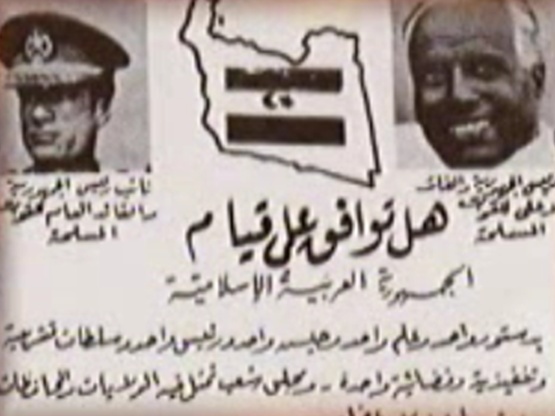
The Arab Islamic Republic (Arabic: الجمهورية العربية الإسلامية, romanizedal-Jumhūriyya al-ʿArabiyyah al-Islāmiyya) was a proposed unification of Tunisia and Libya in 1974, agreed upon by Libyan head of state Muammar Gaddafi and Tunisian President Habib Bourguiba. Additional countries—Morocco and Algeria—were later included in the proposal, which was never implemented.

Key Information

With the death of Egyptian President Gamal Abdel Nasser in September 1970, Muammar Gaddafi sought to establish himself as the figurehead of Pan-Arabism. After a failed attempt at rapprochement between his country and Egypt, he turned to Tunisia. In December 1972, President Bourguiba expressed his disagreement with a proposed union. But on January 12, 1974, the two presidents, meeting on the Mediterranean island of Djerba, agreed on an agreement providing for a union of their countries within an Arab Islamic Republic (AIR), which would have only one constitution, one army, and one flag.[1]

Regional context

[edit]

The attempted merger between Tunisia and Libya took place in a historical and regional context. Maghrebi regional politics played a role embedded into the constitutions of Tunisia, Morocco and Algeria is the ideal of Maghrebi unity,[2] however contradicting this ideal is the competing interests of Morocco and Algeria, the region's two major powers. According to Tunisian scholar Habib Slim, "if there were only Algeria and not Morocco, or Morocco and not Algeria, there could never have been a Maghrib. The major power would have swallowed us all up. To have the Maghrib you need those two rival powers competing with each other in the region".[3] Thus attempts at unification within the Maghreb were more often than not the means by which to counterbalance one or both of the region's major powers.[citation needed]

Additionally, Pan-Arabism influenced the politics of the Arab world. Muammar Gaddafi was a well-known proponent of this ideology and had thus worked to achieve union with several Arab states such as Egypt, Syria, Sudan and Tunisia. He also sought union with Chad. Tunisia was initially suspicious of Gaddafi's intentions, but the Libyan leader visited Tunis in February 1971 and December 1972,[4] and, in a rally in that city during the latter visit, spoke of supporting a union between Libya and Tunisia.[5] Hearing the speech by Gaddafi live at his home over the radio, President Bourguiba rushed to the rally where, after he let Gaddafi finish, he took to the stage and denounced the idea that "the Arabs had ever been united, dismissed all of [Gaddafi's] ideas about rapid Arab unity, and even took the Libyans to task for what he described as their own lack of national unity and their backwardness".[5] Close Libyan-Egyptian ties troubled Maghrebi leaders who feared the proximity of Egypt on their eastern borders and thus worked to pull Libya away from Egyptian influence.[6] At the fourth annual Non-Aligned Movement conference in Algiers, Bourguiba called for the unification of Algeria, Tunisia and Libya to form a "United States of North Africa", a move which he qualified by proposing it take place in stages over an "unspecified period of time".[7][8]

Djerba Declaration

[edit]

On 11 January 1974, the Djerba Declaration was signed by Bourgiba and Gaddafi, which committed the two states to becoming a single state, to be named the Arab Islamic Republic.[9] The agreement was signed on the island of Djerba and thus, is also known as the Djerba Declaration[9] or the Djerba Accord. Referendums were scheduled in each country to vote on the issue. The spontaneous tactic in trying to gain unity with another state on the part of Gaddafi displays a different approach than the previous union attempt with Egypt, where long negotiations did not work out.[10] It is possible that Bourguiba was the original pursuant of a union between Libya and Tunisia, as Bourguiba wanted a regional ally and also wanted to "wean Libya away from Egypt".[11]

The union agreement was a surprise to observers, as it had been thought that Bourguiba did not support the idea, in part due to tensions brought about by the speech by Gaddafi in Tunis in December 1972. This change in support could also have been influenced by the presence of 30,000 Tunisians working in Libya at the time and helping the Tunisian economy.[12] As Tunisia suffered from a labour surplus, a foreign debt of one billion and a lack of natural resources, a closer economic union with the resource-rich but labour-poor Libya would have been an attractive alternative.[13] Why Bourguiba decided to agree to the union is not completely known, but it is known that the Djerba agreement was seen with suspicion by Tunisians and Algerians, as well as outside these states both regionally and internationally.[10]

The Arab Islamic Republic was supposed to have "a single constitution, a single army, and a single President."[12] Under the agreement, Bourguiba was to be president, but Gaddafi wanted to keep the Ministry of Defence.[14] Prior to the Djerba Declaration multiple agreements dealing with singular, separate issues had been arranged between the two states on "trade, customs duties, investment, regulation for migrant workers, social security, and the creation of a joint shipping company",[12] but the agreements were not publicly noted as pursuing a union of the two states. Support for the unity beyond Bourguiba came from others within the Tunisian government, thinking that it would further benefit the Tunisian economy; the most prominent supporter was Tunisian Foreign Minister Mohamed Masmoudi.[12]

The length of time the union lasted is contentious, with one source saying it lasted one month, while another says it lasted only a single day and a third indicating it lasted a few days.[15] What is known though is that Tunisia reconsidered the deal soon after signing it, as Tunisia was supportive of economic benefits gained from the union, but not for giving up Tunisian sovereignty.[16] Thus, as the Tunisian Socialist Destourian Party (PSD) resisted the union plans due to their view that the arrangement was not clear enough and did not include how political institutions would be structured, Bourguiba rescinded his decision to form the Arab Islamic Republic.[16] The referendum in Tunisia was postponed to 20 March 1974, as announced on 12 January 1974.[17] Following Bourguiba's removal of Tunisia from the agreement, the biggest supporter of the union, Tunisian Foreign Minister Masmoudi was fired.[16]

Before the agreement was dissolved, Gaddafi had thought that one merger within the region would lead to regional unification and ultimately unification of the Arab world.[18] Following the union's inception and fallout, Bourguiba's judgement and capacity to lead Tunisia was questioned after he announced the union with Libya.[19] Bechir Ben Yahmed, a Tunisian journalist noted, "For me, he [Bourguiba] died in January, 1974, in Djerba, when during several minutes of face-to-face with Gaddafi, he signed, on hotel stationary, that famous charter of union."[20]

Failure of the Djerba Declaration

[edit]

As a consequence of the ideological differences, there was also a considerable divergence as to what the merger would look like. As understood by Bourguiba, the states themselves would not dissipate, but rather their borders would become "cooperatively permeable" through "functional integration",[21] in a similar manner to the contemporary Arab Maghreb Union, formed over a decade later. Conversely, Gaddafi was more interested in a complete merging of Libya and Tunisia into the Arab Islamic Republic.[citation needed] He saw Libya as a revolutionary movement rather than a territorial state. Gaddafi felt that they were one people, and that the borders were only a product of the ruling elites and imperialist division by conquerors.[21]

Finally, there were the regional political factors. As has been mentioned before, Libyan-Egyptian relations were steadily deteriorating following 1973. In light of the reduced Egyptian threat, Algeria felt it no longer necessary and even undesirable to merge with Libya and was not in favour of Tunisia doing so either.[22] Thus, within twenty four hours of the Republic's announcement, Algeria threatened Tunisia with military intervention if Tunisia went ahead with the unification.[23] There were also accusations of Tunisian foreign ministers being bribed by Libya.[citation needed] As a result, the unification with Libya never happened and relations between the two countries steadily deteriorated.

See also

[edit]

References

[edit]
[edit]
Revisions and contributorsEdit on WikipediaRead on Wikipedia
from Grokipedia
The Arab Islamic Republic was a short-lived proposed political union between Libya and Tunisia, announced on 12 January 1974 via the Djerba Declaration signed by Libyan leader Muammar Gaddafi and Tunisian President Habib Bourguiba during a summit on the Tunisian island of Djerba. The agreement envisioned the merger of the two North African states into a single entity under a shared Islamic and Arab framework, with plans for a referendum to ratify the union and Tunisia initially slated to hold the presidency while Libya managed defense responsibilities. However, Bourguiba reversed Tunisia's commitment shortly after the announcement, citing preferences for broader regional integration across the Maghreb rather than a bilateral merger, leading to the rapid failure of the initiative without any substantive unification. This episode exemplified Gaddafi's persistent efforts to forge pan-Arab and pan-Islamic unions, building on prior attempts like the with and , though it underscored the challenges of aligning disparate national interests and leadership styles in such ventures. The proposed republic's collapse contributed to immediate strains in Libya-Tunisia relations, including mutual accusations of subversion and economic measures like worker expulsions in subsequent years, highlighting underlying tensions over territorial claims, ideological differences, and external influences in the region. Despite its brevity, the Declaration remains a notable instance of Arab unity aspirations amid dynamics, where Libyan revolutionary zeal clashed with Tunisia's more pragmatic secular .

Historical Background

Geopolitical Context in North Africa

North Africa in the early comprised a patchwork of post-colonial states grappling with divergent ideologies, economic disparities, and external influences amid the waning fervor of following Egypt's defeat in the 1967 Six-Day War and the death of in September 1970. The region—encompassing , , , and —lacked deep integration, with states pursuing bilateral ties to major powers rather than collective regional frameworks, influenced by alignments where Soviet support bolstered radical regimes while Western ties sustained more moderate ones. Libya's 1969 revolution under positioned it as a proponent of aggressive Arab unity, leveraging surging revenues—exceeding $10 billion annually by the mid-1970s—to fund ideological exports, in contrast to 's more modest growth from phosphates, , and limited hydrocarbons. Tunisia, independent since 1956 under President , emphasized secular nationalism and pragmatic diplomacy, maintaining close economic and military links with and the while resisting radical pan-Arab entanglements that could undermine its . Bourguiba's regime prioritized domestic stability and modernization, viewing Gaddafi's revolutionary zeal—manifest in Libya's alignment with the for arms and its anti-Western posture—as a potential threat, as evidenced by Tunisia's rejection of an earlier Libyan unity proposal in December 1972. Libya, bordering Tunisia along a 285-mile delimited by agreements in the early , experienced internal consolidation under Gaddafi's jamahiriya system but externally pursued mergers to amplify its influence, having failed in prior attempts like the 1971 with and . The 1973 Yom Kippur War and ensuing Arab oil embargo heightened Libya's geopolitical leverage through its petroleum exports, prompting Gaddafi to intensify union overtures toward Tunisia as a means to project pan-Arab solidarity against Israel and Western imperialism, despite ideological mismatches—Libya's socialist-Islamist fusion versus Tunisia's liberal republicanism. This context of asymmetric power dynamics and Gaddafi's persistent "Qadhafi Plan" for confrontation and integration set the stage for the 1974 Djerba Declaration, though underlying tensions, including Bourguiba's reservations about Libyan dominance, foreshadowed its collapse. Regional rivalries, such as Algeria-Morocco frictions over Western Sahara, further isolated bilateral pairings like Tunisia-Libya, underscoring North Africa's fragmented geopolitics where unity proposals often masked hegemonic ambitions rather than genuine convergence.

Profiles of Key Leaders

Habib Bourguiba served as the first President of Tunisia from its independence in 1956 until 1987, leading the country through a period of secular modernization and economic development. In the context of the Arab Islamic Republic proposal, Bourguiba initially rejected Muammar Gaddafi's overtures for union in 1972, citing concerns over Libya's political instability and ideological differences. However, on January 12, 1974, during a summit on the Tunisian island of Djerba, Bourguiba signed the Djerba Declaration agreeing to merge Tunisia and Libya into a single state, with plans for a transitional period leading to full integration by early 1975. This abrupt reversal drew criticism from his prime minister, Hédi Nouira, and sparked widespread domestic protests in Tunisia over fears of Libyan dominance and erosion of Tunisian sovereignty, prompting Bourguiba to suspend the union plans by late January 1974 amid mounting backlash. The episode raised questions about Bourguiba's decision-making in his later years, though he maintained it as a tactical move to secure economic aid from Libya. Muammar Gaddafi, who ruled from his 1969 coup until 2011, was the driving force behind the Arab Islamic Republic initiative as part of his broader pan-Arabist vision to unify North African states under revolutionary socialist principles infused with Islamic rhetoric. Gaddafi first proposed a Tunisia-Libya merger in 1972, framing it as a rejection of Western imperialism and a step toward , but Bourguiba demurred at the time due to Libya's internal purges and Gaddafi's erratic foreign policy. By January 1974, Gaddafi aggressively pursued the Declaration, committing to provide Tunisia with $1 billion in aid and envisioning a where he would hold significant influence, including joint military commands and . The proposal's collapse following Tunisian repudiation did not deter Gaddafi, who later accused Bourguiba of betrayal and continued advocating similar unions, such as with and , though none materialized. Gaddafi's role highlighted his pattern of using oil wealth to export ideology, often prioritizing symbolic unity over practical governance compatibility.

Prior Attempts at Regional Unity

, who seized power in via a military coup on September 1, 1969, pursued aggressive pan-Arab unification efforts shortly after taking office, viewing merger as essential to counter Western influence and achieve Arab strength. In April 1969, he proposed an immediate political union with under , leading to exploratory talks, but Nasser's death in September 1970 shifted dynamics under . These early initiatives reflected Gaddafi's ideological commitment to , influenced by Nasser's model, though practical integration lagged due to divergent national priorities. A pivotal prior attempt materialized in September 1971 with the formation of the , encompassing , , and , formalized via a tripartite agreement signed on April 17, 1971, in . The federation aimed at unified political, economic, and military structures, including a proposed federal council and common citizenship, with referendums approving it in each country by late 1971— recording 99% approval on September 1, 1971. However, implementation faltered amid internal disputes, such as Egypt's resistance to Libyan subsidies dictating policy and Syria's focus on domestic consolidation under , rendering the federation largely symbolic by 1974 despite retaining nominal existence until 1977. Closer to the 1974 Tunisia-Libya proposal, Gaddafi directly approached in 1972 during a visit to , advocating an immediate merger to foster North African solidarity. Tunisian President rejected the overture, emphasizing developmental disparities—Libya's oil wealth versus 's agrarian economy—and the need for gradual economic alignment rather than hasty , a stance rooted in Bourguiba's pragmatic contrasting Gaddafi's revolutionary fervor. This rebuff strained relations temporarily but highlighted recurring tensions in unity efforts, where earlier post-independence discussions in the 1950s and 1960s—such as the 1958 Conference advocating broader North African cooperation—remained aspirational without binding commitments, often overshadowed by interstate rivalries like the Algeria-Morocco of 1963. These precedents underscored the challenges of reconciling ideological unity drives with sovereign interests, setting the stage for the 1974 Djerba Declaration's brief optimism followed by collapse.

Formation of the Proposal

Prelude to the Djerba Summit

Following Muammar Gaddafi's seizure of power in via a bloodless coup on , 1969, he pursued aggressive pan-Arab unification efforts, inspired by Gamal Abdel Nasser's earlier models but infused with his own revolutionary . Initial attempts, such as the short-lived with and in 1971, collapsed amid ideological clashes and practical disputes, leaving Gaddafi eager for new partners. By the early , Libya's surging oil revenues—exacerbated by the 1973 embargo that quadrupled prices—provided Gaddafi with economic leverage to entice neighbors, as Libyan GDP per capita rose dramatically to over $5,000 by 1974 while grappled with development needs amid slower growth averaging 7-8% annually but persistent unemployment and infrastructure gaps. Gaddafi viewed , sharing a 458 km border and cultural ties, as a natural extension for a greater Arab-Islamic entity, aligning with his Third Universal Theory blending , , and puritanical . In April 1972, Gaddafi formally proposed to Tunisian President during a visit, envisioning immediate merger under joint institutions, but Bourguiba rejected it outright, citing Libya's instability and Gaddafi's youth and inexperience—he publicly remarked that the Libyan leader lacked "the culture nor the experience" for such a venture. Despite the rebuff, bilateral ties warmed through pragmatic cooperation: sought Libyan investment for economic projects, while Gaddafi hosted Bourguiba in Tripoli in 1973 for discussions on trade and security, amid 's requests for to bolster defense against potential regional threats. Libyan flowed into Tunisian and , totaling millions in loans by late 1973, fostering interdependence—Libya supplied 20% of 's oil imports at preferential rates. Gaddafi, undeterred by prior failures like the Egyptian split, intensified rhetoric for unity, framing it as a bulwark against Western influence and Zionist expansion, while quietly pressuring Bourguiba through personal envoys and border goodwill gestures. These overtures culminated in unpublicized preparatory talks in late 1973, setting the stage for the meeting, where Gaddafi leveraged Libya's financial clout—offering Tunisia rotational presidency and resource sharing—to overcome Bourguiba's reservations, despite the Tunisian leader's longstanding and preference for gradualist pan-Maghrebism via the concept. Bourguiba, aged 71 and facing succession uncertainties, appeared motivated by short-term economic relief and a desire to counter Algeria's regional dominance, though domestic Tunisian elites remained wary of subsuming to Gaddafi's radicalism. The prelude reflected causal dynamics of resource asymmetry and ideological opportunism, with Libya's post-1969 revolutionary zeal clashing against 's post-independence stability, yet temporarily bridged by mutual strategic interests.

The Djerba Declaration of 1974

The Djerba Declaration of Unity was signed on January 12, 1974, during a summit on the Tunisian island of by Tunisian President and Libyan leader . The document emerged from closed-door discussions and publicly announced the intent to merge and into a single sovereign entity named the Arab Islamic Republic, reflecting a commitment to Arab brotherhood and political-economic integration. Under the declaration's terms, the new republic would allocate the presidency to while assigning the defense ministry to , with both nations retaining certain administrative roles pending further unification steps. It emphasized joint exploration and exploitation of shared resources, alongside deepened cooperation in economic and political spheres to overcome historical divisions. The leaders pledged to submit the merger to a within months, framing it as a voluntary union of the Libyan Arab Republic and the Republic of into one indivisible state. The signing occurred at the Ulysses Palace Hotel amid heightened regional tensions, including the aftermath of the 1973 , though the declaration itself focused on bilateral unity rather than broader pan-Arab conflicts. Observers noted the abrupt nature of the accord, as Bourguiba had previously rejected Gaddafi's 1972 union proposal, suggesting possible Libyan financial incentives or strategic pressures influenced the reversal. The declaration's text invoked Islamic and Arab solidarity as foundational, but implementation hinged on domestic approvals that soon proved untenable.

Details of the Proposed Union

Political Framework and Governance

The proposed Arab Islamic Republic was to function as a unitary encompassing the territories of and , featuring a single , president, army, and to symbolize complete political integration. This framework aimed to supplant the separate republican systems of the two nations—'s Revolutionary Command Council-led structure under and 's centralized presidential republic under —with unified institutions, though no detailed constitutional charter or legislative mechanisms were publicly elaborated before the initiative's collapse. Interim governance was outlined to involve a transitional phase managed jointly by Gaddafi and Bourguiba, pending ratification through popular referendums scheduled for March 20, 1974, in both countries. Bourguiba was designated as the prospective first president of the merged entity, reflecting Tunisia's larger influence and his seniority, while Gaddafi's advocacy for rapid unification underscored Libya's oil-funded ambitions for regional dominance. The Djerba Declaration of January 12, 1974, emphasized this merger as a step toward broader Arab unity, but underlying divergences—such as Gaddafi's preference for immediate dissolution of national boundaries versus Bourguiba's initial inclination toward a —highlighted unresolved tensions in executive authority and power-sharing. Implementation stalled due to domestic opposition in , where Bourguiba cited the need for constitutional amendments and broader consultations, effectively deferring the referendums indefinitely by late January 1974. No permanent governance bodies, such as a unified or , were established, rendering the political framework aspirational rather than operational, and exposing the fragility of aligning Libya's with Tunisia's more conservative nationalism.

Economic and Military Integration Plans

The proposed under the Arab Islamic Republic aimed at merging the financial ministries of and to form a unified economic framework, facilitating coordinated fiscal policies and resource allocation. , with its burgeoning revenues—exporting over 1.5 million barrels per day by 1974—intended to channel substantial to Tunisia's more agrarian and tourism-dependent , which had a GDP roughly one-third of Libya's at the time. This disparity underscored Libya's role as the economic engine, with plans to harmonize , infrastructure projects, and development initiatives, though concrete mechanisms such as a shared or were not elaborated in the Djerba Declaration itself. Military integration was outlined through the consolidation of defense ministries into a single entity, implying unified command structures, joint procurement, and potentially combined armed forces to enhance regional against perceived external threats. Libya's , bolstered by Soviet-supplied equipment including over 200 tanks and multiple MiG fighters by the early , would have dominated this aspect, while Tunisia's smaller —focused on internal stability—sought defensive assurances. The plans reflected Muammar Gaddafi's vision of pan-Arab , but lacked specifics on operational doctrines or deployments, prioritizing institutional merger over tactical details. These integration efforts were contingent on popular referendums scheduled for mid-1974, with the Djerba Declaration emphasizing phased implementation starting with ministerial fusions, but underlying economic asymmetries and military command imbalances sowed early doubts about feasibility.

Ideological Foundations: Arabism and Islamism

The proposed Arab Islamic Republic drew on pan-Arabism as a core ideological pillar, reflecting Libyan leader Muammar Gaddafi's ambition to revive Arab unity following the death of Egyptian President Gamal Abdel Nasser in 1970, whom Gaddafi had emulated in pursuing federations with Egypt, Syria, and Sudan. Gaddafi positioned the 1974 union with Tunisia as a foundational step toward a broader Arab state, leveraging Libya's oil revenues to fund integration and counter Western imperialism, in line with his Nasserist-influenced revolutionary socialism. The Djerba Declaration of January 11, 1974, explicitly committed the two nations to forming a single entity named the Arab Islamic Republic, invoking shared Arab ethnic and cultural identity to transcend national borders and establish a unified political framework. Complementing Arabism was an emphasis on Islamism, albeit in Gaddafi's idiosyncratic form, which subordinated traditional religious authority to revolutionary principles outlined in his Green Book (published starting 1975) and Third Universal Theory. Gaddafi reinterpreted Islam as a tool for mass participation and anti-colonial struggle, rejecting clerical hierarchies while promoting it as a unifying cultural and moral basis for the proposed republic, distinct from the orthodox caliphate model. This approach aimed to harness the predominantly Muslim populations of Libya (over 96% Sunni Muslim in 1974) and Tunisia (similarly over 99% Muslim) for ideological cohesion, positioning the union as a modern embodiment of Islamic ummah adapted to Arab nationalist goals rather than strict Sharia governance. However, these foundations masked fundamental tensions, as Tunisian President Habib Bourguiba's secular —characterized by policies like banning veils in schools (1956), replacing courts with civil codes, and publicly challenging fasting—clashed with Gaddafi's radical fusion of and pan-Arab interventionism. Bourguiba's initial endorsement of the union appeared pragmatic, driven by economic incentives rather than ideological alignment, and he prioritized Tunisian and Western-oriented modernization over Gaddafi's vision of subsuming states into a revolutionary Islamic-Arab entity. These disparities, evident in Bourguiba's swift revocation of the agreement amid domestic backlash and Algerian opposition by March 1974, underscored how the proposal's Islamist-Arabist rhetoric served Gaddafi's hegemonic aspirations more than a genuine synthesis of compatible doctrines.

Dissolution and Immediate Aftermath

Tunisian Domestic Backlash

Following the Declaration on January 12, 1974, which outlined a phased merger into the Arab Islamic Republic with a planned by late February, Tunisian President faced swift internal resistance from political elites, intellectuals, and segments of the public wary of subsuming Tunisia's under Libyan influence. Concerns centered on profound ideological mismatches—Tunisia's established moderate secular framework clashing with Muammar Gaddafi's and pan-Arab radicalism—as well as fears of economic subordination given Libya's vast oil revenues dwarfing Tunisia's resources, potentially allowing Tripoli to dictate terms despite Tunis holding nominal presidency initially. Bourguiba's hasty agreement, announced without broad prior consultation, amplified perceptions of recklessness, echoing his 1972 rejection of a similar Gaddafi proposal for lacking Libyan domestic buy-in. Domestic opposition crystallized rapidly, manifesting in a rally at Tunis University on January 15, 1974, featuring anti-Bourguiba slogans protesting the union's implications for national independence. This unrest, amid broader elite skepticism from and bureaucratic circles protective of Tunisia's post-colonial stability, prompted Bourguiba to announce the same day that the would be indefinitely postponed pending constitutional revisions to ensure equitable integration and public input. The move effectively stalled the process, reflecting elite pressure to safeguard Tunisia's distinct governance model against Gaddafi's perceived hegemonic ambitions, which included minimal Libyan internal debate on the merger. By early March 1974, Tunisian sources deemed the proposal a "dead letter," with Bourguiba prioritizing internal consolidation and cooperation with other states over union, underscoring how domestic pushback—rooted in preservation and aversion to Libya's destabilizing volatility—overrode initial diplomatic overtures. This backlash not only derailed the initiative but reinforced Bourguiba's domestic authority by aligning with nationalist sentiments, though it strained bilateral ties without inciting widespread riots or organized opposition movements.

Diplomatic Breakdown Between Libya and Tunisia

Following Tunisia's announcement on January 15, 1974, that the proposed referendum on union with Libya would be delayed indefinitely pending constitutional revisions, Libyan state media initially persisted in referring to the entity as the "Islamic Arab Republic," signaling reluctance to acknowledge the retreat. The decision stemmed from internal Tunisian opposition, including the dismissal of Foreign Minister Mohammed Masmoudi, a key proponent of the merger, and concerns over profound disparities: Tunisia's population of approximately 5 million, substantial foreign debt exceeding $1 billion, and pro-Western orientation contrasted sharply with Libya's 2 million inhabitants, $4 billion in annual oil revenues, and adherence to stringent Islamic codes under Muammar Gaddafi. By late March 1974, had effectively shelved the merger, prohibiting discussion in its newspapers and stalling a required in the , while President prioritized broader Maghribi unity involving and over the bilateral pact. responded with punitive measures, expelling around 1,000 Tunisian migrant workers and sentencing two Tunisians to hand amputation—a penalty not executed—heightening economic friction given 's reliance on labor remittances from . Gaddafi further inflamed tensions in a Tripoli speech, publicly criticizing Tunisian women for their attire and customs, which resonated as an ideological rebuke and provoked widespread resentment in . These actions marked the onset of deteriorated bilateral ties, with the failed merger exacerbating mutual suspicions and leading to recurrent expulsions of workers in subsequent years, including thousands of from in 1976. accused of fomenting plots against its officials and training dissidents, while viewed Bourguiba's reversal as a betrayal of pan-Arab commitments, straining diplomatic channels and underscoring incompatibilities in and alignments. The episode contributed to a pattern of volatility, culminating in after blamed for the 1980 Gafsa uprising, though maritime boundary disputes were later resolved in 's favor by the in the early 1980s.

Formal End of the Initiative

On March 31, 1974, Tunisian President announced the indefinite postponement of the referendum originally scheduled to approve the merger with , rendering the Declaration of January 12 effectively void. This decision followed the initial postponement of the vote from January 18 to March 20, as internal opposition mounted against perceived threats to Tunisian and economic . Bourguiba cited the need for further preparation and consultations, but Tunisian sources described the proposal as a "dead letter," signaling its abandonment. U.S. reports confirmed Bourguiba's intent to cancel the merger agreement outright, highlighting risks to his domestic political standing from another failed union attempt akin to prior regional experiments. Libyan leader responded with public criticism, accusing Bourguiba of betrayal and insisting on the union's viability, but no joint institutions were ever established, and Tunisia formally annulled its participation later in 1974. The initiative thus dissolved without or , marking the end of the short-lived diplomatic push for the Arab Islamic Republic.

Causes of Failure

Ideological and Cultural Incompatibilities

The ideological foundations of the proposed Arab Islamic Republic clashed fundamentally between Libya's radical Pan-Arab socialism under and Tunisia's conservative nationalism under . Gaddafi's regime, established after the 1969 coup, promoted a revolutionary blend of Arab unity, , and anti-Western , as outlined in his Green Book, envisioning direct "people's democracy" through basic people's congresses that centralized power in practice. In contrast, Bourguiba's emphasized pragmatic and liberal reforms, including the 1956 Personal Status Code that granted women equal inheritance rights, banned , and prioritized national sovereignty over expansive pan-Arab projects. This rivalry manifested in Bourguiba's rejection of Gaddafi's aggressive unification push following the January 1974 Djerba Declaration, viewing it as a threat to Tunisia's independent modernist path. Cultural divergences exacerbated these tensions, with Tunisia's Mediterranean-influenced society fostering relatively liberal social norms compared to Libya's stricter enforcement of traditional Islamic practices. In Tunisia, urban life in cities like featured vibrant cafes, alcohol consumption, and greater female , reflecting French colonial legacies and Bourguiba's modernization efforts. Libya, however, imposed prohibitions on alcohol and limited women's public roles amid a more austere, tribal-oriented culture, leading to widespread perceptions of boredom and restriction even among Libyans. Tunisian elites and the public feared that integration would erode these distinctions, importing Libyan conservatism and potentially reversing gains in and , as evidenced by domestic protests against the union by March 1974. These incompatibilities fueled Tunisia's swift repudiation of the union, highlighting how Gaddafi's ideological zeal for rapid merger clashed with Bourguiba's caution, ultimately dissolving the initiative within months. The episode underscored broader challenges in pan-Arab schemes, where divergent visions of and societal organization—radical versus reformist—proved insurmountable without coercive assimilation.

Economic Realities and Resource Disparities

In 1974, Libya's economy was dominated by exports, which accounted for the bulk of its revenues following the 1973 oil price surge, enabling rapid wealth accumulation in a sparsely populated . Libya's GDP reached approximately $6,214 that year, reflecting its status as Africa's largest oil reserves holder and a production peak that positioned it as a major contributor. In contrast, relied on a more diversified but resource-constrained base, including (contributing around 20% of GDP), emerging phosphates, textiles, and nascent , with limited hydrocarbons yielding far lower export earnings. 's GDP stood at about $624, roughly one-tenth of Libya's, amid a larger population of over 5 million facing labor surpluses and structural . These asymmetries extended to fiscal positions and development trajectories. Libya generated over $4 billion annually from oil, funding expansive and social programs under Gaddafi's policies, while maintaining low levels buoyed by petrodollars. , however, grappled with foreign exceeding $1 billion, equivalent to a significant portion of its GDP, stemming from import-dependent industrialization and vulnerability to global commodity fluctuations. Bourguiba's regime emphasized pragmatic, state-guided with incentives, contrasting Libya's radical socialist redistribution, which prioritized ideological exports over balanced growth. Such divergences in economic structures—Libya's extractive mono-dependency versus Tunisia's multi-sector fragility—highlighted incompatible integration paths, with Tunisia's and outputs unable to match Libya's windfalls. Resource disparities exacerbated fears of unequal union dynamics, contributing decisively to the proposal's collapse. Tunisian leaders anticipated Libya's fiscal dominance would relegate their to a subordinate , absorbing costs like servicing without proportional benefits, while exposing Tunisia's workforce to Libyan labor demands without reciprocal gains. The absence of detailed equalization mechanisms in the rushed accord amplified these concerns, as Tunisia risked diluting its developmental autonomy to prop up Libya's expansionist ambitions, ultimately prompting Bourguiba's retraction by March amid domestic and elite pushback against perceived economic subjugation. This mismatch underscored broader challenges in pan-Arab mergers, where resource imbalances often undermined mutual viability absent robust compensatory frameworks.

Leadership Ambitions and Sovereignty Issues

The proposed Arab Islamic Republic highlighted tensions arising from Muammar Gaddafi's expansive leadership ambitions, which prioritized ideological exportation and regional dominance over equitable partnership. Gaddafi, who had seized power in via a coup, repeatedly pursued unions with neighbors to amplify his self-conceived role as vanguard of Arab revolution, as evidenced by prior failed attempts like the 1972 Libya-Tunisia proposal rejected by for lacking mutual benefits. In the 1974 initiative, Gaddafi envisioned a merged entity under unified governance that would extend Libyan revolutionary principles, including his Green Book ideology blending socialism and , potentially positioning him as leader despite nominal equality. Bourguiba, Tunisia's president since in 1956, prioritized safeguarding sovereignty amid Libya's oil-driven economic leverage—Libya's exceeded Tunisia's by over tenfold in 1974—and Gaddafi's volatile domestic purges, which had eliminated rivals and centralized power. The January 12, 1974, Declaration committed both nations to a single flag, army, and , but omitted concrete power-sharing formulas, fueling Tunisian apprehensions that integration would subordinate Bourguiba's secular, modernist to Gaddafi's radicalism. Bourguiba's initial endorsement appeared tactical, aimed at extracting Libyan aid and diverting Gaddafi from Egyptian alliances, yet it unraveled as public and elite resistance mounted against perceived threats to Tunisian autonomy. By late March 1974, Bourguiba indefinitely deferred the merger, declaring it required "prolonged study" of socioeconomic implications, a decision Tunisian officials privately confirmed as terminal. This withdrawal stemmed from imperatives: Tunisia's smaller military (approximately 20,000 troops versus Libya's expanding forces) and dependence on Western ties contrasted with Gaddafi's anti-imperialist fervor, rendering equal footing illusory. Gaddafi's reported fury, including personal confrontations, underscored his intolerance for rebuffs to his ambitions, exacerbating bilateral distrust that persisted into the . The episode exemplified how personal leadership styles—Gaddafi's messianic drive versus Bourguiba's pragmatic —undermined structural unity, prioritizing national control over supranational ideals.

Legacy and Broader Implications

Effects on Libya-Tunisia Relations

The failure of the Arab Islamic Republic initiative, following Tunisian President Habib Bourguiba's reversal on the January 12, 1974, Djerba Declaration, immediately fostered mutual distrust between and , as viewed the backtracking as a of pan-Arab commitments, prompting to pursue more assertive policies toward its neighbor. This shift manifested in 's support for Tunisian opposition elements opposed to Bourguiba's secular regime, exacerbating ideological tensions and leading to accusations of Libyan subversion. Relations further deteriorated in 1975 when endorsed Morocco and Mauritania's partition of , a stance that conflicted with 's territorial ambitions in the region, and intensified in March 1976 with 's expulsion of thousands of Tunisian workers, coupled with Tunisian claims of a Libyan-orchestrated assassination plot against officials. The most acute crisis erupted in January 1980 with the uprising in 's phosphate-rich mining region, where armed insurgents—many reportedly trained in —seized towns and called for Bourguiba's overthrow; attributed the incursion directly to Gaddafi's backing of exiled dissidents, resulting in severed diplomatic ties that persisted until partial reconciliation efforts in the mid-1980s. Economic repercussions were severe, particularly for , which relied heavily on remittances from its labor migrants in ; 's August 1985 expulsion of approximately 40,000 Tunisian workers—retaliatory amid broader bilateral frictions—prompted to deport over 300 Libyans, including 30 diplomats, further isolating the states and disrupting cross-border trade. These episodes underscored a pattern of volatility, with the failed union amplifying Gaddafi's aggressive against Bourguiba's emphasis on Tunisian , though underlying economic interdependence eventually facilitated normalization, such as the 1987 restoration of ties after Bourguiba's ouster.

Lessons for Pan-Arab and Pan-Islamic Projects

The rapid dissolution of the Arab Islamic Republic in 1974 highlighted the primacy of national sovereignty over ideological appeals in pan-Arab projects, as Tunisian President prioritized Tunisia's independent institutions and gradualist reforms against Muammar Gaddafi's push for immediate merger, fearing subordination to Libya's revolutionary model. Bourguiba's administration, rooted in post-independence secular , viewed the union's vague structures—lacking defined power-sharing or mechanisms—as a threat to Tunisia's stability, leading to domestic resistance from the and eventual withdrawal before a planned . This episode echoed broader pan-Arab failures, such as the 1972 Libyan-Egyptian union attempt, where similar ambiguities in federal design undermined elite consensus and public buy-in. Economic asymmetries further exposed the impracticality of unity without complementary development paths, with Libya's oil-driven wealth (exporting over 1.5 million barrels daily by ) contrasting Tunisia's agrarian and nascent industrial base, fostering Tunisian apprehensions of resource exploitation rather than mutual benefit. Pan-Islamic framing, intended to transcend Arab nationalism's setbacks, failed to bridge these gaps, as Tunisia's moderation under Bourguiba clashed with Gaddafi's radical reinterpretation of Islam via his Green Book, which emphasized but prioritized Libyan dominance. Historical patterns in other initiatives, like the (1971–1977), demonstrated that resource disparities often devolve into zero-sum competitions, eroding ideological cohesion absent enforceable supranational institutions. Leadership ambitions underscored causal barriers to integration, as Gaddafi's serial union pursuits—from and to —reflected personal aggrandizement over collective viability, alienating partners wary of his interventionism, including covert support for Tunisian opposition. Bourguiba's tactical endorsement during the Declaration served short-term geopolitical aims, like countering Egyptian influence, but collapsed under scrutiny of ceding control, illustrating how authoritarian rulers' egos perpetuate fragmentation in pan-Arab and pan-Islamic endeavors. This dynamic contributed to pan-Arabism's decline post-1970s, prompting Gaddafi's pivot to by the 1990s, as repeated Arab rejections revealed the limits of top-down unity without grassroots legitimacy or aligned incentives. Ultimately, the initiative's demise affirmed that sustainable pan-Arab or pan-Islamic projects demand robust institutional safeguards against asymmetric power, cultural divergences, and elite opportunism, lessons evident in subsequent stalled efforts like the (1989–present), where similar sovereignty frictions persist amid unresolved border and ideological tensions. Empirical evidence from these cases indicates that ideological rhetoric alone cannot override entrenched national interests, with unity succeeding only where and democratic accountability precede political merger, as approximated in the European Union's incremental model rather than abrupt Arab federations.

Historical Assessments and Criticisms

The attempted formation of the in has been assessed by historians as a quintessential example of Muammar Gaddafi's ideologically driven but practically unfeasible pan-Arab initiatives, often characterized by hasty announcements lacking institutional groundwork. Gaddafi, seeking to counterbalance deteriorating ties with following the , proposed the union to Tunisian President during a on the of , envisioning a merged state with shared institutions including a single presidency initially held by Bourguiba. However, the initiative collapsed within weeks, with Bourguiba dismissing his foreign minister on January 14, 1974, and postponing a planned by March 20, 1974, amid domestic opposition and fears of Libyan overreach. Analysts note that this rapid dissolution underscored fundamental incompatibilities, including Libya's oil-funded versus Tunisia's more moderate, state-capitalist model, rendering improbable without coercive measures. Critics, particularly in studies of North African diplomacy, argue that the episode exemplified Gaddafi's pattern of unionist adventurism, where personal ambition supplanted mutual consent, as evidenced by Libya's expulsion of approximately 1,000 Tunisian workers in February 1974 in retaliation for the backtracking. Bourguiba's , rooted in preserving Tunisian post-independence, is credited with averting absorption into a Libyan-dominated entity, given disparities in (Tunisia's 5.5 million versus Libya's 2.5 million), capacity, and (Libya's oil wealth yielding over $2,000 annually compared to Tunisia's under $500). Some assessments highlight external factors, such as Algerian and Moroccan reservations over balance, but emphasize internal Tunisian elite resistance as decisive, with Bourguiba viewing the merger as a threat to his secular reforms. This view is supported by archival diplomatic records indicating Libya's proposal was opportunistic rather than preparatory, lacking feasibility studies or public buy-in beyond elite pacts. Broader historiographical critiques frame the Arab Islamic Republic as emblematic of pan-Arabism's post-Nasserite decline, where rhetorical unity masked elite power struggles and economic realism's triumph over ideology. Gaddafi's subsequent grudge against Bourguiba, persisting into the , fueled intermittent border tensions but ultimately reinforced bilateral over ideological fusion. While some Libyan state narratives portrayed the failure as Tunisian betrayal, independent analyses dismiss this, attributing collapse to asymmetrical dependencies: Libya's resource surplus could not offset Tunisia's diversified but fragile economy, nor reconcile Gaddafi's cult-of-personality governance with Bourguiba's institutionalism. No peer-reviewed studies endorse the union's viability, instead citing it as a cautionary case against top-down mergers absent legitimacy or complementary development paths.

References

Add your contribution
Related Hubs
User Avatar
No comments yet.