Hubbry Logo
Porphyry (geology)Porphyry (geology)Main
Open search
Porphyry (geology)
Community hub
Porphyry (geology)
logo
8 pages, 0 posts
0 subscribers
Be the first to start a discussion here.
Porphyry (geology)
Porphyry (geology)
from Wikipedia
"Imperial Porphyry" from the Red Sea Mountains of Egypt
A waterworn cobble of porphyry
Rhyolite porphyry from Colorado; scale bar in lower left is 1 cm (0.39 in)
Igneous porphyry from the Hunter Mountain pluton in the Last Chance Range in Death Valley National Park

Porphyry (/ˈpɔːrfəri/ POR-fə-ree) is any of various granites or igneous rocks with coarse-grained crystals such as feldspar or quartz dispersed in a fine-grained silicate-rich, generally aphanitic matrix or groundmass. In its non-geologic, traditional use, the term porphyry usually refers to the purple-red form of this stone, valued for its appearance, but other colours of decorative porphyry are also used such as "green", "black" and "grey".[1][2]

The term porphyry is from the Ancient Greek πορφύρα (porphyra), meaning "purple". Purple was the colour of royalty, and the Roman "imperial porphyry" was a deep purple igneous rock with large crystals of plagioclase. Some authors claimed the rock was the hardest known in antiquity.[3] Thus porphyry was prized for monuments and building projects in Imperial Rome and thereafter.

Subsequently, the name was given to any igneous rocks with large crystals. The adjective porphyritic now refers to a certain texture of igneous rock regardless of its chemical and mineralogical composition or its color. Its chief characteristic is a large difference in size between the tiny matrix crystals and the much larger phenocrysts. Porphyries may be aphanites or phanerites, that is, the groundmass may have microscopic crystals as in basalt, or crystals easily distinguishable with the eye, as in granite.

Formation

[edit]

Most igneous rocks have some degree of porphyritic texture. This is because most magma from which igneous rock solidifies is produced by partial melting of a mixture of different minerals.[4] At first the mixed melt slowly cools deep in the crust. The magma begins crystallizing, the highest melting point minerals closest to the overall composition first, in a process called fractional crystallization. This forms phenocrysts,[5] which usually have plenty of room for growth, and form large, well-shaped crystals with characteristic crystal faces (euhedral crystals).[6] If they are different in density to the remaining melt, these phenocrysts usually settle out of solution, eventually creating cumulates; however if the partially crystallized magma is then erupted to the surface as a lava, the remainder of the melt is quickly cooled around the phenocrysts and crystallizes much more rapidly to form a very fine-grained or glassy matrix.[7]

Porphyry can also form even from magma that completely solidifies while still underground. The groundmass will be visibly crystalline, though not as large as the phenocrysts. The crystallization of the phenocrysts during fractional crystallization changes the composition of the remaining liquid magma, moving it closer to the eutectic point, with a mixed composition of minerals. As the temperature continues to decrease, this point is reached, and the rock is entirely solidified. The simultaneous crystallization of the remaining minerals produces the finer-grained matrix surrounding the phenocrysts, as they crowd each other out.[7]

The significance of porphyritic texture as an indication that magma forms through different stages of cooling was first recognized by the Canadian geologist, Norman L. Bowen, in 1928.[8]

Porphyritic texture is particularly common in andesite, with the most prominent phenocrysts typically composed of plagioclase feldspar.[9][10] Plagioclase has almost the same density as basaltic magma, so plagioclase phenocrysts are likely to remain suspended in the magma rather than settling out.[11]

Rhomb porphyry

[edit]

Rhomb porphyry is a volcanic rock with gray-white large porphyritic rhombus-shaped phenocrysts of feldspar (commonly anorthoclase) embedded in a very fine-grained red-brown matrix. The composition of rhomb porphyry places it in the trachytelatite classification of the QAPF diagram.[12]

Rhomb porphyry is found in continental rift areas, including the East African Rift (including Mount Kilimanjaro),[13] Mount Erebus near the Ross Sea in Antarctica,[14] the Oslo graben in Norway,[12] and south-central British Columbia.[15]

Use in art and architecture

[edit]
The Tetrarchs, a porphyry sculpture sacked from the Byzantine Philadelphion palace in 1204, Treasury of St. Marks, Venice
Carmagnola, an imperial porphyry head in Venice thought to represent Justinian

Antiquity and Byzantium

[edit]

To the Romans it was known as Lapis porphyrites. Pliny the Elder's Natural History (36, 11) affirmed that the "Imperial Porphyry" had been discovered in Egypt during the reign of Tiberius; an inscription recently discovered and dated from AD 18 mentions the Roman Caius Cominius Leugas as the finder of this new quarry.[16][17][18] Ancient Egyptians used other decorative porphyritic stones of a very close composition and appearance, but apparently remained unaware of the presence of the Roman grade although it was located in their own country, because its colour had no official value like that of Romans.[citation needed] It was also sometimes used in Minoan art, and as early as 1850 BC on Crete in Minoan Knossos there were large column bases made of porphyry.[19]

It was called "Imperial" as the mines, as elsewhere in the empire, were owned by the emperor.[20] The red porphyry all came from the Gabal Abu Dukhan quarry (or Mons Porphyrites)[21] in the Eastern Desert of Egypt, from 600 million-year-old andesite of the Arabian-Nubian Shield. The road from the quarry westward to Qena (Roman Maximianopolis) on the Nile, which Ptolemy put on his second-century map, was first described by Strabo, and it is to this day known as the Via Porphyrites, the Porphyry Road, its track marked by the hydreumata, or watering wells that made it viable in this utterly dry landscape. It was used for all the red porphyry columns in Rome, the togas on busts of emperors, the panels in the revetment of the Pantheon,[22] the Column of Constantine in Istanbul[23] as well as the altars and vases and fountain basins reused in the Renaissance and dispersed as far as Kyiv.

The Romans also used "Green Porphyry" (lapis Lacedaemonius,[24] from Greece, also known today as Serpentine),[25] and "Black Porphyry" from the same Egyptian quarry.[26]

After the fifth century the quarry was lost to sight for many centuries. Byzantium scholar Alexander Vasiliev suggested this was the consequence of the Council of Chalcedon in 451 and the subsequent troubles in Egypt.[27] The scientific members of the French Expedition under Napoleon sought it in vain, and it was only when the Eastern Desert was reopened for study under Muhammad Ali that the site was rediscovered by the English Egyptologists James Burton and John Gardner Wilkinson in 1823.

Porphyry was extensively used in Byzantine imperial monuments, for example in Hagia Sophia[28] and in the "Porphyra", the official delivery room for use of pregnant Empresses in the Great Palace of Constantinople, giving rise to the phrase "born in the purple".[29]

In general, the renowned rarity and striking appearance of porphyry in the late Roman Empire meant that its use was limited to explicitly Imperial monuments and architecture, thereby helping to emphasize the power and authority of the Emperor in the eyes of the citizens.[30] Porphyry also stood in for the physical purple robes Roman emperors wore to show status, because of its purple colouring. Similar to porphyry, purple fabric was extremely difficult to make, as what we now call Tyrian purple required the use of rare sea snails to make the dye.[31] The colour itself reminded the public how to behave in the presence of the emperors, with respect bordering on worship for the self-proclaimed god-kings.[32]

Roman and late Roman imperial sarcophagi

[edit]
Porphyry sarcophagus, Istanbul Archaeological Museum

A uniquely prestigious use of porphyry was its choice as material for imperial sarcophagi in the 4th and early 5th centuries. That tradition appears to have been started with Diocletian's porphyry sarcophagus in his mausoleum, which was destroyed when the building was repurposed as a church but of which probable fragments are at the Archaeological Museum in Split, Croatia.[33] The oldest and best-preserved ones are now conserved at the Vatican Museums and known as the Sarcophagi of Helena and Constantina.

Nine other imperial porphyry sarcophagi were long held in the Church of the Holy Apostles in Constantinople. They were described by Constantine VII Porphyrogenitus in the De Ceremoniis (mid-10th century), who specified them to be respectively of Constantine the Great, Constantius II, Julian, Jovian, Theodosius I, Arcadius, Aelia Eudoxia, Theodosius II, and Marcian. Of these, most still exist in complete or fragmentary form, despite depredations by later Byzantine Emperors, Crusaders, and Ottoman conquerors.[27] Four presently adorn the facade of the main building of the İstanbul Archaeology Museums,[34] including one whose rounded shape led Alexander Vasiliev to suggest attribution to Emperor Julian on the basis of Constantine Porphyrogenitus's description. Vasiliev conjectures that the nine imperial sarcophagi, including one which carries a crux ansata or Egyptian cross, were carved in Egypt before shipment to Constantinople.[27]

Porphyry sarcophagi in post-Roman Western Europe

[edit]

The imperial porphyry sarcophagi tradition was emulated by Ostrogothic King Theodoric the Great (454-526), whose mausoleum in Ravenna still contains a porphyry tub that was used as his sarcophagus. Similarly Charles the Bald, King of West Francia and Roman Emperor, was buried at Saint-Denis in a porphyry tub[35] which may be the same one known as "Dagobert's tub" (cuve de Dagobert), now in the Louvre.[36]

The tomb of Peter III of Aragon, in the Monastery of Santes Creus near Tarragona, reuses a porphyry tub or alveus, which has been conjectured to be originally the sarcophagus of Late Roman Emperor Constans in his mausoleum at Centcelles, a nearby site with a well-preserved 4th-century rotunda.[37]

In twelfth- and thirteenth-century Sicily, another group of porphyry sarcophagi were produced from the reign of Roger II onward and used for Royal and then Imperial burials, namely those of King Roger II, King William I, Emperor Henry VI, Empress Constance, and Emperor Frederick II. They are all now in the Palermo Cathedral, except William's in Monreale Cathedral. Scholar Rosa Bacile argues that they were carved by a local workshop from porphyry imported from Rome, the latter four plausibly (based on observation of their fluting) all from a single column shaft that may have been taken from the Baths of Caracalla or the Baths of Diocletian. She notes that these Sicilian porphyry sarcophagi "are the very first examples of medieval free-standing secular tombs in the West, and therefore play a unique role within the history of Italian sepulchral art (earlier and later tombs are adjacent to, and dependent on walls)."[38]

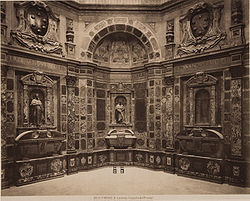
Six grand porphyry sarcophagi are featured along the walls of the octagonal Cappella dei Principi (Chapel of the Princes) that was built as one of two chapels in the architectural complex of the Basilica of San Lorenzo, in Florence, Italy, for the de' Medici family. Purple porphyry was used lavishly throughout the opulent chapel as well, with a revetment of marbles, inlaid with other colored marbles and semi-precious stone, that covers the walls completely. Envisioned by Cosimo I, Grand Duke of Tuscany (1537–1574), it was initiated by Ferdinand I de' Medici, following a design by Matteo Nigetti that won an informal competition held in 1602 by Don Giovanni de' Medici (a son of Cosimo I), which was altered somewhat during execution by Buontalenti.[39]

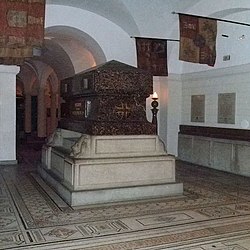
The tomb of Napoleon at Les Invalides in Paris, designed by architect Louis Visconti, is centered on the deceased emperor's sarcophagus that often has been described as made of red porphyry although this is incorrect. Napoleon's sarcophagus is made of quartzite, however, its pedestal is made of green andesite porphyry from Vosges.[40] The sarcophagus of Arthur Wellesley, 1st Duke of Wellington at St Paul's Cathedral was completed in 1858. and was made from a single piece of Cornish porphyry,[41] of a type called luxullianite, which was found in a field near Lostwithiel.[42]

Modern uses

[edit]

In countries where many automobiles have studded winter tires such as Sweden, Finland, and Norway, it is common that highways are paved with asphalt made of porphyry aggregate to make the wearing course and withstand the extreme wear from the spiked winter tires.[43]

See also

[edit]

References

[edit]
[edit]
Revisions and contributorsEdit on WikipediaRead on Wikipedia
from Grokipedia
In , porphyry refers to an exhibiting a distinctive porphyritic texture, characterized by the presence of large, conspicuous crystals known as phenocrysts embedded within a finer-grained or glassy groundmass. This texture arises from a two-stage cooling history of the , where initial slow cooling at depth allows for the growth of larger phenocrysts, followed by more rapid cooling nearer the surface that solidifies the remaining melt into a fine matrix. Porphyries can form in both intrusive and extrusive settings, with phenocrysts typically ranging from 0.3 to 5 millimeters in size, while the groundmass is classified as fine-grained if less than 1 millimeter. The formation process of porphyry begins with residing in a sub-surface chamber, where prolonged slow cooling promotes the of early-formed minerals into phenocrysts, often comprising 10-50% of the rock's volume. Subsequent tectonic activity or pressure changes cause the partially crystallized to ascend or erupt, leading to accelerated cooling rates that prevent further growth of the surrounding material and produce the contrasting texture. This interrupted cooling sequence is a hallmark of porphyritic rocks and distinguishes them from uniformly coarse-grained plutonic rocks like or uniformly fine-grained volcanic rocks like aphanitic . Common minerals in porphyries include , , , , or as phenocrysts, depending on the magma's composition, which can range from ( porphyry) to (rhyolite porphyry). The rock's overall color and durability make it suitable for various uses, such as ornamental stone in ancient , though its primary significance lies in revealing magmatic processes and serving as a key indicator in petrological studies. Examples include andesite porphyry, prevalent in volcanic arcs, and granite porphyry, found in continental intrusions.

Definition and Characteristics

Etymology and Terminology

The term "porphyry" originates from the word porphyra (πορφύρα), meaning "," referring initially to a rare and prestigious purple dye derived from sea snails, known as , which symbolized royalty in antiquity. This linguistic root extended to a specific purple rock quarried exclusively from Mons Porphyrites in Egypt's Eastern Desert during the , dubbed "Imperial Porphyry" due to its reserved use for imperial monuments, sarcophagi, and artifacts by emperors and their families. The rock's distinctive purple hue, resulting from the oxidation of iron-bearing minerals, combined with its porphyritic texture—featuring large white phenocrysts in a fine-grained matrix—made it a hallmark of Roman decorative stonework, with quarrying documented from the 1st to 5th centuries AD. In geological terminology, the word "porphyry" first appeared in a petrographic context in Georgius Agricola's 1556 treatise De Natura Fossilium, where it described rocks resembling the Egyptian Imperial Porphyry, characterized by larger crystals embedded in a finer groundmass. Over time, as igneous petrology developed in the , the term evolved to denote a broader class of igneous rocks exhibiting this texture, particularly shallow intrusive bodies like those associated with porphyry copper deposits. The adjective "porphyritic," introduced in a geological sense by Karl Cäsar von Leonhard in 1823, describes the texture itself as a general feature of igneous rocks where phenocrysts contrast in size with the surrounding aphanitic matrix, applicable to both volcanic and plutonic settings. A key distinction in modern usage separates "porphyry" as a specific rock name—often implying certain compositional or genetic contexts, such as feldspar-bearing varieties in European nomenclature (contrasted with "porphyrite" for plagioclase-dominated types)—from "" as a purely textural descriptor. Historically, the term was sometimes loosely applied to ornamental stones mimicking the Imperial Porphyry's appearance, leading to occasional misnomers for non-igneous materials, though the original and geological senses remain tied to igneous origins. This evolution reflects the term's transition from an ancient to a fundamental concept in .

Mineralogy and Texture

Porphyry is characterized by a porphyritic texture, in which conspicuous larger crystals known as phenocrysts are embedded within a finer-grained groundmass. The phenocrysts are larger than the groundmass crystals, typically ranging from 0.3 mm to 5 mm in diameter, though megaphenocrysts can exceed 5 mm in some varieties, while the groundmass consists of crystals smaller than 1 mm, creating a marked size contrast that defines the rock's distinctive appearance. Phenocrysts may exhibit euhedral forms, displaying well-developed crystal faces such as rectangular shapes in , or anhedral shapes, as seen in rounded grains due to partial resorption. The primary minerals in porphyries include a variety of silicates that form the and groundmass. Common phenocryst minerals are , (such as , sanidine, or ), and in varieties, while types feature , , , , and . The groundmass is an aphanitic matrix, often composed of fine-grained , , and in porphyries, or a mix of minerals like and in more compositions. Mineral assemblages in porphyries vary significantly with silica content, influencing the dominant phases present. In felsic porphyries, such as rhyolitic or granitic types, high silica promotes abundant and alkali phenocrysts within a -plagioclase groundmass. Conversely, porphyries, like basaltic or andesitic varieties, exhibit lower silica levels and are dominated by and phenocrysts in a fine matrix of similar minerals, often with in basaltic examples. These compositional differences reflect the underlying chemistry without altering the fundamental porphyritic fabric.

Physical and Optical Properties

Porphyry rocks exhibit a density range typically between 2.6 and 2.8 g/cm³ for felsic to intermediate compositions, varying with mineralogy; more mafic types can reach up to 3.0 g/cm³. Hardness on the Mohs scale is generally 6 to 7, determined by dominant phenocrysts such as quartz and feldspar, which contribute to the rock's overall resistance to scratching and abrasion. Cleavage patterns in porphyry are primarily inherited from its mineral components, with feldspar phenocrysts displaying perfect cleavage in two directions at 90°, often visible as rectangular fractures, while quartz shows conchoidal fracture without cleavage. Color variations in porphyry arise from mineralogy and alteration; unaltered felsic types appear light gray to pink, but iron oxides like hematite impart purple-red hues, as seen in Imperial Porphyry from Egypt's Eastern Desert, where dispersed hematite flakes create a distinctive imperial purple. Green tones result from chlorite alteration in propylitic zones of porphyry systems, replacing mafic minerals and producing earthy green shades. Under the microscope in thin sections, porphyry's optical properties highlight its porphyritic texture, with phenocrysts showing distinct birefringence: quartz displays low first-order gray interference colors, while plagioclase feldspars exhibit moderate birefringence up to second-order whites and yellows, often with twinning and zoning visible under crossed polars. The fine-grained groundmass appears nearly isotropic with irregular low birefringence due to microcrystalline plagioclase and glass. Porphyry demonstrates high durability and resistance, attributed to its interlocking crystalline structure; Imperial Porphyry, for instance, shows only 1–5 mm of surface crust after exposure to past humid climates and remains structurally intact in ancient Roman monuments over 1,500 years old. This variety also exhibits notable resistance to acid erosion, maintaining integrity in chemically aggressive environments due to the stability of its and components.

Formation and Petrogenesis

Magmatic Processes

Porphyry igneous rocks form through a multi-stage crystallization sequence in which larger phenocrysts develop during prolonged slow cooling within upper crustal magma chambers, typically at depths of several kilometers where temperatures range from 700 to 900°C. This initial phase allows for the nucleation and growth of isolated crystals from the evolving melt, governed by principles such as the Bowen reaction series, which dictates the order of mineral solidification based on temperature and composition. Subsequently, the magma undergoes rapid ascent and decompression, leading to quenching of the residual liquid into a fine-grained or glassy groundmass upon eruption or shallow intrusion. The presence of elevated volatile contents, particularly (H₂O) at concentrations of 4-6 wt% in zone-derived magmas, plays a critical role in facilitating growth by depressing the liquidus temperature and enhancing melt , which reduces rates and allows crystals to enlarge over extended periods under elevated lithostatic pressures of 100-300 MPa. In environments, slab-derived fluids enrich wedge, generating hydrous magmas that ascend and stall in the crust, where these conditions promote disequilibrium and larger crystal sizes compared to drier, intraplate magmas. For instance, arc-related andesitic magmas in the exhibit phenocrysts up to several centimeters due to this volatile buffering, contrasting with smaller crystals in settings. Chemical differentiation via fractional further shapes porphyry compositions, as early removal of minerals from a basaltic to andesitic parent enriches the residual melt in silica (SiO₂), reaching 60-75 wt% in many evolved porphyries. This process occurs incrementally in the , with crystals or being filtered out, progressively concentrating incompatible elements and volatiles in the overlying liquid layer, which ultimately erupts or intrudes to form the rock. Experimental simulations confirm that such differentiation under hydrous conditions at 1-2 kbar pressure yields the silica-rich melts characteristic of porphyries, enhancing their potential for associated mineralization without altering the core dynamics.

Textural Development

The porphyritic texture characteristic of porphyry rocks forms through a multi-stage sequence in evolving systems. Phenocrysts initially nucleate and grow in a viscous, crystal-poor within shallow crustal reservoirs, where low degrees of undercooling allow for slow, sustained crystal development over extended periods. This early stage typically occurs near the liquidus temperature, enabling the formation of isolated, euhedral that can reach sizes of several millimeters before significant matrix crystallization begins. Following this prolonged growth phase, the magma undergoes rapid quenching upon eruption as lava or emplacement as a shallow intrusion, which suppresses further phenocryst enlargement and promotes the nucleation of numerous small crystals or glass in the groundmass. This two-stage process—slow initial cooling followed by abrupt acceleration—creates the hallmark disparity between coarse phenocrysts and fine matrix, distinguishing porphyry from equigranular igneous rocks. In some cases, even single-stage cooling can yield porphyritic textures if local variations in undercooling occur, but multi-stage histories are most common in porphyry settings. Cooling rates profoundly influence the sharpness and preservation of this texture. Extremely slow cooling rates in deeper chambers, often on the order of fractions of a degree per century or slower, facilitate larger growth by maintaining diffusion-limited supply of chemical components to faces, while faster rates during surface or near-surface emplacement limit matrix to micrometers, enhancing textural contrast. In subvolcanic plutons, intermediate cooling allows for partial overgrowth on phenocrysts but still yields distinct fabrics, unlike the more uniform textures in fully plutonic bodies. Disequilibrium textures in phenocrysts, such as resorption and , record dynamic changes in conditions during textural evolution. Resorption manifests as rounded, corroded edges or sieve-like pitting on phenocrysts, often triggered by recharge that reheats the system by 50–70°C, shifting the melt composition across the stability field and causing partial dissolution. , including oscillatory or reverse patterns, arises from rapid fluctuations in , , or volatiles during ascent or mixing, leading to successive layers of differing composition that preserve a history of non-equilibrium growth. These features are prevalent in porphyry phenocrysts and underscore the open-system nature of their host magmas.

Associated Volcanic and Plutonic Settings

Porphyry rocks form in volcanic settings primarily within convergent plate boundaries, particularly subduction zones, where they are associated with stratovolcanoes and volcanic arc-trench systems. These environments feature intermediate to felsic volcanism, including andesitic to dacitic lavas and pyroclastic deposits in island arcs and continental margins. For instance, porphyritic textures develop in magmas emplaced beneath the cores or flanks of stratovolcanoes, often within remnants of summit craters or associated calderas, reflecting volatile-rich, explosive eruptive activity linked to upper-crustal magma reservoirs. In plutonic settings, porphyries manifest as subvolcanic intrusions at shallow crustal levels (typically 5–15 km depth), including vertically elongate and dike swarms exceeding 3 km in extent, derived from the zones of underlying composite plutons. These intrusions, often intermediate to in composition, cluster above parental batholiths that serve as deeper chambers, facilitating the upward migration of volatile-saturated melts. Such settings highlight the genetic linkage between extrusive and intrusive bodies, where porphyry emplacement occurs during episodes of rapid ascent in arc-related plutonic-volcanic complexes.

Types and Variations

Andesitic and Basaltic Porphyries

Andesitic and basaltic porphyries are to intermediate igneous rocks distinguished by their porphyritic texture, featuring prominent s of , , and embedded within a fine-grained, aphanitic groundmass composed of approximately 45–60% silica. This composition reflects their derivation from magmas relatively enriched in iron and magnesium compared to more varieties, with often forming the dominant phase (up to several centimeters in size) alongside or pyroxenes and fresh or altered crystals. These rocks typically display dark gray to black colors and exhibit moderate vesicularity in extrusive forms, reflecting rapid cooling during eruption. Such porphyries are commonly associated with zone environments, where they form as part of the volcanic output above convergent plate boundaries, contributing to the construction of magmatic through repeated eruptions of intermediate to lavas and intrusions. In these settings, the phenocrysts record episodes of slow in subvolcanic chambers followed by rapid ascent and emplacement. Prominent examples of andesitic porphyries occur in the , particularly in Chilean formations such as those hosting the El Teniente copper-molybdenum deposit, where andesite porphyry sills intrude thick volcanic piles of age. Basaltic porphyries, in contrast, are well-represented in oceanic hotspot provinces, including olivine-phyric varieties erupted at the , where they form shield volcanoes through high-volume effusive activity. Geologically, these rocks play a foundational role as precursors to development, supplying the initial fluxes that differentiate into more siliceous magmas over time and stabilize the arc crust. They also hold moderate economic potential, serving as hosts or associates to mineralization, including and in smaller-scale porphyry systems within arc terrains.

Rhyolitic and Granitic Porphyries

Rhyolitic porphyries are extrusive igneous rocks characterized by a texture, featuring prominent phenocrysts of and feldspars such as sanidine or embedded in a fine-grained, aphanitic groundmass with silica content exceeding 70 wt%. These phenocrysts, often 2-5 mm in size, comprise 15-20% of the rock volume and impart a pink, white, or gray coloration, reflecting their high silica and enrichment. The groundmass is typically glassy or microcrystalline, dominated by , , and minor or , with accessory minerals including , , and . Granitic porphyries, in contrast, represent intrusive equivalents formed in shallow plutonic settings, exhibiting larger phenocrysts of and within a phaneritic groundmass that is coarser-grained than in rhyolitic varieties. These rocks maintain a felsic composition with SiO₂ >70 wt%, but their slower cooling allows for more developed frameworks, often resulting in pink or white hues due to abundant K-feldspar. Phenocrysts can reach several centimeters, particularly in K-feldspar, set against a matrix of interlocking , , , and occasional . Both rhyolitic and granitic porphyries frequently display peraluminous compositions, where aluminum saturation exceeds that of alkalis and calcium (Al₂O₃ > Na₂O + K₂O + CaO in molar terms), promoting the crystallization of minerals like alongside . This peraluminosity arises from crustal melting or assimilation, leading to high alkali and contents, such as elevated Rb, Li, and F, while depleting Ca, Mg, and Fe. Such compositions are typical of S-type granites and associated rhyolites, enhancing their distinction as low-temperature, silica-rich melts. Notable examples include rhyolite porphyries in the , where Pleistocene flows exhibit and phenocrysts in a high-silica matrix, contributing to the region's extensive silicic . In intrusive contexts, granitic porphyries like the Johnson Granite Porphyry in the Sierra Nevada's Tuolumne Intrusive Suite represent the most siliceous and youngest phase, intruding older granodiorites with irregular boundaries and high quartz- content. Unlike porphyries, rhyolitic and granitic varieties derive from low-temperature, high-silica melts in cratonic settings, where elevated —up to 10^6 to 10^8 Pa·s—limits ion diffusion and fosters pronounced normal in phenocrysts, preserving compositional gradients from core to rim. This , evident in and feldspars, contrasts with the more uniform crystals in lower- mafic systems and aligns with textural development processes involving protracted .

Rhomb Porphyry

Rhomb porphyry is a distinctive variety of porphyritic or , characterized by large, rhomb-shaped or wedge-like phenocrysts of (an alkali feldspar) embedded in a fine-grained, aphanitic groundmass. The phenocrysts, often 1-3 cm in length, comprise up to 50% of the rock volume and give rise to the name, derived from their geometric form. is typically red to purple due to alteration, with a silica content of 65-75 wt%, classifying it as intermediate to . This texture results from the eruption of viscous, crystal-rich , where the rhombic crystals formed during slow cooling in a shallow chamber before rapid at the surface. The formation of rhomb porphyry is associated with in continental rift settings, particularly during the Permian period (approximately 250-300 Ma). It is emblematic of the Oslo Rift in southern , where it occurs as extensive lava flows, domes, and ignimbrites within a bimodal volcanic province dominated by and . Geochemical signatures indicate derivation from mantle sources with crustal contamination, leading to alkali-rich compositions. U-Pb dating of confirms ages around 280 Ma, aligning with the late rifting that preceded the opening of the North Atlantic. Associated rocks include basalts, larvikites, and syenites, with intercalated sediments in rift basins. Prominent exposures occur in the Oslo Graben, such as the classic sections near and , where thick sequences of rhomb porphyry overlie older sediments. Similar rocks are reported in other rift provinces, including the and the Karoo Basin in , though the Norwegian examples are the type locality. Geologically, rhomb porphyries provide insights into rift-related , recording episodes of fractional crystallization and volatile exsolution that drove explosive eruptions. They also serve as marker horizons for glacial erratics across , aiding paleogeographic reconstructions.

Occurrence and Geological Significance

Global Distribution

Porphyritic igneous rocks, characterized by their distinctive texture of large phenocrysts embedded in a finer-grained groundmass, exhibit a widespread global distribution, particularly in regions associated with convergent plate margins and continental rift systems. These rocks are most abundant in orogenic belts, where they form through magmatic processes in volcanic arcs and intrusive complexes. In the Andes of South America, andesitic porphyries dominate, forming extensive volcanic and subvolcanic sequences along the Andean cordillera from Chile to Colombia, representing a key component of the continental margin's magmatic arc. The Pacific Ring of Fire hosts a diverse array of porphyritic rocks, including andesitic, dacitic, and rhyolitic varieties, occurring in subduction-related settings from Japan and the Philippines to the Aleutian Islands and Kamchatka Peninsula. In the Scandinavian Shield, rhomb porphyry is a notable variant, primarily exposed in the Oslo Rift of southern Norway, where it appears as Permian-age lavas and associated intrusives with characteristic rhomb-shaped feldspar phenocrysts. Felsic porphyries, often granitic in composition, are prevalent in the North American Cordillera, extending from British Columbia through the Rocky Mountains to the Sierra Madre in Mexico, where they intrude Mesozoic to Cenozoic terranes. The age spectrum of porphyritic rocks spans from rare Archean examples, such as those in shields, to Quaternary eruptions in active volcanic arcs, with the majority concentrated in the eon during periods of intense and . This temporal distribution reflects episodic tied to plate tectonic cycles, with peaks in the , , and eras. Mapping and identification of porphyry distributions rely on integrated geophysical surveys, including aeromagnetic and data to delineate intrusive bodies and associated structures, alongside such as Landsat and ASTER for detecting lithological contrasts and alteration halos. These techniques enable large-scale reconnaissance, particularly in remote terrains, by highlighting magnetic anomalies from phenocrysts or spectral signatures of components.

Association with Ore Deposits

Porphyry rocks are closely associated with economic ore deposits, particularly those of , , and gold (Au), formed through the interaction of magmatic-hydrothermal fluids exsolved from cooling intrusions. These fluids, derived from crystallizing at depths of 1–4 km, become supercritical and metal-rich, primarily transporting Cu, Mo, and Au as chloride complexes or bisulfide species in the vapor phase. As the fluids ascend, pressure drops lead to hydrofracturing of the host rock, creating a network of stockwork veins where metals precipitate due to , cooling, and fluid-rock interactions. This process is most effective in shallow, intrusions within continental magmatic above zones. Key deposit models include the Laramide-style porphyry Cu systems in southwestern , which formed during the (ca. 80–40 Ma) under flat-slab conditions that facilitated volatile fluxing and crustal melting. These deposits, such as those in and , feature intermediate-composition porphyries (andesite to ) intruding older basement rocks, with mineralization concentrated in potassic-altered cores. Another prominent model is the Climax-type porphyry Mo deposit at , where rhyolitic porphyry intrusions emplaced in a post- extensional setting (ca. 34 Ma) host molybdenite-rich stockworks in quartz veins, driven by fluorine-enriched magmatic fluids at temperatures exceeding 600°C. Hydrothermal alteration in these systems exhibits concentric , with a central potassic core characterized by secondary , K-feldspar, and quartz- assemblages that host the highest-grade ore. In this , mineral parageneses include with for Cu-Au-rich deposits and for Mo-dominant ones, often accompanied by and early . Outward, phyllic (quartz-sericite-pyrite) and argillic zones overprint the potassic alteration, while peripheral propylitic margins feature , , and , extending up to several kilometers from the intrusion. This reflects evolving fluid compositions, from dominantly magmatic in the core to mixed magmatic-meteoric peripherally, and controls the distribution of economic mineralization.

Tectonic Environments

Porphyry igneous rocks primarily form in convergent tectonic margins characterized by zones, where calc-alkaline generates hydrous, oxidized melts that ascend as intrusions. These settings involve of the mantle wedge and subducted , leading to the emplacement of dioritic to granodioritic porphyries in elongate volcanic arcs. A representative example is the Andean porphyry belts, where subduction of the Nazca plate beneath has produced extensive linear arrays of intrusions aligned with the continental margin. Secondary tectonic environments for porphyry formation include post-collisional settings, where lithospheric or slab break-off following continental convergence triggers renewed . In such regimes, high-K calc-alkaline to shoshonitic melts derived from subduction-modified lower crust rise through thickened crust, as seen in the after the India-Asia collision around 50 Ma. Intraplate settings, often associated with extensional ing, also host porphyries, exemplified by the molybdenum-bearing intrusions in the of , where normal faulting facilitated ascent during early rift development. Structural influences play a critical role in controlling the emplacement of porphyry intrusions, with major fault systems and shear zones directing pathways and forming linear belts parallel to tectonic trends. In zones, transpressional faults create dilational jogs that localize intrusions, while in post-collisional and settings, extensional or strike-slip faults enhance vertical permeability for migration. This fault-controlled alignment results in clustered porphyry occurrences along crustal-scale lineaments, influencing the spatial distribution of magmatic activity.

Economic Importance

Porphyry Copper and Other Deposits

Porphyry copper deposits represent the primary source of worldwide, supplying approximately 60% of global production through large-scale, low-grade orebodies that are economically viable due to their immense . These deposits typically contain copper grades ranging from 0.4% to 1%, with mineralization disseminated in intrusions and surrounding host rocks. A prominent example is the mine in , one of the largest porphyry copper operations, which accounts for about 5% of the world's copper supply and has produced over 1 million tonnes annually in recent years. Beyond , porphyry systems host significant deposits of other metals, including and , often as by-products that enhance overall economic value. The Grasberg deposit in exemplifies a major porphyry copper- system, with proven and probable reserves of approximately 1.6 billion tonnes of ore grading 1.03% and 0.76 g/t (as of December 2022). However, events like the September 2025 cave-in at Grasberg underscore vulnerabilities in these large-scale operations, potentially tightening global supply. Similarly, the Henderson mine in , , is a classic porphyry deposit, featuring molybdenite-rich zones within a rhyolitic intrusion and contributing substantially to global output. Many such deposits boast reserve estimates greater than 1 gigatonne of ore, underscoring their scale and longevity in mineral supply. The exploitation of porphyry deposits has evolved since the early 20th century, with the first major open-pit operations, such as in starting in 1906, marking the onset of large-scale mining that transformed global availability. Production from these systems accelerated post-World War II amid industrialization and demands, reaching record highs in the with refined output increasing to 22.9 million tonnes in 2024, driven by surging needs for green energy technologies like electric vehicles and renewable infrastructure, though 2025 production faces challenges from disruptions at major sites like Grasberg. By 2025, projections indicate continued growth, with global demand expected to rise by over 70% by mid-century to support the .

Extraction and Processing Methods

is the predominant method employed for extracting porphyry ores, particularly in large, low-grade deposits such as those associated with porphyry copper systems, due to their near-surface occurrence and extensive lateral extent. This approach involves the systematic removal of and waste rock to access the body, utilizing large-scale equipment for efficiency and cost-effectiveness in handling the voluminous, disseminated mineralization typical of these deposits. In open-pit operations for porphyry deposits, the mine is developed in a series of horizontal benches, with typical heights ranging from 10 to 20 meters to accommodate heavy-duty haul trucks and shovels while maintaining slope stability. Ore and waste are excavated using hydraulic excavators or electric shovels and transported via haulage systems, primarily fleets of off-highway trucks with capacities exceeding 200 tonnes, along engineered haul roads to crushers or stockpiles. These systems optimize material flow, with ramp gradients limited to 8-10% to ensure safe and efficient truck operations over distances that can span several kilometers in expansive pits. Following extraction, porphyry ores undergo to valuable minerals, beginning with crushing and grinding to liberate sulfides from the host rock, typically reducing particle size to 80% passing 150-200 microns for effective separation. The primary beneficiation technique is , where collectors such as xanthates are used to selectively recover copper-bearing sulfides like into a , achieving recovery rates of 85-95% under optimized conditions. The resulting , containing 20-30% , is then dried and transported to smelters for pyrometallurgical , involving , in reverberatory or flash furnaces, and electrolytic to produce high-purity . Environmental considerations in porphyry ore extraction and processing emphasize sustainable practices to mitigate impacts from large-scale operations. Tailings management involves impoundment in engineered facilities with liners and monitoring to prevent seepage of heavy metals and sulfides, often incorporating dry stacking or thickened tailings to reduce water usage and footprint. Water management is critical, as processing requires significant volumes—up to 2-3 cubic meters per tonne of ore—for grinding and flotation, necessitating recycling systems to minimize freshwater withdrawal and discharge. As of 2025, regulations under frameworks like the U.S. Infrastructure Investment and Jobs Act mandate enhanced treatment of acid mine drainage (AMD) from sulfide oxidation, requiring proactive neutralization using lime or passive wetlands to meet stricter effluent standards and prevent long-term water contamination.

Industrial Applications in Mining

Porphyry copper deposits are the primary source of the world's copper production, accounting for approximately 60% of global supply, which supports key industrial applications such as , , and alloys in and infrastructure. In 2025, with global copper mine output projected at 23.4 million tonnes, porphyry-derived copper underpins about 60% of total copper use in electrical applications, including conductive wiring for and electric vehicles, as well as and alloys for and machinery components. This reliance highlights the deposits' role in enabling the , where copper demand for batteries and grids is expected to rise significantly. Byproducts from porphyry copper mining, such as and , further extend industrial value. , recovered from nearly 95% of global supply via these deposits, is essential for alloying stainless steels and superalloys used in oil pipelines, aircraft engines, and chemical equipment, enhancing corrosion resistance and strength at high temperatures. extracted as a byproduct contributes to (e.g., circuit boards and connectors) and jewelry, with porphyry sources providing a substantial portion of the metal's annual output for these sectors. Economically, porphyry deposits generate immense value; for instance, the copper alone from these sources is estimated to contribute over $140 billion annually to the global market based on 2025 production projections and average prices around $9,000 per . Waste rock from porphyry mining operations, often comprising low-grade igneous material, is increasingly repurposed as aggregates in to promote . In the , trends toward practices have led to its use in road bases, production, and manufactured sands, reducing landfill needs and virgin resource extraction. For example, porphyry waste rock from mines has been processed into durable fill materials for projects, leveraging its mechanical stability while minimizing environmental impacts from disposal. This approach aligns with broader efforts to recover critical minerals from waste streams, enhancing the overall efficiency of porphyry mining.

Historical Uses in Art and Architecture

Ancient and Byzantine Periods

The quarrying of Imperial Porphyry, a distinctive purple-red prized for its rarity and imperial symbolism, began at Mons Porphyrites in Egypt's Eastern Desert during the early 1st century CE, following its discovery in 18 CE under Emperor . This site, located at approximately 1,600 meters elevation in the Gebel Dokhan region, was the sole source of this stone, extracted through labor-intensive methods involving free workers, convicts, and slaves to yield blocks for monumental purposes. Operations continued actively through the Roman Imperial period until the 5th century CE, when the quarry was abandoned amid the empire's decline, logistical disruptions from tribal raids, and reduced demand. Trade routes facilitated export via the Via Porphyrites, a 150-kilometer road linking the quarry to the at , supported by fortified waystations (hydreumata) for water and security, with further transport by oxcarts, barges, and shipping to ports like . In , Imperial Porphyry was reserved for elite architectural and sculptural applications, reflecting its deep purple hue—derived from iron oxides in the andesitic composition—which evoked the dye associated with sovereignty and divine authority. Notable uses included inlaid panels in the Pantheon, pillars at the Temple of Jupiter Heliopolitanus in , and sculpted togas on imperial portraits, underscoring its role in propagating Roman power across the empire. Over 130 monolithic columns were shipped to for public buildings and palaces, exemplifying the stone's status as a material of exclusivity under emperors like and the Tetrarchs. During the Byzantine era, the stone's importation persisted into the , with stockpiles enabling continued use in for ceremonial and ecclesiastical structures that blended Roman imperial legacy with Christian symbolism. Emperor Constantine I commissioned a 30-meter porphyry pillar in 330 CE to mark the city's founding, while the material veneered the imperial birth chamber known as the porphyra, from which heirs "born to the purple" (porphyrogenitos) derived their legitimacy. In , completed under in 537 CE, porphyry featured prominently in eight monolithic columns in the exhedras and in multicolored pavement roundels, including the Omphalion—an encircled purple disc at the church's center used for imperial coronations and evoking the "navel of the world." These applications highlighted porphyry's enduring prestige until the quarry's effective closure curtailed new supplies by the mid-6th century.

Roman and Medieval Sarcophagi

Porphyry, prized for its imperial purple hue and durability, was extensively used in Roman elite burials, particularly for sarcophagi of the imperial family. The sarcophagus of Helena, mother of , exemplifies this practice; crafted from red Egyptian porphyry in the early CE, it features detailed relief carvings of victorious trampling defeated barbarians, symbolizing military triumph and Christian conversion. This monumental piece, measuring approximately 2.5 meters in length, was originally placed in her on the Via Labicana in and is now housed in the . Similarly, 's sarcophagus, also made of red porphyry, was installed in the of Constantine within the in following his death in 337 CE; described as an oblong, four-sided structure originally adorned with gold, silver, and precious stones, it underscored the emperor's divine status and the material's exclusivity to imperial use. In the transition from late Roman to medieval periods, porphyry's association with imperial power persisted through the reuse of ancient pieces in elite Christian burials across , evoking the continuity of Roman authority. During the Carolingian era, this revival was evident in the adoption of porphyry spolia to legitimize Charlemagne's empire; although his initial 814 CE interment used a reused Roman marble sarcophagus in , subsequent Carolingian and rulers incorporated porphyry elements in tomb ensembles to align with Roman precedents, as seen in the porphyry lid repurposed for 's 983 CE burial in , , which was later transferred to the Vatican Grottoes. These adaptations highlighted porphyry's role in bridging antiquity and the medieval , with the stone's scarcity enhancing its symbolic weight. The craftsmanship of porphyry sarcophagi demanded specialized Roman techniques due to the stone's exceptional hardness ( 6.5-7), requiring iron tools hardened with and abrasives like or emery for cutting and carving. Reliefs were incised with chisels, followed by meticulous polishing using pads and finer abrasives to achieve a high gloss that intensified the purple-red color and white phenocrysts, creating an ethereal, almost luminous effect befitting imperial eternity. Occasional inlays of silver or accentuated motifs, though many were later stripped; examples include vine leaf and grape cluster decorations on fragments from . Production declined sharply after the mid-5th century, with Emperor Marcian's 457 CE burial marking the last major use of new porphyry, as Egyptian quarries at Mons Porphyrites fell into neglect amid political shifts. By the , Arab conquests severed Byzantine and Western access to the source, limiting subsequent sarcophagi to recycled Roman and hastening the material's rarity in medieval .

Renaissance and Later European Applications

During the Renaissance, European collectors and patrons revived interest in porphyry as a symbol of ancient imperial grandeur, particularly through the reuse of Roman artifacts. The Medici family in Florence prominently incorporated porphyry into their collections and commissions, drawing on its historical prestige to legitimize their own power. Notable examples include large vases carved from recycled Roman imperial porphyry, such as the Medici Vase—a first-century AD vessel featuring intricate reliefs of Dionysiac scenes, which was restored and displayed in the Uffizi Gallery under Medici patronage. Techniques for carving the hard stone were rediscovered during this period, enabling new works inspired by classical models, as documented by Giorgio Vasari in his accounts of Florentine workshops. This revival extended to painted imitations of porphyry in Medici-sponsored art, emphasizing its association with martyrdom and divine authority through its deep purple hue. In the Baroque era, continued to embody luxury and absolutist rule in major architectural projects. At the Palace of Versailles under in the late 17th century, the material adorned key features, including the Grand Trianon—a structure described as a "little palace of pink marble and porphyry" with lavish interiors and garden elements. Porphyry also bordered the estate's extensive waterworks and fountains, combining with bronze to create opulent displays of and royal splendor. These uses reinforced porphyry's role as a marker of , evoking Roman precedents while adapting the stone to France's neoclassical ambitions. Neoclassical applications in the 18th and 19th centuries further highlighted porphyry's enduring prestige, with northern European variants gaining prominence. Swedish rhomb porphyry, a fine-grained volcanic rock with distinctive feldspar phenocrysts, was industrially quarried in regions like Älvdalen from the late 18th century onward, often under royal oversight, and exported for decorative purposes across Europe. In Britain, this material appeared in 19th-century neoclassical monuments and columns, such as those in palatial interiors and public edifices symbolizing imperial expansion. By the 19th and early 20th centuries, industrial quarrying resumed in both Italy and Egypt to supply monuments, though Egyptian imperial porphyry extraction at Mons Porphyrites proved limited due to quarry exhaustion; brief modern efforts under King Farouk in the 1940s yielded material for Cairo's architectural accents. In Italy, local porphyry variants supported grand projects like civic memorials, perpetuating the stone's cultural symbolism of elite status and historical continuity. Throughout these periods, porphyry's purple tone evoked imperial ideology and exclusivity, linking Renaissance humanism to later expressions of national power.

Modern Uses

Construction and Building Materials

Porphyry's suitability for modern construction stems from its robust physical properties, particularly its high compressive strength ranging from 150 to 250 MPa, which enables it to withstand significant structural loads and environmental stresses. This strength, combined with low water absorption (typically 0.3–1.5%) and high density (around 2550-2600 kg/m³), makes it ideal for demanding applications such as flooring in high-traffic areas, exterior cladding on building facades, and road aggregates in infrastructure projects. In flooring, porphyry cubes and split tiles provide durable, non-slip surfaces for pedestrian zones, while in cladding, ashlar blocks offer resistance to weathering without requiring extensive maintenance. For road aggregates, its gravel and sand variants enhance concrete mixes by improving compressive performance and longevity. In , Italian porphyry varieties, such as the green-toned type quarried in , are widely used in public buildings and urban infrastructure for their functional reliability. For instance, porphyry has been employed in paving and kerbing for public parks and squares across the , including projects in where it forms resilient pathways covering thousands of square meters. In the United States, porphyry sourced from international quarries has gained traction for structural elements like countertops since the early , with importers like facilitating its integration into residential and commercial building projects through processed slabs that leverage the stone's inherent durability. Porphyry contributes to sustainable construction practices due to its relatively low embodied energy from minimal processing, aligning with green building standards. By 2025, ethical sourcing certifications under frameworks like the Natural Stone Sustainability Standard (ANSI/NSI 373) have become common for porphyry suppliers, ensuring responsible quarrying practices that minimize environmental impact and support community benefits in regions like Trentino.

Decorative and Ornamental Applications

In modern design, porphyry finds prominent use in polished slabs for creating sculptures, where its unique crystalline texture and vibrant hues allow artists to craft durable, visually striking pieces that evoke both antiquity and contemporaneity. These applications leverage the stone's hardness and resistance to wear, making it ideal for public installations and private collections that demand longevity alongside aesthetic impact. For jewelry and smaller ornamental objects, porphyry is cut into cabochons, beads, and inlays, often in forms, to add a touch of imperial elegance to accessories and decorative crafts. Varieties such as recreations of the classic imperial porphyry—characterized by its deep red-purple matrix with white phenocrysts—are sourced or mimicked using similar igneous rocks to replicate historical prestige in modern pieces. Colored types, including , further diversify these uses, with stones from regions like providing rich, reddish-purple tones suitable for jewelry and interior accents. Porphyry's color variations, from reddish-brown to , contribute to its versatility in these ornamental contexts. In luxury interiors, porphyry enhances high-end spaces through flooring, wall claddings, and custom furnishings, particularly in the 2020s where red porphyry has been featured in upscale projects across Dubai's hospitality sector to convey opulence and durability. For instance, premium suppliers in the UAE utilize the stone for exclusive residential and commercial designs, emphasizing its non-porous surface and timeless appeal in contemporary settings. Market trends reflect growing demand for such applications, driven by high-end architecture and restoration projects within the broader natural stone trade, which is projected to reach $43.69 billion globally in 2025.

Contemporary Industrial Uses

Crushed porphyry, valued for its exceptional hardness and durability derived from its mineral composition including and phenocrysts in a fine-grained matrix, finds application as an in specialized grinding tools. In contemporary settings, porphyry slabs serve as grinding stones for processing pigments and fillers in paints, enabling fine dispersion that enhances and consistency in high-quality artistic and industrial formulations. Beyond traditional grinding, porphyry aggregate serves as a filler in select industrial formulations, leveraging its mechanical strength to improve product resilience without compromising in non-structural roles. In the ceramics sector, post-2010 developments have explored porphyry-derived materials for innovative applications. , a variant rich in and , has been investigated as a substitute in production, with experimental batches incorporating 20–30 wt% demonstrating improved flooring performance at lower firing temperatures, acting as an inert non-plastic filler that promotes formation and reduces fusion challenges, making it viable for industrial-scale manufacturing.

References

Add your contribution
Related Hubs
User Avatar
No comments yet.