Recent from talks
Nothing was collected or created yet.
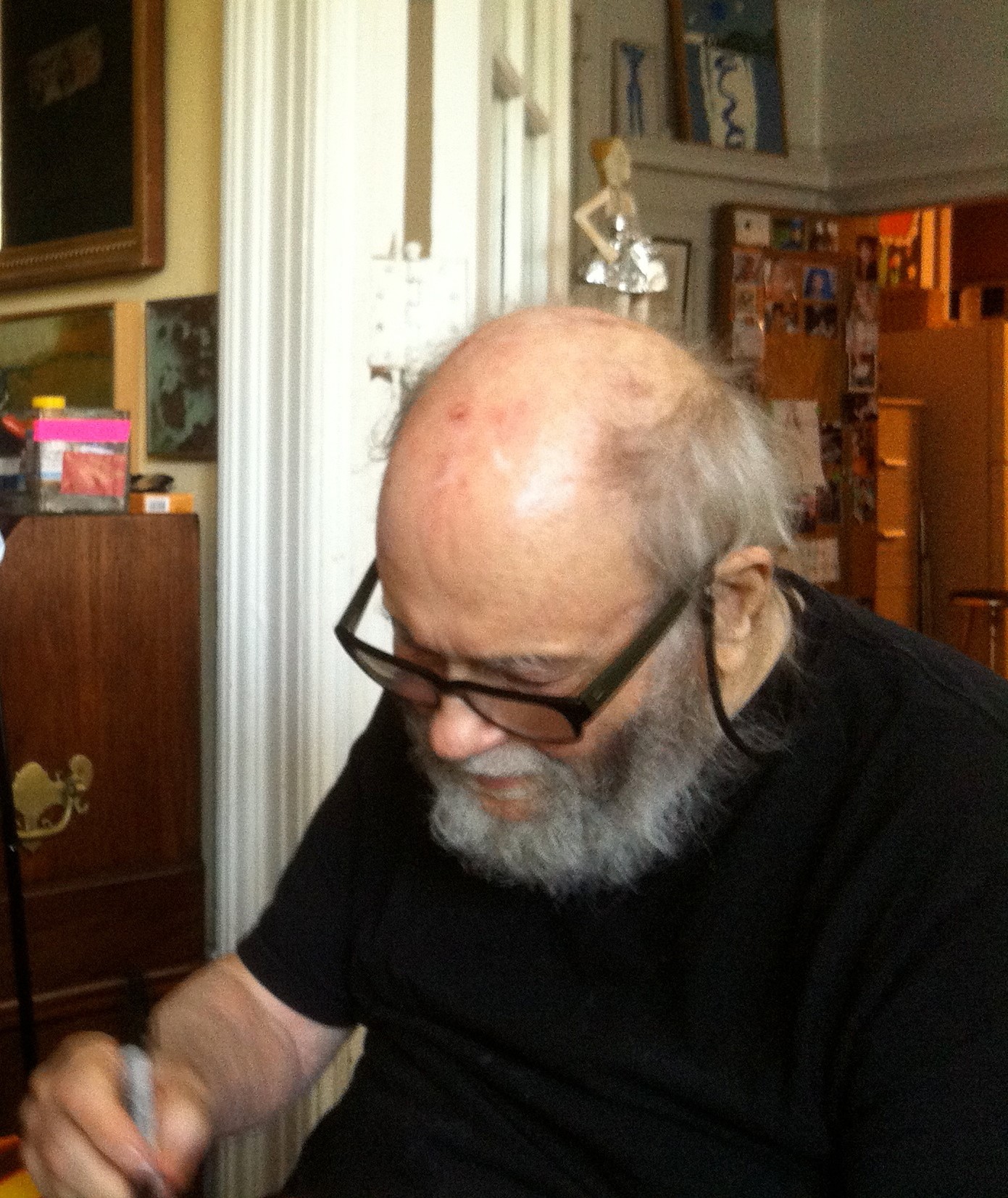
Arthur Danto
View on Wikipedia
Arthur Coleman Danto (January 1, 1924 – October 25, 2013) was an American art critic, philosopher, and professor at Columbia University. He was best known for having been a long-time art critic for The Nation and for his work in philosophical aesthetics and philosophy of history, though he contributed significantly to a number of fields, including the philosophy of action. His interests included thought, feeling, philosophy of art, theories of representation, philosophical psychology, Hegel's aesthetics, and the philosophers Friedrich Nietzsche and Jean-Paul Sartre.
Key Information
Life and career
[edit]Danto was born in Ann Arbor, Michigan, January 1, 1924, and grew up in Detroit.[1] He was raised in a Reform Jewish home.[2] After spending two years in the Army, Danto studied art and history at Wayne University (now Wayne State University). While an undergraduate he intended to become an artist, and began making prints in the Expressionist style in 1947 (these are now great rarities). He then pursued graduate study in philosophy at Columbia University.[1] From 1949 to 1950, Danto studied in Paris on a Fulbright scholarship under Jean Wahl,[3] and in 1951 returned to teach at Columbia.[1]
Upon retirement in 1992 he was named Johnsonian Professor Emeritus of Philosophy.[1] He was twice awarded fellowships from the Guggenheim Foundation and was a member of the American Academy of Arts and Sciences, elected in 1980. He was one of the signers of the Humanist Manifesto.[4] Danto died on October 25, 2013, aged 89 in Manhattan, New York City.[1]
Philosophical work
[edit]Arthur Danto argued that "a problem is not a philosophical problem unless it is possible to imagine that its solution will consist in showing how appearance has been taken for reality."[5] While science deals with empirical problems, philosophy according to Danto examines indiscernible differences that lie outside of experience.[6] Noel Carroll, writing as an art critic, has criticized Danto's anthropology stating that Danto "believe[d] that persons are essentially systems of representation."[7]
"Artworld" and the definition of art
[edit]Danto laid the groundwork for an institutional definition of art[8] that sought to answer the questions raised by the emerging phenomenon of twentieth-century art. The definition of the term "art" is a subject of constant contention and many books and journal articles have been published arguing over the answer to the question "What is Art?" In terms of classificatory disputes about art, Danto takes a conventional approach. Non-conventional definitions take a concept like the aesthetic as an intrinsic characteristic in order to account for the phenomena of art. Conventional definitions reject this connection to aesthetic, formal, or expressive properties as essential to defining art but rather, in either an institutional or historical sense, say that "art" is basically a sociological category. Danto's "institutional definition of art" defines art as whatever art schools, museums, and artists consider art, regardless of further formal definition. Danto wrote on this subject in several of his works and a detailed treatment is to be found in Transfiguration of the Commonplace.[9][10]
Danto stated, "A work of art is a meaning given embodiment." Danto further stated, also in Veery journal, "Criticism, other than of content, is really of the mode of embodiment."[11]
The 1964 essay "The Artworld" in which Danto coined the term "artworld" (as opposed to the existing "art world", though they mean the same), by which he meant cultural context or "an atmosphere of art theory",[12] first appeared in The Journal of Philosophy and has since been widely reprinted. It has had considerable influence on aesthetic philosophy and, according to professor of philosophy Stephen David Ross, "especially upon George Dickie's institutional theory of art. Dickie defined an art work as an artifact 'which has had conferred upon it the status of candidate for appreciation by some person or persons acting in behalf of a certain social institution (the artworld)' (p. 43.)"[13]
According to the Stanford Encyclopedia of Philosophy, "Danto's definition has been glossed as follows: something is a work of art if and only if (i) it has a subject (ii) about which it projects some attitude or point of view (has a style) (iii) by means of rhetorical ellipsis (usually metaphorical) which ellipsis engages audience participation in filling in what is missing, and (iv) where the work in question and the interpretations thereof require an art historical context (Danto with Noël Carroll). Clause (iv) is what makes the definition institutionalist. The view has been criticized for entailing that art criticism written in a highly rhetorical style is art, lacking but requiring an independent account of what makes a context art historical, and for not applying to music."[12]
After about 2005, Danto attempted to streamline his definition of art down to two principles: (i) art must have content or meaning and (ii) the art must embody that meaning in some appropriate manner.[14]
The philosophical disenfranchisement of art
[edit]Danto's Hegelian position on the history of art and its reception was emphasized in his 1984 plenary address to the World Congress of Aesthetics held in Montreal in that year, and later published as the opening chapter in his book The Philosophical Disenfranchisement of Art.[15] In the essay, Danto takes a contrary position to that of Plato who emphasized that art and artistic endeavors occupied an inferior position of importance among the endeavors of philosophers. Danto summarizes this ancient position of the Socratics with the phrase that "art is dangerous" on page four of the essay, which he then criticizes in the remainder of the essay.[16]
The Hegelian end of art
[edit]The basic meaning of the term "art" has changed several times over the centuries and continued to evolve during the 20th century as well. Danto describes the history of Art in his own contemporary version of Hegel's dialectical history of art. "Danto is not claiming that no-one is making art anymore; nor is he claiming that no good art is being made any more. But he thinks that a certain history of western art has come to an end, in about the way that Hegel suggested it would."[17] The "end of art" refers to the beginning of our modern era of art in which art no longer adheres to the constraints of imitation theory but serves a new purpose. Art began with an "era of imitation, followed by an era of ideology, followed by our post-historical era in which, with qualification, anything goes... In our narrative, at first only mimesis [imitation] was art, then several things were art but each tried to extinguish its competitors, and then, finally, it became apparent that there were no stylistic or philosophical constraints. There is no special way works of art have to be. And that is the present and, I should say, the final moment in the master narrative. It is the end of the story."[18]
Art criticism
[edit]Arthur Danto was an art critic for The Nation from 1984 to 2009, and also published numerous articles in other journals. In addition, he was an editor of The Journal of Philosophy and a contributing editor of the Naked Punch Review and Artforum. In art criticism, he published several collected essays, including Encounters and Reflections: Art in the Historical Present (Farrar, Straus & Giroux, 1990), which won the National Book Critics Circle Prize for Criticism in 1990; Beyond the Brillo Box: The Visual Arts in Post-Historical Perspective (Farrar, Straus & Giroux, 1992); Playing With the Edge: The Photographic Achievement of Robert Mapplethorpe (University of California, 1995); The Madonna of the Future: Essays in a Pluralistic Art World (Farrar, Straus & Giroux, 2000); and Unnatural Wonders: Essays from the Gap Between Art and Life (Columbia University Press, 2007).
In 1996, he received the Frank Jewett Mather Award for art criticism from the College Art Association.[19] Danto artist friend Sean Scully, to honor his long-term friendship with Danto, published the book Danto on Scully, bringing together the series of five essays Danto had written on the artist over the previous 20 years after Danto's death in 2013.[20]
Publications
[edit]Books
[edit]- Nietzsche as Philosopher (1965)
- Analytical Philosophy of History (1965)
- What Philosophy Is (1968)
- Analytical Philosophy of Knowledge (1968), republished, within additional material, as Narration and Knowledge (1985)
- Mysticism and Morality: Oriental Thought and Moral Philosophy (1969)
- Analytical Philosophy of Action (1973)
- Jean-Paul Sartre (1975), second edition Sartre (1991)
- The Transfiguration of the Commonplace (1981)
- The Philosophical Disenfranchisement of Art (1986)
- Connections to the World: The Basic Concepts of Philosophy (1989; with new preface, 1997)
- Encounters and Reflections: Art in the Historical Present (1990)
- Beyond the Brillo Box: The Visual Arts in Post-Historical Perspective (1992)
- After the End of Art (1997)
- The Abuse of Beauty (2003)
- Andy Warhol (2009)
- What Art Is (2013)
- Remarks on Art and Philosophy (2014)
- Art and Posthistory, Conversations on the End of Aesthetics written with Demetrio Paparoni (2022)
Essay collections
[edit]- The State of the Art (1987)
- Encounters and Reflections: Art in the Historical Present (1990)
- Embodied Meanings: Critical Essays and Aesthetic Meditations (1994)
- The Wake of Art: Criticism, Philosophy, and the Ends of Taste (1998)
- Philosophizing Art: Selected Essays (1999)
- The Body/Body Problem: Selected Essays (1999)
- The Madonna of the Future: Essays in a Pluralistic Art World (2000)
- Unnatural Wonders: Essays from the Gap Between Art and Life (2007)
Articles, book chapters and other works
[edit]- "The Artworld" (1964) Journal of Philosophy LXI, 571-584
- Introduction to: Playing With the Edge: The Photographic Achievement of Robert Mapplethorpe (1995)
- Hegel's End-of-Art Thesis (1999) preprint of article in: Wellbery, David E. (ed.) A New History of German Literature (2004)
- "The world as ruckus: Red Grooms and the spirit of Comedy" in Red Grooms (2004)[21]
- "The Poetry of Meaning and Loss: The Glass Dresses of Karen LaMonte" (2005)[22]
- (with Robert Fleck and Beate Söntgen) Peter Fischli David Weiss (a survey of their oeuvre) (2005)
- "Weaving as Metaphor" in Sheila Hicks: Weaving as Metaphor (2006)
- "Architectural Principles in the Art of Sean Scully," Border Crossings, August 2007 #103 (2007)
Notes
[edit]- ^ a b c d e Johnson, Ken (October 27, 2013). "Arthur C. Danto, a Philosopher of Art, Is Dead at 89". The New York Times. Retrieved October 28, 2013.
- ^ Italie, Hillel (October 28, 2013). "Groundbreaking art critic Arthur Danto dies at 89". The Times of Israel. Retrieved August 6, 2017.
- ^ Arthur Danto - Interviewed by Zoe Sutherland Archived 2018-09-29 at the Wayback Machine. Naked Punch, 10 July 2010
- ^ "Humanist Manifesto II". American Humanist Association. Archived from the original on October 20, 2012. Retrieved October 7, 2012.
- ^ Arthur Danto, Connections to the World: The Basic Concepts of Philosophy (New York: Harper and Row, 1989), p.6.
- ^ Noel Carroll, "Danto's Comic Vision: Philosophical Method and Literary Style," Philosophy and Literature 39.2 (October 2015), p. 556.
- ^ Noel Carroll, "Danto's Comic Vision: Philosophical Method and Literary Style," Philosophy and Literature 39.2 (October 2015), p. 563 n. 8.
- ^ This theory has been described as an "influential theory about the nature of art", according to Philosophy Now, November 2013
- ^ Danto, Arthur (1981). The transfiguration of the commonplace: a philosophy of art. Harvard University Press. ISBN 978-0-674-90346-3.
- ^ Maes, Hans R.V. and Puolakka, Kalle (2012) "Arthur Danto: The Transfiguration of the Commonplace," [Preprint, final version in:] 50 Key Texts in Art History. Routledge. ISBN 9780415497701
- ^ "Philosopher Art Critic Arthur C. Danto". VEERY JOURNAL. Retrieved September 24, 2020.
- ^ a b Adajian, Thomas. "The Definition of Art", The Stanford Encyclopedia of Philosophy, London, Oct 23, 2007.
- ^ Ross, Stephen David (1984). Art and its Significance. SUNY Press. p. 469. ISBN 0-87395-764-4. Note: Ross also refers to Dickie's book Art and the Aesthetic (Cornell University Press, 1974).
- ^ Danto, Arthur (2014). Remarks on Art and Philosophy. New York: Acadia Summer Arts Program ASAP available through D.A.P./Distributed Art Publishers. pp. 113–114. ISBN 978-0-9797642-6-4.
- ^ The Philosophical Disenfranchisement of Art. By Arthur Danto. Columbia Univ Press. 1986. Page 1.
- ^ The Philosophical Disenfranchisement of Art. By Arthur Danto. Columbia Univ Press. 1986. Page 4.
- ^ Cloweny, David W. (December 21, 2009). "Arthur Danto". Rowan university. Archived from the original on December 27, 2009. Retrieved December 21, 2009.
- ^ Danto, Arthur Coleman (1998). After the end of art: contemporary art and the pale of history. Princeton University Press. p. 47. ISBN 0-691-00299-1. As quoted by Professor David W. Cloweny on his website. [1] Archived 2009-12-27 at the Wayback Machine
- ^ "Awards". The College Art Association. Retrieved October 11, 2010.
- ^ Danto, Arthur C. (2015). Danto on Scully. Dap-distributed Art. ISBN 978-3-7757-3963-4.
- ^ Hoving, Thomas (July 11, 2004). "The Man Who Makes a Ruckus of New York". The New York Times. ISSN 0362-4331. Archived from the original on May 28, 2015. Retrieved March 11, 2022.
- ^ from: Danto, Arthur, Juli Cho Bailer "Karen LaMonte: Absence Adorned." Tacoma, WA: Museum of Glass, International Center for Contemporary Art, (2005)
Further reading
[edit]- Borradori, Giovanna (2008). The American Philosopher : Conversations with Quine, Davidson, Putnam, Nozick, Danto, Rorty, Cavell, MacIntyre, Kuhn. Chicago: University of Chicago Press. ISBN 9780226066493.
- A Companion to Arthur Danto, Lydia Goehr, Jonathan Gilmore (eds.) Wiley, 2022
- Arthur Danto's Philosophy of Art, by Noël Carroll, Brill, 2021
- Arthur Danto and the End of Art', by Raquel Cascales, Cambridge Scholars Publishing, 2019
- The Philosophy of Arthur C. Danto, Randall E. Auxier, Lewis Edwin Hahn (eds.) Open Court Publishing, 2011
- Action, Art, History: Engagements with Arthur C. Danto: A collection of essays edited by Daniel Herwitz and Michael Kelly, including contributions by Frank Ankersmit, Hans Belting, Stanley Cavell, Donald Davidson, Lydia Goehr, Gregg Horowitz, Philip Kitcher, Daniel Immerwahr, Daniel Herwitz and Michael Kelly and replies by Danto himself.
- Danto and his Critics (1993). A collection of essays including contributions by David Carrier, Richard Wollheim, Jerry Fodor, and George Dickie.
- Danto and His Critics: Art History, Historiography and After the End of Art. History and Theory 37, no. 4 (1998), theme issue where philosophers David Carrier, Frank Ankersmit, Noël Carroll, Michael Kelly, Brigitte Hilmer, Robert Kudielka, Martin Seeland and Jacob Steinbrenner address his work; includes a final reply by the author.
- Tiziana Andina, Arthur Danto: Philosopher of Pop, Cambridge Scholars Publishing, 2011
- D. Seiple, "Arthur C. Danto" in Philip B. Dematteis, ed., Dictionary of Literary Biography 273 (2003), 39-48 [author postprint]
- D. Seiple, "Creativity and Spirit in the Work of Arthur Danto"
- D. Seiple, "The Spirit of Arthur Danto," in Randall E. Auxier and Lewis Edwin Hahn, ed., The Philosophy of Arthur C. Danto, The Library of Living Philosophers XXXIII, 671-700 (2013) ISBN 978-0812697322 [author postprint]
External links
[edit]- "Is it art?" - an interview with Alan Saunders of ABC Radio National (03/2006)
- Biography Arthur C. Danto's Biography on Columbia University Website. (Archived by Wayback Machine).
- Arthur Danto - obituary The Daily Telegraph (Archived by Wayback Machine).
- Obituary in November/December 2013 edition of Philosophy Now magazine
- Arthur Danto at IMDb
- Bonard, C. & Humbert-Droz, S. ‘The definition of art’, Internet Encyclopedia of Philosophy (2024)
Arthur Danto
View on GrokipediaBiography
Early Life and Education
Arthur Coleman Danto was born on January 1, 1924, in Ann Arbor, Michigan, to Samuel Budd Danto, a dentist, and Sylvia Danto, members of a Jewish family with Russian immigrant roots. He spent his formative years in Detroit, where frequent visits to the Detroit Institute of Arts with his mother ignited a lifelong passion for visual art.[5][6] Danto's early intellectual curiosity in philosophy emerged during his military service in the U.S. Army from 1943 to 1946, when he served in the Medical Corps in North Africa and Italy, driving supply trucks amid the Allied campaigns. It was during this period that he first encountered the works of Friedrich Nietzsche and Jean-Paul Sartre, whose ideas profoundly shaped his emerging worldview and later scholarly pursuits.[1][3][7] After the war, Danto pursued undergraduate studies at Wayne State University in Detroit, earning a B.A. in fine arts in 1948. His coursework there, including a seminar on Nietzsche, deepened his engagement with philosophical thought while he also explored art history, reflecting his dual interests in aesthetics and intellect.[5][8][7] Danto continued his graduate education at Columbia University, where he received an M.A. in philosophy in 1949 and a Ph.D. in 1952 under the supervision of Sidney Hook. His dissertation focused on Jean-Paul Sartre's existential philosophy, analyzing key concepts such as freedom and consciousness in works like Being and Nothingness, which foreshadowed Danto's own analytical approach to continental thinkers. During this time, he also studied in Paris on a Fulbright scholarship, attending lectures by Maurice Merleau-Ponty at the Sorbonne.[5][9][6] Following his doctorate, Danto held an initial teaching position as instructor at the University of Colorado, Boulder, from 1950 to 1951, before joining the faculty at Columbia University in 1951, marking the beginning of his long academic tenure there. These early roles allowed him to refine his teaching on philosophy and aesthetics while transitioning to full-time academia.[5][1]Academic Career
Arthur Danto began his academic career at Columbia University in 1951, shortly after completing his Ph.D. there in 1952, initially serving as an instructor in the philosophy department.[10] He advanced to full professor by 1966 and was appointed Johnsonian Professor of Philosophy in 1975, a position he held until his retirement in 1992, after which he became Johnsonian Professor Emeritus.[11][12] Throughout his tenure, Danto remained deeply committed to Columbia, contributing to its intellectual environment for over four decades.[13] Danto's teaching emphasized aesthetics, the philosophy of action, and the philosophy of history, areas reflected in his major publications such as Analytical Philosophy of History (1965) and Analytical Philosophy of Action (1973).[1] He offered a renowned year-long graduate seminar in aesthetics, covering the field from Plato to contemporary developments, and supervised numerous doctoral students in these domains.[1] His pedagogical approach integrated analytical philosophy with broader humanistic concerns, fostering critical engagement among students.[1] Danto received significant academic honors, including Guggenheim Fellowships in 1969 and 1982 for his work in philosophy.[14] He was elected a Fellow of the American Academy of Arts and Sciences in 1980 and served as President of the Eastern Division of the American Philosophical Association from 1983 to 1984.[15][16] Beyond teaching, Danto engaged in wider intellectual pursuits, such as signing the Humanist Manifesto II in 1973, which advocated for secular humanism and ethical naturalism, and serving as editor of the Journal of Philosophy starting in 1964, where he shaped philosophical discourse through editorial selections.[17][5]Personal Life and Death
Arthur Danto was born into a Reform Jewish family in Ann Arbor, Michigan, and raised in Detroit, where his cultural background shaped his early engagement with the arts and intellectual pursuits.[18][19] In 1946, he married Shirley Rovetch, with whom he had two daughters, Ginger—an arts writer—and Elizabeth; the couple resided in New York City after Danto's graduate studies, establishing a lifelong base in Manhattan.[20][21][22] Rovetch passed away in 1978, and in 1980, Danto married Barbara Westman, who survived him.[6][21] Throughout his adulthood, Danto maintained a deep personal connection to visual arts, having pursued printmaking and woodcuts as a young artist before shifting to philosophy, and he frequently traveled for academic and military reasons, including service in North Africa and Italy during World War II and studies in Paris.[10][6] These experiences informed his lifelong appreciation for art beyond professional critique, though he was not known as a prominent collector. He spent his later years in Manhattan, continuing to engage with the city's vibrant cultural scene until his health declined. Danto died on October 25, 2013, at the age of 89 in his Manhattan home from heart failure.[10][9] A memorial service was held on February 6, 2014, at Frank E. Campbell Funeral Chapel in New York City.[23] Tributes poured in from the art world, including from painter Sean Scully, a close friend who posthumously published Danto on Scully (2015), compiling Danto's essays on his work as a gesture of enduring admiration.[24][25]Philosophical Work
The Artworld and Definition of Art
Arthur Danto's seminal 1964 essay "The Artworld," published in The Journal of Philosophy, introduced the concept of the "artworld" as a crucial framework for determining what qualifies as art. Danto argued that the meaning and status of an artwork do not derive from its physical properties or perceptual qualities alone but from the interpretive context provided by the artworld—a community of artists, critics, historians, and institutions that collectively confer artistic significance.[26] This idea emerged from Danto's encounter with Andy Warhol's Brillo Box (1964), where identical-looking replicas of commercial Brillo soap pad boxes were exhibited as art; while ordinary Brillo boxes remained mere commodities, Warhol's versions became artworks through their placement within the artworld's theoretical and historical discourse, highlighting how context transforms the commonplace into the aesthetic. Danto defined art as an object or event that occupies a position within an art-historical narrative, rejecting formalist definitions that emphasize intrinsic formal qualities, such as Clive Bell's notion of "significant form" as the essence of aesthetic experience.[27] Influenced by analytic philosophy's focus on language, meaning, and conceptual analysis, Danto contended that art's identity is relational and conferred by the artworld, much like how words gain meaning through usage rather than isolated features.[28] This perspective was particularly applied to pop art and Marcel Duchamp's ready-mades, such as the Fountain (1917), where everyday objects like a urinal achieve artistic status not through beauty or skill but through the artworld's interpretive act, which embeds them in a broader narrative of artistic innovation and critique.[29] In his 1981 book The Transfiguration of the Commonplace: A Philosophy of Art, Danto further developed these ideas by proposing that artworks function through metaphorical interpretation, where ordinary objects are "transfigured" into symbols of deeper philosophical or cultural ideas via the artworld's lens.[30] Here, art is not mere representation but a rhetorical device that reveals hidden meanings in the everyday, expanding on the 1964 essay's institutional theory to emphasize how interpretation bridges the gap between the artwork and its historical context, allowing even the most banal items to embody profound aesthetic and existential truths.[4]Philosophical Disenfranchisement of Art
In The Philosophical Disenfranchisement of Art (1986), Arthur C. Danto articulates the thesis that modern philosophy has progressively excluded art from the domain of cognitive truth-seeking, relegating it instead to the realm of aesthetic experience devoid of philosophical or political efficacy. Drawing on historical precedents, Danto contends that this disenfranchisement began with Plato's critique of mimesis in works like The Republic, where art is dismissed as an imitation thrice removed from truth, incapable of conveying genuine knowledge and thus politically powerless.[31] He extends this analysis to Kant's Critique of Judgment, which frames aesthetic judgment as disinterested pleasure, further insulating art from rational or moral discourse.[32] Post-Hegel, Danto argues, art ceases to fulfill philosophical functions such as embodying the sublime or critiquing reality, marking a shift where philosophy claims exclusive authority over truth.[33] This historical progression traces art's evolving status from a vehicle of knowledge in Renaissance humanism—where works like Leonardo da Vinci's paintings integrated empirical observation with philosophical inquiry—to modernism's assertion of autonomy.[34] In the Renaissance, art was enfranchised as a humanistic pursuit that illuminated human potential and natural truths, but Enlightenment aesthetics and subsequent developments eroded this role. Modernism, exemplified by Clement Greenberg's formalism, intensified the separation by prioritizing optical purity and self-referentiality in painting, as seen in the flatness of modernist canvases, which Danto views as philosophy's final containment of art's cognitive ambitions.[31] Greenberg's insistence on medium-specificity, for instance, reduced abstract art to sensory experience, stripping it of narrative or interpretive depth.[32] The implications of this disenfranchisement reshape art interpretation, positioning artworks not as bearers of objective truth but as embodiments of cultural narratives that demand contextual understanding. Danto illustrates this with abstract expressionism, such as Jackson Pollock's drip paintings, which transcend formalist aesthetics to encode post-World War II existential anxieties and American cultural identity, requiring viewers to engage their rhetorical and historical layers rather than mere visual pleasure.[33] This interpretive framework connects to Danto's earlier Analytical Philosophy of Action (1965), where his concept of narrative sentences—descriptions of events intelligible only in retrospect through subsequent developments—informs how art's meaning emerges from its embedding in broader philosophical and historical actions. Thus, disenfranchised art regains potency through narrative comprehension, linking individual works to transformative human agency.[35]The End of Art Thesis
Arthur Danto's "end of art" thesis posits that the historical narrative of art, understood as a progressive development toward self-awareness akin to Hegel's philosophy of history, reached its culmination in the late 20th century, ushering in an era of pluralism where no single style or direction dominates.[36] Drawing from Hegel's Lectures on Aesthetics, Danto argues that art achieves its "end" not through cessation of production but via the realization of its own philosophical essence, allowing all artistic possibilities to coexist without teleological pressure.[37] This idea first appeared in his 1984 essay "The End of Art," later expanded in the 1997 book After the End of Art: Contemporary Art and the Pale of History.[36][37] A pivotal moment in Danto's formulation is Andy Warhol's 1964 exhibition of Brillo Boxes at the Stable Gallery in New York, which Danto identifies as the event that crystallized art's historical self-consciousness by blurring the boundaries between everyday objects and fine art, thereby exposing the contingency of artistic narratives.[37] This show, featuring wooden replicas of commercial soap pad cartons, demonstrated that art's meaning arises not from perceptual qualities but from its placement within the "artworld," marking the exhaustion of modernist progress toward aesthetic purity.[36] In the post-historical phase that followed, contemporary art embraces pluralism, with works often functioning as philosophical commentaries on art's own history, such as postmodern appropriations that recycle past styles without advancing a unified trajectory.[37] Critics have accused Danto's thesis of implying cultural pessimism by suggesting art's developmental history has stalled, yet Danto counters that this "end" liberates artists from the burden of historical determinism, fostering boundless experimentation and tying into his broader philosophy of history as narrative closure rather than decline.[38] He refines the idea by emphasizing that the disenfranchisement of art from philosophy—its separation into autonomous domains—leads directly to this pluralistic endpoint, where art reflects on its conditions of possibility without prescriptive goals.Art Criticism
Career as Critic
Arthur Danto's professional career as an art critic began in 1984 when he was appointed the art critic for The Nation, serving in the role until his retirement in 2009.[40][41] Prior to this full-time position, Danto had engaged with contemporary art through philosophical essays published in academic journals during the 1960s, such as his seminal 1964 piece "The Artworld" in the Journal of Philosophy, which analyzed the contextual dimensions of artworks like Andy Warhol's Brillo Boxes.[42][43] In his dual role as a philosopher and critic, Danto brought analytical rigor to his journalistic reviews, prioritizing the interpretive and historical contexts that define an artwork's meaning over purely formal or aesthetic evaluations.[44][45] This approach reflected a brief overlap with his broader philosophical theories, particularly in how he used narrative frameworks to unpack an artwork's place within the artworld.[3] His reviews often covered major annual exhibitions and retrospectives, providing insightful overviews of the year's developments in contemporary art, while his writings frequently delved into the practices of key figures like Jeff Koons, exploring the provocative intersections of commerce, banality, and aesthetics in their work.[46][47] Danto's criticism during the 1980s, coinciding with intense debates over public funding for controversial art amid the culture wars, helped shape broader discussions on artistic pluralism and the boundaries of acceptable expression in American culture.[48] For his contributions to the field, he received the Frank Jewett Mather Award for Art Criticism from the College Art Association in 1996, recognizing his distinctive blend of philosophical depth and accessible prose.[49][20]Key Themes in Criticism
Danto's art criticism frequently emphasized the narrative and historical context of artworks, viewing them as embedded within broader philosophical and cultural stories that define their meaning. In his reviews of Pop Art, particularly Andy Warhol's Brillo Boxes, he argued that these pieces disrupted linear art historical progress by embodying the "end of art" thesis, where ordinary objects gain artistic status through interpretive frameworks rather than stylistic evolution, thus exemplifying post-historical pluralism.[50] This approach allowed Danto to highlight how Warhol's work transformed consumer culture into profound commentary on modernity's commodification.[51] Central to Danto's evaluations was an advocacy for pluralism, which celebrated the diversity of media and ideas in contemporary art following the collapse of modernist narratives. He offered positive assessments of installation and conceptual works that defied traditional forms, such as Damien Hirst's The Physical Impossibility of Death in the Mind of Someone Living (1991), praising its formaldehyde-preserved shark as a conceptually rich meditation on mortality and human fragility within a liberated artistic landscape.[52] Danto's reviews thus promoted an inclusive criticism that valued interpretive depth over adherence to any singular aesthetic or ideological program, applying his artworld theory to affirm works' validity through their contextual meanings.[53] Danto also engaged deeply with beauty and kitsch, seeking to rehabilitate popular culture's role in art by challenging its dismissal as superficial. In his 1990s reviews, he explored how influences from fashion, advertising, and consumer imagery—often labeled kitsch—could elevate art beyond elitist standards, as evident in his analyses of Jeff Koons's balloon sculptures, which he saw as monumentalizing the banal to provoke reflection on taste and value.[7] This perspective, informed by his philosophical rejection of beauty as art's essence, underscored art's capacity to embrace the everyday without aesthetic hierarchy.[50] These motifs are prominently featured in Danto's collection Beyond the Brillo Box: The Visual Arts in Post-Historical Perspective (1992), which compiles his reviews of the 1980s and 1990s art scene, demonstrating how his emphasis on narrative pluralism and cultural rehabilitation shaped his engagement with emerging trends like neo-expressionism and multimedia installations.[54]Legacy and Influence
Impact on Art Philosophy
Arthur Danto's essay "The Artworld" (1964) laid foundational groundwork for institutional theories of art, emphasizing the role of interpretive frameworks and social contexts in determining what qualifies as art, which profoundly influenced subsequent philosophers like George Dickie, whose 1974 book Art and the Aesthetic formalized the institutional theory by defining artworks as artifacts presented to an appreciative public by the artworld.[55] This shift sparked ongoing debates about art's social construction, moving away from formalist aesthetics toward viewing art as embedded in institutional practices and community consensus, a trend that reshaped post-1960s art philosophy by highlighting how cultural and historical narratives confer artistic status.[56] Danto's "end of art" thesis, articulated in works like After the End of Art (1997), posited that art had achieved self-awareness through modernism, rendering future styles non-progressive and opening the door to pluralism; this concept became central to postmodern theory, particularly in the 1990s discussions of multiculturalism and globalization, where it framed art's evolution beyond Eurocentric narratives toward diverse, boundary-dissolving practices.[57] For instance, the thesis informed analyses of how global art markets and multicultural exhibitions challenged singular historical progress, promoting instead a "pale of history" where art engages ethical and cultural pluralism without teleological aims.[58] Danto's work bridged analytic and continental philosophy in aesthetics by integrating rigorous conceptual analysis with narrative and historical interpretations, popularizing approaches that treat artworks as embedded in storied contexts rather than isolated objects, thus influencing thinkers across traditions to explore art's philosophical depth through interpretive storytelling.[38] This synthesis encouraged a more inclusive aesthetics, drawing on Hegelian narratives within an analytic framework to address art's role in human understanding. Posthumously, Danto's legacy endures through tributes like the 2015 publication Danto on Scully, a collection of his writings on painter Sean Scully edited as a homage to his critical insight into abstract expressionism's philosophical implications.[59] His ideas remain staples in university curricula, frequently assigned in philosophy of art courses to examine ontology, pluralism, and institutional definitions, ensuring their continued relevance in shaping contemporary aesthetic debates.[60]Scholarly Reception
Scholars have praised Arthur Danto's philosophy of art for its role in democratizing art theory by emphasizing the artworld's contextual and historical framework, which broadens the scope of what qualifies as art beyond traditional aesthetic criteria. Noël Carroll, in his comprehensive analysis, endorses Danto's contributions as foundational to understanding contemporary art's pluralism, highlighting how Danto's theories enable inclusive interpretations that transcend formalist constraints.[61] This approach has been lauded for its relevance to identity politics, as Danto linked artworld pluralism to societal inclusiveness across gender, ethnicity, and class, supporting feminism and civil rights movements while viewing art as a model for egalitarian pluralism.[62] Criticisms of Danto's work often center on the end-of-art thesis, accusing it of over-reliance on Hegelian dialectics and traditional Western art historical models, which some argue impose a Eurocentric narrative on global artistic developments. Others have challenged the thesis for presuming a linear progression rooted in European modernism, potentially marginalizing non-Western traditions and overlooking ongoing pluralism in art before the 1960s. Debates also question Danto's Hegelian framework as overly deterministic, limiting the theory's applicability to diverse cultural contexts.[42] Post-2013 analyses have evolved to reassess Danto's ideas in light of emerging media, with articles in the British Journal of Aesthetics exploring how his constitutive theory of aesthetic properties applies to contemporary interpretive practices. For instance, Sonia Sedivy's 2018 examination connects Danto's views on artworks' historical embeddedness to ongoing debates in aesthetic ontology. Danto's framework has also influenced discussions on digital art, particularly AI-generated works, where scholars apply his emphasis on intention and interpretation to question authorship and creativity in machine-assisted production, transfiguring data outputs into meaningful art via human context.[63] featured reflections from philosophers and critics on his enduring impact, including festschrifts that underscore his humanistic approach to art's philosophical disenfranchisement.[9]Publications
Major Books
Arthur C. Danto authored more than a dozen monographs over his career, with his major works spanning philosophy of action, aesthetics, ethics, and epistemology.[64] Analytical Philosophy of Action (1973) is a foundational text in the philosophy of action, where Danto distinguishes basic actions—such as moving an arm—from more complex bodily movements and intentional behaviors, aiming to isolate the logical structure of human agency. In this work, published by Cambridge University Press, Danto analyzes the conceptual problems of action, emphasizing how primitive actions form the building blocks for understanding voluntary conduct without reducing them to mere physical events. The Transfiguration of the Commonplace: A Philosophy of Art (1981), published by Harvard University Press, serves as Danto's core exploration of art's definition, arguing that artworks lack essential properties distinguishing them from ordinary objects and instead rely on interpretive frameworks and metaphorical transfiguration to achieve aesthetic status.[30] Drawing on examples like Andy Warhol's Brillo Boxes, Danto posits that art emerges through a community's theoretical recognition, transforming the commonplace into something profound via rhetorical and interpretive means.[30] This monograph establishes his institutional theory of art, highlighting how metaphor and narrative elevate mere things into artistic expressions.[65] The Philosophical Disenfranchisement of Art (1986), issued by Columbia University Press, examines the evolving relationship between art and philosophy, contending that modern art's cognitive and interpretive dimensions have shifted it from a philosophical pursuit to an autonomous domain, exemplified by the "end of art" thesis first articulated in the 1960s.[66] Danto explores how artworks now embody self-aware narratives, freeing them from traditional philosophical constraints while retaining deep intellectual engagement.[66] After the End of Art: Contemporary Art and the Pale of History (1997), published by Princeton University Press, elaborates Danto's pluralism in post-historical art, asserting that after modernism's narrative culmination, contemporary art thrives in a state of boundless stylistic variety without a unifying telos.[37] The book addresses pop art, museum roles, and critics like Clement Greenberg, arguing for an era where art's freedom from historical progress enables diverse expressions unbound by prior definitions.[37] Mysticism and Morality: Oriental Thought and Moral Philosophy (1972, reprinted 1987 by Columbia University Press), Danto's primary contribution to ethics, investigates the compatibility of mystical experiences—drawn from Eastern traditions—with Western moral frameworks, proposing that mysticism's vertical orientation toward being can inform horizontal ethical relations without conflict.[67] Through analysis of concepts like karma and enlightenment, Danto bridges Oriental philosophy and moral theory, emphasizing how non-dualistic insights enhance ethical understanding.[67] Connections to the World: The Basic Concepts of Philosophy (1997), from the University of California Press, provides an accessible introduction to metaphysics and epistemology, framing philosophy as inquiries into how individuals connect to reality through knowledge, doubt, and conceptual analysis.[68] Danto structures the text around core topics like perception and belief, offering a triangular model of philosophical problems that underscores human cognition's foundational role.[68]Selected Essays and Articles
Arthur Danto's essay "The Artworld," published in The Journal of Philosophy in 1964, is a foundational piece in his philosophy of art, where he introduces the concept of the artworld as an institutional framework that distinguishes artworks from mere real-world objects, exemplified by Andy Warhol's Brillo Box.[69] This work laid the groundwork for institutional theories of art by arguing that artistic meaning arises from the interpretive context provided by the artworld's shared knowledge and conventions.[43] In 1984, Danto published "The End of Art" in the anthology "The Death of Art" (Haven Publications), outlining his interpretation of Hegel's end-of-art thesis as a post-historical condition in which art is no longer driven by a progressive narrative toward a telos, allowing for pluralism and freedom from avant-garde imperatives. The essay posits that events like Warhol's 1964 exhibition marked the close of art history's developmental phase, ushering in an era where artists could engage narratives without revolutionary pressure.[70] Danto's shorter writings often appeared as chapters in compilations of his art criticism, such as Beyond the Brillo Box: The Visual Arts in Post-Historical Perspective (1992), which includes essays exploring the implications of post-historical art, including discussions of pluralism and cultural narratives in contemporary visual arts. Similarly, Encounters and Reflections: Art in the Historical Present (1990) gathers his critical pieces on artists like Andy Warhol, David Hockney, and Robert Mapplethorpe, analyzing their works within the framework of late-20th-century aesthetics and historical consciousness.[71] Among Danto's later articles, his 1998 piece "Andy Warhol: Drawings, 1942-87" in Artforum examines Warhol's oeuvre as a philosophical intervention, emphasizing how his drawings and prints challenge traditional boundaries between high art and commercial imagery.[72] In 2003, Danto addressed the "return of beauty" in contemporary art through essays like those in The Abuse of Beauty: Aesthetics and the Concept of Art, arguing that beauty had been marginalized in modernist aesthetics but was reemerging as a valid, though abused, category in post-historical art discourse. From 1984 to 2009, Danto contributed over 500 art criticism pieces to The Nation as its longtime critic, covering exhibitions, emerging artists, and philosophical trends in the visual arts with a focus on narrative and institutional contexts.[40] Posthumously, in 2015, the volume Danto on Scully collected Danto's series of essays on the abstract paintings of Irish artist Sean Scully, highlighting Scully's stripe works as embodiments of emotional depth and historical continuity in abstract expressionism.[24] This publication, assembled by Scully to honor their friendship, includes writings originally from journals and catalogs that praise Scully's ability to infuse modernist abstraction with humanistic resonance.[73]References
- https://press.princeton.edu/books/[paperback](/page/Paperback)/9780691163895/after-the-end-of-art
