Hubbry Logo
BalafonBalafonMain
Open search
Balafon
Community hub
Balafon
logo
8 pages, 0 posts
0 subscribers
Be the first to start a discussion here.
Contribute something
Balafon
Balafon
from Wikipedia

Balafon
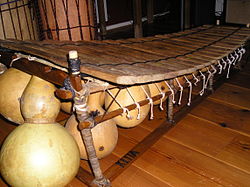
A fixed-key balafon, showing resonators with membrane holes
Other namesbalafo, bala, balaphone, balaphon, balaphong, balani, gyil, balangi
Classification West African wooden Percussion idiophone with up to 21 keys
Hornbostel–Sachs classification111.212
(Sets of percussion sticks)
Developed12th century or earlier
Related instruments
gyil, marimba, xylophone, gambang kayu
Cultural practices and expressions linked to Balafon and Kolintang in Mali, Burkina Faso, Côte d'Ivoire and Indonesia
CountryMali, Burkina Faso, Ivory Coast, and Indonesia
Reference02131
RegionAsia and the Pacific, Africa
Inscription history
Inscription2024 (19th session)
ListRepresentative

The balafon (pronounced /ˈbæləfɒn/, or, by analogy with xylophone etc., /ˈbæləfn/) is a gourd-resonated xylophone, a type of struck idiophone.[1] It is closely associated with the neighbouring Mandé, Bwaba Bobo, Senoufo and Gur peoples of West Africa,[1][2] particularly the Guinean branch of the Mandinka ethnic group,[3] but is now found across West Africa from Guinea, Burkina Faso, Mali.[2] Its common name, balafon, is likely a European coinage combining its Mandinka name ߓߟߊ bála ([bala˦])[4] with the word ߝߐ߲ fóo (nyáa) ([foː˦ ɲaː˦]) 'to say / method of saying'[2][5] or the Greek root phono.[1]

History

[edit]

Believed to have been developed independently of the Southern African and South American instrument now called the marimba, oral histories of the balafon date it to at least the rise of the Mali Empire in the 12th century CE. Balafon is a Manding name, but variations exist across West Africa, including the balangi in Sierra Leone[6] and the gyil of the Dagara, Lobi and Gurunsi from Ghana, Burkina Faso and Ivory Coast. Similar instruments are played in parts of Central Africa, with the ancient Kingdom of Kongo denoting the instrument as palaku.

Records of the balafon go back to at least the 12th century CE. In 1352 CE, Moroccan traveller Ibn Battuta reported the existence of the ngoni and balafon[7] at the court of Malian ruler Mansa Suleyman.

European visitors to West Africa described balafons in the 17th century largely identical to the modern instrument.[8] The Atlantic Slave Trade brought some balafon players to the Americas. The Virginia Gazette records African-Americans playing a barrafoo in 1776, which appears to be a balafon. Other North American references to these instruments die out by the mid-19th century.[9]

Children from Burkina Faso performing in Warsaw, Poland, during the 5th Cross Culture Festival, September 2009

The balafon has seen a resurgence since the 1980s in the growth of African Roots Music and World Music. Most famous of these exponents is the Rail Band, led by Salif Keita. Even when not still played, its distinctive sound and traditional style has been exported to western instruments. Maninka from eastern Guinea play a type of guitar music that adapts balafon playing style to the imported instrument.

Etymology

[edit]

In the Malinké language balafon is a compound of two words: balan is the name of the instrument and is the verb to play. Balafon therefore is really the act of playing the bala.[5]

Bala still is used as the name of a large bass balafon in the region of Kolokani and Bobo Dioulasso. These bala have especially long keys and huge calabashes for amplification. Balani is then used as the name of the high pitched, small balafon with small calabashes and short (3 to 4 cm long) keys. The balani is carried with a strap and usually has 21 keys, while the number of keys on a bala vary with region.

Construction

[edit]
Gum-rubber mallets on a balafon

A balafon can be either fixed-key (where the keys are strung over a fixed frame, usually with calabash resonators underneath) or free-key (where the keys are placed independently on any padded surface). The balafon usually has 17–21 keys, tuned to a tetratonic, pentatonic or heptatonic scale, depending on the culture of the musician.

The balafon is generally capable of producing 18 to 21 notes, though some are built to produce many fewer notes (16, 12, 8 or even 6 and 7). Balafon keys are traditionally made from kosso rosewood, dried slowly over a low flame, and then tuned by shaving off bits of wood from the underside of the keys. Wood is taken off the middle to flatten the key or the end to sharpen it.

In a fixed-key balafon, the keys are suspended by leather straps just above a wooden frame, under which are hung graduated-size calabash gourd resonators. A small hole in each gourd is covered with a membrane traditionally of thin spider's-egg sac filaments (nowadays more usually of cigarette paper or thin plastic film) to produce the characteristic nasal-buzz timbre of the instrument, which is usually played with two gum-rubber-wound mallets while seated on a low stool (or while standing using a shoulder or waist sling hooked to its frame).

Regional traditions

[edit]
Balafon in Ivory Coast

As the balafon cultures vary across West Africa, so does the approach to the instrument itself. In many areas the balafon is played alone in a ritual context, in others as part of an ensemble. In Guinea and Mali, the balafon is often part of an ensemble of three, pitched low, medium and high. In Cameroon, six balafon of varying size perform together in an orchestra, called a komenchang. An Igbo variation exists with only one large tuned key for each player. And while in most cases a single player hits multiple keys with two mallets, some traditions place two or more players at each keyboard.

The Susu and Malinké people of Guinea are closely identified with the balafon, as are the other Manding peoples of Mali, Senegal, and the Gambia. Cameroon, Chad, and even the nations of the Congo Basin have long balafon traditions.

Often, balafon players will wear belled bracelets on each wrist, accentuating the sound of the keys.

In some cultures the balafon was (and in some still is) a sacred instrument, playable only by trained religious caste members and only at ritual events such as festivals, royal, funerial, or marriage celebrations. Here the balafon is kept in a temple storehouse, and can only be removed and played after undergoing purification rites. Specific instruments may be built to be only played for specific rituals and repertoires. Young adepts are trained not on the sacred instrument, but on free-key pit balafons.

The balafon music of the Sambla (Sembla) people in western Burkina Faso is notable for its complex speech surrogate system,[10][11] where the words of the spoken Sambla language are translated into music in a similar fashion to the more famous case of talking drum communication.

Gyil

[edit]
The gyil of northwestern Ghana

The gyil (English: /ˈɪlə/ or /ˈl/) is the name of a buzzing pentatonic balafon common to the Gur-speaking populations in northern Ghana, Burkina Faso, southeastern Mali and northern Ivory Coast in West Africa. Among Mande populations in Ghana like the Ligbi (Numu), Bissa and Dyula, the same instrument is known as bala. The gyil is the primary traditional instrument of the Dagara people of northern Ghana and Burkina Faso, and of the Lobi of Ghana, southern Burkina Faso, and Ivory Coast. The gyil is usually played in pairs, accompanied by a calabash gourd drum called a kuor. It can also be played by one person with the drum and the stick part as accompaniment, or by a soloist. Gyil duets are the traditional music of Dagara funerals. The instrument is generally played by men, who learn to play while young; however, there is no restriction on gender. It is also played by the Gurunsi people of the Upper East Region of Ghana, as well as neighbouring Gurunsi populations across the border in south and central Burkina Faso. A dance related to the gyil is the Bewaa.

The gyil's design is similar to the balaba or balafon used by the Mande-speaking Bambara, Dyula and Sosso peoples further west in southern Mali and western Burkina Faso, as well as the Senoufo people of Sikasso, a region that shares many musical traditions with those of northern Ivory Coast and Ghana. It is made with 14 wooden keys of an African hardwood called liga attached to a wooden frame, below which hang calabash gourds.[12] Spider web silk covers small holes in the gourds to produce a buzzing sound and antelope sinew and leather are used for the fastenings.[12] The instrument is played with rubber-headed wooden mallets.

Cameroon

[edit]

During the 1950s, bars sprang up across Cameroon's capital to accommodate an influx of new inhabitants, and soon became a symbol for Cameroonian identity in the face of colonialism. Balafon orchestras, consisting of 3–5 balafons and various percussion instruments became common in these bars. Some of these orchestras, such as Richard Band de Zoetele, became quite popular in spite of scorn from the European elite.

The middle of the 20th century saw the popularisation of a native folk music called bikutsi. Bikutsi is based on a war rhythm played with various rattles, drums and balafon. Sung by women, bikutsi featured sexually explicit lyrics and songs about everyday problems. In a popularised form, bikutsi gained mainstream success in the 1950s. Anne-Marie Nzie was perhaps the most important of the early innovators. The next bikutsi performer of legendary stature was Messi Me Nkonda Martin and his band, Los Camaroes, who added electric guitars and other new elements.

Balafon orchestras had remained popular throughout the 50s in Yaoundé's bar scene, but the audience demanded modernity and the popular style at the time was unable to cope. Messi Martin was a Cameroonian guitarist who had been inspired to learn the instrument by listening to Spanish language-broadcasts from neighboring Equatorial Guinea, as well as Cuban and Zairean rumba. Messi changed the electric guitar by linking the strings together with pieces of paper, thus giving the instrument a damper tone that emitted a "thudding" sound similar to the balafon.

Guinea

[edit]

The balafon, kora (lute-harp), and the ngoni (the ancestor of the banjo) are the three instruments most associated with griot bardic traditions of West Africa. Each is more closely associated with specific areas, communities, and traditions, though all are played together in ensembles throughout the region. Guinea has been the historic heartland of solo balafon. As griot culture is a hereditary caste, the Kouyaté family has been called the keepers of the balafon, and twentieth century members of this family have helped introduce it throughout the world.

The Sosso Bala

[edit]
Djembe and balafon, Guinea

The Sosso Bala is a balafon, currently kept in the town of Niagassola, Guinea that is reputed to be the original balafon, constructed over 800 years ago. The Epic of Sundiata, a story of the formation of the Mali Empire, tells that a griot (praise-singer) named Bala Faséké Kouyaté convinced Sosso king Sumanguru Kante to employ him after sneaking into Sumanguru's palace and playing the sacred instrument. Sundiata Keita, founder of the Mali Empire overthrew Sumanguru, seized the balafon, and made the griot Faséké its guardian. This honor is said to have passed down through his family, the Kouyatés, and conveys upon them mastership of the balafon to this day.[13]

A young balafon player, Mali
Balafon players in a PAIGC schoolband, Ziguinchor, Senegal, 1973

Historians Jan Jansen and Francis Simonis have argued that the Sosso Bala was in fact 'invented' as a historical artifact by the Kouyaté family in the 1970s.[14] Regardless of the truth of this story, the Sosso Bala was named by UNESCO as one of the Nineteen Masterpieces of the Oral and Intangible Heritage of Humanity in 2001.[15]

Senegal

[edit]

The title of the Senegalese National Anthem is "Pincez tous vos koras, frappez les balafons" (Everyone strum your koras, strike the balafons).

Mali

[edit]

A modern festival devoted to the balafon, the Triangle du balafon, now takes place annually at Sikasso in Mali.[16]

Famous players and ensembles

[edit]

Famous balafon players have included:

See also

[edit]

References

[edit]

Sources

[edit]

Further reading

[edit]
[edit]
Revisions and contributorsEdit on WikipediaRead on Wikipedia
from Grokipedia
The balafon is a traditional West African percussion instrument classified as a , consisting of approximately 20 wooden slats of graduated lengths tuned to a , arranged horizontally on a rectangular wooden frame and amplified by gourd resonators suspended beneath each slat. The slats, often made from hardwoods like and tuned by careful shaving and smoking, produce bright, resonant tones when struck with padded mallets held in both hands. Regional variations exist, with some featuring 19 to 23 keys and tunings ranging from traditional heptatonic scales to modern diatonic adaptations, while resonators incorporate thin membranes—historically or now often —for a buzzing . Originating in the Mandé cultural region during the in the 13th century, the balafon evolved independently of similar instruments like the and became integral to the musical traditions of ethnic groups including the Mandinka, Bambara, Susu, and Yaaka across present-day , , , , and . The instrument's legendary origins are tied to the Sosso-Bala, a sacred balafon crafted around 1235 during the reign of Susu king Sumanguru Kante, which symbolized power and was later captured by Sunjata Keita, founder of the , as recounted in the Sunjata epic. This historic instrument, preserved by the Kouyaté family in Niagassola, , underscores the balafon's role as a repository of and communal identity. In Mandé societies, the balafon is predominantly played by jeliya (griots), hereditary musicians and storytellers who use it to accompany epic recitations, praise singing, and social ceremonies such as weddings, funerals, and initiations. Performances typically feature a repetitive rhythmic (kumbengo) as the base, overlaid with improvised melodic variations (birimintingo), often in ensembles with drums like the or stringed instruments like the kora. The balafon embodies social cohesion, transmitting values, genealogies, and historical events, with its play reserved for skilled balatigui who begin learning from age seven in familial lineages. Today, the balafon tradition is inscribed on 's Representative List of the of Humanity (2008 for the Mandingue balafon), highlighting its vital role in Mandingue communities despite threats from rural depopulation and modernization. In 2024, also inscribed cultural practices and expressions linked to the balafon of the Senufo, Lobi, and Gan communities in , , and Côte d'Ivoire on the Representative List, further emphasizing its broader regional importance. Contemporary masters, such as Malian virtuoso Mamadou Diabaté, have adapted the instrument for international fusion genres while preserving its cultural essence through ensembles like Percussion Mania.

Overview and Description

Physical Characteristics

The balafon is a gourd-resonated , classified as a , featuring 17 to 21 wooden keys tuned to scales such as pentatonic or heptatonic, arranged in a single row and suspended over individual resonators. The instrument's frame is an open wooden or structure, typically measuring about 1 meter in length, 50 cm in width, and 10 to 20 cm in height, providing a stable trapezoidal structure to support the keys and resonators. The keys, crafted from dense hardwoods such as or similar rosewoods, are gradually tapered in length from roughly 45 cm for the lowest-pitched bass notes to 30 cm for the highest treble notes, ensuring proportional and tonal range. Beneath each key hangs a gourd , calibrated in size to match the key's pitch, with a tuned opening covered by a thin vibrating that produces a characteristic buzzing ; traditionally this membrane consists of egg , though contemporary instruments frequently substitute plastic or latex for durability. Players strike the keys using two lightweight mallets, each comprising a slender wooden or bamboo stick topped with a soft gum-rubber head to articulate clear, resonant tones without damaging the wood. Key count varies by subtype, with the standard Mandé balafon employing 17 keys for its core pentatonic or heptatonic scales, while the portable balani variant extends to 21 keys for expanded melodic possibilities.

Cultural Role

The balafon holds a central place in the cultural fabric of West African societies, particularly among the Mandé, Bwaba, Bobo, Senoufo, and Gur peoples, where it serves as a key instrument for griots—hereditary musicians known as jelis or nyamakala—who use it to recount histories, perform praise singing, and accompany ceremonial events. In Mandé traditions, such as those of the Mandinka, the balafon facilitates epic storytelling and laudatory performances that reinforce social bonds and transmit oral heritage across generations. Among the Senoufo, it embodies community identity through solo or group performances during rites that mark life transitions, while in Bwaba and Bobo contexts in , it underscores ethnic musical expressions tied to communal narratives and rituals. For Gur-speaking groups like the Toussian, the instrument is wielded by griots to encode cultural knowledge, blending music with spoken lore in ways that preserve linguistic and historical continuity. A distinctive feature of the balafon is its function as a speech surrogate, where its tuned keys replicate the tonal contours of local languages, allowing musicians to "speak" through melodies that convey syllables, phrases, or entire messages. In Senoufo culture, for instance, the balafon's pitches mimic the three-tone system (low, mid, high) and glides of the Senar language, enabling idiomatic expressions like proverbs or announcements during communal activities, with rapid note sequences distinguishing homophonous words based on tone patterns. Similarly, in Toussian (Gur) practice, single strikes represent level tones while flams (quick double strikes) denote contours, facilitating communication in contexts where direct speech might be inappropriate, thus extending the instrument's role beyond music into linguistic surrogacy. This tonal encoding, rooted in the languages' phonetic structures, allows the balafon to bridge music and discourse, making complex ideas accessible through performance. The balafon's social status elevates it as a of heritage and cohesion, typically played by members of hereditary musical castes who inherit the through lineages, ensuring its transmission as a marker of cultural and communal unity. In these societies, griots wielding the balafon participate in rituals such as weddings, funerals, and initiations, where their playing reinforces social hierarchies, invokes ancestral presence, and fosters without direct verbal confrontation. This hereditary role underscores the instrument's prestige, as mastery demands years of , positioning it as a conduit for ethical guidance and historical reflection in daily and sacred life. In performance, the balafon often leads percussion ensembles, integrating with drums like the and bass instruments to create layered rhythms that amplify vocal elements and drive communal dances or narratives. Among Mandé and Senoufo groups, it anchors these ensembles by providing melodic frameworks that synchronize with percussive pulses, enhancing the expressive depth of group rituals and fostering participatory engagement. This collaborative structure highlights the balafon's versatility, blending solo virtuosity with to sustain cultural vitality.

History

Origins and Early Development

The balafon's origins are rooted in the 13th century CE during the rise of the , particularly within the Mandinka courts under Soundiata Keita, the empire's founder. Oral traditions preserved by griots link the instrument to royal performances, where it served as a key tool for praise-singing and historical narration, symbolizing cultural and political authority. According to Mandé , the instrument's legendary origins are tied to the Sosso-Bala, a sacred balafon crafted around 1235 during the reign of Susu king Sumanguru Kante, which symbolized power and was later captured by Sunjata Keita as recounted in the Sunjata epic. This narrative, preserved by families, underscores the balafon's role as a repository of history. The instrument's association with griot traditions is vividly captured in the Epic of Sundiata, which credits Bala Faséké Kouyaté as the first balafonist. As Soundiata Keita's personal , Kouyaté wielded the balafon to rally support, chronicle battles, and affirm the king's legitimacy during the empire's formation around 1235 CE. This narrative underscores the balafon's role in Mandé society as both a musical and mnemonic device. The earliest possible written reference to instruments resembling the balafon dates to 1352 CE, when Moroccan traveler described musical instruments made of reeds and calabashes beaten with sticks at the court of Mansa Suleyman in the , highlighting its presence in royal ceremonies alongside other stringed instruments like the ngoni. Pre-colonial evolution transformed the balafon from rudimentary log xylophones—simple wooden bars struck for rhythmic accompaniment in early West African communities—to sophisticated tuned models with attached gourd resonators by the 13th and 14th centuries. These advancements, likely developed in Mandé regions, allowed for precise pentatonic scales and enhanced resonance, making the instrument central to griot ensembles and courtly music. The balafon's dissemination accelerated via the Atlantic Slave Trade, reaching the Americas where enslaved Africans adapted it; a 1776 entry in the Virginia Gazette notes African Americans in Norfolk playing the "barrafoo," an apparent reference to the balafon used in martial and social contexts.

Etymology

The term "balafon" derives from the Mandinka (also known as Malinké) language spoken in , where it combines "bala," referring to the xylophone-like instrument itself, with "fô," the verb meaning "to play" or "to strike." This compound essentially denotes the act of playing the bala, emphasizing the performative aspect of the instrument within Mandé musical traditions. In related Mandé languages such as Bambara, a similar etymology holds, with "bala" indicating the instrument and "fô" signifying the action of playing music. Linguistic variations of the name reflect regional adaptations and instrument subtypes across . For instance, "balani" designates a portable version typically featuring 21 keys, commonly used in mobile performances among Mandé communities. In Gur-speaking , , and Côte d'Ivoire, the instrument is known as "gyil," particularly for its buzzing, pentatonic-tuned form associated with Dagara, Lobi, and Gurunsi peoples. In Senegambian regions, variants include "balo" among Mandinka speakers, highlighting local phonetic shifts while maintaining the core reference to the resonated . These names underscore the instrument's widespread integration into diverse ethnic and linguistic contexts without altering its fundamental design. Related terminology in Mandé regions further clarifies distinctions, such as "bala" serving as a generic term for larger bass versions of the instrument, often employed in ensemble settings to provide foundational tones. This avoids confusion with unrelated percussion like the drum, which shares cultural spaces but differs in construction and function. Over time, European encounters influenced transcriptions; 19th-century travel accounts and early ethnographic rendered the name as "balafone" or "balaphone," adapting it to French and while preserving the Mandinka root. Such variations appear in colonial-era descriptions, marking the instrument's introduction to global audiences.

Construction

Materials and Components

The keys of the balafon are crafted from dense hardwoods, primarily , selected for its acoustic properties that ensure clear resonance and sustained vibration when struck. In certain regional traditions, particularly in , wood serves as an alternative due to its comparable density and tonal quality. The supporting frame is constructed from or , offering a yet robust to hold the keys in position. Keys are suspended over the frame using traditional thongs or contemporary cords, which allow free for optimal production. Resonators are made from dried gourds (Lagenaria siceraria), hollowed out and sized proportionally to the corresponding key's pitch, with smaller gourds amplifying higher notes and larger ones enhancing lower frequencies. A distinctive buzzing timbre, referred to as kaza, is achieved through mirliton membranes affixed over holes in the gourds; traditional versions use delicate spider egg sac silk or thin animal skin stretched taut. Modern adaptations substitute these with cigarette paper or latex sheets, glued in place to replicate the vibrating effect that enriches the instrument's overtone complexity. Mallets consist of wooden sticks tipped with sourced from rubber tree sap, providing the necessary firmness to strike the keys without damping their resonance. Accessories include tuning knives, employed to precisely shave the undersides of keys during construction and maintenance.

Tuning and Assembly

The assembly of a balafon begins with carving the wooden keys from dense hardwoods such as Pterocarpus erinaceus (African rosewood) or similar species like hare wood, which are first dried slowly over fire and sun to prevent cracking and ensure stability. The keys are roughly shaped to approximate pitches, typically numbering 18 to 22, and then strung or lashed onto a wooden or bamboo frame using ropes, twine, leather, or goat hide to form a stable trapezoidal structure. Gourds serve as resonators and are hollowed out, with one positioned beneath each key; these are suspended or attached to the frame, often secured with cords, and small holes (about 1 cm in diameter) are covered with thin membranes made from spider egg sacs, plastic film, or paper to produce a characteristic buzzing resonance that amplifies the sound. In traditional builds, beeswax may be used to affix components like bridges or to seal gourd attachments for better acoustic coupling, though lashing remains the primary method for securing keys over gourd openings. Tuning the balafon is a meticulous, iterative process performed primarily by ear, often against a reference instrument, voice, or ensemble member to ensure harmonic compatibility. Keys are initially tuned to rough pitches during carving, then refined by shaving the underside with a knife or adze to lower the pitch by thinning the bar; to raise the pitch, the ends of the bar are filed or shaved. Gourds are tuned separately by scraping or removing material from their tops to match the resonant frequency of the corresponding key, enhancing projection across a range of approximately 90–1120 Hz, spanning up to four octaves. In ensemble contexts, such as Mandé traditions, multiple balafons are tuned relative to one another for interlocking patterns, prioritizing collective harmony over absolute pitch standards. Balafons employ various scale systems depending on regional traditions: tetratonic (four notes) in some simpler forms, pentatonic (five notes) common in the gyil variant from and , and heptatonic (seven notes) in Mandé styles from and , often featuring an equidistant heptatonic structure for modal flexibility. While traditional methods rely on auditory judgment, contemporary workshops increasingly incorporate electronic tuners to align with Western , such as pentatonic scales in A (A–B–C#–E–F#), facilitating integration with other instruments. Maintenance involves periodic re-tuning due to environmental factors like , which causes wooden keys to expand or contract and shift pitches; artisans recommend storing the instrument in a stable climate and checking intonation seasonally by striking keys and comparing to a reference. In humid regions, keys may require re-shaving every few months to restore original tuning, and membranes must be repaired or replaced to maintain . Modern aids, including humidity-controlled cases and electronic monitoring, are used in professional settings to prolong tuning stability.

Playing Techniques

Basic Methods

The balafon is typically played in a seated position on the ground or a low stool, with the instrument resting on the player's or a supporting frame to allow for stable access to the keys. The player holds one in each hand, with the right hand dedicated to on the higher keys and the left hand to bass notes on the lower keys, facilitating independent polyrhythmic coordination. Mallets are generally made of rubber wrapped in for a cushioned strike, and the left mallet is often softer and heavier while the right is harder and lighter to suit the tonal ranges. Basic striking techniques emphasize alternating hands to create rolls and arpeggios, building rhythmic flow through independent arm movements. Soft tones are produced by flicking the for subtle control, whereas full arm motions deliver accents and dynamic emphasis. Hand positions vary for precision: the thumb and grip offers fine control on high keys, while a looser hold between the index and middle finger allows for broader swings on lower notes. For beginners, foundational patterns focus on simple scales played sequentially across the keys and repeating ostinatos that establish steady . These exercises prioritize and to develop even tone and hand independence before advancing to layered melodies. Techniques are learned through , emphasizing , , and physical guidance from teachers. Safety and are essential, as prolonged play can lead to wrist or back strain; players maintain relaxed shoulders and neutral alignment, limiting initial sessions to shorter durations to build without .

Performance Styles

Balafon performance styles emphasize intricate rhythmic patterns, often featuring polyrhythms that arise from the of independent left- and right-hand layers, requiring advanced bimanual coordination to maintain cyclical structures. These polyrhythms commonly juxtapose binary and ternary divisions, such as patterns evoking 6/8 over 4/4 feels through alternating note repetitions and melodic fragments, creating a dense, layered texture. Call-and-response elements are integral, where the balafon player's lead phrases interact dynamically with singers or accompanying drums, fostering communal rhythmic dialogue in traditional settings. Expressive techniques enhance the instrument's resonant , achieved through variations in strikes using one per hand in a matched grip, with softer for bass notes and harder ones for treble to control dynamics. Dynamic swells are crafted via escalating arm movements—varying height, speed, and force—to build tension, often incorporating ornaments like flams (double-note strikes) for added and excitement. Rapid two-note alternations on adjacent keys can create sweeping effects. The buzzing from resonators further amplifies these expressions, contributing to the instrument's emotive depth. In solo performances, the balafon takes a prominent lead role, particularly in traditions where the player improvises extended narratives over a foundational , showcasing virtuosic control. Ensemble contexts shift the balafon to a supportive yet pivotal position, with multiple players interlocking parts; a lead balafon often dialogues with bass lines provided by accompanying stringed instruments that reinforce low-end rhythms alongside percussion. This collaborative approach emphasizes group cohesion, where the balafon's mid-range melodies weave through the texture without dominating. Improvisation forms the core of balafon artistry, rooted in oral traditions where players internalize patterns through aural and , allowing spontaneous variations without notation. These improvisations adapt to pentatonic or diatonic modes, such as those resembling D Dorian, enabling melodic flexibility while adhering to the piece's cyclical framework. Performances typically structure around an introductory that establishes the , gradually evolving into layered variations and climactic solos, with pieces lasting 10–30 minutes or longer depending on the social context, often accelerating in toward resolution.

Regional Variations

Gyil

The gyil is a buzzing pentatonic indigenous to the Gur-speaking peoples, particularly the Lobi and Dagara, featuring 14–20 wooden keys that span nearly three octaves. Its distinctive sound arises from a pronounced membrane buzz, known as kazo, generated by thin animal skin or plastic film stretched over holes in the resonators, which amplifies and adds a rattling when the keys are struck. Construction of the gyil emphasizes durable, locally sourced materials suited to the instrument's resonant qualities. The keys are carved from dense hardwoods like (nirra), dried over fire for tonal stability, and arranged in a single row on a rectangular wooden frame secured with or skin strips. Larger gourds serve as resonators beneath each key, graduated in size to match pitch, with the bass gourd (gyil-saa) being the largest for deep ; metal jingles are sometimes attached to the frame for added rhythmic punctuation. The instrument is tuned to an equidistant —often approximating the Western pentatonic—without semitones, achieved by shaving the undersides of the keys and adjusting gourd openings by ear. Playing the gyil demands technical precision and endurance, typically using two rubber-tipped wooden mallets held between the index and middle fingers. The left hand executes rapid ostinatos and bass patterns, while the right hand delivers melodic improvisations, often incorporating fast tremolos for dynamic expression and polyrhythmic layering between 6/8 and 4/4 meters. It is prominently featured in Dagara funerals (kuurbine) and communal dances across northern , southern , and , where ensembles of two or more gyil players accompany singers, dancers, and percussion like the drum (kuar). Among the Lobi and Dagara, the gyil holds sacred status as a divine instrument bestowed by ancestral spirits (kontomble), played exclusively by male specialists trained from childhood to mediate between the living and the spirit world. In rituals, its music announces deaths, invokes guidance for the deceased, and facilitates spirit communication, embodying cultural identity and continuity—without it, Dagara funerals are deemed incomplete. In contemporary urban contexts, gyil players like Bernard Woma have occasionally fused its techniques with Western in ensemble performances, bridging traditional Dagara music with global percussion scenes.

Cameroon and Central Africa

In and , the balafon manifests in distinct variants adapted to local ethnic traditions, notably among the of eastern , where it forms the komendjan, a large orchestral comprising six mendjans tuned across bass, alto, tenor, and soprano registers. These mendjans are floor-standing xylophones with over 20 keys each, emphasizing collective sound over individual performance. Among the Bamileke in northwestern , a related variant called the djein features large wooden slats laid across trunks for resonance, often scaled down for portability in mobile community settings. Smaller, portable versions without full resonators appear in forest-dwelling groups, facilitating transport during nomadic or ritual activities. Construction in this region typically employs or wooden frames to support the keys, with fewer or no resonators compared to West African models, allowing for lighter, more durable instruments suited to humid environments. Keys are carved from hardwoods like , tuned to heptatonic scales that reflect the tonal structures of local , such as those spoken by the and Bamileke, where pitch variations mimic linguistic inflections for communicative depth. Resonators, when present, use minimal attachments or natural log placement, prioritizing acoustic projection in open-air performances over the buzzing mirliton effects common elsewhere. Playing techniques emphasize ensemble integration, with 3–5 players collaborating on a single large mendjan or djein, using paired mallets to produce interlocking rhythms that build harmonic layers. These group performances often incorporate the ngombi harp-lute, blending the balafon's percussive drive with the ngombi's melodic plucking during rituals, creating a polyphonic texture that evokes communal harmony. The balafon's cultural role diverges from the griot-centric traditions of the Mandé, serving instead in communal ceremonies, rites, and village dances among Bantu-influenced groups, where its sounds are believed to invoke ancestral spirits and foster social cohesion. In and Bamileke contexts, it accompanies therapeutic rituals to alleviate illness or resolve disputes, with melodies prescribed by elders for their symbolic resonance. This less hierarchical, community-oriented use underscores its integration into everyday and sacred life, distinct from professional bardic roles. The regional spread of these variants traces to Bantu migrations originating around 3,000 years ago from West-Central Africa, carrying proto-xylophone forms southward and eastward, where they hybridized with indigenous forest acoustics and materials, yielding styles that differ markedly from the drier, Sahelian Mandé adaptations.

Guinea and the Sosso Bala

In Guinea, the balafon is typically constructed with 19 to 21 wooden keys arranged over a frame, tuned diatonically to produce a resonant, melodic sound that spans several octaves. This configuration allows for intricate patterns in Mandinka musical ensembles, where the balafon serves as a lead melodic instrument alongside the harp-lute kora and supporting djembe or tama drums, creating layered rhythms central to social and ceremonial gatherings. The Sosso Bala stands as the most revered balafon in Guinean history, an approximately 800-year-old instrument originating from the 13th-century epic of Soundiata Keita, the founder of the . According to oral traditions, it was originally owned and played by , the tyrannical king of the Sosso kingdom, before being captured by Soundiata during the pivotal in 1235, symbolizing the triumph of Mandé unity over oppression. Housed in a dedicated in the village of Niagassola near the border, the Sosso Bala is played exclusively during annual festivals, such as the Muslim New Year (Tabaski) and weddings, by authorized griots to recount epic narratives and foster communal cohesion. In 2001, proclaimed the cultural space surrounding the Sosso Bala a of the Oral and Intangible Heritage of Humanity, recognizing its role in preserving Mandé identity; it was later inscribed in 2008 on the Representative List of the of Humanity. Guinean balafon techniques, particularly in Mandinka contexts, include speech surrogacy, where skilled players replicate the tonal inflections of the to intone proverbs and historical phrases, embedding moral lessons within performances. Following Guinea's independence in 1958, the balafon gained prominence in national identity-building efforts under President Sékou Touré, who promoted traditional Mandinka instruments through state ensembles and recordings on the Syliphone label to unify diverse ethnic groups and assert cultural authenticity against colonial legacies. Preservation of the Sosso Bala remains strictly limited to the Kouyaté lineage of griots, who have guarded it for centuries as sacred custodians, with playing rights confined to the family patriarch to maintain its spiritual integrity. Since the 1980s, increased to Niagassola and international recordings by Kouyaté descendants, such as those featuring Balla Kouyaté, have helped sustain awareness and funding for its upkeep amid modernization pressures.

Senegal, Mali, and Mandé Traditions

In the Mandé traditions of and , the balafon serves as a cornerstone instrument within (jeli) culture, where hereditary musicians preserve oral histories, genealogies, and epic narratives through performance. Rooted in the legacy of the medieval , the balafon accompanies sessions that recount foundational myths, such as the epic of Sunjata Keita, the 13th-century founder of the empire, emphasizing themes of heroism and social order. Griots, often from clans like the Kouyaté or Diabaté, use the instrument to evoke emotional depth in these recitations, blending melodic with spoken verse to engage audiences in communal reflection. In , the balafon typically features 18 keys tuned to pentatonic modes, constructed from hardwood slats over gourd resonators for resonant amplification, and is central to jeli ensembles in urban centers like . These groups integrate the balafon with voices and percussion to create layered textures that underscore historical and praise songs, as seen in performances by masters like Balla Kouyaté, who maintain an 800-year-old lineage of artistry. The instrument gained prominence in modern Malian music through its role in the Rail Band, where player Mory Kanté provided melodic support alongside vocalist in the 1970s, fusing traditional modes with emerging orchestral styles to popularize Mandé sounds nationally. Senegalese variants of the balafon, played within Mandé communities amid the dominant Wolof culture, often extend to 20 or more keys and incorporate rhythmic influences from local percussion traditions, such as sabar drum ensembles in urban settings. Griots like Djiby Diabaté exemplify this adaptation, employing the balafon in energetic fusions that blend Mandé melodies with Wolof dance rhythms, enhancing communal events with vibrant, propulsive patterns. This style reflects Senegal's multicultural fabric, where Mandé migrants and residents integrate the instrument into broader performances, though it remains less ubiquitous than in due to the prevalence of Wolof griot alternatives like the xalam . Key techniques in these traditions include narrative playing, where griots improvise melodic phrases on the balafon to punctuate epic recitals, using rapid strikes to mimic speech inflections and sustain notes for dramatic pauses. patterns with the ngoni—a providing bass lines—create polyrhythmic densities, as demonstrated in ensembles like Trio Da Kali, where balafon leads weave around ngoni ostinatos to build tension and resolution in . These methods demand bimanual coordination, with one hand handling and the other damping or accenting for clarity. Culturally, the balafon integrates deeply into daily life across and , featuring in market performances to announce events or praise traders, and at weddings to honor unions through ancestral songs that invoke and . Post-colonial revivals have elevated its status in national arts institutions, such as Mali's National Institute of Arts, where training programs recover pre-independence heritage amid modernization, fostering unity in diverse Sahelian societies. Distinct differences emerge between Malian and Senegalese practices: Malian balafon emphasizes oral history through sustained, melodic narratives that prioritize epic depth and griot authority, while Senegalese variants lean toward rhythmic dance accompaniment, syncing with sabar polyrhythms for celebratory, communal energy in urban contexts. This contrast highlights Mali's focus on historical custodianship versus Senegal's rhythmic integration into multicultural festivities.

Cultural Significance

Traditional Uses and Symbolism

The balafon holds profound ritual significance in West African societies, particularly among the Dagara people of and , where the gyil variant is central to ceremonies that invoke ancestral spirits. During these rites, gyil players perform bine music to facilitate the deceased's transition to the ancestral realm, with the instrument's buzzing resonators believed to summon kontombili spirits and connect the living with ancestors through structured dirges that reenact the individual's life. In broader traditions, such as those of the Toussian in , the balafon accompanies funerals, weddings, and initiations, serving to protect participants via spiritual invocations and to mark life-cycle transitions, including fertility celebrations in matrimonial rituals where its melodies foster communal blessings for prosperity and lineage continuation. Among Mandé groups, the instrument features in protective hunts, as exemplified in oral histories where its sounds ward off dangers and honor the natural world, reinforcing the 's role as spiritual mediator. Symbolically, the balafon embodies wisdom and cultural continuity across West African communities, often representing the unbroken lineage that safeguards societal knowledge. In Dagara cosmology, its gendered construction—such as paired gyil-daa and gyil-pog—mirrors creation myths and ancestral destinies, with numerical patterns in funeral music (three tones for males, four for females) signifying balance between earthly and spiritual realms. Within Mandé traditions, the balafon symbolizes male authority, carrying a against women playing it due to its association with sacred, patrilineal power, thereby underscoring themes of heritage and exclusionary expertise. This instrument's resonant tones also evoke continuity, linking generations through hereditary craftsmanship limited to specific families, as seen in Toussian practices where only designated lineages construct and perform on it. Socially, the balafon facilitates and in villages and royal courts, with griots employing its tonal patterns to encode proverbs that mediate conflicts and impart moral lessons. In Mandé jeliya practices, performers use the instrument during public gatherings to resolve quarrels through metaphorical "speech" modes, drawing on historical precedents to promote harmony without direct confrontation. It also entertains at communal events, praising leaders and fostering social cohesion, as griots integrate balafon rhythms into narratives that entertain while educating on and . Restricted to the jeliya —hereditary griots who undergo apprenticeships starting around age seven—the balafon's mastery reinforces caste exclusivity, with training emphasizing oral transmission over written records to preserve pre-colonial histories of migrations, rulers, and alliances. This linkage to oral traditions ensures the balafon encodes , allowing non-literate societies to maintain verifiable accounts of their past through performative repetition.

Preservation and UNESCO Recognition

The preservation of balafon traditions faces significant challenges, particularly from and rural exodus, which disrupt traditional transmission and community practices in regions like and . These demographic shifts have led to a decline in the number of master builders and performers, as younger generations migrate to cities, reducing the pool of apprentices and threatening the oral and artisanal knowledge required to construct and tune the instrument. Additionally, fragile infrastructure in rural areas exacerbates the vulnerability of sacred sites and instruments like the Sosso-Bala. Efforts to safeguard balafon heritage include apprenticeships and educational programs led by NGOs and local organizations, emphasizing hands-on training in construction, tuning, and performance. For instance, the Playing For Change Foundation's Ecole de Musique de Kirina near , , provides weekly classes in balafon alongside other instruments, reaching up to 200 youth and preserving Mandingue traditions through structured transmission to children starting from age seven. Workshops in urban centers such as , through initiatives like Bwazan, and , via programs offered by local masters like Sayon Camara, further support skill-building for both locals and international participants, fostering continuity amid . These initiatives align with broader safeguarding measures, including integration into school curricula and community education to engage women, girls, and marginalized groups. UNESCO has played a pivotal role in recognizing and protecting balafon practices. In 2001, the cultural space of the Sosso-Bala in Niagassola, Guinea—a sacred balafon symbolizing Mandingue unity and linked to the 13th-century Sunjata epic—was proclaimed a Masterpiece of the Oral and Intangible Heritage of Humanity, highlighting its role in transmitting epic narratives during ceremonies like the Muslim New Year. This was followed in 2024 by the inscription of cultural practices and expressions linked to the balafon in Mali, Burkina Faso, and Côte d'Ivoire, and the kolintang in Indonesia, on the Representative List of the Intangible Cultural Heritage of Humanity (ICH-02131), emphasizing its promotion of social cohesion, tolerance, and health through music and craftsmanship. Community-led actions reinforce these efforts, including periodic festivals in Niagassola centered on the Sosso-Bala, such as the biannual events documented since , which celebrate the instrument through performances and rituals to maintain its cultural vitality. In 2025, the 9th International Balafon Triangle Festival in Sikasso, (October 9–11), further reinforced these efforts by celebrating the instrument through performances and rituals, fostering cultural unity in the Kénédougou region. Digital archiving initiatives, like those at , which preserve recordings of balafon tunings, songs, and ensembles from Mandé and other traditions, aid in documenting and disseminating knowledge to prevent loss. Similarly, international collections such as include digitized tracks of Malinké balafon music, supporting global access and . Looking ahead, future threats include climate change impacts on essential materials, such as and reducing yields of species like the bottle gourd () used for resonators, potentially affecting up to 10-15% of production in African regions and complicating instrument-making. However, success stories like Mali's youth programs demonstrate resilience; the Ecole de Musique de Kirina not only teaches balafon but integrates it with language and , empowering over 200 students weekly and sustaining heritage in a 2,000-person village.

Notable Musicians and Ensembles

Prominent Players

Mamadou Diabaté, born in 1973 in to a family of the Sambla people, is a renowned balafon master who has elevated the instrument through innovative fusions of traditional West African rhythms with contemporary and elements. His work showcases his virtuosic playing and cross-cultural experimentation. Notable recordings like Balanfola (2012) highlight his percussive precision and narrative storytelling, earning him the Austrian World Music Award in 2011 and the Grand Prix at Mali's Triangle du Balafon Competition in 2012. Aly Keïta, born in 1969 in , , to a Guinean family, has become a pioneering solo balafon virtuoso based in , renowned for his refined balance of tradition and modernism through explorations of extended scales, including heptatonic structures that expand the instrument's melodic possibilities beyond pentatonic norms. His innovative techniques, developed since childhood under his father's guidance, have led to acclaimed albums and instructional works, such as the DVD method co-created with Gert Kilian, emphasizing embodied performance practices. Keïta's collaborations with percussionist , including live improvisations and recordings like those from the , fuse balafon with global and Indian rhythms, earning him the Deutsche Jazz Preis 2022 for special instruments. Balla Kouyaté, a Guinean balafonist from the storied Kouyaté lineage, serves as a guardian of the Sosso Bala, the sacred 13th-century instrument symbolizing Mandingue unity, which his family has preserved for over 800 years since the time of . Trained from childhood by his father, El Hadji Sekou Kouyaté—the current Bala Tigui—in the village of Niagassola on the Mali-Guinea border, Kouyaté performs epic recitals that recount historical epics and traditions, maintaining the balafon's role in cultural transmission. As a Heritage Fellow, his virtuosic solos and educational outreach worldwide emphasize the instrument's ancient resonance and narrative power. Djiby Diabaté, a Senegalese balafonist born in 1986 in to Senegalese parents, has been a dynamic force in Dakar's music scene since the early , leading ensembles that integrate the balafon with kora and percussion for vibrant Afro-jazz fusions. Trained in traditional styles, Diabaté's energetic performances, as heard in collaborations like "DJIBY ET NDO – Hommage à Kaw" with kora player Mbemba Kanouté, blend Mandé rhythms with modern improvisation, establishing him as a rising star in West African . Active in cultural exchanges and festivals, including tours with groups like Kayra Ensemble, he promotes the balafon's contemporary relevance through teaching and recordings. Richard Bona, born in 1967 in Minta, , is a Grammy-winning whose early mastery of the balafon—beginning at age four in his village—infuses his global tours with authentic West African percussive elements and melodic phrasing. Drawing from his Beti heritage, Bona incorporates balafon-inspired patterns into bass lines and vocals on albums like Scenes from My Life (1999), collaborating with artists such as and contributing to projects that bridge African traditions with . His worldwide performances, including with the , highlight the balafon's influence on his versatile style, earning acclaim for cultural synthesis.

Influential Groups and Collaborations

The Rail Band, formed in in the 1970s and later known as the Super Rail Band, was a pioneering ensemble that integrated traditional Mandé instruments like the balafon with modern electric guitars and horns, helping to popularize the Mandé sound across under the leadership of vocalist . This blend created a distinctive orchestral style that drew large audiences to sold-out venues and stadiums, influencing subsequent by bridging traditions with urban electrification. In , traditional ensembles associated with the Sosso Bala, the sacred balafon linked to the Keita, perform at annual festivals in Niagassola, preserving Mandé heritage through ritualistic displays. These family-led groups, including those from the Kouyaté lineage, maintain these practices while undertaking international tours since the , introducing audiences to the instrument's historical and ceremonial roles in global performances. The Mandingo Griot Society, established in the United States in the 1980s by Gambian Foday Musa Suso (1950–2025) alongside percussionists Adam Rudolph and , fused West African traditions—including the balafon and kora—with Western elements, marking an early example of cross-cultural experimentation. Suso's multi-instrumental expertise on the balafon contributed to the group's innovative sound, as heard in albums like Watto Sitta (1984), which featured collaborations with pianist , expanding the balafon's reach into contemporary fusion genres. Senegalese artist incorporated the balafon into his Wolof pop recordings, notably on the 2004 album , where its woody tones intertwined with Egyptian orchestral arrangements by the Fathy Salama Orchestra to evoke Sufi spiritual themes. This collaboration highlighted the balafon's rhythmic and melodic versatility in bridging West African elements with North African influences, earning the album a Grammy for best contemporary . Contemporary efforts in include gyil-focused youth ensembles like the Saakumu Dance Troupe's DMC youth group, which promote Dagara traditions through performances and education, aligning with UNESCO's recognition of balafon-related cultural practices. These groups emphasize the gyil's role in community solidarity and intangible heritage preservation, training young musicians to sustain these traditions amid modernization.

Modern Developments

Global Influence and Fusion

The balafon reached the via the transatlantic slave , where enslaved West Africans carried knowledge of the instrument, contributing to the evolution of similar xylophones, such as the in Central and South American traditions. During the , African-American communities revived interest in the balafon as part of broader efforts to reclaim African musical heritage, incorporating it into cultural performances and ethnomusicological studies alongside instruments like the and krin. The balafon's global adoption accelerated in the West during the 1980s boom, as recordings and live performances brought Mandé traditions to international audiences. European festivals, such as the Brosella Folk & Jazz Festival in and the Masala Festival in , regularly featured balafon masters, fostering cross-cultural exchanges. Influences from Afro-Cuban ensembles like the highlighted shared African roots in xylophone-based rhythms, bridging West African and sounds for broader Western listeners. In and , the balafon has appeared in fusion works, notably on Hancock's 1984 track "Junku" from the album Sound-System, where Gambian musician Foday Musa Suso played balafon alongside Hancock's synthesizers, blending Mandé styles with electronic . This collaboration exemplified the instrument's role in experimental genres, influencing subsequent artists in world circuits. Educational programs have further spread the balafon's techniques beyond , with institutions like Wesleyan University's Department offering courses in West African drumming and percussion. Since the , platforms have democratized access, enabling global learners to study tuning, , and cultural context remotely. The instrument's rising popularity has spurred economic benefits in , including exports of handmade balafons to markets in and the via specialized retailers and festivals. Additionally, to and has grown, drawing visitors to workshops and performances centered on the balafon, such as immersive trips organized by artists like Aboubacar Sylla that support local artisans and communities.

Contemporary Innovations

In recent years, balafon makers have incorporated membranes into the resonators to enhance and maintain the traditional buzzing effect, replacing fragile natural materials like spider egg sacs while preserving acoustic qualities. This allows the instrument to withstand and frequent use in contemporary without compromising sound . Electronic integrations have expanded the balafon's versatility, with virtual instrument software enabling digital sampling and emulation for modern production. For instance, Acousticsamples' Balani plugin recreates the balafon's using multi-velocity samples, allowing producers to incorporate its pentatonic scales into electronic compositions without physical hardware. Additionally, general tuning applications like Pano Tuner assist in precise intonation adjustments for balafon players adapting to non-traditional scales. The balafon has fused with urban genres in , particularly in Malian balani music—a high-energy style emerging in the that features smaller balafons alongside synthesizers and percussion for dancefloor tracks. This evolution integrates the instrument into hip-hop-influenced rhythms, as seen in Bamako's club scenes where youth ensembles blend Senufo balafon patterns with electronic beats. Youth engagement has grown through urban initiatives in , , where community workshops teach balafon construction and performance to promote cultural continuity among younger generations. These programs, often family-oriented or student-focused, address accessibility by using local materials and emphasizing . Since the 2000s, female participation has increased modestly, with artists like Burkina Faso's Salimata Diabaté gaining prominence as virtuosos who challenge traditional male-dominated roles through innovative recordings and tours. Sustainability efforts in balafon craftsmanship prioritize responsibly sourced hardwoods like mansonia to mitigate , though specific certifications like FSC remain limited in artisanal production. Research in the has explored for prototypes, enabling precise replication of keys and frames from scanned historical models to test acoustic variations and reduce material waste. For example, cultural institutions have developed printable balafon designs to facilitate and preservation without harvesting rare woods. Recent projects, such as the PercAI generative AI model for West African balafon polyrhythms (developed around 2024), explore human-AI to enhance , analysis, and learning of traditional techniques.

References

Add your contribution
Related Hubs
Contribute something
User Avatar
No comments yet.