Hubbry Logo
Rosette (botany)Rosette (botany)Main
Open search
Rosette (botany)
Community hub
Rosette (botany)
logo
8 pages, 0 posts
0 subscribers
Be the first to start a discussion here.
Rosette (botany)
Rosette (botany)
from Wikipedia
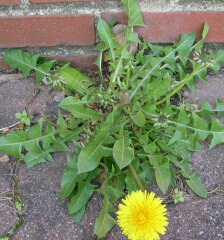
A rosette of leaves at the base of a dandelion
Rosette growth form of the liverwort Ricciocarpos natans.

In botany, a rosette is a circular arrangement of leaves or of structures resembling leaves.

In flowering plants, rosettes usually sit near the soil, but they can also be at the top of an otherwise leafless branch or trunk. Their structure is an example of a modified stem in which the internode gaps between the leaves do not expand, so that all the leaves remain clustered tightly together and at a similar height. Some insects induce the development of galls that are leafy rosettes.[1]

In bryophytes and algae, a rosette results from the repeated branching of the thallus as the plant grows, resulting in a circular outline.

Taxonomies

[edit]

Many plant families have varieties with rosette morphology; they are particularly common in Asteraceae (such as dandelions), Brassicaceae (such as cabbage), and Bromeliaceae. The fern Blechnum fluviatile or New Zealand Water Fern (kiwikiwi) is a rosette plant.

Function in flowering plants

[edit]

Often, rosettes form in perennial plants whose upper foliage dies back with the remaining vegetation protecting the plant. Another form occurs when internodes along a stem are shortened, bringing the leaves closer together, as in lettuce, dandelion and some succulents.[2] (When plants such as lettuce grow too quickly, the stem lengthens instead, a condition known as bolting.) In yet other forms, the rosette persists at the base of the plant (such as the dandelion), and there is a taproot.

Protection

[edit]
Rosette of leaves of Agave americana

Part of the protective function of a rosette like the dandelion is that it is hard to pull from the ground; the leaves come away easily while the taproot is left intact.

Another kind of protection is provided by the caulescent rosette, which is part of the growth form of the giant herb genus Espeletia in South America, which has a well-developed stem above the ground.[3] In tropical alpine environments, a wide variety of plants in different plant families and different parts of the world have evolved this growth form characterized by evergreen rosettes growing above marcescent leaves. Examples where this arrangement has been confirmed to improve survival, help water balance, or protect the plant from cold injury are Espeletia schultzii and Espeletia timotensis, both from the Andes.[4][5]

Form

[edit]

The rosette form is the structure, the relationship of the parts, and the variations within it, as shown in the following study from a herbarium:

  • Dryas octopetala (white dryas, Rosaceae) has a leaf rosette of leaf blades with a short petiole, slim, egg-shaped leaves with cordate bases with clearly and regularly toothed margins, and single flowers on usually long peduncles or stalks, two to four centimetres across. The flowers have seven to nine, often even more, white egg-shaped petals. The sepals are lanceolate.[6]
  • Silene nutans (Nottingham catchfly, Caryophyllaceae) shows ensiform-lanceolate leaves. The slightly rosette-like ground leaves are bigger and of different shape than the sparse, opposite leaves on the stem.[6] This is explained in that side shoots with greatly prolonged internodes may spring from rosettes. They have one or more flowers at their tip, like the primrose. Especially in biennial plants, the main shoot can grow with prolonged internodes and even branches. It is not unusual that the leaves of the rosette and those of the shoot differ in shape.[2]

As form, "rosette" is used to describe plants that perpetually grow as a rosette and the immature stage of plants such as some ferns.

See also

[edit]

References

[edit]
Revisions and contributorsEdit on WikipediaRead on Wikipedia
from Grokipedia
In , a rosette is a circular arrangement of leaves or leaf-like structures radiating from a central point, typically at or near the ground level, resulting from extremely short internodes that compress the stem. This morphology creates a tight cluster or whorl-like pattern, often seen in the basal portion of herbaceous . Rosettes can be basal, forming at ground level from the , or axillary, developing from buds along the stem as shortened shoots known as brachyblasts. The leaves in a rosette are usually arranged in a spiral or alternate fashion, though they appear whorled due to the condensed growth, and may vary in shape from lanceolate to broadly ovate depending on the . This form is common in both monocots and dicots, particularly in rosette plants where the shoot axis is strongly compressed. Many biennial and plants exhibit rosettes during their vegetative phase, such as the dandelion (), carrot (), cabbage (), and lettuce (Lactuca sativa), where the rosette persists through the first season before elongating into a flowering stem. In annuals like the desert plant Chorizanthe rigida, rosettes enable rapid ground-level establishment in arid environments. Functionally, rosettes optimize light interception by positioning leaves horizontally near the surface, enhance retention through overlapping structures, and protect the apical from environmental stresses like cold or herbivory. In some species, the rosette leaves also serve as storage organs for nutrients, supporting bolting and in the subsequent growth phase. This adaptation is widespread in temperate and Mediterranean climates, contributing to the plant's overwintering strategy in biennials.

Morphology

Definition

In , a rosette is defined as a circular arrangement of leaves or leaf-like structures radiating from a central point, typically arising from a very short stem or condensed axis characterized by minimal internode elongation. This structure contrasts with linear or alternate leaf arrangements by emphasizing a compact, radiating that originates close to the substrate. Key characteristics of a rosette include leaves emerging in a radial, symmetrical at or near ground level, often forming a flat or slightly domed disk-like structure that maximizes surface area for capture while minimizing vertical growth. Unlike whorled leaves, which occur along an elongated stem, rosettes feature this clustering primarily at the base due to the suppressed internodes. The term "rosette" derives from the French rosette, meaning "little rose," owing to the visual resemblance of the radiating organs to rose petals; it has been employed in botanical literature since the 18th century to denote basal leaf clusters in herbaceous plants. A classic illustration is the basal rosette of the dandelion (Taraxacum officinale), where lanceolate leaves radiate from the crown in a tight, overlapping circle prior to bolting.

Structural Features

The structural features of a botanical rosette are defined by a highly compressed stem axis, characterized by extremely short internodes, often measuring less than 1 mm in length, which results in leaves appearing to arise from a single basal node or despite their insertion at multiple, closely spaced nodes. This compression creates a radial, disk-like arrangement where the stem is barely visible, with leaves attached directly to the central or base. The central growing point, consisting of the apical , is situated at the core and enclosed by the overlapping bases of the leaves, providing a protected position amid the clustered foliage. Leaves in a rosette are typically simple, with shapes ranging from lanceolate to obovate, featuring entire or lobed margins that radiate outward in a horizontal or slightly ascending orientation to form a flat, circular pattern. These leaves emerge sequentially from the shortened nodes, contributing to the overall compact form without significant elongation between insertions. This arrangement differs from standard phyllotactic patterns such as alternate or leaf placement, where leaves are spaced along an elongated stem with longer internodes; in rosettes, the compression produces a pseudowhorled appearance, with leaves seemingly in a tight circle but actually staggered across minuscule internodal distances. Unlike true whorls, which involve three or more leaves emerging precisely from the same node in a symmetrical ring, rosette leaves occupy slightly offset positions on the compressed axis, avoiding exact radial alignment at any single point.

Classification

Types of Rosettes

Rosettes in are categorized primarily by their position relative to the stem, structural compactness, and growth , reflecting diverse morphological adaptations within vascular and non-vascular lineages. Basal rosettes form at ground level through clustering of leaves around a shortened stem, a common configuration in many herbaceous where internodes are greatly compressed. Cauline rosettes, in contrast, develop along elongated stems rather than at the base, often serving as secondary structures and occurring less frequently in the overall diversity of rosette forms. Succulent rosettes represent a specialized structural type characterized by compact, overlapping leaves that store water, typically in herbaceous or shrubby forms adapted to arid environments, with diverse sizes from small cushions to larger clusters. Sub-variations within rosettes further highlight their developmental stages and organizational patterns. Vegetative rosettes consist of leaves arranged without an associated , representing the pre-flowering growth phase in many . Reproductive rosettes, by comparison, feature an emerging centrally from the cluster, marking the transition to flowering. In non-vascular plants such as bryophytes, rosettes arise from branching that creates circular outlines, mimicking the radial symmetry of vascular rosettes but without true stems or leaves. The formation of rosettes generally results from determinate growth patterns involving suppressed internode elongation, which keeps leaves in close proximity around the shoot apex and produces the characteristic circular arrangement. Within this framework, leaf insertion patterns vary, including spiral phyllotaxy where leaves emerge in a helical sequence around the center, or distichous arrangements where they align in two opposite rows, both contributing to the overall rosette morphology. This suppression of internode growth, often influenced by and hormonal signals, aligns with the general structural feature of shortened internodes observed across rosette types. Certain rosette forms exhibit rarity or exceptions based on lifecycle duration. Temporary rosettes occur in monocarpic species, where the leaf cluster persists only until flowering and subsequent death of the rosette. In contrast, perennial rosettes are typical in hemicryptophytes, where renewal buds at or near the surface allow the rosette to regenerate annually over multiple years.

Taxonomic Distribution

Rosette morphology is predominantly observed in angiosperms, particularly among , where it represents a widespread growth form across diverse families. It is especially common in the , as exemplified by species like dandelions () that form basal leaf rosettes, the , including the model plant , and the , such as succulent genera like . This prevalence reflects the recurrent appearance of rosettes along the angiosperm phylogeny, often associated with limited internodal elongation that concentrates leaves in a compact basal arrangement. In contrast, rosettes are less frequent in monocots, though they occur in certain lineages like bromeliads, and are rare in gymnosperms, where leaf arrangements typically lack the compact circular clustering characteristic of rosettes. Outside angiosperms, rosette-like structures appear in more basal plant groups through analogous developmental processes. In ferns, basal rosettes form via clustering of fronds around a vertical stem or rhizome, as seen in sword ferns (Polystichum munitum) and holly ferns (Polystichum spp.), where the short internodes create a circular leaf display. Bryophytes exhibit rosette-like thalli from radial branching, notably in hornworts (Anthocerotophyta), whose gametophytes form rosettes with dorsal reproductive structures and ventral rhizoids. Similar radial growth patterns produce rosette forms in certain algae, such as thick-walled, clustered cells in snow algae like those in the genus Rosetta (Chlorophyta). The evolutionary distribution of rosettes highlights patterns of , particularly in temperate, arid, and alpine habitats where compact growth aids survival in seasonal or resource-limited conditions. This morphology has arisen independently in multiple lineages, such as giant rosette plants in the (e.g., ) and Campanulaceae (e.g., ), adapting to freeze-thaw cycles and elevation gradients. Distribution gaps are evident in tropical rainforests, where rosettes are rare due to competitive exclusion by taller, climbing vegetation in dense canopies; they are instead more prevalent in open, disturbed, or seasonal environments that favor low-growing forms.

Functions and Adaptations

Protective Functions

In rosette plants, the basal arrangement of leaves provides a key defense against herbivory by enabling the detachment of individual leaves through specialized zones at the petiole base, thereby preserving the central and apical from uprooting or severe damage. This autotomy-like mechanism is evident in species such as , where tensile stress causes leaves to fracture cleanly at the pulvinus, a notched structure at the leaf base, minimizing overall plant loss during by large herbivores like sheep. Similarly, in some dandelion species ( spp.), such as T. collinum, the low stature of rosette leaves (typically under 3 cm) avoids detection and consumption by , with experimental elevation of leaves leading to complete while natural forms remain intact, enhancing survival in environments. Meta-analyses confirm that selectively favors rosette architectures over erect forms, increasing their relative abundance in herbivore-impacted habitats due to reduced accessibility. The compact morphology of rosettes also shields the apical from abiotic stresses, including , , and , by maintaining a low profile close to the soil surface. In Afroalpine giant rosette plants like those in the genus , the dense leaf packing insulates the , preventing freezing temperatures from penetrating to vital tissues and allowing in leaves while core areas remain protected. This structure reduces by trapping humidity and limiting exposure to drying winds, a benefit observed in resurrection plants with rosette growth that tolerate extreme through morphological buffering. Additionally, the sheathing of dead leaves around the stem in species provides insulation against abiotic stresses and promotes post- resprouting, with morphological indicators correlating fire history to survival rates. The dense basal packing further mitigates wind damage to the crown and prevents by anchoring the and covering soil surfaces. Rosettes confer resistance to pathogens through structural and chemical means, with tight leaf bases forming physical barriers that inhibit fungal ingress. In Arabidopsis thaliana, the mature rosette core resists Botrytis cinerea infection via a jasmonate-dependent blockage at petiole-core junctions, where hyphae terminate without penetrating, supported by BLADE-ON-PETIOLE genes that establish developmental barriers akin to zones. This creates a microclimate less conducive to germination and spread, reducing systemic infection. In rosettes like dandelions, latex concentrated in leaf tissues serves as a chemical deterrent, with lactones such as taraxinic acid esters inhibiting feeding. Overall, these protective traits contribute to higher survival in threatened environments, with grazed rosette populations showing up to 100% avoidance in low-profile forms compared to fully exposed erect plants.

Developmental and Physiological Roles

In biennial and monocarpic plants, the rosette stage represents the vegetative phase of the life cycle, characterized by the formation of a basal cluster of leaves during the first growing season, as seen in carrots (), where this phase involves nutrient accumulation in the root prior to overwintering. This stage delays reproductive development, allowing the plant to build reserves before transitioning to flowering in the subsequent season through bolting, a rapid stem elongation process triggered by —a prolonged exposure to low temperatures that induces floral competence. In temperate biennials, this transition ensures synchronization with favorable conditions post-winter, preventing premature reproduction during harsh periods. Physiologically, the rosette's horizontal leaf orientation optimizes light interception in environments with low-angle sunlight, such as understory or alpine habitats, where erect leaves would receive suboptimal irradiance, enhancing photosynthetic efficiency during the vegetative phase. Additionally, thickened petioles in many rosette-forming species serve as storage sites for carbohydrates and nutrients, supporting a subsequent reproductive burst by mobilizing reserves for inflorescence development and seed production in monocarpic plants. This resource allocation strategy is particularly vital in biennials, where overwintering rosettes rely on stored energy to survive dormancy and fuel bolting upon spring warming. Hormonal regulation plays a central role in terminating the rosette stage, with (GAs) promoting internode extension and bolting by stimulating cell elongation in the stem apex, as demonstrated in () where GA application induces reproductive transition. In temperate rosette plants, integrates with this process; long-day conditions post-vernalization activate GA , overriding the compact growth habit and initiating flowering in overwintering species like . This hormonal-photoperiodic interplay ensures adaptive timing, aligning reproduction with seasonal cues. From an evolutionary perspective, mutations in genes such as TERMINAL FLOWER 1 (TFL1), a floral repressor, have facilitated shifts toward rosette-based flowering habits by altering identity and promoting determinate inflorescences from the rosette apex, as observed in mutants that bypass prolonged vegetative growth. Such genetic changes have evolved convergently across multiple angiosperm lineages, enhancing semelparous —where flower once and senesce—by coupling the rosette's resource storage with a single, energy-intensive reproductive event, thereby improving fitness in unpredictable environments. This convergence underscores the rosette's role in diversifying life history strategies beyond perennial habits.

References

Add your contribution
Related Hubs
User Avatar
No comments yet.