


Community hub
Recent from talks
Contribute something
Nothing was collected or created yet.
Western Province, Sri Lanka
View on Wikipedia
Key Information


.png)


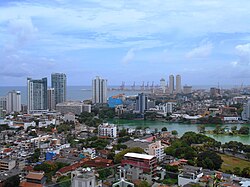
The Western Province (Sinhala: බස්නාහිර පළාත Basnāhira Paḷāta; Tamil: மேல் மாகாணம் Mael Mākāṇam) is one of the nine provinces of Sri Lanka, the first level administrative division of the country. The provinces have existed since the 19th century but did not have any legal status until 1987 when the 13th Amendment to the Constitution of Sri Lanka established provincial councils.[4][5] Western Province is the most densely populated province in the country and is home to the legislative capital Sri Jayawardenepura Kotte as well as to Colombo, the nation's administrative and business center.
History
[edit]Parts of present-day Western Province were part of the pre-colonial Kingdom of Kotte. The province then came under Portuguese, Dutch and British control. In 1815 the British gained control of the entire island of Ceylon. They divided the island into three ethnic based administrative structures: Low Country Sinhalese, Kandyan Sinhalese and Tamil. The Western Province was part of the Low Country Sinhalese administration. In 1833, in accordance with the recommendations of the Colebrooke-Cameron Commission, the ethnic based administrative structures were unified into a single administration divided into five geographic provinces.[6] The districts of Chilaw, Colombo, Kalutara, Puttalam, Seven Korales (present day Kurunegala District), Three Korales, Four Korales and Lower Bulatgama (present day Kegalle District) formed the new Western Province.[7] Chilaw District, Puttalam District and Seven Korales were transferred to the newly created North Western Province in 1845.[8] Three Korales, Four Korales and Lower Bulatgama were transferred to the newly created Sabaragamuwa Province in 1889.[9]
It is planned to create a planned Megacity under the Western Region Megapolis Plan in the Western Province designed by Surbana. Originally initiated in 2004 by Ranil Wickremesinghe it was stopped after his election defeat and was restarted again after his return to power in 2015. The project plans to merge Colombo, Gampaha and Kalutara districts and introduce zoning.[10][11]
Geography and climate
[edit]Western Province is located in the southwest of Sri Lanka. It has an area of 3,684 square kilometres (1,422 sq mi), making it the smallest of the country's nine provinces.[1] The province is surrounded by the Laccadive Sea to the west, North Western Province to the north, Sabaragamuwa Province to the east and the Southern Province to the south.
The Western Province is vulnerable to recurrent flooding as a result of an increase in average rainfall coupled with heavier rainfall events, with knock-on impacts on the infrastructure, utility supply, and the urban economy of the Province. As the most urbanised province in Sri Lanka, these climate events pose a number of problems due to the rapid urban growth the province has undergone.[12]
Administrative divisions
[edit]Districts
[edit]The Western Province is divided into three administrative districts, 40 Divisional Secretary's Divisions (DS Divisions) and 2,505 Grama Niladhari Divisions (GN Divisions).
| District | Capital | District Secretary | DS Divisions |
GN Divisions [13][14][15] |
Total Area (km2)[1] |
Land Area (km2)[1] |
Population (2012 Census)[2] | Population Density (/km2) | |||||
|---|---|---|---|---|---|---|---|---|---|---|---|---|---|
| Sinhalese | Sri Lankan Moors | Sri Lankan Tamil | Indian Tamil | Other | Total | ||||||||
| Colombo | Colombo | Sunil Kannangara | 13 | 566 | 699 | 676 | 1,771,319 | 242,728 | 231,318 | 27,336 | 37,108 | 2,309,809 | 3,304 |
| Gampaha | Gampaha | J. J. Rathnasiri | 13 | 1,177 | 1,387 | 1,341 | 2,079,115 | 95,501 | 80,071 | 10,879 | 29,075 | 2,294,641 | 1,654 |
| Kalutara | Kalutara | U. D. C. Jayalal | 14 | 762 | 1,598 | 1,576 | 1,054,991 | 112,276 | 24,362 | 23,611 | 2,020 | 1,217,260 | 762 |
| Total | 40 | 2,505 | 3,684 | 3,593 | 4,905,425 | 450,505 | 335,751 | 61,826 | 68,203 | 5,821,710 | 1,580 | ||
Major population centres
[edit].jpg)
| Rank | District | Pop. | |||||||
|---|---|---|---|---|---|---|---|---|---|
| 1 | Colombo | Colombo | 639,818 | ||||||
| 2 | Kaduwela | Colombo | 252,041 | ||||||
| 3 | Dehiwala-Mount Lavinia | Colombo | 219,827 | ||||||
| 4 | Maharagama | Colombo | 196,423 | ||||||
| 5 | Moratuwa | Colombo | 185,031 | ||||||
| 6 | Kesbewa | Colombo | 245,232 | ||||||
| 7 | Negombo | Gampaha | 137,223 | ||||||
| 8 | Sri Jayawardenepura Kotte | Colombo | 115,826 | ||||||
| 9 | Gampaha | Gampaha | 9,350 | ||||||
| 10 | Katunayake | Gampaha | 84,643 | ||||||
Demographics
[edit]Population
[edit]The Western Province's population was 6,219,000 in 2021.[18] The majority of the population are Sinhalese, with a minority Sri Lankan Moor and Sri Lankan Tamil population.
Ethnicity
[edit]| Year | Sinhalese | Sri Lankan Moors | Sri Lankan Tamil | Indian Tamil | Other | Total No. | |||||
|---|---|---|---|---|---|---|---|---|---|---|---|
| No. | % | No. | % | No. | % | No. | % | No. | % | ||
| 1981 Census | 3,321,830 | 84.74% | 238,728 | 6.09% | 228,516 | 5.83% | 59,402 | 1.51% | 71,331 | 1.82% | 3,919,807 |
| 2001 Census | 4,530,918 | 84.20% | 374,729 | 6.96% | 325,706 | 6.05% | 61,337 | 1.14% | 88,507 | 1.64% | 5,381,197 |
| 2012 Census | 4,905,425 | 84.26% | 450,505 | 7.74% | 335,751 | 5.77% | 61,826 | 1.06% | 68,203 | 1.17% | 5,821,710 |
Religion
[edit]| Year | Buddhist | Christian[a] | Muslim | Hindu | Other | Total No. | |||||
|---|---|---|---|---|---|---|---|---|---|---|---|
| No. | % | No. | % | No. | % | No. | % | No. | % | ||
| 1981 Census | 2,885,789 | 73.62% | 556,581 | 14.20% | 279,639 | 7.13% | 194,000 | 4.95% | 3,798 | 0.10% | 3,919,807 |
| 2001 Census | 3,942,171 | 73.26% | 721,115 | 13.40% | 441,397 | 8.20% | 271,777 | 5.05% | 4,737 | 0.09% | 5,381,197 |
| 2012 Census | 4,288,797 | 73.67% | 752,993 | 12.93% | 500,992 | 8.61% | 274,336 | 4.71% | 4,592 | 0.08% | 5,821,710 |
Economy
[edit]
The Western province provides the highest contribution to the Gross Domestic Product contributing 41.2% of the Provincial Gross Domestic Product(PGDP) and has a nominal PGDP growth rate of 5.8% as of 2015. Agriculture only made up 1.7% of the GDP the lowest among the nine provinces while Industrial sector made up 34.6% the highest in the country and service sector represented 56.5%.[21]
The province is undergoing rapid development with several of the largest infrastructure development projects happening in the province such as the Colombo International Financial City(CIFC) which is an International Financial Zone and the Western Region Megapolis Planning Project(WRMPP)[22][23][24][25] Western province is also undergoing a major real estate and construction boom with residential and commercial buildings and skyscrapers changing the skylines of cities such as Colombo and Rajagiriya. Several major residential, office and hotel buildings as well as resorts and malls are either proposed or under construction.[26][27][28]
The Colombo Harbour is also a major driver of economic growth being the busiest port in South Asia. It has both privately run and state owned terminals and is being expanded.[29][30]
Education
[edit]
Almost all the premier educational institutions in the island are located in the Western Province. Universities in the province includes the University of Colombo, University of Kelaniya, University of Moratuwa, University of Sri Jayewardenepura, Open University, Sri Lanka, Buddhist and Pali University of Sri Lanka, General Sir John Kotelawala Defence University, National Institute of Business Management and the Sri Lanka Institute of Information Technology. Having the highest population in all the provinces, Western Province has the largest number of schools in the country, which includes national, provincial, private and international schools.
Transportation
[edit]Expressways in Western Province
[edit]International Highways in Western Province
[edit]
National Highways in Western Province
[edit]See also
[edit]Notes
[edit]- ^ Roman Catholic and Other Christian.
References
[edit]- ^ a b c d "Area of Sri Lanka by province and district" (PDF). Statistical Abstract 2011. Department of Census & Statistics, Sri Lanka.
- ^ a b c d "A2 : Population by ethnic group according to districts, 2012". Census of Population & Housing, 2011. Department of Census & Statistics, Sri Lanka. Archived from the original on 28 April 2017. Retrieved 8 December 2013.
- ^ a b "A3 : Population by religion according to districts, 2012". Census of Population & Housing, 2011. Department of Census & Statistics, Sri Lanka. Archived from the original on 7 January 2019. Retrieved 8 December 2013.
- ^ "Provinces of Sri Lanka". Statoids.
- ^ "Provincial Councils". Government of Sri Lanka.
- ^ Mills, Lennox A. (1933). Ceylon Under British Rule (1795 - 1932). London: Oxford University Press. pp. 67–68.
- ^ Mendis, G. C. (1946). Ceylon Under the British (2nd (revised) ed.). Colombo: The Colombo Apothecaries Co. pp. 39–40.
- ^ Medis, G. C. (1946). Ceylon Under the British (2nd (revised) ed.). Colombo: The Colombo Apothecaries Co. p. 51.
- ^ Medis, G. C. (1946). Ceylon Under the British (2nd (revised) ed.). Colombo: The Colombo Apothecaries Co. p. 85.
- ^ "What is the Singapore-styled Western Region Megapolis plan for Colombo? | Adaderana Biz English | Sri Lanka Business News". bizenglish.adaderana.lk. 5 May 2015. Retrieved 30 January 2016.
- ^ "Project Megapolis explained - Colombo, Gampaha, Kalutara to merge - Newsfirst". Sri Lanka News - Newsfirst | News1st | newsfirst.lk | Breaking. 26 January 2016. Retrieved 30 January 2016.
- ^ Integrating urban agriculture and forestry into climate change action plans: Lessons from Sri Lanka, Marielle Dubbeling, the Climate and Environment Knowledge Network, 2014
- ^ "Grama Niladhari Divisions". Colombo District Secretariat. Archived from the original on 12 December 2013. Retrieved 8 December 2013.
- ^ "Grama Niladhari Divisions". Gampaha District Secretariat. Archived from the original on 12 December 2013. Retrieved 8 December 2013.
- ^ "Grama Niladhari Divisions". Kalutara District Secretariat. Archived from the original on 12 December 2013. Retrieved 8 December 2013.
- ^ "Area, Population, Registered voters and Employees of Municipalities, 2011 - 2012" (PDF). Statistics Statistical Abstract 2013. Department of Census and Statistics Sri Lanka. Archived from the original (PDF) on 13 December 2014. Retrieved 5 December 2014.
- ^ "Table 2.4# Population of Municipal Councils and Urban Councils by sex Census, 2012". Department of Census and Statistics.
- ^ Cite error: The named reference
2021ethwas invoked but never defined (see the help page). - ^ "Population by ethnic group and district, Census 1981, 2001" (PDF). Statistical Abstract 2011. Department of Census & Statistics, Sri Lanka.
- ^ "Population by religion and district, Census 1981, 2001" (PDF). Statistical Abstract 2011. Department of Census & Statistics, Sri Lanka.
- ^ "Provincial Gross Domestic Product – 2015" (PDF). cbsl.gov.lk. Archived from the original (PDF) on 3 February 2017. Retrieved 29 January 2017.
- ^ "Government Signs Tripartite Agreement for Colombo International Financial City". Archived from the original on 22 April 2019. Retrieved 29 January 2017.
- ^ "Sri Lanka to create international financial zone where people can also park their money".
- ^ "Megapolis: Part 1 ‒ What To Expect".
- ^ "The Western Region Megapolis Master Plan and the Megapolis Authority".
- ^ Nizar, Ahamed. "The Colombo Skyline - Roar.lk". roar.lk. Retrieved 29 January 2017.
- ^ Haniff, Hakiem. "Colombo's Changing Skyline (Part II) - Roar.lk". roar.lk. Retrieved 29 January 2017.
- ^ "Real Estate Market Update: Roaring Rajagiriya | The Sunday Times Sri Lanka". www.sundaytimes.lk. Retrieved 29 January 2017.
- ^ "Colombo breaks through as South Asia's next big transshipment port". www.joc.com. Archived from the original on 11 January 2017. Retrieved 31 January 2017.
- ^ "Sri Lanka: An Emerging Logistics Hub in South Asia | Hong Kong Means Business". Hong Kong Means Business. Retrieved 31 January 2017.
External links
[edit]
Places adjacent to Western Province, Sri Lanka | |
|---|---|


| Geographic | |
|---|---|
| Other | |

Western Province, Sri Lanka
View on GrokipediaHistory
Ancient and medieval periods
The western coastal regions of what is now the Western Province show evidence of early human activity dating to the prehistoric period, with settlements likely established by coastal migrants who expanded inland along rivers such as the Kelani Ganga. Archaeological findings indicate that these areas were among the first inhabited parts of the island, facilitating initial riverine villages and resource exploitation before the rise of centralized kingdoms.[5] During the Anuradhapura Kingdom era (circa 437 BCE–1017 CE), the western coast fell under the influence of Sinhalese rulers centered in the north-central interior, with local polities maintaining semi-autonomy while contributing to broader administrative and religious networks. Sites like Kelaniya, an ancient city and kingdom near the Kelani River, hosted significant Buddhist establishments, including the Kelaniya Raja Maha Vihara, constructed prior to 543 BCE and renovated around 307 BCE by Prince Uttiya, serving as a key monastic center linked to early Theravada traditions.[6] Other cave temples in the Gampaha area, such as Pilikuththuwa Raja Maha Vihara, preserve artifacts from this period, underscoring the extension of Anuradhapura's patronage to coastal viharas for trade oversight and religious propagation.[7] Maritime trade flourished along the western seaboard from at least the 2nd century BCE, with ports like Kolonthota (precursor to modern Colombo) at the Kelani Ganga estuary enabling exchanges of spices, gems, and textiles with Indian, Arab, and later Chinese merchants, integrating the region into Indian Ocean networks.[7] These hubs supported the export of cinnamon and pearls, drawing foreign vessels and fostering multicultural settlements without supplanting indigenous Sinhalese dominance. In the medieval period (circa 13th–16th centuries), political power shifted southward following the decline of Polonnaruwa, with the Kingdom of Kotte emerging as a fortified stronghold near present-day Colombo from 1415 CE, under rulers like Parakramabahu VI (1412–1467 CE), who unified much of the island against invasions. Kotte's ramparts, moats, and citadel exemplified defensive architecture adapted to swampy terrain, protecting trade routes and royal residences while patronizing Buddhist institutions like expanded Kelaniya complexes.[8] This era solidified the province's role as an economic pivot, with royal edicts promoting irrigation and temple construction amid Chola incursions, until internal divisions weakened it pre-colonially.[8]Colonial era
The Portuguese first made contact with the island in 1505, when a fleet commanded by Lourenço de Almeida anchored in Colombo Harbour after being driven off course by adverse winds.[9] In 1518, they obtained permission from local rulers to construct a stone fort in Colombo, which served as a strategic base to dominate the lucrative spice trade, particularly cinnamon, pepper, and areca nuts sourced from the southwestern coasts.[10] This fortification solidified Portuguese control over key trade routes in the western lowlands, enabling them to enforce monopolies and extract tribute from indigenous kingdoms while suppressing Arab and local merchants.[11] The Dutch East India Company ousted the Portuguese from Colombo in 1658 after a prolonged siege, assuming control of the coastal territories encompassing present-day Western Province.[12] Unlike their predecessors' broader conquests, the Dutch prioritized economic exploitation, securing a monopoly on cinnamon production and export from the region's cinnamon-peeling castes, which generated substantial revenue through regulated quotas and auctions.[13] They also imposed Roman-Dutch law as the framework for civil administration, inheritance, and property rights in the conquered areas, blending it with local customs and leaving a lasting imprint on land tenure and legal precedents.[14] British forces captured Dutch holdings in Sri Lanka in 1796 amid the Napoleonic Wars, but full unification occurred in 1815 with the annexation of the inland Kandyan Kingdom via the Kandyan Convention, incorporating the western coasts into a single colonial administration centered in Colombo.[15] The British transformed the Western Province into the island's primary commercial gateway, investing in infrastructure such as the Colombo-Kandy railway line opened in 1867 to transport plantation crops like coffee and tea from upland estates to the port.[16] This connectivity spurred export-oriented agriculture in the lowlands, including coconut and rubber plantations, while Colombo evolved into a fortified harbor and administrative hub handling over 80% of the colony's trade by the late 19th century.[17]Post-independence developments
Following Sri Lanka's attainment of independence from Britain on February 4, 1948, the Western Province, anchored by Colombo, consolidated its position as the country's administrative, commercial, and financial nucleus, drawing migrants from rural areas and other provinces in search of employment and services.[18] This influx contributed to accelerated urbanization, with the province's population share rising amid national growth from approximately 6.5 million in 1948 to over 10 million by 1971, as Colombo's metropolitan area expanded to accommodate administrative functions and trade hubs like the Port of Colombo.[19][20] Economic policies in the post-independence era prioritized centralization in the Western Province, which became Sri Lanka's economic core due to inherited colonial infrastructure including ports, railways, and urban amenities that facilitated commerce and governance.[21] From the late 1950s onward, state-led initiatives expanded public sector employment and infrastructure, such as road networks linking Colombo to surrounding districts like Gampaha and Kalutara, reinforcing the province's dominance in services and light industry.[22] In the 1960s and 1970s, import substitution industrialization (ISI) policies drove manufacturing expansion, with protections for domestic production leading to growth in textiles, cement, chemicals, and consumer goods factories clustered in the Western Province to capitalize on access to imported inputs via Colombo's port and proximity to labor pools.[23][24] These measures, including tariffs and subsidies, increased industrial output—textile production alone rose significantly under state-owned mills like those in Colombo and its suburbs—but also entrenched regional disparities by favoring the province's established urban base over peripheral areas.[25] The 1978 constitution introduced a pivotal administrative reconfiguration, establishing Sri Jayawardenepura Kotte, a suburb within Colombo District in the Western Province, as the legislative capital to alleviate overcrowding in central Colombo while preserving the latter's commercial primacy.[26][27] This shift, effective from the late 1970s, involved relocating parliamentary buildings and some ministries to the new site, yet economic centralization persisted, with the province accounting for over half of national GDP contributions by the decade's end due to sustained policy focus on urban-industrial hubs.[21]Civil War era and post-2009 recovery
During the Sri Lankan Civil War from 1983 to 2009, Western Province functioned as the primary economic and administrative hub for the government, hosting key military logistics and serving as a refuge for internally displaced persons fleeing violence in the northern and eastern provinces.[28] Colombo, the provincial capital, experienced over 100 LTTE-attributed attacks, including suicide bombings and the 2001 Bandaranaike International Airport assault that destroyed aircraft worth $500 million, yet remained under full government control without LTTE territorial gains or sustained ground incursions.[29] The influx of Tamil refugees strained urban resources, with estimates of up to 100,000 displaced persons settling in Colombo by the mid-1990s, contributing to informal settlements and heightened security measures.[30] Defense expenditures in Sri Lanka escalated from 1.6% of GDP in 1983 to a peak of 5.9% by the late 2000s, diverting funds from civilian infrastructure and imposing fiscal pressure on the province's economy, which accounted for over 40% of national GDP.[31] This military prioritization supported logistics for offensives but correlated with reduced growth in non-defense sectors, as war-related disruptions limited foreign investment and tourism in the capital region.[32] The government's military defeat of the LTTE on May 18, 2009, shifted focus to reconstruction in Western Province, enabling rapid infrastructure projects such as the Colombo Port's South Harbour expansion, which added capacity for 20 million TEUs annually by 2015 through investments exceeding $500 million.[33] Post-war economic liberalization facilitated job growth in services and construction, drawing an estimated 200,000 northern Tamils to Colombo between 2010 and 2015 for employment opportunities, diversifying the urban workforce while integrating former conflict zones' labor into the provincial economy.[34] This migration altered Colombo's demographic dynamics, increasing Tamil representation in low-wage sectors amid rapid urbanization, but posed no notable separatist risks, as LTTE remnants lacked operational capacity in the government-secured southwest.[35] Provincial stability supported national recovery, with GDP growth averaging 6-8% annually in the early 2010s, bolstered by port-driven trade volumes that rose 15% yearly post-2009.[36]Geography
Physical features and topography
The Western Province occupies a predominantly low-lying coastal position on Sri Lanka's southwest seaboard, characterized by flat alluvial plains that form the coastal belt, with elevations typically ranging from sea level to under 100 meters. This terrain transitions gradually inland to undulating foothills and low ridges paralleling the coast, marking the southwestern extension of the island's broader plain region before ascending toward the central highlands. The flat topography supports dense settlement and infrastructure development but limits elevation-driven drainage in low areas.[37][38] The Kelani River serves as the province's primary waterway, originating from the western slopes of the central highlands near the Horton Plains and flowing 145 kilometers westward through Gampaha and Colombo districts to discharge into the Indian Ocean at Colombo. Its basin covers 2,292 square kilometers, encompassing much of the province's northern and central areas, where it deposits fertile sediments that underpin rice cultivation and provides essential surface water for urban and agricultural use. The river's meandering course across the low-gradient plains exacerbates seasonal inundation risks in downstream reaches.[39][40][41] Geologically, the province rests on Precambrian high-grade metamorphic rocks forming part of Sri Lanka's stable cratonic basement, which exhibits minimal tectonic activity and low seismicity compared to surrounding plate boundaries. This ancient foundation, dating back over 2 billion years in places, underlies the sedimentary veneers of the coastal plains but offers scant metallic mineral deposits, with local exploitation limited to non-metallics such as clay for ceramics and quartz aggregates for construction. The coastal exposure, however, renders the region susceptible to oceanic hazards, including the 2004 Indian Ocean tsunami that inundated low-lying areas up to several kilometers inland, highlighting the interplay between stable bedrock and hydrodynamic vulnerabilities.[42][43][44]Climate patterns
The Western Province of Sri Lanka experiences a tropical monsoon climate, dominated by the southwest monsoon from May to September, which delivers heavy rainfall primarily to coastal and low-lying areas. During this period, known as the Yala season, precipitation peaks due to moist winds from the Indian Ocean, with Colombo recording an average of approximately 2,400 mm of annual rainfall, much of it concentrated in these months. This seasonal deluge supports paddy cultivation and influences urban drainage systems, though it can lead to disruptions in transportation and daily activities.[45][46] Inter-monsoon periods, particularly from December to March and shorter transitions in April and October-November, feature reduced rainfall and clearer skies, though humidity remains elevated at 70-90%. Temperatures throughout the year hover between 27°C and 31°C, with minimal seasonal variation owing to the province's proximity to the equator and maritime influence. Nighttime lows rarely drop below 25°C, contributing to a consistently warm environment that affects energy demands for cooling in residential and commercial sectors.[45][47] In urban centers like Colombo, the urban heat island effect exacerbates ambient temperatures, with surface and air temperatures in densely built districts rising 2-5°C above surrounding rural or vegetated areas, particularly during dry periods due to concrete absorption of solar radiation and reduced evapotranspiration. This phenomenon, documented through satellite and ground-based measurements, intensifies heat stress in high-density zones, influencing microclimates and requiring adaptive measures in agriculture and public health planning.[48][49]Environmental challenges
The Western Province, encompassing Sri Lanka's most urbanized areas including Colombo, experiences elevated air pollution primarily from vehicular emissions and industrial activities. Annual average PM2.5 concentrations in Colombo reached 25.2 µg/m³ as of recent monitoring, exceeding the World Health Organization's guideline of 5 µg/m³ by a factor of five, with traffic-congested zones recording averages up to 115.5 µg/m³.[50][51] These levels classify ambient air quality as unhealthy for sensitive groups much of the time, driven by high vehicle density and inadequate emission controls in the province's dense road networks.[52] Water bodies in the province, such as the Kelani River basin, suffer contamination from untreated industrial effluents and sewage discharge, leading to elevated heavy metals and organic pollutants. In the lower Kelani River, machine learning analyses identified industrial sources as primary contributors to pollution indices, with physico-chemical parameters indicating degradation suitable for limited aquatic uses only.[53][54] Surface water pollution stems causally from insufficient wastewater treatment infrastructure amid rapid industrialization, affecting groundwater recharge and downstream ecosystems in urban-industrial zones.[55] Urban expansion has fragmented wetlands and reduced forest cover, notably in the Muthurajawela Marsh, where settlement growth increased by 39.4% from 1980 to 2020, correlating with a 33.7% decline in native vegetation and wetland habitats.[56] This land conversion diminishes biodiversity, as urbanization encroaches on peatlands supporting endemic species, with spatial analyses showing direct wetland loss to built-up areas.[57] Empirical mapping confirms that such fragmentation in the province's coastal lowlands erodes natural buffers against environmental stressors. Coastal erosion along the province's shores has intensified due to sand mining, unplanned development, and sea-level rise, with rates accelerating to threaten infrastructure and livelihoods as of 2023 assessments.[58] Poor waste management exacerbates flood vulnerabilities in Colombo, where illegal dumping clogs canals and reduces wetland capacity, empirically linking unmanaged solid waste to heightened inundation during monsoons—40% of floodwater historically buffered by degraded ecosystems.[59][60] Infrastructure maintenance failures, including canal blockages from effluents and debris, causally amplify risks in low-lying urban areas.[61]Administrative Structure
Districts and local governance
The Western Province is administratively divided into three districts: Colombo, Gampaha, and Kalutara.[62] These districts form the basic units for local administration, each headed by a District Secretary responsible for coordinating central government functions, while broader provincial oversight is provided by a Governor appointed by the President of Sri Lanka.[63] The Governor acts as the chief executive, ensuring alignment between provincial policies and national directives, particularly in devolved areas.[64] Under the 13th Amendment to the Constitution, enacted on November 13, 1987, powers were devolved to provincial councils to manage subjects such as education, health, agriculture, housing, and aspects of local infrastructure.[65] The Western Provincial Council, established on June 22, 1988, pursuant to the Provincial Councils Act No. 42 of 1987, exercises legislative authority over these devolved matters through statutes and oversight of provincial ministries.[66] This structure promotes decentralized decision-making, though executive implementation remains subject to gubernatorial approval and central intervention where national interests prevail.[67] Local governance within the districts operates through a tiered system of authorities, including municipal councils for major urban centers, urban councils for smaller towns, and pradeshiya sabhas for rural areas, elected under the Local Authorities Elections Ordinance.[63] These bodies handle services like sanitation, roads, and markets, funded partly by local revenue sources such as property rates and licenses. Governance efficiency varies, with urban-dominated districts like Colombo demonstrating superior revenue mobilization; for instance, local authorities in the Western Province accounted for over 45% of national local government revenue in 2017, largely from assessment taxes in commercial hubs, compared to lower yields in more rural Kalutara. This disparity reflects higher economic density and enforcement capacity in urban settings, enabling better service delivery but highlighting challenges in equitable resource distribution across districts.[68]Major urban centers
Colombo, the principal urban center in the Western Province, dominates as Sri Lanka's commercial and financial hub, characterized by high-rise office buildings and the Port of Colombo, which manages over 50% of the nation's container traffic. The Colombo District encompasses a population of 2.46 million residents as of 2023, reflecting dense urban development with an urbanization rate of 96.74% according to recent surveys.[69][70] In the Gampaha District, Negombo emerges as a vital satellite city, sustaining a population of approximately 142,000 and bolstering regional economies through its fishing industry, garment manufacturing, and proximity to export processing zones. The city's coastal location supports a major lagoon-based fishery, contributing significantly to national seafood production and processing.[71][72] Kalutara District's urban areas, including Kalutara town and Beruwela, emphasize tourism-driven growth along the southwest coast, with developments focused on beach resorts and heritage sites attracting domestic and international visitors. The district's population reached 1.22 million by the 2012 census, with urban concentrations in coastal municipalities fostering hospitality and related services as key economic drivers.[73][74]Divisional and local administrative units
The Western Province of Sri Lanka is divided into 40 Divisional Secretariats, serving as the principal sub-district administrative units responsible for implementing national policies and delivering essential services such as civil registrations for births, marriages, and deaths; issuance of permits for liquor, timber transport, and land use; pension payments; and coordination of welfare programs including social services for vulnerable populations.[75][76] These secretariats, distributed as 13 in Colombo District, 13 in Gampaha District, and 14 in Kalutara District, oversee smaller Grama Niladhari divisions for grassroots implementation, focusing on land administration, poverty alleviation, and regulatory enforcement.[77][78][79] Complementing the Divisional Secretariats are local elected bodies, including 29 Pradeshiya Sabhas for rural areas and 13 Urban Councils for semi-urban locales, which enact bylaws governing sanitation, solid waste management, drainage maintenance, and regulation of public markets and thoroughfares.[62] These units handle practical service delivery like waste collection receptacles and drain repairs, often in coordination with Divisional Secretariats, though jurisdictional overlaps in areas such as land-related permits can necessitate inter-agency alignment for efficient execution.[80][81] Coordination among these units proved challenging during the 2022 economic crisis, particularly amid fuel shortages that disrupted routine verifications, permit issuances, and welfare distributions, as logistical constraints hampered field operations and resource allocation across urban and rural secretariats.[82] In urban-heavy divisions like those in Colombo District, service continuity relied more on centralized support, highlighting disparities in responsiveness tied to infrastructure density rather than rural equivalents.Demographics
Population dynamics and trends
The Western Province of Sri Lanka recorded a population of 6,113,698 in the preliminary results of the 2024 Census of Population and Housing, up from 5,851,130 in the 2012 census.[1][83] This inter-census increase of 262,568 persons equates to an average annual growth rate of 0.34 percent, below the national average of 0.5 percent for the same period.[1] The province's land area spans 3,684 square kilometers, yielding a population density of approximately 1,660 persons per square kilometer—the highest in the country—primarily driven by sustained rural-to-urban migration toward industrial and service hubs.[84]| Census Year | Population | Annual Growth Rate (to next census) |
|---|---|---|
| 2012 | 5,851,130 | 0.34% (2012–2024) |
| 2024 | 6,113,698 | — |
Ethnic and linguistic composition
The Western Province of Sri Lanka exhibits a demographic profile dominated by the Sinhalese ethnic group, comprising 84.2% of the population according to the 2012 census conducted by the Department of Census and Statistics.[89] Sri Lankan Moors account for 7.9%, while Tamils (including both Sri Lankan and Indian subgroups) constitute 6.8%, with the remainder consisting of smaller groups such as Burghers, Malays, and others.[89] This distribution reflects the province's role as Sri Lanka's economic and urban core, particularly in Colombo District, where historical maritime trade since ancient times fostered a relatively higher concentration of minorities compared to rural Sinhalese-majority areas like Gampaha and Kalutara districts.[18] Linguistically, Sinhala serves as the predominant language, spoken by approximately 84% of residents as their mother tongue, aligning closely with the Sinhalese majority and used in daily administration, education, and commerce outside elite urban sectors.[89] Tamil is the second most common language, utilized by around 15% of the population, primarily among Moors and Tamils in commercial hubs.[89] English proficiency is notably higher here than the national average of 24%, driven by Colombo's status as a global trade port and its colonial legacy, facilitating bilingualism in professional and international business contexts without displacing local languages.[90] Unlike the northern and eastern provinces, where Tamil-majority areas experienced prolonged separatist conflict, the Western Province has maintained relative ethnic harmony, evidenced by the absence of major insurgent activity and the empirical coexistence in mixed urban neighborhoods such as those in Colombo, where market-driven interactions have historically promoted integration over segregation.[91] This stability is attributable to economic interdependence in trade-oriented settlements, reducing silos as observed in census data showing dispersed minority populations integrated into Sinhalese-majority locales.[89]Religious demographics
According to the 2012 Census of Population and Housing conducted by Sri Lanka's Department of Census and Statistics, Buddhism is the predominant religion in the Western Province, with adherents numbering approximately 4.29 million, or 73.4% of the provincial population of 5.85 million.[84] Christianity follows at 13.2% (around 774,000 individuals, predominantly Roman Catholics), Islam at 8.6% (about 501,000), and Hinduism at 4.8% (roughly 279,000), with negligible other religions or unspecified affiliations under 0.1%.[84] These figures reflect the province's urban character, particularly in Colombo, where minority faiths have historically concentrated due to colonial-era influences and trade, resulting in higher Christian and Muslim proportions compared to the national averages of 7.4% and 9.7%, respectively.[92] Buddhism's cultural and historical primacy is underscored by ancient temple complexes such as the Kelaniya Raja Maha Vihara in Gampaha District, a site traditionally linked to the Buddha's third visit to Sri Lanka around the 5th century BCE and renovated under King Devanampiya Tissa in the 3rd century BCE. Other prominent Buddhist institutions include the Gangaramaya Temple in Colombo, established in the 19th century but incorporating relics and artifacts spanning centuries, serving as centers for Theravada practice, education, and community rituals that reinforce Buddhism's role in provincial identity. Hindu, Muslim, and Christian sites, while significant—such as kovils in Colombo's Wellawatte area for Tamil Hindus, the Jami Ul-Alfar Mosque (Red Mosque) in Pettah for Muslims, and St. Lucia's Cathedral for Catholics—remain secondary in scale and influence to Buddhist establishments.[93]| Religion | Population (2012) | Percentage |
|---|---|---|
| Buddhism | 4,293,901 | 73.4% |
| Christianity | 773,516 | 13.2% |
| Islam | 501,389 | 8.6% |
| Hinduism | 278,968 | 4.8% |
| Other | 3,356 | 0.1% |