.jpg/2000px-USS_Oak_Hill,_26th_MEU_Marines_Visit_Batumi,_Georgia_(40817303032).jpg)

Batumi
View on Wikipedia
Batumi (/bɑːˈtuːmi/; Georgian: ბათუმი pronounced [ˈb̥a'tʰu.mi] ⓘ), historically Batum[2] or Batoum,[3] is the second-largest city of Georgia and the capital of the Autonomous Republic of Adjara. Located on the eastern shore of the Black Sea, about 20 kilometres (12 mi) north of the Georgia–Turkey border, Batumi lies at the foot of the Caucasus Mountains in a humid subtropical zone. As one of the country’s principal urban centers, it serves as a major seaport, commercial hub, and cultural gateway between Europe and Asia.[4]
Key Information

.jpg)
.jpg)
.jpg)


The city has played a significant role in the history of the south-eastern Black Sea region due to its deep-water harbor and strategic position along regional trade routes. Over the centuries, Batumi has been ruled by the Kingdom of Georgia, the Ottoman Empire, the Russian Empire, and the Soviet Union, each leaving distinct cultural and architectural imprints. Its economy historically relied on maritime trade and oil transit, particularly following the construction of the Baku–Batumi pipeline in the early 20th century. Today, it remains a key transit point for Caspian energy exports and regional commerce.
Since the early 2000s, Batumi has undergone rapid modernization, with large-scale investments in tourism, high-rise development, and transport infrastructure. It is often referred to as the “Las Vegas of the Black Sea”[5] for its gambling industry, modern hotels, and nightlife, while also being known for restored 19th-century architecture and public spaces. As of 2025, the city has a population of about 187,000 and hosts major cultural events, educational institutions, and one of Georgia’s busiest ports, making it both a leading tourist destination and a vital economic center in the South Caucasus.
History
[edit]Historical affiliations
Lazica (to 780)
Kingdom of Abkhazia, 780–1010
Kingdom of Georgia, 1010–1455
Kingdom of Imereti 1455–1703
Ottoman Empire, 1703–1878
Russian Empire, 1878–1918
British Empire, 1918–1920
Dem. Rep. of Georgia, 1920–1921
USSR (Adj. ASSR in G.SSR) 1921–1991
Adjara (de facto independent, de jure part of Georgia) 1991–2004
Georgia (AR of Adjara), 1991 (2004)–present


Early settlement and antiquity
[edit]Batumi’s strategic location on the Black Sea coast near mountain passes into the Caucasus interior made it an important trade and military point from antiquity. Archaeological excavations at Pichvnari conducted by the Batumi Archaeological Museum alongside the University of Oxford indicate that the Adjara region was inhabited as early as the 5th century BC, with imported amphorae and other evidence of Greek maritime presence.[6] The ancient settlement is commonly identified with the Greek trading post known as Bathus or Bathys (Greek: βαθύς λιμήν, bathys limēn, “deep harbor”), a toponym recorded in classical sources.[7][8] During the reign of Hadrian (c. 117–138 AD), the area featured a Roman fortification. In the 6th century, the Byzantine Empire redirected its regional military focus to the fortress of Petra (modern Tsikhisdziri), reducing Batumi’s strategic importance.
Medieval Georgian principalities
[edit]After the fragmentation of the Kingdom of Georgia, the area came under the rule of the Princes of Guria. In the 15th–16th centuries, Batumi was intermittently occupied by the Ottoman Empire. Following the Battle of Sokhoista (1545), it fell under Ottoman control.
Ottoman rule (15th–19th centuries)
[edit]In the 15th century, during the reign of Prince Kakhaber Gurieli, the Ottoman Empire briefly seized Batumi and its surrounding district but failed to maintain control.[9] A century later, the Ottomans returned with a stronger military presence, inflicting a decisive defeat on Georgian forces at the Battle of Sokhoista in 1545. Batumi subsequently changed hands several times: it was retaken in 1546 by Prince Rostom Gurieli, lost soon afterwards, and again reclaimed in 1609 by Mamia II Gurieli.[10]
In 1703, Batumi was permanently incorporated into the Ottoman Empire as part of the Sanjak of Lazistan. Over the next century and a half, it developed into a small but active provincial port serving the empire’s eastern Black Sea hinterland, facilitating trade in timber, tobacco, and other regional products.[11]
Following the Ottoman conquest, a sustained campaign of Islamization began among the predominantly Christian Georgian population of the region. While conversion rates varied by community, this process significantly altered Adjara's demographic and cultural profile. The Islamization trend was halted and in part reversed after Batumi and Adjara were annexed by the Russian Empire following the Russo-Turkish War (1877–1878).[12]
Russian Imperial era (1878–1918)
[edit]Batumi was the last major Black Sea port to be annexed by the Russian Empire during its conquest of the Caucasian Black Sea coast. Under the terms of the Treaty of San Stefano (ratified 23 March 1878), signed between Russia and the Ottoman Empire following the Russo-Turkish War (1877–1878), Batumi was ceded to Russia and formally occupied on 28 August 1878.[13] It was declared a free port (*porto franco*) until 1886 to encourage trade and foreign investment.[14] Initially functioning as the center of a special military district, it was incorporated into the Kutaisi Governorate on 12 June 1883. On 1 June 1903, together with the Artvin Okrug, Batumi was reorganized as the Batum Oblast under the direct administration of the Viceroy of the Caucasus.[15]
Batumi’s expansion accelerated with major infrastructure projects: the completion of the Batumi–Tiflis–Baku railway in 1883[16][17][18] and the opening of the Baku–Batumi pipeline in 1907.[19] These developments turned Batumi into the chief Russian oil port on the Black Sea. The city’s population doubled within two decades, rising from 8,671 in 1882 to 12,000 in 1889, and by 1902 reached around 16,000, including about 1,000 employed in the oil refinery of Baron Rothschild’s Caspian and Black Sea Oil Company.[20]
In the late 1880s and 1890s, Batumi became the departure point for over 7,400 Doukhobor emigrants bound for Canada, following an agreement with the imperial government allowing their resettlement abroad. The Doukhobors, a pacifist religious minority opposed to military service, received financial and logistical assistance from Quaker and Tolstoyan supporters for the transatlantic journey. Most were eventually settled in Manitoba and Saskatchewan.[21]
British occupation and the Democratic Republic of Georgia (1918–1921)
[edit]Following the Treaty of Brest-Litovsk in March 1918, the Ottoman Empire advanced into southwestern Georgia, occupying Batumi in April 1918.[22] The short-lived Treaty of Batum (4 June 1918) formalized Ottoman control over the city and surrounding district, though the Armistice of Mudros in October 1918 forced Ottoman withdrawal.[23]
In December 1918, British Army forces under General William M. Thomson occupied Batumi as part of the Allied intervention in the Caucasus, citing the need to secure the port and the Baku–Batumi pipeline in the aftermath of the Russian Civil War.[24] The British administered the city as a strategic base for regional operations, maintaining a garrison of several thousand troops.
Facing growing Georgian nationalist pressure and changing strategic priorities, Britain transferred control of Batumi to the Democratic Republic of Georgia on 7 July 1920, under an agreement recognizing Georgian sovereignty while allowing temporary Allied access to port facilities.[25] The handover was part of a broader British withdrawal from the Caucasus as post-war demobilization took effect.
Soviet era (1921–1991)
[edit]In March 1921, during the final stages of the Red Army invasion of Georgia, Turkish troops briefly occupied Batumi under the pretext of protecting the local Muslim population.[26] Following a short period of Georgian control, the city was transferred to the Soviet Union in accordance with the Treaty of Kars (October 1921), which confirmed Turkish recognition of Soviet sovereignty over Batumi and the surrounding Adjara region in exchange for border adjustments in northeastern Turkey.[27]
To address the distinct religious and cultural composition of the local population, the Soviets established the Adjarian Autonomous Soviet Socialist Republic on 16 July 1921, granting nominal autonomy within the Georgian SSR to Adjara’s predominantly Muslim community.[28]
Throughout the Soviet period, Batumi underwent significant transformation. The port was expanded and modernized, becoming a key hub for Black Sea trade, particularly for oil exports from the Baku–Batumi pipeline. Industrialization brought new factories, ship-repair facilities, and food-processing plants, while Soviet urban planning introduced wide boulevards, parks, and standardized residential districts.[29]
In addition to its industrial role, Batumi developed as a resort destination for Soviet citizens, with new hotels, sanatoriums, and a revitalized seaside promenade attracting tourists from across the USSR. The city’s population steadily grew due to internal migration, reflecting its dual role as both a working port and a leisure center on the Black Sea coast.[30]
Post-independence (1991–present)
[edit]
Following Georgia’s declaration of independence in April 1991, Adjara remained part of the country but developed into a semi-autonomous region under the de facto control of regional leader Aslan Abashidze.[31] Abashidze consolidated power by maintaining his own security forces, controlling customs revenues from the port, and limiting the influence of the central government in Tbilisi.
Tensions with the Georgian government escalated in early 2004, following the Rose Revolution, as President Mikheil Saakashvili sought to reassert central authority over Adjara. Mass protests in Batumi and surrounding towns in May 2004 combined with the defection of key security officials forced Abashidze to resign and flee to Russia on 6 May 2004.[32] The region was then reintegrated into Georgia’s political and administrative framework.
Since 2004, Batumi has undergone significant transformation, driven by foreign investment, large-scale urban redevelopment, and government-backed infrastructure projects. The city has emerged as a major tourism hub on the Black Sea, with the construction of modern hotels, a renovated seaside boulevard, and cultural venues aimed at attracting international visitors.[33][34]

Parallel to the tourism boom, the Port of Batumi has been modernized to handle increased cargo traffic, reinforcing its role as a strategic transit point for Caspian oil and regional trade. Ongoing projects include port deepening, new ferry terminals, and expanded logistics facilities, positioning Batumi as both a leisure destination and a commercial gateway in the South Caucasus.[35][36]
Geography
[edit]Climate
[edit].jpg)
Batumi has a humid subtropical climate (Cfa) according to Köppen's classification. The city's climate is heavily influenced by the onshore flow from the Black Sea and is subject to the orographic effect of the nearby hills and mountains, resulting in significant rainfall throughout most of the year, making Batumi the wettest city in both Georgia and the entire Caucasus Region.
The average annual temperature in Batumi is approximately 14 °C (57 °F). January is the coldest month with an average temperature of 5 °C (41 °F). August is the hottest month, with an average temperature of 22 °C (72 °F). The absolute minimum recorded temperature is −6 °C (21 °F), and the absolute maximum is 40 °C (104 °F). The number of days with daily temperatures above 10 °C (50 °F) is 239. The city receives 1958 hours of sunshine per year.
Batumi's average annual precipitation is 2,435 mm (95.9 in). November is the wettest month with an average of 312 mm (12.3 in) of precipitation, while May is the driest, averaging 84 mm (3.3 in). Batumi receives snow most years, but it is often limited in amount (accumulating snowfall of more than 30 cm (11.8 in) is rare), and the number of days with snow cover for the year is 12. The average level of relative humidity ranges from 70 to 80%.
| Climate data for Batumi Airport (normals for 1981-2010) | |||||||||||||
|---|---|---|---|---|---|---|---|---|---|---|---|---|---|
| Month | Jan | Feb | Mar | Apr | May | Jun | Jul | Aug | Sep | Oct | Nov | Dec | Year |
| Record high °C (°F) | 25.3 (77.5) |
27.4 (81.3) |
33.0 (91.4) |
38.3 (100.9) |
37.2 (99.0) |
39.9 (103.8) |
40.8 (105.4) |
39.5 (103.1) |
38.1 (100.6) |
35.4 (95.7) |
30.1 (86.2) |
28.3 (82.9) |
40.8 (105.4) |
| Mean daily maximum °C (°F) | 6.6 (43.9) |
7.6 (45.7) |
12.3 (54.1) |
18.6 (65.5) |
22.8 (73.0) |
27.7 (81.9) |
31.1 (88.0) |
30.9 (87.6) |
26.1 (79.0) |
19.4 (66.9) |
12.4 (54.3) |
7.6 (45.7) |
18.6 (65.5) |
| Daily mean °C (°F) | 5.4 (41.7) |
6.8 (44.2) |
8.7 (47.7) |
12.4 (54.3) |
16.0 (60.8) |
20.2 (68.4) |
22.6 (72.7) |
23.2 (73.8) |
20.1 (68.2) |
16.5 (61.7) |
12.0 (53.6) |
6.8 (44.2) |
14.2 (57.6) |
| Mean daily minimum °C (°F) | 4.3 (39.7) |
4.0 (39.2) |
5.5 (41.9) |
9.1 (48.4) |
12.9 (55.2) |
17.0 (62.6) |
19.9 (67.8) |
20.3 (68.5) |
17.1 (62.8) |
13.5 (56.3) |
9.2 (48.6) |
6.1 (43.0) |
11.6 (52.8) |
| Record low °C (°F) | −7.7 (18.1) |
−8.2 (17.2) |
−6.7 (19.9) |
−2.5 (27.5) |
3.4 (38.1) |
8.1 (46.6) |
12.9 (55.2) |
12.6 (54.7) |
7.5 (45.5) |
2.0 (35.6) |
−3.9 (25.0) |
−4.2 (24.4) |
−8.2 (17.2) |
| Average precipitation mm (inches) | 234.7 (9.24) |
183.4 (7.22) |
156.6 (6.17) |
90.1 (3.55) |
92.5 (3.64) |
141.0 (5.55) |
164.9 (6.49) |
220.7 (8.69) |
330.1 (13.00) |
321.5 (12.66) |
305.5 (12.03) |
277.7 (10.93) |
2,519 (99.17) |
| Average precipitation days (≥ 1 mm) | 14 | 12.7 | 12.6 | 9.6 | 9.6 | 9.9 | 10.1 | 11.5 | 11.1 | 12.4 | 12.2 | 13.1 | 138.8 |
| Mean monthly sunshine hours | 99 | 105 | 126 | 148 | 199 | 235 | 214 | 223 | 201 | 176 | 125 | 107 | 1,958 |
| Source 1: NCEI[37] | |||||||||||||
| Source 2: [38][39] | |||||||||||||
Subdivisions
[edit]According to the 31 March 2008, decision of the Batumi City Council, Batumi is divided into seven boroughs, those of:
- Old Batumi (ძველი ბათუმის უბანი)
- Rustaveli (რუსთაველის უბანი)
- Khimshiashvili (ხიმშიაშვილის უბანი)
- Bagrationi (ბაგრატიონის უბანი)
- Aghmashenebeli (აღმაშენებლის უბანი)
- Javakhishvili (ჯავახიშვილის უბანი)
- Tamar (თამარის უბანი)
- Boni-Gorodok (ბონი-გოროდოკის უბანი)
- Airport (აეროპორტის უბანი)
- Gonio-Kvariati (გონიო-კვარიათის უბანი)
- Kakhaberi (კახაბრის უბანი)
- Batumi Industrial (ბათუმის სამრეწველო უბანი)
- Green Cape (მწვანე კონცხის უბანი)[40]
Cityscape
[edit]
Contemporary architecture
[edit]
.jpg)

.jpg)
Batumi's skyline has been transformed since 2007 with remarkable buildings and monuments of contemporary architecture,[4] including:[41]
- Marriott Hotel
- Radisson Blu hotel
- Public Service Hall
- Hilton Batumi
- Leogrand
A large Kempinski hotel and casino is to open in 2013, a Hilton Hotel as well as a 47-storey Trump Tower is also planned.[42] Alliance Privilege, a building compromising Marriott Hotel, Casino and serviced apartments is one of the contemporary buildings with unique architecture by the beach.
Novelty architecture
[edit]Novelty architecture in Batumi includes:
- Sheraton Hotel, designed in the style of the Great Lighthouse at Alexandria, Egypt[43]
- Alphabetic Tower (145 m, 476 ft high), celebrating Georgian script and writing
- Batumi Piazza, a mixed-used development in the form of an Italian piazza
- Buildings designed in the style of a lighthouse, the Acropolis, and an upside-down White House
Sites of interest
[edit]Main sights
[edit]Attractions include
- Adjara State Museum
- Batumi Botanical Garden
- Circus
- Former resort area along the Black Sea coast.
Tourist attractions
[edit].jpg)
- Batumi Boulevard
- The statue of "Man and Woman" AKA "Ali and Nino" by Georgian artist, Tamara Kvesitadze
- Batumi Botanical Gardens
- Cafe Fantasy
- Dancing Fountains, Batumi
- Dolphinarium
- Piazza Square
- Panoramic Wheel
- Astronomical clock
- Argo Cable Car
- 6 May Park
- Europe Square
- Alphabetic Tower
- Batumi Sea Port
- Miracle Park
- Fountain of Neptune
- Batumi Archeological Museum
- Monument of Ilia Chavchavadze[44]
Demographics
[edit]
| Year | Georgians | Armenians | Russians | Greeks | Others | Total | |||||
|---|---|---|---|---|---|---|---|---|---|---|---|
| 1886 | 2,518 | 17% | 3,458 | 23.4% | 2,982 | 20.1% | 1,660 | 11.2% | 4,185 | 28.3% | 14,803 |
| 1897[46][47] | 6,087 | 21.4% | 6,839 | 24% | 6,224 | 21.8% | 2,764 | 9.7% | 6,594 | 23.1% | 28,508 |
| 1916[48] | 6,481 | 32.4% | 5,524 | 27.6% | 4,825 | 24.1% | 3,190 | 15.9% | 20,020 | ||
| 1926 | 17,804 | 36.7% | 10,233 | 21.1% | 8,760 | 18.1% | 2,844 | 5.9% | 8,833 | 18.2% | 48,474 |
| 1959 | 40,181 | 48.8% | 12,743 | 15.5% | 20,857 | 25.3% | 1,668 | 2% | 6,879 | 8.4% | 82,328 |
| 2002[49] | 104,313 | 85.6% | 7,517 | 6.2% | 6,300 | 5.2% | 587 | 0.5% | 3,089 | 2.5% | 121,806 |
| 2014[50] | 142,691 | 93.4% | 4,636 | 3.0% | 2,889 | 1.9% | 289 | 0.2% | 2,334 | 1.5% | 152,839 |
Religion
[edit]Of the 4,970 inhabitants in 1872, about 4,500 were Muslim (Adjarians, Turks, Circassians, and Abkhazians). In the 1897 census, the Orthodox Christian population was 15,495 (mostly Slavs) while Muslims numbered 3,156, including some of whom were citizens of Turkey.[51]
As of 2014, out of 152,839 inhabitants of Batumi, 68,7% is Eastern Orthodox Christian, and they primarily adhere to the national Georgian Orthodox Church.[52][53] Muslims make up 25,3% of population,[52] while there are also Catholic, Armenian Apostolic, Jehovah's Witness, Seventh-day Adventist, and Jewish communities.[53]
The main places of worship in the city are:
- Georgian Orthodox Cathedral of the Mother of God, and Saint Barbara Church
- Catholic Church of the Holy Spirit
- Saint Nicholas Church
- Batumi Mosque
- Batumi Synagogue[54]
Culture
[edit]
Batumi has 18 various museums, including State Art Museum of Adjara. Rugby Union club Batumi RC competes in the Georgian Didi 10 and previously competed in the Pan-European Rugby Europe Super Cup. Football club FC Dinamo Batumi play at the Batumi stadium.
A sculpture by Tamara Kvesitadze of two standing figures on the seashore shows the story first told in the 1937 Austrian novel, Ali and Nino, of lovers who are parted after World War I. Each day, the two figures move toward each other but never stay together. Ali, an Azerbaijani Muslim, falls in love with Georgian princess, Nino, but sadly, after they are finally able to get together, the war hits home and Ali is killed. It was installed in 2010.[55]
Notable people
[edit]Notable people who are from or have resided in Batumi:
- Irakli Alasania (*1973), Georgian politician, Minister of Defense
- Herbert Backe (1896–1947), Reich Minister of Food in Nazi Germany
- Ioseb Bardanashvili (*1948), composer
- Khatia Buniatishvili (*1987), concert pianist
- Odysseas Dimitriadis (1908–2005), Greek-Soviet music conductor
- Roman Dolidze (*1988), mixed martial artist
- Mary, Princess Eristavi (1888–1986), Georgian princess and model
- Fadiko Gogitidze (1916-1940), Adjara's first woman pilot
- Victor Asrielevich Grossman, (1887–1978), writer
- Devi Khajishvili (*1991), actor
- Sopho Khalvashi (*1986), first Georgian entrant to the Eurovision Song Contest 2007
- Mindia Khitarishvili (*1973), composer
- Konstantin Meladze (*1963), composer and producer
- Valery Meladze (*1965), singer
- Katie Melua, singer
- Aramashot Papayan, Armenian playwright, screenwriter, actor and director
- Lado Seidishvili (1931–2010), Georgian painter and poet
- Arkady and Boris Strugatsky (1925–1991 ; 1933–2012), science fiction authors
- William Horwood Stuart (1857–1906), British diplomat who was murdered there in 1906
- Sergei Yesenin (1895–1925), Russian lyrical poet
- Fyodor Yurchikhin (*1959), astronaut
- Lamara Chkonia (1930–2024), Georgian soprano
Economy and infrastructure
[edit]
Transport
[edit]The city is served by Batumi Airport, one of three international airports in the country.[56]
The main types of public transport are buses, minibusses, and taxis. Batumi has modern electric buses. Using the service is possible by BATUMICARD, transit card, or debit/credit cards. Buses connect almost everywhere in the city. A bike-sharing system named BatumVelo allows you to rent a bicycle on the street with a smart card.[57]
The port of Batumi is on one of the routes of China's proposed Eurasian Land Bridge (part of the "New Silk Road"), which would see an eastern freight link to China via Azerbaijan and the Caspian Sea, and a western link by ferry to Ukraine and on to Europe.[58]
Education
[edit]Batumi has become an emerging centre for medical education in the Caucasus region, attracting international students due to its affordable tuition and English-language programs. Institutions such as Batumi Shota Rustaveli State University, BAU International University offer accredited medical degrees recognized across America, Europe and Asia.[59]
The city’s growth in medical education is supported by modern infrastructure and increasing foreign enrollment. According to The Times of India, many Indian students choose Batumi for MBBS studies due to simplified admission processes and NMC-recognized curriculum.[60]
Postage stamps
[edit]Twin towns – sister cities
[edit] Bari, Italy (1987)
 Savannah, United States (1992)
 Trabzon, Turkey (2000)
 Vanadzor, Armenia (2006)
 Volos, Greece (2007)
 Yalta, Ukraine (2008)
 Burgas, Bulgaria (2009)
 Marbella, Spain (2010)
- Kuşadası, Turkey (2010)
- Ordu, Turkey (2011)
- Ternopil, Ukraine (2011)
 Ashdod, Israel (2011)
- New Orleans, United States (2012)
- Yalova, Turkey (2012)
 Nakhchivan, Azerbaijan (2012)
 Daugavpils, Latvia (2012)
- Donetsk, Ukraine (2013)
 Prague 1, Czech Republic (2013)
 Sharm El Sheikh, Egypt (2014)
 Ürümqi, China (2015)
 Brest, Belarus (2015)
 Paphos, Cyprus (2016)
 Nysa, Poland (2017)
- Mogilev, Belarus (2017)[62]
- Netanya, Israel (2018)
- Wrocław, Poland (2019)[63]
 Constanța, Romania (2020)[64]


Gallery
[edit]Cityscapes & Sea
[edit]-
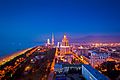 Batumi at night
 -
 Seaside boulevard and beach
 -
 Batumi Seaport
 -
 Night skyline with stadium (2024)


Modern architecture & landmarks
[edit]-
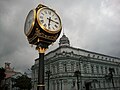 Europe square in Batumi
 -
 Neptun Square
 -
 Radisson Blu Hotel
 -
 Marriott Hotel, Batumi
 -
 Alphabetic Tower
 -
 Batumi Piazza
 -
 Public Service Hall


Heritage & history
[edit]-
 Port of Batumi, 1881
 -
 Colonnades on the boulevard
 -
 Cathedral of the Mother of God
 -
 Batumi Synagogue
 -
 Batumi Mosque


References
[edit]- ^ "Population – National Statistics Office of Georgia". Archived from the original on 2 July 2025. Retrieved 15 July 2025.
- ^ Rose, John D. (April 1980). "Batum as Domino, 1919–1920: The Defence of India in Transcaucasia". The International History Review. 2 (2): 266–289. doi:10.1080/07075332.1980.9640214. JSTOR 40105753. Retrieved 13 August 2025.
- ^ Clifford, John Herbert, ed. (1907). The Standard History of the World. Vol. 6. New York: University Society Inc. p. 3735. Retrieved 13 August 2025 – via Google Books.
- ^ a b Spritzer, Dinah (9 September 2010). "Glamour revives port of Batumi". The New York Times. Archived from the original on 21 July 2016. Retrieved 24 December 2014.
- ^ Curly Tales (11 September 2024). Exploring The Las Vegas Of Black Sea | Beaches, Mountains & Casinos | One World Ep 05 | Curly Tales. Retrieved 13 August 2025 – via YouTube.
- ^ "Pichvnari and Its Environs: 6th Century BC – 4th Century AD". Université de Franche-Comté. 1999. Archived from the original on 20 August 2023. Retrieved 13 August 2025.
- ^ Contextual Research of the Market Potential of Historical Sites in Georgia (PDF) (Report). Black Sea CBC. Archived (PDF) from the original on 15 January 2024. Retrieved 13 August 2025.
- ^ "Batumi – Medieval Harbors". Olkas.net. Archived from the original on 15 May 2023. Retrieved 13 August 2025.
- ^ Peeters, Jeroen (2017). Ottoman Port Cities of the Eastern Black Sea. Leiden: Brill. pp. 104–106. ISBN 978-90-04-34264-8.
{{cite book}}: Check|isbn=value: checksum (help) - ^ Lang, David Marshall (1957). Last Years of the Georgian Monarchy, 1658–1832. New York: Columbia University Press. p. 36.
- ^ Faroqhi, Suraiya (2002). "Ottoman Ports and Trade in the Black Sea". International Journal of Turkish Studies. 8 (1–2): 45–68. ISSN 0272-303X.
{{cite journal}}: Check|issn=value (help) - ^ Zürcher, Erik-Jan (2004). Turkey: A Modern History. London: I.B. Tauris. p. 26.
- ^ Allen, W.E.D. (2017) [1932]. A History of the Georgian People. London: Routledge. pp. 226–228. ISBN 978-1-351-89934-3.
{{cite book}}: Check|isbn=value: checksum (help) - ^ Kozlov, Sergei (2017). "Batumi as a Free Port in the Russian Empire". Journal of Eurasian Studies. 8 (2): 135–150. doi:10.1016/j.euras.2017.04.002 (inactive 7 September 2025). ISSN 1879-3674.
{{cite journal}}: Check|issn=value (help)CS1 maint: DOI inactive as of September 2025 (link) - ^ Gammer, Moshe (2003). Muslim Resistance to the Tsar: Shamil and the Conquest of Chechnia and Daghestan. London: Routledge. p. 278. ISBN 978-0-7146-5588-9.
{{cite book}}: Check|isbn=value: checksum (help) - ^ Patmore, J.A. (1969). Railways, Geography and Economic Growth. Macmillan. pp. 92–94.
- ^ А.Э. Котов (A.E. Kotov) (17 July 2009). ""Из истории Южно-Кавказской железной дороги" ("From the History of the South Caucasus Railway")" (in Russian). Archived from the original on 6 September 2009. Retrieved 31 December 2021.
- ^ "Каспийско-Черноморское нефтепромышленное и торговое общество (Баку) - Ротшильды и Баку" [Caspian-Black Sea Oil Industry and Trade Society – Rothschilds and Baku] (in Russian). Our Baku. Retrieved 31 December 2021.
- ^ Mir-Babayev, Mir-Yusif (February 2015). "Baku-Batumi – The World's Longest Pipeline". Visions of Azerbaijan. Retrieved 13 August 2025.
- ^ Yergin, Daniel (1991). The Prize: The Epic Quest for Oil, Money, and Power. Simon & Schuster. pp. 60–61. ISBN 978-0-671-79932-8.
- ^ Woodcock, George (1968). The Doukhobors. Oxford University Press. pp. 102–108.
- ^ Lang, David Marshall (1962). A Modern History of Georgia. Weidenfeld and Nicolson. pp. 221–223.
- ^ Suny, Ronald Grigor (1994). The Making of the Georgian Nation. Indiana University Press. pp. 184–186. ISBN 978-0-253-20915-3.
- ^ Reynolds, Michael (2006). "Britain and the Caucasus, 1918–1920". Middle Eastern Studies. 42 (5): 759–782. doi:10.1080/00263200600826232 (inactive 7 September 2025).
{{cite journal}}: CS1 maint: DOI inactive as of September 2025 (link) - ^ Allen, W.E.D. (2017) [1932]. A History of the Georgian People. Routledge. pp. 260–261. ISBN 978-1-351-89934-3.
{{cite book}}: Check|isbn=value: checksum (help) - ^ Harris, George S. (1953). The Origins of the Soviet-Georgian Dispute. Stanford University Press. pp. 146–149.
- ^ Walker, Christopher J. (1990). Armenia: The Survival of a Nation. Palgrave Macmillan. pp. 342–343. ISBN 978-0-333-54546-1.
- ^ Suny, Ronald Grigor (1994). The Making of the Georgian Nation. Indiana University Press. pp. 201–202. ISBN 978-0-253-20915-3.
- ^ Gachechiladze, Revaz (1992). "The New Role of Tbilisi and Batumi in Soviet and Post-Soviet Economic Geography". Eurasian Geography and Economics. 33 (2): 79–93. doi:10.1080/10889388.1992.10641089 (inactive 7 September 2025).
{{cite journal}}: CS1 maint: DOI inactive as of September 2025 (link) - ^ Fowkes, Ben (1997). The Disintegration of the Soviet Union: A Study in the Rise and Triumph of Nationalism. Macmillan. pp. 45–46. ISBN 978-0-333-61565-2.
- ^ Mitchell, Lincoln A. (2008). Uncertain Democracy: U.S. Foreign Policy and Georgia's Rose Revolution. University of Pennsylvania Press. pp. 34–36. ISBN 9780812241273.
- ^ "Adjaran Leader Resigns, Leaves Georgia". Radio Free Europe/Radio Liberty. 6 May 2004. Retrieved 13 August 2025.
- ^ Kakulia, Marine (2016). "Tourism Development in Adjara: Trends and Prospects". Journal of Tourism Studies. 12 (3): 45–56.
- ^ "საქართველოს საკონსტიტუციო სასამართლო". constcourt.ge. Archived from the original on 21 July 2011.
- ^ Batumi Port Development Strategy 2030 (PDF) (Report). Asian Development Bank. 2020. Retrieved 13 August 2025.
- ^ "Russia Hands Over Batumi Military Base to Georgia". Civil Georgia, Tbilisi. 13 November 2007. Archived from the original on 14 May 2011. Retrieved 13 November 2007.
- ^ "WMO Climate Normals for 1981-2010: Batumi Airport-37496". National Centers for Environmental Information. Archived from the original (XLS) on 9 October 2021. Retrieved 17 March 2024.
- ^ "The duration of sunshine in some cities of the former USSR" (in Russian). Meteoweb.ru. Archived from the original on 19 May 2019. Retrieved 27 September 2012.
- ^ "37496: Batumi (Georgia)". OGIMET. 14 January 2021. Retrieved 14 January 2021.
- ^ (in Georgian) დადგენილება N 3-1 ბათუმის უბნები[permanent dead link] (Decision #3.1. Boroughs of Batumi). Batumi City Council. Accessed 15 November 2009
- ^ Planet, Lonely; Noble, John; Kohn, Michael; Systermans, Danielle (1 April 2012). Lonely Planet Georgia, Armenia & Azerbaijan. Lonely Planet. ISBN 9781743213032. Archived from the original on 7 May 2016. Retrieved 8 October 2016 – via Google Books.
- ^ "TOURISM IS FLOURISHING IN BLACK SEA RESORT", AP, November 11, 2012 Archived 17 August 2014 at the Wayback Machine
- ^ "News & Events". Archived from the original on 4 January 2013.
- ^ "باتومی – گرجستان". Archived from the original on 19 August 2014. Retrieved 8 October 2016.
- ^ "население грузии". Archived from the original on 8 February 2008. Retrieved 8 October 2016.
- ^ "Демоскоп Weekly – Приложение. Справочник статистических показателей". Archived from the original on 18 August 2016. Retrieved 8 October 2016.
- ^ "Батумский округ 1897". Archived from the original on 9 May 2013. Retrieved 8 October 2016.
- ^ Кавказский календарь на 1917 год [Caucasian calendar for 1917] (in Russian) (72nd ed.). Tiflis: Tipografiya kantselyarii Ye.I.V. na Kavkaze, kazenny dom. 1917. pp. 182–185. Archived from the original on 4 November 2021.
- ^ "Ethnic groups by major administrative-territorial units" (PDF). Archived from the original (PDF) on 7 April 2014. Retrieved 8 October 2015.
- ^ "georgia-ethnic-2014". Archived from the original on 4 November 2018. Retrieved 5 November 2020.
- ^ Sichinava, V (1958). Batumis ist'oriidan ბათუმის ისტორიიდან [From the History of Batumi] (in Georgian). Batumi. p. 110.
{{cite book}}: CS1 maint: location missing publisher (link) - ^ a b georgia-religion 2014
- ^ a b National Statistics Office of Georgia. Population Census 2014: Population by Regions and Religion Archived 14 September 2016 at the Wayback Machine, Retrieved: 6 May 2016
- ^ "Batumi: sights". Official website of Batumi. Archived from the original on 17 March 2019. Retrieved 10 May 2009.
- ^ "Ali and Nino, Batumi, Georgia". 23 October 2015. Retrieved 20 May 2024.
- ^ "Batumi Airport". batumiairport.com. Retrieved 22 December 2023.
- ^ "BatumVelo". www.batumvelo.ge. Retrieved 22 December 2023.
- ^ Dyussembekova, Zhazira (21 January 2016). "Silk Road Renewed With Launch of New Commercial Transit Route". The Astana Times. Archived from the original on 22 January 2016. Retrieved 11 July 2017.
- ^ "School Detail". search.wdoms.org. Retrieved 14 May 2025.
- ^ "Georgia continues to attract Indian medical students". The Times of India. 21 August 2023. ISSN 0971-8257. Retrieved 14 May 2025.
- ^ "ჩვენი ქალაქი – დამეგობრებული ქალაქები". batumi.ge (in Georgian). Batumi. Archived from the original on 31 October 2019. Retrieved 13 February 2020.
- ^ "Ბათუმი და ბალარუსის ქალაქი მოგილიოვი დამეგობრდნენ – TV25". Archived from the original on 28 May 2021. Retrieved 8 March 2021.
- ^ "Batumi miastem partnerskim Wrocławia". wroclaw.pl (in Polish). Wrocław. 17 July 2019. Archived from the original on 22 April 2020. Retrieved 13 February 2020.
- ^ "Კონსტანცასა და ბათუმს შორის თანამშრომლობის მემორანდუმი გაფორმდა". Archived from the original on 28 May 2021. Retrieved 8 March 2021.
- Georgian Soviet Encyclopedia. Georgian SSR (Supplementary Edition). 1981. pp. 16–18.
External links
[edit]


Batumi
View on GrokipediaEtymology and names
Historical nomenclature
In ancient Greek accounts dating to the classical period, the site of Batumi was known as Bathys or Bathus, a name tied to the descriptive phrase bathys limen ("deep harbor"), underscoring the natural depth of its Black Sea anchorage that facilitated early maritime trade and settlement.[4] This nomenclature appears in references to Colchian coastal colonies, where the location served as a fortified outpost amid Hellenistic influence in the region from the 4th century BCE onward.[5] During the medieval era within the Kingdom of Georgia (roughly 9th–15th centuries), local Georgian usage rendered the name as Batomi, reflecting phonetic adaptations in Kartvelian languages, while contemporaneous Greek texts employed Bathou and Western European chroniclers and maps documented it as Vati or Lo Vati.[4] These variants coexisted amid feudal control by local nobles and intermittent Genoese trading presence, with the name denoting a modest port town rather than a major urban center until later Ottoman incursions.[6] From the 16th century under Ottoman suzerainty, which lasted until 1878, the city was designated Batum in Turkish administrative records and European diplomatic correspondence, a simplified transliteration emphasizing its role as a frontier garrison (sanjak) in the eyalet system.[7] This form persisted through the Russo-Turkish War of 1877–1878, when Russian forces captured the port on April 16, 1878, integrating it into the Russian Empire as Batum in official gazetteers and military dispatches.[8] In the Soviet period following incorporation into the Georgian SSR in 1921, the Georgian-endorsed Batumi (ბათუმი) became the standardized form for the capital of the Adjarian Autonomous Soviet Socialist Republic, though Russian-language documents often retained Батуми for bureaucratic consistency until the USSR's dissolution.[7] Post-1991, with Georgia's independence, Batumi in its native Georgian script has remained the exclusive official designation, aligning with national linguistic policies that prioritize indigenous toponymy over prior imperial variants.[4]Modern usage
Since the restoration of Georgia's independence on April 9, 1991, Batumi (Georgian: ბათუმი) has served as the official name of the city, designating it the capital of the Autonomous Republic of Adjara within the Republic of Georgia.[9][10] This usage reflects the post-Soviet emphasis on native Georgian nomenclature, aligning with the country's adoption of the Mkhedruli script for official documents and signage, which phonetically renders the name to approximate the local pronunciation /bɑtʰumi/.[10] In international contexts, particularly English-language materials, "Batumi" has emerged as the predominant transliteration since the 1990s, supplanting earlier variants like "Batum" (from Russian Батум) or "Batoum" that originated in imperial Russian and Ottoman-era mappings.[11] This standardization facilitates global recognition and is codified in diplomatic, trade, and aviation references, such as IATA airport code BUS for Batumi International Airport.[12] For tourism branding, "Batumi" is consistently employed to market the city as a Black Sea resort hub, emphasizing its subtropical climate, modern infrastructure, and cultural sites to attract year-round visitors from Europe and beyond.[13][14] Official campaigns, including those by the Adjara Tourism Department, leverage this name in multilingual promotions, contributing to awards like Europe's Leading Emerging Tourism Destination in 2019 and recognition as a top four-season destination in 2025.[14][13] The choice underscores Adjara's integration into Georgia's national identity while highlighting economic liberalization post-2004, without reverting to Russified forms that could evoke Soviet legacies.[15] Debates on anglicized versus native forms remain marginal for Batumi specifically, though broader discussions in Georgian media critique excessive English loanwords as diluting linguistic purity amid globalization; proponents of strict native transliteration argue it preserves cultural sovereignty, particularly in tourism where simplified spellings risk homogenizing regional identities.[16][17] Nonetheless, "Batumi" enjoys near-universal acceptance internationally, balancing accessibility with fidelity to the Georgian original.History
Ancient and classical periods
The area encompassing modern Batumi formed part of ancient Colchis, an early Iron Age kingdom in western Georgia where archaeological evidence points to settlements emerging by the second millennium BCE, contemporaneous with the development of urban-type habitations across the region.[9] These early sites reflect the Colchian culture's Bronze and Iron Age phases, spanning roughly 2700 BCE to 700 BCE, characterized by advancements in metallurgy and local pottery production.[18] Excavations reveal cultural deposits in the Batumi vicinity dating to the eighth and seventh centuries BCE, including metal artifacts and indigenous ceramics indicative of sustained local habitation amid broader Colchian societal structures.[18] Colchis, including territories near Batumi, gained prominence in Greek sources during the Archaic period, referenced as the mythical destination of Jason and the Argonauts in pursuit of the Golden Fleece, a narrative tied to the kingdom's reputed wealth in resources like metals and timber.[19] Greek colonization efforts extended to the eastern Black Sea littoral by the sixth century BCE, driven primarily by agrarian needs and trade opportunities, resulting in emporia and settlements along rivers like the Rioni, with Colchian sites from the late sixth to fifth centuries BCE showing hybrid Greco-local material culture.[20] While Batumi itself hosted no major attested Greek colony like Phasis (modern Poti), its coastal position facilitated interactions, evidenced by imported goods in regional assemblages.[20] In the classical era, Roman expansion into the Caucasus reached Colchis by the first century CE, prompting the construction of frontier fortifications to counter incursions from nomadic groups and secure Black Sea trade routes. The Gonio-Apsaros fortress, situated 12-15 km south of Batumi at the Chorokhi River mouth, exemplifies this: erected around 100 CE as a Roman legionary base, it comprised a 44,460 square meter enclosure with 228-meter-long and 195-meter-wide walls reinforced by 18 towers.[21][22] Byzantine forces later maintained and adapted such outposts into the fifth and sixth centuries CE, including nearby Petra, to defend against Persian and Alan threats, underscoring the site's role in imperial defensive networks until the eve of medieval shifts.[23]Medieval Georgian and Ottoman transitions
Batumi, situated in the historical region of Colchis, functioned as a modest fortified port within the successor principalities of the ancient Kingdom of Colchis during the early medieval period, prior to the Bagrationi dynasty's consolidation of power.[24] By the 9th century, as the Bagratids expanded from their base in Tao-Klarjeti, western Georgian territories including the Batumi area—then part of the Egrisi (Lazica) realm—gradually integrated into the emerging unified kingdom.[25] The pivotal unification occurred in 1008 under Bagrat III, who merged the eastern Kingdom of Iberia/Abkhazia-Tao with the western principalities, establishing a centralized Georgian monarchy that encompassed Batumi as a Black Sea outpost vital for trade and defense against Byzantine and Seljuk pressures.[26] Under Bagratid rule from the 11th to 15th centuries, Batumi benefited from the kingdom's golden age of cultural and economic flourishing, marked by Orthodox Christian monastic foundations and maritime links to the Byzantine Empire, though it remained a peripheral stronghold amid feudal fragmentation in western Georgia's Guria and Adjara districts.[25] The dynasty's authority waned after the Mongol invasions of the 13th century and Timur's campaigns in 1386, leading to the kingdom's partition into rival states like Imereti, under whose influence Batumi fell as a border fortress by the early 15th century.[26] Local Gurieli princes, vassals of Imereti, administered the area, fending off initial Ottoman probes in the mid-15th century, such as incursions during the reign of Kakhaber Gurieli, where Turkish forces briefly seized but failed to retain the town.[27] The decisive Ottoman transition came in 1547, when Sultan Suleiman the Magnificent's forces, exploiting Georgia's internal divisions and ongoing Safavid-Ottoman wars, captured Batumi following the invasion of neighboring Guria; this marked the effective end of direct Georgian control after sporadic recaptures by local rulers.[28] [4] Initial Ottoman administration tolerated some Georgian Orthodox practices and local elite accommodations, including tribute arrangements with Gurian princes, to stabilize the frontier, though pressures for Islamization soon emerged, met with resistance from Christian communities who preserved linguistic and cultural ties to the Bagratid heritage amid gradual demographic shifts.[28]Ottoman rule and decline
Batumi came under Ottoman control following the conquest of Adjara in the mid-16th century, with the fortress of Gonia captured in 1547, and was incorporated into the Ottoman Empire as part of the Sanjak of Batumi within the Trabzon Eyalet (later transferred to the Childir Eyalet), serving primarily as a modest Black Sea trade outpost handling regional commodities such as timber, agricultural products, and limited transit goods.[29][7] Local governance was often delegated to hereditary beys from families like the Abashidzes, who held sanjak-beg status and managed land ownership and taxation amid nominal imperial oversight.[30] During this period, Batumi's role remained peripheral, with its port functioning as one of several minor Ottoman Black Sea harbors rather than a major commercial hub, constrained by inadequate infrastructure and competition from larger ports like Trabzon. The city's population stagnated at around 2,000 inhabitants by the early 19th century, reflecting limited urban development and economic vitality.[7] Demographically, Ottoman rule facilitated a profound shift in Adjara, including Batumi's hinterland, through gradual Islamization; the local Georgian nobility converted first under incentives and pressures, followed by the broader populace, resulting in the predominance of Muslim Georgians—known as Ajars—by the late 18th century, while Christians paid jizya taxes into the 16th century before widespread conversion.[31][32] By the 1870s, Ottoman control over Batumi exhibited signs of decline, exacerbated by the empire's internal administrative corruption, fiscal strain, and uneven Tanzimat reforms that failed to modernize military capabilities effectively. Russian expansionism, manifested through territorial gains in prior conflicts like the Russo-Turkish War of 1828–1829, intensified pressure on the Caucasian frontier, rendering Ottoman defenses vulnerable and the sanjak increasingly isolated.[33] This erosion of authority, coupled with Batumi's strategic exposure, underscored the broader Ottoman retreat from peripheral provinces amid European great-power rivalries.[28]Russian conquest and imperial development
Following the Russo-Turkish War of 1877–1878, the Congress of Berlin concluded on July 13, 1878, with the Treaty of Berlin ceding Batumi and the surrounding district from the Ottoman Empire to the Russian Empire, marking the completion of Russia's conquest of the Black Sea coast in the Caucasus region.[34] Under Article 59 of the treaty, Russia committed to designating Batumi as a free port focused on commerce, exempt from most customs duties to encourage trade, particularly with Persia and the broader Black Sea basin.[34] Initial Russian administration imposed a military-police regime lasting approximately ten years post-annexation, prioritizing security and infrastructure amid the port's strategic value.[35] Infrastructure modernization accelerated Batumi's transformation into a key imperial outpost. Construction of the Batumi–Tiflis–Baku railway began in 1883 and completed in 1900, linking the port directly to the Caucasus interior and oil fields, which facilitated bulk cargo transport and spurred economic integration with Russian territories.[27] Complementing this, the Baku–Batumi pipeline project, proposed in 1880 and construction initiated in 1897, spanned 885 kilometers as the world's longest refined petroleum line at the time, enabling export of up to 1 million tons of kerosene annually from Baku refineries via Batumi's harbor by the early 1900s.[36] Port expansions followed, with a 1911 imperial plan approving a decade-long development program; initial dredging and facility upgrades commenced in 1912, solidifying Batumi as Russia's primary Black Sea oil terminal.[32] Urban expansion reflected these investments, with population surging from around 2,000 in 1878 to 8,671 by 1882 and 12,000 by 1889, driven by migrant laborers, traders, and administrators attracted to oil-related opportunities.[27] By 1902, the figure exceeded 28,000, encompassing a multi-ethnic mix including Armenians, Greeks, Russians, and local Muslims, though Russian colonial policies from the 1880s promoted settlement of Slavic and other loyal populations to bolster administrative control and dilute Ottoman-era Muslim majorities.[27][37] Russification efforts emphasized Russian-language bureaucracy and Orthodox institutions, yet the free port status preserved commercial diversity and limited direct cultural imposition on Muslim communities, allowing sharia elements in personal law under treaty stipulations for religious tolerance.[38] City self-governance emerged by 1888, balancing imperial oversight with local merchant interests amid rapid port-driven prosperity.[35]World War I, British intervention, and early independence
During World War I, Ottoman forces occupied Batumi following the collapse of Russian control in the Caucasus after the Treaty of Brest-Litovsk in March 1918. On April 22, 1918, Ottoman troops captured the city amid the broader Turkish–Caucasus War, and the Treaty of Batum, signed on June 4, 1918, between the Ottoman Empire and the newly independent states of Armenia, Azerbaijan, and Georgia, formalized Ottoman control over Batumi and surrounding territories, including significant territorial gains for the Ottomans despite the impending armistice. The occupation, lasting until late 1918, was marked by interethnic violence, including clashes between Muslim and Armenian populations, prompting Ottoman military responses framed as protective interventions.[39][40][41] Following the Armistice of Mudros on October 30, 1918, British forces intervened in the Transcaucasus to expel remaining Ottoman and German troops and secure the strategic Baku–Batumi railway line vital for regional stability and oil transport. British occupation of Batumi began in December 2018, with troops from the 39th Brigade establishing control without major resistance, administering the port under the Dunsterforce framework extended to the area. During this period, Batumi functioned as a key Allied base and Black Sea outlet, facilitating logistics amid the Russian Civil War's spillover effects, though British policy emphasized temporary stabilization rather than long-term commitment. The administration included efforts to manage local ethnic tensions and maintain order, with British forces numbering around 3,000 by early 1919.[40][42] British withdrawal commenced in June 1920, culminating on July 7, 1920, when control of Batumi and Adjara was formally transferred to the Democratic Republic of Georgia, reuniting the port city with the central Georgian administration after years of foreign occupations. This handover recognized Georgia's sovereignty claims and underscored Batumi's economic role as the republic's primary Black Sea harbor for exports like manganese and timber, bolstering the young state's viability amid regional threats. Georgia's control proved ephemeral; the Soviet Red Army, exploiting internal Bolshevik agitation, invaded in February 1921, capturing Tbilisi on February 25 after engineered uprisings in border areas. Batumi fell to Soviet forces by mid-March 1921 following brief resistance, ending the Democratic Republic's brief independence and incorporating the city into Soviet Georgia.[40][43]Soviet incorporation and autonomy
Following the Red Army's occupation of the Democratic Republic of Georgia in February-March 1921, the Soviet authorities established the Adjarian Autonomous Soviet Socialist Republic (ASSR) on July 16, 1921, incorporating Batumi and the surrounding Adjara region into the Georgian Soviet Socialist Republic.[44] This administrative unit was created primarily for geopolitical reasons, to placate Turkey amid concerns over Adjara's Muslim-majority population—ethnically Georgian but religiously distinct—and to secure the border under the Treaty of Kars signed on March 16, 1921, which delimited territories and retained Batumi for Soviet Georgia while addressing potential Turkish irredentism.[44][45] The ASSR's autonomy was nominal, granting limited local legislative powers through a Supreme Soviet and concessions like formal recognition of Islamic practices to foster loyalty, but it lacked sovereignty, foreign policy control, or fiscal independence, remaining subordinate to the Communist Party of Georgia and central directives from Moscow.[46] During the first Five-Year Plans of the 1920s and 1930s, Batumi emerged as a vital Black Sea port for oil transshipment from Baku, alongside development in shipbuilding, food processing for tea and citrus exports, and constructivist-era housing projects to support industrial workers.[47][48] Collectivization drives from 1929 onward encountered fierce resistance in rural Adjara, sparking an uprising in the mountainous upper districts against coercive measures like forced de-veiling of women, which intertwined anti-religious campaigns with agricultural consolidation and symbolized broader peasant opposition to property expropriation.[46] The Stalinist purges of 1937-1938 intensified suppression, with executions and deportations targeting perceived dissenters; archaeological evidence includes a mass grave near Batumi in Khelvachauri holding about 150 victims, marked by bullet wounds and dated Soviet-era artifacts.[49] World War II devastation prompted postwar reconstruction focused on expanding collective farms (kolkhozes) for subtropical crops and port infrastructure, yet inefficiencies in central planning—such as misallocated resources and bureaucratic rigidity—led to stagnation by the Brezhnev era (1964-1982), with Adjara's growth rates declining to near zero in the 1980s amid falling agricultural yields and industrial output across Soviet Georgia.[50][51]Post-Soviet revival and 2004 Adjarian Revolution
Following Georgia's declaration of independence from the Soviet Union on April 9, 1991, the Autonomous Republic of Adjara, with Batumi as its capital, descended into a period of civil unrest amid nationwide instability, including civil war and ethnic conflicts that weakened central authority.[52] Aslan Abashidze, who assumed leadership of the region in 1991 through the Adjaran Union for Revival (later renamed the Democratic Union for Revival in 1998), established semi-independent rule characterized by clan-based governance, widespread corruption, and refusal to remit taxes collected at the Sarpi border crossing to Tbilisi, retaining an estimated annual revenue of tens of millions in untaxed customs duties.[53] Abashidze's regime maintained control via local security forces, border closures to central government officials, and alignment with Russia, including tolerance of the Russian 12th Military Base near Batumi, fostering a fiefdom-like autonomy that isolated Adjara economically while enabling smuggling and patronage networks.[54] The 2003 Rose Revolution in Tbilisi, which ousted President Eduard Shevardnadze, spilled over into Adjara, where Abashidze's refusal to recognize Mikheil Saakashvili's January 4, 2004, presidential election victory escalated tensions.[55] Abashidze declared a state of emergency on January 7, 2004, blocked Saakashvili's entry into the region, and suppressed opposition, leading to a March 2004 standoff when Georgian forces approached the Upper Adjara gorges and Abashidze's militias mined bridges; a temporary March 18 agreement allowed for local elections and partial disarmament but collapsed amid ongoing protests.[56] By early May, mass demonstrations in Batumi swelled to 15,000 participants demanding Abashidze's resignation, with security forces attacking an opposition rally on May 4; Prime Minister Zurab Zhvania joined protesters on May 5, prompting Russian Security Council Secretary Igor Ivanov to mediate.[57] On May 6, 2004, Abashidze relinquished power and fled Batumi by Russian aircraft to Moscow, ending his 13-year rule without bloodshed and triggering celebrations across the city as locals toppled his statues.[55][58] The ouster integrated Adjara under central Georgian authority, with Supreme Council elections held on June 20, 2004, yielding a pro-Saakashvili majority; initial reforms dismantled Abashidze's corrupt structures, resolved the decade-long tax dispute by transferring withheld revenues to Tbilisi, and opened the region to foreign investment by easing border controls and disbanding paramilitaries.[54][53] These measures curbed smuggling and patronage, laying groundwork for Batumi's economic liberalization while exposing prior embezzlement, including Abashidze's alleged misuse of GEL 98.2 million in state funds.[59]Contemporary era and economic liberalization
Following the 2004 Adjarian Revolution, Batumi experienced rapid economic liberalization under President Mikheil Saakashvili's national reforms, which emphasized deregulation and reduced corruption to foster private investment. These policies, including simplified business registration and tax cuts, propelled Adjara's GDP growth to an average of 7% annually by 2012, transforming Batumi from a post-Soviet backwater into a burgeoning resort hub.[60] A key initiative was the aggressive promotion of tourism, with infrastructure investments in beaches, promenades, and casinos drawing millions of visitors and spurring a high-rise construction boom that redefined the city's skyline with over 100 modern towers by the mid-2010s.[47] The Port of Batumi, handling bulk cargo, oil, and containers, alongside a burgeoning services sector dominated by tourism and real estate, became central to regional GDP contributions, with transportation and logistics accounting for about 5.5% of Georgia's national GDP in recent years.[61] Tourism arrivals in Adjara grew at approximately 18% per year, outpaced by real estate development that doubled in scale annually, fueled by foreign investment and short-term rentals.[62] Between 2023 and 2025, Batumi's residential real estate market surged, with transaction volumes reaching nearly $900 million in 2024, average new-build prices rising to $1,130 per square meter by early 2025, and 84% of buyers being foreigners seeking high rental yields of 11.4%.[63][64][65] Batumi demonstrated economic resilience amid external shocks, notably the 2022 influx of over 100,000 Russians fleeing mobilization, which boosted local rentals, remittances (peaking at $317 million in December 2022), and service demand despite uneven distribution of benefits.[66][67] Georgia's EU candidate status granted in December 2023 supported aspirations for deeper market integration, potentially enhancing Batumi's trade and investment flows through alignment with EU standards, though implementation challenges persist.[68][69] Visitor numbers continued rising into 2025, with tourism revenues and hotel occupancy reflecting sustained liberalization-driven momentum.[70]Geography
Location and topography
Batumi is positioned on the Black Sea coast in southwestern Georgia, serving as the capital of the Autonomous Republic of Adjara, with geographic coordinates approximately 41°38′N 41°38′E.[71] The city occupies a narrow coastal strip, bordering Turkey to the south along a 273 km international boundary that includes the Sarpi-Sarp crossing point, approximately 20 km from the city center.[72] To the north and east, the terrain ascends from lowlands toward the Caucasus Mountains, creating a transition from subtropical coastal plains to rugged highlands.[73] The urban core lies at an average elevation of about 5 meters above sea level, characteristic of the flood-prone lowlands shaped by river deltas and marine influence, which expose the area to inundation during intense precipitation, as seen in widespread flooding on August 9, 2025, that submerged streets and disrupted infrastructure.[74] [75] These flat, sediment-rich plains support limited natural elevation variation within the city limits, with surrounding hills hosting relict ecosystems of subtropical flora, exemplified by the Batumi Botanical Garden's 111-hectare expanse of diverse plant collections from humid Caucasian and global phyto-geographic zones.[76]Climate and environmental conditions
Batumi features a humid subtropical climate (Cfa) under the Köppen-Geiger classification, strongly influenced by its Black Sea coastal location and the adjacent Adjara Mountains, which moderate temperatures and enhance humidity. Winters are mild, with a January mean temperature of approximately 7.8°C, rarely dropping below freezing due to maritime air flows. Summers are hot and humid, with July daytime highs averaging 26°C and mean temperatures around 24°C, though heatwaves can push peaks above 30°C.[77][78] Annual precipitation totals about 2,400 mm, distributed relatively evenly but peaking in autumn and winter months, with December often exceeding 300 mm. The combination of high rainfall and orographic lift from the mountains results in frequent fog, particularly in mornings and during cooler seasons, reducing visibility and contributing to a persistently moist environment. May stands as the driest month with around 110 mm, yet even then, rainy days number over 10 on average.[77][79] The baseline ecological conditions support the Colchic rainforests and wetlands, relics of ancient subtropical flora with high biodiversity, including over 80 endemic plant species such as Pterocarya fraxinifolia and Colchicum colchisicum, alongside diverse vertebrates in mire habitats. Heavy precipitation and steep terrain predispose the area to natural hazards like landslides and riverbank erosion, which occur annually in upland zones due to saturated soils and gravitational forces on unstable slopes. Pre-development landscapes featured dense broadleaf forests covering much of the lowlands, fostering wetland ecosystems vital for regional endemism.[80][81][82]Administrative subdivisions
Batumi functions as a self-governing municipality within the Autonomous Republic of Adjara, encompassing urban and limited peri-urban territories without formal administrative raions akin to those in Tbilisi.[83] For municipal planning and land use, the city is informally segmented into key zones, including the historic Old Batumi core around Chavchavadze and Bagrationi streets, preserving Ottoman-era and early 20th-century architecture amid dense residential and commercial activity.[84] Adjacent to this is the New Boulevard area, a linear coastal strip extending approximately 7 kilometers along the Black Sea, designated primarily for tourism, hospitality, and recreational land uses with high-rise developments and public promenades.[85] Since the early 2000s, Batumi's urban footprint has expanded northward and eastward into former agricultural and undeveloped peri-urban zones, incorporating areas like the Bagrationi district for mixed residential-commercial growth to accommodate population influx and tourism-driven construction.[86] This outward extension, facilitated by infrastructure projects such as road networks and utilities, has increased the effective built-up area while adhering to Adjara's regional boundaries, ensuring seamless integration without overlapping adjacent municipalities like Khelvachauri.[87] Land use within these subdivisions is governed by the 2009 Batumi Land Use Master Plan, which allocates roughly 40% of municipal territory to green and recreational spaces, promoting a "garden city" model amid subtropical terrain, with the remainder balanced between residential (about 30%), commercial-touristic (20%), and industrial-port facilities.[86] [87] Updates to this framework post-2010 have emphasized sustainable zoning to mitigate coastal erosion and support multifunctional development, preventing haphazard sprawl into ecologically sensitive Adjara highlands.[88]Government and politics
Autonomous status within Georgia
The Autonomous Republic of Adjara, with Batumi as its capital, was granted autonomy on July 16, 1921, when the Soviet Union established it as the Adjarian Autonomous Soviet Socialist Republic within the Georgian Soviet Socialist Republic.[89] This arrangement addressed Turkish concerns under the 1921 Treaty of Kars by recognizing the region's Muslim-majority population, predominantly ethnic Georgians who had converted to Islam during Ottoman rule.[90] The autonomy provided limited self-governance in cultural, educational, and local administrative matters, subordinated to central Soviet authority in the Georgian SSR.[91] Following Georgia's declaration of independence in 1991, Adjara retained its autonomous status, renamed the Autonomous Republic of Adjara, as an inseparable territorial unit of the unitary state under the 1995 Constitution.[92] The legal framework is defined by the Constitutional Law of Georgia on the Status of the Autonomous Republic of Adjara, which outlines powers in areas such as local legislation, budgeting, and administration, while reserving foreign policy, defense, and key economic regulations for the central government in Tbilisi.[93] In 2004, amendments to this law and the Georgian Constitution clarified competences, introducing mechanisms like presidential suspension of regional acts conflicting with national law to prevent autonomy from enabling separatist tendencies.[93][94] Adjara's fiscal autonomy involves managing a regional budget derived from local taxes, including property taxes, and revenues from Batumi's port operations and tourism, alongside substantial transfers from Georgia's central budget to ensure equalization and service provision.[95] In recent assessments, own-source revenues for autonomous and local budgets, such as property taxes totaling 153,641 thousand GEL in specified periods, complement transfers that form the majority of funding, reflecting a balance between regional self-reliance and national fiscal oversight.[95] This structure limits full sovereignty, embedding Adjara's self-rule within Georgia's unitary framework without independent international legal personality or citizenship.[91]Local governance structure
The governance of Batumi operates under a mayor-council framework, with the mayor functioning as the executive head responsible for administering municipal services, executing the approved budget, and managing daily operations such as urban planning, public utilities, and infrastructure maintenance. The Batumi City Council, known as the Sakrebulo, consists of 35 members, including 7 elected from single-mandate majoritarian districts and 28 via proportional representation, serving legislative roles that include approving the annual budget, adopting local ordinances, and exercising oversight over executive actions.[96][97] Local elections for both the mayor and council occur every four years through direct universal suffrage, with the October 4, 2025, vote securing victories for Georgian Dream-affiliated candidates in the mayoral contest and a majority of council seats, reinforcing the party's control established in prior cycles. This alignment influences policy priorities, such as infrastructure development and tourism promotion, though evaluations note limited independent investigations into procurement irregularities despite formal oversight mechanisms.[98][96] Anti-corruption measures at the municipal level rely on Georgia's centralized electronic procurement system, which mandates open tenders and electronic bidding for local contracts, reducing discretionary awards and enhancing auditability in Batumi's public spending as evidenced by national compliance data covering municipal transactions. Complementing this, citizen engagement includes participatory budgeting initiatives, where residents submit and prioritize proposals for a portion of the municipal budget—typically 1-2%—via public consultations and online platforms, fostering direct input into projects like park improvements and community facilities since their institutionalization around 2018.[99][100]Geopolitical significance
Batumi's strategic position on Georgia's Black Sea coastline establishes it as a vital hub for regional connectivity, linking the Caucasus to Europe and Central Asia while circumventing Russian-controlled territories. The port serves as a key endpoint for energy transit, including historical and ongoing oil handling operations that support diversification from northern pipelines vulnerable to Moscow's influence. This role intensified following Russia's 2008 invasion of Georgia, which occupied Abkhazia and severed access to other Black Sea facilities, positioning Batumi as a resilient outlet for Western-aligned trade routes such as the Middle Corridor.[101][102][103] The Baku-Batumi pipeline infrastructure, operational for crude oil and kerosene transport from the Caspian, underscores the city's function as a Black Sea chokepoint for non-Russian energy flows, with the port's capacity enabling up to 18 million tons of cargo annually. This setup bolsters Georgia's geopolitical leverage by facilitating exports from Azerbaijan and potentially Kazakhstan, reducing dependence on routes through occupied regions or adversarial states. Post-Abkhazia conflict dynamics have amplified Batumi's value as a buffer, maintaining Georgian sovereignty over southwestern coastal access amid Russian expansionism in the north.[104][105] Proximity to Turkey, sharing a land border, integrates Batumi into bilateral strategic partnerships that counterbalance Russian pressures through enhanced cross-border infrastructure and cooperation. These ties, rooted in historical treaties like Kars in 1921, shape migration patterns and regional stability by promoting Turkish investment in connectivity projects that align Georgia with NATO-adjacent alliances. Such relations provide Tbilisi with a southern flank secure from direct Russian incursion, fostering resilience against hybrid threats in the Black Sea basin.[106][107][108]Demographics
Population trends and ethnic composition
The population of Batumi experienced a post-Soviet decline, dropping from approximately 136,000 in the 1989 Soviet census to 121,806 in the 2002 Georgian census, attributable to economic instability, civil unrest, and net out-migration following independence.[2] Recovery began in the mid-2000s, driven by internal rural-to-urban migration, port expansion, and tourism growth, with the population rising to 152,839 by the 2014 census—a 25.6% increase over 2002.[2] Preliminary results from the 2024 Georgian census indicate further expansion to around 180,000–200,000 residents in the Batumi municipality (largely urban), reflecting a national trend of modest growth amid return migration and foreign inflows, though exact city proper figures await final tabulation.[109][110]| Census Year | Population | Annual Growth Rate (from prior) |
|---|---|---|
| 2002 | 121,806 | - |
| 2014 | 152,839 | +1.9% |
| 2024 (prelim.) | 234,600 | +4.4% |