


Community hub
Recent from talks
Contribute something
Nothing was collected or created yet.
Bayard–Condict Building
View on Wikipedia
Bayard–Condict Building | |
New York City Landmark No. 0882
| |
 (detail) | |
 | |
| Location | 65 Bleecker Street Manhattan, New York City |
|---|---|
| Coordinates | 40°43′35″N 73°59′42″W / 40.72639°N 73.99500°W |
| Built | 1899 |
| Architect | Louis Sullivan |
| Architectural style | Chicago School |
| NRHP reference No. | 76001236 |
| NYSRHP No. | 06101.001674[1] |
| NYCL No. | 0882 |
| Significant dates | |
| Added to NRHP | December 8, 1976[3] |
| Designated NHL | December 8, 1976[3] |
| Designated NYSRHP | June 23, 1980[1] |
| Designated NYCL | November 25, 1975[2] |
The Bayard–Condict Building (formerly the Condict Building and Bayard Building) is a 12-story commercial structure at 65 Bleecker Street in the NoHo neighborhood of Manhattan in New York City. Built between 1897 and 1899 in the Chicago School style, it was the only building in New York City designed by architect Louis Sullivan, who worked on the project alongside Lyndon P. Smith. Located in the NoHo Historic District, the building was designated a New York City landmark in 1975 and a National Historic Landmark in 1976.
The building occupies a rectangular site and has a terracotta facade divided horizontally into three sections. The lower two stories consist of ground-story storefronts with ornate columns, with an arched entrance in the westernmost bay. On the upper stories, piers separate the building vertically into five bays, each with ornate spandrel panels. There are six winged angels just below the cornice at the top of the building. On the inside, the first two stories are used for retail, while the upper floors generally contain large loft-like spaces and a steel structural frame. A mechanical core with elevators, utilities, and stairs is in its western end.
The Bayard Building was developed by the United Loan and Investment Company, who acquired the land in 1897 from the Bank for Savings in the City of New York and named the edifice after the Bayard family. Due to disputes over construction methods, United Loan was forced to give up the building before it was completed, and Emmeline G. H. Condict had acquired it by June 1899. It was sold in 1900, and again in 1920, before coming under the control of the Shulsky family in the 1940s. The storefronts were replaced in the 1960s, followed by the lobby in the 1980s. The facade was restored during the late 1990s and early 2000s.
Site
[edit]The Bayard–Condict Building is at 65 Bleecker Street in the NoHo neighborhood of Manhattan in New York City. It is on the north side of Bleecker Street between Broadway and Lafayette Street, at the northern end of Crosby Street.[4][5] The land lot is rectangular and measures around 8,330 square feet (774 m2), with a frontage of 83.3 feet (25.4 m) and a depth of 100 feet (30 m) along Bleecker Street.[4] The Robbins & Appleton Building adjoins the Bayard–Condict Building on the same block directly to the north, and an entrance to the New York City Subway's Bleecker Street station is immediately to the east. Other nearby structures include the Schermerhorn Building to the northeast, 339 Lafayette Street to the east, and 640 Broadway to the southwest.[4]
Before the early 19th century, what is now NoHo was part of the farms of numerous families, such as the Bayard, Bleecker, Herring, Pero, and Randall families. West–east streets were laid through the area by the early 19th century, and row houses were built along these streets.[6] This was followed by institutions like churches, libraries, and schools in the 1830s and 1840s,[7] then by store and loft buildings in the 1850s, which catered to the area's wealthy population.[8] With the advent of curtain walls, steel frames, and fireproof elevators, these store and loft buildings were being built as tall as 12 stories by the 1890s. The Bayard–Condict Building was among these early high-rise loft buildings.[9]
Architecture
[edit]The Bayard–Condict Building is the only structure in New York City designed by Louis H. Sullivan, who specialized in the Chicago school style of architecture.[10][11][12] Sullivan is sometimes cited as the building's sole architect,[13] although he was assisted by New York architect Lyndon P. Smith.[13][14] Such partnerships were typical for Sullivan; whenever he designed buildings outside his home state of Illinois, he worked with other architects who were licensed in that state.[15][16] It is unknown how or why Sullivan was selected to design the building, but, at the time of its development in the late 1890s, the city's most prominent structures were generally designed by local firms like McKim, Mead & White.[11] George Elmslie helped design the decoration.[14]
The building was one of the first skeleton frame skyscrapers in New York City, and the Department of Buildings raised numerous objections to the design before the plans were finally accepted.[17] Measuring 162 feet (49 m) tall,[16] with 13 stories, it was considered an early skyscraper.[18] It was similar in design to an unbuilt skyscraper for the St. Louis Trust and Savings Bank that was designed in 1895.[19][20] According to Sullivan's protege Frank Lloyd Wright, the Bayard–Condict Building was Sullivan's favorite design.[18]
Facade
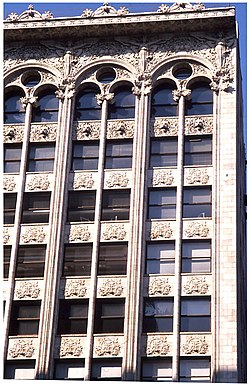
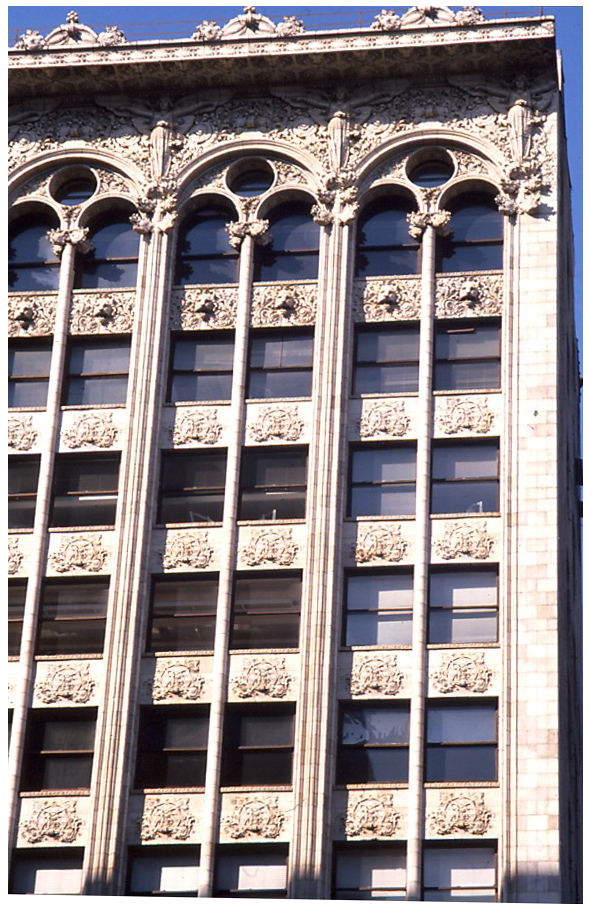
[edit]The Bleecker Street elevation of the facade is clad in white glazed terracotta over a masonry wall.[21] The facade has relatively undecorated mullions and pilasters, which accentuate its height[21][22] and divide the facade vertically into five bays.[23][24] The Bleecker Street facade is divided horizontally into three sections—an ornamented base, a shaft of identical stacked floors, and a decorated crown—illustrating Sullivan's views on skyscraper design.[25][23] Whereas the protrude mullions and pilasters were intended to draw attention to the columns in the building's superstructure, the superstructure's horizontal beams were deemphasized and covered with wide spandrel panels.[22][26] According to Herbert Muschamp, the emphasis of the vertical elements may have been intended to represent "maximum development of a small urban site by thrusting against gravitational force".[26] Sullivan's ornate floral designs decorate the facade's base and top, as well as the spandrels below each window opening.[5] The facade's other three elevations are made of red brick on common bond.[24]
The lowest part of the Bleecker Street facade contains a concrete water table.[24] The entrance to the building is through the westernmost bay.[24][27] The doorway is flanked by piers, above which are a small cornice and an ornamented lunette with "organic" motifs such as spirals, leaves and tendrils. The lunette is topped by geometric designs and leaves.[27] The base of the building originally contained storefronts separated by octagonal columns, above which were ornate capitals[28] that also depicted leaves.[29] The original columns were removed in 1964[21][28] and restored in 2002.[27] Above each of the ground-story storefronts are spandrel panels with more organic motifs.[27]
On the upper stories, the bays are separated by piers, which correspond to the internal structural system; each bay is topped by a large arch.[23] Above the second floor, each bay contains two sash windows per story, separated by a narrow mullion. There are recessed terracotta spandrels with geometric and organic motifs above the pairs of windows on each story.[24][27] The spandrels above the eleventh floor are decorated with lions' heads.[27] The top two stories (the twelfth and thirteenth) were intended to resemble a single story from the outside.[20][30] On these stories, each bay contains an arch at the twelfth and thirteenth stories, and there is a trefoil motif in the spandrels of each arch. A heavy cornice projects from the facade above the thirteenth floor.[24] The cornice contains decorative soffit panels.[14]

There are six winged angels just below the cornice.[24][21] For many years, it was widely believed that Silas Alden Condict, a lawyer with religious aspirations who had briefly owned the building, had wanted the angels to be included.[31] Condict allegedly wanted the angels to represent the six working days of the week (excluding the Sabbath).[32] Sullivan had allegedly initially objected to the presence of the angels;[5][12] according to The New York Times, Sullivan had asked Condict, "Do you want a commercial building or do you want a church?"[32] This account is disputed by historians Sarah Landau and Carl W. Condit, who wrote in their 1996 book Rise of the New York Skyscraper that Sullivan had used winged-angel motifs in his design for the Transportation Building at the 1893 World's Columbian Exposition.[31] The sculptures had been depicted in a Brickbuilder magazine article in June 1898,[29] before the Condict family had even bought the building.[27] There are round motifs and leaves above the cornice,[29] but the roof of the building is otherwise flat.[24]
Interior
[edit]According to the Architectural Review, the Bayard–Condict Building was a speculative development "designed to be used for offices or light manufactures as to the upper storeys, and for shops in the ground and first floors".[33] When the Bayard–Condict Building was built, it generally contained large loft-like spaces, as well as a mechanical core with elevators, utilities, and stairs. The lofts could be divided into smaller offices and were illuminated by natural light, which was maximized by the presence of setbacks at the rear of the building.[20]
Originally, the building was to contain brick curtain walls with a uniform thickness of 12 inches (300 mm). The interior would have been supported by a type of freestanding steel frame called the Gray system, which used 14-by-14-inch (360 by 360 mm) columns attached to cast-steel bases. Sullivan and Dankmar Adler had previously used the Gray system in the Prudential (Guaranty) Building, but New York City officials were loath to approve the use of the Gray system.[20] As a result, the curtain wall measured 20 inches (510 mm) thick between the floor slabs for the first and fifth stories; 16 inches (410 mm) thick between the fifth and ninth stories; and 12 inches (300 mm) thick above the ninth story. The interior columns were also thickened, measuring between 24 inches (610 mm) across at the ground story and 13 inches (330 mm) across on the top two stories.[20][34]
By the late 20th century, the building was accessed through the westernmost bay on Bleecker Street, which led to a north–south hallway. The hallway had terrazzo floors, plastic wall tiles, and acoustical ceiling tiles. A pair of elevators was positioned at the center of the hallway, while the rear end of the hallway had a stairway adjacent to a storefront. The staircase had an ornate balustrade between the basement and third story, stucco-and-plaster walls, and a plaster ceiling. On the upper stories, there was a hallway on the western end of each story connecting to the elevators and stair. The remainder of each story was divided into office or industrial space, with tile floors, plaster walls, and plaster ceilings.[24] Ceiling heights range from 15 feet (4.6 m) on the first floor to 9.5 feet (2.9 m) on the 12th floor.[30][a]
History
[edit]The Bayard–Condict Building was constructed on the former site of the Bank for Savings in the City of New York, also known as the Old Bleecker Street Bank.[35] That bank relocated to Fourth Avenue in the late 19th century.[36]
Development
[edit]
The United Loan and Investment Company had been incorporated in 1895 to sell securities, land, and mortgages for a commission; it was authorized to trade real estate in 1897.[15] That September, United Loan acquired a 83.6-by-100-foot (25.5 by 30.5 m) site on the north side of Bleecker Street from the Bank for Savings. The site reportedly cost $200,000, most of which was covered by a $150,000 mortgage from the Bank of Savings, which was to come due in three years.[35][37] United Loan immediately announced plans to erect the 12-story Bayard Building[15] at a cost of $100,000.[35] The edifice was to be named after the Bayard family, an early settler of the colony of New Netherland, whose area included modern-day New York.[15][38] Although the family was not involved with the project,[15] Landau and Condit wrote that the structure directly referenced William Bayard Jr., the Bank for Savings' first president.[38] Louis Sullivan, working with Lyndon P. Smith of New York state, had been hired to design the structure during mid-1897.[15]
The partnership of Sullivan & Smith submitted plans for a 12-story structure at 65–69 Bleecker Street[b] to the New York City Department of Buildings on September 17, 1897,[20] and The New York Times announced these plans on September 23.[40] The building was to be a fireproof structure with a terracotta facade and would contain numerous elevators.[20][39] The New York Times estimated the building would cost $400,000,[40] while the Chicago Daily Tribune gave a cost of $275,000.[39] According to trade publication The Construction News, the building was to cost between $250,000 and $275,000.[41] After disputes over various aspects of the planned building were resolved, United Loan began erecting the Bayard Building in December 1897.[20] Although Sullivan never again designed another building in New York City, the reason for this is unclear. The Blue Guide New York said Sullivan had a hard time getting the Bayard Building to meet the city's building codes, while Carl Condit stated that the building's remote location on Bleecker Street may have been a factor.[42]
The Bank for Savings initiated foreclosure proceedings on the property in December 1898.[43] In April 1899, Charles W. Rice of the Perth Amboy Terra Cotta Company acquired the building at a foreclosure auction for $327,000,[36][44] wiping out United Loan's investment in the structure.[45] Rice had been one of the building's material contractors, and he had purchased the building to satisfy $150,000 in liens.[36] Emmeline G. H. Condict bought the building in June 1899 from Chase Mellen for $37,000, taking out a $310,000 mortgage on the property.[46] The building was completed in December 1899.[20] The tenth floor was severely damaged in a fire in March 1900,[47][48] and the Condict family sold the building that May to its builder, Charles T. Wills.[20]
20th century
[edit]Sources disagree on the building's original name. Landau and Condit described the structure as being known as the "Bayard Building" when it was completed,[18] while the New York City Landmarks Preservation Commission (LPC) said that it was already known as the "Condict Building" when it opened in December 1899.[20] A 1901 directory listed the Bayard Building as an office building at 65–67 Bleecker Street, adjacent to another office building, the Condict Building at 69 Bleecker Street.[20] A New York Times article about the 1900 fire identified 65–67 Bleecker Street as the Condict Building,[49] while the Brooklyn Times Union described the Condict Building as occupying "65, 67 and 69 Bleecker Street".[48] In its early years, the Condict Building operated as a commercial loft structure.[50][51] The Wills estate continued to own the Condict Building until January 1920, when the estate sold the building to Heidelberg, Wolff & Co.[50] for $450,000.[51]
Elgin Shulsky acquired the building during the 1940s.[28][52] At the end of that decade, the capitals above the columns at ground level were covered with plaster and cinder blocks. This blunted the effect of Sullivan's original storefronts, which had been designed as full-height glass panels between small columns.[53] The popularity of ornate facades, such as that of the Condict Building, had declined significantly by the late 1950s, prompting the Municipal Art Society to select the building as one of several in the city that were "worthy of preservation".[54] Elgin Shulsky replaced the original storefronts with generic commercial aluminum storefronts, designed by Gustave W. Iser, in 1964.[53] The neighborhood was largely occupied at the time by warehousing and light manufacturing firms.[28] One of the original capitals was preserved in the Brooklyn Museum, while a group led by Ivan Karp obtained another capital for the collection of the Anonymous Arts Museum.[53] The capital in the Brooklyn Museum's collection became part of a sculpture garden.[55]
The LPC first hosted a public hearing on whether to designate the building as a city landmark in 1966, but the structure was not designated because the owners objected to it.[21] The LPC hosted further hearings in 1970, 1974, and 1975[21][2] before it designated the Bayard–Condict Building as a city landmark on November 25, 1975.[10][56] The LPC designated the Bayard–Condict Building largely on the grounds that it was Sullivan's only New York City building.[57] The Shulsky family immediately sued the LPC, claiming that "the vast majority of the population in the City of New York and the United States of America have no knowledge whatsoever" of the building's existence, but the lawsuit stalled.[21] The building's owners also objected when preservationist Carolyn Pitts nominated the building for National Historic Landmark designation the next year. Despite the owners' claim that the building was "run-down" and "undistinguished", Pitts surreptitiously created a report on the building and submitted it to the United States Department of the Interior,[58] which approved the nomination the same year.[59][60]
The building continued to be largely occupied by commercial tenants through the late 20th century. By the early 1980s, the Shulsky family was replacing the industrial tenants with office tenants, as the owners wished to refurbish the building.[21][28] Among the tenants who moved out was the building's largest occupant, a company specializing in ribbons and artificial flowers.[61] The vacant space was rented to office tenants for as low as $8 per square foot ($86/m2).[28] Subsequently, the Shulsky family renovated the lobby to designs by Edgar Tafel, whose mentor Frank Lloyd Wright had studied under Sullivan.[61][21] Elgin Shulsky's son Marvin Shulsky took over the building's management in the 1980s.[52]
Restoration
[edit]
In 1996, New York City-based architecture and engineering firm Wank Adams Slavin Associates designed and oversaw a restoration of the Bayard–Condict Building's facade.[11] The project cost $800,000.[11][28] Of the 7,000 glazed architectural terra-cotta tiles, 1,200 had to be replaced.[11] Marvin Shulsky said at the time: "I figured I had a choice: cover the whole thing in $10's and $20's or redo the terra cotta."[28] In addition, replicas of the original capitals at ground level, modeled after the capital in the Anonymous Arts Museum's collection, were installed.[28] By then, the building was nearly fully occupied by tenants such as the Andy Warhol Foundation for the Visual Arts, Carl Fischer Music, the literary agency of Sterling Lord, cosmetics firm The Estée Lauder Companies, and USA Films.[28] The LPC further designated the building as part of the NoHo Historic District in June 1999.[62]
The Greenwich Village Society for Historic Preservation gave its Village Award in 2003 to the contractors who restored the building.[63] By 2013, Marvin Shulsky's son-in-law Lawrence Ellenberg had taken over the building and was adding an elevator.[52] During the early 21st century, the building's tenants included the Council of Fashion Designers of America,[64] a law firm,[65] and an ice cream shop.[66]
Critical reception
[edit]When the Bayard–Condict Building was completed, it was a radical design for its time, since it contravened the strictures of American Renaissance architecture which were the accepted status quo. However, it had little influence on architectural design in New York City, because of its location in the industrial area that Bleecker Street was during that period.[5] Russell Sturgis said the structure "exemplifies the growth of modern American building connected with the steel cage construction", saying that the design was clearly intended to be that of a skyscraper.[67] Montgomery Schuyler wrote: "There is nothing capricious in the general treatment of this structure. It is an attempt, and a very serious attempt, to found the architecture of a tall building upon the facts of the case."[67][68] A reporter for The Wall Street Journal wrote that, following the building's completion, the public saw Louis Sullivan "as the architect who had solved the problem of what to do with the skyscraper".[21]
The building was still largely lauded in the late 20th century. A reporter for the New York Daily News described the Bayard–Condict Building in 1964 as having "the appearance of a large commercial structure from the 1897–98 period", despite its significance as Sullivan's only New York City building.[69] The same year, the Times said the building "is still in every important textbook of the American skyscraper".[53] In designating the Bayard–Condict Building as a city landmark in 1975, the LPC wrote that the structure was "the most significant commercial building utilizing skyscraper structural techniques in New York City".[21][2] Paul Goldberger described the Bayard–Condict Building's cornice in 1976 as "perhaps the finest cornice in all of New York".[70] In his 1994 book New York, a Guide to the Metropolis, Gerard Wolfe wrote that the Bayard–Condict Building was a "startlingly ornate" structure that was tucked onto a side street.[71]
The building also received positive commentary after its renovation in the 1990s and 2000s. According to Herbert Muschamp in 2001, the building "stands as a reminder that private clients, including developers, were once more eager than the cultural organizations to embrace progressive ideals".[26] A 2003 Miami Herald article described the Bayard–Condict Building as "massive and delicate",[72] while the Chicago Tribune wrote that the building was "a study in terra-cotta ornamentation".[73] The architect Chad Smith wrote for the Village Voice in 2005: "It is new because it is modern—both for its forward-looking design and because it was (and is) an innovative solution to 19th-century problems. It feels fresh because it is still so completely a building of its age."[74] The Bayard–Condict Building's architecture also inspired the design of other structures, including a nearby office building in SoHo designed by Marcello Porcelli and Cookfox during the 2010s.[75]
See also
[edit]

References
[edit]Notes
[edit]- ^ The ceiling heights were:
- 1st floor: 15 ft (4.6 m)
- 2nd floor: 13 ft (4.0 m)
- 3rd floor: 12 ft (3.7 m)
- 4th and 5th floors: 11 ft (3.4 m)
- 6th to 11th floors: 10 ft (3.0 m)
- 12th floor: 9.5 ft (2.9 m)
- 13th floor: 14.5 ft (4.4 m)[30]
- ^ Some sources, such as the Chicago Tribune, described the building as "150 feet east of Broadway".[39]
Citations
[edit]- ^ a b "Cultural Resource Information System (CRIS)". New York State Office of Parks, Recreation and Historic Preservation. November 7, 2014. Retrieved July 20, 2023.
- ^ a b c Landmarks Preservation Commission 1975, p. 1.
- ^ a b "Bayard–Condict Building". National Historic Landmark summary listing. National Park Service. September 11, 2007. Archived from the original on October 13, 2007.
- ^ a b c "65 Bleecker Street, 10012". New York City Department of City Planning. Retrieved March 20, 2020.
- ^ a b c d White, Norval & Willensky, Elliot (2000). AIA Guide to New York City (4th ed.). New York: Three Rivers Press. p. 159. ISBN 978-0-8129-3107-5.
- ^ Landmarks Preservation Commission 1999, p. 5.
- ^ Landmarks Preservation Commission 1999, p. 7.
- ^ Landmarks Preservation Commission 1999, p. 9.
- ^ Landmarks Preservation Commission 1999, pp. 16–17.
- ^ a b "City Gets Three New Landmarks". Daily News. November 26, 1975. p. 7. Archived from the original on May 4, 2023. Retrieved May 1, 2023.
- ^ a b c d e Swanson, Stevenson (April 1, 2002). "N. Y. polishes Chicagoan's gem". Chicago Tribune. pp. 1, 2. Archived from the original on May 5, 2023. Retrieved May 1, 2023.
- ^ a b Barron, James (December 20, 1998). "Making It Work; Angels For All Seasons". The New York Times. ISSN 0362-4331. Archived from the original on May 7, 2023. Retrieved May 1, 2023.
- ^ a b Ennis, Thomas W. (March 22, 1964). "Manhattan's Grimy Loft Area Has a Louis Sullivan Landmark: Building Designed by Louis Sullivan. Stands Obscurely Downtown Chicago Architect's Only Work in New York Has Ornate Facade". The New York Times. p. R1. ISSN 0362-4331. ProQuest 115739007.
- ^ a b c Landmarks Preservation Commission 1999, p. 33.
- ^ a b c d e f Landmarks Preservation Commission 1975, p. 3.
- ^ a b Landau & Condit 1996, p. 270.
- ^ Waite, Diana S. (July 1968). "Bayard-Condict Building" (PDF). Historic American Buildings Survey. Washington, D.C.: Library of Congress. p. 2. Archived from the original (PDF) on March 2, 2014. Retrieved February 24, 2014.
- ^ a b c Landau & Condit 1996, p. 268.
- ^ National Park Service 1976, p. 3.
- ^ a b c d e f g h i j k l Landmarks Preservation Commission 1975, p. 4.
- ^ a b c d e f g h i j k Posner, Ellen (February 19, 1985). "Louis Sullivan's Low-Profile Skyscraper". The Wall Street Journal. p. 1. ISSN 0099-9660. ProQuest 397939987.
- ^ a b National Park Service 1976, p. 5.
- ^ a b c Landmarks Preservation Commission 1975, pp. 4–5.
- ^ a b c d e f g h i National Park Service 1976, p. 2.
- ^ New York City Landmarks Preservation Commission; Dolkart, Andrew S.; Postal, Matthew A. (2009). Postal, Matthew A. (ed.). Guide to New York City Landmarks (4th ed.). New York: John Wiley & Sons. p. 60. ISBN 978-0-470-28963-1.
- ^ a b c Muschamp, Herbert (October 5, 2001). "Critic's Notebook; For Rebuilders, Inspiration All Around". The New York Times. ISSN 0362-4331. Archived from the original on April 4, 2023. Retrieved May 25, 2023.
- ^ a b c d e f g Landmarks Preservation Commission 1975, p. 5.
- ^ a b c d e f g h i j Dunlap, David W. (January 9, 2002). "Commercial Real Estate; A Sullivan Is Restored With Honor". The New York Times. ISSN 0362-4331. Archived from the original on May 5, 2023. Retrieved May 1, 2023.
- ^ a b c "Brick and Terracotta in American Cities, and Manufacturers' Department". The Brickbuilder. Vol. 7. 1898. p. 128. Archived from the original on May 4, 2023. Retrieved May 25, 2023.
- ^ a b c Landau & Condit 1996, p. 271.
- ^ a b Landau & Condit 1996, pp. 268–269.
- ^ a b Berger, Meyer (May 15, 1957). "About New York; Bleecker St. Building Stands to Man Who Insisted Angels Have Role on Earth". The New York Times. ISSN 0362-4331. Archived from the original on May 5, 2023. Retrieved May 1, 2023.
- ^ "Architecture in the United States; IV—The Commercial Buildings—The Shops". The Architectural Review. Vol. 25. January–June 1909. p. 89. Archived from the original on May 4, 2023. Retrieved May 25, 2023.
- ^ Landau & Condit 1996, pp. 270–271.
- ^ a b c "Old Bleecker St. Bank Sold". The World. September 15, 1897. p. 5. Archived from the original on May 1, 2023. Retrieved May 1, 2023.
- ^ a b c "Real Estate Market". The Real Estate Record: Real estate record and builders' guide. Vol. 63, no. 1621. April 8, 1899. p. 618. Archived from the original on May 5, 2023. Retrieved May 25, 2023 – via columbia.edu.
- ^ "In the Real Estate Field". The New York Times. September 15, 1897. p. 10. ISSN 0362-4331. Archived from the original on May 5, 2023. Retrieved May 1, 2023.
- ^ a b Landau & Condit 1996, pp. 269–270.
- ^ a b c "Among Architects and Builders: Suggestion as to Best Method of Constructing Foundations". Chicago Daily Tribune. October 10, 1897. p. 30. ISSN 1085-6706. ProQuest 175527792.
- ^ a b "The Building Department.: List of Plans Filed for New Structures and Alterations". The New York Times. September 23, 1897. p. 10. ISSN 0362-4331. ProQuest 95468419.
- ^ "Store and Business Buildings". The Construction News. Vol. 5, no. 41. October 13, 1897. p. 475. ProQuest 128384562.
- ^ McKinley, Jesse (April 16, 1995). "F.Y.I." The New York Times. ISSN 0362-4331. Archived from the original on May 6, 2023. Retrieved May 25, 2023.
- ^ "Foreclosure Suit by Bank for Savings". The New York Times. December 15, 1898. p. 10. ISSN 0362-4331. Archived from the original on May 5, 2023. Retrieved May 1, 2023.
- ^ "Realty at Auction". New-York Tribune. April 5, 1899. p. 13. ISSN 1941-0646. ProQuest 574596231.
- ^ "Receiver Appointed". The New York Times. October 14, 1899. p. 12. ISSN 0362-4331. Archived from the original on May 7, 2023. Retrieved May 1, 2023.
- ^ "In the Real Estate Field". The New York Times. June 28, 1899. p. 12. ISSN 0362-4331. Archived from the original on May 1, 2023. Retrieved May 1, 2023.
- ^ "Early Morning Fire in Bleecker-St". New-York Tribune. March 23, 1900. p. 9. Archived from the original on May 5, 2023. Retrieved May 2, 2023.
- ^ a b "Fire in a Skyscraper". Times Union. March 22, 1900. p. 1. Archived from the original on May 6, 2023. Retrieved May 2, 2023.
- ^ "Fire in Clothing Factory". The New York Times. March 23, 1900. p. 4. ISSN 0362-4331. Archived from the original on May 7, 2023. Retrieved May 25, 2023.
- ^ a b "Investors Are Buying Downtown: Paying Profits to Speculators for Business Premises, in Many Cases Now Occupied by the Buyers". New-York Tribune. January 20, 1920. p. 23. ISSN 1941-0646. ProQuest 576179996.
- ^ a b "Loft Property Demand; $450,000 Bleecker Street Loft Bought by Heidelberg, Wolff & Co". The New York Times. January 20, 1920. ISSN 0362-4331. Archived from the original on May 6, 2023. Retrieved May 25, 2023.
- ^ a b c Li, Roland (October 28, 2013). "Dynasties: Remounting After a Split". Wall Street Journal. ISSN 0099-9660. Retrieved May 25, 2023.
- ^ a b c d "Noted Architectural Ornaments Will Go to Museum". The New York Times. October 6, 1964. ISSN 0362-4331. Archived from the original on May 6, 2023. Retrieved May 25, 2023.
- ^ Callahan, John P. (July 13, 1958). "Ornate Facades Lose Appeal in Era When Less is More: Stark Modern Decor Ends Use of Angel and Gargoyle Ornate Facades Fade From City". The New York Times. p. R1. ISSN 0362-4331. ProQuest 114447547.
- ^ Knox, Sanka (December 20, 1967). "Museum Sets Up a Memory Lane; Salvage Garden in Brooklyn Gets Street Pavements". The New York Times. ISSN 0362-4331. Archived from the original on May 6, 2023. Retrieved May 25, 2023.
- ^ "Brooklyn Area Named Landmark". The New York Times. November 26, 1975. ISSN 0362-4331. Archived from the original on May 5, 2023. Retrieved May 1, 2023.
- ^ Sulzberger, A. O. Jr. (September 20, 1981). "Landmarks Panel Adopts Bolder Tack". The New York Times. ISSN 0362-4331. Archived from the original on November 9, 2022. Retrieved May 25, 2023.
- ^ Hays, Laurie (January 25, 1987). "Feisty preservationist rescues historic buildings". St. Petersburg Times. p. 1H. ProQuest 262475379.
- ^ Pitts, Carolyn (August 11, 1976). "National Register of Historic Places Inventory-Nomination, Bayard–Condict Building". National Park Service. Archived from the original on May 1, 2023. Retrieved May 25, 2023.
- ^ "National Register of Historic Places Inventory-Nomination, Bayard–Condict Building – Accompanying 4 photos, exterior, from 1970". National Park Service. August 11, 1976. Archived from the original on May 1, 2023. Retrieved May 25, 2023.
- ^ a b "Postings; 1899 Landmark Springs to Life". The New York Times. December 18, 1983. ISSN 0362-4331. Archived from the original on May 9, 2023. Retrieved May 25, 2023.
- ^ MacFarquhar, Neil (June 30, 1999). "First SoHo, Now NoHo: Panel Designates a Historic District". The New York Times. ISSN 0362-4331. Archived from the original on August 26, 2013. Retrieved May 1, 2023.
- ^ "Awards" Archived May 28, 2015, at the Wayback Machine on the Greenwich Village Society for Historic Preservation website
- ^ Karimzadeh, Marc (January 31, 2012). "CFDA To Move Offices: CFDA to Move Downtown". Women's Wear Daily. Vol. 203, no. 20. pp. 1, 12. ProQuest 1434339449.
- ^ Finn, Robin (February 18, 2012). "Casey Greenfield v. the World". The New York Times. ISSN 0362-4331. Archived from the original on May 17, 2023. Retrieved May 25, 2023.
- ^ Fabricant, Florence (July 25, 2022). "Scoops Go Flying at Catch'n Ice Cream". The New York Times. ISSN 0362-4331. Archived from the original on October 22, 2022. Retrieved May 25, 2023.
- ^ a b Landmarks Preservation Commission 1975, p. 6.
- ^ National Park Service 1976, p. 4.
- ^ "A Doughty Band of Preservationists is Battling 'Progress' to Defend City's Few Standing Landmarks from Wrecker's Ball". Daily News. March 1, 1964. p. 84. Archived from the original on May 6, 2023. Retrieved May 1, 2023.
- ^ Goldberger, Paul (May 7, 1976). "Metropolitan Baedeker". The New York Times. ISSN 0362-4331. Archived from the original on May 6, 2023. Retrieved May 25, 2023.
- ^ Wolfe, Gerard R. (1994). New York, a Guide to the Metropolis: Walking Tours of Architecture and History. McGraw-Hill. p. 108. ISBN 978-0-07-071397-0.
- ^ Kreuzer, Terese Loeb (March 9, 2003). "Tour of Greenwich Village takes visitors on divergent paths". The Miami Herald. p. 911. Archived from the original on May 6, 2023. Retrieved May 1, 2023.
- ^ Swanson, Stevenson (April 1, 2002). "N.Y. polishes Chicagoan's gem; How and why Louis Sullivan designed a Big Apple landmark remains murky". Chicago Tribune. p. 1.1. ProQuest 279564167.
- ^ Smith, Chad (March 23, 2005). "Saving Face". The Village Voice. p. 16. ProQuest 232309496.
- ^ Slatin, Peter (February 11, 2014). "Gas-Station Owner Cashes 'Lottery Ticket'". Wall Street Journal. ISSN 0099-9660. Retrieved May 25, 2023.
Sources
[edit]- Bayard-Condict Building (Report). National Register of Historic Places, National Park Service. December 8, 1976.
- Bayard-Condict Building (PDF) (Report). New York City Landmarks Preservation Commission. November 25, 1975.
- Landau, Sarah; Condit, Carl W. (1996). Rise of the New York Skyscraper, 1865–1913. New Haven, CT: Yale University Press. pp. 268–271. ISBN 978-0-300-07739-1. OCLC 32819286.
- NoHo Historic District (PDF) (Report). New York City Landmarks Preservation Commission. June 29, 1999.
External links
[edit] Media related to Bayard-Condict Building at Wikimedia Commons
- "Bayard–Condict Building" at in-Arch Net
- "Bayard–Condict Building" at New York Architecture
- "Romantic Symbols: Sullivan in New York" at Columbia University's NYC Architecture site
- Historic American Buildings Survey (HABS) No. NY-5485, "Bayard-Condict Building, 65–69 Bleecker Street, New York, New York County, NY", 5 photos, 7 data pages


| Adler & Sullivan works |
|  |
|---|---|---|
| Sullivan works |
| |
| Lost buildings |
| |
| Affiliations | ||
| Other | ||


| International | |
|---|---|
| National | |
| Geographic | |
