Hubbry Logo
Batavia (region)Batavia (region)Main
Open search
Batavia (region)
Community hub
Batavia (region)
logo
8 pages, 0 posts
0 subscribers
Be the first to start a discussion here.
Batavia (region)
Batavia (region)
from Wikipedia

Key Information

Map
Map
Map

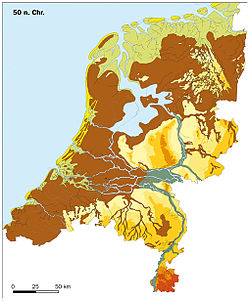
Batavia (/bəˈtviə/ bə-TAY-vee-ə), known in Dutch as Betuwe (Dutch pronunciation: [ˈbeːtyu.ə] ), is a historical and geographical region in the Netherlands, composed of large fertile islands in the river delta formed by the waters of the Rhine (Dutch: Rijn) and Meuse (Dutch: Maas) rivers. During the Roman Empire, it was an important frontier region and source of imperial soldiers. Its name is possibly pre-Roman.

The name Batavia derives directly from the Roman term for the region, and is related to the name of the Batavi or Batavians who lived in the area under Roman rule, until the third century AD. Administratively, the modern version, Betuwe, is a part of the Dutch province of Gelderland, and although the rivers and provinces have changed over history it is roughly the same. Today it includes the Waal river on the south and the Lek and Nederrijn in the north (all rivers which start in the delta itself and are branches of the Rhine). Historically, the former municipality of Rijnwaarden belonged to Betuwe, now in Zevenaar, which was cut off by the building of the Pannerdens Kanaal.

A major freight railroad, the Betuweroute, passes through the Betuwe. It was opened in 2007 after many years of controversy.

Lingewaard riverscape

Today's Betuwe region is divided into nine municipalities: Lingewaard, Arnhem (southern part), Nijmegen (northern part), Overbetuwe, Neder-Betuwe, Buren, Tiel, Culemborg and West Betuwe. The region is characterised by its many orchards, and has been known for centuries as the fruit garden of the Netherlands.[1]

Pre-Roman

[edit]

The "Batavian island" in the Rhine river was mentioned by Julius Caesar in his commentary Commentarii de Bello Gallico. The island's easternmost point is at a split in the Rhine, one arm being the Waal and the other the Lower Rhine/Old Rhine (hence the Latin name Insula Batavorum, "Island of the Batavi").[2] Much later Tacitus wrote that the Batavians who lived there had originally been a part of the Chatti, a tribe in Germany never mentioned by Caesar, who were forced by internal dissension to move to their new home.[3]

Tacitus also reports that before their arrival the area had been "an uninhabited district on the extremity of the coast of Gaul, and also of a neighbouring island, surrounded by the ocean in front, and by the river Rhine in the rear and on either side".[4] In a more detailed description he writes:

The island of the Batavi was the appointed rendezvous because of its easy landing-places, and its convenience for receiving the army and carrying the war across the river. For the Rhine after flowing continuously in a single channel or encircling merely insignificant islands, divides itself, so to say, where the Batavian territory begins, into two rivers, retaining its name and the rapidity of its course in the stream which washes Germany, till it mingles with the ocean. On the Gallic bank, its flow is broader and gentler; it is called by an altered name, the Vahal, by the inhabitants of its shore. Soon that name too is changed for the Mosa river, through whose vast mouth it empties itself into the same ocean.[5]

Modern archaeologists disagree with Tacitus, noting that that island had a pre-Roman and pre-Germanic population, apparently already called the Batavians. Caesar indeed had not only implied the existence of pre-Roman Batavians, but also mentioned that the Belgic Menapii of the Flemish coast had settlements stretching as far as the beginning of the delta, near the modern border with Germany.[6]

Roman era

[edit]

During the Roman Empire there was a civitas of the Batavians, a Germanic tribe. It was described as a large island between rivers in the Rhine-Meuse delta, roughly equivalent to modern Betuwe.[7] The Batavians shared the island with the Germanic Canninefates, to their west near the coast. The Romans founded Nijmegen during the first century B.C., atop a military encampment they had established there.

The name Batavia was also mentioned by Pliny the Elder, and it played a role in the account by Tacitus of the Germanic uprising of 68. He said that "In the Rhine itself, nearly 100 miles [160 kilometres] in length, Batavia is the most famous island of the Batavi and the Canninefates".[8]

Its later Roman history is attested by Ammianus Marcellinus, who mentions the Frankish Salians as a people living there. Zosimus is the only classical author who claims that they had first crossed the Rhine during the Roman upheavals and subsequent Germanic breakthrough in 260 AD. Both authors agree that the Salians were pushed south from Batavia into Toxandria.

Medieval

[edit]

In the Carolingian and Ottonian periods in the early Middle Ages, Batavia, called Batua by the Franks, was an example of a Frankish gau that was based on much older Roman pagi. Several counts are recorded as having their counties there, and it is mentioned in the treaties such as the Treaty of Meerssen, that divided up Europe among the different Frankish kingdoms.

Later, it was mainly absorbed into the newer county of Guelders which had become established to the southeast.

Renaissance

[edit]

In the Renaissance, the Dutch wanted to rediscover their pre-medieval Batavi culture and history. This common history raised Batavi to the status of cultural ancestors to all Dutch people (see The Batavian revival). They occasionally called themselves, or their things (Batavia), Batavians, resulting even in a short-lived Batavian Republic. The name Batavia was also taken to the colonies such as the Dutch East Indies, where they renamed the city of Jayakarta to become Batavia from 1619 until about 1942, when its name was changed to Djakarta (short for the former name Jayakarta, later respelt Jakarta; see: History of Jakarta). The name was also used in Suriname, where they founded Batavia, Suriname, and in the United States where the Holland Land Company founded the city and the town of Batavia, New York. This name spread further west in the United States to such places as Batavia, Illinois, near Chicago, and Batavia, Ohio.

When the Pannerdens Kanaal was dug between 1701 and 1709, the easternmost tip of the Betuwe (including the towns of Pannerden and Lobith) was cut off from the rest of the region.

20th century

[edit]
A landscape in today's Betuwe, shaped for centuries by fruit orchards

In the aftermath of the failed allied Operation Market Garden, the Germans attempted to retake the Allied gains during the Battle of the Nijmegen salient but were unsuccessful.

In the period 1940-1990, land consolidation took place throughout the area. This made further economies of scale and departmentalisation in fruit production possible.[1]

In 1995, a large part of this area had to be evacuated because the rivers threatened to overflow. They did not, but the incident raised the debate again about whether to reinforce the dikes.[citation needed]

References

[edit]
[edit]
Revisions and contributorsEdit on WikipediaRead on Wikipedia
from Grokipedia
Batavia, known in Dutch as the Betuwe, is a historical region in the central comprising fertile islands in the delta formed by the , Waal, and rivers. It served as the territory of the ancient Germanic Batavi tribe, who migrated there from the around the and established a society of farmers and warriors in the marshy, alluvial landscape. The Batavi forged a unique alliance with after their conquest circa , receiving exemptions from direct taxation in exchange for providing elite auxiliary troops, particularly famed for crossing rivers on horseback in full armor. This relationship positioned Batavia as a strategic frontier zone in , with key Roman fortifications such as Batavorum at modern anchoring military presence along the limes. The region's significance peaked during the , when Batavian leader spearheaded a major revolt in AD 69–70, temporarily seizing two legions before Roman forces under suppressed the uprising, highlighting tensions over Roman exploitation of local . By the late 3rd century AD, Batavian identity faded through assimilation into the amid increasing Germanic migrations and Roman withdrawal from the . In medieval times, the area evolved into fragmented lordships under Frankish and later influence, prized for its agricultural productivity that supported fruit cultivation and drainage innovations in the lowlands. The name Batavia persisted symbolically, evoking Dutch ancestral heritage during the and inspiring the short-lived (1795–1806) amid revolutionary fervor against Habsburg rule. Today, the Betuwe remains a verdant expanse of orchards and polders, emblematic of the ' mastery over water and soil inherited from its ancient delta origins.

Geography and Etymology

Physical Geography

The Batavian region, historically known as Batavia and corresponding to the ancient Betuwe, occupies a low-lying area in the eastern Rhine-Meuse delta of the modern Netherlands. This fluvial landscape lies between major branches of the Rhine River, including the Waal to the south and the Nederrijn (Lower Rhine) to the north, with additional waterways such as the Lek and Amsterdam-Rhine Canal influencing modern boundaries. The terrain consists primarily of flat floodplains formed by Holocene alluvial deposits, with elevations typically ranging from sea level to 5-10 meters above. Geologically, the area features river clay soils rich in sediments from upstream , deposited through repeated flooding and channel avulsions during the and epochs. Palaeogeographical reconstructions indicate that during the Roman period (circa CE), the landscape included natural levees along river courses, expansive wet flood basins, and fen woodlands interspersed with dunes. These elements created a of periodically inundated terrains, with peat-forming mires and seasonal marshes dominating much of the interior. The Rhine's dynamic channel shifts contributed to ongoing , building a thick sequence of clays and silts that supported localized fertile patches near riverbanks but rendered broader areas challenging for settlement without adaptation. The delta's proximity to the exacerbates and tidal influences, though the Batavian core was upstream enough to experience primarily riverine flooding rather than full estuarine conditions. Covering approximately 1,800 square kilometers in its mapped extents, the region's relied on natural drainage channels and overbank flows, fostering a wetland-dominated environment that persisted until medieval reclamation efforts transformed it into polders. profiles reveal layers of fine-grained clays overlying coarser sands, indicative of decelerating flow in the deltaic setting, with geochemical showing stable compositions tied to and inputs over millennia.

Etymology and Naming

The name Batavia derives from the Latin designation for the territory inhabited by the Batavi, a Germanic tribe that settled in the Rhine delta region by the 1st century CE. Roman sources, including in his (ca. 98 CE), described the Batavi as dwelling on an island-like area between the 's branches, termed Insula Batavorum due to its watery, isolated geography resembling an island. This Roman nomenclature emphasized the topographic features of the Betuwe (or Betua) district in modern-day and provinces of the Netherlands, where the tribe's core settlements were located. The ethnonym Batavi itself likely stems from Proto-Germanic *batawjō, a compound interpreted as "those of the good (or fertile) island," with *bat- denoting "good" or "excellent" (cognate with English "better" via Proto-Indo-European *bʰad-) and -*awjō referring to "island," "water-meadow," or "marshy land," reflecting the Rhine's floodplain habitat conducive to agriculture and defense. This etymology aligns with the tribe's separation from the Chatti around the mid-1st century BCE, when they migrated westward and occupied alluvial lands ideal for cattle-rearing and horticulture, as noted in Pliny the Elder's Natural History (ca. 77 CE). Alternative derivations, such as links to terms for "battle" or "fighters" (e.g., Old Norse boð for "battle"), have been proposed but lack the geographical specificity supported by the region's deltaic environment. In the early , Dutch humanists and patriots revived Batavia during the (1568–1648) against , portraying the Batavi as ancestral freedom-fighters to legitimize the United Provinces' independence; this symbolic usage extended to naming the Dutch East India Company's headquarters in Batavia (modern ) in 1619, evoking the ancient tribal heartland. The French Revolutionary-era (1795–1806), established after the ' invasion by French forces, formally adopted the name to invoke republican virtues attributed to the Batavi's historical alliance with and revolt against in 69–70 CE, though the polity retained monarchical elements under French influence. Post-Napoleonic, the term persisted poetically for the until supplanted by Nederlanden in official usage by the .

Pre-Roman Period

Origins of the Batavi Tribe

The Batavi tribe emerged as a distinct Germanic group through secession from the larger confederation in central , east of the in the region of modern northern . According to the Roman historian in his (c. AD 98), the Batavi "formed a tribe by seceding from their parent stock [the Chatti] owing to civil dissensions," marking their migration westward across the sometime between 100 and 50 BC. This account aligns with broader patterns of Germanic tribal fragmentation and movement during the late , driven by internal conflicts and pressure from neighboring groups. Archaeological evidence corroborates a migration into the Rhine-Meuse delta (modern ) around 50/30 BC to AD 40, shortly after Julius Caesar's campaigns in (58–50 BC) and before Roman consolidation under Drusus in 12 BC. The Batavi appear to have formed from a heterogeneous coalition, incorporating a Chatti military elite allied with alongside local Celtic-influenced populations and migrants from various northern European regions. Strontium isotope analyses of human remains from early Roman frontier sites reveal diverse origins, with individuals moving from areas east of the and potentially further north, indicating multi-phase mobility rather than a single mass migration. Cultural markers distinguish the Batavi's Germanic imprint from prior La Tène Celtic settlements in the delta: long rectangular post-built houses replaced roundhouses, and coarse handmade pottery with comb-stamped decoration supplanted wheel-turned fine wares. Coin hoards, including silver issues linked to types, and iron weapons with northern European forging techniques further evidence the influx of eastern Germanic elements. These artifacts, found at sites like De Horden and , suggest the Batavi coalesced as an ethnic identity through elite-driven settlement and Roman facilitation, blending imported traditions with local adaptations in a frontier zone.

Settlement and Society

The pre-Roman Batavi inhabited the fertile island region known as the Betuwe, situated between the northern and southern branches of the in the modern-day , where they established small, dispersed rural settlements consisting primarily of individual farmsteads and hamlets rather than centralized oppida typical of Celtic regions further south. These communities were adapted to the dynamic fluvial landscape of the delta, with archaeological evidence indicating occupation from around 150–, featuring post-built structures that combined human living quarters with animal stalls under a single roof, reflecting a reliant on arable farming, rearing, and possibly in the riverine environment. Handmade , iron tools, and limited metalwork from these sites underscore a self-sufficient agrarian , with no indications of large-scale networks or urban development prior to Roman contact. Social organization among the pre-Roman Batavi mirrored broader patterns in Late Iron Age Germanic groups of the lower Rhine, characterized by kinship-based clans and extended family units housed in byre-dwellings, with authority likely vested in chieftains or elders rather than formalized hierarchies. The scarcity of Late Iron Age burials in the region limits direct evidence of stratification, but the absence of elite grave goods or monumental structures suggests relatively egalitarian structures centered on household production and communal land use, though a warrior ethos is inferred from weapon finds and the tribe's later military prominence. Ethnogenesis of the Batavi occurred around 50–15 BC through the migration of a Chatti tribal offshoot from eastern Germania, which integrated with indigenous Celtic-influenced populations, fostering a hybrid cultural identity evidenced by strontium isotope analyses indicating mobility and diverse origins among early settlers. This migratory fusion likely reinforced tribal cohesion through shared descent narratives and oral traditions, without pronounced social divisions observable in material culture.

Roman Era

Initial Contacts and Conquest

The Roman awareness of the Batavian region emerged during Julius Caesar's campaigns across the in 55 and 53 BC, when he described the "Island of the Batavi" (Insula Batavorum) as a strategic area formed by diverging branches of the River, inhabited by allied with or neutral toward Roman incursions into . Caesar's expeditions did not involve direct military engagement with the Batavi, who occupied the delta's fertile lowlands but were not yet a consolidated tribal entity in Roman records; his forces bridged the and raided eastern territories, establishing initial reconnaissance of the region's defensibility and resources without formal conquest. The Batavi, originating as a splinter group from the tribe east of the , migrated westward and settled in the Rhine-Meuse delta between approximately 50 BC and 12 BC, displacing prior inhabitants such as the and establishing control over the area known as Betuwe (modern ). This settlement positioned them as a buffer population along Rome's emerging northern , with later noting their martial prowess and disdain for tribute, traits that facilitated their rapid integration as Roman auxiliaries rather than outright adversaries. The formal Roman conquest occurred in 12 BC under Nero Claudius Drusus, stepson of Emperor Augustus, during the opening phase of campaigns to secure and expand the frontier. Drusus assembled a fleet of transports and warships to navigate the coast and estuaries, subduing the Batavi alongside the through amphibious operations that demonstrated Roman naval superiority and logistical reach; the Batavi offered limited resistance, likely due to their recent migration and interest in alliance against neighboring threats. Following this subjugation, Drusus established military bases along the , including early fortifications in Batavian territory, and negotiated their status as —allied subjects exempt from taxation in exchange for supplying elite and cavalry cohorts to the , a arrangement that bound them closely to imperial service from the outset. This conquest integrated the Batavi into the provincial system of without prolonged warfare, prioritizing their recruitment as crack troops over full provincialization.

Alliance, Military Service, and the Batavian Revolt

The Batavi entered into a formal alliance with Rome following their subjugation around 12 BC, becoming foederati who were exempt from direct taxation in exchange for supplying elite auxiliary troops to the Roman army. This arrangement positioned the Batavi as valued allies rather than conquered subjects, with their warriors renowned for exceptional discipline, swimming prowess across rivers like the Rhine in full armor, and skill in both infantry and cavalry roles. By the first century AD, the tribe contributed approximately 5,000 men to Rome's forces, forming up to 10 auxiliary cohorts (each around 500 strong, including alae of cavalry) and serving in the emperor's personal bodyguard, such as under Caligula and Nero. Batavian units participated in major campaigns, including those of Germanicus in Germania (AD 14–16) and Claudius' invasion of Britain (AD 43), where their ferocity earned them a fearsome reputation among Roman commanders. This military obligation, however, bred resentment over time due to the disproportionate burden on the small tribe's male population—estimated to field over 50% of military-age men during the Julio-Claudian era—and instances of Roman mistreatment, including forced over-recruitment and punitive actions against Batavian elites. Tensions escalated during the (AD 69), when the Batavi, under the command of —a Romanized noble, veteran of a Batavian cohort, and one-eyed warrior scarred from prior service—exploited Roman instability following Nero's death. Civilis, imprisoned and partially blinded by order of the Vitellian procurator for alleged conspiracy, along with the execution of his brother and other kinsmen, harbored personal vendettas that aligned with broader grievances against Roman procurators' corruption and levies that had decimated Batavian manpower. ![Riverscape, Lingewaard, illustrating the Rhine delta terrain central to Batavian military operations][float-right] The revolt ignited in late when Civilis, stationed with legions loyal to , orchestrated a among Batavian auxiliaries at (), swearing loyalty to while feigning support for Vitellius to mask intentions. Rallying the Batavi and neighboring , , and Ubii, Civilis ambushed and defeated Roman forces under Munius Lupercus near , capturing the commander and using the victory to proclaim Batavian independence and desecrate Roman eagle standards in a . The rebels besieged Vetera (), trapping the Legio XV Primigenia and Legio V Alaudae; after a prolonged starvation siege, the legions surrendered in early but were massacred by the Batavians, yielding 8,000 Roman dead and bolstering rebel momentum with captured supplies. Civilis expanded the uprising into a pan-Germanic coalition, briefly controlling the frontier, burning the colonia of Colonia Agrippinensis (), and coordinating with Gallic tribes like the under Julius Classicus, who proclaimed a "Galloroman ." Roman counteroffensives under , dispatched by with 20,000–30,000 troops including fresh legions, reversed Batavian gains by mid-AD 70. defeated Civilis at the Battle of the (near modern ), recaptured Vetera, and inflicted heavy losses on the rebels at Mons Graupius-like engagements along the river, leveraging superior Roman artillery and naval support. Civilis retreated to the Batavian island in the delta, where flooding and dwindling allies forced negotiations; though he evaded capture, the Batavi secured a conditional peace, retaining semi-autonomy, reduced garrisons, and continued auxiliary service under lighter terms, as sought to stabilize the without total annihilation of a proven asset. The revolt highlighted vulnerabilities in Rome's reliance on Germanic auxiliaries but ultimately reinforced Batavian integration, with their cohorts reconstituted and deployed elsewhere to prevent future concentrations near home.

Later Roman Administration and Decline

Following the suppression of the Batavian Revolt in 70 AD, Roman authorities imposed stricter oversight on the Batavi, including the stationing of a permanent legion within their territory to enforce compliance and collect tribute, while curtailing the tribe's former exemptions from direct taxation. The Oppidum Batavorum, established around 12 BC on the south bank of the Waal River near modern Nijmegen, functioned as the primary administrative hub for the civitas Batavorum, housing Roman officials, merchants, and craftsmen alongside Batavian elites to facilitate centralized control and economic integration. This fortified settlement evolved into a key node for tribute storage, trade, and governance, reflecting Rome's strategy to bind the Batavi more tightly to imperial structures post-rebellion. The Batavi retained their role as valued auxiliaries, supplying elite cohorts—totaling around 5,000 men by the late 1st century—that specialized in , such as swimming rivers with horses under arms, and were deployed to frontiers like Britain and the . These units, initially composed primarily of ethnic Batavians under tribal command, continued service through the , with evidence of their participation in campaigns under (r. 98–117 AD) and (r. 117–138 AD), bolstering Roman legions despite occasional recruitment from other Germanic groups diluting ethnic purity over time. Under , the settlement was elevated to the colonia Ulpia Noviomagus Batavorum around 100–104 AD, incorporating Roman , temples, and baths to promote and administrative efficiency. Roman administration in Batavia faltered amid the Crisis of the Third Century (235–284 AD), as recurrent Germanic incursions, economic strain, and internal upheavals eroded frontier defenses along the . Settlements like were largely abandoned by circa 250 AD, with archaeological evidence indicating depopulation and destruction layers attributed to raids by northern tribes, signaling the loss of effective imperial control over the region. The Batavi, facing displacement and intermingling, were absorbed into the expanding by the late 3rd century, their distinct tribal identity fading as Frankish groups settled en masse and Roman forces withdrew eastward. Partial Roman reassertion under (r. 284–305 AD) involved fort-building in former Batavian lands but relied on Franks for defense, presaging the full collapse of the limes by the early amid broader barbarian migrations and the empire's fragmentation.

Migration Period and Early Middle Ages

Post-Roman Transitions

The crisis of the third century severely undermined Roman control over , including the Batavian region in the delta, as repeated Germanic raids by and combined with internal Roman instability led to the abandonment of frontier forts and widespread depopulation in the northern lowlands by the late 260s AD. Archaeological surveys in the Dutch River Area, encompassing the former Batavian heartland, reveal a sharp decline in rural settlements and ceramic production from around 250 AD, with many sites showing evidence of hasty evacuation or destruction before eventual partial repopulation under new occupants. In response to these pressures, the province underwent administrative reconfiguration, being redesignated as Germania Secunda in the early fourth century as part of the diocese of Gaul, though effective central authority waned amid ongoing barbarian incursions and the temporary secession of the (260–274 AD), which briefly centered on . The , a subgroup originating from the estuary, increasingly penetrated the depopulated Batavian territories; following defeats by Saxon raiders, Emperor Julian granted them status in 358 AD, allowing settlement in the island of Batavia (modern Betuwe) as Roman allies tasked with border defense. This arrangement marked a pragmatic shift from direct imperial governance to reliance on Germanic , with Frankish groups exploiting Roman weaknesses to establish semi-autonomous enclaves amid dwindling presence. By the fifth century, these transitions accelerated with the mass in 406 AD by , , and , further eroding Roman infrastructure, though some continuity in local agrarian practices persisted in isolated rural pockets of the Betuwe. The original Batavian population, heavily Romanized and militarily integrated, appears to have largely assimilated into or been displaced by these incoming , as evidenced by shifts in customs and toward Germanic styles by circa 400 AD. Roman urban centers like declined into mere villages, symbolizing the broader collapse of provincial administration before Frankish consolidation.

Frankish Conquest and Integration

The , a subgroup of the Franks originating from areas north of the , established early dominance in the Rhine delta including the Batavian region (modern Betuwe) during the late Roman period. Initially raiding Roman territories from the 3rd century, they were defeated and partially settled as within imperial borders around AD 358 under Emperor Julian the Apostate, who permitted them to occupy depopulated lands in northern following their expulsion from Toxandria. This arrangement positioned the Salians as defenders of the frontier against other Germanic incursions, fostering gradual control over former Batavian lands, which had been ravaged and depopulated by Frankish activity by the late 3rd century. As Roman authority eroded after the Vandal and Alan migrations across the Rhine in AD 406 and the deposition of the last western emperor in 476, the Salian Franks transitioned to de facto independence under kings like Childeric I (r. circa 457–481), whose rule extended from the Scheldt River to the Somme. Childeric's son, Clovis I (r. 481–511), unified the Salian and Ripuarian Franks through military campaigns, including the decisive victory over the Roman ruler Syagrius at the Battle of Soissons in 486, which eliminated residual Roman enclaves in northern Gaul and solidified Frankish hegemony over the delta territories. The Batavian region, lacking distinct tribal resistance post-Batavi assimilation, integrated as a core Salian stronghold without recorded major conquest battles, reflecting its prior Frankicization. Integration into the Merovingian Frankish kingdom involved legal, administrative, and . The Lex Salica, codified under Clovis around 507–511, applied to Salian territories including the delta, emphasizing male-only land inheritance (allods) and regulating fines for offenses, which reinforced Frankish social structures amid a mixed population of Germanic settlers and Romanized remnants. Clovis's conversion to circa 496 facilitated alliances with Gallo-Roman elites, though northern delta areas like Betuwe experienced slower Christianization, with missionary activity intensifying under later Merovingians like (r. 629–639). The region formed part of , the northeastern Frankish subkingdom, governed by royal appointees and local comites (counts), promoting economic continuity in agriculture and trade. Archaeological findings from 6th–8th century Merovingian sites in the delta, such as , reveal robust iron production and exchange networks linking local settlements to broader Frankish economies, indicating effective integration rather than disruption. These sites show evidence of specialized crafts, including blacksmithing with high-quality blooms, and connections to emporia like , underscoring the region's role in sustaining Merovingian power amid feudal precursors. By the , under Carolingian reforms, Betuwe's incorporation deepened through administrative pagi (districts) and foundations, transitioning from tribal lands to a structured provincial appendage of the Frankish realm.

Medieval Period

Administrative Divisions and Feudal Structure

During the High and Late Middle Ages, the Batavia region—corresponding to the historical Betuwe—integrated into the emerging territorial principality of Gelre (Guelders), where counts acquired control over the area by the 12th century through conquest and marriage alliances, laying foundations for ducal authority formalized in 1339. The Betuwe itself divided into two primary subregions: Overbetuwe (upper Betuwe, north of the Waal River) and Nederbetuwe (lower Betuwe, south of the river), each encompassing multiple villages and rural districts known as ambachten that served as basic fiscal and judicial units under feudal oversight. These divisions facilitated localized governance amid the duchy's quarter-based structure, with the Betuwe forming part of the broader Rivierenland (river lands) quarter alongside areas like the Bommelerwaard. Feudal hierarchy in the Betuwe mirrored the ' seigneurial model, with the Duke of Guelders as paramount overlord holding ultimate rights to high , , and domain lands, while delegating via fiefs (leen or beneficium) to nobles who administered heerlijkheden (lordships). Lords exercised low over tenants, collected tithes, tolls, and rents, and maintained manorial courts, though many holdings originated as allods later feudalized, leading to fragmented jurisdictions where overlapping claims by families like the Lords of Batenburg (attested from 1087) or prompted disputes resolved through ducal arbitration. For instance, in 1350, the Lord of Oijen formally recognized Gelre's over Betuwe possessions, exemplifying how peripheral lords integrated into the ducal pyramid in exchange for protection and confirmation of hereditary rights. Lower tiers included knightly vassals and freeholders (allodiale holders), with peasant obligations varying from labor services on demesne lands to fixed rents, though commutation to money payments increased by the amid economic shifts. Key heerlijkheden in Nederbetuwe included high lordships like Lede en Oudewaard and IJzendoorn, which held elevated judicial privileges subordinate to ducal oversight, while Overbetuwe featured around 30 villages grouped into ambachten managed by schouten (sheriffs) appointed by resident lords to enforce ordinances on dike maintenance, markets, and minor disputes. This structure persisted into the 15th-16th centuries, with ducal efforts to centralize—such as reclaiming alienated fiefs—often checked by noble resistance, as seen in conflicts involving the Lords of Bronkhorst over territorial encroachments. Seigneurial power extended to water management, where river lords coordinated flood defenses via collective pacts, reflecting the Betuwe's Rhine-Waal delta vulnerabilities. By the late medieval period, while the duke commanded feudal levies for regional wars, local economies increasingly eroded serfdom, transitioning obligations toward contractual tenancies under noble patronage.

Economy, Agriculture, and Local Conflicts

The medieval economy of the Betuwe region, part of the of Gelre, relied heavily on , leveraging the fertile alluvial soils of the Rhine-Waal interfluve for subsistence and production. High medieval , estimated to have doubled in parts of the between 1000 and 1300, drove agricultural intensification through three-field rotation systems, expanded via assarting, and initial drainage efforts in marshy areas, yielding grains like and alongside such as and sheep. Feudal structures amplified economic disparities, with land ownership skewed toward a noble and clerical from as early as the 9th-10th centuries; by 1300-1400, the western Betuwe exhibited pronounced inequality, where large dominated while smallholders and tenants comprised the majority, fostering dependency on manorial rents and labor services. Late medieval commercialization, influenced by proximity to urbanizing , spurred specialization in and precursors, though yields remained vulnerable to floods and soil exhaustion, contributing to post-1350 demographic stagnation. Social distribution of holdings in the western Betuwe circa 1300-1600 showed elites controlling over 50% of land in some locales, per cadastral records, which incentivized consolidation over fragmentation. Local conflicts arose from these imbalances and feudal fragmentation, including disputes over manorial rights and inheritance within Gelre's nobility; for instance, 13th-century tensions between regional lords and the ducal house often escalated into raids or judicial feuds, with fortifications like Doornenburg Castle—first documented in 1295 and expanded in the 14th century—functioning as defensive seats amid rivalries with neighboring powers such as the Bishopric of Utrecht. Broader Guelders conflicts, including border skirmishes from the 12th century onward, disrupted agrarian routines, though the Betuwe avoided major sieges until later eras, reflecting its strategic riverine position that prioritized deterrence over open warfare. Land accumulation from the 14th century intensified peasant burdens, occasionally sparking micro-revolts or litigation over commons access, as unequal property fueled resentment without widespread upheaval.

Early Modern Period

Under Burgundian, Habsburg, and Dutch Rule

In 1473, Duke of annexed the , incorporating the Batavian region of the Betuwe, after the death of Duke Arnold of Egmond on February 23. This acquisition expanded Burgundian influence eastward, but control proved ephemeral; following Charles's death at the in 1477 and the subsequent Habsburg inheritance through his daughter Mary, the duchy was reclaimed by Charles of Egmond in 1492 amid ongoing feudal disputes. Habsburg rulers, viewing Guelders as part of their Burgundian patrimony, pursued reconquest through intermittent wars, often complicated by Guelders' alliances with and local resistance. Emperor Charles V, born in in 1500 and raised in the , decisively ended Guelders' independence in 1543 by defeating Duke William V of Jülich-Cleves-Berg and securing the Treaty of Venlo on September 7, which ceded the duchy and the County of to Habsburg domains. The of 1548 formalized the integration of Guelders, including the Betuwe, into the under indivisible Habsburg rule, establishing a centralized administrative framework with councils in overseeing provincial estates and stadtholders. Under from 1556, escalating taxation to fund wars—reaching 10% on real estate and sales in some levies—and enforcement of Catholic orthodoxy via the Council of Troubles fueled unrest across the provinces, including . The Dutch Revolt ignited in 1566 with iconoclastic riots, but in , momentum built through the efforts of John VI, Count of Nassau, who as stadholder mobilized support for William of Orange against Spanish governance. By 1579, adhered to the , rejecting Habsburg sovereignty alongside , , and others, paving the way for the 1581 Act of Abjuration deposing . The in 1648 confirmed the Dutch Republic's independence, with the Betuwe region—divided into the Quarter for local administration—integrated as a core agricultural zone of province under the States-General in . Governance emphasized provincial autonomy, with the States of handling taxation and defense, while the area's alluvial soils between the , Waal, and Linge rivers sustained , bolstered by dike maintenance and early drainage projects that mitigated floods and enhanced productivity. This period saw relative stability post-revolt, though occasional inundations, such as those during the 1672 invasion, tested resilience.

Cultural and Economic Developments

The Batavia region, encompassing the fertile Betuwe area in Gelderland, solidified its role as a horticultural powerhouse during the early modern period, with fruit cultivation—particularly apples, pears, and cherries—emerging as a cornerstone of the local economy. The alluvial soils of the Rhine and Waal river delta supported intensive market-oriented farming, building on Roman-era introductions but expanding significantly from the 16th century amid growing urban demand in the Dutch Republic. Towns like Tiel served as key export hubs, facilitating trade of fresh produce to Amsterdam and beyond via riverine networks, which enhanced regional prosperity during the Golden Age. Land management practices evolved with tenant farming on larger consolidated holdings, where by the mid-16th century, a class of elite farmers accumulated sufficient acreage to drive efficiencies in output, even as smaller holdings faced pressures leading to rural exodus or . This structure allowed the Betuwe to supply specialized perishables to broader markets, contributing to the ' overall agricultural commercialization, though the region avoided the industrialization seen in . Economic vitality peaked in the but waned in the 18th amid Dutch wars and stagnation, with local remaining resilient yet undiversified. Culturally, the period marked a shift from medieval Catholic traditions to Reformed Protestantism following the Dutch Revolt and incorporation into the , with Calvinist consistories overseeing moral and communal life in rural parishes. This religious transformation influenced social norms, emphasizing frugality and labor aligned with agricultural rhythms, while local dialects and harvest preserved a distinct rural identity amid broader Dutch cultural homogenization. remained limited to basic for farm management, with higher learning centered in nearby cities like , reflecting the region's agrarian focus over urban intellectualism.

Modern Era

Industrialization and 19th-Century Changes

The Betuwe region, historically known as Batavia, underwent gradual economic transformation in the , characterized by agricultural intensification rather than heavy industrialization typical of western urban centers. Fertile alluvial soils along the and Waal rivers supported expanded fruit cultivation, particularly apples, pears, and cherries, which became export staples due to improved drainage, selective , and market access. By the mid-1800s, steam-powered facilities emerged for jam, juices, and preserves, with Tiel's "De Betuwe" factory exemplifying local value-added production from abundant harvests. Limited developed in tandem with agrarian needs, including steam-driven mills, shipyards for river vessels, and kilns fueled by riverine clay deposits to meet demands from western . In towns like Tiel, small-scale smithies expanded into factories by the late , producing tools and machinery, while Geldermalsen hosted beet sugar refineries and fruit auctions tied to cooperative farming. These industries employed seasonal laborers, supplementing farm incomes amid from 100,000 in 1815 to over 150,000 by 1900, though proletarianization remained modest compared to regions like . Infrastructural advancements accelerated connectivity, with the railway network extending into the region in the 1860s–1880s, including Geldermalsen's station opened in 1868, facilitating freight of produce and goods to and beyond. Early debates on a dedicated Betuwe freight line from to , aimed at boosting , reflected strategic efforts to integrate the area's into national trade, though full realization awaited the . These changes enhanced productivity but also spurred rural-to-urban migration and , as favored larger holdings and displaced smaller farmers. ![Cherry plantation in Baal, Haalderen, Lingewaard][float-right]

20th-Century Events and Contemporary Status

During the Second World War, the Betuwe region served as a frontline after the failure of in September 1944, with Allied airborne operations targeting nearby bridges and resulting in battles such as the fight for Elst in Over-Betuwe. German forces fortified positions along dikes and ruins, turning the area between the and Waal rivers into a no-man's-land subjected to prolonged artillery exchanges. On December 2, 1944, Germans detonated explosives on the dike at Elden, rapidly flooding Over-Betuwe as part of defensive measures under Plan Stork to stall Allied progress; this inundation submerged farmland, displaced thousands of civilians—many of whom evacuated south or north—and persisted into 1945, exacerbating famine and hardship. Approximately 4,000 men remained to guard properties amid the chaos. Liberation occurred unevenly, with villages like Heerewaarden and Dodewaard freed in by advancing forces, while most of the region awaited the German surrender on May 5, 1945. Post-war reconstruction emphasized restoring dikes, drainage, and , though the area saw limited industrialization compared to urban centers; fruit farming modernized through the replacement of high-stem trees with low-stem varieties, , and expanded cultivation, solidifying the Betuwe's role in national produce. In the contemporary era, the Betuwe functions as a predominantly rural expanse within province, spanning municipalities including Overbetuwe (population approximately 47,000), Neder-Betuwe (around 25,000), and West Betuwe (over 53,000). Its economy centers on , earning the moniker "fruit garden of the " through prolific output of apples, pears, cherries, and other soft fruits on fertile river clay soils, with orchards covering thousands of hectares and supporting local processing, exports, and tourism during spring blossoms. The region maintains flood defenses integrated into national water management, while residential growth reflects suburban expansion from nearby and , preserving a of polders, dikes, and family-run farms.

Archaeological and Cultural Significance

Key Discoveries and Sites

The principal archaeological site in the Batavia region is Ulpia Noviomagus, situated in present-day Nijmegen and functioning as the administrative center of the civitas Batavorum from the late 1st century AD. Excavations, including those at the St.-Josephhof in 2005-2006, have uncovered pre-Roman settlement layers from the decade BCE alongside evidence of widespread fire destruction during the Batavian revolt of AD 69-70, confirming the site's role as a target of anti-Roman uprising. Further digs in 2025 revealed a monumental Roman building near the Waal River, spanning at least 30 by 35 meters with a large inner courtyard, indicative of public or administrative architecture within the expanded urban layout of Ulpia Noviomagus. In 2022, excavations in Herwen-Hemeling (municipality of Zevenaar) exposed a Roman sanctuary complex associated with a site, including stone idols, relief carvings, and fragments of painted plaster walls, representing the first fully intact temple ensemble of its type unearthed in the and dating to the 2nd-3rd centuries AD. This discovery highlights the integration of local Batavian religious practices with Roman infrastructure along the . A significant civilian was identified in near Bemmel during infrastructure development, yielding over 50 intact inhumation from the 2nd-3rd centuries AD, complete with pottery, jewelry, and other preserved just 20 inches below the surface, providing insights into non-military Batavian life and customs. Rural settlements across the region, such as those documented through surveys in the Betuwe area, reveal small farmsteads with mixed agrarian economies; artifact analyses indicate rapid Batavian adoption of Roman culinary elements, like imported ceramics and techniques, within decades of the Roman in AD 12-28. Military castella along the limes, including sites near , have produced weapons, coins, and auxiliary equipment linked to Batavian cohorts, underscoring their role as elite Roman troops. These findings are housed and interpreted at institutions like Museum Het Valkhof in , which displays extensive regional artifacts.

Interpretations and Debates

Scholars debate the ethnic origins of the Batavi, with classical sources like claiming they migrated from east of the around 55–50 BCE, potentially as a splinter group from the , while archaeological evidence from the Dutch delta reveals continuity in Late Iron Age , such as handmade and house plans, suggesting limited large-scale migration. Strontium isotope analyses of human remains from early Roman sites indicate some mobility among individuals but no evidence of mass replacement, challenging narratives of wholesale displacement and supporting interpretations of local or elite-driven alliances with Romans. This tension between textual and bioarchaeological data underscores ongoing discussions about the reliability of Roman historiographical accounts versus empirical proxies for . Interpretations of Romanisation in Batavian society remain contested, with some researchers advocating a revived concept of directed cultural change through integration and emulation, evidenced by the adoption of Roman equipment and at sites like (Ulpia Noviomagus Batavorum, founded circa 50 CE), while others emphasize persistent indigenous practices in rural settlements, such as traditional farming tools and votive deposits to native deities. Epigraphic evidence from altars and tombstones highlights a hybrid Batavian identity, where tribal names persisted alongside grants post-98 CE, but debates persist on whether this reflects genuine or pragmatic power negotiation within the auxiliary system. Rural site excavations reveal selective uptake of Mediterranean imports like pottery, interpreted variably as status symbols or economic integration rather than wholesale cultural erasure. The Batavi's role in Roman auxiliaries, particularly cohorts stationed in Britain from the 1st century CE, fuels discussions on exported identity, with archaeological finds like sword fittings and inscriptions at sites such as suggesting maintained ethnic cohesion through familial networks and practices, yet evolving toward imperial loyalty as seen in dedications to Roman gods. Critics of over-reliance on military argue it overstates tribal unity, proposing instead fragmented identities shaped by local contexts, supported by strontium data showing diverse origins among recruits. These debates extend to cultural significance, where 16th–17th-century Dutch humanists repurposed Batavian resistance narratives (e.g., the 69–70 CE revolt led by Julius Civilis) for proto-national myths of liberty, though modern deconstructs such romanticizations by prioritizing material evidence over anachronistic projections.

References

Add your contribution
Related Hubs
User Avatar
No comments yet.