Hubbry Logo
Beer gardenBeer gardenMain
Open search
Beer garden
Community hub
Beer garden
logo
8 pages, 0 posts
0 subscribers
Be the first to start a discussion here.
Beer garden
Beer garden
from Wikipedia

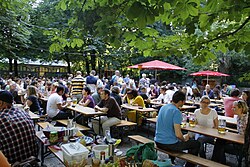
A typical Munich beer garden
A beer garden at night

A beer garden (German: Biergarten) is an outdoor area in which beer and food are served, typically at shared tables shaded by trees.

Beer gardens originated in Bavaria, of which Munich is the capital city, in the 19th century, and remain common in Southern Germany. They are usually attached to a brewery, beer hall, pub, or restaurant.[1][2]

History

[edit]
Decree by King Maximilian I Joseph of Bavaria, dated 4 January 1812, allowing Munich brewers to serve beer from their cooling cellars, but no food other than bread

Facilities of this kind existed for example in Bamberg since 1605 under the German term "Bierkeller" ("Beer cellars"). At that time, the Archdiocese of Bamberg was directly subordinated to Rome and not yet to the Duchy of Bavaria. Hence, the first "Biergarten" in the strict sense of the term and of the decree of 1812 by the Kingdom of Bavaria developed at the beginning of 19th century in Munich. While it is unknown which brewery was first, it was likely one of Munich's big six: Löwenbräu, Hofbräuhaus, Augustinerbräu, Paulaner, Hacker-Pschorr and Spaten.[3]

Seasonal limitations on when beer could be brewed were already in the Bavarian brewing regulations by 1539. In 1553, Albert V decreed a period from 29 September, the Feast of St. Michael, to 23 April, the Feast of Saint George, for its production. The cool seasons were chosen to minimize the risk of fire when boiling mashed grain into wort. Numerous conflagrations had occurred, which resulted in the prohibition of brewing during the summer months. In response, large breweries dug cellars in the banks of the River Isar to keep their beer cool during storage. "Beer cellars" for consuming beer on premises naturally followed.

Tavern Garden. Painting by Jan Steen, c. 1660

To further reduce the cellar temperature during the warm seasons, 19th-century brewers layered gravel upon the cellars by the bluffs and planted horse-chestnut trees for their dense spreading canopies and shallow roots, which would not damage the cellars.[4] Soon afterward, serving cool beer in a pleasant shaded setting emerged. Simple tables and benches were set up among the trees, creating the popular "beer garden" that is known today. Food service followed, aggrieving smaller breweries that found it difficult to compete, and they petitioned Maximilian I to forbid it. As a compromise, beer gardens allowed their patrons to bring their own food, which is still a common practice. Most beer gardens offer clothed tablesets, whose guests must buy food from the house. Those who bring their own food must use the bare table sets, unless—which is common—they bring their own cloth(s) also. With the advent of widespread lagering in the later 19th century, beer gardens grew more popular than ever.

Maximilian's decree is no longer in force, and many beer gardens forbid victuals not sold through the establishment. Common Bavarian fare such as Radi (radish), Brezn (soft pretzel), Obatzda (cheese dip), halbes Hendl (half a grilled chicken), Hax'n (knuckle of pork), and Steckerlfisch (grilled fish) are often served. Equally important to the beer garden is an atmosphere of Gemütlichkeit,[3] conveying a feeling of warmth, friendliness, and belonging. Reinforced by shared tables, it is often accompanied by music, song, and fellowship among strangers.

That is so integral to beer garden culture that the Bayerische Biergartenverordnung (Bavarian Beer Garden Ordinance) of 1999 permits traditional tree shaded venues that allow their patrons to bring their own food to close later and exceed the noise limits that are otherwise in force.[5] The term Biergarten is not otherwise restricted, and anyone can call any kind of open-air restaurant by that name,[citation needed] but purists[who?] distinguish between a Wirtsgarten,[2] in which only the brewery's food is sold (such as the outdoor tables at the Hofbräuhaus am Platzl),[6] and a Biergarten, in which patrons may bring their own.

Around the world

[edit]
A beer garden in Pilgrim's Rest, South Africa

The term "beer garden" (Biergarten) has become a generic term for open-air establishments where beer is served. Many countries have such establishments. The characteristics of a traditional beer garden include trees, wooden benches, a gravel bed, and freshly prepared meals. Some modern beer gardens use plastic chairs, fast food, and other variations of the traditional beer garden.

The largest traditional beer garden in the world is the Hirschgarten in Munich, which seats 8,000.[7]

Australia

[edit]

Australia has many beer gardens, typically as part of a pub, or often next to sports fields.[8][9][10]

Austria

[edit]

In Austria, the beer garden is called Gastgarten (guest garden). They serve food such as ein Paar Würstel (a pair of the German Bratwurst) or Schweinebraten (German pot-roasted pork). When ordering beer, the choices are usually a Pfiff (0.2 L [0.044 imp gal; 0.053 US gal]), a Seidel (0.3 L [0.066 imp gal; 0.079 US gal]), or a Krügerl (0.5 L [0.11 imp gal; 0.13 US gal]).

Canada

[edit]
A beer garden in Churchill Square in Edmonton, Alberta, during the "Cariwest" Caribbean festival

Canada has traditionally lacked an outdoor eating culture conducive to beer gardens. Cold weather and biting insects are part of the reason. However, with increased urbanization during the 20th century, drinking at outdoor cafes and restaurant patios became more common. Such patios are usually attached to licensed establishments. They became particularly popular with smokers in the late 20th and early 21st century as smoking was prohibited in public indoor spaces, however as of 2025 such bans have been expanded in most jurisdictions to cover licensed patios as well.

Canadian alcohol laws generally forbid drinking in unlicensed public places, although in recent years such policies have been relaxed in some jurisdictions. In Canada, beer gardens are generally a segregated area attached to an event such as a concert or festival. They may be outdoors and/or indoors, depending on the season and other circumstances. Eligibility for the specific license needed to operate such an event varies by jurisdiction, and is often effectively limited to non-profit organizations.

Despite the name, most beer gardens in Canada today serve other alcoholic beverages as well. Beer gardens are very popular at large sporting events such as the Memorial Cup in hockey. It is usually illegal to remove alcohol from the area or bring in outside alcohol.[11][12]

Germany

[edit]

The words ‘beer garden’ derive from the German ‘Biergarten’, they are still a very common cultural aspect throughout Germany, where some of the world's oldest breweries are still active. The majority of towns and even villages have at least one small beer garden. Larger cities will have many throughout its neighbourhoods, including some of the largest beer gardens in the world. The Hirschgarten restaurant in Munich is noted for its beer garden, which is possibly the largest in the world. It has seating for well over 8,000 people.[13] The restaurant dates back to 1791.

Biergartens typically are of a particular local or regional brewery, meaning they serve only the beers of the brewery they are associated with. The world's oldest brewery, Weihenstephaner (estd. 1041) has its beer garden next to its brewing facility and the Technical University of Munich, where a brewmaster degree is offered.

In 2011, the world record for 'The world's longest beer garden' was set in Berlin by the Berlin Beer Festival, measuring 1,820 m (5,970 ft) long.[14]

Japan

[edit]

Beer gardens are popular in Japan. Many are located on the roofs of department stores and hotels.[15][16]

United Kingdom

[edit]
A beer garden in England

In Britain a beer garden is an open space which is attached to a pub. In the countryside they usually provide a surrounding view of the area; in towns and cities a beer garden is an open garden space.[17] Pubs located along canals will usually have a canal-side beer garden. Many pubs compete throughout the year to be named 'Britain's best beer garden' in numerous awards. Some provide open air music, as well as food, beer and other drinks.[18][19]

United States

[edit]
A beer garden at Coasters Pub, Indian Harbour Beach, Florida

In the United States, historically, beer gardens offered many pastimes besides just beer drinking. Some spots hosted shooting galleries, bowling alleys, and live classical music.[20] People could come for entertainment and events,[21] even if they did not want to partake in the drinking. Today, many beer gardens have outdoor games, as well as board games, available to patrons.

The Raleigh Beer Garden in Raleigh, North Carolina holds the world record for largest selection of beer at a single location with 378 different beers on tap.[22]

American liquor laws condition how beer gardens can operate in each state (legal drinking age is 21). For example, Washington alcohol laws require organizers to apply for and receive a liquor license, alcohol only to be consumed in the designated venue, the area to be fenced, and staff to "cut off" obviously drunk patrons. Additional laws restrict alcohol-related signage associated with the event and prevent smoking in the beer garden.[23]

See also

[edit]

References

[edit]
[edit]
Revisions and contributorsEdit on WikipediaRead on Wikipedia
from Grokipedia
A beer garden, known as a Biergarten in German, is an outdoor seating area attached to a or where patrons consume and food at communal wooden tables, typically shaded by large trees to keep the cool during warm weather. These establishments originated in 19th-century , particularly , as brewers dug ice cellars along the River to store bottom-fermenting produced under strict winter brewing regulations, planting trees above for natural cooling and shade. The concept traces its regulatory roots to the , when Bavarian Duke Albrecht V issued the 1553 Brauordnung decree limiting beer production to cooler months (September 29 to April 23) to reduce fire risks from summer malting and ensure beer quality through low-temperature . By 1812, King I Joseph formalized beer gardens through a rescript granting brewers licenses to sell and directly from cellars but restricting other food sales to protect local innkeepers, leading to the tradition of patrons bringing their own picnics. This evolved over time; by 1897, food service was permitted again, and the 1999 Bavarian Biergartenverordnung law reaffirmed the right to bring personal food while mandating simple, rustic setups without tablecloths. Beer gardens embody Bavarian —a sense of cozy sociability and equality—fostering communal gatherings across social classes in expansive, tree-shaded spaces that encourage lingering over mugs of beer served from wooden barrels. Traditional accompaniments include hearty fare like pretzels, cheese spread, radishes, and sausage salad, often paired with unfiltered or Weissbier. While rooted in , the model has influenced global outdoor drinking venues, adapting to local cultures from American urban parks to international festivals.

Overview and characteristics

Definition

A beer garden, known in German as a Biergarten, is an outdoor area adjacent to a brewery, pub, or restaurant where beer and food are served at communal tables shaded by trees or other structures. The term originates as a direct loan translation from the German words Bier (beer) and Garten (garden), reflecting its roots in 19th-century Bavarian culture where such spaces facilitated the enjoyment of freshly brewed beer in natural settings. Essential to the concept of a beer garden is its strong association with brewing traditions, often featuring direct connections to on-site production facilities to ensure the beer served is local and authentic. These venues prioritize casual, open-air socializing, with patrons gathered at long shared benches under natural or artificial shade to promote a relaxed, community-oriented atmosphere. Beer gardens are distinct from indoor beer halls, which provide enclosed, heated spaces for year-round drinking without the emphasis on outdoor exposure to nature. They also differ from general patios or outdoor seating areas at restaurants, which lack the specific communal table arrangements, shaded garden-like environment, and historical ties to brewery culture that define a true beer garden.

Design elements

Beer gardens feature a distinctive layout centered on communal seating to foster social interaction, typically consisting of long wooden benches and tables designed to accommodate groups of 8 to 12 people. These fixed benches, often without backs for a rustic feel, are arranged in rows under the canopy of large shade trees such as horse-chestnuts (), which provide natural shelter from the sun while evoking a forest-like ambiance. The ground surfaces in traditional beer gardens are covered with or to ensure effective drainage, maintain a cool beneath the seating areas, and protect tree roots from compaction. This permeable material allows rainwater to percolate quickly, preventing accumulation during wet weather, while the light-colored reflects away from the shaded zones. Architectural elements emphasize simplicity and integration with the natural environment, including lightweight roofing like canvas awnings or wooden pergolas to supplement shade during peak sun hours. Many historic beer gardens are situated near natural water sources, such as rivers, to facilitate cooling of underground beer cellars through ambient temperatures, a practice rooted in Bavarian brewing traditions. For scale, Munich's Königlicher Hirschgarten exemplifies large-capacity designs with approximately 8,000 seats spread across expansive gravel areas under mature trees. Over time, materials have evolved from natural wood and stone in traditional setups to incorporate durable modern alternatives in contemporary beer gardens. While authentic designs prioritize untreated wooden benches and stone pathways for longevity and aesthetic harmony, non-traditional venues often add fixed umbrellas for adjustable shade and gas or electric heaters to extend seasonal use, with occasional use of weather-resistant plastics for bench slats to reduce maintenance.

Atmosphere and traditions

The atmosphere in a beer garden is characterized by , a German concept denoting a sense of cozy warmth, sociability, and belonging that fosters relaxed interactions among patrons, often strangers sharing long communal benches under shaded trees. This environment encourages casual conversations, with children playing nearby and groups engaging in light-hearted activities such as card games or chess, contributing to a laid-back, inclusive vibe. Live , including occasional bands, may enhance the setting, blending traditional melodies with the hum of daily enjoyment. Traditional practices reinforce this communal spirit, such as the custom of Brotzeit, where patrons historically bring their own simple snacks like bread, cheese, and cold cuts to pair with beer, a right codified in Bavaria's 1999 Biergarten Decree to preserve affordability and accessibility. Seating operates on a first-come, first-served basis with no reservations, promoting equality and spontaneity, while beer gardens typically open seasonally from spring through autumn to capitalize on mild weather. Sensory elements immerse visitors in the experience: the cheerful clink of liter mugs during toasts, bursts of laughter from nearby tables, and the savory aromas of grilling meats and fresh pretzels wafting through natural breezes beneath leafy canopies. emphasizes respect within this shared space, encouraging communal toasting with eye contact and the informal "Du" address, while respecting personal boundaries; attire remains casual, though traditional Bavarian outfits like add to the festive mood without being mandatory.

History

Early origins

The roots of beer gardens lie in the 16th-century brewing practices of , where regulations sought to reduce fire risks from the open flames used in boiling wort during summer months. Seasonal limitations on brewing were established in Bavarian regulations as early as 1539, prohibiting production from April to September to prevent conflagrations in the region's wooden architecture. In 1553, Duke Albrecht V formalized these restrictions through the Bavarian Brauordnung, confining brewing to the cooler months between September 29 (St. Michael's Day) and April 23 (St. George's Day), while also mandating cool storage conditions for the resulting beer to ensure its quality during warmer periods. To comply with these storage requirements, brewers excavated deep ice cellars—often around 40 feet in depth—directly into the banks of the River, leveraging the waterway's natural cooling effect. Above these underground facilities, they planted fast-growing chestnut trees to create shaded canopies that helped regulate temperatures and protect the from heat and sunlight. This practical arrangement not only preserved the lagers but also laid the groundwork for the outdoor settings that would characterize later beer gardens. During the 17th and 18th centuries, these shaded areas above the cellars evolved from mere storage adjuncts into informal social venues, where locals gathered to drink the cooled in the open air. What began as a necessity for beer preservation gradually fostered leisurely assemblies, with simple tables placed under the trees for communal enjoyment, marking an early shift toward . Many of Munich's enduring beer garden sites trace their origins to this period. A prominent precursor to these developments appeared in , where the Bierkeller—beer cellars dug into hills—emerged in the early as dedicated spaces for storing and serving beer, though they were primarily underground and lacked extensive outdoor shading. These cellars exemplified the regional trend of adapting natural geology for brewing needs, predating the more formalized Bavarian beer gardens.

19th-century development

The formal establishment of beer gardens in began with a pivotal issued on January 4, 1812, by King I , which permitted brewers to serve beer directly from their cooling cellars in shaded outdoor areas but strictly prohibited the sale of any food to safeguard the interests of local innkeepers. This legal compromise resolved ongoing disputes between breweries and taverns, transforming temporary shaded spots above cellars into dedicated beer-serving venues and giving rise to the enduring tradition of patrons bringing their own provisions for picnics. In the late , the growing popularity of bottom-fermenting beers, which demanded consistent cold storage in underground cellars to mature properly, further drove the evolution of these spaces. Brewers expanded the shaded areas overhead—often planting rows of chestnut trees for natural cooling along the River—to protect the cellars from summer heat, effectively turning modest cellar entrances into expansive gardens that could accommodate larger crowds seeking the crisp, refreshing brewed during winter months. This adaptation aligned with advancements in production techniques originating in , enhancing the viability and appeal of outdoor beer service. Prominent examples of this development appeared in Munich's , where historic sites like the beer garden at the —constructed in 1790 but fully integrated as a social venue by the mid-19th century—offered vast, park-like settings for communal drinking. The era's industrialization granted the newfound time and disposable income, spurring a surge in beer garden numbers across as affordable, open-air alternatives to stuffy indoor taverns, with alone hosting dozens by the century's end. These gardens quickly assumed a significant social role, serving as egalitarian venues where individuals from diverse classes mingled freely over , fostering informal political discussions and hosting local festivals that reinforced community bonds amid rapid . Such gatherings exemplified by providing accessible public spaces for , distinct from more stratified indoor establishments, and helped solidify beer gardens as symbols of Bavarian conviviality.

20th-century spread

The spread of beer gardens beyond accelerated in the early through waves, particularly to the , where German enclaves in cities like New York and adopted the concept to foster community gatherings. German immigrants, arriving in significant numbers until , established open-air venues attached to breweries, mirroring Bavarian traditions of communal drinking under shaded trees. These spaces served as social hubs for working-class families, offering beer and simple meals in urban settings. This expansion encountered major setbacks in the United States due to the era from 1920 to 1933, which outlawed alcohol production and sales, forcing most beer gardens to close or convert to non-alcoholic soda fountains. Compounding the issue, during and after stigmatized these immigrant-rooted establishments as un-American, leading to a sharp decline in their operation. Post-repeal in 1933, a modest resurgence occurred as surviving breweries like in revived outdoor serving areas, though the culture remained subdued compared to pre-Prohibition vibrancy. Following , beer gardens underwent a notable revival across Europe, with countries like and restoring wartime-damaged venues and expanding them as symbols of cultural recovery. In the United States, adaptations persisted in German-American strongholds such as , where Milwaukee's beer gardens, tied to local breweries like Pabst and , reemerged as family-oriented outdoor destinations emphasizing live music and regional pride. Meanwhile, initial appearances in emerged in via blended British-German influences, gaining popularity among European immigrants seeking casual al fresco drinking spots. From the 1950s to the 1970s, beer garden growth surged in connection with rising tourism and festivals, as international visitors sought authentic experiences. in , resuming in 1946 after wartime cancellations, expanded its global reach through exported traditions, inspiring temporary beer garden setups at events in and . This era solidified the beer garden's transition from niche immigrant custom to a widely adapted format, overcoming earlier disruptions through economic recovery and cross-cultural exchange.

Cultural significance

Social role in Germany

Beer gardens in , particularly in , function as democratic equalizers by providing communal spaces where individuals from all social classes—workers, professionals, and elites—mingle freely at shared tables, transcending everyday hierarchies and fostering social cohesion. This egalitarian atmosphere, rooted in the tradition of long benches under chestnut trees, encourages spontaneous interactions and a sense of unity, where status differences momentarily dissolve during shared enjoyment of and conversation. As and hubs, beer gardens serve as versatile venues for everyday relaxation, birthdays, club meetings, and other gatherings, often accommodating picnics brought from home to create inclusive, low-cost experiences suitable for . These spaces play a vital role in preserving Bavarian identity by embodying —a convivial warmth that reinforces cultural traditions through seasonal visits and communal rituals. Their integral connection to festivals like further cements this, drawing millions annually to celebrate regional heritage in open-air settings. Historically, beer gardens have been sites for free speech and political discourse, notably during 19th-century protests like the 1844 Munich Beer Riots against price increases, where crowds gathered to voice grievances over economic policies affecting daily life. In the , particularly post-World War II, they supported democratization efforts; the 1995 "Beer Garden Revolution" saw around 20,000 demonstrators rally in against restrictive opening-hour regulations, leading to the 1999 Bavarian Beer Garden Ordinance that protected their cultural role and affirmed their status as democratic public forums. Today, beer gardens attract thousands daily during warm months and underscore their enduring place in German social fabric as accessible retreats for leisure and connection.

Community and events

Beer gardens serve as central venues for a variety of organized events that foster communal gatherings, including major festivals like the annual in , which attracted 6.7 million visitors in 2024 and featured extensive beer garden setups within its tents for outdoor enjoyment. These spaces also host music performances, such as traditional oompah bands and folk dances at locations like the in 's , where events draw crowds for live entertainment on Sundays and public . Sports viewings, particularly for soccer matches like those during the , are common, with large screens set up in beer gardens to accommodate enthusiastic fans in a relaxed outdoor setting. Seasonal markets, including summer folk festivals and fairs, further utilize these venues to blend local traditions with casual socializing. The community impact of beer gardens extends through their role in hosting charity events, local fairs, and corporate outings, which strengthen social ties and support regional causes; for instance, many Bavarian beer gardens participate in fundraisers tied to folk festivals that attract hundreds of thousands annually. In terms of tourism, beer gardens significantly boost visitor numbers, as seen in , where the city's overall appeal—including its beer culture—draws more than six million tourists each year, with events like amplifying this economic and cultural draw. Organizationally, beer gardens adapt flexibly for large-scale events, often featuring temporary setups to handle crowds; a notable example is the 2011 International Beer Festival, which established the for the longest beer garden at 1,820 meters along , accommodating hundreds of breweries and thousands of attendees over a weekend. These venues integrate seamlessly with public holidays, remaining open and hosting extended hours for celebrations, such as music and family gatherings on Sundays and national observances, ensuring accessibility during peak community times. To promote inclusivity, many beer gardens incorporate family-friendly features like dedicated play areas for children, allowing parents to relax while kids enjoy swings, slides, and games; in , at least 11 such locations, including the Seehaus in the , provide these amenities alongside shaded seating. adaptations, such as ramps and spacious layouts for wheelchairs, are standard in larger German beer gardens to accommodate diverse visitors, enhancing their role as inclusive community hubs.

International cultural adaptations

In the , beer gardens have evolved beyond their German roots by integrating live and themed nights to appeal to diverse urban crowds. Venues like The Olde Mecklenburg Brewery & Biergarten in , host live music performances on weekends, fostering a lively atmosphere that encourages prolonged socializing among families and groups. Similarly, Jester King Brewery in , incorporates unique themed events such as guided goat walks and "Doom Metal goat yoga," blending rustic outdoor settings with whimsical, locally inspired activities that draw in a broader demographic. In the , adaptations emphasize culture traditions like quizzes and recognition through garden awards, transforming beer gardens into competitive social hubs. The Rising Sun in , , for instance, has been named Britain's Best Beer Garden and hosts popular pub quizzes led by notable quizzers, integrating intellectual entertainment with outdoor drinking to enhance . Many UK pubs participate in awards like the Great British Pub Awards for beer gardens, which highlight well-maintained outdoor spaces with features such as heated patios and scenic views, adapting the communal to Britain's weather-variable . Cultural shifts in international beer gardens often move from strictly communal seating to more privatized arrangements, reflecting local preferences for comfort and exclusivity. In some North American and European venues, traditional long shared benches have given way to individual sets, cabanas, and reserved booths, allowing for smaller groups or families to enjoy while still promoting an open-air vibe. This evolution is evident in Canadian adaptations, where beer gardens incorporate local festivals, including sports events; for example, rugby games feature pop-up beer tents with craft brews, creating temporary outdoor zones that tie into the excitement of matches and fan gatherings. Efforts to preserve the authentic identity of beer gardens persist among diaspora and adopting communities, often blending traditional elements with local urban lifestyles. In Japan, rooftop beer gardens like those at Matsuya Ginza in Tokyo maintain communal tables and seasonal operations reminiscent of Bavarian originals but adapt to dense cityscapes by offering all-you-can-drink packages with Japanese twists, such as yakitori and chu-hai cocktails, atop department stores for panoramic views. These venues, operating from May to September, honor the German concept of shaded outdoor socializing while integrating urban Japanese culture through themed nights and fusion menus, ensuring the format's enduring appeal in a high-rise environment. Challenges in adapting beer gardens arise particularly in conservative regions with strict alcohol norms, requiring modifications to comply with local laws. In Gulf countries like and , where alcohol sales face heavy restrictions or outright bans in areas like stadiums and public spaces, introducing beer garden-style venues demands non-alcoholic alternatives or limited operations, as seen during the when beer sales were prohibited at event sites despite initial plans. In and Sharjah (UAE), complete prohibitions on alcohol complicate traditional setups, prompting diaspora communities or hotels to explore alcohol-free versions that emphasize food, ambiance, and mocktails to balance cultural preservation with regulatory adherence.

Food and beverages

Beer and other drinks

Beer gardens primarily serve a variety of traditional German beer styles, with a strong emphasis on lagers and s that align with Bavarian brewing heritage. Common offerings include , a known for its crisp, malty flavor and low hop bitterness, often considered the quintessential beer garden choice due to its refreshing profile suited for outdoor consumption. Weizen or Hefeweizen, an unfiltered with banana and clove notes from top-fermentation, is another staple, particularly popular in summer settings for its light body and effervescence. Dunkles, a darker Munich-style with roasted aromas, and , an amber with caramel undertones, round out the typical selection, providing fuller-bodied options for varied preferences. In , is traditionally served in a , a one-liter dimpled that promotes communal sharing and extended enjoyment, though half-liter portions are also available for lighter drinkers. This large serving size underscores the leisurely pace of beer garden visits, where fresh pours from kegs ensure optimal and temperature. Preference is given to locally brewed beers, often unpasteurized and unfiltered varieties like , which retain natural yeast for enhanced flavor and freshness, drawing directly from nearby breweries to support regional traditions. Beyond beer, beer gardens offer non-alcoholic alternatives to accommodate diverse guests, including Radler, a shandy-style mix of and lemonade that halves the alcohol content while adding refreshment, ideal for hot days. Apfelschorle, a simple blend of and sparkling , provides a crisp, fruity non-alcoholic option popular across all ages, evoking the orchards of . Soft drinks, herbal teas, and seasonal specialties like lighter summer wheat beers or stronger winter bocks further diversify the menu, ensuring inclusivity without deviating from the garden's casual ethos. Internationally adapted beer gardens, such as those , expand beverage variety to include extensive draft selections, with Raleigh Beer Garden offering over 350 beers on tap and having held the Guinness World Record for the most beers on tap (verified as 397 in 2019, with current selections exceeding 380 as of 2025), showcasing a mix of local crafts, imports, and seasonals to cater to global tastes. This emphasis on fresh, on-site pours maintains the core appeal of beer gardens as hubs for unhurried, high-quality imbibing.

Traditional and regional foods

Beer gardens in Bavaria traditionally feature a selection of hearty, straightforward dishes that pair well with , emphasizing local ingredients and simple preparations to foster communal dining. Central to this cuisine is , a pungent originating in 19th-century , crafted from ripe or similar soft cheese blended with , onions, , and sometimes for added depth; it is typically smeared onto soft s or as an appetizer. Brezn, the iconic Bavarian , complements this with its chewy texture and salted exterior, often baked fresh on-site and served whole for sharing among groups at long communal tables. Sausages like Weißwurst represent another cornerstone, a delicate white variety made from finely ground and seasoned with , , and mild spices, poached gently rather than grilled to preserve its tenderness; it is customarily consumed before midday, sliced and eaten without the skin ("zuzeln"), accompanied by sweet mustard and a side of crisp radishes for contrast. Hendl, or , provides a more substantial option, with whole birds spatchcocked, marinated in salt, pepper, and , then grilled over open flames on a spit until the skin achieves a crispy, golden finish; portions are sold as halves or wholes, ideal for family-style sharing. Preparation in beer gardens favors simplicity and speed to suit the casual atmosphere: sausages and chicken are grilled outdoors for a smoky aroma, while cold plates like and pretzels require minimal assembly. Historically, a 1812 Bavarian decree prohibited breweries from selling food to avoid competition with inns, leading patrons to bring their own provisions—a tradition that persists in some self-service areas today, though modern beer gardens predominantly offer brewery-provided meals for convenience. Regional variations include accompaniments such as , dressed lightly with vinegar, oil, broth, and onions rather than , or fresh bundles (Radi), which add a peppery crunch; these sides are portioned generously to encourage sharing and prolong the social drinking experience. The fare emphasizes affordability and heartiness, with dishes designed to sustain long afternoons of beer consumption without overwhelming the palate—rustic proteins and starches that absorb the beer's malty notes while remaining accessible to all social classes, reflecting beer gardens' roots as egalitarian gathering spots.

Global variations

Germany

Beer gardens, known as Biergärten, form a of German outdoor , particularly as a national institution in where they originated and remain most prevalent. Across , beer gardens number in the thousands, with Bavaria hosting the highest concentration. These establishments are typically shaded by chestnut trees and feature long communal tables, fostering social interaction amid servings of regional beers. In Bavaria, they embody a protected cultural , emphasizing simplicity and community over commercial excess. Iconic beer gardens highlight regional diversity and scale. Munich's Hirschgarten stands as the world's largest, accommodating up to 8,000 patrons in a sprawling park setting adjacent to a deer enclosure, drawing visitors for its vast communal benches and traditional Augustiner beer. Within Munich's expansive Englischer Garten—one of Europe's largest urban parks—venues like the Chinesischer Turm and Seehaus offer idyllic settings with lake views and historical pavilions, seating thousands under tree canopies since the 19th century. In Franconia, Bamberg's historic Bierkeller—cellars hewn into sandstone hillsides—provide a cooler alternative, with several such sites historically serving smoked Rauchbier in garden-adjacent spaces overlooking the Regnitz River. Berlin's beer garden scene reached a milestone in 2011 when the International Berliner Bierfestival established a Guinness World Record for the longest beer garden, stretching 1,820 meters along the Spree River and accommodating over 10,000 visitors. The city features around 50 such venues. Unique legal and operational features distinguish Bavarian beer gardens from other hospitality venues. The 1999 Bayerische Biergartenverordnung (Bavarian Beer Garden Ordinance) permits extended operating hours until 11 p.m. daily—later than standard restaurants—and relaxes noise regulations to accommodate lively gatherings, provided they maintain a traditional, low-key character without amplified music after closing. A key distinction exists between a pure Biergarten, where patrons may bring their own food but must purchase beer on-site to support the communal ethos, and a Wirtsgarten, which offers full table service with establishment-provided meals alongside drinks. This framework preserves the self-service tradition while allowing flexibility for larger operations. Beer gardens are deeply intertwined with Germany's festive culture, most notably in , where the event transforms into a vast temporary beer garden complex. The festival features 14 large tents and 21 smaller ones, many with expansive outdoor gardens serving approximately 7 million liters of beer in 2024 from Munich's six major breweries, creating ephemeral hubs of revelry that echo permanent Bavarian sites. These seasonal setups reinforce beer gardens' role as communal anchors, blending tradition with large-scale celebration.

Other European countries

In , beer gardens known as Gastgärten offer shaded outdoor seating where patrons enjoy local alongside traditional dishes such as Würstel (sausages) and Schweinebraten (roast pork). is commonly served in a 0.5-liter measure called a Krügerl, particularly in Viennese establishments. These venues trace their roots to the Viennese , open-air wine taverns established in the as precursors to modern beer gardens, where visitors brought their own food to pair with fresh brews under rustic canopies. In the , pub gardens function as informal beer gardens, often featuring scenic canal or river views that enhance the relaxed atmosphere for enjoying real ales and ciders. Notable examples include The Free Trade Inn in Newcastle-upon-Tyne, perched above the River Tyne with selections of craft ales, and in , which integrates local ciders and earned the Great British Pub Awards' Pub of the Year in 2017 for its welcoming outdoor space. The (CAMRA) recognizes exemplary pub designs through its annual Pub Design Awards, frequently highlighting gardens with innovative seating and historical integrations, such as canalside refurbishments that blend heritage architecture with modern amenities. Beyond these, the features pivní zahrady ( gardens) as communal outdoor spots emphasizing affordable pivo () amid park-like settings with panoramic city views. Popular sites like Letná Beer Garden and Riegrovy Sady provide picnic-style tables under chestnut trees, serving a range of lagers alongside simple grilled foods, fostering social gatherings from spring through early autumn. In , guinguettes represent a historic , evolving from 18th-century tax-avoidance taverns into modern riverside venues that now serve alongside wine and cocktails in convivial, family-oriented atmospheres with deckchairs and areas. Influenced by broader Central European traditions, beer gardens in northern regions like the and exhibit adaptations to cooler climates, including shorter operating seasons limited to warmer months and increased covered seating with heaters to extend usability.

North America

In the United States, beer gardens trace their origins to 19th-century German immigrants who introduced the tradition as social gathering spots, particularly in the Midwest's "German Triangle" encompassing cities like , Wisconsin; , Missouri; and Cincinnati, Ohio. These immigrants, fleeing political unrest and economic hardship in , established open-air venues where working-class families could relax on Sundays, enjoying beer served alongside simple foods like bread and sausages, in line with Bavarian customs. In , a hub for German settlement and brewing giants such as Pabst, Schlitz, and , early beer gardens like the Schlitz Palm Garden (opened in 1890) became community centers featuring live music, animal exhibits, and pagoda-style architecture to evoke European roots. These spaces emphasized entertainment, with brass bands providing live performances and areas for games that created a festive, family-oriented atmosphere akin to mini amusement parks. Modern American beer gardens often highlight extensive craft beer selections and hold notable records for scale, such as the Raleigh Beer Garden in , which achieved the World Record for the most different varieties of beer on tap with 369 drafts in 2015. This venue exemplifies the shift toward diverse, locally sourced brews, including over 100 options, paired with outdoor seating and casual entertainment. In , beer gardens are predominantly event-driven, appearing at major sporting occasions like the hockey tournament, where they serve as licensed outdoor areas for pre- and post-game festivities including live music and food trucks. For instance, during the 2022 in , the Bash on the Bay event incorporated beer gardens at the Waterfront Container Village to enhance fan experiences within a controlled, ticketed environment. Their prevalence is curtailed by harsh weather in many regions, limiting operations to warmer months, and strict provincial laws that generally prohibit public alcohol consumption outside licensed venues or designated events to maintain public order. North American adaptations of beer gardens increasingly emphasize innovation, with venues blending expansive indoor halls and outdoor patios to accommodate year-round use and diverse crowds. Urban revivals, such as those in , feature hybrid spaces like the CRAFT Beer Market, which offers over 100 taps in a financial setting with seasonal patios, reflecting a fusion of European and local microbrewery . However, operators face challenges from fragmented licensing regimes, where U.S. states and Canadian provinces impose varying requirements for outdoor service, capacity limits, and approvals, often complicating expansions or event hosting.

Asia and Oceania

In Japan, beer gardens have evolved into popular rooftop venues atop department stores and hotels, offering panoramic city views and a casual atmosphere that blends with the izakaya tradition of shared and after-work socializing. These seasonal summer spots, typically operating from May to September, emphasize refreshing local brews such as Asahi alongside grilled meats and light bites, fostering communal relaxation amid urban heat. Australia's beer gardens often integrate with pub culture or adjoin sports fields, providing shaded outdoor seating for casual gatherings that echo British pub traditions while incorporating German immigrant influences from the early . They proliferate nationwide, from urban courtyards to expansive setups. Across other Asian countries, beer garden concepts are emerging with local twists, particularly in urban settings. In , craft beer parks and gardens are gaining traction amid the rising craft scene. China features urban beer plazas that transform public spaces into lively hubs, such as Qingdao Beer Street, a bustling pedestrian area lined with restaurants serving Tsingtao and other beers from evening onward. In , microbrewery gardens adapt the format to spicy regional cuisines. In beyond , New Zealand's beer gardens frequently neighbor vineyards, leveraging the mild climate for year-round operations that combine with wine . These spots emphasize scenic, low-key socializing, often as part of broader hop and grape tours in regions like Marlborough and Nelson.

Modern developments

In , beer gardens are governed by specific regulations that distinguish them from other venues, particularly under the Bavarian Beer Garden Ordinance (Bayerische Biergartenverordnung) enacted in 1999. This ordinance recognizes beer gardens as an essential element of Bavarian , granting them exemptions from standard noise and operating hour restrictions applicable to other establishments. It allows beer gardens to remain open until 11:00 p.m. and permits live music, such as bands, to perform at higher volumes without violating local noise ordinances, provided the venue adheres to communal seating and open-air traditions. A key legal distinction in German beer garden operations lies in food service rules, separating traditional Biergärten from Wirtsgärten. In a Biergarten, patrons are permitted to bring their own —often simple Brotzeit like bread, cheese, and sausages—while purchasing exclusively from the venue, reflecting historical edicts from King Maximilian I in the mid-19th century that encouraged this practice to promote accessibility. In contrast, a Wirtsgarten, typically associated with larger breweries equipped with kitchens, requires all to be purchased on-site from the establishment, with covered tables and more formal service. These rules ensure beer gardens maintain their communal, egalitarian character while complying with health and licensing standards. Across jurisdictions, beer gardens must adhere to common operational rules, including age restrictions on alcohol service, capacity limits for safety, and standards. As of 2025, in , the minimum age for purchasing and wine is 16, and for spirits is 18; youths aged 14 and 15 may consume and wine only in the presence of a parent or . is considering raising the age for and wine to 18. , the federal minimum drinking age is 21 for all alcoholic beverages, strictly enforced in licensed venues like beer gardens. Capacity is regulated by local fire and building codes to prevent overcrowding, often limiting seating to fixed numbers based on square footage, while follows national laws, such as 's Food and Feed Code (Lebensmittel- und Futtermittelgesetzbuch, LFGB) or the U.S. Food Code, mandating proper , waste disposal, and temperature controls for any on-site food preparation. Internationally, regulations vary significantly, emphasizing licensing for alcohol service and restrictions on consumption. In the United States, gardens require state-specific licenses for outdoor alcohol sales and consumption, such as Washington's approval for "shared outdoor alcohol service areas" or Vermont's permits for patios and gardens, which often prohibit removing open containers from the premises. Open-container laws further restrict transport of alcohol outside licensed areas, with violations varying by state—fines or charges common in places like or New York. In , drinking is generally banned outside designated licensed areas, with provincial laws prohibiting consumption in parks or streets unless part of a permitted event; gardens or patios attached to licensed establishments are allowed, but municipalities like enforce strict no-alcohol rules in spaces to maintain order. Historically, regulations have shifted in response to social and economic pressures. In the United States, the Prohibition era (1920–1933) under the 18th Amendment banned alcohol production and sale, effectively eradicating gardens—introduced by German immigrants in the as family-oriented outdoor spaces—from the cultural landscape, as they relied on legal service and faced additional suppression from during World Wars I and II. Post-repeal in 1933, gardens slowly reemerged but remained limited by state-level controls. In , post-World War II liberalizations, driven by economic recovery and reduced wartime rationing, facilitated increased alcohol consumption and relaxed restrictions on public venues; for instance, consumption patterns shifted upward after 1945 as countries like and those in eased prior temperance-era limits, enabling the revival and expansion of traditional gardens amid broader social democratization.

Sustainability and innovations

Beer gardens have increasingly adopted environmental practices to minimize their , particularly through the preservation of natural shading elements and waste reduction strategies. In traditional German beer gardens, large trees provide essential shade, and Bavarian regulations under the 1999 Bayerische Biergartenverordnung recognize beer gardens as , supporting their traditional character including shaded areas with trees. Waste reduction efforts include the use of reusable , as seen at events like , where disposable plastics have been banned since the 1990s, and reusable mugs are promoted to cut down on single-use waste. Solar shading innovations, such as customizable awnings and pergolas, offer UV protection and extend usability while integrating energy-efficient LED lighting, reducing reliance on artificial cooling. For beer storage, water-efficient cooling in cellars employs advanced systems like glycol-based units that recycle water and maintain precise temperatures with minimal consumption, supporting sustainable operations in attached brewing facilities. Innovations in beer gardens blend tradition with modern technology to enhance accessibility and appeal. Integration of craft beers has become standard, with many venues featuring local microbrews alongside classics to promote in sourcing and reduce transportation emissions. App-based reservations streamline operations, allowing users to book tables in advance via mobile platforms, as demonstrated by dedicated beer garden booking apps that optimize seating and reduce no-shows. Heated enclosures, including retractable roofs and radiant heaters, enable year-round use by protecting against cold and wind, increasing revenue potential while minimizing seasonal downtime. Urban vertical gardens are emerging in city-based beer gardens, where hydroponic wall systems grow herbs and on-site, enhancing aesthetics and providing fresh ingredients with low water use. Post-2020 trends reflect adaptations to and environmental priorities, boosting the popularity of beer gardens as safe outdoor venues. Contactless service, including mobile ordering and payments, became widespread during the to minimize interactions, with many gardens implementing spaced picnic tables for social distancing that persist for enhanced guest comfort. The growth of eco-certified venues has accelerated, with associated breweries achieving B Corp status for commitments to and zero-waste practices, leading to more gardens powered by solar installations and certified sustainable. Despite these advances, challenges from threaten beer gardens' seasonal viability, particularly in temperate regions where extreme weather disrupts outdoor operations. In underrepresented regions like and , beer gardens remain limited, though emerging solar-powered brewing facilities integrate for off-grid viability, offering models for sustainable expansion.

References

Add your contribution
Related Hubs
User Avatar
No comments yet.