


Community hub
Recent from talks
Contribute something
Nothing was collected or created yet.
Colors of noise
View on Wikipedia | This article may be confusing or unclear to readers. (December 2021) |

| Colors of noise |
|---|
In audio engineering, electronics, physics, and many other fields, the color of noise or noise spectrum refers to the power spectrum of a noise signal (a signal produced by a stochastic process). Different colors of noise have significantly different properties. For example, as audio signals they will sound different to human ears, and as images they will have a visibly different texture. Therefore, each application typically requires noise of a specific color. This sense of 'color' for noise signals is similar to the concept of timbre in music (which is also called "tone color"; however, the latter is almost always used for sound, and may consider detailed features of the spectrum).
The practice of naming kinds of noise after colors started with white noise, a signal whose spectrum has equal power within any equal interval of frequencies. That name was given by analogy with white light, which was (incorrectly) assumed to have such a flat power spectrum over the visible range.[citation needed] Other color names, such as pink, red, and blue were then given to noise with other spectral profiles, often (but not always) in reference to the color of light with similar spectra. Some of those names have standard definitions in certain disciplines, while others are informal and poorly defined. Many of these definitions assume a signal with components at all frequencies, with a power spectral density per unit of bandwidth proportional to 1/f β and hence they are examples of power-law noise. For instance, the spectral density of white noise is flat (β = 0), while flicker or pink noise has β = 1, and Brownian noise has β = 2. Blue noise has β = -1.
Technical definitions
[edit]Various noise models are employed in analysis, many of which fall under the above categories. AR noise or "autoregressive noise" is such a model, and generates simple examples of the above noise types, and more. The Federal Standard 1037C Telecommunications Glossary[1][2] defines white, pink, blue, and black noise.
The color names for these different types of sounds are derived from a loose analogy between the spectrum of frequencies of sound wave present in the sound (as shown in the blue diagrams) and the equivalent spectrum of light wave frequencies. That is, if the sound wave pattern of "blue noise" were translated into light waves, the resulting light would be blue, and so on.[citation needed]
White noise
[edit]
White noise is a signal (or process), named by analogy to white light, with a flat frequency spectrum when plotted as a linear function of frequency (e.g., in Hz). In other words, the signal has equal power in any band of a given bandwidth (power spectral density) when the bandwidth is measured in Hz. For example, with a white noise audio signal, the range of frequencies between 40 Hz and 60 Hz contains the same amount of sound power as the range between 400 Hz and 420 Hz, since both intervals are 20 Hz wide. Note that spectra are often plotted with a logarithmic frequency axis rather than a linear one, in which case equal physical widths on the printed or displayed plot do not all have the same bandwidth, with the same physical width covering more Hz at higher frequencies than at lower frequencies. In this case a white noise spectrum that is equally sampled in the logarithm of frequency (i.e., equally sampled on the X axis) will slope upwards at higher frequencies rather than being flat. However, it is not unusual in practice for spectra to be calculated using linearly-spaced frequency samples but plotted on a logarithmic frequency axis, potentially leading to misunderstandings and confusion if the distinction between equally spaced linear frequency samples and equally spaced logarithmic frequency samples is not kept in mind.[3]

Pink noise
[edit]
The frequency spectrum of pink noise is linear in logarithmic scale; it has equal power in bands that are proportionally wide.[4] This means that pink noise would have equal power in the frequency range from 40 to 60 Hz as in the band from 4000 to 6000 Hz. Since humans hear in such a proportional space, where a doubling of frequency (an octave) is perceived the same regardless of actual frequency (40–60 Hz is heard as the same interval and distance as 4000–6000 Hz), every octave contains the same amount of energy and thus pink noise is often used as a reference signal in audio engineering. The spectral power density, compared with white noise, decreases by 3.01 dB per octave (10 dB per decade); density proportional to 1/f. For this reason, pink noise is often called "1/f noise".
Since there are an infinite number of logarithmic bands at both the low frequency (DC) and high frequency ends of the spectrum, any finite energy spectrum must have less energy than pink noise at both ends. Pink noise is the only power-law spectral density that has this property: all steeper power-law spectra are finite if integrated to the high-frequency end, and all flatter power-law spectra are finite if integrated to the DC, low-frequency limit.[citation needed]
Brownian noise
[edit]
Brownian noise, also called Brown noise, is noise with a power density which decreases 6.02 dB per octave (20 dB per decade) with increasing frequency (frequency density proportional to 1/f2) over a frequency range excluding zero (DC). It is also called "red noise", with pink being between red and white.
Brownian noise can be generated with temporal integration of white noise. "Brown" noise is not named for a power spectrum that suggests the color brown; rather, the name derives from Brownian motion, also known as "random walk" or "drunkard's walk".
Blue noise
[edit]
Blue noise is also called azure noise. Blue noise's power density increases 3.01 dB per octave with increasing frequency (density proportional to f ) over a finite frequency range.[5] In computer graphics, the term "blue noise" is sometimes used more loosely as any noise with minimal low frequency components and no concentrated spikes in energy. This can be good noise for dithering.[6] Retinal cells are arranged in a blue-noise-like pattern which yields good visual resolution.[7]

Cherenkov radiation is a naturally occurring example of almost perfect blue noise, with the power density growing linearly with frequency over spectrum regions where the permeability of index of refraction of the medium are approximately constant. The exact density spectrum is given by the Frank–Tamm formula. In this case, the finiteness of the frequency range comes from the finiteness of the range over which a material can have a refractive index greater than unity. Cherenkov radiation also appears as a bright blue color, for these reasons.
Violet noise
[edit]
Violet noise is also called purple noise. Violet noise's power density increases 6.02 dB per octave with increasing frequency[8][9] "The spectral analysis shows that GPS acceleration errors seem to be violet noise processes. They are dominated by high-frequency noise." (density proportional to f 2) over a finite frequency range. It is also known as differentiated white noise, due to its being the result of the differentiation of a white noise signal.
Due to the diminished sensitivity of the human ear to high-frequency hiss and the ease with which white noise can be electronically differentiated (high-pass filtered at first order), many early adaptations of dither to digital audio used violet noise as the dither signal.[citation needed]
Acoustic thermal noise of water has a violet spectrum, causing it to dominate hydrophone measurements at high frequencies.[10] "Predictions of the thermal noise spectrum, derived from classical statistical mechanics, suggest increasing noise with frequency with a positive slope of 6.02 dB octave−1." "Note that thermal noise increases at the rate of 20 dB decade−1"[11]
Grey noise
[edit]
Grey noise is random white noise subjected to a psychoacoustic equal loudness curve (such as an inverted A-weighting curve) over a given range of frequencies, giving the listener the perception that it is equally loud at all frequencies.[citation needed] This is in contrast to standard white noise which has equal strength over a linear scale of frequencies but is not perceived as being equally loud due to biases in the human equal-loudness contour.
Velvet noise
[edit]
Velvet noise is a sparse sequence of random positive and negative impulses. Velvet noise is typically characterised by its density in taps/second. At high densities it sounds similar to white noise; however, it is perceptually "smoother".[12] The sparse nature of velvet noise allows for efficient time-domain convolution, making velvet noise particularly useful for applications where computational resources are limited, like real-time reverberation algorithms.[13][14] Velvet noise is also frequently used in decorrelation filters.[15]
Informal definitions
[edit]There are also many colors used without precise definitions (or as synonyms for formally defined colors), sometimes with multiple definitions.
Red noise
[edit]- A synonym for Brownian noise, as above.[16][17] That is, it is similar to pink noise, but with different spectral content and different relationships (i.e. 1/f for pink noise, while 1/f2 for red noise, or a decrease of 6.02 dB per octave).
- In areas where terminology is used loosely, "red noise" may refer to any system where power density decreases with increasing frequency.[18]
Green noise
[edit]- The mid-frequency component of white noise, used in halftone dithering[19]
- Bounded Brownian noise
- Vocal spectrum noise used for testing audio circuits[20]
- Joseph S. Wisniewski writes that "green noise" is marketed by producers of ambient sound effects recordings as "the background noise of the world". It simulates the spectra of natural settings, without human-made noises. It is similar to pink noise, but has more energy in the area of 500 Hz.[20]
Black noise
[edit]- Silence
- Infrasound[21]
- Noise with a 1/fβ spectrum, where β > 2. This formula is used to model the frequency of natural disasters.[22][clarification needed]
- Noise that has a frequency spectrum of predominantly zero power level over all frequencies except for a few narrow bands or spikes. Note: An example of black noise in a facsimile transmission system is the spectrum that might be obtained when scanning a black area in which there are a few random white spots. Thus, in the time domain, a few random pulses occur while scanning.[23]
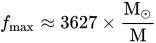
- Noise with a spectrum corresponding to the blackbody radiation (thermal noise). For temperatures higher than about 3×10⁻⁷ K the peak of the blackbody spectrum is above the upper limit of human hearing range. In those situations, for the purposes of what is heard, black noise is well approximated as violet noise. At the same time, Hawking radiation of black holes may have a peak in hearing range, so the radiation of a typical stellar black hole with a mass equal to 6 solar masses will have a maximum at a frequency of 604.5 Hz – this noise is similar to green noise. A formula is: Hz. Several examples of audio files with this spectrum can be found here.[citation needed]
Noisy white
[edit]In telecommunication, the term noisy white has the following meanings:[24]
- In facsimile or display systems, such as television, a nonuniformity in the white area of the image, i.e., document or picture, caused by the presence of noise in the received signal.
- A signal or signal level that is supposed to represent a white area on the object, but has a noise content sufficient to cause the creation of noticeable black spots on the display surface or record medium.
Noisy black
[edit]In telecommunication, the term noisy black has the following meanings:[25]
- In facsimile or display systems, such as television, a nonuniformity in the black area of the image, i.e., document or picture, caused by the presence of noise in the received signal.
- A signal or signal level that is supposed to represent a black area on the object, but has a noise content sufficient to cause the creation of noticeable non-black spots on the display surface or record medium.
Generation
[edit]Colored noise can be computer-generated by first generating a white noise signal, Fourier-transforming it, then multiplying the amplitudes of the different frequency components with a frequency-dependent function.[26] Matlab programs are available to generate power-law colored noise in one or any number of dimensions.
Identification of power law frequency noise
[edit]Identifying the dominant noise type in a time series has many applications including clock stability analysis and market forecasting. There are two algorithms based on autocorrelation functions that can identify the dominant noise type in a data set provided the noise type has a power law spectral density.
Lag(1) autocorrelation method (non-overlapped)
[edit]The first method for doing noise identification is based on a paper by W.J Riley and C.A Greenhall.[27] First the lag(1) autocorrelation function is computed and checked to see if it is less than one third (which is the threshold for a stationary process):

where is the number of data points in the time series, are the phase or frequency values, and is the average value of the time series. If used for clock stability analysis, the values are the non-overlapped (or binned) averages of the original frequency or phase array for some averaging time and factor. Now discrete-time fractionally integrated noises have power spectral densities of the form which are stationary for . The value of is calculated using :


where is the lag(1) autocorrelation function defined above. If then the first differences of the adjacent time series data are taken times until . The power law for the stationary noise process is calculated from the calculated and the number of times the data has been differenced to achieve as follows:


where is the power of the frequency noise which can be rounded to identify the dominant noise type (for frequency data is the power of the frequency noise but for phase data the power of the frequency noise is ).


Lag(m) autocorrelation method (overlapped)
[edit]This method improves on the accuracy of the previous method and was introduced by Z. Chunlei, Z. Qi, Y. Shuhuana. Instead of using the lag(1) autocorrelation function the lag(m) correlation function is computed instead:[28]

where is the "lag" or shift between the time series and the delayed version of itself. A major difference is that are now the averaged values of the original time series computed with a moving window average and averaging factor also equal to . The value of is computed the same way as in the previous method and is again the criteria for a stationary process. The other major difference between this and the previous method is that the differencing used to make the time series stationary () is done between values that are spaced a distance apart:


The value of the power is calculated the same as the previous method as well.
See also
[edit]- Mains hum (also known as the AC power hum)
- Whittle likelihood
References
[edit]- ^ "ATIS Telecom Glossary". atis.org. Alliance for Telecommunications Industry Solutions. Retrieved 16 January 2018.
- ^ "Federal Standard 1037C". Institute for Telecommunication Sciences. Institute for Telecommunication Sciences, National Telecommunications and Information Administration (ITS-NTIA). Retrieved 30 November 2022.
- ^ Randall D. Peters (2 January 2012). "Tutorial on Power Spectral Density Calculations for Mechanical Oscillators".
- ^ "Definition: pink noise". its.bldrdoc.gov. Archived from the original on 8 June 2021.
- ^ "Definition: blue noise". its.bldrdoc.gov. Archived from the original on 8 June 2021.
- ^ Mitchell, Don P. (1987). "Generating antialiased images at low sampling densities". Proceedings of the 14th annual conference on Computer graphics and interactive techniques. Vol. 21. pp. 65–72. doi:10.1145/37401.37410. ISBN 0897912276. S2CID 207582968.
- ^ Yellott, John I. Jr (1983). "Spectral Consequences of Photoreceptor Sampling in the Rhesus Retina". Science. 221 (4608): 382–85. Bibcode:1983Sci...221..382Y. doi:10.1126/science.6867716. PMID 6867716.
- ^ Transactions of the American Society of Heating, Refrigerating and Air-Conditioning Engineers 1968 [1] Quote: 'A "purple noise," accordingly, is a noise the spectrum level of which rises with frequency.'
- ^ Zhang, Q. J.; Schwarz, K.-P. (April 1996). "Estimating double difference GPS multipath under kinematic conditions". Proceedings of the Position Location and Navigation Symposium – PLANS '96. Position Location and Navigation Symposium – PLANS '96. Atlanta, GA, USA: IEEE. pp. 285–91. doi:10.1109/PLANS.1996.509090.
- ^ Hildebrand, John A. (2009). "Anthropogenic and natural sources of ambient noise in the ocean". Marine Ecology Progress Series. 395: 478–480. Bibcode:2009MEPS..395....5H. doi:10.3354/meps08353.
- ^ Mellen, R. H. (1952). "The Thermal-Noise Limit in the Detection of Underwater Acoustic Signals". The Journal of the Acoustical Society of America. 24 (5): 478–80. Bibcode:1952ASAJ...24..478M. doi:10.1121/1.1906924.
- ^ Välimäki, Vesa; Lehtonen, Heidi-Maria; Takanen, Marko (2013). "A Perceptual Study on Velvet Noise and Its Variants at Different Pulse Densities". IEEE Transactions on Audio, Speech, and Language Processing. 21 (7): 1481–1488. doi:10.1109/TASL.2013.2255281. S2CID 17173495.
- ^ Järveläinen, Hanna; Karjalainen, Matti (March 2007). Reverberation Modeling Using Velvet Noise. 30th International Conference: Intelligent Audio Environments. Helsinki, Finland: AES.
- ^ "The Switched Convolution Reverberator, Lee et. al".
- ^ Alary, Benoit; Politis, Archontis; Välimäki, Vesa (September 2017). Velvet-Noise Decorrelator. 20th International Conference on Digital Audio Effects (DAFx-17). Edinburgh, UK.
- ^ "Index: Noise (Disciplines of Study [DoS])". Archived from the original on 22 May 2006.
- ^ Gilman, D. L.; Fuglister, F. J.; Mitchell Jr., J. M. (1963). "On the power spectrum of "red noise"". Journal of the Atmospheric Sciences. 20 (2): 182–84. Bibcode:1963JAtS...20..182G. doi:10.1175/1520-0469(1963)020<0182:OTPSON>2.0.CO;2.
- ^ Daniel L. Rudnick, Russ E. Davis (2003). "Red noise and regime shifts" (PDF). Deep-Sea Research Part I. 50 (6): 691–99. Bibcode:2003DSRI...50..691R. doi:10.1016/S0967-0637(03)00053-0.
- ^ Lau, Daniel Leo; Arce, Gonzalo R.; Gallagher, Neal C. (1998). "Green-noise digital halftoning". Proceedings of the IEEE. 86 (12): 2424–42. doi:10.1109/5.735449.
- ^ a b Joseph S. Wisniewski (7 October 1996). "Colors of noise pseudo FAQ, version 1.3". Newsgroup: comp.dsp. Archived from the original on 30 April 2011. Retrieved 1 March 2011.
- ^ "David Bowie and the Black Noise". The Vigilant Citizen Forums. 21 May 2017.
- ^ Schroeder, Manfred (2009). Fractals, Chaos, Power Laws: Minutes from an Infinite Paradise. Courier Dover. pp. 129–30. ISBN 978-0486472041.
- ^ "Definition of "black noise" – Federal Standard 1037C". Archived from the original on 12 December 2008. Retrieved 28 April 2008.
- ^ "Definition: noisy white". its.bldrdoc.gov. Archived from the original on 8 June 2021.
- ^ "Definition: noisy black". its.bldrdoc.gov. Archived from the original on 8 June 2021.
- ^ Das, Abhranil (2022). Camouflage detection & signal discrimination: theory, methods & experiments (corrected) (PhD). The University of Texas at Austin. doi:10.13140/RG.2.2.32016.07683.
- ^ Riley, W.J.; Greenhal, C.A. (2004). "Power law noise identification using the lag 1 autocorrelation". 18th European Frequency and Time Forum (EFTF 2004). IEE. pp. 576–580. doi:10.1049/cp:20040932. ISBN 978-0-86341-384-1.
- ^ Zhou Chunlei; Zhang Qi; Yan Shuhua (August 2011). "Power law noise identification using the LAG 1 autocorrelation by overlapping samples". IEEE 2011 10th International Conference on Electronic Measurement & Instruments. IEEE. pp. 110–113. doi:10.1109/icemi.2011.6037776. ISBN 978-1-4244-8158-3.
 This article incorporates public domain material from Federal Standard 1037C. General Services Administration. Archived from the original on 22 January 2022.
External links
[edit]Colors of noise
View on GrokipediaOverview
Concept and terminology
In signal processing and statistics, noise refers to a stochastic process that generates a random signal fluctuating in time, often modeled as a sequence of random variables.[5] Colored noise represents a class of such stochastic processes where the power spectral density (PSD)—a measure of power distribution across frequencies—is non-uniform, introducing correlations that distinguish it from uncorrelated variants.[6] This non-uniformity arises from filtering or inherent system dynamics, resulting in frequency-dependent energy allocation that affects signal behavior in applications like acoustics, electronics, and environmental modeling.[6] The terminology of "colors" for noise draws an analogy from optics, where white noise corresponds to white light, exhibiting equal intensity across all frequencies in the audible or relevant spectrum, much like white light combines all visible wavelengths uniformly.[7] Other colors denote spectral tilts: for instance, sounds with more low-frequency emphasis evoke "warmer" hues like red or pink, while high-frequency boosts suggest "cooler" tones such as blue, reflecting how the PSD shape alters perceived or measured characteristics.[8] This metaphorical naming, originating in mid-20th-century audio engineering, aids in classifying noise types based on their auditory or analytical profiles without implying literal coloration.[7] A common mathematical framework for colored noise describes its PSD in a power-law form, , where is frequency and is the exponent that determines the specific color—positive values amplify high frequencies, while negative ones emphasize lows.[9] For example, yields white noise with flat PSD, whereas deviations like produce pink-like noise.[10] Such forms capture long-range dependencies in real-world signals. Natural phenomena often exhibit colored noise signatures; for instance, the irregular fluctuations in ocean wave heights approximate pink-like noise due to energy concentration at lower frequencies from wind-driven turbulence.[11] In contrast, thermal noise in electronic conductors, arising from random molecular motion, behaves as white-like noise with roughly equal power across frequencies up to thermal limits.[12]Historical development
The concept of colored noise began with the term "white noise" in the mid-20th century, emerging from radio engineering and signal processing to describe a random signal with equal power across all frequencies, analogous to white light containing all visible wavelengths uniformly.[13] The analogy to white light was explicitly noted in early literature, with the term gaining traction in the 1940s as engineers studied thermal noise in electronic circuits and radio transmission.[14] In the early 1960s, the term "pink noise" was introduced to characterize 1/f noise observed in electronic components, such as vacuum tubes and resistors, where power decreases inversely with frequency, evoking the warmer, reddish tone of pink light due to its emphasis on lower frequencies. This naming convention extended the light spectrum metaphor, distinguishing it from white noise's flat spectrum, and was commonly used in audio and electronics testing by the mid-1960s. The power law exponents underlying these names provided a mathematical basis for classification, with white noise at exponent 0 and pink at -1. The term "brown noise" appeared in the 1960s, linking the integrated form of white noise (with a 1/f² spectrum) to Brownian motion, first mathematically described by Albert Einstein in 1905 as the random movement of particles in a fluid. This connection highlighted the noise's cumulative, random-walk-like behavior in physical systems. Expansion to other colors occurred in the late 1980s, with "blue noise" coined by Robert Ulichney in his 1988 paper on dithering with blue noise for digital halftoning in imaging contexts, and "violet noise" coined in audio engineering for high-frequency emphasized spectra used in dithering techniques to minimize quantization errors in digital imaging and sound.[15] "Grey noise" followed in the 1990s, designed to sound perceptually flat to human hearing by following equal-loudness contours, aiding in psychoacoustic testing. A key milestone was the 1971 publication on detection of signals in colored noise, which formalized analysis methods in acoustics and signal processing. In the 2000s, informal terms like "green noise" and "black noise" emerged from online communities and audio applications, often for relaxation and sleep aids, with green representing mid-frequency balanced sounds akin to natural environments and black denoting silence or impulse-like sparsity. The 2010s saw a surge in their use in wellness apps, broadening the terminology beyond technical fields.[16]Spectral properties
Power spectral density
The power spectral density (PSD) of a signal quantifies how its power is distributed across different frequencies, providing a frequency-domain representation essential for analyzing stationary random processes such as noise. For wide-sense stationary processes, the PSD is defined as the Fourier transform of the autocorrelation function, which captures the signal's statistical correlation in the time domain.[17] The general form of the PSD for a stationary noise process is given by the Wiener–Khinchin theorem as where denotes the autocorrelation function, is frequency, and is the time lag. This integral transforms the time-based correlation measure into a spectrum that describes average power as a function of frequency.[18] In the context of colored noise, the PSD often adheres to a power-law relationship, commonly expressed as or alternatively , with the exponents related by ; the specific convention depends on the field or application, but both forms highlight the non-uniform frequency dependence that distinguishes colored noise from uniform spectra.[19] The PSD is measured in units of power per unit frequency, typically watts per hertz (W/Hz) or squared amplitude per hertz, reflecting the density of power within a narrow frequency band. For visualization and comparison, especially across wide frequency ranges, PSD plots frequently employ logarithmic scales, expressing power in decibels per hertz (dB/Hz) to emphasize relative variations and spectral slopes.[20][21] While the time-domain waveform of noise may exhibit apparent randomness without discernible patterns, the PSD uncovers hidden frequency-domain structures, such as concentration of power in low or high frequencies, which is crucial for signal processing and noise characterization. For instance, white noise features a flat PSD that remains constant regardless of frequency.[22][19]Classification by power law exponent
Colors of noise are classified according to the power law exponent β in their power spectral density (PSD), expressed as , where denotes frequency. This exponent quantifies the spectral tilt: β = 0 yields a flat spectrum with equal power across frequencies, negative β tilts power toward lower frequencies, and positive β shifts power to higher frequencies. The classification stems from the PSD's role in defining the noise's frequency distribution, enabling categorization based on how energy is allocated across the spectrum.[23] The standard values of β for formal colors of noise are summarized in the following table, highlighting their spectral characteristics:| Color | β | Description |
|---|---|---|
| White | 0 | Flat PSD, equal power per unit frequency. |
| Pink | -1 | PSD ∝ 1/f, equal power per octave. |
| Brown | -2 | PSD ∝ 1/f², characteristic of random walks. |
| Blue | +1 | PSD ∝ f, increasing power with frequency. |
| Violet | +2 | PSD ∝ f², strong high-frequency dominance. |
| [24][25][26][27] |
Formal colors of noise
White noise
White noise is a fundamental type of random signal characterized by a flat power spectral density (PSD) across all frequencies, meaning it has equal power per unit frequency bandwidth. This results in a constant PSD, expressed as , where is a constant denoting the noise power density, corresponding to a power-law exponent in the classification of noise colors.[8][32][33] Ideally, white noise possesses infinite bandwidth, but in physical systems, it is typically band-limited due to practical constraints such as equipment limitations or environmental factors.[34] The autocorrelation function of white noise is a Dirac delta function, given by , where is the variance and indicates perfect correlation only at zero lag. This property implies that samples of white noise are uncorrelated at any non-zero time separation, making it a baseline model for independent random processes. For Gaussian white noise, the expected value of the product of the signal at times and is , emphasizing its statistical independence.[8][35][36] When generated as an audio signal within the human hearing range, white noise produces a harsh, static-like sound reminiscent of television snow or untuned radio static, as higher frequencies are more prominent to the ear despite the equal spectral distribution.[7][37] White noise finds applications in random number generation, where its uncorrelated nature provides a source of entropy for cryptographic and simulation purposes; in modeling thermal noise, such as Johnson-Nyquist noise in resistors, which exhibits white characteristics up to high frequencies; and in basic sound masking to obscure unwanted auditory distractions, like in tinnitus therapy or office environments.[38][39][40]Pink noise
Pink noise, also known as 1/f noise, is a type of colored noise characterized by a power spectral density (PSD) that follows a power-law distribution where the power decreases inversely with frequency, specifically for frequencies . This corresponds to a power-law exponent of in the general classification of noise colors. Unlike white noise, which has equal power across all frequencies, pink noise distributes energy such that there is approximately equal power per octave, resulting in a spectrum that appears balanced when analyzed on a logarithmic frequency scale.[41][42][43] The autocorrelation function of pink noise exhibits long-range correlations, decaying more slowly than the delta-function autocorrelation of white noise, particularly at low lags where temporal dependencies are stronger. This correlation structure arises from the concentration of power at lower frequencies, leading to persistent fluctuations over time. In auditory perception, pink noise produces a softer, more natural sound compared to the harsher, static-like quality of white noise, often resembling steady rain, wind, or ocean waves due to the reduced emphasis on high frequencies. It is commonly used in music production and audio engineering, such as in equalizers, to test and calibrate systems because its equal power per octave aligns well with human hearing's logarithmic sensitivity.[44][45][42] Pink noise is prevalent in various natural and physical systems, reflecting underlying complex dynamics. Examples include variability in heartbeat intervals, where healthy physiological rhythms show 1/f scaling; fluctuations in river flow rates, driven by hydrological processes; and flicker noise in electronic components, such as resistors and transistors, where low-frequency variations dominate due to material imperfections.[46][47][44] One common method to generate pink noise is by passing white noise through a filter whose magnitude response is proportional to , which shapes the flat PSD of white noise into the desired form, as the output PSD is the product of the input PSD and the squared filter magnitude. This filtering approach ensures the resulting signal maintains finite variance, distinguishing it from brown noise, which accumulates low-frequency power to the point of divergence. where is the filter transfer function and is constant.[48][49]Brown noise
Brown noise, also known as Brownian noise and sometimes referred to as red noise, is a type of colored noise characterized by a strong emphasis on low frequencies, arising from its connection to random walk processes in physics and mathematics. Its power spectral density (PSD) follows the form , corresponding to a power-law exponent of . This spectral shape results in power per octave that decreases linearly with increasing frequency, producing a steeper roll-off compared to pink noise. Brown noise is generated by integrating or cumulatively summing successive samples of white noise, which models the accumulation of random increments over time. In discrete time, this process is represented by the recurrence equationwhere denotes independent white noise samples, often drawn from a Gaussian distribution with zero mean and unit variance./18%3A_Brownian_Motion/18.01%3A_Standard_Brownian_Motion) This formulation directly links brown noise to the discrete approximation of Brownian motion. Auditorily, brown noise manifests as a deep, continuous rumble, evoking natural sounds such as distant thunder or ocean surf due to its dominant low-frequency content.[50] Although strictly non-stationary—exhibiting a wandering mean that drifts without bound like a random walk—it is frequently treated as stationary in practical signal processing and analysis contexts for simplicity.[51]
Blue noise
Blue noise is a type of colored noise characterized by a power spectral density (PSD) that increases linearly with frequency, expressed as where .[52] This positive exponent places blue noise in the category of noises with amplified high-frequency content, contrasting with those that emphasize lower frequencies.[53] In auditory terms, blue noise produces a hissing sound reminiscent of air or steam escaping under pressure, which is generally perceived as less intrusive than the uniform hiss of white noise when used to mask errors or artifacts.[54] Its spectral profile concentrates energy at higher frequencies, resulting in patterns that appear more uniform and isotropic in spatial distributions, avoiding visible low-frequency clustering.[55] Blue noise can be conceptually derived as white noise passed through a high-pass filter with a linear frequency response, shifting power from low to high frequencies.[56] This property makes it particularly effective for applications requiring minimal perceptual artifacts, such as dithering in digital imaging to reduce quantization errors without introducing noticeable patterns.[57] In computer graphics, it is employed for anti-aliasing to smooth edges by distributing samples in a way that pushes aliasing artifacts into less visible high-frequency realms.[58]Violet noise
Violet noise, also known as purple noise, is characterized by a power spectral density (PSD) that increases quadratically with frequency, expressed as with a power-law exponent .[3] This results in a steep emphasis on high frequencies, producing 6 dB more power per octave compared to lower frequencies.[3] Unlike blue noise, which amplifies high frequencies linearly (), violet noise exhibits even more extreme high-frequency dominance.[59] Auditorily, violet noise manifests as a sharp, sibilant hiss or sizzle, with pronounced treble components that create a piercing, high-pitched quality resembling intense static or radio interference.[59] It serves as the spectral inverse of brown noise, where brown noise's PSD decreases as ; thus, applying an boost to white noise yields violet noise.[60] This property makes it valuable in audio testing to evaluate high-end frequency response, as its energy concentration highlights system performance in the treble range. Violet noise can be generated by filtering white noise with an transfer function or, theoretically, by differentiating white noise, which multiplies the PSD by ./02%3A_Modeling_Basics/2.05%3A_Noise_modeling-_more_detailed_information_on_noise_modeling-_white_pink_and_brown_noise_pops_and_crackles) In applications, it has been employed in early dithering techniques for audio and image processing, including printer halftoning to minimize visible dot patterns by dispersing errors into high-frequency components.[61]Grey noise
Grey noise is a variant of colored noise designed to appear perceptually flat across the human audible frequency range, achieved by shaping white noise according to the sensitivity of human hearing. It is generated by applying a filter to white noise that follows the inverse of a psychoacoustic equal-loudness curve, such as an inverted A-weighting filter, ensuring that all frequencies contribute equally to perceived loudness. This adjustment accounts for the fact that the human ear is less sensitive to low and high frequencies compared to mid-range ones, resulting in a sound that humans perceive as balanced rather than emphasizing any particular spectral region.[62] The power spectral density (PSD) of grey noise is not truly flat in the linear frequency domain but is shaped to yield a flat response when evaluated on an A-weighted scale, which approximates equal loudness perception; in the mid-frequency range, it behaves similarly to white noise with a power-law exponent β ≈ 0, though the overall profile is frequency-dependent to match auditory response. This shaping boosts power at extreme frequencies (below ~500 Hz and above ~10 kHz) relative to the mid-range, counteracting the ear's reduced sensitivity there. The foundational psychoacoustic basis for this derives from equal-loudness contours, originally mapped by the Fletcher-Munson curves, which experimentally determined the sound pressure levels required for tones of different frequencies to sound equally loud at various overall intensities.[63] In terms of auditory experience, grey noise manifests as a smooth, neutral hum without the shrill hiss of white noise, as the perceptual equalization reduces the apparent dominance of high frequencies. It is generated mathematically by convolving white noise with the impulse response of an inverse A-weighting filter , where , and is the standard A-weighting transfer function that maintains unity gain in the mid-frequencies (around 1-4 kHz) while attenuating at the spectral extremes. Applications include sound masking in open office environments to enhance speech privacy through uniform perceptual coverage, as well as in audiometric testing and audio system calibration where accurate representation of human hearing is essential.[64][65]Velvet noise
Velvet noise is a type of structured noise characterized by a power spectral density (PSD) similar to that of blue noise, with an approximate power law exponent β ≈ +1, but distinguished by isolated, non-overlapping impulses in the frequency domain that ensure a smooth, randomized spectral distribution without clustering. This configuration promotes an even spread of energy, particularly in high frequencies, making it effective for applications requiring uniform noise without low-frequency artifacts.[66] Auditorily, velvet noise manifests as a soft whoosh, lacking the harshness or tonal artifacts found in other noise types, due to its sparse and aperiodic impulse structure. This perceptual smoothness arises from the randomized placement of impulses, which avoids periodic patterns that could introduce audible tones.[67] Key properties of velvet noise include its use in aperiodic dithering for audio and visual processing, where it prevents spectral clustering and provides a more natural, artifact-free distribution compared to traditional white or blue noise. It extends concepts from blue noise by incorporating Poisson-distributed frequency spikes, enhancing its suitability for decorrelation and texture-like effects while maintaining perceptual uniformity. The generation typically involves placing these spikes at random intervals in the frequency domain, though detailed methods are covered in digital synthesis techniques.[68]Informal colors of noise
Red noise
Red noise serves as an informal synonym for brown noise, referring to a stochastic process with a power spectral density (PSD) typically proportional to . This equivalence emphasizes the shared emphasis on low-frequency components, though red noise lacks a distinct technical definition separate from brown noise in most signal processing contexts. The term "red" originates from an analogy to the visible light spectrum, where red light predominates at longer wavelengths (lower frequencies), mirroring the concentration of power in lower frequencies for this noise type. Auditory perception of red noise yields a deep, rumbling quality, akin to the sound of distant thunder or a waterfall, which aligns closely with the sonic characteristics of brown noise.[69] In geophysics and climate science, red noise specifically denotes signals, such as atmospheric or oceanic variability, exhibiting a PSD with an exponent of in the form .[70] This usage highlights its role in modeling persistent low-frequency fluctuations in natural systems. Occasionally, the term extends more broadly to processes with , encompassing noise redder than pink noise (where ) but without introducing unique generative equations beyond those for brown noise.[70]Green noise
Green noise is an informal variant of colored noise characterized by an emphasis on mid-frequency content, serving as a perceptual bridge between the broad-spectrum energy of white noise and the high-frequency boost of blue noise. It is typically generated by applying a band-pass filter to white noise, resulting in a power spectral density (PSD) that remains approximately flat across the mid-range frequencies, such as 300 to 3000 Hz, while exhibiting roll-off outside this band; this yields a spectral slope parameter β ≈ 0 within the typical speech frequency range.[71] Unlike formally defined noise colors, green noise lacks a standardized analytical equation and instead relies on digital filtering techniques to achieve its profile.[72] The auditory perception of green noise evokes natural environmental sounds, such as the rustling of leaves in a forest or gentle wind through trees, creating a soothing ambiance that promotes relaxation and focus.[73][74] This mid-frequency focus mimics the balanced spectral qualities of ambient outdoor noises, making it less harsh than white noise while avoiding the rumbling lows of red or brown noise. Its properties align closely with real-world ecological soundscapes, providing a sense of calm without overwhelming high or low extremes.[75] Green noise has gained popularity in audio production and sound therapy applications since the late 2010s. It has since been incorporated into white noise machines and sleep aids, leveraging its ability to replicate the restorative qualities of nature sounds for improved concentration and stress reduction.[73][61]Black noise
Black noise refers to a type of colored noise characterized by a power spectral density (PSD) that decreases at a rate steeper than brown noise, typically following a 1/f^β form where β > 2, concentrating nearly all energy at very low frequencies while exhibiting near-zero power across higher bands. In audio and acoustics contexts, this results in a PSD of zero or near-zero within the human audible range of 20 Hz to 20 kHz, with any residual power confined to infrasonic frequencies below 20 Hz or ultrasonic frequencies above 20 kHz, rendering the signal inaudible. This configuration creates substantial gaps in the frequency spectrum, distinguishing it from other noise colors that maintain audible components. Perceived as silence by humans, black noise evokes the visual analogy of black as the total absence of light, symbolizing a complete lack of perceptible sound energy. As the conceptual opposite of white noise, which distributes equal power across all frequencies, black noise eliminates audible content to provide a neutral, distraction-free auditory environment. The term has been applied in therapeutic acoustics since at least the mid-2010s, particularly for masking low-frequency sounds that annoy sensitive individuals, such as those affected by environmental infrasound from sources like wind turbines. In these cases, black noise helps reduce perceived annoyance by overlaying a low-energy profile that does not introduce additional mid- or high-frequency disturbances. It is also utilized for tinnitus masking and promoting pure rest, where the spectral voids in the audible range allow for relaxation without competing sounds. Variants of black noise include total silence, representing an absolute absence of acoustic power across all frequencies, and filtered extremes that retain minimal energy solely in inaudible infrasonic or ultrasonic bands to simulate a structured yet imperceptible background.Noisy white
Noisy white noise is an informal variant within the spectrum of colors of noise, referring to white noise perturbed with low-level structure to simulate imperfect randomness in real-world scenarios. It is mentioned in patent literature as a type of audible noise suitable for audio generation in devices, such as navigational aids for the visually impaired, alongside formal colors like white, pink, and brown noise.[76] The power spectral density (PSD) of noisy white noise is predominantly flat, corresponding to a spectral slope of β ≈ 0 like pure white noise, but incorporates subtle modulations or harmonics that deviate from ideal uniformity. This introduces slight temporal correlations, distinguishing it from purely uncorrelated white noise and making it useful for modeling flaws in noise generators or environmental approximations in audio testing. Auditorily, noisy white noise resembles the steady hiss of white static but includes faint tonal elements, with the "noisy" descriptor emphasizing its departure from perfect stochastic uniformity. One conceptual generation approach involves overlaying low-amplitude sinusoidal components onto white noise, represented as: where is white noise, is the small amplitude, is a low frequency, and is phase. This method highlights its role in informal applications rather than rigorous theoretical frameworks.Noisy black
Noisy black noise, in the context of audio signals, represents an informal extension of black noise characterized by near-total silence augmented with minimal, inaudible perturbations to create subtle masking effects. Unlike pure black noise, which approximates complete absence of sound across all frequencies, noisy black incorporates tiny irregularities—often described as noise flecks—primarily in ultrasonic and infrasonic ranges, resulting in a perceptually silent yet non-absolute void. This design emerged in the early 2020s within wellness and relaxation audio, where tracks labeled as "noisy black noise" appeared on platforms for promoting deep rest without overt disturbance, as exemplified by releases from artists like Sensitive ASMR in 2023. The power spectral density (PSD) of noisy black noise features near-zero power throughout the human audible range (approximately 20 Hz to 20 kHz), with only trace amounts of energy at the extremes beyond this spectrum, ensuring imperceptibility while providing a faint underlying texture. In telecommunication origins, the term "noisy black" dates to standards like Federal Standard 1037C, defining it as nonuniformity in black areas of facsimile or display systems that introduces signal variations akin to noise, such as speckle in scanned black regions. Perceptually, noisy black noise manifests as profound quietude, with any ultrasonic or infrasonic hints remaining below conscious detection, fostering a sense of enveloped stillness suitable for subtle therapeutic masking. Its key property lies in mitigating the drawbacks of total silence by blending a black noise foundation with epsilon-level power additions, thus offering gentle auditory support without introducing distracting elements. No standardized equation governs its generation; instead, it is typically synthesized by generating low-amplitude noise confined to non-audible frequency bands.Generation methods
Analytical approaches
Analytical approaches to generating colored noise primarily involve mathematical models that transform white noise—characterized by a flat power spectral density (PSD)—into spectra with frequency-dependent power distributions. A fundamental method is linear filtering, where white noise serves as input to a linear time-invariant filter with transfer function designed such that , ensuring the output PSD matches the desired colored spectrum .[1][5] Since white noise has constant PSD , the filter magnitude simplifies to . This approach assumes an ideal white noise source with uniform power across all frequencies, which facilitates analytical tractability but introduces practical challenges related to infinite bandwidth and power.[77][78] For specific colors, the filter design follows directly from the target PSD. Pink noise, with PSD proportional to , requires , yielding a -3 dB per octave roll-off that emphasizes lower frequencies while maintaining perceptual balance in audio applications.[79] Brown noise, or Brownian noise, exhibits PSD and is generated by integrating white noise, corresponding to the transfer function of an ideal integrator , which accumulates low-frequency components to produce a spectrum heavily weighted toward bass frequencies.[1] These frequency-domain designs enable precise control over the noise coloration through inverse Fourier transforms or differential equation solutions in the time domain.[5] Stochastic differential equations (SDEs) provide another continuous-time framework for modeling colored noise, particularly for processes with temporal correlations. Brownian motion, a canonical brown noise, is defined by the SDE , where is the standard Wiener process representing the integral of white noise, resulting in non-differentiable paths with variance linear in time.[80] For more general colored variants, the Ornstein-Uhlenbeck process extends this via , where introduces mean reversion, producing exponentially decaying autocorrelation and a PSD that models Ornstein-Uhlenbeck noise as a colored extension of white noise.[81] This SDE can be solved analytically using Itô calculus, yielding Gaussian stationary distributions suitable for simulating correlated noise in physical systems.[80] Despite their elegance, these analytical methods rely on idealized assumptions that limit real-world applicability. The requirement of perfect white noise input overlooks finite bandwidth constraints in physical generators, potentially leading to spectral distortions at high frequencies where real noise sources exhibit roll-off.[1] Additionally, the infinite power implied by unbounded white noise spectra complicates energy normalization and stability in continuous models, necessitating approximations or cutoffs for practical implementation.[78]Digital synthesis techniques
Digital synthesis techniques for colored noise typically involve processing white noise through computational methods to achieve the desired power spectral density (PSD). These approaches are implemented in software or digital signal processors, enabling efficient generation for applications like audio production and simulation. Common methods include frequency-domain manipulation and time-domain filtering, often drawing briefly from analytical filter designs for their basis. One widely used frequency-domain technique employs the fast Fourier transform (FFT) to generate colored noise with arbitrary PSD shapes. The process begins by creating a sequence of white noise in the time domain, transforming it to the frequency domain via FFT, multiplying the complex amplitudes by the square root of the target PSD (to preserve noise power), and then applying the inverse FFT to return to the time domain. This method ensures precise control over the spectral slope β and is computationally efficient for offline generation of long sequences. For example, to produce pink noise (β = 1), the PSD is set proportional to 1/|f|.[82] Time-domain methods often rely on infinite impulse response (IIR) or finite impulse response (FIR) filters applied to a stream of white noise samples. IIR filters are preferred for their low computational cost in real-time applications, as they approximate the desired frequency response using recursive coefficients derived from analytical designs. A seminal example is the Voss-McCartney algorithm for pink noise, which generates 1/f spectra by summing multiple independent white noise sources updated at octave-spaced rates (e.g., every sample, every second sample, up to 2^k steps). This avoids direct filtering while achieving the target PSD through superposition, with implementations using a running sum updated incrementally to maintain efficiency. FIR filters, while more resource-intensive due to non-recursive convolution, offer linear phase and are used when exact impulse responses are needed, such as in high-fidelity audio synthesis.[83][84] Recursive techniques simplify synthesis for specific noise colors. Brown noise (β = 2) is produced by cumulatively summing (integrating) white noise samples, which amplifies low frequencies and yields a 1/f² PSD; in digital terms, each output sample is the previous value plus a new white noise increment, often scaled to control variance. Blue noise (β = -1) can be generated by high-pass filtering white noise with |H(f)| ∝ √f (+3 dB/octave) or by applying a first-order difference to pink noise (output = current pink sample minus previous), boosting high frequencies while suppressing low ones.[56] These methods are straightforward for streaming generation but require normalization to prevent unbounded growth in brown noise./02%3A_Modeling_Basics/2.05%3A_Noise_modeling-_more_detailed_information_on_noise_modeling-_white_pink_and_brown_noise_pops_and_crackles) Software implementations facilitate practical use. In MATLAB, colored noise is generated by filteringrandn (Gaussian white noise) with IIR coefficients from dsp.ColoredNoise, which applies a cascade of second-order sections to achieve 1/|f|^α PSDs. Audio tools like REAPER use built-in plugins such as ReaSynth for pink noise (selectable waveform) or JS: Pink Noise Generator for customizable synthesis via the Voss-McCartney approach.[3][85]
Synthesis can introduce artifacts that distort the PSD. For low-β noises like brown, cumulative summation often produces DC bias (offset from zero mean), leading to unwanted low-frequency drift; this is mitigated by high-pass filtering or subtracting the running mean. Quantization effects arise in fixed-point implementations, where rounding in filters adds correlated noise, potentially altering the spectral slope—IIR structures are particularly sensitive, with output variance scaling as the number of poles. Using higher bit depths or dithering minimizes these issues.[86][87]