Hubbry Logo
Bread of Life DiscourseBread of Life DiscourseMain
Open search
Bread of Life Discourse
Community hub
Bread of Life Discourse
logo
8 pages, 0 posts
0 subscribers
Be the first to start a discussion here.
Bread of Life Discourse
from Wikipedia
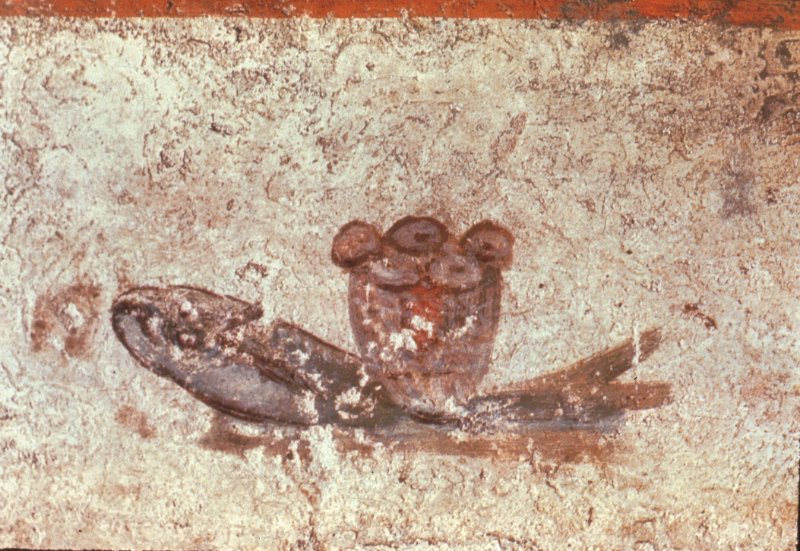
Early third century depiction of eucharistic bread and fish, Catacomb of San Callisto, Rome

The Bread of Life Discourse is a portion of the teaching of Jesus which appears in chapter 6 of John's Gospel (verses 22–59) and was delivered in the synagogue at Capernaum.[1]

The title "Bread of Life" (Ancient Greek: ἄρτος τῆς ζωῆς, artos tēs zōēs) given to Jesus is based on this biblical passage, which is set in the gospel shortly after the feeding the multitude episode (in which Jesus feeds a crowd of 5,000 people with five loaves of bread and two fish), after which he walks on the water to the western side of Sea of Galilee and the crowd follow by boat in search of him.[2]

John's Gospel does not include an account of the blessing of the bread during the Last Supper as in the synoptic gospels e.g. Luke 22:19. Nonetheless, this discourse has often been interpreted as communicating teachings regarding the Eucharist which have been very influential in the Christian tradition.[3]

Biblical account

[edit]

In the central part of this discourse:

Jesus said to them, "Very truly, I tell you, it was not Moses who gave you the bread from heaven, but it is my Father who gives you the true bread from heaven. For the bread of God is that which comes down from heaven and gives life to the world." They said to him, "Sir, give us this bread always." Jesus said to them, "I am the bread of life. Whoever comes to me will never be hungry, and whoever believes in me will never be thirsty."

— John 6:32–35, New Revised Standard Version.[4]

The reference to the bread given by Moses concerns the manna given to the people of Israel in the desert, recorded in Exodus 16.[5] Psalm 78 asserts that He (i.e. God) had "rained down manna upon them to eat".[6] Albert Barnes reflects that "this was regarded as a miraculous interference in their behalf, and an attestation of the divine mission of Moses, and hence they said familiarly that Moses gave it to them".[5]

Church Fathers

[edit]

The Liturgy of the Eucharist, from the earliest days, was performed behind closed doors out of fear of persecution. One of the earliest explanations of the Eucharist given on behalf of a Christian to the larger contemporary community is given by Justin Martyr in his First Apology to the Roman Emperor Antoninus Pius:

"We call this food Eucharist, and no one else is permitted to partake of it, except one who believes our teaching to be true and who has been washed in the washing which is for the remission of sins and for regeneration [i.e., has received baptism] and is thereby living as Christ enjoined. For not as common bread nor common drink do we receive these; but since Jesus Christ our Savior was made incarnate by the word of God and had both flesh and blood for our salvation, so too, as we have been taught, the food which has been made into the Eucharist by the Eucharistic prayer set down by him, and by the change of which our blood and flesh is nurtured, is both the flesh and the blood of that incarnated Jesus." —(First Apology 66 [A.D. 151]).

Ignatius of Antioch, a disciple of John the Apostle (the author of the gospel of John), first-century Christian writer and Patriarch of Antioch, explains the common understanding of the Eucharist as truly the body and blood of Jesus Christ in a letter written c. 110 AD:

Take note of those who hold heterodox opinions on the grace of Jesus Christ which has come to us, and see how contrary their opinions are to the mind of God…They abstain from the Eucharist and from prayer because they do not confess that the Eucharist is the flesh of our Savior Jesus Christ, flesh which suffered for our sins and which that Father, in his goodness, raised up again. They who deny the gift of God are perishing in their disputes.

— Ignatius of Antioch, Letter to the Smyrnaeans 6:2-7:1

This orthodox understanding is further affirmed by Irenaeus of Lyon in his famous work "Against Heresies" where he asks rhetorically "If the Lord were from other than the Father, how could he rightly take bread, which is of the same creation as our own, and confess it to be his body and affirm that the mixture in the cup is his blood?" (Against Heresies 4:32-33).

Cyril of Jerusalem, a fourth-century Christian writer and bishop of Jerusalem during the Arian controversy, explains that "the bread and the wine of the Eucharist before the holy invocation of the adorable Trinity were simple bread and wine, but the invocation having been made, the bread becomes the body of Christ and the wine the blood of Christ" (Catechetical Lectures 19:7).

Augustine of Hippo in his Tractate on John 6 teaches that Jesus was speaking mystically and not carnally (that is, not solely physically): by eating his flesh and drinking his blood the Church not merely be consuming Jesus' body and blood, but would be ritually united with Christ.[7] Augustine elsewhere teaches that the bread and wine is the same body that Jesus gave up and the same blood that he shed on the cross.[8]

"I promised you [new Christians], who have now been baptized, a sermon in which I would explain the sacrament of the Lord’s Table….That bread which you see on the altar, having been sanctified by the word of God, is the body of Christ. That chalice, or rather, what is in that chalice, having been sanctified by the word of God, is the blood of Christ"

— Augustine of Hippo, Sermons 227

John Chrysostom, in his Homily 47 on the Gospel of John, teaches that Jesus' words are not an enigma or a parable, but are to be taken literally.[9]

Writings in the modern era

[edit]

An expanded form of wording, "I am the bread that gives life", appears in several modern translations of John 6:35.[10]

Cornelius a Lapide comments on the words "comes down", writing: "not in the past, but the present tense. The Greek is καταβαίνων, the present participle. The expression therefore signifies the perpetual descent of Christ upon the Eucharistic altar even to the end of the world. For whensoever the priest consecrates the Eucharist, Christ, who after His death ascended into heaven, comes down from thence to the consecrated species of bread, and in them declares His presence."[11]

Friedrich Justus Knecht gives the typical Roman Catholic interpretation of the promises of Jesus in these passages, writing: "He promised to give us a food, the effects of which would not be passing, but would endure for ever. This Food is Himself: He is the living and life-giving Food which came down from heaven. He promised to give His Flesh for the life of the world, and to offer this His Flesh to be our Food. When the Jews were scandalized at the idea of His giving His Flesh to be eaten, He did not say to them: "You have misunderstood Me." On the contrary, He reaffirmed the very thing which had scandalized them, and asserted repeatedly that His Flesh was meat indeed and His Blood drink indeed, and that those only will have life who eat His Flesh and drink His Blood; though, at the same time, He signified that the Flesh which He would give to be our Food was His glorified Body. When many of His disciples were still offended at the idea of His giving His Flesh to eat, and refused to believe His words, our Lord preferred to let them go, rather than retract or explain away one syllable of the words He had spoken. It is therefore undeniably true that our Lord promised to give His Body, His Flesh and Blood, to be the Food of His servants... Our Lord fulfilled it a year later at the Last Supper."[12]

Meredith J. C. Warren and Jan Heilmann have challenged the Eucharistic interpretation of this passage. Warren argues that it reflects ancient Mediterranean traditions of sacrificial meals that identify a hero with a divinity.[13] Heilmann argues that the imagery of eating the flesh of Jesus and drinking his blood is to be understood against the background of the conceptual metaphor.[14]

In the Christological context, the use of the Bread of Life title is similar to the Light of the World title in John 8:12, where Jesus states: "I am the light of the world: he who follows me shall not walk in darkness, but shall have the light of life."[15] These assertions build on the Christological theme of John 5:26, where Jesus claims to possess life just as the Father does and provides it to those who follow him.[15][16] The alternative wording, "bread of God", appears in John 6:33, but not elsewhere in the New Testament.[4]

See also

[edit]

References

[edit]
Revisions and contributorsEdit on WikipediaRead on Wikipedia
from Grokipedia
The Bread of Life Discourse is a central in the , spanning verses 6:22–59, in which , following the of feeding the five thousand, proclaims himself as the "bread of life" descended from heaven, urging believers to partake of him through faith to attain eternal life. This discourse, set in the at Capernaum, uses of and sustenance to reveal ' divine identity and mission, contrasting the temporary given to the in the with the enduring spiritual nourishment he provides. The discourse occurs in the context of Jewish Passover (John 6:4), linking Jesus' actions to exodus themes, including the feeding miracle (John 6:1–15) where he multiplies five barley loaves and two fish to feed a large crowd near the , and his walking on water (John 6:16–21), which prompts the crowd to seek him out. As the crowd questions ' origins and authority—referencing his upbringing in and the knowledge of his earthly parents—he responds with a series of "I am" statements, a hallmark of Johannine that echoes God's self-revelation in Exodus 3:14. The narrative structure unfolds as a , with the crowd's inquiries driving ' explanations, narrated by the apostle John to emphasize theological depth over mere historical recounting. Key elements include Jesus' declaration, "I am the of life; whoever comes to me shall not hunger, and whoever believes in me shall never thirst" (:35), and the provocative call to "eat the flesh of and drink his blood" (:53–56) for abiding in him and receiving on the last day. These statements, employing metaphors of consumption, underscore faith as the means of , while provoking misunderstanding among listeners who interpret them literally. The discourse culminates in Jesus affirming that "the Spirit gives life; the flesh counts for nothing. The words I have spoken to you—they are full of the Spirit and life" (:63), highlighting the divine enablement required for (:44, 65). The teaching elicits strong reactions: many disciples deem it a "hard teaching" and desert (John 6:60–66), while the Twelve, led by Peter, confess, "You have the words of eternal life... We have come to believe and to know that you are the Holy One of " (John 6:68–69). Theologically, it serves as the fourth of John's seven signs, pointing to as the fulfillment of Jewish expectations and the source of , with interpretations debating its sacramental ties to the versus its emphasis on faith alone. Written likely after amid Jewish-Christian tensions, the discourse reinforces ' preeminence over temple rituals and traditions, inviting ongoing reflection on belief and eternal life.

Biblical Context

The Miracles Preceding the Discourse

The miracles preceding the Bread of Life Discourse in the Gospel of John occur in chapter 6, verses 1–21, and serve as pivotal signs that attract a large crowd to near the . crosses to the far shore of the (also known as the Sea of ) and ascends a nearby mountain where a great multitude, numbering about five thousand men besides women and children, follows him because they have seen the signs he performed on the sick. The evangelist notes that the Jewish Feast of was near, situating these events in a time resonant with themes of divine provision and liberation from narrative. In the Feeding of the Five Thousand (John 6:1–15), tests his disciple by asking where they might buy bread for the crowd, to which replies that two hundred denarii would not suffice to give each a little. then mentions a who has five loaves and two , but questions how these could feed so many. instructs the crowd to recline on the grass, gives thanks, and distributes the loaves and , with all eating as much as they want; afterward, twelve baskets of fragments remain. This , the only one recorded in all four Gospels, underscores themes of abundance and provision, with the twelve baskets symbolizing completeness and evoking the . The use of loaves highlights the modest, everyday nature of the resources, contrasting with the extraordinary outcome. Upon witnessing the sign, the crowd declares Jesus to be "the prophet who is to come into the world," reminiscent of Deuteronomy 18:15, and attempts to seize him to make him king forcibly. Jesus, however, withdraws alone to the mountain, rejecting political messianism in favor of his divine mission. This reaction reveals the crowd's misunderstanding of his identity, setting the stage for the subsequent teaching in Capernaum where they pursue him across the sea. That evening, the disciples embark in a boat to cross to Capernaum as darkness falls and a strong wind stirs the sea (John 6:16–21). About three or four miles out, they see Jesus walking on the water toward them and are terrified, but he reassures them with the words, "It is I; do not be afraid." They take him into the boat, and immediately it reaches the destination. This sign demonstrates Jesus' authority over natural elements, paralleling exodus motifs of God parting waters for deliverance and calming chaotic seas. The phrase "It is I" (Greek: egō eimi) echoes divine self-revelation, affirming his presence amid peril. These events during Passover time evoke Israel's historical deliverance, priming the audience for Jesus' revelations about true bread from heaven.

Setting and Audience

The Bread of Life Discourse takes place in the of Capernaum, a prominent Jewish center on the northern shore of the , where had established his ministry base. Capernaum served as a hub for Jewish religious and social life in first-century , featuring a public assembly space designed for , teaching, and communal debate, often accommodating both common people and local leaders. The discourse unfolds following the feeding of the five thousand near the , after which withdraws to a mountain alone while his disciples cross the sea by boat. The next day, the crowd, realizing was not with the disciples, searches for him across the lake and locates him in Capernaum, setting a scene of pursuit and confrontation as they board boats to follow. The primary audience consists of Jews who had witnessed the feeding miracle, including a mix of curious followers, disciples, and synagogue attendees, reflecting the diverse makeup of a Galilean Jewish community expectant of messianic signs. Their motivations are largely material and skeptical: they seek Jesus not for his signs but for further physical bread to satisfy hunger, as he rebukes them for pursuing earthly sustenance over spiritual truth. The crowd tests him by demanding a sign comparable to the manna provided to their ancestors in the wilderness, revealing a desire to validate his authority through miraculous provision akin to Mosaic feats. This interaction transitions into the synagogue teaching, where the audience shifts to include more formalized Jewish interlocutors, fostering a tense, dialogic atmosphere. The cultural backdrop is deeply rooted in Jewish festal and scriptural traditions, particularly the season, which frames the discourse with themes of exodus and divine provision. The audience's questions draw on expectations of a messianic like , who would supply heavenly bread and lead liberation, influencing their probing of ' origins and credentials in a setting where discourse often involved midrashic interpretation of . This environment of communal inquiry and potential hostility underscores the discourse's role in challenging conventional Jewish hopes for a political deliverer.

The Discourse Itself

Structure and Progression

The Bread of Life Discourse in :22–59 exhibits a deliberate literary structure characteristic of Johannine composition, organized as an extended dialogue interspersed with ' monologic teachings that build upon audience responses. It is typically divided into three interconnected sections: the public dialogue with the crowd in Capernaum (vv. 22–40), where addresses inquiries about signs and true bread; the private teaching amid the murmuring of the or disciples (vv. 41–51), emphasizing divine initiative in ; and the climactic intensification (vv. 52–59), marked by controversy over consuming ' flesh and blood. This tripartite framework highlights a shift from communal questioning to personal commitment, with each segment advancing the revelation of ' identity while echoing narrative of provision in the wilderness. The progression commences with the crowd's pursuit of across the sea, prompted by the feeding (vv. 22–24), leading to their probing questions about performing works for and seeking a sign greater than the given to (vv. 25–34). redirects their focus from physical sustenance to eternal life, declaring, "Do not work for the that perishes, but for the that endures for eternal life" (v. 27), and transitions to self-revelation in vv. 35–40. Here, the discourse escalates as identifies himself as the source of life, promising for those who believe, thereby contrasting temporal with the enduring gift from the . The momentum builds in vv. 41–51 through the audience's grumbling over ' origins—"Is not this , the son of , whose father and mother we know?" (v. 42)—prompting a deeper exposition on the necessity of divine drawing for , culminating in the assertion that is the living given for the world's life (v. 51). This leads into the final phase (vv. 52–59), where contention peaks with the ' dispute—"How can this man give us his flesh to eat?" (v. 52)—and insists on the life-giving reality of partaking in his flesh and blood, evoking subtle Eucharistic echoes in the discourse's apex. Central to the Johannine style employed throughout is the recurrent "I am" (ego eimi) statements, beginning emphatically with "I am the bread of life" (v. 35) and reiterated in variations (vv. 41, 48, 51), which evoke divine self-disclosure akin to Exodus 3:14 while underscoring ' preexistence and unity with the . Irony permeates the exchanges, as the crowd misapprehends ' metaphorical —seeking signs after witnessing the multiplication of loaves (vv. 26, 30)—thereby exposing their spiritual blindness and inviting deeper insight into themes of belief versus unbelief. Additionally, chiastic patterns structure key subsections, such as the in vv. 27 and 51 linking "food" (brōsis) and "life" (zōē), which reinforce exodus motifs by paralleling the manna's temporary provision with as the superior, eternal from (vv. 31–33, 49–51). These elements create a rhetorical flow that mirrors the Gospel's broader pattern of sign-revelation-rejection. As the longest continuous teaching unit in the Gospel of John prior to the , spanning 38 verses, the Bread of Life Discourse occupies a pivotal position within the "" (chs. 2–12), immediately following the feeding of the five thousand and (6:1–21)—two that prefigure its themes of divine provision and over . This placement underscores the discourse's role in interpreting those signs for amid impending rejection, bridging the public ministry's revelatory phase and the escalating opposition leading toward the Passion narrative. The sequential development thus emphasizes as the response to Jesus' signs, setting the stage for the Gospel's culminating claims about eternal life.

Core Teachings and Key Verses

In the Bread of Life Discourse, declares that he surpasses the provided to the in the wilderness, stating in :32-33, "Truly, truly, I say to you, it was not who gave you the bread from , but gives you the true bread from . For the bread of God is he who comes down from and gives to the world." This teaching positions as the source of superior, life-sustaining provision, distinct from temporary physical sustenance. Central to the discourse is ' self-revelation as the bread of life, articulated in :35: "I am the bread of life; whoever comes to me shall not hunger, and whoever believes in me shall never thirst." This "I am" statement emphasizes ongoing spiritual fulfillment through personal encounter with him, contrasting with the crowd's initial pursuit of miraculous signs. The themes of and underscore eternal life as accessible through in the Son. teaches in :40, "For this is the will of my Father, that everyone who looks on the Son and believes in him should have eternal life, and I will raise him up on the last day." Complementing this, :44 explains divine initiative: "No one can come to me unless the Father who sent me draws him. And I will raise him up on the last day." These verses highlight as the pathway to , initiated by God's drawing action. The discourse escalates to a provocative call for consumption, intensifying the imagery of incorporation into Jesus' life. In John 6:53, Jesus states, "Truly, truly, I say to you, unless you eat the flesh of the Son of Man and drink his blood, you have no life in you." The original Greek terms reinforce the discourse's emphasis on a direct, non-abstract engagement. The phrase Ἄρτος τῆς ζωῆς (Artos tēs zōēs), translated as "bread of life," appears repeatedly (e.g., John 6:35, 48, 51) to denote Jesus as the essential, vivifying element. In John 6:51-56, the term σάρξ (sarx, "flesh") is used instead of σῶμα (sōma, "body"), evoking raw physicality and suggesting a literal rather than purely metaphorical intent in the eating imagery. This lexical choice heightens the realism of the call to partake in Jesus' very substance for life.

Theological Significance

The Eucharist and Real Presence

The Bread of Life Discourse in John 6 provides a foundational scriptural basis for understanding the Eucharist as a sacrament involving the real presence of Christ, particularly through its emphasis on consuming Jesus' flesh and blood as essential for eternal life. In John 6:51, Jesus declares, "I am the living bread that came down from heaven. Whoever eats of this bread will live forever; and the bread that I will give for the life of the world is my flesh," which theologians interpret as pointing to the perpetual efficacy of the Eucharist as a source of ongoing spiritual nourishment, distinct from the temporary sustenance of the manna in the wilderness. This verse underscores the discourse's portrayal of the Eucharist not as a one-time event but as a continual participation in Christ's sacrificial offering, enabling believers to abide in him eternally. The discourse foreshadows the institution of the Eucharist at the Last Supper, supplying theological depth to the synoptic accounts where Jesus states, "This is my body... this is my blood" (Matthew 26:26-28). Unlike the synoptics, which focus on the narrative of the meal, John's discourse elaborates on the eucharistic implications through the manna typology, presenting the wilderness bread as a prefigurement of the true bread from heaven—Christ himself—thus linking Old Testament sustenance to the New Testament sacrament. Scholar Raymond E. Brown notes that John 6:51c may preserve a Johannine variant of the Last Supper words of institution, compensating for the absence of an explicit eucharistic narrative in John 13. Christian doctrines of real presence draw heavily on this discourse to affirm Christ's substantial presence in the eucharistic elements. In the Catholic tradition, holds that the substance of bread and wine changes entirely into Christ's , while the accidents (appearances) remain, as defined by the in 1551: "By the consecration of the bread and of the wine, a conversion is made of the whole substance of the bread into the substance of the our Lord, and of the wine into the substance of his blood." The council further affirms the real presence as true, real, and substantial, citing to support the as spiritual food. Lutheran theology teaches the whereby Christ's are truly present "in, with, and under" the bread and wine, without altering their substance, allowing for a real reception by communicants; this view is sometimes inaccurately termed by outsiders. The views the transformation as a mystical change effected by the during the , wherein the bread and wine become Christ's in a profound mystery of union, emphasizing deification through participation rather than philosophical explanation. In contrast, many Protestant traditions, such as Reformed and evangelical groups, interpret the eating and drinking metaphors in as symbolic of believing in Christ for eternal life, rather than a reference to real presence in the , emphasizing through . Detractors of literal interpretations in Catholic apologetics, such as those advanced by Brant Pitre, argue that such views impose transubstantiation on ambiguous metaphorical language, akin to Jesus' statements "I am the door" in John 10:9 or the spiritual sense of "my food is to do the will of him who sent me" in John 4:34; they contend that the crowd's reaction in John 6 reflects a misunderstanding of spiritual truth accessed through faith—where "believes in me" parallels "eating" and "drinking"—rather than a literal realism, and that typological parallels like the manna do not prove a specific substance change. These interpretations highlight the discourse's role in sustaining diverse yet converging affirmations of eucharistic realism across traditions.

Faith, Belief, and Eternal Life

In the Bread of Life Discourse, belief (pistis) is portrayed not as mere intellectual assent but as an active, ongoing process of coming to Jesus, as stated in John 6:35-37: "Jesus said to them, 'I am the bread of life. Whoever comes to me will never be hungry, and whoever believes in me will never be thirsty. But I said to you that you have seen me and yet do not believe. Everything that the Father gives me will come to me, and anyone who comes to me I will never drive away.'" This continuous action—emphasized by the present tense verbs in the Greek—signifies a persistent trust and relational commitment, ensuring spiritual sustenance rather than a one-time event. Scholars interpret this as a trustful surrender to Jesus as the divine revelation from the Father, equating believing with coming and receiving him fully. Central to this belief is God's enabling role, as articulated in John 6:44: "No one can come to me unless drawn by the Father who sent me; and I will raise that person up on the last day." This divine initiative underscores that faith originates from the Father's drawing, making human response possible and linking it inextricably to salvation. The promise of eternal life, therefore, is tied to this faith: it is not mere physical immortality but a present spiritual reality culminating in resurrection, as in John 6:39-40: "This is the will of him who sent me, that I should lose nothing of all that he has given me, but raise it up on the last day. And this is the will of him who sent me, that everyone who sees the Son and believes in him may have eternal life; and I will raise them up on the last day." This contrasts sharply with the perishable manna of the exodus, which sustained physical life but could not prevent death (John 6:49: "Your ancestors ate the manna in the wilderness, and they died"), highlighting Christ's bread as the source of enduring spiritual life. The disciples' response exemplifies this dynamic, culminating in Peter's confession in John 6:68-69: "Simon Peter answered him, 'Lord, to whom can we go? You have the words of eternal life. We have come to believe and know that you are the Holy One of God.'" This declaration affirms as the sole bearer of eternal life amid widespread rejection, recognizing his divine authority through . Yet, it also foreshadows , as notes in :70-71: "Jesus answered them, 'Did I not choose you, the twelve? Yet one of you is a .' He was speaking of Judas son of Simon Iscariot, for he, though one of the twelve, was going to him." This underscores the authenticity of true against superficial allegiance. Within broader Johannine , is framed as "the work of " in :29: "Jesus answered them, 'This is the work of : to believe in the one whom he has sent.'" This positions not as human achievement but as the divinely ordained response to Jesus' signs throughout , fostering union with the through the and leading to eternal life. Eating of the bread, in this context, serves briefly as a for this deep incorporation through .

Historical Interpretations

Patristic Period

In the Patristic Period, early from the 1st to 5th centuries interpreted the Bread of Life Discourse (:22–71) as affirming the real presence of Christ in the , emphasizing its literal and sacramental significance against emerging heresies. This consensus underscored the discourse's role in teaching that the bread from heaven is Christ's own flesh, offered for eternal life, and that partaking unites believers mystically with Him. Ignatius of Antioch, writing around 110 AD, was among the earliest to link the discourse to the in combating , which denied Christ's true . In his Letter to the Smyrnaeans (6:2–7:1), he condemns heretics who "abstain from the and from prayer, because they confess not the to be the flesh of our Savior Jesus Christ, which suffered for our sins, and which the Father, of His goodness, raised up again," thereby affirming the sacrament as the real body of the incarnate Christ. Justin Martyr, circa 151 AD, further elaborated this view in his First Apology (66), describing how the bread and wine, after (eucharistia), become the flesh and blood of Christ: "For not as common bread and common drink do we receive these; but... the food which is blessed by the prayer of His word... is the flesh and blood of that Jesus who was made flesh." This interpretation directly echoes :51–56, presenting the as a transformative participation in Christ's saving flesh. Irenaeus of Lyons, around 180 AD, defended the against Gnostic heresies that rejected the material world's role in , portraying the as a union of divine and human elements. In Against Heresies (4.18.5), he states: "For as the , which is produced from the , when it receives the invocation of God, is no longer common , but the , consisting of two realities, earthly and heavenly," illustrating how the incorporates believers into Christ's incarnate life, mirroring the discourse's promise of eternal life through His flesh. Later Fathers built on these foundations. Cyril of Jerusalem, circa 350 AD, in his Catechetical Lectures (22.1, 6, 9), instructed catechumens on the discourse's literal fulfillment: "Consider therefore the Bread and the Wine not as bare elements, for they are, according to the Lord's declaration, the Body and Blood of Christ... the seeming bread is not bread... but the Body of Christ." This emphasized the transformation (metabole) enabling mystical union. John Chrysostom, around 390 AD, in Homily 46 on John (3), highlighted the real presence as unifying believers: "We become one Body, and members of His flesh and of His bones... He has kneaded up His body with ours, that we might be a certain One Thing." Augustine, circa 400 AD, in Tractate 26 on John (1, 15, 18), interpreted eating the bread spiritually through faith yet sacramentally: "He that eats my flesh, and drinks my blood, dwells in me, and I in him," linking belief in the discourse to Eucharistic participation for eternal life. Common themes across these patristic writings include the anti-heretical defense of Christ's real via the and the 's role in achieving mystical union with , providing a doctrinal basis that influenced later medieval .

Medieval and Reformation Eras

In the medieval period, interpretations of the Bread of Life Discourse evolved amid intense Eucharistic controversies, particularly concerning the nature of Christ's presence in the . Berengar of Tours (c. 999–1088), an archdeacon and scholasticus at Tours, advanced a symbolic view of the , emphasizing a spiritual rather than physical presence of Christ, influenced by earlier figures like Ratramnus of Corbie. This position, which denied a carnal or substantial change in the elements, sparked widespread debate and led to Berengar's condemnation at multiple councils, including the Council of Rome in 1059, where he was forced to recant his views on his knees, and subsequent synods at (1075) and (1079). These events highlighted tensions between symbolic and realistic understandings of , building on patristic foundations of real presence while prioritizing rational inquiry. The Fourth Lateran Council of marked a pivotal moment by formally mandating the doctrine of , declaring that "the body and blood are truly contained in the sacrament of the altar under the forms of bread and wine, the bread and wine having been transubstantiated, by God’s power, into his body and blood." This canon aimed to resolve ongoing disputes, including those over Berengar's legacy, by affirming a substantial change while restricting the administration of the sacrament to ordained priests, thereby emphasizing faith over sensory perception in receiving the . Thomas Aquinas (1225–1274) further systematized this teaching in the 13th century, employing Aristotelian categories of substance (the underlying reality) and accidents (observable qualities) to explain in his (III, q. 75). He argued that the entire substance of bread and wine is converted into Christ's body and blood by divine power, while the accidents remain to facilitate reception and test faith, ensuring the sacrament's truth without contradicting . Aquinas viewed this as a unique conversion, distinct from natural changes, directly tied to the Johannine promise of eternal life through eating Christ's flesh (:54–56). During the Reformation, Protestant reformers diverged sharply from medieval Catholic interpretations, challenging while retaining elements of real presence rooted in the discourse. (1483–1546), in his 1520 treatise The Babylonian Captivity of the Church, affirmed the real presence of Christ's body and blood in the for believers, insisting on simple in Christ's words ("This is my body"), but rejected as an unbiblical "figment of human reason" that denies the ongoing reality of bread and wine. Ulrich Zwingli (1484–1531), in contrast, advocated a purely and memorial view, interpreting the Supper as a commemoration of Christ's sacrifice without any substantial presence, emphasizing the discourse's call to spiritual over physical eating (John 6:63). John Calvin (1509–1564) sought a middle path in his Institutes of the Christian Religion (4.17), positing a spiritual presence of Christ in the effected by the , whereby believers truly partake of Christ's body and blood through faith, nourished for eternal life as in , but without local or physical inclusion in the elements. This pneumatic real presence rejected both and mere symbolism, focusing on the as a seal of divine promise. The Catholic response came at the (1545–1563), which in its thirteenth session reaffirmed against Protestant critiques, declaring the whole Christ—body, , , and —truly, really, and substantially present under the species of and wine, converted by the words of consecration. Trent condemned views denying this change as heretical, upholding the discourse's literal fulfillment in the while mandating of the consecrated host.

Modern and Contemporary Views

Scholarly Analysis

Scholarly analysis of the Bread of Life Discourse in has evolved through historical-critical methods, emphasizing the text's composition in the late first century AD within the , where it likely reflected emerging Eucharistic practices amid tensions with authorities. , in his influential 20th-century commentary, interpreted the discourse as an existential myth, stripping away mythological elements to reveal a call for authentic decision and faith in the face of human existence, positing multiple redactional layers that integrated earlier traditions into the evangelist's theological framework. This approach dates the core material to around 90-100 AD, viewing it as a product of the Johannine school's communal reflections on ' identity. Non-Eucharistic interpretations challenge readings by framing the discourse within ancient Mediterranean sacrificial and dining contexts. Meredith J.C. Warren, in her 2015 , argues that :51c-58 employs the metaphor of a sacrificial to signify identification with the divine , drawing on Greco-Roman and Jewish traditions where consuming divine flesh grants , rather than instituting a . Similarly, Jan Heilmann's 2018 analysis highlights ancient dining customs, such as shared symbolizing communal bonds and divine favor, suggesting the text evokes these cultural motifs to underscore ' life-giving role without direct reference to Eucharistic . Literary criticism focuses on the discourse's ironic structures and motifs of misunderstanding, which propel the and reveal deeper theological truths. The crowd's repeated "murmuring" (e.g., :41, 43, 61) echoes Exodus wilderness complaints but ironically contrasts earthly expectations with heavenly revelation, heightening the tension between sign-based faith and belief in ' origin. Scholars identify possible redactional layers in , with an initial miracle expanded by insertions that address community disputes, creating a unified yet composite text that critiques superficial responses to ' signs. Key 20th- and 21st-century studies further illuminate these dynamics. , in his 1966 commentary, examines how the feeding miracle functions as a "" prompting , linking imagery to Mosaic typology while emphasizing progression from physical sustenance to spiritual belief. Craig S. Keener's 2003 two-volume work situates the symbolism in first-century Jewish and Greco-Roman contexts, where evoked divine provision and portrayed as nourishing , thus enriching ' claims as fulfillment of these traditions. Contemporary debates also address potential anti-Judaic undertones in the crowd's murmuring, with some scholars arguing it reflects intra-Jewish polemics in the rather than blanket hostility toward , though others caution against readings that fuel historical . More recent scholarship, such as a 2024 analysis in HTS Teologiese Studies, examines the narrative structure of :1–71, highlighting how selective storytelling reveals as the fulfilling spiritual needs. Within these debates, modern critiques of Catholic interpretations advocating a literal reading of "eat my flesh" (John 6:51-58), such as those by Brant Pitre, emphasize the metaphorical nature of the language, drawing parallels to other Johannine metaphors like "I am the door" (John 10:9) or spiritual food in John 4:34. Detractors argue that the crowd's reaction reflects a misunderstanding of spiritual truth accessed through faith, where "believing in me" parallels "eating" and "drinking" for eternal life, rather than a realistic eucharistic mandate. Furthermore, they contend that typological links to manna or Passover do not prove a specific substance change like transubstantiation.

Liturgical and Cultural Impact

The Bread of Life Discourse from John 6 holds a prominent place in Christian liturgical calendars, particularly in the Roman Catholic and Eastern Orthodox traditions, where it serves as a foundational scriptural basis for Eucharistic celebrations. In the Catholic lectionary, extended passages from the discourse (John 6:24–71) are proclaimed over five consecutive Sundays during Ordinary Time—specifically the 17th through 21st Sundays in Year B—emphasizing themes of faith and the Eucharist as sustenance for eternal life. Similarly, Orthodox lectionaries include selections from John 6, particularly during the weeks following Pentecost and in services related to Holy Communion, reinforcing the discourse's Eucharistic themes. Eucharistic prayers further invoke its imagery; for instance, the Roman Canon describes the consecrated host as the "holy Bread of eternal life," directly echoing Jesus' words in John 6:51 about the bread given for the life of the world. In recent years, the U.S. Conference of Catholic Bishops' National Eucharistic Revival (2022–2025) has prominently featured the discourse, with dedicated preaching resources and its recitation at the 2024 National Eucharistic Congress in Indianapolis. Devotional practices inspired by the discourse center on the as a source of spiritual nourishment, fostering traditions of adoration and ody. The practice of , where the Blessed Sacrament is exposed for prayer and contemplation, draws explicitly from John 6's teaching on eating Christ's flesh for eternal life, viewing the consecrated as the real presence of Jesus that sustains believers amid worldly trials. A seminal example is the 13th-century "" by , composed for the feast of Corpus Christi, which celebrates the " of angels" becoming food for humanity, paralleling the discourse's promise of divine life through consumption of the living . This , often sung during or adoration, has shaped Catholic piety for centuries, inspiring personal and communal devotion to the as the " come down from heaven." Artistic representations of the discourse span early Christian to modern eras, symbolizing abundance, sacrifice, and eternal sustenance. In the 3rd-century Catacomb of San Callisto in , a depicts and loaves as Eucharistic symbols, alluding to the multiplication miracle in John 6:1–15 and its extension to the discourse's theme of as the true bread. Renaissance artists expanded this imagery; for instance, Lucas Cranach the Elder's painting The Miracle of the Five Loaves and Two (c. 1530s) depicts the feeding with at the center, linking the event to Eucharistic prefigurements. Contemporary icons continue this tradition, such as depictions of Christ as the "Bread of Life," often evoking the promise of resurrection and eternal life in John 6:54. The discourse's themes permeate broader cultural expressions, influencing literature and ecumenical renewal. In 20th-century American literature, Flannery O'Connor wove Eucharistic motifs from John 6 into her stories, such as The Violent Bear It Away, where characters grapple with grace as a devouring "bread of life" that demands total surrender, reflecting her own fierce defense of the Real Presence. Ecumenically, the Second Vatican Council's Sacrosanctum Concilium (1963) elevated Scripture's role in liturgy, promoting fuller proclamation of passages like the Bread of Life Discourse to enrich worship across Christian denominations and foster unity through shared biblical meditation.

References

Add your contribution
Related Hubs
User Avatar
No comments yet.