


Community hub
Recent from talks
Contribute something
Nothing was collected or created yet.
River Calder, West Yorkshire
View on Wikipedia
| Calder | |
|---|---|
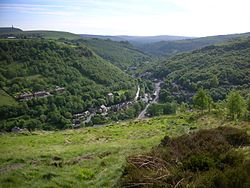
 View of the Calder Valley west of Hebden Bridge | |
 | |
| Location | |
| Country | England |
| Metropolitan County | West Yorkshire |
| Towns/Cities | Todmorden, Hebden Bridge, Sowerby Bridge, Elland, Brighouse, Mirfield, Dewsbury, Wakefield |
| Physical characteristics | |
| Source | Heald Moor |
| • location | between Holme Chapel and Cornholme, Lancashire |
| • elevation | 1,312 ft (400 m) |
| Mouth | |
• location | River Aire, Castleford |
| Length | 45 mi (72 km) |
The River Calder (/ˈkɔːldər, ˈkɒl-/[1]) is a river in West Yorkshire, in Northern England.
The Calder rises on Heald Moor in Lancashire close to the source of another river with the same name, and then flows east into West Yorkshire through green countryside, former woollen-mill villages and towns before joining the River Aire near Castleford.
The river's valley is generally known as the Calder Valley. The name Calderdale usually refers to the large urban and rural borough (centred on Halifax) through which the upper river flows. The lower reaches flow through the boroughs of Kirklees (based on Huddersfield) and Wakefield. However, the river does not flow through the centres of Halifax and Huddersfield, which are on the Calder's main tributaries, Hebble Brook and the River Colne respectively. The only large town centres through which the Calder flows are Brighouse, Mirfield, Dewsbury and the city of Wakefield.
The river itself is only navigable in short sections, but these sections are connected by artificial "cuts" (e.g. Horbury Cut) to form the Calder and Hebble Navigation, a popular leisure waterway which is part of the connected inland waterway network of England and Wales.
Etymology
[edit]The word ultimately derives from the Brythonic language, with most scholars agreeing that the name is a compound of two elements related to the Modern Welsh words caled (hard) and dwr (water). However, it is still a subject of debate if the hard element refers to the river's bed, or figuratively to the strength of its currents. As such two separate meanings are commonly derived with 'hard (or violent) water',[2] or river of stones[3] being commonly given translations.
The name 'Calder' is common in Northern Britain, being found in various places across Lancashire and Yorkshire, as well as Calderstones, Liverpool, East Calder and West Calder near Edinburgh and Calderwood near Glasgow, and as the name of the Scottish Clan Calder.[4] The late survival of Celtic speaking peoples in the vicinity of the river Calder is perhaps evidenced in the names of villages such as Walsden, in upper Calderdale, which probably derives from *Walhaz Dene, meaning "Valley of the "Welsh" ('Welsh' being what the Anglo-Saxons called the native Celts who would have spoken Old Welsh).[5]
Geography
[edit]The river rises approximately 1,300 feet (400 m) above sea level at Heald Moor,[6] north-west of Todmorden, and drains an area of 369 square miles (957 km2). It flows for a distance of around 45 miles (72 km) through Cornholme, Todmorden, Eastwood, Hebden Bridge, Mytholmroyd, Luddendenfoot, Sowerby Bridge, Copley, Elland, Brighouse, Mirfield, Dewsbury, Horbury Bridge and on to Wakefield.
The catchment lies on Carboniferous rocks of Millstone Grit, and is heavily reservoired, with 39 reservoirs licensed to provide water. The river is joined by Hebden Water at Hebden Bridge, and by the River Ryburn at Sowerby Bridge; it is linked to the town of Rochdale, Greater Manchester across the Pennines via the Rochdale Canal.
For much of its length, the Calder is canalised and becomes the Calder and Hebble Navigation. It is also part of the Aire and Calder Navigation, and to the east of Castleford,[7] it merges into the River Aire, going on to join the Humber Estuary and the North Sea.
History
[edit]
The river was central to establishment of the textile industries in the local area, and flows through the area known as the Yorkshire Heavy Woollen District. Many major mills were constructed along its banks, particularly at Dewsbury and Wakefield, but also in the smaller communities of Brighouse, Hebden Bridge, Sowerby Bridge and Todmorden, as well as along its tributaries: the Hebble at Halifax, and the Colne at Huddersfield. The mills in the Upper Calder Valley specialised in cotton weaving, with some cotton spinning, while those in the lower part of the valley specialised in wool and shoddy. Some of these structures still exist as listed buildings, although the large scale production of yarn and textile has now ceased.
The river formed an important transportation system for raw materials and the products of the mills, particularly prior to the development of other infrastructures such as road and railway links to the area. At many places, the river is not navigable because of weirs or the shallow depth, and passage for boats was made by the creation of cuts where boats are able to enter the Calder and Hebble Navigation. Work began to make the Calder navigable above Wakefield in 1758.
Wakefield's medieval nine-arched bridge is 320 feet (98 m) long, was built in sandstone between 1342 and 1356, and replaced an earlier wooden structure on the site of an ancient ford. The chantry chapel on the bridge was licensed in 1356. At Wakefield, a variety of former mill buildings are currently being redeveloped to create a Waterfront project which will combine residential housing, offices, galleries and public spaces. The Hepworth Wakefield opened in 2011.
In the late 1830s and early 1840s, the River Calder was diverted at Kirkthorpe to aid the building of the railway between Wakefield Kirkgate and Normanton. This also straightened out one of the larger curves in the river and was a cheaper option than building bridges to span the river.[8][9][10] In 2015 a 100 kW hydro installation and fish pass was completed at Whalley Weir on the River Calder in Whalley. The micro hydroelectric generating plant uses a variable speed Archimedean screw.[11][12] The weir at Kirkthorpe was adapted in 2017 to be a hydroelectric generating station, with a capacity of 500 kWh.[13]
Filming location
[edit]The valley's historic towns and cities have attracted film and television productions. Several films and television series have been filmed in the area, particularly around the town of Halifax.[14][15] For example, portions of the BBC television series Happy Valley (2014) were filmed in Halifax; in addition to exteriors, some of the studio filming was done at North Light Film Studios at Brookes Mill, Huddersfield. As well, interiors for the BBC's Jamaica Inn, for the BBC's Remember Me and for ITV series Black Work, were also filmed at the studios.[16][17][18][19] Many of the exteriors of the BBC series Jericho (2016) were filmed at the nearby Rockingstone Quarry and some interior work was done at North Light Film Studios.[20]
The TV series The Gallows Pole takes place in Calder Valley in the 1760s, and is partially filmed in Heptonstall.[21]
Environmental
[edit]Wildlife and fish
[edit]Until the 19th century, the Calder was home to large numbers of salmon but pollution from the textile and chemical industries along its banks led to the death of the salmon population by the mid 19th century. The last salmon on record was caught at Wakefield in 1850, however there is evidence that they are returning, with sightings on the lower river at Castleford in 2008[22] and alleged catchings much further upstream. Around Huddersfield, Mirfield and Wakefield are popular areas for coarse fishing, roach, perch, chub, dace, minnows, gudgeon, pike, bream and trout. The areas upstream of Dewsbury are quickly becoming cleaner and more suited to game and specialised river cyprinids like barbel, as well as general coarse fish that are also doing well.
Alongside the river are four Sites of Special Scientific Interest.
Recent improvements in reducing the amount of pollution have led to the return of native wildlife, such as the otter and kingfisher to stretches of the river.
Kingfishers are easily spotted (all year round, due to its orange underbelly) all the way up and down the river's course and are quite numerous around the Mirfield area.
Pollution
[edit]The river has been heavily polluted by the textile industry, and, more recently, chemical works along its banks.
Close to its source at Heald Foot, the water is polluted by the remains of past opencast mining activities and a landfill site. This has also led to a significant amount of soil erosion, with major mudslides into the river and its tributaries in 1947, 1982, 1991 and 2001.
As the river reached Huddersfield, the traditional textile industries created a considerable amount of water pollution, particularly through the processes involved in the production of synthetic dyes and in scouring the wool clean. The enormous growth of the population over the last hundred years (currently over 800,000 people live within the river's catchment) has caused other problems in relation to sewage. Another major source of pollution until recently came from a disused tar distillery in Mirfield.[23]
In the middle 1950s the river was so polluted by dyeworks in the middle reaches between Todmorden and Sowerby Bridge, that it ran different opaque colours from day to day. On Easter Monday, after a long weekend holiday shutdown, the water cleared and the river bottom could be seen, looking like a grey wool blanket. Tighter controls during the 1950s led to an improvement in water quality, and presently organisations such as Calder Future are working collaboratively with local industries and Yorkshire Water to promote more responsible use of the river and to re-establish lost wildlife along its banks.
Flooding and flood defences
[edit]The river has a history of flooding, mainly due to the high sides of its banks in its earlier stages, which cause rapid runoff of water following heavy rain. Much of the lower part of the river has been urbanised, therefore trapping flowing water within the engineered river channels. Fast flows of water cause the deposition of sediment collected from the river banks, raising the river height further.
A variety of flood defences are in operation along the Calder Valley to prevent the recurrence of floods which devastated communities in the early part of this century. At Wakefield, for example, the lake at Pugneys Country Park is used as an overflow for the river in order to protect the town.
The recently regenerated Wakefield Waterfront area is defended by one of the most sophisticated flood defence systems in Europe. This complex of computer controlled automatic flood barriers are housed below ground and rise automatically when a flood threat is detected.
Leisure use of the river
[edit]The river is host to a variety of watersports activities:
- a canoeing centre at Sowerby Bridge
- waterskiing in gravel pits at Cromwell Bottom
- watersports and angling at Pugneys Country Park
- the use of leisure craft and narrowboats along the lower stretch of the river where navigation is made easier through the canals built during the Industrial Revolution
- Walking routes along the Pennine Way and Calderdale Way
- Angling in areas is distributed between the following; Bradford No.1 angling association, Mirfield AC, Thornhill AC, and Wakefield AC. Some stretches are free and only require a valid Environment agency rod licence
See also
[edit]- Rivers of the United Kingdom
- List of crossings of the River Calder, West Yorkshire
- List of most-polluted rivers
- Upper Calder Valley
- Murder of Lindsay Rimer, unsolved 1994 case of a 13-year-old girl found murdered in the river
References
[edit]- ^ Wells, John C. (2008). "Calder". Longman Pronunciation Dictionary (3rd ed.). Longman. ISBN 978-1-4058-8118-0.
- ^ Watts, Victor, ed. (2010). "Calder". The Cambridge Dictionary of English Place-Names. Cambridge University Press.
- ^ "Fact File". www.kirklees-ednet.org.uk. Retrieved 23 September 2009.
- ^ Price, Glanville (2000). Languages in Britain & Ireland. Oxford: Blackwell Publishers. p. 74. ISBN 9780631215806.
- ^ Watts, Victor, ed. (2010). "Walsden". The Cambridge Dictionary of English Place-Names. Cambridge University Press.
- ^ 53°43′19″N 2°10′23″W / 53.722°N 2.173°W
- ^ 53°43′55″N 1°21′32″W / 53.732°N 1.359°W
- ^ "Stanley History Online - Stanley Ferry History". stanleyhistoryonline.com. Archived from the original on 2 June 2010. Retrieved 23 July 2019.
- ^ "Plan of Kirkthorpe dam and cut diversion of the river Calder". discovery.nationalarchives.com. Retrieved 23 July 2019.
- ^ Herepath, John (1839). "Reports". Herepath's Railway and Commercial Journal. 6. Charing Cross: James Wyld: 245. OCLC 221127091.
- ^ "Whalley Hydro powers up". Premier Construction News. 13 January 2015. Retrieved 6 February 2021.
- ^ "Whalley Community Hydro | Community Renewable Energy Scheme". 2 August 2015. Archived from the original on 2 August 2015. Retrieved 6 February 2021.
- ^ Snowden, Ros (19 July 2019). "Yorkshire green energy firm snapped up in multi-million pound deal". The Yorkshire Post. Archived from the original on 19 July 2019. Retrieved 24 July 2019.
- ^ "Productions at North Light Film Studios". North Light Film Studios. North Light Film Studios. 2017. Retrieved 10 February 2017.
- ^ "Film & TV". Examiner. Huddersfield. 29 October 2016. Retrieved 10 February 2017.
- ^ Ballinger, Lauren (5 December 2014). "North Light Film Studios - Remember Me filming locations". Examiner. Huddersfield. Retrieved 10 February 2017.
- ^ Rees, Caroline (3 November 2013). "Sally Wainwright: not the same old". The Guardian. Retrieved 19 January 2014.
- ^ Bremner, Jade (11 December 2013). "Last Tango in Halifax actress Sarah Lancashire begins shooting new crime drama in Yorkshire". Radio Times. Retrieved 19 January 2014.
- ^ "Creative England provides filming location and crew support to new BBC drama Happy Valley when filming in Yorkshire". Creative England. 29 April 2014. Retrieved 12 June 2014.
- ^ Gildea, Samantha (1 February 2016). "Jericho filming locations". Examiner. Huddersfield. Retrieved 10 February 2017.
- ^ Vinter, Robyn (16 June 2023). "'Definitely a lot busier': TV show lures visitors to coin gang's Yorkshire home". The Guardian. Retrieved 9 March 2024.
- ^ "Return of the Salmon". 29 January 2008. Retrieved 14 August 2010.
- ^ "A good clean up". EHJ online. 2 January 2005. Archived from the original on 26 May 2005.
Sources
[edit]- Kirklees site about the River Calder
- Rivers Info with images Retrieved 14 December 2007.
External links
[edit]

River Calder, West Yorkshire
View on GrokipediaName and Origins
Etymology
The name of the River Calder originates from the Brythonic Celtic language, a branch of the ancient Celtic tongues spoken in Britain before the Anglo-Saxon period. It is derived from the compound elements *caleto-, meaning "hard," and *dubro-, meaning "water" or "stream," resulting in an interpretation of "hard water." Alternative etymologies include "river of stones" or "rapid stream," possibly alluding to the river's rocky, fast-flowing character.[7][8][9] The "Calder" designation is notably common across Northern Britain, appearing in multiple river names such as those in Lancashire and Cumbria, as well as further north in Scotland. This prevalence underscores the enduring legacy of Brythonic Celtic nomenclature in the region's hydrology and topography, where similar terms describe environmental features like turbulent or resilient waterways.[9] Evidence of Celtic linguistic survival near the River Calder is seen in associated place names, such as Walsden in upper Calderdale, which stems from the Old English wealh + denu, denoting the "valley of the foreigners" or Celtic Britons, highlighting late Brythonic influence in the area.[10]Geological Formation
The River Calder's valley in West Yorkshire was primarily shaped during the Devensian stage of the last Ice Age, approximately 17,000 years ago, when glacial meltwater from retreating ice sheets scoured and eroded the landscape. Although the Calderdale area itself was not directly covered by ice, meltwater from the Lancashire ice sheet channeled through the Cliviger valley and flowed eastward along the Calder valley, deepening and widening the pre-existing channels through abrasive action and sediment transport. This glacial meltwater activity exploited existing weaknesses in the Carboniferous bedrock, resulting in the formation of the river's characteristic steep-sided valleys in the upper reaches.[11][12] The bedrock underlying the River Calder catchment consists predominantly of Upper Carboniferous rocks from the Millstone Grit Group, formed around 310–325 million years ago through deltaic sedimentation in ancient river systems. These rocks include coarse-grained sandstones, such as the Kinderscout Grits and Rough Rock, interbedded with mudstones, which provide a resistant but fractured foundation that contributes to the steep, incised topography of the Pennine uplands. In the upper catchment, the Millstone Grit's durability leads to narrow, V-shaped valleys with prominent rocky outcrops, while downstream toward the east, the bedrock transitions to the younger Coal Measures Group, featuring finer sandstones, mudstones, and thin coal seams that allow for broader valley floors.[11][5][12] Fault lines significantly influenced the river's geological development by creating zones of weakened rock that guided erosion patterns. The Todmorden Smash Belt, a series of small north-west to south-east trending faults along the Cliviger valley, facilitated the initial routing of meltwater and ongoing fluvial incision by fracturing the Millstone Grit and Coal Measures. Additionally, broader north-west and north-east trending normal and strike-slip faults, reactivated during Mesozoic and Neogene periods, further controlled the structural alignment of the valley, enhancing the river's ability to carve through the resistant bedrock over time.[11][12]Physical Geography
Course and Length
The River Calder originates on Heald Moor in Lancashire, at an elevation of approximately 400 metres above sea level, near the villages of Holme Chapel and Cornholme, just west of the West Yorkshire border.[13] From there, it flows southeast for approximately 72 km through the Pennine foothills and the densely populated valleys of West Yorkshire, draining a catchment area of about 957 km² before joining the River Aire at Castleford.[14][15] The river's path follows a predominantly eastward trajectory, carving through steep, narrow valleys in its upper reaches before broadening into more expansive floodplains downstream.[16] Entering West Yorkshire near Todmorden, the Calder passes through several historic mill towns and urban centres, including Todmorden, Hebden Bridge, Mytholmroyd, Luddendenfoot, Sowerby Bridge, Elland, and Brighouse within Calderdale.[13] It continues into Kirklees, flowing alongside or through Mirfield and Dewsbury, before reaching Wakefield in the lower valley, where the terrain flattens and the river meanders through industrial and agricultural landscapes en route to its confluence.[16] Along this course, the river is paralleled by sections of the Rochdale Canal and the Calder and Hebble Navigation, which utilise its waters and alter its natural flow in places.[13] Key tributaries augment the Calder's flow at various points, notably Walsden Water joining near Todmorden in the upper reaches, the River Ryburn at Ripponden, Hebden Water at Hebden Bridge, and Hebble Brook—which drains the Halifax area—further downstream near Elland.[13] Additional significant inflows include Cragg Brook near Mytholmroyd, Luddenden Brook at Luddendenfoot, the River Holme near Cooper Bridge, and the River Colne, which enters via the Spen system near Dewsbury, contributing to the river's volume as it approaches Wakefield.[13][1]Hydrology and Drainage
The River Calder's catchment spans 957 km², encompassing upland moorlands in the Pennines and lowland valleys across West Yorkshire, with significant contributions from tributaries such as the Colne, Hebble, Ryburn, and Holme. This area drains predominantly peaty soils and urbanized landscapes, shaping the river's hydrological regime through variable precipitation patterns typical of the region. The catchment's topography facilitates rapid runoff from the western uplands, where annual rainfall exceeds 1,500 mm, transitioning to more moderated flows in the eastern lowlands.[17][18][19] Average discharges at key gauging stations range from approximately 8 m³/s near Elland to around 17 m³/s at Dewsbury and up to 20 m³/s downstream near the full catchment, reflecting cumulative inflow.[20][21][22] These flows exhibit pronounced seasonal variations, with elevated winter discharges driven by intense Pennine rainfall events, often exceeding mean levels by factors of 3–5 during wet periods from October to March. In contrast, summer baseflows drop significantly, relying on groundwater contributions and reduced precipitation, typically falling below 10 m³/s in dry months like July and August, which underscores the river's flashy character influenced by the region's climate.[21] Urbanisation within the catchment, particularly in densely populated areas like Dewsbury, Wakefield, and Brighouse, has accelerated runoff rates by replacing permeable surfaces with impervious ones, increasing peak flows during storms by up to 20–30% compared to rural sub-catchments. This impervious cover, estimated at over 15% in lower reaches, also elevates pollutant loads in stormwater, degrading water quality metrics such as biochemical oxygen demand and suspended solids during high-flow events. These anthropogenic influences compound natural variability, necessitating integrated management to mitigate heightened erosion and sedimentation in the river system.[23]Historical Development
Pre-Industrial Era
The River Calder played a vital role in prehistoric human activity in West Yorkshire, serving as a corridor for trade and ritual practices during the Bronze Age. Finds of Group VI stone axes originating from Cumbria along the river's course indicate its use for transport and exchange networks, as these tools were likely moved via riverine routes from the Lake District.[24] Additionally, ritual depositions of Middle and Late Bronze Age metalwork, including palstaves and spearheads, have been recovered from the river, suggesting communities engaged with the waterway for ceremonial purposes possibly linked to fishing and resource gathering in nearby settlements.[24] Evidence from the broader Calderdale area includes Bronze Age barrows, flints, funeral urns, and bronze tools, pointing to seasonal camps and settlements that exploited the river for sustenance and mobility.[25] In the medieval period, the River Calder's fords and emerging bridges became essential for regional connectivity and economy. Natural fords allowed early crossings, but structured infrastructure developed with the construction of Wakefield Bridge between 1342 and 1356, a stone structure that replaced earlier wooden versions and supported increased trade in wool and grain.[26] The bridge featured a central chantry chapel dedicated to St Mary, erected around 1350 to provide for travelers' spiritual needs and funded by local bequests, highlighting the river's integration into daily life and pilgrimage routes.[27] These crossings, enabled by the river's geological valley formation, facilitated the movement of goods and people across West Yorkshire before the widespread adoption of roads.[24] From the 12th to 18th centuries, the Calder powered early industrial activities through water mills, particularly corn mills operated by monastic communities. Institutions like Nostell Priory, an Augustinian foundation established in the early 12th century adjacent to the river, influenced the development of water-powered milling for grain processing, as monasteries commonly harnessed local waterways for self-sufficiency and estate management.[28] A documented corn mill on the Luddenden Brook, a Calder tributary, dates to 1274, while sites in Wakefield trace back to the early 13th century, underscoring the river's consistent role in agrarian economies prior to mechanization.[8][29] By the 15th century, additional mills like Brighouse Lower Mill emerged as fulling mills for wool processing, marking early textile activities alongside corn milling and supporting local economies.[30]Industrial Revolution and Textile Industry
During the Industrial Revolution, the River Calder became a vital artery for the burgeoning textile industry in West Yorkshire, providing hydropower that fueled the expansion of woollen and cotton mills along its course. The river's steep gradients and reliable flow enabled the construction of weirs and leats to channel water for driving machinery, transforming small-scale operations into large-scale production centers. In the Halifax and surrounding areas of Calderdale, over 100 such mills were powered by these hydraulic systems, specializing in woollen cloth finishing, spinning, and weaving, which capitalized on the region's abundant raw wool supplies.[31][32] A key development supporting this industrial growth was the Calder and Hebble Navigation, initiated in 1758 and progressively extended through the 1820s to facilitate barge transport of coal, raw materials, and finished textiles. This waterway made the upper reaches of the River Calder navigable from Wakefield to Sowerby Bridge, allowing heavy goods to bypass shallow sections and rapids, thereby reducing transport costs and enabling mills to access broader markets. Barges carried essential coal for steam engines supplementing water power and exported dyed woollen goods to ports like Hull, underpinning the textile boom in mill towns such as Halifax and Brighouse.[33][34] The textile industry's reliance on the Calder spurred rapid urbanization and population growth in Calderdale's mill towns, as employment opportunities drew migrants from rural areas and beyond. Halifax's population, for instance, surged from approximately 50,000 in 1801 to over 106,000 by 1851, reflecting the influx of workers to operate the proliferating mills and ancillary industries like dyeing and engineering. This demographic expansion fostered dense urban settlements, with social structures shifting as handloom weavers transitioned to factory labor, though it also intensified demands on housing and infrastructure along the river valleys.[31]Post-Industrial Changes
Following the Second World War, the textile industry along the River Calder in West Yorkshire experienced significant decline, with numerous mills closing between the 1960s and 1980s primarily due to intensified global competition from low-cost imports. In West Yorkshire's wool and worsted sectors, employment plummeted by over 50% since 1978, contributing to a broader loss of 300,000 jobs across the UK's textile industry since the war. Specific closures included Hoyle's Mill in Calderdale, which shut in 1968 after acquisition by a larger group, and Dean Clough Mills in Halifax, a major carpet production site that ceased operations in 1982-1983 amid falling demand and rising imports from countries like Turkey and South Korea. By the late 1980s, imports accounted for 44.6% of the UK textile market, exacerbating short-time working and redundancies in the Calder Valley region.[35][36][32][37] Deindustrialization prompted regeneration initiatives in the late 20th and early 21st centuries, transforming former industrial sites along the river into sustainable energy and cultural assets. The Kirkthorpe Weir Hydropower Plant, commissioned in December 2016 and officially opened in March 2017, represents Yorkshire's largest low-head river hydropower scheme at 500kW capacity, harnessing the River Calder's flow near Wakefield to generate renewable electricity for approximately 800 homes annually. These projects exemplify efforts to repurpose the river's historic weirs for green energy amid the shift away from fossil fuel-dependent industries.[38][39] The Wakefield Waterfront regeneration, initiated in the 2000s as part of a £100 million scheme, has driven economic diversification by redeveloping riverside brownfield sites into cultural and leisure hubs, fostering a transition from manufacturing to tourism and service-based economies. Key developments include the 2011 opening of the Hepworth Wakefield gallery, which attracted 220,000–250,000 visitors per year pre-pandemic (as of 2019 data) and supports creative industries employing around 2,500 people in the district (as of 2019), contributing to the district's record 10 million visitors in 2024.[40][41][42] Ongoing projects like Tileyard North, converting former woollen mills into a music and creative quarter since the 2020s, further emphasize the river corridor's role in cultural tourism. Phases of Tileyard North were completed in 2024, with the public courtyard opening in summer 2024 and the project shortlisted for the Brick Awards 2025, further boosting cultural tourism along the river.[43][40][44][45] This evolution has helped stabilize employment near regional averages, though low-paid service jobs predominate, while briefly addressing lingering textile pollution legacies through integrated site remediation.Ecology and Environment
Biodiversity and Wildlife
The River Calder in West Yorkshire has seen significant recovery in its biodiversity following decades of industrial pollution that led to the local extinction of several species, including Atlantic salmon.[46] Efforts to improve water quality and remove migration barriers have facilitated the return of migratory fish, with Atlantic salmon first sighted near Castleford in 2008 and subsequent evidence of spawning in tributaries above Todmorden by 2022, with ongoing spawning activity observed as of November 2025.[47][48][49] Current populations include thriving coarse fish such as chub and roach, which are abundant in stretches around Huddersfield, Mirfield, and Wakefield, supporting local angling communities.[50] Beyond fish, the river supports key vertebrate species indicative of improving habitat conditions. Otters, which experienced widespread decline in the late 20th century, have recolonized the Calder near Wakefield since the early 2000s, with increasing signs of presence recorded by 2011.[51] Kingfishers and dippers are now regularly observed along cleaner upper and middle reaches, where they hunt for aquatic invertebrates and small fish.[52] Riparian zones along the Calder feature native woodlands dominated by alder and willow, providing essential cover, shade, and organic input to the river ecosystem, which sustains invertebrate communities and supports bird and mammal populations.[46] Conservation initiatives, including the Calder Future partnership established in the 2010s, have focused on habitat enhancement through bank stabilization, invasive species removal, and wetland creation to bolster biodiversity.[53] Projects like the Reviving Calderdale’s Rivers scheme, completed in 2023, have enhanced 2.7 km of riverbank with willow spiling and removed invasive Himalayan balsam from 3.9 hectares, directly improving conditions for fish and riparian wildlife.[46]Pollution History and Remediation
During the 19th and 20th centuries, the River Calder in West Yorkshire suffered severe pollution from industrial activities and urban growth. Dye works and print mills discharged chemical effluents, rendering the water highly toxic; a 1863 report noted that "the Calder is so polluted by dye and print works, that the fish in it have been nearly, if not quite de-destroyed."[54] Coal mining contributed heavy metal contaminants, with legacy effluents elevating dissolved lead (1.25 μg/L) and zinc (35.9 μg/L) levels in the river.[55] Sewage from rapidly expanding textile towns like Wakefield added organic waste, turning the river into an open sewer; by the 1860s, the waterway near Wakefield was described as stagnant and offensive, filled with putrefying mud, colorful froth from dye-works, and solid fecal matter.[56][57] This contamination led to the local extinction of salmon populations, with the last recorded catch at Wakefield in 1850.[3] Remediation efforts intensified in the late 20th century and accelerated with the European Union's Water Framework Directive (WFD), implemented in the UK from 2000, which mandated achieving good ecological status for rivers by 2015 (extended in many cases). Yorkshire Water has invested significantly in wastewater infrastructure to reduce point-source pollution; a notable example is the £18.5 million upgrade of Calder Vale treatment works in Wakefield, completed in 2012, which improved sewage processing for 110,000 people and enhanced compliance with environmental directives.[58] In the Aire and Calder catchment, which includes the River Calder, phosphate removal at over 250 sewage treatment works has cut effluent loads by 67%, aiding WFD compliance despite challenges from diffuse urban pollution.[59] By the 2020s, water quality classifications showed progress, with the lower River Calder achieving moderate ecological status in both 2019 and 2022 assessments, up from poorer conditions historically, though biological elements like fish remain at moderate due to ongoing pressures.[60] The 2024 West Yorkshire Local Nature Recovery Strategy further supports remediation through initiatives like creating nature-friendly habitats adjacent to water bodies and partnering with organizations such as the Calder Rivers Trust to target pollution hotspots and restore riverine ecosystems.[61] These efforts have contributed to tentative biodiversity recovery, including sightings of returning salmon in tributaries.Human Interactions
Flooding Events and Defences
The River Calder in West Yorkshire has a long history of significant flooding events, with the earliest recorded incident occurring in 1615 when heavy rainfall caused the river to overflow and destroy the stone Elland Bridge in Calderdale. This event highlighted the vulnerability of infrastructure in the narrow valley, leading to the bridge's rebuilding in 1617 at considerable cost. Subsequent major floods in the 20th and 21st centuries have repeatedly demonstrated the river's propensity for rapid inundation, affecting communities along its course.[5][62] In June 2000, prolonged heavy rainfall exceeding 30 hours led to the River Calder bursting its banks in Todmorden, flooding over 500 homes and businesses with water depths reaching eight feet in some areas. The event caused extensive structural damage and disruption, with insurers estimating cleanup and repair costs at approximately £12 million in Todmorden alone. The Boxing Day floods of 2015, triggered by Storm Eva following saturated ground from earlier storms, were among the most severe, impacting over 2,800 homes and 1,600 businesses across Calderdale. This disaster resulted in direct business losses of nearly £47 million, with the total regional economic impact on Calderdale and adjacent Kirklees exceeding £170 million, including £25 million in infrastructure damage and over £50 million in council recovery costs by 2016.[63][62] More recent severe flooding struck the Upper Calder Valley in December 2024 due to Storm Gerrick, affecting multiple communities and prompting evacuations, while as of November 2025, flood warnings remain active along the river amid heavy rainfall from Storm Claudia.[62][64] Flooding along the River Calder is primarily driven by the steep topography of its upper catchment in the Pennines, which accelerates water flow into the valley, combined with urban impervious surfaces in lower areas that increase surface runoff during intense rainfall. These factors, exacerbated by high antecedent soil moisture from frequent storms, lead to rapid river level rises and flash flooding in constricted valley sections. For instance, the 2015 event saw over 100 mm of rain fall in under 24 hours, overwhelming the channel capacity.[65][62] To mitigate these risks, engineered flood defences have been implemented, including barriers along the River Calder in Wakefield developed as part of early alleviation efforts in the late 20th century to protect urban waterfront areas from overflow. More recent initiatives include the June 2025 allocation of nearly £2 million in government funding for Calder Valley schemes, supporting traditional defences in locations such as Mytholmroyd, Todmorden, and Hebden Bridge, alongside natural flood management (NFM) measures. NFM approaches, such as upstream storage reservoirs on tributaries like Colden Clough and over 1,600 leaky wooden dams installed since 2017 at sites including Hardcastle Crags near Hebden Bridge, aim to slow runoff and store excess water in the upper catchment, reducing peak flows downstream by mimicking natural processes. These community-led efforts, coordinated by groups like Slow the Flow Calderdale, have been integrated into broader catchment strategies to enhance resilience without relying solely on hard infrastructure, with ongoing progress reported in attenuating recent flood peaks.[66][67][68][69][70]Navigation and Infrastructure
The Calder and Hebble Navigation comprises a 21-mile canalized stretch of the River Calder from Sowerby Bridge to Wakefield, incorporating sections of the natural river channel connected by artificial cuts and featuring 27 locks to manage the 250-foot elevation change.[71][72] This infrastructure, authorized by an Act of Parliament in 1758 and completed in 1770, originally enabled the transport of coal, stone, and woolen goods during the Industrial Revolution.[33] Along the navigation, a diverse array of bridges spans the river, ranging from medieval packhorse examples like the 16th-century structure at Heptonstall (near the Calder's upper reaches) to 19th-century turnpike bridges such as Brighouse Bridge (built 1825) and contemporary motorway crossings including the M62 viaduct near Brighouse.[73] Weirs punctuate the waterway, with historical structures repurposed or supplemented by modern hydroelectric installations; for instance, the Kirkthorpe Hydro scheme at Kirkthorpe Weir, operational since 2016, harnesses low-head flow to produce around 500 kW of renewable energy annually.[74] Commercial traffic on the navigation dwindled after the mid-20th century, with most freight ceasing by 1955 and the final coal deliveries to Thornhill Power Station ending in 1981 due to competition from road and rail.[33] Maintenance now focuses on periodic dredging by the Canal & River Trust to preserve channel depth for residual navigation needs.[71]Leisure and Recreation
The River Calder in West Yorkshire supports a range of non-commercial leisure activities, particularly angling, canoeing, and walking along its banks and associated paths. Angling is popular, with several local clubs managing fishing rights on various stretches of the river, offering opportunities for both coarse and fly fishing targeting species such as chub, barbel, roach, perch, trout, and grayling.[50][75][76] For instance, the Wakefield Angling Club holds rights on multiple lengths in the Wakefield area, while the Todmorden Angling Society maintains waters along the upper Calder, providing day tickets and membership for anglers.[75][76] Canoeing and kayaking are well-established pursuits on the river, with calm sections suitable for beginners and more challenging white-water features for experienced paddlers. The West Yorkshire Canoe Club organizes trips ranging from flat-water paddles to advanced river sessions on the Calder, including routes from Hebden Bridge to Sowerby Bridge.[77][78] A notable facility is the Sowerby Bridge Whitewater Course, a 300-meter slalom course utilizing the river's weirs, which was reformed in 2001 and hosts playboating and training sessions.[79][80] Walking trails enhance recreational access to the river valley, with the 50-mile Calderdale Way providing an "up and down" circular route through the Calderdale hills, moors, and valleys, starting from the towpath in Brighouse and passing through mill towns along the River Calder's banks.[81] Link paths connect the trail to the valley floor for riverside exploration, while the longer Pennine Way National Trail crosses the Calder Valley near Hebden Bridge, incorporating scenic sections near the river en route to landmarks like Stoodley Pike.[81][82] Leisure boating, including canoeing and narrowboat hires, is available from Sowerby Bridge, allowing non-commercial trips along the connected Calder and Hebble Navigation with its distinctive lever-operated locks.[83][71] Riverside facilities support these activities, such as Pugneys Country Park in Wakefield, a 250-acre site around the River Calder and adjacent lakes offering walking, cycling paths, and watersports like canoeing, though some activities have been scaled back to prioritize wildlife conservation.[84][85] In Hebden Bridge, the Visitor Centre provides information on local trails and river-based recreation, situated directly beside the Calder. These amenities also offer brief opportunities for biodiversity viewing, such as birdwatching along the trails detailed in the ecology section.[84]Cultural and Media Uses
The River Calder in West Yorkshire has inspired literary works that capture the rugged beauty and historical depth of its surrounding valleys. Poet Ted Hughes, who grew up in the Upper Calder Valley, drew extensively from the landscape in his poetry, notably in the 1979 collection Remains of Elmet, which explores the valley's glacial formation, industrial decay, and ancient Celtic heritage through free verse poems depicting its moors, mills, and enduring harshness.[86] The Brontë sisters, residing in nearby Haworth amid the Pennine hills, found inspiration in the broader moorland and valley terrains that extend to the Calder area, influencing their evocative depictions of wild, windswept landscapes in novels like Wuthering Heights.[87] In modern media, the Calder Valley serves as a picturesque backdrop for television productions, highlighting its dramatic terrain and historic villages. The BBC crime drama Happy Valley (2014–2023), created by Sally Wainwright, filmed key scenes in Hebden Bridge, a market town at the confluence of the River Calder and Hebden Water, using the area's cobbled streets, canals, and riverfront to evoke the region's gritty authenticity.[88] Similarly, Shane Meadows' 2023 BBC period drama The Gallows Pole, based on Benjamin Myers' novel about 18th-century coin forgers, shot most exterior scenes in Heptonstall and nearby Hebden Bridge, leveraging the steep, stone-built village overlooking the Calder Valley to portray the industrial-era setting.[89] Cultural events along the River Calder celebrate its literary and industrial legacy through heritage trails and festivals. The Calder Valley Heritage Trails, a series of self-guided e-trails, trace the river's path while exploring sites of 19th-century textile mills, water-powered forges, and worker settlements, connecting visitors to the area's transformation during the Industrial Revolution.[90] Annual events such as the Ted Hughes Festival in Mytholmroyd honor the poet's ties to the valley with readings, walks, and exhibitions that often follow riverine routes, fostering appreciation of the landscape's influence on creative expression.[91]References
- https://en.wikisource.org/wiki/On_the_Pollution_of_the_Rivers_of_the_Kingdom