Hubbry Logo
CalenderCalenderMain
Open search
Calender
Community hub
Calender
logo
8 pages, 0 posts
0 subscribers
Be the first to start a discussion here.
Contribute something
Calender
Calender
from Wikipedia
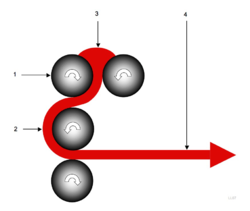
Calender process
Calender at end of paper machine
Old calender machine
Threading paper through calender rolls, 1941
Calender machine for electrode pressing in lithium-ion battery manufacturing

A calender is a series of hard pressure rollers used to finish a sheet of material such as paper, textiles, rubber, or plastics. Calender rolls are also used to form some types of plastic films and to apply coatings.[1] Some calender rolls are heated or cooled as needed.[2] Calenders are sometimes misspelled calendars.

Etymology

[edit]

The word "calender" itself is a derivation of the word κύλινδρος kylindros, the Greek word that is also the source of the word "cylinder".[3]

History

[edit]

Calender mills for pressing serge were apparently introduced to the Netherlands by Flemish refugees from the Eighty Years' War in the 16th and 17th centuries.[4]

In eighteenth century China, workers called "calenderers" in the silk- and cotton-cloth trades used heavy rollers to press and finish cloth.

In 1836, Edwin M. Chaffee, of the Roxbury India Rubber Company, patented a four-roll calender to make rubber sheet.[5] Chaffee worked with Charles Goodyear with the intention to "produce a sheet of rubber laminated to a fabric base".[6] Calenders were also used for paper and fabrics long before later applications for thermoplastics. With the expansion of the rubber industry the design of calenders grew as well, so when PVC was introduced the machinery was already capable of processing it into film.[6] As recorded in an overview on the history of the development of calenders, "There was development in both Germany and the United States and probably the first successful calendering of PVC was in 1935 in Germany, where in the previous year the Hermann Berstorff Company of Hannover designed the first calender specifically to process this plastic".[6]

In the past, for paper, sheets were worked on with a polished hammer or pressed between polished metal sheets in a press. With the continuously operating paper machine it became part of the process of rolling the paper (in this case also called web paper).[7] The pressure between the rollers, the "nip pressure", can be reduced by heating the rolls or moistening the paper surface. This helps to keep the bulk and the stiffness of the web paper which is beneficial for its later use.

Modern calenders have hard heated rollers made from chilled cast iron or steel, and soft rollers coated with polymeric composites. The soft roller is slightly non-cylindrical, tapered in diameter toward both ends, to widen the working nip and distribute the specific pressure on the paper more evenly.

Calendering paper

[edit]

In a principal paper application, the calender is located at the end of a papermaking process (on-line). Those that are used separately from the process (off-line) are also called supercalenders. The purpose of a calender is to make the paper smooth and glossy for printing and writing, as well as of a consistent thickness for capacitors that use paper as their dielectric membrane.

The calender section of a paper machine consists of a calender and other equipment. The paper web is run between in order to further smooth it out, which also gives it a more uniform thickness. The pressure applied to the web by the rollers determines the finish of the paper, in three basic types:

  • machine finish, or MF Paper, which can range from a rough, matte (non glossy) look, to a smooth, high-quality finish.
  • plater finish, obtained by placing cut sheets of paper between stacked zinc or copper plates and put under pressure and heat. A special finish such as a linen finish would be achieved by placing a piece of linen between the plate and the sheet of paper, or else an embossed steel roll might be used.

After calendering, the web has a moisture content of about 6% (depending on the finish). It is wound onto a roll called a tambour, and stored for final cutting and shipping.

Supercalender

[edit]

A supercalender is a stack of calenders consisting of alternating steel- and fiber-covered rolls through which paper is passed to increase its density, smoothness and gloss. It is similar to a calender except that alternate chilled cast-iron and softer rolls are used. The rolls used to supercalender uncoated paper usually consist of cast iron and highly compressed paper, while the rolls used for coated paper are usually cast iron and highly compressed cotton. The finish produced varies according to the raw material used to make the paper and the pressure exerted on it, and ranges from the highest English finish to a highly glazed surface. Supercalendered papers are sometimes used for books containing fine line blocks or halftones because they print well from type and halftones, although for the latter they are not as good as coated paper.

Calendering textiles

[edit]

Calendering is a finishing process used on cloth and fabrics. A calender is employed, usually to smooth, coat, or thin a material.

With textiles, fabric is passed under rollers at high temperatures and pressures. Calendering is used on fabrics such as moire to produce its watered effect and also on cambric and some types of sateens.

Various man-made fabrics made from synthetic materials are also calendered.

Other materials

[edit]
Calender rolls for milling and mixing rubber

Calenders can also be applied to materials other than paper and textiles when a smooth, flat surface is desirable.

Polymers such as vinyl and ABS polymer sheets, and to a lesser extent HDPE, polypropylene and polystyrene, are calendered.

The calender is also an important processing machine in the rubber industries, especially in the manufacture of tires, where it is used for the inner layer and fabric layer.

Calendering can also be used for polishing, or making uniform, coatings applied to substrates- an older use was in polishing magnetic tapes, for which the contact roller rotates much faster than the web speed. More recently, it is used in the production of certain types of secondary battery cells (such as spirally-wound or prismatic lithium-ion cells) to achieve uniform thickness of electrode material coatings on current collector foils.

See also

[edit]

References

[edit]
Revisions and contributorsEdit on WikipediaRead on Wikipedia
from Grokipedia
A calender is a machine equipped with two or more metal rollers mounted in vertical frames and revolving in opposite directions, used to smooth, compress, glaze, or finish sheet materials such as paper, textiles, rubber, plastics, or nonwovens by passing them between the rollers under controlled pressure and temperature. This mechanical finishing process imparts desirable properties like enhanced smoothness, gloss, uniform thickness, and specific surface textures, making it essential in various manufacturing industries. In , calendering serves as a critical final step to improve surface quality by compacting the web, balancing bulk and smoothness while controlling caliper profiles, and it can be applied on-line or off-line depending on the grade of or board. The process often involves heated rollers operating at temperatures between 50°C and 180°C to optimize gloss and reduce variations in thickness along the sheet's length and width. Key benefits include minimizing , preserving sheet strength, and enabling high-speed production tailored to web width and machine conditions. Calenders vary by application and design, with common types including hard-nip calenders using chilled iron or rolls for basic smoothing, and soft-nip calenders that incorporate compliant rolls (such as those covered with , synthetics, or elastomers) for gentler processing and superior results on or coated papers. Supercalenders, typically off-machine multi-roll stacks, provide high-gloss finishes for specialty grades like coated (LWC) paper. In textiles, calendering modifies fabric and appearance by compressing fibers, often producing effects like luster or embossing through variations such as or chasing calenders. For rubber and plastics, the machine sheets or coats compounds continuously, with historical developments tracing back to mid-19th-century innovations like the four-roll calender patented by Chaffee in 1836 for rubber production. Modern advancements, particularly since the 1980s, have shifted toward on-line soft-roll systems, with nearly 200 installations worldwide as of 1989 enhancing efficiency and through features like variable crown rolls and precise load distribution.

Overview

Definition and Purpose

A calender is a mechanical device consisting of a series of pressure rollers arranged to form one or more nips, through which a continuous sheet of material passes to receive uniform pressure, often combined with and sometimes . This process deforms the material to achieve desired surface and structural properties, primarily in industries such as production, textiles, and plastics. The primary purposes of a calender include smoothing the surface of the material to reduce roughness, increasing gloss and density for enhanced visual appeal, and controlling thickness to ensure uniformity across the sheet. It also improves printability by minimizing surface irregularities that could affect adhesion and transfer, while imparting aesthetic qualities such as sheen or specific textures tailored to end-use requirements. General components of a calender encompass heated or chilled rollers made from materials like for , cotton-filled for softness, or polymers such as fiber-reinforced for specialized compliance. Drive systems enable synchronized rotation of the rollers at variable speeds, while tension controls regulate material feed to maintain consistent web alignment and prevent defects. Key benefits include achieving uniformity in material properties such as thickness and , which reduces and enhances overall quality for downstream processes like or . This results in improved product performance and efficiency in production lines, with compaction contributing to better structural integrity without excessive loss of bulk.

Etymology

The term "calender" derives from the Greek word "κύλινδρος" (kylindros), meaning "" or "roller," which entered Latin as "cylindrus." This root reflects the machine's core function of using cylindrical rollers to press and smooth materials. The word passed into as "calendra," denoting a cloth-pressing device, and then into as "calandreur" or "calandre" by the late medieval period. In English, "calender" first appeared in the 1510s, initially as a describing the itself and soon after as a meaning "to pass through a calender." Historical records trace its early usage to the late through the "calenderer," applied to operators of cloth-pressing devices in medieval , where such roller-based tools were used to finish textiles by compressing and glazing fabrics. By the , the term had fully evolved to encompass broader applications of roller machines in industrial processes, solidifying its association with mechanical pressing and finishing. The word "calender" is etymologically unrelated to "," which originates from Latin "kalendae," referring to the first day of the Roman month, derived from the "*kele-," meaning "to " or "proclaim." Despite their phonetic similarity, the two terms stem from distinct linguistic lineages, with "" entering English around via "calendier" to denote a system for tracking time or a register of days. Occasional confusion arose in early texts due to overlapping spellings, such as "calender" for the timekeeping device in the , prompting a deliberate shift to "" to avoid ambiguity with the machinery term.

History

Early Origins

The calendering technique for pressing woolen serge fabrics was introduced to the by Flemish refugees fleeing the during the 16th and 17th centuries, bringing advanced finishing methods that enhanced the smoothness and quality of cloth production in the region. These immigrants contributed to a more flexible organization of the industry, incorporating tools like the calender mill to press fabrics, which marked an early mechanized step in European processing while retaining manual elements. Pre-industrial calendering relied on manual processes, where textiles and early sheets were hand-rolled using weighted cylinders or presses to achieve a smooth surface and compact the fibers. These methods involved passing fabric through simple rollers or beating it with heavy tools to finish the material without powered machinery. By the late , initial industrial adoption of calendering emerged in textile mills, with horse-powered setups used for finishing cloths in early American operations, such as in (1790), and (1792), reflecting the shift toward proto-industrial scales. This evolution laid the groundwork for later powered machines, though manual oversight remained essential.

Key Inventions and Developments

The friction calender, featuring rollers operating at differential speeds to achieve specific surface effects on fabrics and materials, was patented in 1805 by William Smith of New York. In 1836, Edwin M. Chaffee of the Roxbury India Rubber Company patented a four-roll calender designed for producing uniform rubber sheets, marking an early advancement in continuous processing for rubber goods in collaboration with . In , machine calenders using iron rolls for smoothing sheets were developed in the early , coinciding with the rise of continuous production machines around 1800–1820 in . The Schreiner calender, which imparts a fine linen-like finish to textiles through engraved rollers, was developed around to enhance fabric luster and texture in finishing processes. In 1935, the Hermann Berstorff Company in introduced the first successful PVC calendering line, enabling the continuous production of plastic films and sheets by adapting calender technology to thermoplastic materials. Throughout the , calendering machines evolved with the integration of electric heating systems to enable temperature-gradient processing for improved material properties, automated controls for precise cross-direction caliper management, and multi-stack configurations like soft-nip calenders that supported higher loads, speeds, and temperatures without component failure. Following , calendering saw widespread adoption in the polymer industry for producing films and sheets from materials like PVC, ABS, and other thermoplastics, driven by the need for high-volume, high-quality output in packaging and coating applications. In the battery sector, calendering became a standard step in lithium-ion from the 1990s onward, following the commercialization of Li-ion batteries in 1991, compressing coated electrodes to optimize density, porosity, and performance while enhancing volumetric . As of 2025, calendering trends emphasize energy-efficient designs, such as optimized circuits in rollers to minimize thermal losses during lithium battery electrode processing, alongside digital monitoring via models for real-time microstructural analysis and process optimization to support sustainable .

Operating Principles

Basic Mechanism

A calender functions by feeding a continuous web of through a series of stacked or paired rollers, where the encounters successive nips—narrow gaps between the rollers—that apply compressive force to deform and finish the sheet. This core relies on the rollers rotating in opposite directions to draw the forward while exerting line pressure, typically in the range of 200 to 800 kN/m (approximately 1,140 to 4,570 ), which compresses and shears the web to achieve uniform processing. Heat is applied to the rollers, often reaching 80–150°C through internal circulation of , hot oil, or elements, to soften the material's fibers or polymers and enable plastic flow under pressure; selective cooling via water jackets may be used in some setups to stabilize certain finishes. Operational parameters such as web speed, up to 1,000 m/min in high-speed configurations, and tension are precisely controlled using variable-speed drives and tension sensors to maintain sheet stability, avoiding defects like wrinkles, tears, or uneven feeding. The combined action of , heat, and shear results in plastic deformation of the material, leading to controlled thickness reduction for precise caliper management, increased through fiber consolidation, and enhanced surface leveling that minimizes roughness and improves . To ensure safe operation, calenders incorporate safety devices such as trip rods, devices, or presence-sensing systems to guard against access to in-running points, along with emergency stop devices accessible to operators; practices include regular roller alignment checks using nip impression tests and periodic resurfacing to preserve uniform pressure profiles and extend equipment life.

Roller Configurations and Types

Calenders employ a range of roller configurations to accommodate diverse processing needs, typically featuring 3 to 10 rollers arranged in vertical or horizontal stacks. Vertical stacks are common for their compact and stability, with applied through mechanical, hydraulic, or pneumatic loading systems, which simplifies the and reduces energy consumption. Horizontal configurations, though less prevalent, allow for easier access and maintenance in certain industrial setups. These arrangements ensure uniform contact across the web, with the number of rollers determining the degree of compression and finishing achieved. Roller materials are selected based on the required nip and surface interaction with the material. Hard chrome-plated rollers provide exceptional durability and resistance to wear, often used as the primary load-bearing components in high-pressure applications. Filled rollers, incorporating or blends, create softer nips for gentle processing of delicate fabrics or papers, minimizing damage while promoting even compression. Polymer-covered rollers offer non-stick surfaces, reducing adhesion issues and facilitating release of processed materials like plastics or coated textiles. Specialized calender types incorporate unique roller designs to impart specific surface effects. calenders utilize differential speeds between rollers—typically 5-10% faster on the pattern roll—to generate frictional and luster, often in a three-roll setup with a heat-resistant cotton-filled intermediate roller. Embossing calenders feature engraved or patterned rollers that transfer textures onto the material under controlled pressure and . Schreiner calenders employ rollers with fine, closely spaced grooves, heated to produce a subtle, silk-like sheen on fabrics through micro-embossing. Multi-nip setups enhance progressive compression by stacking multiple rollers, commonly centered around a robust king roll at the base that supports the entire load. This configuration alternates hard rollers with soft filled ones, allowing sequential nips to gradually densify and smooth the material without excessive stress on any single point. Such designs are prevalent in high-volume production for achieving superior uniformity. Contemporary calender advancements include hydraulic or pneumatic loading mechanisms, enabling precise and adjustable control across the roller stack to adapt to varying thicknesses and processing speeds. These systems replace traditional mechanical loading, offering zoned adjustments for consistent results over wide webs.

Applications in Paper Production

On-line Calendering

On-line calendering integrates the calender directly into the , typically positioned at the dry end of the following the drying section, where it processes paper stock with a content of 4-8% to ensure stability during finishing. This placement allows for immediate treatment of the newly formed web without interruption, enabling continuous operation at high speeds. The process utilizes single-nip or multi-nip stacks, often featuring a combination of hard and soft rolls, to apply controlled that smooths the surface and consolidates the structure, resulting in a finish ranging from matte to semi-gloss. Key operational parameters are optimized to match the paper machine's output while minimizing risks such as web breaks. Line loads are maintained at 50-300 kN/m (approximately 285-1,713 ) to accommodate the delicate web, with speeds synchronized to the machine's production rate, typically 500-800 meters per minute (m/min). Moisture control, often via humidification or misting, further aids in achieving uniform nip contact without excessive drying or overheating. These settings ensure the process enhances bonding and surface evenness without compromising structural integrity. The outcomes of on-line calendering include significantly improved sheet uniformity and reduced basis weight variation across the web, leading to more consistent paper properties for downstream applications like . Typical output levels stabilize around 6%, preserving the web's dimensional stability post-calendering. Compared to off-line methods, on-line calendering offers substantial through lower operational expenses—estimated at about one-fourth the per for similar finishing—and eliminates the need for separate handling and transport of reels, though it generally achieves less gloss than dedicated supercalendering setups.

Supercalendering and Finishes

Supercalendering is an off-line finishing process conducted on a dedicated separate from the primary , designed to impart premium surface qualities to paper webs. The setup typically features a vertical stack of alternating chilled rolls and softer filled rolls, such as those covered with compressed , , or materials, forming multiple nips—often up to 12—for intensive treatment. These configurations allow for high line loads ranging from 100 to 350 kN/m (approximately 571-2,000 pli), enabling precise control over compression and heat application to enhance paper properties without integrating into the continuous flow. In the process, dry paper from the production reel is first re-wetted to a moisture content of approximately 6-8% to optimize plasticity and prevent cracking under pressure. The web then passes through the heated nips, where steam-heated steel rolls (often at temperatures exceeding 100°C) compress the sheet against the softer rolls, promoting fiber realignment for increased density and gloss development. Post-nip cooling occurs rapidly as the paper exits each stack, allowing the surface to set and retain the imparted finish while minimizing dimensional changes. This sequential, high-pressure treatment contrasts with milder on-line methods by focusing on specialty enhancements for high-value papers. By 2025, traditional supercalendering has largely been supplanted by on-line soft-nip calenders in new installations for improved efficiency and reduced energy use. Specific finishes achievable through supercalendering include the plater finish, which delivers an exceptionally high gloss suitable for and papers requiring mirror-like surfaces; the English finish, offering moderate sheen and smoothness for writing or book grades; and the linen finish, often achieved through embossing with textured rolls or linen sheets in a platen press to introduce a subtle mimicking fabric weave. These variations depend on nip count, pressure distribution, and roll surface treatments, allowing customization for end-use demands like print quality or tactile appeal. The outcomes of supercalendering significantly elevate paper performance, achieving Sheffield smoothness values of 20-50 units for superior print receptivity and reduced ink show-through, alongside increased opacity due to higher sheet density. This process is applied to both coated and uncoated premium grades, such as magazine stocks or fine art papers, where enhanced gloss and uniformity justify the additional step. Recent advancements in energy-efficient calendering technologies, including soft-nip systems, support sustainable production in modern mills.

Applications in Textiles

Standard Calendering Processes

Standard calendering in finishing involves passing fabrics such as , and synthetics through a series of heated rollers to achieve basic surface smoothing and thickness reduction. The process typically operates at temperatures up to 210°C and pressures ranging from 400-1500 pounds per linear inch (), allowing the fabric to be compressed under controlled conditions of time, speed, and tension. This mechanical treatment flattens the structure, levels the surface, and imparts a finish without altering the fabric's core composition. Preparation for standard calendering usually occurs after or to ensure even application of colors and patterns, with the fabric fed into the machine via a tension control unit to prevent creases or uneven feeding. Stitched selvedges are often used to maintain width stability during . Post-calendering, the fabric undergoes for evenness, checking for defects like stains, wrinkles, or inconsistent gloss across the width. Operating speeds generally range from 10-120 meters per minute, suitable for various fabric weights. The primary effects of standard calendering include surface leveling, which reduces fabric thickness, and enhanced luster, particularly beneficial for fabrics like sateens where a smooth, shiny appearance is desired. This process also improves the hand-feel by creating a silkier texture and may reduce protruding fibers, potentially aiding resistance to pilling. Common outcomes encompass better overall aesthetics, improved drape, and reduced air permeability, making the fabric more suitable for apparel and upholstery applications. Quality control in standard calendering focuses on measuring gloss using a reflectometer or , which quantifies surface reflectivity at angles like 60° to ensure consistent luster levels. Adjustments are made based on fabric weight and type, with roller performed per shift to maintain process integrity. These measures help achieve reliable results, verifying improvements in thickness uniformity and surface evenness without over-compression that could lead to fabric damage.

Specialized Calendering Techniques

Specialized calendering techniques in textiles extend beyond uniform finishing to create distinctive patterns, textures, and functional properties, often employing engraved or differentially operated rollers to achieve aesthetic and performance enhancements on fabrics such as silks, synthetics, and rayons. These methods leverage precise mechanical compression, , and to impart wavy effects, luster, raised designs, or sheen, tailored for applications in apparel, , and . Moire calendering produces a characteristic watery or wavy on fabrics, achieved by passing material—typically silks or acetates—between engraved rollers under . The engraved cylinders, often featuring or patterned surfaces, compress the fabric unevenly, some areas more than others to create the optical interference known as the moiré effect. This water-finished process enhances the fabric's visual depth and silk-like appearance without altering its core structure, commonly used for decorative linings and evening wear. The Schreiner technique employs fine-line on a roller, typically with 250 to 300 lines per inch at a shallow depth of about 0.001 inches and a 26.5-degree angle, paired with a resilient or bowl to impart a chintz-like luster on synthetic fabrics and cottons. This orients the lines diagonally to the fabric's weave, reflecting light in a way that mimics silk's sheen while improving opacity, softness, and translucency for sateens, linings, and printed goods. The process involves internal heating in the bowl to facilitate even compression, resulting in a subtle, iridescent finish prized in high-end apparel and decorative textiles. Embossing calendering utilizes heated patterned rolls to imprint raised or recessed designs onto fabrics, creating three-dimensional textures for and . A steel roller engraved with the desired motif—such as florals or geometrics—is heated and pressed against a soft, resilient counter-roll, often coated with or paper, to deform the fabric fibers permanently under controlled and . This method enhances and aesthetic appeal, allowing for custom patterns that improve grip or visual interest in applications like curtains and protective gear. Friction calendering achieves high-sheen effects through differential roller speeds, typically at a 1:1.5 ratio, generating shear forces that polish the fabric surface, particularly on rayons and viscose blends. The faster-moving top roll rubs against the slower bottom roll, compressing and aligning fibers to produce a glossy, chintz-type finish while maintaining fabric integrity at speeds up to 35 yards per minute and nip pressures around 1,500 pounds per linear inch. This technique is valued for enhancing light reflection and smoothness in dress fabrics and linings without the need for chemical additives. Modern adaptations of these techniques incorporate engraved rolls for precise embossing and are combined with processes, such as or applications, to achieve while preserving , as seen in coated fabrics where post-calendering treatments improve water repellency without compromising mechanical properties. Recent trends emphasize sustainable practices, such as eco-friendly s and reduced energy calendering, to meet demands for functional textiles in healthcare and outdoor gear.

Applications in Other Materials

Polymers and Plastics

In the calendering of polymers and plastics, molten materials such as (PVC), (ABS), high-density polyethylene (HDPE), and are extruded and fed between heated rollers to produce continuous sheets or films with thicknesses ranging from 0.05 to 5 mm. The process begins with the melting of pellets in an extruder under controlled temperatures, typically 150–200°C, followed by passage through the calender rolls where the material is squeezed and shaped into a uniform flat structure, ensuring homogeneity and minimal defects. This method is particularly suited for high-volume production of flexible or rigid sheets, as the rolls impart , control gauge, and allow for surface texturing if needed. Common configurations for calendering include the inverted L-stack and Z-stack arrangements, which utilize 3 to 5 counter-rotating rolls to achieve even distribution, cooling, and thickness gauging of the extruded melt. The inverted L configuration, often with rolls arranged vertically and horizontally, is favored for PVC films due to its efficiency in handling viscous melts and providing stable sheet formation. The Z-stack, with its offset roll layout, minimizes heat loss in the material during processing, making it suitable for thinner films requiring precise control. Post-nip solidification is typically achieved using chill rolls, which rapidly cool the sheet to lock in dimensions and prevent warping. Calendered plastic sheets find widespread use in vinyl flooring, where PVC-based products offer durability and easy maintenance; films, providing barrier properties and printability; and automotive interiors, such as dashboards and made from flexible PVC or PP sheets that deliver high clarity, uniformity, and aesthetic finishes. These applications benefit from the process's ability to produce materials with consistent thickness and surface quality, enhancing performance in end-use environments. Key operational parameters in polymer calendering include line speeds of 10–50 m/min, which balance throughput and quality, and roll pressures ranging from 100 to 400 to ensure proper compression without degradation. Edge trimming is performed downstream to achieve precise width control, with excess often recycled back into the process to minimize . As of 2025, advancements in calendering extend to bio-based polymers, such as those derived from renewable sources like or plant oils, enabling the of sustainable films for and flooring that reduce volatile organic compound (VOC) emissions compared to traditional petroleum-based options. These developments support growing market demands for eco-friendly materials while maintaining the high uniformity and clarity achieved through standard calendering techniques.

Rubber and Composites

In rubber processing, calendering involves mixing natural or compounds, typically prepared through milling to achieve a homogeneous, viscous state, and then feeding them into multi-roll calenders to produce uniform sheets or to impregnate fabrics. Four-roll calenders are commonly employed for sheeting operations, where the rubber is passed through heated rolls to form continuous sheets with thicknesses ranging from 0.5 to 10 mm, suitable for subsequent fabrication. This process ensures precise control over dimensions and surface quality, preparing the material for further steps like cutting or layering. Specific configurations enhance functionality for composite applications; for instance, three-roll calenders, often arranged in a vertical or inverted L-shape, are used for textiles with rubber, as seen in the production of conveyor belts, where the rubber is applied to both sides of the fabric substrate. Frictioning techniques, utilizing differential roll speeds in these setups, are particularly vital for plies, embedding cords into the rubber matrix to create reinforced layers. Operating conditions typically involve pressures of 200-500 pounds per linear inch (pli) and temperatures between 80-120°C to maintain rubber flow without degradation, optimizing for even distribution. Key applications include , where calendered rubber forms inner liners, sidewalls, and plies for structural integrity, as well as hoses and rubberized fabrics for industrial uses like belting. The process yields outcomes such as uniform caliper across the sheet, strong to fabrics or cords, and preparation for by minimizing defects; it also reduces air pockets through compressive action in the roll nips, enhancing material density and reliability. As of 2025, advancements in calendering incorporate recycled rubber compounds to produce eco-tires, improving tread consistency and by adapting systems for devulcanized waste integration at scale. This parallels thin-film forming in polymers but emphasizes viscous and fabric hybridization unique to rubber.

Emerging Industrial Uses

In battery production, calendering is increasingly applied to electrode slurries, such as graphite-based mixes, to form uniform foils with thicknesses typically ranging from 50 to 150 μm for -ion cells. This process compacts the coated material between heated rollers, achieving densities of approximately 1.5 g/cm³ for anodes and up to 3.3 g/cm³ for cathodes while controlling to 20-40% to balance diffusion and . Proper management during calendering enhances infiltration and electrochemical performance, mitigating issues like lithium plating in high-rate applications. Beyond traditional sectors, calendering supports the fabrication of advanced composites and , including the pressing of carbon fiber prepregs for components and sheets for . In carbon fiber reinforced polymers (CFRP), shear-calendering orients s and integrates toughening agents like microparticles, improving interlaminar toughness without compromising structural integrity. For -based materials, low-temperature calendering compacts reduced graphene oxide films, preserving electrical conductivity and thermal properties essential for and sensors, where excessive heat could degrade nanoscale structures. Emerging applications extend to medical and food industries, where calendering produces biodegradable films from (PLA) for and textiles. PLA films, processed via extrusion-calendering, achieve uniform thickness and barrier properties suitable for food wrapping, enabling compostable alternatives to petroleum-based plastics with controlled degradation under industrial conditions. In textiles, calendering smooths surfaces of synthetic or blended fabrics, reducing protrusion to minimize skin irritation in medical garments and linens. Sustainability advancements as of 2025 include waterless calendering in dry electrode processes, which eliminate solvent drying and reduce by up to 70% compared to wet methods in battery manufacturing. Additionally, AI-optimized nip adjustments—controlling roller pressure and gap in real-time—enable energy savings of 15-25% in green manufacturing lines by minimizing over-compaction and waste. Key challenges in these emerging uses involve for high-volume battery production, where maintaining uniform across large rolls demands advanced roll control to avoid defects, and achieving nanoscale precision for uniform porosity in or PLA films without inducing cracks.

References

Add your contribution
Related Hubs
Contribute something
User Avatar
No comments yet.