
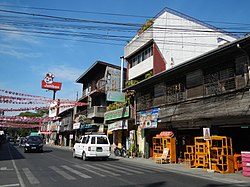


Community hub
Recent from talks
Contribute something
Nothing was collected or created yet.
Candon
View on Wikipedia | This article has multiple issues. Please help improve it or discuss these issues on the talk page. (Learn how and when to remove these messages)
|


Candon, officially the City of Candon (Ilocano: Siudad ti Candon; Filipino: Lungsod ng Candon), is a component city in the province of Ilocos Sur, Philippines. According to the 2024 census, it has a population of 61,315 people.[6]
Key Information


.svg)

Dubbed the "Tobacco Capital of the Philippines", the city is the country's largest producer of Virginia tobacco.
The town is known for making the world's heaviest and largest kalamay, a sweet and viscous snack made from sticky rice, coconut milk, and sugar. This city also has a rich historical background. In its legends, the name of the city is derived from the legendary "kandong" tree which is almost extinct in the area. Its patron saint is John of Sahagún whose feast day is celebrated on June 12.[7]
Candon is the center of the 2nd district of Ilocos Sur and also the most populous city in that province. Government district offices are all located in the city, supporting more than 100,000 residents in terms of commercial and industrial services.
Etymology
[edit]The origin of the name of Candon is unknown. The name was rendered as Candón or Candon in old Spanish records. It might be named after the Spanish municipality of Candón in Huelva, Andalucia; or from a Hispanicization of Ilocano kandong (Cyrtophyllum fragrans), a native species of tree with very hard wood also known as agandong or urandong in other places in the Ilocos region.[8][9][10]
History
[edit]Historically, during the pre-colonial period, Candon was a coastal trading settlement frequented by trade ships of Austronesian, Arab, Indian, Chinese, and Japanese traders (similar to other trading towns along the Ilocos region like Aparri, Lingayen, and Vigan).[11]
The settlement also had a long history of trading ties with Cordillerans in the highlands of Luzon, which continued through the Spanish colonial period. The town of Candon features prominently in the accounts of Biag, the legendary 17th century folk hero and founder of Sagada. Candon also hosted missionaries who were converting the Itneg and other Cordilleran peoples in neighboring regions.[12]
The history of Candon in the early Spanish period is hazy. The first church in the settlement was established by an Augustinian mission in 1591. According to modern folklore, this church was built near a kandong tree, which is supposedly the origin of the name of the city. The church was later replaced with the Candon Church in 1695. Candon Church was damaged by an earthquake in 1707 and was restored in 1713.[10][13] The church graveyard located south of the Población was opened in 1797.[citation needed]
The settlement was organized into a municipality in 1780. The first civil government was established under the cabeza de barangay Don Juan P. Madarang by the Augustinian friar Mariano de Conquera.[8] In the Diccionario geográfico, estadístico, histórico de las Islas Filipinas (Buzeta & Bravo, 1850–1851), Candon was described as being a city of around 3,000 households, with a port and a military fort named "San Martín de Tiagán". Candon was mainly agricultural. Its products consisted of rice, corn, sugarcane, vegetables, and fruits. It also had a cotton and indigo industry, as well as a livestock industry.[12][14]
During the Philippine Revolution, Candon started forming local revolutionary groups in 1896. They planned to overthrow the local government by April 1, 1898. However, their plans were discovered when one of their members was captured by Spanish forces, forcing them to launch a premature assault. On March 25, 1898, the revolutionaries led by Isabelo Abaya attacked the Spanish garrison in Candon and managed to take the town. Abaya established the Republica de Filipinas Katipunan de Candon, a revolutionary government, and declared independence from the Spanish colonial government.[8]
The Spanish colonial government retaliated by deploying the Cazadores, elite Spanish expeditionary troops. The better-trained and heavily armed Spanish forces retook Candon and the rebels were arrested and summarily executed.[8]
During the Japanese Occupation in the Second World War, another revolution was staged. Several truckloads of Imperial Japanese forces and supplies perished along the national highway. However, the Japanese soldiers retaliated by burning the whole town in January 1942.
Despite the hardships that the townsfolk went through during the war, residents resolved to rebuild. Tall acacia trees at the town plaza and municipal buildings are testimonies to the people's steadfastness, with large trees up to 15 meters high and 20 feet in circumference now line the National Highway in the Población.[15]
Cityhood
[edit]In the Charter of Candon City, Candon applied to become the second city in the province of Ilocos Sur so it can undertake government programs with additional funding from the national government. These were intended to benefit the people in the field of social services, economic growth, peace and order, health, education, agriculture, and infrastructure development.
Like the "Kandong" tree of yore, Candon is just beginning to spread out its branches to reach out for the skies in its own bid to become the next city in Ilocos Sur. From the start of House Bill No. 7260 seeking to convert Candon into a component city was filed by then Congressman Eric D. Singson in the 10th Congress and later re-filed by Congresswoman Grace D. Singson in the 11th Congress. Owing to the merits and qualifications of Candon as the leading town in Southern Ilocos Sur, the bill easily got the approval of the Committees on Local Government in both House of Representatives and in the Senate.
Until recently, the aspiration for Candon to become a city remained a dream, but its destiny inevitable when the counterpart Senate Bill No. 2242 was sponsored by then Senate President Aquilino "Nene" Pimentel Jr., Senators Frank Drilon, Sergio Osmeña III, and all the members of the Senate Committee on Local Government. It was subsequently approved unanimously by the Senate in plenary session, and now it is up to the townspeople to embrace this honor with an equally unanimous "YES to Cityhood" vote.[16]
Geography
[edit]The City of Candon is situated in the lower central portion of the province of Ilocos Sur. It has a C-shape with elevations ranging from 10 – 500 ft above sea level.
Candon is situated 60.19 kilometres (37.40 mi) from the provincial capital Vigan City, and 343.19 kilometres (213.25 mi) from the country's capital city of Manila.

Barangays
[edit]Candon is politically subdivided into 42 barangays. Each barangay consists of puroks and some have sitios. It is bordered by Santiago, Banayoyo, Lidlidda, and San Emilio to the north, Galimuyod to the northeast, Salcedo to the west, and Santa Lucia to the south.
- Allangigan Primero
- Allangigan Segundo
- Amguid
- Ayudante
- Bagani Camposanto
- Bagani Gabor
- Bagani Tocgo
- Bagani Ubbog
- Bagar
- Balingaoan
- Bugnay
- Calaoaan
- Calongbuyan
- Caterman
- Cubcubboot
- Darapidap
- Langlangca Primero
- Langlangca Segundo
- Oaig-Daya
- Palacapac
- Paras
- Parioc Primero
- Parioc Segundo
- Patpata Primero
- Patpata Segundo
- Paypayad
- Salvador Primero
- Salvador Segundo
- San Agustin
- San Andres
- San Antonio (Población)
- San Isidro (Población)
- San Jose (Población)
- San Juan (Población)
- San Nicolas
- San Pedro
- Santo Tomas
- Tablac
- Talogtog
- Tamurong Primero
- Tamurong Segundo
- Villarica
Climate
[edit]The climate is generally dry that usually occurs from the months of October to May. However, the southernmost portion is observed to be humid and rain is evenly distributed throughout the year while the eastern part is dry with rain not sufficiently distributed. August has the most rainfall while January and February have the least. The mean temperature in the province is 27 °C (81 °F). January is the coldest.[15]
| Climate data for Candon City, Ilocos Sur | |||||||||||||
|---|---|---|---|---|---|---|---|---|---|---|---|---|---|
| Month | Jan | Feb | Mar | Apr | May | Jun | Jul | Aug | Sep | Oct | Nov | Dec | Year |
| Mean daily maximum °C (°F) | 30 (86) |
31 (88) |
33 (91) |
34 (93) |
33 (91) |
31 (88) |
30 (86) |
30 (86) |
30 (86) |
31 (88) |
31 (88) |
30 (86) |
31 (88) |
| Mean daily minimum °C (°F) | 19 (66) |
20 (68) |
21 (70) |
23 (73) |
25 (77) |
25 (77) |
25 (77) |
25 (77) |
24 (75) |
22 (72) |
21 (70) |
20 (68) |
23 (73) |
| Average precipitation mm (inches) | 10 (0.4) |
10 (0.4) |
14 (0.6) |
23 (0.9) |
80 (3.1) |
103 (4.1) |
121 (4.8) |
111 (4.4) |
119 (4.7) |
144 (5.7) |
39 (1.5) |
15 (0.6) |
789 (31.2) |
| Average rainy days | 5.2 | 3.9 | 6.2 | 9.1 | 18.5 | 21.4 | 22.9 | 19.8 | 19.8 | 16.2 | 10.5 | 6.1 | 159.6 |
| Source: Meteoblue (modeled/calculated data, not measured locally)[17] | |||||||||||||
Demographics
[edit]Population census of Candon | |||||||||||||||||||||||||||||||||||||||||||||||||||||||||||
|
|
| |||||||||||||||||||||||||||||||||||||||||||||||||||||||||
| Source: Philippine Statistics Authority[18][19][20][21][22] | |||||||||||||||||||||||||||||||||||||||||||||||||||||||||||
In the 2024 census, the population of Candon was 61,315 people,[23] with a density of 590 inhabitants per square kilometre or 1,500 inhabitants per square mile.
Language
[edit]The dominant dialect spoken in Candon is Ilocano.
Religion
[edit]Candon City, located in the province of Ilocos Sur, is predominantly Christian, reflecting its strong religious heritage rooted in Spanish colonial influence and diverse faith traditions.
- Religious Demographics
According to the 2015 data from the Philippine Statistics Authority (PSA) and the National Statistics Office (NSO), the religious composition of the city is as follows:
- Roman Catholicism – 82.11%
- Iglesia ni Cristo – 10.45%
- Protestantism – 4.12%
- Other Christian denominations – 3.32%
- Islam – 1–2%
- Indigenous or traditional beliefs – Less than 1%
Economy
[edit]
Candon City has a geographical setting and proximity to the national highway and other towns that encouraged greater mobility in terms of trade, economic, social and cultural activities. The Department of Trade and Industry termed the city as the "Center for Trade and Commerce" in Ilocos Sur.
Existing industries in Candon City are manufacturing, agro-industry and cottage industry. The manufacturing sector owns the Tobacco Stalk Cement Bonded Board Plant that produces particle boards for low cost housing and other construction needs. Other manufacturing establishments are based on kalamay-making, chichacorn (deep-fried corn), baked goods, ice cream, and vinegar; furniture making, concrete products manufacturing, and a coconut oil processing plant located at Barangay Talogtog. On the other hand, cottage industries include balut egg production, fish re-drying, salt making, native delicacies, woodcraft and handicraft.
The city is the center of trade and commerce in the 2nd district of Ilocos Sur. Urban growth has a linear pattern along major thoroughfares in the city center and the national highway.
Government
[edit]
Local government
[edit]Candon, belonging to the second congressional district of the province of Ilocos Sur, is governed by a mayor designated as its local chief executive and by a city council as its legislative body in accordance with the Local Government Code. The mayor, vice mayor, and the councilors are elected directly by the people through an election which is being held every three years.
Elected officials
[edit]| Position | Name |
|---|---|
| District Representative (2nd Legislative District the province of Ilocos Sur) |
Kristine Singson-Meehan |
| Chief Executive of the City of Candon | Mayor Ericson G. Singson |
| Presiding Officer of the City Council of Candon | Vice-Mayor Kristelle G. Singson |
| Councilors of the City of Candon | Alfonso D. Singson |
| Robert B. Tudayan | |
| Aileen Rhoda I. Acal | |
| Angela C. Itchon | |
| Lerisa M. Llanes | |
| Joanne Ascencion G. Valdez | |
| George T. Valdez | |
| David D. Wagayen | |
| Oscar Materno L. Balagot | |
| Godofredo F. Abrero |
City seal
[edit]
The official seal of the City of Candon was approved and adopted by the Sangguniang Panlungsod under Resolution No. 017-01 sponsored by Councilor David Gacusana. It is published to immortalize the “Cry of Candon” of March 1898 and to commemorate the ratification of its Cityhood charter under Republic Act 9018 on March 28, 2001.
Attractions
[edit]

- Candon Church (Saint John de Sahagun Parish Church)
- Darapidap Beach
- Tobacco Festival - Celebrated every month of March as thanksgiving for the city's vast harvest of tobacco
- Feria de Candon (Trade Fair) - Every first week of December in honor of Santa Barbara (December 4).
- Candon City Arena - Opened in 2023, the 8,000-seater arena has hosted various sporting events and concerts.[33][34][35]
Transportation
[edit]Candon City is accessible via the McArthur National Highway, which is also the city's main thoroughfare. Other major streets in the city are 25 de Marzo Street and San Juan Street, both parallel to the National Highway. Quirino Boulevard is a secondary highway that connects the city proper to the upland barangays of Candon City and the upland municipalities of Ilocos Sur. The Darapidap Beach Road or the Samonte Boulevard where you can find the Muslim Mosque aside of it. This Road connects the seaside barangays to the urban center.
Tricycles and jeepneys are the major types of transportation in the city. There are over 3000 registered tricycles in the city, the highest number of registered tricycles in the province (as an individual local government unit.)
Buses provide long-distance trips to major cities like Manila, Baguio and Laoag. Mini-Buses provide short trips to neighboring municipalities and the nearby cities of Vigan and San Fernando, La Union. Major Bus Companies also established their terminals in the city, among them are:
- Partas
- Dominion Bus Lines
- Santa Lucia Express and Martinez Trans (managed by Victory Liner)
- Candon Bus Line
Education
[edit]The Candon City Schools Division Office oversees the operations of all Schools District Offices within the city. The Division Office is managed by the Department of Education (DepEd). There are two schools district offices (SDOs), namely: Candon City District I Schools District Office, and Candon City District II Schools District Office. They govern the operations of all private and public elementary and high schools throughout the city.[36] Tertiary levels are governed by the Commission on Higher Education (CHED).
Primary and elementary schools
[edit]- Allangigan Elementary School
- Amguid Elementary School
- Ayudante Elementary School
- Bagani Elementary School
- Bagani-Tocgo Elementary School
- Bagar Elementary School
- Balingaoan Elementary School
- Bugnay Elementary School
- Cabanela Preschool Center
- Calaoa-an Elementary School
- Calongbuyan Elementary School
- Candon North Central School
- Candon South Central School
- Candon South Central School SPED Center
- Caterman Elementary School
- Caterman Mt. Zion Academy
- Cubcubbuot Elementary School
- Filomeno G. Gagarin Elementary School
- Darapidap Elementary School
- Langlangca Elementary School
- Maranatha Christian Academy (Elementary)
- Nicosat Colleges (Elementary)
- Oaig-Daya Elementary School
- Parioc East Elementary School
- Parioc Elementary School
- Patpata Elementary School
- Paypayad Elementary School
- Salvador Elementary School
- San Andres Adventist Elementary School
- San Juan de Sahagun (Parish) Pre-School Formation Center
- St. Cecilia Early Learning Center (Elementary)
- St. Joseph's Institute (Elementary)
- Sto. Tomas Elementary School
- Tablac Elementary School
- Talogtog Elementary School
- Tamurong Elementary School
- The Shepherd Kiddie School
- The Sto. Tomas UMC Children's Garden Learning Center
- Ubbog Elementary School
- UCCP - Nursery Kindergarten School
Secondary schools
[edit]- Candon City High School
- Candon City Information Technology National High School
- Candon National High School
- Dr. Ricardo Gacula Memorial National High School
- Maranatha Christian Academy
- Nicosat Colleges (High School)
- St. Cecilia Early Learning Center
- St. Joseph's Institute
- Sto. Tomas National High School
Higher educational institutions
[edit]- Ilocos Sur Polytechnic State College (ISPSC)
- Nicosat Colleges
- North Luzon Philippines State College - Formerly a campus of the University of Northern Philippines, founded as the Candon Community College before its merger with UNP by virtue of a bill enacted by then Congressman Eric Singson.
- Saint Joseph Institute - a co-ed private school owned and administered by the Sisters of St. Paul of Chartres.
Media
[edit]AM stations
[edit]- DZTP 693 kHz Tirad Pass Broadcasting Network
FM stations
[edit]- DWRE 104.5 Radyo Natin
Sister Cities
[edit]

References
[edit]- ^ City of Candon | (DILG)
- ^ "2015 Census of Population, Report No. 3 – Population, Land Area, and Population Density" (PDF). Philippine Statistics Authority. Quezon City, Philippines. August 2016. ISSN 0117-1453. Archived (PDF) from the original on May 25, 2021. Retrieved July 16, 2021.
- ^ "2024 Census of Population (POPCEN) Population Counts Declared Official by the President". Philippine Statistics Authority. July 17, 2025. Retrieved July 18, 2025.
- ^ https://blgf.gov.ph/wp-content/uploads/2024/12/04.-BLGF-MC-No.-020.2024.pdf [bare URL PDF]
- ^ "PSA Releases the 2021 City and Municipal Level Poverty Estimates". Philippine Statistics Authority. April 2, 2024. Retrieved April 28, 2024.
- ^ "2024 Census of Population (POPCEN) Population Counts Declared Official by the President". Philippine Statistics Authority. July 17, 2025. Retrieved July 18, 2025.
- ^ "Candon City Official Website". Archived from the original on August 20, 2008. Retrieved August 13, 2005.
- ^ a b c d "Local History of Candon". City of Candon, Republic of the Philippines. November 28, 2022. Retrieved April 8, 2025.
- ^ Raras, Jaime. "The Quest: Kandong Tree". Tawid News Magazine. Retrieved April 8, 2025.
- ^ a b "Tobacco Festival". FestivalScape. March 27, 2023. Retrieved April 8, 2025.
- ^ "The City | Vigan City Government - Etymology: How the City Got its Name". vigancity.gov.ph. Retrieved March 29, 2025.
- ^ a b Scott, William Henry (1964). "The Legend of Biag, an Igorot Culture Hero". Asian Folklore Studies. 23 (1): 93–110. doi:10.2307/1177639. JSTOR 1177639.
- ^ "Church of Candon historical marker". Read the Plaque. Retrieved April 8, 2025.
- ^ Buzeta, Manuel; Bravo, O.S.A. (1850–1851). Diccionario Geográfico, Estadístico, Histórico, de las Islas Filipinas. Madrid: Imprenta de José C. de la Peña.
- ^ a b "1stPhilippines.Com - Candon City in the Philippines". Archived from the original on March 3, 2016. Retrieved February 8, 2010.
- ^ http://candoncity.gov.ph/new/about-the-city/28-citihood[permanent dead link]
- ^ "Candon: Average Temperatures and Rainfall". Meteoblue. Retrieved May 14, 2020.
- ^ "2024 Census of Population (POPCEN) Population Counts Declared Official by the President". Philippine Statistics Authority. July 17, 2025. Retrieved July 18, 2025.
- ^ Census of Population (2015). "Region I (Ilocos Region)". Total Population by Province, City, Municipality and Barangay. Philippine Statistics Authority. Retrieved June 20, 2016.
- ^ Census of Population and Housing (2010). "Region I (Ilocos Region)" (PDF). Total Population by Province, City, Municipality and Barangay. National Statistics Office. Retrieved June 29, 2016.
- ^ Censuses of Population (1903–2007). "Region I (Ilocos Region)". Table 1. Population Enumerated in Various Censuses by Province/Highly Urbanized City: 1903 to 2007. National Statistics Office.
- ^ "Province of Ilocos Sur". Municipality Population Data. Local Water Utilities Administration Research Division. Retrieved December 17, 2016.
- ^ "2024 Census of Population (POPCEN) Population Counts Declared Official by the President". Philippine Statistics Authority. July 17, 2025. Retrieved July 18, 2025.
- ^ "Poverty incidence (PI):". Philippine Statistics Authority. Retrieved December 28, 2020.
- ^ "Estimation of Local Poverty in the Philippines" (PDF). Philippine Statistics Authority. November 29, 2005.
- ^ "2003 City and Municipal Level Poverty Estimates" (PDF). Philippine Statistics Authority. March 23, 2009.
- ^ "City and Municipal Level Poverty Estimates; 2006 and 2009" (PDF). Philippine Statistics Authority. August 3, 2012.
- ^ "2012 Municipal and City Level Poverty Estimates" (PDF). Philippine Statistics Authority. May 31, 2016.
- ^ "Municipal and City Level Small Area Poverty Estimates; 2009, 2012 and 2015". Philippine Statistics Authority. July 10, 2019.
- ^ "PSA Releases the 2018 Municipal and City Level Poverty Estimates". Philippine Statistics Authority. December 15, 2021. Retrieved January 22, 2022.
- ^ "PSA Releases the 2021 City and Municipal Level Poverty Estimates". Philippine Statistics Authority. April 2, 2024. Retrieved April 28, 2024.
- ^ "2019 National and Local Elections" (PDF). Commission on Elections. Archived (PDF) from the original on October 6, 2020. Retrieved March 11, 2022.
- ^ Mariano, Paolo (October 27, 2023). "New Candon arena to host thrilling double treat in third stop of PVL on Tour". onesports.ph. Retrieved February 18, 2025.
- ^ Naredo, Camille B. (April 13, 2024). "PBA: TNT erases deficit to snap NLEX's winning streak". ABS-CBN News. Retrieved February 18, 2025.
- ^ "Ben&Ben, Parokya Ni Edgar, and Flow G to Rock Candon Festival 2024". www.wheninmanila.com. September 26, 2024. Retrieved February 18, 2025.
- ^ "Masterlist of Schools" (PDF). Department of Education. January 15, 2021. Retrieved April 18, 2025.
- ^ "05/11/15 Honolulu and Candon City become Sister-Cities". honolulu.gov. Retrieved November 26, 2015.
- ^ "Baguio and Candon City Sign Sisterhood MOU". SunStar. Retrieved June 28, 2016.
External links
[edit]

- Official website
- Philippine Standard Geographic Code
- Philippine Census Information
- Local Governance Performance Management System
Places adjacent to Candon | ||||||||||||||||
|---|---|---|---|---|---|---|---|---|---|---|---|---|---|---|---|---|
| ||||||||||||||||


Candon
View on GrokipediaCandon, officially the City of Candon, is a component city in the province of Ilocos Sur, Philippines.[1]
As of the 2020 Census of Population and Housing, it has a population of 61,432 distributed across 50 barangays.[2]
Situated along the coast in the southern part of Ilocos Sur, the city spans approximately 103 square kilometers and serves as the center of the province's second congressional district, hosting key government offices and functioning as a major hub for trade and commerce.[1][3]
Known as the "Tobacco Capital of the Philippines," Candon is the largest producer of Virginia tobacco in the country, with the crop forming the backbone of its agricultural economy since the mid-20th century.[4]
The city's name derives from "Kandong," a large native tree that was central to early settlement life, and it was formally established as a municipality in 1780 before achieving cityhood on May 5, 2001, via Republic Act No. 9018.[1]
Historically significant for the Candon Uprising of 1898, led by Don Isabelo Abaya against Spanish colonial rule, Candon features landmarks such as the St. John of Sahagun Parish Church and black-sand beaches like Darapidap, contributing to its tourism alongside its economic role in tobacco festivals and regional events.[1][5]
Etymology
Origins and Derivation
The name Candon derives from the Ilocano word kandong, referring to a large indigenous tree species that anchored early community life in the area. Local accounts, as recorded by municipal authorities, describe the tree as the nucleus of native settlements, where social, cultural, and economic activities converged, with its prominence leading to the toponym's adoption.[1] This etymology aligns with oral traditions preserved in regional folklore, emphasizing the tree's role prior to extensive documentation.[6] During the Spanish colonial era, the name evolved in official records to Candón or Candon, reflecting phonetic adaptations to Hispanic spelling conventions while retaining the core indigenous root. Alternative hypotheses propose a possible link to a Spanish municipality named Candón in Huelva, Andalusia, though primary local sources prioritize the Austronesian linguistic origin over external naming influences.[7] The kandong tree itself is now rare or extinct in the vicinity, underscoring the name's preservation as a vestige of pre-colonial environmental and communal features.[8]History
Pre-Colonial and Early Settlement
Prior to European contact, the coastal area encompassing modern Candon in Ilocos Sur was part of a network of Austronesian settlements that emerged following the displacement of earlier Negrito populations by migrating Austronesian groups, who arrived in northern Luzon through successive waves beginning around 2200 BCE. These settlers established villages in sheltered coves along the Ilocos coastline, leveraging the region's rivers and proximity to the South China Sea for subsistence fishing, agriculture, and early barter systems focused on local resources such as salt and marine products. Oral traditions and archaeological surveys indicate clustered populations organized in kinship-based barangays, with evidence of structured social hierarchies evidenced by burial practices and artifact distributions in coastal sites.[9][10] Candon's location positioned it as a peripheral trading hub within the broader Ilocos maritime network, where pre-colonial communities engaged in barter with visiting merchants from China, Japan, and Southeast Asia between the 10th and 16th centuries. Trade centered on exporting bulked gold sourced from inland Cordillera mines via riverine routes, exchanged for imported ceramics, porcelain, and other prestige goods that archaeological excavations have uncovered in regional coastal deposits. This commerce, documented through Spanish-era accounts of prior prosperous arrangements and supported by Ilocos Sur Archaeological Project findings of foreign sherds in sites near Candon, underscores the area's integration into the Indian Ocean World exchange sphere without evidence of centralized polities dominating the locality.[9][10][11] Archaeological indicators from the Ilocos Sur Archaeological Project, including test pits and surface surveys in adjacent municipalities, reveal pre-Spanish settlement patterns marked by residential clusters and trade-related artifacts, suggesting moderate population densities sustained by diversified coastal economies rather than intensive urbanization. Oral histories, such as elements in the Ilocano epic Biag ni Lam-ang, preserve accounts of these interactions, linking coastal villages to upland resource flows, though direct excavations at Candon remain limited, relying on regional analogies for reconstruction.[9][12]Spanish Colonial Period
Candon was formally established as a mission station by Augustinian friars on June 26, 1591, integrating the settlement into the Spanish colonial framework in the Ilocos region.[13] The Augustinians organized it as a pueblo under the patronage of San Francisco de Asís, initially overseeing three visitas: Cavisilán, Santa Lucía, and Santa Cruz.[13] Evangelization efforts focused on constructing the first Roman Catholic church using timber from a local kandong tree, ordered cut by Spanish friars in the 16th century, which served as the center for religious and administrative control.[1] This mission work aligned with broader Spanish objectives of Christianization and pacification, transforming pre-existing Ilocano communities into doctrina systems under friar supervision.[13] Colonial administration evolved with the installation of civil governance in 1780, appointing Don Juan P. Madarang as the first cabeza de barangay and D. Mariano de Conquera, an Augustinian friar, to oversee initial municipal structures.[1] Economically, Candon adapted to impositions like the tobacco monopoly enacted in 1781, which mandated cultivation of the crop across Ilocos Sur to generate revenue for the Spanish crown through the Manila-Acapulco galleon trade.[14][15] As a major producer of Virginia tobacco, the area contributed to export volumes that made the monopoly one of the colony's most profitable enterprises, though it enforced quotas and inspections that strained local farmers.[4] A cemetery was added south of the poblacion in 1797, reflecting growing permanent settlement under these policies.[1] Resistance to colonial exactions manifested in sporadic adaptations and culminated in overt challenges, such as the Ikkis ti Candon uprising on March 25, 1898, led by Don Isabelo Abaya against friar abuses, forced labor, and tribute collection.[1] Revolutionaries briefly seized the town hall and parish convent, declaring a provisional republic before Spanish forces, bolstered by reinforcements, recaptured it after two days.[1] This event, part of wider Ilocano revolts against tribute and labor demands dating back centuries in the region, highlighted ongoing tensions despite evangelization successes. Earlier compliance with tobacco quotas and religious hierarchies indicated pragmatic adaptations, but underlying grievances over resource extraction persisted.[14]American Occupation and Independence
Following the defeat of Spanish forces in the Philippines during the Spanish-American War of 1898, U.S. military governance was imposed in Ilocos Sur, including Candon, amid the ensuing Philippine-American War (1899–1902). Local revolutionaries, such as those aligned with Isabelo Abaya—who had led the Cry of Candon against Spain in March 1898—initially resisted American control, contributing to sporadic conflicts in the region as U.S. troops advanced southward from Vigan, which was occupied in December 1899. By mid-1902, organized resistance had subsided, enabling a shift to civil administration; on September 1, 1901, the U.S. established a provincial civil government in Ilocos Sur, appointing Marcelino "Mena" Crisólogo, a former Malolos Congress delegate, as its first governor.[16] [17] Candon, already a municipality since 1780 under Spanish rule, underwent administrative reorganization under Philippine Commission Acts such as No. 205 (August 1901), which standardized local governance structures across the archipelago while preserving its status as a key coastal town.[18] American authorities introduced systemic reforms emphasizing infrastructure and public services, including enhancements to the coastal road network traversing Candon, which facilitated trade and military mobility along the Ilocos corridor.[19] A nationwide public education system was also implemented starting in 1901, with English as the medium of instruction and U.S.-trained "Thomasite" teachers dispatched to rural areas; in Ilocos Sur, this expanded access to secular schooling beyond elite religious institutions, though specific enrollment data for Candon remains limited. Tobacco farming, a staple of the local economy inherited from the Spanish era's estanco monopoly (ended in 1882), persisted with minimal disruption, as American policies promoted free-market agriculture without introducing novel production techniques during the occupation; output focused on native varieties amid ongoing regional cultivation. A cholera epidemic ravaged Candon in 1902, highlighting early public health challenges under U.S. sanitation efforts.[1] The period culminated in gradual autonomy, formalized by the Tydings-McDuffie Act of 1934, which established the Philippine Commonwealth in 1935 and scheduled full independence for July 4, 1946. Japanese occupation from 1942 to 1945 interrupted this trajectory, with U.S. forces liberating Ilocos Sur in 1945, restoring pre-war administrative continuity in Candon as the nation transitioned to sovereignty. Local governance emphasized economic stability, with tobacco and coastal commerce sustaining the municipality through the Commonwealth era's developmental initiatives.[20]Post-Independence Developments
Following the Philippines' independence in 1946, Candon experienced recovery from World War II devastation, which had included the razing of its town proper by Japanese forces in January 1942. Local agricultural pursuits, particularly Virginia tobacco cultivation, drove economic resurgence as farmers re-established planting on available lands, leveraging the crop's established viability in the Ilocos region without reliance on foreign aid. Tobacco emerged as the dominant export commodity, with Candon's output supporting household incomes and regional trade, reflecting a pattern of self-sustained growth rooted in traditional farming practices.[1][4] By the mid-20th century, tobacco production solidified Candon's role as a key supplier in the national industry, with cultivation spanning over 1,000 hectares and yielding millions of kilograms annually by the 1980s. This sector provided seasonal employment for over 1,000 residents in classification and labor, funding education and local prosperity while minimizing dependence on external investments. Population expanded steadily amid this agricultural base, rising from approximately 22,000 in 1948 to over 43,000 by 1990, driven by natural increase and internal migration tied to farming opportunities. Infrastructure enhancements, such as improved local roads and curing facilities tied to tobacco processing, accompanied this expansion, fostering connectivity within Ilocos Sur without documented major foreign-funded projects.[4][21] Political stability under successive local administrations enabled focused regional contributions, with leaders prioritizing agricultural extension and community-led initiatives over aid-dependent models. Candon's elevation to a second-class municipality by the late 20th century, evidenced by average annual incomes reaching 42 million pesos by 1998, underscored this trajectory of endogenous development, positioning the locality as a tobacco hub influencing broader Ilocos economic patterns.[1]Achievement of Cityhood and Recent Milestones
The Municipality of Candon in Ilocos Sur was converted into a component city through Republic Act No. 9018, enacted on March 5, 2001, by the Philippine Congress and signed into law by President Gloria Macapagal-Arroyo.[22] This legislative measure recognized Candon's viability as a city based on its income, population, and land area thresholds, granting it expanded administrative powers including local taxation and infrastructure development.[23] The conversion elevated Candon's status, enabling greater autonomy in governance and resource allocation while integrating it into the provincial framework of Ilocos Sur. Post-cityhood, Candon solidified its position as the tobacco production hub of Ilocos Sur, with industry leaders establishing re-drying and flue-curing facilities that boosted local employment and agricultural output.[4] Annual events like the Tobacco Festival, held in March to coincide with the city fiesta, highlight this economic mainstay, featuring cultural displays and farmer showcases that underscore sustained leadership in Virginia tobacco cultivation.[5] In recent years, Candon has marked milestones in sports tourism and regional collaboration, hosting the Region 1 Tourism Summit on September 18-20, 2025, themed "Tourism and Sustainable Transformation," which included sectoral discussions and a local trade fair.[5] The city also successfully organized the 3rd Leg of the 2025 Philippine Archery Cup from October 1-5 at the Bagani Campo Bypass, establishing itself as Northern Luzon's first regional archery training center.[24] Additionally, volleyball leagues such as the ABCAMP Challenge and Candon Cup Championship in 2025 have drawn competitors and spectators, enhancing infrastructure like the Candon City Arena and positioning the city as an emerging sports destination.[25]Geography
Location and Physical Features
Candon City is situated in the lower central portion of Ilocos Sur province in the Ilocos Region of the Philippines, approximately 294 kilometers north of Manila by straight-line distance.[26] As a coastal municipality, its western boundary abuts the South China Sea, providing direct access to the coastline.[27] The city is bordered to the north by the municipalities of Santiago, Banayoyo, Lidlidda, and San Emilio; to the south by Santa Lucia; and to the east by Galimuyod and Salcedo.[27] The city's land area measures 103.28 square kilometers.[3] It exhibits a distinctive C-shaped topography, with elevations ranging from 10 to 500 feet (3 to 152 meters) above sea level.[28] The terrain primarily comprises low-lying coastal plains that gently undulate eastward, transitioning to slightly higher ground, which supports alluvial deposits conducive to agriculture.[28] Candon's proximity to the South China Sea shapes its physical profile, featuring sandy beaches and estuarine features along the coast where local rivers discharge into the marine environment.[27] This coastal orientation, combined with the prevailing plain-dominated landscape, has influenced settlement patterns and economic activities centered on maritime and land-based resources.[3]Administrative Divisions
Candon City is administratively subdivided into 42 barangays, the smallest local government units in the Philippines, each managed by an elected barangay council responsible for community-level governance, public services, and dispute resolution.[29] Of these, four are classified as urban barangays forming the Poblacion district, while the remaining 38 are rural, reflecting the city's blend of urban commercial activity and rural agricultural base.[29] This division supports decentralized administration, enabling tailored policies for urban trade facilitation and rural infrastructure maintenance.[29] The urban barangays—San Juan, San Antonio, San Isidro, and San Jose—function as the core administrative and economic nodes, hosting key government offices, educational facilities, hospitals, and trading centers that centralize commercial operations and public administration.[29] These areas streamline urban governance by concentrating services, reducing administrative overlap, and promoting efficient resource allocation for city-wide needs.[29] Rural barangays are geographically categorized into upland, highway, and coastal types to optimize local management: upland barangays oversee highland crop production zones, highway-adjacent ones manage linear agricultural strips along transport routes, and coastal barangays handle shoreline-related activities, all contributing to cohesive territorial administration without redundant oversight.[29] Barangay Calaoaan notably serves as the site of the city government center, encompassing the City Hall, Hall of Justice, and other essential administrative buildings, which bolsters operational efficiency across divisions.[29] This structure ensures spatial distribution aligns with governance demands, facilitating rapid response to local issues and coordinated development planning.[29]Climate and Environmental Factors
Candon City exhibits a tropical monsoon climate (Köppen classification Am), featuring two distinct seasons: a dry period from November to April dominated by the northeast monsoon, and a wet season from May to October influenced by the southwest monsoon. Annual precipitation in the surrounding Ilocos Sur province averages approximately 2,772 mm, with the heaviest monthly rainfall occurring in August, often exceeding 500 mm due to intensified monsoon activity and frequent typhoons. The Philippines lies within the western Pacific typhoon belt, exposing Candon to an average of 4–6 tropical cyclones annually, which contribute to episodic heavy downpours and elevate flood risks in low-lying coastal and riverine areas.[30][31] Mean annual temperatures hover around 27 °C, with diurnal highs reaching 32–33 °C in May, the warmest month, and lows dipping to about 23 °C during January, the coolest. These consistent warmth and humidity levels, rarely falling below 18 °C monthly, support year-round vegetative growth but amplify evapotranspiration demands on soils during the dry season. Typhoon-induced winds and storm surges further heighten vulnerability to coastal inundation, as evidenced by recurrent flooding events in barangays along the West Philippine Sea shoreline, where tidal influences exacerbate water level rises during low-pressure systems.[32][33] Ecologically, Candon's coastal-alluvial soils, including variants like Umingan clay loam and Bauang sandy loam prevalent in Ilocos Sur, exhibit moderate to high fertility due to river-deposited sediments rich in silt and organic content, enabling effective nutrient cycling and water retention that favors deep-rooted crops such as tobacco through improved drainage and aeration. However, prolonged wet-season saturation can lead to leaching of micronutrients, while coastal zones face accelerating erosion from wave action and typhoon surges, with observed increases in shoreline retreat and saltwater intrusion compromising soil salinity balance. Efforts to bolster soil organic matter via natural amendments are noted to mitigate fertility decline in marginally acidic profiles (pH 5.5–6.5), preserving agronomic viability amid these pressures.[34][35][36]Demographics
Population Dynamics
The population of Candon City has exhibited steady but gradual growth over the past century, increasing from 18,828 inhabitants recorded in the 1903 census to 61,432 as of the 2020 census.[3] [2] This represents an overall expansion of approximately 226% across 117 years, reflecting incremental demographic pressures amid regional constraints.[3] Census data indicate slower growth in recent decades, with the population rising from 60,623 in 2015 to 61,432 in 2020, corresponding to an annualized growth rate of 0.28%.[3] [2] This modest rate aligns with broader trends in Ilocos Sur province, where domestic population increases have been tempered by net out-migration to urban centers like Metro Manila and overseas destinations for employment.[37] At 595 persons per square kilometer in 2020, Candon's population density underscores moderate urbanization within its 103.28 square kilometers of land area, concentrated primarily in the urban core and adjacent barangays.[2] The median age of 28 years points to a relatively youthful demographic structure, with roughly half the population under this threshold, supporting sustained but low-momentum growth absent higher fertility or in-migration.[3]| Census Year | Population |
|---|---|
| 1903 | 18,828 |
| 1918 | 19,950 |
| 1939 | 20,528 |
| 1948 | 22,362 |
| 2015 | 60,623 |
| 2020 | 61,432 |