Hubbry Logo
Car floatCar floatMain
Open search
Car float
Community hub
Car float
logo
8 pages, 0 posts
0 subscribers
Be the first to start a discussion here.
Contribute something
Car float
Car float
from Wikipedia
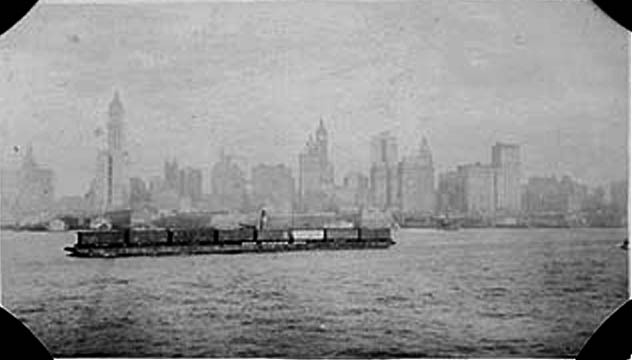
A railroad car float in the Upper New York Bay, 1919. A tugboat (towboat) stack is visible behind the middle car.
1912 PRR map showing the Greenville Terminal and its car float operations, also the current crossing

A railroad car float or rail barge is a specialised form of lighter[1] with railway tracks mounted on its deck used to move rolling stock across water obstacles, or to locations they could not otherwise go. An unpowered barge, it is towed by a tugboat or pushed by a towboat.

This is distinguished from a train ferry, which is self-powered.

Historical operations

[edit]

U.S. East Coast

[edit]

During the Civil War, Union general Herman Haupt, a civil engineer, used huge barges fitted with tracks to enable military trains to cross the Rappahannock River in support of the Army of the Potomac.[2]

Beginning in the 1830s, the Baltimore and Ohio Railroad (B&O) operated a car float across the Potomac River, just south of Washington, D.C., between Shepherds Landing on the east shore, and Alexandria, Virginia on the west. The ferry operation ended in 1906.[3] The B&O operated a car float across the Baltimore Inner Harbor until the mid-1890s. It connected trains from Philadelphia to Washington, D.C., and points to the west. The operation ended after the opening of the Baltimore Belt Line in 1895.[3]

The Port of New York and New Jersey had many car float operations, which lost ground to the post-World War II expansion of trucking, but held out until the rise of containerization in the 1970s.[4]

These car floats operated between the Class 1 railroads terminals on the west bank of Hudson River in Hudson County, New Jersey and the numerous online and offline terminals located in Brooklyn, Queens, Staten Island, the Bronx, and Manhattan.[5][6] Class 1 railroads in the New York Harbor area providing car float services were:

As well as the offline terminal railroads:

Car float service was also provided to many pier stations and waterfront warehouse facilities (that did not engage in car floating service directly) by the above-mentioned railroads.

At their peak, the railroads had 3,400 employees operating small fleets totalling 323 car floats, plus 1,094 other barges, towed by 150 tugboats between New Jersey and New York City.

Abandoned float bridges are preserved as part of this history at:

Several other abandoned but unrestored float bridges exist in other locations around New York Harbor. A complete list is available at Surviving Float Bridges of New York Harbor

The Bay Coast Railroad formerly operated a 2-barge car float connecting Virginia's Eastern Shore with the city of Norfolk, Virginia across the Chesapeake Bay.

U.S. Midwest

[edit]
An Erie tugboat and barge on the Chicago River in 1917

Between 1912 and 1936, the Erie Railroad operated a car float service on the Chicago River in Chicago, Illinois.[33]

U.S. West Coast

[edit]

Canada

[edit]
Woodfibre, British Columbia
Car float in Howe Sound

Existing operations

[edit]

Alaska

[edit]

The Alaska Railroad provides the Alaska Rail Marine rail barge service from downtown Seattle to Whittier on the central Alaskan mainland.[38]', CN Rail provided the Aquatrain rail barge service from Prince Rupert, British Columbia to Whittier.[39] Service ended in April 2021.[34]

New York / New Jersey

[edit]
The car float docks at Bay Ridge, Brooklyn, New York.

The only remaining car float service in operation in the Port of New York and New Jersey is operated by New York New Jersey Rail. This company, operated by the bi-state government agency Port Authority of New York & New Jersey is the successor to the New York Cross Harbor Railroad. Car float service operates between 65th Street / Bay Ridge Yard in Brooklyn and Greenville Yard in Jersey City, New Jersey.[40] The service exists because freight cars do not run in the East River Tunnels nor the North River Tunnels (under the Hudson River), in part due to inadequate tunnel clearances of the New York Tunnel Extension.

See also

[edit]

References

[edit]
[edit]
Revisions and contributorsEdit on WikipediaRead on Wikipedia
from Grokipedia
A car float, also known as a rail barge, is an unpowered flat-topped barge fitted with railroad tracks on its deck, designed to transport entire rail cars across bodies of water such as rivers, harbors, or bays where no fixed bridge or tunnel connects rail lines. These vessels, typically measuring 300 to 400 feet in length and capable of carrying 15 to 20 standard freight cars, are towed by powerful tugboats and loaded or unloaded using specialized transfer bridges or gantry cranes at terminal facilities. Unlike self-propelled train ferries, car floats rely entirely on external propulsion and were a critical for overcoming geographical barriers in rail networks, particularly in urban waterfront settings. The concept of the car float emerged in the early as railroads expanded but faced natural obstacles like wide rivers. , the first rail car service began in 1836 with the steam-powered ferry Susquehanna, which carried rail cars across the between Perryville and , marking the inception of waterborne . By the late 19th and early 20th centuries, car floats proliferated in major ports, with nearly 20 railroad companies operating over 300 such barges around alone to facilitate freight movement across the and . Notable examples include the Long Island Rail Road's operations between Bay Ridge in and Long Island City in , which bypassed lengthy land routes via Albany and reduced transit times by more than half. Car float operations peaked in the mid-20th century but declined sharply after due to the construction of bridges, tunnels, and highways, as well as the rise of trucking for short-haul freight. In New York, services across the Hudson largely ended by the , though remnants like the New York Central's 69th Street Transfer Bridge persist as historical landmarks. Despite this, limited modern usage continues; for instance, the of New York and New Jersey's NYNJ Rail operates a fleet including the 370-foot NYNJR 100 , which shuttles up to 18 rail cars between Jersey City and , offering an efficient, low-emission alternative to diesel locomotives. During , innovative concrete car floats—such as the twelve 265-foot vessels commissioned by the U.S. War Department—highlighted wartime adaptations for durability and rapid deployment. Overall, car floats represent a pivotal chapter in railroad , blending maritime and rail technologies to sustain commerce in constrained geographies.

Overview

Definition and purpose

A car float is an unpowered fitted with railway tracks on its deck, specifically designed to transport entire railroad cars, or , across bodies of water in situations where fixed rail infrastructure such as bridges or tunnels is unavailable or impractical. This specialized vessel enables the seamless movement of freight by allowing rail cars to be loaded directly onto the barge from a terminal via a transfer bridge, ferried across the , and then unloaded at the destination terminal in a similar manner. The primary purpose of a car float is to maintain the continuity of over waterways, eliminating the labor-intensive process of unloading from rail cars, transferring it to another mode, and reloading it elsewhere. Historically, this method proved essential for overcoming geographic barriers in port cities and along rivers, supporting efficient in densely developed areas where alternative rail routing would involve lengthy detours. Car floats differ from related vessels like train ferries, which are self-propelled ships capable of carrying entire —including locomotives and often passengers—over longer distances under their own power. In contrast, car floats lack propulsion systems and are towed by dedicated tugboats, focusing exclusively on freight cars without any passenger accommodations. Among its key advantages, the car float system offers a cost-effective solution for short-distance crossings, minimizing operational expenses compared to building extensive land-based rail extensions or bridges. It also reduces on rail infrastructure by shortening overall route lengths and facilitates direct car-to-car transfers, preserving the integrity of without repackaging. At its height in the early to mid-20th century, such operations in processed over 6,000 freight cars daily, underscoring their scale in supporting industrial freight networks.

Design and technical features

A car float is typically a flat-deck barge measuring approximately 150 to 300 feet in length and 30 to 50 feet in width, equipped with three to five parallel railway tracks of standard gauge (4 feet 8.5 inches) mounted directly on the deck to accommodate 15 to 25 rail cars depending on their length and loading configuration. These dimensions allow for efficient transport across short water distances while maintaining stability under the weight of loaded freight cars, with examples like Long Island Railroad barges at about 169 feet long supporting up to 19 cars across three tracks (seven on outer tracks and four to five on the center track). Historically, car floats were constructed primarily from for early 20th-century models, transitioning to for greater durability and load-bearing capacity in designs. Modern iterations employ reinforced hulls with to enhance stability and resistance to , often incorporating watertight compartments divided by bulkheads to prevent flooding and ensure even if one section is breached. Key components include the or transfer bridge at terminal ends, which facilitates loading and unloading of rail cars through hydraulic adjustments or gravity-assisted movement, with lock bars and toggle mechanisms securing the connection and aligning tracks to within ±0.25 inches. Fender systems, typically rubber or cellular materials, absorb impacts during docking, while cleats and connections—often supplemented by dolphins—allow secure attachment to tugboats and withstand longitudinal forces up to 700 kips from towing and tidal surges. In operation, car floats are towed at low speeds by tugboats across harbors or rivers, with precise alignment of deck tracks to shore rails achieved via adjustable transfer bridges that compensate for tidal variations of up to 10 feet. Safety features such as rail clamps or locking pins secure cars against movement during transit, preventing derailments from wave action or listing, and hydraulic buffers mitigate mooring impacts. Variations include rare self-propelled hybrids, which integrate onboard propulsion for limited maneuvering but are uncommon compared to towed designs, often reclassified as rail ferries. During , the U.S. War Department commissioned twelve car floats measuring 265 feet long by 36.5 feet wide for wartime durability and conservation.

History

Origins and early development

The concept of transporting rail cars across water barriers predated widespread car float operations, with precursors appearing in during the early . In 1833, the Monkland and Kirkintilloch Railway in established the world's first rail wagon ferry across the , where a towed horse-drawn wagons loaded on flat-bottomed boats to extend the line without bridging the waterway. This innovation addressed similar logistical challenges posed by canals and rivers, though it relied on animal power rather than locomotives. By 1850, Britain introduced the first roll-on/roll-off across the using the , allowing steam locomotives to remain attached to cars during the crossing and marking a step toward more efficient rail-water integration. In the United States, the extensive network of navigable rivers and the rapid expansion of railroads in the 1830s drove the invention and initial adoption of car floats as a practical alternative to costly bridges. The first documented railroad car ferry in the country, the steam-powered Susquehanna, entered service in April 1836 on the between Havre de Grace and Perryville, , operated by the Philadelphia, Wilmington and Baltimore Railroad. This barge transported freight cars—but not locomotives—across the wide estuary until a bridge replaced it in 1866, using wooden flatboats fitted with temporary rail tracks laid by hand for each crossing. The U.S. led global development due to its geography of major waterways like the Potomac, Susquehanna, and , which fragmented rail lines and necessitated such solutions for commercial connectivity. The (B&O) played a pivotal role in early commercial adoption, initiating regular car float service across the in 1874 from Shepherd's Landing in to , to bypass ownership disputes over Long Bridge. Passenger cars were floated first, followed immediately by freight, with operations continuing until 1906 when the opening of rendered the service obsolete; initial designs employed wooden barges with removable tracks secured by spikes and for stability. Similarly, the B&O operated car floats across the to connect rail lines around the city's waterfront obstacles, serving industrial areas like Fells Point until the completion of the Baltimore Belt Line tunnel in 1895 eliminated the need. These early systems highlighted the shift from experimental, ad-hoc setups to routine commercial use by the mid-19th century, enabling seamless rail continuity despite water barriers. Technological advancements in the further refined car float operations, particularly through the introduction of transfer bridges for efficient loading and unloading. The first such device in the U.S. was built in 1838 across the at Havre de Grace and Perryville, Maryland, by the Camden & Amboy and Baltimore & Potomac Railroads, consisting of a structure that lifted entire rail cars from land tracks onto floating barges, reducing manual labor and turnaround times compared to earlier ramp-based methods. By the 1850s, these innovations transitioned car floats from military and provisional applications to integrated commercial rail networks, with wooden barges evolving to include permanent deck tracks aligned via adjustable aprons. A key formalization occurred during the Civil War in 1862, when U.S. Army engineer Herman Haupt designed specialized railroad float barges for the Military Railroads Construction Corps to ferry supply cars across the , demonstrating scalable pontoon-style platforms that influenced postwar civilian designs.

Expansion and peak usage

Following the Civil War, car float operations experienced rapid expansion as railroads sought efficient methods to bypass geographical barriers like rivers and harbors, with major lines such as the and Baltimore & Ohio adopting the technology by the 1880s to facilitate cross-water freight transfers in key industrial areas. This growth accelerated in the early , reaching its operational peak during the 1920s through 1940s, when car floats became integral to national rail networks, particularly supporting wartime logistics during by enabling the rapid movement of military supplies and equipment across congested ports. Similar operations expanded to ports like and , handling millions of tons of freight annually and supporting industrial supply chains nationwide. The economic drivers behind this expansion centered on the need for cost-effective in densely industrialized hubs, where building extensive bridges or tunnels was prohibitively expensive; car floats allowed railroads to move loaded railcars—carrying commodities like , , and manufactured goods—directly across waterways, integrating seamlessly with existing track and reducing the overall cost of in regions like the Northeast. By avoiding the need for at water crossings, these operations minimized delays and labor expenses, bolstering the efficiency of supply chains for and contributing to the broader economic vitality of rail-dependent manufacturing centers. At their zenith in the mid-20th century, U.S. car float networks supported a vast operational scale, employing approximately 3,400 workers to manage fleets comprising 323 dedicated car floats, 1,094 support barges, and 150 tugboats that facilitated transfers primarily between New York and terminals. This infrastructure handled millions of tons of freight annually, underscoring the critical role of car floats in sustaining peak rail throughput before the widespread adoption of alternative transport modes. Key innovations during this era enhanced the reliability and capacity of car float systems, including the standardization of steel hull construction in the , which replaced wooden designs to improve durability against harsh marine conditions and increase load capacities for heavier railcars. Terminals integrated electric locomotives for precise switching of cars onto and off floats, allowing safer and more efficient operations in confined harbor yards without the emissions and fire risks of steam power. During , the U.S. War Department commissioned twelve 265-foot concrete car floats for added resilience, with these units built to withstand wartime demands and potential , exemplifying adaptations for heightened logistical pressures.

Regional operations

United States East Coast

The car float operations in formed the most extensive and dense network on the United States East Coast, facilitating the transfer of freight cars between terminals and destinations in and . This system, which connected rail lines terminating in Jersey City and Hoboken to waterfront facilities, relied on a fleet of barges pushed by tugs across the Hudson and East Rivers. Major operators, including the and later the Penn Central, maintained key float bridges at the 32nd Street Terminal in Hoboken and the 65th Street Yard in Bay Ridge, supporting daily crossings that handled thousands of cars during peak periods. These operations continued under Penn Central until the , when economic pressures and infrastructure shifts led to their gradual curtailment. Beyond New York, car float services operated at several other East Coast ports, notably in the Baltimore-Washington corridor. The (B&O) ran a car float across the from Shepherd's Landing in to , providing a vital link for freight from 1872 until 1906, when the opening of rendered it obsolete. In Baltimore Harbor, both the B&O and Philadelphia, Baltimore & Washington Railroad utilized car floats to shuttle cars across the , connecting Philadelphia-bound trains to southern routes; these early services employed wooden barges until steel construction became standard in the . Philadelphia's harbor operations similarly involved short-haul floats across the , supporting regional coal and merchandise traffic until bridge expansions diminished their role by the early . Operational challenges in East Coast car float services stemmed from the geography of urban harbors, where crossings typically spanned 1 to 5 miles amid strong tidal currents and frequent fog that complicated tug navigation and barge alignment. High volumes of coal and oil cars dominated traffic, particularly in New York and Baltimore, where these commodities fueled industrial demands and required specialized handling to prevent spills during tidal shifts. Tugs often waited for slack tides to minimize drift, and fog signals or pilot guides were essential for safe docking at transfer bridges. Key adaptations during the Civil War accelerated the adoption of car floats on the East Coast, with Union General Herman Haupt pioneering their military use in 1862 by fitting large Schuylkill barges with tracks to supply trains across the , bypassing Confederate disruptions. This innovation, which enabled rapid troop and materiel movement, influenced postwar commercial expansions. Following , terminals in underwent electrification, with transfer bridges at sites like Hoboken upgraded to electric-powered mechanisms by the , improving efficiency and capacity for handling larger 10-car floats amid growing freight demands.

United States Midwest and West Coast

In the Midwest, car float operations were relatively limited and focused on riverine environments, often serving as supplements to rail networks constrained by urban waterways and competing infrastructure like canals and bridges. The maintained a modest car float service on the starting in 1913, utilizing vessels such as the tug "Wauwatosa" to transfer freight cars between facilities including those in South Chicago and the 40th Street yards. This operation facilitated intra-city freight movement along the North and South Branches but remained small-scale, handling limited volumes compared to eastern ports due to the availability of alternative routing via the and and expanding bridge infrastructure. Operations ceased by 1936 as rail efficiencies improved and demand shifted. Further west along major rivers like the , car float usage involved longer tows and experimental adaptations to navigate broad, variable currents. Historical experiments included the deployment of concrete car floats by the Federal Barge Line in the 1920s, with twelve such vessels transferred for service on the in 1920 to handle freight across wider spans where bridges were impractical or under construction. These operations typically involved pushing multiple barges loaded with rail cars over distances exceeding those in more confined eastern waterways, supporting agricultural and industrial shipments but on a sporadic basis limited by seasonal water levels and flood risks. Pontoon-based systems also ferried thousands of rail cars annually across the river at key crossings, such as near , until permanent bridges supplanted them in the mid-20th century. On the West Coast, car float activities centered on bay and strait crossings, adapting to seismic risks and supporting resource-based economies in ports like San Francisco, Portland, and Seattle. In Seattle, the Chicago, Milwaukee, St. Paul and Pacific Railroad (Milwaukee Road) used car floats into the mid-20th century to deliver grain and lumber loads to pier facilities, towed by contracted tugs like those from Foss Barge, enabling efficient harbor switching for Pacific Northwest exports. These West Coast fleets numbered in the dozens rather than hundreds, reflecting less intensive urban rail density than the East, and incorporated robust hull designs to withstand tidal surges and occasional seismic activity, though specific earthquake-resistant modifications were not widely documented beyond general reinforcement standards post-1906 San Francisco events. During the industrial expansion, Midwest and West Coast car floats integrated into booming sectors like manufacturing and resource extraction, with services aiding grain shipments and operations supporting automotive and agricultural growth tied to broader rail networks. In the era, these systems contributed marginally to Pacific supply efforts by facilitating domestic rail-to-water transfers for staging in West Coast ports, though primary relied on oceangoing vessels rather than floats.

Canada

In Canada, car float operations were primarily employed to bridge geographical barriers along coastal and inland waterways, extending rail networks in regions where building continuous tracks was impractical due to fjords, islands, and rugged terrain. The Canadian Pacific Railway (CPR) pioneered significant use in , utilizing rail barges to connect the mainland transcontinental line at with the Esquimalt and Nanaimo Railway on . Starting in 1900, the barge Transfer No. 1, towed by the tug Czar, carried up to 12 boxcars across the 40-mile from Ladysmith to , handling commodities like , , and pulp products. By the , CPR expanded to five dedicated rail barges (Transfer Nos. 1-5) and supporting scows, towed by tugs such as Nanoose (introduced in 1908 with 600 horsepower for reliable coastal navigation). These operations integrated seamlessly with CPR's transcontinental system, facilitating freight from eastern to western ports and industries. In , a fjord-like north of , car floats supported industrial spurs for pulp and mining operations, adapting to strong tidal currents (up to 10 feet) and narrow channels through reinforced hulls and precise tug assistance. The Pacific Great Eastern Railway (later ) employed 20-car capacity barges from Squamish to serve mills at Woodfibre and export zinc ore from to , with tank cars frequently loaded for coastal transfers during the 1920s to 1960s. Further north, () operated the Aquatrain service from Prince Rupert, loading railcars onto specialized barges for towing to Port Mann near , primarily for grain, lumber, and minerals integrating with CN's western mainline. Overall, Canada's car float fleet remained modest at 10-20 units, constrained by the country's dispersed geography compared to denser U.S. networks, emphasizing short-haul extensions over long-distance hauls. Elsewhere, operations were more limited. On Ontario's in the early 1900s, sporadic rail barge services supported isolated logging and lines, but lacked the scale of coastal efforts due to seasonal and competing lake steamer routes. Wartime demands in the spurred expansions, with CPR's traffic peaking at 17,282 outbound cars in 1942 to supply Allied efforts, including munitions and raw materials via routes. Post-war infrastructure shifts, such as road bridges and extended rail lines (e.g., CN's completion of coastal connections), led to the decline of many services; CPR's Ladysmith wharf closed in 1955, transitioning barge loading to , while overall reliance waned by the 1960s in favor of integrated highway-rail systems.

Current operations

New York-New Jersey

The New York-New Jersey car float service, operated by New York New Jersey Rail, LLC (NYNJR), represents the primary surviving commercial rail barge operation in the United States, facilitating freight movement across Upper . Established in 2006 through the acquisition of the New York Cross Harbor Railroad and acquired by the of New York and in 2008, NYNJR conducts daily crossings from Greenville Yard in , to 65th Street Yard in , New York—a route spanning approximately 4 miles and taking about 40 minutes. This service bypasses the freight-prohibited Rail Tunnel, connecting rail networks in and to the national system via . NYNJR's current fleet consists of two modern four-track steel car floats, NYNJR 100 and 200, each measuring 370 feet long and 59 feet wide, with a capacity of 18 sixty-foot rail cars. Built by Metal Trades, Inc., of Yonges Island, , the NYNJR 100 entered service in 2019 following its delivery in 2017, while the NYNJR 200 followed shortly thereafter; these vessels replaced older infrastructure to enhance efficiency and environmental compliance. The floats are towed by vendor tugboats, such as the Marjorie McAllister (built 1974), and are supported by three Tier 4-compliant KLW SE10B locomotives for onboard switching. Operations run Monday through Friday, typically from early morning to mid-afternoon, to load, tow, and unload cars. The service handles a variety of freight, including , building materials, , recyclables, metals, food products, and intermodal cargo such as containers and automobiles, with the 65th Street Yard designated as an intermodal terminal. In 2023, NYNJR transported approximately 5,000 rail cars, equivalent to reducing thousands of truck trips on congested roadways. This operation supports key industries by enabling efficient cross-harbor movement without road or tunnel dependencies. Recent developments include the Port Authority's 2024 initiatives to expand waterborne freight via "marine highways," with $100 million invested in modernizing Greenville Yard, such as installing a hydraulic transfer bridge, to further reduce traffic and emissions. These plans aim to increase car float capacity and integrate with 's zero-emission Blue Highways pilots, including the Blue Highways Action Plan launched on October 31, 2025, by the New York City Economic Development Corporation and , which seeks to reactivate waterways for zero-emission cargo movement, reduce congestion, and create economic opportunities through federal grants for waterfront landings; though operations have experienced no interruptions as of late 2025.

International and experimental

Outside the continental , car float operations have been minimal in recent decades, with notable activity confined largely to Alaska's remote needs. The Aquatrain service, a rail-marine intermodal operation linking , to , via the world's largest rail car barge, ceased in April 2021 after nearly 60 years of year-round , including commodities like and generators; the discontinuation was driven by escalating operational costs amid shifting supply chains. As of 2025, the maintains occasional barge capacity for overflow freight using a vessel operated by Alaska Marine Lines, featuring eight 400-foot tracks capable of accommodating up to 48 rail cars, supporting essential connectivity to isolated ports despite the end of dedicated Aquatrain runs. Internationally, regular commercial car float services remain absent, with European and Asian networks favoring alternative rail-water integrations like train ferries rather than towed barges for rail cars. In Europe, for instance, the sole remaining operational train ferry in the 2020s carries entire passenger and freight trains across Italy's Strait of Messina between Villa San Giovanni and Sicily, a holdover from earlier 20th-century practices but distinct from barge-based car float systems; no widespread prototypes for inland canal car floats, such as those explored conceptually in the Netherlands during the 2010s for urban logistics, have progressed to commercial use. Similarly, in China, experimental efforts for rail car transport on the Yangtze River in the 2020s have focused on high-speed rail expansions via bridges and tunnels rather than barge tests, with no documented regular or trial car float operations for high-speed cars. Experimental developments have historically emphasized material innovations and modern sustainability. During , the U.S. War Department commissioned 12 car floats—each measuring 265 feet long, 36 feet 5 inches wide, and 11 feet 3 inches deep, with capacity for 18 rail cars—as a wartime expedient to conserve , primarily for service; their post-1948 fate remains undocumented, with many likely scrapped or repurposed amid postwar surplus. In contemporary trials, the has seen research into eco-friendly barges with hybrid propulsion systems, including diesel-electric conversions for marine vessels; while not yet applied to rail car floats, projects like the 2025 retrofit of ' MV Wenatchee—the largest hybrid-electric ferry in , with a 202-vehicle capacity and battery integration for reduced emissions but which encountered mechanical issues including a temporary out-of-service status as of November 2025 due to drive motor problems (unrelated to the hybrid system)—signal potential adaptations for climate-resilient rail-water logistics in the region. As of , no major international car float fleets operate commercially, reflecting a broader shift toward fixed rail and multimodal alternatives; ongoing prioritizes low-emission and resilient designs to address environmental challenges in coastal and riverine transport.

Decline and legacy

Factors contributing to decline

The decline of car float operations was driven by a combination of infrastructural advancements that reduced the necessity for water-based rail crossings, as well as competitive pressures from alternative transportation modes. The construction of major bridges and tunnels in the mid-20th century provided direct land-based routes for freight, bypassing the need for rail-water transfers. For instance, the opening of the Bridge-Tunnel in 1964 eliminated passenger and vehicle ferry services across the bay, while rail car float operations supporting connections on the , which dated to the early 1900s, continued until 2018. Similarly, rail mergers in the 1960s, such as the formation of Penn Central in 1968, led to the rationalization of redundant routes and the closure of inefficient operations like car floats to cut costs and streamline networks. The rise of trucking, accelerated by the established in 1956, offered greater flexibility and speed for freight movement, eroding the market share of rail-water hybrids. Trucks could deliver door-to-door without the delays inherent in loading and towing car floats, leading to a sharp drop in rail freight volumes overall during the and . Containerization, which gained prominence in the , further favored direct road and sea transport by standardizing cargo for intermodal use on highways and ships, diminishing the role of specialized rail barges. These shifts prioritized higher speeds and reduced handling, making car floats obsolete for most bulk and general freight. Economic factors compounded the challenges, with car float operations facing high maintenance costs for aging barges and tugs, as well as labor-intensive requirements that became unsustainable in peacetime. At their peak, operations in employed thousands of workers to handle wartime surges, but postwar overcapacity and declining volumes led to massive staff reductions. The labor and upkeep for maintaining transfer bridges and floats proved prohibitive as freight traffic waned, prompting operators to abandon these facilities. Major closures occurred between the 1950s and 1970s, with car float activity in New York Harbor declining sharply; the New York Dock Railway, for example, experienced a 77% drop in carloadings between 1973 and 1982, leading to the shutdown of terminals like its facilities by 1983. On the Pacific coast, the end of Aquatrain service in April 2021 symbolized the final decline of long-distance rail barge operations, ceasing the unmanned barge runs between British Columbia and Alaska that had persisted into the 21st century. The last remaining car float operation on the Delmarva Peninsula, operated by the Bay Coast Railroad, ceased in 2018.

Preservation efforts

Preservation efforts for car floats have focused on safeguarding surviving structures, artifacts, and operational knowledge to maintain their historical significance in railroad transportation. In , several abandoned car float transfer bridges have been integrated into public parks as industrial monuments. For instance, the gantries at in , , originally used by the to load and unload railcar floats, now serve as prominent reminders of the waterfront's rail history and are maintained by the New York State Office of Parks, Recreation and . Similarly, the Greenville Yard Transfer Bridge System in Jersey City, constructed between 1902 and 1904 by the , is recognized as a contributing resource to the National Register-eligible Greenville Yard Piers complex, highlighting its role in cross-harbor freight transfer. Museums have also played a key role in preserving related artifacts. At the Cape Charles Museum and Welcome Center in , the Cape Charles Historical Society acquired the pilothouse from the car float barge Captain Edward Richardson along with other railroad equipment in 2019, displaying them to illustrate the region's rail-barge operations across the . These efforts extend to documentation through dedicated publications and online resources. The 2023 documentary video New York's Lost Rail Floats, produced by enthusiasts, chronicles the rise and decline of car float operations in , drawing on archival footage and interviews to educate viewers on their engineering and economic impact. Additionally, The Crete Fleet online archive documents the twelve experimental concrete car floats built in 1920 for the U.S. Shipping Board Emergency Fleet Corporation, noting that eleven remained in service as late as 1948 with the Federal Barge Line, and explores their mysterious postwar fate through historical records and photographs. The legacy of car floats continues to influence contemporary transportation designs and education. Their role in bridging rail gaps has informed modern intermodal freight systems, where containerized barge transport echoes the efficiency of rail car floating. In 2024, the North Jersey Transportation Planning Authority outlined ambitious plans for expanded cargo movement in the New York-New Jersey region, including the revival of barge-based rail car floating to alleviate truck congestion and support zero-emission "Blue Highways" initiatives. The Port Authority of New York and New Jersey's 2025 budget further commits $9.4 billion toward emissions reductions, potentially funding green barge technologies aligned with these concepts. Educationally, car floats feature prominently in model railroading, where hobbyists replicate operations to understand historical logistics; the National Model Railroad Association's 2020 guide details HO-scale modeling of float yards, bridges, and sequencing techniques, using kits like Walthers' to simulate real-world transfers. Despite these initiatives, challenges persist in preserving wooden car float relics, primarily due to natural deterioration from exposure and biodeterioration. Wooden structures, often waterlogged over decades, suffer from bacterial and soft-rot degradation, complicating conservation as seen in archaeological wood recovery efforts. Limited funding exacerbates the issue; at the Cape Charles Museum, ongoing repairs for the Captain Edward Richardson pilothouse and related artifacts require significant resources, straining nonprofit budgets and delaying full restorations.

References

Add your contribution
Related Hubs
Contribute something
User Avatar
No comments yet.