Hubbry Logo
Case BlackCase BlackMain
Open search
Case Black
Community hub
Case Black
logo
8 pages, 0 posts
0 subscribers
Be the first to start a discussion here.
Case Black
Case Black
from Wikipedia
Case Black
Part of World War II in Yugoslavia

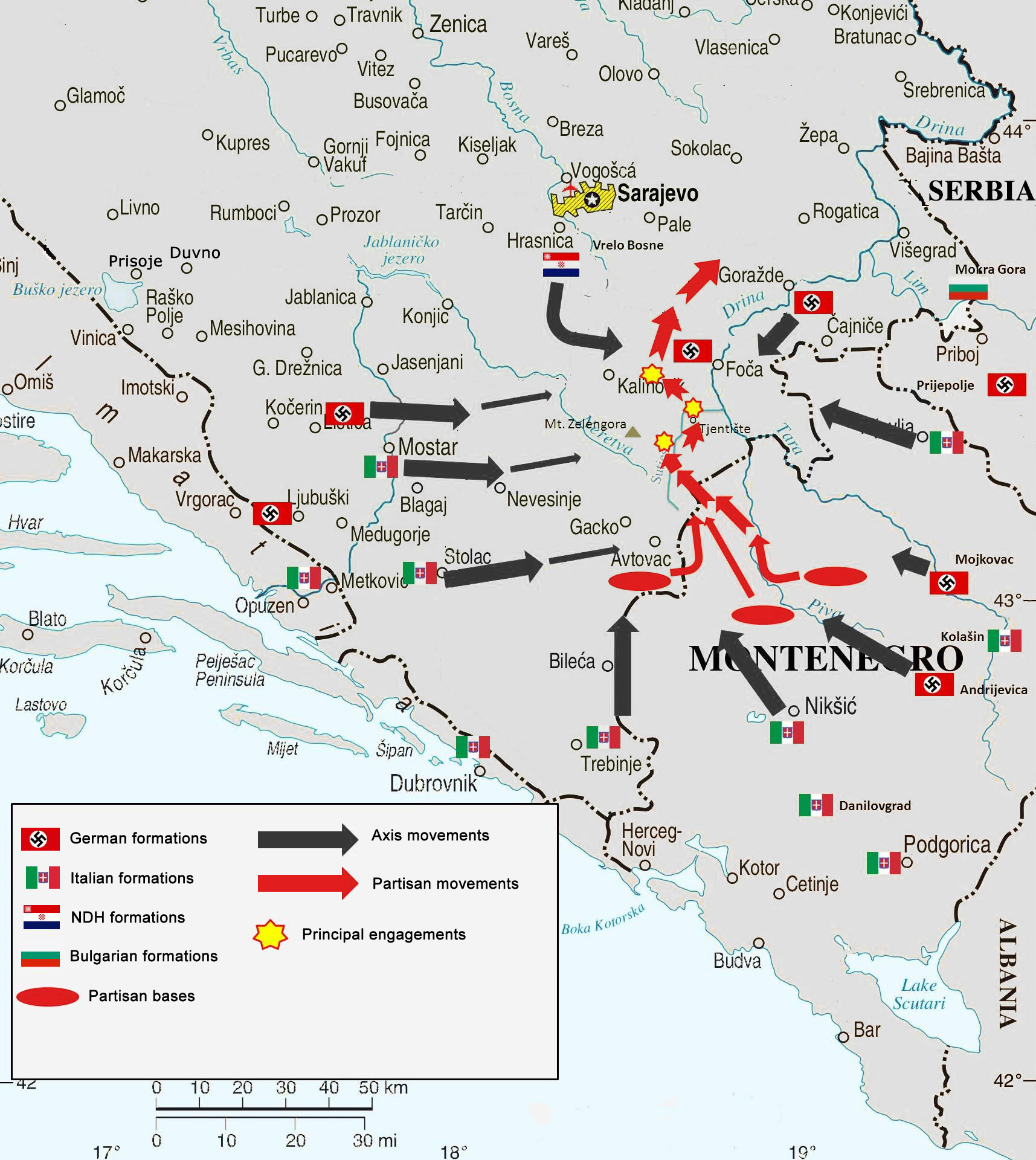
Map of Case Black, superimposed on modern-day borders
Date15 May – 16 June 1943
Location
Northwestern Montenegro and southeastern Bosnia and Herzegovina, occupied Yugoslavia
Result

Inconclusive

  • Axis failure despite heavy Partisan casualties
Belligerents
Axis:
 Italy
 Germany
 Croatia
 Bulgaria[1][2][3]
Yugoslav Partisans
Commanders and leaders
Nazi Germany Alexander Löhr
Nazi Germany Rudolf Lüters
Yugoslav Partisans Josip Broz Tito (WIA)
Yugoslav Partisans Velimir Terzić
Yugoslav Partisans Koča Popović
Yugoslav Partisans Peko Dapčević
Yugoslav Partisans Vlado Šegrt
Yugoslav Partisans Pavle Jakšić
Yugoslav Partisans Radovan Vukanović
Yugoslav Partisans Sava Kovačević 
Strength
127,000 men
300+ aircraft
Around 22,148 men[4]
Casualties and losses
Nazi Germany 583 killed, 1,760 wounded, 425 missing[5][6]
Fascist Italy 290 killed, 541 wounded, 1,502 missing[7]
Independent State of Croatia 40 killed, 166 wounded, 205 missing[5][6]
Total casualties:
913 killed, 2,467 wounded, 2,132 missing[5][7]
1/3 killed and wounded[4][8]
(6,391[8]–7,543[9] killed and wounded)
2,537 pro-Partisan civilian sympathizers executed[10][11]

Case Black (German: Fall Schwarz), also known as the Fifth Enemy Offensive (Serbo-Croatian Latin: Peta neprijateljska ofanziva) in Yugoslav historiography and often identified with its final phase, the Battle of the Sutjeska (Serbo-Croatian Latin: Bitka na Sutjesci pronounced [bîtka na sûtjɛst͡si]), was a joint attack by the Axis. Taking place from 15 May to 16 June 1943, it aimed to destroy the main Yugoslav Partisan force, near the Sutjeska River in south-eastern Bosnia. The failure of the offensive marked a turning point for Yugoslavia during World War II. It was also the last major German-Italian joint operation against the partisans.[12]

The operation immediately followed Case White which had failed in accomplishing the same objectives: to eliminate the central Partisan formations and capture their commander, Josip Broz Tito.

Background

[edit]

During the previous operation Weiss, Chetniks fought against Partisans under Italian command. However, even during the operation, negotiations were held between the German and Italian leaders on the disarmament of the Chetniks. German Wehrmacht deeply believed that the Allies would invade the Balkans after victory in the North African campaign. In operations Weiss I and Weiss II, the Wehrmacht did not achieve their desired goals of destroying the Yugoslav partisans and establishing control over the region, so preparations began for a new venture.

With operation Schwarz, the Wehrmacht intended to clear the background of the Adriatic coast by destroying both the Chetnik and Partisan movements, which were still firmly established in Herzegovina and Montenegro. Hitler calculated that, in the event of a British invasion of the Balkans, Chetniks under Italian care would switch sides and join the Allies.[13]

However, in the first phase, there were tensions and misunderstandings between the German and Italian armies on that issue. Since the Italian commanders in Yugoslavia were very reluctant to disarm the Chetniks, Hitler won the consent through Mussolini government and the Italian Supreme Command. General Mario Robotti was fiercely against the disarmament of the Chetniks, at least until the partisans were destroyed. This attitude was shared by Chief of Staff of the Italian Army, general Vittorio Ambrosio, but he had to obey the promise that Mussolini gave to Hitler. At the beginning of March 1943, general Ambrosio, summoned Robotti and Alessandro Pirzio Biroli to Rome for talks on the disarmament of Chetniks and operations against partisans.[13]

Axis plans

[edit]

The Axis rallied 127,000 land troops for the offensive, including German, Italian, Croatian, Bulgarian, and over 300 airplanes.

For this operation, the Commander of the Southeast, colonel-general Alexander Löhr, received elite 1st Mountain Division from the Eastern Front as reinforcements. Löhr entrusted the tactical command to the German troop commander in Croatia, Rudolf Lüters. The combat group for this operation was therefore called the Croatian Corps.

The German command adjusted the operational plan of action against Partisans to the characteristics of the terrain. They planned to concentrate main partisan divisions and their Supreme Headquarters on the naturally isolated and almost uninhabited area between the Tara and Piva canyons, and the Durmitor mountain, and to destroy it there with the mass use of aviation, artillery and mountain troops. The 1st Mountain Division with its northern wing, the Italian 19th Infantry (Mountain) Division Venezia, the battle group Ludwiger (724th German, 61st and 63rd Bulgarian Regiments), the 369th Infantry Division, the 118th Jäger Division with the 4th Home Guard Jäger Brigade of the Independent State of Croatia were deployed in a semicircle on the east and north sides. In the first phase, these forces were supposed to take control of Sandžak and push Partisan forces to the left side of River Tara. The southern wing of the 1st Alpine Division Taurinense, 23rd Infantry Division Ferrara and the 7th SS Mountain Division Prinz Eugen were supposed to push Partisans from the south and southeast. After that, the 118th Jäger Division had the task of occupying the left bank of the Piva and thus closing the environment, so that the breakthrough was hindered not only by strong forces but also by deep river gorges. This would bring Partisan forces to a dead end and destroy them.

In addition to these forces, there were additional 4 Italian divisions deployed in Adriatic hinterland, from the Albanian border to the lower course of the Neretva: were these Italian divisions: 155th Infantry Division Emilia in the Bay of Kotor, 151st Infantry Division Perugia in area of Vilusi, Bileća and Trebinje, 154th Infantry Division Murge around Dubrovnik and 32nd Infantry Division Marche in downstream of the Neretva, from Mostar to Metković.[14]

Partisans activities prior to Axis offensive

[edit]
Partisan column during the Battle of the Sutjeska

While the Axis were preparing for Operation Schwarz, fierce battles were fought on the territory of Herzegovina and Montenegro. After operation Weiss, the operative group of Partisan divisions set out with all its might through Herzegovina to break into Montenegro, destroying the Chetniks and Italians units on its path, and taking control over the area. In that area, the exhausted fighters would rest, the wounded would be treated, and then they would move towards Kosovo and southern Serbia.

Fierce battles between partisans and Italian-Chetnik forces were fought in the sector Foča-Kalinovik-Gacko-Šavnik. Nevesinje passed from hand to hand as many as eight times. On April 6, Partisan forces forced the Drina, defeated parts of the Taurinense division and the Chetniks near Ifsar, captured Čajniče and besieged Foča, where an Italian battalion and about 1,000 Chetniks were surrounded. Chasing the Chetniks deeper and deeper into Montenegro, the Supreme Headquarters moved to Mount Durmitor.

After the heavy defeat inflicted on the Italians in Pivka Javorka, on May 1, the First and Second Proletarian Divisions embarked on a comprehensive offensive to liquidate the Italian-Chetnik garrison in Kolašin, with the intention of continuing the advance towards Berane.[15] As part of the siege of Kolašin, a strike group of battalions (two battalions of the Fourth and one battalion of the Fifth Montenegrin Brigade) defeated the Italian regiment near Bioč on May 15.

At the beginning of operation Schwarz, the Yugoslav National Liberation Army had 22,148 soldiers in 16 brigades.[9] There were 8,925 Partisans from Croatia (5,195 of those from Dalmatia), 8,293 from Bosnia and Herzegovina, 1,492 from Serbia (including Vojvodina and Kosovo) and 3,337 from Montenegro. By ethnicity 11,851 were Serbs, 5,220 Croats, 3,295 Montenegrins and 866 Muslims.[16][17]

Partisan units were bringing with them central hospital with about 3,000 wounded.[18] In addition, YNLA troops suffered from severe lack of food and medical supplies, and many were struck down by typhoid.

Operation

[edit]

Axis preparations

[edit]

Wehrmacht forces were advancing towards Montenegro from the north and from the east. Partisan forces were keeping parts of the Italian Alpine Division "Taurinense" and about 1,100 Chetniks under blockade in Foča since April 15. In early May, parts of the German 369th Legionary Division penetrated as far as Foča, suppressing the Sixth East Bosnian and Fifteenth Majevica Brigades, liberating the Aosta battalion of the Italian Taurinense division and about 1,000 Chetniks, who had been under siege by Partisan forces for 23 days. The Chetniks were disarmed, and released.

The left wing of the 369th Legionary Division advanced from the direction of Priboj towards Pljevlja, and, without encountering any resistance, merged with the main body of the "Taurinense" division.

Disarmament of Chetniks

[edit]

During the advance of the 7th SS Mountain Division and the 118th Jäger Division through eastern Herzegovina, German forces encountered a certain degree of Italian obstruction and skirmishes with the Chetniks. Hundreds of Chetniks were disarmed.

At the beginning of May, Pavle Đurišić established contacts with parts of the 1st Mountain Division and the 4th Brandenburg Regiment. The Germans decided to conceal their real intentions, so they let the first group of disarmed Chetniks go home. By accepting communication with the Chetniks, by mid-May 1943 they managed to concentrate a large number of Chetniks, led by Đurišić, around the town of Kolašin, where German combat units were already deployed. In a surprise raid on the morning of May 14, despite the established contacts and strong opposition of the commander of the Italian 14th Corps, general Ercole Roncaglia, the Germans captured the Chetniks in their sleep and disarmed them. German forces on the ground appealed to the higher command to reconsider the decision to arrest the Chetniks, because they proved to be reliable allies against the partisans, but the German command did not give up on the original idea. One part of captured Chetniks, including Đurišić, was to be interned in prison camps in Greece and Poland, and the rest for labor battalions in the upcoming fight against the Partisans. In the meantime, Mihailović left the village of Gornje Lipovo and headed for Serbia. After capturing the majority of Montenegrin Chetniks near Kolašin, the Germans continued with operation Schwarz.

Phase I: Initial battles (15–20 May)

[edit]

After a period of troop concentration, the offensive started on 15 May 1943. The Axis troops used the advantage of better starting positions to encircle and isolate the partisans on the Durmitor mountain area, located between the Tara and Piva rivers in the mountainous areas of northern Montenegro and forced them to engage in a fierce month-long battle on waste territory.

The first clashes after operation Schwarz commenced, took place in the north, between Čajniče and Foča, with parts of the 369th Legionary Division, and in the east, near Brodarevo and Mojkovac, with the 1st Mountain Division.

Phase II: Breakthrough attempt toward eastern Bosnia (21–27 May)

[edit]

Faced with the advance of large German forces from the east, the Supreme Headquarters decided to prevent the closure of the ring by capturing Foča and provide communication with eastern Bosnia. The attack was carried out from May 21 to 25 by the reinforced 1st Proletarian Division against the majority of the German 118th Jäger Division and the 4th Home Guard Jäger Brigade of the Independent State of Croatia. Despite certain tactical successes (breaking up of the 7th Mountain Regiment on May 21 and the 13th Mountain Regiment on May 24), after a flanking attack by parts of the 369th Division near Gradac on May 25, this attack proved hopeless. From there, on May 27, the Supreme Headquarters ordered the transfer of all forces to the left bank of the Tara.

The 118th Jäger Division had the task of breaking out on Piva from the west and blocking it. On May 22, her 738th Regiment, without contact with Partisan units, broke out on Vučevo, a plateau west of Piva. However, they could not organize communications and supplies in this wide and impassable area, so the regiment commander, lieutenant colonel Anacker, sent one battalion to the south to establish a connection with the 7th SS Division, and one to the west, to connect with the headquarters of his division. The remaining, 2nd Battalion, in a battle on May 29, was repelled from dominant positions by the two battalions of the 2nd Proletarian Brigade. The intervention of parts of the division from the north, across the Drina, was suppressed by the forces of the 1st Proletarian Division, which moved across the Tara. Thus, the Partisan forces firmly occupied Vučevo and prevented the Germans from closing the ring on Piva. The next natural obstacle on which the 118th Division could do that was valley of river Sutjeska.

On May 18, the 7th SS Division and the Italian Division Ferrara began to appear from the south towards Šavnik, Žabljak and Mratinje. The successful defense of the First Dalmatian and the Fifth Montenegrin Brigades, which suppressed the appearance of the right wing of the 7th SS Division and the Italians, enabled the organization of an attack on the left wing of the 7th SS Division.

Phase III: Arrival of British mission (27 May – 3 June)

[edit]

Informed on May 20, 1943 of the arrival of the British military mission, the Supreme Headquarters left Đurđevića Tara and settled in the forest near Black Lake, at the foot of Durmitor.

On the night of 27/28 May, the British Liaison Department arrived. At the head of this mission were Captain William F. Stewart, who worked at the British Consulate in Zagreb before the war spoke Serbo-Croatian, and William Deakin, a history professor at Oxford. In addition to the two of them, the mission had 4 more members.

The very next day, Tito received the British. He demanded military assistance and that the British Air Force bomb German concentration centers.

From May 31 until June 5, the 4th Montenegrin, 7th Krajina and 10th Herzegovinian brigades fought fierce and exhausting battles with the Germans on the rugged sides of the mountain Bioč and in the upper course of the Piva. The successes achieved were insufficient, given the reserves available to the Germans.

Phase IV: Supreme Headquarters in encirclement (4 June – 9 June)

[edit]
Walter Stettner, commander of 1st Mountain Division during the battle

As the attempt to break through the front via Foča failed, the Supreme Headquarters had to return to its initial positions, which the Germans used to make an even stronger ring. In addition to the daily fighting, the Sutjeska canyon was bombarded by planes every day, in a very low flight. On June 3, Tito crossed the Piva near Mratinje with the Supreme Headquarters. Thus, in the first days of June, the entire Supreme Headquarters found itself encircled, together with the central hospital in the Sutjeska valley.

On the same day, at the session of the Supreme Staff, the position of the Partisan groups with the hospital was discussed, and it was concluded that the situation was critical. The Supreme Headquarters saw that the main operational group could only break toward the west, through the Sutjeska valley because there were weaker German forces there. However, the Germans foresaw this development, so they hurried to fortify the entire Sutjeska valley. Having established that this direction, through the source part of Sutjeska and Gatačko Polje, was densely occupied in depth, the Supreme Headquarters decided to divide Partisan forces into two parts. The first group consisted of the 1st and 2nd Divisions, which had already forced Piva, with the Supreme Headquarters, and the second of the 3rd (in a slightly changed composition) and the 7th Division, with the Central Hospital and part of the councillors of AVNOJ, located east of Piva. The second group was led by Milovan Đilas, as a delegate of the Supreme Headquarters, and Sava Kovačević, who was appointed commander of the 3rd Division. The two groups were to break through in divergent directions in order to stretch the German forces. The first group was to break through Sutjeska to the northwest, while the second was given the task of returning to the right bank of the Tara, toward Sandžak.

Soldiers of 2nd Dalmatian Brigade rest on Milinklade on June 9, 1943. Author: George Skrigin

The First Proletarian Division was sent to attack the valley of Sutjeska via Piva and Vučevo. As a dominant point, it was necessary take the hill at Vučevo, to make a corridor for the free passage over Sutjeska, in the direction of Zelengora and further to Bosnia. The German command also foresaw such a possibility, so it sent an advance force to take Vučevo. In a hand-to-hand battle, the forces of the 1st Proletarian Division managed to overcome the Germans and take control of this dominant point. The Germans then began to occupy the entire valley of the Sutjeska, from Tjentište to its confluence with the Drina near Čelebić. The 7th SS Division Prince Eugene penetrated in that direction, which surrounded the majority of forces and the central hospital.

In the area around the canyons of Sutjeska and Suha, fierce battles began for the surrounding heights, which alternately fell into the hands of both. An area of 5–6 km was made for the passage of the majority of forces. The wounded were supposed to go there as well.

The First Proletarian Division marched through Milinklade and on June 8, 1943, broke out on Zelengora. The Second Proletarian Division was less fortunate. At the place of Bare, not far from Volujak, there was a scene of bloody battles with units of the 118th German Division.

Supreme Commander Josip Broz Tito and Ivan Ribar during the Battle of the Sutjeska photo credit: Savo Orović

On 9 June Tito was nearly killed on Milinklade when a bomb fell near the leading group, wounding him in the arm. The popular post-war report of the event credited Tito's German shepherd dog Luks, for sacrificing his life to save Tito's.[19] Captain William F. Stewart (a Special Operations Executive operative who was parachuted into Tito's headquarters alongside Captain William Deakin during May[20]) was also killed by the explosion.[21]

Phase V: Partisan breakthrough toward eastern Bosnia (10 June – 15 June)

[edit]
Situation in June and direction of partisan breakthrough
Commanders of 1st Proletarian Division Koča Popović and Danilo Lekić during battle of Sutjeska

Facing almost exclusively German troops, the Yugoslav National Liberation Army (YNLA) finally succeeded in breaking out across the Sutjeska river through the lines of the German 118th and 104th Jäger and 369th (Croatian) Infantry divisions in the northwestern direction, towards eastern Bosnia. Three brigades and the central hospital with over 2000 wounded were surrounded. Following Hitler's instructions, German commander in chief Generaloberst Alexander Löhr ordered their annihilation, including the wounded and the unarmed medical personnel.

War crimes

[edit]

Of the more than 6,000 killed Partisan fighters in Sutjeska, a large number were exhausted fighters and wounded who were executed by the Germans. The report of the 1st Mountain Division says: "Captured: 498, of which 411 were shot." Most of the immobile wounded (about 700 of them) were hidden by partisans, with nurses. However, the Germans, searching the terrain with search dogs, killed them almost to the last, together with the nurses. In addition, a large number of civilians were also killed.

The SS Mountain division was also notorious for killing civilians suspected of helping partisans.

At the post-war trial, generals Alexander Löhr, Fritz Neidholdt and Josef Kübler and at that time Standartenführer August Schmidhuber were charged with war crimes during the battle. They were sentenced to death and executed in 1947.

Aftermath

[edit]
Battle of Sutjeska Memorial at Tjentište

In total there were 7,543 partisan casualties, more than a third of the initial force.[9] The German field commander, General Rudolf Lüters in his final report described the so-called "communist rebels" as "well organized, skillfully led and with combat morale unbelievably high".

The successful Partisan breakout helped their reputation as a viable fighting force with the local populace. Consequently, they were able to replenish their losses with new recruits, regroup, and mount a series of counterattacks in eastern Bosnia, clearing Axis garrisons of Vlasenica, Srebrenica, Olovo, Kladanj and Zvornik in the following 20 days.

The battle marked a turning point toward Partisan control of Yugoslavia, and became an integral part of the Yugoslav post-war mythology, celebrating the self-sacrifice, extreme suffering and moral firmness of the partisans.

Order of battle

[edit]
Liberated territory in Yugoslavia, May 1943

Allied order of battle

[edit]

Democratic Federal Yugoslavia Yugoslav Partisans (Partisans Main Operational Group)

Axis order of battle

[edit]

 Germany

 Italy

Croatia

  • 4th Home Guard Jäger Brigade

 Bulgaria

  • 63rd Infantry Regiment
  • 61st Infantry Regiment also in the area
    (both units under the command of the 369th (Croatian) Infantry Division)

In film

[edit]

Battle of Sutjeska was made into a movie in 1973, Sutjeska, with Richard Burton playing the lead as Josip Broz Tito, leader of the partisan forces.

In song

[edit]

There are several songs about the Battle of Sutjeska. One of the more popular is called "Sivi Sokole" which translates to peregrine falcon. It mentions the death of Commander Sava Kovačević.

Serbo-Croatian English

Sivi sokole, prijatelju stari,
Daj mi krila, sokole da preletim planine.

Visoka je planina, nebo iznad nje,
A na nebu sivi soko, gleda na mene.

Duboka je Sutjeska, kanjon iznad nje
Na kanjonu Tito stoji, gleda ranjene

Na kanjonu Tito stoji i poručuje
Sutjeska se mora proći, da spasimo ranjene
Sivi sokole...

Sutjeska je probijena, ranjeni su spašeni
A naš stari heroj Sava osta mrtav da leži
Sivi sokole...

Radili smo, radimo, radit ćemo još
Druže Tito, kunemo se, pobijedit ćemo

Peregrine falcon, old friend of mine,
Give me wings, falcon, that I may fly over the mountains.

The mountain is high, the sky above it,
And in the sky the peregrine falcon, looking down upon me.

Sutjeska is deep, the canyon above it
Above the canyon stands Tito, watches over the wounded

Above the canyon stands Tito and commands,
The Sutjeska must be crossed to save the wounded,
Peregrine falcon...

Sutjeska is breached, the wounded are saved
But our old hero Sava remained lying dead
Peregrine falcon...

We have toiled, we toil, we will toil still
Comrade Tito, we pledge, we will triumph.

Memorial complex

[edit]

Sculptor Miodrag Živković designed the memorial complex, dedicating to the Battle of the Sutjeska in the 1970s.[22] The complex contains frescoes by the Croatian artist Krsto Hegedušić.[23]

See also

[edit]

Citations

[edit]
  1. ^ J. B. Tito, The Yugoslav Road, 99
  2. ^ Slobodan Nešović, Yugoslav-Bulgarian Relations, 1941–1945, 95
  3. ^ Tomasevich 1975, p. 199.
  4. ^ a b Kučan 1996.
  5. ^ a b c Report of the commander of German troops in Croatia from the 20th of june 1943 (in Croatian), Collection of Documents and Information on the National Liberation War of the Peoples of Yugoslavia, Volume XII (german documents), book 3, page 94
  6. ^ a b Report of the commander of German troops in Croatien (Befehlshaber der Deutschen Truppen in Kroatien), June 20th 43, National Archive Washington T314, roll 560, frames 750–751
  7. ^ a b Cloutier, Patrick (2013). Regio Esercito: The Italian Royal Army in Mussolini's Wars, 1935–1943. lulu.com. p. 182. ISBN 978-1105074011.
  8. ^ a b Ante Cuvalo, The A to Z of Bosnia and Herzegovina, 237
  9. ^ a b c Hoare 2006, p. 341.
  10. ^ Andric, Milan (1964). Hronologija oslobodilačke borbe naroda jugoslavije. Beograd: Vojnoistorijski institut. p. 471.
  11. ^ National Archive Washington T315, roll 1294, frames 537–545
  12. ^ Tomasevich 1975, p. 255.
  13. ^ a b Milovanović 1983, pp. 295–296.
  14. ^ Terzić 1958, p. 8.
  15. ^ Kučan 1996, pp. 7–8.
  16. ^ Marko Attila Hoare; (2002) Whose is the Partisan movement? Serbs, Croats and the legacy of a shared resistance p. 7 [1]
  17. ^ Viktor Kučan; (1996) Borci Sutjeske p. 33-35 ISBN 8617049847
  18. ^ Kučan 1996, p. 8.
  19. ^ Doder, Duško (1979). The Yugoslavs. Vintage Books. p. 130. ISBN 978-0-394-74158-1.
  20. ^ Gilbert, Martin (1971). Winston S. Churchill: Challenge of War 1914–1916. Houghton Mifflin. p. 319. ISBN 978-0-395-13153-4.
  21. ^ Ritchie, Sebastian (2004). Our Man In Yugoslavia: The Story of A Secret Service Operative. Routledge. p. 46. ISBN 978-0-7146-5559-8.
  22. ^ "Miodrag Živković". Archived from the original on 2016-10-29. Retrieved 2011-10-06.
  23. ^ Renata Jambrešić Kirin. The Politics of Memory in Croatian Socialist Culture: Some Remarks

References

[edit]
[edit]
Revisions and contributorsEdit on WikipediaRead on Wikipedia
from Grokipedia
Case Black (German: Fall Schwarz) was a large-scale Axis military offensive conducted from 15 May to 16 June 1943 in Nazi-occupied eastern Bosnia-Herzegovina, targeting the annihilation of the Yugoslav Partisan Main Operational Group under . The operation, the fifth major Axis anti-Partisan campaign, involved coordinated assaults by German, Italian, (NDH), and Bulgarian forces totaling approximately 127,000 troops, supported by air power and artillery, against roughly 20,000 Partisan combatants burdened by over 3,000 wounded and civilian non-combatants. Despite initial successes in encircling the Partisans first along the Neretva River and then in the Sutjeska valley, the operation failed to achieve total destruction due to Partisan tactical maneuvers through rugged terrain, determined breakouts, and shortcomings in Axis inter-force coordination. The campaign's defining phase, the Battle of the Sutjeska, saw the Partisans suffer severe attrition, with estimates of 7,000 to 11,000 killed, wounded, or captured, alongside the abandonment of most and many wounded to avoid capture, marking one of the costliest engagements for Tito's forces. Axis casualties were comparatively lower, around 3,000, underscoring the offensive's tactical efficacy in inflicting disproportionate losses, though strategic goals eluded them as the Partisan command structure and core units escaped to regroup. In Yugoslav communist , the event was reframed as a heroic triumph symbolizing unbreakable resistance, but empirical assessments reveal it as a near-catastrophic defeat narrowly averted, highlighting the Partisans' reliance on mobility and morale over conventional firepower, while exposing Axis overextension in the amid broader war pressures. The operation's outcome bolstered Allied perceptions of Partisan viability, influencing subsequent SOE and OSS support shifts away from royalist , despite the former's ideological alignment with .

Historical Context

Preceding Axis Operations

Operation Weiss, conducted from 20 January to 9 March 1943, represented the primary Axis anti-partisan effort immediately preceding Case Black, focusing on the destruction of Partisan strongholds in northwestern Bosnia and , including the pocket and surrounding regions. German-led forces, supported by Italian, Croatian, and Chetnik contingents totaling over 60,000 troops, utilized encirclement maneuvers backed by strikes to overrun these areas, securing territorial control from the River valley to the Montenegrin border. The operation inflicted severe losses on Partisan formations, estimated at 12,500 killed and 2,506 captured, effectively dismantling organized units in western Bosnia and forcing the remnants, including wounded and civilian followers, to disperse eastward toward central Bosnia. Axis casualties numbered 6,500 to 8,500, reflecting the intensity of engagements but underscoring the operation's net success in territorial consolidation. Enhanced coordination under German General , including integrated command structures and real-time intelligence sharing among Axis partners, enabled these gains, addressing shortcomings of earlier 1942 operations where fragmented national efforts had allowed Partisan breakouts. This relocation of Partisan main forces into more exposed positions set the tactical preconditions for Case Black, as the Axis sought to exploit the vacuum in the west and prevent further regrouping.

Yugoslav Resistance Dynamics

The Chetnik Detachments of the Yugoslav Army, organized by Colonel in Ravna Gora, , in early May 1941 from remnants of the defeated Royal Army, prioritized the preservation of Serbian ethnic territories, restoration of the Karađorđević monarchy, and guerrilla operations calibrated to limit Axis reprisals against civilian populations, reflecting a strategy of long-term national survival over immediate confrontation. In opposition, the National Liberation Partisan Detachments, formed under Communist Party directive by on 22 June 1941 near , , combined anti-occupation guerrilla tactics with a parallel civil war to eradicate capitalist and monarchical elements, positioning themselves to seize post-liberation power through mass mobilization and territorial control. These divergent aims—royalist preservation versus revolutionary transformation—fostered competition for recruits, supplies, and Allied recognition from the outset. Early collaboration during the widespread uprising of July 1941 fractured amid disputes over command and reprisal policies, escalating into direct combat by early November 1941 in western Serbia, where Mihailović ordered Chetnik assaults on Partisan-held positions around Užice, prompting Partisan counteroffensives and mutual accusations of collaboration with occupiers. By late 1941, this rift had solidified, with Chetniks viewing Partisans as Bolshevik threats to Serbian dominance and Partisans decrying Chetniks as reactionary obstacles to proletarian victory, leading to the disarmament or absorption of rival units rather than joint operations against German or Italian garrisons. Conflicts proliferated into 1942 across Bosnia-Herzegovina, where Partisan forces, expanding from and , targeted Chetnik strongholds to consolidate liberated zones, as seen in assaults on Chetnik-controlled areas in eastern Bosnia that displaced Mihailović's units and forced tactical retreats. These engagements, often prioritizing ideological purification over Axis targets, resulted in thousands of casualties on and fragmented resistance networks, enabling Axis commands to redirect fewer resources to pacification while observing the depletion of guerrilla strength through self-inflicted attrition. The infighting's causal effect was a diluted national front, as divided loyalties hampered coordinated or uprisings, allowing occupiers to maintain control over urban centers and supply lines with relative efficiency until external factors shifted the balance later in the war.

Axis Strategic Objectives

In early 1943, amid escalating Partisan guerrilla activities that tied down significant Axis resources in the , German command identified an opportunity to strike at the weakened main body of the National Liberation Army (NOVJ) following their retreat from prior operations like Case White. Intelligence reports pinpointed Tito's Supreme Headquarters and approximately 20,000-25,000 Partisans, burdened by thousands of wounded, regrouping in the rugged terrain of eastern , particularly around the and Sutjeska river valleys. This vulnerability prompted planning for a decisive to prevent further consolidation and potential Allied linkages. The primary objective, as directed by and approved on 31 March 1943, was the complete annihilation of the central Partisan formations, including capture or elimination of their leadership to decapitate the movement. Generaloberst , commander of , coordinated a multi-national effort involving German divisions, Italian forces, units from the Independent State of , and Bulgarian contingents to envelop the target area, leveraging superior numbers and air support for a pincer closure. This operation sought to exploit initial cooperation from Chetnik militias to block escape routes while linking German and Italian columns, thereby trapping the NOVJ in a pocket where systematic destruction could occur. Broader strategic imperatives underscored the urgency: the garrison, exceeding 300,000 troops by mid-1943, diverted divisions desperately needed for the Eastern Front after setbacks like Stalingrad, with Partisan sabotage disrupting vital supply lines to and beyond. Success in Case Black was envisioned to restore control over key regions, reduce occupation forces, and deter resistance growth, aligning with Hitler's emphasis on ruthless anti-partisan warfare to secure rear areas. However, underlying Axis assessments underestimated Partisan mobility and resolve, reflecting overreliance on intelligence gaps regarding their operational cohesion.

Preparations

Axis Force Assembly

The Axis mobilized a multinational force totaling approximately 127,000 troops for Operation Case Black (Fall Schwarz), comprising German, Italian, (NDH), and Bulgarian contingents, with assembly concentrated in eastern prior to the 15 May 1943 launch. German forces formed the core, numbering around 67,000 personnel organized under the XV Corps, including the 1st Division redeployed from the Eastern Front and elements of the 104th Light Division's regimental combat team transferred from . Italian units contributed about 43,000 troops, drawn from formations in and , while NDH forces provided roughly 11,000 soldiers, notably including the 369th Infantry Division, and Bulgarian elements added a smaller detachment of around 2,000. _Infantry_Division) Command responsibility rested primarily with General Rudolf Lüters, who as Commander of German Troops in directed the overall operation from his headquarters, coordinating the multinational elements to encircle partisan concentrations in the rugged terrain of eastern Bosnia. Italian participation fell under General Mario Robotti, whose forces in the 2nd Army sector supported the southern flanking movements, though German dominance in planning reflected tensions over operational control in the occupied . This structure emphasized German mountain infantry for high-altitude advances, supplemented by Italian and NDH units for holds and Bulgarian auxiliaries for rear . Logistical preparations involved concentrating supplies along tenuous lines from eastward and southward, reliant on limited roads and pack mule trains to sustain artillery regiments, armored elements, and over 300 aircraft amid the ' steep gradients and narrow passes. The mountainous environment posed inherent challenges, with elevation changes exceeding 1,500 meters complicating fuel and ammunition distribution, often necessitating localized and air resupply to maintain momentum before the offensive's phased . These constraints underscored the operation's dependence on rapid assembly to exploit initial surprise, as prolonged exposure risked partisan of extended supply routes.

Chetnik Involvement and Disarmament

In Operation Weiss (January–April 1943), approximately 20,000 Chetnik troops under Italian command actively participated alongside Axis forces in combating Partisan units, contributing to the encirclement efforts in eastern . This collaboration reflected the Chetniks' strategic prioritization of eliminating the communist-led Partisans, perceived as a greater existential threat to Serbian nationalist goals than the Axis occupation, leading to joint anti-Partisan sweeps that inflicted significant casualties on the resistance. Initial planning for Case Black incorporated select Chetnik detachments into the Axis , particularly under Italian auspices, to block Partisan movements in and regions, leveraging their local knowledge against the Main Operational Group. German commanders, however, deemed the Chetniks unreliable due to documented instances of tactical hesitancy, intelligence leaks to Partisans, and prior non-aggression pacts that allowed communist forces to maneuver freely, prompting directives for preemptive to neutralize potential during the offensive. On 14 May 1943, elements of the German 1st Mountain Division and Brandenburg Regiment launched a surprise raid on Chetnik positions held by near in , disarming several thousand fighters and capturing leaders, with orders to detain resistors as prisoners amid fears of defections that could open flanks to Partisan breakthroughs. This action stemmed from empirical reports of Chetnik ambushes on Axis convoys in prior months and their selective engagements that spared Partisans when not directly beneficial, underscoring a loyalty conditioned more by than anti-Axis commitment. The triggered immediate Chetnik withdrawals into remote terrain, with Đurišić's fragmenting to evade full , though captured commanders faced summary executions by German field units to deter further resistance. Italian reluctance to fully enforce the policy preserved some armed detachments under their protection, but the episode exposed the fragility of the Axis-Chetnik entente, as disarmed units either dispersed or negotiated separate truces, depriving Case Black of auxiliary blocking forces in critical sectors like the Tara River gorges. Post-operation analyses by German high command attributed partial Partisan evasion in to this pre-offensive disruption, validating concerns over Chetnik opportunism where communist elimination took precedence over sustained Axis cooperation.

Partisan Defensive Measures

The , anticipating an Axis envelopment based on and reports from local informants, positioned their main forces in the rugged Sutjeska-Neretva by early May 1943, where Supreme Headquarters under had relocated following prior operations. This intelligence network, comprising sympathetic civilians and partisan scouts, provided timely warnings of German troop concentrations from and , enabling partial dispersal of units to avoid immediate concentration in vulnerable areas. Partisan forces, organized into divisions such as the 1st Proletarian and 5th , emphasized operational mobility through lightweight equipment and rigorous training in forced marches across mountainous terrain during April-May 1943. Evacuation plans for the approximately 3,000 wounded from earlier engagements prioritized manual transport via stretchers and mules, integrated into broader breakout maneuvers to prevent capture. Constrained by scarce supplies, the Partisans foraged for food from rural populations and depended on captured Axis munitions, supplementing limited Allied airdrops that were minimal prior to the offensive's onset. efforts focused on temporary positions leveraging barriers like river gorges and dense forests, rather than static defenses, to facilitate evasion and counterattacks. These measures reflected guerrilla doctrine prioritizing survival over positional warfare against superior Axis numbers.

Conduct of the Operation

Phase I: Initial Engagements (15–20 May 1943)

The offensive began on 15 May 1943 with Axis forces launching multi-pronged assaults to sever Partisan supply lines and isolate their main concentrations in southeastern Bosnia. In the northwest sector, elements of the German 1st Mountain Division, recently redeployed from the , advanced from positions near toward , targeting detachments of the ' 2nd Corps. These initial clashes involved probes supported by , aiming to dislodge Partisan outposts and prevent reinforcement of the central forces around the Sutjeska River valley. Croatian NDH units and Bulgarian contingents contributed in secondary sectors, coordinating to compress the Partisan operational area. Partisan responses emphasized mobile delaying tactics, leveraging the dense forests and terrain of Bosnian to harass advancing columns with ambushes and hit-and-run raids, while avoiding decisive engagements that could expose their flanks. Units such as the 3rd Krajina Proletarian Brigade conducted rearguard actions near , inflicting attrition on Axis spearheads but conceding ground incrementally to preserve cohesion. By 17–18 May, German motorized elements, including the 92nd Motorized Regiment, had penetrated key passes, fragmenting peripheral Partisan groups and capturing local supply depots. This phase saw Axis forces advance steadily toward , establishing blocking positions that tightened the noose around the Partisans' 1st and 2nd Proletarian Divisions. Through 20 May, the engagements yielded tactical gains for the Axis, with reports of several hundred Partisan casualties in scattered fights, though exact figures remain disputed due to incomplete records. The Partisans, under operational orders to weakness and probe for gaps, succeeded in diverting some pressure but suffered losses in and personnel from superior Axis firepower, including close support. These opening battles set the momentum for , as Axis commanders exploited their numerical superiority—over 100,000 troops against approximately 20,000 Partisans—to methodically clear outer pockets without overextending into the core defensive zone.

Phase II: Advance into the Neretva Valley (21–27 May 1943)

From 21 to 27 May 1943, Axis forces intensified their coordinated advances to compress the Yugoslav Partisan Main Operational Group into the Valley, aiming to eliminate escape routes southward and test the cohesion of approximately 18,000 Partisan troops organized in 16 brigades. German, Italian, Croatian, and Bulgarian units totaling around 127,000 men, supported by over 300 aircraft, executed pincer maneuvers from multiple directions, including pushes by the German 118th Division and elements of the 7th SS Gebirgs Division to tighten the encirclement initially formed around the mountains. Key captures included the town of on or around 23 May by elements of the 118th Jäger Division, securing vital bridges and positions along the River to block Partisan crossings. Concurrently, Partisan units launched counterattacks, notably at , where fierce resistance inflicted delays on Axis forces despite heavy Partisan losses, preventing immediate closure of the . These actions strained Axis logistics, as overextended supply lines in the rugged terrain began to manifest shortages, complicating sustained pressure on the maneuvering Partisans. The phase highlighted the Partisans' tactical flexibility, with diversionary efforts buying time amid mounting casualties, while Axis commanders sought to exploit superior numbers and air support to force a decisive engagement before the valley terrain further hindered operations.

Phase III: British Liaison and Tactical Shifts (27 May – 3 June 1943)

On the night of 27–28 May 1943, a British military mission codenamed Operation TYPICAL, led by F. W. D. Deakin and William F. Stuart, parachuted into the vicinity of Josip Broz Tito's headquarters in southeastern Bosnia. Accompanied by two operators, the team established direct radio communication with Allied headquarters in , enabling the transmission of intelligence on Axis dispositions and facilitating requests for support. This liaison provided the Partisans with updated assessments of enemy movements, which informed immediate tactical adaptations amid the Axis advance into the Sutjeska region. Leveraging the newfound intelligence, Tito directed temporary dispersal of Partisan units to execute feints and probes, aiming to obscure the main force's intended maneuvers and potential breakout corridors. These shifts included diversionary actions to draw Axis attention away from critical sectors, exploiting features like the dense forests and ravines around the Sutjeska River. By early June, such deceptions had sown uncertainty among Axis commanders, who reinforced suspected escape routes but failed to pinpoint the primary concentration of Partisan strength. Axis forces, detecting these probes through and local , responded by intensifying patrols and barrages, progressively narrowing the without fully capitalizing on intercepted movements. Engagements on 1 June near exemplified Partisan efforts to simulate a thrust toward , prompting Italian and Croatian units to divert resources northward and momentarily easing pressure on the central pocket. Despite these responses, coordination gaps between Axis commands allowed Partisan high command to maintain operational flexibility leading into subsequent phases.

Phase IV: Encirclement of Partisan Headquarters (4–9 June 1943)

On 4 June 1943, Axis forces under Generaloberst Lothar Rendulić completed the encirclement of the primary Yugoslav Partisan grouping, including Josip Broz Tito's Supreme Headquarters, in the Sutjeska valley of southeastern Bosnia. German divisions, reinforced by Italian and Croatian units, sealed the trap after coordinated advances from multiple directions, isolating around 20,000 Partisans with limited supplies and terrain offering scant escape routes. Intensive bombing campaigns commenced immediately, with repeated air strikes targeting Partisan positions, supply lines, and assembly areas, followed by ground assaults from elite mountain troops aiming to shatter resistance and capture leadership. These attacks inflicted heavy casualties, including the death of prominent commanders such as Vlado Šegrt, deputy of the Main Operational Group, during defensive actions. The bombing alone caused significant disruption, as evidenced by reports of prolonged aerial barrages lasting up to nine hours at key defensive points like Milinklade. Partisan efforts to evacuate their central hospital, sheltering approximately 3,000 wounded fighters, unfolded amid relentless fire, with medical staff and able-bodied troops attempting to relocate patients through contested terrain. However, the ferocity of Axis assaults forced the abandonment of many incapacitated personnel, contributing to estimates of over 7,000 Partisan killed or wounded across the operation, a substantial portion occurring in this compressed phase. Tito personally directed defenses from forward positions, organizing counterattacks that repelled several penetrations and ensured his evasion of capture despite targeted efforts by German intelligence to eliminate him.

Phase V: Partisan Breakout and Withdrawal (10–15 June 1943)

On the night of 9–10 June 1943, elite Partisan units, including the 1st and 2nd Proletarian Divisions under , launched a coordinated assault through the weakly defended Čajniče gap in the Axis encirclement lines, exploiting a sector held by Croatian and Bulgarian forces. This daring maneuver involved forcing crossings of the Sutjeska River at points like Suha bridge and Tjentište amid , enabling , the Supreme Staff, and approximately 2,000 command and combat elements to break out northward across the Foča-Kalinovik road. The Seventh Banija Division supported the effort by holding key positions such as Bare against pursuing German mountain troops, while the main operational group of around 20,000 fighters prioritized the escape of leadership over sustaining the full force. Axis forces reacted swiftly, with German SS and mountain divisions, including the 7th SS "Prinz Eugen," closing the gap just 15 minutes after the initial penetration and initiating intense pursuit supported by , aircraft, and Croatian Ustaša units. Skirmishes continued through 13–15 as Partisan remnants, numbering over 10,000 survivors, scattered into the rugged mountains and eastern Bosnia, evading total annihilation despite the Third Division being largely trapped east of the Sutjeska with heavy losses among the wounded. German accounts reported inflicting 5,697 Partisan deaths during the operation, emphasizing tactical successes in containment, though these figures likely included non-combatants and reflected standard Axis overestimation to claim victory amid the failure to destroy the core leadership. The withdrawal fragmented the Partisan main group into smaller detachments that maneuvered through and , preserving operational capacity at the cost of over half their strength, including the near-total loss of the Central Hospital's 3,000 wounded and medical staff. Tito himself sustained a minor wound during the chaos, but the breakout ensured the continuity of the high command, contrasting Axis proclamations of decisive triumph with the reality of Partisan survival and dispersal.

Military Analysis

Tactical Execution and Terrain Challenges

Axis tactical execution in Case Black relied on elite mountain infantry formations, such as the German 1st Mountain Division (Gebirgs-Division) and the 7th SS Volunteer Mountain Division Prinz Eugen, specialized for operations in the rugged and terrain of southeastern Bosnia.) These units advanced methodically along narrow trails and through dense forests, employing pack mules for supply and limited pack to support infantry assaults, as mechanized vehicles and heavy armor were largely unusable due to the absence of roads and steep gradients exceeding 30 degrees in many sectors. Partisan forces countered with mobile guerrilla tactics, leveraging intimate terrain knowledge for hit-and-run ambushes that targeted stretched Axis supply columns and isolated forward elements, particularly during critical river crossings in the Valley from 21 to 27 May 1943. For instance, small Partisan detachments positioned on elevated ridges disrupted German bridging efforts over the Neretva's deep gorges, inflicting disproportionate casualties through enfilading fire while avoiding sustained engagements that would expose their numerically inferior Main Operational Group. Spring weather conditions, characterized by frequent heavy rains in across , caused the and its tributaries to swell, flooding low-lying approach routes and delaying Axis advances by turning potential crossing sites into impassable torrents and mud-choked paths that immobilized and pack animals alike. This exacerbated logistical strains, as resupply over mountain tracks became protracted, contrasting sharply with prior Axis successes in flatter terrains like the Vojvodina plains during the 1941 invasion, where panzer mobility enabled rapid encirclements and breakthroughs unhindered by such natural barriers. In Case Black's high-elevation zones around Sutjeska, reaching altitudes over 1,500 meters, the terrain similarly nullified German firepower advantages, compelling a reliance on foot marches vulnerable to Partisan interdiction that prior operations in more open Bosnian lowlands had minimized.

Intelligence and Command Decisions

Generaloberst , as commander of , directed the operation's overall strategy, opting for a multi-phased involving coordinated advances from German, Italian, Croatian, and Bulgarian forces totaling approximately 127,000 troops against the Partisans' 20,000-strong Main Operational Group. Löhr's decision to reinforce the eastern front with elite units, including the 1st Mountain Division transferred from the Eastern Front, reflected confidence in compressing the Partisans into the Sutjeska valley, but this commitment stretched logistics across rugged terrain and divided Axis efforts. Tito's command emphasized flexibility, issuing orders for decentralized maneuvers such as the 21 May 1943 directive to to advance the 1st Proletarian Division 80 kilometers to blunt Axis probes in the sector, enabling independent unit actions that confounded Axis predictions. This approach contrasted with Löhr's centralized coordination, allowing Partisan formations to feint and regroup, culminating in the decision to prioritize wounded evacuation before the main breakout force's push through the Sutjeska gorge on 12–13 . Axis intelligence drew on and signals intercepts targeting Partisan radio traffic, yet human sources from collaborators like Chetnik units yielded inconsistent results due to rivalries and Partisan infiltration efforts. Partisans, supported by emerging British SOE liaison missions during the operation, maintained operational secrecy through counterintelligence, which executed suspected spies and limited betrayals, contributing to the evasion of full . Löhr's reliance on these imperfect inputs underestimated Partisan adaptability, while Tito's evasion of fixed patterns preserved command integrity.

Reasons for Operational Failure

The Partisans' ideological cohesion, rooted in communist and the existential imperative of national liberation intertwined with class struggle, fostered fanatical resistance and rapid force regeneration despite grievous losses exceeding 7,500 —over one-third of the approximately 22,000 personnel in the Main Operational Group. This unity under centralized command allowed tactical flexibility, including forced marches through impassable terrain and willingness to abandon wounded, enabling a narrow breakout that preserved core leadership and cadre for rebuilding. In contrast, the Axis multinational composition—encompassing German units, Italian divisions reluctant to fully commit amid domestic instability, Croatian formations plagued by low morale and ethnic animosities, Bulgarian contingents with limited operational scope, and opportunistic Chetnik auxiliaries—generated persistent coordination frictions, diluting offensive momentum through divergent priorities and unreliable execution. Systemic resource constraints further undermined Axis efficacy, as commitments to the Balkan theater diverted seasoned divisions and logistical assets from the critical Eastern Front, where post-Stalingrad pressures demanded ; by mid-1943, over a dozen German divisions were immobilized in , comprising non-elite mountain and security troops ill-suited for prolonged pursuit in rugged topography. Italian hesitancy, foreshadowing Mussolini's ouster on , 1943, manifested in half-hearted engagements and defensive posturing, reflecting Rome's strategic retrenchment amid Allied invasions in and eroding fascist resolve, which compromised efforts reliant on southern blocking positions. These causal factors—internal Axis disunity and overextension—ensured that, despite numerical superiority exceeding 150,000 troops, the operation could inflict tactical defeats but not achieve strategic , as Partisan survivability hinged on asymmetric evasion rather than symmetric confrontation.

Atrocities and War Crimes

Axis and Collaborator Actions

In the course of Operation Case Black, German forces implemented severe reprisal measures against civilians suspected of providing aid to Partisan units, resulting in mass executions in the operational theater. In the Piva River Valley, elements of the Wehrmacht and SS divisions, including the 7th SS Volunteer Mountain Division Prinz Eugen, conducted killings of non-combatants, with over 500 civilians executed in multiple sites during June 1943, exemplified by the Dola massacre where local villagers were rounded up and shot for alleged collaboration. These actions aligned with broader Wehrmacht directives for collective punishment in anti-partisan warfare, targeting Serb-majority villages in eastern Bosnia and Montenegro to deter support for the resistance. NDH collaborator units, comprising Croatian and -integrated formations under German operational control, contributed to civilian targeting during the encirclement phases around and , executing suspected Partisan sympathizers as part of joint sweeps. While specific casualty figures for NDH actions in this operation remain underdocumented in declassified records, these forces adhered to policies of ethnic reprisals against Serbs, amplifying German efforts to clear the Sutjeska region. Italian occupation troops, responsible for blocking positions in , enforced internment and punitive raids but exhibited restraint compared to German and Croatian units, focusing on containment rather than systematic massacres. Bulgarian auxiliary forces in peripheral sectors applied pressure through cordons but engaged minimally in direct ethnic targeting during the offensive. To sever Partisan supply lines, Axis commands authorized scorched-earth policies, systematically burning villages and destroying food stores across the Neretva and Sutjeska valleys, thereby exacerbating civilian displacement and hardship.

Partisan Reprisals and Executions

Yugoslav Partisan forces routinely executed captured during clashes in 1943, viewing them as collaborators with rather than legitimate combatants, a practice that extended into the Case Black operation where Chetnik units supported encirclement efforts in and eastern Bosnia. Such summary executions prevented potential leaks or rear-guard sabotage amid the Partisans' precarious maneuvers, though they intensified the internecine violence of the Yugoslav civil war. Suspected collaborators in villages along the and Sutjeska routes faced reprisals, including targeted killings to disrupt local networks aiding Axis advances; these actions, while operationally motivated, contributed to deaths and property destruction in contested areas. Partisan doctrine prioritized eliminating perceived internal threats, reflecting a broader pattern of mass executions by resistance groups against rivals and non-combatants. Under the strain of in early June 1943, Partisan leadership enforced ideological discipline through purges, executing rank-and-file members accused of or that could facilitate enemy breakthroughs during the Sutjeska withdrawal; these internal reprisals ensured cohesion but underscored the movement's ruthless internal controls. communist dominance over Yugoslav has limited detailed documentation of such incidents, privileging narratives of unmitigated heroism over balanced accounting of all wartime violence.

Chetnik Contributions to Violence

During Operation Case Black, Chetnik forces coordinated with Axis commands to intercept Partisan movements, motivated by their prioritization of combating over direct confrontation with occupiers, whom they viewed as a temporary threat compared to the existential danger posed by Bolshevik . In eastern Bosnia, prior to Italian disarmament of select units in mid-1943, Chetnik detachments under local commanders targeted Partisan sympathizers, including executions of captured fighters and reprisals against Muslim communities suspected of aiding communists, resulting in civilian deaths framed as necessary to secure Serb-majority territories from perceived by Partisan-aligned forces. These actions aligned with broader Chetnik directives to eliminate communist infrastructure, though they escalated inter-ethnic tensions in regions like Foča and Višegrad, where Muslims were often conflated with Partisan supporters due to tactical alliances against Ustaše earlier in the war. In some instances, engaged in localized collaboration with elements against common Partisan foes, facilitating joint operations that devolved into ethnic killings, though such pacts were opportunistic and dissolved amid mutual distrust. This contributed to a where Chetnik rationale emphasized preemptive defense of Serb populations, citing Partisan massacres of civilians in as justification for uncompromising warfare. Following the Partisan breakout from the Sutjeska encirclement on 15–16 June 1943, Chetnik units ambushed retreating columns in eastern Bosnia, per accounts from survivors and local witnesses, slaughtering wounded and isolated fighters to prevent regrouping. A notable case occurred on 13 July 1943 near Vrbica village outside Foča, where Chetnik forces executed Croatian Partisan poet Ivan Goran Kovačić during an incursion, exemplifying the summary justice meted out to captured enemies amid the chaos of withdrawal. These post-disarmament attacks, numbering dozens of confirmed executions in the immediate aftermath, underscored Chetnik commitment to eradicating Partisan leadership and rank-and-file, even as Axis forces shifted focus elsewhere.

Aftermath

Immediate Consequences for Forces Involved

The ' Main Operational Group entered Operation Case Black with approximately 22,000 combatants but emerged from the Sutjeska encirclement on 15–16 having suffered heavy losses, including around 8,500 killed and over 2,000 captured according to Axis tallies. These casualties halved the group's effective fighting strength, with many wounded succumbing due to exhaustion and lack of amid the rugged terrain. Despite the toll, the command cadre, including Supreme Commander , remained intact after the breakout, preserving organizational continuity and preventing total collapse. By late , remnants had regrouped in eastern Bosnia's forested regions, initiating rapid reconstitution through local recruitment and scavenging, which restored operational capacity within weeks as evidenced by renewed Allied supply drops commencing on 25 June. Axis commanders declared tactical success, asserting over 20,000 Partisan dead based on body counts and intelligence, but the failure to eradicate the central force prompted phased withdrawals from forward positions by mid-June 1943. German and Italian units, strained by elongated supply lines vulnerable to and the logistical demands of mountainous operations, relocated to more defensible garrisons, incurring minimal direct combat losses—583 German killed and 290 Italian—but facing elevated non-battle attrition from and overextension. This pullback reflected frustration at the operation's strategic shortfall, diverting resources from other fronts and underscoring the Partisans' resilience, which dampened Axis morale in the Balkans theater. Chetnik royalist formations, tasked with blocking Partisan movements, experienced immediate disarray as German directives during Fall Schwarz mandated their disarmament to curb unreliability and potential defections. Units under , already plagued by internal divisions, saw weapons confiscated and personnel dispersed or interned, accelerating fragmentation and alienating local supporters who viewed the move as Axis betrayal. This erosion compounded the Chetniks' weakened position, with morale plummeting as the Partisans' survival highlighted royalist inefficacy, prompting desertions and localized capitulations that diminished their coordinated resistance capability in the short term.

Shift in Allied Support

British (SOE) liaison officers embedded with Josip Broz Tito's Partisan forces during Case Black provided critical eyewitness accounts of their operational resilience. Arriving in late May 1943, the initial mission, including Captain F. W. Deakin who joined on 28 May, documented the Partisans' maneuver through the Axis encirclement in southeastern Bosnia, enduring intense combat and supply shortages while evading annihilation. These observations highlighted the Partisans' active engagement, tying down multiple German divisions in a manner that contrasted with contemporaneous intelligence on Chetnik forces' limited anti-Axis actions. Field reports from the Sutjeska campaign, corroborated by revealing Chetnik communications with Axis commands, empirically refuted earlier British favoritism toward Draža Mihailović's , which had been predicated on assumptions of their dominance in Yugoslav resistance from 1941–1942. SOE assessments quantified Partisan effectiveness through metrics such as sustained guerrilla operations disrupting Axis logistics, versus Chetnik passivity that freed enemy resources for other fronts. By early , these findings prompted a formal SOE policy reversal, endorsing exclusive material and advisory support for the to maximize disruption of German forces ahead of prospective Allied invasions in the Mediterranean. The shift manifested in redirected supply airdrops, with the first major deliveries to Tito's commencing on 19 , prioritizing weapons and medical aid to bolster Partisan offensives. British policymakers, including Prime Minister , acknowledged the Partisans' communist objectives and potential postwar dominance in but deemed their demonstrated combat utility against the paramount, overriding ideological concerns in favor of pragmatic wartime exigencies. This decision marked the effective abandonment of Chetnik support, as subsequent missions like Fitzroy Maclean's in September reinforced the emphasis on Partisan capabilities observed amid Case Black.

Long-Term Implications for Yugoslav Civil War

The survival of Josip Broz Tito's main Partisan force during Case Black, despite encirclement by approximately 120,000 Axis troops and sustaining around 7,000 casualties, preserved the communist-led cadre's command structure and fighting capability, enabling rapid reorganization in eastern Bosnia by late June 1943. This outcome underscored the Partisans' willingness to engage in sustained against overwhelming odds, in contrast to the strategy of conserving forces for a potential Allied landing, which British intelligence reports increasingly viewed as passive non-cooperation with Axis advances. The demonstrated resilience bolstered Partisan , with their ranks swelling to over 200,000 by year's end, laying the groundwork for territorial control in liberated areas that facilitated governance experiments and ideological indoctrination. This pivotal demonstration of anti-Axis commitment influenced Allied strategic reassessments, culminating in the of November 1943, where British and American leaders, informed by on-the-ground liaison reports of Partisan activity versus Chetnik inactivity, resolved to redirect material support toward Tito's forces. By early , this shift materialized in increased airdrops of weapons, , and medical supplies, totaling thousands of tons, which amplified Partisan offensives and accelerated the erosion of Axis holdouts in . The marginalization of Draža Mihailović's , deprived of Western backing, confined them to sporadic guerrilla actions, rendering them unable to contest Partisan dominance and hastening their post-liberation suppression through mass arrests and trials that executed or imprisoned tens of thousands by 1946. Causally, the operation's failure prevented the of the communist , allowing it to leverage Allied for a 1944-1945 surge that synchronized with advances, culminating in the uncontested seizure of on October 20, 1944, and nationwide control by May 1945. This trajectory suppressed monarchical and multi-ethnic alternatives, entrenching one-party communist rule under the Federal People's Republic of Yugoslavia from 1945 onward, characterized by centralized , suppression of dissent, and forced collectivization that persisted until the federation's dissolution amid ethnic conflicts in the . The preserved Partisan nucleus thus directly enabled decades of ideological monopoly, foreclosing paths to a restored kingdom or federal pluralism that might have emerged had the main force been eliminated.

Order of Battle

Axis and Allied Forces

The Axis forces committed to Case Black totaled approximately 127,000 troops, drawn from German, Italian, Croatian (NDH), Bulgarian, and , supported by over 300 and regiments. German elements operated primarily under the , commanded by SS-Gruppenführer , which included the 7th SS Volunteer Division Prinz Eugen, the 1st Division, the 188th Division, the 369th Infantry Division (Croatian-manned), the 373rd Infantry Division (Croatian-manned), and elements of the 104th Division. The XIX Corps, under General Viktor von Schweinitz, contributed the 1st Division, elements of the 114th Division, and the 181st Infantry Division. Italian forces from the 2nd Army, led by Generale d'Armata , provided flank security and blocking forces in the broader operational area, utilizing several and alpine divisions to cordon off escape routes. NDH contributions were integrated into German commands, with the 369th and 373rd Infantry Divisions forming key components of the , comprising ethnic Croatian troops under oversight. Bulgarian units and Ustaša militias supplemented the main effort in peripheral sectors. Allied involvement was limited to the British military liaison mission attached to Yugoslav Partisan headquarters, known as Mission Typical, comprising personnel such as Colonel William Deakin and Captain William F. Stuart, along with wireless operators for communication with . This small team, numbering fewer than a dozen, facilitated intelligence exchange but provided no significant combat equipment or troops during the operation; Captain Stuart was during the encirclement phase.

Partisan and Chetnik Formations

The ' Main Operational Group, numbering over 20,000 fighters, formed the core resistance force during Case Black, structured in a decentralized manner with divisions composed of mobile brigades adapted to in rugged terrain. This group encompassed the 1st Division, headquartered near Sahovići and including the 1st Proletarian Brigade, 3rd Brigade, 3rd Brigade, and 3rd Dalmatian Brigade; the 2nd Division, based west of with the 7th Brigade, 4th Proletarian Brigade, and 2nd Dalmatian Brigade; and the 3rd Division, featuring the 10th Brigade, elements of the 2nd Proletarian Brigade, 5th Montenegrin Brigade, and 1st Dalmatian Brigade. Additional units included the 7th Division and the Operational Group, incorporating battalions from the Majevica Brigade and 6th Bosnian Brigade, all under the operational command of Supreme Headquarters to enable flexible brigade-level maneuvers amid . Chetnik formations in the operational area were organized into regional detachments, such as the Corps, which had undergone partial disarmament by Italian occupation forces in late 1942 but persisted as supporting Axis efforts against Partisans in sectors like Foča-Kalinovik. These structures emphasized local vojvoda-led groups rather than rigid hierarchies, with involvement limited to collaborationist roles alongside Italian troops rather than independent anti-Axis resistance during the offensive.

Historiographical Debates

Interpretations of Resistance Effectiveness

Historians have debated the relative effectiveness of the Partisan and Chetnik resistance movements in inflicting damage on Axis forces during World War II, often using metrics such as enemy casualties inflicted, infrastructure sabotage, and the number of Axis troops diverted from other fronts. Empirical assessments drawn from German military records indicate that Partisans conducted more frequent and sustained operations against Axis supply lines and garrisons, particularly after 1942, leading to greater overall attrition. In contrast, Chetnik strategy emphasized selective, low-intensity sabotage to avoid mass reprisals against Serb civilians, resulting in fewer direct engagements and limited strategic impact on Axis operations. Quantitative comparisons highlight disparities in force growth and operational tempo. Following the Axis Case Black offensive in May–June 1943, which inflicted approximately 7,543 casualties on Partisan units, the movement rebounded and expanded to around 300,000 fighters by late 1943, enabling escalated sabotage and ambushes that tied down an estimated 15–20 German divisions in by 1944. Chetnik forces, peaking at roughly 100,000 in 1941–1942, remained static or contracted thereafter, with many units entering de facto collaboration with Italian or German commands to prioritize survival over offensive actions. German field reports from 1943 onward attributed the majority of railway derailments, ambushes, and supply disruptions to Partisans, while Chetnik activity waned to sporadic intelligence-sharing or minor disruptions along rivers like the Morava. Critiques of Partisan effectiveness often center on post-war Yugoslav communist narratives, which systematically inflated claims of Axis kills and downplayed internecine fighting with to consolidate Tito's legitimacy. Independent analyses using captured Axis documents, such as those by Jozo Tomasevich, reveal that while Partisans demonstrated superior adaptability and combat initiative—evidenced by their role in forcing Axis reallocations— obscured how much of their growth stemmed from coerced recruitment and dynamics rather than pure anti-Axis fervor. proponents argue their restraint preserved Serb demographics for eventual liberation, but Axis assessments consistently rated them as negligible threats compared to Partisans, who provoked major counteroffensives like Case Black due to persistent guerrilla pressure. This historiographical divide underscores the tension between verifiable Axis-source data and ideologically driven accounts from the victorious Partisan regime.

Role of External Influences

The dispatch of a British military mission to Tito's headquarters on 27 , during the early phases of Case Black, represented an initial probing of Partisan capabilities amid growing doubts about Chetnik effectiveness, as sought intelligence on resistance groups tying down Axis forces. The mission, led by figures including William Deakin, accompanied Partisans during their evasion maneuvers, witnessing firsthand the breakout from encirclement at Sutjeska in late June, which demonstrated operational resilience and informed subsequent policy reassessments. This direct observation contributed to the progressive shift in British support toward Partisans by autumn , prioritizing groups proven to inflict sustained attrition on German divisions despite material shortages, over those perceived as passive or collaborative. Soviet policy exerted negligible material influence during Case Black, with no documented shipments of arms, supplies, or personnel reaching Partisan forces amid the from May to ; Moscow's engagement remained largely rhetorical, focused on Comintern directives rather than operational , which only materialized substantially in 1944 during the . This absence underscored self-reliance in the operation's , countering later narratives exaggerating Soviet centrality to their survival and ascendancy, as verifiable records indicate Allied—primarily British—air drops post-Sutjeska provided the initial external boost absent from Soviet channels at the time. Italian participation in Case Black, involving over 20,000 troops under reluctant command, highlighted emerging Axis fissures, as Rome's commitments were constrained by domestic and strategic divergences, presaging the 8 September 1943 that dissolved Italian occupation zones in . The capitulation enabled Partisans to overrun garrisons like Split, seizing approximately 50,000 rifles, 500 machine guns, and artillery pieces, which materially enhanced their armament and accelerated territorial gains, thereby shaping historiographical views of Axis disunity as a causal accelerator of resistance momentum independent of coordinated external intervention during the operation itself. Diplomatic reporting from Allied observers, including SOE assessments relayed to , emphasized these dynamics in cables documenting Italian hesitancy and its downstream effects on German overextension.

Post-War Narratives and Revisions

In the communist-era historiography of , Operation Case Black was reframed as the "Fifth Enemy Offensive," a of the official narrative glorifying the Partisans' resilience under Josip Broz Tito's command. State-controlled accounts portrayed the campaign as a heroic of encirclement and breakthrough, particularly emphasizing the Battles of and Sutjeska from February to , where approximately 20,000 Partisan fighters evaded annihilation despite suffering up to 11,000 casualties, including 7,000 dead. This depiction, disseminated through textbooks, monuments, and films like the 1973 production Battle of the Sutjeska—which dramatized Tito's leadership and the role of his dog in locating supply drops—suppressed the ' minimal engagement with Axis forces during the operation and omitted Partisan diversions toward internal foes, framing the conflict solely as anti-fascist struggle to legitimize the regime's monopoly on resistance legitimacy. Post-1990s revisions, enabled by the Yugoslav breakup and archival openings, critiqued this mythology by integrating declassified Allied intelligence and forensic evidence of mutual atrocities. British reports from , analyzed in subsequent scholarship, revealed Allied policymakers' pragmatic pivot to Partisan aid—supplying over 4,000 tons of by 1944—based on verified metrics of Axis casualties inflicted (e.g., Partisans claiming 26,000 German kills in versus Chetniks' lower figures), overriding ideological qualms about communist expansionism and awareness of Partisan executions of Chetnik prisoners during Case Black. Discoveries of mass graves, such as those in Kočevski Rog () with 15,000-20,000 victims, and estimates of 50,000-100,000 deaths in post-war purges like , underscored Partisans' systematic liquidation of non-communists, paralleling Chetnik ethnic cleansings of and Croats, thus debunking notions of Partisan moral exclusivity through empirical tallies of civil war violence exceeding 500,000 Yugoslav deaths beyond combat. These re-evaluations, exemplified in Jozo Tomasevich's War and Revolution in Yugoslavia series (1975-2001), applied first-principles analysis to operational records, highlighting how Partisan survival hinged on tactical maneuvers like the feint (diverting forces to evacuate wounded and seize Italian supplies) rather than unyielding heroism, while exposing biases in communist sources that inflated Axis losses and erased intra-Yugoslav conflict. 1990s Serbian and international studies further balanced war crime attributions, estimating Chetnik atrocities at 40,000-50,000 civilian deaths alongside Partisan equivalents, attributing narrative dominance to victors' control rather than evidentiary superiority, and cautioning against overreliance on ideologically skewed pre-1990 accounts from regime-affiliated institutions.

References

Add your contribution
Related Hubs
User Avatar
No comments yet.