Hubbry Logo
Southern cassowarySouthern cassowaryMain
Open search
Southern cassowary
Community hub
Southern cassowary
logo
8 pages, 0 posts
0 subscribers
Be the first to start a discussion here.
Contribute something
Southern cassowary
Southern cassowary
from Wikipedia

Southern cassowary
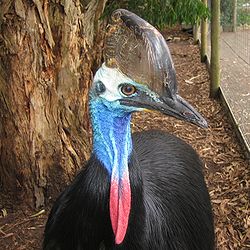
Wild individual seen in Etty Bay, Queensland, Australia
Scientific classification Edit this classification
Kingdom: Animalia
Phylum: Chordata
Class: Aves
Infraclass: Palaeognathae
Order: Casuariiformes
Family: Casuariidae
Genus: Casuarius
Species:
C. casuarius
Binomial name
Casuarius casuarius
Native distribution of the southern cassowary

The southern cassowary (Casuarius casuarius), also known as double-wattled cassowary, Australian cassowary, or two-wattled cassowary, is a large, flightless, mostly black bird, found in Indonesia, Papua New Guinea, and northeastern Australia. It is one of the three living species of cassowary, alongside the dwarf cassowary and the northern cassowary. It is a ratite and therefore related to the emu, ostrich, rhea and kiwi.

The Australian population is listed as Endangered under federal and Queensland state legislation.

Taxonomy

[edit]

Presently, most authorities consider the southern cassowary monotypic, but several subspecies have been described.[3] It has proven very difficult to confirm the validity of these due to individual variations, age-related variations, the relatively few available specimens (and the bright skin of the head and neck – the basis upon which several subspecies have been described – fades in specimens), and that locals are known to have traded live cassowaries for hundreds, if not thousands of years, some of which are likely to have escaped/been deliberately introduced to regions away from their origin.[3]

Cassowaries are most closely related to kiwis, their respective families diverging from a common ancestor approximately 40 million years ago.[3]

The binomial name Casuarius casuarius is derived from its Malay name kesuari.[4] The southern cassowary was first described by Carl Linnaeus, in his 18th-century work Systema Naturae, as Struthio casuarius,[5] from a specimen from Seram, in 1758.[6] It is now the type species of the genus Casuarius.[6] Common names for the species include southern cassowary, double-wattled cassowary, Australian cassowary,[2] and two-wattled cassowary.[6]

The southern cassowary has been described under a large number of scientific names, all of which are now considered taxonomic synonyms for the species.[7]

Description

[edit]
Phenotypic diversity of the head

The southern cassowary has stiff, bristly black plumage, a blue face and a long neck, red on the cape and two red wattles measuring around 17.8 cm (7.0 in) in length hanging down around its throat. A horn-like brown casque, measuring 13 to 16.9 cm (5.1 to 6.7 in) high, sits atop the head. The bill can range from 9.8 to 19 cm (3.9 to 7.5 in). The plumage is sexually monomorphic, but the female is dominant and larger with a longer casque, larger bill and brighter-coloured bare parts. The juveniles have brown longitudinal striped plumage.[6]

The three-toed feet are thick and powerful, equipped with a lethal dagger-like claw up to 12 cm (4.7 in) on the inner toe. It is perhaps the largest member of the cassowary family and is tied as the third heaviest bird on earth (after the Somali ostrich and the common ostrich), at a maximum size estimated at 85 kg (187 lb) and 190 cm (6 ft 3 in) tall. Normally, this species ranges from 127 to 170 cm (4 ft 2 in to 5 ft 7 in) in length.[6] The height is normally 150 to 180 cm (4 ft 11 in to 5 ft 11 in) ; females average 58.5 kg (129 lb), while males average 29 to 34 kg (64–75 lb). The northern cassowary is about the same size on average and is perhaps very mildly less sexually dimorphic than the southern.[6] Most adult birds will weigh between 17 and 70 kg (37 and 154 lb).[8] It is technically the largest Asian bird (since the extinction of the Arabian ostrich) and the largest Australian bird (though the emu may be slightly taller).[citation needed]

Range and habitat

[edit]

The southern cassowary is distributed in Indonesia, Papua New Guinea, and northeastern Australia.[9] It mainly inhabits tropical rainforests but may make use of nearby savannah forests or mangroves stands.[1] The species prefers elevations below 1,100 m (3,600 ft) in Australia,[6] and 500 m (1,600 ft) in New Guinea.[1]

As of 2018, according to Birdlife International, the breeding populations were as follows:[1]

Breeding population and trends
Location Population Trend
Southern New Guinea Unknown Declining
Seram, Indonesia Unknown Unknown
Aru Islands, Indonesia Unknown Unknown
Northeastern Australia 1,500 to 2,500 Declining
Paluma Range, Qld, Australia Unknown Declining
McIlwraith Range, Qld, Australia 1,000+ Declining
Apudthama National Park, Qld, Australia Unknown Unknown
Total 4,000+ Declining

Diet

[edit]
Adult male with two chicks

Southern cassowaries forage on the forest floor for fallen fruit and seeds and are capable of safely digesting some fruits and seeds toxic to other animals. They also eat fungi, and some insects, other invertebrates (such as snails), small vertebrates (such as fish, frogs, small birds and their eggs and nestlings, and small mammals), and carrion. When food is scarce, both wild and captive cassowaries have been seen to ingest earth, perhaps seeking supplementary minerals.[10] Inspection of the faeces reveals that commonly ingested fruits are Davidsonia pruriens, Syzygium divaricatum, and members of the palm (Arecaceae), quandong (Elaeocarpaceae), laurel (Lauraceae), and myrtle (Myrtaceae) families.[11][10]

Breeding

[edit]
Egg at Museum Wiesbaden

The southern cassowary is a solitary bird, which pairs only in breeding season, in late winter or spring. The male builds a nest on the ground,[6] a mattress of herbaceous plant material 5 to 10 centimetres (2–4 in) thick and up to 100 centimetres (39 in) wide. This is thick enough to let moisture drain away from the eggs. The male also incubates the eggs and raises the chicks alone. A clutch of three or four eggs are laid measuring 138 by 95 millimetres (5.4 in × 3.7 in). They have a granulated surface and are initially bright pea-green in colour although they fade with age.[6][12] Southern cassowaries make a thunderous call during mating season, and hissing and rumblings otherwise. Chicks will make frequent high-pitched contact whistles and chirps to call the male.[1]

Interaction with humans

[edit]
Silhouette comparison of the relative sizes of an adult man and a cassowary. The cassowary's head is at about shoulder height.
Full-grown southern cassowary compared to an adult man
Detail of feet showing spearlike inner claw

Southern cassowaries have a reputation for being dangerous to humans and other animals, and are often regarded as aggressive. The birds can jump quite high and kick powerfully with their blade-like claws. However, deadly encounters with southern cassowaries are rare. Only two human deaths have been reported since 1900. A 2003 historical study of 221 southern cassowary attacks showed that 150 had been against humans: 75% of these had been from southern cassowaries that had been fed by people, 71% of the time the bird had chased or charged the victim, 15% of the time they kicked. Of the attacks, 73% involved the birds expecting or snatching food, 5% involved defending their natural food sources, 15% involved defending themselves from attack, and 7% involved defending their chicks or eggs. Only one human death was reported among those 150 attacks.[13]

The first documented human death caused by a southern cassowary was on 6 April 1926. In Australia, 16-year-old Phillip McClean and his brother, age 13, came across a southern cassowary on their property and decided to try and kill it by striking it with clubs. The bird kicked the younger boy, who fell and ran away as his older brother struck the bird. The older McClean then tripped and fell to the ground. While he was on the ground, the cassowary kicked him in the neck, opening a 1.25 cm (0.5 in) wound that may have severed his jugular vein. The boy died of his injuries shortly thereafter.[14]

Another human death due to a southern cassowary was recorded in Florida, United States on 12 April 2019. The bird's owner, a 75-year-old man who had raised the animal, was apparently clawed to death after he fell to the ground.[15]

Being fed by people tempts southern cassowaries into closer associations with human-inhabited areas, increasing the already high risk of vehicle strikes – a major cause of southern cassowary mortality – and increasing the likelihood of encounters with humans.[16]

In a 2017 Australian Birdlife article, Karl Brandt suggested Aboriginal encounters with the southern cassowary may have inspired the myth of the bunyip.[17]

Conservation

[edit]

Although subject to ongoing habitat loss (some due to logging), limited range, and overhunting in some areas, the southern cassowary was evaluated as Least concern in 2018 by the International Union for Conservation of Nature (IUCN). Other threats include feral animals eating their eggs and roadkill.[1][6] Road-building, feral animals and hunting are the worst of these threats. It has an occurrence range of 396,000 km2 (153,000 sq mi), and between 10,000 and 20,000 birds were estimated in a 2002 study, with between 1,500 and 2,500 in Australia.[1]

The Australian population is listed as Endangered under federal (EPBC Act). Under the Nature Conservation (Animals) Regulation 2020 (Queensland), November 2022 list, the northern population is considered vulnerable, while the southern population remains as endangered.[2] A draft recovery plan to save the species was published by the federal government in June 2023, at which time there were estimated to be around 5,000 individuals in Australia.[18] A study published in Biological Conservation in March 2023 listed 23 species which the authors considered to no longer meet the criteria as threatened species under the EPBC Act, including the Southern cassowary. A 2021 study had shown that extensive reservation had led to recovery of the species, and legislation had prevented the previously rapid loss of habitat. The reason for their assessment was given as "Populations now stable or declining at a rate less than threshold".[19] The team, led by John Woinarski of Charles Darwin University looked at all species listed as threatened under the act in 2000 and 2022.[20]

Southern cassowaries have been bred in zoos around the world, including White Oak Conservation in Yulee, Florida, United States.[21]

[edit]

See also

[edit]

References

[edit]
[edit]
Revisions and contributorsEdit on WikipediaRead on Wikipedia
from Grokipedia
The Southern cassowary (Casuarius casuarius) is a large, flightless bird endemic to the tropical rainforests of , northeastern , and adjacent islands such as Seram and the Aru Islands, distinguished by its prominent casque on the head, vividly colored neck and wattled lobes, and powerful legs equipped with sharp, dagger-like claws capable of delivering dangerous kicks. Adults typically stand 1.5 to 1.8 meters (4.9 to 5.9 feet) tall, with females larger than males at up to 76 kilograms (167 pounds), while males weigh 29 to 55 kilograms (64 to 121 pounds); the species exhibits , with females featuring brighter and larger size. Primarily inhabiting lowland rainforests below 1,100 meters elevation, as well as mangroves, swamps, and occasionally eucalypt woodlands, the Southern cassowary plays a crucial ecological role as a keystone disperser, consuming fruits from over 200 and aiding regeneration by excreting viable seeds far from parent trees. Its diet is predominantly frugivorous but opportunistic, including fallen fruits, fungi, , small vertebrates, and carrion when available, foraged mainly during daylight hours in a slow, deliberate manner. Behaviorally solitary and territorial year-round, Southern cassowaries are generally shy and elusive, communicating through deep booms, hisses, and bill-clacking, though they can become aggressive when threatened, particularly during breeding season from May to October in . Breeding involves the female laying 3 to 5 large, olive-green eggs in a ground nest, after which the male assumes all parental duties, incubating the eggs for about 50 days and rearing precocial chicks for up to 9 months until independence. Globally assessed as Least Concern by the due to its wide distribution and estimated population of 20,000 to 50,000 mature individuals, the faces regional declines, particularly in where it is listed as Endangered under national legislation, driven by from and development, vehicle collisions, predation by dogs, and human-cassowary conflicts. Conservation efforts focus on protecting corridors, mitigating road impacts, and community education to sustain this vital biodiversity engineer.

Taxonomy and classification

Etymology and naming

The common name "" originates from the Malay word kasuari, which translates to "horned head" and alludes to the prominent casque atop the bird's head. This term was likely adopted by European explorers through interactions with Malay traders in the region, reflecting the bird's distinctive helmet-like feature. In indigenous languages of the bird's native range, variations include "muruk" in , the of , highlighting local cultural recognition of the species. The scientific binomial Casuarius casuarius was established by Swedish naturalist in the 10th edition of his in 1758, initially under the genus Struthio before the genus Casuarius was formalized. The genus name Casuarius directly derives from the same Malay root kasuari, emphasizing the linguistic connection to the bird's morphology. Linnaeus based his description on specimens from the Indonesian island of Seram, marking the formal entry of the species into Western . The descriptor "southern" in Southern cassowary serves to differentiate C. casuarius from its congeners, particularly the (Casuarius unappendiculatus), which inhabits northern , and the (Casuarius bennetti), found in the island's highlands. This naming convention reflects the species' primary distribution in the southern lowlands of and northeastern .

Phylogenetic position

The southern cassowary (Casuarius casuarius) occupies a distinct position within the avian phylogeny as a member of the order , the family , and the Casuarius. This placement reflects its status as one of three extant cassowary species, characterized by flightless, ratite-like morphology adapted to terrestrial life in forested environments. Within the broader context of paleognathous birds (), the southern cassowary shares a close evolutionary relationship with the (C. unappendiculatus) and the dwarf cassowary (C. bennetti), forming a monophyletic within Casuarius. This is further allied with the (Dromaius novaehollandiae) in the family , distinguishing them from other ratites such as ostriches, rheas, and kiwis. Phylogenetic analyses based on mitochondrial genomes consistently support this grouping, positioning Casuarius as a basal lineage among casuariids relative to the emu. Fossil evidence traces the divergence of ratites, including casuariids, from other avian lineages to approximately 50–80 million years ago during the to early , coinciding with the breakup of and the isolation of southern continents. The casuariid lineage likely originated and diversified in , as indicated by Oligo-Miocene fossils such as Emuarius gidju from Australian deposits, which exhibit transitional features between early ratites and modern cassowaries. estimates further refine this timeline, suggesting the split between the casuariid-emu and kiwis around 77 million years ago, with subsequent divergence between Casuarius and approximately 41 million years ago. Genetic studies utilizing mitochondrial DNA sequences from multiple cassowary specimens have reinforced the monophyly of the Casuarius genus, demonstrating low genetic divergence among its species and confirming their shared ancestry distinct from other paleognaths. These analyses, including complete mitochondrial genome sequencing, highlight the evolutionary conservation within Casuarius and its basal position relative to other crown-group cassowaries.

Subspecies

The southern cassowary (Casuarius casuarius) has been described with multiple subspecies or races based on morphological and geographic distinctions, though recent taxonomic assessments have questioned their validity due to limited genetic divergence. The nominate subspecies, C. c. casuarius, occupies the lowlands of New Guinea, including associated islands such as Aru and Seram, and exhibits the standard form with a transversely ridged casque and deep blue skin on the head and neck accented by red wattles. The Australian subspecies, C. c. johnsonii, is endemic to the tropical rainforests of northeastern , where populations are isolated from mainland by historical sea barriers; it is distinguished by brighter, more vivid red coloration on the neck wattles and brighter blue hues on the head skin compared to the nominate form. This isolation has resulted in reduced within Australian populations, increasing vulnerability to environmental changes. However, taxonomic debates persist, with studies from the indicating only minor genetic and morphometric divergence across populations, leading some authorities to treat the species as monotypic without formal . Major ornithological references, such as Birds of the World (as of 2022), consider the southern cassowary monotypic. For instance, geometric morphometric analyses of casques from New Guinean specimens revealed few significant differences between regional groups, supporting a single despite historical classifications recognizing up to eight races. This view is reinforced by phylogenetic research showing shallow divergence times linked to Pleistocene dispersal events between and .

Physical description

Size and morphology

The southern cassowary (Casuarius casuarius) is one of the largest flightless birds, characterized by a tall, robust body adapted for terrestrial life in dense rainforests. Adults typically stand 1.5 to 1.8 meters in height, measured from the ground to the top of the casque, with body lengths ranging from 127 to 170 centimeters. Adults weigh between 29 and 76 kilograms, with pronounced : females average about 58 kilograms and reach up to 76 kilograms, while males weigh 29 to 55 kilograms. This species exhibits pronounced sexual size dimorphism, with females up to 30% larger than males in overall body mass and linear dimensions, a trait common among ratites that supports the females' role in territorial defense and egg production. The build is sturdy and upright, featuring a heavy torso supported by powerful, muscular legs that enable rapid locomotion; these birds can sprint at speeds up to 50 kilometers per hour through thick undergrowth, aided by their elongated strides and strong tendons. Wings are vestigial and reduced to small, featherless stubs hidden beneath the , rendering flight impossible and emphasizing reliance on ground-based mobility. The feet are three-toed and robust, with the inner toe bearing a dagger-like up to 12 centimeters long, used for scratching, digging, and defense; this , combined with the bird's kicking , can inflict severe injuries. Skeletally, adaptations for flightlessness include a keelless , which lacks the ridge for anchoring large flight muscles found in volant birds, and denser, more solid bones throughout the to provide stability and support the animal's mass without the need for lightweight pneumatization. These features, shared with other ratites, reflect evolutionary convergence toward cursorial lifestyles in forested environments.

Plumage and coloration

The southern cassowary exhibits glossy black that consists of quill-like, hair-like feathers lacking extensive barbules, resulting in a shaggy, coarse texture adapted to dense environments. These feathers, similar to those of other ratites, provide a protective layer against thorns, sharp , and while offering some through trapped air pockets. The absence of typical interlocking barbs contributes to the feathers' satin-like sheen, which arises from a thick, smooth rachis structure producing a novel form of gloss as . The bird's head and neck are largely bare, featuring vibrant blue skin on the face and fore-neck, accented by red wattles and patches of yellow-red coloration on the nape and throat. These vivid hues serve roles in visual communication and display during social interactions, with skin tones capable of intensifying or shifting slightly in response to excitement or agitation. Subspecies show minor variations in skin coloration and casque shape, though overall plumage remains uniformly black across forms. Juveniles differ markedly from adults, hatching with longitudinal brown and creamy-white stripes for that fade to uniform dull brown between three and six months of age. This brownish juvenile phase persists until approximately four years, when molting transitions the feathers to the glossy adult black, coinciding with . The bare neck skin in young birds starts duller, gradually developing the bright blue and red tones. The striking coloration of the bare skin aids in the by facilitating heat dissipation through vascularized tissue, while also playing a key role in displays and territorial signaling among individuals. The dark , conversely, enhances concealment within shaded understories, minimizing visibility to predators or rivals.

Distinctive features

The southern cassowary is distinguished by its prominent keratinous casque, a helmet-like structure atop the head measuring 10-20 cm in length, which is composed of a tough, elastic, spongy outer layer of overlying a bony core formed by fused cranial elements including the nasals, lacrimals, frontals, mesethmoid, and a median casque element. This casque is largely hollow internally, providing a lightweight yet sturdy form that may function as a during movement through dense vegetation or as a to amplify low-frequency vocalizations. Proposed roles also include visual display for species recognition and territorial signaling, as well as protection against impacts while pushing through undergrowth. Another key feature is the dagger-like on the inner toe of each foot, which can reach up to 12.5 cm in length and serves as a primary defensive capable of inflicting severe lacerations. This , along with the other two toes on the three-toed foot, may also aid in digging or scratching the forest floor to access food sources, though its defensive utility is most emphasized in anatomical studies. The bird's legs are exceptionally powerful, supported by thick, scaly that covers muscular thighs and lower limbs adapted for in forested environments. These legs enable bursts of speed reaching 50 km/h and vertical jumps of up to 2 meters, facilitated by strong extensor muscles and a robust skeletal structure that distribute the bird's weight effectively during rapid acceleration or evasion. Anatomically, the southern cassowary possesses specialized vocal structures, including an enlarged and inflatable throat pouches, that produce low-frequency booms down to about 32 Hz—near the lower limit of human hearing—potentially amplified by the casque's resonant cavity to extend communication range in dense habitats.

Distribution and habitat

Geographic range

The Southern cassowary (Casuarius casuarius) is native to the tropical rainforests of , northeastern , and parts of eastern , with its range shaped by the biogeographic barrier of the that separates Asian and Australasian faunas. In , the species occupies lowlands up to elevations of approximately 1,100 meters across much of the island, excluding the northern watershed regions between the Sepik and Ramu rivers. It also occurs on nearby islands, including Seram and the Aru Islands in . In , the Southern cassowary is restricted to northern , where the largest continuous population extends from the Paluma Range north of to around Mount Amos in the Wet Tropics, with smaller, disjunct populations further north on , such as near the McIlwraith and Iron Ranges. The Australian range spans an extent of occurrence of about 23,400 km², though the area of occupancy is considerably smaller due to . Historically, the species had a broader distribution across northern following the end of the last , when cooler, wetter conditions supported more extensive cover, but post-glacial warming and subsequent human-induced alterations led to significant range contraction and population isolation. Attempts to introduce the Southern cassowary outside its native range, such as to certain Indonesian islands, have not resulted in established populations. Current global population estimates place the number of mature individuals between 20,000 and 49,999, though this figure is precautionary and likely underestimates the total, with the population trend decreasing due to ongoing threats (assessed in 2018). In Australia, the population is estimated at approximately 4,000–4,500 individuals as of 2025 assessments.

Habitat requirements

The southern cassowary exhibits a strong preference for intact, mature tropical rainforests characterized by a dense and a diverse array of fruiting trees, particularly those in the family, which provide essential food resources. These birds are highly dependent on primary forest ecosystems where fallen fruits form a staple of their diet, and they generally avoid open areas or heavily degraded due to the lack of suitable cover and food availability. While they primarily inhabit closed-canopy rainforests, they occasionally utilize edge habitats, swamp forests, mangroves, and even adjacent woodlands as supplementary or transit areas. In terms of elevation, the species occupies lowlands up to approximately 1,100 m in (typically below 500 m), but in northeastern , it is typically restricted to elevations below 150 m, reflecting adaptations to coastal rainforest environments. Southern cassowaries show sensitivity to microclimatic variations, favoring humid, shaded conditions within dense that maintain stable temperatures and moisture levels critical for their and efficiency. These preferences underscore their vulnerability to alterations in forest structure, such as canopy gaps that expose them to drier or hotter conditions. Habitat fragmentation poses significant challenges to southern cassowary movement and survival, as the species has a limited ability to traverse altered landscapes like cleared agricultural areas or roads, which disrupt natural dispersal routes. This fragmentation isolates populations and hinders , particularly for juveniles seeking new territories, necessitating the maintenance of vegetated corridors to connect remnant forest patches and support long-term viability. Adults with established home ranges also rely on such corridors for seasonal movements to fruit-rich areas.

Population distribution

The southern cassowary maintains low population densities across its range, typically ranging from 0.04 to 1.8 individuals per km² in habitats, with optimal areas supporting 0.1 to 1 individual per km². Densities can be higher in fruit-rich zones where food availability supports greater aggregation, though such variations are influenced by seasonal fruiting patterns and habitat quality. In , the population is estimated at approximately 4,000–4,500 individuals as of 2025, distributed in fragmented subpopulations primarily within the Wet Tropics and of northeastern . These groups are isolated by , leading to local extirpations in parts of due to reduced connectivity and small population sizes. In contrast, the population is substantially larger, comprising the majority of the global estimate of to 50,000 mature individuals, though it exhibits a declining trend amid broader habitat pressures. Spatial patterns show concentrations in remote, intact forests, with abundance decreasing toward human-modified edges. Population monitoring has relied on non-invasive methods such as camera traps and scat surveys since the , enabling estimates of density and distribution without disturbing the species' elusive behavior. Camera trapping, in particular, has been scaled up across the Australian range to map occupancy and abundance, revealing patchy distributions tied to core patches; a 2025 range-wide study confirmed these patterns and refined abundance estimates. Scat surveys complement these efforts by providing insights into local presence and dietary indicators of in understudied New Guinea areas.

Behavior and ecology

Diet and feeding

The southern cassowary (Casuarius casuarius) is primarily frugivorous, with fruits comprising the bulk of its diet and records indicating consumption from over 200 plant species, predominantly fallen fruits from trees and shrubs in families such as , , Elaeocarpaceae, and . It supplements this with fungi, like and snails, and occasionally small vertebrates or carrion, particularly when fruit availability is low. Foraging occurs on the , where the scratches the with its powerful feet to uncover buried fruits and tosses items into its bill before swallowing them whole, a method that accommodates large-seeded fruits unsuitable for smaller dispersers. This positions the southern as a key seed disperser in tropical rainforests, transporting viable away from parent plants via , often over distances exceeding 200 meters. Individuals consume an estimated 2–5 kg of daily, depending on availability and body size, with captive studies reporting averages around 2.9–3 kg. During lean fruiting periods, such as May–July in parts of its range, the diet shifts toward more persistent fruiting species and increased animal matter to meet nutritional needs. Through gut passage, the enhances seed germination for many plant species by scarifying tough coatings and providing nutrient-rich fecal deposits, thereby playing a vital role in regeneration and maintenance as a .

Locomotion and activity patterns

The southern is flightless and employs a bipedal , utilizing its robust, muscular legs for walking, running, and jumping through . These legs enable short bursts of speed reaching up to 50 km/h (31 mph), allowing rapid evasion of predators or navigation of challenging terrain. The is also adept at short distances, often crossing creeks, rivers, or coastal waters to access resources or flee threats. Primarily diurnal, the southern cassowary forages and moves actively during daylight hours, though it shifts to crepuscular patterns—peaking and —in hotter conditions to minimize stress and reduce encounters with diurnal competitors. Individuals maintain home ranges spanning approximately 0.5–5 km² (up to 12 km² in uplands), depending on habitat quality and , which they patrol daily to and defend against intruders. These solitary, territorial birds deposit large piles of dung during patrols, which serve as indicators of their presence. Adaptations for traversing dense vegetation include the keratinous casque atop the head, which shields against branches and thorns, and a low head carriage that facilitates pushing through thick foliage while maintaining forward momentum. This posture, combined with three-toed feet for stability on uneven ground, supports efficient movement in low-light, obstructed environments where visibility is limited.

Social structure and communication

The southern is predominantly solitary, maintaining individual territories and avoiding interactions with other adults outside of the breeding season, during which brief pairings occur for . Members of the same generally steer clear of one another, though females exhibit social dominance over males, often causing males to retreat upon encounter. In areas with superabundant fallen fruit, however, individuals may show loose tolerance toward one another, allowing temporary proximity without aggression. Communication primarily relies on vocalizations and visual displays adapted to the dense environment. The species produces deep, low-frequency booming calls that reach as low as 32 Hz, bordering on and enabling propagation over long distances through thick vegetation to signal presence or attract mates. These booms are often accompanied by hisses during defensive situations, while the casque atop the head may serve in visual signaling, such as during territorial posturing where the bird lowers its head to emphasize the structure. Grunts and rumblings also convey alarm or warnings, frequently alerting observers to the bird's approach before it is visible. Aggression is displayed through a series of escalating behaviors to deter intruders, including standing tall, ruffling , and emitting hisses or booms to intimidate. If threats persist, the cassowary may charge with its powerful legs and threaten with the sharp inner toe claw, capable of inflicting severe injuries, particularly by territorial males during the breeding period. Such confrontations between males typically involve standoffs with feather fluffing and vocalizations until one retreats, minimizing physical contact. Group formation is minimal, with no stable social units beyond parent-offspring bonds; juveniles remain with the male parent for approximately nine months before dispersing to establish independent territories. This dispersal coincides with the fading of juvenile stripes and the onset of independence, ensuring limited overlap in adult ranges.

Reproduction and life cycle

Mating system

The southern cassowary employs a sequentially polyandrous , in which females mate with multiple males over the course of a breeding season, typically two to three, without forming long-term pair bonds. In this system, females maintain larger territories that overlap with those of several males, allowing them to sequentially select and breed with different partners, while males defend smaller, exclusive areas and provide all after . Courtship is initiated and dominated by females, who actively pursue prospective males through chases that gradually become less aggressive as acceptance is signaled, reflecting female control in mate selection. Males respond with vocalizations, including a distinctive "boo-boo-boo" call produced while inflating their throats, and may perform stretch displays to appear larger and more imposing. by females appears influenced by the quality of a male's , particularly its resources, as territories rich in support successful chick-rearing by the male post-mating. Breeding timing is opportunistic and closely tied to fruit availability in their tropical habitats, occurring year-round where resources permit but peaking from May to October (or June to November in some areas) during periods of high fruit abundance. This synchronization ensures females can locate suitable males with well-provisioned territories, optimizing reproductive success in a fruit-dependent ecosystem.

Breeding biology

The southern cassowary reaches at approximately three years of age for both males and females, though some sources report variation between 2.5 and 4 years depending on environmental conditions and . Once mature, individuals can reproduce for several decades, with some captive males fathering beyond 30 years. Females produce large, olive-green to dark green eggs with thick shells, measuring about 13.5–16 cm in length and weighing 500–600 grams each. A typical clutch consists of three to five eggs, though up to eight have been reported in some cases. Oviposition occurs at intervals of two to three days until the clutch is complete, with the female laying all eggs in a ground scrape prepared by the male. Following the completion of a , females often engage in multiple matings, laying subsequent at intervals of several weeks with different males during the breeding season. This polyandrous system is facilitated by the female's ability to store viable from multiple males in specialized structures within the reproductive tract, enabling delayed fertilization and the potential for a single to contain eggs sired by more than one male.

Development and parental care

Following egg-laying, the female southern cassowary abandons the nest, leaving all parental responsibilities to the male. The male incubates the clutch of 3–5 large, greenish eggs for 47–54 days, during which he remains vigilant, rarely leaving the nest except for brief periods to feed and rarely stands to turn the eggs. This extended incubation period requires the male to guard aggressively against potential predators such as feral dogs and monitor lizards, ensuring the eggs' protection in the humid rainforest understory. Upon hatching, southern cassowary chicks are precocial, covered in striped brown down for and capable of following their immediately, though they weigh only about 0.35 kg. The male provides exclusive care, leading the chicks through the , defending them from threats, and regurgitating to supplement their diet during the initial weeks. Chicks develop flightless feathers around 3 months of age but remain dependent on the for up to 9–12 months, during which the family group forages together and the young gradually learn . Southern cassowary chicks exhibit rapid growth, increasing from weight to approximately 14.5 kg by 6 months and attaining near-adult body size within 1–2 years, though is not reached until 2.5–3 years of age. Juvenile mortality is high, particularly in the first year, with probable low natural survival rates due to predation, , and road hazards, contributing to slow population recruitment. Throughout this period, the male father teaches techniques, such as identifying fallen fruits and navigating dense , and imparts avoidance behaviors to evade dangers, fostering the chicks' independence before dispersal.

Interactions with humans

Cultural and historical significance

In the indigenous cultures of , the southern cassowary is revered as an ancestral spirit and , symbolizing both male and female attributes and often viewed as a complete being capable of reproduction without a mate. Its bones are used to craft ceremonial daggers in the , believed to embody the bird's spiritual power due to its cultural associations with motherhood and fertility. Cassowary feathers are integral to traditional rituals and ceremonies, prominently featured in male headdresses worn during dances, wars, and festivals to signify prestige and status. Among Australian Aboriginal peoples in the Wet Tropics region, the southern cassowary features prominently in Dreamtime narratives as a creator figure, protector of the , and sometimes a transformative being. Known by names such as Kutini or Gunduy, it appears in stories like that of the Girramay people, where a man named Goondoye is transformed into the bird after breaking cultural taboos, emphasizing themes of solitude and guardianship. These oral traditions, passed down through songs, dances, and ceremonies, underscore the cassowary's role in maintaining ecological and spiritual balance. European contact with the southern cassowary began in 1597, when Dutch traders imported a live specimen from Banta Island near to , marking the first recorded arrival in and sparking interest among naturalists. By the late , British naturalist Walter amassed dozens of living cassowaries in his private zoological collection at Tring Park, , where they were studied and displayed, contributing to early scientific understanding of the species. In contemporary times, the bird inspires artistic representations, from motifs to modern paintings sold to tourists, and serves as a flagship icon for in northern Queensland's rainforests, promoting cultural awareness and habitat appreciation.

Conflicts and safety concerns

Southern cassowaries pose risks to humans primarily through defensive behaviors, with documented attacks causing injuries or fatalities in rare cases. A comprehensive study of 221 recorded attacks in Queensland, Australia, identified 150 incidents involving humans, including eight cases of serious injury and one fatality in 1926, where a cassowary kicked and disemboweled a young boy. In 2019, a pet southern cassowary in Florida, United States, killed its 75-year-old owner during a confrontation, marking the second recorded human death by the species; the bird slashed the man's leg with its dagger-like inner toe claw, leading to fatal blood loss. Attacks are typically triggered by human actions such as feeding the birds, which habituates them to people and accounts for 75% of incidents, or by cornering, approaching nests with chicks, or invading territory, prompting defensive responses. Cassowaries deliver powerful forward kicks using their robust legs and sharp, three-toed feet, where the innermost claw—up to 12 cm long—can penetrate flesh, muscle, and even vital organs, often while the bird jumps onto the victim. To mitigate risks, especially for hikers and residents in cassowary habitats, official guidelines emphasize never feeding or approaching the birds, maintaining a distance of at least 10 meters, and slowly backing away if one approaches while remaining calm to avoid provoking a charge. In the event of an attack, individuals should protect their head and neck, curl into a ball if knocked down, and seek immediate medical attention, as wounds from cassowary claws require urgent treatment to prevent infection. Although attack incidence remains low relative to human encounters—fewer than 150 documented human cases over a century—conflicts are increasing due to expanding habitat overlap from and in northeastern rainforests. This rise underscores the need for on coexistence, as human encroachment not only heightens aggression risks but also contributes to broader threats like vehicle strikes.

Captivity and aviculture

The Southern cassowary has been maintained in captivity since the early , with notable breeding successes contributing to population assurance. The received its first pair in 1929, and the first documented chick to hatch and survive in managed care occurred there in 1957. Facilities like the , , and have participated in regional and international breeding programs, often mimicking natural environments with dense , shade, and substrate for to promote natural behaviors. These programs have achieved hatches, such as at Blank Park Zoo in 2019 and ongoing efforts at , which coordinates the national breeding program in . In August 2025, in the UK hatched a chick—the first there in 21 years and the first in that year—demonstrating continued success in . Captive management presents significant challenges due to the bird's territorial nature, aggression, and specific needs. Southern cassowaries require large enclosures to reduce stress and ; guidelines recommend a minimum of two adjacent areas, each at least 18 m × 12 m (approximately 1,000 total for a pair), with secure , natural barriers, and hiding spots to allow separation during non-breeding periods. Their diet in must replicate wild frugivory, consisting primarily of varied fruits (e.g., pawpaw, bananas, and native berries) supplemented with browse, , fungi, and commercial pellets to meet nutritional requirements and prevent deficiencies. , particularly during breeding, necessitates careful handling protocols, including visual barriers and remote feeding to minimize human-bird interactions. Genetic management is coordinated through studbooks to maintain diversity and prevent in captive populations. The Australasian Species Management Program oversees regional efforts, while the European Studbook (ESB) and International Studbook track pedigrees and recommend transfers between facilities. These tools have supported a stable captive population of over 100 individuals across zoos as of , aiding long-term viability. Captive programs play a key role in public education about the species' ecological importance and conservation needs, with exhibits fostering through interpretive signage and guided tours. Although reintroduction trials remain limited due to challenges like post-release survival, past Australian recovery plans have considered using captive-bred juveniles for habitat supplementation where feasible.

Conservation

Status and threats

The southern cassowary (Casuarius casuarius) is currently classified as Least Concern on the , a status it has held since following a downlisting from Vulnerable, though its global population is decreasing due to persistent anthropogenic pressures. In , where the species faces more acute risks, it is listed as Endangered under national legislation, reflecting localized declines driven by habitat pressures in the Wet Tropics and Cape York regions. Overall population estimates suggest 20,000–50,000 mature individuals across its range, with ongoing fragmentation exacerbating vulnerability. The most significant threat to the southern cassowary is habitat loss and fragmentation, primarily from , , and urban development, which have historically reduced suitable lowland areas by approximately 80% in key regions like Australia's Wet Tropics by the late . Deforestation rates in these areas peaked in the mid- but have slowed to approximately 1% annually since the due to some protective measures, yet cumulative impacts continue to isolate populations and limit dispersal. In , ongoing commercial further compounds range contraction, with road networks facilitating access for resource extraction. Additional dangers include vehicle collisions, which cause significant mortality, particularly along coastal roads in where hotspots have been identified near urban fringes. Hunting for meat and feathers persists at low to moderate levels in parts of and , though it is less prevalent in . Predation by such as feral dogs and pigs threatens eggs and juveniles, while disrupts fruiting cycles essential for the bird's diet and intensifies events that destroy and food sources. These factors collectively contribute to a projected continued decline unless addressed.

Protection measures

The southern cassowary (Casuarius casuarius johnsonii) is protected under Australia's Environment Protection and Biodiversity Conservation Act 1999 (EPBC Act), listing it as Endangered at the national level, and under Queensland's Nature Conservation Act 1992, which affords it the same status within the state where its Australian population resides. These designations prohibit unauthorized taking, trade, or habitat disturbance, with recovery plans mandating habitat mapping and development approvals to safeguard remaining populations. Key protected areas include in , , which encompasses critical lowland rainforest habitat essential for the bird's survival and seed dispersal role. In and , Wasur National Park in serves as a vital reserve, preserving and forest ecosystems where southern cassowaries forage and breed. Within these regions, community-based monitoring programs in villages track cassowary populations and hunting activities, enabling sustainable management through collaboration with external researchers. Reforestation and habitat corridor initiatives in the 2020s have focused on reconnecting fragmented rainforests in , such as the SUGi Project's Gurrbum in Queensland's Smiths Gap, planted in 2021 with native to link habitats across 2 hectares. Similarly, the Tropical ReGen project, launched in collaboration with Indigenous groups, has planted over 10,000 trees from 180 since its 2021 launch to restore a 213-hectare corridor in the Daintree region (as of 2024). Anti-poaching efforts in involve community rangers using for real-time monitoring of protected areas, reducing illegal hunting pressures on cassowaries. funding supports these measures through schemes like Cassowary Credits, which incentivize landowners to restore habitats via offsets, generating revenue for ongoing protection in Queensland's Wet Tropics.

Future outlook

The future outlook for the southern cassowary remains precarious, with ongoing threats from habitat loss and projected to drive further population declines without intensified interventions. Modeling efforts indicate that suitable habitat in the Australian Wet Tropics is expected to contract significantly under high-emission scenarios, particularly around the Atherton Tablelands, as rising temperatures and altered rainfall patterns disrupt ecosystems critical to the . These projections, based on ensemble forecasts from 18 global circulation models under RCP8.5, suggest a continuous reduction in habitable range through 2085, potentially exacerbating fragmentation and limiting dispersal opportunities for the . Emerging research is enhancing monitoring and predictive capabilities to inform conservation strategies. Large-scale camera surveys conducted across the ' Australian range in 2024-2025 have quantified associations, revealing higher detection rates in intact rainforests compared to adjacent forests and underscoring the need for quality preservation. modeling continues to evolve, incorporating CMIP6 projections to map suitability shifts, which highlight vulnerabilities to sea-level rise and changes in fruiting that could affect food availability. Additionally, non-invasive genetic techniques using scat and feather samples are advancing population estimates and connectivity assessments, providing tools for tracking demographic trends in fragmented landscapes. Recovery potential exists through targeted expansions of protected areas and connectivity enhancements, which could stabilize or reverse declines if implemented swiftly. The Australian federal draft recovery plan proposes increasing protected by 50% by 2031 via strategic land acquisitions and revegetation of corridors, aiming to link fragmented patches and reduce in the Wet Tropics. Such measures, building on existing protections like national parks that cover about 89% of essential , could support population recovery by mitigating road mortality and impacts, with early modeling suggesting improved viability in connected landscapes. Key knowledge gaps persist, particularly in long-term and disease dynamics, hindering comprehensive risk assessments. While initial genetic studies indicate bottlenecks from , broader genomic surveys are needed to evaluate risks across subpopulations. Similarly, the impacts of emerging diseases on wild populations remain poorly understood, with captive management reports noting vulnerabilities to pathogens but limited data on transmission in natural settings. Addressing these through integrated will be essential for and ensuring the species' persistence amid accelerating environmental pressures.

References

Add your contribution
Related Hubs
Contribute something
User Avatar
No comments yet.