


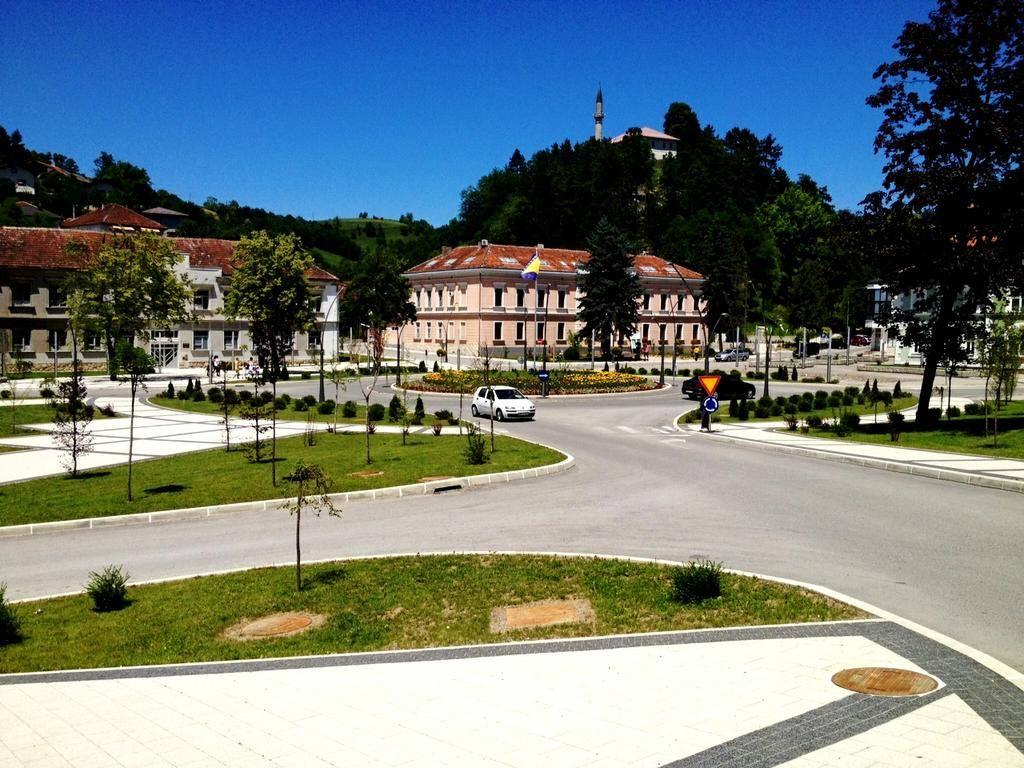
Community hub
Recent from talks
Contribute something
Nothing was collected or created yet.
Cazin
View on WikipediaCazin (Serbian Cyrillic: Цазин) is a city located in Una-Sana Canton of the Federation of Bosnia and Herzegovina, an entity of Bosnia and Herzegovina. It is situated in northwest Bosnia and Herzegovina in the Bosanska Krajina region, near the border with Croatia. As of 2013, it has a population of 66,149 inhabitants. The municipality is often also called Cazinska Krajina. The town of Cazin is located on the main road which connects Bihać and Velika Kladuša.
Key Information


History
[edit].jpg)
Cazin has several historic places, some dating back to the 14th century. The Ostrožac Castle and Radetina Tower are located in Cazin. During the Middle Ages, the city served as the seat of the Roman Catholic bishop of Knin.[2]
The Cazin uprising of 1950, an armed anti-communist rebellion of peasants, occurred in Cazin and neighboring Velika Kladuša and Slunj, which were all part of the Socialist Federal Republic of Yugoslavia at the time.[3] The peasants revolted against the forced collectivization and collective farms by the Yugoslav government on the farmers of its country.
Following a drought in 1949, the peasants of Yugoslavia were unable to meet unrealistic quotas set by their government and were punished. The revolt that followed the drought resulted in the killings and persecution of those who organized the uprising, but also many innocent civilians.[4][5] It was the only peasant rebellion in the history of Europe that occurred during the Cold War.[6]
Settlements
[edit]Aside from the urban area of Cazin, the city administrative area comprises the following settlements:
- Bajrići
- Brezova Kosa
- Bukovica
- Crnaja
- Čajići
- Čizmići
- Ćehići
- Ćoralići
- Donja Barska
- Donja Koprivna
- Donja Lučka
- Glogovac
- Gornja Barska
- Gornja Koprivna
- Gornja Lučka
- Gradina
- Hadžin Potok
- Kapići
- Kličići
- Kovačevići
- Krakača
- Krivaja
- Liđani
- Liskovac
- Ljubijankići
- Majetići
- Miostrah
- Mujakići
- Mutnik
- Osredak
- Ostrožac
- Ostrožac na Uni
- Pećigrad
- Pivnice
- Pjanići
- Podgredina
- Polje
- Ponjevići
- Prošići
- Rošići
- Rujnica
- Skokovi
- Stijena
- Šturlić
- Šturlićka Platnica
- Toromani
- Tržac
- Tržačka Platnica
- Tržačka Raštela
- Urga
- Vilenjača
- Vrelo
- Zmajevac
Demographics
[edit]According to the 2013 census, the municipality of Cazin has a population of 66,149 inhabitants. The town of Cazin has a population of 13,863.
Ethnic groups
[edit]The ethnic composition of the municipality: Here is the table with the columns ordered by year, starting with 2013 on the left:
| Ethnic group | Population 2013[7] |
Population 1991[8] |
Population 1981 |
Population 1971 |
|---|---|---|---|---|
| Bosniaks/Muslims | 63,463 | 61,693 | 55,401 | 43,880 |
| Croats | 320 | 139 | 122 | 175 |
| Serbs | 29 | 778 | 826 | 1,196 |
| Yugoslavs | - | 430 | 529 | 51 |
| Others/Unspecified | 2,337 | 369 | 232 | 166 |
| Total | 66,149 | 63,409 | 57,110 | 45,468 |
Twin towns – sister cities
[edit]Cazin is twinned with:
 Develi, Turkey[9]
- Kahramanmaraş, Turkey[10]

Gallery
[edit]-
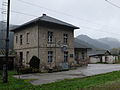 Cazin Srbljani (railway station)
 -
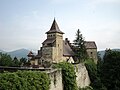
-
 Cazin fortress
 -
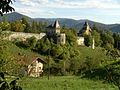
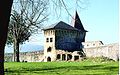 Cazin fortress
.jpg)


See also
[edit]References
[edit]- ^ "Preliminarni Rezultati Popisa stanovništva, domaćinstava i stanova u Bosni i Hercegovini 2013" (PDF). Archived from the original (PDF) on 2018-11-23. Retrieved 2013-11-06.
- ^ HAMDIJA KREŠEVLJAKOVIĆ, 1953, STARI BOSANSKI GRADOVI (VIEUX BOURGS BOSNIAQUES) https://www.fmks.gov.ba/download/zzs/1953/1-1953.pdf #page=32
- ^ "CAZINSKA BUNA 1950: Danas se navršavaju 62 godine od ustanka u Krajini". Cazin. 6 May 2012. Archived from the original on 9 June 2012. Retrieved 11 February 2014.
- ^ "Klanjana kolektivna dženaza žrtvama Cazinske bune iz 1950. godine". Haber. 11 May 2012. Archived from the original on 22 February 2014. Retrieved 11 February 2014.
- ^ "Vera Kržišnik Bukić i Cazinska buna". Radio Sarajevo. 4 May 2012. Archived from the original on 22 February 2014. Retrieved 11 February 2014.
- ^ Mueller, Andrew (2010). Rock and Hard Places: Travels to Backstages, Frontlines and Assorted Sideshows. Soft Skull Press. ISBN 9781593763794. Retrieved 11 February 2014.[permanent dead link]
- ^ "POPIS STANOVNIŠTVA, DOMAĆINSTAVA I STANOVA U BOSNI I HERCEGOVINI, 2013. REZULTATI POPISA" (PDF). popis2013.ba (in Serbian). Archived from the original (PDF) on 24 December 2017. Retrieved 9 May 2018.
- ^ "Bosnian Congres - census 1991 - North of Bosnia". Hdmagazine.com. Archived from the original on 13 June 2013. Retrieved 9 May 2018.
- ^ "Kardeş Belediyeler". develi.bel.tr (in Turkish). Develi. Retrieved 2020-12-28.
- ^ "Gradsko vijeće Cazin: Donesena odluka o bratimljenju Cazina sa turskom općinom Kahramanmaraš". rtvcazin.ba (in Bosnian). Radio-televizija Cazin. 2018-02-22. Retrieved 2020-12-28.[permanent dead link]
External links
[edit]
- Official website
- BK Krajina Archived 2021-05-04 at the Wayback Machine
- Cazin
Municipalities of the Una-Sana Canton | ||
|---|---|---|
 | ||


| International | |
|---|---|
| National | |
| Other | |

Cazin
View on GrokipediaGeography
Location and Administrative Status
Cazin is situated in the Una-Sana Canton of the Federation of Bosnia and Herzegovina, in the northwestern part of the country within the Bosanska Krajina region.[5] The municipality lies near the international border with Croatia, facilitating regional connectivity through proximity to cross-border routes.[5] Its geographical coordinates are approximately 44°58′01″N 15°56′35″E.[6] Cazin is located about 20 kilometers north of Bihać by road and roughly 140 kilometers from Zagreb, Croatia.[7][8] As a municipality, Cazin encompasses an administrative area divided into multiple settlements, with reports indicating around 22 local communities.[9] Following the Dayton Agreement of 1995, which established the Federation of Bosnia and Herzegovina as one of two entities and delineated internal boundaries, Cazin's municipal borders were integrated within the Una-Sana Canton structure, maintaining its status without territorial reconfiguration specific to the area.[10] The cantonal framework, including Una-Sana, was formalized post-agreement to govern sub-entity administration.[10] Portions of the Cazin municipality border the Una River, particularly in areas like Ostrožac, contributing to its hydrological and regional connectivity features.[11] This proximity underscores Cazin's position in the Una-Sana river basin, influencing local geography and cross-border interactions with Croatia along the Una valley.[11]Physical Features and Climate
Cazin lies within the Bosanska Krajina region of northwestern Bosnia and Herzegovina, featuring undulating hilly terrain shaped by the Dinaric karst landscape, with the municipal area encompassing elevations from approximately 200 meters in the Una River valley to around 400 meters or higher in surrounding uplands.[12][13] The Una River, a major tributary of the Sava, traverses the western part of the municipality, forming a fertile valley amid limestone karst formations that include poljes, sinkholes, and groundwater systems typical of the region.[14] This hydrology supports local water resources while exposing low-lying areas to periodic inundation, as evidenced by historical flood events along the Una.[15] The climate is humid continental, with distinct seasonal variations driven by the inland position and topographic influences. Winters are cold, with January averages hovering near 0°C (highs around 4°C, lows -3°C), often accompanied by snowfall.[16] Summers are warm, peaking in July with averages of about 20°C (highs up to 26°C, lows 14°C).[17] Annual precipitation totals roughly 1,200 mm, distributed fairly evenly but with higher intensity in autumn and spring, fostering dense mixed forests covering significant portions of the hills and enabling arable farming in valleys. The terrain's karst permeability and river proximity heighten flood risks during heavy rains, impacting habitability and agriculture in lower elevations.[18]History
Origins and Medieval Period
The region encompassing modern Cazin, situated in the Una River valley, exhibits evidence of early human habitation by Illyrian tribes, particularly the Iapodes, who occupied northwestern Bosnia during the Iron Age. Archaeological investigations in the Una valley have uncovered settlements, fortifications, and artifacts attributable to these groups, reflecting a tribal society engaged in pastoralism, metallurgy, and conflict with neighboring peoples.[19] Roman expansion into the Balkans from the 2nd century BCE onward brought indirect influences to the area through military campaigns and infrastructure, including nearby roads facilitating trade and control; remnants such as coins and building foundations in the valley attest to limited Roman penetration and interaction with local Illyrian populations.[20] Slavic migrations into the Balkans during the 6th and 7th centuries CE led to the gradual settlement of the Una valley by South Slavic groups, supplanting or assimilating prior inhabitants amid the collapse of Roman provincial administration. By the early Middle Ages, the area formed part of emerging Slavic polities in the region, with sparse documentation indicating rural communities centered on agriculture and local lordships. The written record for Cazin itself remains obscure until the late medieval period, consistent with the limited literacy and administrative centralization of early Bosnian principalities.[21] In the high medieval era, the territory around Cazin integrated into the Banate of Bosnia, which evolved under the Kotromanić dynasty. The Ostrožac fortress, overlooking the Una near Cazin, was first documented in 1286 as a holding of the Croatian noble Babonić family, serving as a defensive stronghold amid feudal rivalries; its construction underscores the strategic importance of the valley for controlling riverine routes.[22] Under Ban Stephen Tvrtko I (r. 1353–1377), who crowned himself king in 1377 and expanded Bosnian holdings northwestward, the region likely contributed to the kingdom's military and economic base, though direct references to Cazin are absent; fortifications like Ostrožac remained modest, reflecting a decentralized landscape with low population densities inferred from the paucity of contemporary charters and tax impositions.[23] Pre-Ottoman settlement patterns, evidenced by archaeological surveys and feudal documents, suggest dispersed villages rather than urban centers, with overall regional demographics remaining thin due to mountainous terrain and subsistence economies.[24]Ottoman Rule and Islamicization
The Ottoman conquest of the Kingdom of Bosnia occurred rapidly in the summer of 1463, with Sultan Mehmed II's forces overrunning central Bosnia, including the Una valley region encompassing Cazin, after the decisive defeat and execution of King Stjepan Tomasević at Jajce.[25] [26] This military campaign involved sieges, massacres of resisting garrisons, and forced displacements, marking the end of medieval Bosnian independence and initiating direct imperial control.[27] The conquered territories, including Cazin, were integrated into the newly formed Sanjak of Bosnia, an administrative unit subdivided into nahiyas for tax collection and local governance, with Ottoman defters documenting the registration of lands and populations in the area.[28] Islamicization in the Cazin region accelerated post-conquest through a mix of economic incentives, social pressures, and institutional embedding, rather than outright mass coercion, though underlying violence from the invasion and systems like devshirme—where Christian boys were levied, converted to Islam, and trained as Janissaries—fostered resentment and selective compliance.[29] [30] Converts evaded the jizya poll tax imposed on non-Muslims and received timar land grants, as evidenced in 16th-century tahrir defters recording reallocations to Muslim settlers and local converts, which boosted agricultural productivity and timber extraction in forested areas like Cazin's.[31] By the 17th century, Ottoman records indicate a Muslim demographic majority in Bosnia's northwestern nahiyas, driven by elite conversions for status, rural incentives amid depopulation from wars, and immigration of Anatolian Muslims, though Christian communities persisted under harac taxation.[32] The construction of mosques and Sufi tekkes in Cazin and surrounding areas institutionalized this shift, with Ottoman patrons funding structures that served as centers for conversion and dervish orders promoting Islamic practice among locals.[33] Economically, the region contributed to the empire's timber trade via Una River routes and sustained agriculture on fertile plains, with defters noting increased yields from converted timar-holders, though periodic rebellions in Bosnia—stemming from tax burdens and devshirme levies—highlighted underlying tensions, including localized unrest against Ottoman officials.[34] This process reflected causal dynamics of conquest enabling demographic engineering through material benefits, rather than mere tolerance, as non-converts faced cumulative disadvantages in land access and military exemptions.[35]Austro-Hungarian Era and Early 20th Century
Following the occupation of Bosnia and Herzegovina in 1878, authorized by the Congress of Berlin, the region including Cazin fell under Austro-Hungarian civil administration after an initial military phase, marking the end of nominal Ottoman suzerainty.[36] The authorities formally annexed the territory in 1908, integrating it into the Dual Monarchy's administrative framework while preserving certain Islamic institutions to mitigate resistance.[36] A key policy was agrarian reform beginning in the 1880s, which abolished the Ottoman miri land tenure system—where state-owned lands were granted to usufruct holders—and redistributed parcels to individual peasant households, aiming to foster loyalty and productivity.[37] This disrupted entrenched Muslim elite (agha) control over estates, often worked by sharecropping peasants, leading to widespread discontent and localized unrest, as smallholdings proved insufficient for subsistence amid high taxes and population pressures; both Muslim dispossessed landlords and Christian tenants participated in protests, though suppressed by imperial forces.[37] In Herzegovina and adjacent areas, such tensions erupted into revolts as early as 1882, involving over 1,000 peasants targeting administrative posts.[38] Modernization initiatives targeted infrastructure to integrate the periphery economically, including the expansion of narrow-gauge railways from the 1880s onward; lines along the Una River valley, serving regions near Cazin, were developed by the 1890s to facilitate timber export and troop movement, connecting to broader networks from Zagreb.[39] These efforts coexisted with ethnic segregation in education and administration, preserving distinct confessional identities rather than promoting assimilation. The 1910 census reflected continuity in demographic patterns, with Muslims comprising the majority in northwestern districts like Una-Sana, underscoring persistent Islamic cultural dominance in Cazin despite inflows of Catholic settlers.[40] During World War I, Cazin and surrounding areas endured intensified military governance, with conscription drives and food requisitions exacerbating hardships, as Bosnia served as a strategic rear for Austro-Hungarian forces against Serbia.[38] Repressive measures targeted suspected nationalists, contributing to economic strain. Following the monarchy's collapse in late 1918, the region transitioned to the Kingdom of Serbs, Croats, and Slovenes, with local Muslim leaders initially wary of centralizing Serb-dominated rule.[38]Period Under Yugoslavia
Following the liberation of the Bihać region, which encompassed Cazin, by Yugoslav Partisans in November 1942 as part of the short-lived Bihać Republic, local fighters including residents from Cazin contributed to anti-Axis resistance efforts against the Independent State of Croatia and German forces.[41][42] After World War II, Cazin was integrated into the Socialist Republic of Bosnia and Herzegovina within the Federal People's Republic of Yugoslavia, where federal policies emphasized multi-ethnic unity under communist governance, though implementation in peripheral rural areas like Bosanska Krajina often prioritized central directives over local conditions. Agrarian reforms and forced collectivization in the late 1940s triggered widespread discontent among Cazin's predominantly peasant population, culminating in the Cazin rebellion of May 1950. This armed uprising, involving around 20 villages in the Cazin and Velika Kladuša districts, protested high mandatory grain delivery quotas, excessive taxation, and land expropriations, reflecting resistance to state-driven agricultural modernization. Yugoslav authorities suppressed the revolt swiftly, arresting 714 individuals, trying 288 before military courts, and executing at least 12 leaders in July 1950, underscoring the coercive enforcement of socialist policies in underdeveloped regions.[43][44][45] The subsequent adoption of worker self-management in the 1950s aimed to decentralize economic decision-making to enterprise councils, but in Cazin and similar Bosnian peripheries, it yielded modest results amid chronic underinvestment compared to northern republics like Slovenia and Croatia. Agricultural cooperatives dominated, with limited expansion into light industry such as wood processing, while remittances from guest workers in West Germany supplemented household incomes and mitigated some structural inequalities by the 1970s.[46] Bosnia's status as a "super-peripheral" economy within Yugoslavia exacerbated disparities, with lower per capita investment and slower infrastructure growth, fostering latent socioeconomic strains despite official narratives of balanced federal development.[47] The municipality's population expanded to 57,110 by the 1981 census, driven by natural growth and internal migration, though outmigration for labor abroad signaled persistent local limitations.[48]Bosnian War and Internal Conflicts
At the outset of the Bosnian War in 1992, the Cazin area within the Cazinska Krajina region came under the de facto control of the Army of the Republic of Bosnia and Herzegovina (ARBiH), aligned with the central government in Sarajevo led by Alija Izetbegović. Local political tensions escalated due to dissatisfaction with Sarajevo's centralist approach, which many in the northwest viewed as neglecting regional autonomy and economic interests. Fikret Abdić, a prominent pre-war figure who had garnered substantial support as founder of the Agrokomerc conglomerate and a successful electoral candidate in 1990, positioned himself against Izetbegović's policies, advocating for pragmatic local governance and ceasefires with surrounding Serb forces to avert devastation.[49][50] On September 29, 1993—Abdić's birthday—he declared the Autonomous Province of Western Bosnia (APWB), a self-proclaimed entity centered in Velika Kladuša but extending influence into adjacent municipalities including Cazin, rejecting subordination to Sarajevo. The APWB, defended by Abdić's paramilitary National Defence forces (NOZB), entered into alliances with the Army of Republika Srpska (VRS) and the Army of the Republic of Serbian Krajina (ARSK), signing operational agreements that facilitated joint actions against ARBiH positions. This intra-Bosniak rift manifested in sporadic clashes from late 1993, as ARBiH units sought to reassert control, fracturing communities along factional lines rather than strictly ethnic ones, with families often divided between autonomist and loyalist camps.[50][4] Intense fighting intensified in late 1994 during Operation Spider, a VRS-ARSK offensive supported by APWB forces targeting the Bihać pocket, which included ARBiH-held areas near Cazin; the operation aimed to expand autonomist territory but stalled amid counteroffensives. By mid-1995, ARBiH launched operations such as Sword-95, recapturing key APWB enclaves and dissolving the province by September, amid the broader collapse of Serb positions following Croatian advances. The Cazinska Krajina clashes, pitting Bosniak against Bosniak, contributed to heavy localized casualties, underscoring causal fractures from political and economic grievances rather than unified ethnic aggression.[51][52] Atrocities occurred on both sides: APWB/NOZB units under Abdić were later prosecuted for the unlawful confinement, torture, and killing of ARBiH prisoners and suspected loyalist civilians in detention sites during 1994-1995, leading to Abdić's conviction for war crimes by a Croatian court in 2002 (upheld on appeal, with a 20-year sentence served until 2016). ARBiH forces, upon retaking areas, similarly engaged in expulsions, beatings, and executions of autonomist supporters, as documented in post-war trials. Abdić's autonomist stance retained enduring local backing, evidenced by his post-war electoral successes in the region—such as winning 48% in Velika Kladuša's 2016 mayoral race and re-election in 2020—reflecting rejection of Sarajevo's centralism among segments of the population prioritizing survival and pragmatism over ideological unity.[53][54]Post-War Reconstruction and Developments
The Dayton Agreement, signed on December 14, 1995, formalized the reintegration of Bosnia and Herzegovina's territories, including Cazin within the Federation of Bosnia and Herzegovina, under a decentralized structure that preserved ethnic divisions while enabling initial stabilization. NATO-led Implementation Force (IFOR), deployed from December 1995, enforced demilitarization and ceasefires, transitioning to the Stabilization Force (SFOR) in 1996, which facilitated early reconstruction amid ongoing tensions; European Union Force (EUFOR) assumed responsibilities in December 2004, maintaining a reduced presence focused on deterrence until gradual drawdowns.[55][56] Reconstruction prioritized housing and basic infrastructure, with international donors funding repairs to war-damaged properties through programs like the Regional Housing Programme, which targeted vulnerable returnees; in Bosnia and Herzegovina overall, aid supported the rebuilding of over 600,000 housing units by the mid-2000s, though local implementation in areas like Cazin faced delays from bureaucratic fragmentation and uneven aid allocation favoring politically connected recipients. Returnee initiatives, backed by the Office of the High Representative and UNHCR, aimed to reverse displacement, but emigration persisted due to economic hardship, contributing to Cazin's municipal population falling to 66,149 by the 2013 census— a decline from pre-war levels exceeding 90,000.[57] In the 2010s, external assistance supplemented domestic efforts, including Turkish Cooperation and Coordination Agency (TIKA) projects enhancing regional infrastructure such as roads and utilities in Una-Sana Canton, where Cazin is located, amid Bosnia and Herzegovina's broader reliance on foreign donors for development. Economic recovery remained sluggish, with annual GDP growth in the Federation averaging 1-2% post-2005, constrained by stalled structural reforms, high corruption perceptions (BiH ranked 110th out of 180 on Transparency International's 2023 index), and inefficiencies in aid disbursement that perpetuated dependency rather than fostering self-sustaining growth. Persistent local autonomist undercurrents in Cazin, echoing pre-war movements against Sarajevo's centralism, highlighted governance challenges, including protests over resource allocation and limited fiscal autonomy within the cantonal system.[58][59]Demographics
Population Trends
The population of Cazin municipality stood at 63,409 according to the 1991 census conducted under Yugoslavia.[57] This figure reflected steady growth from prior decades, driven by birth rates exceeding replacement levels, with Bosnia and Herzegovina's total fertility rate averaging around 2.5 children per woman in the late 1980s. The Bosnian War (1992–1995) caused widespread displacement and casualties across the region, yet the 2013 census recorded an increase to 66,149 residents, suggesting a combination of natural population growth and partial returns offsetting wartime losses.[57] Post-2013 trends indicate reversal, with estimates placing the population at 64,518 in 2022 amid Bosnia and Herzegovina's broader demographic contraction from low fertility (now approximately 1.3–1.5 children per woman) and sustained net out-migration.[57] Emigration accelerated after 1995, contributing to annual declines as younger cohorts sought opportunities abroad, mirroring national patterns where net migration losses exceeded 100,000 in the immediate postwar years alone.[60] Projections aligned with United Nations models for Bosnia and Herzegovina anticipate further reduction, potentially to around 63,000 by 2025, assuming continued low birth rates and negative migration balances.[61] Within the municipality, the urban core of Cazin town accounted for 13,863 residents in 2013, representing roughly 21% of the total and underscoring a rural-dominated settlement pattern where villages comprise the majority of inhabitants.[62] This split has persisted, with depopulation pressures more acute in rural areas due to limited local vitality and heightened emigration incentives.[57]Ethnic Composition
According to the 1991 census, the municipality of Cazin had a total population of 63,409, with Muslims (subsequently redesignated as Bosniaks in official terminology) comprising 61,693 individuals or 97.3%, Serbs 778 or 1.2%, Croats 139 or 0.2%, and others 799 or 1.3%; a small number, approximately 430, identified as Yugoslavs, reflecting residual multi-ethnic identification from the socialist era.[63] [64] The Bosnian War (1992–1995) led to significant ethnic homogenization in Cazin, which remained under Bosniak Army (ARBiH) control throughout the conflict. Non-Bosniak minorities, particularly Serbs and Croats, faced displacement amid broader patterns of population transfers in Una-Sana Canton; pre-war Serb and Croat residents largely fled to Serb- or Croat-held territories, with limited returns post-Dayton Agreement due to property disputes, security concerns, and economic barriers. By the 2013 census, Serb presence had dwindled to negligible levels (fewer than 50 individuals reported), and Croats numbered around 0.5% of the population.[65] The 2013 census recorded a municipal population of 66,149, with Bosniaks at 63,463 or 95.9%, Croats approximately 0.5%, Serbs effectively 0%, and others/undeclared 3.5%; this slight decline in Bosniak percentage from 1991 reflects net migration patterns rather than ingroup losses, as war-era displacements of minorities were not substantially reversed. The "Yugoslav" category, which garnered minor support in 1991 amid Yugoslavia's dissolution, vanished locally by 2013, aligning with national trends where such declarations fell below 0.3% amid entrenched ethnic polarization.[63][66]| Census Year | Total Population | Bosniaks (%) | Serbs (%) | Croats (%) | Others/Yugoslavs (%) |
|---|---|---|---|---|---|
| 1991 | 63,409 | 97.3 | 1.2 | 0.2 | 1.3 (incl. ~0.7 Yugoslavs) |
| 2013 | 66,149 | 95.9 | ~0.0 | ~0.5 | 3.5 |
Religious Affiliation
The population of Cazin is overwhelmingly Muslim, with over 93 percent adhering to Sunni Islam of the Hanafi madhhab, as reflected in the ethnic composition from the 2013 Bosnia and Herzegovina census where Bosniaks—predominantly Sunni Muslims—constitute 93.15 percent of the municipality's residents.[57] [67] This demographic dominance stems from Ottoman-era Islamicization and has persisted through subsequent historical periods, with the Islamic Community of Bosnia and Herzegovina maintaining extensive records of over 50 mosques in the municipality serving daily prayers, Friday congregations, and major holidays like Eid al-Fitr and Eid al-Adha.[68] Historically, religious practice in the Cazin region bore influences from Naqshbandi Sufism, a tariqa introduced during Ottoman rule that emphasized silent dhikr and adherence to sharia, with tekkes (Sufi lodges) established across Bosnia including in nearby areas of Una-Sana Canton.[69] [70] Post-1995 Dayton Accords, a limited Salafi presence emerged amid foreign mujahideen influences from the Bosnian War, with estimates of 100-200 adherents in Cazin and surrounding communities adopting stricter interpretations rejecting Sufi traditions and local customs like mawlid celebrations.[68] [71] This group remains marginal, comprising less than 1 percent of Muslims locally, and has faced pushback from the mainstream Islamic Community for promoting Wahhabi-inspired separatism.[67] [72] Religious minorities are negligible, with Catholics (primarily Croats) at around 3.4 percent and Orthodox Christians (Serbs) under 0.5 percent per census data, supported by only a handful of churches amid the war's demographic shifts that reduced non-Muslim infrastructure.[57] Surveys of religiosity in Una-Sana Canton, including Cazin, indicate higher-than-national-average conservatism among Muslims, with elevated mosque attendance and adherence to practices like Ramadan fasting exceeding BiH Muslim norms by 10-15 percent in self-reported observance.[73]Socioeconomic Indicators
In Bosnia and Herzegovina, the adult literacy rate reached 98.3% in 2022, reflecting near-universal basic education access nationally.[74] Upper secondary education completion rates, however, lag at approximately 72.3% for the population aged 25 and older as of 2022, with regional variations in Una-Sana Canton—where Cazin is located—exacerbated by enrollment declines; primary school attendance in Cazin dropped 22.6% from 5,252 students in 2018/2019 to 4,064 in 2022/2023, signaling broader youth disengagement and emigration pressures.[75][76] Unemployment in the country averaged 13.2% in 2023 per labor force surveys, though informal estimates and older canton-specific data indicate persistently higher structural joblessness in underdeveloped areas like Una-Sana, where rates approached 60% as of 2015 assessments.[77][78] Poverty affects roughly 17% of the national population at official lines, but Cazin municipality exhibits elevated vulnerability, with household reliance on remittances from emigrants—contributing about 10% to Bosnia and Herzegovina's GDP annually—serving as a critical buffer against local economic stagnation.[79][80] Life expectancy at birth in Bosnia and Herzegovina improved to 77.85 years in 2023, yet infant mortality remains at 5.3 deaths per 1,000 live births, exceeding rates in neighboring EU states like Croatia (3.9 per 1,000).[81][82] In Una-Sana Canton, limited healthcare infrastructure contributes to disparities, with canton-level data underscoring higher risks compared to more developed regions.[83]| Indicator | Value (Recent) | Source |
|---|---|---|
| Literacy Rate (Adults) | 98.3% (2022) | Agency for Statistics of BiH via globaleconomy.com[74] |
| Upper Secondary Completion | ~72% (2022, national) | World Scorecard[75] |
| Unemployment Rate | 13.2% national (2023); up to 60% in Una-Sana (2015 est.) | ILOSTAT; Sarajevo Times[77][78] |
| At-Risk-of-Poverty Rate | ~17% national | World Bank[79] |
| Life Expectancy | 77.85 years (2023) | World Bank via Trading Economics[81] |
| Infant Mortality Rate | 5.3 per 1,000 (2023) | Statista[82] |