Hubbry Logo
search
logo
1507530

Ching Chuan Kang Air Base

logo
Community Hub0 Subscribers
Read side by side
from Wikipedia
U.S. Air Force Lockheed F-104C Starfighters from the 434th Tactical Fighter Squadron, 479th Tactical Fighter Wing, at Ching Chuan Kang Air Base, Taiwan, in April 1965.

Key Information

CCK AB, Taiwan, Main Gate, a joint guard post of the U.S. Air Force Security Police and the ROC Air Force Military Police, 1969
Bob Hope Christmas Show at CCK Air Base, Taiwan on 29 December 1969
CCK Air Base, Taiwan, Flag Raising of the U.S. Air Force Security Police and the ROC Air Force Military Police, 1973
Lockheed C-130E-LM Hercules 63-7825 345th TAS/374th TAW
McDonnell F-4C-23-MC Phantoms of the 44th TFS/18th TFW deployed at CCK, 2 October 1973
The EF-4C fighters of the 67th Tactical Fighter Squadron of the US Air Force took off from the CCK Air Base, Taiwan for Combat air patrol, 20 November 1972
The 44th and 67th Tactical Fighter Squadron deployed to Ching Chuan Kang Air Base in Taiwan, F-4 fighter pilots and ROC Air Force pilots were interviewed by reporters, 20 November 1972
Main gate of Ching Chuan Kang Air Base
The F-CK-1 fighter of the ROC Air Force is located at Ching Chuan Kang Air base
Five F-CK-1s of the 427th Wing at Ching Chuang Kang Air Base

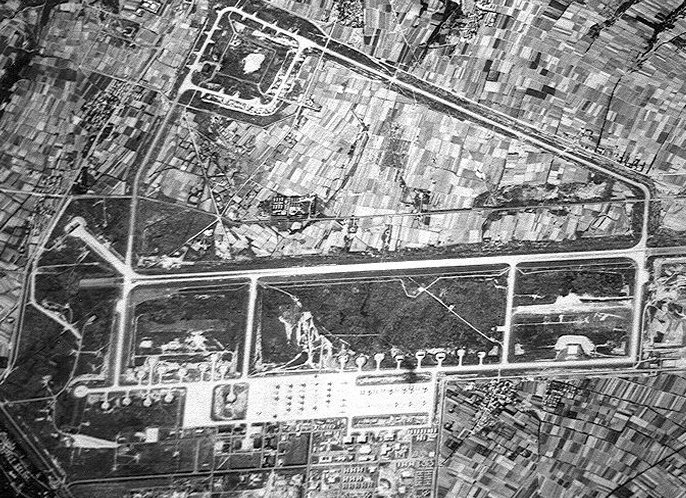
Ching Chuan Kang Air Base (Chinese: 清泉崗空軍基地, CCK) is a Republic of China Air Force (ROCAF) base located in Taichung, Taiwan. It is the home to the 3rd Tactical Fighter Wing, with three squadrons of AIDC F-CK-1 Ching-kuo fighter aircraft. It is also used by the army's airborne and special operations command.

ROCAF F-16A Flight Demonstration in Ching Chuan Kang Air Force Base

Ching Chuan Kang Air Base is shared with Taichung International Airport (IATA: RMQ, ICAO: RCMQ).

History

[edit]

The forerunner to CCK Air Base was built in 1936, during Japanese rule, in the vicinity of Kōkan (公館), hence the former name Kōkan Airport. Construction of the airfield started in 1954, and was given the highest priority of several projects begun after the situation between Taiwan and Mainland China became tense in the mid-1950s. The air base was renamed Ching Chuan Kang Air Base on 20 March 1966 in memory of ROC Army Gen. Qiu Qingquan, and was thereafter known throughout the theater by its initials, CCK. As of the late 1990s, the longest runway at CCK was reportedly 12,000 feet (3,700 m) long.

Taiwan obtained an initial batch of American F-104 Starfighters in 1960–61, and eventually received over 200 of these aircraft, all of which were withdrawn from service in the early 1990s. The Starfighters were operated by the 2nd/499th Tactical Fighter Wing at Hsinchu, the 3rd/427th TFW at Ching Chuan Kang AB, and the 5th/401st Tactical Combined Wing at Taoyuan.

In May 1999 it was reported that China had built a replica of Ching Chuan Kang AB at a site near Dingxin airport (40°22′44″N 99°53′24″E / 40.379°N 99.89°E / 40.379; 99.89) in the northwest province of Gansu, presumably to train units assigned to attack the Taiwanese facility in the event of conflict.[1]

The base is also currently home to the AH-1W attack helicopters of the Army's 602nd Brigade.[2]

Based units

[edit]

Republic of China Air Force

  • 3rd Tactical Fighter Wing
    • War Research Evaluation Center
    • 7th Tactical Fighter Squadron – AIDC F-CK-1 Ching-kuo
    • 28th Tactical Fighter Squadron – AIDC F-CK-1 Ching-kuo
    • 3rd Maintenance and Supply Group
    • 3rd Base Service Group
    • 3rd Military Police Squadron
  • Air Force Air Defense and Artillery Command

USAF use

[edit]

During the Cold War, CCK was used by the United States Air Force as a support installation of United States Taiwan Defense Command. At the same time, it was also the largest air base of the US military stationed in Taiwan, with about 6,000-8,000 US troops stationed.

In 1954, the US Military Assistance Advisory Group, Taiwan (MAAG, Taiwan) was stationed at the base.

USAF use of the base began in 1958 with the deployment of twelve Lockheed F-104 Starfighters from the 83d Fighter-Interceptor Squadron during the Quemoy crisis. The crisis was peacefully resolved, and the aircraft were returned to the United States.

From August 1958 to January 1959, the 51st Fighter-Interceptor Wing deployed eight F-86Ds to Ching Chuan Kang Air Base Taiwan to fly combat air support missions for Republic of China Armed Forces.

In February 1960, after US Air Force a survey of bases on Taiwan it was decided that Kung Kuan AB would best suit the needs of USAF tactical units.

In 10 – 20 May 1960, the 67th Tactical Reconnaissance Wing aircraft were deployed to Kung Kuan AB (later Ching Chuan Kang).[3]

From 20 May – 13 June 1960, the Tactical Air Command (TAC) deployed the 474th Tactical Fighter Wing, 428th Tactical Fighter Squadron from Nellis Air Force Base, Nevada, to Kung Kuan AB.

From 4–14 June 1960, the 18th Tactical Fighter Wing deployed aircraft from Kadena Air Base, Okinawa to Kung Kuan AB.

4-11 December 1960, the 405th Fighter Wing deployed F-102 Delta Dagger from Clark Air Base, Philippines to Kung Kuan AB.

14 – 28 March 1961, the 18th Tactical Fighter Wing deployed the 15th Tactical Reconnaissance Squadron from Kadena Air Base, Okinawa to Kung Kuan Air Base, Taiwan with McDonnell RF-101 Voodoo.[4]

18 – 25 April 1961, 18th Tactical Fighter Wing deployed a detachment of 12th Tactical Fighter Squadron from Kadena Air Base, Okinawa to Kung Kuan Air Base with North American F-100 Super Sabre.

11 – 24 May 1961, the 39th Air Division based at Misawa Air Base, Japan deployed a task force of reconnaissance aircraft to Kung Kuan AB, Taiwan.

1 August – 30 September 1961, F-102 Delta Dagger of 509th Fighter-Interceptor Squadron were deployed from Clark AB to Kung Kuan AB in Operation BIG TRUCK.

6 – 12 March 1962, 18th Tactical Fighter Wing aircraft deployed to Kung Kuan AB. While there they participated in exercise FLYING TIGER, March 10 – 17, the 8th Tactical Fighter Wing was also deployed from Itazuke Air Base, Japan to Kung Kuan AB.

20-27 February 1963, The 510th Tactical Fighter Squadron was supported by Detachment 1, 6214th Air Base Group, Kung Kuan AB, during its deployment to Taiwan.[5]

21 February 1963, 405th Fighter Wing deployed F-102 Delta Dagger to Kung Kuan AB for participation in SKY SOLDIER III.

13 March – 15 May 1963, The 67th Tactical Fighter Squadron was supported by Detachment 1, 6214th Air Base Group at Kung Kuan AB for its deployment to Taiwan with Republic F-105 Thunderchief.

17 – 27 March 1964, the 15th Tactical Reconnaissance Squadron was deployed from Kadena Air Base to Kung Kuan AB for reconnaissance missions, equipped with McDonnell RF-101 Voodoo.

In April 1965, the 479th Tactical Fighter Wing at George AFB California deployed two F-104C squadrons to CCK (434th and 435th TFS).

On 17 April 1965, General William H. Blanchard, Vice Chief of Staff, USAF, visited Ching Chuan Kang Air Base. He formally opened the new 1,000 man dining hall.

On 2 February 1966, 6217th Combat Support Group was established in CCK.[6][7][8]

The following are the units that the 479th Tactical Fighter Wing once stationed at Ching Chuan Kang Air Base in Taiwan:

  • 434th Tactical Fighter Squadron (April 1965 – October 1965) (F-104C)
  • 435th Tactical Fighter Squadron (12 October 1965 – 21 December 1965) (F-104C)

Tactical Air Command reassigned the 314th Troop Carrier Wing, with Fairchild C-123 Providers and Lockheed C-130 Hercules to CCK on 22 January 1966 from Sewart AFB, Tennessee. Known squadrons were:

  • 50th Tactical Airlift Squadron (C-130E) (February 1966 – May 1971) (Tail Code DE)
  • 345th Tactical Airlift Squadron (C-130E) (February 1966 – May 1971) (Tail Code DH)
  • 346th Tactical Airlift Squadron (C-130E) (March 1969 – May 1971) (Tail Code DY)
  • 776th Tactical Airlift Squadron (C-130E) (February 1966 – May 1971) (Tail Code DL)

These aircraft remained deployed to the base to provide passenger and cargo airlift throughout the Far East and combat airlift in Southeast Asia. The 314th TAW returned to Little Rock AFB, Arkansas in 1971. The 314th was replaced by the Pacific Air Forces 374th Tactical Airlift Wing on 31 May 1971, being reassigned from Naha AB, Okinawa, with CCK becoming a major depot support facility in Asia for theater-based tactical airlift aircraft. Known squadrons were:

  • 21st Tactical Airlift Squadron (C-130E) (May 1971 – November 1973) (Tail Code DY)
  • 37th Tactical Airlift Squadron (C-130E) (December 1971 – March 1973)
  • 50th Tactical Airlift Squadron (C-130E) (May 1971 – November 1973) (Tail Code DE)
  • 345th Tactical Airlift Squadron (C-130E) (May 1971 – November 1973) (Tail Code DH)
  • 776th Tactical Airlift Squadron (C-130E) (May 1971 – November 1973) (Tail Code DL)

The 374th remained heavily committed to support of operations in Southeast Asia, and also continued routine airlift in other areas. One of the wing's humanitarian missions-flood relief in the Philippines-earned it a Philippine Republic Presidential Unit Citation in 1972. The wing provided support in March 1973 for Operation Homecoming, the repatriation of American prisoners from Hanoi, North Vietnam.

The increase in the B-52 Arc Light sortie rates over Vietnam necessitated relocation of additional KC-135's which provided PACAF fighter support. In February 1968 the United States Air Force Strategic Air Command 4220th Air Refueling Squadron deployed to CCK, bringing KC-135 tankers formerly based at Takhli RTAFB, Thailand and Kadena AB Okinawa.

The KC-135s were redeployed to permit increased B-52 operations at U-Tapao and F-111 deployment at Takhli. The move of the KC-135's to Ching Chuan Kang increased their effectiveness since they would be based nearer to Vietnam refueling areas.[9][10] In addition, five U-Tapao Royal Thai Navy Airfield based radio relay aircraft were moved to Ching Chuan Kang by February 1968, along with approximately 450 additional USAF personnel.

On 21 March 1968, after the SR-71 Blackbird reconnaissance aircraft #61-17974 of the 1st Strategic Reconnaissance Squadron of the 9th Strategic Reconnaissance Wing completed a supersonic high-altitude reconnaissance operation against North Vietnam, due to the bad weather at the Kadena Air Base in Okinawa, two aircraft Under the cover of the KC-135Q aerial tanker, it landed at the Ching Chuan Kang Air Base early. During the process, it also used the call sign of one of the KC-135Q to avoid the PRC’s surveillance. When it entered the Ching Chuan Kang Air Base, the SR-71 pilots Major Jerry O'Malley and Colonel Ed Payne requested permission from the tower to land, and landed in the middle of the two KC-135Qs at a speed of 175 knots. Immediately after landing, the photographed film was transported to Yokota Air Base in Tokyo by C-130 transporter for processing. It was also the first long-range strategic reconnaissance plane that landed in Taiwan. They returned to Kadena Air base on 23 March.

On 31 May 1968, the 6217th Combat Support Group was disbanded.

Two Martin EB-57 Canberras from the 347th Tactical Fighter Wing based at Yokota AB Japan deployed to CCK, between 29 November and 8 December 1968. These aircraft provided Republic of China Air Defense pilots an opportunity to detect and intercept enemy aircraft that used electronic countermeasure (ECM) equipment.

5 December 1969, a C-130E - 50th Tactical Airlift Squadron 62-1800 crashed about 6 miles (9.65 km) south of Tainan Air Base. 2 October 1970, a c-130 departed Songshan Airport in Taipei with incoming Airforce personnel to CCK. It crashed 6 minutes after take off on top of a mountain and all on board were killed. That aircraft was one of two c-130 sent from CCK to Songshan Airport in Taipei to transport incoming personnel. On 20 February 1972 a Lockheed HC-130 set a world record [that still stands] for a great circle distance without landing with a turboprop aircraft of 8,732.09 miles (14,052.94 km), flying from Ching Chuan Kang AB to Scott AFB, Illinois.

The 18th Tactical Fighter Wing based at Kadena AB, Okinawa maintained two Squadron of McDonnell F-4C Phantom II aircraft from November 1972 until May 1975.

On 6 November 1972, the 18th Wing dispatched the McDonnell Douglas F-4C/D Phantom II fighters of 44th Fighter Squadron and 67th Fighter Squadron to the Ching Chuan Kang Air Base until 31 May 1975, to assist Taiwan's defense against aerial threats from China.[11][12][13][14][15]

The following are the units that the 18th Tactical Fighter Wing once stationed at Ching Chuan Kang Air Base in Taiwan:

  • 44th Tactical Fighter Squadron (Tail Code: ZL) (6 November 1972 – 10 April 1975) (F-4C/D)
  • 67th Tactical Fighter Squadron (Tail Code: ZG) (6 November 1972 – 31 May 1975) (EF-4C, F-4D)

In March 1973, the number of US troops stationed at CCK was about 5,000.

16 September 1973 - A 44th Tactical Fighter Squadron F-4C aircraft crashed during a temporary duty assignment in Taiwan; the crewmembers safely ejected.

15 October 1973, an EF-4C 63-7462 of the 67th Tactical Fighter Squadron crashed shortly after takeoff from CCK AB.

On 13 November 1973, the 374th TAW was reassigned to Clark Air Base in the Philippines.

On November 15, 1973, the 6217th Combat Support Group was reactivated.

On 1 September 1974, the 6217th Combat Support Group was renamed the 6217th Tactical Group.[16][17]

On 10 April 1975, the 44th Tactical Fighter Squadron of the 18th Tactical Fighter Wing withdrew from Ching Chuan Kang Air Base in Taichung, Taiwan, total of 24 McDonnell F-4C/D Phantom II fighters and 450 pilots and ground crews to Kadena Air Base in Okinawa.

In May 1975, the 67th Tactical Fighter Squadron was withdrawn from CCK AB, Taiwan, with the final squadron of 18 F-4Cs departing for Kadena Air Base, Okinawa, between 27 and 31 May.

From 1 June 1975, due to the withdrawal of F-4 fighter jets, the 6217th Tactical Group was reorganized to the 6217th Air Base Squadron, and CCK AB had been placed in caretaker status.[18] By 31 July 1975, the number of US troops stationed at CCK AB was 571. From 1977, the number of US troops stationed at CCK AB has been reduced to 100.

On 1 January 1979, the US normalized relations with the People's Republic of China (PRC). on 25 April 1979, which resulted in the lowering of the national flag by US Air Force personnel and their withdrawal from the base.[19]

World's longest turboprop aircraft distance record

[edit]

On 20 February 1972, Lieutenant Colonel Edgar Allison, USAF, and his flight crew set a recognized turboprop aircraft class record of 8,732.09 miles (14,052.94 km) for a great circle distance without landing. The USAF Lockheed HC-130H was flown from Ching Chuan Kang Air Base to Scott Air Force Base, Illinois in the United States. As of 2018, this record still stands more than 40 years later.[20][21]

Accidents and incidents

[edit]

On 21 January 2025, a master sergeant officer of the Republic of China Air Force died after being sucked into a fighter jet engine during a routine final checkup of the aircraft inside a hangar.[22]

See also

[edit]

References

[edit]
Revisions and contributorsEdit on WikipediaRead on Wikipedia
from Grokipedia
Ching Chuan Kang Air Base (CCK), located in Taichung, Taiwan, at coordinates 24°15'52"N 120°37'14"E, is a primary Republic of China Air Force (ROCAF) installation spanning 1,750 acres with a 12,000-foot runway, serving as the headquarters for the 3rd Tactical Fighter Wing.[1][2] Construction began in 1957 as a high-priority project in response to military tensions with the People's Republic of China, with the base originally named Kung Kuan Air Base before being renamed Ching Chuan Kang on 20 March 1966 in honor of a Nationalist general.[1] From 1957 to 1979, CCK hosted significant United States Air Force operations, becoming the largest U.S. military base in Taiwan during the Vietnam War era, where it supported the 374th Tactical Airlift Wing's rotations of C-130E Hercules aircraft for combat missions in Southeast Asia and accommodated up to 7,000 American personnel as a key supply and maintenance hub.[2] Today, the base houses the 3rd Tactical Fighter Wing's three squadrons—the 7th, 8th, and 28th Tactical Fighter Squadrons—operating approximately 60 AIDC F-CK-1 Ching-kuo indigenous defense fighters, while also facilitating Republic of China Army airborne and special operations training, underscoring its enduring role in Taiwan's asymmetric defense posture against potential invasion threats.[1][2] Remnants of its U.S. legacy, including a preserved chapel museum with artifacts, highlight the base's historical bilateral military cooperation.[2]

History

Establishment and Early ROCAF Operations (1957–1965)

Construction of the Kung Kuan airfield, subsequently renamed Ching Chuan Kang Air Base, was prioritized in the mid-1950s as Taiwan reinforced its military infrastructure in response to escalating cross-strait hostilities, including the First Taiwan Strait Crisis of 1954–1955, during which the People's Republic of China (PRC) bombarded ROC-held islands and threatened amphibious operations.[3] Runway expansion specifically began in May 1957 and concluded in April 1958, involving an investment of about $3.5 million to accommodate modern jet fighters and enhance operational capacity for rapid air defense sorties.[4] The Republic of China Air Force (ROCAF) assumed primary control of the facility upon its operational readiness around 1958, establishing it as a central hub for fighter-interceptor squadrons tasked with patrolling the Taiwan Strait and countering PRC air incursions. Early deployments emphasized North American F-86 Sabres and Republic F-84 Thunderjets, which formed the backbone of ROCAF's tactical air units during this era, enabling quick scrambles to intercept reconnaissance flights and provide ground support against potential invasion forces.[5] These operations integrated Kung Kuan into a broader island-wide air defense architecture, coordinated through radar stations and command centers to detect and neutralize threats from Fujian-based PRC aircraft, reflecting Taiwan's doctrine of forward denial to deter amphibious assaults.[3] By the early 1960s, the base supported transport elements alongside fighters, facilitating logistical sustainment for dispersed ROCAF assets amid ongoing PRC artillery and air pressure, as evidenced by heightened alert postures following the Second Taiwan Strait Crisis in 1958. In 1965, ROCAF received its initial batch of nine Northrop F-5A/B Freedom Fighters under U.S. military aid, with some allocated to Kung Kuan for advanced training and light attack roles, marking an upgrade in tactical versatility while maintaining focus on high-threat interception missions.[6][7]

Renaming and Expansion During Heightened Tensions (1966–1970s)

The air base, previously known as Kung Kuan Air Base, was officially renamed Ching Chuan Kang Air Base on March 20, 1966, in honor of Republic of China Army General Qiu Qingquan, who was killed in action during the 1949 Huaihai Campaign against communist forces, thereby underscoring Taiwan's commitment to anti-communist resistance.[1][8] This renaming coincided with escalating tensions across the Taiwan Strait and the intensification of the Vietnam War, positioning the base as a key asset in the broader containment strategy against communism.[9] Amid strengthening U.S.-Republic of China military cooperation, significant infrastructure expansions were undertaken at Ching Chuan Kang to accommodate larger and heavier aircraft. In 1966, the United States initiated runway lengthening and base upgrades specifically tied to support for B-52 bombing operations in Vietnam, extending the primary runway to approximately 12,000 feet by the early 1970s to handle strategic bombers and heavy transports.[10][2] These enhancements, including improved taxiways and support facilities, transformed the airfield into a dual-use hub capable of sustaining both Republic of China Air Force (ROCAF) operations and U.S. logistical demands without ceding full control to American forces.[11] Joint training and logistics activities between ROCAF and U.S. Air Force personnel increased during this period, focusing on interoperability for regional defense while preserving ROCAF oversight of the base. U.S. rotations, such as C-130 Hercules squadrons under the 374th Tactical Airlift Wing, utilized Ching Chuan Kang for staging missions into Southeast Asia, leveraging its strategic location to bolster anti-communist efforts across the Pacific theater.[2] This collaborative model highlighted Taiwan's pivotal role in U.S. forward deployment strategies, enabling rapid response capabilities against potential People's Republic of China aggression, all under the framework of mutual defense commitments.[12]

Post-Vietnam War Transition and ROCAF Primacy (1979–Present)

Following the United States' normalization of diplomatic relations with the People's Republic of China on January 1, 1979, American military forces completed their withdrawal from Ching Chuan Kang Air Base by April 25, 1979, ending a 22-year presence that had supported operations in the Vietnam War and regional deterrence.[2] This transition placed the full operational responsibility on the Republic of China Air Force (ROCAF), necessitating rapid adaptations to maintain air defense capabilities amid curtailed U.S. commitments under the Taiwan Relations Act, which preserved defensive arms sales but shifted emphasis toward Taiwanese self-reliance. The ROCAF prioritized indigenous development to offset restrictions on advanced foreign aircraft acquisitions, culminating in the deployment of the AIDC F-CK-1 Ching-kuo Indigenous Defense Fighter, which entered service in 1992 and has since operated from the base to fulfill air superiority and ground attack roles.[13] Infrastructure adjustments supported this shift, including facilities tailored for the F-CK-1's maintenance and deployment, reflecting a broader strategy of technological independence that reduced vulnerability to external supply disruptions.[14] In response to escalating missile threats from the People's Republic of China, the base has incorporated resilience measures such as runway widening for expedited repairs after potential strikes, part of a nationwide effort across seven air bases to sustain operational tempo in conflict scenarios.[15] Dispersal tactics, including aircraft relocation to alternate sites during alerts, further enhance survivability, ensuring the ROCAF can generate sorties despite initial barrages estimated to target fixed infrastructure heavily.[16] These adaptations underscore a doctrinal evolution toward asymmetric defense, prioritizing endurance over symmetrical confrontation with superior PRC forces.

Facilities and Infrastructure

Runway and Airfield Specifications

Ching Chuan Kang Air Base occupies a 1,750-acre site in Taichung, Taiwan, serving as a joint civil-military facility shared with Taichung International Airport.[2][12] The primary runway, designated 18/36, measures 3,659 meters (12,005 feet) in length with a concrete surface and 60-meter width, enabling operations of heavy transport aircraft such as C-130 Hercules and large bombers including the B-52.[1][9][17] This configuration supports fighter jets like the indigenous F-CK-1 Ching-kuo, with extensive taxiways and aprons facilitating rapid aircraft dispersal and sortie generation during high-threat scenarios.[18] Located in central Taiwan's varied terrain, the base's infrastructure incorporates reinforcements suited to the region's seismic and weather conditions, allowing sustained year-round military aviation activities.[19]

Support and Logistical Capabilities

Ching Chuan Kang Air Base maintains dedicated maintenance facilities and hardened infrastructure to support the 3rd Tactical Fighter Wing's fleet of AIDC F-CK-1 Ching-kuo multirole fighters, enabling routine servicing and structural enhancements. Since 2020, construction of 36 missile-proof hangars—each designed to shelter one fighter and withstand impacts from 2,000-pound bombs—has been underway, with completion targeted for 2026 at a cost of approximately US$157 million.[20] [21] These upgrades bolster aircraft protection and rapid deployment capabilities amid regional tensions.[22] The base incorporates training areas for Republic of China Army airborne units and special operations forces, including designated drop zones for paratrooper insertions and joint exercises. Facilities shared with the Army's airborne and special operations command facilitate integrated air-ground operations, drawing on historical precedents like the "Suzie Drop Zone" used for C-130 troop carrier drops.[1] [8] Logistically, Ching Chuan Kang functions as a key hub for regional airlift and sustainment, with munitions storage areas and fuel support infrastructure historically critical for U.S. Pacific theater operations via C-130 squadrons and KC-135 tankers.[8] [2] These assets, expanded during the Vietnam era to include dedicated maintenance for tactical airlift aircraft, continue to enable efficient supply distribution and operational resilience for Taiwan's defense forces.[23]

Military Units and Operations

Current ROCAF Based Units

Ching Chuan Kang Air Base serves as the primary location for the Republic of China Air Force's (ROCAF) 3rd Tactical Fighter Wing, which operates three squadrons equipped with AIDC F-CK-1 Ching-kuo multirole fighters.[24] These squadrons, part of the 3rd Tactical Fighter Group, focus on air superiority missions, including interception of People's Republic of China (PRC) aircraft incursions into Taiwan's air defense identification zone.[16] The F-CK-1 fleet, primarily comprising upgraded F-CK-1C/D variants, supports both air-to-air engagements and precision strike capabilities against ground and maritime targets.[25] ROCAF training at the base emphasizes beyond-visual-range (BVR) combat tactics, leveraging the F-CK-1's integration of TC-2 active radar-guided missiles to offset PRC numerical superiority in fighter aircraft.[26] In 2025, Taiwan tested an indigenous electronic countermeasures (ECM) pod for the F-CK-1, designed to enhance survivability against advanced PRC air threats by providing self-protection jamming without requiring aircraft structural modifications.[27][25] This upgrade addresses vulnerabilities in contested electromagnetic environments, aligning with broader ROCAF modernization efforts to maintain deterrence amid escalating PRC aerial activities.[28]

Army and Special Forces Integration

The Ching Chuan Kang Air Base supports operations of the Republic of China Army's airborne and special operations command, which utilizes the facility's extensive open areas for training exercises including parachute drops and heliborne insertions.[1] This integration dates back to the base's early development, complementing its primary role as a ROC Air Force installation by providing ground forces access to aviation support infrastructure. The Army's Aviation and Special Forces Command, responsible for such mobile units, leverages the site's runways and surrounding terrain to simulate rapid deployment maneuvers.[1] Joint coordination between ROC Army special operations elements and ROCAF personnel at the base enables scenario-based drills focused on countering enemy incursions, such as securing remote areas or responding to amphibious threats. These activities enhance interoperability for time-sensitive operations, drawing on the base's logistical capabilities without relying solely on dedicated army facilities. The presence of army units contributes to a layered defense approach, allowing for quick mobilization of elite ground forces in conjunction with airlift assets to address specialized threats from the People's Republic of China.[1]

Historical USAF Deployments and Contributions

United States Air Force operations at Ching Chuan Kang Air Base (CCK) commenced in the late 1950s amid escalating tensions in the Taiwan Strait, serving primarily as a forward operating location for rotational deployments to bolster deterrence against communist expansion without engaging in direct combat from Taiwanese territory.[2] Early fighter deployments included F-104 Starfighters, with units such as the 434th Tactical Fighter Squadron operating F-104Cs from CCK in 1965 as part of the 479th Tactical Fighter Wing, contributing to regional air defense patrols.[1] The base's role expanded significantly during the Vietnam War, transforming CCK into a critical logistics hub for Pacific Air Forces' airlift operations supporting U.S. efforts in Southeast Asia. In January 1966, the 314th Tactical Airlift Wing relocated to CCK (then known as Kung Kuan Air Base) from Naha Air Base, Okinawa, equipping it with C-130E Hercules aircraft to conduct passenger and cargo airlift missions, including troop rotations and resupply flights to Vietnam, Thailand, and Laos. This wing maintained operations until May 1971, when it was replaced by the 374th Tactical Airlift Wing, which continued rotating C-130E squadrons—such as the 50th and 345th Tactical Airlift Squadrons—for combat support, sustaining U.S. forces with over 4,000 to 7,000 personnel peaking at the base during this period.[29][2] Additional units, including the 4200th Air Refueling Squadron deploying KC-135 tankers in February 1968 and fighter squadrons like the 44th Tactical Fighter Squadron with F-4C Phantoms in the 1970s, enhanced CCK's utility for aerial refueling and tactical air support without basing combat sorties directly against North Vietnam.[1] USAF presence at CCK facilitated broader Cold War contingencies by providing a secure staging area for air mobility, enabling rapid deployment of resources to counter communist threats across the region while adhering to policy restrictions on offensive operations from Taiwan. The 374th Tactical Airlift Wing, for instance, supported Operation Homecoming in March 1973 by airlifting repatriated prisoners of war.[29] Infrastructure developments under USAF tenure, including expanded runways, hardened facilities, and logistical support systems, were calibrated for heavy airlift demands, leaving a durable foundation that later supported Republic of China Air Force autonomy following the American drawdown.[2] The phased withdrawal of USAF units from CCK aligned with U.S. policy shifts after the normalization of relations with the People's Republic of China on January 1, 1979, culminating in the lowering of the U.S. flag on April 25, 1979, and the inactivation of support groups like the 6214th Combat Support Group.[30] This transition marked the end of permanent USAF basing in Taiwan, though the enhancements to CCK's capabilities—such as its 12,000-foot runway and extensive support infrastructure—continued to underpin regional deterrence efforts under ROCAF control.[2]

Strategic and Operational Role

Defense Against PRC Threats

Ching Chuan Kang Air Base's central location in Taichung enables Republic of China Air Force (ROCAF) fighters to achieve rapid response times across the western Taiwan Strait, positioning it as a key node for disrupting potential People's Republic of China (PRC) amphibious operations. Situated at approximately 24°15'52"N 120°37'14"E, the base supports the 3rd Tactical Fighter Wing, which operates indigenous F-CK-1 Ching-kuo fighters capable of air-to-air intercepts and ground strikes against landing forces. This geographic centrality allows coverage of central strait sectors where PRC assault shipping would likely concentrate for beachhead establishment, facilitating preemptive sorties to target troop transports and degrade invasion momentum before forces consolidate ashore.[1] To counter PRC ballistic missile barrages, the base incorporates hardened aircraft shelters designed to withstand direct impacts from 2,000-pound bombs, with 36 such shelters constructed at CCK as part of broader ROCAF survivability enhancements. These fortifications, alongside dispersal protocols that prioritize aircraft relocation to auxiliary sites during heightened alerts, aim to preserve sortie generation rates amid initial strikes from PRC's extensive short-range ballistic missile inventory, estimated at over 1,000 DF-15/16/17 variants deployable against Taiwan. Taiwan's strategy emphasizes post-attack recovery over pre-war concentration, recognizing that fixed basing vulnerabilities could otherwise enable PRC air superiority through saturation attacks, though empirical assessments indicate hardened infrastructure can sustain 20-30% of pre-strike capabilities if dispersal is executed promptly.[21][31] Persistent PRC intrusions into Taiwan's Air Defense Identification Zone (ADIZ) highlight the imperative for a robust ROCAF presence at bases like CCK, with PLA aircraft incursions reaching 1,737 in 2022, 1,703 in 2023, and 1,905 in 2024, often exceeding 300 monthly by 2025. These operations, involving fighters and bombers simulating blockade or strike profiles, underscore the base's role in maintaining deterrence against narratives of PRC inevitability, as Taiwan's centralized fighter basing counters numerical disparities through qualitative edges in pilot training and integration with ground-based air defenses. While PRC airpower projections confer advantages in volume, CCK's contributions to median-line patrols and rapid scrambles have empirically contested ADIZ dominance, preserving operational tempo essential for protracted defense.[32][33][34]

Participation in Military Exercises and Modernization

Ching Chuan Kang Air Base serves as a primary venue for Taiwan's Han Kuang exercises, which simulate People's Republic of China (PRC) joint strikes on key infrastructure. These annual drills, such as Han Kuang 33 in 2017, designate the base as a main target to test air defense integration, rapid base recovery operations, and overall operational resilience against missile barrages and airborne assaults.[35][36] In scenarios mimicking PRC invasions, personnel at the base practice dispersing aircraft, hardening facilities, and coordinating with ground forces to maintain sortie generation rates, emphasizing self-reliant defense amid conventional force imbalances.[37] Modernization efforts at the base focus on enhancing indigenous capabilities for the Republic of China Air Force (ROCAF) F-CK-1 Ching-kuo fighters stationed there. In August 2025, testing commenced on the "Xuan Ji Project" electronic countermeasures (ECM) pod, an indigenous system designed to jam PRC radars and provide self-protection jamming, thereby improving first-strike avoidance and survivability in contested airspace.[27][25] This development, integrated via C-130H testbeds, reflects Taiwan's push toward asymmetric tactics, including electronic warfare upgrades to counter superior PRC numbers without relying on foreign platforms.[28] The base's role underscores a broader ROCAF shift to asymmetric warfare, incorporating quick-repair teams for runway crater filling and facility restoration to sustain operations post-strike. Han Kuang iterations incorporate these tactics to address disparities in airpower, prioritizing mobility, deception, and rapid reconstitution over symmetrical engagements.[38][39] Such evolutions demonstrate operational readiness through domestic innovation and exercise realism, independent of external dependencies.[40]

Notable Achievements and Records

USAF Turboprop Distance Record

On February 20, 1972, a United States Air Force Lockheed HC-130H Hercules, serial number 65-0972, commanded by Lieutenant Colonel Edgar Allison, departed Ching Chuan Kang Air Base in Taiwan and completed a nonstop flight to Scott Air Force Base, Illinois, traversing a great circle distance of 8,732.09 miles (14,052.94 km) without aerial refueling or intermediate landings.[41] [42] This endurance flight established a Fédération Aéronautique Internationale-recognized world record for the longest unrefueled distance by a turboprop-powered aircraft, a mark that remains unbroken in its class.[1] [43] The mission exemplified the HC-130H's design for extended-range search-and-rescue and special operations, with the aircraft's four Allison T56-A-15 turboprop engines enabling efficient fuel consumption over the demanding Pacific-to-continental routing.[41] Ching Chuan Kang's 11,800-foot (3,597-meter) main runway proved essential, accommodating the maximum takeoff weight laden with supplemental fuel tanks and provisions for crew sustainment during the approximately 50-hour journey.[1] The record highlighted USAF engineering in navigation aids, including inertial systems and celestial backups, alongside aerodynamic optimizations that minimized drag, affirming the base's role in supporting high-stakes logistical demonstrations amid regional operational demands.[43]

Contributions to Regional Airlift and Logistics

During the Vietnam War era, Ching Chuan Kang Air Base (CCK) functioned as a pivotal rear-area hub for U.S. tactical airlift operations, hosting the 374th Tactical Airlift Wing from 1966 onward. This wing rotated C-130E Hercules squadrons, including the 346th, 50th, and 776th Tactical Airlift Squadrons, to conduct intratheater airlift missions supporting U.S. forces in Southeast Asia. These rotations enabled the rapid transport of personnel, cargo, and equipment, with C-130s from CCK contributing to the sustainment of combat operations by providing reliable resupply amid forward base constraints.[2][12] CCK's extensive facilities, including runways capable of handling heavy airlifters and logistics infrastructure, supported up to 8,000 U.S. personnel at peak, serving as a maintenance and staging point that enhanced operational tempo. This role extended air mobility reach across the Pacific theater, allowing C-130 crews to perform short-haul deployments while basing out of Taiwan minimized exposure to combat zones, thereby preserving aircraft availability for high-sortie demands. The base's position facilitated efficient supply chain integration, underscoring its causal contribution to U.S. logistical resilience in the conflict.[12] Following the U.S. Air Force's withdrawal in the mid-1970s, the Republic of China Air Force (ROCAF) repurposed CCK's infrastructure for indigenous logistics operations, integrating it into national air mobility frameworks for disaster response and defense sustainment. ROCAF units have leveraged the base's capabilities for regional resupply missions, including support to remote islands like Kinmen and Matsu, demonstrating operational self-sufficiency in maintaining supply lines without ongoing foreign basing. This transition affirmed Taiwan's capacity to independently manage airlift demands, countering narratives of perpetual reliance on external hardware sustainment through proven domestic maintenance and deployment proficiency.[2][44]

Accidents and Incidents

Major USAF-Era Crashes

On October 22, 1968, a U.S. Air Force Boeing KC-135A Stratotanker (serial number 61-0301) of the 4252nd Strategic Wing crashed into a mountain approximately 75 km southeast of Ching Chuan Kang Air Base while on final approach amid poor weather conditions, killing all six crew members aboard.[45][46] The aircraft, en route from Andersen Air Force Base, Guam, impacted terrain during descent, with the accident occurring during the phase of approach to the base.[47] On March 8, 1969, a U.S. Air Force Lockheed C-130E Hercules (serial number 64-0545) of the 50th Troop Carrier Squadron undershot the runway at Ching Chuan Kang Air Base during landing in dense fog following a resupply mission from Vietnam, resulting in the aircraft breaking apart on impact and the deaths of all 12 personnel aboard.[48][49] Nine individuals were killed on impact, while three survivors succumbed to injuries by March 14.[50] The crash underscored visibility challenges at the base during high operational tempos supporting Southeast Asia contingencies.[51] These accidents, occurring amid intensive aerial refueling and logistics operations tied to Vietnam War demands, reflected environmental and procedural hazards at Ching Chuan Kang but represented a small fraction of the thousands of safe sorties flown by USAF units there through the era.[52]

Recent ROCAF Mishaps

On January 21, 2025, a 41-year-old female master sergeant surnamed Hu, with approximately 17 years of service in the Republic of China Air Force (ROCAF), was fatally injured at Ching Chuan Kang Air Base in Taichung when she was ingested into the right engine of an F-CK-1 Ching-kuo Indigenous Defense Fighter during a routine post-landing inspection.[53][54] The incident occurred while Hu was setting up wheel chocks, with the engine still operating at a slow standby rotation prior to full shutdown, leading to her being pulled into the intake; she was transported to a hospital but pronounced dead at 11:40 a.m. local time.[53][54] In response, the ROCAF base immediately suspended takeoffs for Indigenous Defense Fighter jets pending investigation, highlighting potential human factors such as procedural miscommunication in high-readiness maintenance environments under modernization pressures.[54] The Air Force Command Headquarters initiated a formal probe in coordination with authorities, utilizing hangar security footage to reconstruct events, and committed to a procedural review to enhance safety protocols while providing assistance to the victim's family.[53] This transparent handling contrasts with the limited public disclosure typical of aviation mishaps in the People's Republic of China's air force, where systemic opacity often obscures causal details and preventive lessons.[53][54]

References

User Avatar
No comments yet.