Hubbry Logo
logo
Chirality
Community hub

Chirality

logo
0 subscribers
Read side by side
from Wikipedia
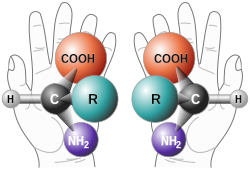
Two enantiomers of a generic amino acid that is chiral

Chirality (/kˈrælɪti/) is the property of an object not being identical to its mirror image. An object is chiral if it is not identical to its mirror image; that is, it cannot be superposed (not to be confused with superimposed) onto it. Conversely, an object is achiral (sometimes also amphichiral) if its mirror image cannot be distinguished from the object (i.e. can be superposed onto its mirror image), such as a sphere. A chiral object and its mirror image are called enantiomorphs (Greek, "opposite forms") or, when referring to molecules, enantiomers. Chirality is a property of asymmetry important in several branches of science.

Human hands are perhaps the most recognized example of chirality. The left hand is a non-superposable mirror image of the right hand; no matter how the two hands are oriented, it is impossible for all the major features of both hands to coincide across all axes.[1] This difference in symmetry becomes obvious if someone attempts to shake the right hand of a person using their left hand, or if a left-handed glove is placed on a right hand.

The word chirality is derived from the Greek χείρ (kheir), "hand", a familiar chiral object. The term was first used by Lord Kelvin in 1893 in the second Robert Boyle Lecture at the Oxford University Junior Scientific Club which was published in 1894:

I call any geometrical figure, or group of points, 'chiral', and say that it has chirality if its image in a plane mirror, ideally realized, cannot be brought to coincide with itself.[2]

Mathematics

[edit]
An achiral 3D object without central symmetry or a plane of symmetry
A table of all prime knots with seven crossings or fewer (not including mirror images).

In mathematics, a figure is chiral (and said to have chirality) if it cannot be mapped to its mirror image by rotations and translations alone. For example, a right shoe is different from a left shoe, and S-twist yarn is different from Z-twist. See[3] for a full mathematical definition.

A chiral object and its mirror image are said to be enantiomorphs. The word enantiomorph stems from the Greek ἐναντίος (enantios) 'opposite' + μορφή (morphe) 'form'. A non-chiral figure is called achiral or amphichiral.

The helix (and by extension a spun string, a screw, a propeller, etc.) and Möbius strip are chiral two-dimensional objects in three-dimensional ambient space. The J, L, S and Z-shaped tetrominoes of the popular video game Tetris also exhibit chirality, but only in a two-dimensional space.

Many other familiar objects exhibit the same chiral symmetry of the human body, such as gloves, glasses (sometimes), and shoes. A similar notion of chirality is considered in knot theory, as explained below.

Some chiral three-dimensional objects, such as the helix, can be assigned a right or left handedness, according to the right-hand rule.

Geometry

[edit]

In geometry, a figure is achiral if and only if its symmetry group contains at least one orientation-reversing isometry. In two dimensions, every figure that possesses an axis of symmetry is achiral, and it can be shown that every bounded achiral figure must have an axis of symmetry. In three dimensions, every figure that possesses a plane of symmetry or a center of symmetry is achiral. There are, however, achiral figures lacking both plane and center of symmetry. In terms of point groups, all chiral figures lack an improper axis of rotation (Sn). This means that they cannot contain a center of inversion (i) or a mirror plane (σ). Only figures with a point group designation of C1, Cn, Dn, T, O, or I can be chiral.

Knot theory

[edit]

A knot is called achiral if it can be continuously deformed into its mirror image, otherwise it is called chiral. For example, the unknot and the figure-eight knot are achiral, whereas the trefoil knot is chiral.

Physics

[edit]
Animation of right-handed (clockwise) circularly polarized light, as defined from the point of view of a receiver in agreement with optics conventions.

In physics, chirality may be found in the spin of a particle, where the handedness of the object is determined by the direction in which the particle spins.[4] Not to be confused with helicity, which is the projection of the spin along the linear momentum of a subatomic particle, chirality is an intrinsic quantum mechanical property, like spin. Although both chirality and helicity can have left-handed or right-handed properties, only in the massless case are they identical.[5] In particular for a massless particle the helicity is the same as the chirality while for an antiparticle they have opposite sign.

The handedness in both chirality and helicity relate to the rotation of a particle while it proceeds in linear motion with reference to the human hands. The thumb of the hand points towards the direction of linear motion whilst the fingers curl into the palm, representing the direction of rotation of the particle (i.e. clockwise and counterclockwise). Depending on the linear and rotational motion, the particle can either be defined by left-handedness or right-handedness.[5] A symmetry transformation between the two is called parity. Invariance under parity by a Dirac fermion is called chiral symmetry.

Electromagnetism

[edit]

Electromagnetic waves can have handedness associated with their polarization. Polarization of an electromagnetic wave is the property that describes the orientation, i.e., the time-varying direction and amplitude, of the electric field vector. For example, the electric field vectors of left-handed or right-handed circularly polarized waves form helices of opposite handedness in space.

Circularly polarized waves of opposite handedness propagate through chiral media at different speeds (circular birefringence) and with different losses (circular dichroism). Both phenomena are jointly known as optical activity. Circular birefringence causes rotation of the polarization state of electromagnetic waves in chiral media and can cause a negative index of refraction for waves of one handedness when the effect is sufficiently large.[6][7]

While optical activity occurs in structures that are chiral in three dimensions (such as helices), the concept of chirality can also be applied in two dimensions. 2D-chiral patterns, such as flat spirals, cannot be superposed with their mirror image by translation or rotation in two-dimensional space (a plane). 2D chirality is associated with directionally asymmetric transmission (reflection and absorption) of circularly polarized waves. 2D-chiral materials, which are also anisotropic and lossy exhibit different total transmission (reflection and absorption) levels for the same circularly polarized wave incident on their front and back. The asymmetric transmission phenomenon arises from different, e.g. left-to-right, circular polarization conversion efficiencies for opposite propagation directions of the incident wave and therefore the effect is referred to as circular conversion dichroism. Like the twist of a 2d-chiral pattern appears reversed for opposite directions of observation, 2d-chiral materials have interchanged properties for left-handed and right-handed circularly polarized waves that are incident on their front and back. In particular left-handed and right-handed circularly polarized waves experience opposite directional transmission (reflection and absorption) asymmetries.[8][9]

While optical activity is associated with 3d chirality and circular conversion is associated with 2d chirality, both effects have also been observed in structures that are not chiral by themselves. For the observation of these chiral electromagnetic effects, chirality does not have to be an intrinsic property of the material that interacts with the electromagnetic wave. Instead, both effects can also occur when the propagation direction of the electromagnetic wave together with the structure of an (achiral) material form a chiral experimental arrangement.[10][11] This case, where the mutual arrangement of achiral components forms a chiral (experimental) arrangement, is known as extrinsic chirality.[12][13]

Chiral mirrors are a class of metamaterials that reflect circularly polarized light of a certain helicity in a handedness-preserving manner, while absorbing circular polarization of the opposite handedness.[14] However, most absorbing chiral mirrors operate only in a narrow frequency band, as limited by the causality principle. Employing a different design methodology that allows undesired waves to pass through instead of absorbing the undesired waveform, chiral mirrors are able to show good broadband performance.[15]

Chemistry

[edit]
(S)-Alanine (left) and (R)-alanine (right) in zwitterionic form at neutral pH

A chiral molecule is a type of molecule that has a non-superposable mirror image. The feature that is most often the cause of chirality in molecules is the presence of an asymmetric carbon atom.[16][17]

The term "chiral" in general is used to describe the object that is non-superposable on its mirror image.[18]

In chemistry, chirality usually refers to molecules. Two mirror images of a chiral molecule are called enantiomers or optical isomers. Pairs of enantiomers are often designated as "right-", "left-handed" or, if they have no bias, "achiral". As polarized light passes through a chiral molecule, the plane of polarization, when viewed along the axis toward the source, will be rotated clockwise (to the right) or anticlockwise (to the left). A right handed rotation is dextrorotary (d); that to the left is levorotary (l). The d- and l-isomers are the same compound but are called enantiomers. An equimolar mixture of the two optical isomers, which is called a racemic mixture, will produce no net rotation of polarized light as it passes through.[19] Left handed molecules have l- prefixed to their names; d- is prefixed to right handed molecules. However, this d- and l- notation of distinguishing enantiomers does not say anything about the actual spatial arrangement of the ligands/substituents around the stereogenic center, which is defined as configuration. Another nomenclature system employed to specify configuration is Fischer convention.[20] This is also referred to as the D- and L-system. Here the relative configuration is assigned with reference to D-(+)-Glyceraldehyde and L-(−)-Glyceraldehyde, being taken as standard. Fischer convention is widely used in sugar chemistry and for α-amino acids. Due to the drawbacks of Fischer convention, it is almost entirely replaced by Cahn-Ingold-Prelog convention, also known as the sequence rule or R and S nomenclature.[21][22] This was further extended to assign absolute configuration to cis-trans isomers with the E-Z notation.

Molecular chirality is of interest because of its application to stereochemistry in inorganic chemistry, organic chemistry, physical chemistry, biochemistry, and supramolecular chemistry.

More recent developments in chiral chemistry include the development of chiral inorganic nanoparticles that may have the similar tetrahedral geometry as chiral centers associated with sp3 carbon atoms traditionally associated with chiral compounds, but at larger scale.[23][24] Helical and other symmetries of chiral nanomaterials were also obtained.[25]

Biology

[edit]
R-(+)-Limonene found in all citrus fruits
S-(–)-Limonene found in only trace amounts in lemongrass and citronella
(S)-(+)-Carvone occurs in caraway seed oil, and (R)-(−)-carvone occurs in spearmint
Dextropropoxyphene or Darvon, a painkiller
Levopropoxyphene or Novrad, an anticough agent

All of the known life-forms show specific chiral properties in chemical structures as well as macroscopic anatomy, development and behavior.[26] In any specific organism or evolutionarily related set thereof, individual compounds, organs, or behavior are found in the same single enantiomorphic form. Deviation (having the opposite form) could be found in a small number of chemical compounds, or certain organ or behavior but that variation strictly depends upon the genetic make up of the organism. From chemical level (molecular scale), biological systems show extreme stereospecificity in synthesis, uptake, sensing, metabolic processing. A living system usually deals with two enantiomers of the same compound in drastically different ways.

In biology, homochirality is a common property of amino acids and carbohydrates. The chiral protein-making amino acids, which are translated through the ribosome from genetic coding, occur in the L form. However, D-amino acids are also found in nature. The monosaccharides (carbohydrate-units) are commonly found in D-configuration. DNA double helix is chiral (as any kind of helix is chiral), and B-form of DNA shows a right-handed turn.

Sometimes, when two enantiomers of a compound are found in organisms, they significantly differ in their taste, smell and other biological actions. For example,(+)-Carvone is responsible for the smell of caraway seed oil, whereas (–)-carvone is responsible for smell of spearmint oil.[27] However, it is a commonly held misconception that (+)-limonene is found in oranges (causing its smell), and (–)-limonene is found in lemons (causing its smell). In 2021, after rigorous experimentation, it was found that all citrus fruits contain only (+)-limonene and the odor difference is because of other contributing factors.[28]

Also, for artificial compounds, including medicines, in case of chiral drugs, the two enantiomers sometimes show remarkable difference in effect of their biological actions.[29] Darvon (dextropropoxyphene) is a painkiller, whereas its enantiomer, Novrad (levopropoxyphene) is an anti-cough agent. In case of penicillamine, the (S-isomer is used in the treatment of primary chronic arthritis, whereas the (R)-isomer has no therapeutic effect, as well as being highly toxic.[30] In some cases, the less therapeutically active enantiomer can cause side effects. For example, (S-naproxen is an analgesic but the (R-isomer causes renal problems.[31] In such situations where one of the enantiomers of a racemic drug is active and the other partner has undesirable or toxic effect one may switch from racemate to a single enantiomer drug for a better therapeutic value.[1] Such a switching from a racemic drug to an enantiopure drug is called a chiral switch.

The naturally occurring plant form of alpha-tocopherol (vitamin E) is RRR-α-tocopherol whereas the synthetic form (all-racemic vitamin E, or dl-tocopherol) is equal parts of the stereoisomers RRR, RRS, RSS, SSS, RSR, SRS, SRR, and SSR with progressively decreasing biological equivalency, so that 1.36 mg of dl-tocopherol is considered equivalent to 1.0 mg of d-tocopherol.[32]

A natural left-handed helix, made by a certain climber plant's tendril
Shells of two different species of sea snail: on the left is the normally sinistral (left-handed) shell of Neptunea angulata, on the right is the normally dextral (right-handed) shell of Neptunea despecta
Wachendorfia paniculata flower with style left

Macroscopic examples of chirality are found in the plant kingdom, the animal kingdom and all other groups of organisms. A simple example is the coiling direction of any climber plant, which can grow to form either a left- or right-handed helix.

In anatomy, chirality is found in the imperfect mirror image symmetry of many kinds of animal bodies. Organisms such as gastropods exhibit chirality in their coiled shells, resulting in an asymmetrical appearance. Over 90% of gastropod species[33] have dextral (right-handed) shells in their coiling, but a small minority of species and genera are virtually always sinistral (left-handed). A very few species (for example Amphidromus perversus[34]) show an equal mixture of dextral and sinistral individuals.

In humans, chirality (also referred to as handedness or laterality) is an attribute of humans defined by their unequal distribution of fine motor skill between the left and right hands. An individual who is more dexterous with the right hand is called right-handed, and one who is more skilled with the left is said to be left-handed. Chirality is also seen in the study of facial asymmetry and is known as aurofacial asymmetry.[35]

Schema of the development of the axial twist in vertebrates.

According to the Axial Twist theory, vertebrate animals develop into a left-handed chirality. Due to this, the brain is turned around and the heart and bowels are turned by 90°.[36]

In the case of the health condition situs inversus totalis, in which all the internal organs are flipped horizontally (i.e. the heart placed slightly to the right instead of the left), chirality poses some problems should the patient require a liver or heart transplant, as these organs are chiral, thus meaning that the blood vessels which supply these organs would need to be rearranged should a normal, non situs inversus (situs solitus) organ be required.

In the monocot bloodroot family, the species of the genera Wachendorfia and Barberetta have only individuals that either have the style points to the right or the style pointed to the left, with both morphs appearing within the same populations. This is thought to increase outcrossing and so boost genetic diversity, which in turn may help to survive in a changing environment. Remarkably, the related genus Dilatris also has chirally dimorphic flowers, but here both morphs occur on the same plant.[37] In flatfish, the summer flounder or fluke are left-eyed, while halibut are right-eyed.

Resources and Research

[edit]

Journal

[edit]
  • Chirality- a scientific journal focused on chirality in chemistry and biochemistry in respect to biological, chemical, materials, pharmacological, spectroscopic and physical properties.

Selected Books

[edit]
  • Creutz, Michael (2018). From quarks to pions: chiral symmetry and confinement. New Jersey London Singapore Beijing , Shanghai Hong Kong Taipei Chennai Tokyo: World Scientific. ISBN 978-981-322-923-5
  • Wolf, Christian (2008). Dynamic stereochemistry of chiral compounds: principles and applications. Cambridge: RSC Publ. ISBN 978-0-85404-246-3
  • Beesley, Thomas E.; Scott, Raymond P. W. (1998). Chiral chromatography. Separation science series. Chichester Weinheim: Wiley. ISBN 978-0-471-97427-7

See also

[edit]

References

[edit]
[edit]
Revisions and contributorsEdit on WikipediaRead on Wikipedia
from Grokipedia
Chirality is the property of an object or system that is not identical to its mirror image, meaning it cannot be superimposed upon it through rotations or translations.[1] This geometric asymmetry, derived from the Greek word cheir meaning "hand," manifests in everyday examples like left and right hands, which are mirror images but non-superimposable.[2] In scientific contexts, chirality is a fundamental concept across disciplines, influencing molecular structure, particle behavior, and biological processes. In chemistry, chirality typically arises in molecules that lack an internal plane of symmetry, often due to a chiral center such as a carbon atom bonded to four different substituents.[3] Such chiral molecules exist as pairs of enantiomers—non-superimposable mirror images that rotate plane-polarized light in opposite directions, a property known as optical activity.[4] This stereochemical distinction is critical in fields like pharmacology, where enantiomers can exhibit vastly different biological activities; for instance, one enantiomer of a drug may be therapeutic while its mirror image is inactive or toxic.[5] In biology, chirality underpins the phenomenon of homochirality, where living systems preferentially utilize one enantiomer over the other, such as L-amino acids for proteins and D-sugars for nucleic acids and carbohydrates.[6] This uniformity is a hallmark of terrestrial life, emerging from prebiotic chemistry despite symmetric origins, and it enables the specific interactions essential for enzymatic function and molecular recognition.[7] The origins of biological homochirality remain an active area of research, with proposed mechanisms involving physical processes like crystallization or chemical amplification in prebiotic environments.[8] In physics, chirality describes the handedness of fundamental particles and fields, distinct from but related to helicity—the projection of spin along the direction of motion.[9] Notably, the weak nuclear force violates parity symmetry, treating left- and right-handed particles differently, as demonstrated in experiments like the 1956 Wu experiment on beta decay.[10] This intrinsic chirality influences phenomena in quantum field theory, topology, and materials science, where chiral structures can exhibit unique electronic and optical properties, such as in topological insulators or chiral quantum matter.[11]

Fundamentals

Definition and Basic Concepts

Chirality is a geometric property of an object that renders it non-superimposable on its mirror image, meaning the object and its reflection cannot be aligned to coincide perfectly through rotations or translations.[12] A classic example is the human hand: a left hand cannot be superimposed on a right hand, no matter how it is rotated, illustrating this asymmetry in three dimensions.[13] Superimposability requires that every point in the object matches the corresponding point in its mirror image after rigid transformations; objects lacking this property are chiral, while those that can be superimposed, such as a sphere, are achiral.[2] In the context of stereoisomers, chiral objects give rise to enantiomers, which are pairs of stereoisomers that are non-superimposable mirror images of each other and exhibit identical physical properties except for interactions with other chiral entities.[2] Diastereomers, by contrast, are stereoisomers that are not mirror images of each other; they occur in molecules with multiple stereocenters where the configurations differ at some but not all centers, leading to distinct physical properties unlike enantiomers.[14] Chirality must be distinguished from helicity, which describes a projection-based asymmetry related to the direction of motion or spin, such as in particles where helicity depends on momentum and is not an intrinsic geometric trait like chirality.[15] For instance, in particle physics, chirality is Lorentz-invariant and inherent to the field, whereas helicity varies with the observer's frame.[16] Mathematically, chirality can be analyzed through group theory, where the presence of improper rotations—symmetry operations combining a rotation by 2π/n2\pi/n around an axis followed by a reflection through a perpendicular plane (denoted as SnS_n)—indicates achirality.[17] Point groups lacking such SnS_n axes, like the cyclic groups CnC_n with only proper rotations, belong to chiral classes.[18] The chirality operator in this framework effectively tests for the absence of these improper symmetries, classifying structures as chiral if they transform under representations without inversion or reflection elements. To visualize chirality, consider two-dimensional figures: an isosceles triangle is achiral because it possesses a mirror plane of symmetry along its altitude, allowing superimposition on its mirror image, whereas a scalene triangle with all unequal sides lacks such symmetry and is chiral.[19] In three dimensions, beyond hands, a helical screw is chiral as it cannot coincide with its mirror image without distortion, contrasting with an achiral object like a cube that aligns perfectly via rotations.[20] These examples underscore chirality's reliance on the absence of symmetry elements that permit mirror-image congruence.

Historical Development

The discovery of optical activity, a key phenomenon associated with chirality, dates back to the early 19th century. In 1815, French physicist Jean-Baptiste Biot observed that quartz crystals rotated the plane of polarized light, with some crystals producing rotation in one direction and others in the opposite, laying the groundwork for recognizing asymmetric properties in matter.[21] This observation extended earlier work by François Arago in 1811 on quartz's polarizing effects, but Biot's experiments with liquids like turpentine demonstrated that such rotation could occur in non-crystalline substances as well.[21] A pivotal advancement came in 1848 when Louis Pasteur, while investigating tartaric acid derived from wine fermentation, identified two forms of its crystals that were mirror images but non-superimposable, which he termed enantiomers.[22] Using a pair of tweezers under a microscope, Pasteur manually separated these hemihedral crystals, revealing that one form rotated polarized light to the left (levorotatory) and the other to the right (dextrorotatory), thus establishing the existence of molecular handedness.[23] This serendipitous discovery, building on Biot's earlier findings, marked the first recognition of chirality at the molecular level and demonstrated that optical activity arises from the asymmetric arrangement of atoms.[22] The theoretical foundation for molecular chirality emerged in 1874 with independent proposals by Jacobus Henricus van 't Hoff and Joseph Achille Le Bel, who suggested that carbon atoms with four different substituents form a tetrahedral geometry, enabling mirror-image isomers.[24] Van 't Hoff's pamphlet "La Chimie dans l'Espace" explicitly described this spatial arrangement to explain the optical activity of organic compounds, while Le Bel emphasized its implications for asymmetric carbon atoms in his Bulletin de la Société Chimique de France publication.[24] These ideas revolutionized organic chemistry by providing a structural basis for stereoisomerism. The term "chirality" was formally introduced in 1904 by Lord Kelvin in his Baltimore Lectures on Molecular Dynamics, derived from the Greek word "cheir" meaning hand, to describe objects or structures non-superimposable on their mirror images.[25] This nomenclature standardized the concept beyond mere optical activity. In the mid-20th century, Chien-Shiung Wu's 1956 experiment on cobalt-60 beta decay demonstrated parity violation in weak interactions, revealing that nature favors left-handed chirality in fundamental particles and linking molecular handedness to physics at the subatomic scale.[26] Key recognitions of stereochemical contributions include the 1969 Nobel Prize in Chemistry awarded to Odd Hassel and Derek Barton for conformational analysis, which elucidated the three-dimensional shapes of organic molecules, and the 1975 Nobel Prize shared by John Warcup Cornforth and Vladimir Prelog for their work on the stereochemistry of enzyme-catalyzed reactions and organic synthesis, respectively.[27] These awards highlighted the evolving understanding of chirality's role in chemical and biological processes.

Mathematics

Geometric Chirality

In geometry, chirality is defined as the property of an object that lacks improper rotation symmetry, meaning it cannot be superimposed on its mirror image through rotations, translations, or combinations thereof, but specifically due to the absence of symmetry elements such as reflection planes, inversion centers, or improper rotation axes (S_n axes). This dissymmetry distinguishes chiral objects from achiral ones, which possess at least one such improper symmetry operation. For instance, a helix exemplifies intrinsic geometric chirality because its twisted structure inherently prevents superposition with its mirror image, regardless of orientation.[28][29] Geometric chirality can be classified into intrinsic and extrinsic types. Intrinsic chirality arises from the object's own structure, independent of its environment or viewing angle, as in helices or twisted ribbons where the form itself is non-superimposable on its enantiomer. In contrast, extrinsic chirality depends on the context, such as the relative orientation of the object to an external reference like incident light or a surface, where an otherwise achiral object may exhibit handedness due to asymmetric interactions. Additionally, chirality manifests at local and global scales: local chirality refers to handedness in individual subunits or motifs, such as chiral centers in a lattice, while global chirality pertains to the overall structure, where local asymmetries may cancel out or reinforce to produce net handedness in the entire object.[30][31] Key theorems in the study of chiral polyhedra provide classifications and enumerations of such structures in Euclidean space. Schulte's work enumerates all discrete infinite chiral polyhedra in three-dimensional Euclidean space with finite skew faces and finite skew vertex-figures, proving that no such polyhedra exist with finite planar faces beyond those listed. A notable example is the snub cube, an Archimedean solid composed of 32 equilateral triangles and 6 squares meeting at each vertex, which is chiral due to its lack of reflection symmetry, existing in left- and right-handed enantiomorphic forms.[32][33] To quantify geometric chirality, measures such as the continuous symmetry measure (CSM) assess the deviation from ideal symmetry operations, including improper rotations. The CSM for chirality, or continuous chirality measure (CCM), computes the minimal distance of a structure to any achiral point group (S_n), yielding a value between 0 (perfect achirality) and 100 (maximal chirality), providing a numerical index for comparing handedness across objects. This approach, originally developed for molecular geometries, applies to broader geometric forms by mapping vertices or points to an ideal symmetric configuration and minimizing the root-mean-square deviation under symmetry transformations.[34] Examples of geometric chirality abound in Euclidean tilings and friezes. In the plane, chiral tilings, such as those formed by uniform convex polygons without reflection symmetry, include the snub square tiling (derived from the square lattice by rotational twists), which covers the plane periodically but only with one enantiomer, as its dual is the only other uniform chiral tiling. Frieze patterns, infinite strip-like designs, exhibit chirality when their symmetry group lacks reflections, relying instead on translations, rotations, and glide reflections, such as in helical motifs along a line that cannot be mirrored without reversal. In three dimensions, chiral crystals like α-quartz (space group P3_121 or P3_221) demonstrate handedness through helical arrangements of SiO_4 tetrahedra, lacking inversion or mirror symmetry, with left- and right-handed forms occurring naturally. These structures highlight how geometric chirality extends from finite polyhedra to infinite lattices while preserving the core absence of improper symmetries.[35][36][37]

Topological Aspects

In topology, chirality refers to the property of an object that is not equivalent to its mirror image under continuous deformations, or homeomorphisms, that preserve the object's embedding in space. For knots embedded in three-dimensional Euclidean space, a knot is chiral if there is no orientation-preserving homeomorphism of the space that maps the knot to its mirror image; otherwise, it is achiral. The trefoil knot, the simplest nontrivial knot, exemplifies topological chirality, as it cannot be deformed into its mirror counterpart without cutting.[38][39] Topological invariants play a crucial role in detecting and distinguishing chiral knots and links. The Jones polynomial, introduced by Vaughan Jones in 1984, serves as a Laurent polynomial invariant that can identify chirality: for a chiral knot KK, the Jones polynomial VK(t)V_K(t) satisfies VK(t)=VK(1/t)V_{\overline{K}}(t) = V_K(1/t), where K\overline{K} is the mirror image, and these differ unless the knot is amphichiral. In contrast, the Alexander polynomial, developed by James W. Alexander in 1923, fails to detect chirality, as it remains unchanged under mirroring, though it distinguishes many knot types from their non-mirror equivalents. For links, the linking number, defined as half the signed sum of crossings between components, provides a chiral invariant, negating under mirroring and thus signaling handedness in intertwined structures.[40][41] John Horton Conway advanced the study of knot chirality through his development of the Conway polynomial in the 1960s, a refinement of the Alexander polynomial that facilitates computations via skein relations and reveals properties of amphichirality—knots equivalent to their mirrors via homeomorphism, such as the figure-eight knot. Amphichiral knots form a minority in knot tables, with most low-crossing knots being chiral. In higher-dimensional topology, chiral 3-manifolds, like the Poincaré homology sphere, exhibit similar non-homeomorphism to their orientation-reversed mirrors, preserving handedness under diffeomorphisms. Applications extend to biological systems, where DNA supercoiling introduces topological chirality through writhe and linking numbers, with enzymes like topoisomerase IV selectively recognizing left-handed superhelical crossings over right-handed ones.[42][38] Recent developments in the 2020s leverage Heegaard Floer homology, a categorification of the Alexander polynomial introduced by Peter Ozsváth and Zoltán Szabó in the early 2000s, to distinguish enantiomorphic knot and manifold structures. This invariant detects chirality by computing graded vector spaces that differ for a knot and its mirror, enabling classifications of chiral surgeries and non-alternating knots; for instance, it has been used to identify infinite families of hyperbolic chiral knots with specific concordance properties. These tools underscore topology's role in abstracting handedness beyond rigid geometry.[43][44][45]

Physics

Chirality in Particle Physics

In particle physics, chirality is defined as a Lorentz-invariant property of fermions, corresponding to the eigenvalues of the operator γ5\gamma^5 in the Dirac equation, which distinguishes left-handed fermions (eigenvalue 1-1) from right-handed ones (eigenvalue +1+1). The Dirac equation, (iγμμm)ψ=0(i \gamma^\mu \partial_\mu - m) \psi = 0, describes relativistic spin-1/2 particles, and chirality arises from the pseudoscalar nature of γ5=iγ0γ1γ2γ3\gamma^5 = i \gamma^0 \gamma^1 \gamma^2 \gamma^3. To project onto chiral components, the operators PL=1γ52P_L = \frac{1 - \gamma^5}{2} and PR=1+γ52P_R = \frac{1 + \gamma^5}{2} are used, such that a left-handed spinor satisfies ψL=PLψ\psi_L = P_L \psi and similarly for ψR\psi_R. These projections ensure that massless fermions have definite helicity aligning with chirality, but massive fermions exhibit a mixture due to mass terms coupling left- and right-handed components. A pivotal development was the discovery of parity violation in weak interactions, which highlighted the physical distinction between chiralities. In 1956, Chien-Shiung Wu's experiment on the beta decay of cobalt-60 nuclei demonstrated that electrons are preferentially emitted opposite to the nuclear spin direction, confirming non-conservation of parity and supporting the V-A (vector-axial vector) structure of the weak current, where only left-handed fermions participate.[46] This V-A theory, proposed by Feynman and others, implies that weak interactions couple solely to left-handed chiral states, making chirality a fundamental asymmetry in nature. In the Standard Model of particle physics, fermions are organized into chiral representations under the gauge group SU(3)_C × SU(2)_L × U(1)_Y, with left-handed quarks and leptons forming SU(2)_L doublets and right-handed singlets.[47] The Higgs mechanism provides masses through spontaneous electroweak symmetry breaking via the Higgs vacuum expectation value, which generates Yukawa couplings that explicitly break the global chiral symmetry of the massless Lagrangian, resulting in Dirac mass terms that mix chiral components.[48] Without these masses, the theory would preserve chiral symmetry, but the breaking is essential for observed fermion masses while maintaining the chiral nature of gauge interactions.[49] Prominent examples illustrate these principles. Neutrinos in the Standard Model are strictly left-handed in their weak interactions, with only the left-chiral component appearing in the SU(2)_L doublets; right-handed neutrinos are absent, rendering them massless in the minimal theory.[47] In kaon decays, CP violation—first observed in 1964 through the decay of neutral kaons into two pions—arises from phase differences in the quark mixing matrix, with implications for chiral currents in the weak Hamiltonian that govern the decay amplitudes. These phenomena underscore chirality's role in fundamental asymmetries beyond parity.[50]

Optical Activity and Electromagnetism

Optical activity refers to the ability of chiral substances to rotate the plane of polarization of linearly polarized light passing through them. This phenomenon arises due to the differential refractive indices for left- and right-circularly polarized light in chiral media, leading to a net rotation of the polarization plane. The magnitude of rotation is quantified by the specific rotation [α][\alpha], defined as [α]=θlc[\alpha] = \frac{\theta}{l \cdot c}, where θ\theta is the observed rotation angle in degrees, ll is the path length in decimeters, and cc is the concentration in g/mL. This property was first systematically studied by Jean-Baptiste Biot in the early 19th century, who observed it in quartz crystals and organic solutions. The underlying mechanisms of optical activity involve circular birefringence (different refractive indices for left- and right-circularly polarized light, nLnRn_L \neq n_R) and circular dichroism (differential absorption of the two polarizations, ϵLϵR\epsilon_L \neq \epsilon_R). In non-absorbing regions, circular birefringence dominates, causing the rotation θ=π(nLnR)lλ\theta = \frac{\pi (n_L - n_R) l}{\lambda}, where λ\lambda is the wavelength. Circular dichroism, prominent near electronic transitions, leads to elliptical polarization changes and is described by the dissymmetry factor g=Δϵϵg = \frac{\Delta \epsilon}{\epsilon}, where Δϵ=ϵLϵR\Delta \epsilon = \epsilon_L - \epsilon_R and ϵ\epsilon is the average molar absorptivity. These effects stem from the lack of mirror symmetry in chiral structures, which breaks the degeneracy between circular polarizations. Natural optical activity, intrinsic to the chiral medium without external fields, contrasts with the Faraday effect, where rotation occurs in the presence of a magnetic field along the light path due to magneto-optical coupling, as in the Verdet constant relation θ=VBl\theta = V B l, with VV as the Verdet constant and BB the magnetic field strength. In electromagnetic theory, chiral media are modeled as bi-anisotropic, with constitutive relations coupling electric and magnetic fields:
D=ϵE+ξH,B=μHξE \mathbf{D} = \epsilon \mathbf{E} + \xi \mathbf{H}, \quad \mathbf{B} = \mu \mathbf{H} - \xi \mathbf{E}
Here, ϵ\epsilon and μ\mu are the permittivity and permeability, while ξ\xi represents the chirality parameter (with the negative sign ensuring reciprocity). These relations lead to eigenmodes of circularly polarized waves with wavenumbers k±=ωμϵ±κk_\pm = \omega \sqrt{\mu \epsilon} \pm \kappa, where κ\kappa is related to ξ/μϵ\xi / \sqrt{\mu \epsilon}, enabling chiral discrimination of electromagnetic fields. Such media exhibit Tellegen behavior in non-reciprocal cases when the cross-coupling parameters do not satisfy the reciprocity condition ξ=ζ\xi = -\zeta^*.[51] Examples of optical activity include chiral crystals like quartz, where helical arrangements of silica tetrahedra produce opposite rotations for left- and right-handed forms (e.g., dextrorotatory and levorotatory quartz). In synthetic systems, plasmonic chirality in gold nanoparticles with helical geometries enhances circular dichroism signals up to 10^4 times compared to molecular scales, useful for sensing. Measurements rely on polarimetry, which detects rotation using a polarizer-analyzer setup to measure θ\theta with sensitivities down to 0.001°, and ellipsometry, which assesses both birefringence and dichroism by analyzing reflected or transmitted light ellipticity for thin films and surfaces.

Chemistry

Chiral Molecules and Enantiomers

Molecular chirality arises in organic molecules when they lack an improper axis of rotation, such as a plane or center of symmetry, resulting in non-superimposable mirror images. A common source is a tetrahedral carbon atom bonded to four different substituents, known as a chiral center or stereocenter.[52] Other forms include axial chirality, as in allenes where the cumulative double bonds create perpendicular planes of substituents that cannot interconvert without breaking bonds.[53] Planar chirality occurs in structures like cyclophanes, where a rigid macrocyclic framework positions substituents asymmetrically relative to a reference plane.[54] Enantiomers are pairs of chiral molecules that are non-superimposable mirror images of each other. They exhibit identical physical properties, such as melting points, boiling points, and solubilities in achiral environments, but differ in interactions with chiral reagents or light, including opposite senses of optical rotation.[55] Enantiomers also show distinct biological activities due to their inability to overlap perfectly with chiral biological targets.[56] Not all molecules with potential chiral centers are chiral; meso compounds contain multiple chiral centers but possess an internal plane of symmetry that makes the overall structure achiral and superimposable on its mirror image. For instance, (2R,3S)-tartaric acid is a meso form because the plane bisects the molecule, rendering the two halves mirror images of each other.[57] The absolute configuration of chiral centers is designated using the Cahn-Ingold-Prelog (CIP) rules, which assign R (rectus) or S (sinister) descriptors. Priorities are given to substituents based on the atomic number of the directly attached atoms, with higher numbers receiving higher priority; ties are resolved by comparing subsequent atoms along the chain.[58] To assign the descriptor, the lowest-priority substituent is oriented away from the viewer, and the remaining groups are viewed in decreasing priority order: clockwise is R, counterclockwise is S. Lactic acid provides a classic example of enantiomers, with the chiral carbon bearing a hydrogen, hydroxyl, methyl, and carboxyl group. The (R)- and (S)-lactic acid enantiomers have identical melting points of 53 °C but rotate plane-polarized light in opposite directions: +3.8° for (S) and -3.8° for (R).[55] Similarly, the enantiomers of carvone illustrate sensory differences; (R)-(-)-carvone imparts a spearmint taste and aroma, while (S)-(+)-carvone has a caraway seed flavor, despite identical physical properties like boiling point (228 °C).[59]

Stereoisomerism and Synthesis

Stereoisomerism encompasses various forms of spatial arrangements of atoms in molecules that differ from enantiomers, which are non-superimposable mirror images. Diastereomers, for instance, are stereoisomers that are not mirror images of each other and thus possess distinct physical and chemical properties, such as differences in melting points, solubilities, and reactivity.[1] This distinction arises in molecules with multiple chiral centers, where configurations at some centers match while differing at others, leading to separable compounds via conventional methods unlike the identical properties of enantiomers. Beyond point chirality at tetrahedral centers, conformational chirality emerges from restricted rotation around single bonds, producing atropisomers as stable stereoisomers. Atropisomers, such as those in substituted biaryls, maintain chirality due to steric hindrance preventing bond rotation at room temperature, allowing isolation of enantiomers with barriers typically exceeding 23 kcal/mol.[60] A classic example is 6,6'-dinitro-2,2'-diphenic acid, where axial chirality around the biaryl axis yields resolvable enantiomers despite lacking traditional chiral centers.[60] Racemization refers to the conversion of an enantiomerically pure compound into a 1:1 mixture of enantiomers, often through processes that invert or equilibrate chiral centers. Epimerization, common in carbohydrates under basic conditions, involves inversion at one chiral center, altering diastereomeric relationships and potentially leading to racemic mixtures if multiple epimerizations occur.[61] Mutarotation exemplifies this in sugars like glucose, where ring-opening and reformation via the open-chain aldehyde cause epimerization at the anomeric carbon, resulting in optical rotation changes toward equilibrium.[62] Walden inversion, observed in SN2 reactions, achieves racemization through backside nucleophilic attack, fully inverting configuration at a chiral carbon, as demonstrated in early studies with chlorosuccinic acid derivatives.[63] Asymmetric synthesis enables the direct production of chiral compounds from achiral precursors with high enantioselectivity. Asymmetric induction via chiral auxiliaries involves attaching a temporary chiral group to the substrate, directing stereochemistry in subsequent reactions before removal, often achieving enantiomeric excesses (ee) over 90%.[64] Catalytic methods, such as the Sharpless epoxidation developed in 1980, use titanium tartrate complexes to enantioselectively oxidize allylic alcohols, yielding epoxides with up to 96% ee and predictability based on substrate orientation.[65] This breakthrough, recognized in the 2001 Nobel Prize in Chemistry, has broad applications in synthesizing complex natural products.[66] Resolution techniques separate racemates into enantiomers, with classical methods relying on diastereomeric salt formation and selective crystallization using chiral resolving agents like tartaric acid, exploiting solubility differences to isolate pure enantiomers in yields up to 50%.[67] Modern approaches employ chromatography with chiral stationary phases (CSPs), such as polysaccharide-based columns, which form transient diastereomeric interactions in the mobile phase, enabling preparative separations with resolutions exceeding 2.0 and recoveries over 99% ee.[68] These CSPs, commercialized since the 1980s, have revolutionized pharmaceutical production by scaling to kilogram quantities.[68] Recent advances in 2024 highlight enzymatic synthesis for achieving exceptionally high ee in chiral compound production. Biocatalytic one-pot cascades using ene-reductases and alcohol dehydrogenases have synthesized chiral sulfides and β-hydroxy selenides with ee values above 99%, integrating multiple steps for sustainable access to pharmaceuticals.[69]

Biology

Homochirality in Biomolecules

Homochirality refers to the uniform handedness observed in biological molecules, where nearly all proteins are composed of L-amino acids and nucleic acids incorporate D-sugars, such as D-ribose in RNA and D-2-deoxyribose in DNA. This selective use of one enantiomer over the other is a defining feature of terrestrial life, enabling efficient polymerization and folding without interference from mirror-image counterparts. While this uniformity is pervasive, exceptions exist, notably the incorporation of D-amino acids in bacterial cell walls, where they contribute to peptidoglycan structure, enhancing resistance to enzymatic degradation. These D-amino acids, such as D-alanine and D-glutamate, are produced by racemases and play regulatory roles in cell wall remodeling. At the structural level, homochirality manifests in the right-handed α-helices predominant in protein secondary structures, which arise from the L-amino acid backbone and stabilize functional conformations through hydrogen bonding. In carbohydrates, β-D-glucose units linked via β-1,4-glycosidic bonds form the linear chains of cellulose, a key structural polysaccharide in plant cell walls, where the D-configuration ensures uniform helical assembly and mechanical strength. These chiral architectures underscore how biomolecular handedness dictates macromolecular organization and biological function. The origins of this homochirality remain a subject of intense research, with amplification mechanisms providing a pathway from initial small enantiomeric excesses to dominance. The Soai reaction exemplifies such autocatalysis, where a pyrimidyl alkanol acts as both reactant and chiral catalyst, exponentially amplifying trace enantiomeric excess through nonlinear kinetics in organozinc additions. Prebiotic selection hypotheses propose that external influences, like circularly polarized ultraviolet light from star-forming regions, could preferentially photodestroy one enantiomer of amino acids or sugars in interstellar or early Earth environments, establishing an initial bias later amplified by autocatalytic processes. Chiroptical spectroscopy techniques, including electronic circular dichroism (ECD) and vibrational circular dichroism (VCD), are essential for characterizing biomolecular handedness by measuring differential absorption of left- and right-circularly polarized light. These methods reveal the secondary structure and enantiomeric purity of proteins and polysaccharides, with ECD spectra showing characteristic bands for right-handed α-helices around 222 nm and 208 nm due to n-π* and π-π* transitions. Such measurements confirm the near-absolute homochirality in natural biomolecules and aid in studying evolutionary precursors.

Biological and Pharmacological Implications

In biological systems, chirality plays a critical role in molecular recognition processes, particularly through enzymes that exhibit high specificity for chiral substrates via the lock-and-key model proposed by Emil Fischer in 1894. This model posits that the chiral active site of an enzyme acts as a rigid "lock" that precisely accommodates only the matching enantiomeric "key," enabling selective catalysis and preventing unintended reactions with mirror-image molecules. For instance, enzymes such as proteases and synthetases discriminate between L-amino acids and their D-enantiomers, ensuring efficient metabolic pathways in homochiral environments. Such selectivity is essential for maintaining biochemical order, as mismatched enantiomers would bind poorly or not at all, potentially disrupting cellular functions. Olfactory receptors further exemplify chiral discrimination, allowing organisms to distinguish enantiomers based on subtle structural differences. Human and animal olfactory systems can detect enantiomeric odors with remarkable sensitivity, often within seconds, as demonstrated by studies on pairs like carvone and limonene where one enantiomer evokes distinct scents (e.g., spearmint vs. caraway). This capability arises from chiral binding pockets in G-protein-coupled olfactory receptors that interact differently with left- and right-handed molecules, influencing signal transduction to the brain. In insects, similar mechanisms enable precise pheromone detection, underscoring chirality's role in behavioral and survival responses.[70][71] Pharmacologically, chirality profoundly impacts drug efficacy and safety, as illustrated by the thalidomide tragedy of the 1950s and 1960s, where the racemic mixture was prescribed for morning sickness but caused severe birth defects due to the teratogenic effects of the (S)-enantiomer, while the (R)-enantiomer provided sedative benefits—though rapid in vivo racemization negated enantiopure advantages. This incident prompted the U.S. Food and Drug Administration (FDA) to issue a 1992 policy statement mandating evaluation of stereoisomeric composition for new chiral drugs, encouraging development of single-enantiomer formulations to minimize adverse effects and optimize therapeutic profiles. For example, the nonsteroidal anti-inflammatory drug ibuprofen is marketed as a racemate, but the (S)-(+)-enantiomer accounts for nearly all anti-inflammatory and analgesic activity by selectively inhibiting cyclooxygenase-1 and -2 enzymes, while the (R)-(-)-enantiomer is largely inactive and partially converts to the active form in vivo. Similarly, in pest control, the chiral pesticide (S)-methoprene, an insect growth regulator mimicking juvenile hormone, is more potent and environmentally selective than its racemic counterpart, reducing non-target impacts.[72][73][74] Chirality also influences disease pathology, particularly in protein misfolding disorders like prion diseases, where the infectious PrP^Sc form adopts a β-sheet-rich structure that propagates misfolding and alters supramolecular chirality in aggregates, leading to neurotoxicity distinct from the α-helical PrP^C precursor. Homochirality enhances metabolic efficiency by enabling streamlined enzymatic cascades; disruptions, such as introducing opposite enantiomers, impair protein function and homeostasis, as shown in multicellular models where loss of chirality in amino acids reduced viability and signaling fidelity. Recent advancements include 2024 studies on chiral pyrrolidines as multipotent agents targeting multiple Alzheimer's disease pathways, such as amyloid-β aggregation and cholinesterase inhibition, where specific enantiomers exhibit superior neuroprotective effects and lower toxicity compared to racemates. These findings highlight ongoing efforts to leverage chirality for precision therapeutics in neurodegenerative conditions.[75][76][77]

Advanced Topics

Chiral Materials and Nanotechnology

Chiral materials encompass engineered structures that exhibit handedness at the macroscopic or nanoscale level, enabling unique interactions with polarized light and electromagnetic fields. Chiral metamaterials, composed of subwavelength artificial structures, can achieve a negative refractive index, allowing for the manipulation of chiral light propagation, such as selective refraction of left- and right-handed circularly polarized waves at terahertz frequencies.[78] This property arises from the intrinsic chirality of the metamaterial design, which couples electric and magnetic responses to produce negative permittivity and permeability simultaneously.[79] Helical carbon nanotubes represent another class of chiral materials, where the helical arrangement of graphene sheets imparts distinct electronic and mechanical properties, including semiconducting behavior dependent on the nanotube's chiral indices (n,m).[80] These structures form bundles with observable helicity, enhancing their potential in lightweight composites and conductive applications.[81] In nanotechnology, chiral plasmonics leverages the collective electron oscillations in metallic nanostructures to amplify chirality-dependent optical responses. Gold nanoparticle helices, assembled into three-dimensional superstructures, serve as sensitive plasmonic sensors by detecting biomolecular chirality through circular dichroism shifts, with stability improved by tuning nanoparticle dimensions to prevent disassembly under environmental stress.[82] Recent breakthroughs in 2025 have introduced novel stereogenic centers in three-dimensional chiral molecules, enabling unprecedented stability—lasting over 80,000 years—via dynamic chromatography validation, which facilitates precise control in nanoscale architectures for optoelectronic devices.[83] These advances build on earlier DNA-templated assemblies of gold nanoparticles into helical forms, enhancing sensor selectivity for chiral analytes.[84] Key properties of these chiral materials include giant chiroptical effects, where circular dichroism and optical rotation exceed natural values by orders of magnitude due to resonant plasmonic or metamaterial enhancements.[85] Such effects enable applications in enantioselective catalysis, where chiral hybrid magnetic particles promote crystallization of one enantiomer over the other, achieving high purity in pharmaceutical intermediates.[86] In drug delivery, chiral macrocyclic carriers exhibit handedness-dependent biodistribution, prolonging circulation and targeted accumulation of enantiopure therapeutics while minimizing off-target effects.[87] Synthesis of chiral materials often relies on self-assembly of polymers, where chiral monomers or helix-sense-selective polymerization induces supramolecular handedness in nanoparticle superlattices.[88] Advances in 2025 click-chemistry polymers have revealed emergent chirality propagating from molecular to single-chain and supramolecular levels, allowing tunable helical assemblies without predefined stereocenters.[89] This bottom-up approach contrasts with top-down lithography, offering scalability for complex nanostructures. Exemplary applications include chiral perovskites in spintronics, where organic cations break inversion symmetry to generate spin-polarized currents without external magnets, supporting low-power spin-optoelectronic devices.[90] Remote chirality transfer in hybrid semiconductors, demonstrated in 2024 by NREL researchers, imposes handedness on achiral metal halide layers via distant chiral ligands, enabling circularly polarized light emission and spin-selective transport in low-dimensional perovskites.[91]

Origins in Astrophysics and Cosmology

The origins of molecular chirality in the universe are traced to astrophysical processes that can preferentially produce or select one enantiomer over another in interstellar and pre-solar environments. Circularly polarized ultraviolet light from young neutron stars, arising from synchrotron radiation in their magnetospheres, has been proposed to photodissociate racemic mixtures of organic molecules on interstellar dust grains, leading to enantiomeric excesses (EE). This mechanism is supported by observations of substantial circular polarization levels (up to 17%) in reflection nebulae near star-forming regions, which could irradiate molecular clouds and induce chiral biases in amino acids. For instance, analysis of the Murchison carbonaceous chondrite meteorite revealed L-enantiomeric excesses in several α-amino acids, such as isovaline (up to 18% EE), attributed in part to such extraterrestrial photolysis rather than terrestrial contamination.[92][93][94] Cosmological theories link chirality to fundamental asymmetries in the early universe, including parity violation during the Big Bang under the Sakharov conditions, which require baryon number violation, C- and CP-symmetry violation, and departure from thermal equilibrium to explain matter-antimatter imbalance. This parity violation, mediated by the weak nuclear force, could imprint a subtle chiral preference on primordial nucleosynthesis and subsequent molecular formation, though the energy differences are minuscule (on the order of 10^{-17} kT at room temperature). Quantum fluctuations during cosmic inflation, amplified to macroscopic scales, may have seeded initial density perturbations that favored asymmetric molecular distributions in the interstellar medium, potentially contributing to homochirality precursors. These ideas connect briefly to particle physics observations of parity violation in weak interactions, providing a foundational asymmetry for cosmic chirality.[95][96] In prebiotic chemistry, the Vester-Ulbricht hypothesis posits that longitudinally polarized electrons from beta decay of radioactive isotopes in supernovae remnants or interstellar grains could selectively destroy one enantiomer in racemic mixtures, generating EE through parity-violating interactions. Experimental tests have confirmed chiral sensitivity in electron-induced breakup of halocamphor, where left-handed electrons preferentially fragment one enantiomer, supporting the hypothesis's viability for interstellar conditions. Recent 2024 experiments demonstrated near-complete (96% purity) quantum state separation of enantiomers using coherent laser control, simulating interstellar low-temperature environments and showing potential for enantiomer-specific excitation in molecular clouds. These processes could have polarized prebiotic organics delivered to Earth via meteorites.[97][98][99] Evidence for cosmic chirality includes enantiomeric excesses observed in cometary materials, as probed by the ESA Rosetta mission to comet 67P/Churyumov-Gerasimenko in 2014. The COSAC instrument on the Philae lander was designed for gas chromatography-mass spectrometry with chiral separation capabilities, detecting complex organics but limited amino acid identification due to low abundance.[100] These findings imply a role in abiogenesis, where extraterrestrial chiral seeds could amplify into biomolecular homochirality on early Earth.

References

User Avatar
No comments yet.