Hubbry Logo
Christmas crackerChristmas crackerMain
Open search
Christmas cracker
Community hub
Christmas cracker
logo
8 pages, 0 posts
0 subscribers
Be the first to start a discussion here.
Christmas cracker
Christmas cracker
from Wikipedia

Christmas crackers

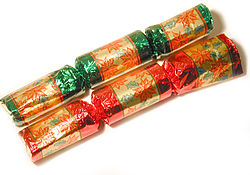
Christmas crackers are festive table decorations that make a snapping sound when pulled open, and typically contain a small gift, paper hat and a joke. They are part of Christmas celebrations in the United Kingdom, Ireland and Commonwealth countries such as Australia, Canada, New Zealand and South Africa.

A cracker consists of a segmented cardboard tube wrapped in a brightly decorated twist of paper with a prize in the centre,[1] making it resemble an oversized sweet-wrapper. The cracker is pulled apart by two people, each holding an outer chamber, causing the cracker to split unevenly and leaving one person holding the central chamber and prize.[1] The split is accompanied by a mild bang or snapping sound produced by the effect of friction on a shock-sensitive, chemically impregnated card strip (similar to that used in a cap gun).[1] One chemical used for the friction strip is silver fulminate.[2]

Tradition

[edit]
Dinner party guests pull a cracker

Crackers are traditionally pulled during Christmas dinner or at Christmas parties. One version of the cracker ritual holds that the person who ends up with the larger end of cracker earns the right to keep the contents of the cardboard tube. Sometimes, each participant retains ownership of their own cracker and keeps its contents regardless of the outcome. Christmas crackers traditionally contain a colourful crown-shaped hat made of tissue paper, a small toy, a plastic model, or a trinket, and a small strip of paper with a motto, a joke, a riddle, or a piece of trivia.[3] The paper hats, with the appearance of crowns, are usually worn at Christmas dinner. The tradition of wearing festive hats is believed to date back to Roman times and the Saturnalia celebrations, which also involved decorative headgear.[1]

Christmas crackers are also associated with Knut's parties, held in Sweden at the end of the Christmas season.

Author and historian John Julius Norwich (Viscount Norwich) was known for sending his family and friends a Christmas Cracker each year which was a kind of expanded Christmas card of anecdotes, trivia and witticisms collected from history and literature. Initially he printed them privately to give to friends but also sold via some London bookstores. His 49th and final cracker was published posthumously[4] in the year of his death.

History

[edit]

The Oxford English Dictionary records the pulling of crackers from 1847.[5]

Tom Smith

[edit]
Catalogue for Tom Smith's Christmas Novelties from 1911

Tradition tells of how Tom Smith (1823–1869) of London invented crackers in 1847.[6][7] He created the crackers as a development of his bon-bon sweets, which he sold in a twist of paper (the origins of the traditional sweet-wrapper). As sales of bon-bons slumped, Smith began to come up with new promotional ideas. His first tactic was to insert love messages into the wrappers of the sweets (similar to fortune cookies).[8]

Smith was inspired to add a "crackle" element after hearing the crackle of a log he had just put on a fire.[8][9] The size of the paper wrapper had to be increased to incorporate the banger mechanism, and the sweet itself was eventually dropped, to be replaced by a trinket: fans, jewellery and other substantial items.[10] The new product was initially marketed as the Cosaque (French for Cossack),[10] but the onomatopoeic "cracker" soon became the commonly used name, as rival varieties came on the market.

The other elements of the modern cracker—the gifts, paper hats and varied designs—were all introduced by Tom Smith's son, Walter Smith, to differentiate his product from the rival cracker manufacturers which had suddenly sprung up.[9]

Tom Smith & Company merged with Caley Crackers in 1953.

A memorial water fountain to Tom Smith and his family stands in Finsbury Square, London.[11][12]

Art

[edit]
Norman Rockwell (1919)

A Christmas cracker is the subject of The Party Favor, an oil painting by American artist Norman Rockwell. [13][14] The painting appeared as cover art for The Saturday Evening Post on 26 April 1919.[15]

Records

[edit]

The World's Largest Christmas Cracker was measured at 63.1 m (207 ft) long and 4 m (13 ft) in diameter and was made by the parents of children at Ley Hill School and Pre-School, Chesham, Buckinghamshire, UK on 20 December 2001.[16]

The longest Christmas cracker pulling chain consisted of 1081 people and was achieved by The Harrodian School in London on 10 December 2015.[17]

On 17 August 2020, while filming a Christmas episode of the television series QI, British comedian Alan Davies set a Guinness World Record for the most crackers pulled by an individual in 30 seconds. He achieved 35 successful cracks, outscoring fellow panelist Justin Moorhouse by five in a head-to-head competition.[18] Davies' record stood until Joel Corry achieved 41 successful cracks at Capital's Jingle Bell Ball on 12 December 2021.[19]

Flight restrictions

[edit]

Rules on transporting Christmas crackers in luggage vary by airline and airport.[20] Passengers on commercial flights in and to the United States are explicitly prohibited from carrying Christmas crackers on board or in checked baggage.[21]

References

[edit]
[edit]
Revisions and contributorsEdit on WikipediaRead on Wikipedia
from Grokipedia
A Christmas cracker is a festive consisting of a tube wrapped in brightly colored and twisted at both ends, designed to be pulled apart by two people to produce a sharp popping sound from an internal chemical snapper. Inside each cracker are typically a crown, a small gift or trinket such as a or keyring, and a —often a punny or printed on a narrow strip of . The tradition originated in the during the and remains a staple of celebrations, particularly at meals where participants don the crowns and read the mottos aloud. The invention of the Christmas cracker is credited to Tom Smith, a London-based confectioner, who in 1847 began importing French bonbons—sugared almonds wrapped in with attached love mottos—and adapted them for the British market by replacing the almonds with small gifts. Around 1860, Smith introduced the signature "bang" mechanism, inspired by the crackling sound of burning logs in a , using silver fulminate-impregnated strips that create and when pulled. His son, , further evolved the design in the early 1900s by adding colorful paper hats, while mottos shifted from romantic verses to humorous jokes by the 1930s, reflecting changing social tastes. Beyond the dinner table, Christmas crackers have cultural significance in British holiday customs, often pulled in a chain by groups of people with crossed arms to amplify the communal fun and surprise element. Over time, they have been themed around events like coronations, wars, and pop culture, with production involving handmade elements such as guillotined tissue and precise folding for aesthetic appeal. Though primarily associated with , variations appear in other celebrations, underscoring their role as a symbol of joy and lighthearted tradition.

Description and Components

Physical Appearance

A Christmas cracker typically features a cylindrical paper tube shape, measuring about 10 to 12 inches in length and 1 to 2 inches in diameter, designed to resemble an oversized or . The exterior is wrapped in brightly colored paper, often twisted at both ends and secured with ribbons for a festive, elongated appearance that evokes cheer. The wrapping materials vary, including traditional gift wrap stock, tissue paper, foil, or cellophane for added shine and texture, with ends commonly tied using satin or curling ribbons in complementary colors like red, gold, or green. These variations allow for creative adaptations, such as embossed or metallic finishes, while maintaining the core tubular form. Visual designs emphasize seasonal motifs, such as leaves and berries, snowflakes, ribbons, or abstract festive patterns printed across the surface to enhance the celebratory aesthetic. Commercial versions often incorporate branding elements, like manufacturer logos or themed artwork, printed on the wrappers or accompanying boxes. Since the , the appearance has standardized around this cylindrical, twisted-end format, evolving from Tom Smith's initial 1847 patent for simple bonbon-style wrappers to more elaborate, trend-inspired decorations by the , such as fringed gold paper or topical illustrations. This consistency in form and festive styling has persisted, with modern examples retaining the vibrant, ribbon-secured look established during the .

Internal Mechanism

The internal mechanism of a Christmas cracker centers on its snapping device, which produces the characteristic sound during the pulling ritual. This device consists of two thin strips of or , typically measuring about 12 inches in length, layered together along their length. One strip is coated with a small amount of (AgCNO), a highly -sensitive compound, while the other features an abrasive surface, such as or a rough . When the strips are pulled apart, the ignites the , causing a minute that generates the snap without significant force or residue. These strips are embedded lengthwise within the cylindrical tube of the cracker, running parallel to its axis and secured at both ends to the twisted closures. This attachment ensures balanced tension during the pull, allowing the to occur uniformly across the overlapping sections in the middle of the cracker, while the ends provide equal resistance for the two participants. The design maintains structural integrity, preventing premature separation and enabling the contents to remain contained until the snap occurs. The mechanism evolved from its inception in the mid-19th century, when Tom Smith patented the basic design in 1847 and refined it by 1860 using for the , replacing earlier noisemaking novelties inspired by French bonbons. During the 20th century, particularly amid rationing, production of the explosive snaps was restricted due to material shortages and safety concerns, leading to temporary alternatives or simplified versions. Post-war regulations enhanced safety, with modern limits such as up to 1 mg in the (as of 2015, per PHMSA) or 2.5 mg in the UK (as of 2015, per Pyrotechnic Articles Regulations) to minimize risks. In recent decades, some manufacturers have introduced non-explosive, friction-based alternatives or silent s—often using mechanical or chemical-free poppers—to address noise sensitivity, environmental concerns, and stricter explosive handling rules, though traditional fulminate-based versions remain standard in many markets.

Typical Contents

A Christmas cracker typically contains three core items: a paper , a small novelty or trinket, and a or printed on a slip of paper. The paper , made from folded , serves as festive headwear that participants don during meals to enhance the celebratory and playful atmosphere. The or , often a , , or trivia question, is intended to provide light-hearted entertainment, usually read aloud by those who pull the cracker. The novelty or trinket acts as a , appealing especially to children, and commonly includes items such as figurines, keychains, tools like screwdrivers or openers, or simple like travel chess sets. Variations in contents have emerged based on the cracker's price and , with standard versions featuring basic, inexpensive trinkets and premium ones incorporating higher-quality or themed items. For instance, seasonal themes often include holiday-specific novelties like miniature ornaments or snowflake keychains in everyday crackers, while luxury editions may contain branded accessories such as charms, engraved jewelry, or custom to elevate the gifting experience. These adaptations maintain the entertaining purpose of the core elements but cater to diverse preferences during festive gatherings.

History

Origins with Tom Smith

Tom Smith, a London-based confectioner born in 1823, is credited with inventing the Christmas cracker in the mid-19th century. During a business trip to in the early 1840s, Smith encountered French bon-bons—sugared almonds wrapped in colorful with twisted ends, often containing romantic mottos. Inspired by this novelty, he began producing similar wrapped sweets in his shop around 1847, marketing them as elegant gifts with printed love verses to appeal to Victorian couples during the season. Initial sales were modest, as the products lacked excitement beyond their decorative wrapping. Around 1860, Smith sought to enhance their appeal after observing the crackling sound of a burning log in his fireplace, which evoked the festive atmosphere of a . He collaborated with a fireworks chemist, Tom Brown, to develop a friction-based mechanism using strips impregnated with , creating a sharp "bang" when the ends were pulled apart. This addition transformed the bon-bon into an interactive novelty, shifting its focus from mere to a celebratory device. In 1861, introduced the product to the market as "Bangs of Expectation." This marked the first commercial Christmas cracker, complete with the signature snap, though early versions still emphasized mottos over additional contents, establishing the core tradition that would define the product.

Commercial Development

Following Tom 's death in 1869, his three sons, , Walter, and Henry, took over the family business, significantly expanding production operations in to meet growing demand. The company relocated to larger premises on , where it remained until the 1950s, allowing for increased output and distribution across the city and beyond. This growth transformed the nascent invention—sparked by 's earlier inspiration from French bonbons—into a viable commercial enterprise, with the brothers focusing on scaling up from artisanal to a more structured manufacturing model. By the 1880s, the Tom Smith company introduced themed Christmas crackers tailored for occasions such as weddings and parties, diversifying beyond standard holiday items to appeal to a broader market. These specialized variants, often featuring custom mottos or decorations suited to events like nuptials, helped capture niche consumer interest and boosted sales. Concurrently, advancements in techniques, including mechanized assembly lines for wrapping and filling, reduced costs and made crackers affordable for middle-class households, shifting them from luxury novelties to everyday festive accessories. In the early 1900s, the business extended its reach through exports to countries, where crackers were integrated into British colonial holiday traditions, fostering widespread adoption in places like , , and . This international expansion was aided by the product's alignment with imperial festive customs, with production ramping up to supply global markets. Royal endorsement further propelled commercial success, as and her family incorporated crackers into their celebrations, lending prestige and encouraging upper-class emulation across the .

Design Evolution

The design of Christmas crackers originated in the with ornate aesthetics featuring elaborate illustrations and luxurious materials such as gold foil wrapping, reflecting the period's emphasis on opulent festive decorations. These early crackers, produced by pioneers like Tom Smith, often included intricate printed motifs on their boxes and wrappers, drawing from romantic and seasonal themes to appeal to the upper classes. As commercial production expanded in the early , designs transitioned to simpler, more colorful mass-market versions using vibrant coverings to make them accessible and appealing for widespread use in households. This shift prioritized affordability and bold aesthetics over elaborate detailing, with twisted ends and festive hues becoming standard. Post-World War II, innovations included the incorporation of inexpensive plastic toys as contents, aligning with the broader postwar boom in synthetic materials for novelties, which added durability and variety to the traditional hat, , and trinket. In the late 20th and early 21st centuries, designs evolved further with the rise of luxury editions featuring higher-quality contents like treats or metallic accents, catering to premium markets. Environmental concerns prompted a shift toward eco-friendly papers and recyclable materials starting in the , reducing reliance on non-biodegradable elements. Artistic influences have persisted through collaborations with illustrators, such as the 1907 partnership between Tom Smith and for whimsical cat motifs, inspiring custom designs with unique themes. Notable extremes include the for the largest Christmas cracker, measuring 63.1 meters long and created in , , , on 20 December 2001.

Traditions and Usage

Role in Christmas Festivities

Christmas crackers play a central role in holiday celebrations, particularly as festive table decorations during Christmas dinners in the and Commonwealth countries such as , , , and . They are traditionally placed beside each plate as part of the meal setup, adding color and anticipation to the communal dining experience. This placement encourages interaction among family and guests, transforming the dinner into a lively, participatory event. Symbolically, crackers embody joy, surprise, and communal participation, fostering a sense of shared excitement that aligns with Victorian ideals of family entertainment. Originating in the tradition of the era, they promote lighthearted fun through elements like jokes and small gifts, enhancing the festive atmosphere without relying on elaborate setups. In this way, they serve as a simple yet effective means of bringing people together, reflecting the era's emphasis on domestic merriment during the holiday season. Beyond the dinner table, crackers are incorporated into broader festivities, such as parties in the UK, where they contribute to pre-meal gatherings and extend the celebratory mood.

The Pulling Tradition

The pulling tradition of a cracker centers on an interactive ritual typically involving two people, who each grasp one end of the tubular device and pull simultaneously in opposite directions. This action causes the cracker to split at its predetermined weaker friction point, producing a distinctive bang and ejecting the contents outward for all to see. The individual left holding the larger segment of the cracker is deemed the winner, a role that carries lighthearted privileges. The winner dons the colorful paper crown contained within, recites the printed or aloud to elicit from the group, and claims the small novelty or gift as their prize. In communal settings like , the tradition often scales to groups where participants cross their arms—holding their own cracker in the right hand and their neighbor's in the left—to pull multiple crackers at once, fostering shared excitement. surrounding the pull varies, with some recommending it occur across the dinner table after the to avoid disrupting the meal, while others suggest starting the festivities at the meal's beginning so crowns can be worn throughout. For younger participants, pulls are commonly conducted in supervised pairs to ensure safety and enjoyment. To enhance winning odds, participants may employ techniques such as gripping their end lower than their partner's and applying a steady, two-handed pull rather than a sudden yank, as advised by defense technology experts. Regardless of the outcome, the ritual emphasizes fun and inclusivity within the festive gathering.

Global and Cultural Variations

Christmas crackers, originating from British traditions, spread to nations through colonial influences in the . In , British settlers introduced the custom during the , adapting it to local contexts with themed designs featuring native wildlife such as kangaroos and koalas in the toys and decorations inside the crackers. Similarly, in and , the tradition arrived via British migration, becoming a staple at holiday dinners in regions with strong ties, often incorporating elements like family-oriented jokes and small gifts reflective of local culture. Beyond these Commonwealth countries, Christmas crackers see occasional adoption in other regions, particularly where they are available through specialty retailers and used in some gatherings or expat celebrations, though they remain unfamiliar to many as a core tradition. In some parts of outside the , they appear sporadically at Christmas markets. Adaptations extend to non-Christian contexts, with variants like crackers filled with rather than -specific items, serving as party favors for celebrations worldwide regardless of religious affiliation. In modern multicultural settings, particularly in diverse communities in the , fusions emerge such as Diwali-themed crackers featuring colorful designs and surprises tailored to the Festival of Lights, blending festive popping mechanisms with cultural motifs like patterns.

Production and Variations

Manufacturing Process

The industrial production of Christmas crackers follows a structured process to ensure efficiency and uniformity. Decorative is first rolled around a tube using a cylindrical former and secured with glue to create the main body. One end is gathered with and twisted to form a seal, after which the snap—a thin strip with a mild charge—is inserted lengthwise through the tube, alongside the contents including jokes, hats, and small novelties. The opposite end is then twisted closed, and ribbons or bows are attached to both ends for finishing. Automation of these stages, including rolling, insertion, and twisting, was introduced in the mid-20th century to support growing demand, though hand-finishing persists for premium variants. Leading manufacturers like the Tom Smith Group produce over 50 million crackers annually, with output ramping up seasonally from October through December to align with holiday distribution needs. Quality control measures focus on snap reliability, targeting activation rates of at least 98%, and content safety, involving inspections for defects and compliance with standards; premium lines undergo additional hand-finishing to verify structural integrity and presentation.

Materials and Sustainability

Traditional crackers are primarily constructed from for the outer wrapping and inner tubes, providing a lightweight and festive covering that can be colorful and patterned. The internal structure includes strips for the , which are coated with chemical compounds such as (AgCNO) to produce the characteristic bang upon pulling. Small toys or novelties, often made from plastic, are included as surprises, alongside hats and mottos, contributing to the overall composition that emphasizes affordability and disposability. Sustainability challenges arise from the plastic components in , which generate non-recyclable and contribute to microplastic , as an estimated 40 million crackers end up in landfills annually in the alone, along with their single-use contents. Additionally, the snaps' coating renders them non-biodegradable and hazardous, complicating efforts and prompting some manufacturers to remove them entirely to enable full recyclability of the elements. These issues highlight the environmental of traditional production, where short-lived festivities lead to persistent . Since the 2010s, eco-friendly alternatives have gained traction, incorporating biodegradable plastics for toys and seed-embedded paper for wrappers that can be planted to grow wildflowers, reducing waste and promoting regeneration. These innovations, such as plantable seed paper crackers, allow the materials to biodegrade naturally or serve a secondary purpose post-use, addressing while maintaining the festive tradition. The industry has responded with initiatives like (FSC) certification for paper sourcing, ensuring sustainable forestry practices; for instance, brands such as Heart & Soul have committed to 100% FSC-certified materials by 2026 to minimize impacts. In the , post-2000 regulations under REACH (Registration, Evaluation, Authorisation and Restriction of Chemicals), effective since 2007, have imposed restrictions on hazardous substances, including limits on compounds like those in , influencing safer formulations and encouraging chemical-free designs to comply with environmental standards.

Modern Innovations and Records

In recent years, Christmas crackers have incorporated digital elements to enhance interactivity and reduce waste. For instance, establishments like have introduced e-crackers featuring QR codes that link to digital prizes and jokes, launched in 2022 as an eco-friendly alternative to traditional paper versions. These innovations allow users to scan codes for virtual content, blending the pulling tradition with integration. Advancements in additive manufacturing have enabled customizable 3D-printed components for crackers. Designers offer open-source models for printing entire crackers or internal toys, such as functional snaps or personalized trinkets, with recent examples including reusable, multi-color designs shared in 2023. Platforms like and Printables host these files, allowing users to tailor contents to themes or sizes using home printers. Sustainability drives further innovations, particularly zero-waste designs. Companies like Waste Free Celebrations produce reusable crackers from recycled materials, which earned a and editor's choice at the 2023 Australian Clean & Conscious Awards for eliminating and enabling refillable use. Similarly, Happy Crackers offers lifetime-durable, -free versions to counter the annual disposal of over 40 million traditional crackers. Notable records highlight the scale of Christmas cracker enthusiasm. The largest ever cracker measured 63.1 meters long and 4 meters in diameter, created by parents at Ley Hill School in the UK on , 2001. In terms of participation, the biggest pulling event involved 1,478 people organized by R&D Ken-Yu-Kai Tochigi in on October 18, 2009. For speed, the record for most crackers pulled by an individual in 30 seconds stands at 41, set by at Capital's in the UK on December 12, 2021. A team record of 30 pulls in one minute was achieved by students from Walnut Tree Walk Primary School in the UK on December 19, 2024. Looking ahead, future trends point toward greater digital integration to combat declining physical sales and environmental concerns. Virtual adaptations, such as app-based pulling simulations, are emerging alongside broader VR applications for holiday gatherings, potentially allowing remote participants to "pull" crackers in shared digital spaces. These developments aim to preserve the festive spirit while promoting .

Regulations and Restrictions

Travel and Aviation Rules

Christmas crackers, containing small explosive snaps, are classified as low-hazard fireworks (Category F1 under European standards) and fall under Class 1.4G explosives in the International Civil Aviation Organization (ICAO) Technical Instructions for the Safe Transport of Dangerous Goods by Air, which generally prohibit fireworks in passenger baggage due to their potential as ignition sources. These regulations were strengthened post-9/11 to enhance aviation security, leading to outright bans on flights to, from, or transiting the United States, where the Transportation Security Administration (TSA) forbids Christmas crackers in both carry-on and checked luggage. Under ICAO guidelines, Christmas crackers may be transported in checked baggage if compliant with dangerous goods rules and in original retail packaging, but policies vary by airline and country. Carry-on is often not permitted due to the explosive content, though some airlines allow limited quantities; passengers must verify with their carrier. Exceptions exist for defused or novelty non-snapping versions that lack the mechanism, which are not classified as and may be permitted in either carry-on or . For example, some airlines like permit standard crackers up to two boxes in both cabin and hold baggage if in original packaging; however, travelers must verify with the carrier as policies vary. For postal services, the permits sending Christmas crackers internationally if they are in complete, original retail packaging with a total net content not exceeding 50 mg per package, or 100 mg for domestic shipments, but standalone snaps are banned as explosives. Incidents of are common but rarely result in fines, with teams at like in the reporting the seizure of hundreds of prohibited holiday items monthly, including crackers, during peak travel seasons. Travelers are advised to check airline-specific policies in advance, consider purchasing crackers at their destination to avoid issues, or opt for non-explosive alternatives to ensure smooth holiday journeys. Christmas crackers present certain health and safety risks, primarily related to their mechanism and small novelty components. The , which produces the characteristic bang, utilizes a small amount of , a friction-sensitive that can cause minor burns or if mishandled or ingested accidentally, though such incidents are rare when used as intended. The act of pulling crackers can lead to minor injuries such as strains or fractures, with hospitals reporting around four broken arms annually from overenthusiastic pulling. Additionally, the small toys or trinkets inside pose hazards, particularly for children under three years old, as these parts can easily become lodged in airways if swallowed. Injuries from crackers tend to affect the hands, eyes, or face due to the snap's force or flying debris, but overall reported cases remain low, emphasizing the need for adult supervision during use. Regulatory standards in the UK and EU focus on mitigating these risks through strict manufacturing and consumer guidelines. Christmas crackers are classified as category F1 pyrotechnic articles under the UK's Pyrotechnic Articles (Safety) Regulations 2015, which require compliance with essential safety requirements including stable construction, non-toxic composition of the explosive charge, and clear labeling to prevent misuse. Sales are restricted to individuals aged 12 and over to reduce accident risks among younger users. The novelties and paper components must adhere to the Toys (Safety) Regulations 2011, transposing the EU Toy Safety Directive 2009/48/EC, mandating non-toxic materials, mechanical integrity to avoid sharp edges, and the CE marking to certify conformity with health and safety standards. In the UK, post-Brexit, toys must bear the UKCA mark under the Toys (Safety) Regulations 2011 (as amended), aligning closely with EU standards but separate from CE marking. These regulations prohibit substances like phthalates above specified limits and ensure flammability resistance for the outer casing. Regarding , and standards ban lead in paints and coatings, with the Directive establishing migration limits of 2 mg/kg for lead in dry, brittle, or powdered materials since its full implementation in 2011, building on earlier restrictions from the to protect against neurotoxic exposure in children. Compliance testing involves to verify these limits, ensuring all elements of the cracker, including printed decorations, are safe for incidental contact or mouthing. The evolution of these standards reflects a progression from lax oversight to rigorous enforcement driven by public health advocacy. In the 19th century, Christmas cracker production by pioneers like Tom Smith operated without formal regulations, relying on rudimentary craftsmanship amid widespread use of potentially hazardous materials. Child safety campaigns in the 1960s, highlighted by media exposés on dangerous toys, prompted the UK's first dedicated Toy Safety Regulations in 1974, which introduced basic mechanical and chemical safety benchmarks. By the post-1960s era, escalating concerns over pyrotechnic mishaps led to harmonized EU directives and UK updates, culminating in the Pyrotechnic Articles (Safety) Regulations 2015 (setting a 12-year age limit for Christmas crackers, while 16 for other F1 fireworks) and the 2011 toy rules, significantly reducing injury rates through mandatory risk assessments and traceability. These measures continue to be enforced by bodies like the Office for Product Safety and Standards, with penalties for non-compliance including fines or product recalls.

References

Add your contribution
Related Hubs
User Avatar
No comments yet.