


Community hub
Recent from talks
Contribute something
Nothing was collected or created yet.
Golden algae
View on Wikipedia
| Golden algae | |
|---|---|

| |
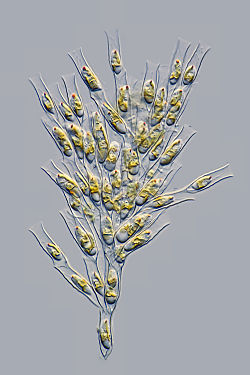
| Dinobryon divergens, a tree like sessile form with cells in the cup-like shells | |
Scientific classification 
| |
| Domain: | Eukaryota |
| Clade: | Sar |
| Clade: | Stramenopiles |
| Phylum: | Ochrophyta |
| Clade: | Chrysista |
| Clade: | Limnistia |
| Class: | Chrysophyceae Pascher, 1914[1] |
| Orders[2] | |
|
Chromulinales | |
| Synonyms | |
| |
The Chrysophyceae, usually called chrysophytes, chrysomonads, golden-brown algae, or golden algae, are a large group of algae, found mostly in freshwater.[3]
The Chrysophyceae should not be confused with the Chrysophyta, which is a more ambiguous taxon. Although "chrysophytes" is the anglicization of "Chrysophyta", it generally refers to the Chrysophyceae.
Members
[edit]Originally they were taken to include all such forms of the diatoms and multicellular brown algae, but since then they have been divided into several different groups (e.g., Haptophyceae,[4] Synurophyceae) based on pigmentation and cell structure. Some heterotrophic flagellates as the bicosoecids and choanoflagellates were sometimes seen as related to golden algae too.
They are now usually restricted to a core group of closely related forms, distinguished primarily by the structure of the flagella in motile cells, also treated as an order Chromulinales. It is possible membership will be revised further as more species are studied in detail.
The Chrysophyceae have been placed by some in the polyphyletic Chromista. The broader monophyletic group to which the Chrysophyceae belong includes various non-algae including the bicosoecids, not the collar flagellates, opalines, oomycete fungi, proteromonads, actinophryid heliozoa, and other heterotrophic flagellates and is referred to as the Stramenopiles.
Description
[edit]
The "primary" cell of chrysophytes contains two specialized flagella. The active, "feathered" (with mastigonemes) flagellum is oriented toward the moving direction. The smooth passive flagellum, oriented toward the opposite direction, may be present only in rudimentary form in some species.
An important characteristic used to identify members of the class Chrysophyceae is the presence of a siliceous cyst that is formed endogenously. Called statospore, stomatocyst or statocyst, this structure is usually globose and contains a single pore. The surface of mature cysts may be ornamented with different structural elements and are useful to distinguish species.[5]
- Most members are unicellular flagellates, with either two visible flagella, as in Ochromonas, or sometimes one, as in Chromulina. The Chromulinales as first defined by Pascher in 1910 included only the latter type, with the former treated as the order Ochromonadales. However, structural studies have revealed that a short second flagellum, or at least a second basal body, is always present, so this is no longer considered a valid distinction. Most of these have no cell covering. Some have loricae or shells, such as Dinobryon, which grows in branched colonies. Most forms with silicaceous scales are now considered a separate group, the synurids, but a few belong among the Chromulinales proper, such as Paraphysomonas.
- Some members are generally amoeboid, with long branching cell extensions, though they pass through flagellate stages as well. Chrysamoeba and Rhizochrysis are typical of these. There is also one species, Myxochrysis paradoxa, which has a complex life cycle involving a multinucleate plasmodial stage, similar to those found in slime molds. These were originally treated as the order Chrysamoebales. The superficially similar Rhizochromulina was once included here, but is now given its own order based on differences in the structure of the flagellate stage.
- Other members are non-motile. Cells may be naked and embedded in mucilage, such as Chrysosaccus, or coccoid and surrounded by a cell wall, as in Chrysosphaera. A few are filamentous or even parenchymatous in organization, such as Phaeoplaca. These were included in various older orders, most of the members of which are now included in separate groups. Hydrurus and its allies, freshwater genera which form branched gelatinous filaments, are often placed in the separate order Hydrurales, but may belong here.
Classifications
[edit]
Pascher (1914)
[edit]Classification of the class Chrysophyceae according to Pascher (1914):[1][6][7]
- Division Chrysophyta
- Class Chrysophyceae
- Order Chrysomonadales
- Order Chrysocapsales
- Order Chrysosphaerales
- Order Chrysotrichales
- Class Heterokontae
- Class Diatomeae
- Class Chrysophyceae
Smith (1938)
[edit]According to Smith (1938):
- Class Chrysophyceae
- Order Chrysomonadales
- Suborder Cromulinae (e.g., Mallomonas)
- Suborder Isochrysidineae (e.g., Synura)
- Suborder Ochromonadineae (e.g., Dinobryon)
- Order Rhizochrysidales (e.g., Chrysamoeba)
- Order Chrysocapsales (e.g., Hydrurus)
- Order Chrysotrichales (e.g., Phaeothamnion)
- Order Chrysosphaerales (e.g., Epichrysis)
- Order Chrysomonadales
Bourrely (1957)
[edit]According to Bourrely (1957):[8]
- Class Chrysophyceae
- Order Phaeoplacales
- Order Stichogloeales
- Order Phaeothamniales
- Order Chrysapionales
- Order Thallochrysidales
- Order Chrysosphaerales
- Order Chrysosaccales
- Order Rhizochrysidales
- Order Ochromonadales
- Order Isochrysidales
- Order Silicoflagellales
- Order Craspedomonadales
- Order Chromulinales
Starmach (1985)
[edit]According to Starmach (1985):[9]
- Class Chrysophyceae
- Subclass Heterochrysophycidae
- Order Chromulinales
- Order Ochromonadales
- Subclass Acontochrysophycidae
- Order Chrysarachniales
- Order Stylococcales
- Order Chrysosaccales
- Order Phaeoplacales
- Subclass Craspedomonadophycidae
- Order Monosigales
- Subclass Heterochrysophycidae
Kristiansen (1986)
[edit]Classification of the class Chrysophyceae and splinter groups according to Kristiansen (1986):[9]
- Class Chrysophyceae
- Order Ochromonadales
- Order Mallomonadales
- Order Chrysamoebales
- Order Chrysocapsales
- Order Hydrurales
- Order Chrysosphaerales
- Order Phaeothamniales
- Order Sarcinochrysidales
- Class Pedinellophyceae
- Order Pedinellales
- Class Dictyochophyceae
- Order Dictyochales
Margulis et al. (1990)
[edit]Classification of the phylum Chrysophyta according to Margulis et al. (1990):[10]
- Phylum Chrysophyta
- Class Chrysophyceae
- Class Pedinellophyceae
- Class Dictyochophyceae (= Silicoflagellata)
van den Hoek et al. (1995)
[edit]According to van den Hoek, Mann and Jahns (1995):
- Class Chrysophyceae
- Order Ochromonadales (e.g., Ochromonas, Pseudokephyrion, Dinobryon)
- Order Mallomonadales (= Class Synurophyceae, e.g., Mallomonas, Synura)
- Order Pedinellales (= Class Pedinellophyceae, e.g., Pedinella)
- Order Chrysamoebidales (e.g., Rhizochrysis, Chrysarachnion)
- Order Chrysocapsales (e.g., Chrysocapsa, Hydrurus)
- Order Chrysosphaerales (e.g., Chrysosphaera)
- Order Phaeothamniales (e.g., Phaeothamnion, Thallochrysis)
Preisig (1995)
[edit]Classification of the class Chrysophyceae and splinter groups according to Preisig (1995):[9]
- Class Chrysophyceae
- Order Bicosoecales
- Order Chromulinales
- Order Hibberdiales
- Order Hydrurales
- Order Sancinochrysidales
- Order Chrysomioridales
- Class Dictyochophyceae
- Order Pedinellales
- Order Rhizochromulinales
- Order Dictyochales
- Class Synurophyceae
- Order Synurales
Guiry and Guiry (2019)
[edit]According to Guiry and Guiry (2019):[11]
- Class Chrysophyceae
- Order Chromulinales
- Order Hibberdiales
- Order Hydrurales
- Order Rhizochrysidales
- Order Thallochrysidales
- Chrysophyceae ordo incertae sedis (11 genera)
Ecology
[edit]
Chrysophytes live mostly in freshwater, and are important for studies of food web dynamics in oligotrophic freshwater ecosystems, and for assessment of environmental degradation resulting from eutrophication and acid rain.[14]
Evolution
[edit]
Chrysophytes contain the pigment fucoxanthin.[15] Because of this, they were once considered to be a specialized form of cyanobacteria.[citation needed] Because many of these organisms had a silica capsule, they have a relatively complete fossil record, allowing modern biologists to confirm that they are, in fact, not derived from cyanobacteria, but rather an ancestor that did not possess the capability to photosynthesize. Many of the chrysophyta precursor fossils entirely lacked any type of photosynthesis-capable pigment. The most primitive stramenopiles are regarded as heterotrophic, such as the ancestors of the Chrysophyceae were likely heterotrophic flagellates that obtained their ability to photosynthesize from an endosymbiotic relationship with fucoxanthin-containing cyanobacteria.
References
[edit]- ^ a b Pascher, A (1914). "Über Flagellaten und Algen". Berichte der Deutschen Botanischen Gesellschaft. 32: 136–160. doi:10.1111/j.1438-8677.1914.tb07573.x. S2CID 257830577.
- ^ NCBI. Taxonomy Browser (Chrysophyceae)
- ^ "Introduction to the Chrysophyta". Retrieved 2009-06-13.
- ^ Medlin, L. K., W. H. C. F. Kooistra, D. Potter, G. W. Saunders, and R. A. Anderson. 1997. Phylogenetic relationships of the “golden algae” (haptophytes, heterokont chromophytes) and their plastids. Plant Systematics and Evolution (Supplement) 11: 187–219.
- ^ Duff, K. E.; Zeeb, B. A.; Smol, John P. (1995). Atlas of Chrysophycean Cysts. Springer-Science+Business Media, B. V.
- ^ Round, F.E. (1986). The Chrysophyta - a reassessment. In: Chrysophytes: Aspects and Problems. Kristiansen, J. and R.A. Andersen [Eds.]. Cambridge University Press, Cambridge, p. 12.
- ^ Sharma, O. P. (1986). Textbook of Algae. McGraw Hill. p. 23, [1].
- ^ Andersen, R.A. (2007). Molecular systematics of the Chrysophyceae and Synurophyceae. In: Unravelling the algae: the past, present, and future of algal systematics. The Systematics Association Special Volume Series, 75. (Brodie, J. & Lewis, J. Eds), pp. 285-313. Boca Raton: CRC Press.
- ^ a b c Preisig, H. R. (1995). "A modern concept of chrysophyte classification". In Sandgren, C. D.; Smol, J. R.; Kristiansen, J. (eds.). Chrysophyte algae: ecology, phylogeny and development. Cambridge University Press. pp. 46–74. ISBN 9780521462600.
- ^ Margulis, L., J.O. Corliss, M. Melkonian, D.J. Chapman. Handbook of Protoctista. Jones and Bartlett Publishers, Boston, 1990.
- ^ Guiry, M.D.; Guiry, G.M. (2019). "AlgaeBase". World-wide electronic publication, National University of Ireland, Galway. Retrieved 2019-06-03.
- ^ Ohishi H.; Yano H.; Ito H.; Nakahara M. 1991. Observations on a chrysophyte hikarimo in a pond in Hyogo prefecture, Japan. [兵庫県内の池に発生したヒカリモ(黄金藻)の観察.] Japanese Journal of Phycology 39(1): 37-42, link.
- ^ Goff, Matt. "Chromophyton (Golden Glow Mystery Revisited)". Sitka Nature (online). March 16, 2011. link.
- ^ Sandgren et al. (1995).
- ^ "Chrysophyta". Archived from the original on 2008-09-22. Retrieved 2009-06-13.
Bibliography
[edit]

- Andersen, R. A. 2004. Biology and systematics of heterokont and haptophyte algae. American Journal of Botany 91(10): 1508–1522. 2004.
- Duff, K.E., B.A. Zeeb & J.P. Smol. 1995. Atlas of Chrysophycean Cysts, Vol. 1., [2]; 2001, Vol. 2, [3]. Kluwer Academic Publishers, Dordrecht.
- Jørgen Kristiansen. 2005. Golden algae: a biology of chrysophytes. A.R.G. Gantner Verlag, distributed by Koeltz Scientific Books, Königstein, Germany, vii + 167 pp. ISBN 3-906166-23-6.
- Kristiansen, J. and R.A. Andersen [Eds.]. 1986. Chrysophytes: Aspects and Problems. Cambridge University Press, Cambridge, xiv + 337 pp.
- Kristiansen, J. and Preisig, H. [Eds.]. 2001. Encyclopedia of chrysophyte genera. Bibliotheca Phycologica, Vol. 110, J. Cramer, Berlin.
- Medlin, L. K., W. H. C. F. Kooistra, D. Potter, G. W. Saunders, and R. A. Anderson. 1997. Phylogenetic relationships of the “golden algae” (haptophytes, heterokont chromophytes) and their plastids. Plant Systematics and Evolution (Supplement) 11: 187–219.
- Sandgren, C.D., J.P. Smol, and J. Kristiansen [Eds.]. 1995. Chrysophyte algae: ecology, phylogeny and development. Cambridge University Press, New York. ISBN 0-521-46260-6.
- Škaloud, P., Škaloudová, M., Pichrtová, M., Němcová, Y., Kreidlová, J. & Pusztai, M. 2013. www.chrysophytes.eu – a database on distribution and ecology of silica-scaled chrysophytes in Europe. Nova Hedwigia, Beiheft 142: 141-146. link
| National | |
|---|---|
| Other | |

Golden algae
View on GrokipediaDescription
Morphology
Golden algae, or Chrysophyceae, exhibit a range of morphological forms, predominantly unicellular or colonial, with some species forming simple multicellular structures.[3][4] Most are flagellated, possessing two heterokont flagella of unequal length inserted apically: the anterior flagellum is longer, tinsel-like with tubular mastigonemes for propulsion, while the posterior one is smooth and shorter, functioning as a rudder, often accompanied by a heterokont-type photoreceptor and eyespot.[3][4] Cells typically lack a rigid cell wall or possess only a thin one, frequently covered by intricate siliceous scales or bristles that are characteristic of the class and aid in species identification.[3][4] Cell sizes vary from 2 to 100 μm, encompassing nannoplanktonic to larger forms, with shapes ranging from spherical and ovoid to elongated, amoeboid, or stalked configurations.[5] In certain genera, such as Dinobryon, cells are enclosed in a lorica—a vase-shaped, mucilaginous or siliceous envelope—or surrounded by mucilage, facilitating sessile or colonial lifestyles.[3][6] A defining feature includes statospores, which serve as resting cysts formed endogenously within a silica deposition vesicle during asexual or sexual reproduction.[3][7] These spherical to ovoid structures, typically 3–10 μm in diameter, feature ornate siliceous walls with species-specific patterns of pores, ridges, and spines, often sealed by a polysaccharide plug, making them valuable for taxonomic and paleolimnological studies as durable microfossils.[7][4]Pigments and Reproduction
Golden algae, belonging to the class Chrysophyceae, derive their distinctive golden-brown coloration from a suite of photosynthetic pigments that optimize light absorption in aquatic environments. The primary pigments include chlorophyll a and chlorophyll c, which facilitate core photosynthetic reactions, alongside the xanthophyll carotenoid fucoxanthin, responsible for the characteristic hue by masking the green tones of chlorophyll.[8] These organisms also contain β-carotene as an accessory carotenoid, but notably lack chlorophyll b, distinguishing them from green algae.[9] Fucoxanthin plays a crucial role in broadening the absorption spectrum, with peaks at 510–525 nm in the blue-green to yellow-green range, enabling efficient harvesting of light in the often dim, freshwater habitats where many golden algae thrive.[10] Complementing their photosynthetic capabilities, most golden algae exhibit mixotrophic nutrition, integrating autotrophy with heterotrophic modes such as phagotrophy—engulfing bacterial prey—or osmotrophy, absorbing dissolved organic compounds.[11] This dual strategy enhances survival in nutrient-variable environments, where light or inorganic nutrients may be limiting, allowing species like Ochromonas to switch between phototrophy and bacterivory based on conditions.[12] Reproduction in golden algae is predominantly asexual, occurring via binary fission in vegetative cells or through the release of motile zoospores that disperse and develop into new individuals.[13] Sexual reproduction is infrequent and poorly documented across the group, but when observed, it typically involves zygotic meiosis with gametes that are isogamous (equal in size) or oogamous (with distinct egg and sperm forms) in certain species.[13] The life cycle encompasses vegetative cells as the active phase, resting cysts (often siliceous stomatocysts) for dormancy during adverse conditions, and palmelloid stages where non-motile cells aggregate in a gelatinous matrix for protection and propagation.[14]Cysts and Identification
Golden algae within the Chrysophyceae produce distinctive endogenous siliceous cysts known as statospores or stomatocysts, which serve as resting stages in their life cycles. These cysts are typically globose, hollow structures with diameters ranging from 2 to 30 μm, though most fall between 5 and 10 μm, and feature a single germination pore often surrounded by a collar. The cyst wall forms within a silica deposition vesicle and consists of an inner unornamented layer overlaid by an outer layer exhibiting species-specific ornamentation, such as spines, ridges, reticulum, scabrae, or patterns like reticulate and scrobiculate designs that aid in taxonomic differentiation.[15][16][17] Cyst formation occurs endogenously under adverse environmental conditions, including nutrient limitation, temperature fluctuations, pH changes, or increased population density, acting as a survival mechanism to form a dormant seed bank resistant to dissolution. Excystment is facilitated through the germination pore, allowing the release of viable cells even after prolonged dormancy; for instance, cysts from lake sediments have germinated after at least 60 years. These cysts are taxonomically valuable, with morphology often considered species-specific, though linkages to vegetative stages remain limited for many taxa, leading to an artificial naming system developed by the International Statospore Working Group.[18][15][17] Identification of golden algae relies heavily on cyst morphology, particularly through scanning electron microscopy (SEM) to examine fine-scale ornamentation and pore-collar structures, complementing observations of associated silica scales. For example, genera like Mallomonas are distinguished by unique cyst-silica patterns, such as specific spine arrangements or equatorial divisions. Over 200 cyst morphotypes have been described globally, with regional studies documenting up to 253 in Finnish freshwater sediments alone, though many remain unnamed or unlinked to living species, which complicates biodiversity assessments.[18][15][17] In paleolimnology, these durable siliceous cysts preserve well in sediments and function as proxies for reconstructing past environmental conditions, such as pH, temperature, salinity, and nutrient levels, with fossil records extending back to the Late Triassic. Their abundance and resistance make them particularly useful for inferring historical aquatic dynamics in oligotrophic or acidic habitats like peatlands and lakes.[18][15]Classification
Historical Systems
The classification of golden algae, historically encompassed within the class Chrysophyceae, began with Alfred Pascher's foundational work in 1914, where he established the class based on shared morphological features such as heterokont flagellation and the production of siliceous cysts or scales, drawing parallels to series observed in green algae; he divided it into three subclasses—Chrysomonadineae (two flagella, often scaled), Ochromonadineae (one or two flagella, palmelloid stages), and Aphanomonadineae (amoeboid or plasmodial forms)—primarily using light microscopy to assess flagellar arrangement and cyst formation.[19][20] Gilbert M. Smith's 1938 system refined Pascher's framework by emphasizing vegetative forms and motility, dividing the Chrysophyceae into two main orders: Chrysomonadales for primarily flagellate species with silica scales or cysts, and Heterochloridales for those exhibiting amoeboid stages alongside flagellated ones, such as the colorless heterotrophic forms; this approach highlighted the transitional nature between flagellate and amoeboid lifestyles but retained a broad, morphology-driven grouping.[21] Pierre Bourrelly's 1957 revision further organized the class into orders like Ochromonadales, which included non-walled, biflagellate species capable of forming colonies, alongside other orders for coccoid and heterotrophic forms, incorporating observations of colonial aggregations and cyst development to better accommodate diverse life cycles observed under light microscopy.[22] By the 1980s, Kazimierz Starmach's 1985 classification introduced more nuanced subclasses within Chrysophyceae, distinguishing Heterochrysophycidae for flagellate-dominated groups with scales or loricae, and Acontochrysophycidae for non-scaled, often amoeboid or palmelloid taxa lacking prominent flagella, based on detailed light microscopic examinations of cell coverings and motility; this system aimed to reduce overlap in prior schemes by prioritizing absence or presence of scales. Subsequent works, such as Jørgen Kristiansen's 1986 review, advanced this by elevating silica-scaled families like Mallomonadaceae to ordinal status as Mallomonadales within Chrysophyceae, separating them from non-scaled ochromonad forms to reflect specialized scale ultrastructure visible under electron microscopy, though still reliant on traditional morphological criteria.[1] Similarly, C. van den Hoek and colleagues in 1995 proposed distinguishing silica-scaled groups like Synurales as a separate order or even class precursor, underscoring shifts toward recognizing scale-based autapomorphies in late 20th-century morphology-based systems.[23] These historical classifications, grounded in light and early electron microscopy, often resulted in polyphyletic groupings by conflating convergent traits like flagellation and cyst formation across unrelated heterokont lineages.[24] This morphology-centric approach laid the groundwork for later transitions to molecular phylogenetics in the 1990s.[20]Modern Taxonomy
The modern taxonomy positions golden algae within the class Chrysophyceae, part of the phylum Ochrophyta (synonymous with Heterokontophyta) in the kingdom Chromista. This placement reflects their affiliation with stramenopiles, characterized by heterokont flagellation and chlorophyll c-containing plastids.[25] The class comprises approximately 1,200 species across about 112 genera, predominantly freshwater forms with a few marine and soil representatives. Post-2000 taxonomic revisions, driven by molecular phylogenetics, have refined the hierarchy by excluding unrelated groups such as pedinellids, now classified in the order Pedinellales within the class Dictyochophyceae in Ochrophyta. Nine orders are currently recognized: Ochromonadales (core heterotrophic and mixotrophic flagellates), Chromulinales (organic-scaled monads), Synurales (colonial scaled forms), Phaeothamiales (filamentous heterotrophs), Apoikiales, Hibberdiales, Hydrurales, Paraphysomonadales (siliceous-scaled choanoflagellate-like forms), and Sarcinochrysidales. Family-level organization includes prominent groups like Dinobryaceae (encompassing genera such as Dinobryon) and Synuraceae (including Synura species). In 2023, the class Synurophyceae was formally synonymized with Chrysophyceae, consolidating scaled colonial taxa under a unified framework.[26][27][28] Recent updates documented in AlgaeBase since 2019 emphasize integrative approaches, incorporating ultrastructural and genetic data for genus-level delimitations. A key 2022 revision introduced the family Chrysosphaerellaceae (order Chromulinales), based on the Arctic species Chrysosphaerella septentrionalis, highlighting adaptations in polar environments and resolving ambiguities in scaled chrysomonad taxonomy. These changes underscore the class's paraphyletic nature in earlier schemes, now more robustly delineated through multi-gene analyses.Phylogenetic Advances
Recent advances in molecular phylogenetics have significantly refined the understanding of relationships within the Chrysophyceae, commonly known as golden algae, through the application of genetic markers such as the small subunit ribosomal RNA (SSU rRNA) and ribulose-1,5-bisphosphate carboxylase/oxygenase large subunit (rbcL) genes. These markers have revealed high cryptic diversity and paraphyly in several orders, including Ochromonadales, by demonstrating that morphologically similar taxa often represent distinct evolutionary lineages. For instance, multigene analyses combining nuclear SSU rRNA and plastid rbcL sequences have shown that traditional order boundaries do not always reflect monophyletic groups, necessitating taxonomic revisions based on genetic evidence.[29][30] Phylogenetic studies place Chrysophyceae within the larger Ochrophyta clade, where they share a close relationship with diatoms (Bacillariophyceae) and brown algae (Phaeophyceae), forming part of the basal heterokonts. This positioning is supported by analyses of multiple plastid and nuclear genes, highlighting shared evolutionary traits such as secondary endosymbiosis-derived plastids. High-throughput sequencing efforts in 2022 further illuminated the extensive diversity within Ochromonadales, identifying numerous novel lineages in freshwater environments and underscoring the group's ecological adaptability. More recently, a 2025 phylogenetic study on Chrysococcus utilized concatenated SSU rRNA and rbcL datasets to establish its loricate position within Chrysophyceae, revealing evolutionary transitions toward colonial forms and implying broader implications for lorica development across the class.[31][26][32] Genomic investigations have provided deeper insights into the molecular basis of Chrysophyceae traits, particularly mixotrophy. A 2019 draft genome assembly of the golden alga Hydrurus foetidus, combined with transcriptome data, identified genes associated with phagotrophy and photosynthesis, supporting the prevalence of mixotrophic lifestyles in the group. Comparative pan-genomics of chrysophyte strains, including Ochromonas species, has further shown nutrient-driven expansions in genes for carbon acquisition, reinforcing the adaptive flexibility observed in phylogenetic trees. Additionally, 2024 DNA barcoding using SSU rRNA, large subunit rRNA (LSU rRNA), and rbcL sequences documented new sites of Hydrurus foetidus in Shanxi Province, China, refining biogeographic models for benthic chrysophytes in Asian freshwater systems.[33][34][30]Diversity
Major Orders
The major orders within the Chrysophyceae are distinguished primarily by differences in siliceous scale morphology, cell organization, and motility, reflecting adaptations to varied trophic modes and habitats; the class encompasses approximately 1,274 described species (including 58 fossil forms) across 180 genera.[35] The class now comprises nine orders, with ongoing discoveries adding to its diversity.[36] Ochromonadales represent a diverse group of mostly unicellular flagellates, often exhibiting phagotrophic nutrition through pseudopodia or direct engulfment, distributed across multiple genera featuring heterokont flagella and occasional loricae or colonies.[37][38] Synurales comprise colonial forms characterized by intricate siliceous scales covering cells, enabling coordinated swimming in spherical or linear colonies, known for their role in freshwater blooms due to these protective and structural scales.[37][38] Chromulinales include amoeboid or palmelloid organisms, frequently bearing scales or spines, that alternate between flagellate and non-motile stages, emphasizing their transitional morphologies within the class.[37][38] Other notable orders include Apoikiales, a rare group of parasitic heterotrophs.[36]Key Genera and Species
Golden algae (class Chrysophyceae) encompass approximately 180 genera and 1,274 species, predominantly freshwater organisms, with genera such as Synura (about 57 species) and Mallomonas (over 220 species) representing a substantial portion of the described diversity, together accounting for roughly 20% of all species.[35][39][40] These taxa illustrate the class's morphological and ecological variety, spanning free-living monads to colonial forms across orders like Ochromonadales and Synurales. The genus Dinobryon, belonging to the order Ochromonadales, consists of colonial loricate flagellates that form branching chains within vase-shaped loricae, often dominating plankton in oligotrophic waters. A representative species, Dinobryon divergens, is commonly found in temperate lakes, where it exhibits mixotrophic nutrition by combining photosynthesis and bacterivory.[29][41] Mallomonas, in the order Synurales, includes scaled monads characterized by siliceous scales and bristles that aid in locomotion and protection; these unicellular or loosely colonial forms are widespread in freshwater habitats. For example, Mallomonas caudata features polymorphic scales varying in shape and ornamentation, enabling adaptation to diverse environmental conditions in lakes and ponds globally.[5][42] The genus Synura, also within Synurales, forms spherical colonies of scaled cells connected by cytoplasmic bridges, creating hollow, rotating balls that propel through water. Synura uvella, a common species in temperate and boreal lakes, is notorious for forming blooms that release volatile organic compounds, imparting a fishy odor to affected waters.[43][44] Ochromonas species, assigned to Ochromonadales, are typically free-swimming, biflagellate monads that lack scales or loricae, relying on their golden-brown chloroplasts for phototrophy while often engaging in mixotrophic feeding on bacteria and algae. The species Ochromonas danica exemplifies this lifestyle, thriving in freshwater and marine environments as a versatile predator and primary producer.[45][46] A notable recent addition to the Chrysophyceae is Chrysosphaerella septentrionalis, described in 2022 from a peat bog in the Arctic's Pasvik Nature Reserve, Russia; this colonial species, endemic to high-latitude wetlands, forms small spheres of loricate cells and represents a new family, Chrysosphaerellaceae, highlighting ongoing discoveries in extreme environments.[47]Morphological Variation
Golden algae exhibit a wide range of morphological forms, transitioning between flagellate and amoeboid states in certain lineages. Many species are primarily biflagellate, with one long heterokont flagellum for propulsion and a shorter smooth flagellum, enabling motile, planktonic lifestyles. In contrast, amoeboid forms, such as those in the genus Chrysamoeba, feature cells with radiating pseudopodia up to 20 μm long, facilitating substrate attachment and phagotrophy, while retaining the capacity for flagellate stages during dispersal or reproduction. These transitions highlight adaptive plasticity in locomotion and feeding strategies within the group.[48][49] A prominent variation involves the presence or absence of scales, with approximately 250 species bearing intricate siliceous scales that cover the cell surface, comprising about 20% of the ~1,300 described Chrysophyceae.[35] These scales, formed via silicification in the Golgi apparatus, range from simple plate-like structures to elaborate forms with ribs, pores, spines, or keels, providing protection, buoyancy, or species-specific identification markers visible only under electron microscopy. Unscaled species, predominant in heterotrophic lineages, lack these ornaments and often display smoother, naked protoplasts adapted for rapid movement or osmotrophy. Scale morphology can vary intraspecifically, influenced by environmental factors.[1][49] Colonial adaptations further diversify golden algae morphology, with cells aggregating into structured assemblages for enhanced survival. Stalked colonies, as seen in genera like Poterioochromonas, feature cells attached via mucilaginous stalks to substrates, forming linear or branched arrays that anchor in benthic environments. Free-floating spherical colonies, typical of Synura species, consist of hundreds to thousands of cells embedded in gelatinous matrices, rotating via coordinated flagellar beats to optimize light exposure or nutrient uptake. These colonial forms contrast with solitary cells, emphasizing collective behaviors in resource-limited habitats.[49][1] Morphological complexity spans a broad size spectrum, from naked, unicellular flagellates measuring 2–10 μm in diameter to elaborate colonies reaching 1 mm or more in diameter. For instance, individual Chrysamoeba cells are typically 8–10 μm, while Synura colonies can aggregate up to 1 mm, comprising micron-scale cells in dense, spherical clusters. This variation in scale and organization reflects evolutionary trade-offs between mobility, protection, and metabolic efficiency. A study on Synura petersenii demonstrated that under silica-limited nutrient stress, scales downsized and became malformed, reducing overall cell ornamentation and highlighting environmental modulation of morphological traits.[50][48][51]Ecology
Habitats and Distribution
Golden algae, belonging to the class Chrysophyceae, are predominantly inhabitants of freshwater environments, comprising nearly all known species in this category, with only a small fraction occurring in marine or brackish settings.[19] They thrive in oligotrophic waters such as clear lakes, slow-flowing rivers, and peat bogs, where nutrient levels, particularly total phosphorus, remain low (typically below 15 μg L⁻¹).[19] These algae exhibit a preference for soft, dilute waters with low conductivity (less than 50 μS cm⁻¹) and pH ranges from 5 to 8, often in acidic to circumneutral conditions influenced by humic substances in brown waters.[19][2] Temperature tolerances generally fall between 4°C and 20°C, favoring cold to cool conditions that support their mixotrophic lifestyles.[26] Their distribution is cosmopolitan, recorded on every continent except Antarctica, though abundance peaks in cold-temperate regions of the Holarctic realm, including boreal forests and subarctic areas.[19] High diversity is noted in Nordic countries, the Alps, and mountain lakes, where species richness correlates with oligotrophic, low-pH habitats.[26] Benthic forms, such as Hydrurus foetidus, are characteristic of fast-flowing, cold rivers during snowmelt periods, while planktonic genera like Dinobryon and Ochromonas dominate in temperate lakes.[52] Rare brackish occurrences include species like Dinobryon balticum in the Baltic Sea.[2] Biogeographically, golden algae show elevated endemism in ancient lakes, such as Lake Baikal, where over 25 silica-scaled species have been documented, including endemics like Mallomonas kuzminii. Recent studies as of 2025 have expanded the checklist of silica-scaled species in Lake Baikal to 57 taxa.[53][54] Recent expansions in known ranges include the 2024 discovery of Hydrurus foetidus in the Fenhe River of Shanxi Province, China, highlighting their presence in East Asian freshwater systems previously underreported.[30] Overall, approximately 90% of Chrysophyceae species are confined to freshwater habitats, underscoring their role as indicators of pristine, nutrient-poor aquatic ecosystems.[19]Ecological Roles
Golden algae, particularly those in the class Chrysophyceae, serve as primary producers and mixotrophs in aquatic ecosystems, often contributing 10–75% of phytoplankton biomass in oligotrophic and dystrophic waters, where their photosynthetic activity supports overall primary production.[55] Mixotrophic species, such as Chrysosphaerella multispina, can dominate biomass exceeding 50% in nutrient-poor conditions by combining autotrophy with heterotrophy, enhancing their resilience and role in carbon flow.[55] A 2022 review highlights Chrysophyceae as key contributors to carbon fixation in humic lakes, where their mixotrophic strategies facilitate efficient nutrient utilization and primary productivity in low-light, organic-rich environments.[55] In food webs, golden algae occupy a versatile position as both prey and predators; they are grazed by zooplankton such as Daphnia, which can assimilate up to 27% of their resources from species like Mallomonas caudata, thereby transferring energy to higher trophic levels.[55] Conversely, mixotrophic forms like Dinobryon spp. act as significant predators on bacteria, with grazing rates that can exceed those of other protists and link bacterial production to the broader planktonic food web, accounting for substantial bacterivory in freshwater systems.[56] Heterotrophic chrysophytes, such as Paraphysomonas, further bridge primary producers and metazoans by consuming organic particles and bacteria.[55] Golden algae contribute to nutrient dynamics through silicon cycling, as silica-scaled species produce biogenic silica structures like scales and stomatocysts, which deposit in lake sediments and influence local silica availability, though their global impact is minor compared to diatoms.[55] These scales facilitate silica precipitation, altering sediment composition and supporting biogeochemical processes in freshwater habitats.[55] Additionally, their mixotrophic feeding enhances cycling of carbon, nitrogen, and phosphorus, with 40–60% of carbon flux passing through bacterial interactions mediated by chrysophytes.[55] Symbioses involving golden algae are rare but documented. Some species also function as epiphytes, attaching to aquatic plants or substrates; for instance, Lagynion spp. occur epiphytically in oligotrophic lakes, contributing to periphyton communities and localized primary production.[57] Similarly, Chrysidiastrum epiphyticum exemplifies epiphytic growth on pond substrates, aiding in microhabitat nutrient exchange.[58]Environmental Interactions
Golden algae, particularly species within the Chrysophyceae, serve as sensitive bioindicators of environmental changes due to their specific tolerances to water chemistry variables. Chrysophyte cysts in lake sediments have been used to reconstruct historical acidification, with studies showing pH declines in approximately 24% of monitored lakes attributed to acidic deposition, alongside shifts in trophic status from cottage development and eutrophication pressures.[59] Silica-scaled chrysophytes exhibit defined responses to eutrophic and acidic conditions, with certain taxa declining in polluted waters where pH drops below 5.5 or nutrient levels exceed oligotrophic thresholds, enabling their use in assessing water quality degradation.[60] While blooms of true Chrysophyceae are rare and generally non-toxic, related golden algae such as Prymnesium parvum (Haptophyta) can form dense, ichthyotoxic blooms in brackish or low-salinity environments, leading to significant fish kills through prymnesin toxins that disrupt gill function and osmoregulation.[61] These events, often triggered by moderate environmental stress like salinity fluctuations between 1-10 ppt, have been documented in inland waters, highlighting broader vulnerabilities among golden-pigmented algae to anthropogenic alterations.[62] Climate warming influences golden algae distributions and cyst production, with rising air temperatures altering lake mixing regimes and cyst fluxes in sediments, as observed in northeast Polish lakes where warmer, ice-free winters reduced cyst peaks by limiting nutrient and light availability.[63] Assemblage shifts toward warmth-tolerant morphotypes have been recorded in Arctic sediments since the early 20th century, with increased cyst concentrations serving as proxies for extended growing seasons and trophic cascades driven by reduced ice cover.[64] Pollution impacts golden algae through heavy metal exposure, where scaled species like Synura echinulata exhibit tolerance and dominance in contaminated sediments, with assemblages reflecting elevated aluminum, iron, and nickel levels up to 5,000 μg/L during industrial emissions.[65] Since the 1980s, cyst assemblages of golden algae have been integral to paleoenvironmental reconstructions, providing quantitative insights into past lake pH, productivity, and climate variability through multivariate analyses of sediment cores from diverse regions.[66]Evolution
Ancestral Origins
Golden algae, or Chrysophyceae, belong to the heterokont lineage within stramenopiles, where the acquisition of photosynthesis occurred through secondary endosymbiosis involving a red alga. This event is estimated to have taken place between approximately 1300 and 600 million years ago, marking a pivotal step in the evolution of complex plastids in this group. The secondary plastid, surrounded by four membranes, integrated red algal photosynthetic machinery into a previously non-photosynthetic host, enabling the diversification of ochrophytes, the photosynthetic stramenopiles that include golden algae.[67] The ancestral state of stramenopiles was heterotrophic, with early lineages likely consisting of bacterivorous flagellates that preyed on prokaryotes in aquatic environments. Photosynthesis was acquired later in the ochrophyte branch, following the divergence from aplastidic relatives such as oomycetes and labyrinthulomycetes, indicating that phagotrophy preceded plastid integration by at least tens of millions of years. This heterotrophic ancestry underscores the opportunistic nature of stramenopile evolution, where nutrient acquisition via bacterivory provided a foundational trophic strategy before the endosymbiotic upgrade to autotrophy.[68][69] A defining feature of ochrophyte pigment evolution is the presence of fucoxanthin, a xanthophyll carotenoid that enhances light harvesting in the 500-550 nm range and photoprotection. This pigment originated in the common ancestor of photosynthetic stramenopiles, distinguishing ochrophytes from other chromalveolate groups and contributing to their golden-brown coloration. Fucoxanthin's biosynthesis pathway, involving enzymes like phytoene synthase and lycopene cyclase, was retained across diverse ochrophyte lineages, reflecting its adaptive value in variable aquatic light conditions.[70] Within ochrophytes, a key evolutionary event was the divergence of major lineages, including the separation of the chrysophyte line from that leading to diatoms, estimated around 250-370 million years ago based on molecular clock analyses. This split occurred hundreds of millions of years after plastid acquisition, allowing independent diversification of siliceous (diatoms) and non-siliceous (chrysophytes) forms. Mixotrophy, combining photosynthesis and phagotrophy, represents a primitive trait in Chrysophyceae, retained in most species as an ancestral condition from which full heterotrophy evolved multiple times through gradual plastid reduction and gene loss.[71][72]Fossil Record
The fossil record of golden algae (Chrysophyceae) is primarily preserved through siliceous structures such as scales, bristles, and resting cysts (stomatocysts or statospores), which resist degradation in sedimentary environments far better than the fragile organic components of their cells. These silica-based features, often found in lacustrine deposits, provide a robust proxy for reconstructing past algal diversity and ecology, as the soft-bodied vegetative stages rarely fossilize.[73] The earliest unambiguous fossils attributed to Chrysophyceae are statospores from Late Triassic lacustrine sediments in the Ordos Basin, China, dating to approximately 228–235 million years ago (Ma). These spherical, siliceous cysts exhibit morphological features consistent with modern chrysophyte resting stages, marking the group's initial appearance in the Mesozoic following the Permian-Triassic extinction. Earlier potential records, such as ambiguous microfossils from the Ordovician (~450 Ma), have been proposed but remain unconfirmed due to challenges in taxonomic assignment. Diversity peaked during the Mesozoic, particularly in the Late Cretaceous, with abundant and varied silica scales documented in ancient lake deposits like the Wombat locality in Canada (~83 Ma), where over 100 morphotypes of scales and bristles indicate a thriving scaled-chrysophyte assemblage. Molecular clock analyses estimate the origin of the order Synurales at approximately 157 Ma in the Jurassic, though the fossil record of scales and bristles begins in the Eocene (~48 Ma), with definitive fossils more common from the Cretaceous onward, including structures akin to modern genera like Mallomonas and Synura.[73][20] In the Quaternary, chrysophyte cysts are extensively used in sediment stratigraphy to infer environmental changes, including climate shifts, due to their sensitivity to temperature, pH, and nutrient levels. Assemblages from Holocene lake cores, for instance, reveal submillennial-scale variations in winter-spring conditions in regions like the northwestern Mediterranean, with cyst morphotypes tracking transitions from cooler, oligotrophic phases to warmer periods. A 2023 analysis of scale-bearing lineages documented 29 distinct evolutionary lines in the fossil record, demonstrating remarkable morphological stability since the Cretaceous (~83 Ma), with many taxa showing little change over tens of millions of years despite environmental upheavals.[73]Recent Molecular Studies
Recent molecular studies on golden algae (Chrysophyceae) have advanced understanding of their evolutionary dynamics through genomic and phylogenomic approaches. A notable genome project is the 2019 draft assembly of Hydrurus foetidus, a benthic chrysophyte, which produced a 171 Mb genome from hybrid short- and long-read sequencing, achieving 77% completeness based on BUSCO analysis.[33] This assembly provides a foundation for exploring mixotrophic pathways, as H. foetidus exhibits combined phototrophy, phagotrophy, and osmotrophy, with transcriptomic data revealing gene expression patterns linked to nutrient acquisition and environmental adaptation.[33] Complementary transcriptomic studies on related mixotrophic species like Ochromonas spp. have identified upregulated genes for phagocytosis and carbon metabolism under varying light and prey conditions, highlighting evolutionary adaptations in nutritional flexibility.[74] Phylogeographic analyses using high-throughput metabarcoding have uncovered substantial cryptic diversity within inland water populations of Chrysophyceae. A 2022 study analyzing 2,370 environmental sequences from 218 European lakes revealed a large, previously overlooked diversity in unscaled chrysophytes, with phylogenetic affiliations indicating widespread cryptic speciation driven by habitat-specific adaptations.[26] This metabarcoding effort estimated that undescribed diversity could be at least twice the known taxa, emphasizing the role of molecular tools in resolving hidden evolutionary lineages.[26] Similarly, multigene phylogenies in genera like Dinobryon have confirmed cryptic species complexes, with integrative morphological and molecular data describing five new species and suggesting biogeographic patterns tied to freshwater dispersal.[29] Evolutionary implications from recent phylogenomics include insights into morphological innovations, such as scale formation. A 2025 phylogenetic analysis of Chrysococcus, incorporating its type species C. rufescens, resolved key transitions within Chrysophyceae, implying that silica scale evolution may involve gene duplication events in structural protein families, though direct genomic evidence remains pending.[75] Evidence for horizontal gene transfer (HGT) further shapes these trajectories, with bacterial-derived ice-binding protein genes integrated into chrysophyte genomes, enhancing cold adaptation in snow algae like Chloromonas nivalis relatives.[76] Such HGT events, likely from bacterial prey, also support osmotrophic capabilities by bolstering extracellular degradation pathways, as inferred from comparative genomics across protistan osmotrophs.[77] These findings collectively refine post-2020 views on chrysophyte evolution, integrating genomic plasticity with ecological niches.References
- https://species.wikimedia.org/wiki/Chrysophyceae