Hubbry Logo
Yellow-green algaeYellow-green algaeMain
Open search
Yellow-green algae
Community hub
Yellow-green algae
logo
8 pages, 0 posts
0 subscribers
Be the first to start a discussion here.
Yellow-green algae
Yellow-green algae
from Wikipedia

Yellow-green algae
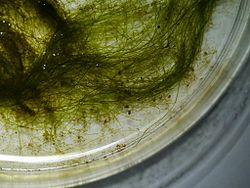
Examples of xanthophytes (repair the unequal flagella in the cells)
Scientific classification Edit this classification
Domain: Eukaryota
Clade: Sar
Clade: Stramenopiles
Division: Ochrophyta
Clade: Chrysista
Clade: Fucistia
Class: Xanthophyceae
Allorge, 1930,[1] emend. Fritsch, 1935[2]
Synonyms
  • Heterokontae Luther, 1899[3]
  • Heterochloridia Pascher, 1912
  • Tribophyceae Hibberd, 1981[4]
  • Heteromonadida Leedale, 1983[5]
  • Xanthophyta Hibberd, 1990[6]

Yellow-green algae or the Xanthophyceae (xanthophytes) are an important group of heterokont algae. Most live in fresh water, but some are found in marine and soil habitats. They vary from single-celled flagellates to simple colonial and filamentous forms. Xanthophyte chloroplasts contain the photosynthetic pigments chlorophyll a, chlorophyll c, β-carotene, and the carotenoid diadinoxanthin.[7] Unlike other Stramenopiles (heterokonts), their chloroplasts do not contain fucoxanthin, which accounts for their lighter colour. Their storage polysaccharide is chrysolaminarin.[7] Xanthophyte cell walls are produced of cellulose and hemicellulose.[7] They appear to be the closest relatives of the brown algae.

Classifications

[edit]

The species now placed in the Xanthophyceae were formerly included in the Chlorophyceae.[8] In 1899, Lüther created the group Heterokontae for green algae with unequal flagella. Pascher (1914) included the Heterokontae in the Chrysophyta. In 1930, Allorge renamed the group as Xanthophyceae.

The monadoid (unicellular flagellates) and also sometimes the amoeboid species have been included by some authors in the Protozoa or Protista,[9][10] as order Heterochloridina (e.g., Doflein and Reichenow, 1927–1929[11]), as class Xanthomonadina, with orders Heterochloridea and Rhizochloridea (e.g., Deflandre, 1956[12]), as order Heterochlorida (e.g., Hall, 1953,[13] Honigberg et al., 1964[14]), as order Heteromonadida (e.g., Leedale, 1983[15]), or as subclass Heterochloridia (e.g., Puytorac et al., 1987[16]). These groups are called ambiregnal protists, as names for these have been published under either or both of the ICZN and the ICN.

AlgaeBase (2020)

[edit]

Xanthophyceae have been divided into the following five orders in some classification systems:[17]

Lüther (1899)

[edit]

Classification according to Lüther (1899):[19][20]

  • Class Heterokontae
    • Order Chloromonadales
    • Order Confervales

Pascher (1912)

[edit]

Classification according to Pascher (1912):[21]

  • Heterokontae
    • Heterochloridales
    • Heterocapsales
    • Heterococcales
    • Heterotrichales
    • Heterosiphonales

Fritsch (1935)

[edit]

Fritsch (1935) recognizes the following orders in the class Xanthophyceae:[22]

Smith (1938)

[edit]

In the classification of Smith (1938), there are six orders in the class Xanthophyceae, placed in the division Chrysophyta:

Pascher (1939)

[edit]

Pascher (1939) recognizes 6 classes in Heterokontae:[23]

  • Class Heterochloridineae
  • Class Rhizochloridineae
  • Class Hetcrocapsineae
  • Class Heterococcincae
  • Class Hetcrotrichineae
  • Class Heterosiphonineae

Copeland (1956)

[edit]

Copeland (1956) treated the group as order Vaucheriacea:[24]

  • Kingdom Protoctista
    • Phylum Phaeophyta
      • Class Heterokonta
        • Order Vaucheriacea
          • Family Chlorosaccacea
          • Family Mischococcacea
          • Family Chlorotheciacea
          • Family Botryococcacea
          • Family Stipitococcacea
          • Family Chloramoebacea
          • Family Tribonematacea
          • Family Phyllosiphonacea

Ettl (1978), van den Hoek et al. (1995)

[edit]

In a classification presented by van den Hoek, Mann and Jahns (1995), based on the level of organization of the thallus, there are seven orders:

These are the same orders of the classification of Ettl (1978),[25] an updated version of the classic work by Pascher (1939). Ultrastructural and molecular studies shows that the Mischococcales might be paraphyletic, and the Tribonematales and Botrydiales polyphyletic,[26] and suggests two orders at most be used until the relationships within the division are sorted.[27]

Maistro et al. (2009)

[edit]

Informal groups, according to Maistro et al. (2009):[28]

  • Botrydiopsalean clade
  • Chlorellidialean clade
  • Tribonematalean clade
  • Vaucherialean clade

Unicellular flagellates, amoeboid and palmelloid taxa were not included in this study.

Adl et al. (2005, 2012)

[edit]

According to Adl et al. (2005, 2012):[27][29]

  • Tribonematales (genera Botrydium, Bumilleriopsis, Characiopsis, Chloromeson, Heterococcus, Ophiocytium, Sphaerosorus, Tribonema, Xanthonema)
  • Vaucheriales (genus Vaucheria)

See also

[edit]

References

[edit]
Revisions and contributorsEdit on WikipediaRead on Wikipedia
from Grokipedia
Yellow-green algae, scientifically classified as the class Xanthophyceae within the division Ochrophyta of the lineage, are a diverse group of primarily freshwater photosynthetic protists distinguished by their yellowish-green pigmentation resulting from chlorophylls a and c (with e in some species), high levels of , and accessory xanthophylls such as vaucheriaxanthin, diadinoxanthin, and heteroxanthin, while lacking and . These algae encompass over 600 species organized into unicellular, colonial, filamentous, or coenocytic thalli, with cell walls typically composed of pectic substances and other , including in some species (e.g., ), sometimes reinforced with silica in resting cysts. Their food reserves consist of the chrysolaminarin (also known as leucosin) and or oils, rather than . Xanthophyceae are predominantly found in freshwater habitats such as ponds, lakes, and dystrophic or mesotrophic waters rich in , though some species occur in marine, brackish, or terrestrial environments like damp soils and tree trunks; they are cosmopolitan in distribution, from to tropical regions, and often thrive under acidic conditions. Motile cells, including zoospores, are equipped with two heterokont flagella of unequal length inserted apically or subapically—the longer one pantonematic (with hairs) and the shorter acronematic (smooth)—facilitating movement in aquatic settings. Reproduction is chiefly asexual through fragmentation, aplanospores, autospores, or zoospores, with documented but rare, manifesting as in genera like Tribonema and Botrydium or oogamy in the siphonous . Ecologically, yellow-green algae play roles in primary production within microbial mats and biofilms, contributing to nutrient cycling in freshwater ecosystems, and some species like Tribonema are common in polluted or eutrophic waters, while Vaucheria forms extensive tubular networks in intertidal zones. Their evolutionary proximity to (Phaeophyceae) and diatoms underscores their position in the heterokont lineage, with no confirmed record, though a putative , Palaeovaucheria, from the ~1 billion-year-old Lakhanda Formation has been attributed to the group, and silica-containing cysts suggest potential for paleontological preservation. Recent research highlights their potential in , such as production due to high lipid content in species like Tribonema minus, and their structures offer insights into light-harvesting adaptations among chromalveolates.

Overview

Definition and Scope

Yellow-green algae, formally known as the class Xanthophyceae, belong to the division Ochrophyta of the lineage, a group of heterokont protists. This class encompasses approximately 600–700 described species distributed across more than 30 genera, representing a modest but ecologically significant portion of algal diversity. Commonly referred to as yellow-green algae or xanthophytes, the name derives from word "xanthos," meaning yellow, reflecting their distinctive coloration imparted by accessory pigments. The morphological diversity of Xanthophyceae is notable, spanning unicellular flagellates and coccoid cells to more complex colonial forms, unbranched or branched simple filaments, and siphonous structures. Unicellular species often exhibit via flagella, while colonial and filamentous types form aggregations or chains that can dominate in certain freshwater environments. The siphonous Vaucheria serves as a representative example, featuring coenocytic, tubular thalli that highlight the class's range from simple to multinucleate organization. As heterokonts, Xanthophyceae share evolutionary ties with diatoms, , and , but they are distinctly separated from () by their pigment suite—lacking , possessing , but lacking —and their storage product, chrysolaminarin, rather than starch. This biochemical distinction underscores their phylogenetic position outside the green algal lineage, emphasizing their role as a unique branch in algal evolution.

Distinctive Features

Yellow-green algae, belonging to the class Xanthophyceae, are characterized by their heterokont affinity, evident in motile stages where cells possess two unequal : an anterior tinsel adorned with lateral mastigonemes for propulsion and a posterior smooth whiplash , though many lack entirely. A key feature of their photosynthetic apparatus is the presence of chloroplasts containing chlorophylls a and c1/c2, but notably absent chlorophyll b, which differentiates them from ; additionally, they exhibit elevated levels of pigments, including vaucheriaxanthin ester, that dominate the coloration and mask underlying green hues. Unlike diatoms and , yellow-green algae lack the , further contributing to their distinctive yellow-green appearance rather than a brownish tone. For , they accumulate chrysolaminarin—a soluble β-1,3-linked —in cytoplasmic vesicles, contrasting with the starch reserves typical of and underscoring their heterokont . Cells generally measure 2–100 μm in diameter, while coenocytic filaments in genera like can extend to several centimeters in length.

Taxonomy and Classification

Historical Developments

The classification of yellow-green algae, now recognized as the class Xanthophyceae, began with early botanical efforts to distinguish them from based on flagellar and pigment differences. In 1899, Alexander Luther first grouped certain algae with unequal flagella into the category Heterokontae, separating genera such as Chlorosaccus, Botrydiopsis, and Tribonema from the due to their distinctive motility and coloration. This initial recognition laid the groundwork for treating them as a distinct assemblage. Subsequently, August Pascher in 1912 established the subclass Heterochloridia, emphasizing their unique pigmentation—including chlorophylls a and c alongside xanthophylls—and the heterokont pattern, which differentiated them from isokont ; in 1914, he included the group within Chrysophyta, introducing orders like Heterochloridales and Heterosiphonales to accommodate their morphological diversity. The class Xanthophyceae was formally named by Allorge in 1930 and emended by Fritsch in 1935. Throughout the mid-20th century, several influential systems refined this framework, incorporating light microscopy observations of cellular structure and habitat preferences. F. E. Fritsch's 1935 classification integrated the Xanthophyceae into the broader schema, recognizing five orders—such as Heterochloridales, Heterotrichales, and Vaucheriales—based on pigmentation, reserve products like chrysolaminarin, and reproductive modes, while highlighting their predominantly freshwater occurrence. Gilbert M. Smith in 1938 further emphasized their limnic habitats and expanded the class to six orders within the division Chrysophyta, including Chloramoebales and Mischococcales, to better reflect ecological and structural variations observed in North American species. Pascher's 1939 refinements, detailed in his comprehensive , adjusted orders like Chloramoebales to include amoeboid and coccoid forms, drawing on detailed microscopic examinations of over 300 species to resolve ambiguities in filamentous and siphoneous types. Later, Herbert F. Copeland in 1956 placed the group within the phylum Heterokontae under kingdom Protoctista, treating it as an order (Vaucheriaceae) to underscore shared heterokont affinities with diatoms and . Advancements in during the late drove further subdivisions, shifting from to microscopy, which revealed ultrastructural parallels with diatoms, such as siliceous scales in some forms, and helped delineate morphological lineages. Hanuš Ettl's 1978 system subdivided the Xanthophyceae into seven orders, including new ones like Pleurochloridellales and Gloeobotrydales, based on detailed analyses of palmelloid, coccoid, and filamentous organization in central European taxa. Similarly, Christiaan van den Hoek and colleagues in 1995 proposed a scheme with six to seven orders, refining boundaries through comparative morphology and addressing pre-molecular confusions with , which had arisen from overlapping freshwater habitats but were clarified via pigment biochemistry showing the absence of . These pre-molecular classifications highlighted persistent challenges in delimiting the group without genetic data, often relying on flagellar insertion and storage products for resolution.

Current Systems

Contemporary taxonomic frameworks for yellow-green algae (Xanthophyceae) integrate , particularly analyses of rbcL and nuclear genes, with traditional morphology to refine classifications within the broader group Ochrophyta. These systems emphasize monophyletic clades derived from sequence data, moving beyond earlier morphology-driven groupings. While AlgaeBase retains a morphology-based , molecular phylogenies like those in Adl et al. (2019) recognize fewer, more monophyletic orders. The database AlgaeBase, updated through 2023, recognizes seven orders in Xanthophyceae, including Chlorocystidales, Tribonematales, and Vaucheriales, encompassing approximately 33 families and around 600 described species. Revisions by et al. (2005, 2012, 2019) position Xanthophyceae firmly within Ochrophyta, incorporating molecular evidence for distinct clades such as those encompassing Monodopsidales, Indothamnion, and Synchromatales, which highlight early divergences supported by and rbcL phylogenies; et al. recognize two main orders: Tribonematales and Vaucheriales. A key study by Maistro et al. (2009) utilized rbcL gene sequences to delineate 4–5 major clades within Xanthophyceae, effectively separating coccoid forms (e.g., in Mischococcales) from filamentous ones (e.g., in Tribonematales), providing a foundation for resolving paraphyletic assemblages. Post-2020 updates have incorporated expanded datasets, revealing in genera like Tribonema and Botrydium, prompting taxonomic revisions such as the reclassification of endobiotic genera like Ducellieria out of Xanthophyceae into Peronosporomycetes. AlgaeBase has added several extremophile species in 2023–2025, particularly from habitats, reflecting ongoing discoveries that expand the known diversity. Overall estimates are around 600, with continued molecular surveys in terrestrial environments uncovering lineages.

Morphology and Ultrastructure

Cellular Organization

Yellow-green algae, or Xanthophyceae, exhibit a range of cellular organizations from unicellular to complex multicellular forms, reflecting their adaptation to diverse freshwater and environments. Unicellular include amoeboid forms such as Chloramoeba, which are motile with no and possess 2–6 small parietal chloroplasts, enabling metaboly for locomotion. Coccoid unicellular types, like Pleurochloris, are nonmotile, enclosed by a distinct , and feature within their chloroplasts. Colonial and filamentous arrangements are common, with unbranched filaments observed in genera such as Tribonema, where cells connect via H-shaped wall segments for structural integrity. Branched filaments occur in Heterothrix, allowing for more extensive growth patterns. Siphonous coenocytic tubes characterize Vaucheria, forming multinucleate, aseptate filaments that can reach lengths of up to 30 cm, with dispersed chloroplasts lining the periphery. Cell walls in Xanthophyceae are primarily composed of , often reinforced with hemicelluloses such as xylans and mannans, providing flexibility and strength. Some produce hemicellulose-based scales, while silica deposition is rare and not as prominent as in diatoms. In filamentous forms like Tribonema, walls form overlapping H-shaped pieces that facilitate without full separation. Chloroplasts typically number 1–4 per cell and are discoid or girdle-shaped, positioned parietally against the for efficient light capture. These organelles feature thylakoids arranged in triplets and may include girdle lamellae, though absent in some genera like Bumilleriopsis. , when present, are naked and submerged within the matrix, as seen in Pleurochloris and Tribonema. The nucleus and other organelles follow a typical eukaryotic configuration, with cells generally uninucleate except in coenocytic forms like Vaucheria, which are multinucleate. Dictyosomes (Golgi apparatus) play a key role in producing hemicellulose scales and other wall components in scaled species.

Pigments and Storage Products

The primary photosynthetic pigments in yellow-green algae (Xanthophyceae) are chlorophyll a, which serves as the main pigment, and chlorophyll c1 and c2 (with chlorophyll e in some species), which function as accessory pigments. Accessory carotenoids include β-carotene and diadinoxanthin, while the dominant xanthophylls are vaucheriaxanthin and its ester form, as well as heteroxanthin. These pigments are located within chloroplasts that typically possess four surrounding membranes, a characteristic shared with other heterokont algae. Yellow-green algae lack chlorophyll b and the brown pigment , distinguishing them from and , respectively. This absence results in their characteristic yellow-green coloration, as the combination of chlorophyll a, chlorophyll c, and xanthophylls like vaucheriaxanthin absorbs light primarily in the spectrum (around 450–550 nm), rather than the broader green absorption seen in chlorophyll b-containing organisms. The pigment composition enables efficient capture of available light in shaded or turbid freshwater environments. The photosynthetic apparatus in yellow-green algae exhibits efficiency comparable to that of diatoms, another heterokont group, particularly in , which is adapted for low-light conditions prevalent in their freshwater habitats. Early analyses from and later studies have quantified ratios, revealing high xanthophyll-to-chlorophyll proportions, which enhance photoprotection and light utilization under variable . Energy reserves in yellow-green algae are primarily stored as chrysolaminarin (also known as leucosin), a soluble β-1,3-glucan accumulated in cytoplasmic vesicles rather than chloroplasts. Some also accumulate as secondary storage products, often in the form of oil droplets, providing additional metabolic flexibility.

Habitat and Distribution

Preferred Environments

Yellow-green algae, belonging to the class Xanthophyceae, predominantly occupy freshwater habitats including lakes, pond shores, ditches, pools, slow-flowing streams, and humid mudflats, where they favor levels between 4.5 and 9.0—optimally 4.5 to 7.2—and moderate nutrient availability in dystrophic or mesotrophic conditions. These environments support their growth as single-celled flagellates, colonial forms, or filamentous mats, with species like often forming dense cushions on substrates. occurrences are common on moist soils, tree bark, and damp walls, particularly in shaded, aeroterrestrial microhabitats that retain . Certain xanthophytes exhibit tolerances to environmental extremes, enabling persistence in acidic bogs ( 4–5), such as Bumilleria species in clay-bottom pools and unirrigated soils. They also endure hypersaline pools and brackish waters as forms, with some taxa recorded in halophilic biological soil crusts of arid regions. Thermal tolerances extend to warmed waters up to around 30°C and cold conditions near 0°C or under ice, with some found peripherally to hot springs, reflecting adaptations like formation for surviving adversity. Marine habitats are rare but include coastal benthic such as Vaucheria velutina in brackish to saline intertidal zones. Xanthophytes frequently form associations as epiphytes on aquatic macrophytes, , and , or as endolithic communities within rocks, enhancing their access to stable microhabitats. Soil-dwelling forms contribute to crusts in arid and semi-arid landscapes, where they stabilize surfaces amid fluctuating moisture. Key influencing factors include a preference for low to moderate light intensities, facilitated by pigments like xanthophylls that optimize and mitigate excess exposure through chloroplast repositioning in forms like . Availability of silica supports impregnation in some cell walls, though not forming elaborate scales, aiding structural integrity in varied substrata.

Geographic Range

Yellow-green algae (Xanthophyceae) display a largely , with the majority of species inhabiting freshwater environments across temperate regions, including and , where they thrive in ponds, streams, and lakes. Species such as Tribonema are widespread in these aquatic systems globally, reflecting their adaptability to a range of freshwater conditions. Recent studies indicate potential range expansions in polar regions due to climate warming (as of 2023). In polar regions, yellow-green algae are present in both and environments, often in lakes and soils under cold conditions (0-10°C). For instance, Tribonema species have been documented in lakes like those in , while terrestrial forms such as Heterococcus endolithicus occur in endolithic habitats, showcasing physiological adaptations to low temperatures and . Arctic soils also host related taxa, contributing to microbial communities in high-latitude terrestrial ecosystems. Certain species extend into tropical and subtropical zones, particularly marine and estuarine forms of Vaucheria, which are recorded along Indo-Pacific coasts as cosmopolitan elements in both hemispheres. Terrestrial yellow-green algae also inhabit arid soils, including desert regions of Australia, where they contribute to biological soil crusts in semi-arid landscapes. Species such as Bumilleria sicula occur in geothermal lakes, contributing to localized diversity within the class.

Reproduction and Life Cycles

Asexual Methods

is the predominant mode of propagation in yellow-green algae (Xanthophyceae), occurring through vegetative division, fragmentation, and the formation of various spores, which allows rapid colonization in favorable environments. These methods vary by thallus type, with unicellular and colonial forms relying on , while filamentous and coenocytic often employ fragmentation or sporogenesis. Vegetative reproduction includes binary fission or multiple fission in monadoid, palmelloid, and coccoid genera, producing daughter cells or autospores that are released upon rupture of the mother cell wall. For instance, in Botrydiopsis and Chlorellidium, division results in tetrads or clusters of non-motile autospores, typically 2–12 µm in diameter, with 1–4 chloroplasts per spore; this process is observed across Antarctic and terrestrial strains. Fragmentation is common in filamentous genera like Tribonema, where the filament breaks into segments that regenerate into complete individuals, facilitating dispersal in freshwater and soil habitats. Coenocytic forms, such as Vaucheria, may also fragment, though sporulation is more typical. These vegetative strategies are documented as primary mechanisms in standard algal taxonomy. Zoospore formation represents a key motile asexual method, with biflagellate (or multiflagellate in some cases) produced in across diverse genera. In Tribonema and Botrydium, are pear-shaped or ellipsoidal, 1.5–15 µm long, featuring two unequal heterokont flagella, an eyespot, and 1–2 plastids; they are liberated through gelatinization or rupture of the wall and swim briefly before settling and encysting. Vaucheria produces distinctive multiflagellate coenzoospores (synzoospores) up to 100 µm, lacking eyespots but with numerous flagella pairs for dispersal in aquatic settings. This process has been ultrastructurally characterized, confirming its role in propagation under optimal conditions. Non-motile spores, including aplanospores and akinetes, serve as resting or survival structures during adverse conditions like . Aplanospores, thin- to thick-walled and 2–19 µm in size, form by division in genera such as Ophiocytium, Tribonema, and Botrydium, releasing upon sporangial dissolution to germinate into new thalli. Akinetes, modified vegetative cells with thickened walls, occur in filamentous species like Tribonema and , enabling persistence in suboptimal environments before resuming growth. These spore types underscore the adaptive versatility of Xanthophyceae .

Sexual Processes

Sexual reproduction is rare among yellow-green algae (Xanthophyceae) and has been documented primarily in the genera Botrydium, Tribonema, and Vaucheria, with most species relying on asexual methods. In Botrydium and Tribonema, the process is typically isogamous, involving the fusion of similar-sized, biflagellate gametes that are morphologically alike and motile. These gametes unite to form a zygote, which often develops a thick wall and enters dormancy before germinating via meiosis to produce new haploid thalli. In Botrydium, some species exhibit anisogamy, where gametes differ slightly in size but retain motility. The genus Vaucheria represents the most advanced form of in Xanthophyceae, characterized by oogamy. Antheridia, which are slender, branched, and often hook-shaped structures, develop on the filaments and release numerous biflagellate, spermatozoids through apical pores. Oogonia are claviform or spherical chambers containing a single non-motile egg. Fertilization occurs internally within the , where spermatozoids enter and fuse with the egg nucleus, forming a thick-walled that functions as a resting . This can remain dormant for extended periods before germinating under favorable conditions, such as low temperatures and long-day photoperiods, to produce a protonema-like germ tube that develops into a new coenocytic . Vaucheria species may be monoecious, with both antheridia and oogonia on the same filament, or dioecious in some cases. The life cycle in sexually reproducing Xanthophyceae is haplontic and monophasic, with the multicellular being haploid and the ( or ) as the sole diploid phase. occurs during , restoring the haploid condition and initiating vegetative growth. This cycle allows adaptation to fluctuating environmental conditions, as the provides resistance to and extremes. Environmental factors, such as and temperature, influence the induction of , often favoring it under stress compared to asexual modes.

Ecology and Evolutionary Aspects

Ecological Roles

Yellow-green algae, or Xanthophyceae, serve as primary producers in freshwater ecosystems, where they contribute to biomass and perform oxygen production and carbon fixation through . In certain lakes and ponds, they can account for a notable portion of the community, with densities forming dense mats that enhance local primary productivity, such as in dystrophic and mesotrophic waters. For instance, species like Tribonema and form floating masses or benthic cushions in streams and ditches, supporting and oxygen release in these habitats. Their decomposition in moist soils further contributes to organic matter breakdown and nutrient release, particularly and , fostering microbial activity in terrestrial ecosystems. Additionally, as soil , they promote overall biogeochemical processes by fixing carbon and influencing nutrient availability in oligotrophic settings. Yellow-green algae interact with other organisms through grazing by zooplankton, which consumes unicellular and colonial forms, transferring energy within food webs. They compete with diatoms in low-light, nutrient-limited conditions, occasionally dominating in shaded freshwater bodies. Rarely, species like Heterococcus form symbiotic associations with fungi in lichens, providing photosynthetic support in terrestrial habitats. As bioindicators, Xanthophyceae are sensitive to , with increased abundance signaling from high nutrient loads in waters. Their presence in organic-rich, acidic environments helps assess , as blooms often indicate mesotrophic to dystrophic conditions influenced by anthropogenic inputs. Ecological impacts of yellow-green algae include minor blooms forming green-yellow mats in ditches and streams, which can alter benthic habitats without producing major toxins. These mats stabilize sediments but may reduce oxygen in dense aggregations, affecting local .

Phylogenetic Relationships

Yellow-green algae, classified as Xanthophyceae, occupy a position within the Ochrophyta of the stramenopiles, forming part of the RPX alongside Raphidophyceae and Phaeophyceae. This placement reflects their derivation from a secondary endosymbiosis event involving a red alga, resulting in plastids surrounded by four membranes and containing chlorophylls a and c. Within Ochrophyta, Xanthophyceae are more closely related to diatoms (Bacillariophyceae) and (Phaeophyceae) than to (Chlorophyta), underscoring their affiliation with heterokont lineages rather than the . Molecular phylogenies based on 18S rRNA and rbcL genes have established the of Xanthophyceae, with analyses of multiple supporting a cohesive distinct from other groups. These findings, integrated into broader classifications, confirm their robust placement within stramenopiles, as affirmed by subsequent phylogenomic studies using extensive datasets. The evolutionary origins of Xanthophyceae trace back to the diversification of Ochrophyta around 414–719 million years ago during the late to early , with xanthophyte-specific radiation likely occurring in freshwater environments following the . Key evolutionary events include the loss of , a retained in sister groups like Phaeophyceae, and the acquisition of vaucheriaxanthin as a characteristic , adaptations possibly linked to terrestrial or freshwater transitions. Siphonous growth forms, exemplified by genera like , represent a derived trait within the class. The fossil record remains sparse, with no confirmed unambiguous evidence, though putative fossils such as Palaeovaucheria suggest possible origins as early as ~1000 million years ago; molecular studies indicate a likely origin around the (~223 million years ago).

References

Add your contribution
Related Hubs
User Avatar
No comments yet.