



Community hub
Recent from talks
Contribute something
Nothing was collected or created yet.
Churchmanship
View on Wikipedia
| Part of a series on |
| Anglicanism |
|---|
 |
 Christianity portal Christianity portal |
| Part of a series on |
| Lutheranism |
|---|
 |
Churchmanship (also churchpersonship, or tradition in most official contexts) is a way of talking about and labelling different tendencies, parties, or schools of thought within the Church of England and the sister churches of the Anglican Communion. The term has been used in Lutheranism in a similar fashion.
Anglicanism
[edit]In Anglicanism parties can include, from highest to lowest, Anglo-Papalist, Anglo-Catholic, Prayer Book Catholic, Old High/Center, Broad, Low/Evangelical.
The term is derived from the older noun churchman, which originally meant an ecclesiastic or clergyman but, some while before 1677, it was extended to people who were strong supporters of the Church of England and, by the nineteenth century, was used to distinguish between Anglicans and Dissenters. The word "churchmanship" itself was first used in 1680 to refer to the attitude of these supporters but later acquired its modern meaning. While many Anglicans are content to label their own churchmanship, not all Anglicans would feel happy to be described as anything but "Anglican".[1] Today, in official contexts, the term "tradition" is sometimes preferred.
"High" and "Low", the oldest labels, date from the late seventeenth century and originally described opposing political attitudes to the relation between the Church of England and the civil power. Their meaning shifted as historical settings changed and, towards the end of the nineteenth century, they had come to be used to describe different views on the ceremonies to be used in worship. Shortly after the introduction of the "High/Low" distinction a section of the "Low" Church was nicknamed Latitudinarian because of its relative indifference to doctrinal definition. In the nineteenth century this group gave birth to the Broad Church which, in turn, produced the "Modernist" movement of the first half of the twentieth century. Today, the "parties" are usually thought of as Anglo-Catholics, evangelical Anglicans, and Liberals and, with the exception of "High Church", the remaining terms are mainly used to refer to past history. The precise shades of meaning of any term vary from user to user and mixed descriptions such as liberal-catholic are found. Today "Broad Church" may be used in a sense that differs from the historical one mentioned above and identifies Anglicans who are neither markedly high, nor low/evangelical nor liberal.[2]
It is an Anglican commonplace to say that authority in the church has three sources: Scripture, Reason and Tradition. In general, the Low churchman and the Evangelical tends to put more emphasis upon Scripture, the Broad churchman and the Liberal upon reason and the High churchman or Anglo-Catholic upon tradition.[3][4] The emphasis on "parties" and differences is necessary but in itself gives an incomplete picture. Cyril Garbett (later Archbishop of York) wrote of his coming to the Diocese of Southwark:
I found the different parties strongly represented with their own organizations and federations... But where there was true reverence and devotion I never felt any difficulty in worshipping and preaching in an Anglo-Catholic church in the morning and in an Evangelical church in the evening"... and when there was a call for united action... the clergy and laity without distinction of party were ready to join in prayer, work and sacrifice.
— Garbett, [5]
and William Gibson commented that
the historical attention given to the fleeting moments of controversy in the eighteenth century has masked the widespread and profound commitment to peace and tranquility among both the clergy and the laity.... High Church and Low Church were not exclusive categories of thought and churchmanship. They were blurred and broad streams within Anglicanism that often merged, overlapped and coincided.
— Gibson, [6]
A traditional poem to describe churchmanship is "Low and Lazy, Broad and Hazy, and High and Crazy." Lazy refers to simpler worship, hazy to unclear tradition or beliefs, and crazy to excessive ceremonialism; but the author of the poem may have been a humorist.
In the United States a "churchman" is a member of the Episcopal Church in the United States of America (ECUSA). Usage of the term began in the nineteenth century and has been modified in the twentieth century.[7]
Lutheranism
[edit]Lutheranism has traditionally retained cohesiveness due to doctrinal unity on the Book of Concord.[8]
The concept of churchmanship is used in Lutheranism. In Lutheran churches churchmanship can be liberal, pietist, confessional, high church or evangelical Catholic.[9]
There may be overlap between these categories; for example, the Lutheran Church–International (LC–I) is a confessional Lutheran denomination of Evangelical Catholic churchmanship.[10]
Gallery
[edit]-
 Chancel of Newcastle Cathedral (High Church)
 -
 Altar of St Sepulchre-without-Newgate (Low Church)
 -
 Interior of St Ann's Church, Manchester (Broad Church)
 -
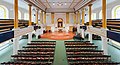 Interior of All Souls Church, Langham Place (Conservative Evangelical Anglicanism)
 -
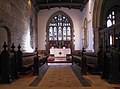 Interior of St Giles Church, Durham (Central churchmanship)
 -
 Chancel of All Saints, Margaret Street (Anglo-Catholicism)
 -
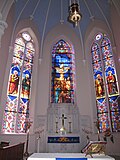 Chancel of St. Matthew's German Evangelical Lutheran Church (Evangelical Catholic)
 -
 Lutheran Church of the Redeemer (High Church)
.jpg)


.jpg)


See also
[edit]References
[edit]- ^ Neill, Stephen (1960). Anglicanism. London: Pelican. p. 398.
- ^ Hylson-Smith, Kenneth (1993). High Churchmanship in the Church of England. Edinburgh: T&T Clark. p. 340.
- ^ Holmes III, Urban T. (1982). What is Anglicanism?. Wilton, Connecticut: Moorehouse-Barlow Co. p. 11.
- ^ Carey, George (1996). "Celebrating the Anglican Way". In Bunting, Ian (ed.). Celebrating the Anglican Way. London: Hodder & Stoughton. pp. 14–16.
- ^ Garbett, Cyril (1947). The Claims of the Church of England. London: Hodder & Stoughton. p. 27.
- ^ Gibson, William (2001). The Church of England: 1688-1832. London: Routledge. pp. 1, 2.
- ^ The Churchman's Human Quest (1995–1996). ISSN 0897-8786 & ISSN 0009-6628 – is one of the titles of a periodical which has changed many times.
- ^ "Book of Concord FAQs". Lutheran Reformation. Retrieved 16 May 2025.
The Book of Concord is unique among all churches in the world, since it gathers together the Lutheran Church's most normative expressions of the Christian faith into a single book that has been used for nearly five hundred years as a fixed point of reference for the Lutheran Church.
- ^ Rawlyk, George A. (17 February 1997). Aspects of the Canadian Evangelical Experience. McGill-Queen's Press. p. 248. ISBN 978-0-7735-6648-4.
- ^ "Bulletin: Pentecost and Ordinary Time 2024" (PDF). LC-I. 2024. Retrieved 2 February 2025.
We do not want to provide reasons for those outside of our church body to be confused as to where we stand and for what we stand as a confessional Christian Lutheran church body in the evangelical catholic understanding.
Bibliography
[edit]- Balleine, G. R. (1909). A History of the Evangelical Party. London: Longmans, Green & Co.
- Bebbington, D. W. (1993). Evangelicalism in Modern Britain. London: Routledge.
- Bennett, Gareth (1998). To the Church of England. Worthing, UK: Churchman Publishing Ltd.
- Chadwick, Owen (1996R). The Reformation. London: Adam & Charles Black.
- Chadwick, Owen (1987). The Victorian Church (2 vol). London: Pelican.
- Cragg, Gerald C. The Church and the Age of Reason 1648–1789. London: Pelican (revised 1960).
- Davies, Julian (1992). The Caroline Captivity of the Church. Oxford: Clarendon Press.
- Hylson-Smith, Kenneth (1989). Evangelicals in the Church of England: 1734–1984. Edinburgh: T&T Clark.
- Shahan, Michael (2008). A Report from the Front Lines: Conversations on Public Theology: A Festschrift in Honor of Robert Benne. Wm. B. Eerdmans Publishing. ISBN 978-0-8028-4863-5.
- Smyth, Charles (1962). The Church and the Nation. London: Hodder & Stoughton.
- Rosman, Doreen (2006). The Evolution of the English Churches. Cambridge University Press.
- Spurr, John (1991). The Restoration, Church of England, 1646–1689. London: Yale University Press.
- Trevelyan, G. M. (December 1944). History of England. London: Longman Green & Co.
Churchmanship
View on GrokipediaChurchmanship refers to the distinctive theological, liturgical, and ecclesiological emphases that define an individual's or congregation's stance within Anglicanism, often involving a deliberate prioritization of complementary aspects of Christian commitment such as evangelical, catholic, liberal, or conservative elements.[1][2] This concept, peculiar to the Anglican tradition, shapes worship styles, doctrinal interpretations, and church governance, reflecting a spectrum of practices from formal sacramental rites to scripture-centered preaching.[3] The tradition emerged during the English Reformation, initially dividing into parties of reformers favoring simplified worship and traditionalists retaining medieval forms, evolving by the seventeenth century into the contrasting High Church and Low Church identities.[3] High Churchmanship stresses continuity with historic catholic practices, including elaborate liturgy, sacraments, vestments, and apostolic succession, while Low Churchmanship prioritizes the authority of scripture, personal piety, and evangelistic preaching over ritual formality.[4][3] Broad Churchmanship occupies a mediating position, promoting doctrinal latitude and rational inquiry to encompass diverse viewpoints within the church's via media.[3] Sub-traditions such as Anglo-Catholicism, a nineteenth-century development within High Churchmanship, incorporate pre-Reformation elements like incense and devotion to saints, whereas conservative evangelicalism dominates Low Church contexts with its focus on biblical inerrancy and conversion experiences.[4][3] These divisions have historically influenced Anglican revivals, liturgical reforms, and internal debates, contributing to the communion's pluralistic character despite occasional tensions over authority and practice.[3]
Definition and Etymology
Core Meaning and Usage
Churchmanship denotes the characteristic styles of theological emphasis, liturgical practice, and ecclesial orientation that distinguish internal parties or schools of thought within the Church of England and the broader Anglican Communion.[2] Emerging prominently from the 17th century onward, it categorizes tendencies such as a prioritization of sacramental liturgy and episcopal tradition in high churchmanship, a focus on personal conversion, biblical preaching, and evangelical zeal in low or evangelical churchmanship, and an accommodation to rational inquiry or cultural adaptation in broad churchmanship.[1] These variations reflect differing weights given to scripture, tradition, and reason within a shared confessional framework, without fracturing the communion into autonomous denominations.[5] The term originates from "churchman," historically signifying an ordained cleric or devout adherent to the established church, compounded to form "churchmanship" as the profession or manner thereof.[6] Its earliest recorded use appears in 1690, in a sermon by Henry Maurice, a Church of England clergyman, denoting the principled conduct of ecclesiastical office.[7] By this period, amid post-Restoration Anglican consolidation, the concept encapsulated loyalty to the church's institutional forms against nonconformist challenges, evolving to label partisan affiliations among clergy and laity committed to the via media.[8] Critically, churchmanship differs from denominationalism by emphasizing permeable, non-exclusive identities within a single ecclesial body, rather than rigid separations into rival organizations.[5] Empirical instances include 19th-century usages where terms like "high" or "low" delineated advocacy groups—such as Tractarians pushing for patristic recovery—yet operated under common governance and the Book of Common Prayer, preserving unity despite divergent practices.[4] This intra-communal framing underscores Anglicanism's preference for comprehensive latitude over schismatic purity, as affirmed in historical synodal documents balancing party claims.[9]Historical Origins
Early Development in the Church of England
The Elizabethan Settlement of 1559, enacted through the Act of Supremacy and the Act of Uniformity imposing the second Book of Common Prayer, forged the Church of England as a Protestant institution preserving episcopal governance, ordained ministry, and liturgical ceremonies derived from Catholic precedents while embedding Reformed theology via the Thirty-Nine Articles of 1571. This deliberate equilibrium, driven by Queen Elizabeth I's pragmatic avoidance of continental extremes, created inherent ambiguities—such as retained vestments and altars versus iconoclastic impulses—that engendered early partisan alignments by the 1570s and 1580s. Conformist clergy, upholding the settlement's forms as apostolic remnants essential for orderly worship and social stability, clashed with Puritan advocates for presbyterian structures and bare simplicity, as evidenced in the 1580s Admonition Controversy where critics like Thomas Cartwright decried "popish" residues as causal barriers to genuine scriptural reformation.[10] By the Jacobean era, these fissures deepened, with the 1604 Canons and Hampton Court Conference of 1604 highlighting demands for Puritan concessions like abolishing ceremonies, which James I rejected to maintain hierarchical uniformity. The Caroline Divines, theologians active under Charles I from circa 1625 onward, crystallized proto-high churchmanship by synthesizing scriptural primacy with patristic and conciliar authorities, positing that ecclesiastical traditions causally preserved doctrinal integrity against individualistic interpretations. Lancelot Andrewes (1555–1626), bishop of Chichester, Ely, and Winchester, exemplified this in his Preces Privatae (published posthumously 1640s) and sermons, drawing on over 100 early fathers to affirm sacraments as objective channels of grace rather than mere memorials, thereby countering Puritan reductions to subjective faith experiences.[11][12] The Laudian ascendancy from 1628, culminating in William Laud's elevation as Archbishop of Canterbury in 1633, amplified ceremonial enforcement—mandating railed altars, bowing toward the east, and enriched liturgical vestments—to embody a "beauty of holiness" that causally linked visible reverence to inward piety and communal order, per rubrics in the 1604 Canons. This stance, rooted in empirical restoration of pre-Reformation practices deemed biblically warranted (e.g., altars as per Hebrews 13:10), provoked Puritan retorts for fostering superstition, as in John Bastwick's 1630s tracts decrying such as "idolatry"; the resulting 1,000+ prosecutions for nonconformity by 1640 empirically quantified the divide, fueling allegiance tests that prefigured Civil War schisms.[13][14] Prior to 1830, the distinction between High Church and Low Church Anglicanism had solidified, reflecting ongoing tensions from these early developments. High Churchmanship, termed Old High Church, emphasized sacramental presence in the Eucharist (receptionist or virtualist views rejecting transubstantiation), episcopal polity with apostolic succession, and continuity with patristic traditions, while adhering to Reformed doctrines per the Thirty-Nine Articles. Low Churchmanship, influenced by Puritan and early evangelical tendencies, prioritized scriptural authority, preaching, personal conversion, and simpler worship forms, often viewing sacraments more as memorials and episcopacy as a pragmatic polity rather than essential for grace.[15][16]Key Historical Influences and Figures
The Evangelical Revival of the 1730s, spearheaded by Anglican clergy such as John Wesley and George Whitefield, marked a pivotal shift toward low church emphases on personal conversion, scriptural preaching, and itinerant evangelism within the Church of England.[17] Wesley, initially influenced by high church sacramentalism, pivoted after his 1738 Aldersgate experience to prioritize experiential faith and open-air preaching to the unchurched masses, fostering a doctrinal focus on justification by faith that contrasted with prevailing latitudinarian complacency.[18] This movement, peaking in the 1740s, invigorated low churchmanship by emphasizing moral reform and Bible-centered piety, though Wesley's field preaching strained Anglican norms without immediate schism—Methodism formalized post his death in 1791.[19] The 19th-century Oxford Movement, inaugurated in 1833 by John Keble's assize sermon on "National Apostasy" and propelled by John Henry Newman and Edward Pusey, countered perceived doctrinal erosion from liberal reforms and Erastianism by reviving high church commitments to apostolic succession, eucharistic realism, and patristic liturgy.[20] Through the Tracts for the Times (1833–1841), Newman critiqued the erosion of sacramental efficacy amid Enlightenment rationalism and parliamentary interventions like the 1832 Reform Act, arguing for the church's inherent catholicity independent of state control.[21] Newman's 1845 conversion to Roman Catholicism fractured the movement, yet Pusey and others sustained Anglo-Catholic trajectories, embedding ritualist practices and Tractarian theology that fortified high churchmanship against broad church accommodationism.[20] In the 20th century, C.S. Lewis exemplified a synthetic evangelical-broad churchmanship, blending rigorous apologetics, scriptural orthodoxy, and irenicism to critique modernist dilutions while appealing across Anglican divides; his works like Mere Christianity (1952) underscored personal faith amid sacramental restraint, influencing post-war renewal without rigid partisanship.[22] Evangelical Anglicanism surged post-1945, with conservative renewal movements reporting increased ordinands and parish vitality—evangelicals comprising roughly 25% of clergy by the 1960s, up from interwar lows—amid reactions to broad church liberalizations on doctrine and ethics following the World Wars' existential shocks.[23] Critics, including evangelicals, decried broad churchmanship's concessions to secular humanism, as seen in the 1920s modernist controversies, which prioritized experiential ethics over confessional boundaries, contributing to evangelical retrenchment for doctrinal fidelity.[24]Primary Types in Anglicanism
High Churchmanship
High Churchmanship denotes a tradition in the Church of England and broader Anglican Communion that prioritizes episcopal authority, apostolic succession, and a sacramental understanding of church life to uphold continuity with the undivided early church while remaining within Protestant parameters. Emerging in the late 16th century as Reformation controversies subsided, it gained prominence through the Caroline Divines during the reigns of James I and Charles I (1603–1649), who countered Puritan iconoclasm by restoring liturgical elements such as altar furnishings, vestments, and frequent Eucharistic celebrations.[25][26] These theologians, including Lancelot Andrewes and William Laud, articulated a via media that integrated patristic sources with Reformed doctrine, emphasizing the real spiritual presence of Christ in the Eucharist without endorsing transubstantiation.[27] Central characteristics encompass ornate worship practices, veneration of tradition as a safeguard against doctrinal innovation, and a high ecclesiology viewing bishops as successors to the apostles essential for valid ordination and sacramental efficacy. High Churchmen historically defended these elements as preserving Anglican distinctiveness amid 17th-century pressures for further Protestant simplification, contributing to the 1662 Book of Common Prayer's enduring form with its rubrics for ceremonial reverence.[4][28] This approach empirically linked to doctrinal stability by rooting authority in visible church structures rather than individual interpretation, though it occasionally provoked tensions with evangelical factions over perceived ritual excess.[25] A pivotal episode was the Non-Jurors schism, where approximately 400 clergy, predominantly High Church adherents, refused the 1689 oath of allegiance to William III and Mary II following the Glorious Revolution, citing unbreakable vows to James II and principles of non-resistance to anointed monarchs. This group, led by bishops like Thomas Ken, maintained parallel structures until the 1710s, producing revised liturgies that heightened sacramental language but ultimately declined due to isolation from the established church.[29][30] Critics, often from Low Church perspectives, leveled charges of Romanizing tendencies against High Church practices, yet proponents countered by strict adherence to the Thirty-Nine Articles, which explicitly reject papal supremacy, purgatory, and sacrificial Mass interpretations—doctrines incompatible with Anglican formularies. Empirical fidelity to these Articles, subscribed by High Church clergy, underscores a causal realism in distinguishing sacramental realism from Catholic metaphysics, thereby averting full convergence with Rome while critiquing radical Protestant reductions.[28][25] Such defenses highlight High Churchmanship's role in sustaining a balanced catholicity, though ritual emphases have at times alienated broader Anglican unity.Evangelical or Low Churchmanship
Evangelical or Low Churchmanship in Anglicanism prioritizes the sole authority of Scripture (sola scriptura), justification by faith alone (sola fide), and salvation by grace alone (sola gratia), principles derived from the Protestant Reformation's solae.[31] This tradition emphasizes personal conversion experiences, biblicist preaching, and crucicentric theology over elaborate ritual or sacramental mediation, fostering simple worship services centered on the proclamation of the Gospel.[32] Low Church adherents, often synonymous with evangelicals in this context, view the Thirty-Nine Articles as a Reformed doctrinal foundation, resisting traditions that might obscure direct reliance on Christ alone (solus Christus).[31] Historically, this form of churchmanship gained prominence during the 18th-century Evangelical Revival within the Church of England, influenced by figures such as John Newton and Charles Simeon, who promoted activism in missions and social reform.[32] A key achievement was the founding of the Church Missionary Society (CMS) on April 12, 1799, by evangelical Anglicans including John Venn, aimed at propagating the Gospel in Africa and Asia without reliance on high church structures.[33] The CMS mobilized over 9,000 missionaries in its first two centuries, contributing to the expansion of Anglicanism in the Global South through Bible translation, education, and church planting.[34] In practice, evangelical churchmanship manifests in congregational activism, lay involvement, and a focus on individual repentance and discipleship, often employing contemporary hymnody and expository sermons rather than fixed liturgies.[31] Globally, it has driven Anglican growth, with the Communion doubling to approximately 100 million members in the past 50 years, adding about one million annually, primarily in evangelical strongholds in Africa and Asia where orthodox doctrines resist liberal reinterpretations.[35][36] Organizations like GAFCON, representing around 75 million Anglicans committed to Reformation principles, underscore this tradition's role in preserving doctrinal integrity amid Western declines.[37] Critics, including some communitarian theologians, contend that evangelical emphasis on personal conversion fosters excessive individualism, potentially eroding ecclesial unity and corporate worship.[38] However, empirical data on membership retention and missionary success indicate that this approach sustains institutional vitality, as evidenced by the CMS's ongoing partnerships and the numerical dominance of evangelical provinces in the Anglican Communion.[33][35]
Broad or Liberal Churchmanship
Broad Churchmanship, a latitudinarian tradition within Anglicanism, originated in the mid-19th century as a response to intellectual challenges posed by scientific and historical criticism. It gained prominence through the 1860 publication of Essays and Reviews, a collection by seven Anglican scholars that advocated critical approaches to biblical interpretation, questioning traditional views on inspiration and miracles while affirming a broad compatibility between Christianity and modern knowledge.[39] [40] This work, often regarded as a manifesto for liberal Anglicanism, provoked trials for heresy but ultimately contributed to a theological shift prioritizing reason and ethical principles over rigid dogma.[41] Key features include an emphasis on moral and social ethics as central to Christian practice, rather than strict adherence to creedal formulations, alongside promotion of ecumenism to foster unity across denominational lines. Proponents viewed this flexibility as enabling adaptive engagement with contemporary society, allowing the church to address issues like industrialization and scientific progress without dogmatic conflict.[42] However, critics contend that this accommodation eroded fidelity to first-principles orthodoxy, as seen in 20th-century modernist theology, where figures influenced by Broad Church thought sought to recast doctrines in experiential terms, diminishing supernatural elements like the bodily resurrection.[43] Empirical patterns support causal critiques of this trajectory: post-1960s secularization accelerated declines in adherence within liberal-leaning Anglican bodies, with Church of England weekly attendance dropping from approximately 1.1 million in 1960 to under 400,000 by the 2010s, correlating with theological shifts away from supernatural realism.[44] Studies of comparable congregations indicate that conservative doctrinal emphasis sustains higher retention and growth, while liberal dilutions foster disengagement, as ethical humanism supplants creedal commitment.[45] [46] Mainstream academic sources, often aligned with progressive institutions, may understate these dynamics due to institutional biases favoring modernist narratives over empirical orthodoxy.[47]Anglo-Catholicism as a Variant
Anglo-Catholicism emerged as the ritualist extreme of high churchmanship following the Oxford Movement, which began in 1833 with leaders such as John Henry Newman, John Keble, and Edward Bouverie Pusey advocating a return to patristic and pre-Reformation Anglican traditions.[20] This variant intensified emphasis on sacramental realism, particularly in Eucharistic theology, where practices like reservation of the sacrament for adoration and Benediction became hallmarks, reflecting a belief in Christ's real presence beyond consumption.[48] Such devotions, though contested, drew from early church precedents to argue continuity with undivided Christianity, diverging from broader Protestant reticence toward extra-liturgical adoration.[49] Parallel to these liturgical developments, Anglo-Catholicism spurred monastic revivals, with the first modern Anglican male order, the Society of St. John the Evangelist, founded in 1866 by Richard Meux Benson at Cowley, Oxford, and earlier female communities like the Sisterhood of the Holy Cross established in 1845.[50] These initiatives aimed to restore contemplative life suppressed post-Reformation, fostering vocations amid urban poverty and missionary work. However, ritualist innovations—incense, vestments, and altar orientations—provoked backlash, culminating in the Public Worship Regulation Act of 1874, which facilitated prosecutions; clergy such as Arthur Tooth (imprisoned 1876), Sidney Faithorn Green (1881), and Richard William Enraght (1882) faced penalties for "illegal" practices deemed popish.[51] These trials, often initiated by evangelical parishioners, highlighted irreconcilable tensions with Anglicanism's Protestant settlement, yet galvanized Anglo-Catholic resilience.[52] Liturgically, Anglo-Catholicism achieved renewal through enriched parish Masses, hymnody, and ceremonial, influencing even non-Anglo-Catholic worship via figures like Percy Dearmer's promotion of the "English Use," which integrated medieval forms with Reformed sensibilities.[53] Protestant critics, including evangelicals, assailed it for approximating Roman doctrines like transubstantiation and saintly intercession, arguing such proximities undermined the Thirty-Nine Articles' rejection of "Romish" errors and prioritized tradition over Scripture's sufficiency.[54] Anglo-Catholics rebutted via patristic appeals, contending early fathers evidenced apostolic practices unbound by later sola scriptura formulations, thus preserving Anglican via media against purist reductions.[55] The 2009 Apostolic Constitution Anglicanorum coetibus by Pope Benedict XVI offered personal ordinariates for Anglican groups entering Rome while retaining liturgical patrimony, leading to establishments like the Personal Ordinariate of Our Lady of Walsingham (2011, UK) and the Chair of Saint Peter (2012, US), attracting clergy and laity dissatisfied with Anglican developments on issues like ordination of women.[56] This migration, involving hundreds of parishes and thousands of members globally by the 2020s, underscores Anglo-Catholicism's persistent identity crisis: fidelity to Catholic ethos within Protestant-structured communion versus full ecclesial unity elsewhere.[57]