Hubbry Logo
Collaborative fictionCollaborative fictionMain
Open search
Collaborative fiction
Community hub
Collaborative fiction
logo
7 pages, 0 posts
0 subscribers
Be the first to start a discussion here.
Collaborative fiction
from Wikipedia

Collaborative fiction is a form of writing by a group of authors who share creative control of a story.

Collaborative fiction can occur for commercial gain, as part of education, or recreationally – many collaboratively written works have been the subject of a large degree of academic research.

Process

[edit]

Our overall process changes from book to book. Usually while I'm working on another project, Mary will come up with an idea, run it by me for my input, then get on with plotting and research. Nothing's ever set in concrete. No two books follow quite the same procedure.

A collaborative author may focus on a specific protagonist or character in the narrative thread, and then pass the story to another writer for further additions or a change in focus to a different protagonist. Alternatively, authors might write the text for their own particular subplot within an overall narrative, in which case one author may have the responsibility of integrating the story as a whole. In Italy, various groups of authors have developed more advanced methods of interaction and production.[2]

The methods used by commercial collaborative writers vary tremendously. When beginning writing the short story 'the toy mill' Karl Schroeder and David Nickle began by writing alternating sentences,[3] whereas when English authors Terry Pratchett and Neil Gaiman wrote Good Omens they largely wrote separate plotlines and then collaborated much more heavily when revising the manuscript.[4]

The collaboration may be very limited. When John Green and David Levithan wrote Will Grayson, Will Grayson the only plot point they decided on was that two characters would meet at some point in the novel and that their meeting would have a tremendous effect on their lives. After this decision, they separately wrote the first three chapters for their half and then shared them with each other. After sharing, they then "knew immediately it was going to work", as stated by Levithan.[5][6]

Debate over value of collaborative authorship

[edit]

Some academics are concerned with being able to discover who wrote what, and which ideas belong to whom.[7] Specifically, in the humanities collaborative authorship has been frowned upon in favor of the individual author. In these instances, antiquated ideas of individual genius influence how scholars look at issues of attribution and tenure.[8] Collaboration scholars Ede and Lunsford note, "everyday practices in the humanities continue to ignore, or even to punish, collaboration while authorizing work attributed to (autonomous) individuals".[8] In particular, literary-critical essays often move to "settle" questions of authorship before moving on to their central interpretive purposes.[9] Woodmansee uses studies of writing practices since the Renaissance to conclude that the modern definition of authorship, is a 'relatively recent formation' and that previously 'more corporate and collaborative' forms of writing prevailed,[10] suggesting a long history of Collaborative Fiction. She further argues that the concept that 'genuine authorship consists in individual acts of origination' is an entirely modern myth.[10]

For Renaissance playwrights, collaboration appears to have been the norm; Bently notes that nearly two-thirds of plays mentioned in Henslowe's papers reflect the participation of more than one writer.[11] There is also an issue of continuous revision: it was common practice in Renaissance English theatre for professional writers attached to a company to compose new characters, scenes, prologues and epilogues for plays in which they did not originally have a hand.[12] Scott McMillin has exported revision as a deconstruction of authorial individuality in the Sir Thomas More manuscript.[13]

In an artistic sense, as Lorraine York notes, "Critics and readers feel a persistent need to 'de-collaborate' these works, to parse the collective text into the separate contributions of two or more authors".[14] This is part of a tradition in criticism to view collaboration as a subset or aberrant kind of individual authorship – such that later readers could separate out by examining the collaborative text.[15] Particular examples of this approach to criticism include Cyrus Hoy who studies authorship in the Beaumont/Fletcher plays.[9]

There have been several university-based projects that investigated collaborative fiction, both from a writing perspective and as a testbed for scientific techniques, such as visualization of narrative structure.[16] Collaborative writing in smaller groups is a widespread and successful educational technique.

A Million Penguins was a large scale and completely open collaborative fiction writing sponsored by Penguin Books in 2007 that did not succeed in developing community or a cohesive narrative.[17][18][19]

Collaborative fiction in different countries

[edit]

In Italy

[edit]

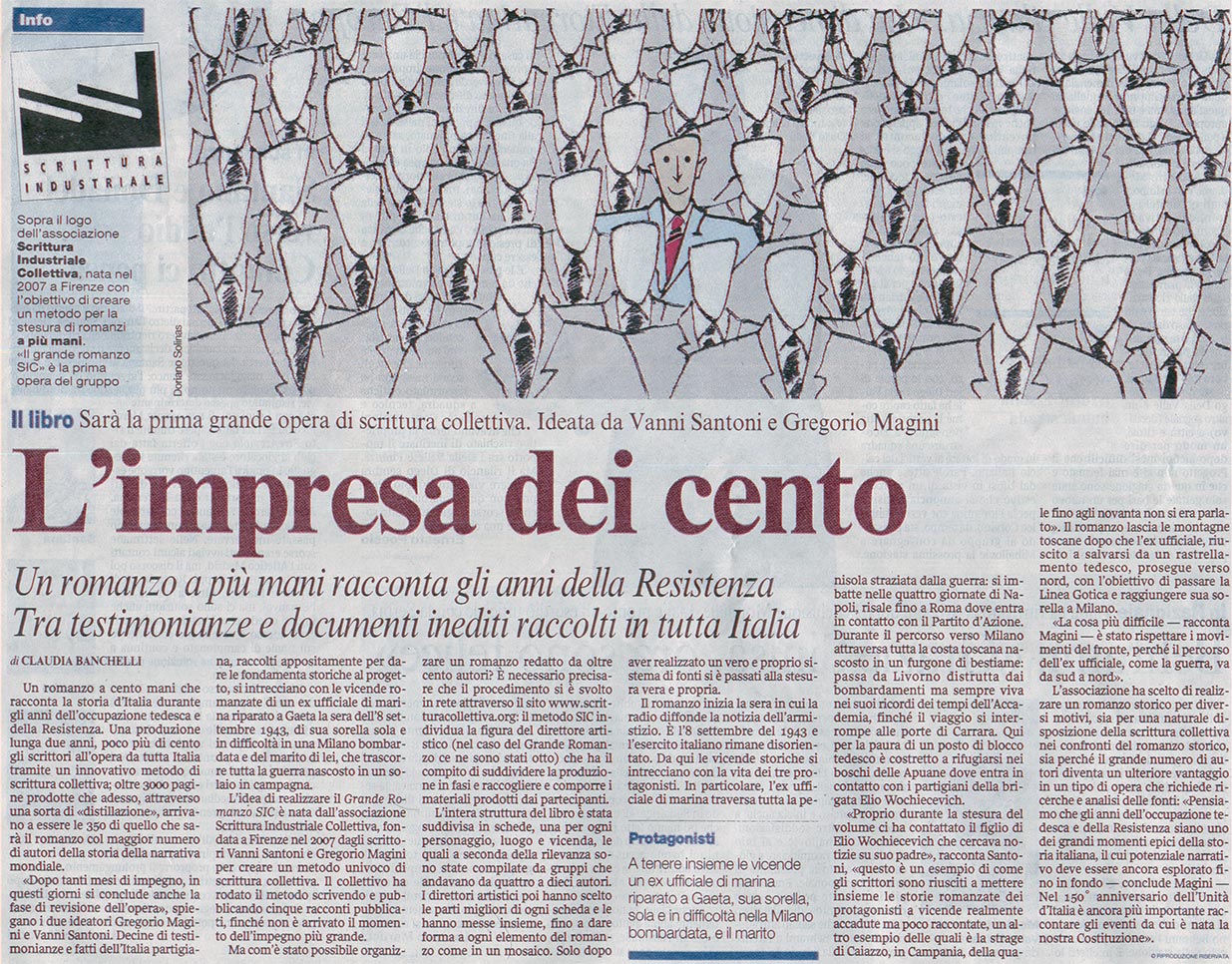
Italy has a strong tradition[20] in collaborative fiction: the most remarkable texts being Lo zar non è morto [it], a 1929 collective novel[21] by the futurist team "Gruppo dei Dieci", Don Milani's Scuola di Barbiana experiment, Lettera a una professoressa (1967), the various historical best-sellers produced by the Wu Ming collective between 1999 and 2011, and In territorio nemico, the 115-author[22] novel realized within the SIC – Scrittura Industriale Collettiva [it] project founded by Gregorio Magini and Vanni Santoni [it],[23] which established a codified methodology[24] for the collective production of literary texts.

In Australia

[edit]

Australia has a number of famous writing teams. In 1944 James McAuley and Harold Stewart collaborating as Ern Malley wrote seventeen poems in one day as a hoax against Max Harris and his magazine Angry Penguins. From the late 1920s to the late 1940s Flora Eldershaw and Marjorie Barnard wrote under the name of M. Barnard Eldershaw. During that time they published a body of work that included five novels. Evidently Barnard did more of the actual writing whilst Eldershaw concentrated on development and structure of the works. Louise Elizabeth Rorabacher who wrote about the collaboration stated: "that in their early collaborative novels it is impossible to distinguish their separate contributions." The partnership worked because according to Nettie Palmer, a leading literary critic of the time: "Any difference in the characters of the two women doesn't make for a difference in their point of view or values." Dymphna Cusack wrote twelve novels, two of which were collaborations. She wrote Come In Spinner, a novel set in Sydney during the end of World War II, with Florence James. The completed book was submitted and won the 1948 Daily Telegraph novel competition. Cusack also collaborated with another writer – Miles Franklin on the 1939 novel Pioneers on Parade.

Between 1997 and 2000, Australian children's authors, Paul Jennings and Morris Gleitzman, co-wrote two series of children's books, Wicked and Deadly.

This tradition has continued into the 21st century. The 2015 Australian outback novel The Painted Sky[25] was written by a group of five Australian women, and its 2017 sequel The Shifting Light'[26] by four authors who collaboratively write under the pseudonym Alice Campion. Their unique writing process has resulted in critics applauding their "single" author voice. As 'Group Fiction', three of the collective have also written a guide to collaborative fiction writing called How to Write Fiction as a Group. In 2020, novelist Craig Cormick collaborated with Indigenous Australian writer Harold Ludwick to write an alternative history novel, On a Barbarous Coast, about Captain Cook's 1768-1771 voyage to Australia.

Community and educational uses

[edit]
Selection of books written collaboratively as part of the 826 Valencia Project

Collaborative writing has been used to increase community engagement in writing: one of the three 2008 TED Prizes was given to Dave Eggers, partially for his work with the 826 project, which uses many collaborative techniques to engage school children, and community groups in writing. The 826 Valencia chapter consists of a writing lab, a street-front pirate supply store that partially funds the programs, and two satellite classrooms in nearby middle schools. Over 1,400 volunteers—including published authors, magazine founders, SAT-course instructors, and documentary filmmakers—have donated time to work with thousands of students since the chapter was founded.[27] His TED Prize wish was for community members to personally engage with local public schools.[28][29]

Other educationally motivated work has been developed by the University of London and used both to improve the writing skills of the participants and as a testing ground for scientific techniques, such as visualization of narrative structure.[16][30] The project attempted to show students the workflow of a novel from inception to production and to improve teamwork and feedback skills.[31] Workshops lasted up to a week and aimed to produce a full-length novel from a plot idea provided by an established author, with younger students producing smaller sized novels.[32] Because the workshops were very short the use of collaborative writing was required so that a novel could be produced in the timeframe.[31] Techniques from software engineering were used to arrange the workload amongst the students.[31]

A collaborative novel written in an educational setting was Caverns, written collaboratively in 1989 as an experiment by Ken Kesey and a creative writing class that he taught at the University of Oregon. Because of Kesey's attachment to the project, the book was widely reviewed in newspapers and magazines. Critics were generally intrigued by the book but ultimately critical of its shortcomings: noting in particular the lack of a coherent voice and a too-large cast of characters. Writing in the Los Angeles Times, Bob Sipchen noted, "Caverns is an amusing lark, full of weird characters and goofy plot twists. It was a sufficiently intriguing project to make The Mainstream Media swarm around Kesey again. But no one is calling Caverns literature."[33]

Recreational collaborative writing

[edit]

Collaborative fiction can be fully open with no rules or enforced structure as it moves from author to author; however, many collaborative fiction works adopt some set of rule on what constitutes an acceptable contribution.[34]

Writing games for collaborative writing have a tradition in literary groups such as the Dadaists and the Oulipo. The advent of the internet has seen many such collaborative writing games go online, resulting both in hypertext fiction and in more conventional literary production. For example, the Baen's bar forum, known as 1632 Tech, has been a prime force behind the many works in the popular alternate history 1632 series under the aegis of Eric Flint — especially The Grantville Gazettes. Other examples of collaborative online writing include the SCP Foundation wiki and writing by the 4chan board /lit/. Author and scholar Scott Rettberg's paper "Collective Narrative" discusses connections between avant garde literary groups and online collaborative fiction.[35]

We've done things differently with different works, For our children's book, we had a complete outline. Each of us would write one section each week, and we would revise when we met. This method worked well. By the end, you really couldn't tell who had written what.

Lee Rouland[36]

Influence of tabletop gaming

[edit]

Other forms of collaborative fiction have evolved from the practices of tabletop and role-playing video game gamers and related 'fandom' activities. Role-playing games such as Dungeons and Dragons are often seen as a process to generate narratives through each characters interactions[34] Such table top role-playing has always been an exercise in collaborative fiction, but can possess more structured rules: players acting out in an antisocial way can be penalised by the game mechanics (though they are just as likely to be penalised socially).[37]

Eventually, these tabletop behaviors merged with hypertext fiction to create text-based interactive role-playing environments, like roleplaying MUSHes. In 2001, OtherSpace became the first such game to publish a novel taken from these interactions.[38]

World creation

[edit]

Ring of Fire (series) is a series of alternate history books by Eric Flint and other authors set in a universe created by Eric Flint with the intention of integrating multiple authors into the fabric of the universe structure.

Sites such as Orion's Arm and Epic Legends Of The Hierarchs: The Elemenstor Saga encourage the development of fictional universes rather than novels (though 'Epic Legends' is parody of fantasy universes).[39]

Online collaboration platforms

[edit]

With the development of the internet collaborative writing is gaining new relevance with various online collaborative writing platforms emerging. Most popular are collaborative real-time editors such as Etherpad and Google Docs which are however mostly used for coordinating projects and brainstorming. Nevertheless, they have also been used to collectively write works of fiction, such as Hypersphere[40] or The Legacy of Totalitarianism in a Tundra[41][42][43] anonymous users of the Literature (/lit/) board of 4chan from over 71 countries using Google Docs.[44]

Commercial collaborations

[edit]

Traditional fiction writers and writing circles have experimented in creating group stories, such as Robert Asprin's Thieves World and MythAdventures – such approaches date back at least as far as The Floating Admiral in 1931. There are many highly regarded collaborations, but also some collaborative work produced as spoofs or hoaxes such as Naked Came the Stranger, which was allegedly written to illustrate the point that popular American literary culture had become mindlessly vulgar.[45] The Australian genre fiction collaborators known as Alice Campion are thought to be the first in the world to publish commercial fiction as a team of five, now four. Their popular novels, The Painted Sky[25] (2015) and The Shifting Light[26] (2017) were published by Penguin Random House.

[edit]

The disadvantages of the collaborative writing process can include problems with series or sequels to successful books, if one partner has other commitments or is bored with the project, then losses, delays and pressure on the relationship may occur.[46] The Association of Authors' Representatives recommends that "a collaboration agreement must deal with termination of the collaboration: How the collaborators can part ways, who keeps the money, who keeps the rights to the material".[47]

Moreover, there can be legal complications if, for example, two authors are under contract to write other books individually for different publishers – if there is any overlap on the types of books then the contractual responsibilities need to be thoroughly examined to avoid copyright problems.[48]

See also

[edit]

Notes

[edit]

References

[edit]
[edit]
Revisions and contributorsEdit on WikipediaRead on Wikipedia
from Grokipedia
Collaborative fiction is a form of literary creation in which multiple authors contribute to a single , often sequentially or without full visibility of prior contributions, resulting in a story that blends diverse perspectives and styles. This practice challenges traditional notions of singular authorship, emphasizing communal production over individual genius, and has historical precedents in both oral traditions and written texts where ideas were treated as shared intellectual commons. The roots of collaborative fiction extend to pre-modern eras, when texts like the evolved through generations of rabbinic contributions, though such works were more interpretive than purely fictional. In the modern period, it gained prominence with the Romantic emphasis on individual creativity and emerging laws, such as the 1710 , which prioritized ownership and marginalized collaborative models despite their persistence. A landmark development occurred in the 1920s with the Surrealists' invention of the (or cadavre exquis), a parlor game where participants folded paper to add phrases blindly, producing absurd, dream-like sentences or poems; the method's name derives from its first output: "The exquisite corpse will drink the new wine." This technique, originating among French artists and poets like and , exemplified collaborative improvisation to subvert rational narrative control. Other key forms include the round-robin story, in which writers alternate composing sections of a tale, a method used in early 20th-century like for experimental horror and fantasy, as seen in the 1935 collaborative novella The Challenge from Beyond by authors including and . In the digital era, collaborative fiction has expanded through networked platforms, with netprov (networked improvisation) enabling real-time, global storytelling via the , as in improvisational narratives that mimic live performance. These contemporary iterations, alongside communities and educational exercises, highlight collaborative fiction's role in fostering , though it continues to navigate tensions around attribution and .

Overview and History

Definition and Key Characteristics

Collaborative fiction refers to a literary practice in which two or more authors jointly create a , sharing responsibility for elements such as plot, characters, setting, and themes. This form emphasizes co-authorship, where contributors negotiate and integrate their ideas to produce a unified work, distinguishing it from individual authorship by incorporating diverse creative inputs. Unlike solitary writing, it often emerges from communal traditions, evolving into structured collaborations in print or . Key characteristics of collaborative fiction include its iterative and interactive nature, typically involving sequential contributions where authors alternate writing sections, or parallel efforts where multiple writers develop interconnected parts simultaneously. This process fosters and mutual revision, allowing the to adapt dynamically and blend varied stylistic influences. Serial publication is common, particularly in periodicals or platforms, enabling ongoing evolution through reader feedback or additional author inputs, which can introduce elements of surprise, disagreement, or thematic depth. The form highlights and collective creativity, often serving purposes beyond , such as exploring social issues or conducting through world-building and character analysis. In open-domain settings, it supports mass participation, drawing on historical communal to generate expansive, multifaceted narratives. Collaborative fiction thus promotes inclusivity and , though it requires effective communication to maintain coherence amid diverse perspectives.

Historical Development

While early collaborative efforts often involved non-fictional or religious texts as precursors, collaborative fiction has roots in ancient oral traditions, where stories were collectively shaped and transmitted across generations before being committed to writing. Many foundational texts, including epic stories like the and religious compilations like the , emerged from such communal processes, involving multiple contributors who built upon shared narratives over time. In Imperial , literary creation emphasized synthesis and quotation from predecessors, with works like those attributed to (circa 551–479 BCE) and later poets such as Wu Li (1631–1718) reflecting a collaborative incompatible with modern notions of individual ownership, as no existed until the 20th century. Similarly, non-fictional texts like the , compiled between the late 1st and 7th centuries CE by hundreds of Palestinian and Babylonian rabbis, evolved through layers of oral commentary and debate, embodying a dynamic, group-authored central to Jewish lore. During the medieval period, collaboration persisted in the production of texts in monastic scriptoria, where scribes, illuminators, and editors worked together to copy and embellish manuscripts, blending text and artistry in a endeavor. The saw literary circles that facilitated group discussions influencing shared works. A landmark example is the King James Version of the (1611), translated collaboratively by 47 scholars divided into six committees, drawing from prior multilingual sources to create one of the most influential texts in English literature. In the (late 16th to early 17th century), English theater exemplified plural authorship, with playwrights like and , or Francis Beaumont and John Fletcher, co-creating dramas through intimate partnerships that blurred individual credits. The marked a shift toward Romantic individualism and the (1710), which introduced copyright and reinforced solitary authorship, diminishing overt collaborative models despite their continued undercurrents in salons like the English Lunar Society. By the , explicit collaborative novels emerged as experiments, such as Six of One by Half a Dozen of the Other (1872), an American work by six authors with prefaces documenting their divided process, and Las vírgenes locas (1886), a Spanish by eleven writers including explanatory paratexts. In the , movements revived collaboration; and Surrealists employed techniques like "" for joint surreal narratives. Postwar examples include and Jack Kerouac's And the Hippos Were Boiled in Their Tanks (written 1945, published 2008), a story alternating chapters. The late saw large-scale efforts like Scrittura Industriale Collettiva (SIC, founded 2007), producing novels such as In territorio nemico (2013) by over 100 contributors using online coordination. The digital era accelerated this with platforms enabling massive participation, exemplified by the (launched 2007 on ), a of anomalous tales grown by thousands of anonymous writers into a phenomenon.

The Collaborative Process

Methods and Techniques

Collaborative fiction employs a variety of methods and techniques to facilitate joint authorship, often adapting strategies from broader practices to suit creative development. Core activities typically include brainstorming to generate plot ideas and character concepts, conceptualizing to refine central themes, outlining to structure the , drafting sections of the , reviewing for feedback, revising for coherence, and editing for stylistic consistency. These steps ensure that multiple contributors align on a unified vision while leveraging individual strengths, such as one author's expertise in dialogue or another's in world details. One common approach is sequential writing, where authors contribute in turn, building on prior sections to advance the plot. For instance, in round-robin storytelling, each writer handles a chapter or segment, often assigned to specific characters or time periods, with detailed outlines established upfront to maintain plot cohesion. This method, exemplified in multi-author novels spanning decades, relies on communication via or shared documents to clarify developments and resolve inconsistencies, promoting trust and seamless progression. Parallel writing offers an alternative, dividing the into simultaneous tasks—such as separate character arcs or subplots—allowing contributors to work independently before integrating drafts, which suits teams with specialized skills. For more experimental techniques, the method, originating with Surrealist artists in the , involves participants adding to a story or drawing sequentially while folding the paper to conceal previous contributions, fostering surprise and subconscious creativity. Adapted to , writers might agree on a sentence (e.g., adjective-noun-verb) and contribute words blindly, yielding absurd yet innovative narratives that break habitual patterns. This technique encourages collaboration without overplanning, often producing unexpected results through its emphasis on hidden inputs. In , particularly and , collaborative provides a foundational technique for constructing shared universes. This involves step-by-step processes: establishing a framework with , scope, and historical events; developing social forces through tools like card decks that prompt competing structures in , , and ; populating a catalog of elements such as characters and locations; and applying the world to interconnected stories. Worksheets and digital platforms like World Anvil facilitate group brainstorming and , enabling iterative refinement while modeling established worlds like those in Star Wars or . Such methods scale for large teams, embedding critique at each stage to evolve complex, consistent settings.

Challenges and Debates

One significant challenge in collaborative fiction is maintaining consistency and coherence across multiple contributors, as differing writing styles and interpretations can lead to plot discrepancies or tonal shifts. For instance, in co-authored novels, authors may prioritize individual character arcs over unified story progression, requiring extensive revisions to align visions. This issue is compounded by logistical hurdles, such as coordinating schedules and communication breakdowns, which can delay projects and foster frustration among participants. Creative control and interpersonal dynamics present further obstacles, often resulting in conflicts over decision-making, such as character development or plot resolutions, where collaborators must compromise to avoid bruised egos or stalled progress. In group settings, like fanfiction circles or writing workshops, dominant personalities may overshadow others, leading to uneven contributions and resentment. These tensions highlight the need for clear roles and strategies from the outset. Debates surrounding authorship in collaborative fiction center on the erosion of traditional notions of individual , challenging the romanticized image of the solitary genius author. Scholars argue that collaboration disrupts capitalist constructs of , fostering "distributed authorship" where credit allocation becomes contentious, particularly in digital platforms where anonymous contributions blur lines of accountability. This raises ethical questions about representation and voice, especially in participatory projects involving marginalized groups, where ensuring authentic contributions without exploitation remains contested. Critics also whether collaborative works dilute literary , though proponents contend they enrich through diverse perspectives, as seen in successful co-authored .

Forms of Collaborative Fiction

Recreational and Fandom Writing

Recreational and fandom writing constitutes a major domain of collaborative fiction, where enthusiasts of media franchises—such as books, films, television series, and video games—jointly produce derivative narratives for personal enjoyment, , and creative exploration. This form, often termed collaborative fanfiction, involves multiple contributors building interconnected stories within or expanding upon established fictional universes, fostering a sense of shared ownership and interpretive . Unlike commercial writing, it prioritizes emotional resonance, social interaction, and playful experimentation over profit or . The practice originated in the 1960s within small, niche groups like fandom, where fans exchanged stories through printed zines and conventions, laying the groundwork for communal narrative extension. By the , the advent of digital tools such as newsgroups and early web forums shifted collaboration online, enabling broader participation and real-time feedback. The early 2000s marked a surge with platforms like , which integrated story posting with threaded discussions, turning reading into a co-creative process. This evolution reflected broader cultural shifts toward participatory media, challenging traditional notions of solitary authorship in favor of collective literary production. Key methods in recreational collaborative fanfiction include or round-robin writing, where authors alternate contributions to advance a plot sequentially, and synchronous (RP), conducted via or chat rooms for immediate co-authorship. More recent techniques leverage affordances, such as "inter-fan "—borrowing and remixing elements from peers' works without formal permission—and hyperdiegetic expansion, which deepens immersive worlds through layered, believable details. These approaches are facilitated by tagging systems and comment sections on sites like and , allowing contributors to track contributions and solicit input organically. Notable examples illustrate the scale and diversity of these efforts. The Transcendence AU, a Gravity Falls-inspired launched on in 2014, exemplifies large-scale collaboration, amassing approximately 50 active members and 4,000 followers while introducing original characters like Henry alongside canon elements. In K-pop and Thai BL fandoms, Twitter-based alternate universe () threads proliferated during the , blending short-form text with visuals to create episodic, community-driven sagas. Archives like , which hosted over one million texts by 2006, and An Archive of Our Own (AO3), which as of May 2025 hosts over 15 million fanworks, emphasize organization of such works through metadata, supporting global relay projects across genres. Overall, recreational collaborative fanfiction thrives on its non-hierarchical structure, where peer reviews—such as the 1,569 received for one early story over five years—reinforce bonds and refine narratives across international networks. This subfield not only sustains vitality but also models inclusive creativity, with participants spanning diverse ages, genders, and cultures.

Educational and Therapeutic Uses

Collaborative fiction, encompassing shared and creation, has been integrated into educational settings to foster , communication, and among learners. In classroom environments, tools like KidPad enable children aged 6-11 to collaboratively build hyperlinked, non-linear stories using drawing and linking features, promoting interpersonal interaction and story comprehension skills. This approach draws from oral traditions, where group aids in information retention and , while encouraging young participants to negotiate contributions and resolve conflicts during creation. During the , online platforms facilitated for primary school students, with 116 children in grades 1-5 producing 81 shared narratives via and , enhancing narrative thinking, problem-solving, and emotional development. These activities demonstrated high levels (Cronbach’s α = 0.90) and boosted social presence through real-time interactions, adapting chained story formats for younger learners to maintain engagement despite physical isolation. In higher education, supports composition by leveraging tabletop games, where students co-author narratives to explore communal authorship and rhetorical strategies. In therapeutic contexts, collaborative fiction serves as a tool for emotional processing and healing, particularly through techniques that re-author personal stories in group settings. Family-based collaborative storytelling allows members to share perspectives on shared experiences, incorporating emotions to reconstruct narratives and promote collective understanding and resilience. role-playing games (TTRPGs), such as , exemplify this by enabling clients to engage in character-driven collaborative narratives, which enhance , , and trauma recovery through dice-based unpredictability and group problem-solving. Therapeutic applications of TTRPGs have shown efficacy in addressing anxiety, depression, and identity issues among youth aged 7-19, with case studies indicating improved emotional regulation and self-awareness via tailored game sessions. In group for adolescents with autism spectrum disorder or LGBTQ+ youth, these collaborative stories foster empowerment and coping mechanisms, aligning with cognitive behavioral principles through . Similarly, creative writing groups utilize collaborative prompts to build connections and reduce isolation, where participants co-create stories to explore personal emotions in a supportive environment.

Gaming-Inspired Collaborations

Gaming-inspired collaborations in collaborative fiction draw heavily from the mechanics and structures of tabletop role-playing games (TTRPGs), where participants co-create narratives through shared and rule-based decision-making. In TTRPGs such as (D&D), players and a game master collaboratively build stories by embodying characters, resolving conflicts via dice rolls, and adapting plots in real-time, resulting in emergent fiction unique to each session. This process exemplifies collaborative fiction by distributing authority among participants, fostering a dynamic interplay between pre-designed worlds and player-driven choices. The narrative potential of TTRPGs lies in their incremental approach, where small contributions from multiple players accumulate into cohesive tales, differing from solitary writing by emphasizing immediate feedback and collective world-building. For instance, in D&D's fifth edition, released in , the system's emphasis on inclusivity and flexibility allows groups to localize adventures, incorporating cultural elements like humor or regional references to enhance communal identity and narrative relevance. This method not only generates but also supports character development as a reflective tool, enabling participants to explore personal identities through avatars, as seen in academic applications where players map professional growth onto game elements. Beyond traditional tabletops, gaming-inspired collaborations extend to digital and hybrid formats, such as actual-play streams and participatory media, where TTRPG sessions are recorded and shared, amplifying collaborative fiction's reach. These formats, exemplified by communities adapting modules like Hoard of the Dragon Queen, highlight bottom-up narrative creation that counters top-down media structures, promoting democratized amid concerns over commercial dominance. Scholars note that such collaborations enhance pedagogy by breaking narratives into manageable parts, encouraging peer critique and innovation in fiction craft. Overall, TTRPGs provide a foundational model for gaming-inspired collaborative fiction, blending structure with spontaneity to produce rich, shared literary experiences.

Technological and Commercial Dimensions

Online Platforms and Tools

Online platforms have revolutionized collaborative fiction by enabling real-time interaction, shared editing, and community-driven storytelling among distributed authors. Since the advent of technologies around the mid-2000s, blogging platforms and wikis have provided foundational tools for co-creation, allowing multiple contributors to build narratives incrementally through editable posts and hyperlinked content. These tools democratized access, transforming solitary writing into communal endeavors where participants could revise, expand, or branch stories without centralized control. Forum-based role-playing communities represent a prominent form of online collaborative fiction, particularly in speculative genres like fantasy and . These platforms, often structured as play-by-post systems, allow users to assume character roles and advance plots through threaded responses, fostering emergent narratives over extended periods. Academic analyses highlight how such forums function as distinct collaborative environments, blending with structured world-building to produce cohesive yet dynamic fictions. Examples include dedicated sites like Daireem and Mizahar, where participants co-author expansive, ongoing universes through asynchronous contributions. Fanfiction archives have emerged as key hubs for collaborative creative writing, especially within fandom communities. Wattpad, a user-generated content platform launched in 2006, supports collaborative fiction through features like shared story ideas and comment-driven expansions, where authors and readers co-develop plots in real-time. Similarly, the Archive of Our Own (AO3), operated by the nonprofit Organization for Transformative Works since 2009, explicitly enables co-authorship by allowing multiple users to be credited on works, facilitating joint fanfiction projects that build on shared canons. These sites emphasize community feedback loops, with millions of users contributing to serialized tales that evolve via collective input. Specialized tools and experimental platforms further enhance collaborative processes. General-purpose applications like provide robust real-time editing and commenting features, making them adaptable for co-writing fiction across genres, with version history to track contributions. In more innovative cases, (2010–2012), a transmedia historical adventure by the Corporation, utilized a custom social book platform for serialized releases, where authors , , and others iteratively shaped the narrative through online collaboration. Emerging frameworks, such as the Cast platform, integrate context-aware scripting to orchestrate opportunistic contributions from users in mobile or web environments. Recent advancements incorporate AI to augment human , as seen in platforms like CreatAIlity, which combines digital tools with AI prompts to foster among groups. As of 2025, platforms such as WriteAlong.io further this trend by leveraging AI to power collaborative story writing communities. These developments prioritize and , though they raise questions about authorship attribution in hybrid human-AI outputs. Overall, such tools underscore the shift toward scalable, inclusive models of fiction production. Commercial publications of collaborative fiction encompass a range of formats, from duo-authored novels to multi-author anthologies and edited collections, often leveraging the diverse strengths of contributors to create marketable works. Notable examples include (1990), co-written by and , which blends humor and apocalyptic themes into a bestselling fantasy novel published by Gollancz. Similarly, the series The Expanse by (the pseudonym for Daniel Abraham and ) has produced multiple commercially successful installments since 2011, published by , demonstrating how collaborative authorship can sustain long-running franchises. Multi-author projects like Hotel Angeline: A Novel in 36 Voices (2011), involving Seattle-based writers such as , were created in a live relay-style event and published by Open Book Software, highlighting innovative, event-driven commercial ventures. More recent efforts include Fourteen Days (2024), a pandemic-themed co-edited by and with contributions from 36 authors including and , published by Harper and benefiting the Foundation through its proceeds. In the realm of fan-derived collaborative fiction, commercial success often arises from transforming non-commercial works into original publications by altering copyrighted elements. E.L. James's (2011), originally Twilight fanfiction titled Master of the Universe, was revised to remove direct references to Stephenie Meyer's characters and published by , becoming a global bestseller without legal challenge from the original rights holder. Anna Todd's After series (2014 onward), based on One Direction fanfiction, followed a similar path, with Wattpad's platform facilitating its initial collaborative feedback before commercial release by Gallery Books. These cases illustrate how platforms like enable collaborative refinement in fan communities, leading to viable commercial products once "serial numbers are filed off" to avoid infringement claims. However, such transitions remain precarious, as they rely on tacit tolerance rather than explicit permission. Legal issues in commercial collaborative fiction primarily revolve around copyright ownership, joint authorship, and derivative works, necessitating clear agreements to mitigate disputes. Under U.S. copyright law, joint works—where contributors intend their parts to form an inseparable whole, such as a co-authored novel—grant each co-owner equal undivided rights to the entire work, allowing any one to license or exploit it without others' consent unless specified otherwise (17 U.S.C. § 101, 201(a)). This can lead to conflicts over royalties or control, as seen in recommendations for written agreements delineating contributions and revenue shares. In contrast, collective works like anthologies treat contributions as separate copyrights assembled into a whole, with the compiler holding rights to the collection but not individual pieces (17 U.S.C. § 201(c)). For fanfiction-based collaborations, commercialization often implicates fair use defenses under Section 107, but profit-making weakens this, particularly if it harms the original market; non-commercial fanworks are more readily tolerated, yet platforms like Amazon's Kindle Worlds (launched 2014, discontinued 2018) introduced licensed models that grant rights holders veto power and profit shares, limiting creator autonomy. Disputes in collaborative commercial fiction are rare but underscore the need for proactive legal structuring. Historical precedents, such as the Detection Club's (1931), involved contractual agreements among members like to manage joint rights. In fan contexts, while lawsuits against non-commercial works are infrequent due to promotional benefits, attempts at direct without alteration have prompted cease-and-desist actions, as in Chelsea Quinn Yarbro's opposition to fan derivatives of her Saint-Germain series. Overall, successful commercial collaborations emphasize preemptive contracts to clarify ownership, often prioritizing transformative elements to navigate risks.

Global Perspectives

In Italy

Collaborative fiction in Italy has roots in the early twentieth century, emerging within and radical literary circles. One seminal example is Lo zar non è morto (), a collective novel written by the group Gruppo dei Dieci, which experimented with multi-authored adventure narratives to challenge individual authorship and explore themes of political upheaval. In the mid-century, took on educational and social dimensions, as seen in Lettera a una professoressa (1967), a manifesto-like text co-authored by students under the guidance of priest and educator Don at the Barbiana school, using group writing methods to critique educational inequalities and promote collective voice. The advent of in the twenty-first century revitalized collaborative fiction, fostering digital platforms that blurred lines between authors and readers. The collective , formed in 2000 by five writers evolving from the earlier Project, became a cornerstone of this movement, rejecting named authorship to produce multi-authored historical novels like Q (1999), 54 (2002), Manituana (2007), and Altai (2009). Their approach integrates print works with transmedia extensions, such as the Manituana website featuring , multimedia elements, and reader contributions, alongside the Giap! (launched 2010) that incorporates guest posts and comments to evolve narratives collaboratively. Parallel to , the Scrittura Industriale Collettiva (SIC), founded in 2007 by Gregorio Magini and Vanni Santoni, developed a structured method for serialized writing by numerous contributors to craft unified narratives. Their flagship work, In territorio nemico (2013), involved 115 authors in a coordinated online process to produce a single set during the German occupation of , drawing on personal anecdotes for historical realism without post-publication modifications. These initiatives reflect Italy's ongoing emphasis on collectivism in , adapting to digital tools to democratize and critique contemporary power structures.

In Australia

Collaborative fiction in has gained prominence through both commercial publishing ventures and partnerships, particularly those bridging Indigenous and non-Indigenous perspectives. These efforts often emphasize shared authorship to foster authentic narratives, addressing historical imbalances in literary representation. A landmark example is the collective known as Alice Campion, formed by five members of a Sydney book club—Jane Richards, Denise Tart, Jane St Vincent Welch, Jenny Crocker, and Maddy Oliver—who began collaborating in 2010 during a weekend retreat inspired by discussions of classic literature. Their debut novel, The Painted Sky (2015), a blend of romance, , and mystery set in outback , was published by Australia and achieved commercial success, including international release in . The group followed with The Shifting Light (2017), a written by four of the original members, demonstrating sustained collaborative output. Their process involved collective plotting, individual scene-writing, group revisions, and role assignments like a "Keeper of the Word" for manuscript management, ensuring a unified voice without individual bylines. Alice Campion's work is notable for pioneering multi-author commercial in , with the group founding the Group Fiction to promote similar collaborations and conducting workshops at events like the Writers' Festival. Cross-cultural collaborations, especially between First Nations and non-Indigenous writers, represent another vital strand, often rooted in oral traditions and aimed at reclaiming Indigenous histories. For instance, A Piece of Red Cloth (2025), a historical set in 17th-century , was co-authored by knowledge holders Merrkiyawuy Ganambarr-Stubbs, Djawa Burarrwanga, and Djawundil Maymuru alongside non-Indigenous novelist Leonie Norrington, drawing on pre-colonial oral stories of trade and resistance against foreign intruders. This project, initiated through Norrington's long-standing cultural ties in the region, prioritizes Indigenous supervision for authenticity and serves as a model for ethical co-authorship in . Other notable works include Warra Warra Wai: How Discovered Captain Cook & What They Tell About the Coming of the Ghost People (2025) by Darren Rix and First Nations contributors, which reimagines colonial encounters from Indigenous viewpoints, and Black Cockatoo (2018) by Carl Merrison and Hakea Hustler, a blending and fiction to explore Kimberley life. These partnerships span genres from to , promoting cultural dialogue while navigating issues of appropriation through mutual respect and shared narrative control. Beyond these, book club initiatives have spurred additional projects, such as the collaborative by nine writers whose paths intersect at an Australian wellness center, structured as interwoven chapters to highlight diverse voices in a shared setting. Such efforts underscore Australia's evolving landscape for collaborative fiction, where community-driven and culturally attuned works continue to expand access to and .

In the United States

Collaborative fiction in the United States has roots in 19th-century literary partnerships, exemplified by the 1873 novel The Gilded Age: A Tale of Today, co-authored by and . This satirical work critiqued post-Civil War and excess, originating from a dinner-party wager that led to their joint effort, with Twain handling much of the narrative drive and Warner contributing descriptive elements. The novel's title became synonymous with the era, highlighting how could amplify in . In the mid-20th century, the Beat Generation produced notable examples, such as And the Hippos Were Boiled in Their Tanks (written in 1945, published 2008), a crime novel co-authored by Jack Kerouac and William S. Burroughs. Inspired by the real-life 1944 murder of their friend David Kammerer, the duo alternated chapters under pseudonyms, blending hard-boiled detective tropes with experimental prose that foreshadowed their later individual works. This unpublished manuscript for decades represented an early instance of avant-garde collaboration among emerging American writers. The late 20th century saw collaborative fiction expand through fan communities, particularly with the emergence of fanfiction tied to Star Trek. Fanfiction as a distinct form originated in the United States in the late 1960s, driven by female fans who produced and shared zines containing stories, art, and poetry expanding the show's universe at conventions and through mail networks. These early efforts, often distributed in print, laid the groundwork for transformative works that reimagined canon characters and plots, fostering a participatory culture central to American fandom. The digital era amplified this tradition with the rise of online platforms. In 2007, the (OTW), a U.S.-based nonprofit, was founded to advocate for fan creators and preserve fanworks amid concerns. OTW launched the (AO3) in 2009 as a free, fan-run repository, which as of October 2025 hosts over 16 million works, predominantly collaborative in spirit through tagging, remixing, and community feedback. This platform institutionalized collaborative storytelling, enabling global participation while rooted in U.S. legal and cultural advocacy for . Contemporary examples include Fourteen Days (2024), a compiled from contributions by 36 prominent American authors, edited by and to raise funds for relief. Each chapter, written anonymously and sequentially, builds a mosaic of lives during , demonstrating collaborative fiction's adaptability to social crises. Such projects underscore the ongoing evolution of the form in the U.S., blending commercial viability with communal narrative building.

In Other Countries

In France, the Ouvroir de littérature potentielle (Oulipo), founded in 1960, exemplifies collaborative fiction through its emphasis on constrained writing techniques developed collectively by writers and mathematicians. Members such as Raymond Queneau and Georges Perec co-created works like Cent mille milliards de poèmes, a combinatorial sonnet project allowing readers to generate millions of variations, highlighting the group's focus on procedural creativity over spontaneous inspiration. This approach influenced experimental literature by prioritizing shared invention of literary forms, as detailed in foundational anthologies of Oulipian texts. In the , collaborative fiction has deep roots in the , where authors like and jointly produced novels such as The Perils of Certain English Prisoners (1857), blending mystery and social commentary through divided narrative sections. Academic analyses reveal that such partnerships were common among women writers too, including ' shared early manuscripts, challenging notions of solitary authorship in 19th-century . These collaborations often addressed gender dynamics and publication norms, as explored in studies of popular literary ventures during the period. Germany's literary history features notable collaborative authorship, particularly in the 18th and 19th centuries, where figures like Goethe and Schiller exchanged drafts and co-edited works to refine dramatic and poetic forms. Modern scholarship highlights intergender s, such as those between male publishers and female novelists, which expanded opportunities for women in German fiction despite patriarchal constraints. Literary joint ventures from 1750 to 1850, including anonymous partnerships in periodicals, underscore how collaboration fostered innovation in narrative structure and thematic depth. In Japan, collaborative fiction manifests prominently in the production of anime and manga, where teams of writers, artists, and animators co-develop serialized stories, as seen in long-running series like One Piece, which involves collective input on plot and character arcs over decades. This model emphasizes iterative creativity within studio environments, contributing to anime's global success as a multimedia narrative form. Traditional influences persist in collaborative poetry forms like renga, adapted into modern prose experiments that inform group-based fiction writing. In , collaborative draws from ancient oral traditions, evolving into contemporary projects where authors and traditional artists co-create illustrated fiction, such as animations and books based on Rajasthan's Kaavad folk narratives, preserving cultural motifs while innovating narrative delivery. These efforts promote plurality by integrating community input into written forms, bridging with modern .

References

Add your contribution
Related Hubs
User Avatar
No comments yet.